
1. Define the financing decision
The decision is whether a specified desalination plant can support long-term debt under the proposed water-purchase agreement, electricity arrangements and operating envelope. The appraisal begins with the public service requirement, contracted capacity, delivery point, water-quality standard, dispatch rule, planned availability and interface with the transmission network. It then tests whether the project company can control the cost and performance risks assigned to it. A low levelised tariff cannot answer those questions because the same tariff can arise from different assumptions about power price, plant utilisation, indexation, membrane life, reserve funding and government support.
The authority should compare the project with credible public and private delivery alternatives. The World Bank's desalination risk-allocation guidance identifies availability payments, production payments, power supply, feed-water conditions, membrane supply and associated infrastructure as material parts of a desalination PPP [1]. Its broader water PPP guidance also links investment sustainability to stable revenue and sector governance [2]. These issues belong in the business case before bidders commit capital.
The financing record should permit four outcomes: proceed, proceed after defined conditions, redesign, or use another delivery route. A project should remain outside procurement when the dispatch regime, electricity source, tariff formula or baseline plant model cannot be reproduced. A valid water-security need does not make an incomplete financing structure bankable.
| Decision area | Evidence required | Bankability question | Release condition |
|---|---|---|---|
| Service | Capacity, delivery, quality and dispatch requirements | Can output obligations be measured at a controlled boundary? | Signed output and interface schedule |
| Technology | Intake, pretreatment, RO design and energy recovery | Does the design remain operable across the accepted envelope? | Reviewed design basis and performance model |
| Electricity | Supply, price, outages, quality and curtailment rules | Who controls energy cost and availability? | Executable supply and indexation package |
| Tariff | Fixed, variable, pass-through and deduction mechanics | Can each invoice be reproduced under central and downside cases? | Tested payment model and verifier protocol |
| Capital | EPC, owner costs, reserves, lifecycle and contingency | Is total committed capital sufficient through completion? | Funded uses and drawdown conditions |
| Data and AI | Source systems, model purpose, validation and override | Can optimisation inform decisions without becoming an ungoverned payment input? | Approved model-governance plan |
| Debt | CFADS, covenants, security, liquidity and refinancing | Does protected cash cover debt under credible stresses? | Lender-tested downside and remedies |
Original framework. Each gate requires project-specific engineering, commercial, legal, fiscal and financing review.
2. Place the project within GCC water strategy
Gulf systems use desalination because reliable freshwater supply cannot depend on rainfall or renewable groundwater alone. Procurement programmes in Saudi Arabia and the United Arab Emirates increasingly use private capital, competitive tendering and reverse osmosis. Saudi Water Partnership Company describes itself as the principal offtaker for privately developed water-production projects and publishes a multi-year procurement programme [3]. DEWA identifies Hassyan as its first independent water producer and states that the project uses seawater reverse osmosis with clean energy [4].
These programmes create a reference set for capacity, tariff, technology and financing, while each project still requires its own evidence. The SWPC page for Shuaibah 3 records 600,000 cubic metres per day, reverse-osmosis technology, a build-own-operate structure, project cost and an adjusted levelised cost [5]. DEWA records 180 million imperial gallons per day and investment for Hassyan [4]. Those disclosed figures describe their projects. They should not be transferred into a new bid model without verifying scope, date, energy arrangements, financing terms, taxes and performance obligations.
The public decision should also account for system flexibility. A plant may provide drought resilience, replace thermal capacity, reduce fuel exposure or support a cleaner power-and-water system. The financing model should show the value of those services separately from plant revenue. This allows the authority to compare a low tariff with the fiscal cost of guarantees, grid support, capacity commitments and contingent compensation.
3. Establish one design and commercial basis
The design basis should state feed-water salinity, temperature, turbidity, biological risk, intake arrangement, pretreatment, recovery ratio, membrane configuration, number of trains, product-water quality, post-treatment, brine discharge and operating redundancy. Each variable affects power use, chemical consumption, membrane loading, availability and capital cost. The commercial model should use the same definitions and ranges.
The project data room should distinguish measured site data from vendor curves and engineering assumptions. Seasonal samples, red-tide history, marine studies and grid records are observed evidence. Membrane degradation, future chemical price and long-term fouling rate are model inputs. A lender should be able to trace each material input to a source, responsible owner, date and approved use.
The World Bank notes that reverse osmosis can be more energy efficient than thermal desalination while remaining sensitive to seawater quality and specialist membrane supply [1]. DEWA describes dissolved-air flotation, dual-media filtration, two-pass reverse osmosis and high-efficiency energy-recovery devices in its Jebel Ali plant [6]. The lesson for finance is practical: the performance guarantee and operating model should cover the complete intake-to-delivery system rather than a membrane train in isolation.
4. Model energy intensity as an operating envelope
Specific electricity consumption measures kilowatt-hours used per cubic metre of product water. It should be defined at a stated boundary and period. A plant-wide measure can include intake pumping, pretreatment, high-pressure pumps, reverse-osmosis trains, post-treatment, product-water pumping and auxiliary systems. A train-only measure will be lower and cannot support the same tariff conclusion.
Energy intensity changes with salinity, temperature, recovery, membrane permeability, pressure losses, fouling, energy-recovery performance and plant loading. The base model should therefore be a curve or surface rather than one point. The model should show which variables come from design guarantees, which are measured during performance tests and which will be updated during operations. The World Bank's recent desalination work cites efficient seawater reverse-osmosis consumption near 2.9 kilowatt-hours per cubic metre and notes that electricity can represent a large share of operating cost, subject to local tariffs [7]. This is contextual evidence rather than a guaranteed benchmark for a specific site.
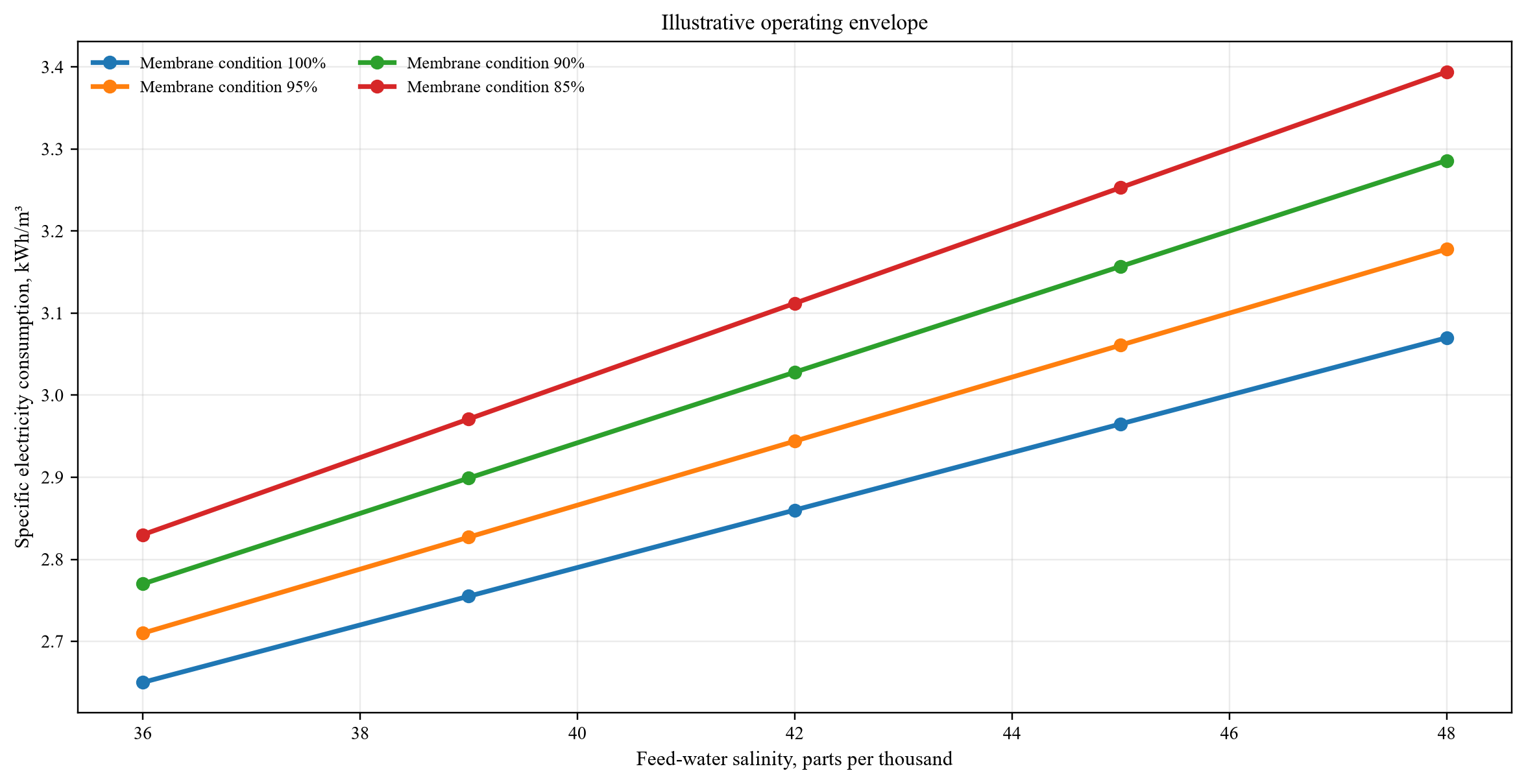
Management assumptions only. The model illustrates sensitivity and does not represent an actual plant or vendor guarantee.
The financing model should translate the operating envelope into monthly electricity volume, cost and payment. It should identify a warning level, a performance-deduction level and a covenant level. The operator can use the same hierarchy to plan cleaning, membrane replacement, pressure optimisation and load allocation.
5. Separate electricity volume from electricity price
Electricity cost equals metered consumption multiplied by the applicable price, with adjustments for demand charges, losses, power factor, network fees, taxes and contractual credits. Volume risk and price risk belong in separate schedules. An optimisation model may reduce consumption while the cash cost still rises because the tariff changes. A favourable power price can also conceal poor plant efficiency.
The electricity arrangement may be a direct grid supply, an allocation from the offtaker, a dedicated generation contract, renewable supply, or a combination. The agreement should define delivery point, capacity, reliability, voltage and frequency, outage treatment, curtailment, metering, price, indexation, change in law and force majeure. The World Bank risk matrix observes that desalination projects often leave power provision and price risk with the contracting authority, although structures vary [1].
The debt case should use the executed electricity terms. A bidder should not assume unlimited low-cost power when the grid connection, tariff class or renewable allocation remains conditional. The model should show the consequence of an outage, a price step and a mismatch between water dispatch and contracted power. It should also show whether the project company receives relief from performance deductions when the offtaker or grid causes the constraint.
6. Define dispatch before pricing the tariff
An independent water project can receive a fixed capacity payment, a variable production payment, or a combined tariff. Dispatch determines how much water the offtaker requests and how efficiently the plant can operate. A plant held at low load may carry fixed labour, maintenance and financing cost while losing the efficiency assumed at design conditions. Frequent starts and stops can also affect membranes, chemicals and equipment life.
The water-purchase agreement should state minimum offtake, nomination timing, ramp rates, planned outages, emergency dispatch, excess production, deemed availability and payment when the plant is ready but not dispatched. Capacity and variable charges should match those obligations. The World Bank payment-mechanism guidance recommends explicit tariff formulae and clear treatment of inflation and other economic variables [8].
Before financial close, the parties should run hourly or daily dispatch cases for representative seasons. The output should include water volume, plant loading, specific electricity consumption, chemical use, maintenance exposure and invoice. The finance model can then aggregate verified operating cases into monthly cash flow. This prevents an annual average from hiding uneconomic operating periods.
7. Build the tariff from auditable components
The tariff should separate components that repay capital and fixed operating cost from components that compensate variable cost. A typical model may include capacity, fixed operations, variable electricity, chemicals, membrane use, delivery pumping, indexation and deductions. Each component needs a formula, source index, measurement boundary, settlement period and dispute process.
Pass-through design should allocate controllable and uncontrollable cost. Full electricity pass-through protects debt but weakens the operator's incentive to improve efficiency. A fixed energy allowance creates an efficiency incentive but can expose the project to conditions it does not control. A practical structure can use an indexed electricity price, a contract energy curve and a sharing mechanism for verified outperformance. The operator then bears excess consumption caused by controllable performance while the offtaker bears an approved market price change.
The tariff model should produce the same invoice from the same data in the project company, offtaker and verifier systems. Rounding, time zones, meter substitutions, rejected data, revised indices and taxes should be defined. The World Bank's water PPP resources identify tariff stability and revenue adequacy as central to sustainable investment [2,9].
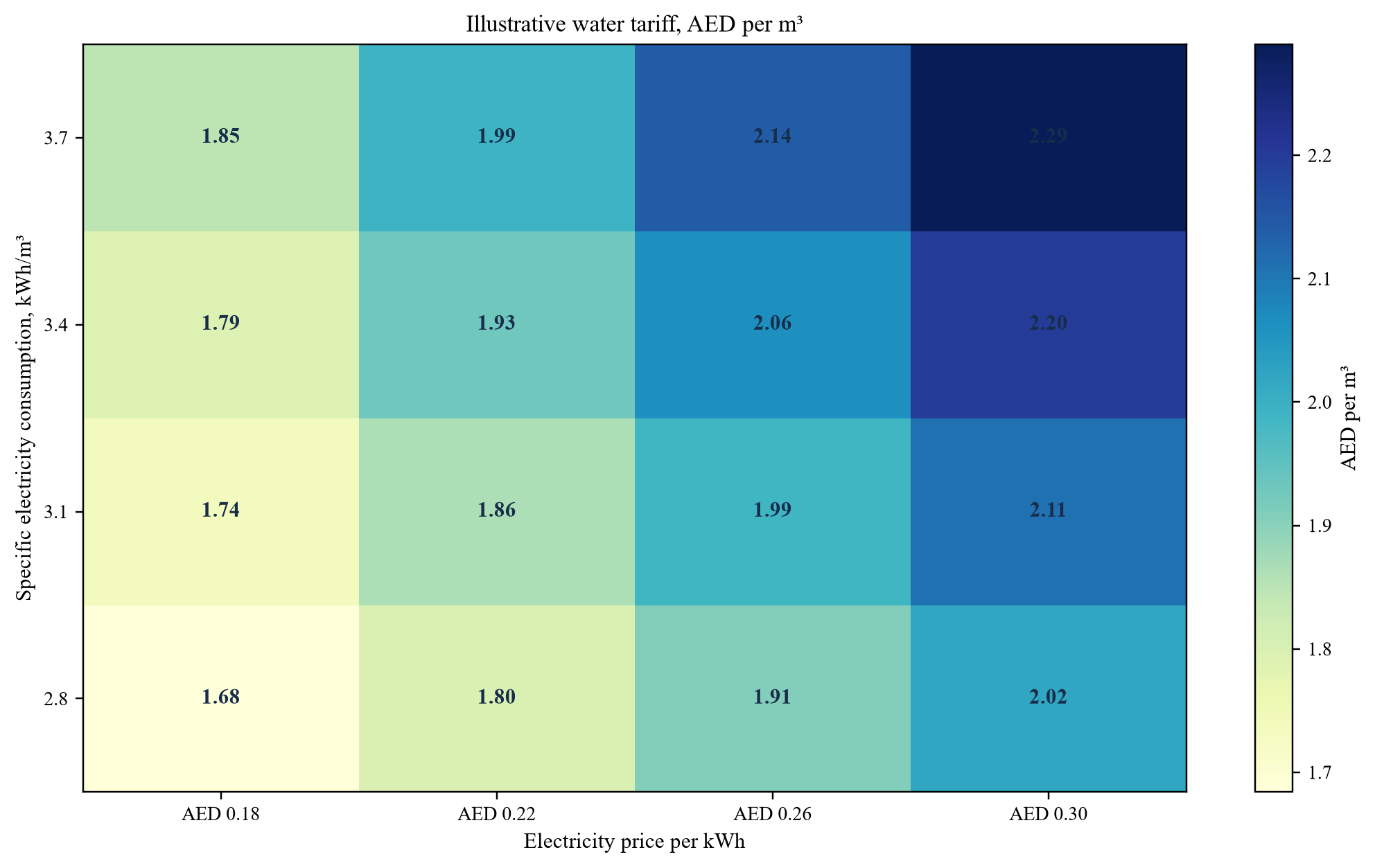
All values are hypothetical management assumptions and exclude project-specific taxes, deductions and indexation.
8. Treat membrane performance as a financing variable
Membranes influence pressure, salt rejection, recovery, product quality and cleaning frequency. The model should distinguish reversible fouling, irreversible deterioration, physical damage and expected age-related decline. A single annual replacement allowance can understate a clustered failure or supply-chain event.
The operator should maintain a train-level membrane register with manufacturer, element type, installation date, cleanings, normalised permeability, salt passage, differential pressure and replacement history. Performance should be normalised for temperature and feed conditions before drawing conclusions. The maintenance plan should define clean-in-place thresholds, inspection, integrity testing, rotation and disposal.
Financing should cover baseline replacements, an adverse cohort, supplier delay and technology obsolescence. The lifecycle reserve can be funded by time, operating hours or verified condition. Draws should require evidence and preserve minimum liquidity. Lenders should also test warranties, spare elements, approved suppliers and rights to technical data. Specialist supplier reliance is a recognised desalination risk [1].
9. Use AI within an engineering control system
AI can forecast energy use, detect sensor anomalies, predict fouling, estimate remaining useful life, optimise pressure and schedule maintenance. Each application requires a specific target, decision owner and acceptance test. A model trained to predict energy consumption should not be reused to certify membrane condition without separate validation.
The IEA reports that energy companies use AI to optimise systems, improve uptime, reduce cost and support safety, while noting that benefits beyond individual cases can be difficult to quantify [10,11]. A financing case should therefore use verified plant tests and conservative assumptions. Vendor claims, simulated savings and pilot results belong outside lender base-case cash flow until the project can reproduce them in the contractual environment.
Model governance should cover training data, feature definitions, performance metrics, drift, cyber controls, versioning, human override and retirement. The operator remains accountable for dispatch and maintenance. The verifier remains accountable for certification. The offtaker remains accountable for payment. The AI system supplies evidence and recommendations within those roles.
10. Create a governed plant digital twin
A plant digital twin should represent the physical and commercial system at a defined level of detail. It can connect the intake, pretreatment, high-pressure pumps, reverse-osmosis trains, energy-recovery devices, post-treatment, delivery system, electricity meters, laboratory results and work orders. Its value depends on controlled tags, timestamps, units and configuration.
The twin should have an authoritative source for each object and parameter. A changed membrane element, calibrated meter or modified pump curve requires an approved update. Historical versions should remain available for invoice and performance review. The system should preserve the raw record, transformation logic, model version, user action and approval.
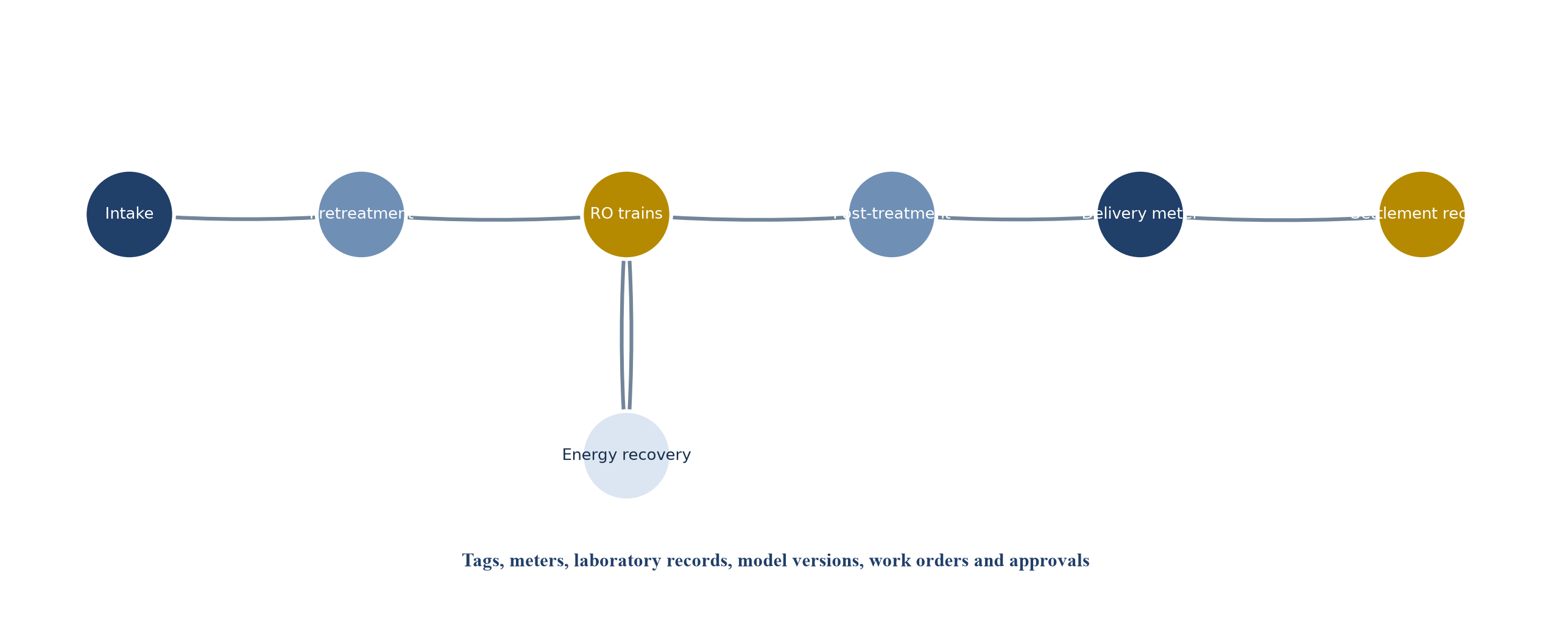
Original framework. The twin supports decisions and verification; authorised people remain responsible for operations and payment.
11. Preserve meter and laboratory evidence
Payment should rely on meters and laboratory tests operating under an accepted quality regime. The contract should identify revenue meters, electricity meters, flow meters, pressure instruments, conductivity, temperature, turbidity and product-quality measurements. It should define accuracy, calibration, redundancy, timestamp alignment and substitution when a device fails.
The monthly evidence pack should include raw readings, validated readings, quality flags, calibration status, data gaps, approved substitutions, dispatch, availability, water quality, electricity use, chemical use and relevant work orders. The independent verifier should be able to recalculate the invoice without depending on an undocumented spreadsheet.
SWPC has procured external water-quality analysis across independent water and sewage-treatment plants, illustrating the importance of independent testing in the operating portfolio [12]. Abu Dhabi's technical reporting also records plant reliability and water-quality performance [13]. The project contract should convert the relevant project-specific tests into clear payment and cure rules.
12. Design deductions around controllable performance
Deductions should apply to measurable failures within the project company's control. Examples include unavailable contracted capacity, water-quality non-compliance, excessive energy use against the accepted curve, late reporting and failure to fund lifecycle work. The mechanism should distinguish an isolated event from persistent deterioration.
Relief should address offtaker-caused dispatch constraints, grid failure, approved force majeure, abnormal feed-water conditions outside the accepted envelope and authority-directed changes. Each relief event should have notice, evidence, mitigation and time limits. A broad relief clause can remove operating incentives. A narrow clause can make the project unfinanceable.
Deduction caps, payment floors and termination thresholds should be modelled together. A payment floor may preserve debt service while accumulating a liability or extending the contract. The authority should understand that fiscal consequence. Lenders should understand the path from warning to cure, cash lock-up, step-in and termination compensation.
13. Allocate price risk with an indexation matrix
The tariff can contain local inflation, foreign inflation, exchange rate, electricity, chemicals, labour and membrane components. Each index should match the cost it is intended to protect. A broad consumer-price index may poorly represent a specialist imported input. A foreign index can create mismatch when procurement currency or supplier terms change.
The indexation matrix should show base date, source, frequency, lag, floor, cap, rebasing and missing-index treatment. It should identify which components are fixed in nominal terms and which reset. The finance model should reproduce the formula for every debt-service period. It should also test delayed publication and discontinuation of an index.
Foreign-exchange risk requires separate analysis. The tariff may protect imported cost while debt remains local currency, or protect debt while leaving lifecycle inputs exposed. Hedging can manage a defined exposure but cannot repair an unclear contractual formula. The project should close only after the commercial model, financing model and contract use the same currency and index definitions.
14. Apply a hypothetical integrated case
Assume a project company develops a 550,000-cubic-metre-per-day seawater reverse-osmosis plant under a long-term water-purchase agreement. The accepted operating envelope covers feed-water salinity, temperature, turbidity and biological conditions. The tariff includes a fixed capacity component, variable production component, indexed electricity price and a contract energy curve. This case is a management scenario and does not represent a disclosed GCC project.
Total initial uses are AED 3.60 billion. The model assigns AED 2.65 billion to EPC and commissioning, AED 210 million to electricity and water interconnection, AED 180 million to development and owner costs, AED 250 million to financing and transaction costs, AED 130 million to initial reserves and AED 180 million to contingency. Sources comprise AED 900 million of sponsor equity, AED 2.34 billion of senior debt, an AED 180 million reserve facility and AED 180 million of sponsor contingency support.
| Uses | AED million | Sources | AED million |
|---|---|---|---|
| EPC and commissioning | 2,650 | Sponsor equity | 900 |
| Interconnection | 210 | Senior debt | 2,340 |
| Development and owner costs | 180 | Reserve facility | 180 |
| Financing and transaction costs | 250 | Sponsor contingency support | 180 |
| Initial reserves | 130 | Total sources | 3,600 |
| Contingency | 180 | ||
| Total uses | 3,600 |
AED millions. All values are management assumptions and do not describe an observed project, approved budget or financing commitment.
Central annual revenue is AED 550 million. The model assumes AED 150 million of electricity cost, AED 95 million of other operating cost, AED 30 million of lifecycle funding and AED 25 million of tax and other adjustments. Cash available for debt service is AED 250 million. Annual debt service is AED 175 million, producing coverage of 1.43 times.
15. Size debt to protected cash flow
Debt should be sized to cash that can be invoiced, certified and collected under the executed contracts. The base case should use contracted dispatch and energy rules, operating costs, lifecycle reserves, taxes, working capital and deductions. It should not include unverified AI savings, refinancing gains or uncontracted merchant value.
Drawdown conditions should connect capital to completion evidence. The lender may require executed project agreements, permits, land and marine rights, EPC security, insurance, hedging, grid connection, reserve funding and an accepted base-case model. Later draws can depend on verified progress, independent engineer certificates and remaining-cost-to-complete tests.
The security package may include project accounts, receivables, contract rights, insurance, shares, reserve accounts and direct agreements. Step-in rights should align with the water-purchase agreement, electricity arrangement, EPC contract and operating contract. A lender needs enough time and information to cure a material failure without compromising public service.
16. Test correlated downside before close
Single-variable sensitivities can understate the risk because adverse conditions can coincide. High salinity, membrane deterioration and low plant loading can increase energy intensity at the same time that the electricity price rises. A feed-water event can reduce production while increasing pretreatment and chemical cost. A delayed tariff index can create temporary working-capital pressure.
The hypothetical correlated downside assumes annual revenue of AED 515 million, electricity cost of AED 185 million, other operating cost of AED 105 million, lifecycle funding of AED 38 million and tax and other adjustments of AED 16 million. Cash available for debt service falls to AED 171 million, equal to 0.98 times AED 175 million of debt service. Approved remedies restore revenue to AED 525 million and reduce electricity and operating cost through verified dispatch changes, maintenance and temporary reserve support. Cash available for debt service reaches AED 210 million, equal to 1.20 times debt service.
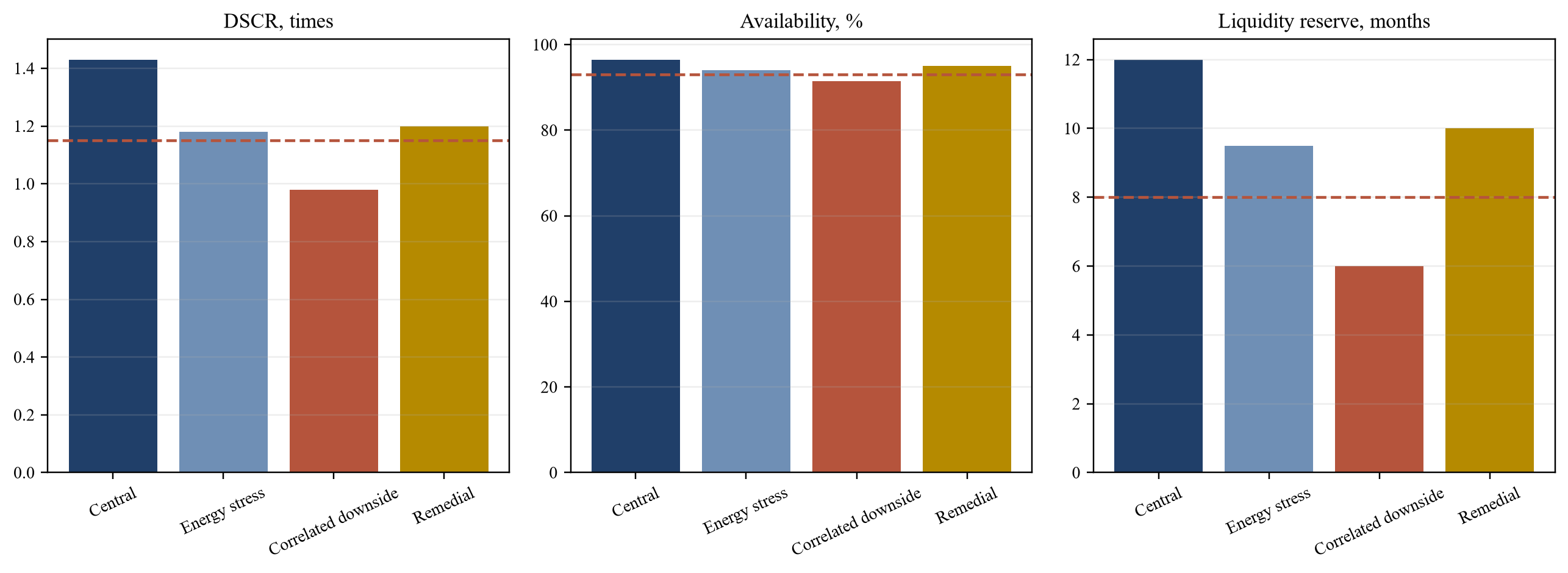
Ratios and thresholds are management assumptions. The dashboard is not a credit opinion or financing forecast.
17. Build remedies that remain executable
A downside response should identify action, owner, evidence, timing, cash effect and approval. Operating remedies can include train reallocation, cleaning, membrane replacement, energy-recovery maintenance, intake management and revised production sequencing. Contractual remedies can include relief, index catch-up, reserve draw, equity cure and temporary distribution lock-up.
The model should avoid savings that require an unapproved change to water quality, environmental limits or dispatch. It should also avoid double counting. A membrane replacement may reduce energy use and increase availability, while requiring cash and downtime. The model should show each effect in the correct period.
The finance documents should set warning, lock-up and default thresholds. A warning can trigger enhanced reporting and a remedial plan. A lock-up can retain cash. A default can activate lender rights after agreed cure periods. These thresholds should align with the project agreement so that a contractual cure remains available before finance enforcement prevents performance.
| Item | Central | Correlated downside | Remedial |
|---|---|---|---|
| Revenue | 550 | 515 | 525 |
| Electricity cost | (150) | (185) | (165) |
| Other operating cost | (95) | (105) | (92) |
| Lifecycle funding | (30) | (38) | (32) |
| Tax and other adjustments | (25) | (16) | (26) |
| Cash available for debt service | 250 | 171 | 210 |
| Debt service | (175) | (175) | (175) |
| Debt-service coverage | 1.43x | 0.98x | 1.20x |
AED millions except ratios. All values are hypothetical management assumptions.
18. Protect lifecycle performance
The lifecycle plan should cover intake structures, pretreatment, pumps, membranes, energy-recovery devices, pressure vessels, post-treatment, electrical systems, controls, laboratory equipment and delivery assets. It should distinguish routine maintenance, major overhaul, replacement and obsolescence.
The reserve should reflect timing and clustering rather than a smooth annual percentage. A shared cohort of membranes or pumps can create a concentrated cash need. Long-lead equipment can require deposits before delivery. Currency and freight can change replacement cost. The plan should maintain a current asset register, condition record, work history and approved forecast.
Distribution tests should require current lifecycle funding, minimum debt coverage, no unresolved material default and an up-to-date operating model. The operator should report deferred work, temporary repairs and parts cannibalisation. Lenders and the offtaker need visibility before asset condition becomes a service failure.
19. Govern cybersecurity and operational technology
Desalination relies on operational technology controlling pumps, valves, chemical dosing, pressure and treatment. The digital architecture should separate safety-critical control from analytics, enterprise systems and external vendor access. Network segmentation, identity, privileged access, logging, backup, recovery and incident response should cover both operations and payment evidence.
An AI or digital-twin platform may require high-frequency sensor data and remote support. The contract should define approved connections, data ownership, retention, model access and exit assistance. A vendor should not be able to disable essential operations or withhold the evidence needed to calculate payment.
NIST's AI Risk Management Framework and AI profile support governance, measurement and management of AI risk [14,15]. Saudi data and AI authorities publish ethical principles and data-protection requirements relevant to projects operating in the Kingdom [16,17]. Project counsel and security owners should determine the rules that apply to the actual data and systems.
20. Establish independent verification
The independent verifier should test output, availability, water quality, energy consumption, indexation, deductions and relief. Independence requires appointment, access, competence, conflict controls, tenure, payment arrangements and replacement procedures that prevent either contracting party from directing the conclusion.
The verifier should reproduce the monthly invoice from controlled records and identify disputed inputs. A technical disagreement may require a membrane, laboratory or metering expert. A contractual disagreement may require a different determination route. The contract should preserve service and undisputed payment while the defined process operates.
Lenders should receive the verified invoice, material exceptions, operating report and covenant certificate within a fixed timetable. Persistent exceptions should trigger additional assurance and a plan to restore data quality. This turns verification into a continuing bankability control.
21. Assess value for money and fiscal exposure
The authority should compare the PPP with realistic public delivery and procurement alternatives. Quantified analysis may cover capital, operating cost, financing, tax, risk transfer, timing and service performance. Qualitative analysis may cover capability, innovation, competition, flexibility, workforce and accountability.
The fiscal model should include capacity payments, production payments, electricity support, guarantees, termination compensation, change in law, relief events, indexation and contingent facilities. A low bid tariff can create high fiscal exposure when the authority retains power-price risk or guarantees minimum dispatch. The World Bank's recent MENA desalination analysis warns that tariff gaps and extensive guarantees can create contingent liabilities if sector governance and pricing remain weak [18].
The authority should disclose the assumptions and limits of the comparison. A single net-present-value result cannot explain whether the project remains affordable under correlated water, energy and fiscal stress. The approval record should show both central and downside exposure.
22. Procure an evidence system as well as a plant
Prequalification should test desalination delivery, financing, operations, marine works, grid integration, digital systems, cybersecurity, contract management and lender experience. A consortium should identify material subcontractors and explain how warranties, data and intellectual property remain available to the project company.
The request for proposals should provide an accepted design basis, dispatch cases, energy arrangements, tariff formula, model protocol, performance regime and data-room index. Bid evaluation should separate compliance, risk qualifications, total fiscal cost, tariff resilience, technical performance and financing deliverability. A nominal tariff comparison is incomplete when bidders use different dispatch, energy or index assumptions.
Bid clarifications should be logged and applied consistently. Known gaps should remain visible rather than being converted into a bidder assumption without authority review. Financial close should update the public business case with the winning bid, executed financing, final guarantees and contingent exposure.
23. Manage change through controlled evidence
Water demand, grid structure, environmental rules, treatment standards and technology can change during a long concession. The contract should define change notice, baseline, cost and schedule evidence, mitigation, valuation, approval, financing and implementation.
An AI model update is also a controlled change when it affects dispatch, maintenance, energy guarantees or payment. The operator should run the new version in parallel, compare outcomes, document errors and obtain approval before contractual use. Historical models and results should remain reproducible for disputes and audit.
The change register should link technical documents, financial model, risk allocation and payment mechanics. Several small changes can alter the project more than one major amendment. Periodic review should test whether risk allocation, reserve funding and service standards remain coherent.
24. Sequence the first 180 days
The first thirty days should confirm the decision perimeter, data room, design basis, dispatch requirement, electricity arrangement, tariff objectives, verifier role and approval map. The authority should identify each critical gap and the decision it prevents.
Days thirty to ninety should complete site and marine evidence, operating-envelope analysis, reference design, dispatch cases, energy model, tariff model and initial project-finance case. Technical and financial teams should reconcile the same assumptions. Model development should define purpose, data rights, validation and fallback before promising optimisation benefits.
Days ninety to one hundred and twenty should test risk allocation, bankability, fiscal exposure, procurement structure, financing appetite and market capacity. The authority should share a structured issues list through market sounding without transferring its decision responsibility to bidders.
Days one hundred and twenty to one hundred and eighty should finalise the business case, procurement documents, evaluation model, draft contracts, monitoring plan and decision memorandum. Release should occur only when the design, energy, tariff, data and financing structure is sufficiently defined for comparable bids.
| Gate | Required output | Decision owner | Stop or redesign trigger |
|---|---|---|---|
| Service | Capacity, quality, dispatch and delivery schedule | Contracting authority | Output obligation cannot be measured |
| Design | Accepted operating envelope and reference configuration | Technical authority | Material performance assumption remains unsupported |
| Electricity | Supply, price, reliability and relief package | Energy and contract owners | Power risk is unallocated or unavailable |
| Tariff | Tested capacity, production, indexation and deduction model | Finance and contract owners | Invoice cannot be reproduced under downside |
| Data and AI | Architecture, rights, validation, cyber and fallback | Data and security owners | Payment depends on uncontrolled model output |
| Capital | Costed EPC, owner costs, reserves and lifecycle plan | Programme sponsor | Uses lack contingency or committed funding |
| Debt | Lender-tested cash flow, security and direct agreements | Project finance owner | Credible downside lacks liquidity or cure |
| Fiscal | Direct and contingent exposure with approvals | Public finance authority | Obligations exceed approved capacity |
| Procurement | Qualification, evaluation and data-room readiness | Procurement authority | Bids cannot be compared on one basis |
The memorandum records evidence, conditions and accountable decisions; it does not replace statutory approvals.
25. Use one approval record through financial close
The final memorandum should state the water-security decision, plant scope, design basis, dispatch, electricity arrangement, tariff, risk allocation, fiscal exposure, data and AI controls, procurement strategy, financing, open conditions and decision rights. It should include one controlled model and links to the evidence used. Every open item needs an owner, deadline, required proof and consequence.
The record should continue through procurement. Bid assumptions and committed finance should replace the reference case. Before signature, the authority should repeat affordability and value-for-money analysis using the selected bid. Lenders should test the final payment mechanism, direct agreements, reserve package and downside. The verifier protocol should operate on the systems and data actually proposed.
Financial close should establish the opening configuration and data set. The authority, project company, operator, verifier and lenders should identify each meter, model, index, tariff input, approved estimation method and responsible owner. A later change needs an effective date, approval trail and quantified consequence. This preserves the distinction between physical improvement, measurement change and commercial adjustment.
AI-supported optimisation can strengthen a desalination project when it improves engineering decisions and produces auditable evidence. Bankability depends on the entire control system: defined service, accepted operating envelope, executable energy supply, transparent tariff, sufficient capital, resilient cash flow, funded lifecycle work and accountable decisions. Approval should follow only when those elements operate together under central and downside conditions.
26. Maintain post-close assurance
Financial close should begin a controlled transition from bid evidence to construction and operating evidence. The project company should maintain a requirements register that links every output obligation, design commitment, financing condition and permit to an accountable owner and acceptance record. A change in equipment, membrane supplier, plant configuration, electricity arrangement or control architecture should be assessed against the tariff, completion tests, warranties and financing assumptions before approval. The independent engineer and lenders need timely visibility when a proposed substitution changes energy use, availability, lifecycle cost or data access.
Construction reporting should connect physical progress, committed cost, forecast cost to complete, contingency use and schedule. A percentage-complete report has limited value when critical marine works, grid connection, long-lead pumps or control systems remain exposed. The project should track each critical path with the evidence required for completion. Drawdown should stop when remaining committed funding and contingency no longer cover the verified cost to complete. Sponsor support, contractor security and insurance should remain available for the risks they are intended to cover.
Commissioning should test the whole commercial system. Performance tests need accepted feed-water conditions, calibrated meters, stable electricity, product-water quality and sufficient duration. The test protocol should state correction curves, retest rights, delay consequences and treatment of conditions outside the accepted envelope. The authority, project company, engineer, operator and lenders should agree the final result and unresolved exceptions. The tariff and debt model should then replace design assumptions with accepted test evidence.
The operating handover should include the asset register, configuration, model versions, maintenance plan, spares, warranties, cyber baseline, laboratory protocols and training. The operator should demonstrate that it can reproduce energy intensity, availability, water quality and the invoice from controlled records. A temporary manual process can support early operation when its owner, approval and end date are explicit. An undocumented workaround should not become a permanent source of payment evidence.
Monthly assurance should reconcile dispatch, produced and delivered water, electricity consumption, energy intensity, availability, quality, deductions, indexation, invoice, cash collection, operating cost, lifecycle reserve and debt service. The report should explain movement against the approved case and identify the physical or contractual cause. Model output should appear alongside the observed result and confidence limits. Material disagreement between prediction and operation should trigger investigation before the model informs a consequential decision.
Quarterly governance should review model drift, sensor performance, false alerts, overridden recommendations, cyber events, deferred maintenance, tariff exposure and covenant headroom. Named technical, commercial and finance owners should approve actions. The board should receive an integrated view of service, asset condition, liquidity and fiscal exposure. This preserves the connection between optimisation and the contractual cash flow that supports debt.
Annual assurance should refresh the operating envelope, lifecycle plan, downside cases and refinancing outlook. It should test whether the electricity arrangement, tariff indices, membrane strategy and reserve remain fit for the remaining concession. A refinancing or distribution decision should use current verified performance and retain enough liquidity for adverse operating conditions. Independent review may be appropriate after a material model change, repeated performance failure, major cyber incident or proposed contract amendment.
The project should also prepare for expiry and handback from the beginning. Data rights, software access, model documentation, spare parts, staff capability and asset condition all affect continuity. The contract should define handback standards, inspections, reserve funding and remediation. A plant that depends on an inaccessible model or unsupported vendor platform can meet today's tests while creating a later public-service risk. Bankability therefore includes an executable path for the authority or successor operator to continue service at the end of the private term.
Sources
- World Bank PPP Resource Center, PPP Risk Allocation Tool 2019 Edition: Water Desalination. Read the primary source
- World Bank PPP Resource Center, Water and Sanitation PPPs. Read the primary source
- Saudi Water Partnership Company, Seven-Year Statement 2024-2030. Read the primary source
- Dubai Electricity and Water Authority, Hassyan Seawater Reverse-Osmosis Project. Read the primary source
- Saudi Water Partnership Company, Shuaibah 3 Independent Water Project. Read the primary source
- Dubai Electricity and Water Authority, Jebel Ali Seawater Reverse-Osmosis Plant. Read the primary source
- World Bank, Barriers to Desalination Created by Retail Tariff Setting Mechanisms and Economic Regulation. Read the primary source
- World Bank PPP Resource Center, Payment Mechanism. Read the primary source
- World Bank PPP Resource Center, Tariff Setting and Funding Constraints. Read the primary source
- International Energy Agency, Energy and AI. Read the primary source
- International Energy Agency, AI for Energy Optimisation and Innovation. Read the primary source
- Saudi Water Partnership Company, Water and Treated Sewage Effluent Quality External Analysis. Read the primary source
- Abu Dhabi Department of Energy, 2023 Technical Report. Read the primary source
- National Institute of Standards and Technology, Artificial Intelligence Risk Management Framework 1.0. Read the primary source
- National Institute of Standards and Technology, Artificial Intelligence Risk Management Framework Generative Artificial Intelligence Profile. Read the primary source
- Saudi Data and AI Authority, AI Ethics Principles. Read the primary source
- Saudi Data and AI Authority, Personal Data Protection Law. Read the primary source
- World Bank, Fresh Perspectives: Emerging Issues and Opportunities for Desalination in the Middle East and North Africa. Read the primary source
- Dubai Electricity and Water Authority, Integrated Report 2024. Read the primary source
- Dubai Electricity and Water Authority, Hassyan Financial Close. Read the primary source
- Abu Dhabi Department of Energy, Net Zero Strategic Initiative. Read the primary source
- World Bank, Dealing with Water Scarcity through Desalination, Non-Revenue Water Reduction and PPPs. Read the primary source
- World Bank PPP Resource Center, Desalination Plant for Victoria. Read the primary source
- World Bank PPP Resource Center, Desalination Plant, Ensenada, Mexico. Read the primary source
- International Organization for Standardization, ISO 24591-1:2024 Smart Water Management Data Management Guidelines. Read the primary source
- International Organization for Standardization, ISO 24591-2:2024 Smart Water Management Data Management Guidelines. Read the primary source
