

1. Define the bankability decision
The decision is whether a defined water-distribution service can support a long-term public-private partnership whose obligations, payment mechanics and financing remain workable under credible downside conditions. The authority should identify the service perimeter, customers, assets, starting condition, public objectives and delivery alternatives before choosing a PPP structure. A digital tool cannot compensate for an uncertain asset register, an incomplete water balance or rights that do not allow the private party to operate the network.
The business case should separate four questions. First, does the programme deliver a justified public service and resource benefit? Second, can the proposed operator control enough of the result to accept performance risk? Third, can the payment mechanism support operating cost, lifecycle capital, debt service and an appropriate return without creating uncontrolled fiscal exposure? Fourth, can the authority procure, monitor and enforce the contract through its life? The World Bank PPP Reference Guide treats feasibility, commercial viability, value for money, fiscal implications and management capability as distinct appraisal questions [1]. Saudi Arabia's National Center for Privatization and PPP also requires project scope, risk allocation, payment mechanics and monitoring to be developed through the business case [2-4].
The decision record should permit four outcomes: proceed to procurement, proceed after specified conditions, redesign and retest, or use another delivery model. A performance-based operations contract may suit a programme whose assets and baseline remain uncertain. A capital-intensive PPP may suit a well-defined network where rehabilitation, operations and long-term performance can be integrated. The public need can remain valid even when the proposed financing route is not ready.
| Decision area | Evidence required | Bankability question | Release condition |
|---|---|---|---|
| Service perimeter | Asset register, hydraulic zones, customer base, interfaces and responsibilities | Can obligations be measured within a controlled boundary? | Signed perimeter and interface schedule |
| Starting condition | Water balance, meter confidence, pressure history, bursts and work orders | Is the baseline reproducible and independently testable? | Accepted baseline protocol and correction process |
| Delivery model | Options appraisal, value for money, market sounding and capability assessment | Does long-term risk transfer improve service and whole-life cost? | Approved business case and procurement route |
| Payment | Availability rules, outcome metrics, deductions, indexation and dispute process | Can invoices be certified from governed evidence? | Tested payment model and verifier protocol |
| Capital | Rehabilitation plan, lifecycle reserve, contingency and funding commitments | Is the programme funded through completion and downside? | Sources, uses, draw conditions and reserve documents |
| Data and AI | Architecture, lineage, validation, cyber controls and decision rights | Can analytics support action without becoming an unauditable payment oracle? | Approved model governance and human accountability |
| Debt | Cash flow, security, step-in, covenants and termination compensation | Does resilient cash cover debt through plausible failure paths? | Lender-tested downside and executable remedies |
Proposed framework. Every live decision requires project-specific technical, legal, financial, environmental, data and procurement review.
2. Place leakage reduction within Saudi water policy
Saudi Arabia's National Water Strategy 2030 identifies water security, demand management, cost-effective service, resource protection, effective governance, private participation and innovation as connected objectives [5]. The strategy also recognises the cost of desalination and transmission in an arid environment. A distribution programme should therefore value water saved through the full supply chain rather than treating a repaired leak as a local maintenance event.
The Ministry of Environment, Water and Agriculture reported in 2026 that daily distribution was 11.4 million cubic metres, supported by 12.8 million cubic metres per day of production capacity, with 127,500 kilometres of distribution network [6]. These published system indicators describe national scale. They do not establish the condition, loss rate or investment requirement of a proposed contract area. A procurement should use current, controlled project data and reconcile it to the responsible entities' records.
Saudi Water Partnership Company has developed a broad PPP portfolio across production, treatment, transmission and storage [7-9]. Distribution leakage introduces a different interface. The operator may inherit an operating network, mixed meter quality, historic repairs, changing customer demand and assets installed over many years. The authority must decide whether the contract covers design-build-finance-operate obligations, rehabilitation plus operations, or a performance-based service with limited private capital. The chosen form should follow the evidence and risk that can be transferred.
3. Establish a reproducible water balance
Non-revenue water is the difference between system input volume and billed authorised consumption. It contains physical losses, commercial losses and authorised consumption that is not billed. Those components require different responses. Pipe repair does not correct a customer-master error. Meter replacement does not resolve an unrecorded operational use. A single percentage can therefore conceal the work, cost and party responsible for improvement.
The baseline should follow a documented water-balance method and state the period, boundary, meter population, meter accuracy, data completeness, estimation rules and reconciliation process. ISO 24528 provides a methodology for water-loss investigation and a water-loss management plan [10]. The World Bank's performance-based contracting resources also begin with a water balance and provide tools for component analysis, financial assessment, trends and district-metered-area rollout [11-13].
The baseline should be versioned. Later corrections may be necessary when a bulk meter is recalibrated, customer records are cleaned or an illegal connection is discovered. The contract should define which correction changes the historical baseline, which affects only the current period and how the economic result is shared. The independent verifier should reproduce the calculation from raw source records, transformation rules and accepted exclusions. Bankability depends on a metric that the parties can audit and dispute without interrupting service.
4. Build district metered areas as evidence units
A district metered area, or DMA, creates a controlled hydraulic zone with measured inflow and a defined customer population. It can support minimum-night-flow analysis, pressure management, leak investigation and verification of repair outcomes. A DMA becomes useful only when its boundaries are closed or understood, meters operate within tolerance, timestamps align and field changes are recorded.
The programme should rank DMAs by evidence quality before ranking them by apparent loss. A zone with high calculated loss and weak boundary control may require instrumentation before excavation. A zone with a stable minimum-night-flow increase after a pressure event may justify immediate investigation. The operator should record isolation-valve status, bulk-meter condition, pressure logger coverage, customer-meter completeness, material, age, soil, burst history and critical customers.
The contract can assign a readiness state to each DMA: uninstrumented, instrumented but unstable, baseline accepted, intervention active, or outcome verified. Capital release should follow those states. This limits the risk of spending heavily in zones where the programme cannot prove starting condition or result. It also permits lenders to connect drawdown to accepted work packages rather than a single national loss target.
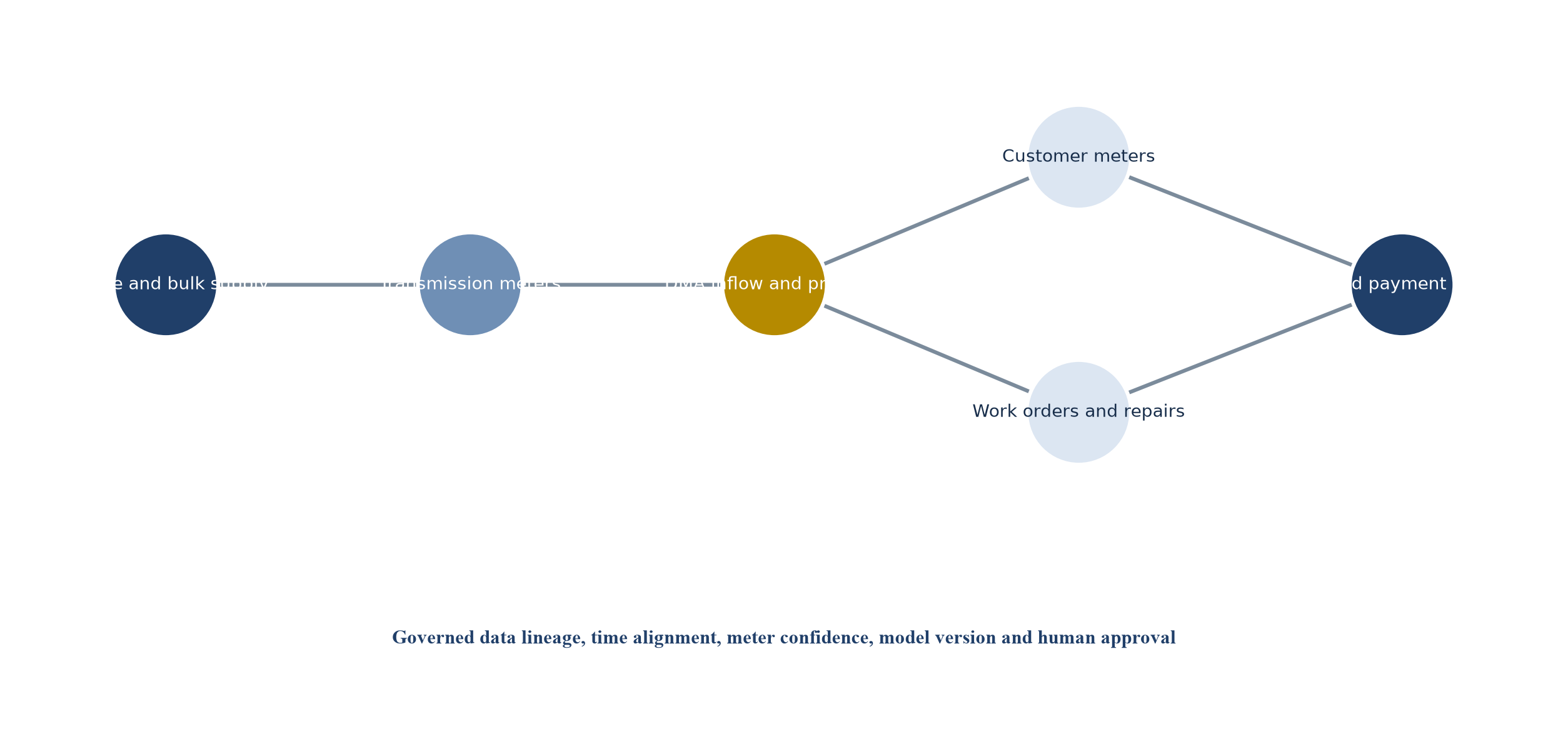
Original framework. The digital representation supports operations and verification; it does not replace field evidence or authorised decisions.
5. Treat predictive analytics as a prioritisation control
Predictive leakage analytics can combine flow, pressure, acoustics, consumption, asset age, material, soil, repair history and weather to identify unusual patterns. The output can rank inspections, suggest likely failure locations or estimate the probability of a burst. It remains a decision-support signal. Excavation, pressure changes and maintenance deferral require accountable operating decisions informed by safety, service and field evidence.
The model should have a defined objective and target variable. A classifier trained on historic bursts differs from an anomaly detector trained on expected night flow. A model that performs well in one network may fail in another because pipe materials, pressure regimes, repair practices or sensor coverage differ. Validation should therefore include out-of-sample testing, geographic testing, seasonal testing and comparison with a simple operational baseline. Precision matters when false positives consume field crews. Recall matters when missed leaks create service or asset consequences.
The project should record the model version, input lineage, training period, known limitations, validation result, deployment date, alert threshold, override, decision owner and field outcome. Saudi Data and AI Authority principles emphasise fairness, privacy, security, transparency and accountability [14-16]. NIST's AI Risk Management Framework provides a complementary approach to governing, mapping, measuring and managing AI risk [17]. These sources guide control design; they do not certify a particular water model.
6. Separate observed data from model estimates
The payment record should classify each material value. Observed data comes directly from an accepted meter or operational system. Corrected data applies an approved adjustment to an observed value. Estimated data fills a gap under a contractually defined method. Model output is a prediction or anomaly score. Certified data is accepted by the independent verifier for the relevant payment period.
The categories should never be merged silently. A predictive estimate of leak probability cannot be treated as measured water saved. A repaired pipe does not establish the annual volume reduction unless the baseline, operating conditions and post-repair measurement support that conclusion. A drop in minimum night flow can indicate improvement while also reflecting lower pressure, a boundary change or unusual demand.
The data-quality schedule should define completeness, latency, calibration, clock alignment, outage handling, substitution and challenge thresholds. It should also state which defects reduce payment, which trigger a cure plan and which make the relevant metric unavailable. The operator needs enough discretion to manage an operating network. The authority and lenders need protection from data changes that alter payment or debt capacity without an auditable reason.
7. Allocate obligations according to control
The private party can accept responsibility for activities it controls: installing and maintaining specified sensors, operating pressure within an approved band, responding to alerts, completing investigations, repairing assets, maintaining records and meeting defined service standards. It may be able to accept a measured leakage-reduction obligation when the baseline, boundary and demand drivers are sufficiently controlled.
The authority or public utility should retain risks arising from undisclosed asset condition, inaccurate inherited records, compulsory access powers, public-policy changes, bulk-supply interruption outside the project, tariff decisions outside the operator's control and customer data that it does not permit the operator to correct. Shared risks may include exceptional demand changes, third-party damage, rapid urban expansion, drought measures and agreed changes in network configuration.
Each risk requires a response in the contract: a price allowance, performance obligation, relief event, compensation event, insurance requirement, contingency, shared band or termination rule. Broad wording that the parties will cooperate does not establish who funds the event. The Saudi PSP implementing regulations require identification of key project risks, an allocation basis and mitigation strategies [3]. The allocation should also give the responsible party the rights, information and time needed to manage the risk.
| Risk | Primary allocation | Contract instrument | Evidence and response |
|---|---|---|---|
| Inherited meter error | Public party until accepted baseline | Baseline correction and compensation event | Calibration records, joint test and approved adjustment |
| Sensor availability | Private party within specified architecture | Availability standard and deduction | Automated uptime record and cure period |
| Hidden pipe condition | Shared within defined bands | Latent-condition regime and contingency | Survey, failure evidence and cost protocol |
| Ordinary leak detection and repair | Private party | Output specification and response time | Alert, work order, field confirmation and closure test |
| Major public network reconfiguration | Public party | Change mechanism | Approved design, schedule and baseline reset |
| Model underperformance | Private party for tool operation; human decision remains accountable | Validation, monitoring and replacement obligation | Accuracy report, drift test, override and approved fallback |
| Customer-data correction | Party controlling the source system | Data-quality obligation | Change log, reconciliation and verifier acceptance |
| Cyber incident | Party responsible for failed control, subject to shared systemic events | Security standard, incident response and relief rules | Logs, forensic report, continuity action and regulator process |
Illustrative allocation only. The live matrix should reflect law, asset condition, operating control and market evidence.
8. Design an availability payment around service
An availability payment should compensate the project company for making the contracted network service available at defined performance levels. The gross payment can contain a fixed capacity element, a variable operating element, a verified rehabilitation milestone element and a limited outcome element. The structure should cover efficient cost and financing while preserving incentives to improve the service.
The deductions schedule should address consequences that the operator can control. Examples include unavailable DMA instrumentation, missed response times, repeated pressure breaches, unreconciled data, delayed repair, water-quality non-compliance attributable to the operator, customer-service failure and failure to fund lifecycle work. The mechanism should distinguish a minor isolated failure from a systemic or repeated failure. Caps can preserve financeability, while escalation and persistent-default provisions protect the public service.
Leakage reduction can influence payment through a banded mechanism. The operator may receive the base availability amount for meeting service and programme obligations, an additional amount for independently verified savings above an agreed threshold, and deductions for failure to maintain accepted gains. The contract should avoid paying twice for the same output through milestone payment and outcome bonus. It should also avoid an all-or-nothing target that encourages dispute or neglect of harder zones.
9. Build an auditable payment waterfall
Every invoice should begin with the contractual gross availability payment. The verifier then applies accepted availability, service and data adjustments. The project company pays operating costs, taxes and lifecycle reserves before calculating cash available for debt service. Debt service is paid through controlled accounts, followed by required reserve top-ups and permitted distributions.
The waterfall should distinguish cash deductions from non-cash performance points. A disputed amount may be held in a separate account or paid under a defined interim rule while the service continues. The authority should not have unlimited unilateral discretion to withhold amounts that support debt service. The project company should not receive payment on a metric it cannot evidence.
Indexation should reflect material uncontrollable costs through transparent indices and review rules. Energy, labour, imported equipment and general inflation can behave differently. Full pass-through weakens cost discipline, while no adjustment can make a long contract unfinanceable. The model should show the index formula, lag, cap, floor and treatment of exceptional changes.
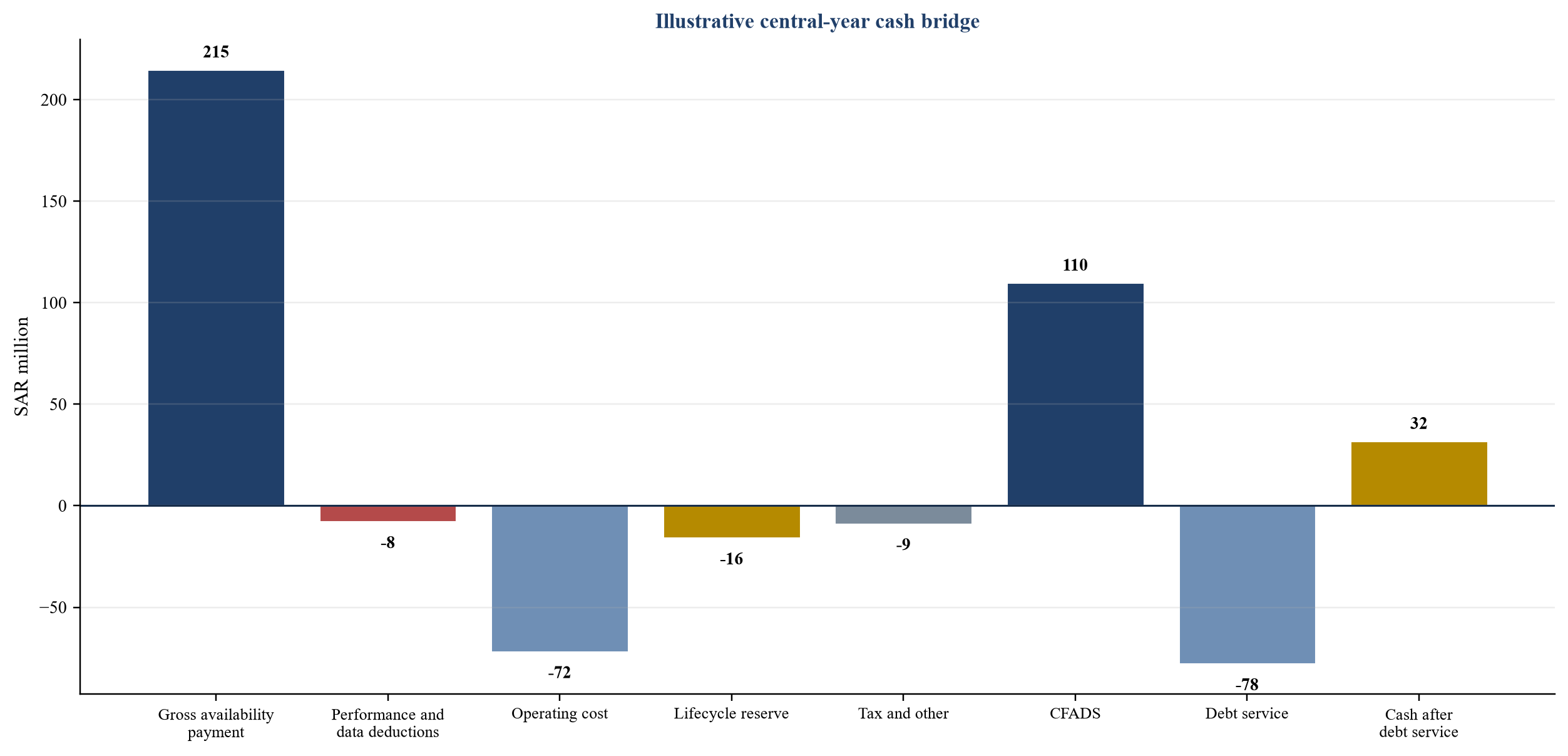
SAR millions. All amounts are hypothetical management assumptions and do not represent an offered tariff or financing.
10. Connect the payment mechanism to capital planning
The rehabilitation plan should convert network evidence into work packages, cost, timing and expected service effect. Each package should state the DMA, asset, intervention, design basis, access requirement, environmental and safety controls, procurement route, commissioning test and evidence required for payment. Capital should be sequenced to the constraint that limits performance rather than spread evenly across the network.
Predictive analytics can improve sequencing when the model identifies a concentration of failure risk that field investigation confirms. The investment committee should still compare the recommended work with alternatives such as pressure management, targeted meter replacement, active leakage control or operating changes. The economic assessment should include water production and transmission avoided, emergency repair avoided, service benefit, energy effect, useful life and implementation cost.
The financing plan should distinguish initial rehabilitation, routine renewal, major lifecycle replacement, technology refresh and change in scope. Initial debt should fund work with an accepted design and completion path. The lifecycle reserve should accumulate for predictable replacement. Technology should not be financed on the assumption that one vendor or model remains current throughout a twenty-five-year term. Interoperability, data export and replacement rights preserve operational continuity.
11. Create a governed digital twin
A digital twin should represent the physical and operational state needed for decisions. It can link the network topology, assets, meters, pressure zones, customer demand, work orders and accepted hydraulic relationships. Its value depends on data lineage and operating use. A visually impressive map with stale meters and incomplete work orders provides weak evidence.
The contract should define the authoritative source for each object, refresh frequency, identifier, unit, timestamp, quality flag and owner. Changes to network topology require approval and effective dates. Field crews should be able to correct asset condition and location through a controlled process. The verifier should receive read access to the evidence needed for certification and should preserve an immutable record of each payment period.
ISO 24591-1 and ISO 24591-2 provide general guidance for smart-water governance and data management [18-19]. The World Bank's Digital Water programme includes smart metering, data integration, predictive maintenance, active leak detection and cybersecurity within utility transformation [20-22]. A project should select technology according to the operating problem and maturity of the utility. It should retain a tested manual or simplified fallback when the advanced platform is unavailable.
12. Govern cybersecurity and personal data
Water operations form part of critical public service. The digital architecture should separate operational technology, enterprise systems, analytics environments, customer information and external vendor access according to risk. Identity, least privilege, network segmentation, secure configuration, logging, backup, recovery, vulnerability management and incident response should be tested through the project life.
The analytics platform may process consumption records linked to individuals or properties. Saudi personal-data requirements address lawful purpose, data minimisation, retention, accuracy, security, accountability and rights of data subjects [15-16]. The project should determine which party is controller or processor for each dataset, where data is stored, who can access it, how it is retained and which transfers require additional controls. The payment model should normally use aggregated operational evidence when individual customer detail is unnecessary.
Cyber obligations should be measurable. The contract should define notification, containment, forensic cooperation, recovery time, data restoration, regulator interaction, service continuity and allocation of cost. A cyber incident may affect both service and payment evidence. The mechanism should prevent a party from benefiting from loss of records it was required to protect.
13. Establish independent verification
The independent verifier should test the baseline, measurement protocol, meter confidence, data substitutions, performance calculation and payment adjustments. Independence requires appointment rules, access, competence, conflict controls, tenure, payment arrangements and replacement procedures that prevent either contracting party from directing the conclusion.
The verifier should reproduce calculations from controlled source data and record disagreements at the level of the affected metric. The process should distinguish a data-quality issue, a modelling disagreement, a contractual interpretation and a field-performance dispute. Each category may require different expertise and escalation. Service should continue while disputed amounts follow the agreed interim payment rule.
The verifier should not become the operator's quality department or the authority's advocate. The project company remains responsible for performance, and the authority remains responsible for contract management. Verification provides an additional control linking technical evidence to payment. Lenders should have access to relevant certificates, material disputes and persistent data-quality failures because these matters can affect cash flow and default risk.
14. Apply a hypothetical integrated case
Assume a project company rehabilitates and operates five distribution clusters serving 1.2 million connections. Annual system input volume is 420 million cubic metres. The accepted starting non-revenue-water ratio is 29 per cent, comprising stated physical, commercial and unbilled-authorised components. The contract targets a reduction to 19 per cent by the end of year five, subject to the agreed baseline and correction protocol. All figures are management assumptions for illustration.
Initial uses total SAR 1.20 billion: SAR 610 million for network rehabilitation, SAR 170 million for meters and sensors, SAR 120 million for systems and integration, SAR 90 million for mobilisation and programme management, SAR 80 million for financing and transaction cost, SAR 70 million for initial reserves, and SAR 60 million for contingency. The assumed sources are SAR 330 million of sponsor equity, SAR 660 million of senior debt, SAR 120 million of public milestone support, SAR 60 million of vendor finance and a SAR 30 million reserve facility.
In the central operating year, gross availability payment is SAR 215 million. Performance and data deductions are SAR 8 million. Operating cost is SAR 72 million, lifecycle reserve funding SAR 16 million and tax and other cash cost SAR 9 million. Cash available for debt service is SAR 110 million. Annual senior and vendor debt service totals SAR 78 million, giving 1.41 times coverage and SAR 32 million of residual cash before other reserve or distribution requirements.
| Uses | SAR million | Sources | SAR million |
|---|---|---|---|
| Network rehabilitation | 610 | Sponsor equity | 330 |
| Meters and sensors | 170 | Senior debt | 660 |
| Systems and integration | 120 | Public milestone support | 120 |
| Mobilisation and programme management | 90 | Vendor finance | 60 |
| Financing and transaction cost | 80 | Reserve facility | 30 |
| Initial reserves | 70 | Total sources | 1,200 |
| Contingency | 60 | ||
| Total uses | 1,200 |
SAR millions. Values are management assumptions and do not describe an observed Saudi project, approved budget or financing commitment.
15. Size debt to resilient certified cash
Debt capacity should follow cash that can be invoiced, certified and collected under the contract. Expected water saved may support the public value case without becoming project revenue. The lender should model the actual payment base, deductions, indexation, operating cost, lifecycle funding, tax, reserve rules and timing from certification to cash receipt.
The debt case should use the accepted commissioning and ramp-up schedule. A project can complete physical work while missing the data quality needed for outcome certification. Draw conditions should therefore include technical completion and evidence readiness. The facility should fund a realistic interest-during-construction period and maintain liquidity through delayed acceptance.
Key protections can include a debt-service reserve, minimum coverage, distribution lock-up, lifecycle-reserve covenant, change control, information rights, direct agreement, lender step-in and termination compensation consistent with law and policy. Security should reflect the concession, accounts, receivables, contracts and assets that can lawfully be charged. The lender should not assume ownership of public network assets or operational rights that the contract does not permit.
16. Test correlated downside and remedies
Single-variable sensitivities can understate the stress that matters. Sensor failure can delay certification at the same time that field costs rise and leakage targets are missed. A severe case should combine lower gross payment, larger deductions, higher operating cost, delayed lifecycle work and additional liquidity use. The model should show the timing of each effect and whether the contract provides relief or simply reduces cash.
The hypothetical correlated downside assumes gross payment of SAR 205 million, deductions of SAR 25 million, operating cost of SAR 82 million, lifecycle funding of SAR 16 million and tax and other cost of SAR 7 million. Cash available for debt service is SAR 75 million, giving 0.96 times coverage against SAR 78 million of debt service. The shortfall should trigger the agreed reserve, distribution lock-up and action plan rather than an assumption that future performance automatically repairs it.
An illustrative remedial case restores gross payment to SAR 210 million after accepted cure work, reduces deductions to SAR 14 million, lowers operating cost to SAR 76 million through verified measures, temporarily reschedules SAR 4 million of non-critical lifecycle work and uses vendor refinancing to reduce annual debt service to SAR 77 million. Cash available for debt service becomes SAR 91 million, or 1.18 times. Every remedy requires contractual authority, technical acceptability and committed funding.
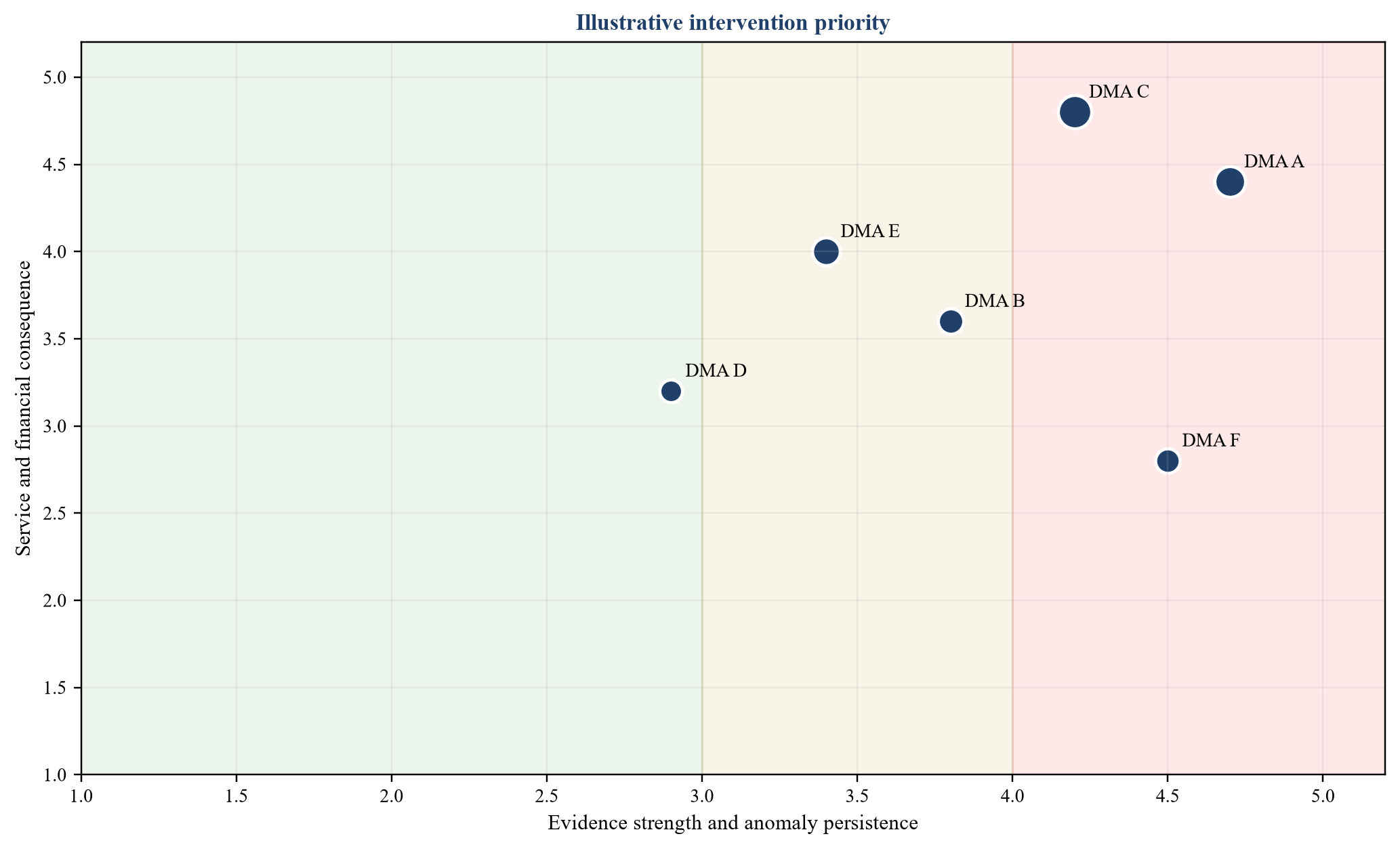
Scores are illustrative. Priority should combine verified evidence, consequence and field judgment rather than model output alone.
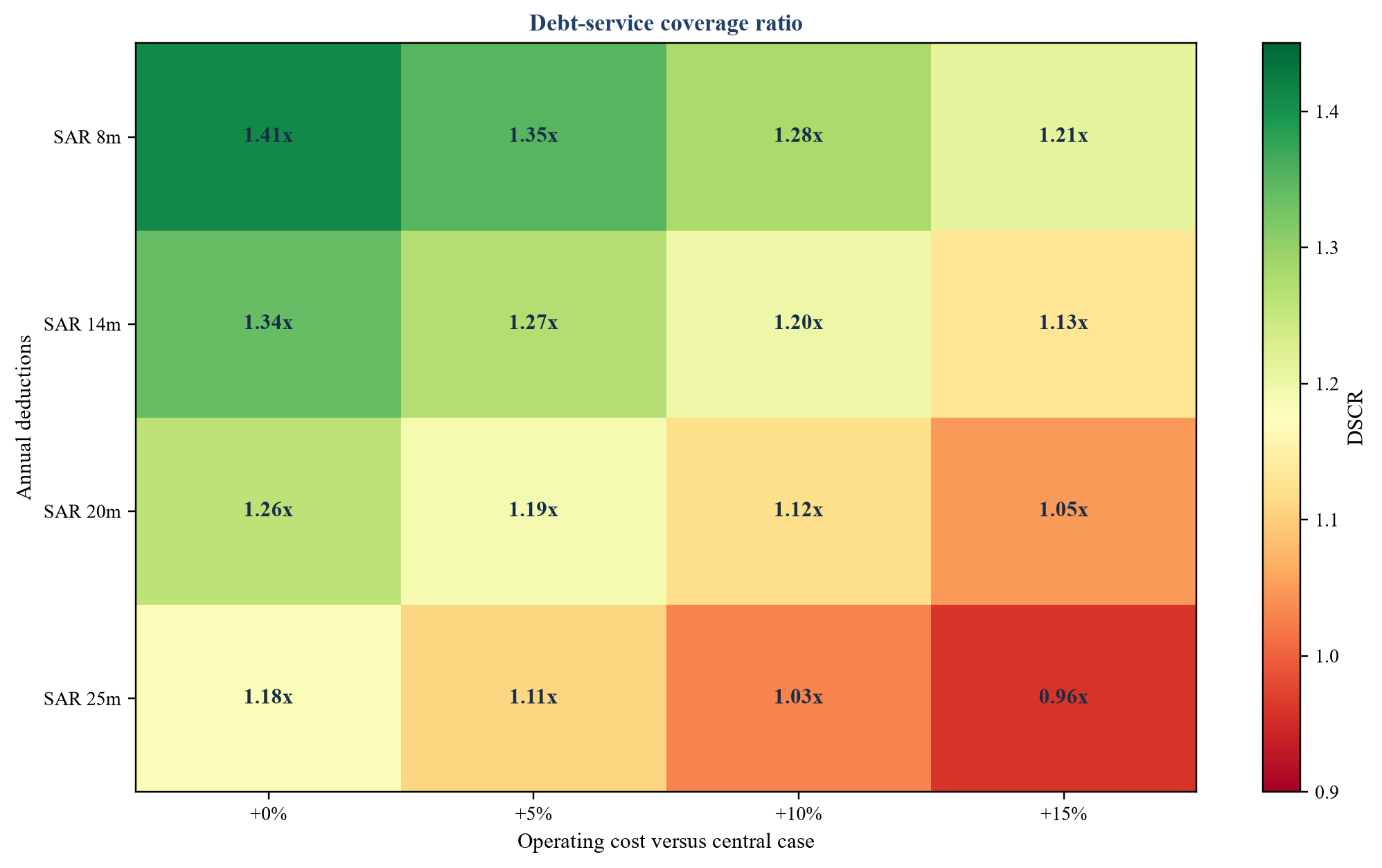
Ratios are management assumptions. The matrix is not a credit opinion or forecast.
17. Assess value for money and fiscal exposure
The authority should compare the PPP with realistic public and contracted alternatives. Value for money can arise from integrated lifecycle responsibility, faster rehabilitation, specialist capability, disciplined data, competition and performance-linked payment. It can be lost through expensive risk transfer, weak baseline information, inflexible technology obligations, excessive transaction cost or public support that absorbs the downside while leaving upside private.
The comparison should include quantified and qualitative factors. Quantified analysis may cover capital, operations, lifecycle renewal, retained risk, financing, tax, transaction cost and expected deductions. Qualitative analysis may cover service continuity, innovation, accountability, workforce transition, public capability and flexibility. Assumptions should be consistent across alternatives.
Fiscal analysis should identify direct payments, milestone support, guarantees, compensation events, termination exposure, land or asset contribution and retained service obligations. PFRAM or an authorised equivalent can support analysis of fiscal cost and risk [23]. The budget should reflect the actual payment profile and plausible deductions or relief. Apparent affordability created by deferring obligations beyond the current budget period is not a durable financing case.
18. Procure the evidence and operating capability
Qualification should test water-distribution operations, rehabilitation delivery, data and cyber capability, financing, Saudi implementation capacity and experience managing performance-based contracts. A bidder may combine operator, contractor, technology provider, investor and lender roles through a consortium. The authority should understand which member carries each obligation and how performance survives a member failure.
The data room should include the asset register, network model, bulk and customer-meter data, pressure records, burst and repair history, customer master, billing and collection information, land and access rights, existing contracts, environmental and safety records, cyber architecture and planned capital works. Known gaps should be disclosed with a bidder process for inspection and clarification. A disclaimer does not allocate an unknown risk efficiently when no bidder can investigate it.
Bid evaluation should separate technical compliance, baseline method, delivery plan, data architecture, lifecycle plan, financing, payment requirement and risk qualifications. A low nominal payment can depend on aggressive leakage improvement, underfunded renewal or broad relief events. The evaluation should model the whole contract using each bidder's assumptions and stated exceptions.
19. Manage contract change through evidence
Water networks change as development expands, customer demand shifts and public projects alter roads or utility corridors. The contract should define how an added zone, major connection, bulk-supply change, regulatory requirement or technology replacement affects scope, baseline, payment and capital. Each change should have an evidence cut-off, valuation method, approval route and implementation plan.
Model changes require similar discipline. The operator may improve an algorithm, replace a vendor or introduce new sensors. A new model should pass acceptance testing and run in parallel where practical before it influences prioritisation or payment evidence. Historical results should remain reproducible under the model version used at the time. A vendor change should include data migration, access continuity and exit assistance.
The contract-management team should maintain one change register linked to technical documents, financial model, risk allocation and payment mechanics. Accumulated small changes can alter the project more than one major amendment. Periodic review should test whether the risk allocation, lifecycle funding and service standard remain coherent.
20. Protect operations through lifecycle funding
Leakage improvement can deteriorate if pressure controls, meters, valves, sensors and repaired assets are not maintained. The contract should specify lifecycle activities, condition thresholds, reserve funding, permitted use and handback requirements. The project company should not improve early performance by deferring work beyond the measurement period.
The lifecycle plan should reconcile technical useful life with debt tenor and contract term. Bulk meters, customer meters, communications equipment, batteries, software and network assets have different replacement cycles. Technology refresh should maintain required functionality and cyber support without forcing the authority to buy a particular future product. The operator should report condition, failure, remaining life, work completed and forecast cost.
Lenders should monitor lifecycle reserve adequacy and permitted withdrawals. A reserve shortfall can reduce future service before it appears in current coverage. Distribution tests should therefore include required reserve balances, current service compliance, absence of material unresolved defects and an updated lifecycle forecast.
21. Sequence the first 180 days
The first thirty days should confirm the decision perimeter, data room, baseline protocol, verifier role, procurement approvals and market-sounding plan. The authority should identify each critical gap and decide whether it can be resolved before bid or requires a contract mechanism.
Days thirty to seventy-five should complete priority field tests, DMA readiness assessment, data architecture, options analysis, risk workshops and the first financial model. The technical and financial teams should reconcile the capital programme to the payment and debt cases. Model-development work should define the use case, data rights, validation and fallback rather than promising an unspecified AI benefit.
Days seventy-five to one hundred and twenty should test the payment mechanism, deductions, indexation, change rules, fiscal exposure, security and direct agreement through market sounding. The authority should update the structure when several credible bidders or lenders identify the same unfinanceable term. Market comments are evidence of appetite, not approval of the public-interest case.
Days one hundred and twenty to one hundred and eighty should finalise the business case, procurement documents, evaluation model, draft contract, monitoring plan and decision memorandum. Release should occur only when the baseline, interfaces, capital, data and payment structure are sufficiently defined for competitive bids.
| Gate | Required output | Decision owner | Stop or redesign trigger |
|---|---|---|---|
| Baseline | Accepted water balance, DMA status and correction protocol | Technical authority | Material volume cannot be reproduced |
| Scope | Asset and service perimeter with interface schedule | Contracting authority | Critical responsibility remains unallocated |
| Data | Architecture, access, cyber, privacy and model-governance plan | Data and security owners | Payment depends on inaccessible or uncontrolled data |
| Capital | Costed rehabilitation and lifecycle plan | Programme sponsor | Material work lacks design, contingency or funding path |
| Payment | Tested availability mechanism and deduction model | Finance and contract owners | Central or downside invoice cannot be reproduced |
| Debt | Lender-tested cash flow, security and direct agreement | Project finance owner | Credible downside lacks liquidity or cure |
| Fiscal | Direct and contingent exposure with approvals | Public finance authority | Obligations exceed approved capacity |
| Procurement | Qualification, evaluation and data-room readiness | Procurement authority | Competition or bid comparability remains weak |
The memorandum records evidence, conditions and accountable decisions; it does not replace statutory approvals.
22. Use one approval record through financial close
The final memorandum should state the service decision, delivery model, baseline, capital programme, payment mechanism, risk allocation, fiscal exposure, data and AI controls, procurement strategy, financing, open conditions and decision rights. It should include one controlled model and links to the evidence used. Open items require an owner, deadline, required proof and consequence.
The record should continue through procurement. Bid assumptions, qualifications and committed finance should replace the pre-bid case. Before contract signature, the authority should repeat affordability and value-for-money analysis using the selected bid. Lenders should test the final payment mechanism, direct agreement, reserve package and downside. The independent verifier protocol should be executable on the systems and data actually proposed.
Financial close should also establish a controlled opening data set. The authority, project company, operator, verifier and lenders should sign an evidence schedule identifying each meter, district boundary, calibration record, data-quality exception, approved estimation method and responsible system owner. This opening record creates the reference point for subsequent leakage claims, payment deductions, covenant testing and dispute resolution. A later change to a boundary, sensor, calculation rule or model version should carry an effective date, approval trail and quantified consequence. Without this discipline, apparent operating improvement can reflect a measurement change rather than a physical reduction in water loss.
The financing package should translate the same record into lender controls. Drawdown conditions can require completion certificates for priority districts, approved procurement packages, insurance, reserve funding and evidence that the payment-calculation environment is operational. Continuing undertakings can cover meter availability, data retention, model monitoring, verifier access, cybersecurity incidents and lifecycle-reserve replenishment. A breach should lead to a proportionate sequence of notification, investigation, cure, cash retention and escalation. The design objective is early correction of evidence or performance weakness while the service remains recoverable.
Governance should preserve accountable human decisions throughout the concession. Predictive rankings may propose where to inspect or invest, while named operational and financial owners approve the work programme, payment certificate and funding response. The model committee should review drift, false positives, missing data and changed network conditions. The contract-management team should review whether deductions remain linked to controllable obligations and whether remedial investment is solving the underlying network problem. Material model changes require validation and controlled deployment before they affect contractual cash flow.
The annual business plan can then connect public-service objectives, asset condition, analytics, capital expenditure, operating resources, expected payment and debt capacity. Variances should be traced to physical network evidence and assigned actions. This creates a practical basis for periodic value-for-money review, refinancing decisions, reserve release and contract change. It also gives the authority an auditable explanation of how data informed expenditure without allowing an opaque model to become the decision maker.
Predictive leakage analytics can strengthen a water PPP when it improves the sequence and verification of work. Bankability comes from the wider control system: accepted boundaries, measurable obligations, governed evidence, fair risk allocation, resilient cash flow, funded lifecycle performance and accountable decisions. The project should be approved only when those elements operate together under central and downside conditions.
Sources
- World Bank Group and partner institutions, PPP Reference Guide, Version 3. Read the primary source
- National Center for Privatization and PPP, PPP Journey Guidelines for Private Sector Participation. Read the primary source
- National Center for Privatization and PPP, Implementing Regulations of the Private Sector Participation Law. Read the primary source
- National Center for Privatization and PPP, PSP Business Case Checklist. Read the primary source
- Ministry of Environment, Water and Agriculture, Saudi National Water Strategy 2030. Read the primary source
- Ministry of Environment, Water and Agriculture, Saudi Water Security, 23 June 2026. Read the primary source
- Saudi Water Partnership Company, 2024 Sustainability Report. Read the primary source
- Saudi Water Partnership Company, Seven-Year Statement 2024-2030. Read the primary source
- Saudi Water Partnership Company, Request for Qualification for Independent Sewage Treatment Plant Projects. Read the primary source
- International Organization for Standardization, ISO 24528:2021, Guideline for a water loss investigation of drinking water distribution networks. Read the primary source
- World Bank PPP Resource Center, Contracting Tools for Non-Revenue Water Reduction. Read the primary source
- World Bank PPP Resource Center, Performance-Based Contracting Tools for Non-Revenue Water Reduction. Read the primary source
- World Bank PPP Resource Center, Performance-Based Leakage Reduction Procurement Documents. Read the primary source
- Saudi Data and AI Authority, AI Ethics Principles. Read the primary source
- Saudi Data and AI Authority, Regulations and Policies. Read the primary source
- Saudi Data and AI Authority, Personal Data Protection. Read the primary source
- National Institute of Standards and Technology, Artificial Intelligence Risk Management Framework 1.0. Read the primary source
- International Organization for Standardization, ISO 24591-1:2024, Smart water management, general guidelines and governance. Read the primary source
- International Organization for Standardization, ISO 24591-2:2024, Smart water management, data management guidelines. Read the primary source
- World Bank, Digital Water programme. Read the primary source
- World Bank Global Water Security and Sanitation Partnership, Annual Report 2024. Read the primary source
- World Bank, Utility of the Future and Digital Water resources. Read the primary source
- International Monetary Fund and World Bank Group, PPP Fiscal Risk Assessment Model 2.0 User Manual. Read the primary source
- World Bank PPP Resource Center, PPP Risk Allocation Tool 2019 Edition, Water and Waste. Read the primary source
- World Bank PPP Resource Center, PPP Contract Management. Read the primary source
- International Finance Corporation, Delivering Universal and Sustainable Water Services: Partnering With the Private Sector. Read the primary source
