

Introduction
India combines large healthcare demand, uneven clinical capacity, expanding digital infrastructure and a growing supply of AI products. These conditions can support consolidation. They also make broad market narratives unreliable for an acquisition decision. A radiology triage tool, pathology decision aid, hospital coding product, patient-engagement agent and population-health model have different intended users, consequences, evidence needs and routes to payment.
The acquisition team should begin with the clinical task and the accountable decision maker. It should then trace the product through evidence, deployment, monitoring, reimbursement or budget ownership and cash collection. This sequence prevents a buyer from treating model performance, regulatory status, software usage and revenue as interchangeable measures.
India's Medical Devices Rules provide the legal framework for regulated devices, and CDSCO has published classifications for medical-device software based on intended use and associated risk [1-3]. ICMR's 2023 AI guidance addresses ethical principles, stakeholder responsibilities, governance, review and consent [4]. ABDM policies address health-data governance and interoperability [5-7]. International materials from WHO, IMDRF, FDA, NIST and standards bodies provide useful evidence and lifecycle frameworks [8-24]. Current advice is required to determine which rules apply to a target and use case.
This paper is for strategic buyers, private-capital investors, lenders, boards and management teams evaluating healthcare-AI combinations. It provides a transaction framework. It does not provide medical, legal, regulatory, accounting, tax or valuation advice.
1 Define the acquisition thesis by accepted clinical work
The thesis should identify the clinical or administrative decision that improves after closing. Examples include prioritising a radiology worklist, identifying a pathology region for review, detecting deterioration, coding an episode, estimating a no-show risk or routing a patient to an appropriate service. Each task has a different harm profile and acceptance test.
The target asset should be described in operational terms. It may include a validated algorithm, labelled data rights, a quality-management system, hospital integrations, regulatory clearances, clinical champions, distribution agreements, service capability or a longitudinal outcomes dataset. The buyer's contribution may include a broader installed base, capital for multicentre validation, channel reach, product adjacencies or stronger post-market operations.
Every value mechanism needs a baseline, accountable owner, continuing cost, timing and failure condition. A thesis that the combination will accelerate diagnosis should identify the eligible population, clinical setting, comparator, review protocol, material outcome and monitoring requirement. A thesis that cross-selling will create value should name the customer cohort, buying authority, integration work, procurement cycle, sales cost and cash-conversion period.
The board paper should state what evidence must exist before value is released. A regulatory submission can support the perimeter. A controlled study can support performance under defined conditions. Production telemetry can support adoption. Invoice and bank records can support cash. The evidence should match the claim being valued.
| Value claim | Required evidence | Decision question | Principal risk |
|---|---|---|---|
| validated clinical use | intended use protocol representative study comparator and endpoints | does evidence support use in the proposed setting | validation does not match population workflow or claim |
| adopted workflow | production telemetry review records overrides and clinician interviews | is the product embedded in accountable work | access or pilot activity is presented as adoption |
| transferable data advantage | provenance consent purpose rights quality and change-of-control terms | can the buyer lawfully continue material use | data cannot transfer or support the intended purpose |
| durable distribution | signed terms pipeline conversion implementation and renewal cohorts | can the buyer reach and retain customers economically | revocable channel or founder-led sales |
| sustainable earnings | full evidence quality safety support and hosting cost | what recurring cash remains under proper control | reported margin omits essential operations |
| integration value | use-case overlap migration plan acceptance gates and net cash | which synergies survive clinical and commercial controls | forced integration weakens safety or customer trust |
Proposed structure; target-specific legal regulatory clinical technical commercial accounting cyber and tax review is required.
2 Build the evidence to cash chain
The evidence chain begins with a patient, sample, image or clinical event. It continues through lawful capture, identity, data quality, model version, output, clinician review, action, outcome, billing and collection. A failure at any stage can reduce value even when the algorithm performs well in a controlled test.
The buyer should distinguish source observations, annotations, model estimates, clinical judgments and authorised records. An image is a source observation. A segmentation mask can be an annotation. A risk score is a model estimate. A radiologist's conclusion is a clinical judgment. The signed report is an authorised record. These layers should remain distinguishable in the audit trail.
The map should identify the system of record for patient identity, orders, images, laboratory results, clinical notes, prescriptions, billing and consent. It should also identify the system that controls model configuration, alerts, overrides, corrections and monitoring. Interoperability can create access while leaving the target dependent on another vendor's identifiers, permissions or interface.
Commercial evidence belongs in the same chain. The buyer should connect eligible events, completed analyses, accepted outputs, billable units, invoices, deductions, payment time and renewal. Model calls and active users can describe activity. Accepted clinical work and collected cash support value more directly.
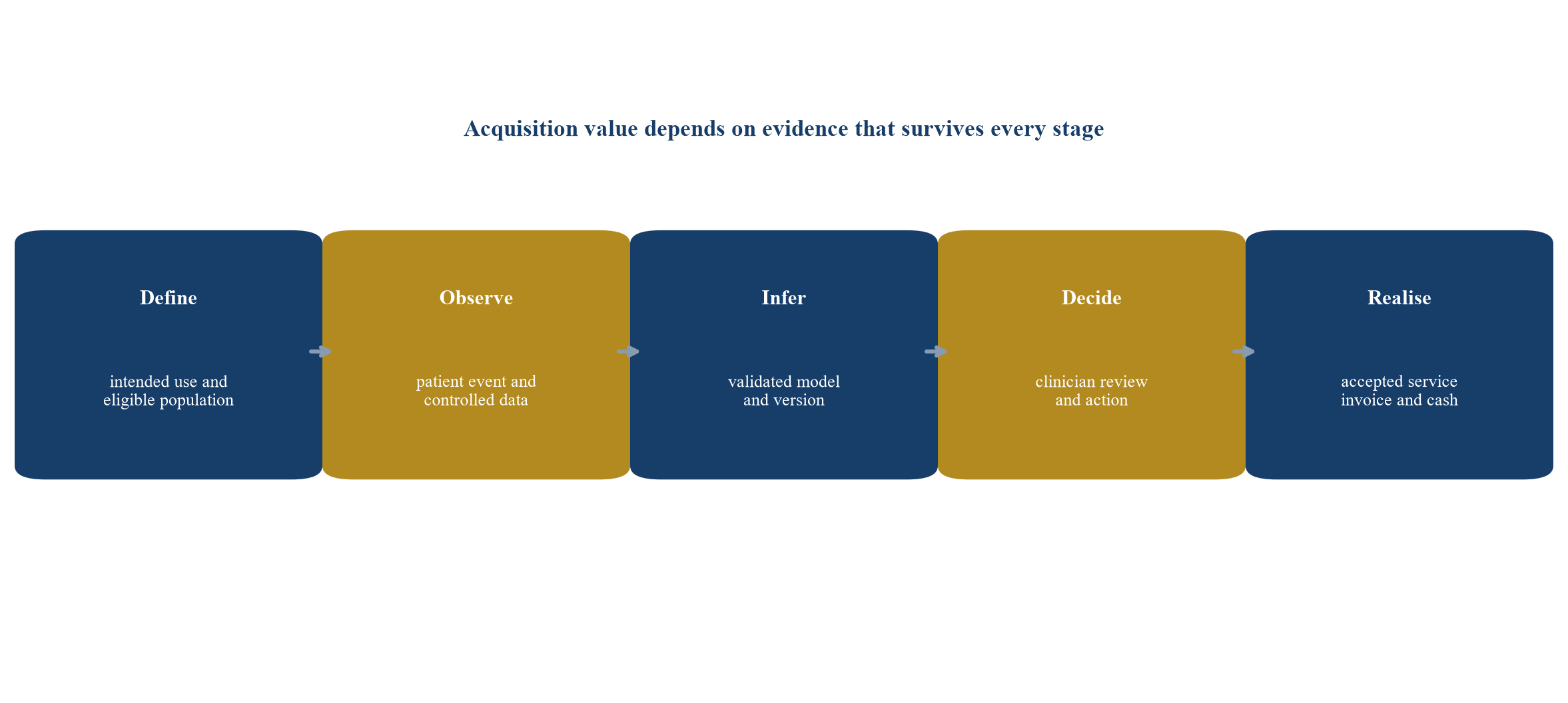
Proposed acquisition map; actual controls depend on the intended use care setting contract and accountable clinical authority.
3 Classify each intended use and regulatory perimeter
Classification should be performed at the function and intended-use level. A platform can contain regulated and unregulated functions. The same model may move into a different risk category when it changes from administrative support to diagnosis, treatment recommendation or autonomous action.
The diligence team should capture the target population, condition, user, setting, input, output, role in the clinical decision, time sensitivity and consequence of error. It should compare marketing claims, contracts, training materials, user interfaces and actual use with the registered or approved purpose. Differences can create regulatory, product-liability and customer risk.
India regulates medical devices under the Drugs and Cosmetics Act and Medical Devices Rules. CDSCO's software classification material links risk classification to intended use and other parameters [1-3]. The transaction team should confirm current licences, registrations, quality-system evidence, authorised manufacturing or importing entities, approved labels, complaints, recalls and change-control history. It should also review local clinical-establishment, telemedicine, professional and consumer-protection requirements where relevant.
Regulatory status outside India should be mapped separately. FDA, EU or other authorisation can support diligence because it exposes evidence and lifecycle controls. It does not establish Indian classification, local performance or commercial acceptance. The buyer should avoid treating a foreign clearance as a universal quality certificate.
| Field | Diligence evidence | Acquisition implication |
|---|---|---|
| intended population and condition | approved label protocol inclusion and exclusion criteria | defines the population whose evidence can support value |
| intended user and setting | workflow maps training and actual-use telemetry | determines competence supervision and implementation need |
| clinical role | decision point output and human review | links model error to patient and professional consequence |
| device classification | current CDSCO and other authority records | determines licences quality and change-control requirements |
| marketed and actual claims | website proposals contracts demonstrations and interviews | identifies unsupported commercial use |
| material changes | model data workflow and label version history | tests whether current deployment remains within evidence and approval |
Proposed record; classification and obligations require current jurisdiction-specific advice.
4 Establish the clinical validation hierarchy
Technical validation asks whether the system performs as specified on defined data. Clinical validation asks whether the output is associated with the clinical condition or outcome for the intended use. Clinical utility asks whether use changes decisions, processes or outcomes in a way that matters. Economic evidence asks whether the change creates sustainable value for the institution or payer.
The buyer should place every material claim on this hierarchy. Retrospective accuracy on a curated dataset can support early technical evidence. External validation across independent sites can test transportability. Prospective silent deployment can test performance in the real data pipeline without influencing care. Prospective interventional evaluation can test workflow and outcome effects. Post-market evidence can show continuing performance, drift and incidents.
WHO's evidence framework for AI-based medical devices addresses training, validation and evaluation, while IMDRF's SaMD clinical-evaluation framework separates valid clinical association, analytical validation and clinical validation [8,11]. ICMR's ethical guidance addresses governance and stakeholder responsibilities in Indian biomedical research and healthcare [4]. These sources support a disciplined hierarchy. They do not prescribe one study design for every function.
The transaction team should test study registration, protocol changes, endpoint selection, missing data, site selection, reference standard, subgroup results, reader design, statistical analysis and publication status. It should distinguish peer-reviewed evidence from abstracts, preprints, sponsored case studies and vendor-authored claims.
| Evidence level | What it can support | Key diligence test | Common limitation |
|---|---|---|---|
| development performance | early feasibility and engineering comparison | leakage controls labels and separation of training and test data | curated data overstates field performance |
| external retrospective validation | transportability to independent historical data | site independence population match and reference standard | workflow effect remains untested |
| prospective silent validation | performance in live data flow | pre-specified protocol exclusions failures and subgroup results | no evidence that clinicians use the output |
| prospective interventional study | effect on decisions time or clinical outcome | comparator adoption contamination and adverse events | narrow study setting may limit scale |
| post-market evidence | continuing safety performance and drift | complaint reconciliation incident capture and revalidation | weak surveillance can understate failures |
| economic evidence | budget and cash consequence | causal design full cost and realised payment | gross saving ignores implementation and control cost |
Proposed hierarchy; required evidence depends on intended use risk and current regulatory requirements.
5 Test data representativeness and reference standards
The relevant dataset is the population encountered in the intended workflow. A model trained on one hospital type, scanner fleet, laboratory process, language or disease prevalence may perform differently elsewhere. Acquisition diligence should reconstruct the data-generation process before reviewing headline metrics.
The data map should include institutions, dates, geography, care setting, equipment, protocol, demographics, disease prevalence, acquisition quality, missingness, labels, annotators and adjudication. It should identify repeated patients, related images and temporal leakage across training and test sets. It should also identify whether the target can reproduce the cohort after change of control.
Reference standards require clinical scrutiny. Labels derived from routine reports can carry reader variability and historical practice. Pathology, follow-up, consensus review or outcome data may provide stronger standards for some uses. A label can be accurate for one question and unsuitable for another. The target should document uncertainty and disagreement instead of converting every case into an artificial binary truth.
Subgroup analysis should follow clinical and operational relevance. Performance may vary by age, sex, comorbidity, disease severity, site, device, protocol, language or image quality. Small subgroup samples should be reported with uncertainty. The buyer should treat missing subgroup evidence as an unresolved limitation.
6 Measure performance according to consequence
Sensitivity, specificity, predictive values, calibration, discrimination, localisation accuracy and time saved answer different questions. The correct metric depends on the clinical role and prevalence. A triage system that misses urgent cases presents a different risk from a documentation tool that creates false billing suggestions.
The acquisition team should create a consequence matrix for false positive, false negative, abstention, delayed output, incorrect patient match, unavailable service and automation bias. It should connect each failure to detection, human review, corrective action, notification and patient impact. Aggregate discrimination measures should not replace operating-point results.
Calibration deserves attention when a score changes care. A model can rank risk well while producing probabilities that do not match observed outcomes. Thresholds selected on development data may fail when prevalence, workflow or capacity changes. The buyer should inspect local threshold governance and whether customers can alter thresholds without controlled validation.
Generative outputs require separate tests for factual accuracy, omission, unsupported recommendation, source attribution, stability and unsafe content. The system should abstain or escalate when evidence is insufficient. A fluent explanation can increase automation bias, so human-factors testing belongs in the validation plan.
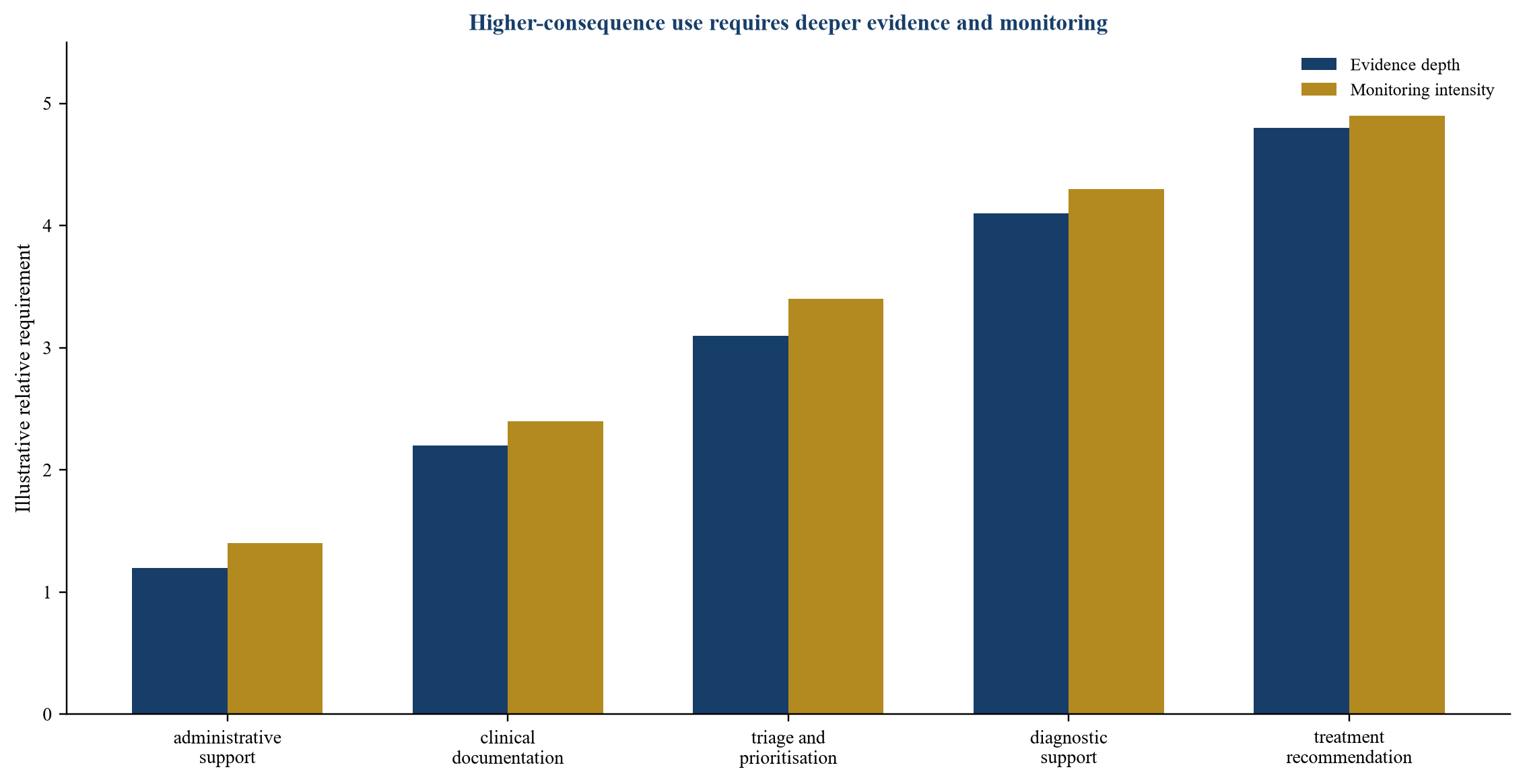
Proposed framework; thresholds and evidence should be defined for the specific intended use.
7 Assess human factors and workflow adoption
Clinical value depends on what users do with an output. The interface can change attention, timing, workload, communication and accountability. A technically accurate product can fail when alerts arrive too late, the queue is poorly prioritised, the rationale is unclear or users cannot correct the record.
The buyer should observe work rather than rely only on interviews. It should sample shifts, sites, user groups and exceptional cases. It should measure eligible cases, completed analyses, output availability, view rate, response time, override, correction, escalation, final action and unresolved alerts. Training completion should be linked to actual use and error patterns.
Human review should be defined precisely. The reviewer needs competence, authority, time and access to source evidence. A product that displays a result beside a crowded queue may claim human oversight while creating practical reliance. The team should test whether users can identify model limits, inspect sources, challenge outputs and document a different judgment.
Adoption should be analysed by use-case cohort. A pilot can receive exceptional vendor support and senior sponsorship. Production scale may introduce staff turnover, night shifts, lower-connectivity sites and competing systems. The buyer should identify which activities remain dependent on founders, specialist clinicians or manual data cleaning.
8 Reconstruct post-market surveillance and model change control
Healthcare AI changes through software releases, model updates, new data, customer configuration and shifts in clinical practice. The quality system should identify which changes require validation, regulatory action, customer approval or renewed training. Silent model replacement weakens the evidence basis for past and current use.
The target should maintain an inventory of products, functions, model versions, data dependencies, intended uses, approvals and deployed customers. Release records should identify code, model, prompt, threshold, interface and infrastructure changes. Each material change should have risk assessment, verification, validation, approval and rollback evidence.
Post-market surveillance should reconcile complaints, support tickets, incidents, overrides, performance monitoring, downtime, cybersecurity events and regulatory reports. A low incident count can indicate safe performance or poor detection. The buyer should compare recorded events with logs, customer interviews and corrective-action records.
The FDA's guidance on predetermined change-control plans and international Good Machine Learning Practice principles illustrate a lifecycle approach to planned modifications and continuing safety [14-16]. They can inform diligence even when they do not apply directly to an Indian deployment. The acquisition model should include the recurring staff, tooling and study cost needed to operate this lifecycle.
9 Secure data rights privacy and patient trust
Healthcare data rights should be traced from collection to each use. The diligence register should identify the responsible entity, legal basis, consent or other authority, purpose, retention, location, recipient, processor, subprocessor, training use, derived data, deletion and data-subject process. A contract right to host data may not permit model training or cross-customer analytics.
India's Digital Personal Data Protection framework and ABDM policies require current legal analysis [5-7,25-27]. Health data also carries contractual, professional, research and ethical obligations. De-identification should be tested for the actual dataset and linkage environment. Imaging, genomic, rare-disease and longitudinal data can remain re-identifiable through combinations of attributes.
Change of control can affect licences, research approvals, hospital permissions, cloud arrangements and cross-border transfers. The buyer should identify consents and operational dependencies before signing. It should also test whether model weights or embeddings contain information that cannot be separated when a customer withdraws.
Patient trust can affect adoption and institutional risk. The product should communicate its role, limits and oversight in a way appropriate to the use. Consent, notice and redress should match the clinical setting. The buyer should treat opaque or exaggerated claims as a commercial risk because hospitals and clinicians carry reputational consequences from deployment.
| Data or interface | Evidence required | Principal acquisition risk | Transaction response |
|---|---|---|---|
| patient clinical data | authority purpose retention access and deletion | use exceeds permission or cannot continue after closing | consent restrict ring-fence or exclude |
| labelled research dataset | protocol ethics approval licence provenance and adjudication | research right does not support commercial deployment | obtain new rights or limit intended use |
| model training and derived data | permitted purpose lineage and customer allocation | combined training creates ownership or deletion conflict | segregate retrain or price remediation |
| hospital integration | contract technical specification security and support | interface access is revocable or expensive | consent transition plan and service reserve |
| device and vendor data | licences formats version controls and export | supplier change breaks validated performance | lock versions validate alternatives and protect exit |
| user and workflow telemetry | notice minimisation access and retention | surveillance or unsupported workforce use | narrow purpose and governance |
Proposed register; current legal ethical contractual security and clinical review is required.
10 Verify interoperability and the system of record
Interoperability should be evaluated as an operating dependency. The product may rely on hospital information systems, electronic medical records, laboratory systems, picture archiving, devices, identity services, terminology and billing. A demonstration connection does not establish reliable production operation.
The buyer should map message standards, APIs, batch transfers, custom adapters, identifiers, terminology, time synchronisation and error handling. HL7 FHIR and DICOM provide international standards for health-data exchange and imaging [21-22]. ABDM defines national digital-health architecture and policy components [5-7]. Actual customer implementations can still require local mapping and governance.
The map should identify which party owns data quality, interface monitoring, failed-message repair, identity matching and downtime procedures. It should examine whether the target can test changes before a hospital or vendor upgrade. Hard-coded interfaces and manual reconciliation create recurring service cost that can be hidden in software margins.
The buyer should sample complete cases through the production chain. It should reconcile source records, model inputs, output timing, patient match, clinician view, correction, final record and billing. Exceptions should be quantified by site and interface. Transferable value increases when the target has a repeatable integration pattern, controlled terminology and observable failure recovery.
11 Analyse customer cohorts and workflow depth
Customer logos can conceal large differences in adoption. The acquisition team should build cohorts by product, intended use, institution type, deployment date, integration method, clinical department and commercial model. For each cohort it should track eligible cases, processed cases, accepted outputs, clinician response, override, incident, support cost, renewal and collection.
Depth should be measured at the workflow level. A hospital may have a licence across several sites while only one department uses the system. A laboratory network may process high volume but rely on vendor staff for exceptions. A public programme may have broad reach and slow payment. These patterns produce different recurring economics.
References should include mature users, recent deployments, reduced-volume customers, non-renewals and customers that declined expansion. Questions should cover clinical purpose, evidence, implementation, training, failure handling, integration, procurement, budget ownership and alternatives. The buyer should reconcile interview statements with telemetry and financial records.
The cohort model should separate pilot, adopted, embedded and controlled use. Pilot activity tests feasibility. Adopted use shows repeated clinical work. Embedded use connects to institutional process and systems. Controlled use adds documented validation, monitoring, governance and continuity. Valuation should recognise the cost and durability associated with each stage.
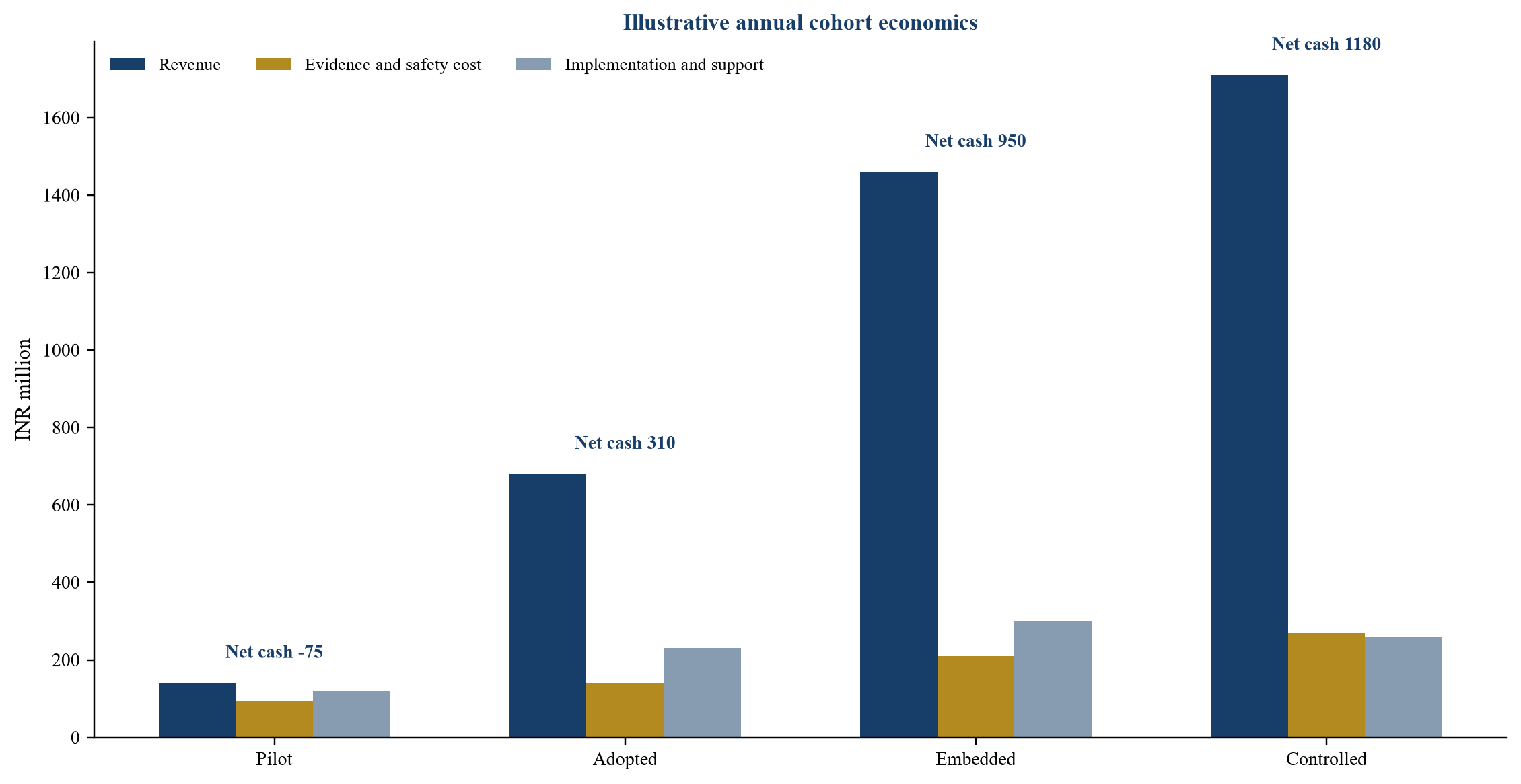
Management assumptions used solely to demonstrate cohort analysis; figures do not describe a company or market.
12 Examine distribution channel economics
Healthcare AI distribution can run through direct enterprise sales, hospital groups, laboratory and imaging networks, device vendors, system integrators, insurers, government programmes or clinical champions. Each route changes evidence access, customer ownership, pricing and implementation responsibility.
The buyer should reconstruct the funnel from qualified institution to signed contract, technical deployment, clinical activation, billable event, renewal and cash. It should identify the channel's share of economics, exclusivity, territory, minimum commitments, termination rights, data access, branding, support obligations and customer portability. Founder relationships should be separated from institutional coverage.
Channel volume can reduce selling cost while weakening control of the end customer. A device bundle may reach many sites but make the AI function a low-priced feature. A system integrator can accelerate procurement while owning the renewal relationship. A government programme can provide scale and reference value while introducing tender concentration and payment delay.
Distribution synergies should be estimated by cohort. The buyer should apply probability and timing only where evidence supports conversion, and then deduct clinical validation, localisation, integration, training, channel share, support, working capital and churn. A list of cross-sell targets is pipeline evidence, rather than recurring value.
13 Rebuild sustainable EBITDA
Reported EBITDA should be rebuilt from the operating requirements of the accepted product. Necessary recurring costs can include clinical affairs, quality management, regulatory maintenance, post-market surveillance, safety review, data curation, annotation, model evaluation, cybersecurity, hosting, integration support, customer training and incident response.
The diligence team should review capitalised development and implementation costs. Engineering expenditure can be divided among maintenance, customer configuration, evidence generation, control remediation, new products and research. Capitalisation can improve reported earnings while current cash funds work needed to retain the product. The buyer should test useful lives, impairment indicators and technology that will be replaced during integration.
Revenue should be reconciled to intended use and acceptance. Upfront licences, minimum commitments and project invoices can produce revenue before sustained workflow adoption. The team should connect revenue to eligible volume, completed use, accepted output, support burden, renewal and collection. It should separate pass-through cloud, device and channel components from the target's own economics.
The resulting earnings measure should be reproducible by cohort. It should also include a normal level of failed deployments, non-renewals and remediation. A buyer that removes evidence and safety functions to achieve a margin target can damage the asset supporting revenue.
| Item | Amount | Diligence treatment |
|---|---|---|
| reported annual revenue | 5200 | reconcile to contracts workflow use invoices and collections |
| reported EBITDA | 1150 | starting measure before transaction normalisation |
| capitalised development adjustment | -150 | continuing cash development required to maintain products |
| under-recorded clinical evidence and regulatory cost | -110 | recurring validation surveillance and submission work |
| implementation labour in cost base | -90 | customer work necessary for accepted production use |
| data quality and annotation normalisation | -55 | recurring curation adjudication and lineage operations |
| cybersecurity and resilience normalisation | -45 | recurring controls testing response and recovery |
| key-person and clinical leadership normalisation | -50 | market cost of durable leadership and accountable review |
| sustainable EBITDA | 650 | illustrative recurring earnings under controlled operation |
INR millions; management assumptions used solely to demonstrate the framework.
14 Convert synergy claims into evidence weighted cash
Synergies should be defined as cash mechanisms. Revenue synergy may arise from cross-selling an already validated use to an eligible customer cohort, expanding an accepted workflow or entering a channel with transferable contracts. Cost synergy may arise from shared infrastructure, procurement, administration or duplicated support. Clinical, regulatory and quality functions should be combined only after the buyer establishes equivalent scope and control.
The synergy register should identify customer, use case, baseline, evidence, owner, timing, implementation cost, continuing cost and failure condition. It should distinguish signed expansion, qualified pipeline and management aspiration. It should also identify dis-synergy from product migration, channel conflict, clinician retraining, data segregation and loss of key staff.
Integration can create a stronger evidence platform. Shared clinical operations, common data lineage, reusable connectors and central surveillance may reduce duplication. The value depends on whether products can share those capabilities without collapsing distinct intended uses or contaminating validation datasets.
Gross annual synergy should therefore pass through an evidence funnel. The hypothetical case reduces INR 1.30 billion of gross annual claims to INR 520 million of recurring net cash after removing unsupported pipeline, delayed adoption, channel share, validation and integration cost. The conversion is a management assumption for method only.
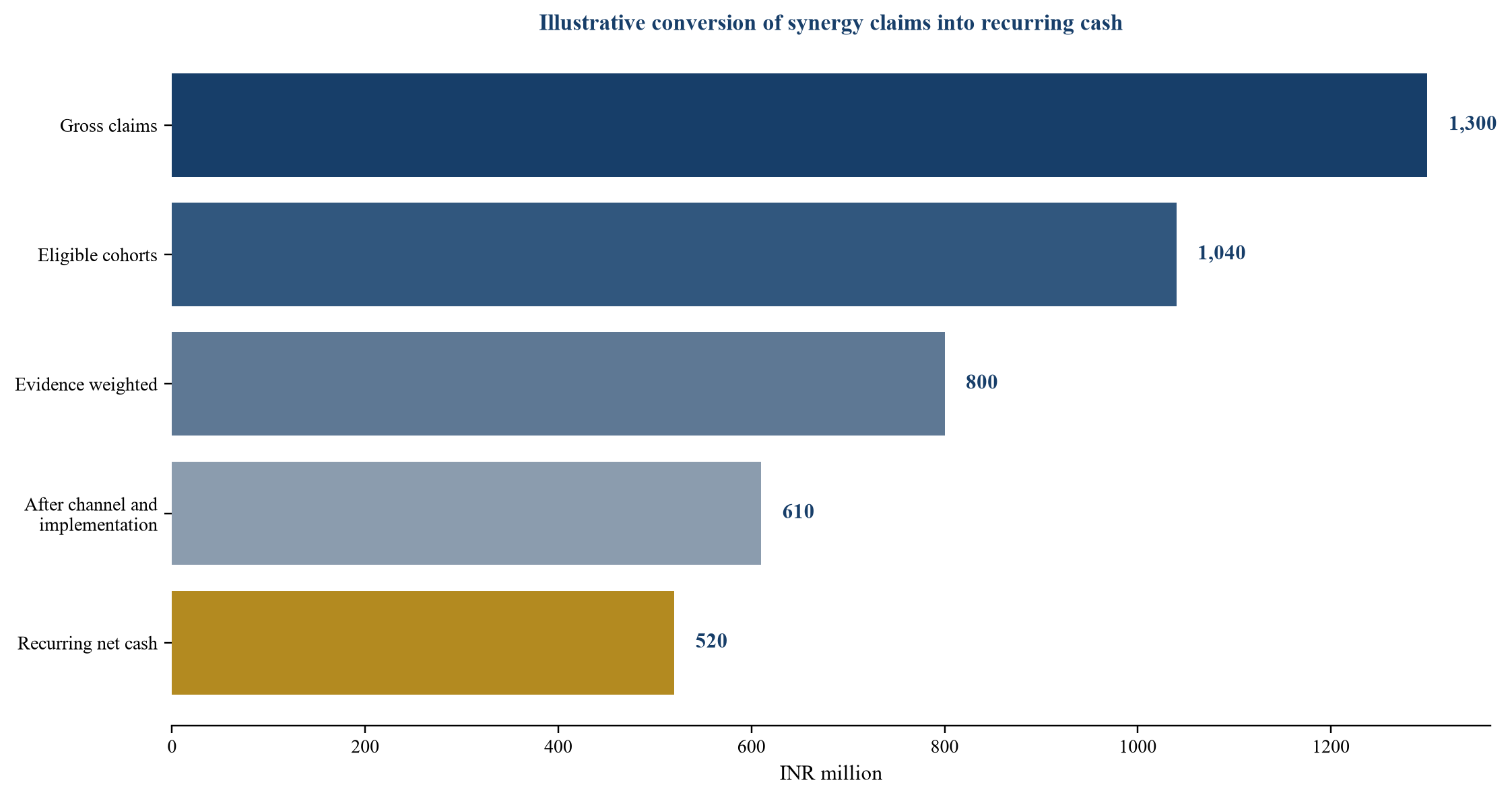
INR millions; management assumptions used solely to demonstrate the method.
15 Construct the valuation bridge
Valuation should begin with sustainable earnings from currently accepted workflows. Separate components can then reflect contracted growth with completed deployment evidence, evidence-weighted synergies, remediation, integration, concentration, working capital, net debt and other claims. The bridge should avoid assigning a software multiple to implementation revenue or a clinical premium to an unvalidated feature.
The base multiple should be tested against growth, retention, evidence quality, market position, implementation burden, customer concentration and continuing investment. Public-company and transaction multiples need adjustments for scale, liquidity, business mix, date, geography and disclosure. A disclosed acquisition price rarely provides enough information to establish comparable earnings or product evidence.
The hypothetical case applies fourteen times sustainable EBITDA of INR 650 million, creating INR 9.10 billion. It adds INR 1.80 billion of evidence-weighted synergy present value and deducts INR 2.60 billion for integration, remediation and distribution risk, giving INR 8.30 billion. This is arithmetic for the framework. It is not a view on a company or market price.
The board should also review downside and severe cases. These may include loss of a major channel, delayed regulatory action, lower adoption, higher surveillance cost, a data-right restriction or required product withdrawal. Valuation should be linked to transaction protections where the uncertainty can be allocated.
| Component | Amount | Evidence gate |
|---|---|---|
| sustainable EBITDA | 0.65 | accepted workflow cohorts and recurring cost base |
| illustrative multiple | 14.0x | risk and growth characteristics after normalisation |
| value of sustainable earnings | 9.10 | arithmetic product of the two assumptions |
| evidence weighted synergy present value | 1.80 | use-case customer timing and net-cash support |
| integration and clinical remediation | -1.05 | costed workplan with accountable owners |
| distribution and concentration risk | -0.85 | contract and cohort downside |
| data regulatory and cyber risk | -0.70 | unresolved rights controls and contingency |
| illustrative transaction value | 8.30 | management scenario for method only |
INR billions; management assumptions used solely to demonstrate the framework.
16 Test competition and product bundling
Healthcare AI competition includes specialist vendors, hospital-built tools, equipment manufacturers, information-system suppliers, outsourced clinical services and manual work. The relevant alternative is the method a customer can adopt within its budget, infrastructure and governance.
The buyer should compare evidence, workflow depth, integration, implementation time, total cost, switching effort and accountable service. A model with higher benchmark performance may lose to a product with reliable integration and strong clinical operations. A lower-priced tool can become expensive when the hospital must provide data cleaning, monitoring and support.
Bundling changes bargaining power. A device manufacturer can include software with equipment. A hospital platform can add an AI function within a wider contract. An imaging network can build internal workflow intelligence from its scale. The target should demonstrate which element remains differentiated when AI capability becomes a feature.
The diligence team should examine tender losses, price concessions, replacement history, proof-of-concept conversion and reasons for non-renewal. It should also assess freedom to operate and third-party dependencies. Competitive advantage should be supported by accepted workflow, evidence assets, contractual access and learning that the buyer can continue.
17 Identify model and supplier dependencies
Products may depend on foundation models, cloud providers, annotation platforms, device manufacturers, data vendors, external clinical services and open-source components. These dependencies can affect cost, performance, security, availability, regulatory evidence and exit rights.
The buyer should inventory each material model and supplier, including purpose, version, contract, pricing, location, data use, service level, audit right, change notice, subcontractors, incident history and termination assistance. It should identify components that cannot be reproduced or substituted within the validation basis.
A foundation-model change can alter output without a change to the target's application code. The target should pin versions where appropriate, maintain evaluation suites, monitor production and control release. Prompt records and guardrails are part of the configuration. A vendor statement of safety cannot replace target-specific validation.
Supplier concentration should enter the cash model. The buyer should stress price increases, usage growth, service interruption and migration. It should distinguish the cost of technical replacement from the wider cost of clinical revalidation and customer acceptance.
18 Protect clinical leadership and accountable governance
Healthcare AI requires governance across product, engineering, clinical, regulatory, quality, privacy, security and commercial functions. An acquisition can weaken control when key clinicians leave, founders hold undocumented decisions or integration assigns authority to teams without the required competence.
The buyer should map material responsibilities and evidence. It should identify who approves intended use, protocols, datasets, thresholds, releases, customer configurations, incidents, safety actions and regulatory communications. Committees should have defined authority, quorum, conflicts and records.
Key-person analysis should cover clinical credibility, customer relationships, regulatory history, dataset knowledge and incident response. Retention packages should align with safe transfer and measurable integration work. The buyer should avoid incentives that reward deployment volume without evidence and safety gates.
Independent challenge is necessary for material claims. Clinical and quality staff should be able to stop deployment or require remediation. Board reporting should include unresolved evidence gaps, serious incidents, model drift, overdue corrective actions, channel concentration and cash conversion.
19 Translate diligence findings into transaction protections
Transaction documents can allocate risks that are clearly defined and measurable. Representations may address licences, intended-use claims, clinical evidence, data rights, privacy, security, intellectual property, complaints, adverse events, regulatory communications, contracts and financial records. Disclosure should identify exceptions at product and customer level.
Conditions can require regulatory consents, change-of-control approvals, key data licences, channel continuity, remediation of critical vulnerabilities and delivery of evidence records. Holdbacks, escrow, indemnities or contingent consideration can address defined exposures subject to legal advice.
Earn-outs should use measures that the parties can observe and control. Revenue alone can reward unsupported deployment or discounting. A stronger structure can combine collected revenue from specified accepted products with renewal, quality and evidence conditions. The agreement should define product versions, customer cohorts, allocation of integration cost and treatment of withdrawals or safety actions.
The buyer should retain the ability to take necessary patient-safety and regulatory action without distorting contingent consideration. Governance for earn-out disputes should use preserved source records and independent expertise where needed.
20 Integrate by intended use cohort
Integration should proceed by product and intended-use cohort. Shared administration can move early. Clinical workflows, models, data and quality records require evidence gates. The buyer should preserve the deployed configuration until it can demonstrate that a change remains safe, compliant and accepted.
The integration map should cover legal entity, quality system, regulatory ownership, clinical governance, data controllers, infrastructure, identity, interfaces, support, incident response, customer contracts and billing. It should identify where temporary separation is necessary.
Each cohort should have a baseline for performance, availability, adoption, incidents, support cost, revenue and cash. Changes should be tested against that baseline. A customer migration should include technical validation, clinical acceptance, training, rollback and post-change monitoring.
Value capture should follow accepted migration. Procurement saving can be recognised when contracts change. Infrastructure saving can be recognised after capacity and resilience tests. Cross-sell value can be recognised after deployment, acceptance and collection. This sequencing protects the evidence chain.
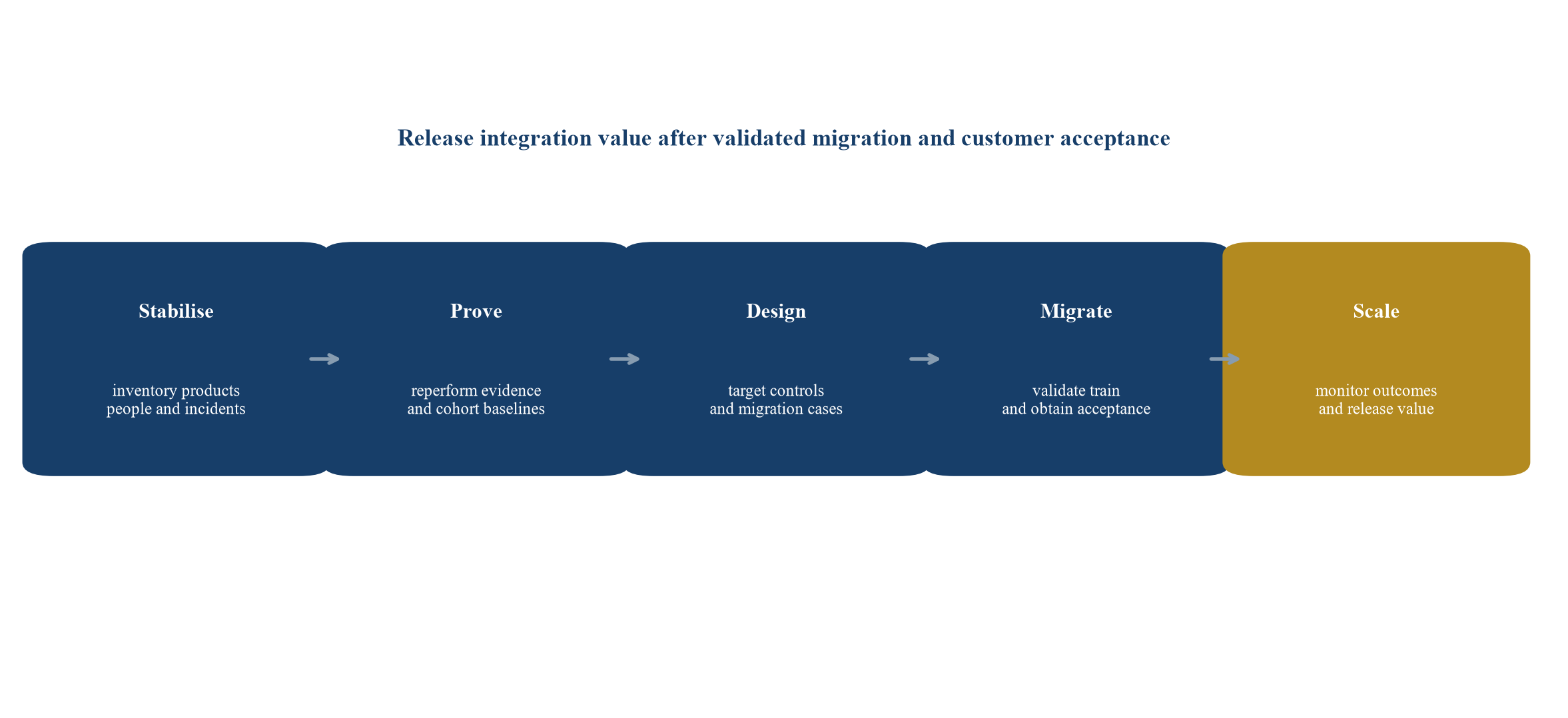
Proposed roadmap; actual timing depends on regulatory customer clinical and technical requirements.
21 Execute the first one hundred days
The first thirty days should stabilise the evidence and control environment. Management should freeze undocumented product changes, reconcile the product and model inventory, confirm clinical and regulatory owners, protect source records, review serious incidents and contact priority customers. Critical vulnerabilities and continuity risks should receive immediate action.
Days thirty-one to sixty should reperform validation and economics for material cohorts. Teams should trace selected cases, reconcile performance and incident data, validate data rights, review interfaces, rebuild sustainable EBITDA and test distribution contracts. The integration office should publish use-case-specific migration gates.
Days sixty-one to one hundred should launch controlled integration. Shared services can move where dependencies are understood. Product migrations should begin with a low-risk cohort and documented acceptance criteria. Customer and regulator communications should be approved through accountable functions.
The board should receive a baseline, unresolved risk register, cash bridge, synergy evidence funnel and integration decision log. Value should be released only where the corresponding evidence exists. This creates a record for later impairment, financing and exit decisions.
| Period | Required actions | Evidence gate | Board decision |
|---|---|---|---|
| days 1 to 15 | secure records confirm owners review serious incidents and continuity | complete product model customer and risk inventories | approve immediate safety and continuity actions |
| days 16 to 30 | reconcile regulatory status data rights contracts and key people | exceptions quantified with accountable owners | approve stabilisation budget and retained separation |
| days 31 to 60 | reperform validation cohort economics and integration dependencies | material claims trace to source evidence and cash | approve target operating model and migration cases |
| days 61 to 80 | conduct controlled migrations training and acceptance testing | signed acceptance rollback and monitoring records | release cohort-specific integration spend |
| days 81 to 100 | measure outcomes incidents collections and synergy | baseline comparison and unresolved variance | release evidenced value and defer unsupported claims |
Proposed sequence; responsibilities and timing should be adapted to the transaction.
22 Operate a board scorecard
The scorecard should connect safety, evidence, adoption and cash. Clinical measures can include eligible cases, completed use, performance at the approved operating point, subgroup results, overrides, serious incidents, downtime and overdue corrective actions. Commercial measures can include active sites, adopted departments, renewal, net retention, implementation backlog, support cost, days sales outstanding and collected cash.
The board should see versions and cohorts. Group averages can hide a failing product or site. Measures should identify the intended use, model version, period, denominator and data source. Changes to definitions should be documented.
Thresholds should lead to actions. A drift trigger may require review or revalidation. A serious incident may require suspension and notification. Falling adoption may require workflow redesign. Delayed collections may require channel or contract action. The scorecard should record the owner and closure evidence.
Financing covenants and earn-out measures should use reconciled definitions. A metric designed for product management may not be suitable for legal payment or debt service. The board should approve the purpose and controls for each externally consequential measure.
23 Control generative and agentic functions
Generative systems can draft notes, summarise records, answer questions or coordinate workflow. Agentic systems can select tools and take actions across systems. Their value depends on bounded purpose, source access, approval and retained evidence.
The buyer should identify where generated text can enter a clinical or billing record. It should test source attribution, omission, contradiction, prompt injection, data leakage, inappropriate certainty and unsafe recommendation. Output should be reviewable and correctable. Material actions should require explicit authority and preserve the evidence considered.
Agents should operate through least-privilege permissions, approved tools, transaction limits, policy checks and complete logs. The target should separate development experiments from production and prevent hidden model or prompt changes. A human approval should correspond to a meaningful decision, rather than a routine click after automation has already acted.
WHO has called for clear evidence of benefit before widespread routine use of large language models in healthcare, and NIST provides risk-management resources for AI and generative AI [9-10,17-18]. These materials support disciplined governance. Product-specific evaluation remains necessary.
24 Segment hospitals laboratories imaging networks and payers
Distribution and value vary by customer. Large hospital groups may demand integration, security, evidence and enterprise procurement, while offering multi-site expansion. Smaller providers may value hosted deployment and operational support, with higher service cost. Laboratories and imaging networks can provide concentrated volume and standardised workflow. Payers may focus on utilisation, fraud or care management and require different evidence.
Public-sector deployment can increase reach and health-system relevance. It can also involve formal procurement, localisation, accessibility, reporting and payment requirements. The buyer should verify contract scope and avoid treating programme announcements as cash.
Each segment should have a separate acquisition case covering clinical problem, buyer, user, budget, workflow, evidence, implementation, pricing, channel and collection. The same product can have attractive economics in one segment and poor economics in another.
The roll-up strategy should prioritise combinations that share real operating capabilities. Common clinical operations, connectors or channels can support value. Superficial use of AI or healthcare branding does not create integration logic.
25 Stress financing and liquidity
Acquisition debt should be sized to recurring cash after essential clinical and control costs. The lender should not rely on gross synergy, capitalised development or uncollected public-sector revenue. Debt service should be tested against customer concentration, renewal, implementation delay, product suspension, remediation and working-capital stress.
The model should distinguish unrestricted cash from customer, regulatory or operational reserves. It should include costs of incident response, required studies, cyber remediation and replacement of critical suppliers. A delay in evidence or approval can defer revenue while costs continue.
Financing documents should avoid incentives that conflict with patient safety. Management should retain authority and liquidity to suspend a product, notify customers and remediate. Information undertakings can cover material regulatory action, serious incidents, cybersecurity events and withdrawal of major channels.
The board should maintain a downside funding plan before closing. It may include additional equity, deferred consideration, seller support or a committed facility. The plan should state trigger, amount, authority and time to cash.
26 Preserve exit and separation readiness
Exit value depends on the buyer's ability to prove what it owns and how the products operate. The group should maintain a current product and model inventory, approvals, clinical evidence, data rights, quality records, customer cohorts, contracts, financial bridge and incident history. These records also support continuing governance.
Integration should preserve separability where licences, regulatory ownership or customer commitments require it. Shared infrastructure and data should have documented allocation and export. A product sale should be possible without reconstructing years of evidence.
The buyer should track value creation against the acquisition baseline. Improvements in clinical evidence, workflow adoption, retention, implementation cost, safety and cash should be documented. An exit narrative without this record can be challenged during diligence.
Separation planning should include transition services, data return or deletion, model rights, quality and regulatory handover, key people, customer consents and continuity. These requirements affect the value of a later sale or carve-out.
27 Conclusion and limitations
Healthcare AI consolidation in India can create value when the combined group owns accepted clinical workflows, reproducible evidence, durable distribution and recurring cash. The acquisition unit should be the intended use and customer cohort, because evidence, risk and economics vary at that level.
The framework connects intended use, clinical validation, human factors, data rights, interoperability, post-market control, distribution, sustainable earnings and integration. It converts broad AI claims into questions that transaction teams can test. It also protects the continuing cost of clinical evidence and safety from premature synergy reductions.
The hypothetical figures demonstrate arithmetic only. They do not describe a company, market forecast or transaction. The regulatory and policy sources cited were current at the time of research, and requirements can change. Product classification, validation and contractual rights require current professional review.
The practical decision rule is direct. Price current value from accepted workflows and recurring cash. Treat incomplete validation, revocable distribution, uncertain data rights and untested migrations as contingent value. Release integration benefits after evidence shows that the combined workflow remains safe, adopted and commercially durable.
Sources
- Central Drugs Standard Control Organization. Medical Devices Rules 2017 and amendments. Read the primary source
- Central Drugs Standard Control Organization. Classification of medical device pertaining to Software under Medical Devices Rules 2017. Read the primary source
- Central Drugs Standard Control Organization. Essential Principles for Safety and Performance of Medical Devices. Read the primary source
- Indian Council of Medical Research. Ethical Guidelines for Application of Artificial Intelligence in Biomedical Research and Healthcare. 2023. Read the primary source
- National Health Authority. Ayushman Bharat Digital Mission. Read the primary source
- National Health Authority. Health Data Management Policy. Read the primary source
- National Health Authority. ABDM Sandbox and interoperability resources. Read the primary source
- World Health Organization. Generating Evidence for Artificial Intelligence Based Medical Devices. 2021. Read the primary source
- World Health Organization. Ethics and Governance of Artificial Intelligence for Health. 2021. Read the primary source
- World Health Organization. Regulatory Considerations on Artificial Intelligence for Health. 2023. Read the primary source
- International Medical Device Regulators Forum. Software as a Medical Device Clinical Evaluation. IMDRF SaMD WG N41. Read the primary source
- International Medical Device Regulators Forum. Software as a Medical Device Possible Framework for Risk Categorization. IMDRF N12. Read the primary source
- International Medical Device Regulators Forum. Principles and Practices for the Cybersecurity of Legacy Medical Devices. Read the primary source
- US Food and Drug Administration. Artificial Intelligence Enabled Medical Devices. Read the primary source
- US Food and Drug Administration. Good Machine Learning Practice for Medical Device Development Guiding Principles. Read the primary source
- US Food and Drug Administration. Predetermined Change Control Plans for Artificial Intelligence Enabled Device Software Functions. 2025. Read the primary source
- National Institute of Standards and Technology. Artificial Intelligence Risk Management Framework 1.0. 2023. Read the primary source
- National Institute of Standards and Technology. Artificial Intelligence Risk Management Framework Generative Artificial Intelligence Profile. 2024. Read the primary source
- International Organization for Standardization. ISO 13485 Medical devices quality management systems. Read the primary source
- International Organization for Standardization. ISO 14971 Medical devices application of risk management. Read the primary source
- Health Level Seven International. FHIR Overview. Read the primary source
- Digital Imaging and Communications in Medicine. DICOM Standard. Read the primary source
- International Electrotechnical Commission. IEC 62304 Medical device software software life cycle processes. Read the primary source
- International Electrotechnical Commission. IEC 62366-1 Medical devices application of usability engineering. Read the primary source
- Government of India. Digital Personal Data Protection Act 2023. Read the primary source
- Ministry of Electronics and Information Technology. Digital Personal Data Protection Rules 2025. Read the primary source
- Ministry of Health and Family Welfare. Telemedicine Practice Guidelines. Read the primary source
- European Union. Regulation EU 2024 1689 Artificial Intelligence Act. Read the primary source
- European Commission Medical Device Coordination Group. MDCG 2019-11 Guidance on Qualification and Classification of Software. Read the primary source
- European Commission Medical Device Coordination Group. MDCG 2020-1 Guidance on Clinical Evaluation of Medical Device Software. Read the primary source
- Medicines and Healthcare products Regulatory Agency. Software and AI as a Medical Device Change Programme. Read the primary source
- UK National Institute for Health and Care Excellence. Evidence Standards Framework for Digital Health Technologies. Read the primary source
- US Food and Drug Administration. Clinical Decision Support Software Guidance. Read the primary source
- US Food and Drug Administration. Cybersecurity in Medical Devices Quality System Considerations and Content of Premarket Submissions. Read the primary source
- World Health Organization. Guidance on Large Multi Modal Models for Health. 2024. Read the primary source
- World Health Organization. WHO Calls for Safe and Ethical AI for Health. 2023. Read the primary source
- CONSORT AI Extension. Reporting Guidelines for Clinical Trials Evaluating AI Interventions. Nature Medicine. 2020. Read the primary source
- SPIRIT AI Extension. Protocol Guidelines for Clinical Trials Evaluating AI Interventions. Nature Medicine. 2020. Read the primary source
- STARD AI Steering Group. STARD AI reporting guidance project. Read the primary source
- TRIPOD AI Steering Group. TRIPOD AI reporting guidance. Read the primary source
- DECIDE AI Steering Group. DECIDE AI reporting guideline for early stage clinical evaluation. Nature Medicine. 2022. Read the primary source
- World Health Organization. Classification of Digital Health Interventions v1.0. Read the primary source
- World Health Organization. Global Strategy on Digital Health 2020 to 2025. Read the primary source
- International Organization for Standardization. ISO IEC 42001 Artificial intelligence management systems. Read the primary source
- International Organization for Standardization. ISO IEC 23894 Artificial intelligence risk management. Read the primary source
- International Organization for Standardization. ISO 27001 Information security management systems. Read the primary source
- International Organization for Standardization. ISO 27701 Privacy information management. Read the primary source
- Institute of Electrical and Electronics Engineers. IEEE 7000 Model Process for Addressing Ethical Concerns During System Design. Read the primary source
- World Medical Association. Declaration of Helsinki Ethical Principles for Medical Research Involving Human Participants. Read the primary source
- Council for International Organizations of Medical Sciences. International Ethical Guidelines for Health-related Research Involving Humans. Read the primary source
