

Introduction
Semiconductor manufacturing equipment operates inside tightly controlled production environments. A failed vacuum pump, contaminated chamber, inaccurate metrology result, unavailable software licence or delayed replacement part can affect wafer starts, yield and customer commitments. Equipment vendors therefore sell a continuing capability rather than a single machine. Public filings describe service businesses that maintain availability, improve productivity, supply parts, deliver upgrades, extend system life and support installed tools across multiple technology generations [1-12].
Carve-outs make this operating model difficult to see. Product development may sit in one legal entity, field engineers in another, parts depots in a shared logistics network, software licences in a corporate platform, and customer contracts in regional subsidiaries. Remote diagnostics may depend on group cybersecurity, identity and data infrastructure. Revenue can be booked by the product division while support costs are allocated from central functions. A clean revenue schedule can therefore conceal operational dependencies that must be recreated or contracted before the business can perform independently.
The transaction question is practical: which installed tools can the carved-out business support, under which rights and service levels, at what cost, with which people, parts, software and regulatory permissions, and how reliably will those activities convert into cash? This paper provides a diligence, valuation, separation and integration framework for answering that question. It is intended for strategic buyers, private-equity investors, corporate-development teams, lenders, founders and boards. It does not provide engineering, legal, accounting, tax, regulatory or investment advice. Each transaction requires current specialist review.
1 Define the service perimeter before valuing the installed base
The service perimeter should begin with the customer outcome. It includes the activities required to keep a tool safe, available, accurate and productive under the contracted specification. Those activities can include preventive maintenance, break-fix labour, parts, consumables, calibrations, software, remote monitoring, upgrades, refurbishments, applications support and customer training. The perimeter also includes the rights and infrastructure that make delivery possible.
The legal perimeter may differ from the operating perimeter. A regional affiliate may employ field engineers and invoice customers. A central company may own diagnostic software, trademarks, repair procedures and technical documentation. A shared procurement organisation may negotiate parts. Group warehouses may pool inventory across product lines. The buyer should create an asset-and-obligation map that assigns each dependency to owned, transferred, licensed, supplied under a transition agreement, replaced before closing or excluded.
The map should separate product warranty from paid service. Warranty cost belongs to the economics of the original equipment sale unless the transaction perimeter explicitly transfers the associated obligation and funding. Paid service should be reconciled to contracts, entitlements, work orders, consumption and cash. Upgrades should be distinguished from maintenance because their demand, margin, timing and revenue recognition may follow different drivers. Refurbished tools and non-leading-edge systems should be modelled separately when they require capital, inventory and acceptance activity.
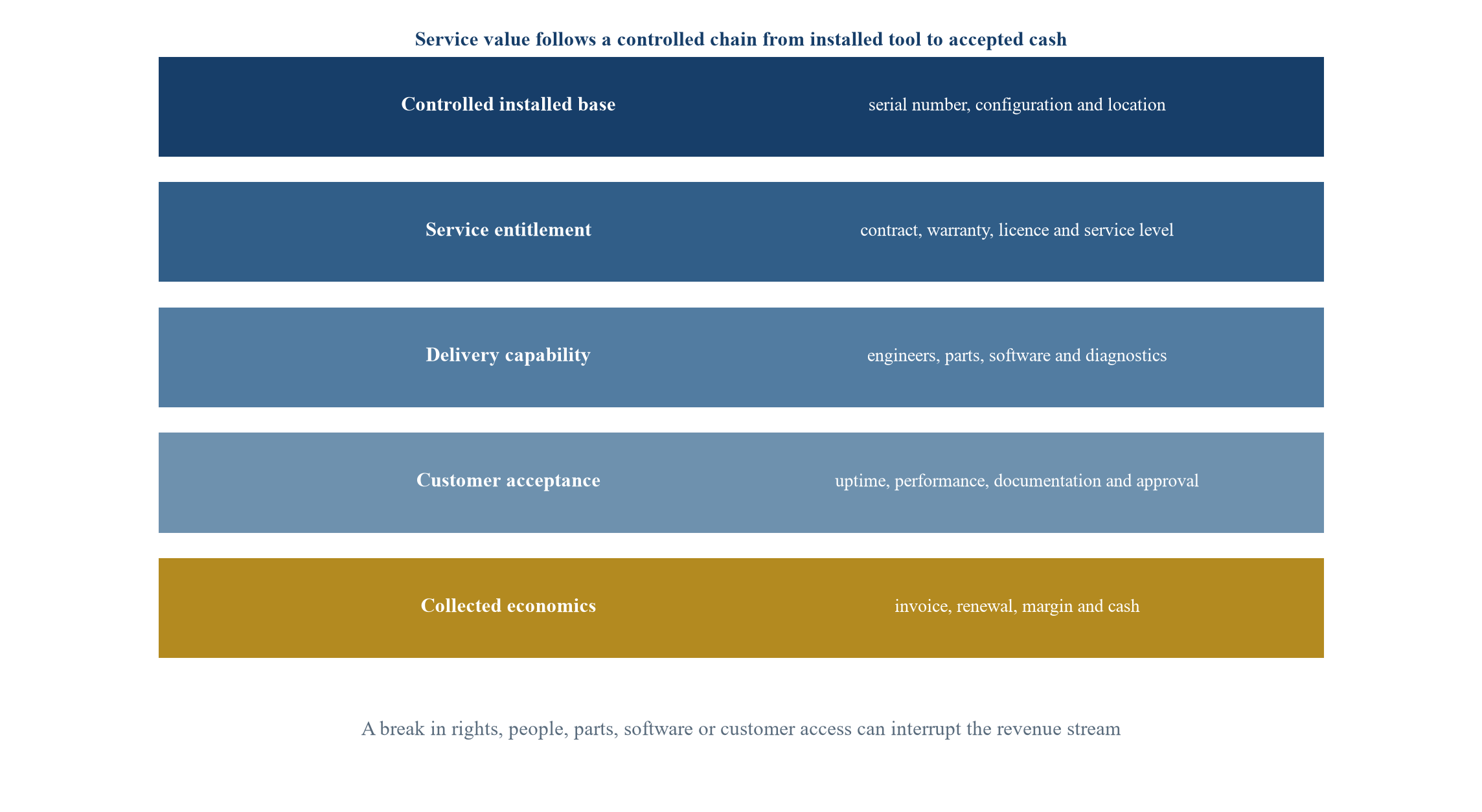
Proposed transaction architecture; value depends on an uninterrupted chain from tool identity to collected service cash.
| Value layer | Minimum evidence | Separation question | Valuation risk |
|---|---|---|---|
| installed tools | serial number, configuration, location, owner, status | can the register transfer and remain current | inactive or unsupported tools inflate the addressable base |
| entitlements | contract, warranty, licence, service level, expiry | which legal entity holds each right and obligation | revenue cannot transfer or requires customer consent |
| delivery | engineers, certifications, procedures, depots, repair routes | which people and assets move at closing | service depends on stranded group capability |
| software and data | source rights, licences, identity, telemetry, cybersecurity | can diagnostics and tool data operate independently | remote service or upgrades cannot continue lawfully |
| economics | work order, invoice, cost, credit, collection, renewal | can revenue and cost be reconstructed by cohort | allocations conceal margin and working-capital needs |
Proposed diligence structure; each revenue stream should reconcile to transferable operating capability.
2 Reconstruct the installed base at serial-number level
The installed base should be a controlled operational register rather than a commercial estimate. Each record should identify tool family, serial number, configuration, software version, customer, fab, jurisdiction, installation date, ownership, warranty status, service entitlement, last service, operating status, utilisation indicator and planned retirement. Duplicate, relocated, cannibalised, idle and decommissioned systems should be resolved before the forecast is built.
The register should reconcile to multiple independent records. Useful sources include shipment and acceptance records, fixed-asset or lease data, customer master files, contract entitlements, field-service work orders, remote connections, parts consumption, software activation and invoices. Differences should be classified and owned. A tool that appears in invoices but lacks an operating record may represent bundled billing, an incorrect serial association or a contract covering several assets. A tool visible in telemetry but absent from contract data may be under warranty, customer-maintained or supported informally.
History should be preserved rather than overwritten. A current configuration can conceal chamber changes, controller replacements, software migrations and relocations that affect parts demand, reliability and service effort. The diligence data model should therefore retain dated configuration events and connect them to work orders, engineering changes and customer acceptance. This history helps the buyer distinguish a structurally expensive cohort from a temporary failure episode. It can also expose revenue credited to an upgrade programme when the underlying work was required to restore contractual performance.
Ownership and service rights require separate fields. A customer can own the tool while the vendor retains software, remote-access or repair rights. A leased or consigned tool can create different obligations. The buyer should identify liens, leases, customer-owned spares, consigned inventory and third-party modules. It should also record tools serviced by distributors or authorised partners, because the economic relationship may depend on territory, exclusivity, margin sharing and access to technical documentation.
Configuration matters because two tools with the same family name can have different chambers, sensors, software, throughput and parts requirements. The buyer should identify the configuration baseline needed to meet each service level. It should also map technology generation and remaining service life. Mature tools can support profitable service for many years, while obsolescence, component end-of-life or unavailable expertise can require inventory investment and engineering work.
Management assumes 4,800 active tools in the illustrative perimeter. Reconciliation removes 160 retired or duplicate records, adds 110 tools evidenced through service activity, and classifies 3,350 tools as contracted, 620 as time-and-material, 390 as warranty, and 390 as customer-maintained or unsupported. These values are assumptions. The method requires every classification to link to evidence and a dated owner.
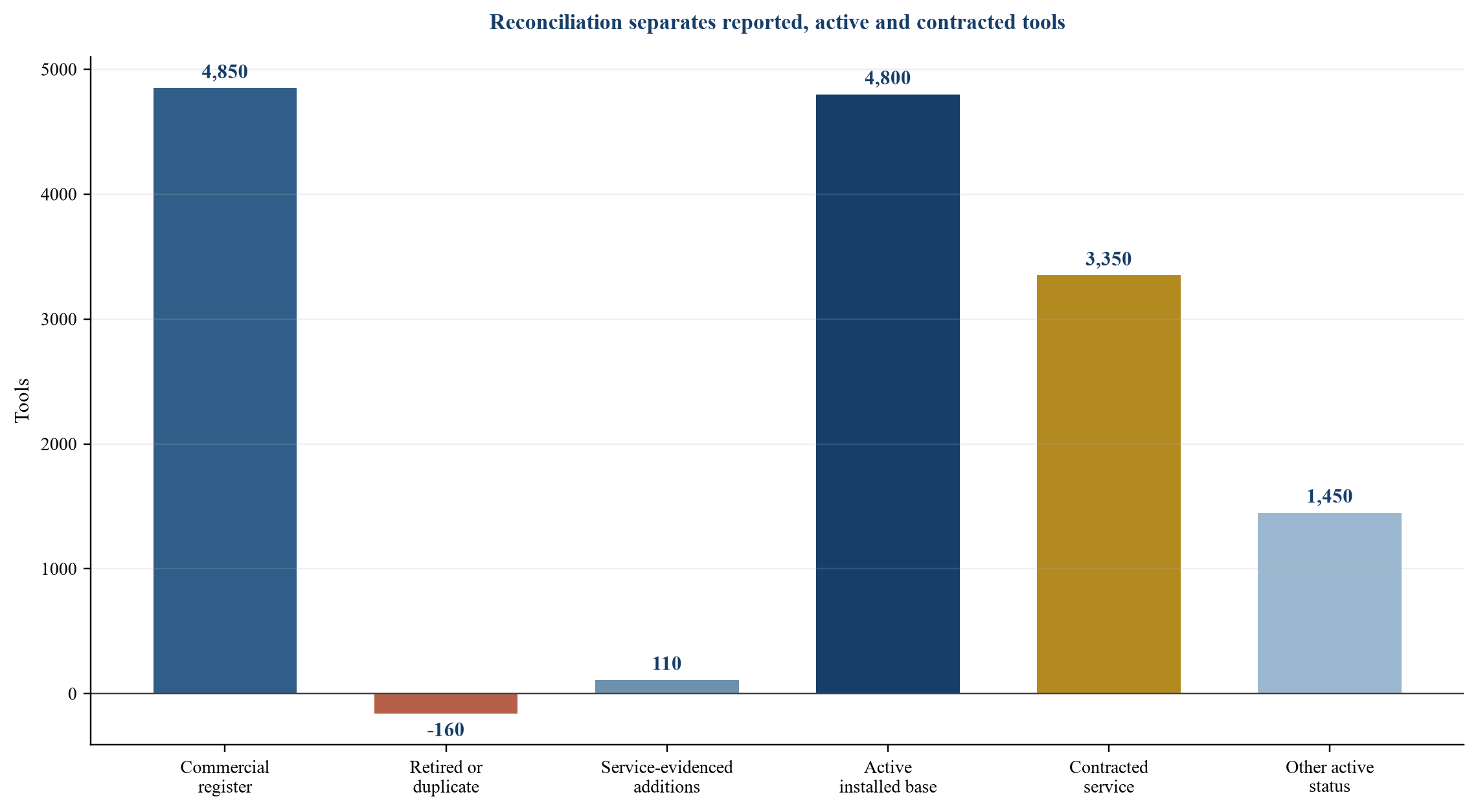
Tool counts are management assumptions used solely to demonstrate the method.
3 Separate recurring contracts from usage-driven and project revenue
Service revenue can contain different economic behaviours. Fixed-price maintenance contracts may renew annually and include defined labour, remote support and selected parts. Time-and-material work depends on failures and customer purchasing. Consumables and spares can follow tool utilisation. Upgrades can be discretionary projects connected to productivity, process change or obsolescence. Refurbished tool sales can be cyclical and capital intensive. Software subscriptions can be recurring while implementation work remains project based.
The buyer should classify every revenue line by contract type, performance obligation, trigger, duration, renewal mechanism, termination right, indexation, service level, parts inclusion and customer acceptance. IFRS 15 and ASC 606 require revenue to follow identified performance obligations and transfer of control [21-24]. The transaction model should remain consistent with the accounting evidence while adding a commercial view of repeatability and cash conversion.
Contracted does not always mean recurring. A multi-year agreement can permit cancellation, volume reset or scope reduction. A framework agreement can require separate purchase orders. A customer can perform more maintenance internally or move to a third party, a risk ASML identifies for installed-base revenue [1]. Revenue should therefore be grouped into enforceable committed value, expected renewal from evidenced behaviour, utilisation-linked demand, upgrade options and non-recurring projects.
The forecast should avoid applying a single multiple to the entire service line. Fixed recurring contracts with high renewal, stable cost-to-serve and strong cash collection can support a different valuation than volatile upgrade projects or parts sales exposed to tool utilisation. Each stream should have its own cohort, margin, working-capital and risk assumptions.
| Revenue stream | Primary driver | Minimum evidence | Valuation treatment |
|---|---|---|---|
| fixed maintenance | covered tools, service level and renewal | executed contract, entitlement, work orders, invoices, renewal history | contracted term plus evidence-weighted renewal |
| time and material | failures, labour hours and callouts | work order, rate card, engineer time, acceptance, invoice | activity-based forecast with volatility |
| spares and consumables | utilisation, wear and replacement cycle | part-to-tool map, issue record, price, cost, return history | cohort consumption and working-capital model |
| software | licensed modules, connected tools and renewal | entitlement, activation, usage, support, renewal | recurring only where rights and use are evidenced |
| upgrades | productivity, obsolescence and process change | customer case, bill of materials, acceptance, margin | probability-weighted project pipeline |
| refurbished equipment | demand for mature-node capacity | inventory, refurbishment scope, order, acceptance | separate capital and cycle model |
Proposed classification; contract language and observed behaviour should control the treatment.
4 Build cohort economics by tool family, generation and customer
Installed-base economics should be modelled by cohorts that share operational and commercial behaviour. Useful dimensions include tool family, generation, age, configuration, customer, fab, geography, service contract, utilisation and field-support model. A portfolio average can conceal a mature cohort with high parts demand, a newer cohort under warranty, or a restricted geography where service permissions are uncertain.
Revenue per tool should be reconciled to contract price, parts, labour, software and upgrades. Cost per tool should include direct labour, travel, parts, logistics, repair, remote support, software hosting, technical escalation, warranty leakage and allocated infrastructure that must exist in the stand-alone business. The model should distinguish avoidable corporate allocations from real capabilities that require replacement.
Management assumes annual service and parts revenue of USD 920 million in the illustrative case. It assumes USD 610 million of contracted maintenance and software, USD 184 million of parts and time-and-material activity, and USD 126 million of upgrades. Direct and attributable delivery cost is assumed at USD 592 million. Stand-alone functions and systems add USD 90 million, producing USD 238 million of service EBITDA before separation investment. These amounts are management assumptions.
The buyer should compare billed, recognised and collected revenue. Advance billing can create deferred revenue and cash benefits. Parts and field labour can create inventory and receivable requirements. Credits, penalties and free remediation reduce realised price. Currency and local tax can affect cash by jurisdiction. The cohort model should therefore bridge revenue to contribution, EBITDA, working capital and free cash flow.
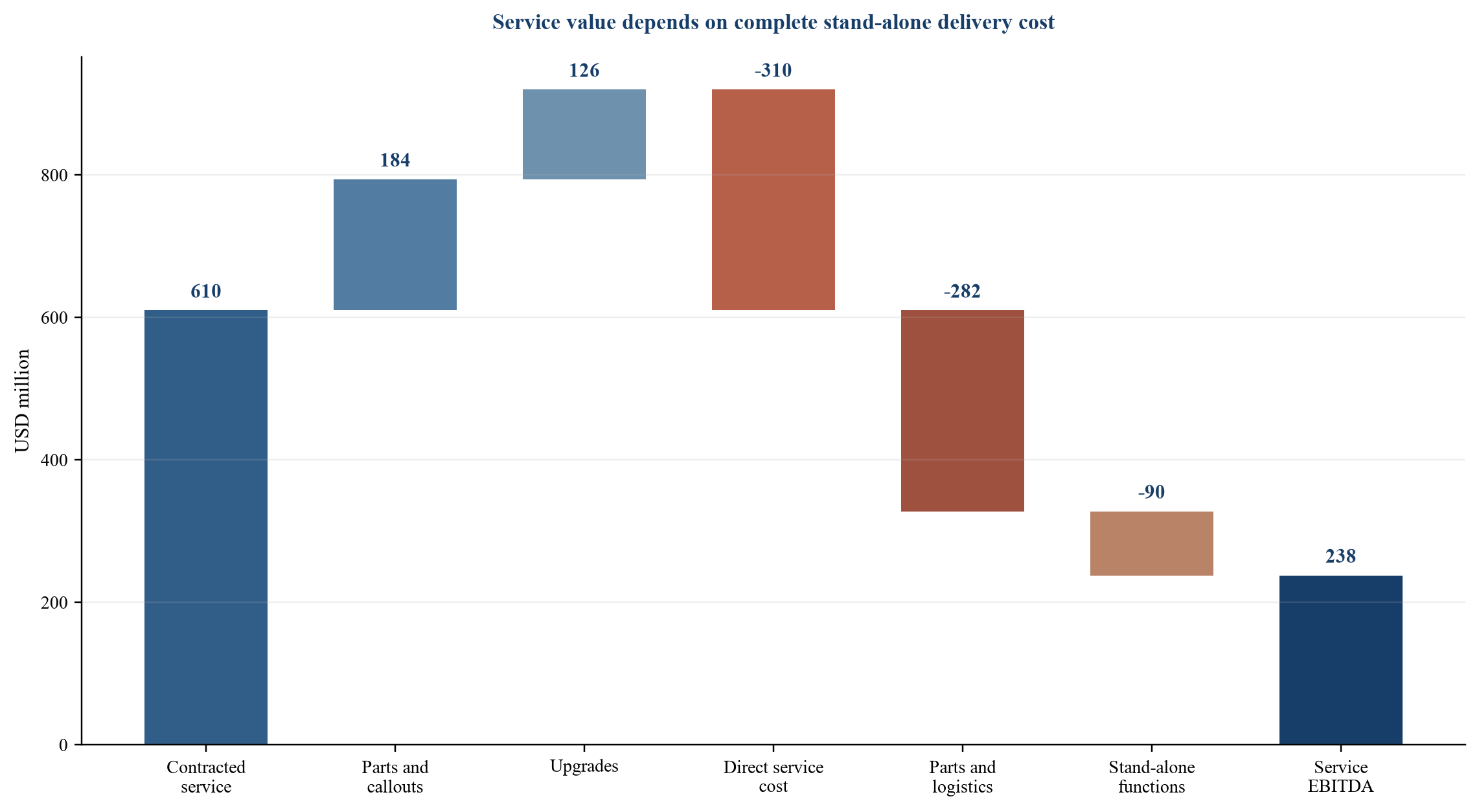
All amounts are management assumptions in USD millions and do not describe an identified company.
| Cohort | Active tools | Contract attach | Annual service revenue per active tool | Contribution margin | Principal risk |
|---|---|---|---|---|---|
| leading-edge process | 1,050 | 86% | USD 330,000 | 45% | customer concentration and rapid roadmap change |
| advanced packaging | 720 | 78% | USD 245,000 | 40% | application support and configuration diversity |
| mature-node production | 1,840 | 63% | USD 135,000 | 33% | component obsolescence and third-party competition |
| specialty and research | 690 | 49% | USD 82,000 | 24% | low density and high travel cost |
| inactive or customer-maintained | 500 | 0% | nil in central case | not applicable | register overstatement and unsupported optionality |
Values are management assumptions used to demonstrate the calculation.
5 Test attach, renewal, coverage and service-level performance
Contract attach should be measured as contracted serviceable tools divided by eligible active tools, with warranty and customer-maintained tools shown separately. The denominator matters. Including retired tools depresses attach; excluding eligible customer-maintained tools inflates it. The buyer should reproduce attach by family, age, customer and geography, then explain changes through pricing, product reliability, customer capability and competitive alternatives.
Renewal should follow contract cohorts rather than a blended percentage. The analysis should show gross renewal by tools, recurring revenue and customers, together with price, scope, cross-sell, contraction and churn. Renewal can appear strong when customers consolidate contracts or when price offsets tool retirement. A proper bridge separates retained tools, additions, removals, price, scope and service credits.
Service-level performance connects revenue quality to operational capability. Relevant measures include response time, mean time to repair, planned-maintenance completion, first-time fix, parts fill rate, remote resolution, uptime or availability, escalation age, repeat failure, safety events and customer credits. SEMI standards provide industry vocabulary for equipment reliability, productivity, communication and material-control interfaces [31-37]. Contract definitions should control the transaction calculation.
The buyer should test whether reported service metrics cover the same tools and periods as the revenue. A dashboard can exclude customer-caused downtime, waiting for access, parts delays or engineering holds. Those exclusions may be contractually valid while still affecting customer experience and renewal. The investment case should show the reported metric, contractual metric and full operational downtime where evidence permits.
6 Treat spare parts and repair capability as cash-flow infrastructure
Parts availability can determine whether service revenue is deliverable. The buyer should map each critical part to tool configurations, failure mode, supplier, lead time, repair route, shelf life, regulatory classification, substitute and last-time-buy decision. It should identify parts sourced from the seller, manufactured internally, repaired in shared centres or procured through contracts that will not automatically transfer.
Inventory should be analysed as service capacity rather than a balance-sheet total. Stock may include new parts, repaired units, customer-owned consignment, quarantine, obsolete components and cannibalised assemblies. The valuation should use serviceability and demand rather than book value. A part with no forecast demand can remain obsolete even when technically usable. A scarce part for a high-value installed cohort can justify strategic stock above ordinary turns.
Repair loops matter because high-cost modules may circulate through removal, diagnosis, repair, test and return. The buyer should measure turnaround, yield, no-fault-found rates, work in progress, vendor dependency and freight. It should verify ownership and customs treatment at each stage. Separation can interrupt the loop when repair authorisations, test fixtures, software keys or data remain with the seller.
Parts pricing should be reconciled to contract inclusion. A fixed-price service agreement can transfer consumption risk to the provider. Time-and-material sales can create margin when customers bear that risk. Warranty or goodwill replacements can sit inside service operations while economically belonging elsewhere. The model should allocate parts cost to the revenue and obligation that caused it.
7 Preserve software, telemetry and technical-data rights
Modern equipment service depends on software and data. Remote diagnostics, predictive maintenance, calibration, recipe management, parts identification, cybersecurity, entitlement and upgrade delivery can rely on shared platforms. A carve-out must identify the intellectual property, licences, interfaces, infrastructure and customer permissions required to continue each workflow.
The buyer should map software by product, tool generation, deployment model, owner, licence, third-party dependency, security classification and end-of-support date. Source code may remain with the seller under a licence. Compiled software may embed group libraries. Diagnostic tools may require seller identity systems. The separation plan should specify who can modify, sign, distribute, support and audit every relevant component.
Telemetry requires a lawful and secure data model. Tool data may contain customer-confidential process information, equipment health, production timing and security-sensitive detail. Customer contracts and privacy or cybersecurity requirements can restrict transfer and use. The EU Data Act, GDPR, NIST Cybersecurity Framework and IEC 62443 provide relevant governance context [38-42]. The buyer should obtain current legal advice for each jurisdiction and data flow.
Technical documentation should include controlled service manuals, parts catalogues, schematics, change notices, known issues, safety procedures, calibration records and training. Access alone is insufficient when documents are outdated, incomplete or dependent on undocumented expert knowledge. The buyer should test representative repair and escalation workflows using the transferred documentation before closing.
| Dependency | Evidence required | Day-one control | Failure consequence |
|---|---|---|---|
| diagnostic software | ownership, licence, release and signing rights | transferable entitlement and release authority | engineers cannot diagnose or restore tools |
| remote connectivity | customer consent, network route, identity and logs | segregated secure access with tested recovery | remote service stops or creates security exposure |
| telemetry | field definition, purpose, retention and permitted use | lawful data transfer and controlled analytics | predictive service and evidence become unavailable |
| technical documents | controlled versions, completeness and access | transferred repository and change process | repeat repair depends on informal knowledge |
| third-party components | licence, support term and assignment | consent, replacement or transition commitment | software distribution or support becomes unlawful |
Proposed control schedule; rights and customer permissions require transaction-specific legal review.
8 Value the field organisation as a scarce operating asset
Field engineers connect the installed base to customer outcomes. Their value depends on certification, experience, fab access, language, geography, security clearance, product knowledge, escalation networks and willingness to transfer. Headcount alone does not establish capability. The buyer should map named people to tool families, customer sites, shifts and critical procedures.
The organisation should be tested for coverage. The model should compare forecast work demand with productive engineer hours after training, travel, administration, leave and escalation. It should identify single points of failure, on-call obligations, contractor reliance and locations with insufficient density. Hiring plans should include the time and cost required to train an engineer before independent customer work.
Knowledge transfer should be operational. Classroom completion is weak evidence when complex failures require supervised field practice. The carve-out plan should define proficiency gates, access to product engineering, expert escalation and retention for scarce roles. It should also preserve customer relationships without creating prohibited coordination before closing.
Compensation and retention must be included in stand-alone cost. Seller benefits, equity, mobility, overtime and allowances can change after separation. Works councils, consultation, immigration and local employment law can affect timing and transfer. The transaction should use current local advice rather than assuming a uniform global process.
9 Map export-control and sanctions exposure to each service route
Semiconductor manufacturing equipment and associated parts, software, technology and servicing can be subject to export controls. US Bureau of Industry and Security rules address equipment, components, software, technology, installation and servicing activities, with requirements that depend on classification, destination, end user, end use and authorisation [25-30]. The rules change. A historical ability to serve a tool does not prove future permission.
The buyer should create a route-level matrix for equipment, spare parts, diagnostic software, remote access, technical data and people. Each route should identify classification, origin, destination, end user, end use, licence or exception, conditions, reporting, expiry and responsible compliance owner. The model should distinguish revenue that is currently authorised, revenue pending authorisation, revenue dependent on renewal and revenue that management excludes from the central case.
Export controls can affect valuation through more than lost revenue. They can strand inventory, interrupt repair loops, reduce attach, increase local support cost, restrict upgrades, extend downtime and alter customer behaviour. The transaction structure may require excluded assets, licences, covenants, closing conditions, indemnities or contingent consideration. The buyer should avoid assuming that a contractual obligation can be performed when regulatory permission is uncertain.
Sanctions, anti-bribery, customs and local technology-control requirements should be reviewed with the same operational granularity. Distributor or third-party service channels require end-user and conduct evidence. A representation can allocate historical exposure. It cannot substitute for a lawful day-one operating model.
10 Test customer transfer, consent and continuity
Customer relationships can be the most valuable and least transferable part of a carve-out. Contracts should be reviewed for assignment, change of control, subcontracting, data, intellectual property, cybersecurity, audit, service levels, termination, warranty, limitation, pricing and most-favoured terms. Master agreements, local statements of work, purchase orders and informal commitments should be connected to the same entitlement record.
Consent planning should begin with materiality and timing. The team should identify customers that require consent before closing, notification after signing, security approval, new vendor onboarding, tax documentation, data migration or site-access changes. Customer contact must be controlled by the transaction protocol. The plan should state who communicates, when, with which approved information and how objections are escalated.
Continuity evidence should include named customer owners, open escalations, planned shutdowns, upgrade projects, renewal dates, credits, disputes and at-risk tools. The buyer should understand whether service quality depends on seller brand, bundled product relationships or access to a wider product portfolio. Customer interviews, when permitted, should test the value proposition and willingness to contract with the stand-alone business.
The closing plan should protect service during cutover. Customer support numbers, dispatch, remote access, parts ordering, invoicing and escalation should function under the new model. A cutover rehearsal should use real representative scenarios. Every unresolved customer dependency should have an owner, fallback and dated resolution.
11 Build the stand-alone operating model before applying a multiple
Historical profit can omit capabilities supplied by the parent. The buyer should build the stand-alone model from service demand and required capability. Functions can include product engineering, technical support, software release, cybersecurity, quality, regulatory compliance, export control, parts planning, procurement, warehousing, repair, logistics, finance, HR, legal, tax, facilities and IT.
The model should identify current cost, destination cost, one-time separation cost, duplicate running cost and stranded cost. A transition service can bridge timing, but it does not remove the end-state requirement. The agreement should specify service, performance, data, security, price, duration, exit dependency, assistance, audit and remedies. Long or poorly governed transitions can delay autonomy and weaken incentives.
Systems separation should prioritise operational chains. An enterprise-resource-planning cut is incomplete when field dispatch, entitlement, parts, software licences or customer portals fail. The programme should map each customer outcome to applications, interfaces, data, identity and external parties. Cutover should be gated by reconciled tool records, open work orders, parts availability, billing and incident response.
Management assumes USD 92 million of separation and systems investment, including USD 34 million for applications and data, USD 18 million for facilities and depots, USD 16 million for cybersecurity and remote service, USD 14 million for programme and dual running, and USD 10 million for customer and regulatory work. It also assumes USD 90 million of annual stand-alone functions already reflected in central EBITDA. These figures are assumptions.
| Capability | End-state requirement | One-time cost | Principal acceptance gate |
|---|---|---|---|
| service and entitlement platform | independent tool, contract and work-order control | USD 22m | installed-base and open-work-order reconciliation |
| parts and logistics | depots, planning, repair routes and customs | USD 18m | fill-rate and repair-loop test |
| remote service and cybersecurity | identity, connectivity, monitoring and incident response | USD 16m | customer-approved secure connectivity |
| finance and billing | order, revenue, tax, receivable and cash control | USD 12m | invoice-to-cash parallel run |
| people and facilities | transferred teams, access, training and locations | USD 14m | roster, access and coverage confirmed |
| programme and contingency | cutover governance and unresolved dependencies | USD 10m | board-approved readiness decision |
Costs are management assumptions and require target-specific scoping.
12 Reconcile revenue recognition, deferred revenue and working capital
Service accounting should be reconstructed by performance obligation and contract. Maintenance may be recognised over time, while parts or upgrades can be recognised at a point in time or over time depending on control and acceptance [21-24]. The buyer should reconcile contract liabilities, unbilled revenue, receivables, credits, warranty provisions and inventory to the transferred obligations.
Deferred revenue is economically important because the buyer may inherit an obligation funded by cash collected before closing. The purchase agreement should define which deferred-revenue balances and related cash transfer, how the working-capital target treats them and whether accounting adjustments affect the price mechanism. The operating model should fund service delivery even when the associated cash remains with the seller.
Inventory and receivables should be tested for quality. Parts should be mapped to active cohorts and demand. Receivables should be reconciled to accepted work, disputes and customer concentration. Contract assets should be supported by enforceable rights and progress evidence. Reserves should be reviewed against ageing, obsolescence, returns and credits.
The cash model should include billing cadence, payment terms, tax, customs, consignment, inventory replenishment, repair work in progress, capital expenditure and transition fees. EBITDA can remain positive while cash is absorbed by parts and separation. Debt capacity should therefore follow recurring collected cash after maintenance capital and working-capital volatility.
13 Value the installed base through evidence-weighted cash flow
Valuation should start with stand-alone service cash flow by cohort. The forecast should model active tools, eligible tools, attach, renewal, price, utilisation, parts, upgrades, cost-to-serve, stand-alone functions, working capital, maintenance capital and separation investment. It should include tool retirement and new installations only when they belong to the transaction perimeter and evidence supports the path.
Management assumes a central service EBITDA of USD 238 million. It assumes USD 1.84 billion of value from contracted and evidence-weighted service cash flows, USD 420 million from upgrade and extension options, USD 210 million from working-capital and operational improvements, and deductions of USD 92 million for separation investment and USD 28 million for regulatory, customer and concentration risk. The illustrative stand-alone enterprise value is USD 2.35 billion. These values are management assumptions and do not describe a market transaction.
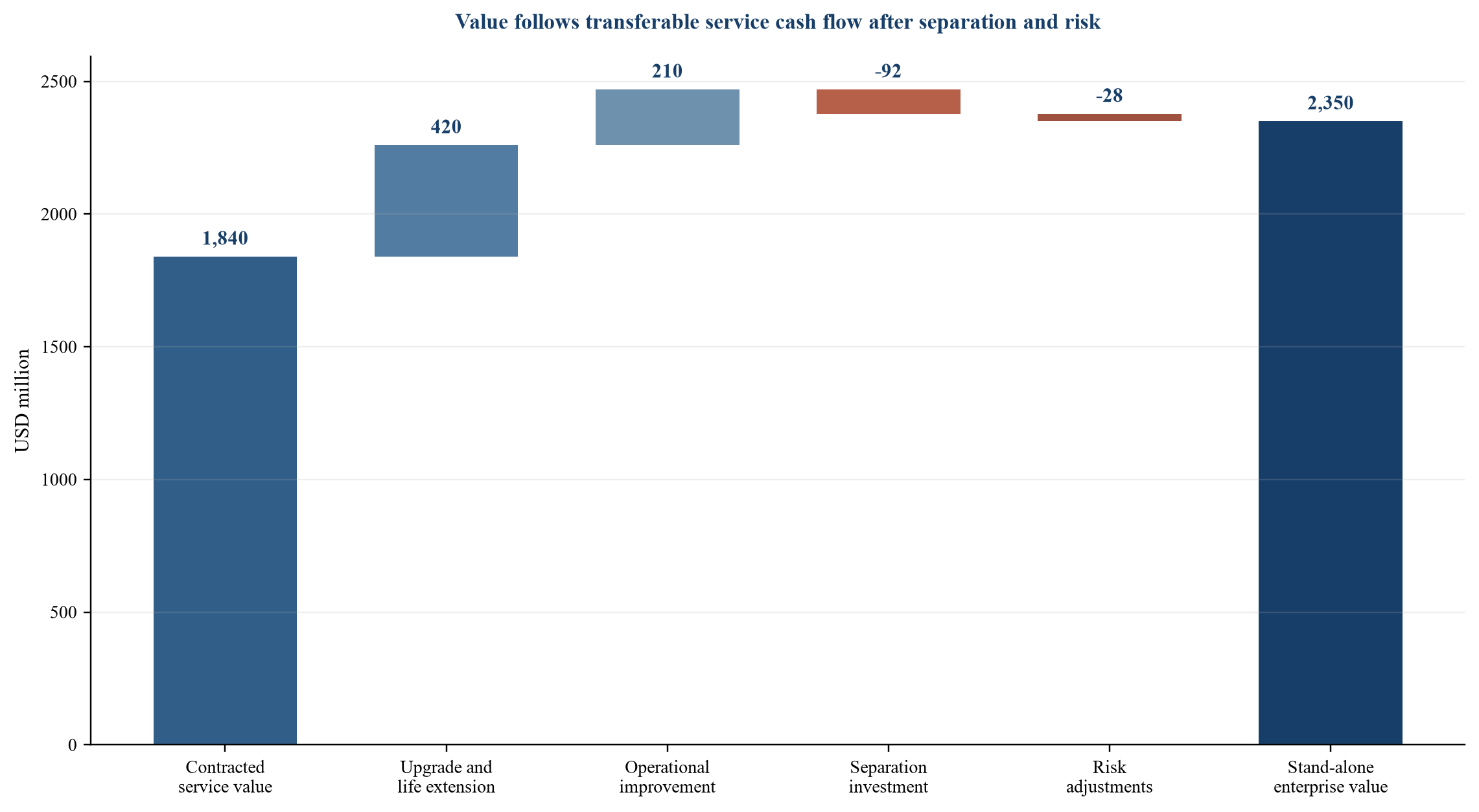
All amounts are management assumptions in USD millions and do not describe an identified company.
Market multiples can provide a reasonableness check after comparability is established. Public equipment companies combine systems, service, software and intellectual property in different proportions. Their growth, margin, capital intensity, customer concentration, product position and geographic exposure differ. A buyer should avoid applying a public-company multiple to a carved-out service line without adjusting for perimeter, stand-alone cost, control, liquidity and execution risk.
The downside case should combine stresses that can occur together. Lower utilisation can reduce parts consumption and upgrades while customer cost pressure weakens renewal price. A delayed software separation can increase transition fees. A licence restriction can interrupt a profitable geography. Parts obsolescence can absorb cash precisely when revenue slows. The model should show the effect on EBITDA, free cash flow, covenant headroom and required equity, rather than applying isolated percentage reductions that ignore operational interaction.
Option value should remain separate from the central case. The installed base may support new analytics, predictive service, productivity software, refurbished-tool programmes or adjacent product sales. The buyer should recognise these opportunities when it has customer permission, technical capability, a funded product plan and evidence of willingness to pay. A conceptual cross-sell path should not be capitalised as recurring service revenue. Milestone valuation or contingent consideration can preserve upside while limiting payment for unevidenced adoption.
14 Separate stand-alone value from buyer-specific synergy
A strategic buyer may create value through parts procurement, depot density, field coverage, software integration, cross-selling, product engineering, repair yield and reduced corporate cost. These benefits belong in a buyer-specific case with named actions, cost, timing and customer constraints. The seller should not receive full payment for synergy that only the buyer can produce.
Synergy can create customer risk. Combining service businesses may reduce platform neutrality, change data access or concern customers about competition. Product overlap can trigger competition review. The US merger guidelines and European merger framework require analysis of concentration, foreclosure, platform effects and competitive harm in applicable transactions [43-46]. Current legal advice is necessary.
The synergy model should show gross opportunity, implementation cost, tax, delay, customer response, regulatory constraints and probability. It should preserve required service levels and avoid assuming immediate workforce or inventory reductions. Service resilience can justify duplicate capability during integration.
Seller dis-synergy also matters. The parent may lose purchasing scale, repair utilisation, shared engineering or customer leverage. These effects can influence the seller's transition commitments and willingness to grant long-term supply or licences. They should be negotiated separately from the target's stand-alone value.
15 Match transaction structure to evidence maturity
Price structure should follow the maturity of the service evidence. Verified contracted tools, transferable entitlements and accepted cash can support closing consideration. Renewal, upgrades, uncertain consents or pending authorisations may suit contingent consideration when metrics can be controlled and measured. Separation investment can be funded through price adjustment, seller completion, escrow or a defined closing balance sheet.
Representations should cover the installed-base register, contracts, entitlements, service levels, credits, parts, inventory, software rights, data permissions, cybersecurity, export controls, regulatory authorisations, workforce, revenue recognition and financial statements. Indemnities or escrows can address identified historical exposures. They do not create operating capability.
Conditions precedent can cover material customer consents, licences, people transfer, software rights, key supply contracts, remote-service approval and transition readiness. Interim covenants can preserve teams, inventory, service quality, contracts, licences and ordinary-course investment. The buyer should maintain lawful separation from pre-closing control.
| Finding | Economic effect | Potential transaction response | Post-closing control |
|---|---|---|---|
| installed-base register not reconciled | eligible tools and attach are uncertain | price adjustment or closing reconciliation | controlled serial-number master |
| major consent outstanding | revenue may not transfer | condition, holdback or excluded contract | customer conversion dashboard |
| shared diagnostic software | service cannot operate independently | licence, seller completion or transition service | release and entitlement governance |
| restricted service route | revenue or parts delivery may be interrupted | excluded value, condition, indemnity or earn-out | route-level compliance control |
| scarce engineers may not transfer | response and repair capacity weakens | retention, offer condition or funded hiring | coverage and proficiency gates |
| parts obsolescence understated | working capital and uptime deteriorate | inventory adjustment and funded last-time buy | cohort demand and obsolescence review |
Proposed structure; legal drafting and remedies require transaction-specific advice.
16 Control the first hundred days around customer continuity
The first hundred days should begin before signing with a frozen baseline of tools, contracts, people, parts, systems, open work orders, customer escalations, consents, licences and cash. The baseline should remain traceable through closing and the first complete billing and renewal cycle.
Day-one readiness should prove dispatch, remote access, parts ordering, customer communication, safety, escalation, billing and incident response. Each critical process should have a primary route, fallback, owner and evidence of rehearsal. Open work orders and inventory movements should reconcile across the cutover.
The first thirty days should stabilise service and data. The buyer should validate tool records, engineer access, parts availability, customer contacts, billing and cybersecurity events. Days thirty to one hundred should move from transition dependency to stand-alone control, prioritising the most material customer and service routes. Transition exits should require evidence rather than elapsed time.
The board should monitor active tools, attach, renewal, service levels, open escalations, parts fill, repair turnaround, engineer coverage, customer consents, restricted routes, billing, cash, separation cost and transition exits. Every metric should compare actual performance with the signing baseline and investment case.
| Control | Day-one evidence | Day-30 evidence | Day-100 evidence |
|---|---|---|---|
| customer continuity | contact, dispatch and escalation routes tested | material customer issues and consents reconciled | renewal and satisfaction actions owned |
| service delivery | open work orders and engineer access transferred | response, repair and repeat-failure trends stable | performance meets approved service thresholds |
| parts | critical stock and ordering routes available | fill, shortage and repair-loop exceptions resolved | inventory policy aligned to cohort demand |
| software and data | diagnostic access and security controls tested | data flows, licences and incidents reconciled | transition dependencies reduced to approved plan |
| billing and cash | invoice and collection routes operational | first close and cash reconciliation completed | recurring revenue and cash bridge validated |
| separation | transition services and exit owners confirmed | exit tests underway with evidence | critical exits completed or board-approved remediation funded |
Proposed board control set; thresholds should follow the actual service contracts and separation plan.
17 Translate diligence into price, terms and funded actions
Diligence creates value when findings change a decision. Every material finding should be classified as a price adjustment, perimeter change, closing condition, contractual protection, transition requirement, funded integration action or monitored risk. The record should identify evidence, financial exposure, timing, owner and approval.
The classification should avoid pushing solvable operating gaps into generic risk language. A missing depot can be costed and built. An unassignable software licence may require a replacement or a different perimeter. An uncertain export permission may require an excluded forecast or conditional structure. A customer consent can become a closing gate or holdback. A service-level failure can change renewal assumptions and working capital.
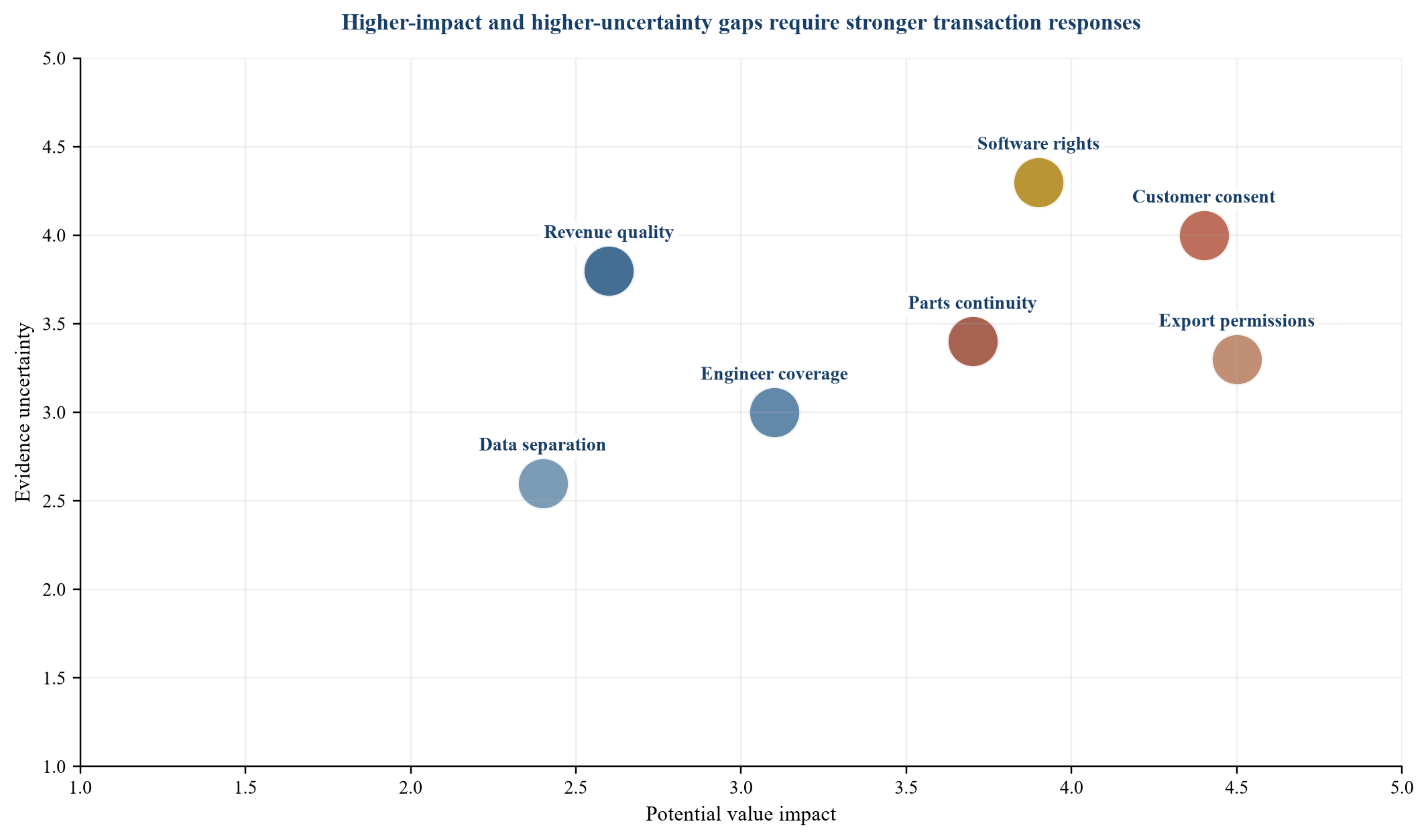
Proposed decision map; position and treatment should be calibrated to target-specific evidence.
The final investment paper should reconcile headline price, net debt, working capital, deferred revenue, separation funding, contingent consideration, retention and integration cost. It should show stand-alone value and buyer-specific value separately. Each major diligence finding should have a visible effect on the model, terms or funded plan.
Conclusion
The installed base can be the central asset in a semiconductor-equipment carve-out because service continues across equipment cycles and protects customer production. Its value depends on more than tool count. The buyer needs a controlled chain from serial-number identity and transferable entitlement through engineers, parts, software, data, regulatory permission, accepted service and collected cash.
The strongest service businesses combine high-quality contracts with operational density, technical depth, parts availability, secure diagnostics, disciplined pricing and trusted customer relationships. Their recurring characteristics must be demonstrated through attach, renewal, service levels, contribution and cash. Upgrade, parts and refurbished-equipment revenue should retain their distinct drivers and capital needs.
The transaction discipline is practical. Define the service perimeter. Reconcile the installed base. Classify revenue. Build cohort economics. Test people, parts, software and permissions. Reconstruct stand-alone cost and cash. Value evidenced service streams. Separate synergy. Choose terms that match the maturity of evidence. Preserve customer continuity through a controlled cutover and the first complete operating cycle.
Sources
- ASML, 2025 Annual Report on Form 20-F, Read the primary source
- ASML, 2025 annual-report financial performance, Read the primary source
- ASML, 2025 fourth-quarter and full-year results, Read the primary source
- KLA, 2025 Annual Report on Form 10-K, Read the primary source
- KLA, fiscal 2025 annual report, Read the primary source
- KLA, fiscal 2025 service-business review, Read the primary source
- Lam Research, fiscal 2025 Annual Report on Form 10-K, Read the primary source
- Lam Research, customer-support business description, Read the primary source
- Lam Research, customer-support revenue disclosures, Read the primary source
- Applied Materials, fiscal 2025 Annual Report, Read the primary source
- Applied Materials, annual reports and proxy materials, Read the primary source
- Applied Materials, Applied Global Services overview, Read the primary source
- Tokyo Electron, annual reports, Read the primary source
- ASM International, annual reports, Read the primary source
- BE Semiconductor Industries, annual reports, Read the primary source
- Teradyne, annual reports, Read the primary source
- Onto Innovation, annual reports, Read the primary source
- Axcelis Technologies, annual reports, Read the primary source
- Veeco Instruments, annual reports, Read the primary source
- SEMI, semiconductor equipment and materials industry resources, Read the primary source
- IFRS Foundation, IFRS 15 Revenue from Contracts with Customers, Read the primary source
- Financial Accounting Standards Board, Accounting Standards Codification Topic 606, Read the primary source
- US Securities and Exchange Commission, Staff Accounting Bulletin No. 104, Read the primary source
- Public Company Accounting Oversight Board, auditing revenue, Read the primary source
- US Bureau of Industry and Security, Export Administration Regulations, Read the primary source
- US Bureau of Industry and Security, EAR Part 744, Read the primary source
- US Bureau of Industry and Security, EAR Part 740, Read the primary source
- US Bureau of Industry and Security, semiconductor manufacturing equipment controls, Read the primary source
- US Bureau of Industry and Security, export-control compliance guidelines, Read the primary source
- Wassenaar Arrangement, control lists, Read the primary source
- SEMI, E10 equipment reliability, availability and maintainability standard, Read the primary source
- SEMI, E30 Generic Model for Communications and Control, Read the primary source
- SEMI, E90 substrate tracking standard, Read the primary source
- SEMI, E95 human interface standard, Read the primary source
- SEMI, E116 performance tracking standard, Read the primary source
- SEMI, E125 equipment self-description standard, Read the primary source
- SEMI, standards catalogue, Read the primary source
- European Union, Data Act, Read the primary source
- European Union, General Data Protection Regulation, Read the primary source
- National Institute of Standards and Technology, Cybersecurity Framework 2.0, Read the primary source
- National Institute of Standards and Technology, Secure Software Development Framework, Read the primary source
- International Electrotechnical Commission, IEC 62443 industrial cybersecurity, Read the primary source
- US Department of Justice and Federal Trade Commission, 2023 Merger Guidelines, Read the primary source
- US Federal Trade Commission, premerger notification programme, Read the primary source
- European Commission, merger-control legislation, Read the primary source
- European Commission, horizontal merger guidelines, Read the primary source
- IFRS Foundation, IFRS 3 Business Combinations, Read the primary source
- IFRS Foundation, IFRS 5 Non-current Assets Held for Sale and Discontinued Operations, Read the primary source
- OECD, transfer-pricing guidelines, Read the primary source
- World Intellectual Property Organization, intellectual-property valuation, Read the primary source
