

1. Define institutionalisation as repeatable fiduciary performance
Institutionalisation is the ability to perform the manager's fiduciary and commercial obligations repeatedly, explain how they are performed, and produce evidence that the stated process actually operated. It concerns investment decisions, conflicts, valuation, cash, ownership records, service providers, portfolio monitoring, regulatory reporting, investor communications, fundraising and continuity. The objective is not to make every emerging manager resemble a large multi-strategy firm. The objective is to make the chosen strategy governable, auditable and resilient at its actual scale.
The founding advantage should remain visible. A manager may possess proprietary access to founders, scientific expertise, operating capability, geographic relationships or an unusual underwriting lens. Institutionalisation protects that advantage by separating judgement from avoidable dependency. A documented process should preserve why the manager wins, how decisions are challenged, which exceptions are permitted and what evidence is retained. Generic policies that do not describe real work can weaken credibility because they create a gap between the diligence answer and observed practice.
LP diligence should be treated as an examination of operating claims. A statement that the team has a disciplined investment process invites questions about sourcing data, screening thresholds, committee materials, recusals, minutes, dissent, conditions, follow-up and realised outcomes. A statement that valuation is independent invites questions about methods, inputs, conflicts, service-provider roles, review and exceptions. The manager should therefore build the platform around claims it can substantiate rather than around the broadest possible marketing language.
ILPA's DDQ 2.0 provides a useful map because it brings succession, investment process, team, governance, compliance, track record, accounting, valuation, reporting, legal, technology and third parties into one diligence architecture.[1] The manager can use those domains as a control inventory while adapting depth to strategy, size, jurisdiction and fund terms.
Table 1. Evidence states for an emerging-manager platform
| Evidence state | Minimum support | Permitted external statement | Required control |
|---|---|---|---|
| design intention | named principle, scope and unresolved assumptions | describe as proposed or in development | approval owner and completion plan |
| approved policy | authorised document, effective date and accountable owner | describe the approved control | version, distribution and training record |
| operating process | completed records from representative cases | describe how the process operates | sample testing and exception register |
| independently supported output | administrator, auditor, legal, valuation or system evidence | cite the relevant independent support precisely | scope, date, limitations and reconciliation |
| realised platform result | repeated delivery across reporting or investment cycles | describe observed operating performance | retained records and periodic board review |
A policy becomes institutional evidence only when ownership, operation and review can be demonstrated.
2. Freeze the strategy, product and obligation baseline
The platform cannot be designed around an undefined fund. Management should freeze a baseline covering strategy, mandate, geography, sectors, stages, instruments, ownership targets, concentration, reserves, follow-ons, liquidity, leverage, co-investment, holding period, return objective, fund size range and portfolio construction. Each item should be connected to governing-document language, investment-decision criteria, data requirements and operating capacity.
The baseline should also describe the legal and operating structure: manager, general partner, fund vehicles, feeders, parallel vehicles, carry entities, advisory committee, administrator, auditor, custodian or depositary where applicable, legal advisers, tax advisers, valuation support, compliance support, banking and technology. For every entity and provider, the manager records role, authority, contract, data flow, service level, oversight, termination path and contingency.
Obligations should be converted into a single control register. Sources include fund documents, side letters, subscription materials, regulatory rules, service-provider agreements, bank mandates, insurance, privacy commitments and internal policies. The register records obligation, trigger, due date, owner, reviewer, evidence, escalation and completion. Side-letter obligations require particular care because different reporting, notice, excuse, co-investment or most-favoured-nation terms can create parallel processes.
The baseline establishes capacity. An investment strategy requiring frequent small transactions, active operating support and complex valuations has a different staffing and provider burden from a concentrated buyout strategy. Management should model work by transaction, portfolio company, investor, entity and reporting cycle. A fund-size target should not exceed the platform's ability to deploy and govern capital within the promised strategy.
3. Build the platform around accountable capabilities
An emerging manager needs an operating model that makes capabilities, decisions and evidence visible. The core capabilities are investment, portfolio value creation, risk and compliance, fund finance and operations, investor relations, fundraising, technology and data, and enterprise governance. Some roles can be outsourced. Accountability remains with the manager to the extent required by governing documents and applicable law.
Each capability should have an accountable executive, a primary operator, a substitute, an approved process, a system of record, a review cadence and an escalation path. A service provider can calculate a capital account or prepare a report, while the manager remains responsible for supplying complete data, reviewing the output, resolving exceptions and communicating with investors. The operating model should therefore show retained oversight beside outsourced execution.
Committee design should follow decisions rather than titles. The investment committee governs investment and disposal decisions. A valuation committee or equivalent process governs methods, inputs, conflicts and exceptions. A conflicts process addresses allocation, related parties, co-investment, cross-fund activity and personal interests. An operating or risk committee reviews cash, reporting, compliance, cyber, provider and continuity matters. Small teams can combine forums if mandates, voting, recusals and records remain clear.
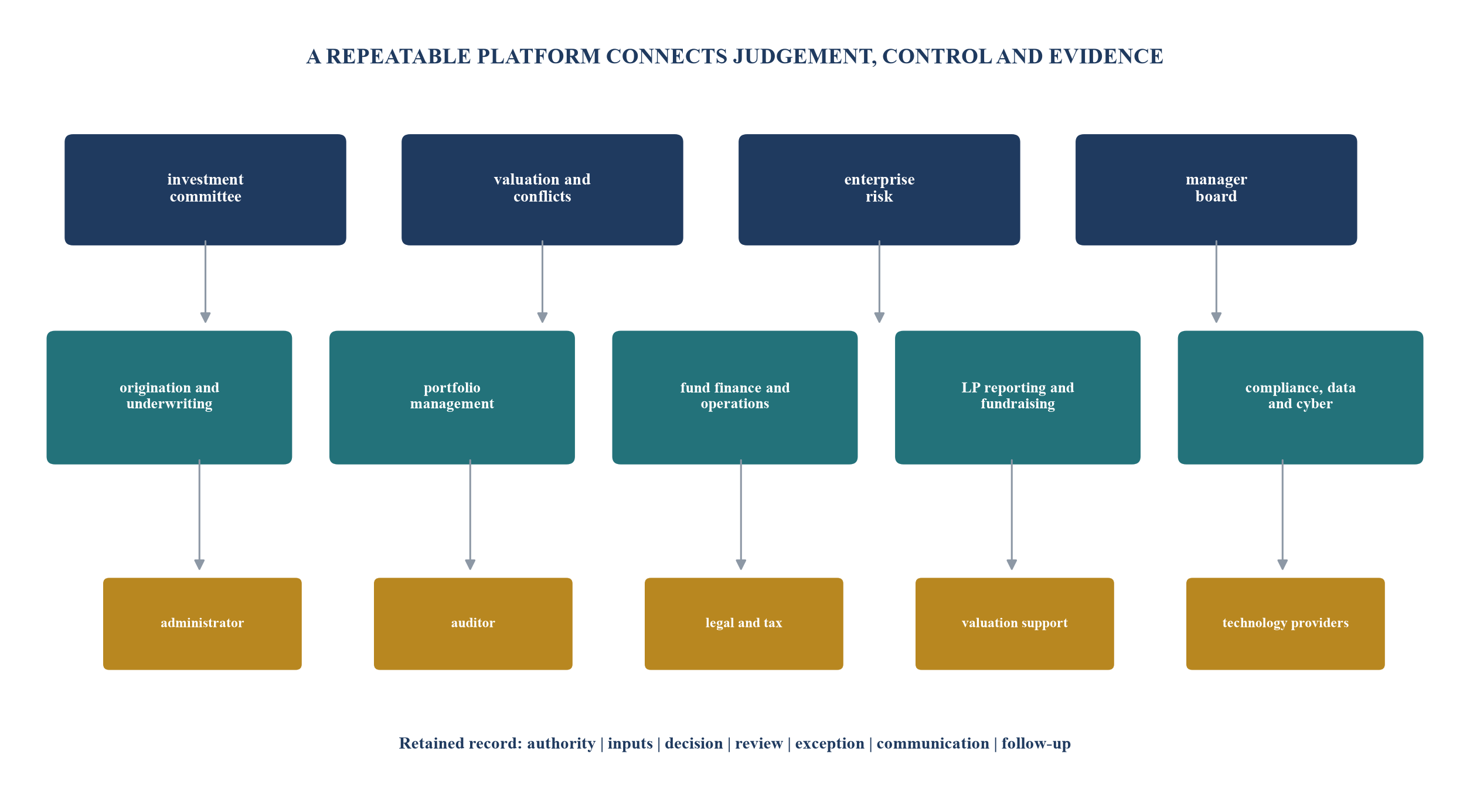
The model separates fiduciary decisions, controlled execution, independent support and retained evidence.
4. Convert investment judgement into a reconstructable process
An institutional investment process preserves judgement and shows how it is used. The process begins with a sourcing record that identifies origin, relationship, referral terms, conflicts and initial thesis. Screening records show mandate fit, exclusion criteria, concentration and why work should continue. The diligence plan assigns questions, evidence, owners and decision thresholds across commercial, financial, legal, tax, operational, technology, cyber, ESG and management domains as relevant.
The investment memorandum should distinguish facts, management representations, third-party evidence, analysis and assumptions. It should include downside cases, liquidity, financing, governance, value-creation plan, exit routes, conflicts and conditions. The investment committee record should capture attendees, recusals, challenge, decision, conditions, dissent and follow-up. Approval should not erase uncertainty; it should state which risks are accepted, transferred, mitigated or monitored.
Portfolio monitoring should connect the original thesis to observed evidence. A monthly or quarterly pack can track operating metrics, cash, covenant headroom, governance, value-creation initiatives, material risks, valuation inputs and exit readiness. Deviations require an owner and response. This creates a continuous evidence chain from origination to exit and allows the manager to test whether its claimed edge appears in realised operating outcomes.
Attribution should be controlled. A founder may have led a transaction at a prior employer, served on a board, advised a company or invested personal capital. Those roles do not confer identical ownership of the track record. The manager should document role, decision authority, period, capital, realised and unrealised results, data source, permission and limitations before including any case in fundraising materials.
Table 2. Minimum investment-decision record
| Stage | Required record | Decision authority | Primary exception |
|---|---|---|---|
| source and screen | origin, mandate fit, conflict check and initial thesis | designated investment professional | referral or allocation conflict |
| diligence approval | workplan, evidence owners, budget and stop questions | deal lead under approved authority | unavailable critical evidence |
| investment decision | memorandum, model, risks, conditions, recusals and vote | investment committee | unresolved condition or dissent |
| completion | executed terms, funds flow, ownership, consents and closing evidence | authorised signatories | deviation from approval |
| monitoring | thesis, operating data, cash, risk, governance and valuation | portfolio owner with committee review | repeated variance without response |
| exit | options, conflicts, valuation, approvals, proceeds and attribution | investment committee or board | related-party or continuation transaction |
The record should be proportionate to the investment and sufficient to reconstruct the decision later.
5. Map and reduce key-person dependency
Key-person risk is broader than the legal key-person clause. It includes relationships, sourcing channels, investment judgement, committee authority, portfolio influence, bank access, passwords, service-provider knowledge, valuation decisions, fundraising history and institutional memory. The manager should map these dependencies by activity and consequence rather than naming only senior investors.
Each dependency receives four tests. Concentration asks how much authority or knowledge sits with one person. Substitutability asks whether another qualified person can act. Documentation asks whether the necessary record is current and usable. Recovery asks whether the substitute has demonstrated the task under controlled conditions. A nominal deputy who has never led a committee, contacted the LP or operated the payment process provides limited resilience.
Mitigation can include dual coverage of LP and portfolio relationships, committee rotation, delegated authorities, documented decision criteria, password vaults, bank-mandate redundancy, service-provider contacts, cross-training, succession terms and tested business-continuity exercises. The goal is not to remove the founder. It is to prevent the platform from stopping when the founder is unavailable and to demonstrate that delegated work retains quality and control.
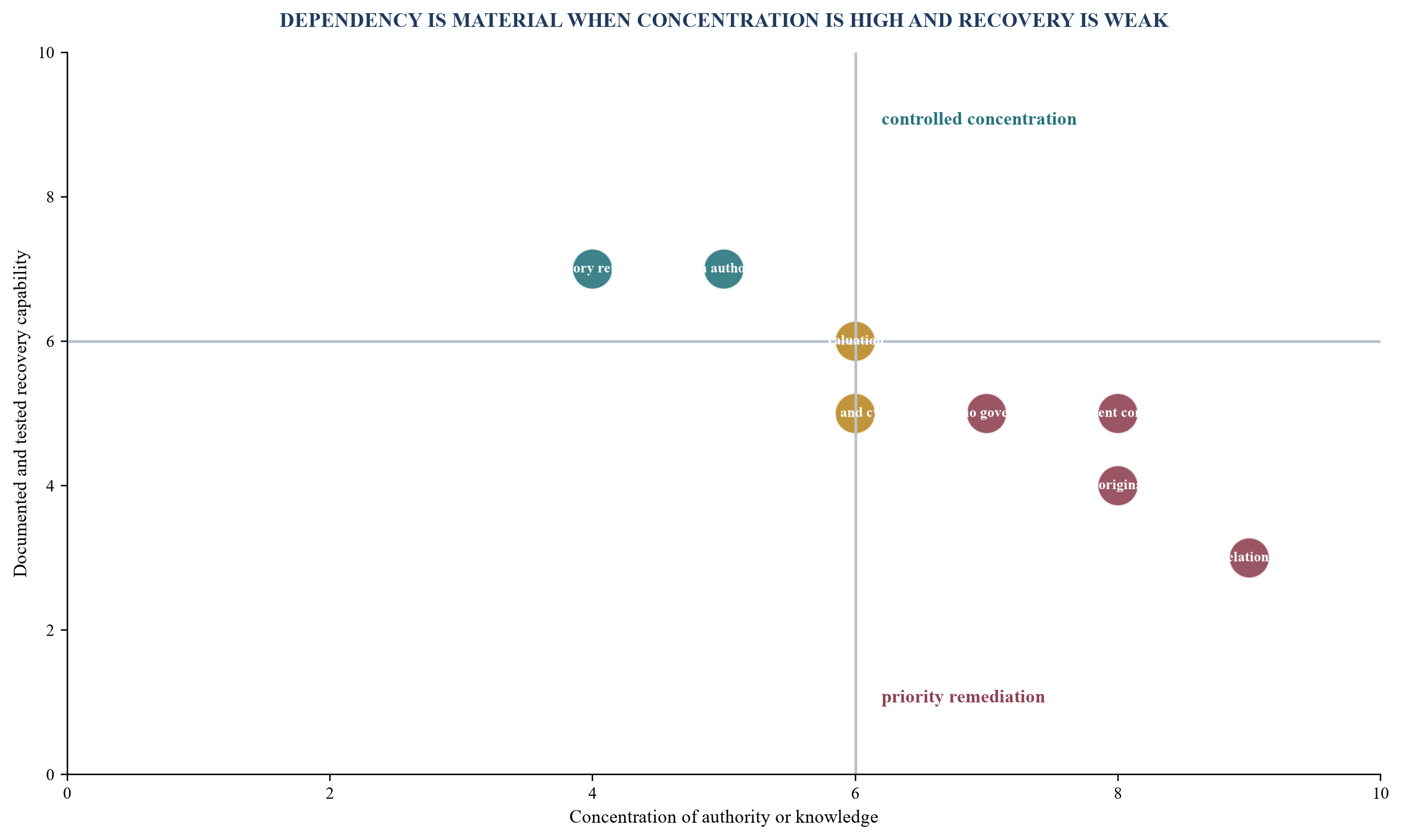
Scores are illustrative. A live map requires role, authority, documentation and tested-recovery evidence.
6. Build a reusable diligence evidence architecture
The manager should convert recurring diligence questions into an evidence system. Each question has an approved answer, evidence owner, source document, source location, review date, confidentiality level, permitted recipient, open issue and change trigger. This prevents contradictory answers across LPs and reduces the risk that fundraising language outruns approved policy or supporting records.
The data room should be organised around investor decisions, with a controlled index linking firm, team, ownership, governance, fund terms, strategy, process, track record, portfolio, valuation, reporting, compliance, legal, tax, service providers, cyber, ESG and references. Naming, versioning, permissions, watermarking and access logs should be consistent. Sensitive portfolio, personal and third-party information requires a lawful and contractually permitted disclosure path.
Questionnaires should be answered from the evidence library, not from memory. When an LP requests a different definition, calculation or period, the variation should be recorded and reconciled. A diligence answer should state limitations directly. Missing evidence, a newly approved process or a short operating history can be disclosed with a remediation plan and owner. Concealing the gap increases diligence and reputational risk.
The SEC marketing rule illustrates the importance of substantiation and fair balance where it applies. It prohibits material misstatements, unsupported material claims, unfair treatment of risks and misleading performance presentation.[10] Even where that rule does not govern a particular communication, the operating discipline is useful: material fundraising claims should have a reasonable basis, approved evidence and balanced limitations.
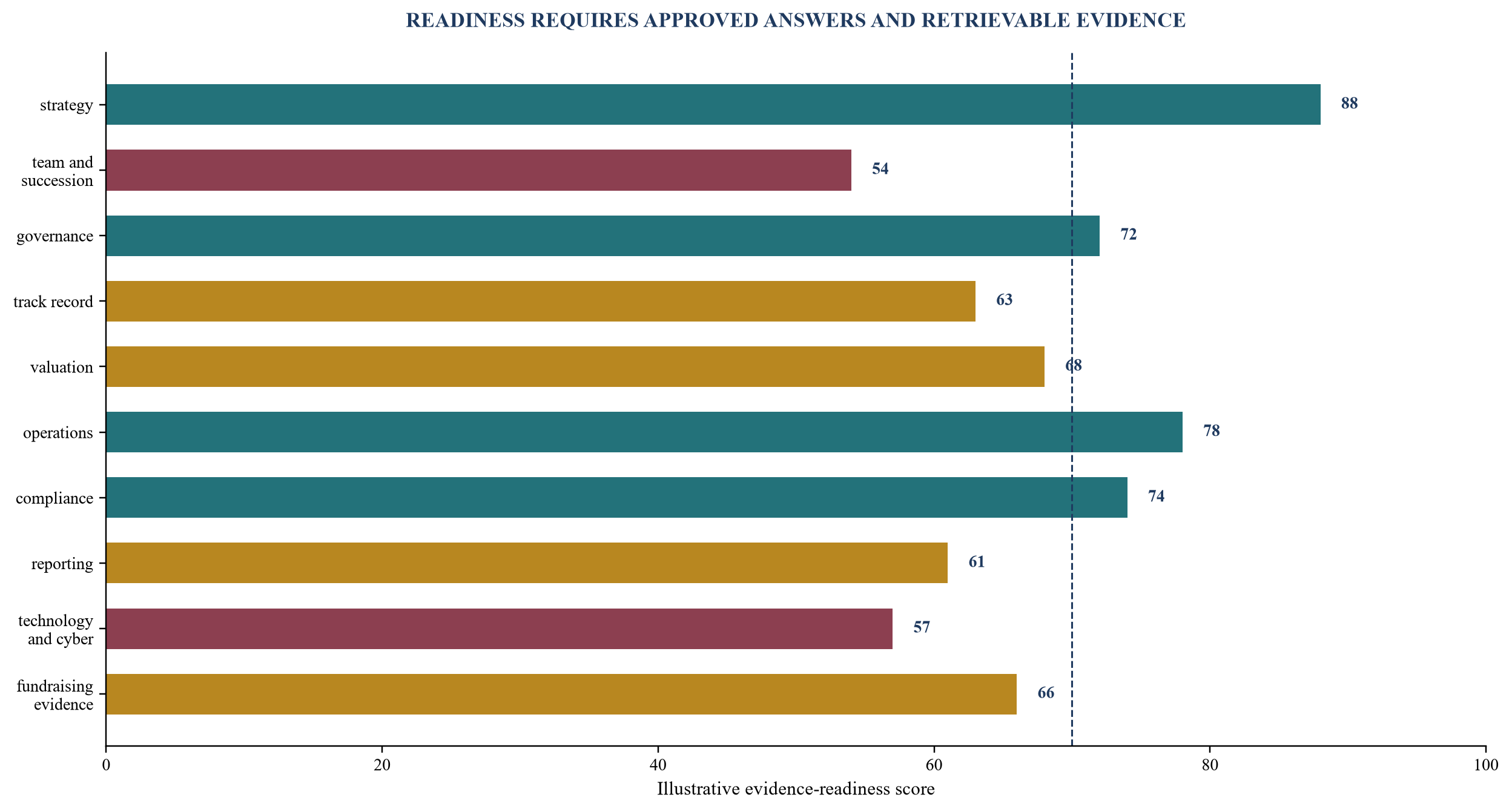
Scores demonstrate prioritisation only. They are not an LP standard or probability of commitment.
7. Govern track record and performance presentation
Track record is frequently the most sensitive diligence area for an emerging manager. The manager should define which investments belong to the firm, predecessor organisations, individual professionals, co-investments, personal portfolios, realised exits and unrealised holdings. It should preserve the original cash flows, currency, ownership, fees, leverage, valuation dates, attribution and source evidence for every included record.
Performance calculations should have a controlled methodology and an independent or appropriately segregated review. Gross and net returns, fund-level and deal-level results, realised and unrealised performance, subscription facilities, recycling, foreign exchange, write-offs and excluded transactions should be defined consistently. The presentation should show the time period, valuation date, methodology, relevant fees and material limitations.
The GIPS standards are voluntary unless adopted or required by contract, while they provide widely recognised principles for fair representation and comparison.[3] A manager should not claim compliance without satisfying all applicable requirements. It can still use GIPS concepts to strengthen definitions, input controls and disclosure. The SEC's 2025 marketing FAQ also illustrates the need for comparable gross and net presentation when the marketing rule applies.[11]
Performance evidence should connect to the accounting and valuation records. The manager can maintain a cash-flow ledger, investment master, valuation history and attribution memorandum with approval and change logs. A fundraising deck becomes a controlled view of that evidence rather than a separate spreadsheet that can drift from fund records.
8. Establish valuation independence and escalation
Valuation governance should specify responsible body, frequency, methods, hierarchy of inputs, calibration, portfolio-company data, external support, challenge, conflicts, overrides, back-testing and investor disclosure. Illiquid assets require judgement. Institutionalisation makes the judgement visible and consistently governed.
The investment team provides company and market knowledge, while it may also have incentives linked to valuation, performance and fundraising. The process should therefore introduce segregation or independent challenge appropriate to size. A valuation committee, CFO, administrator, external specialist or auditor may contribute different forms of review. Their scope and limitations should be understood; an administrator's calculation does not necessarily constitute an independent valuation opinion.
IOSCO's principles state that collective investment schemes should have a proper and disclosed basis for asset valuation and pricing.[13] IFRS 13, where applicable, defines fair value, a measurement framework and disclosure requirements.[15] The manager should map the governing accounting framework and fund documents to its methods rather than applying a generic valuation policy.
Exceptions require escalation. Examples include stale portfolio data, financing distress, a related-party transaction, a down round, model change, broker indication, market dislocation or deviation from the approved method. The record should show alternative methods, sensitivity, conflict, decision and communication. Back-testing at exit or financing helps assess whether methods and inputs behaved as expected.
Table 3. Valuation control register
| Control | Evidence | Owner | Escalation trigger |
|---|---|---|---|
| policy and hierarchy | approved methods, input priority and frequency | valuation authority | new asset or method outside policy |
| portfolio data | signed accounts, management information and reconciliations | portfolio owner and finance | missing, stale or inconsistent data |
| calculation | model, assumptions, comparables and sensitivity | qualified preparer | material change or unsupported input |
| independent challenge | committee, administrator or external review record | segregated reviewer | conflict, override or wide range |
| approval and reporting | minutes, valuation file and investor output | authorised committee | unresolved challenge or reporting impact |
| back-test | exit, financing or subsequent evidence comparison | finance and valuation committee | persistent bias or method weakness |
Method selection and review depth should reflect the asset, evidence and governing framework.
9. Design LP reporting from source data
LP reporting should begin with data definitions and a closing calendar. The reporting architecture should connect portfolio-company information, bank and administrator records, capital activity, ownership, valuations, fees, expenses, carry, commitments, unfunded amounts, foreign exchange, side-letter obligations and narrative updates. Each output should have a data owner, calculation owner, reviewer and release authority.
The manager should establish a data dictionary for every recurring metric. Terms such as invested capital, realised value, unrealised value, gross multiple, net multiple, internal rate of return, management fees, organisational expenses and fund expenses should be consistent with governing documents and reporting standards. Changes should be versioned and explained.
ILPA released its updated Reporting Template in January 2025 and states that it is intended to replace the 2016 template on a go-forward basis for funds in scope, including funds commencing operations on or after 1 January 2026.[2] Adoption is a governance decision based on fund terms, investor expectations and applicable requirements. The manager should design the administrator ledger and data collection so the required fields can be produced without quarter-end reconstruction.
Reporting includes narrative judgement. Portfolio updates should identify thesis development, material events, operating change, governance, financing, valuation and exit outlook with appropriate confidentiality. Bad news should not disappear into optimistic narrative. A controlled reporting process makes material variance and management response visible.
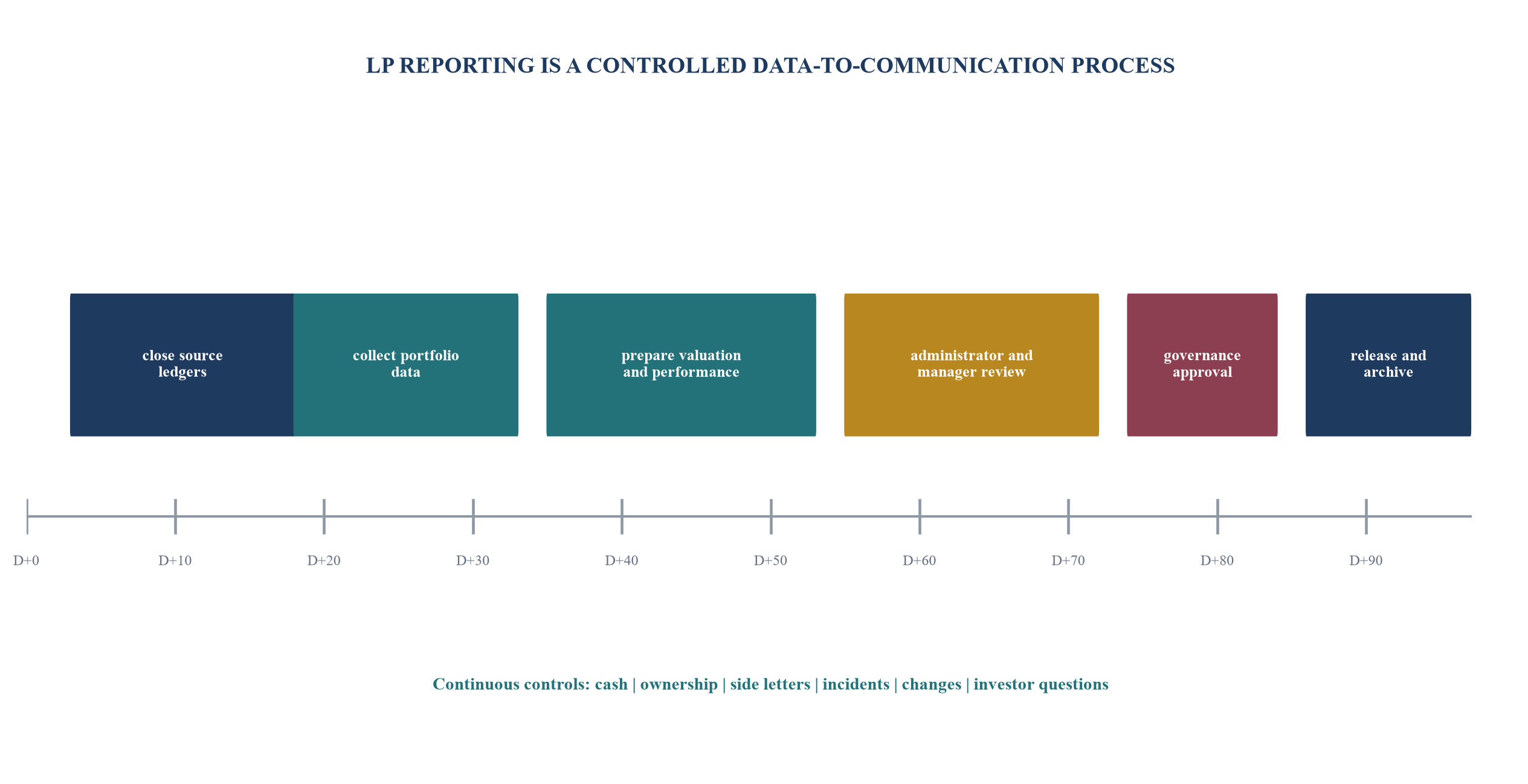
Timing is illustrative. Governing documents, side letters and regulation determine actual deadlines.
Table 4. LP-reporting release controls
| Workstream | Primary source | Review | Release evidence |
|---|---|---|---|
| capital and ownership | administrator ledger, bank and legal records | finance and administrator reconciliation | approved capital-account and commitment schedule |
| fees and expenses | ledger, invoices, allocation policy and fund terms | finance, administrator and compliance | fee and expense bridge with exception review |
| portfolio performance | company data, cash flows, valuations and ownership | investment, finance and valuation review | controlled performance workbook and methodology |
| risk and narrative | portfolio monitoring, incidents and committee records | portfolio, compliance and senior management | approved investor letter and disclosures |
| side letters and notices | obligation register and investor terms | legal or compliance review | investor-specific completion record |
| distribution and archive | approved recipient list and secure channel | investor-relations release authority | transmission log and immutable archive |
Each release should reconcile governing obligations, source records and approved communication.
10. Turn compliance into an operating control system
Compliance should be based on the manager's entities, activities, investors, products, jurisdictions and communications. The obligations register translates applicable law, licence conditions, fund documents and policies into recurring controls. It includes owner, due date, evidence, reviewer, breach threshold and reporting path. Legal interpretation remains with qualified advisers; operational ownership should remain explicit inside the manager.
Risk-based investor onboarding requires identity, authority, beneficial ownership, source-of-funds or wealth evidence where applicable, sanctions screening, politically exposed person assessment, jurisdiction risk, tax documentation, eligibility and subscription conditions. FATF recommendations and guidance provide global reference points for customer diligence and ownership transparency.[4][5] Local rules and administrator procedures determine the live process.
The current SEBI AIF regulations and June 2026 Master Circular illustrate the density of an active regulatory environment, including reporting and compliance requirements.[6][7] FCA rules require AIFMs in scope to report instruments, markets, exposures and concentrations, while the FCA's 2026 consultations propose broader reforms and consolidated reporting.[8][9][12] AIFMD II addresses organisational resources, delegation, reporting and loan origination among other topics.[11] An emerging manager should maintain jurisdiction modules rather than assuming one global compliance manual is sufficient.
Marketing and fundraising approvals need a controlled workflow. Every deck, case study, track-record table, website statement, data-room answer and placement arrangement should have an owner, jurisdiction, audience, evidence, legal or compliance review where required, approval date and expiry or refresh trigger. This reduces the risk that an old statement survives after personnel, valuations, regulations or fund terms change.
11. Control fund finance, cash and service providers
Cash control should separate instruction, approval, release and reconciliation. Bank mandates need appropriate dual authority, payment limits, callback procedures, recipient verification, change controls, access review and tested continuity. Capital calls and distributions should reconcile notices, investor commitments, administrator records, bank movements and the general ledger. Exceptions should be resolved before the next cycle.
Fund expenses require a documented allocation policy connected to fund documents. The manager should distinguish management-company, fund, broken-deal, organisational, portfolio-company and shared expenses, and record allocation rationale. Fee offsets, waivers, rebates, tax and side-letter terms should flow through the same control system. ILPA's updated reporting work increases the value of granular source data for fees, expenses and carried interest.[2]
Service-provider oversight begins with selection and continues through data, output and resilience review. The manager should assess competence, independence, controls, insurance, technology, subcontracting, confidentiality, business continuity, incident notification, termination and data portability. Material outputs require manager review. Outsourcing should not create an evidence gap where the provider holds the only usable version of the record.
The provider register should show contract owner, service scope, key personnel, systems, data held, regulatory relevance, service-level indicators, exceptions, audit or assurance material, last review and contingency. A manager can then demonstrate how it knows a provider is performing and what happens if the relationship fails.
12. Build technology, data and cyber resilience proportionately
The technology stack should support the operating model without becoming an uncontrolled collection of spreadsheets and inboxes. Core records may include CRM, fundraising pipeline, document management, data room, portfolio monitoring, administrator interface, accounting, valuation, compliance, board materials, investor portal and identity management. A system-of-record map should prevent duplicate sources from producing contradictory answers.
Access should follow role and least privilege, with joiner, mover and leaver controls, multifactor authentication, privileged-access review and secure sharing. Sensitive investor and portfolio information requires classification, retention, encryption, backup, incident response and lawful processing. The manager should understand where providers host data, which subprocessors are used and how data can be recovered or exported.
NIST's Cybersecurity Framework 2.0 organises outcomes through govern, identify, protect, detect, respond and recover.[14] An emerging manager can use those functions to structure a proportionate control register and provider review. A claim of enterprise-grade security should not be made solely because a reputable cloud provider is used; configuration, identity, devices, workflow and human behaviour remain material.
Continuity exercises should cover founder unavailability, payment fraud, administrator outage, corrupted data, investor-portal failure, ransomware, lost device and portfolio-company incident. Each exercise should record objectives, participants, evidence, decisions, recovery time, unresolved gaps and remediation. The tested record is stronger than an untested policy.
13. Treat fundraising as a controlled conversion process
Fundraising should begin with a defined eligible market and evidence-backed proposition. The manager identifies investor type, geography, cheque size, strategy fit, portfolio constraints, stage, regulatory route, decision process and required advisers. It should also identify where marketing is permitted, which materials are approved and which investor interactions create recordkeeping or regulatory obligations.
The pipeline should use explicit stages: identified, qualified, engaged, evidence exchanged, diligence active, investment committee path confirmed, terms negotiated, closing conditions open, subscribed and funded. Stage movement requires evidence. A friendly meeting is not diligence; diligence is not investment-committee sponsorship; a signed subscription remains subject to conditions and funding.
Conversion should be analysed by investor segment, source, objection, owner, time in stage and next evidence requirement. This allows management to distinguish insufficient fit from missing institutional capability. If multiple qualified LPs pause at succession, reporting or attribution, the platform should address the underlying control rather than changing the deck repeatedly.
Placement agents, introducers and advisers require diligence and approved terms. Scope, jurisdiction, compensation, conflicts, investor communications, approval rights and recordkeeping should be explicit. The SEC marketing rule includes requirements for compensated testimonials and endorsements where applicable.[10] Other jurisdictions have their own placement and financial-promotion regimes.
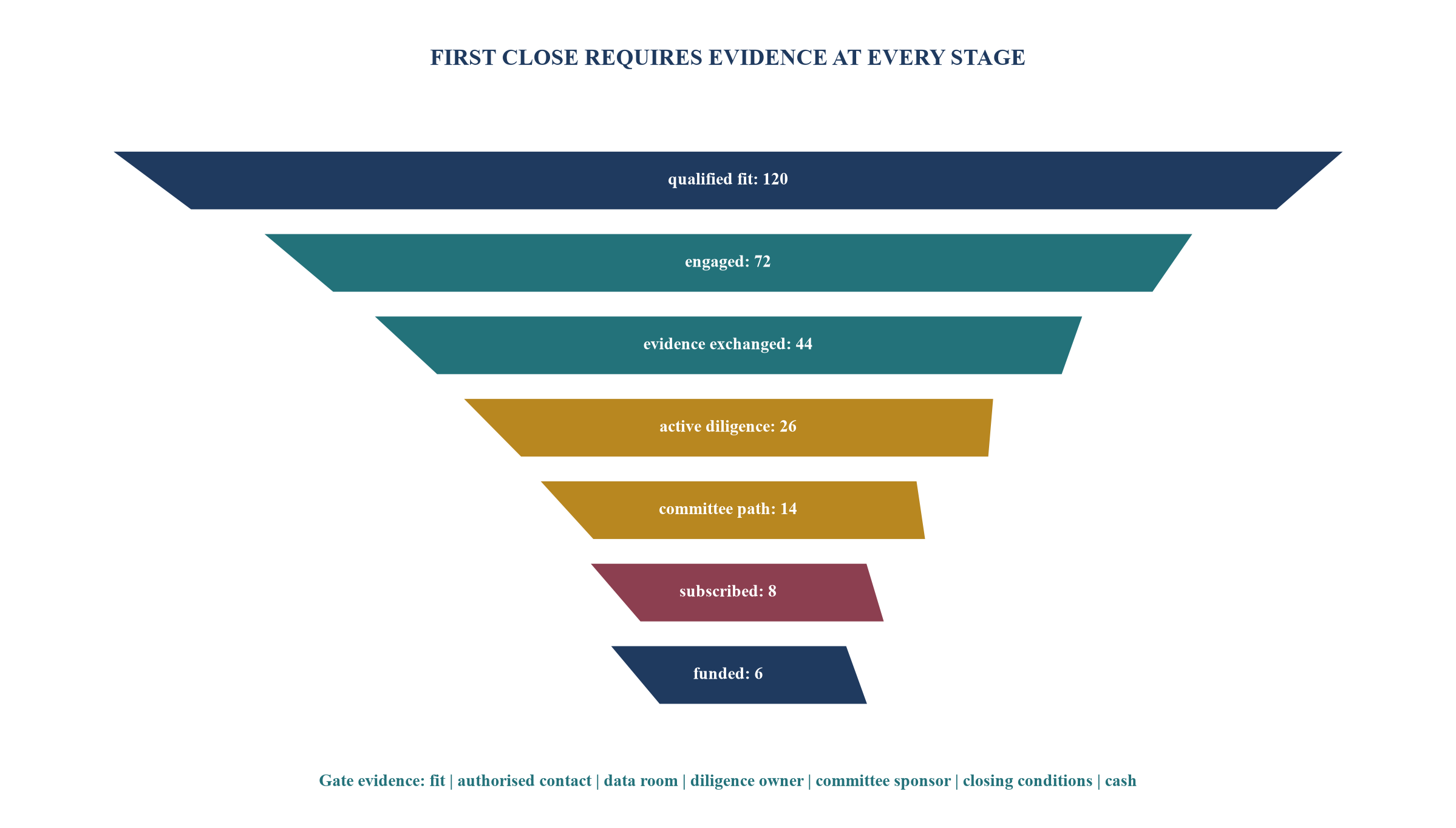
Counts and rates are illustrative and do not forecast fundraising performance.
14. Govern the first close and post-close transition
The first close has legal, operational and reputational consequences. The manager should maintain a closing checklist covering final fund documents, regulatory status, marketing permissions, investor eligibility, KYC and AML, tax forms, side letters, most-favoured-nation process, subscriptions, powers of attorney, bank readiness, administrator records, capital-call mechanics, insurance, service-provider activation and signatory authority.
Conditions should be classified as legal, regulatory, investor, operational, commercial or documentary, with owner and evidence. The manager should distinguish signed commitments, accepted subscriptions, conditional subscriptions and funded capital. External communication should use the precise status and should not treat a target, soft circle or unsigned indication as committed capital.
The first ninety days after close test whether the platform works. The manager onboards investors into the portal and reporting register, confirms side-letter obligations, completes capital activity, activates governance, tests banking and administrator interfaces, updates the fundraising record and establishes the first reporting calendar. Lessons from the closing should update policies and evidence, not remain in personal email.
Table 5. First-close control gates
| Gate | Required evidence | Release authority | Failure response |
|---|---|---|---|
| fund and manager readiness | executed governing documents, registrations, providers and bank controls | manager board and counsel | defer acceptance or closing |
| investor eligibility | subscription, authority, eligibility, tax and onboarding evidence | authorised manager and administrator | cure, reject or hold conditional |
| commercial terms | commitment, side letter, fee terms and allocation | authorised signatories | reconcile before acceptance |
| operational setup | ledger, portal, reporting and obligation registers | COO or CFO and administrator | complete before capital activity |
| capital movement | notice, approvals, bank verification and reconciliation | dual authorised signatories | stop payment and investigate |
| public communication | accepted status, approved wording and evidence | legal or compliance approval | correct or withdraw statement |
Legal advisers and applicable authorities determine the live closing requirements.
15. Sequence the first 180 days
Days one to thirty establish the factual baseline. Management freezes strategy, structure, obligations, provider roles, current policies, systems, ownership, track-record sources, investor pipeline and key-person dependencies. It appoints accountable owners and creates a remediation register. The manager should avoid broad institutional claims until supporting evidence is available.
Days thirty-one to sixty build the control spine. The team approves committee mandates, conflicts, valuation, cash, expense allocation, compliance, marketing, data and continuity procedures. It creates the investment-decision record, obligation register, provider register, evidence library, data-room index and approved-answer register. Critical gaps that affect legal operation or investor communication receive priority.
Days sixty-one to one hundred and twenty operate and test. The manager runs sample investment and valuation processes, reconciles a reporting pack, tests a capital call or payment workflow, performs a continuity exercise, completes a representative ILPA DDQ response and challenges the track-record workbook. The point is to create evidence from operation and identify where policy does not match reality.
Days one hundred and twenty-one to one hundred and eighty move to repeatability. Management closes open exceptions, establishes quarterly calendars, refreshes the data room, segments the qualified LP pipeline and requires evidence for stage movement. The board reviews platform capacity, regulatory change, fundraising conversion and the next fund-cycle requirements.
Table 6. First 180-day institutionalisation plan
| Period | Principal work | Required output | Governance decision |
|---|---|---|---|
| days 1-30 | freeze strategy, structure, obligations, systems and dependencies | platform baseline and remediation register | approve scope and accountable owners |
| days 31-60 | build policies, committee mandates, registers and evidence architecture | control spine and governed data room | approve operating design |
| days 61-120 | run sample cycles and continuity tests | investment, valuation, reporting, cash and DDQ evidence | close, redesign or escalate gaps |
| days 121-180 | establish recurring calendars and qualified fundraising funnel | repeatable platform dashboard | confirm readiness for first close or further remediation |
| continuous | monitor regulation, providers, incidents and investor feedback | change log and exception register | reallocate management attention and budget |
Timing is illustrative and must follow actual authorisation, fund and fundraising conditions.
16. Use a board dashboard that tests evidence and capacity
The board dashboard should show whether the platform can perform its obligations and support the promised strategy. It should include investment pipeline and capacity, portfolio monitoring, valuation status, cash and reconciliations, investor onboarding, reporting calendar, compliance obligations, provider exceptions, cyber incidents, key-person dependencies, diligence readiness, fundraising stages and closing conditions.
Metrics require definitions and evidence. A pipeline value should specify stage, probability treatment, ownership and date. A reporting status should distinguish data received, calculation completed, review completed and release approved. A fundraising count should distinguish identified prospects from qualified LPs, active diligence, committee sponsorship, subscriptions and funded commitments.
The dashboard should highlight exceptions and decisions, not reward a high volume of activity. Examples include a valuation awaiting critical data, a side-letter obligation without an owner, a founder-only LP relationship, a performance table awaiting source permission, a delayed administrator reconciliation or a material prospect stalled on governance. Each item needs consequence, owner, due date and escalation.
Capacity should be forward-looking. The board can compare expected transactions, portfolio companies, investors, reporting entities and regulatory obligations with available people and provider capacity. Hiring or outsourcing should follow the actual constraint. A fundraising target without an operating-capacity model can create a platform that succeeds commercially and fails operationally.
17. Questions an institutional LP should be able to answer
After diligence, an LP should be able to explain the manager's repeatable edge, how the team finds and decides investments, which evidence supports the track record, how conflicts are governed, how assets are valued, how cash is controlled, how the portfolio is monitored and how information reaches investors. The answers should be consistent across documents, meetings, references and service providers.
The LP should understand what happens if a founder or senior professional is unavailable. It should know which responsibilities move, whether the substitute has authority and experience, what the governing documents provide and how relationships and systems remain accessible. A succession plan should describe operational continuity and long-term ownership, not only identify a replacement name.
The LP should also understand the limits of the platform. Emerging managers may have short operating histories, smaller teams, outsourced functions, incomplete realised records or a first institutional fund. Clear disclosure allows the investor to judge the gap and the remediation. Unsupported claims reduce trust when diligence reveals the underlying evidence state.
Finally, the LP should be able to see how the manager learns. Investment outcomes, valuation back-tests, reporting exceptions, provider failures, cyber exercises, investor questions and closing lessons should change processes. Institutionalisation is demonstrated through controlled improvement across cycles.
18. Conclusion
An emerging manager becomes institutional when its investment edge can be exercised through repeatable decisions, controlled operations and retrievable evidence. The founder remains central to strategy and relationships while the platform prevents judgement, authority and knowledge from becoming single points of failure.
The operating system in this paper begins with a frozen strategy and obligation baseline, assigns accountable capabilities, creates reconstructable investment records, maps key-person dependencies, builds a reusable diligence architecture, governs track record and valuation, designs LP reporting from source data, and controls cash, compliance, providers, technology and fundraising. It treats the first close as a legal and operational transition supported by evidence at each gate.
The result is a platform that can answer the institutional investor's central question: can this manager perform the promised strategy, protect investor interests, explain what happened and continue doing so through change? That answer must be demonstrated through operating records, independent support where relevant, clear limitations and consistent execution.
References
- Institutional Limited Partners Association. Due Diligence Questionnaire 2.0 and User Guide. 2021. https://ilpa.org/resources-tools/resource-library/due-diligence-questionnaire/
- Institutional Limited Partners Association. ILPA Reporting Template 2.0 and Supplemental Guidance. Released January 2025. https://ilpa.org/industry-guidance/templates-standards-model-documents/ilpa-templates-hub/ilpa-reporting-template/
- CFA Institute. Global Investment Performance Standards for Firms, 2020 Edition and current authoritative guidance. https://www.gipsstandards.org/standards/gips-standards-for-firms/
- Financial Action Task Force. The FATF Recommendations. Updated June 2025. https://www.fatf-gafi.org/en/publications/Fatfrecommendations/Fatf-recommendations.html
- Financial Action Task Force. Guidance on Beneficial Ownership and Transparency of Legal Arrangements. 2024. https://www.fatf-gafi.org/en/publications/Fatfrecommendations/Transparency-and-beneficial-ownership.html
- Securities and Exchange Board of India. Securities and Exchange Board of India (Alternative Investment Funds) Regulations, 2012, current consolidated version. https://www.sebi.gov.in/sebiweb/home/HomeAction.do?doListingAll=yes&search=Alternative+Investment+Funds
- Securities and Exchange Board of India. Master Circular for Alternative Investment Funds. 3 June 2026. https://www.sebi.gov.in/legal/master-circulars/jun-2026/master-circular-for-alternative-investment-funds-aifs-_101817.html
- Financial Conduct Authority. FUND 3: Requirements for Alternative Investment Fund Managers. Current FCA Handbook. https://handbook.fca.org.uk/handbook/fund3
- Financial Conduct Authority. CP26/28: The UK AIFM Regime. 14 July 2026. https://www.fca.org.uk/publications/consultation-papers/cp26-28-uk-aifm-regime
- United States Securities and Exchange Commission. Investment Adviser Marketing: Small Entity Compliance Guide. 28 April 2021. https://www.sec.gov/resources-small-businesses/small-business-compliance-guides/investment-adviser-marketing
- United States Securities and Exchange Commission. Marketing Compliance Frequently Asked Questions. Updated through 2025. https://www.sec.gov/rules-regulations/staff-guidance/division-investment-management-frequently-asked-questions/marketing-compliance-frequently-asked-questions
- European Union. Directive (EU) 2024/927 amending AIFMD and UCITS requirements. Official Journal, 26 March 2024. https://eur-lex.europa.eu/eli/dir/2024/927/oj
- International Organization of Securities Commissions. Principles for the Valuation of Collective Investment Schemes. May 2013. https://www.iosco.org/library/pubdocs/pdf/IOSCOPD413.pdf
- National Institute of Standards and Technology. The NIST Cybersecurity Framework 2.0. NIST CSWP 29, 2024. https://doi.org/10.6028/NIST.CSWP.29
- IFRS Foundation. IFRS 13 Fair Value Measurement. Issued standard. https://www.ifrs.org/issued-standards/list-of-standards/ifrs-13-fair-value-measurement/
