

1. Treat rate protection as part of acquisition financing
The acquisition model usually contains a benchmark-rate assumption, a credit spread, fees, amortisation and an exit or refinancing date. Those inputs determine cash interest, debt service, covenant headroom and equity returns. If the benchmark floats, the board has approved an economic exposure that can change after signing and continue for years after closing.
Rate protection belongs inside the financing decision because it changes the distribution of cash flows. A swap can create certainty over a defined notional and tenor. A cap can limit the benchmark while preserving the benefit of lower rates for an upfront or deferred premium. A blend can divide the protected debt between certainty and participation. Each choice also affects break costs, collateral, counterparty exposure, accounting and operational requirements.
The Acquisition Debt Rate Protection Test starts with the debt and covenant model. It asks how much cash interest the business can carry in the base case and in identified downside cases; how principal is expected to decline; when refinancing, disposal or prepayment may occur; and which failure states would force an early hedge termination. It then selects an instrument and schedule that fit those facts.
This order matters. A transaction team that starts with a dealer quotation can mistake a product price for a risk decision. The board needs a transparent connection between enterprise performance, debt service, covenant limits and hedge outcomes.
The decision should also be linked to the acquisition thesis. A business bought for stable contracted cash flow can support a different protection profile from a cyclical company whose earnings and working capital respond to the same macroeconomic conditions that move rates. Integration expenditure, synergy timing and customer concentration can narrow the cash buffer during the period when debt is highest. These operating dependencies should be visible in the hedge mandate rather than remaining in a separate transaction model.
2. Separate the benchmark from the rest of the debt cost
A floating acquisition loan commonly combines a reference benchmark, a contractual credit spread, floors, original-issue discount, commitment fees and other charges. A benchmark hedge normally addresses only the specified reference rate. It does not remove the lender spread, cure a leverage problem or guarantee refinancing.
For a USD 600 million loan priced at the applicable benchmark plus 350 basis points, every 100-basis-point benchmark increase adds USD 6 million of annualised cash interest before amortisation. A 70 per cent hedge changes the sensitivity to USD 1.8 million on the unhedged portion, subject to the instrument terms. The 350-basis-point credit spread remains payable on the full outstanding debt.
Rate floors require explicit treatment. If the loan benchmark has a one per cent floor while a swap receives the actual benchmark, the borrower can pay the swap fixed rate and continue to pay the loan floor when market rates fall below one per cent. A cap written on the actual benchmark can also leave the floor economics untouched. The model should therefore replicate the loan definition rather than applying a generic floating rate.
Fees and original-issue discount affect the effective interest cost and refinancing economics. They should be included in the debt model and covenant definitions where applicable. The hedge comparison should show cash flows separately from accounting effective-interest calculations.
3. Map the debt, covenant and hedge exposures
The exposure map should connect the acquisition vehicle, operating cash flows, lenders, hedge counterparties, controlled accounts and equity support. It should identify which entity borrows, which entity enters the derivative, where cash interest is paid and whether security or guarantees support the hedge.
The debt lane includes drawdown, scheduled amortisation, cash sweeps, mandatory prepayments, incremental facilities and maturity. The operating lane includes EBITDA, working capital, capital expenditure, tax and integration costs. The covenant lane converts those flows into leverage, interest-cover, fixed-charge and liquidity tests. The hedge lane adds fixed payments, floating receipts, cap settlements, premiums, collateral and termination values.
The map should distinguish contractual requirements from management expectations. A five-year legal maturity may coexist with a three-year sponsor exit case. Scheduled amortisation can be supplemented by asset-sale proceeds or excess-cash-flow sweeps. The hedge should not assume those events are certain unless the governing documents make them so.
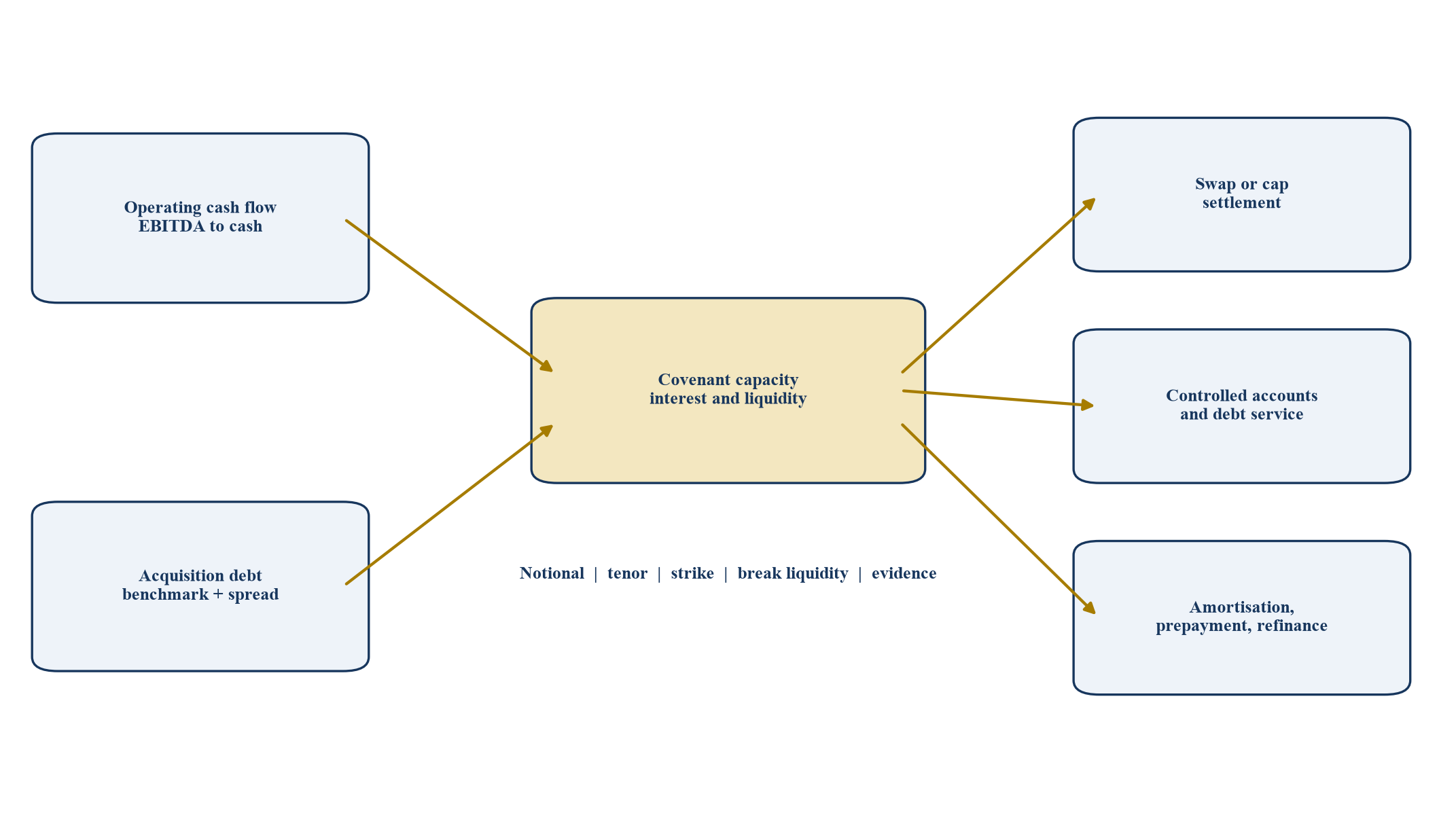
The architecture links operating cash generation, loan cash flows, covenants and derivative settlements. Transaction documents determine the actual payment and security routes.
4. Define the board’s protection objective
The board should approve the outcome it wants before deciding on a product. Possible objectives include a maximum annual cash-interest amount, a minimum interest-cover ratio, a minimum liquidity reserve, protection of the acquisition base case or a combination of these.
A statement such as “hedge 70 per cent” is incomplete because it does not specify the protected rate, debt path, period or failure states. A decision-grade mandate could require the business to remain above a stated interest-cover threshold under an agreed benchmark-rate and EBITDA stress while preserving a defined amount of capacity for early repayment or refinancing.
The mandate should also state whether favourable-rate participation has value. A sponsor expecting a rapid deleveraging or early exit may prefer a cap because the debt can benefit from falling rates and the option can expire without a negative mark-to-market. A long-term owner with stable debt may value the lower upfront cash requirement and certainty of a swap. The choice depends on the verified transaction economics.
Delegated authorities should cover execution timing, counterparties, notional adjustments, premium payment, collateral, novation, termination and hedge-accounting documentation. Exceptions should return to the approving body with quantified cash and covenant effects.
Protection should be calibrated to warning and breach levels. The warning level gives management enough time to reduce expenditure, raise equity, seek a covenant amendment or change the hedge. The breach level reflects the legal threshold. A programme that protects only the final legal threshold can leave no practical response period. The board pack should therefore show a management buffer above the covenant and explain which actions remain available if the buffer is consumed.
5. Build the debt balance before sizing the hedge
The protected notional should follow a conservative debt path. The model should begin with contractual amortisation and then show separately any assumed cash sweep, disposal or voluntary prepayment. Combining these into one declining balance can hide the risk that debt remains higher than expected or that the hedge becomes larger than the loan.
The hypothetical loan begins at USD 600 million and amortises by USD 60 million each year. The contractual balance is therefore USD 540 million after year one, USD 480 million after year two and USD 420 million after year three. A static USD 420 million swap would hedge 70 per cent at closing, 78 per cent after year one and 100 per cent after year three.
If the borrower also prepays USD 120 million from a disposal in year two, the swap can exceed the remaining floating exposure. The company may then carry a stand-alone derivative whose value moves independently of the reduced debt. The documentation may permit partial termination or novation, but the economics and approvals must be planned.
A hedge schedule can use step-down notionals aligned to contractual amortisation. The schedule can also leave an unhedged buffer for expected prepayment. The board should understand that too much buffer increases rate sensitivity while too little increases over-hedging and break-cost risk.
6. Translate rate movements into cash-interest outcomes
The model should express rate risk in annual cash amounts and covenant metrics. Basis-point sensitivity is useful for treasury, yet boards and operating teams need to see how it affects debt service, liquidity and the integration plan.
The worked case assumes a USD 600 million opening balance, a 350-basis-point spread and four hypothetical benchmark scenarios: two, four, six and eight per cent. The unhedged annual cash interest is USD 33 million, USD 45 million, USD 57 million and USD 69 million respectively.
The swap case fixes the benchmark on USD 420 million at 4.25 per cent and leaves USD 180 million floating. It produces annual cash interest of USD 42.45 million at a two per cent benchmark and USD 53.25 million at eight per cent. The cap case protects USD 420 million above a 4.50 per cent strike, excluding its hypothetical USD 7.2 million premium from the annual cash-interest schedule. The blended case swaps USD 300 million, caps USD 120 million and leaves USD 180 million floating.
| Benchmark rate | Unhedged | 70% swap at 4.25% | 70% cap at 4.50% | 50% swap plus 20% cap |
|---|---|---|---|---|
| 2.00% | USD 33.00m | USD 42.45m | USD 33.00m | USD 39.75m |
| 4.00% | USD 45.00m | USD 46.05m | USD 45.00m | USD 45.75m |
| 6.00% | USD 57.00m | USD 49.65m | USD 50.70m | USD 49.95m |
| 8.00% | USD 69.00m | USD 53.25m | USD 54.30m | USD 53.55m |
USD millions. The 350-basis-point credit spread applies to the full USD 600 million. Cap premium and fees are excluded from annual interest and shown separately in the liquidity analysis.
7. Use swaps for defined cash-flow certainty
In a plain pay-fixed, receive-floating swap, the borrower pays a fixed benchmark rate and receives the floating benchmark on the agreed notional. The loan continues to pay the benchmark plus spread. When the definitions and reset conventions align, the floating loan benchmark and swap receipt offset economically on the hedged portion.
The swap’s main strength is defined-rate certainty without an option premium paid at inception under ordinary collateral and credit terms. Its main limitation is symmetry. If benchmark rates fall, the borrower continues to pay the fixed swap rate. If the debt is prepaid, refinanced or sold, the remaining swap can have a positive or negative value.
The notional schedule should match the loan’s contractual balance and the approved protection percentage. Reset dates, day-count conventions, compounding, observation shifts and payment dates should be reconciled with the loan. A mismatch can create basis and timing differences even where both documents refer to the same benchmark family.
The fixed rate is only one term. The board should also receive the tenor, amortisation, break provisions, credit support, collateral mechanics, counterparty concentration and permitted transfer terms. A low fixed rate does not compensate for an unusable prepayment profile.
8. Use caps to protect the ceiling and preserve participation
An interest-rate cap is a series of options that pays when the reference rate exceeds the strike, subject to the contract terms. The borrower continues to pay the floating loan rate and receives cap settlements in high-rate periods. When rates remain below the strike, the option expires for that period and the loan benefits from the lower benchmark.
The economic cost is the premium. It can be paid upfront, financed, amortised for management reporting or structured through other terms. Financing the premium changes debt and interest; deferring it can create counterparty and pricing consequences. The comparison should show the actual cash timing.
A cap can be valuable where prepayment or refinancing is plausible because the borrower owns an option rather than owing fixed payments under a swap. The option can retain value after a refinancing, depending on its terms and the continuing exposure. It can also be sold or novated, subject to documentation and market liquidity.
The strike should come from the covenant and liquidity model. Choosing a strike solely because the premium appears affordable can leave cash interest above the level the business can support. The relevant question is whether the strike keeps the combined debt service inside the approved boundary.
9. Use blended programmes to divide certainty and flexibility
A blended programme can allocate one portion of debt to a swap, another to a cap and the remainder to floating exposure. It can also layer execution over time or use different maturities. This architecture can reduce the upfront cap premium while retaining some benefit from falling rates and some flexibility for prepayment.
The blended worked case swaps 50 per cent of the opening debt, caps 20 per cent and leaves 30 per cent floating. At a six per cent benchmark, annual cash interest is USD 49.95 million, close to the 70 per cent swap outcome. At a two per cent benchmark, the blended cost is USD 39.75 million, lower than the 70 per cent swap because the capped portion participates in the lower rate.
Complexity increases with each layer. The borrower must track multiple notionals, settlements, valuations and accounting designations. A small improvement in scenario outcomes can be outweighed by operational burden or documentation risk.
The programme should therefore have a stated purpose for each layer. The swap can protect the minimum debt expected to remain outstanding. The cap can protect debt likely to amortise or refinance. The floating slice can preserve participation and absorb model uncertainty.
10. Compare instruments on a common economic basis
Quotes should be converted into comparable outcomes across the same debt balance, rate scenarios and dates. The analysis should include premium cash, fixed payments, floating receipts, loan interest, credit spread, fees, collateral and termination value.
A swap with no upfront premium can still have a material negative value later. A cap with a visible premium can have residual value and limited downside beyond the premium. A blend can create both. The comparison should avoid describing one structure as free because cash is deferred or embedded.
| Decision factor | Pay-fixed swap | Interest-rate cap | Blended programme |
|---|---|---|---|
| Rate ceiling | Fixed benchmark on hedged notional | Strike caps benchmark on protected notional | Fixed on one slice, capped on another |
| Benefit from falling rates | Limited on swapped notional | Preserved below strike | Preserved on capped and floating slices |
| Upfront cash | Commonly no premium, subject to terms | Premium usually payable or financed | Lower cap premium than an all-cap approach |
| Early repayment | Can create positive or negative termination value | Option may retain value; premium is sunk | Requires coordinated adjustment of layers |
| Notional discipline | High; over-hedging can be costly | High; excess protection can remain as an option | High; multiple schedules must reconcile |
| Counterparty exposure | Bilateral or cleared exposure under terms | Premium and settlement exposure under terms | Exposure across each instrument and counterparty |
| Best fit | Stable minimum debt and certainty objective | Uncertain debt path or participation objective | Mixed certainty, flexibility and liquidity objectives |
The assessment describes general features. Actual economics, enforceability, accounting and regulation depend on transaction-specific terms and jurisdictions.
11. Measure covenant headroom directly
The hedge should be evaluated through the actual covenant definitions. Interest cover may use EBITDA, EBITA, cash flow or fixed charges; include or exclude realised hedge settlements; and treat cap premiums, lease costs and exceptional items differently. The legal definition controls.
For illustration, the worked case uses an EBITDA-to-cash-interest test with a minimum of 2.00 times. At USD 120 million EBITDA, the maximum cash interest consistent with the threshold is USD 60 million. At USD 105 million EBITDA, it is USD 52.5 million.
At a six per cent benchmark, unhedged cash interest is USD 57 million. It leaves USD 3 million of headroom in the base EBITDA case and breaches the illustrative threshold by USD 4.5 million in the downside case. The 70 per cent swap produces USD 49.65 million of cash interest; it leaves USD 10.35 million and USD 2.85 million of headroom respectively.
This calculation shows why hedge design and operating downside must be tested together. Rate protection can preserve a covenant under one combined stress and remain insufficient under another. It cannot replace operating repair, equity support or debt restructuring.
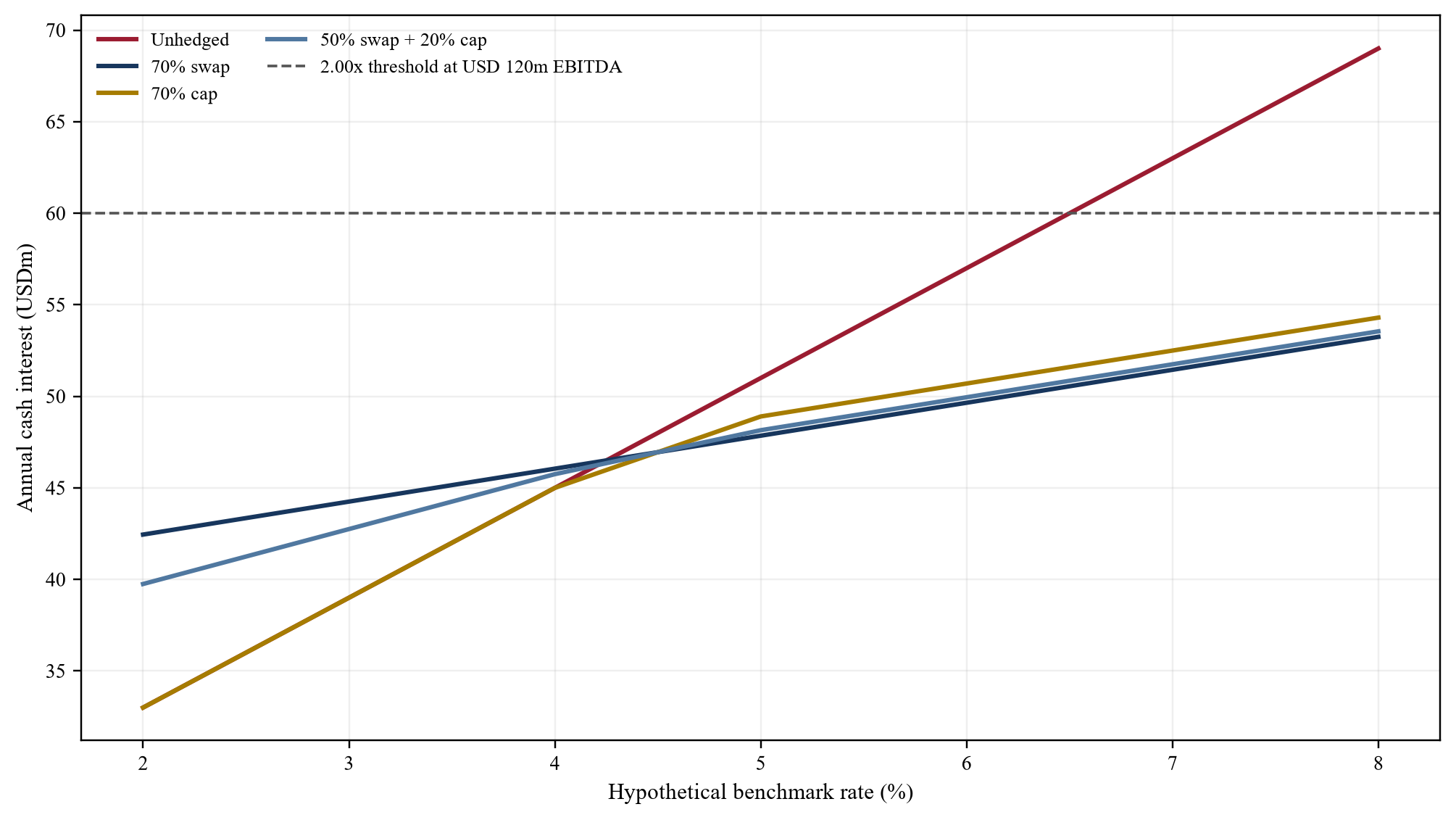
The figure uses a USD 600 million opening balance, 350-basis-point spread and USD 120 million EBITDA. The dashed line represents the USD 60 million interest amount consistent with a 2.00 times threshold.
12. Stress EBITDA and rates together
A single-variable rate sensitivity can understate the acquisition risk. Higher rates may coincide with weaker demand, cost inflation, delayed synergies or tighter refinancing. The downside model should combine benchmark rates with operating outcomes and identified integration costs.
The covenant matrix should show headroom as an amount and a ratio. Negative headroom identifies a breach under the illustrative definition. The model should also show minimum cash, leverage and fixed-charge metrics because a structure can protect interest cover while leaving another covenant constrained.
| EBITDA | Benchmark | Unhedged headroom | 70% swap headroom | 70% cap headroom | Blended headroom |
|---|---|---|---|---|---|
| USD 120m | 4.00% | USD 15.00m | USD 13.95m | USD 15.00m | USD 14.25m |
| USD 120m | 6.00% | USD 3.00m | USD 10.35m | USD 9.30m | USD 10.05m |
| USD 120m | 8.00% | USD (9.00)m | USD 6.75m | USD 5.70m | USD 6.45m |
| USD 105m | 4.00% | USD 7.50m | USD 6.45m | USD 7.50m | USD 6.75m |
| USD 105m | 6.00% | USD (4.50)m | USD 2.85m | USD 1.80m | USD 2.55m |
| USD 105m | 8.00% | USD (16.50)m | USD (0.75)m | USD (1.80)m | USD (1.05)m |
USD millions. Headroom equals EBITDA divided by the illustrative 2.00 times minimum less annual cash interest. Positive values indicate remaining capacity under this simplified test.
13. Match the hedge to contractual amortisation
An amortising swap can reduce its notional on dates aligned with scheduled principal repayments. The schedule should be built from the final credit agreement, including grace periods, quarterly instalments, bullet components and currency conventions.
The hedge should also recognise mandatory prepayment provisions. Excess cash flow, insurance proceeds, debt incurrence, asset sales and equity issuances can reduce principal outside the base schedule. The borrower should identify which events are plausible and whether the hedge can be partially terminated without undermining the remaining protection.
The model should compare three balances: contractual debt, management’s expected debt and protected notional. The protected notional should remain below the debt exposure under the approved scenario set unless an intentional option position is permitted and documented.
The comparison should be refreshed whenever the debt schedule changes. An acquisition add-on, delayed asset sale, permitted incremental facility or revised cash sweep can alter the minimum debt that remains exposed. A hedge amendment may be unnecessary when the change falls inside the approved buffer; a larger deviation should trigger an explicit decision. The governance record should show the old schedule, the revised schedule, the resulting hedge ratio and the authorised response.
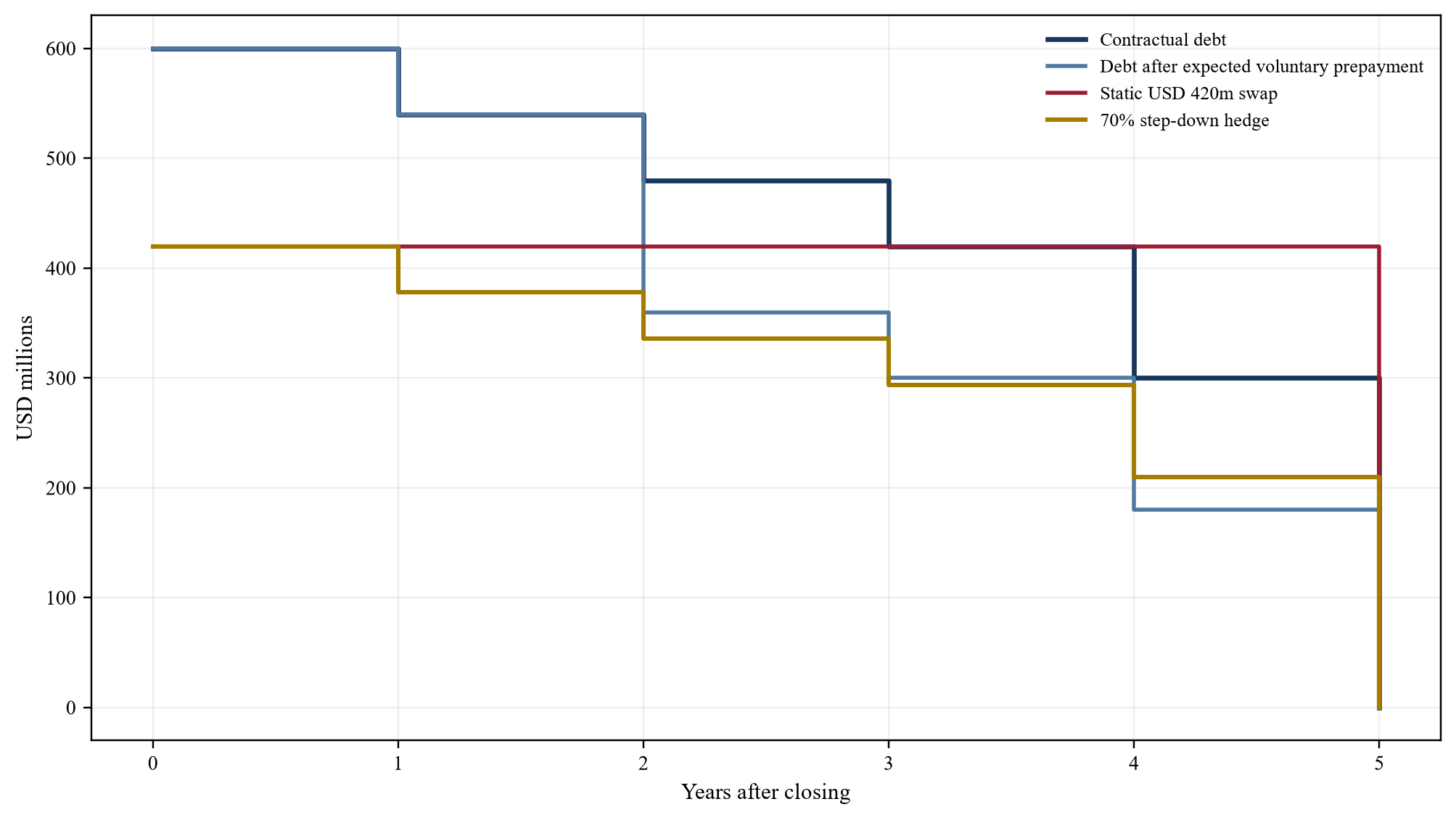
The contractual debt and proposed hedge schedules are illustrative. Expected voluntary prepayments should remain separate from binding amortisation.
14. Quantify early-termination value before execution
A swap’s market value changes as forward rates, time and discount factors change. Early repayment does not extinguish the derivative automatically. The borrower may terminate, novate, retain or offset it, subject to the documents and the continuing exposure.
A simplified first-order estimate can illustrate sensitivity. If a USD 420 million pay-fixed swap has a remaining duration of 3.2 years and the comparable market fixed rate falls by 150 basis points, the adverse value can be approximated as USD 20.16 million before discounting, curve effects and contractual adjustments. Actual valuation requires the full cash-flow schedule and current market inputs.
This amount can become payable when sale or refinancing proceeds are already allocated to repay lenders. The sources-and-uses model should therefore include derivative termination under each exit route. The transaction documents should specify whether hedge liabilities rank with the senior debt, share security and receive payment from controlled accounts.
Caps have different termination economics. The premium is already paid or owed, and the option can have positive residual value. The borrower should verify transferability, settlement and valuation rather than assuming the cap can simply follow a new facility.
15. Protect refinancing flexibility
Acquisition debt often has a shorter expected life than its legal maturity. Refinancing may reduce the spread, extend maturity, change currency, alter amortisation or replace the benchmark convention. A hedge designed only around the original facility can obstruct that transaction.
The refinancing plan should consider four routes. The existing hedge may remain against the new debt if the exposure still matches. It may be novated to a new counterparty. It may be terminated and replaced. It may be economically offset through a new derivative while the original remains outstanding. Each route has legal, credit, accounting and operational consequences.
The board should see the combined economics of debt repricing and hedge termination. A lower credit spread can be offset by an adverse swap break cost. A new fixed-rate bond can leave the old pay-fixed swap redundant. A new currency can create both rate and foreign-exchange exposures.
Refinancing flexibility can be protected through shorter hedge tranches, break clauses, aligned call dates, step-down notionals and pre-agreed transfer mechanics. These terms have value and should be included in quote comparison.
16. Treat the cap premium as a liquidity decision
The cap premium competes with acquisition equity, fees, integration expenditure and the minimum cash reserve. It should be shown in sources and uses and in the opening liquidity bridge.
The hypothetical 70 per cent cap has a USD 7.2 million upfront premium. If paid at closing, it reduces cash available for integration or increases the equity requirement. If financed, it increases debt and may affect leverage. If deferred, the borrower should model the payment schedule and counterparty terms.
Premium should be compared with protected cash-flow outcomes and residual value, not with a swap’s zero upfront price alone. The cap is an option asset whose cost buys asymmetry. The decision is whether that asymmetry is worth the cash requirement given the expected debt path and downside boundary.
The liquidity model should also include collateral and settlement timing. A cap buyer commonly has limited future payment exposure beyond premium, but transaction-specific credit support can differ. A swap can produce collateral calls or secured-hedge exposure depending on the documentation and regulatory status of the parties.
17. Control counterparty and collateral risk
The derivative introduces a financial exposure to the hedge counterparty. When the hedge has positive value to the borrower, counterparty default can remove protection at a time of market stress. When it has negative value, collateral or termination payment can consume liquidity.
Counterparty selection should consider credit quality, legal capacity, pricing, operational capability, collateral terms, transfer restrictions and concentration. Allocating protection across counterparties can reduce concentration while increasing documentation and settlement complexity.
Valuation governance is equally important. The borrower should receive independent or multi-dealer valuations at an agreed frequency and reconcile material differences. The process should identify the source curves, credit adjustments, collateral assumptions and accrued amounts used in each value. A termination quote received during a transaction should be checked against the contractual calculation method and the current market before it is accepted.
The ISDA Master Agreement, schedule, credit support documents and transaction confirmations should be negotiated as part of the financing workstream. Key terms include events of default, termination events, cross-default, additional termination events, close-out currency, calculation agent, thresholds, eligible collateral and dispute procedures.
The security and intercreditor structure should identify the hedge counterparty’s position. Senior-secured hedge claims can consume collateral value and affect lender recoveries. An unsecured hedge can price differently and expose the borrower to separate enforcement. These consequences require legal advice in each jurisdiction.
18. Align benchmark definitions and fallback mechanics
SOFR, SONIA and the euro short-term rate are administered and published under distinct methodologies. Loan and derivative documents should use matching rate sources, observation periods, compounding conventions, lookbacks, payment delays and fallback triggers.
The New York Fed describes SOFR as a broad measure of the cost of financing Treasury securities overnight and publishes compounded averages and an index. The Bank of England administers SONIA and publishes a compounded index. The European Central Bank publishes the euro short-term rate and compounded averages. These official resources provide transparent benchmark foundations, yet contract mechanics still determine actual cash flows.
A loan can reference term rates while a derivative references overnight compounded rates. This creates basis risk. Timing differences can also produce temporary cash mismatches. The hedge model should calculate both legs using the exact conventions and test fallback events.
Documentation should define what happens if the benchmark is unavailable, changed or discontinued. The borrower should avoid relying on operational assumptions that are absent from the signed documents.
19. Apply hedge accounting after economic design
IFRS 9 states that hedge accounting represents the effect of risk-management activities using financial instruments to manage exposures that can affect profit or loss or, in specified cases, other comprehensive income. Qualification depends on eligible items and instruments, formal designation and documentation, the economic relationship, credit-risk dominance and the hedge ratio.
The accounting team should be involved before execution because the documented risk component, hedge ratio and forecast cash flows need to match the economic strategy. Scheduled amortisation, prepayment and refinancing can change the expected debt exposure and require rebalancing or discontinuation.
Accounting eligibility should not drive an economically unsuitable hedge. The decision record should first establish the exposure and board objective, then assess whether the selected relationship can be designated. Any difference between economic protection and accounting treatment should be quantified and explained.
For groups reporting under US GAAP, FASB Topic 815 and current amendments require a separate transaction-specific assessment. The paper does not provide accounting conclusions.
20. Address clearing, margin and reporting requirements
Derivatives regulation varies by jurisdiction, entity classification, instrument and threshold. Some interest-rate derivatives can be subject to clearing, margin, reporting, confirmation, reconciliation and dispute requirements. Commercial end-user treatment and exemptions require fact-specific legal analysis.
ESMA describes EMIR requirements for central clearing of certain OTC classes and risk-mitigation techniques for non-cleared transactions, including timely confirmation, portfolio reconciliation, dispute procedures and collateral provisions. CFTC rules govern swaps and margin requirements within their scope. Cross-border groups can face more than one framework.
The execution plan should identify the booking entity, counterparty status, applicable rules, reporting responsibility and required identifiers. It should also confirm whether clearing or collateral affects liquidity and whether the acquisition vehicle can satisfy operational onboarding before closing.
Regulatory compliance should be a gate in the hedge timetable. A trade should not be delayed until the funding date because entity classification, documentation, know-your-customer checks or reporting setup remains incomplete.
Cross-border structures require a legal-entity view. The borrower, guarantors, treasury company and parent may be established in different jurisdictions, and the hedge can be booked outside the operating group that generates cash. The analysis should confirm authority, benefit, guarantee limitations, insolvency treatment, withholding and payment routes. These matters can affect enforceability and settlement even when the economic rate model is correct.
21. Use a decision tree rather than a product preference
The first decision is whether the unhedged combined rate and EBITDA stress breaches the approved covenant or liquidity boundary. If it does not, the board can retain exposure within a documented limit. If it does, protection should cover at least the amount needed to restore the boundary with an appropriate margin.
The second decision is debt certainty. A stable minimum debt balance supports a swap. Material prepayment, disposal or refinancing uncertainty supports a cap or a shorter, layered swap. The third decision is liquidity. A cap requires premium cash; a swap can create future break or collateral cash. Both should be tested.
The fourth decision is participation. If lower rates materially improve deleveraging and exit value, the cap or floating slice has economic value. If certainty dominates, a swap can be appropriate. The fifth decision is operational capacity. A more complex blend should be used only where the treasury, accounting and legal systems can manage it.
22. Establish the evidence required for approval
The hedge mandate should be supported by the executed or near-final debt terms, covenant definitions, debt schedule, operating model, benchmark conventions, sources and uses, refinancing assumptions and counterparty documents.
Evidence should be version controlled. A hedge approved against a draft facility can become misaligned when the final agreement changes the benchmark floor, amortisation profile, interest period or mandatory-prepayment waterfall. The approval pack should identify the document version and the date on which each model input was verified. Any later financing amendment should trigger a focused reconciliation of the loan and derivative cash flows.
The evidence pack should also distinguish external values from management assumptions. Dealer indications, benchmark publications and executed contractual terms can be tied to dated sources. EBITDA, cash conversion, disposal timing and refinancing plans remain management scenarios until supported by performance or binding commitments. Keeping that distinction visible allows the board to understand which outcomes depend on markets, documents or execution.
| Test | Required evidence | Decision output | Primary owner |
|---|---|---|---|
| Exposure | Debt balance, spread, floor, benchmark and payment dates | Verified floating-rate cash-flow schedule | Treasury and financing |
| Capacity | EBITDA, cash conversion, integration and downside cases | Maximum sustainable interest and liquidity floor | CFO and operating team |
| Covenants | Executed definitions, cure rights and testing dates | Headroom by combined rate and operating scenario | Finance and legal |
| Instrument | Swap, cap and blend term sheets on common assumptions | Economic comparison including premium and termination | Treasury |
| Debt path | Contractual amortisation and identified prepayment events | Protected notional schedule and adjustment triggers | Financing |
| Counterparty | Master agreement, credit support and security position | Approved counterparty and collateral limits | Treasury and legal |
| Accounting | Designation, hedge ratio and effectiveness process | Accounting treatment and volatility assessment | Controller |
| Regulation | Entity classification, clearing, margin and reporting | Compliance sign-off and operational readiness | Legal and compliance |
| Execution | Authorisations, confirmations, settlement and monitoring | Signed mandate and controlled implementation calendar | CFO |
Each item requires transaction-specific evidence and an accountable owner before execution.
23. Execute through a controlled calendar
The rate-protection workstream should begin during financing design rather than after debt documents are signed. The first phase establishes exposure, capacity and permitted instruments. The second obtains comparable terms, negotiates documentation and confirms legal, accounting and regulatory treatment. The third executes after the relevant approvals and transaction conditions are satisfied.
After closing, the borrower should reconcile every loan and derivative cash flow. Monthly or quarterly reporting should show debt balance, protected notional, benchmark, effective cash rate, covenant headroom, mark-to-market, collateral, counterparty utilisation and forthcoming decision dates.
The reporting pack should include exceptions and decisions, not only values. It should state whether actual debt differs from the approved path, whether covenant headroom has crossed a warning level, whether a refinancing event is becoming probable and whether counterparty or collateral limits remain available. Each exception should have an owner, response date and approval route. This turns rate protection into an operating control rather than a trade that disappears into the treasury system after closing.
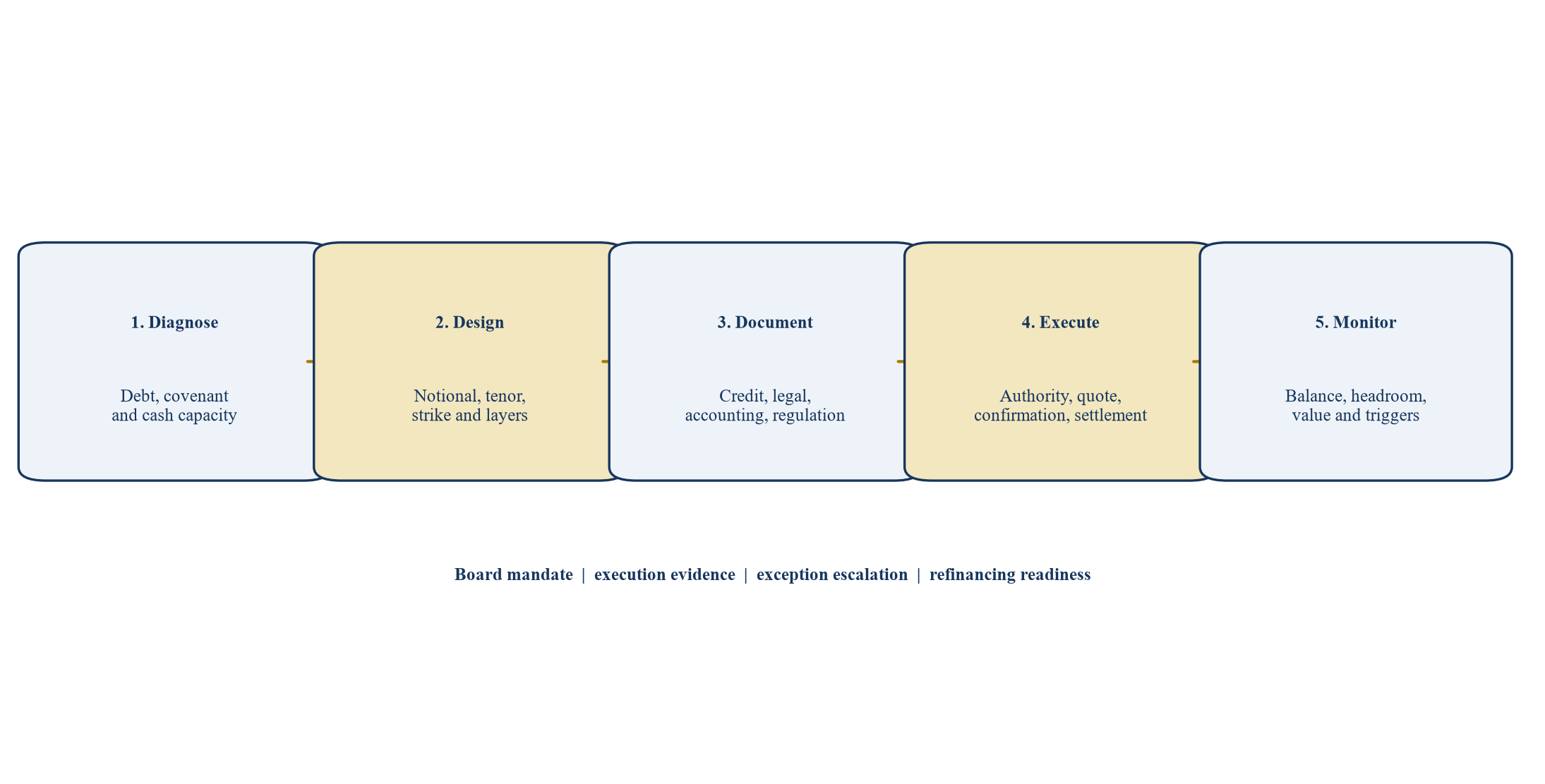
The roadmap separates decision, documentation, execution and monitoring gates. Timing depends on transaction readiness and market access.
24. Monitor, rebalance and rehearse exit
Monitoring should compare protected notional with actual debt after every repayment. It should update covenant scenarios for current operating performance and benchmark curves. It should also track the hedge’s mark-to-market and the cash required under a refinancing, disposal or default.
Rebalancing should follow pre-approved triggers. Examples include debt falling below the protected notional, covenant headroom approaching the warning threshold, a refinancing mandate becoming probable or counterparty exposure exceeding a limit. The trigger should initiate analysis and approval rather than automatic trading unless the mandate expressly permits it.
The borrower should rehearse exit mechanics before a refinancing or sale. The rehearsal should confirm valuation sources, notices, settlement accounts, release of security, replacement or novation options, accounting close-out and responsibility for approvals. This reduces the chance that the derivative becomes a late transaction dependency.
25. Limitations and conclusion
This paper provides a decision framework and does not constitute investment, treasury, legal, tax, accounting or regulatory advice. Product availability, pricing, enforceability, collateral and accounting treatment depend on market conditions, counterparties, documentation and jurisdiction. The worked case is hypothetical and omits many transaction-specific cash flows.
Interest-rate protection should be designed around the acquisition’s cash and covenant capacity. The benchmark exposure, credit spread, floors, debt path, prepayment rights and refinancing routes should be separated and then reconnected in one decision model.
A swap can protect a stable minimum debt balance. A cap can protect a ceiling while preserving participation and flexibility. A blend can allocate certainty and optionality across different debt slices. The strongest choice is the lowest-complexity structure that keeps the verified combined downside within the approved covenant and liquidity boundaries.
The practical discipline is continuous alignment. The borrower should reconcile debt and hedge notionals, monitor mark-to-market and covenant headroom, and prepare for refinancing or exit before it becomes urgent. Rate protection cannot guarantee acquisition performance or refinancing. It can make the financing exposure visible and keep decisions connected to cash, covenants and value.
Sources
- Bank for International Settlements, OTC interest rate derivatives turnover in April 2025, accessed 17 September 2026, Read the primary source
- Bank for International Settlements, OTC derivatives statistics at end-June 2025, accessed 17 September 2026, Read the primary source
- Bank for International Settlements, OTC derivatives statistics data portal, methodology and interest-rate tables, accessed 17 September 2026, Read the primary source
- International Swaps and Derivatives Association, 2021 ISDA Interest Rate Derivatives Definitions, accessed 17 September 2026, Read the primary source
- International Swaps and Derivatives Association, The Value of OTC Derivatives, corporate risk-management examples, accessed 17 September 2026, Read the primary source
- Federal Reserve Bank of New York, Reference Rates, SOFR, SOFR Averages and Index, accessed 17 September 2026, Read the primary source
- Bank of England, SONIA interest rate benchmark and compounded index, accessed 17 September 2026, Read the primary source
- European Central Bank, Euro short-term rate and compounded averages, accessed 17 September 2026, Read the primary source
- IFRS Foundation, IFRS 9 Financial Instruments, hedge-accounting requirements, accessed 17 September 2026, Read the primary source
- IFRS Foundation, IFRS 9 Financial Instruments, issued standard text, accessed 17 September 2026, Read the primary source
- IFRS Foundation, IFRIC Update April 2021, hedge-accounting requirements and risk components, accessed 17 September 2026, Read the primary source
- Financial Accounting Standards Board, Accounting Standards Update 2025-09, Derivatives and Hedging, accessed 17 September 2026, Read the primary source
- Board of Governors of the Federal Reserve System, Interagency Guidance on Leveraged Lending, accessed 17 September 2026, Read the primary source
- Office of the Comptroller of the Currency, Interest Rate Risk, Comptroller's Handbook, accessed 17 September 2026, Read the primary source
- European Securities and Markets Authority, Clearing obligation and risk mitigation techniques under EMIR, accessed 17 September 2026, Read the primary source
- Basel Committee on Banking Supervision, Counterparty credit risk guidelines and sound practices, accessed 17 September 2026, Read the primary source
