

1. Treat the joint venture as an operating institution
A joint venture begins with a commercial proposition: one party may contribute technology and operating capability while another provides distribution, licences, customer access, local knowledge or capital. The proposition becomes investable only when the parties can translate those contributions into enforceable rights, operating responsibilities, decision authority, information and credible routes through disagreement.
Many programmes concentrate their effort on partner search and contract negotiation. Those activities are necessary, yet they leave a continuing governance workload. Contributions have to be delivered and accepted. Budgets have to be approved. Management has to know which decisions it owns. Sponsors need timely information. Related-party services need arm's-length discipline. Funding shortfalls, leadership changes, regulatory developments and strategic divergence require decisions after signing.
The joint-venture office is a practical response. It is a small retained capability that maintains the venture thesis, evidence, decision architecture and sponsor cadence across the full life cycle. Its work can be performed by a dedicated internal team, an external adviser or a blended group. The title describes a function rather than a prescribed legal entity or regulated role.
The office should have a written mandate. It should state the sponsors it serves, decisions it prepares, information it can obtain, matters that remain with legal or professional advisers, conflicts protocol, confidentiality rules, records, escalation authority and termination conditions. It should report through an agreed steering group before formation and through the appropriate board or shareholder channel after formation.
The operating model has seven stages:
1. define the strategic mandate and non-negotiable constraints; 2. identify, screen and rank potential partners; 3. conduct commercial, financial, legal, compliance and operating diligence; 4. design contributions, ownership, economics and control; 5. negotiate, form and launch the venture; 6. support governance, reporting, performance and sponsor alignment; and 7. manage stress, deadlock, transfer, reset or exit.
This life-cycle view keeps the original business case connected to later decisions. It also creates continuity when sponsor executives change. The office retains why a right was negotiated, what evidence supported a contribution value, which risks were accepted, and how the parties intended to measure performance.
2. Start with the mandate, not the partner list
Partner search becomes efficient when the sponsors first define the problem that the venture must solve. A mandate should identify the target customers and territory, products or services, intended duration, required capabilities, capital envelope, regulatory dependencies, expected return logic, timetable and acceptable alternatives. It should also record constraints such as excluded counterparties, protected intellectual property, sanctions exposure, control requirements and the maximum continuing guarantee.
The counterfactual matters. Management should compare the joint venture with internal build, licensing, distribution, minority investment, acquisition, contractual alliance and no action. This comparison does not need false precision. It should make the trade-offs visible: speed, control, capital, reversibility, information access, regulatory feasibility and dependency on another party.
The mandate should then convert the commercial thesis into testable hypotheses. If the proposed partner is expected to accelerate market access, the team needs evidence about customer coverage, decision-maker relationships, distribution capacity, licences and actual conversion. If the partner is expected to provide technology, the team needs to understand ownership, restrictions, maturity, interoperability, security, support and the cost of continued use. If the proposition relies on cost sharing, the operating model must show which costs are avoidable, incremental or transferred.
A clear mandate also helps competition counsel assess the project early. Under the UAE federal competition framework, an economic concentration can require pre-completion notification when the applicable thresholds and legal tests are met. Cabinet Resolution No. 3 of 2025 sets thresholds by UAE sales and market share, and Cabinet Resolution No. 59 of 2026 provides the current executive regulations.[3,4,5] The application of these rules to a specific joint venture depends on the transaction structure, control, market definition, parties and exemptions. The office should open a competition workstream at term-sheet stage and follow qualified advice before implementation.
3. Select a partner through gates, evidence and fit
A familiar name can reduce the effort needed to begin a discussion. It does not establish strategic fit, authority, funding capacity or governance compatibility. Partner selection should use two layers: mandatory gates and a weighted evidence scorecard.
Mandatory gates protect the sponsors from candidates that should not proceed. They can cover verified legal identity and beneficial ownership, authority to negotiate, sanctions and integrity screening, conflicts, ability to fund, required licences, material litigation and willingness to provide diligence evidence. The precise checks depend on the parties, sectors and jurisdictions. A failed gate should pause or end the process unless a documented remedy is completed and approved.
The weighted scorecard compares candidates that have passed the gates. The following dimensions provide a starting point:
- strategic fit: common objective, scope, duration and appetite for investment;
- execution capability: people, systems, operational record and delivery capacity;
- financial resilience: funding evidence, balance-sheet capacity and downside endurance;
- governance compatibility: decision style, transparency, control expectations and escalation behaviour;
- integrity and compliance: ownership clarity, conduct record, controls and willingness to remediate;
- contribution evidence: ownership, availability, value support and transferability of promised inputs; and
- continuity and exit fit: leadership stability, change-of-control risk and acceptable exit paths.
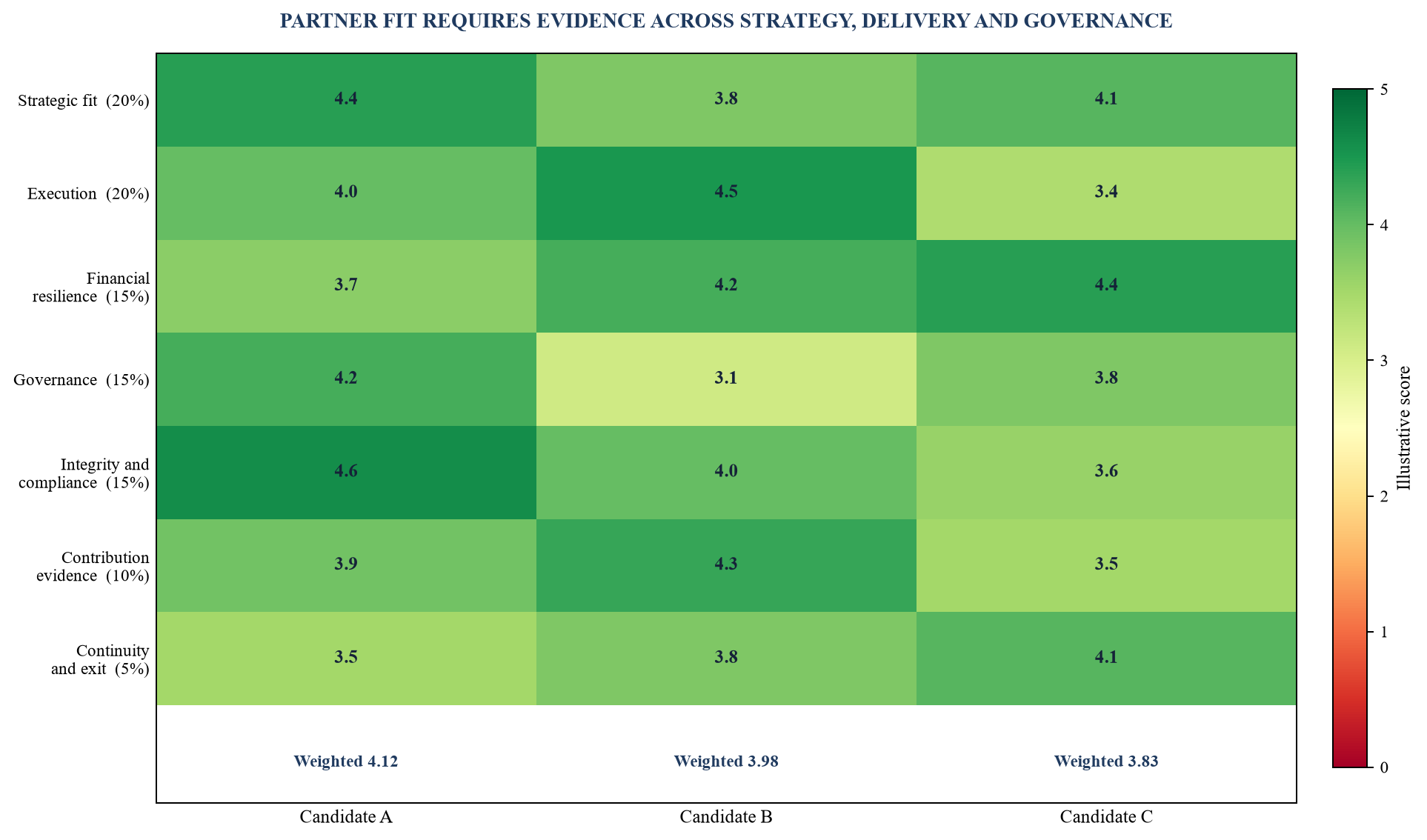
Hypothetical scores on a zero-to-five scale. Weights and thresholds require sponsor approval and do not predict venture performance.
An illustrative 100-point weighting might assign 20 points each to strategic fit and execution capability, 15 each to financial resilience, governance compatibility and integrity, 10 to contribution evidence and five to continuity and exit. These weights are management assumptions. A venture whose value rests on protected technology may assign more weight to intellectual-property control. A regulated market-entry venture may give greater weight to licences and compliance.
Scoring discipline matters. Each score should state the evidence, source date, reviewer, limitations and unresolved question. Interviews should be reconciled with documents and reference checks. Commercial enthusiasm should not raise a score without evidence. A high weighted total should not override a failed mandatory gate.
Partner behaviour during diligence is itself evidence. Delayed ownership information, inconsistent financial data, refusal to identify decision makers or pressure to bypass approvals may reveal governance risk. The office should record these observations factually and allow the candidate to explain or remediate them.
Research supports a process view while requiring careful limits. Solesvik's maritime-industry case study identified partner selection, aligned objectives, resources and trust as important considerations.[13] Sarkar, Aulakh and Madhok analysed 235 firms and reported links between alliance processes and value generation, with an alliance function strengthening some effects.[10] These studies concern particular samples and methods. They do not establish that a scorecard will cause a successful outcome in a GCC venture.
Table 1. Partner-selection evidence register
| Question | Evidence | Owner | Decision use | Typical limitation |
|---|---|---|---|---|
| can the party enter and perform? | constitutional records, approvals, licences and capacity | legal and operating leads | authority and feasibility gate | authority may depend on final documents |
| who owns and controls the party? | registers, beneficial-owner records and group chart | compliance and legal leads | integrity and conflict gate | complex structures require continuing verification |
| can promised funding be delivered? | audited accounts, funding approvals and financing evidence | finance lead | resilience score and funding design | historical liquidity may not show future availability |
| does the capability work? | operating data, site review, customer evidence and technical tests | commercial and technical leads | execution and contribution score | reference results may not transfer to the venture |
| can the parties govern together? | decision simulations, disclosure practice and sponsor interviews | joint-venture office | governance and deadlock design | stated behaviour may differ under stress |
| what happens after change? | succession, change-of-control and continuity evidence | sponsor and legal leads | protection and exit design | future leadership and ownership remain uncertain |
The required diligence depth should follow sector, jurisdiction, transaction structure and risk.
4. Convert promises into a contribution matrix
Ownership percentages do not explain the full contribution bargain. One party may provide cash at formation. Another may license intellectual property, second employees, secure premises, introduce customers, obtain approvals or guarantee financing. These inputs differ in certainty, timing, control, risk and accounting treatment.
The contribution matrix turns each promise into an operable commitment. It should record the contributor, description, legal owner, valuation or pricing basis, evidence, delivery date, acceptance test, ongoing obligation, dependency, tax and accounting review, and remedy for delay or failure. It should distinguish contributed assets from licensed rights, paid services, shareholder funding, guarantees and commercially valuable effort.
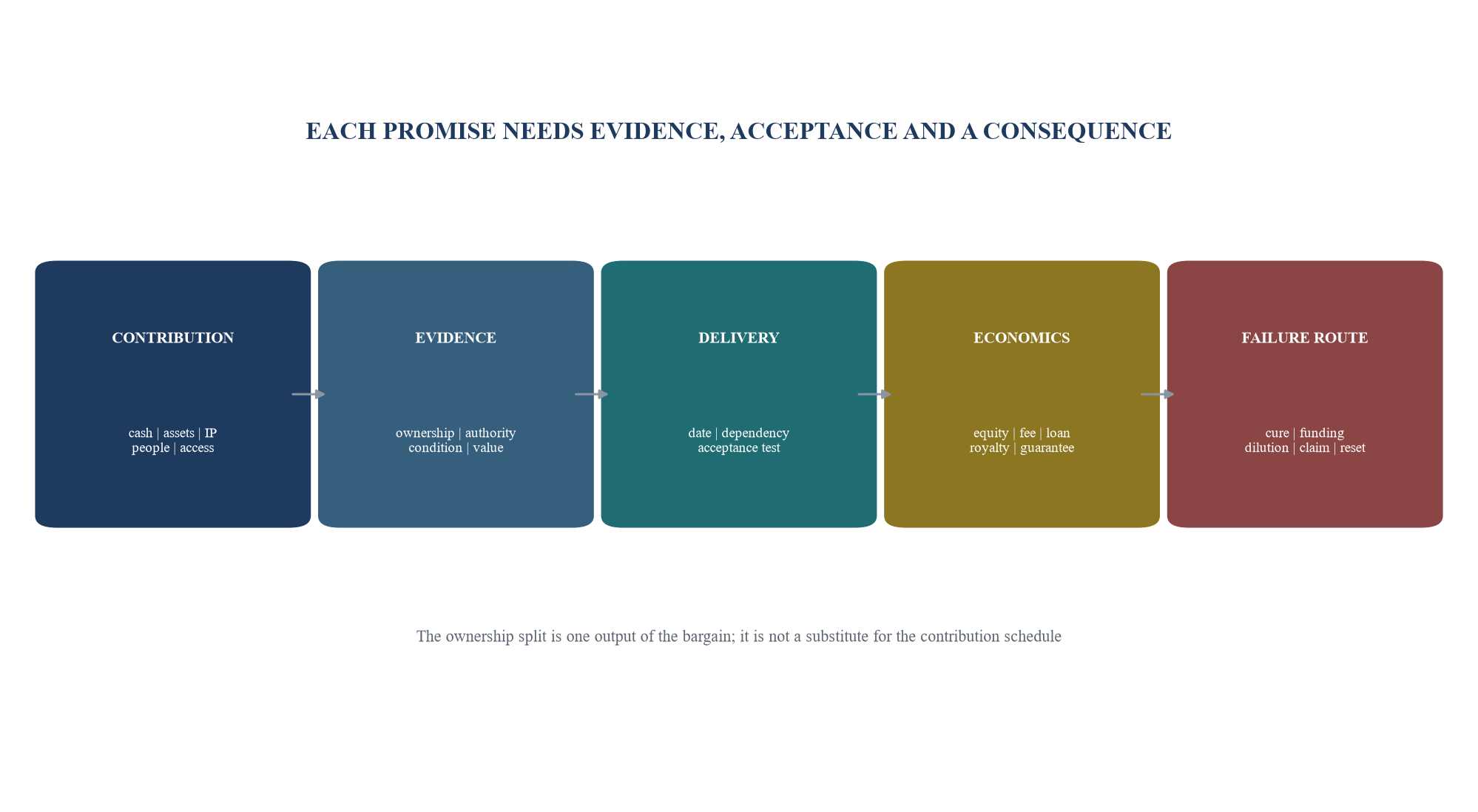
Illustrative contribution categories. Legal title, value, accounting and tax treatment require transaction-specific advice.
Cash is usually the simplest contribution to evidence, though its source, currency, timing and permitted use still matter. Non-cash contributions require deeper analysis. Intellectual property needs an ownership and encumbrance review, a definition of the licensed field and territory, maintenance obligations, improvement rights, cyber controls and a route if the licence ends. Seconded people need roles, cost allocation, authority, confidentiality, employment compliance and replacement provisions. Market access needs measurable deliverables rather than a broad statement of relationships.
The official UAE Ministry of Economy and Tourism joint-venture template illustrates several relevant design questions. It provides for agreed initial contributions, further funding subject to party approval, scheduled non-cash assistance, equal board representation, no chair casting vote, budgets, management accounts, transfer restrictions and a deadlock route.[2] The Ministry describes its common contracts as general templates and disclaims liability for their use.[1] The template is a useful issue list. It is not a substitute for tailored documents or advice.
Contribution economics should reconcile across the business plan, constitutional documents, shareholder agreement, licences, service contracts and financial model. A contribution described as equity in one document and a recoverable service cost in another can create disputes over returns and control. A guaranteed market volume should not appear as base-case revenue unless the obligation, counterparty capacity and remedies support that treatment.
Table 2. Illustrative contribution schedule
| Contribution | Evidence and acceptance | Economic treatment | Continuing obligation | Failure response |
|---|---|---|---|---|
| formation cash | cleared funds from approved source by completion | subscribed equity or approved shareholder instrument | further funding only under agreed process | cure period, permitted alternative funding and resulting rights |
| equipment or facility | title, condition, independent inspection and usable capacity | transfer, lease or service charge | maintenance, insurance and replacement | repair, substitute asset, price adjustment or claim |
| intellectual property | ownership, freedom-to-license review and technical acceptance | assignment, exclusive or defined-field licence, royalty if agreed | updates, support, security and infringement response | cure, step-in, substitute licence or orderly separation |
| seconded team | named roles, credentials, employment basis and mobilisation | reimbursement or service fee under approved policy | replacement, supervision, conduct and knowledge transfer | replacement period, cost allocation and service remedy |
| distribution and access | signed channels, licence status and defined customer work | commission, service fee or venture economics | coverage, reporting and compliance | revised scope, remedial plan or termination right |
| guarantee or credit support | executed instrument, cap, expiry and lender acceptance | fee or recognised sponsor support | covenant reporting and renewal decision | replacement security, refinancing or controlled wind-down |
The entries show the required fields. They do not prescribe ownership percentages or values.
5. Separate ownership, control and management
An equal ownership split can coexist with unequal operating responsibility. A majority economic interest may still be subject to joint control over relevant activities. Management can hold broad delegated authority while shareholders retain a narrow set of enterprise-defining matters. The architecture should distinguish these layers clearly.
Under IFRS 11, joint control exists when decisions about relevant activities require unanimous consent of the parties sharing control. Classification then depends on rights and obligations: a joint operation gives parties rights to assets and obligations for liabilities, while a joint venture gives parties rights to net assets.[8] Legal form, contractual terms and other facts and circumstances can matter. The commercial label used by the sponsors does not decide the accounting classification. Finance and audit advisers should assess the final arrangement before approval and revisit it when rights or operating facts change.
The governance map should identify the shareholders, board, committees, chief executive, delegated management and sponsor interfaces. It should also show who prepares information, who recommends, who approves, who implements and who assures. A chart becomes useful only when it reconciles to the constitutional documents, shareholder agreement, board resolutions, employment terms, bank mandates and system permissions.
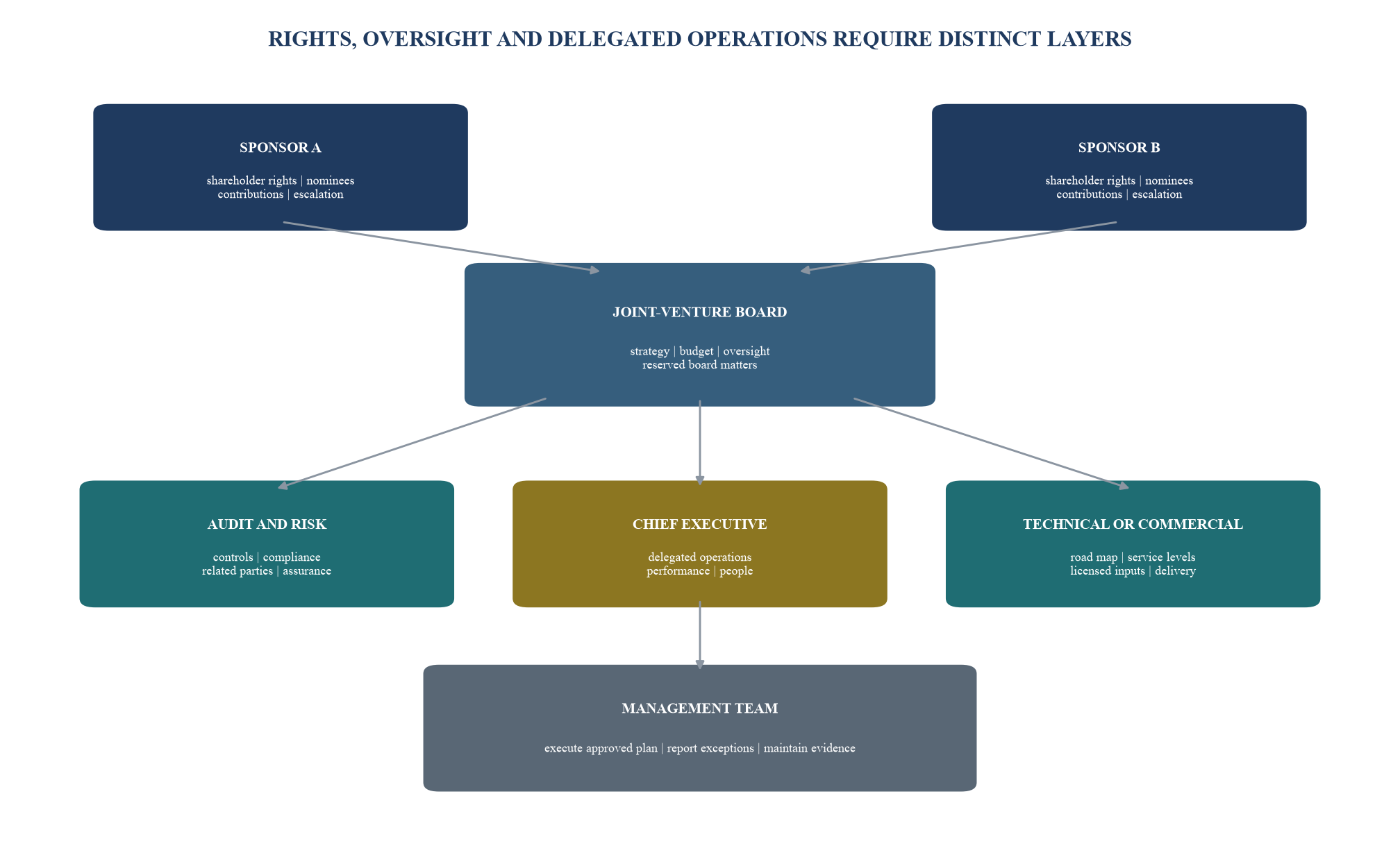
Illustrative architecture. Actual authority follows applicable law and executed documents.
Board design should address composition, qualifications, chair role, quorum, alternates, conflicts, information rights, meeting frequency and written resolutions. A rotating chair or independent chair can help process, but the documents must state whether the chair has a casting vote. A casting vote can change the negotiated allocation of control and may affect accounting analysis.
Independent directors may add expertise and a perspective that is not tied to either sponsor. Olie, Klijn and Reuer studied independent directors on joint-venture boards and found associations with competitive overlap, functional scope and contractual complexity.[9] Their evidence does not establish a universal requirement. The board should identify the conflict, information or capability problem that an independent director is expected to address and define nomination, removal, confidentiality and voting rights accordingly.
Management needs a protected operating mandate. Annual plan and budget approval should establish revenue, cost, investment, hiring, financing and risk limits. Within those limits, executives should be able to run the business. The office should track decisions that repeatedly escalate because they fall outside the budget, lack information or trigger an ambiguous reserved matter. Those cases are evidence for redesign.
6. Design reserved matters around risk and materiality
Reserved matters are decisions that require board, shareholder or unanimous approval beyond ordinary delegated authority. They protect the venture's purpose, capital, ownership, control, integrity and major commitments. A long undifferentiated veto list can slow ordinary operations and create manufactured deadlock.
Each reserved matter should include six design fields: the decision category, materiality threshold, approving body, information pack, response period and consequence of no decision. The documents should also state whether related decisions are aggregated, whether emergency action is permitted, and how monetary thresholds are reviewed for growth and inflation.
The distinction between sponsor consent and board consent matters. Shareholders may reserve amendments to constitutional documents, new equity, transfer of ownership, change of business, merger, sale or winding up. The board may reserve budgets, senior appointments, major contracts, financing and litigation. Management should own actions inside the approved plan and policy.
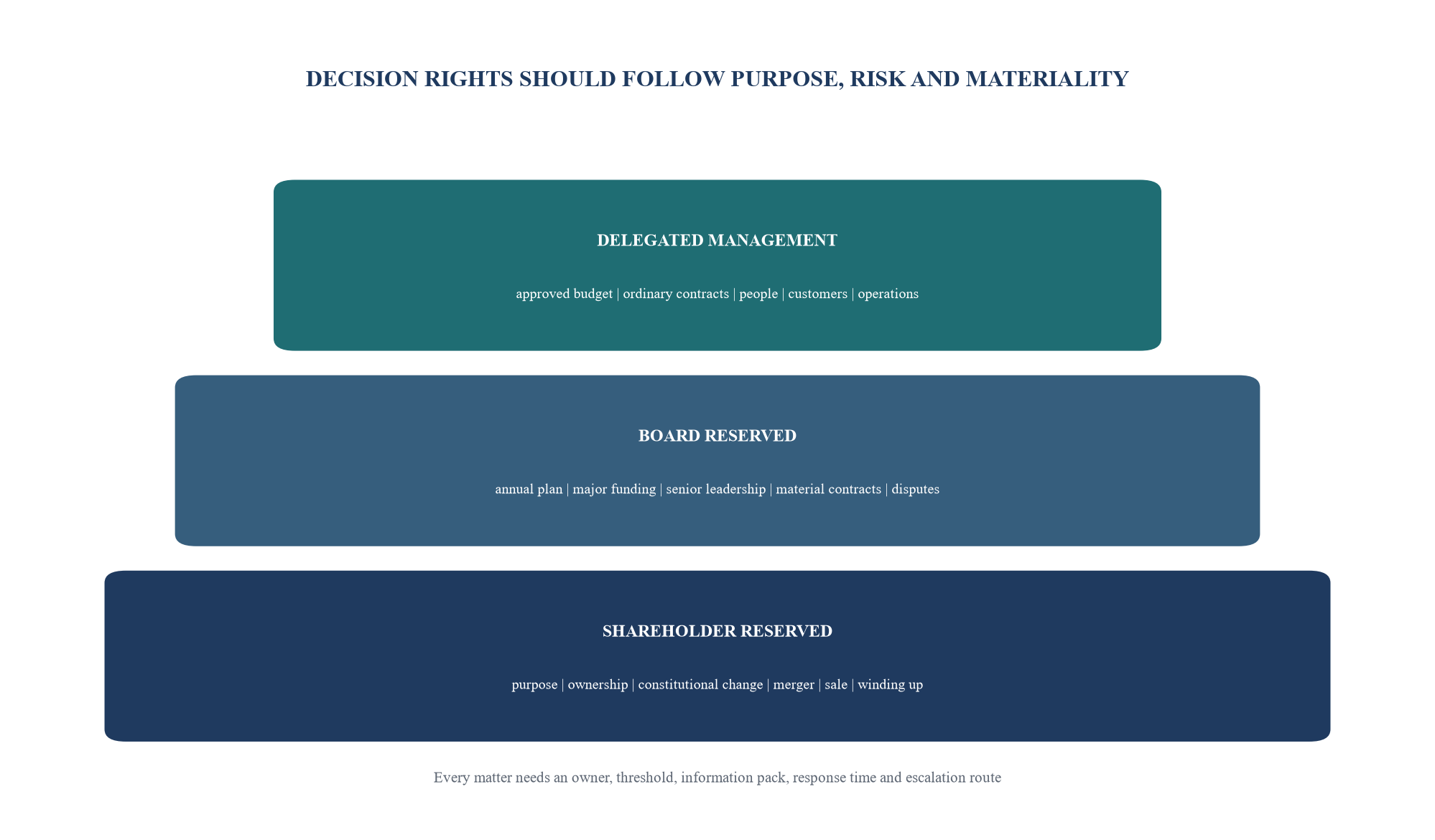
Thresholds and approval layers are hypothetical. Applicable law and executed documents govern.
Table 3. Reserved-matters design table
| Matter | Approval layer | Threshold design | Required information | No-decision route |
|---|---|---|---|---|
| annual plan and budget | board, with agreed sponsor rights | full annual plan plus defined variance bands | strategy, forecast, funding, risks and assumptions | prior-year continuity budget for limited period, then escalation |
| unbudgeted capital expenditure | board above delegated limit | single and aggregated commitments | business case, procurement, funding and sensitivity | revise, defer or sponsor escalation |
| new debt or security | board or shareholders by scale | amount, tenor, security and covenant effect | sources, uses, liquidity, covenants and alternatives | alternative funding review and liquidity protocol |
| related-party contract | disinterested approval body | any material or non-standard transaction | benchmarking, conflicts, terms and service evidence | independent review, revised terms or no transaction |
| chief executive or finance leader | board | appointment, removal and material remuneration | search evidence, conflicts, mandate and succession | interim appointment under defined time limit |
| change of business or territory | shareholders | outside approved purpose or material geography | strategic case, regulatory impact and capital | retain current scope or invoke strategic-review process |
| transfer or licence of core intellectual property | shareholders or board by scope | exclusivity, field, territory, duration and value | ownership, valuation, security, tax and continuity | narrower licence, independent review or rejection |
| acquisition, disposal or joint arrangement | board or shareholders by scale | value, risk and control thresholds | diligence, valuation, financing and integration | revise structure or discontinue |
| litigation and settlement | board above risk threshold | claim value, precedent and conduct risk | merits, cost, insurance, disclosure and options | litigation committee or urgent-action protocol |
| dividends and additional funding | board and shareholders under documents | solvency, policy, cap and timing | cash flow, covenants, needs and alternatives | retain cash, approved funding process or reset plan |
Categories and threshold types are illustrative. Counsel should reconcile them to the legal form and constitutional documents.
Related-party transactions deserve specific treatment because each sponsor may supply people, technology, premises, procurement or distribution. The policy should cover identification, pricing evidence, conflicts, approval by disinterested decision makers where applicable, service levels, audit rights and periodic review. The OECD Principles emphasise board attention to conflicts and related-party transactions as part of informed, objective oversight.[6]
Reserved matters should be tested with scenarios before signing. The parties can simulate a budget delay, urgent cyber expenditure, replacement of a chief executive, a sponsor service failure and an acquisition opportunity. The exercise reveals missing information, impractical thresholds and issues that would fall directly into deadlock.
7. Build information rights that make decisions possible
Decision rights are ineffective without timely and reliable information. The reporting schedule should cover annual budgets and forecasts, monthly management accounts, cash and funding, operational performance, customer concentration, regulatory compliance, incidents, related-party services, contribution delivery and disputes.
The official UAE joint-venture template includes annual budgets and cash-flow statements, quarterly management accounts and comparison with budget.[2] A specific venture may need a different frequency. A capital-intensive project may require monthly cash forecasting and construction milestones. A digital venture may need weekly customer, availability and cyber indicators. The principle is consistent: the cadence should match the speed and consequence of the decisions.
Information rights should address access, format, timing, confidentiality, privilege, personal data, competition-sensitive information and audit. Sponsors that compete outside the venture may need clean-team procedures and limits on commercially sensitive data. Counsel should determine the protocol.
The joint-venture office can maintain one decision calendar. It shows each required approval, information owner, distribution date, decision date and consequence of delay. It also tracks whether management has answered prior questions. This discipline reduces procedural deadlock caused by incomplete papers or missed notice requirements.
Table 4. Minimum governance information pack
| Cadence | Information | Decision supported | Quality test |
|---|---|---|---|
| weekly or fortnightly where needed | cash, sales, delivery, incidents and urgent decisions | liquidity and operating intervention | current source data, owner and exceptions |
| monthly | management accounts, forecast, working capital, operating indicators and contribution status | performance, corrective action and funding | reconciliation, variance explanation and action owner |
| quarterly | strategy progress, risk, compliance, related parties, people and sponsor services | board oversight and reserved matters | material issues, trend, options and recommendation |
| annually | business plan, budget, capital, funding, remuneration and assurance plan | operating mandate for next period | assumptions, sensitivities, dependencies and sponsor approval |
| event-driven | breach, litigation, regulatory contact, cyber event or major commercial loss | containment, disclosure and escalation | time stamp, verified facts, accountable response and privilege protocol |
The actual pack should follow the venture's business, risk, legal and reporting requirements.
8. Govern performance without reopening the bargain each month
Performance measures should connect the original venture thesis to controllable outcomes. A market-access venture might track qualified pipeline, conversion, active customers, retention, gross margin and cash collection. A technology venture might add release milestones, availability, defects, adoption and support. A manufacturing venture might focus on commissioning, yield, quality, utilisation, safety and working capital.
The measures should distinguish venture performance from sponsor obligations. If a sponsor has promised seconded engineers, licences, leads or purchasing support, the office should track delivery separately. Poor venture revenue may stem from a failed sponsor contribution, a weak market assumption, management execution or several causes. The governance response depends on the diagnosis.
Budgets should contain defined variance bands. Management should explain the cause, cash effect, corrective action and decision required. A variance outside the band may trigger a revised forecast, but it should not automatically reopen ownership or control. Ownership resets and dilution need explicit contractual triggers and legal review.
The board should also monitor relationship health. Useful observations include decision cycle time, unresolved information requests, repeated vetoes, sponsor service failures, management bypass and executive turnover. These indicators do not predict failure. They show where governance capacity is under strain.
Alliance research suggests that contracts and relational governance can operate together. Keller, Lumineau, Mellewigt and Ariño studied governance responses to disruption through a longitudinal case of a pharmaceutical research-and-development alliance and described changes in governance mechanisms over time.[12] Hill and Hellriegel's interviews with 98 oil and gas joint-venture managers highlighted the importance of functional-area control and multidimensional performance measures.[11] Both studies have sector, period and design limitations. They support a practical need to align formal rights, operating relationships and performance information.
9. Diagnose deadlock before selecting the remedy
Deadlock is an inability to obtain a required decision under the agreed governance rules. It can arise through a failed vote, absent quorum, refusal to provide information or incompatible sponsor instructions. The documents should define the triggering events carefully. Ordinary disagreement, missed performance and breach may require different remedies.
The office should classify a deadlock before escalating it:
- information deadlock: the decision pack is incomplete or disputed;
- process deadlock: notice, quorum or authority is defective;
- operating deadlock: sponsors disagree on a decision inside the current strategy;
- strategic deadlock: sponsors disagree on purpose, market, capital or risk appetite;
- funding deadlock: required capital has no approved source;
- compliance deadlock: a proposed action may breach law, licence or policy;
- related-party deadlock: sponsor economics or conflicts prevent approval; and
- exit deadlock: the parties agree the model is no longer workable but disagree on route or price.
This taxonomy determines the next step. An accounting calculation may be suitable for independent expert determination. A disputed strategy is rarely solved by an expert choosing one sponsor's commercial preference. A compliance concern should go to qualified advisers and the appropriate board process. A funding dispute needs liquidity protection before negotiation.
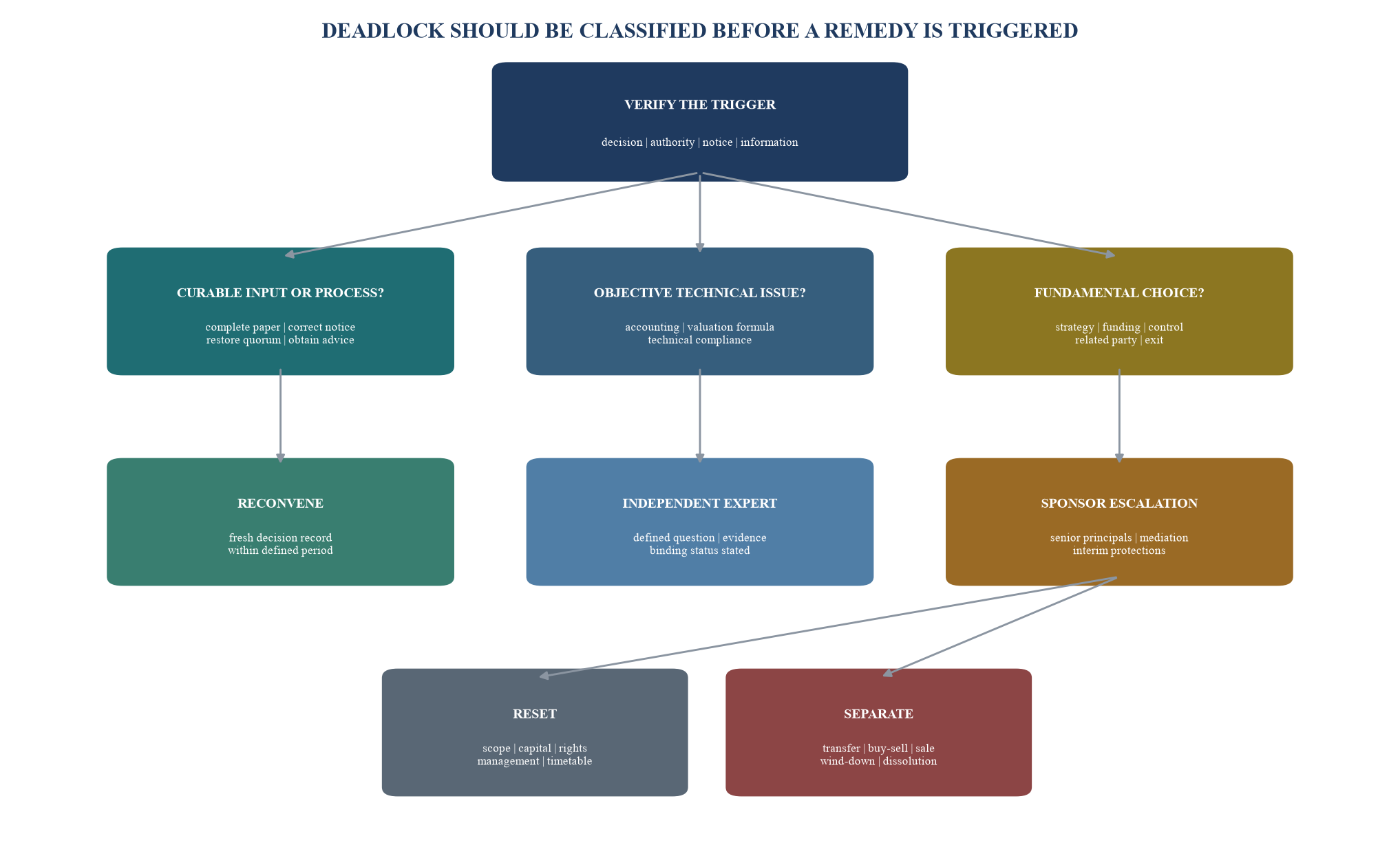
Illustrative process. Time periods, remedies and enforceability require tailored legal advice.
The first route should usually correct the decision process. The parties confirm that the matter is genuinely reserved, distribute the complete information pack, cure notice or quorum defects and reconvene within a short period. A defined standstill can preserve the existing business while prohibiting irreversible actions, asset leakage or unilateral public statements.
The next route can refer an objectively determinable question to an independent expert. The referral should define the question, evidence, timetable, appointment method, cost, standard, confidentiality and whether the decision is final. Broader commercial disputes may benefit from sponsor-chair escalation or mediation.
The official UAE template illustrates a staged route: a Deadlock Notice, referral to the parties' chairmen, good-faith efforts and, after a stated period, a roulette-style buy-sell process.[2] The template also cautions users to consider governing law, arbitration, entity form, continuing funding and enforceability. The mechanism should be treated as an example rather than a default.
A buy-sell clause can produce a clean separation, yet it may favour the party with greater liquidity or information. The design should consider financing certainty, price mechanism, minority protections, regulatory approvals, guarantees, tax, employee and customer continuity, intellectual-property access and completion failure. Other options include a sealed bid, independent sale process, put or call under defined events, business division, scope reset, managed wind-down or dissolution.
Arbitration can determine legal disputes when a valid agreement and applicable law support it. UAE Federal Law No. 6 of 2018 provides the federal arbitration framework.[14] Arbitration does not supply a missing commercial strategy or approve a budget on the sponsors' behalf unless the documents create an arbitrable question and lawful remedy. Counsel should design dispute and deadlock provisions together.
Table 5. Deadlock route and fit
| Route | Suitable question | Required design | Principal risk |
|---|---|---|---|
| cure and reconvene | incomplete information, notice, quorum or authority | short timetable, complete pack and recorded decision | tactical delay can continue |
| independent expert | defined accounting, valuation-formula or technical issue | narrow question, evidence, standard and status of decision | expert asked to make a commercial choice |
| senior sponsor escalation | strategic, funding or relationship disagreement | named principals, preparation and interim safeguards | principals repeat existing positions |
| mediation | negotiable package across several issues | authority, confidentiality and settlement process | delay without decision authority |
| governance reset | venture remains viable under revised scope or rights | new business case, value transfer, approvals and documents | temporary compromise without operating alignment |
| buy-sell or put/call | continuing co-ownership is no longer viable | fair process, funding, valuation, completion and approvals | asymmetry of liquidity or information |
| third-party sale or wind-down | neither sponsor should continue alone | sale mandate, asset and liability plan, people and customer continuity | value erosion during delay |
| arbitration or court | legal breach, interpretation or enforceable claim | valid clause, forum, interim relief and remedy | legal outcome may leave commercial deadlock unresolved |
The table is a management issue map. Qualified counsel should determine validity and enforceability.
10. Protect continuity during stress
A deadlock route needs an interim operating protocol. The venture must continue paying employees, complying with law, preserving assets, serving customers and protecting data while the sponsors decide. The protocol should define the last approved budget, minimum liquidity, permitted ordinary expenditure, emergency authority, insurance, cyber response, public communications and restrictions on related-party payments.
Funding stress requires early warning. The board should receive a rolling cash forecast and covenant position. If additional funding needs unanimous approval, the documents should state the proposal process, evidence, permitted alternatives and consequences when one party declines. Alternatives may include third-party debt, shareholder instruments, reduced scope, asset sales or a controlled wind-down, subject to approvals and duties.
Intellectual property and data need continuity arrangements. The venture may depend on a sponsor-hosted system, trademark, patent, code base, customer data or technical support. The contracts should define access during dispute, step-in or transition support where lawful, security, data return and rights after termination. The office should test these arrangements through a continuity exercise.
Employees and customers should receive controlled communications. Premature disclosure of sponsor conflict can damage retention and trading. Concealment of a material service or solvency risk can also create harm. The board should use verified facts, agreed spokespersons and advice on disclosure duties.
11. Run the office through a decision calendar and evidence register
The joint-venture office should maintain a compact control set rather than duplicate management. The core records are the venture thesis, partner evidence register, contribution matrix, approvals map, reserved-matters register, decision calendar, performance dashboard, sponsor-obligation tracker, risk and issue register, and deadlock or dispute log.
During partner search, the office coordinates evidence requests and maintains a consistent scoring basis. During negotiation, it reconciles the commercial term sheet with the model and draft documents. Before launch, it checks that approvals, funding, licences, bank mandates, systems, people and reporting are ready. After launch, it prepares governance papers, tracks decisions and preserves institutional memory.
The office should not become an unaccountable shadow board. Management remains responsible for operating the venture. Directors and shareholders exercise their formal rights and duties. Legal, tax, accounting and other regulated advice remains with qualified professionals. The office provides preparation, coordination, evidence and follow-through under a clear mandate.
Its service levels can include a defined turnaround for board papers, status of contribution obligations, overdue decisions, action closure and escalation. Quality measures should address complete papers, on-time distribution, decision implementation and unresolved exceptions. High meeting volume is not evidence of good governance.
Table 6. Joint-venture office stage gates
| Gate | Evidence required | Decision |
|---|---|---|
| mandate approved | counterfactual, objectives, scope, economics, constraints and advisory plan | authorise partner search and initial spend |
| shortlist approved | mandatory gates, evidence scorecards, conflicts and reference findings | select parties for full diligence and negotiation |
| design approved | contribution matrix, model, governance map, accounting and regulatory workstreams | approve term-sheet parameters |
| signing approved | reconciled documents, diligence exceptions, funding, conditions and implementation plan | sign subject to stated conditions |
| launch approved | formation, cash, licences, people, systems, controls, insurance and reporting | commence operations |
| operating review | performance, sponsor obligations, risks, decisions and relationship health | continue, correct, fund or redesign |
| stress or exit gate | verified trigger, liquidity, legal advice, options, valuation and continuity | resolve, reset, transfer, sell or wind down |
Timing should follow the venture's sector, complexity, approvals and operating cycle.
12. Illustrate the economics without claiming an outcome
Consider a hypothetical 50:50 operating venture between a regional commercial partner and an international technical partner. The business plan assumes an initial AED 60 million funding requirement. The regional partner proposes AED 30 million in cash. The technical partner proposes AED 15 million in cash plus a ten-year technology licence and seconded launch team that the parties preliminarily attribute AED 15 million of negotiated contribution value.
These figures do not describe a market benchmark or an actual transaction. They show why the contribution matrix matters. The parties need evidence for the licence ownership, scope, maintenance, restrictions, tax and accounting treatment. They need a defined team, mobilisation period, replacement obligation and cost. They also need to decide whether the AED 15 million figure affects equity, royalties, service fees, performance conditions or several elements.
The base plan assumes first full-year revenue of AED 90 million and EBITDA of AED 13.5 million. A delayed technology acceptance could move six months of launch revenue into the following period and add interim operating cost. A delayed market licence could have a different cause and remedy. The model should connect each contribution failure to timing, cash, funding and contractual response.
Table 7. Hypothetical contribution and delay scenario
| Item | Agreed planning case | Illustrative delay case | Governance use |
|---|---|---|---|
| initial cash funding | AED 60.0m | AED 60.0m | confirm sources, timing and draw controls |
| attributed non-cash contribution value | AED 15.0m | AED 15.0m subject to acceptance | separate negotiated value from usable delivery |
| first full-year revenue | AED 90.0m | AED 67.5m | model six-month delay for affected launch revenue |
| EBITDA margin | 15.0% | 9.0% | test under-absorption and interim support cost |
| minimum liquidity buffer | AED 12.0m | AED 18.0m | decide contingency funding before cash falls below limit |
| management response | operate approved plan | cure, rescope, bridge funding or reset | follow contribution and reserved-matter routes |
Illustrative management assumptions only. Values do not estimate a likely GCC venture, valuation or legal recovery.
The model should state whether a case is a base plan, downside, stress or decision threshold. It should avoid double counting a delayed contribution in reduced revenue, higher cost and a separate blanket discount unless each effect is distinct. Qualified valuation, tax and accounting advisers should review the treatment when it affects ownership, financial statements or a transaction.
13. Apply governance and diligence principles proportionately
UAE Federal Decree-Law No. 32 of 2021 frames companies as arrangements in which parties contribute money or work to an economic project and share profit or loss, subject to permitted legal forms and applicable rules.[3] The law also addresses governance and protection of partners and shareholders. Mainland, free-zone, regulated-sector and contractual structures can differ. The final entity and documents require jurisdiction-specific advice.
Beneficial ownership verification is a continuing governance issue. UAE Cabinet Decision No. 109 of 2023 uses ownership, voting and other control tests and requires reasonable measures to maintain accurate and current information.[15] The office should reconcile ownership and control information during diligence and after relevant changes. Sanctions, anti-bribery, licensing, data, tax and sector reviews should follow the actual parties and activities.
The OECD Due Diligence Guidance for Responsible Business Conduct describes risk-based due diligence that can extend to business relationships and be embedded in contracts, reporting, monitoring and termination arrangements.[7] Its responsible-business-conduct purpose differs from full transaction diligence. It provides a useful logic: identify risks, prevent or mitigate, track implementation, communicate and remediate where appropriate.
The G20/OECD Principles of Corporate Governance 2023 are primarily directed to publicly traded companies while noting relevance to unlisted companies. They do not prescribe one governance model.[6] Their emphasis on strategic guidance, informed board decisions, disclosure, risk oversight and conflicts is useful when adapted to the venture's size and ownership.
14. Assumptions, limits and professional boundaries
This paper is a general research and management framework. It is not legal, competition, tax, accounting, audit, valuation, employment, regulatory or investment advice. A specific joint venture requires qualified advice in each relevant jurisdiction and sector.
The partner scores, weights, gates, contribution fields, governance layers, thresholds, timelines and financial scenarios are hypothetical. They are original management tools and have not been statistically validated as predictors of partner quality, venture performance, legal enforceability or value. Management should adapt them to verified facts and record its assumptions.
The official UAE common-contract template is a general starting resource. Its clauses are not instructions for a specific venture. The Ministry's own description states that the templates are general and provided without liability.[1] The parties should obtain tailored advice on entity form, constitutional documents, governing law, arbitration, funding, transfer rights, competition, tax and remedies.
The UAE competition framework cited is current as of August 2026. Whether a venture constitutes a notifiable economic concentration and meets the thresholds depends on facts, market definition, control and applicable exemptions. The official English legislative pages state that the Arabic text prevails for interpretation. Competition counsel should confirm the filing analysis and current procedure.
IFRS 11 is financial-reporting guidance. Classification depends on enforceable rights and obligations and may require judgement.[8] It does not determine the commercial quality of a venture. The OECD materials serve governance and responsible-business-conduct purposes. They do not replace domestic law or transaction diligence.
The academic studies cited use different countries, industries, periods and methods. Sarkar and colleagues studied alliance portfolios across 235 firms.[10] Hill and Hellriegel interviewed managers in oil and gas ventures.[11] Solesvik used maritime-industry cases.[13] Olie and co-authors examined joint-venture boards and alliance governance in defined samples.[9,12] Their findings provide context; they should not be generalised mechanically to a particular GCC venture.
15. Implementation conclusion
A joint venture becomes governable when the parties translate a commercial idea into evidence, contributions, authority, information and decision routes. The work begins before a partner is selected and continues after the documents are signed.
The joint-venture office provides continuity across that work. It maintains the mandate, applies gates and scorecards, reconciles contribution economics, prepares the governance architecture, tracks sponsor obligations and keeps decisions connected to evidence. During stress, it verifies the trigger, protects continuity and routes the issue through the agreed process.
The five tools in this paper form one system. The partner scorecard tests fit after mandatory gates. The contribution matrix converts promises into accepted value and consequences. The governance map separates shareholder rights, board oversight and delegated operations. The reserved-matters architecture protects enterprise-defining choices without absorbing ordinary management. The deadlock decision tree preserves a path from cure and expert input to reset or separation.
The result is a venture that can be monitored, challenged and adapted. Residual disagreement remains possible. The parties gain a documented method for making decisions, identifying failure and choosing the next lawful step.
References
- [1] UAE Ministry of Economy and Tourism, Common Contracts Projects. https://www.moet.gov.ae/en/common-contracts-projects
- [2] UAE Ministry of Economy and Tourism, Joint Venture Agreement template. https://www.moet.gov.ae/documents/20121/0/Joint%2BVenture%2BAgreement.doc/b7176ff3-2c18-9c07-7e8a-32a318f5539b?t=1687169889703
- [3] United Arab Emirates Legislation, Federal Decree-Law No. 32 of 2021 on Commercial Companies. https://www.uaelegislation.gov.ae/en/legislations/1542/download
- [4] United Arab Emirates Legislation, Federal Decree-Law No. 36 of 2023 Regarding the Regulation of Competition. https://uaelegislation.gov.ae/en/legislations/2117/download
- [5] United Arab Emirates Legislation, Cabinet Resolution No. 3 of 2025 and Cabinet Resolution No. 59 of 2026 under the federal competition framework. https://www.uaelegislation.gov.ae/en/legislations/2788/download ; https://uaelegislation.gov.ae/en/legislations/4451
- [6] OECD, G20/OECD Principles of Corporate Governance 2023. https://doi.org/10.1787/ed750b30-en
- [7] OECD, OECD Due Diligence Guidance for Responsible Business Conduct, 2018. https://doi.org/10.1787/15f5f4b3-en
- [8] IFRS Foundation, IFRS 11 Joint Arrangements and supporting material. https://www.ifrs.org/issued-standards/list-of-standards/ifrs-11-joint-arrangements/
- [9] Rene Olie, Elko Klijn and Jeffrey J. Reuer, Antecedents of Independent Directors on Joint Venture Boards, Organization Science 35(4), 2024. https://doi.org/10.1287/orsc.2021.14865
- [10] M. B. Sarkar, Preet S. Aulakh and Anoop Madhok, Process Capabilities and Value Generation in Alliance Portfolios, Organization Science 20(3), 2009. https://doi.org/10.1287/orsc.1080.0390
- [11] Robert C. Hill and Don Hellriegel, Critical Contingencies in Joint Venture Management, Organization Science 5(4), 1994. https://doi.org/10.1287/orsc.5.4.594
- [12] Arne Keller, Fabrice Lumineau, Thomas Mellewigt and Africa Ariño, Alliance Governance Mechanisms in the Face of Disruption, Organization Science 32(6), 2021. https://doi.org/10.1287/orsc.2021.1437
- [13] Marina Z. Solesvik, Partner Selection for Strategic Alliances: Case Study Insights from the Maritime Industry, Industrial Management & Data Systems 110(6), 2010. https://doi.org/10.1108/02635571011055081
- [14] United Arab Emirates Legislation, Federal Law No. 6 of 2018 Concerning Arbitration. https://uaelegislation.gov.ae/en/legislations/1069/download
- [15] UAE Ministry of Economy and Tourism, Cabinet Decision No. 109 of 2023 on beneficial-owner procedures. https://www.moet.gov.ae/documents/20121/294745/Cabinet%2BDecision%2B109-2023%2BEnglish%2BVersion%2BPDF.pdf/1590f581-52c1-ac5c-19de-be97a879a240?t=1706692042660
About the Author
Chennakeshav Adya is an independent researcher whose work focuses on corporate finance, value creation, private capital and transaction execution. His research translates financial, commercial and operating evidence into decision frameworks for boards, investors and management teams.
Appendix A: Partner and design checklist
- Define the venture objective, counterfactual, scope, duration, capital envelope and non-negotiable constraints.
- Complete legal identity, beneficial ownership, authority, integrity, sanctions, funding and licence gates before weighted ranking.
- Record evidence, source date, reviewer and limitation for every partner score.
- Reconcile each cash and non-cash contribution to evidence, acceptance, economics, continuing obligation and failure route.
- Confirm competition, accounting, tax, valuation and regulatory workstreams before final approval.
- Reconcile the governance map to constitutional documents, shareholder agreement, resolutions, mandates and systems.
Appendix B: Governance and deadlock checklist
- Distinguish shareholder rights, board oversight, delegated management and sponsor service obligations.
- Give every reserved matter a threshold, approving body, information pack, response period and escalation route.
- Maintain a decision calendar, performance dashboard, contribution tracker and related-party register.
- Define deadlock triggers separately from breach, underperformance and ordinary disagreement.
- Test the decision route with budget, funding, leadership, cyber, related-party and strategy scenarios.
- Protect cash, employees, customers, data, intellectual property and compliance during any standstill.
- Obtain qualified advice on expert determination, mediation, arbitration, buy-sell, transfer, sale, wind-down and dissolution provisions.
