

1. Define the seasonal financing decision
The credit decision should identify the borrower, producers, traders, storage operators, buyers, jurisdictions, commodities, crop seasons, currencies and repayment sources. It should specify whether drawings fund inputs, crop purchases, pre-export activity, inventory, receivables or a combination. Each purpose creates a different collateral and control problem.
The committee should set a committed amount, sublimits, availability period, tenor, advance rates, reserves, concentration limits, margin-call mechanics and reporting frequency. It should determine when an in-field crop becomes eligible, when harvested output enters inventory, when inventory becomes a receivable and when a receivable becomes collected cash. A single annual leverage ratio does not capture that migration.
Satellite analytics belongs inside this decision as corroborating evidence. It can indicate whether a mapped field was planted, whether vegetation differs from a baseline, whether rainfall or flood conditions changed and whether harvest activity appears to have begun. Legal title, lien priority, crop ownership, warehouse custody, grade, export documentation, buyer obligation and bank receipt require other evidence. The facility should state which observation changes availability and which observation only prompts review.
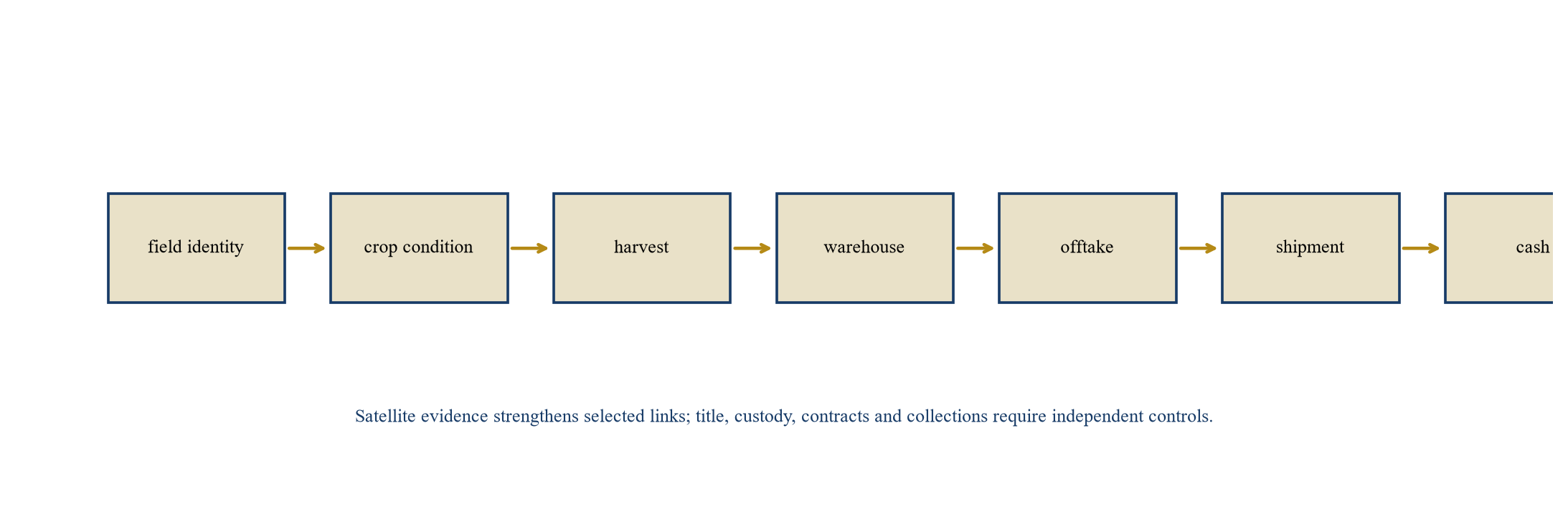
Analytical framework; actual eligibility depends on contracts, law, controls and current evidence.
| Asset stage | Primary evidence | Principal risk | Illustrative treatment |
|---|---|---|---|
| inputs and planting | invoices, field register, planting verification | diversion and failed establishment | controlled disbursement and low advance |
| in-field crop | field rights, crop classification, condition and inspection | yield, weather and ownership | evidence-weighted value less finishing cost |
| harvested crop | weighbridge, grade and delivery records | loss and measurement | reconcile to intake before step-up |
| warehouse stock | receipt, custody, inspection and insurance | title, fraud, quality and shrinkage | controlled quantity and price haircut |
| receivable | contract, shipment, invoice, acceptance and assignment | buyer, dispute and timing | buyer limit and collection control |
| cash | controlled bank receipt | leakage and set-off | mandatory application under waterfall |
Proposed evidence hierarchy; actual treatment depends on facility terms and jurisdiction.
2. Map the crop-to-cash chain
The operating map begins with land access, seed, fertilizer, labour, irrigation and planting. It continues through crop development, harvest, transport, drying, grading, storage, sale, shipment, invoice and collection. Finance may enter and leave at several points. Controls should follow the asset without creating an evidentiary gap.
For in-field crops, useful evidence includes registered field polygons, land or production rights, crop type, planting date, agronomic inspection, input records, weather and satellite indicators. After harvest, the evidence shifts to weighbridge tickets, quality certificates, warehouse receipts, stock reports, insurance and collateral-manager controls. For export receivables, the lender requires the contract, shipment, invoice, acceptance, buyer credit, assignment, collection account and any trade instrument.
IFC's Global Warehouse Finance Program uses warehouse receipts or equivalent collateral arrangements to support working capital for agricultural producers and traders. Where negotiable warehouse receipts are unavailable, collateral-management or stock-monitoring agreements may provide an alternative control structure [1]. That programme illustrates the importance of custody and collateral architecture. A remote-sensing estimate of crop volume does not replace those post-harvest controls.
3. Establish field identity before measuring condition
A satellite model is only as useful as its spatial perimeter. The lender should receive field polygons tied to a producer, crop, season and legally relevant production right. Duplicate polygons, boundary overlap, leased parcels, intercropping and changes in management can create double counting or ownership ambiguity. The field register should carry a unique identifier and an audit trail.
The perimeter review should compare borrower submissions with cadastral or land records where lawfully available, historical imagery, crop masks, agronomic inspection and prior-season planting. A field that appears cultivated may belong to another producer or support a different crop. The credit process should preserve this distinction.
FAO describes high-resolution optical and radar time series as useful for crop mapping, phenology, yield estimation and forecasting when combined with statistically sound sampling and ground data [2]. The lender should therefore document image source, resolution, revisit frequency, cloud and radar treatment, classification method and validation sample. A mapped area becomes eligible only after the ownership, season and crop evidence meet the facility's defined grade.
4. Build a crop calendar and observation plan
Satellite signals change meaning across emergence, canopy development, flowering, grain fill, senescence and harvest. A vegetation decline near maturity can be normal; the same decline earlier may indicate stress. The lender should use a crop and geography-specific calendar, including expected planting windows, phenological stages, harvest periods and known multiple-cropping patterns.
The observation plan should define which sensors are used, how frequently data are expected, which weather variables supplement imagery and when field inspection is mandatory. Optical imagery may be obscured by cloud. Radar can provide different information and requires specialised interpretation. Data latency matters when a drawing or margin call depends on current conditions.
Copernicus describes Sentinel-1 applications in crop-condition monitoring, soil properties, harvest prediction, seasonal change and drought-related productivity assessment [3]. Those capabilities support monitoring design; they do not create a universal yield measure. The facility should record the model version and local validation for each crop-zone combination, along with explicit procedures for missing observations, sensor changes and exceptional weather.
5. Separate crop detection, condition and yield
Crop detection asks what is planted and where. Condition analysis asks how observed development compares with a benchmark. Yield estimation converts multiple signals into expected output. These are different analytical tasks with different error structures. Credit policy should not treat a confident crop classification as a confident yield forecast.
The model pack should report planted-area confidence, condition indicators, expected yield range and uncertainty separately. It should identify whether the estimate relies on historical yields, weather, soil, management practice, remote sensing, field samples or proprietary data. Where the borrower has limited history, regional averages may be informative yet weak for a specific field.
FAO's Agricultural Stress Index uses rainfall and vegetation information for early identification of areas likely affected by dry spells or drought [4]. It is an early-warning input. The lender should investigate a deterioration, compare it with field and weather evidence, and revise availability only under agreed rules. A single index threshold should not automatically determine default or loan acceleration.
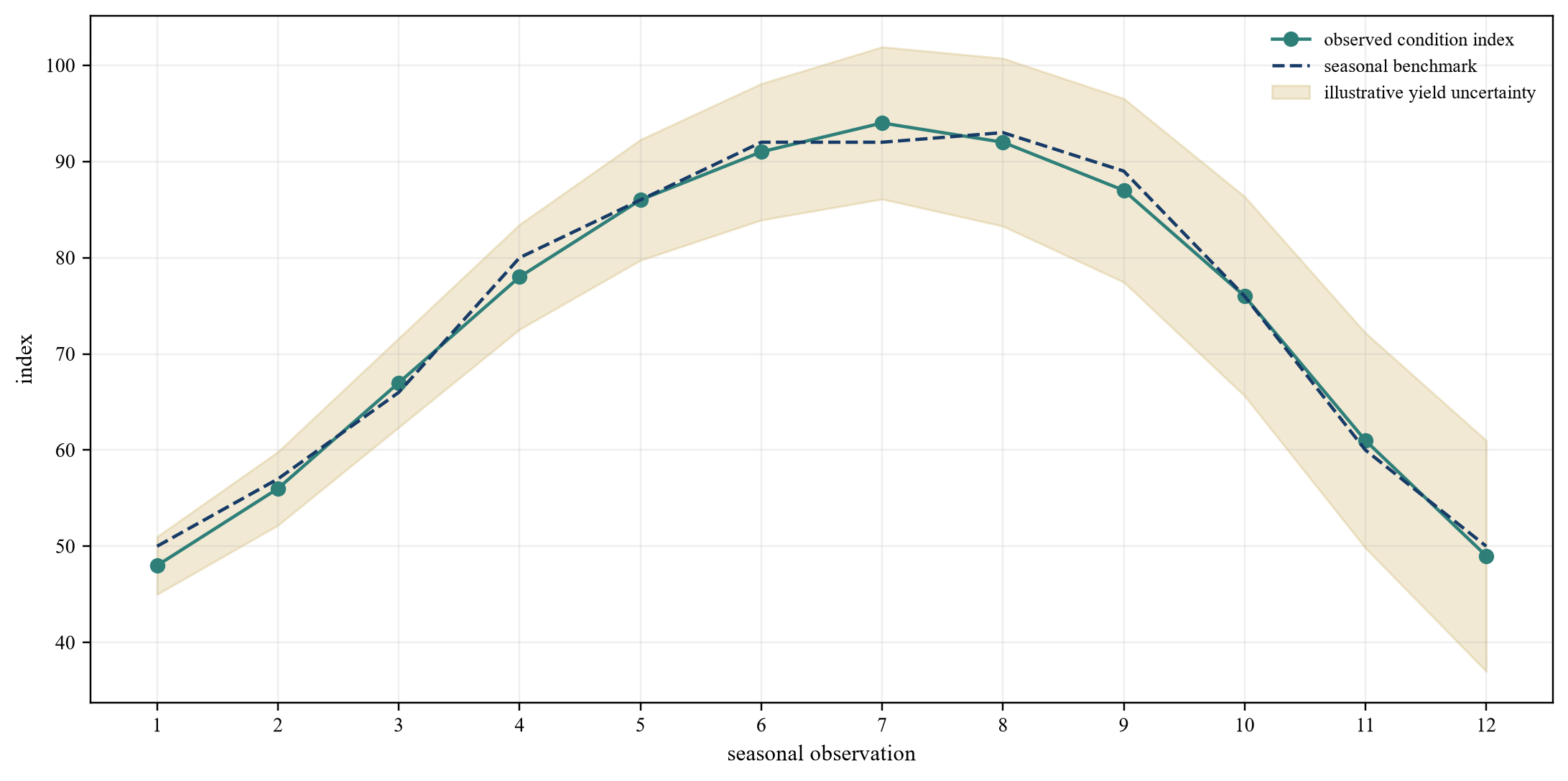
Wholly hypothetical indices; values do not represent an identified farm, crop or forecast.
| Test | Evidence | Credit question | Response to weakness |
|---|---|---|---|
| crop classification | labelled fields and confusion matrix | is the financed crop present? | exclude or inspect uncertain polygons |
| planted area | field boundary and measured reference | is eligible area overstated? | conservative area and duplication control |
| condition | stage-specific ground observation | is stress detected early? | raise monitoring and reserve |
| yield | harvest and warehouse intake | is output systematically overstated? | lower policy yield and advance rate |
| timing | planting and harvest dates | will cash arrive before debt service? | extend buffer or reshape amortisation |
| model drift | seasonal residuals by crop and zone | has performance changed? | revalidate, revert or suspend uplift |
Proposed validation schedule; no single metric proves financeability.
6. Calibrate satellite evidence to ground truth
Ground truth converts an attractive image into a testable credit input. The validation sample should cover material regions, crops, farm sizes, irrigation regimes and stress conditions. It should avoid selection controlled solely by the borrower or model provider. Agronomic inspections, harvest measurements and warehouse intake provide reference observations at different stages.
Performance should be reported through errors that matter to finance: false inclusion of ineligible area, false exclusion, yield overstatement, timing error and bias under drought, flood or cloud. Average accuracy can conceal concentrated misses in high-exposure zones. The committee should see performance by crop, region, season and forecast horizon.
Independent validation should reproduce a sample from frozen inputs and compare forecasts with realised harvest and warehouse intake. Where error widens, the response can include a lower evidence grade, reduced advance rate, extra reserve, more inspection or suspension of incremental drawings. The decision should remain traceable to a named version and data date.
7. Link climate signals to financial scenarios
Rainfall, temperature, soil moisture, drought, frost, heat and flood affect crops through different biological channels. The credit model should avoid translating an observed anomaly directly into a single loss percentage. It should connect weather and vegetation evidence to crop stage, agronomic response, expected yield range, harvest timing, quality and cost.
IDB's climate-risk work highlights the role of agricultural insurance and public-private risk transfer in managing production volatility [5]. IDB has also supported satellite and vegetation-index approaches designed to address systemic drought and flood risk [6]. The financing model should distinguish expected crop proceeds, insurance recovery and contingent public support. Each has a different trigger, timing and counterparty.
Scenarios should include a localised event, a correlated regional event and a multi-factor case combining crop loss, price movement and logistics disruption. The lender should test when information becomes available, when the borrower must act and when cash is actually received. A valid insurance claim may still settle after interest or supplier payments fall due.
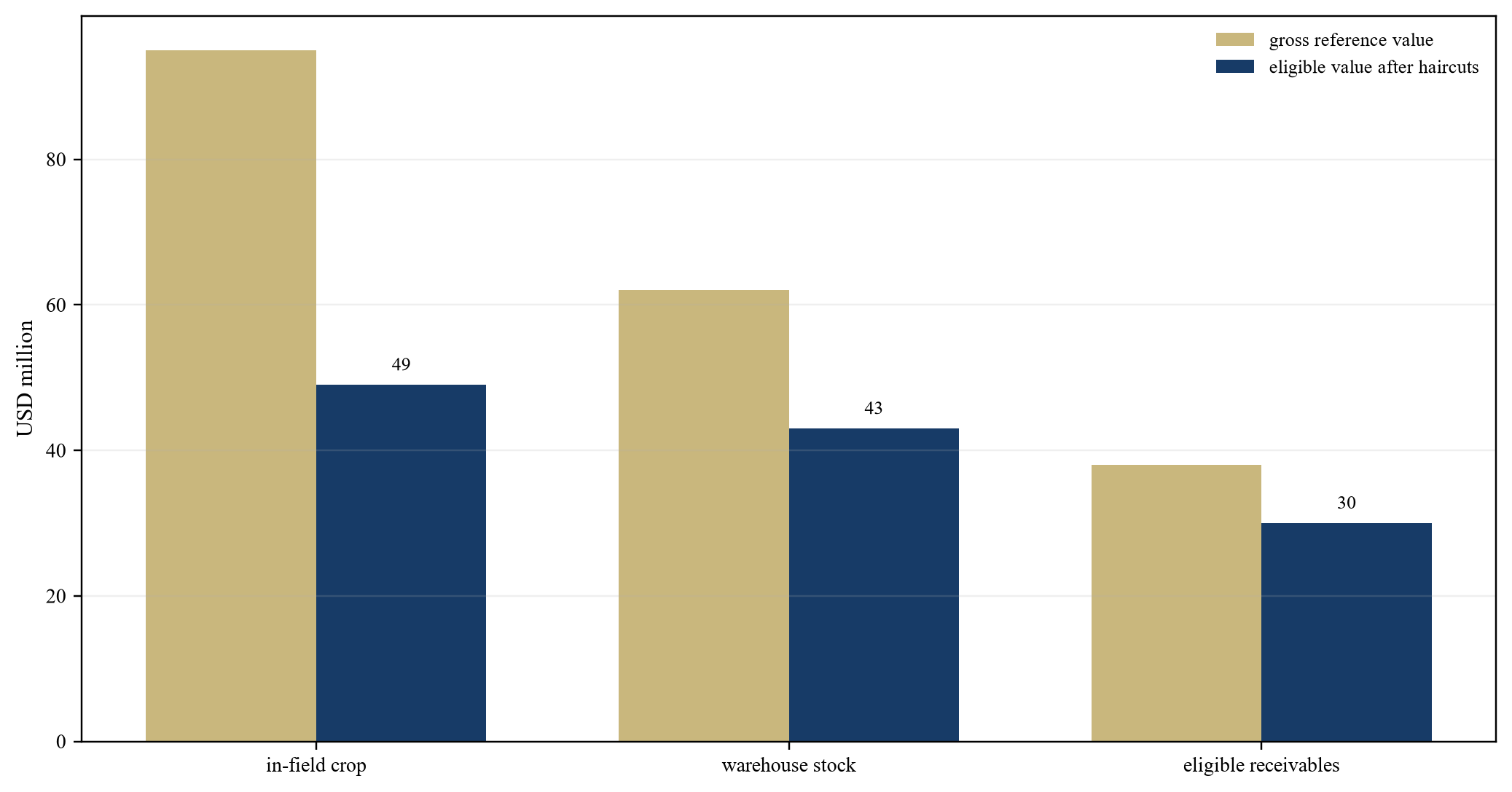
Wholly hypothetical USD millions; values and advance rates are illustrative.
| Component | Gross reference | Key deductions | Illustrative eligible value |
|---|---|---|---|
| in-field crops | 95 | yield range, finishing cost, climate and evidence grade | 49 |
| warehouse inventory | 62 | price, quality, shrinkage, storage and concentration | 43 |
| export receivables | 38 | buyer, disputes, currency and collection timing | 30 |
| subtotal | 195 | combined controls and haircuts | 122 |
| portfolio reserve | - | country, buyer and model concentration | (12) |
| borrowing-base availability | - | lower of formula and committed limit | 90 |
Wholly hypothetical; USD millions and percentages do not describe an identified facility.
8. Design an evidence-weighted borrowing base
A borrowing base should advance against eligible value after quantity, price, ownership, control and concentration haircuts. In-field crop value can use the lower of a validated yield range and a conservative policy yield, multiplied by eligible area and a stressed price, less remaining production and harvest cost. Inventory value can use independently verified quantity, grade and location at a defined price. Receivables require eligible buyers, invoices and assignment.
Satellite evidence can change the quantity or confidence component for in-field crops. It should not eliminate deductions for finishing cost, harvest, transport, basis, quality, insurance gaps, senior claims or timing. The lender can use evidence grades with different maximum advance rates. A fully controlled warehouse receipt may receive different treatment from an estimated standing crop.
Availability should be the lower of the policy formula, committed limit, sublimit and cash need. The model should show all exclusions and reserves. Borrowers need a clear route to cure a discrepancy through new evidence, cash, collateral or reduced drawings.
9. Reconcile harvest estimates to warehouse evidence
Harvest creates a control transition. Expected crop volume leaves mapped fields, enters trucks, passes weighbridges, may be dried or processed and arrives at one or more warehouses. Loss, diversion, moisture adjustment, quality downgrade and commingling can occur. The lender should reconcile estimated harvest with measured intake and explain variance.
The reconciliation should link field identifiers to delivery notes where operationally possible, then to weighbridge tickets, quality certificates, warehouse lots and stock reports. Independent collateral managers, insured storage and periodic physical counts can support control. Electronic warehouse receipts may improve traceability where the legal framework recognises them.
Remote sensing can indicate harvest progression and possible output. It does not measure warehouse custody or title. Once inventory is stored, controlled physical evidence should carry greater credit weight. A large unexplained shortfall between field forecast and warehouse intake should trigger an exception review, not an automatic assumption that the crop remains elsewhere.
10. Test storage, quality and shrinkage
Agricultural inventory is exposed to moisture, pests, contamination, spoilage, fire, theft, fraud and operational loss. Grade and condition may determine sale price and buyer acceptance. The borrowing base should apply commodity-specific shrinkage, quality, ageing and location rules, supported by inspection and insurance.
Warehouse due diligence should cover ownership, licensing, capacity, segregation, systems, operator credit, access controls, insurance, liens, historical losses and ability to release goods. Where stock is commingled, the legal and operational claim requires close review. Inventory reporting should reconcile opening stock, receipts, processing, transfers, sales, dispatch and closing stock.
Satellite data has limited direct visibility into indoor commodity quantity and quality. It can support origin and harvest context, while warehouse controls support the stored asset. The facility should avoid extending the field model beyond its evidentiary domain. A separate anomaly system can compare reported stocks with movements, sales and physical checks.
| Question | Evidence | Risk if unresolved | Financing response |
|---|---|---|---|
| who must pay? | executed contract and buyer identity | wrong or weak counterparty | buyer exclusion or lower limit |
| what is fixed? | quantity, price formula and quality | uncertain receivable value | conservative eligibility |
| when is payment due? | delivery, acceptance and invoice terms | liquidity gap | tenor and reserve adjustment |
| can obligations be reduced? | set-off, rejection and cancellation | disputed collection | haircut or trade instrument |
| can the lender control cash? | assignment and account documents | proceeds leakage | controlled collection account |
| is payment protected? | letter of credit, guarantee or insurance | bank or insurer exposure | separate counterparty limit |
Proposed diligence matrix; qualified advisers should confirm legal effect.
11. Verify offtake and buyer credit
A crop becomes repayable cash through a buyer obligation and collection. The lender should verify quantity, quality, price formula, currency, delivery term, acceptance, deductions, cancellation, force majeure, set-off, assignment and payment date. It should assess buyer credit and concentration independently of the producer's performance.
Offtake can be fixed-price, indexed, provisional, minimum-volume or optional. A contract may provide market access while leaving price, quality or volume open. The borrowing base should credit the enforceable and measurable component. Buyer limits should reflect financial strength, jurisdiction, performance history, dispute risk and any letter of credit, guarantee or insurance.
IFC's Global Trade Finance Program covers transaction-specific instruments including letters of credit, bills, guarantees and supplier credit, and provides pre-export funding through participating banks [7]. Such instruments can alter payment risk, subject to their terms and issuing-bank exposure. They do not cure production, quality or documentary failure.
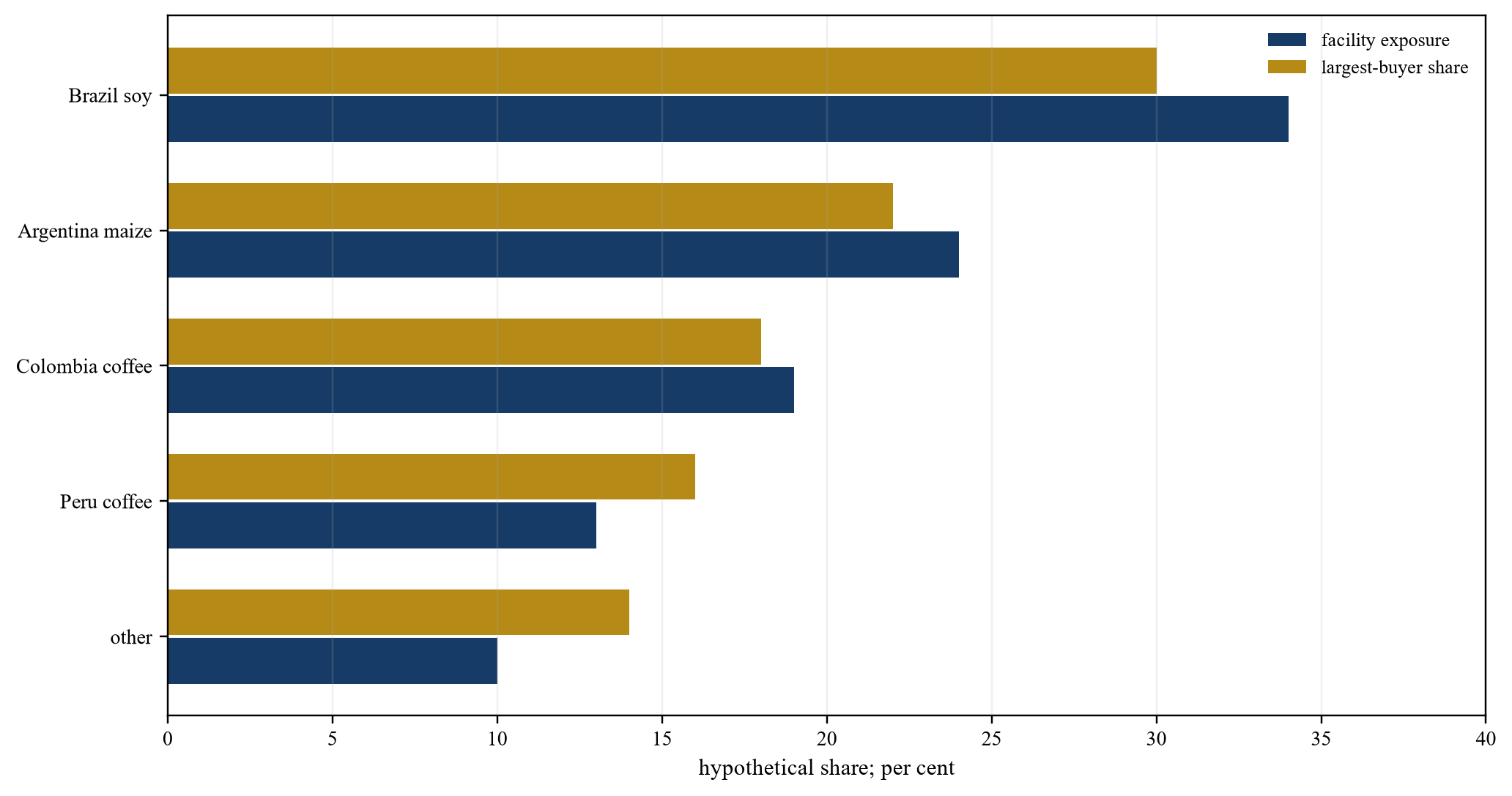
Wholly hypothetical exposure shares; portfolio correlation requires transaction-specific analysis.
12. Model commodity price and basis risk
Commodity prices can move between planting, harvest, storage, shipment and collection. The borrower may sell under a benchmark plus or minus local basis, quality and logistics adjustments. A global price screen therefore does not equal expected cash. The lender should capture benchmark, currency, basis, hedge, margin and settlement terms.
The World Bank's April 2026 Commodity Markets Outlook described divergent agricultural dynamics, including higher energy and fertilizer costs, weather risk and different trajectories across food, beverage and raw-material groups [8]. IDB's 2026 trade estimate similarly reported large differences across coffee, soy and sugar prices in 2025 [9]. A diversified facility can still have correlated exposure through currency, freight or input cost.
Borrowing-base prices should use transparent sources and conservative rules. Hedging should be verified through contracts, counterparties, margin requirements and settlement. A hedge may reduce benchmark price risk while creating liquidity calls, basis exposure or counterparty risk. The cash model should include those effects.
| Event | Crop effect | Cash effect | Insurance question | Credit action |
|---|---|---|---|---|
| drought | yield and quality decline | lower sale proceeds | does the trigger match field loss? | reduce availability and test claim lag |
| flood | crop, access and storage loss | delayed harvest and sale | are field and stock both covered? | reserve and inspect |
| frost or heat | stage-specific loss | volume and quality shortfall | is peril covered and timely reported? | revise yield range |
| logistics disruption | crop intact but shipment delayed | collection after debt service | is delay covered? | liquidity buffer and tenor test |
| buyer default | production realised | receivable impairment | is trade credit cover effective? | buyer exclusion and claim timing |
Proposed scenario design; policy wording and claims evidence govern recovery.
13. Control insurance and index basis risk
Insurance may cover named perils, multi-peril crop loss, weather index, yield index, inventory, transit, trade credit or combinations. The lender should identify insured party, beneficiary, covered asset, location, peril, sum insured, deductible, exclusion, notification, loss adjustment, settlement timing and assignment.
Satellite or weather data can support parametric triggers and loss assessment. Basis risk remains when the index payment differs from the borrower's actual loss. A field can suffer without a trigger; an index can trigger when the borrower retains output. The financing case should therefore model insurance recovery separately from crop proceeds and maintain liquidity for the settlement gap.
Policy eligibility should require premium payment and current coverage. The lender should understand whether multiple policies overlap, whether government support affects claims and whether proceeds flow to a controlled account. A model-provided loss estimate is not itself an insurance entitlement.
14. Address logistics, ports and documentary performance
Export repayment depends on moving the right commodity through inland transport, storage, inspection, customs and port operations. Road, rail, river, terminal and vessel constraints can delay shipment beyond a debt-service date. Weather can affect both production and logistics, creating correlated risk.
The transaction map should record Incoterms, transfer of risk and title, shipping window, nominated port, freight arrangement, inspection, sanitary and phytosanitary documents, customs requirements and buyer acceptance. WTO's Standards and Trade Development Facility supports capacity for food safety and plant and animal health standards, including digital approaches, because compliance affects access to agrifood markets [10].
The lender should distinguish documentary compliance from physical performance. A clean letter of credit may still require exact documents. A harvested crop may remain ineligible for export if quality or phytosanitary evidence fails. Scenario analysis should include port congestion, route interruption, document discrepancy and delayed vessel nomination.
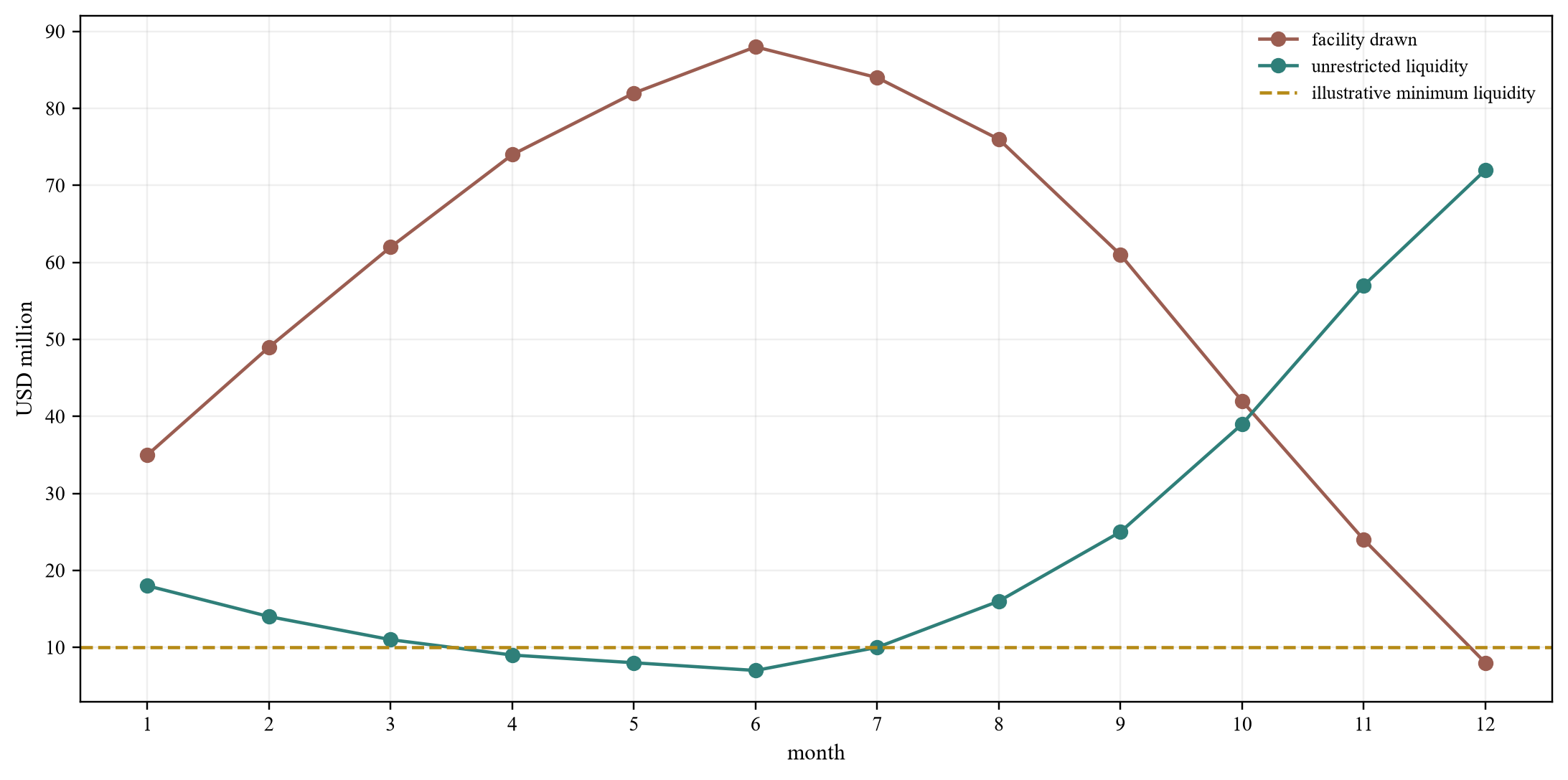
Wholly hypothetical USD millions; the profile illustrates timing risk.
15. Build a monthly seasonal cash model
The cash model should run monthly or more frequently from input purchase through final collection. It should show opening cash, drawings, input cost, crop purchases, operating expense, harvest, transport, storage, hedging margin, tax, interest, amortisation, sales, insurance and closing liquidity. Restricted cash should be separated from available cash.
The borrowing base and cash model should use consistent quantities, dates and prices. A model can report positive annual margin while producing a funding trough before harvest or collection. The facility may need a seasonal peak, clean-down period, reserve or staged amortisation aligned with crop cycles.
The worked example assumes a USD 90 million revolver across several crop and country exposures. This amount and every input are hypothetical. Central, downside and severe cases test yield, price, collection and logistics. The committee should size drawings to the lowest defensible eligible value and minimum liquidity, then test the maturity against delayed harvest and buyer payment.
16. Manage country, currency and transfer risk
A regional portfolio spans different legal systems, currencies, banking markets, exchange controls, taxes, collateral regimes and political risks. The borrower may incur local-currency production cost and receive US-dollar export revenue. Currency mismatch can occur through timing, domestic sales, taxes and hedges.
Country sublimits should consider legal enforceability, collateral registration, warehouse-receipt rules, insurance, payment flows and operational capability. Cash should move through designated accounts where permitted. The lender should document assumptions about conversion and transfer rather than treating export invoicing currency as the only relevant exposure.
Regional diversification can reduce a local weather risk while increasing operational complexity. Common commodity prices, shipping routes, input costs and global buyers can create correlation. The credit model should show gross and net exposure by country, commodity, buyer, currency, warehouse, route and climate zone.
17. Govern model versions, vendors and data continuity
A production model requires named ownership, documented inputs, code or methodology, validation, change control, access management, monitoring and business continuity. The lender should know whether data and analytics come from the borrower, an adviser or a third-party platform, and whether use rights survive a dispute or provider failure.
Version changes should not silently alter eligible acreage or yield. Each borrowing-base certificate should record model version, observation period, data sources and overrides. Material changes should require review and, where appropriate, independent validation. Historical outputs and source evidence should remain reproducible for audit.
Data continuity scenarios should include cloud cover, sensor outage, delayed products, provider insolvency, cyber incident and loss of field connectivity. A fallback can use radar, alternative imagery, weather, inspection or a frozen conservative base. The agreement should avoid dependence on an opaque score that neither party can explain or reconstruct.
18. Design exception and override controls
Agriculture produces legitimate exceptions: late planting, replanting, crop rotation, mixed fields, unusual phenology, flood, smoke, cloud and harvest timing. An override may be necessary. It also creates a route for bias or availability inflation.
Every override should identify the field, model output, reason, supporting evidence, value effect, approver and expiry. Overrides that increase availability deserve stronger review than conservative overrides. Repeated exceptions in one region, producer or model version should be analysed as a systemic issue.
The lender should define discrepancy thresholds between borrower reports, satellite estimates, field inspections, warehouse intake and sales. Breaches can lead to inquiry, inspection, additional reserve, reduced advance rate, drawing stop or mandatory repayment according to agreed terms. The process should preserve reasonable cure and dispute mechanics. Human accountability remains with authorised decision-makers.
| Identified risk | Structural protection | Monitoring signal | Escalation |
|---|---|---|---|
| uncertain in-field quantity | evidence grade and conservative policy yield | model error and inspection variance | lower advance or exclude field |
| commodity price decline | price haircut, hedge and margin reserve | benchmark and basis movement | margin call or repayment |
| inventory control failure | collateral manager, receipt and inspection | unexplained stock variance | drawing stop and investigation |
| buyer concentration | buyer limits and trade instruments | overdue and dispute trend | reserve or buyer exclusion |
| seasonal timing | liquidity reserve and sculpted amortisation | harvest and collection delay | reserve draw or maturity action |
| data interruption | fallback evidence and version control | missing observations | conservative frozen base |
Proposed structuring map; transaction documents determine enforceability.
19. Use structure to allocate seasonal uncertainty
Facility structure can align funding with evidence. Sublimits may separate inputs, in-field crops, warehouse inventory and receivables. Availability can step up when evidence improves and step down as assets age or contracts expire. Reserves can address finishing cost, price basis, quality, logistics, insurance settlement and taxes.
Security may include receivables, bank accounts, inventory, warehouse receipts, insurance proceeds, shares or other rights, subject to law and contracts. Conditions precedent should cover legal capacity, collateral, data rights, field register, insurance, offtake, storage and reporting. Draw conditions should confirm current eligibility rather than rely only on closing diligence.
Cash dominion, controlled collection accounts and mandatory prepayment can connect realised proceeds to repayment. Covenants should use clear financial and operating definitions. The structure should remain understandable to the borrower, lender, collateral manager, insurer and auditor.
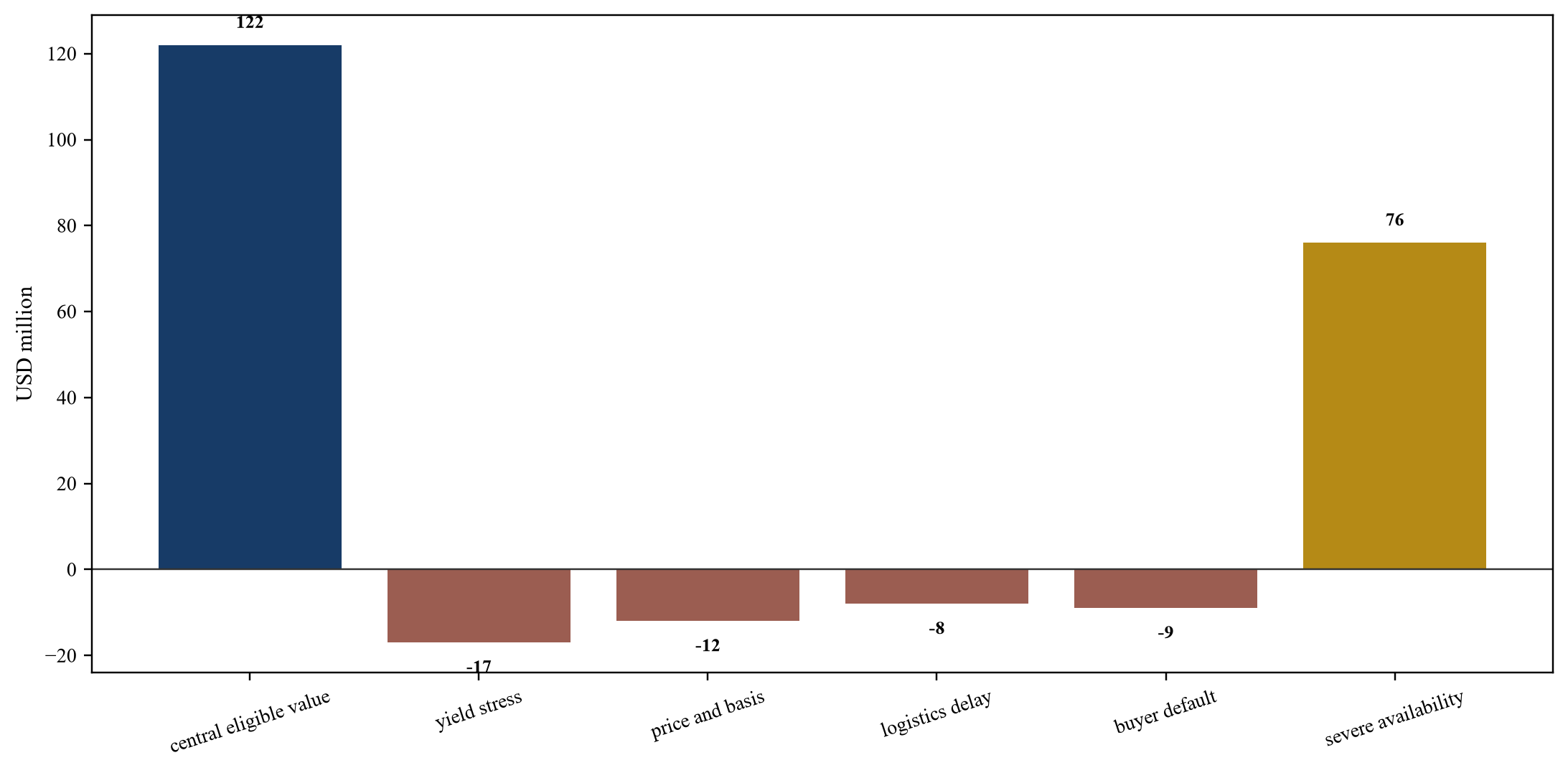
Wholly hypothetical USD millions; stresses are additive only for illustration.
20. Stress correlated climate, price and logistics events
A severe scenario should combine stresses that can occur together. Drought may reduce yield, increase local prices and weaken borrower output. Flood can damage crops and transport. Energy disruption can raise fertilizer, drying and freight cost. Export restrictions or buyer stress can change market access. The World Bank's 2026 analysis emphasised upside risks from extreme weather, input costs and trade restrictions [11].
The model should identify correlation explicitly. It can test a regional yield shortfall, a commodity price move, a currency change, a port delay and an insurance lag in the same period. The objective is to locate the cash and covenant failure point and the time available for action.
Stress results should inform advance rates, reserves, sublimits, tenor, insurance, hedging and information frequency. They should not be disguised as forecasts. The board and lender should see assumptions, triggers, mitigants and residual risk.
21. Address environmental and social supply-chain risk
Agricultural finance can be exposed to deforestation, land conflict, labour conditions, biodiversity, water, pesticide use, community impact and traceability requirements. Satellite data can help detect land-cover change and origin patterns. It does not establish lawful land rights, labour conditions or full compliance.
The due-diligence perimeter should follow applicable law, lender standards, buyer requirements and product-specific certifications. Where export markets require deforestation or origin evidence, field polygons and supply-chain records should be reconciled. Exclusions and corrective-action plans should be clear. Remote alerts require investigation and documented resolution.
IFC trade-finance disclosures identify agriculture supply-chain environmental and social risks and the need for financial institutions to manage them [12]. The credit process should assign responsibility, escalation and reporting. An environmental alert can affect eligibility, saleability, reputation and repayment even when crop condition is strong.
22. Build a board and lender dashboard
The dashboard should combine exposure, evidence and action. Core measures include eligible area, model confidence, condition anomalies, expected yield range, harvest progress, warehouse quantity and quality, insured value, contracted offtake, buyer concentration, shipment status, receivables, collections, borrowing-base availability, drawings and liquidity.
Leading indicators include delayed planting, vegetation stress, rainfall anomaly, model drift, field-report discrepancy, slow harvest, warehouse variance, buyer delay and logistics interruption. Lagging indicators include realised yield, sales, margin, claims and cash. Thresholds should identify owner, investigation deadline and financial response.
Maps and scores should link to transaction records. A coloured field alone cannot explain value. The board should receive a bridge from the prior certificate to the current certificate, showing quantity, price, eligibility, reserve and drawing changes. This provides a controlled record of why availability moved.
23. Execute a one-hundred-day evidence programme
The first thirty days should establish the facility perimeter, field register, crop calendars, data rights, model inventory, storage network, offtake contracts, insurance and cash accounts. The team should freeze the base case and list every missing item that could change availability.
Days thirty-one to sixty should validate field polygons, inspect a risk-based sample, back-test satellite outputs, reconcile production history and establish warehouse and buyer controls. The team should run the central and downside borrowing bases and agree exception thresholds. Legal and regulatory advisers should confirm collateral, assignment, data and trade-document requirements.
Days sixty-one to one hundred should conduct parallel reporting, test draw certificates, validate the cash waterfall, complete contingency procedures and train responsible staff. The credit committee should receive a clear approval pack, open-condition register and monitoring calendar. Funding should follow satisfied conditions and current evidence.
Implementation detail: turning evidence into a controlled certificate
The monthly certificate should begin with a locked field register. Each line identifies country, region, producer, land or production right, polygon, crop, season, planting date and expected harvest window. The certificate records the most recent imagery, weather period, field inspection and model version. Additions and boundary changes require approval and an audit trail. The same polygon should not support more than one borrowing-base line unless the crop cycle and eligibility rules clearly permit it.
The analytics layer should calculate crop classification, condition, expected yield range and data quality separately. A composite score may help navigation, yet the certificate should retain the underlying measures. The credit formula uses the lower defensible quantity rather than the model's central point alone. Policy yield, historical producer performance, regional evidence, field samples and the model range can each constrain the result. Remaining input, harvest, transport and handling cost is deducted before any in-field value becomes eligible.
The price layer begins with the relevant commodity benchmark and contract formula. It deducts location basis, quality, freight, tax, hedge costs and a volatility haircut. Where offtake fixes a price, the lender should confirm enforceability, volume, quality and buyer credit. Where a hedge fixes a benchmark, basis and margin liquidity remain. Price sources, dates and currency conversions should be recorded so another reviewer can reproduce the certificate.
At harvest, the certificate should shift quantity from field estimates to measured intake. The bridge shows expected output, harvested volume, deliveries, moisture or quality adjustments, processing, shrinkage, transfers and closing stock. Unexplained differences remain outside eligibility until resolved. This prevents an estimated standing crop and the resulting warehouse inventory from being counted at the same time.
The warehouse schedule should identify lot, location, operator, receipt, owner, quantity, grade, insurance, liens and last inspection. Independent reports should reconcile with the borrower's system. Releases require authorised instructions and should connect to a sale, transfer or processing event. A lender should know which goods remain physically present, which are committed to a buyer and which have already generated a receivable.
The receivables schedule should identify buyer, contract, shipment, invoice, currency, due date, acceptance, disputes, assignment and collection account. Invoices beyond policy ageing or buyer limits are excluded. Concentration reserves should reflect related parties and common economic exposure. Cash application should reconcile bank receipts to invoices and borrowing-base releases.
Model monitoring should compare each prior forecast with realised area, yield, intake and cash. Error should be measured in both agronomic and financial terms. A ten per cent yield error can have different credit effects depending on price, advance rate, finishing cost and available headroom. Performance reports should therefore include eligible-value error, liquidity effect and time to covenant pressure. Persistent bias requires policy recalibration.
Governance should separate model development, commercial submission, credit approval and independent validation. The borrower or data provider can explain an anomaly; the authorised lender decides eligibility. Material overrides, version changes and missing data require recorded approval. A committee should see the gross value, every adjustment and the final availability bridge rather than only a score.
The facility's information undertakings should specify field, model, warehouse, insurance, offtake, shipment and cash reports. Reporting frequency may increase during sensitive crop stages, after a climate alert or near debt-service dates. A rapid alert is useful only when an identified person investigates and the agreement provides a proportionate response.
Contingency planning should address alternative data, field inspection, inventory verification, buyer communication and liquidity. If satellite observations are unavailable, the lender can freeze availability at a conservative level, use other sensors or rely on current ground evidence. If a warehouse operator fails, control of goods and records becomes the priority. If a buyer delays, the lender should assess the underlying sale, trade instrument, alternative buyer and cash runway.
The annual review should examine realised losses, exceptions, model changes, crop and country expansion, warehouse performance, buyer behaviour, insurance claims and covenant usefulness. Policies that never trigger despite losses may be weak. Thresholds that trigger constantly without financial relevance may create noise. The objective is a smaller set of early signals tied to specific credit actions.
Portfolio construction should prevent a regional programme from becoming a collection of incomparable certificates. The lender can require common definitions for eligible area, expected yield, gross commodity value, finishing cost, warehouse quantity, eligible buyer, overdue receivable and collected cash. Local schedules can capture crop and country differences. A common data dictionary allows aggregation without erasing those differences. Changes to a definition should show their effect on current and prior availability.
New-country entry should follow a controlled pilot. The lender should select a limited crop, region and borrower population; test polygon registration, sensor coverage, ground sampling, warehouse controls and buyer settlement; and compare forecasts with a complete crop cycle. The pilot should identify legal and operational differences before the programme uses portfolio-scale limits. Early performance should support learning, while conservative policy values prevent an unproven model from creating immediate leverage.
Producer incentives also matter. Reporting requirements that are slow, costly or disconnected from payment can reduce data quality. The operating design should collect evidence once where feasible, explain how it affects availability and provide a prompt exception process. Smaller producers may require cooperative, aggregator or lender-supported infrastructure. Inclusion goals do not remove control requirements; they influence how evidence and support are organised.
Fraud analysis should combine spatial, operational and financial signals. Possible indicators include overlapping fields, sudden polygon changes, crop types inconsistent with history, repeated satellite observations across borrower records, warehouse receipts exceeding intake capacity, inventory movements without transport records, buyer addresses linked to related parties and collections inconsistent with invoices. No signal proves misconduct by itself. A case-management process should join evidence, preserve review and avoid automated accusations.
The economics of the analytics programme should be measured against credit outcomes. Relevant benefits can include earlier detection, reduced inspection travel, broader field coverage, lower loss severity, faster certificate review and better portfolio allocation. Costs include imagery, platform, integration, validation, field sampling, governance and specialist staff. The business case should use observed changes in process and loss experience. A marketing claim about model accuracy does not establish a financial return.
Exit and refinancing require attention from inception. A short-term facility can face a late harvest, slow sale or disputed receivable near maturity. The lender should define extension criteria, cash sweeps, refinancing milestones and asset realisation options. A borrower should understand when a field or stock ceases to be eligible, how proceeds are applied and how seasonal clean-down is measured. These provisions connect the analytical framework to an orderly repayment path.
Audit evidence should be preserved at the level needed to reconstruct material decisions. This includes source files, observation dates, field and warehouse identifiers, calculation logic, approvals, overrides and bank-receipt links. Retention periods should reflect facility, legal, regulatory and dispute requirements. Access should follow role and confidentiality. A reviewer should be able to trace a drawing from the approved borrowing-base certificate through the field or asset evidence and later through sale and cash application. This traceability makes monitoring credible, supports internal assurance and helps distinguish a genuine operating variance from a data or control failure. The same record supports efficient renewal, portfolio review, assurance, refinancing, regulatory examinations and post-loss analysis for future transactions.
24. Apply red-team tests before approval
The red team should attempt to double count fields, misclassify crops, inflate area, shift a model version, suppress an adverse observation, submit duplicated warehouse receipts, overstate quality, use an ineligible buyer or divert collections. It should test whether ordinary controls detect the attempt before availability or cash changes.
Operational tests should simulate cloud, provider outage, delayed field reports, warehouse interruption, port closure, buyer dispute and insurance delay. Legal review should test ownership, lien, assignment, enforcement and cross-border cash assumptions. Model review should examine bias under uncommon weather and new geographies.
Findings should be ranked by exposure and time to cash impact. Remediation should identify owner and evidence. Unresolved high-impact gaps can be addressed through exclusion, reserve, lower advance rate, additional control or deferred funding. The red-team record supports a disciplined committee decision.
| Finding | Cash consequence | Financing response | Accountable owner |
|---|---|---|---|
| field identity or crop evidence is weak | unsupported eligible value | exclude or require inspection | borrower and credit team |
| satellite yield is biased high | borrowing-base overstatement | lower policy yield and advance rate | model owner and validator |
| harvest does not reconcile to warehouse | possible loss or diversion | suspend step-up and investigate | collateral manager |
| offtake is cancellable or concentrated | uncertain collection | buyer haircut, limit or protection | commercial and credit leads |
| insurance has material basis or timing risk | liquidity gap after event | reserve and conservative recovery | insurance lead |
| evidence chain and cash controls operate | improved monitoring | recognise only current eligible value | board and lender |
Proposed decision framework; it is not a credit rating or lending recommendation.
25. Use a credit checklist that connects field, stock, sale and cash
The final credit paper should identify borrowers, commodities, countries, crop cycles, field polygons, models, warehouses, buyers, insurers, accounts and repayment dates. It should state the eligibility and advance-rate rule for each asset stage and show the lowest point of liquidity under each scenario.
The committee should receive a field and crop register, satellite-method summary, validation report, climate scenarios, warehouse controls, offtake analysis, price and hedge schedule, insurance matrix, logistics map, borrowing base, monthly cash model, security analysis, covenants and exception register. Every material input should be classified as contractual evidence, observed performance, management estimate or hypothetical scenario.
Approval conditions should identify unresolved evidence and deadlines. Monitoring should focus on signals that deteriorate before cash failure: crop condition, forecast error, harvest delay, warehouse variance, price and basis, buyer delay, shipment disruption, claim timing, liquidity and availability. The framework supports a reasoned credit decision; it does not determine one.
Sources
- International Finance Corporation, Global Warehouse Finance Program, current programme description, Read the primary source
- Food and Agriculture Organization, Land Cover and Crop Monitoring, geospatial information for sustainable food systems, Read the primary source
- Copernicus Sentinel-1, Agriculture Applications, crop condition, soil and seasonal monitoring, Read the primary source
- Food and Agriculture Organization, GIEWS Earth Observation and Agricultural Stress Index System, Read the primary source
- Inter-American Development Bank, Climate Risk Financing in Agriculture, Read the primary source
- Inter-American Development Bank, S4: De-risking Agricultural Production via Data Analytics and Satellite Imagery, project RG-Q0048, Read the primary source
- International Finance Corporation, Global Trade Finance Program, programme structure and instruments, Read the primary source
- World Bank Group, Commodity Markets Outlook, April 2026, Read the primary source
- Inter-American Development Bank, Trade Trends Estimates: Latin America and the Caribbean, 2026 edition, Read the primary source
- World Trade Organization, Standards and Trade Development Facility: Digital Technologies and Trade, Read the primary source
- World Bank Group, When Risks Stack Up: Threats to Global Food Markets in 2026, 16 June 2026, Read the primary source
- International Finance Corporation, GWFP ETG 2025 disclosure and supply-chain risk rationale, Read the primary source
- Inter-American Development Bank, Agricultural Productivity in Latin America and the Caribbean: What We Know and Where We Are Heading, 2025, Read the primary source
- Inter-American Development Bank, Logistics, Financing and Public Policies Are the Main Barriers for Agrifood Companies in Latin America and the Caribbean, 2026, Read the primary source
- International Finance Corporation, Trade and Supply Chain Finance: Supporting Businesses, Protecting Jobs, FY2025, Read the primary source
- World Trade Organization, Trade Finance, institutional overview, Read the primary source
- World Trade Organization, Agreement on Agriculture gateway, Read the primary source
- Food and Agriculture Organization, CropSuit application, 2 July 2026, Read the primary source
- Food and Agriculture Organization, Smart Farming Solutions in Latin America and the Caribbean, 1 July 2026, Read the primary source
- World Bank Group, AgriConnect: Mobilising Capital and Digital Public Infrastructure for Agriculture, Read the primary source
- IFRS Foundation, IFRS 9 Financial Instruments, issued standard, Read the primary source
- IFRS Foundation, IFRS 15 Revenue from Contracts with Customers, issued standard, Read the primary source
- IFRS Foundation, IAS 2 Inventories, issued standard, Read the primary source
- Basel Committee on Banking Supervision, Principles for the Effective Management and Supervision of Climate-related Financial Risks, Read the primary source
