
1. Define the financing decision
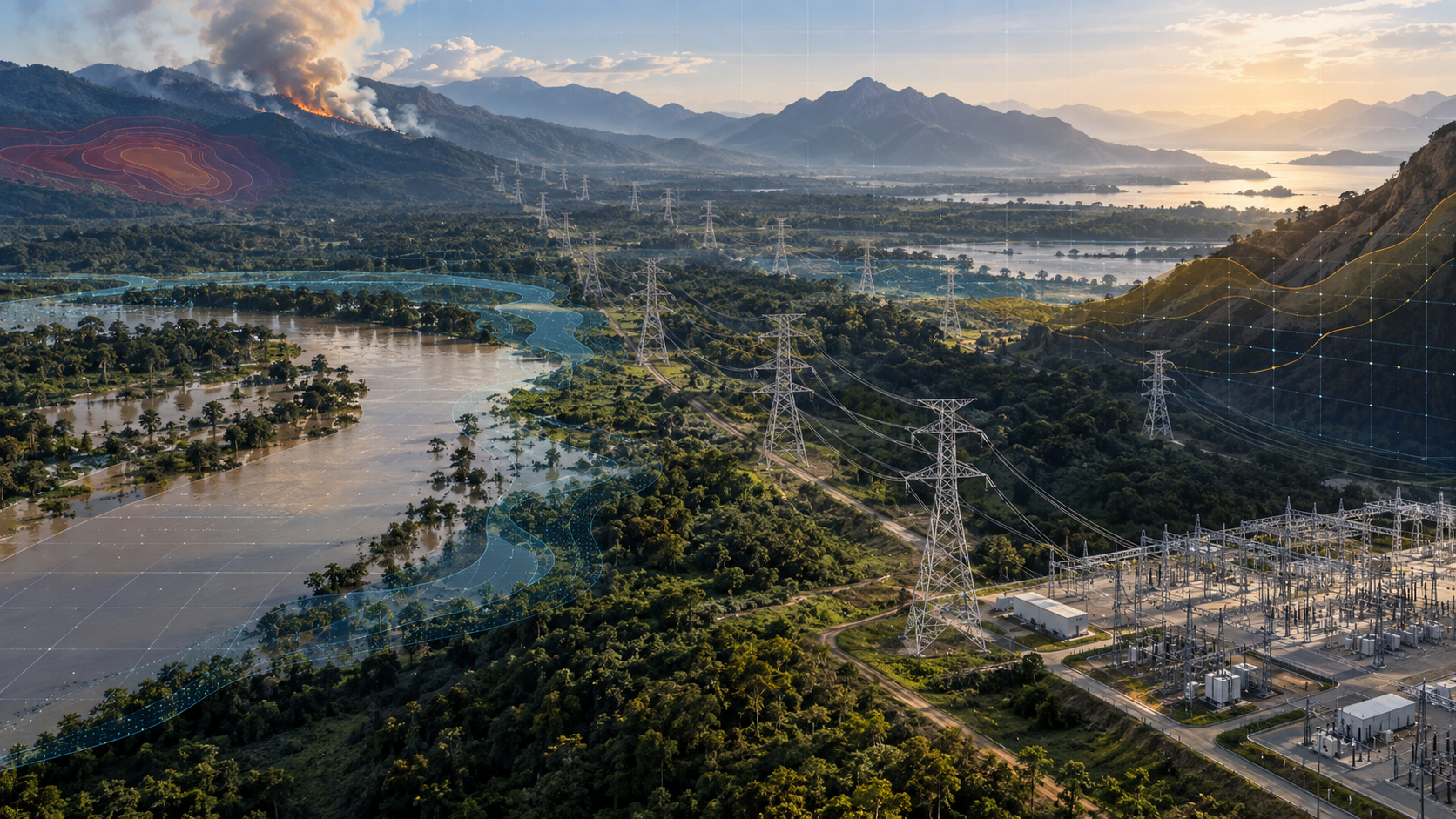
The financing decision is whether a transmission concession can sustain debt service across the operating life while climate hazards, asset condition, insurance markets and regulatory rules change. Latin America has substantial renewable resources and growing grid requirements. The International Energy Agency estimates that regional clean-energy investment reached about USD 70 billion in 2025, while grid and storage spending must rise materially under its announced-policy pathway [1,2]. Transmission programmes in Brazil, Peru, Chile and other markets show that competitive procurement and long-term concessions can mobilise private capital, but the same contractual duration exposes lenders to several climate and policy cycles.
The decision should therefore be framed as a credit boundary rather than a climate score. Lenders need to know which assets produce the availability payment, which events permit deductions, which costs sit with the concessionaire, when force-majeure relief applies, how insurance responds, and how quickly liquidity is restored after an event. A model that predicts fire or flood probability without tracing those consequences cannot support debt sizing. The required output is a set of cash-flow scenarios with evidence, limitations, named owners and pre-agreed actions.
The same boundary should govern bid strategy. Sponsors need to decide whether the tender provides enough climate and asset information to price lifecycle performance, whether relief provisions are financeable, and which investigations must be completed before a binding offer. Lenders should identify conditions that affect commitment, financial close or first drawdown. Public authorities benefit when these questions are resolved during preparation because risk that cannot be measured or controlled is likely to appear through a higher tariff, a qualified bid, reduced competition or later renegotiation. The stress test therefore supports procurement design as well as credit approval.
| Layer | Primary evidence | Required corroboration | Financing consequence |
|---|---|---|---|
| Asset perimeter | Route, towers, substations, access and communications | Concession schedules, engineering drawings and land rights | Defines secured and operating estate |
| Hazard | Fire, flood, heat, wind, drought and landslide indicators | Authoritative climate data and specialist interpretation | Defines scenario frequency and severity |
| Vulnerability | Design, age, condition, redundancy and maintenance | Engineer reports, inspections and failure history | Converts hazard into damage and outage |
| Contract | Availability rules, deductions, relief and restoration | Executed concession, regulation and legal advice | Converts outage into revenue and liability |
| Credit | Cash flow, reserves, insurance and debt service | Financial model, policy terms and facility documents | Sets debt sizing, covenants and controls |
Each analytical layer must be corroborated before it changes debt capacity or transaction terms.
2. Establish the regional investment context
Transmission is becoming a binding constraint on renewable integration, reliability and regional power trade. The IEA reports that Latin American grids and storage receive less than half a dollar for each dollar invested in new generation, while the required ratio rises towards USD 0.85 by 2035 under its announced-policy scenario [2]. The Inter-American Development Bank also identifies transmission planning, regulation, finance and regional integration as central to system reliability [3]. These sources support a large investment need, but they do not make every proposed concession bankable.
Bankability remains project-specific. Competitive auctions can deliver transparent price discovery, yet aggressive bids can also compress lifecycle maintenance allowances and transfer poorly understood risk to the concessionaire. Foreign-currency debt can reduce initial cost while introducing mismatch against local-currency availability payments. Supply-chain delays for transformers, switchgear and conductors can extend restoration. Land, community, environmental and permitting obligations can alter route access. Climate analysis must therefore sit inside a wider underwriting system that covers contract enforceability, sponsor capability, construction, operations, insurance, refinancing and sovereign or offtaker exposure.
3. Freeze the asset and contractual perimeter
The first control is a versioned asset register. It should identify every tower, span, conductor type, substation bay, transformer, protection system, communication node, control centre, access route, drainage structure, spare and shared interface. Each item needs coordinates, elevation, design standard, commissioning date, condition, maintenance owner, replacement lead time and contractual status. A route centreline alone is insufficient because substations, river crossings, mountain access and shared interconnections can dominate outage duration.
The contract register should map each physical component to the concession schedule, performance regime, handback requirement, land right, permit and security package. It should distinguish assets that earn availability from assets that merely support performance. Interfaces with state-owned utilities and adjacent concessions require particular attention. An outage may begin outside the project perimeter while still reducing payment. The financing model should reflect the executed allocation of that interface risk, including relief, compensation and dispute procedures.
The perimeter also determines data responsibility. The private partner may operate sensors and maintenance systems while the system operator controls dispatch, protection logs and network-event classification. Meteorological and geospatial data may come from third parties under licences that restrict redistribution. The diligence plan should identify who can lawfully provide each dataset, whether lenders may retain and audit it, and what happens when the concession changes operator. A model whose evidence cannot be reproduced by an independent reviewer should remain outside the core debt case until access and retention are resolved.
4. Separate hazard, exposure and vulnerability
Hazard describes the physical event, such as flood depth, heat intensity, wind speed, fire weather or slope instability. Exposure describes the assets and services located where the event occurs. Vulnerability describes how those assets respond given design, condition, redundancy, maintenance and recovery capability. Combining these concepts into one score hides the mechanism that lenders must underwrite. Two substations can share the same flood depth and have different loss outcomes because one has elevated equipment, protected control rooms and redundant access.
The IPCC assesses increasing risks to infrastructure across Central and South America from floods, landslides, extreme heat, drought and wildfire, with uncertainty varying by hazard and sub-region [4,5]. The appropriate credit response is therefore scenario-based. The model should preserve the confidence level and spatial scale of each climate input, identify where historical observations are weak, and avoid converting low-confidence regional projections into precise site-level probabilities. Engineering evidence determines whether the hazard becomes a cash-flow event.
5. Build the geospatial evidence register
Every dataset should enter an evidence register with provider, product, acquisition date, spatial resolution, temporal resolution, coordinate system, processing method, licence, quality flag and retention rule. Typical sources include operator outage records, meteorological observations, satellite imagery, terrain models, land-cover products, fire detections, flood extent, lightning, vegetation, soil moisture and road-access data. Forward-looking scenarios require model family, emissions pathway, downscaling method, baseline period and uncertainty range.
The register must distinguish raw observations from derived features. A satellite fire detection is an observation; distance to a tower is a derived feature; predicted outage probability is a model output; and a debt-service adjustment is a management decision. Preserving that chain allows independent review and prevents a transformed variable from becoming an unexplained fact. The World Bank Climate Change Knowledge Portal, Copernicus services and NASA climate datasets can support screening, while local agencies and engineering studies remain necessary for project decisions [10-12].
6. Create a physical failure taxonomy
Credit analysis becomes clearer when each hazard is connected to a failure mechanism. Wildfire can damage poles, insulators, conductors, fibre and access; smoke and heat can affect operations even without direct burn. Flood can inundate substations, undermine foundations, erode access and delay restoration. Heat can reduce line ratings, accelerate equipment ageing and coincide with peak demand. Landslide can remove foundations, sever access or create progressive movement that is not captured by a single event date.
The taxonomy should include initiating event, affected component, failure mode, detection method, operational consequence, restoration sequence, cost category and contractual treatment. It should also identify cascading paths. A substation outage can de-energise several lines; a damaged road can delay repair; communications failure can impair remote control; and multiple asset failures can exhaust spares. Machine learning can rank combinations found in historical data, but engineering judgement must validate whether the relationship is physically credible.
| Hazard | Typical physical mechanism | Evidence required | Potential credit treatment |
|---|---|---|---|
| Wildfire | Conductor, insulator, fibre and access damage | Fire history, vegetation, design, inspection and restoration record | Outage deduction, emergency cost, reserve and insurance case |
| Flood | Inundation, erosion, scour and access loss | Flood depth, elevation, drainage, foundation and access evidence | Downtime, repair capital, deductible and liquidity stress |
| Heat | Rating derate, equipment stress and demand coincidence | Temperature, load, dynamic rating and equipment condition | Reduced transfer capacity and higher operating cost |
| Landslide | Foundation movement, route failure and blocked access | Terrain, rainfall, ground movement and geotechnical evidence | Major repair, prolonged outage and covenant stress |
| Wind and storm | Tower loading, debris and communication damage | Wind field, design standard, event and failure history | Correlated outage and restoration-supply scenario |
The matrix links physical mechanisms to evidence and credit treatment rather than relying on a single climate score.
7. Assemble the historical event ledger
The event ledger should reconcile hazards, asset alarms, outages, inspections, work orders, insurance claims, availability calculations and cash receipts on a common clock. Every event needs a start, detection time, isolation time, restoration milestones and close-out date. Apparent non-events are equally important. A severe hazard that produced no outage can reveal resilience, redundancy or data gaps. The ledger should preserve missingness rather than filling it silently.
Data reconciliation frequently exposes inconsistent asset identifiers, time zones and causal codes. An outage recorded as weather-related may actually reflect deferred vegetation management or protection failure. A force-majeure claim may use a legal definition that differs from the operator's engineering classification. The modelling team should maintain both labels and document the reconciliation. Historical frequency can guide model training, but the ledger should not assume that past asset condition, maintenance quality or climate distribution remains constant.
8. Select machine-learning tasks conservatively
Machine learning is most useful for bounded tasks: classifying vegetation encroachment, detecting anomalous temperature or vibration, estimating restoration duration, prioritising inspection, identifying correlated outage patterns and producing conditional probability ranges. The model should be matched to the decision. A ranking model may be useful for allocating site visits even when it is unsuitable for estimating a precise probability of default.
Rare, severe events create a small-sample problem. A complex model can fit noise, regional reporting differences or maintenance practices that will not persist. Train and test sets should therefore be split by time, geography and event where practical. Performance should be compared with transparent benchmarks such as engineering thresholds, logistic regression and survival models. Calibration, false negatives, stability and sensitivity matter as much as headline accuracy. The investment committee should see where the model performs poorly and which decisions remain rule-based.
The modelling objective should be expressed in operational terms before feature selection begins. Predicting whether any outage occurs may be less useful than estimating whether restoration exceeds the contractual grace period or whether combined uninsured cost and revenue deduction exceed available liquidity. Labels should follow the same definitions used in the concession and financial model. Where historical labels are inconsistent, the team may need a narrower task with higher-quality evidence. A simpler model linked to a financing action is more valuable than a sophisticated classifier whose output cannot be converted into an approved decision.
9. Control leakage, bias and proxy risk
Data leakage occurs when a model uses information that would not have been available at the decision date. Final repair cost, claim acceptance or post-event inspection labels can inadvertently enter predictors. The result may look accurate in testing and fail in live use. A reproducible feature timestamp and a strict information cutoff are essential. Models should be rebuilt using only data available when the forecast would have been made.
Bias can arise from uneven sensor coverage, different outage-reporting cultures, missing rural events, selective insurance claims and concentration of high-quality data in newer assets. Geography may act as a proxy for sponsor, regulator, maintenance quality or community conditions. The model should examine error rates across jurisdictions, asset types, ages and hazard regimes. A higher predicted risk should trigger investigation and evidence gathering; it should not automatically determine credit terms without a documented mechanism and review.
10. Integrate forward-looking climate scenarios
Historical observations are necessary but insufficient for a 20-year or 30-year debt tenor. Forward-looking analysis should use several climate models and scenarios, preserve the distribution across models, and disclose downscaling and bias-correction methods. The IPCC Interactive Atlas, regional assessments and recognised climate datasets provide a defensible starting point [4,6,10]. The chosen horizons should align with construction, debt maturity, major maintenance and concession handback.
Scenario design should focus on variables that drive failure. Average annual temperature may be less relevant than consecutive high-temperature hours during peak loading. Annual rainfall may be less relevant than short-duration intensity on a vulnerable slope. Fire-weather indices may require vegetation, ignition and access context. The analyst should avoid pseudo-precision: where the data supports only a direction or range, the credit scenario should remain a range. Engineering thresholds and contractual consequences provide the bridge from climate variable to cash flow.
Time horizon requires equal care. Near-term forecasts can support construction and initial operation, while climate projections inform later maintenance, refinancing and handback. Mixing horizons can overstate confidence. The scenario register should state the decision date, projection period, reference climate, asset age and assumed adaptation. It should also distinguish chronic trends from acute events. A gradual increase in average heat can alter equipment life and maintenance, while a short compound event can cause a liquidity shock. Both may affect value, but they enter the model through different cash-flow lines and controls.
11. Model wildfire and vegetation risk
Wildfire risk combines weather, fuel, ignition, terrain, access and suppression capacity. Transmission corridors can cross several vegetation regimes and jurisdictions. A useful model might predict the probability that a corridor segment enters an inspection or intervention category within a defined period. Features can include fire-weather indices, historical detections, vegetation growth, clearance history, slope, wind, lightning and proximity to access routes. The output should be validated against patrol findings and actual interruptions.
The financial model should distinguish preventive cost, planned de-energisation, direct asset damage, third-party liability, restoration and reputational exposure. Contract treatment may differ for a regional emergency, a maintenance-related fire and a precautionary outage. Insurance exclusions and sublimits need specific review. The model should also test correlated events because extreme fire conditions may affect multiple segments and constrain contractor capacity at the same time.
12. Model flood, erosion and access loss
Flood screening should cover river, surface-water, coastal and infrastructure-failure pathways where relevant. Substation elevation, drainage capacity, foundation type, river crossing, road access and upstream land-use change can alter vulnerability. Satellite flood extent can support event reconstruction, while terrain models and hydraulic studies provide additional context. Observed water near an asset does not establish equipment damage or contractual outage.
The scenario should separate direct repair from restoration delay. A substation may remain physically intact while access roads, communications or adjacent utility assets prevent return to service. Emergency works can face permitting and community constraints. Cash-flow effects can include availability deductions, unplanned operating cost, capital expenditure, deductible, premium increase and delayed insurance recovery. Liquidity timing is particularly important because claims may settle after debt service falls due.
13. Model heat and dynamic line rating
High ambient temperature can reduce conductor capacity, increase sag, stress transformers and coincide with elevated demand. Static ratings may overstate or understate usable capacity depending on weather and operating rules. Dynamic line rating can improve utilisation when wind and temperature conditions permit, but it depends on sensor reliability, communications, control processes and regulatory acceptance. The financing case should distinguish a proven operating capability from a future optimisation claim.
A heat-stress model should use hourly or sub-hourly data where the decision depends on peak conditions. It should test compound states such as high temperature, low wind and high demand. The output can inform transfer-capacity assumptions, maintenance windows and equipment replacement. Any revenue effect must follow the concession's actual performance rules. A technical derate has no direct cash consequence when availability payment remains protected, while the same event can become material if deductions or system penalties apply.
14. Model landslide and ground movement
Mountain routes can face rainfall-triggered landslide, erosion, seismic interaction and slow ground movement. Static susceptibility maps help prioritise sites, but they should be combined with route geometry, drainage, cut slopes, foundations, historical movement and field inspection. Radar interferometry may support detection of selected deformation patterns, subject to vegetation, geometry, coherence and expert interpretation. It does not replace geotechnical investigation.
For credit purposes, restoration duration may matter more than initial failure probability. Remote terrain, limited access, environmental restrictions and specialised foundations can extend repair. A scenario should test loss of one or several structures, road reopening, mobilisation, replacement availability and temporary bypass. The concession's emergency-procurement and relief provisions should be mapped to that timeline. Lenders may require targeted monitoring, spare strategy or liquidity where the route contains non-substitutable high-consequence segments.
15. Capture correlated and cascading events
Transmission networks are designed as systems. A portfolio of lines can share substations, control centres, telecoms, contractors, spare transformers, grid interfaces and weather corridors. Treating each asset as independent can materially understate downside. The model should create event clusters based on physical proximity, shared infrastructure, hazard footprint and restoration dependencies. It should also test whether neighbouring network failures increase or reduce the concession's obligations.
Cascading analysis should remain transparent. The sequence from initiating hazard to outage, redispatch, overload, protection action and restoration should be reviewed by power-system engineers. Machine learning can identify historical co-movement and non-linear relationships, but it cannot prove causal propagation from observational data alone. The financial scenario should include only mechanisms accepted by technical and contractual reviewers, while an uncertainty reserve can address residual ambiguity.
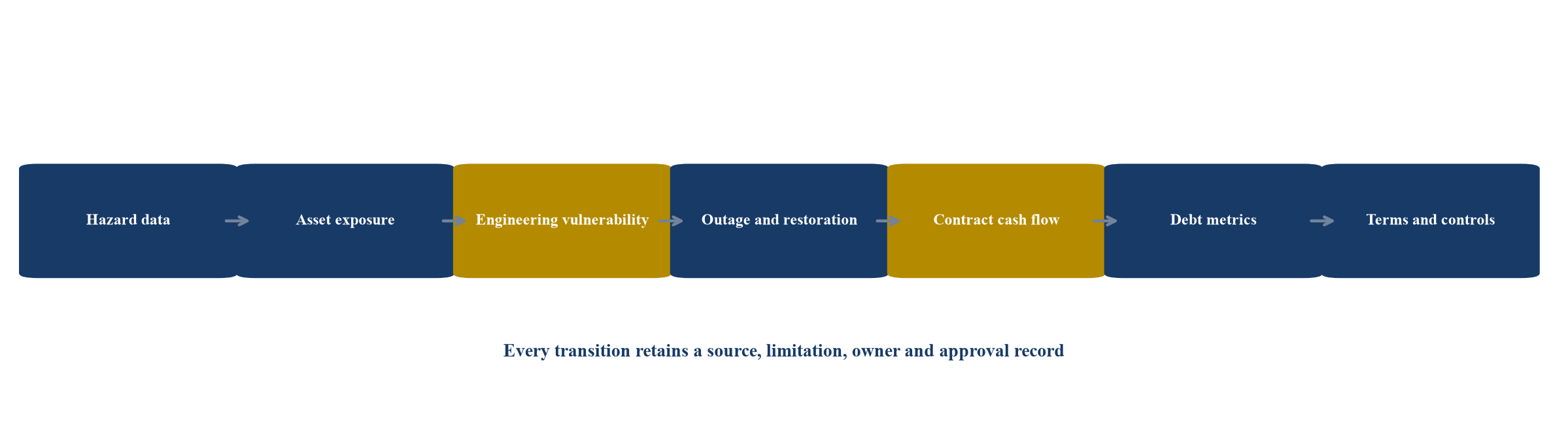
Proposed governance sequence. A model output changes debt treatment only after physical, contractual and financial corroboration.
16. Translate outages into concession cash flow
The concession agreement determines whether a physical interruption becomes a revenue loss. The model should capture availability definition, measurement point, exclusion, grace period, performance deduction, cap, cure, relief event, force majeure, termination threshold and compensation. It should also identify notice requirements and evidence standards. A technically severe event can have limited immediate revenue effect when relief is available, while a smaller maintenance failure can create deductions if procedural conditions are missed.
Cash-flow modelling should preserve timing. Restoration spending may occur immediately, availability revenue may fall in the next payment cycle, insurance may pay later, and a regulatory true-up may arrive after year end. Annual models can hide this liquidity gap. Monthly or quarterly periods are preferable for the stress window. The model should reconcile to reserve-account mechanics, distribution lock-up and debt-service dates so that the lender can distinguish temporary liquidity need from permanent value impairment.
Revenue deductions should be calculated from contractual measurement rather than a generic percentage of annual revenue. Some regimes measure unavailable capacity, some measure asset availability, and others apply event or service-quality penalties. Caps, exclusions and cumulative thresholds may change the result. The model should reproduce sample invoices and payment certificates from historical periods where available. Legal and technical teams should agree the event classification before finance applies the deduction. This reconciliation reduces the risk that a technically plausible outage scenario is paired with the wrong commercial consequence.
17. Rebuild insurance as a cash-flow instrument
Insurance review should cover property damage, machinery breakdown, business interruption, delay, natural catastrophe, third-party liability, cyber and political-risk elements where relevant. Policy limits, deductibles, waiting periods, aggregation, sublimits, exclusions, reinstatement and claims-control clauses determine financial protection. The insured values and business-interruption period should reconcile to the engineering restoration case and the concession's revenue mechanism.
Climate stress can affect both loss and insurance availability. Premiums, deductibles and exclusions may change at renewal, particularly after regional events. The base case should not assume uninterrupted coverage on current terms for the full debt tenor. Scenarios should include non-renewal, higher deductible, reduced limit and slower recovery. Lenders can respond through minimum coverage covenants, broker reports, reserve sizing, captive or parametric options, and a requirement to revisit debt distributions when protection deteriorates.
Claims evidence should be designed before an event. Asset values, maintenance records, photographs, alarms, repair invoices, outage calculations and mitigation duties may determine recovery. A model can estimate gross loss while policy wording determines insured loss. The insurance workstream should therefore test hypothetical claims against notice, proof, loss-adjustment and reinstatement requirements. Parametric cover may accelerate liquidity when an objective trigger is met, although basis risk can leave the project exposed when physical loss and trigger diverge. The financing model should show that basis risk explicitly.
18. Construct the hypothetical concession
The illustrative project comprises 900 kilometres of high-voltage transmission, 12 substations and associated control and communication assets under a 30-year availability-based concession. Management assumptions set capital expenditure at USD 1.2 billion, funded by USD 780 million of senior debt and USD 420 million of sponsor equity. The base year assumes availability revenue of USD 150 million, operating and lifecycle cost of USD 35 million, cash flow available for debt service of USD 115 million and scheduled debt service of USD 85 million.
The resulting base debt service coverage ratio is 1.35x. These figures are constructed to demonstrate the method and do not represent a specific concession or financing. The route is divided into 60 analytical segments. Management assumes that 14 segments have elevated wildfire exposure, nine have material flood or erosion exposure, eight have heat-related operating sensitivity, five have landslide sensitivity and several exposures overlap. The scenario process retains segment-level evidence while aggregating cash flow at the borrower level.
| Item | Base assumption | Severe pre-mitigation case | Severe post-mitigation case |
|---|---|---|---|
| Route and substations | 900 km and 12 substations | Same physical perimeter | Same physical perimeter |
| Capital expenditure | USD 1.2 billion | Additional emergency and resilience capital | Planned resilience programme |
| Senior debt | USD 780 million | Same opening debt | Same opening debt |
| Annual CFADS | USD 115 million | USD 78 million | USD 96 million |
| Annual debt service | USD 85 million | USD 85 million | USD 85 million |
| DSCR | 1.35x | 0.92x | 1.13x |
| Primary response | Normal operations | Lock-up, liquidity and remediation | Controlled recovery with monitoring |
All amounts and operating positions are management assumptions created solely to demonstrate the framework.
19. Design the severe multi-hazard scenario
The severe scenario combines two wildfire interruptions, a flood-related substation outage, heat-related capacity constraints and delayed access to a landslide-sensitive segment within one debt-service year. The model assumes availability deductions, emergency operating expenditure, repair capital, insurance deductibles and delayed claim recovery. It also assumes that some events share contractor and spare-equipment capacity, extending restoration. Each input is a management assumption tied to a defined mechanism rather than a forecast of event occurrence.
Under the illustrative case, cash flow available for debt service falls from USD 115 million to USD 78 million and DSCR declines from 1.35x to 0.92x. The scenario breaches the assumed 1.10x distribution lock-up level and falls below scheduled debt service. The result does not imply default by itself. Available cash, debt-service reserve, sponsor support, insurance timing, cure rights and facility-document provisions determine the actual outcome. The model should show those sources explicitly rather than treating DSCR as a complete credit conclusion.
20. Size mitigation and liquidity
The mitigation package should target the failure mechanism. Management assumes USD 42 million of resilience capital for substation protection, drainage, vegetation and fire controls, slope monitoring, communications redundancy and selected dynamic-rating capability. It also assumes an USD 18 million dedicated climate-liquidity reserve and an USD 8 million aggregate insurance deductible and waiting-period buffer. These amounts are illustrative and require engineering, insurance and tax review before any transaction use.
Post-mitigation, the severe case assumes annual cash flow available for debt service of USD 96 million and DSCR of 1.13x. The improvement reflects shorter restoration, lower uninsured cost and controlled liquidity timing. A lender should test whether the measures are completed before risk occurs, whether the reserve is bankruptcy-remote and replenishable, and whether contractual deductions actually respond to the improved restoration plan. Capital expenditure has value only when it changes the failure or cash-flow pathway.
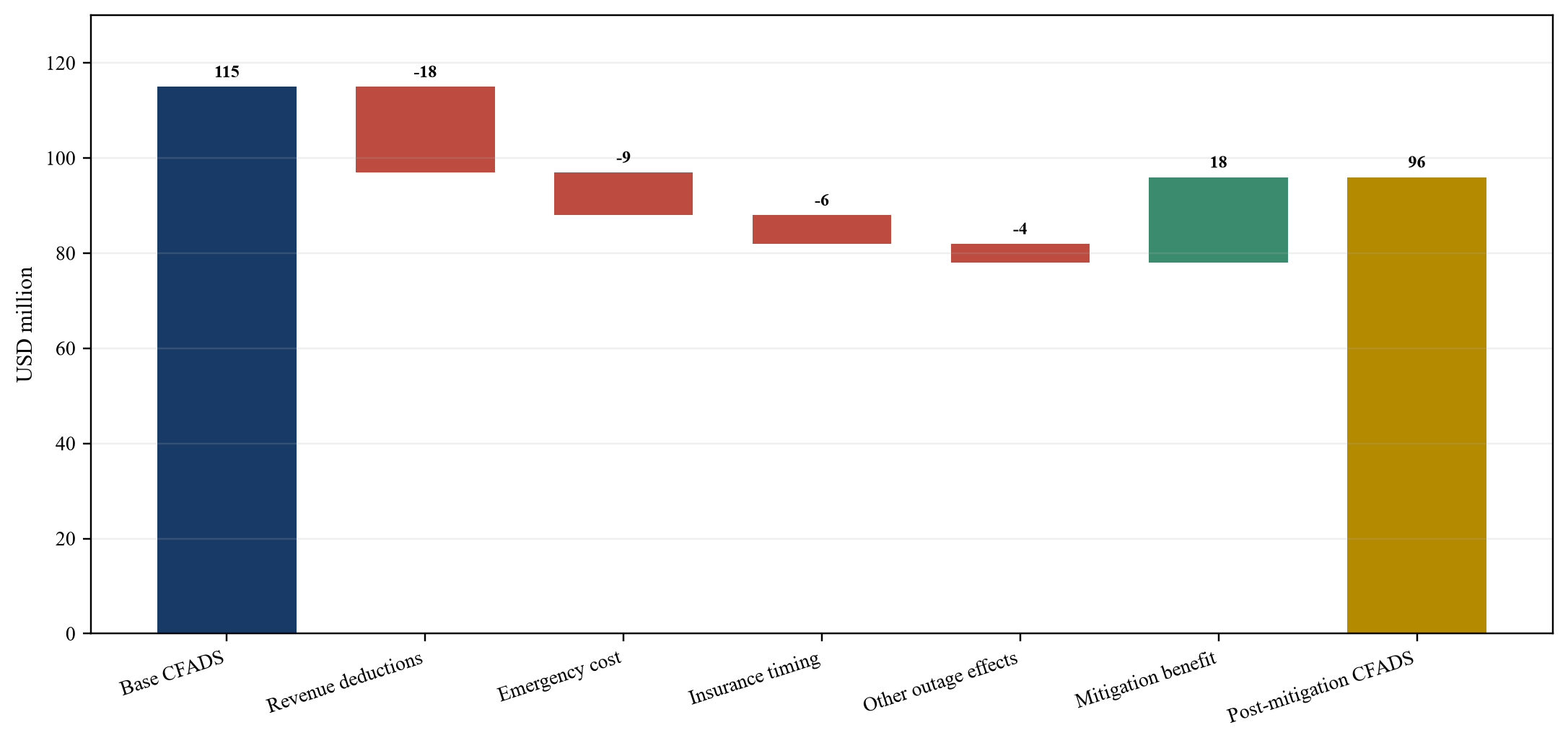
Management assumptions in USD million. The bridge demonstrates method only and does not represent a forecast, valuation or committed financing.
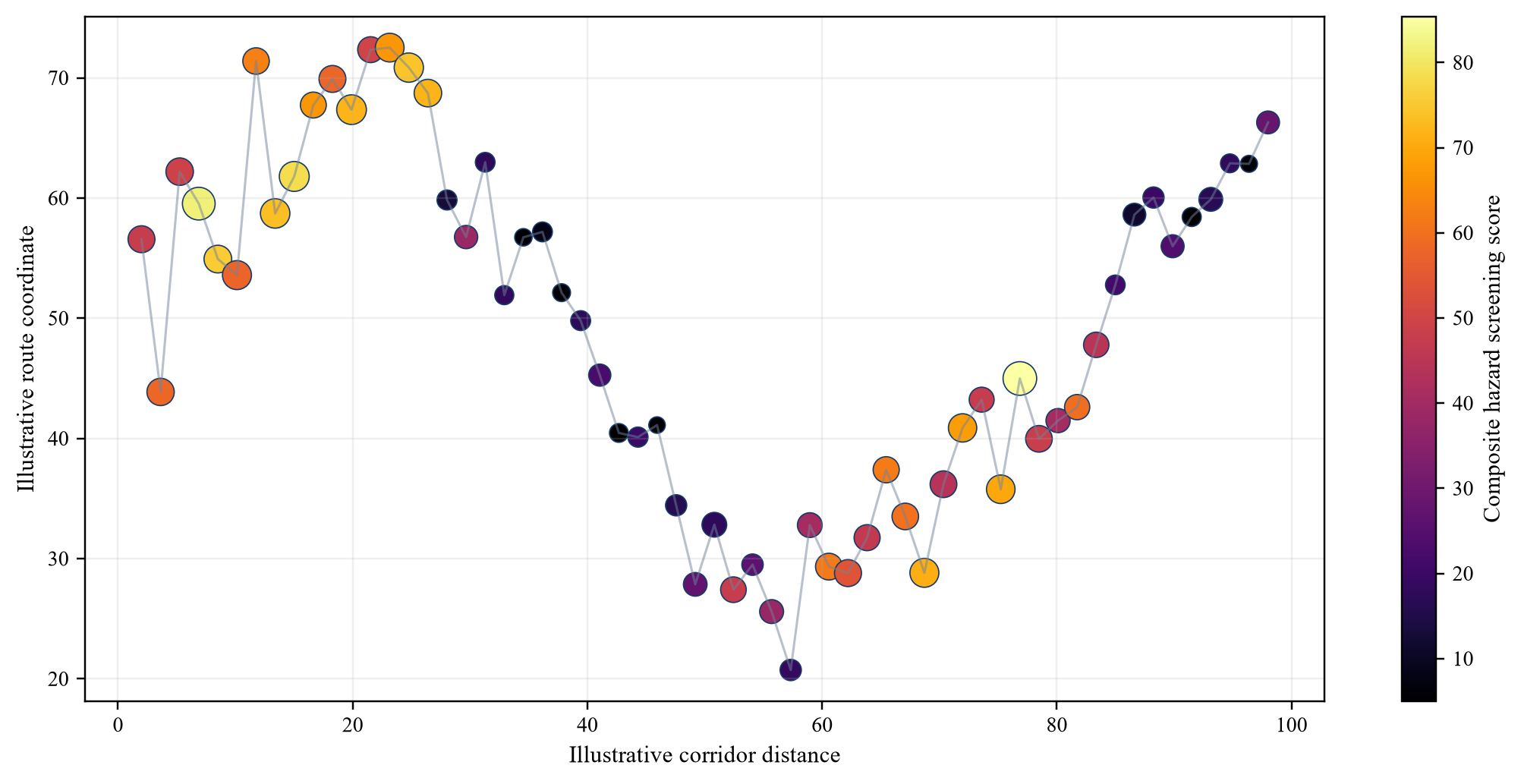
Abstract route coordinates do not represent a real project. Colour indicates management-assumed composite hazard and marker size indicates evidence priority.
21. Stress debt service coverage and covenant headroom
The credit model should calculate DSCR, loan-life coverage, reserve sufficiency, distribution lock-up duration and minimum cash through the event and recovery period. A single annual minimum can obscure the depth and timing of stress. The lender needs to see monthly or quarterly cash, insurance receipts, repair spending, reserve draws, cure contributions and recovery. Sensitivity should cover event frequency, restoration duration, deduction treatment, deductible, claim delay and interest-rate or currency interaction.
Covenants should be connected to controllable evidence. A forward-looking DSCR test can include an approved climate-remediation plan, while a reserve release can require engineer certification and insurance confirmation. Broad model-change discretion can create disputes. Facility documents should specify who may update hazard assumptions, when a model is refreshed, which expert resolves disagreement and how a material methodology change affects distributions or additional debt.
Debt-service reserves should be sized against timing as well as amount. A six-month reserve may be adequate for a short outage and inadequate when specialised equipment has a long lead time or claim recovery is contested. The model should show the sequence of operating cash, reserve draw, insurance receipt, sponsor cure and debt-service payment. It should also test whether reserve replenishment creates a later distribution lock-up. Where currency differs between revenue, debt service, equipment and insurance, the stress should include the exchange rate at the time each cash flow occurs.
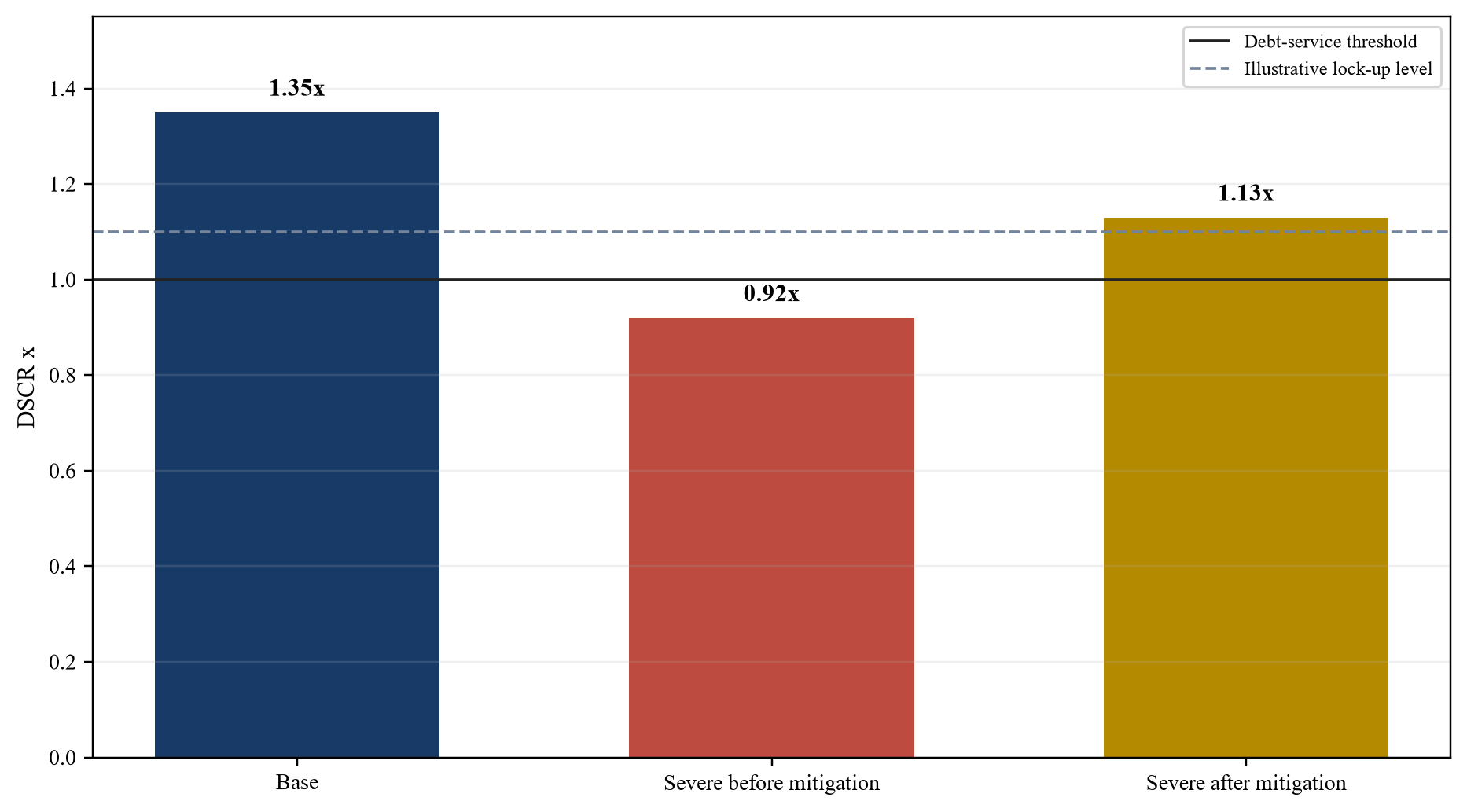
Management assumptions compare the base case, severe case before mitigation and severe case after mitigation. Values do not represent observed project performance.
22. Convert model outputs into debt sizing
Debt sizing should use cash flow after realistic climate cost, insurance structure and reserve funding. A lender can apply scenario weights, a downside case, minimum coverage, debt quantum caps or amortisation sculpting. The choice should reflect evidence quality and contractual protection. Weak data may justify lower debt or additional reserve even when the central estimate appears acceptable. Strong mitigation evidence can improve terms when it demonstrably reduces loss or recovery time.
The model should avoid double counting. A climate event should not simultaneously reduce revenue, add repair cost, increase insurance premium and inflate the discount rate without tracing distinct effects. Debt sizing and valuation should use consistent scenarios. If the base cash flow already includes expected maintenance and weather normalisation, an additional generic climate haircut may duplicate risk. An adjustment register should identify the affected line, evidence, owner, duration and interaction with other adjustments.
23. Allocate risk in the PPP contract
Climate risk allocation should follow control, insurability and value for money. The public authority may control system planning, adjacent network and some regulatory responses. The private partner controls design, construction, maintenance and restoration within its perimeter. Neither party controls the hazard. The contract should define relief, compensation, extension, emergency instruction, change in law, insurance unavailability and termination with sufficient precision to support finance.
The IDB's resilient PPP guidance recommends integrating resilience across project identification, preparation, procurement, contract and financing [7,8]. That lifecycle view matters because late-stage contract drafting cannot cure an under-designed asset. Bid documents should include climate information, performance expectations and data standards. Evaluation should test lifecycle resilience rather than initial price alone. The final agreement should preserve incentives for prevention while avoiding unfinanceable exposure to events that the private partner cannot manage economically.
24. Draft lender protections and information covenants
Lender protections can include resilience-capital milestones, minimum insurance, dedicated reserves, maintenance standards, vegetation controls, inspection frequency, critical-spares plans, emergency exercises and reporting after threshold events. Information covenants should require the asset register, hazard data, model version, exceptions, outage ledger, claims status and remediation. Material incidents should have a defined notice period and minimum evidence package.
Model governance should also be contractual. The borrower should identify the approved purpose, data owner, methodology owner, validation frequency and change-control process. A new machine-learning model should not silently alter the base-case forecast. Material changes should be compared against the prior model, explained to lenders and approved where facility terms require it. The governing principle is traceability: a lender must be able to reconstruct why a risk score changed and whether that change affects cash flow or covenant compliance.
| Finding | Evidence threshold | Financing action | Release or cure test |
|---|---|---|---|
| Elevated corridor hazard | Authoritative data plus engineering vulnerability | Targeted capex and monitoring covenant | Independent engineer confirms completion |
| Weak outage history | Unreconciled events or missing causal codes | Conservative scenario and reporting covenant | Audited event ledger and stable data quality |
| Insurance gap | Material exclusion, limit or waiting-period mismatch | Reserve, sponsor support or debt reduction | Policy and broker confirmation accepted by lenders |
| DSCR below lock-up | Approved downside model | Distribution lock-up and remediation plan | Forward DSCR and reserve tests satisfied |
| Non-transparent model | Missing lineage, validation or change record | Exclude output from debt case | Independent validation and governance approval |
Illustrative actions should be tailored to the executed concession and financing documents.
25. Govern model risk and human accountability
The model inventory should state purpose, owner, users, training data, validation, limitations, approved decisions and prohibited uses. Data and code should be versioned. Independent validation should test conceptual soundness, data quality, performance, stability, calibration, sensitivity and implementation. Monitoring should identify drift in hazard, assets, maintenance, contract or reporting. A model that remains statistically stable can still become economically wrong when the concession or asset changes.
Human accountability means that a named credit officer, engineer, insurance adviser and legal reviewer approve their respective transitions from model output to decision. The machine can rank segments or estimate conditional outcomes; it should not approve debt, certify engineering sufficiency or interpret contractual relief. Overrides should be recorded with reasons and outcomes. Persistent overrides may reveal model weakness or governance failure. The board and investment committee need concise reporting on performance, exceptions and unresolved limitations.
Validation should be proportionate to materiality. A model used only to schedule routine inspections can tolerate a different error profile from one used to reduce reserves or increase debt. Independent review should reproduce representative calculations, challenge feature logic, examine outliers and test the approved implementation. Vendors should disclose sufficient methodology and data limitations for the user to govern the result. Intellectual-property restrictions should not prevent the borrower or lender from understanding the drivers of a consequential credit output. Unresolvable opacity is a reason to constrain use, regardless of apparent performance.
26. Execute phased diligence
The first phase should freeze the project perimeter, obtain contracts and facility documents, reconcile route and asset data, and build the event ledger. Early fatal issues include missing concession rights, uninsurable design, unresolved land access, non-transferable permits, invalid revenue assumptions or insufficient data to test availability. The team should direct fieldwork to high-value and high-uncertainty segments rather than sampling only convenient locations.
The second phase should build hazard and vulnerability features, validate models, construct cash-flow scenarios and review insurance. The third phase should agree mitigation, reserve, covenant, contract and monitoring actions. Each issue should have an evidence request, owner, due date, cash-flow line and transaction consequence. A final evidence register should show what is verified, conditionally accepted, unresolved or excluded. Findings that cannot be resolved before financial close should become enforceable conditions or retained risk.
27. Carry the framework into operations
Closing should transfer the evidence system into asset management. The borrower should maintain the asset register, event ledger, inspection evidence, model versions, insurance claims and remediation plan. Monitoring frequency should follow risk and decision need. High-risk slopes or fire corridors may require more frequent observation than stable low-risk sections. Alerts should trigger investigation, not automatic financial action.
Operating review should compare predicted and observed events, false alarms, missed failures, restoration duration, cost and insurance recovery. The results should update maintenance and scenario design while preserving the original financing approval record. Lenders need a clear distinction between model improvement and retrospective rewriting. A post-event review should identify data, assumption, control and execution failures and assign corrective action. The framework creates value when it shortens response and improves decisions, not when it merely produces more scores.
28. Conclude with an evidence-to-debt discipline
Latin American transmission PPPs can mobilise long-term private capital for a grid system that needs expansion, resilience and renewable integration. Their long duration makes climate risk a contractual and credit issue from the outset. Wildfire, flood, heat, wind and landslide should be analysed through physical mechanisms, restoration pathways, availability rules, insurance and liquidity. The resulting scenarios can support debt sizing, covenants, reserves and resilient design.
Machine learning can improve scale, consistency and prioritisation. Its contribution remains bounded by data quality, rare events, structural change, causal ambiguity and governance. The strongest financing case uses transparent benchmarks, multiple scenarios, engineering validation and accountable approval. Every material output should end in a defined action: gather evidence, improve design, adjust cash flow, allocate risk, size liquidity, change terms or monitor after closing. That evidence-to-debt discipline is the basis for financeable climate resilience.
Sources
- International Energy Agency, World Energy Investment 2025: Latin America and the Caribbean. Read the primary source
- International Energy Agency and OLADE, Unlocking Investment Opportunities in Latin America's Energy Transition, 2025. Read the primary source
- Inter-American Development Bank, Unlocking the Grid: How to Ensure Reliable and Sustainable Energy in Latin America and the Caribbean, 2025. Read the primary source
- Intergovernmental Panel on Climate Change, Climate Change 2022: Central and South America. Read the primary source
- Intergovernmental Panel on Climate Change, Climate Change 2022: Cities, Settlements and Key Infrastructure. Read the primary source
- Intergovernmental Panel on Climate Change, Interactive Atlas. Read the primary source
- Inter-American Development Bank, Climate Resilient Public Private Partnerships: A Toolkit for Decision Makers. Read the primary source
- Inter-American Development Bank, Resilient Public-Private Partnerships: A Regional and Multi-Sectoral Toolkit. Read the primary source
- World Bank, Public-Private Partnership Reference Guide Version 3. Read the primary source
- World Bank, Climate Change Knowledge Portal. Read the primary source
- Copernicus Emergency Management Service, Mapping and Early Warning. Read the primary source
- NASA Center for Climate Simulation, NEX-GDDP-CMIP6. Read the primary source
- European Centre for Medium-Range Weather Forecasts, ERA5 Reanalysis. Read the primary source
- World Meteorological Organization, State of the Climate in Latin America and the Caribbean 2024. Read the primary source
- International Energy Agency, Building the Future Transmission Grid, 2025. Read the primary source
- World Bank, Lifelines: The Resilient Infrastructure Opportunity. Read the primary source
- World Bank, Innovative Approaches to Public-Private Partnerships for Smart Grids. Read the primary source
- Network for Greening the Financial System, NGFS Climate Scenarios. Read the primary source
- International Finance Corporation, Performance Standards on Environmental and Social Sustainability. Read the primary source
- Equator Principles Association, The Equator Principles EP4. Read the primary source
- Agencia Nacional de Energia Eletrica, Transmission Auctions. Read the primary source
- ProInversion Peru, Electricity Project Portfolio. Read the primary source
- Chile National Energy Commission, Annual Transmission Expansion Plan. Read the primary source
- Colombia Mining and Energy Planning Unit, Transmission Expansion Planning. Read the primary source
- International Organization for Standardization, ISO 14091 Adaptation to Climate Change: Guidelines on Vulnerability, Impacts and Risk Assessment. Read the primary source
- IFRS Foundation, IFRS S2 Climate-related Disclosures. Read the primary source
