

1. The lending decision
The approval question is whether a laboratory can convert eligible services into sufficient cash to meet its operating commitments and the proposed repayment schedule. A lender should begin with the source of repayment, the timing of the funding need and the evidence available to test both. The analysis in this paper is intended for an initial credit assessment and the design of subsequent diligence. It does not establish that any particular laboratory is financeable, that a financing opportunity is available, or that a proposed lender has permission to undertake the transaction.
A diagnostic laboratory connects several contractual relationships. A clinician requests a test. The laboratory performs the work using staff, equipment and consumables. The party entitled to invoice may be the laboratory, a hospital, another healthcare provider or a contracting intermediary. An insurer or another debtor then evaluates a payment request under the relevant agreement. Cash reaches an account after the resulting adjustments and settlement process. Each relationship needs its own evidence. A lender financing a subcontracted laboratory should identify whether its debtor is the referring facility or the insurer before assessing concentration or collateral.
The principal recommendation is to construct a claim-level cash history and a supplier commitment schedule before negotiating an advance amount. This is the analytical approach proposed by this paper. A credit committee can then distinguish an operating business with a temporary cash gap from a business whose allowable collections fail to cover its unavoidable expenditure. An additional facility can bridge a defined timing mismatch when its conditions permit drawing. Funding a recurring operating deficit requires an independently credible corrective plan and an identified source of loss-bearing capital.
The scope is UAE diagnostic laboratory working capital, with selected regulatory evidence from Abu Dhabi and Dubai. Each emirate, licensing authority, payer contract and service category requires its own applicability check. The analysis does not extend a local rule across the GCC or assume that a UAE facility can acquire, operate or lend in another jurisdiction on the same terms. Specialist tests, international sample transfers and hospital bundled payments can require separate investigation. Routine laboratory claims supply the central example because their path to cash can be examined at the level of an individual billed activity.
2. What the public evidence establishes
The Department of Health Abu Dhabi describes Shafafiya as both a healthcare information exchange and a source of the standards governing that exchange. Its description connects patients, encounters, activities, providers and payers, and directs healthcare entities to monitor changes to the data standards. This provides a public starting point for understanding the transaction records a lender should request. It does not establish the completeness of any laboratory's implementation or the collectability of a claim submitted through that system. [1]
The DoH prices page, reviewed on 10 September 2026, lists Claims and Adjudication Rules V2025.1 and subsequent addenda. The underlying rules include provisions on adjudication, medically unlikely edits and the exchange of insurer simple edits. The lender's diligence should therefore obtain the applicable provider agreement and current payer instructions alongside the public rules. An old tariff workbook alone is insufficient evidence for the amounts a particular borrower is entitled to collect. No tariff, payment deadline or deduction percentage is assumed to apply universally in this paper. [2], [3]
Addendum 03 introduces indicators for certain medically necessary repeat outpatient laboratory and radiology services in Abu Dhabi, with complete rollout dated 1 July 2026. For laboratory services, L1 and L2 distinguish repeats ordered by the same healthcare facility group and another group. The stated conditions require supporting medical justification. The addendum excludes use for repeats caused by specimen or equipment testing problems when a normal one-time result is sufficient, and for specified codes describing a series of results. Unsupported use may lead to denial. Emergency services, as defined in the document, are outside its stated purpose. [4]
Dubai's published Standards for Clinical Laboratory Services, issue 2, carry an effective date of 17 July 2023. The reviewed provisions address specimen traceability, reporting, confidentiality and the use of reagents. They prohibit expired reagents and require assay validation or verification before patient testing with new tests, methods or instruments. The lender should have a qualified reviewer check the facility's current obligations and later applicable circulars. The standard's listed revision date does not establish that no intervening requirements exist. [5]
Supplier terms also require careful qualification. Bio-Rad's 2025 Form 10-K describes a reagent-rental programme combining instrument use and consumables, potentially with maintenance and training. It states that its arrangements generally contain variable payments and no fixed or minimum lease payments. This issuer disclosure is a counterexample to any universal assumption about fixed rental obligations. It does not reveal the terms of a particular UAE laboratory's contract or establish the absence of a separate purchase commitment. The minimum-purchase scenario used below is an invented contract term for sensitivity analysis. [6]
These sources support a set of diligence questions. They provide no borrower-level collection record, supplier negotiation outcome, default probability, financing spread or institutional demand estimate. All numerical inputs below are expressly selected for illustration. The legal effectiveness of security, the lender's regulatory permissions and the tax position require separate professional assessment using the actual parties, contracts and transaction structure.
3. Reconstructing the route from test to cash
The proposed data model follows one original billed activity through its subsequent states. The laboratory should supply a stable pseudonymous identifier, service date, billing entity, debtor, contractual amount, submission date and all later adjustments. Resubmissions and appeals should remain linked to that original identifier. The objective is to count one economic claim once, including when several messages or invoices describe its history. A data extract that treats each resubmission as fresh revenue can overstate production and create apparent receivables that duplicate an earlier record.
The analyst should reconcile the extract to the accounting ledger at a common cutoff date. Opening receivables, new billings, credit notes, cash allocated, write-offs and closing receivables must form a complete movement. Unallocated bank receipts should remain visible until matched. A cash payment received after the cutoff belongs in a subsequent-events test; the historical dataset should retain the date on which the claim was still outstanding. This makes it possible to test what a lender would actually have known when certifying availability.
Three analytical dates answer different questions. The service date groups claims by the underlying activity. The submission date measures the time taken to prepare and transmit the claim. The bank receipt date identifies when usable cash arrived. Measuring only the gap from submission to remittance can conceal a lengthy pre-submission backlog. Measuring only an average across all paid claims can omit the oldest unpaid population. Both omissions matter when estimating the amount and duration of a proposed draw.
For each monthly service cohort, calculate the share of its original contractual billings collected by successive ages, its permanent reductions and its unresolved balance. Use the same denominator across ages. Compare payer cohorts separately and preserve the distinction between direct insurer claims and amounts owed by referring facilities. A laboratory with several insurance brands in its patient population may still have one contractual debtor if a hospital invoices the insurers and pays the laboratory under a subcontract.
| Stage | Evidence to request | Credit question |
|---|---|---|
| Service completed | Pseudonymous activity reference and authorised service record | Was the billed activity performed within the facility's scope? |
| Claim submitted | Original claim, amendments and submission timestamps | Is this one economic claim with a traceable history? |
| Claim adjudicated | Payer response and adjustment reasons | Which amount remains collectible and why? |
| Cash received | Remittance allocation and dated bank entry | Has the money arrived in the expected account? |
| Balance unresolved | Appeal evidence, deadlines and reconciliation | What supports the remaining amount and expected timing? |
Proposed underwriting controls. The actual data fields and access permissions require agreement with the laboratory and relevant specialists.
The completeness test should include unusual records. Sample reversed payments, negative adjustments, manual journal entries, claims moved between debtors and receipts assigned to multiple invoices. Request the preparer's explanation and supporting evidence for each exception. A lender may decide to exclude unresolved items from its initial borrowing base while continuing diligence. Such an exclusion is a proposed credit policy choice, not a conclusion that the underlying claim has no value. The final treatment should follow verified evidence and agreed documentation.
4. Separating deductions from delay
Permanent dilution means a reduction in the amount ultimately collectible from the original billed balance. Collection delay means an amount remains expected to arrive later. The distinction is an analytical classification that needs support from the payer response, contract and subsequent outcome. An initial denial can be corrected and paid, partly recovered or finally lost. The paper does not assume that every denied claim becomes a loss or that every appeal succeeds. The model should keep disputed amounts separately until their outcome is sufficiently supported.
The lender should examine realised outcomes by reason and claim age. A missing attachment corrected promptly can have a different history from a service outside contracted coverage. A technical coding issue can affect many claims submitted under one configuration. Where records support such groupings, they help identify which exposure is a discrete backlog and which exposure is continuing to accumulate. No percentage recovery should be assigned simply because management describes a claim as recoverable. That description should be tested against dated evidence and matched resolutions.
Gross claim counts can obscure the cash effect. A small number of high-value reductions may outweigh many low-value claims resolved successfully. Calculate both claim-count and value-weighted measures, with the value basis stated. Reconcile deductions against revenue recognition and receivable provisions so that the same loss does not enter the cash model twice. If the opening model already uses billings net of a contractual discount, subtracting that discount again would understate collections. If it starts from a laboratory price list, the bridge to contractual billings must be explicit.
For the hypothetical model below, annual contractual billings are USD 12.00 million before a further assumed 5% of permanent deductions. This is a modelling convention, with no implication that the laboratory could invoice that amount under any observed tariff. Ultimate annual collections are therefore USD 11.40 million before timing changes. The assumption is applied consistently to each cohort. Additional delay changes the period in which this cash arrives. A further deduction changes its total. The separate calculations make the effect of each assumption visible to the credit committee.
The committee should require a reconciliation of any management forecast to the historical denominator. A forecast using new service volumes, a different payer mix or a revised contract is not directly comparable with an old aggregate collection percentage. Each change should be identified and evidenced. Until verified, such inputs should remain labelled as management estimates in private diligence materials. Public scenario analysis should describe the assumptions naturally and should never present a constructed recovery estimate as an observed industry collection rate.
5. Reading the reagent agreement as a cash schedule
A lender should obtain the signed reagent supply and instrument-use contracts, their schedules and amendments. The contract review should determine whether the laboratory buys consumables, pays for tests performed, leases an instrument, commits to purchase quantities, or combines these arrangements. It should also identify who invoices, which legal entity owes payment, when title passes and what happens on termination. A distributor agreement may differ from the instrument manufacturer's general programme. A product brochure is insufficient evidence of the borrower's binding obligations.
For a minimum-purchase clause, the relevant questions include its measurement period, qualifying products, price basis, adjustment rights and consequences of a shortfall. A yearly target can create a concentrated payment at year-end even where monthly purchases look flexible. A quantity minimum can become more expensive when unit prices change. A commitment covering one reagent family might provide no relief when demand shifts toward a different test. The model should preserve these details rather than converting every arrangement into a constant percentage of revenue.
Inventory requires a separate physical analysis. The analyst should reconcile opening stock, deliveries, consumption, returns, destruction and closing stock by product and expiry date. Stock that cannot be used within its valid period should not support an assumed recovery at full purchase cost. A qualified laboratory reviewer should assess the operating constraints on substitution and instrument compatibility. The lender should not ask clinicians to order unnecessary tests to use up committed supplies. Any supplier renegotiation must work within clinical requirements and the borrower's lawful scope of activity.
The cash model should track invoices and payments independently of the expense recognised when reagents are consumed. In the hypothetical base case, the laboratory pays USD 3.60 million for purchases and consumes USD 3.20 million at cost. With no other stock movements, inventory increases by USD 0.40 million. Subtracting the USD 3.60 million purchase payment already captures that cash use. Subtracting another USD 0.40 million as an inventory increase would count the same funding requirement twice. An indirect cash-flow model starting with consumption expense would instead add the inventory movement once.
Termination deserves its own scenario. The laboratory might need to return an instrument, settle outstanding invoices, acquire replacement capacity or transfer work to an authorised provider, depending on the actual agreement and applicable requirements. Those possibilities should be investigated rather than presumed. A receivables lender should assess the cash cost and time needed to preserve lawful service continuity under the documented circumstances. A security interest in receivables cannot itself resolve a supplier's operational or contractual rights over essential equipment.
6. A hypothetical operating cash bridge
Consider an invented laboratory with stable annual contractual billings of USD 12.00 million and permanent deductions of 5%. Assume that opening and closing collectible receivables are equal in the base year, so collections equal USD 11.40 million. Reagent purchase payments are USD 3.60 million, including the cash effect of the assumed minimum commitment. Other operating cash expenditure is USD 5.40 million. An additional USD 0.60 million covers a deliberately simplified allowance for cash tax and necessary capital expenditure. These inputs are selected to explain the method and are unrelated to any identified UAE business.
Cash available for debt service, abbreviated CFADS, is USD 1.80 million: collections of USD 11.40 million less USD 3.60 million, USD 5.40 million and USD 0.60 million. This definition is specific to the illustration. A real financing agreement should define its calculation precisely, including permitted adjustments, tax timing, maintenance investment and restricted cash. The example excludes acquisition spending, dividends, extraordinary litigation costs, foreign-exchange movements and new equity contributions. Their omission limits what the result can establish for an actual financing decision.
Assume a separate proposed USD 5.00 million facility commitment with USD 1.00 million drawn for the illustrated debt-service calculation. For transparency, annual cash interest is fixed at USD 0.12 million and scheduled principal repayment at USD 0.78 million. Total annual debt service is USD 0.90 million. The interest amount is an illustrative input equivalent to 12% on the stated constant reference balance, rather than a market quote or an amortising interest schedule. A real model must calculate interest on dated outstanding balances, fees and any benchmark-reset terms.
The base coverage ratio is therefore 2.00 times, calculated as USD 1.80 million divided by USD 0.90 million. Cash remaining after the stated debt service is USD 0.90 million. Neither figure is a lending recommendation. They omit intra-year timing and depend on all the chosen inputs. The USD 5.00 million headline commitment also says nothing about the amount the borrower can draw on a particular date. The borrowing-base example later in the paper deliberately tests that distinction using a separate cutoff balance.
This cash bridge should sit beside a monthly liquidity forecast. Annual coverage can conceal a deficit before a large remittance arrives or before an annual supplier true-up is payable. A lender should request the lowest projected cash balance, the date on which it occurs and the conditions for accessing every proposed liquidity source. Undocumented shareholder support, expected refinancing and a proposed asset sale should remain outside committed liquidity until the relevant evidence is available. Their potential contribution can be shown separately as a conditional scenario.
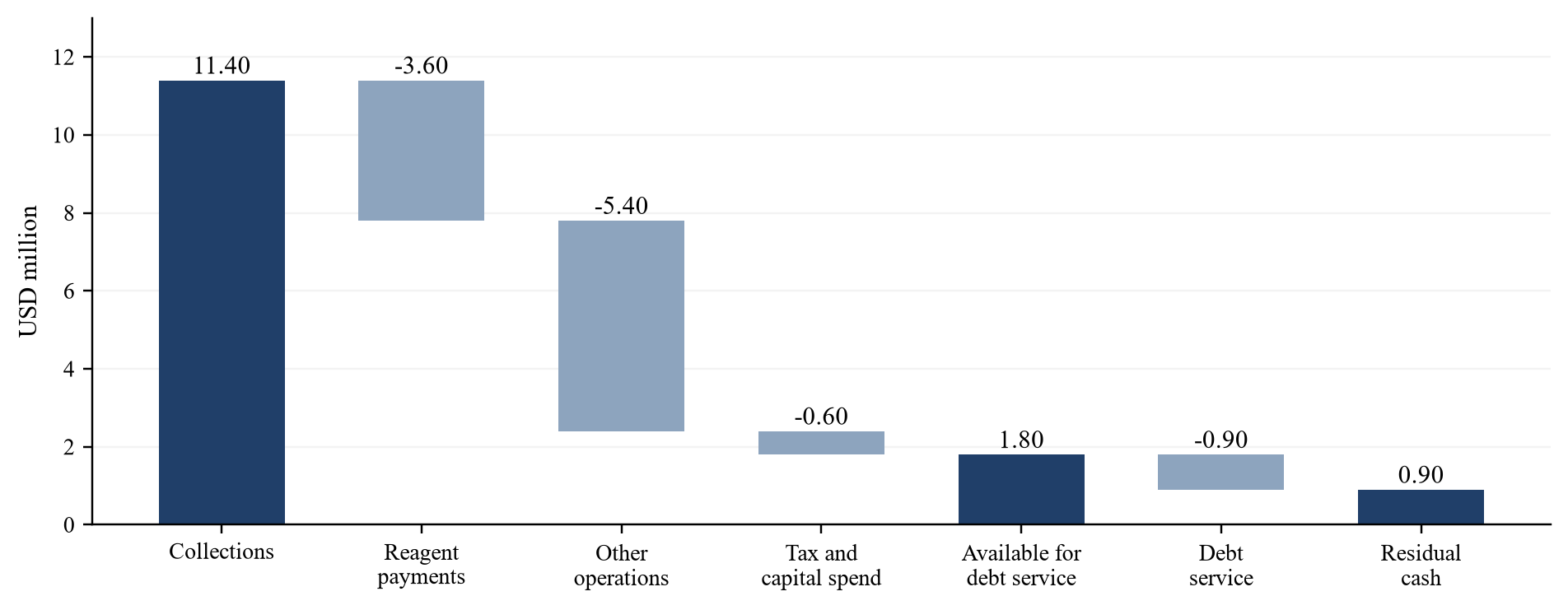
USD million. All figures are invented modelling inputs or arithmetic results. Reagent cash purchases already include inventory funding. The final bar is cash after the specified debt service.
7. Measuring the funding cost of slower collection
In a stable monthly model, USD 11.40 million of annual collectible billings corresponds to USD 0.95 million each month. Assume every monthly cohort is collected exactly two months after billing. The collectible receivable stock at a month-end then represents two monthly cohorts, or USD 1.90 million. This simplified timing pattern is an analytical device. Actual collections are dispersed across dates and may involve instalments, deductions or late recoveries. A real forecast should use the verified cohort curve and dated opening balances.
Now assume the collection lag increases from two months to three months with no change to eventual recovery. The steady-state collectible receivable stock increases to USD 2.85 million. During the transition, another USD 0.95 million is tied up in receivables. If all other annual cash flows remain unchanged, CFADS in the affected transition year falls from USD 1.80 million to USD 0.85 million. Against USD 0.90 million of debt service, coverage is about 0.94 times and the cash shortfall is USD 0.05 million before any opening cash or additional financing.
The additional USD 0.95 million is a one-time stock increase under the stipulated stable-volume transition. It should not be deducted again every year once the new lag is established. The business still carries the larger receivable stock, and financing it can create continuing interest or fee costs. Those incremental financing costs are omitted from the simple transition calculation and should be added in an actual forecast. If delay continues to worsen or sales continue growing, the stock can increase again. These are different assumptions and should be modelled explicitly.
An extra 15 days of delay is approximated here as half of a 30-day modelling month. It absorbs USD 0.475 million. An extra 60 days absorbs USD 1.90 million. The day convention is chosen for arithmetic clarity and is not a claim about contractual payment terms. Calendar-day precision, weekends and actual payment dates belong in the operating forecast. The example shows why a small positive annual cash margin can coexist with a significant refinancing or equity requirement when the collection pattern changes.
The lender should test whether availability expands when receivables age. A borrowing base may exclude overdue claims or limit exposure to a particular debtor. In that case, the same delay that increases the funding need can reduce the amount eligible for drawing. The resulting cash gap requires both calculations at the same cutoff date. Counting an undrawn headline commitment as automatically accessible would hide the interaction. A viable approval case should identify a documented funding source for the stress period and show the effect of any reserve or eligibility change.
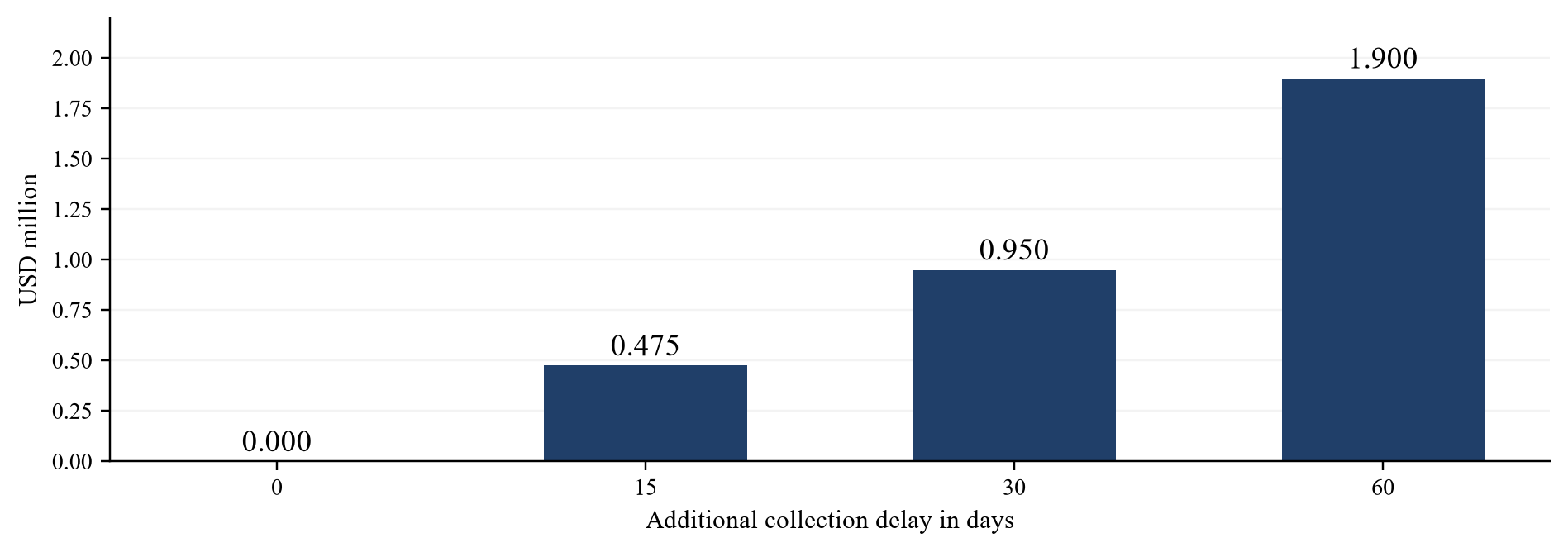
Hypothetical stable collectible billings of USD 11.40 million annually. A modelling month contains 30 days. Bars show the transition increase in receivables, before incremental financing costs.
8. Combining volume pressure with reagent commitments
The model's other operating cash expenditure is split into USD 3.60 million of fixed expenditure and USD 1.80 million that varies directly with test volume. Prices and service mix are held constant, so the change in contractual billings represents the change in volume. Reagent purchase payments remain at the invented USD 3.60 million minimum. The separate tax and necessary capital expenditure allowance stays at USD 0.60 million. These simplifying choices isolate the effect of a purchase floor. They are not estimates of a typical laboratory cost structure.
With volume 20% lower, contractual billings become USD 9.60 million. If deductions simultaneously rise to 8%, ultimate annual collections become USD 8.832 million. Other operating cash expenditure falls to USD 5.04 million, calculated as USD 3.60 million plus 80% of USD 1.80 million. After reagent purchases and the USD 0.60 million allowance, CFADS is negative USD 0.408 million. The deficit after the assumed USD 0.90 million debt service is USD 1.308 million, before any further collection delay or financing costs.
Inventory accumulation also changes. If reagent consumption at cost falls in proportion to volume, the base USD 3.20 million becomes USD 2.56 million. Against cash purchases of USD 3.60 million, stock increases by USD 1.04 million in the absence of returns, wastage or other movements. This larger stock build is already reflected in purchase payments. A write-down for expiry would affect the accounting value of stock; it would create another cash requirement only to the extent of replacement purchases or other actual payments. The model must avoid subtracting both the original cash payment and an assumed non-cash write-down as separate outflows.
Figure 3 varies volume and permanent deductions while retaining the same operating assumptions. At 90% of base volume and 8% deductions, annual CFADS is USD 0.516 million. At full volume and 12% deductions it is USD 0.960 million, leaving only USD 0.060 million after the specified debt service. None of the cells includes an additional timing shock. Combining a selected operating cell with a cash-delay scenario requires recalculating the monthly collectible amount for that cell before estimating the stock increase.
The committee should ask which assumption can change through a documented action. A signed reduction in minimum purchases, a verified price amendment or completed restructuring of a fixed cost has a different evidential status from a management intention. The model can show each potential action separately with its cash cost and implementation date. Clinical quality, staff qualifications and necessary maintenance should remain constraints. An apparent improvement based on unsafe service reductions or unnecessary test volumes does not constitute an acceptable operating recovery plan.
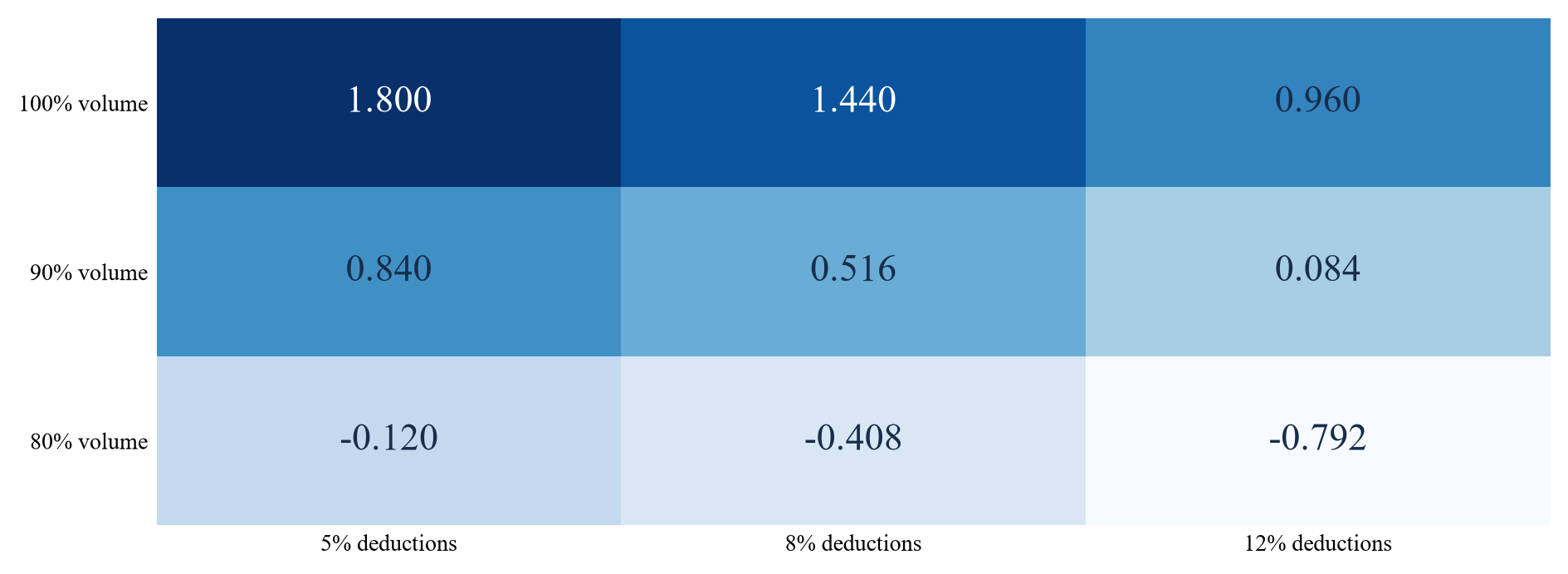
Hypothetical USD million annually, before the USD 0.90 million debt service and before additional collection delay. Fixed reagent purchases are USD 3.60 million. Negative values indicate an operating cash deficit after the specified tax and capital allowance.
9. Eligible receivables and actual drawing capacity
Consider a separate invented borrowing-base certificate with USD 2.00 million of receivables at its cutoff date. Assume USD 0.20 million is excluded for identified adjustments and eligibility issues, leaving USD 1.80 million. Apply a hypothetical advance rate of 70%, producing USD 1.26 million, then subtract a separately defined USD 0.16 million reserve. The resulting borrowing-base limit is USD 1.10 million. With USD 1.00 million already drawn and no other restrictions, incremental availability is USD 0.10 million. The USD 5.00 million facility commitment does not change this calculation.
This certificate is an independent example of contractual availability, not a reconciliation to the timing model's receivable stock. Its 10% exclusion and additional reserve were selected to show the sequence of deductions. They should never be presented as standard UAE lending terms. In an actual certificate, each reserve should name the risk it covers and whether the same risk has already been removed from eligible balances. Without that reconciliation, a model can conceal either inadequate protection or overlapping deductions that make the facility less usable than intended.
At a subsequent cutoff, suppose eligible receivables decline to USD 1.30 million while the advance rate and reserve remain unchanged. The limit becomes USD 0.75 million: 70% of USD 1.30 million less USD 0.16 million. Against USD 1.00 million outstanding, the borrower is USD 0.25 million above that illustrative limit. The finance documents determine any repayment obligation, cure period and enforcement consequences. The arithmetic alone does not establish those rights. The forecast should nevertheless show how the borrower would address the potential liquidity requirement.
Eligibility should be assessed with the legal structure and operating evidence together. Matters for counsel include the identity of the assignor and debtor, authority to grant rights, existing security, contractual restrictions, notice requirements, debtor defences, priority and insolvency treatment. These are questions for transaction-specific legal advice. IFC's credit infrastructure material places information systems, secured transactions and insolvency arrangements within the broader architecture of asset-based finance. It does not validate a proposed UAE security package or replace local legal analysis. [7]
The lender should also understand how collections are allocated across a group. An insurer payment into a hospital account may not be available to a laboratory subsidiary when needed. Cash pooling, related-party offsets and existing lender controls can affect access. The diligence team should trace the actual payment route and identify the proposed contractual changes, required consents and operational implementation. A signed agreement should be followed by an authorised test of the collection process before the lender relies on that process for routine monitoring.
| Exposure | Document or evidence | Approval question |
|---|---|---|
| Insurer receivable | Provider agreement and claim history | Who owes the amount and what can reduce it? |
| Hospital subcontract | Executed subcontract and settlement records | Does the lab have a direct insurer claim or a hospital claim? |
| Collection account | Bank arrangements and existing controls | Can the agreed cash route operate lawfully as documented? |
| Reagent inventory | Purchase terms, title and expiry records | What stock is owned, usable and independently recoverable? |
| Diagnostic instrument | Instrument-use and maintenance contracts | Who owns it and what happens if the supply relationship ends? |
| Existing financing | Debt and security documents | Which consents and priority arrangements are required? |
Questions for commercial, clinical and legal diligence. This matrix states no conclusion on ownership, enforceability, priority or recovery value.
10. Concentration at the level that controls payment
Concentration analysis should follow the obligor and the operational dependency. The name on an insurance card, the claims administrator, the contracting payer and the referring hospital can be different parties. The lender should document those relationships before aggregating exposures. Several administrative brands can share a payment decision-maker, and one large referral source can affect claims billed to several insurers. Treating every label as an independent source of repayment would give the committee an unreliable picture of diversification.
The proposed analysis uses two schedules. The first groups collectible balances and receipts by legal debtor, contract and relevant payment route. The second groups service volume and contribution by referral relationship, instrument platform and critical supplier. These schedules answer different questions. A debtor concentration limit addresses repayment exposure. A supplier dependency analysis addresses the ability to continue providing authorised services and generating future claims. The same adverse event can affect both, so the combined stress should identify the overlap explicitly.
For example, an invented case could assume that a single contract contributes 30% of annual billings and that its receipts stop for two modelling months. At the base 5% deduction assumption, the affected monthly collectible amount would be USD 0.285 million, producing a USD 0.570 million temporary gap if all delayed amounts ultimately arrive. This is a timing scenario only. If the contract is terminated or future services lose reimbursement eligibility, the lender must also model the volume loss, the duration of fixed costs and any supplier commitments. The paper assigns no likelihood to either event.
Historical concentration measures should use several observation dates so that a single unusually large remittance does not determine the conclusion. Request the largest debtor exposures before and after normal payment runs. Review whether concentration rises when weaker payers become overdue and stronger payers settle. A portfolio can appear more diversified by annual sales while its outstanding receivables become increasingly concentrated in the slowest-paying account. The borrowing-base and liquidity models should use the balances and cash patterns relevant to the proposed draw period.
The evidence that changes a decision should be recorded precisely. An executed contract extension can support the remaining term of a relationship. A payment received after an appeal can support that particular resolved claim. Neither proves future volumes or recovery on unrelated claims. The committee should preserve these boundaries when using subsequent events to revise a forecast. A documented collection improvement deserves recognition to the extent supported by the cohort data, with remaining uncertainty retained in the stress cases.
11. The evidence required before approval
The proposed initial request should be proportionate to the transaction and sensitive to patient confidentiality. Start with company records, executed commercial agreements, financial statements, a reconciled receivables extract and bank evidence. Request a data dictionary explaining the fields, permitted uses and pseudonymisation approach. The credit team should establish what can be reviewed without receiving identifiable clinical records. Where a clinical sample is necessary, qualified reviewers should determine the lawful access arrangements, minimum information required and appropriate reporting of findings to the lender.
A useful credit report should separate verified observations, management estimates and conditions still outstanding. It should identify the source, date and owner for material data. The lender should be able to trace each important number in the repayment model to a document or an expressly hypothetical sensitivity. A source file's existence does not establish its accuracy. Reconciliation, sample testing and independent confirmation should be selected according to the risk, with unresolved differences carried into the committee paper rather than silently corrected to make the model balance.
The proposed scope includes a review of existing debt, guarantees, supplier arrears, related-party balances and off-balance-sheet commitments. These can affect cash availability and the order in which counterparties expect to be paid. Management should explain which liabilities were omitted from its original financing request and why. The credit team should also request details of disputed invoices and any arrangements to defer supplier payments. Extending payment beyond the documented agreement can overstate sustainable cash generation if the forecast assumes that the delay continues indefinitely.
The service review should be conducted by appropriately qualified healthcare specialists. It should cover the permissions and operating evidence relevant to the laboratory's actual scope, together with matters that could interrupt service or impair claims. The credit report can describe the financial consequences of verified findings while clinical decisions remain with qualified professionals. A lender should avoid interpreting a clean financial audit as assurance that every test, instrument or billing process complies with applicable healthcare requirements.
The committee's decision should state the amount, purpose, permitted use of proceeds and reasons for any conditions. Conditions should identify the specific evidence or action required, the responsible party and how satisfaction will be verified. A condition described only as satisfactory diligence leaves too much ambiguity for closing. For example, a proposed requirement to reconcile a defined sample of claims to bank receipts is testable. A general statement that collections are strong lacks the detail needed to determine whether the condition has been met.
| Workstream | Minimum decision evidence | Unresolved issue to record |
|---|---|---|
| Cash reconciliation | Ledger movement tied to dated receipts | Unmatched cash and unexplained journal entries |
| Claim outcomes | Cohort recovery with appeals linked to originals | Old unresolved claims and changes in denominator |
| Supplier commitments | Executed terms and dated payment schedule | Minimums, true-ups, termination and stock ownership |
| Operating continuity | Specialist review of actual service scope | Licensing, staffing, equipment and supply dependencies |
| Security and accounts | Transaction-specific legal and bank review | Priority, consents, rights and practical implementation |
| Repayment | Monthly cash forecast with downside funding sources | Timing gaps and conditional support |
A transaction-specific work programme, with no representation that any borrower has supplied or passed these checks.
12. Monitoring the facility after closing
The monitoring proposal should be built around the information the borrower can deliver reliably and the lender needs to act. A monthly package can include the receivables reconciliation, cohort collection curve, changes to supplier commitments, stock ageing and a refreshed cash forecast. Higher-frequency reporting may be appropriate when liquidity is tight or data quality is still being established. The frequency should be justified by the transaction's risk and agreed in advance. This paper sets no universal reporting standard or lender covenant threshold.
Reports should retain prior-period versions so that changes are visible. If a laboratory revises a historical claim from expected recovery to final loss, the next package should explain the effect on the opening balance and the forecast. A claims system migration should preserve the original economic identifiers or a tested mapping. Manual adjustments should name their approver and supporting document. The lender should be able to distinguish a genuine improvement in collections from a changed classification, a removed population or the reassignment of receipts across reporting periods.
Trigger design requires a response process. A rising unresolved balance can prompt sample review and a forecast revision. A supplier notice can prompt review of instrument continuity and the timing of potential payments. A borrowing-base deficiency requires treatment under the actual financing agreement. The parties should identify who receives the information, who determines its significance and which actions require further approval. A threshold by itself has limited value if the lender cannot obtain the underlying records or establish the cause of the change.
Monitoring should also test whether the original minimum-purchase assumption remains relevant. A renewal, product migration or volume rebate can alter the cash schedule. Ask management to identify new commitments before they become binding where the agreed finance documents provide such a process. Any proposed consent should evaluate both the operating benefit and the downside obligation. A lower initial equipment payment may be attractive, but its associated future cash payments still need to fit within a realistic service-volume and collection forecast.
The clinical and information-governance boundaries continue after closing. Credit monitoring should use aggregated or appropriately pseudonymised information wherever suitable. Access to patient records should remain limited to a lawful, necessary purpose under arrangements reviewed by the appropriate specialists. The lender's interest in repayment does not confer clinical authority. The financing process should support the laboratory's ability to provide authorised care without pressuring clinicians to generate tests, alter records or compromise reagent and equipment standards to satisfy financial projections.
13. Interpreting the return and the commercial mandate
A credit investor should assess return using the capital actually deployed and the dates of the cash flows. A contractual interest rate alone does not describe the realised outcome. Delayed interest, principal losses, origination costs, servicing expenses and unused commitment costs can affect the result. The base example specifies USD 0.12 million of annual interest only to make its debt-service arithmetic reproducible. It provides no evidence of an achievable UAE lending yield, expected loss rate or return available from a proposed laboratory portfolio.
A USD 5.00 million commitment with USD 1.00 million drawn illustrates another commercial question. The investor may need to allocate capacity for future drawings even though current income depends on the drawn amount and any agreed fees. The borrower may value a larger commitment while being unable to use it because of eligibility restrictions. Both sides should examine realistic utilisation paths and the cost of maintaining capacity. The model should describe commitment fees or other charges only when they are documented or explicitly introduced as separate assumptions.
For a capital provider seeking advisory support, a scoped engagement could cover borrower search against agreed criteria, initial commercial screening, coordination of financial and specialist diligence, preparation of a credit memorandum and negotiation support within applicable permissions. Those are proposed work packages, subject to an agreed mandate and verification of service scope. They are not representations that a particular borrower has been sourced or approved. The engagement should specify deliverables, evidence standards, exclusions, conflicts and the point at which the investor makes its own decision.
Investment principal and advisory fees should have separate documentation and payment routes. The investor should retain control over its lending decision and execution through its authorised arrangements. Any advisory scope should address confidentiality, conflicts of interest and the use of third-party specialists. It should not imply that a research publication provides custody, discretionary investment management, a securities offer or a commitment to place capital. The purpose of the research is to make the underwriting questions sufficiently specific for a properly scoped professional discussion.
Mandate design also affects research quality. If the engagement rewards introductions without requiring evidence of repayment capacity, the capital provider may receive a long candidate list with little decision value. A useful initial deliverable is a screened list whose entries state what is verified, what remains outstanding and why the candidate fits the agreed credit criteria. The next stage can investigate the strongest candidates in depth. There is no assurance that this process produces a financeable borrower, a signed transaction or a particular fee outcome.
14. The evidence that should change the decision
The hypothetical cases identify four questions for a committee. Does the claim history support the amount expected to be collected? Can the laboratory absorb a realistic delay with documented liquidity? Do supplier payments remain affordable under lower volumes? Does the proposed security and collection structure work under the actual contracts and applicable law? The answer to each requires specific evidence. A favourable base case should not be used to close gaps in the other questions through assumption.
Evidence can support a more favourable assessment. A reconciled claim history may show that a defined backlog has been paid. An executed supplier amendment may reduce a future cash obligation. A completed bank arrangement may establish the documented route for collections. An independent specialist review may resolve a defined operating concern. Each improvement should update the relevant model input and condition. Its effect should be limited to the question actually resolved, with the remaining risks and assumptions retained.
Evidence can also justify declining or postponing a transaction. Examples include an unreconciled material receivable balance, an unsupported recovery forecast, a supplier obligation that creates an unfunded deficit, or a legal review that leaves the proposed rights unresolved. The committee should state the reason and, where appropriate, the evidence that would permit reconsideration. This produces a more useful record than an unexplained reduction in the facility amount. It also gives the borrower a defined opportunity to address a genuine information or structural gap.
The central result of the paper is conditional and reproducible. Under the invented assumptions, USD 1.80 million of base annual CFADS falls to USD 0.85 million during a one-month collection-lag transition. A separate combined operating stress produces negative USD 0.408 million before debt service. The borrowing-base example allows only USD 0.10 million of additional drawing despite a USD 5.00 million commitment. These results demonstrate mechanisms a lender should test; they are not forecasts for a UAE laboratory. An approval requires the actual evidence, a suitable financing structure and the investor's independent judgement.
Appendix A. Calculation audit and scenario boundaries
The following calculations use USD million unless stated otherwise. Annual contractual billings of 12.00 multiplied by 95% give 11.40 of ultimate collections. With stable opening and closing collectible receivables, annual cash receipts equal that amount. Payments are reagent purchases of 3.60, other operating costs of 5.40 and the tax and capital expenditure allowance of 0.60. The difference is CFADS of 1.80. Debt service of 0.12 interest plus 0.78 principal equals 0.90. Coverage is 1.80 divided by 0.90, or 2.00 times. Residual cash is 0.90.
The cash-delay calculation divides 11.40 by twelve to obtain monthly collectible billings of 0.95. Two months outstanding gives 1.90 and three months gives 2.85. Their difference is 0.95. Subtracting that one-time stock increase from base CFADS gives 0.85. Dividing 0.85 by 0.90 gives 0.9444 times, rounded to 0.94. Cash after debt service is negative 0.05. Half of a modelling month ties up 0.475 and two additional months tie up 1.90. Incremental financing costs are excluded from these timing figures.
For the combined operating case, 12.00 multiplied by 80% gives billings of 9.60. Collections after 8% deductions are 9.60 multiplied by 92%, or 8.832. Other cash operating expenditure is 3.60 fixed plus 1.80 multiplied by 80%, or 5.04. Subtracting 3.60 of reagent purchases, 5.04 of other operating expenditure and 0.60 of tax and investment gives negative CFADS of 0.408. Deducting debt service of 0.90 gives a cash deficit of 1.308. The model assumes no new financing, equity, asset disposal or additional delay in this case.
For every cell of Figure 3, multiply 12.00 by the volume factor and by one minus the deduction rate. Then subtract 3.60 for reagent payments, 3.60 for fixed operating expenditure, 1.80 multiplied by the volume factor for variable expenditure, and 0.60 for the separate allowance. At full volume, the outputs are 1.800, 1.440 and 0.960 for deduction rates of 5%, 8% and 12%. At 90% volume they are 0.840, 0.516 and 0.084. At 80% volume they are negative 0.120, negative 0.408 and negative 0.792. Rounding applies only to presentation.
The independent borrowing-base example starts from face receivables of 2.00, removes exclusions of 0.20 and applies 70% to the remaining 1.80, giving 1.26. A reserve of 0.16 produces a limit of 1.10. After a drawn balance of 1.00, additional availability is 0.10. In the subsequent certificate, eligible receivables of 1.30 multiplied by 70% give 0.91. Subtracting the same 0.16 reserve gives 0.75. A drawn balance of 1.00 exceeds that limit by 0.25. Actual repayment and cure obligations depend on the executed documents.
The model is deliberately limited. It contains no empirical UAE operating dataset, borrower forecast, probabilistic loss estimate, inflation assumption or investment recommendation. Prices and service mix are constant, variable operating costs move linearly with volume, reagent purchases remain fixed and collection cohorts follow a simplified monthly pattern. Tax and necessary capital spending share a fixed allowance that is unsuitable for a real tax computation or asset replacement plan. The working-capital facility's debt service is a stated annual input, with no representation of a real amortisation profile. Applying the framework requires replacing these assumptions with verified records and a dated cash model.
Sources
- Department of Health Abu Dhabi. Shafafiya overview. Healthcare data exchange, standards and key concepts. Reviewed 10 September 2026. Read the primary source
- Department of Health Abu Dhabi. Shafafiya prices and adjudication rules index. Current index reviewed 10 September 2026. Read the primary source
- Department of Health Abu Dhabi. Claims and Adjudication Rules V2025.1. Section 5, printed page 32, and revision history. Read the primary source
- Department of Health Abu Dhabi. Addendum 03 to Claims and Adjudication Rules V2025.1, Introduction of Indicators. Pages 2-5. Complete rollout dated 1 July 2026. Read the primary source
- Dubai Health Authority. Standards for Clinical Laboratory Services, issue 2. Effective 17 July 2023. Sections 9.1.4-9.1.6, printed pages 27-30. Read the primary source
- Bio-Rad Laboratories. Form 10-K for the year ended 31 December 2025. Revenue recognition and reagent-rental arrangements, printed pages 50-51. Read the primary source
- International Finance Corporation. Credit Infrastructure. Sections on credit information, secured transactions and asset-based lending, and insolvency and debt resolution. Reviewed 10 September 2026. Read the primary source
