

1. Leverage converts patient private equity into a dated cash obligation
A pre-IPO share can remain illiquid for years. Debt has interest dates, maturity, reporting duties, covenants and enforcement rights. Combining them creates a maturity and liquidity mismatch that should be underwritten explicitly.
The SPV can borrow at acquisition, after closing or against an existing position. Proceeds can fund the purchase, fees, reserves, follow-on capital or distributions. Each use changes investor economics and lender risk. The facility can be full recourse to the SPV, limited recourse to collateral, supported by guarantees or linked to investor commitments.
The underlying security can be common or preferred, direct or beneficial, certificated or electronic, and subject to transfer restrictions. The SPV may hold through another nominee or feeder. A lender's ability to value and enforce the collateral depends on this complete chain.
Leverage magnifies both directions. A higher exit value can lift investor return on contributed equity. A lower value absorbs the equity cushion faster. Interest and fees continue while the asset remains private. A forced transfer can occur when the buyer universe is narrow and information is limited.
The Financial Stability Board states that leverage in non-bank financial intermediation can amplify stress and highlights monitoring, disclosures, counterparty risk and cross-border cooperation. Its recommendations are system-level. The same mechanisms are useful at SPV level: incomplete exposure data, concentrated collateral, liquidity calls and interconnected lenders can turn valuation changes into cash demands.
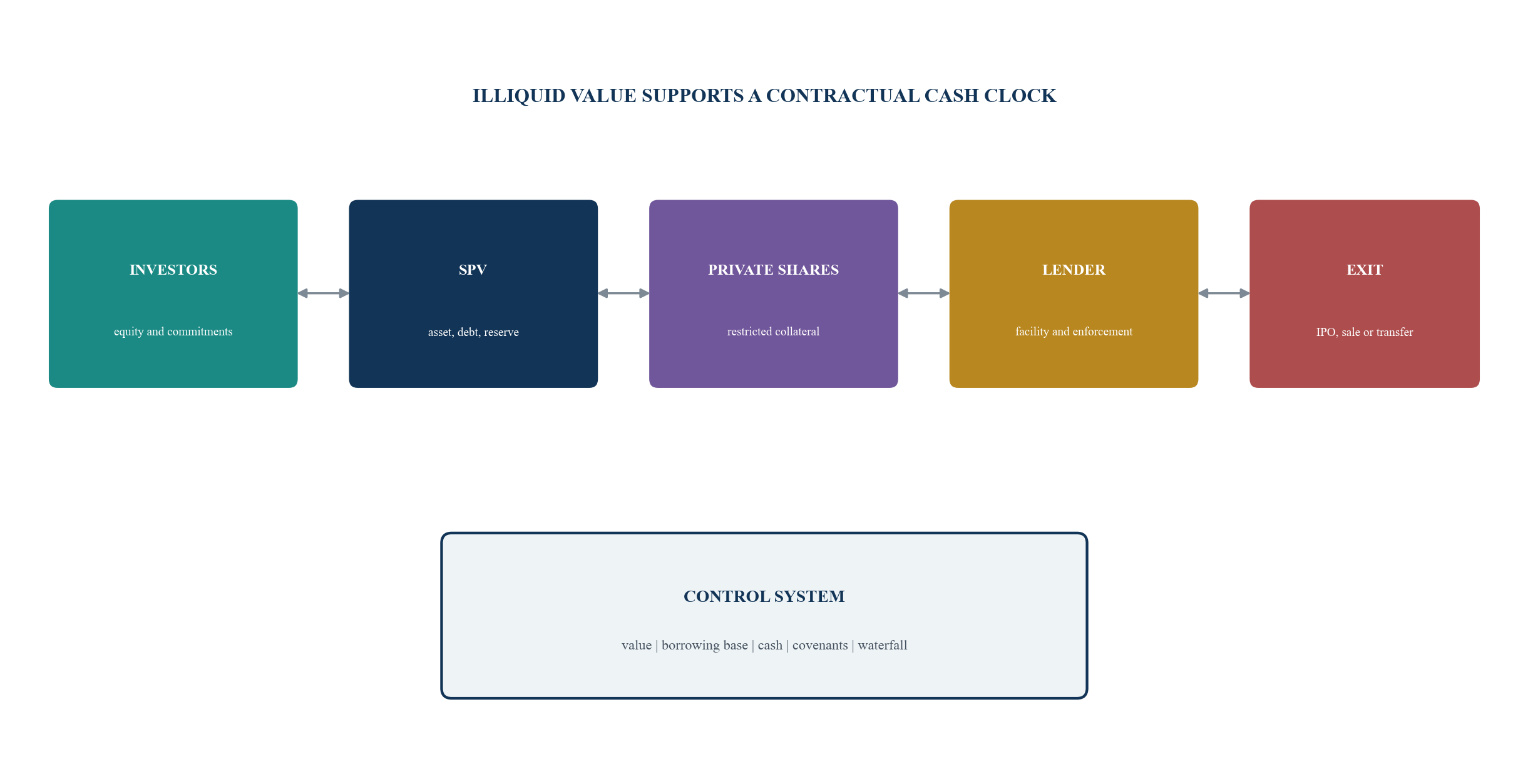
The lender and investor depend on valuation, transferability, liquidity and the contractual waterfall operating together.
2. Define the transaction and regulatory perimeter
The mandate identifies the issuer, security class, quantity, price, seller, SPV jurisdiction, manager, investors, lender, collateral agent, administrator, custodian, bank and advisers. It states whether the vehicle acquires shares directly, a beneficial interest or an interest in another SPV.
The investor base affects offering, disclosure, suitability, tax and marketing requirements. The financing can itself be a security or regulated credit activity in some jurisdictions. The SPV's management, custody and arranging functions should be mapped to current permissions.
US SEC guidance explains that private-company securities offerings and resales require registration or an available exemption. Rule 506(b) purchasers receive restricted securities. SEC private-secondary guidance describes the limited resale routes and state-law considerations. Other jurisdictions use their own frameworks. The legal memo should cover both acquisition and enforcement or sale.
The facility purpose should be explicit. Acquisition financing, capital-call bridging, liquidity reserve funding and return-enhancement leverage produce different cash flows and conflicts. Investor materials should describe the purpose, maximum debt, recourse, pricing, margin rules, maturity and enforcement.
The SPV's life should match a realistic exit range. A short legal term against an uncertain IPO can create repeated refinancing dependence. Extension mechanics, voting thresholds, lender consent and investor funding obligations need to be agreed before closing.
Table 1. Levered SPV perimeter definition
| Dimension | Required definition | Evidence | Failure created by ambiguity |
|---|---|---|---|
| asset | issuer, class, quantity, rights and restrictions | issuer records and executed purchase documents | wrong collateral or value assumption |
| vehicle | entity, ownership, governance and permitted activity | constitutional and offering documents | authority or bankruptcy-remoteness gap |
| investors | identity, eligibility, commitments and rights | subscription and KYC file | invalid offer or unfunded obligation |
| financing | purpose, amount, recourse, maturity and pricing | facility and security documents | hidden cash or enforcement exposure |
| service roles | manager, administrator, custodian and collateral agent | licences and agreements | unaccountable or unpermitted function |
| jurisdictions | issuer, SPV, investors, lender, bank and exit market | legal, tax and sanctions map | missed restriction, filing or tax step |
| exit | IPO, issuer tender, private sale, refinance or wind-down | documented route and conditions | debt maturity precedes viable liquidity |
Current advisers should confirm the legal and regulatory analysis for every relevant jurisdiction.
3. Reconstruct the complete capital stack and document package
The capital stack includes investor equity, unfunded commitments, shareholder loans, external debt, accrued interest, fees, hedging, taxes and reserves. Rights of priority and recourse should be mapped at legal-entity level. A lender to a holding SPV can be structurally subordinated to claims at an underlying vehicle.
Acquisition documents should reconcile purchase price, share quantity, class, transfer approvals, rights, fees and funds flow. Financing documents should reconcile commitment, utilisation, interest, original issue discount, arrangement fee, unused fee, exit fee, default interest, valuation costs, covenants and enforcement.
The security package can include a pledge over shares, SPV bank accounts, rights under acquisition documents, investor commitments, manager interests or distribution proceeds. Legal opinions should address creation, perfection, priority, transfer restrictions and enforcement in each relevant jurisdiction.
The waterfall belongs in one controlled model and one plain-language schedule. It should show cash during the holding period, enforcement and each exit route. Terms in a lender model, offering memorandum and operating agreement should agree.
Side letters can alter economics or control. Fee rebates, preferred liquidity, reporting, excuse rights, most-favoured-nation terms and transfer rights should enter the model and governance matrix.
Table 2. Core SPV and financing document stack
| Workstream | Core documents | Underwriting question | Closing evidence |
|---|---|---|---|
| SPV authority | constitution, resolutions and manager agreement | can the vehicle acquire, borrow, pledge and sell? | valid approvals and signatories |
| equity | offering, subscription and side letters | when must investors fund and what do they receive? | accepted subscriptions and funded cash |
| asset | purchase, transfer, issuer consents and register | does the SPV own the intended security? | updated authoritative holder record |
| debt | facility, fee letter and utilisation | what cash, covenant and maturity obligations arise? | conditions precedent and draw confirmation |
| security | pledge, account control and collateral agency | can the lender enforce the intended assets? | perfection and priority opinions |
| operations | administration, custody, valuation and bank agreements | who controls records, cash and reporting? | live accounts and tested authorities |
| exit | lock-up, resale, consent and distribution mechanics | can proceeds reach the waterfall on time? | route-specific closing checklist |
Transaction facts determine the final package and opinion coverage.
4. Underwrite collateral eligibility before leverage
The collateral review begins with valid title and transferability. It confirms the registered and beneficial owner, liens, pledges, rights of first refusal, board consent, investor consent, co-sale, drag, lock-up, securities-law restrictions and enforcement treatment.
A lender can assign no collateral value to an asset it cannot reliably control or sell. A contractual pledge does not create a liquid market. The review should identify who could purchase after enforcement, what information they would receive, who can approve transfer and how long registration could take.
Restricted securities have specific resale limits. SEC Rule 144 is one US safe-harbour route with conditions that can include holding period, current information, volume and manner-of-sale requirements. Private resales can use other exemptions when their conditions are met. These rules do not create guaranteed liquidity.
The information package affects value and enforcement. The lender should have contractual access to current financial, cap-table, financing, legal and transaction information, subject to confidentiality and securities-law controls. A stale headline valuation is weak collateral monitoring.
Concentration is inherent when the SPV holds one issuer. FINRA guidance on securities-backed credit warns that concentrated positions can fall sharply and trigger maintenance calls. A private asset adds valuation lag and restricted disposal. Haircuts and covenants should reflect both.
5. Establish an independent, trigger-based valuation process
The valuation policy defines purpose, standard, date, security, unit, methods, frequency, information cut-off, reviewer, committee and conflict controls. Lender value, financial-reporting fair value, tax value and investor reporting value can differ. Their bridges should be documented.
The latest funding round is calibration evidence for a dated security and transaction. Current value should incorporate operating performance, cash runway, market multiples, financing risk, capital structure, security rights, secondary evidence and exit timing.
The FCA's 2025 private-market review emphasised documented methodology, independent challenge, conflicts and ad hoc triggers. The policy should define events that require a new value: financing, secondary trade, material performance, customer loss, litigation, capital change, failed or launched IPO, takeover process, market movement or lender request.
The lender and SPV should agree a valuation dispute process. It can specify approved valuers, information access, timing, cost allocation and interim collateral treatment. A dispute should not leave the facility without an operative risk control.
The valuation report should show enterprise value, total equity value, class value and collateral value. Transfer restrictions, size, information and enforcement conditions should be reflected through an evidence-based method rather than an unexplained haircut.
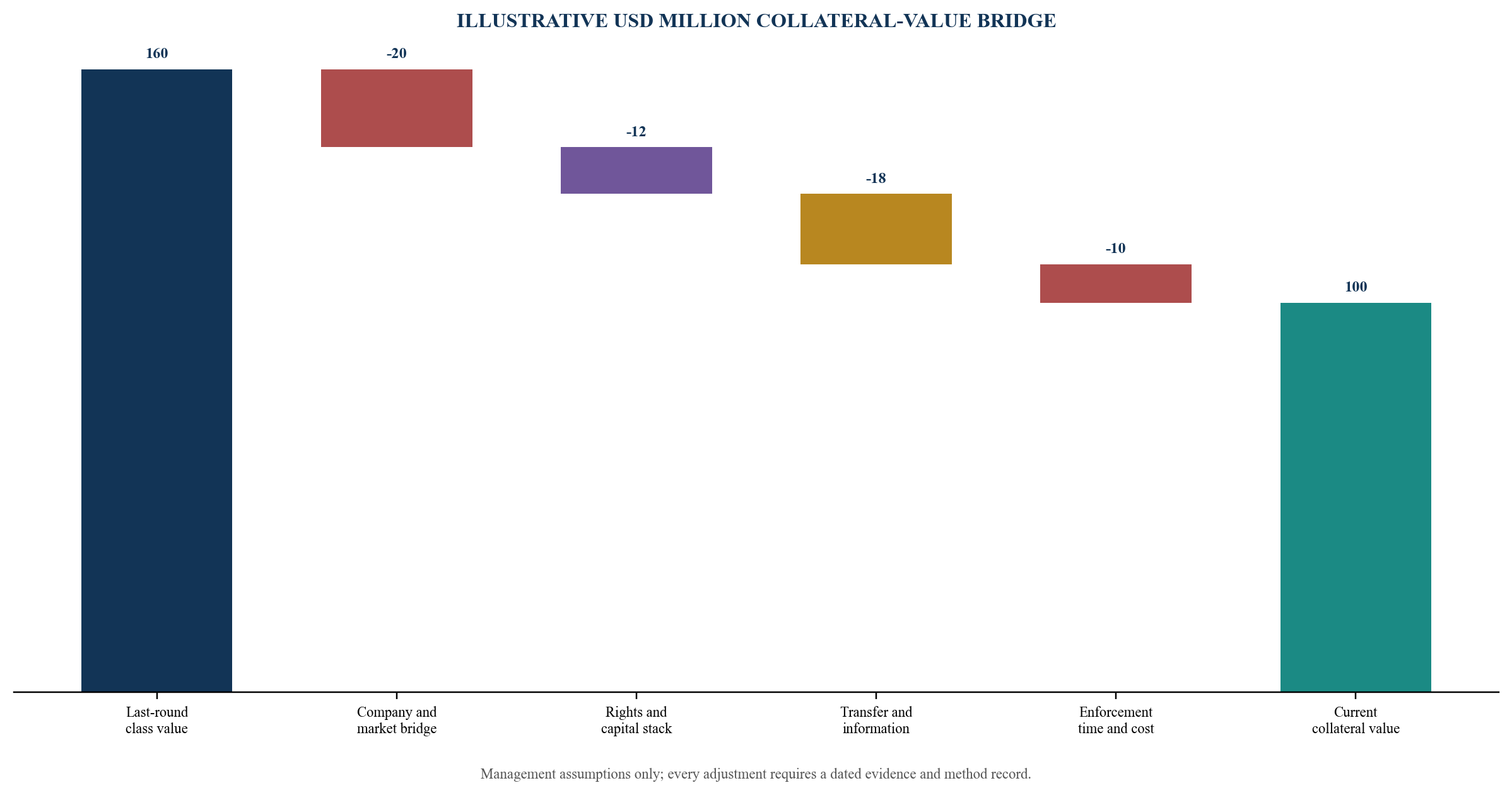
Values and adjustments are management assumptions and do not represent an observed issuer, facility or investment.
6. Design the borrowing base and advance rate
The borrowing base should distinguish gross asset value, eligible value and lendable value. Eligibility tests can exclude disputed, unregistered, pledged, prohibited, stale-valued or non-transferable positions. The advance rate then applies to eligible value.
The facility can use a lower of formula: a percentage of independent value, a percentage of cost and a hard currency cap. This limits upward borrowing from a marked valuation that has not produced liquidity. The model should also cap total interest and fees that can be capitalised.
Haircuts can reflect issuer stage, information, volatility, transfer restrictions, class rights, holding size, currency, jurisdiction, time to exit and buyer depth. A transparent schedule is easier to govern than discretionary changes. The lender may retain discretion for extraordinary events; notice and dispute mechanics should be clear.
Headroom is the difference between debt and the maximum permitted borrowing base. Initial headroom should survive plausible downside before an immediate call. A structure drawn to the maximum on day one transfers ordinary valuation noise into funding risk.
Availability also depends on maturity and cash. A high advance rate with short maturity and capitalised interest can become more dangerous than a lower advance with amortisation and reserve coverage.
Table 3. Illustrative borrowing-base architecture
| Component | Illustrative amount | Rule | Control purpose |
|---|---|---|---|
| current class value | USD 120m | independent dated value | establish gross collateral reference |
| eligibility deduction | USD 20m | transfer, information and enforcement adjustments | exclude unreliable value |
| eligible collateral | USD 100m | reconciled value after deductions | base for advance calculation |
| advance rate | 40% | policy and facility term | translate value to debt capacity |
| formula availability | USD 40m | eligible value multiplied by advance rate | establish maximum formula debt |
| hard facility cap | USD 35m | lower-of limit | constrain model and concentration risk |
| initial draw | USD 28m | approved utilisation | preserve USD 7m initial headroom |
Values and thresholds are management assumptions for method demonstration.
7. Model maintenance calls as a liquidity event
A maintenance call can arise from value decline, haircut increase, ineligibility, accrued interest, currency movement, covenant breach or lender discretion under agreed terms. The model should calculate each trigger separately and in combination.
Public-margin and securities-backed-credit guidance provides useful mechanics. FINRA notes that lenders can require additional collateral or repayment after a value decline, and concentrated portfolios can be particularly exposed. The actual private SPV facility is contractual and can use different thresholds, notice and enforcement rights.
The cure hierarchy should be agreed: apply unrestricted cash; call committed investor capital; add eligible collateral; repay from sponsor or shareholder funding; obtain waiver; refinance; or sell. Each route has an authority, timing and probability.
Notice periods should reflect operational reality. A two-day cure period is weak if investors have ten business days to fund or the private share needs weeks of consent. The facility, subscription terms and reserve should be designed together.
The lender should not rely on an IPO as the only cure. Listing can be delayed, priced below expectations or followed by lock-up. The SPV needs cash and governance routes that operate while the asset remains private.
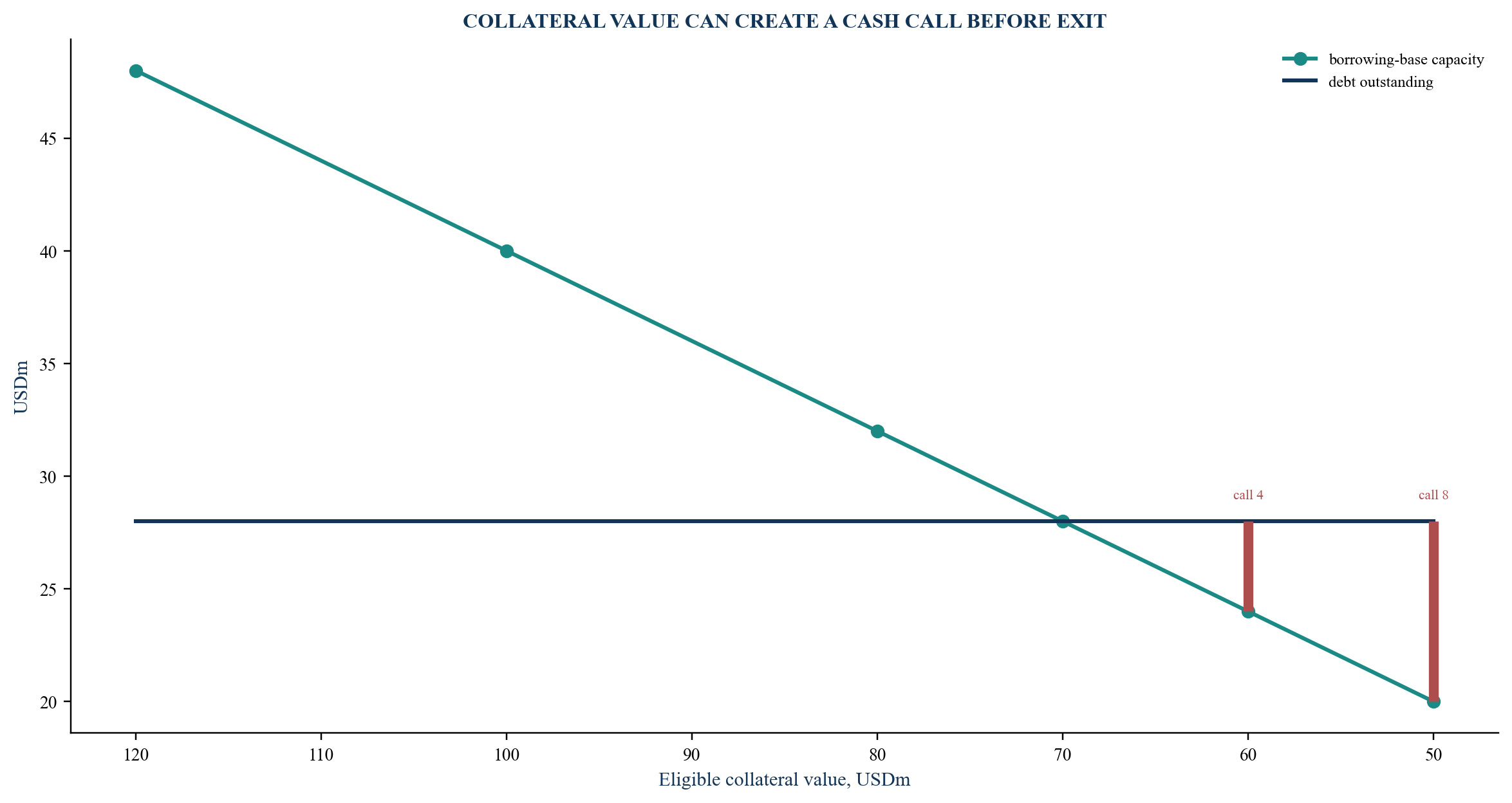
The calculation uses management assumptions: USD 28m debt, 40% advance rate and no change in eligibility adjustments.
8. Size a liquidity reserve against the actual cash clock
The reserve should cover scheduled interest, fees, administration, tax, valuation and a selected collateral-call scenario over the survival period. It should be held in permitted liquid assets and remain legally available to the SPV.
The survival period extends to a realistic refinance, investor call or asset sale, including notice, settlement and contingency. A reserve sized to the next interest date can be inadequate when the cure process lasts months.
Investor commitments can supplement cash if they are legally enforceable, undrawn, creditworthy and callable on compatible notice. The model should haircut commitments for default, excuse, concentration, jurisdiction and timing. An unfunded promise is not the same as cash.
The FSB's 2024 liquidity-preparedness recommendations address margin and collateral calls in stressed markets. The operating lesson is to measure liquidity needs under extreme but plausible scenarios, identify diverse resources and test operational readiness.
The reserve policy should govern replenishment and release. Distributions or new investments should not reduce coverage below the approved floor. Maturity, valuation and transaction events can require an increased reserve.
Table 4. Illustrative twelve-month liquidity reserve
| Requirement | Illustrative amount | Timing assumption | Eligible resource |
|---|---|---|---|
| cash interest | USD 3.2m | four quarterly payments | unrestricted SPV cash |
| facility and administration fees | USD 0.8m | scheduled through twelve months | unrestricted SPV cash |
| valuation, legal and tax | USD 0.5m | event and annual work | unrestricted SPV cash |
| collateral-call stress | USD 6.0m | five-business-day cure | cash or compatible committed capital |
| operating contingency | USD 1.0m | immediate | unrestricted SPV cash |
| gross reserve need | USD 11.5m | twelve-month survival period | governed liquidity pool |
| reliable callable commitments | USD 3.0m | ten-business-day funding after haircut | secondary resource only |
| minimum cash reserve | USD 8.5m | available without asset sale | protected SPV account |
Amounts and stress assumptions are management assumptions and do not represent a facility recommendation.
9. Calculate the full financing cost and break-even exit
The stated interest margin is one component. Total financing cost can include base rate, floor, original issue discount, arrangement fee, commitment fee, agent fee, valuation expense, legal cost, hedge cost, exit fee, default interest and amendment fees.
Fees can be paid in cash, deducted from proceeds or capitalised. Capitalised amounts increase debt and reduce borrowing-base headroom. A fee charged on commitment can produce a different effective cost from one charged on drawn principal.
The model should calculate cash interest, accrued interest, lender internal rate of return and SPV effective annual cost across exit dates. It should include refinancing and extension terms. A one-year delay can add another cycle of interest, administration and valuation cost while deferring investor distributions.
Investor break-even includes asset purchase, SPV fees, management or carry arrangements, financing cost, tax and senior repayment. A high underlying gross multiple can yield a modest net result when duration and costs are material.
The model should separate committed, drawn and net invested capital. Marketing that compares gross asset value with investor equity without the complete waterfall can overstate leverage benefits.
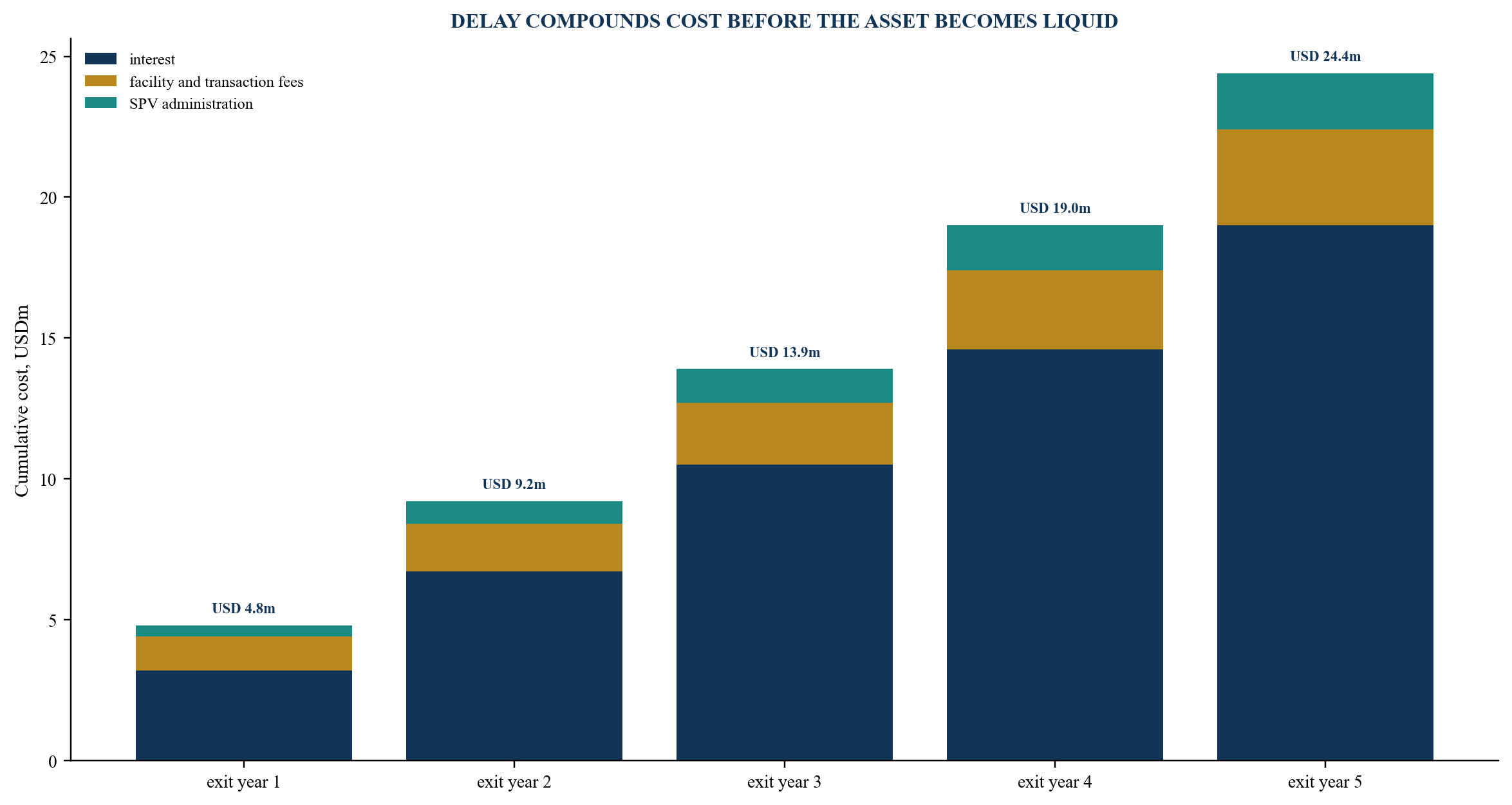
Values are management assumptions using USD 28m debt and a simplified all-in cost profile.
10. Build lender, SPV and investor waterfalls together
The proceeds waterfall begins with gross cash actually received. It deducts transaction taxes and costs, enforcement or sale expenses, secured principal, accrued interest, lender fees and other senior claims. It then applies SPV expenses, reserves and investor priority before residual participation or carry.
The order matters. A lender exit fee calculated on principal can rank ahead of investors. A sponsor loan can sit before or after investor preferred return. A reserve can remain trapped until final wind-down. Each item should cite the governing document.
The waterfall should model IPO and private-sale routes. An IPO can produce listed shares rather than immediate cash. Lock-up, orderly-market agreements and restricted legends can delay monetisation. The model should distinguish distributed securities, sold securities and cash.
Partial exits need allocation rules. Proceeds can repay debt first, replenish reserve, distribute pro rata or follow a negotiated release price. The collateral-release mechanism should state how many shares can be sold or distributed after a repayment.
Waterfall validation should use at least one low, base and high exit plus enforcement. The administrator, lender and manager should reconcile outputs before investor reporting or closing.
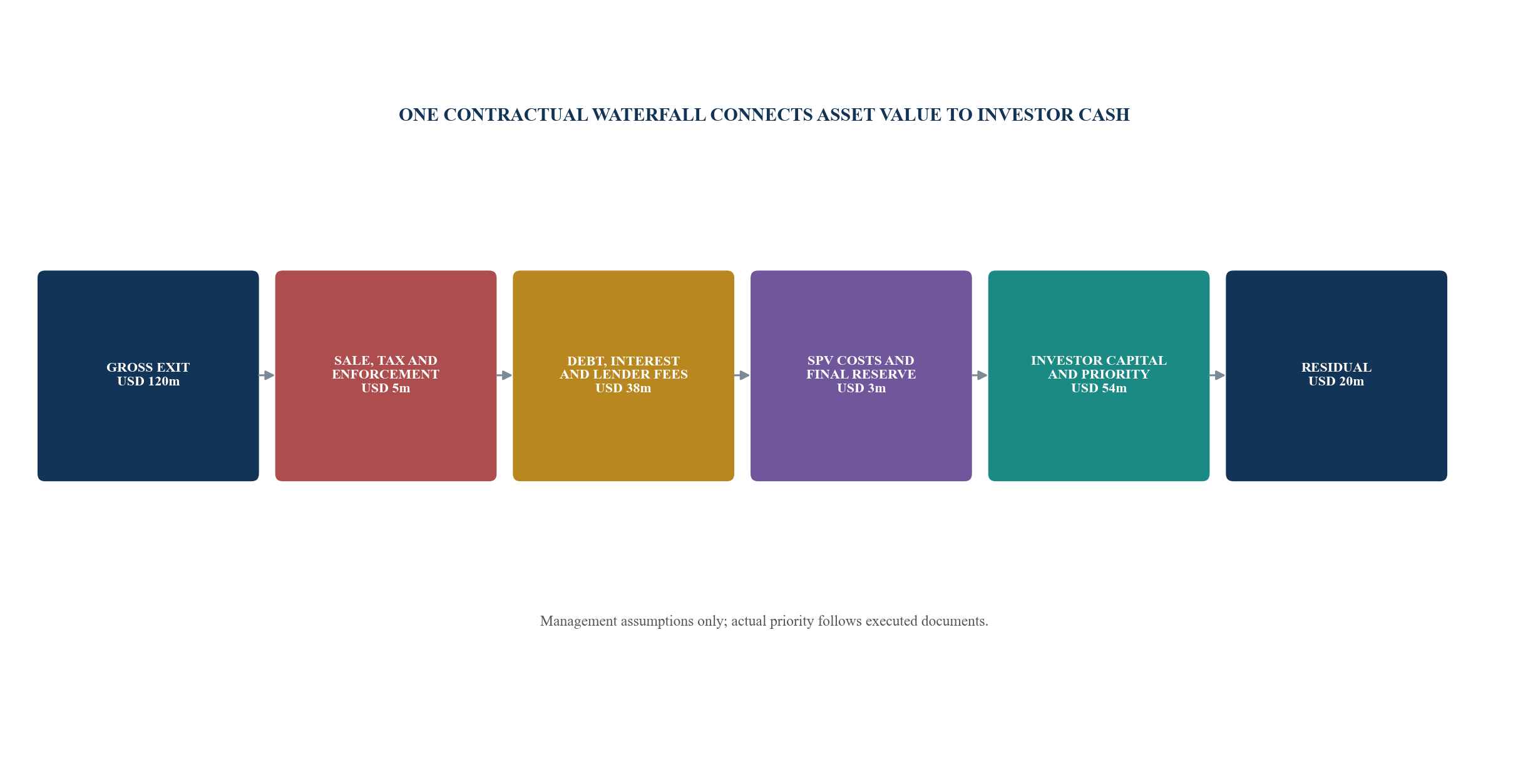
Values and priorities are management assumptions and do not represent an offering or expected return.
11. Design covenants around information, value and cash
Financial covenants can include maximum loan-to-value, minimum collateral coverage, minimum cash, interest coverage where cash income exists, maximum leverage and maturity tests. The definitions should state valuation source, eligible deductions, debt components, currency and calculation frequency.
Information covenants should require issuer financials, cap table, financing activity, material events, secondary trades, litigation, transfer restrictions and IPO developments. Delivery deadlines should reflect the SPV's contractual access to issuer information.
Negative covenants can restrict new debt, liens, distributions, amendments, asset transfers, changes to manager, bank accounts, valuation policy and related-party transactions. Consent rights should remain proportionate and operationally workable.
Events of default can include non-payment, covenant breach, misrepresentation, invalid security, insolvency, unlawfulness, loss of title and cross-default. Material-adverse-effect clauses should be understood in the context of an early-stage private issuer.
Cure rights and waivers need governance. The manager should not agree a waiver fee, additional collateral or forced sale without the approvals required by SPV documents. Investors should receive material notices under a predefined protocol.
Covenant calculations need a controlled data lineage. The calculation certificate should identify the value date, approved valuation, eligible deductions, facility balance, accrued interest, reserve balance, currency rates and every manual adjustment. The administrator or independent reviewer should reproduce the result from source evidence. An unexplained spreadsheet override can move the SPV from compliance to breach and should require named approval.
The covenant calendar should extend through maturity. It should include financial delivery, valuation dates, interest payments, commitment expiries, extension elections and investor-call periods. The team can then compare the earliest lender deadline with the time required to obtain issuer data, convene approvals and fund a cure. A long contractual cure that cannot be operationally completed remains weak protection.
12. Stress the asset, debt, liquidity and exit together
Stress testing should combine variables that can move together. A down round can reduce value, trigger anti-dilution, signal a longer exit and make refinancing harder. A market shock can lower multiples and lender risk appetite while increasing interest cost.
Core scenarios include operating miss, down round, IPO delay, failed IPO, valuation dispute, haircut increase, lender non-renewal, investor funding default, currency move, issuer transfer refusal and enforcement discount. Each has a dated narrative and cash consequence.
The model should calculate borrowing base, headroom, cure amount, reserve coverage, maturity shortfall, proceeds waterfall and investor outcome. It should identify the earliest breached control and available response time.
Reverse stress asks what value, delay or cost level consumes the equity cushion or reserve. This can reveal that a modest company decline produces a severe SPV outcome because debt and fees rank first.
The board or investment committee should approve scenarios, actions and owners. Stress outputs should influence initial draw, reserve, covenants, maturity and investor commitments before closing.
Table 5. Illustrative integrated SPV stress matrix
| Scenario | Collateral value | Debt and accrued cost | Immediate liquidity need | Investor implication |
|---|---|---|---|---|
| base exit in year three | USD 120m | USD 38m | zero | positive residual after senior claims |
| twenty-five per cent value decline | USD 90m | USD 35m | USD 1m call | reserve absorbs initial shortfall |
| fifty per cent value decline | USD 60m | USD 35m | USD 11m call | investor funding or restructuring needed |
| two-year IPO delay | USD 100m | USD 47m | USD 8m reserve refill | higher break-even and refinance dependence |
| lender haircut increase | USD 100m | USD 35m | USD 7m call | cure required without company-value change |
| enforcement sale | USD 55m | USD 40m | sale process funded from reserve | limited residual after senior claims and costs |
Results are management assumptions for method demonstration.
13. Treat IPO timing and lock-up as separate risks
An IPO is a process, not a date. Readiness, filing, regulator review, investor demand, market conditions, pricing and board decisions can change the schedule. The SPV should not treat management aspiration as committed liquidity.
Pre-IPO shares can convert at listing. The conversion ratio, preference, dividend, option pool and corporate actions should enter the model. The lender's security and control must attach to the resulting listed securities and proceeds where legally valid.
Lock-up can prevent immediate sale. Banks, issuer and underwriters can impose restrictions, waivers and orderly-market conditions. The facility should survive the period between listing and permitted monetisation, including listed-price volatility.
A listed price can move before the SPV can sell. Maintenance tests can become more frequent after listing, while a concentrated block can require a disposal plan. Hedging may be unavailable or restricted and needs legal, contractual and economic review.
The exit plan should include private secondary, issuer tender, strategic sale, distribution in kind, refinancing and orderly wind-down. Each route requires a current feasibility and proceeds timeline.
The transition from private to public status also changes the information and dealing perimeter. The SPV, manager, lender and investors can receive confidential listing information and become subject to restrictions on use and dealing. The control plan should identify insiders, wall-crossing records, permitted disclosures, trading approvals and the point at which information becomes public. Distribution in kind should be assessed against investor eligibility, custody capability, lock-up and tax.
A staged monetisation plan can reduce concentration while respecting liquidity and market conduct. It should state permitted volumes, price parameters, lender release mechanics, reserve replenishment and the allocation of cash or listed shares. The plan should remain conditional on current legal advice, market conditions and executed agreements.
14. Control counterparties, agents and conflicts
The SPV depends on manager, lender, collateral agent, custodian, administrator, bank, valuer and issuer. Due diligence should assess authority, capability, financial strength, systems, conflicts, subcontracting and continuity.
The Basel Committee's 2024 counterparty-credit-risk guidelines emphasise initial and ongoing due diligence, comprehensive risk mitigation, complementary exposure metrics and strong governance. The guidelines apply to banks, while the practices inform lender and sponsor diligence.
Conflicts can arise when the sponsor sources the asset, sets valuation, receives fees, selects the lender and controls exit. A lender affiliate can provide valuation or brokerage. Investor allocations and side letters can alter incentives. The conflict register should assign mitigation and approval.
Valuation should receive independent challenge. Related-party transfers, sponsor-led exits, amendments and waivers should use enhanced governance. Committee minutes should record information, dissent and decisions.
Counterparty failure should be tested. The SPV needs access to records, bank accounts, collateral evidence and successor agents. A facility transfer to a new lender should not silently expand control or fees beyond agreed terms.
15. Establish an operating dashboard and escalation clock
The dashboard should combine asset, debt and cash. It records current value, eligible value, debt, accrued cost, advance rate, headroom, reserve, next payment, maturity, investor commitments, transfer status and exit milestones.
Event monitoring should be frequent enough for the risk. Private-company information may arrive monthly or quarterly, while financing, litigation, customer, IPO and market events can require immediate review. Every material event should have an owner and impact assessment.
Escalation levels can progress from watch, to cash preservation, to cure preparation, to formal call, to restructuring or enforcement. Each level activates restrictions, approvals and communications. The process should avoid an improvised response after a call arrives.
Investor reporting should distinguish observed facts, management assumptions and valuation conclusions. It should show gross asset performance, financing cost and net SPV result. Material covenant or liquidity events require prompt communication under the governing documents.
The board should review exceptions, reserve adequacy, valuation triggers, refinancing runway and exit readiness. A green headline loan-to-value can conceal a near-term maturity or inaccessible investor commitments.
Dashboard ownership should be divided clearly. The manager owns investment and issuer information; the administrator owns books, investor allocations and waterfall calculations; the lender or agent owns the official facility balance and notices; the custodian owns position evidence; and the board owns escalation decisions. Reconciliations should identify which source controls where records differ.
Performance measures should include valuation-delivery timeliness, unresolved collateral exceptions, minimum headroom, reserve survival months, investor-call readiness, covenant-calculation accuracy, maturity runway and exit-route readiness. Thresholds are management decisions. Breach of a threshold should activate a documented action and accountable completion date.
16. Run a ten-day levered SPV diagnostic
Days one and two define the vehicle, asset, investors, lender, jurisdictions and financing purpose. The team gathers every executed document, current issuer record, valuation, bank statement and investor commitment.
Days three and four reconstruct acquisition, debt, security, fees, cash and waterfall. It confirms title, transferability, perfection and enforcement dependencies.
Days five and six rebuild current value, eligible collateral, borrowing base, headroom and reserve. The team reconciles lender, administrator and manager records.
Days seven and eight model maintenance calls, maturity, IPO delay, down round, haircut change, refinance and enforcement. It maps cure resources to actual notice periods and authority.
Day nine ranks title, regulatory, valuation, liquidity, covenant, counterparty and governance gaps. Day ten is the gate: proceed; resize; add reserve; change terms; obtain evidence; restructure; refinance; or decline.
The ten-day period is a management target. Complex securities, multiple feeders, cross-border perfection or missing records can require longer. Unresolved matters should remain visible.
Table 6. Ten-day levered pre-IPO SPV diagnostic
| Period | Workstream | Decision | Completion evidence |
|---|---|---|---|
| days 1-2 | perimeter and evidence | what structure and rules apply? | role map, document index and licence checks |
| days 3-4 | title, debt and waterfall | what owns, owes and ranks? | chain of title, debt bridge and validated waterfall |
| days 5-6 | value and liquidity | what supports the current borrowing base? | dated value, headroom and reserve report |
| days 7-8 | integrated stress | what event creates the first cash or covenant failure? | scenarios, cure routes and maturity plan |
| day 9 | remediation | which gaps block approval or require new terms? | severity-ranked action register |
| day 10 | governance gate | proceed, resize, reserve, restructure or decline? | signed decision and conditions |
Owners and timing should be adapted to the transaction.
17. Implement a thirty-day control and execution office
The first week creates governance and a single transaction model. Roles, valuation policy, borrowing-base rules, reserve policy, instruction authority, conflicts and reporting are approved.
The second week completes title and collateral readiness. The SPV obtains issuer confirmations, consents, security documents, opinions, investor commitments, bank controls and administrator records.
The third week implements the dashboard, cash calendar, valuation triggers, covenant calculations, waterfall, exception log and investor reporting. Maker-checker and document version controls are tested.
The fourth week runs simulations: value decline, maintenance call, investor call, IPO delay, refinancing, partial sale, lender transfer and enforcement. Failed steps enter accountable remediation before the facility is fully drawn.
Ongoing retained work can include monthly borrowing-base and liquidity monitoring, quarterly valuation challenge, covenant and maturity management, investor reporting, refinancing and exit execution. The service boundary should be explicit.
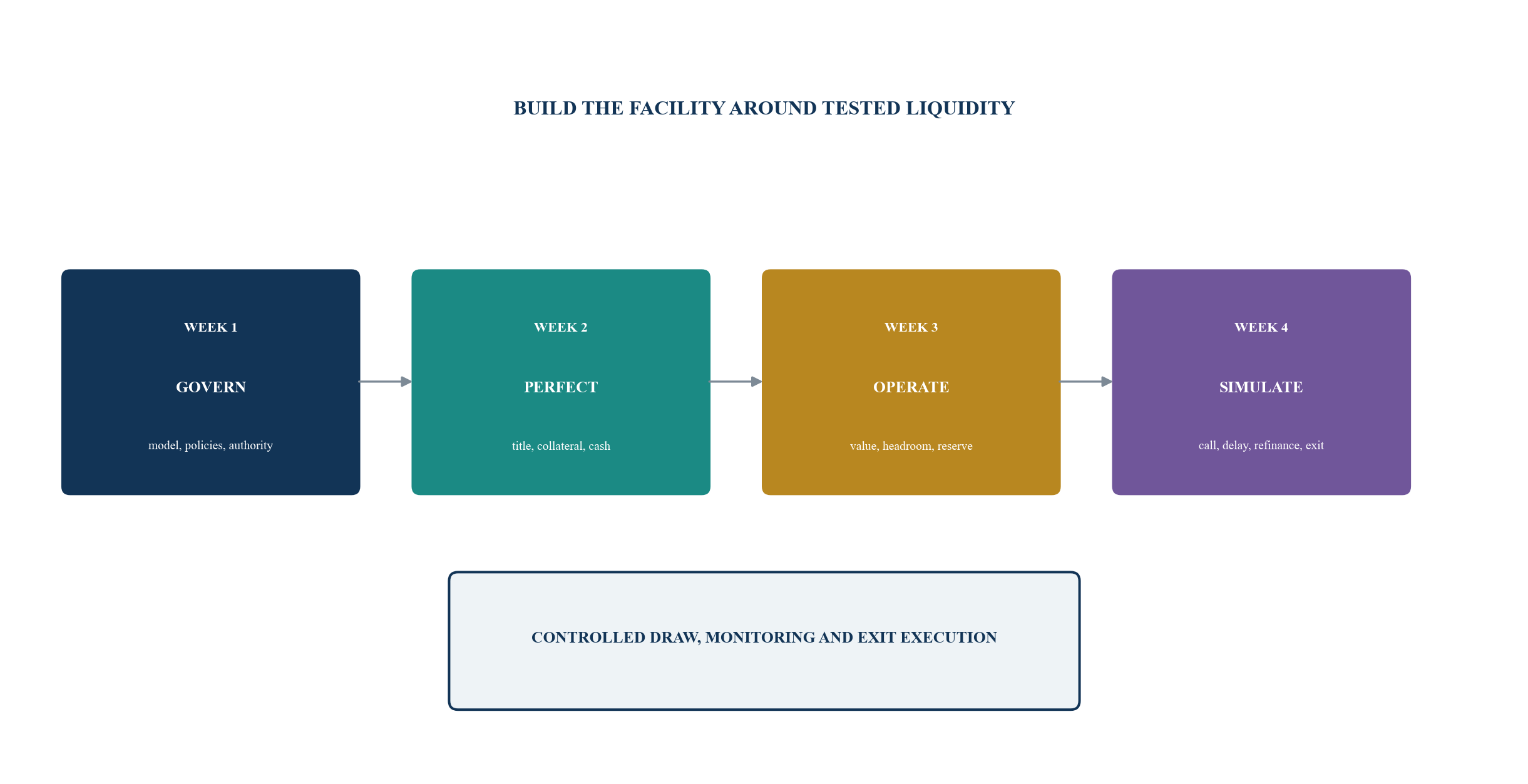
Full draw follows evidence, controls and tested cure capacity rather than document signing alone.
18. Conclusion
A levered pre-IPO SPV combines an illiquid, restricted and judgement-valued asset with fixed financing obligations. The structure can support acquisition and capital efficiency, while the debt clock, concentration and transfer limits require disciplined underwriting.
The framework defines the complete perimeter, reconstructs the capital stack, validates collateral, establishes current valuation, designs the borrowing base, sizes liquidity, calculates all-in cost and connects lender, SPV and investor waterfalls. It then tests covenants, IPO delay, refinancing, counterparty failure and enforcement.
FSB, Basel Committee, FINRA, SEC and FCA materials reinforce the importance of leverage data, liquidity preparedness, counterparty diligence, concentrated-collateral controls, resale restrictions, current valuation and governance. Their rules have distinct legal scopes, so each transaction requires current professional advice.
For sponsors and investors, the framework shows when leverage adds value and when it transfers timing risk into a cash call. For lenders, it links collateral value to enforceability and cure capacity. For advisers, it creates a route from ten-day diagnostic through restructuring, capital sourcing, refinancing and exit execution. Commercial demand and fees remain unverified until evidenced by signed engagements and collected payments.
References
- Financial Stability Board. Leverage in Non-bank Financial Intermediation: Final Report. 9 July 2025. https://www.fsb.org/2025/07/leverage-in-nonbank-financial-intermediation-final-report/
- Financial Stability Board. Liquidity Preparedness for Margin and Collateral Calls: Final Report. 10 December 2024. https://www.fsb.org/work-of-the-fsb/financial-innovation-and-structural-change/non-bank-financial-intermediation/
- Financial Stability Board. Chair's Speech at the Launch of the Final NBFI Leverage Report. 9 July 2025. https://www.fsb.org/2025/07/fsb-chairs-speech-at-the-launch-event-for-the-fsbs-final-report-on-leverage-in-nonbank-financial-intermediation-nbfi/
- Basel Committee on Banking Supervision. Final Guidelines for Counterparty Credit Risk Management. 11 December 2024. https://www.bis.org/bcbs/publ/d588.htm
- FINRA. Securities-Backed Lines of Credit Explained. 3 January 2024. https://www.finra.org/investors/insights/securities-backed-lines-credit
- FINRA. Know What Triggers a Margin Call. 24 May 2023. https://www.finra.org/investors/insights/margin-calls
- FINRA. Rule 4240, Security-Based Swap Margin Requirements. https://www.finra.org/rules-guidance/rulebooks/finra-rules/4240
- US Securities and Exchange Commission. Starting a Private Fund. https://www.sec.gov/about/starting-private-fund
- US Securities and Exchange Commission. Private Placements: Rule 506(b). Updated 17 March 2026. https://www.sec.gov/resources-small-businesses/exempt-offerings/private-placements-rule-506b
- US Securities and Exchange Commission. Private Secondary Markets. Updated 24 April 2026. https://www.sec.gov/resources-small-businesses/capital-raising-building-blocks/private-secondary-markets
- US Securities and Exchange Commission. Rule 144: Selling Restricted and Control Securities. https://www.sec.gov/reports/rule-144-selling-restricted-control-securities
- US Securities and Exchange Commission. Private Companies and the SEC. Updated 24 April 2026. https://www.sec.gov/resources-small-businesses/capital-raising-building-blocks/private-companies-sec
- Financial Conduct Authority. Private Market Valuation Practices. 5 March 2025. https://www.fca.org.uk/publications/multi-firm-reviews/private-market-valuation-practices
About the Author
Chennakeshav Adya, Independent Researcher
