

Introduction
A GEO satellite can remain commercially useful after its own propulsion margin becomes constrained. The payload may still transmit, customer beams may remain configured, ground systems may remain integrated and an orbital slot may remain strategically important. A life-extension vehicle can attach to the satellite and provide orbit and attitude control. That physical intervention creates potential value by preserving service continuity and deferring replacement, launch and customer migration.
Financeability requires more than a successful docking concept. The operator must demonstrate the payload's remaining health, the expected customer cash during the extension, the legal authority for combined operations, the service provider's mission capability, insurance and liability treatment, and a disposal path at the end of the service. The financing also needs a cash source that remains available after a mission delay, customer churn or technical underperformance.
The correct analytical unit is the incremental extension perimeter. Historical satellite construction cost, sunk launch cost and headline replacement cost can inform context but cannot repay a lender. The model should isolate cash that exists because the service is completed, deduct every cost required to earn and protect that cash, and preserve a funded route to disposal. The paper therefore treats verified life, contracted revenue, mission execution, counterparty credit and residual value as separate gates.
1. Define the financing decision
The central financing issue concerns the exact extension period, client satellite, service scope, financing perimeter and decision date. The evidence set should begin with board mandate, fleet plan, satellite health record, customer forecast, service proposal and financing term sheet. Engineering, customer, contract and cash records should share one valuation date and one controlled configuration.
The required analytical output is one approved financing question and evidence cut-off. Link each conclusion to technical life, contracted cash, mission probability, counterparty capacity, regulatory authority, timing and disposal. Incremental cash becomes financeable when the operator can control it, protect it and continue earning it through a defined downside.
For the transaction, the board and credit committee should state whether capital funds mission preparation, service consideration, liquidity, customer transition or a combined package. A financing described as satellite-backed can in practice depend on future service revenue and operator credit. The approval paper should identify the actual repayment source and the conditions that create it. Identify the base case, correlated downside, cure funding, decision owner and documentary protection. State which conclusion changes if docking, payload performance, customer retention, licensing, counterparty support or disposal evidence deteriorates.
2. Separate design life, service life and financeable life
The central financing issue concerns the difference between manufacturer design life, engineering service life, accounting useful life, contracted extension and lender tenor. The evidence set should begin with manufacturer commitments, telemetry, fuel model, component-cycle analysis, accounting policy and independent engineering review. Engineering, customer, contract and cash records should share one valuation date and one controlled configuration.
The required analytical output is a reconciled life schedule with a conservative financeable horizon. Link each conclusion to technical life, contracted cash, mission probability, counterparty capacity, regulatory authority, timing and disposal. Incremental cash becomes financeable when the operator can control it, protect it and continue earning it through a defined downside.
For the transaction, the board and credit committee should size debt to the shortest evidenced period that supports collected cash. Operator filings describe useful-life estimates as judgements based on design life, fuel, component degradation, operating history and strategy. A servicing contract does not by itself extend payload capability. Identify the base case, correlated downside, cure funding, decision owner and documentary protection. State which conclusion changes if docking, payload performance, customer retention, licensing, counterparty support or disposal evidence deteriorates.
3. Establish the client-satellite baseline
The central financing issue concerns payload health, propulsion margin, power, thermal performance, station-keeping history, anomalies and remaining operational flexibility. The evidence set should begin with telemetry, trend analysis, anomaly log, redundancy state, fuel estimate, payload utilisation and engineering sign-off. Engineering, customer, contract and cash records should share one valuation date and one controlled configuration.
The required analytical output is a controlled technical baseline before mission commitment. Link each conclusion to technical life, contracted cash, mission probability, counterparty capacity, regulatory authority, timing and disposal. Incremental cash becomes financeable when the operator can control it, protect it and continue earning it through a defined downside.
For the transaction, the board and credit committee should condition financing on an independently reviewed baseline and defined deterioration limits. The extension proposition is strongest when propulsion or attitude control is the binding constraint and the revenue-generating payload remains functional. Multiple ageing subsystems create correlated downside. Identify the base case, correlated downside, cure funding, decision owner and documentary protection. State which conclusion changes if docking, payload performance, customer retention, licensing, counterparty support or disposal evidence deteriorates.
4. Prove docking and control compatibility
The central financing issue concerns whether the servicer can approach, capture, dock with and control the specific legacy spacecraft configuration. The evidence set should begin with interface drawings, launch-adapter geometry, mass properties, simulations, hardware-in-the-loop tests, flight heritage and customer approvals. Engineering, customer, contract and cash records should share one valuation date and one controlled configuration.
The required analytical output is a target-specific compatibility and safety case. Link each conclusion to technical life, contracted cash, mission probability, counterparty capacity, regulatory authority, timing and disposal. Incremental cash becomes financeable when the operator can control it, protect it and continue earning it through a defined downside.
For the transaction, the board and credit committee should fund only configurations that pass defined verification gates. Successful servicing of one GEO spacecraft does not prove compatibility with every satellite bus, geometry, control mode or operating authority. Target-specific evidence remains essential. Identify the base case, correlated downside, cure funding, decision owner and documentary protection. State which conclusion changes if docking, payload performance, customer retention, licensing, counterparty support or disposal evidence deteriorates.
5. Map the mission tree
The central financing issue concerns the conditional path from preparation through rendezvous, docking, commissioning, extended service and disposal. The evidence set should begin with mission design, launch plan, proximity operations, abort logic, ground procedures, acceptance tests and contingency plans. Engineering, customer, contract and cash records should share one valuation date and one controlled configuration.
The required analytical output is a probability-weighted mission tree with cost and recovery at each branch. Link each conclusion to technical life, contracted cash, mission probability, counterparty capacity, regulatory authority, timing and disposal. Incremental cash becomes financeable when the operator can control it, protect it and continue earning it through a defined downside.
For the transaction, the board and credit committee should tie drawdowns and amortisation to completed mission gates. A single blended mission probability can conceal correlated launch, navigation, docking, customer and licensing risks. Each branch should identify who pays, who controls recovery and when cash resumes. Identify the base case, correlated downside, cure funding, decision owner and documentary protection. State which conclusion changes if docking, payload performance, customer retention, licensing, counterparty support or disposal evidence deteriorates.
6. Verify incremental customer cash
The central financing issue concerns which customer receipts continue because the satellite remains in service. The evidence set should begin with customer contracts, beam assignments, renewal history, utilisation, pricing, churn, invoices and collections. Engineering, customer, contract and cash records should share one valuation date and one controlled configuration.
The required analytical output is a customer-level extension revenue schedule. Link each conclusion to technical life, contracted cash, mission probability, counterparty capacity, regulatory authority, timing and disposal. Incremental cash becomes financeable when the operator can control it, protect it and continue earning it through a defined downside.
For the transaction, the board and credit committee should exclude revenue that transfers to replacement capacity or depends on uncommitted renewals. The relevant cash flow is the difference between serviced and unserviced fleet outcomes. Existing group revenue may continue through another satellite and should not be double counted as extension value. Identify the base case, correlated downside, cure funding, decision owner and documentary protection. State which conclusion changes if docking, payload performance, customer retention, licensing, counterparty support or disposal evidence deteriorates.
7. Test customer concentration and migration
The central financing issue concerns whether a small number of customers can reprice, terminate or migrate during the extended period. The evidence set should begin with contract terms, renewal dates, service-level obligations, portability rights, alternative capacity and customer interviews. Engineering, customer, contract and cash records should share one valuation date and one controlled configuration.
The required analytical output is a concentration and migration stress matrix. Link each conclusion to technical life, contracted cash, mission probability, counterparty capacity, regulatory authority, timing and disposal. Incremental cash becomes financeable when the operator can control it, protect it and continue earning it through a defined downside.
For the transaction, the board and credit committee should reserve against the largest executable customer losses. Life extension can preserve continuity while a replacement programme develops. It can also extend an asset into a market with falling prices or changing technology. Contract evidence should outrank market narratives. Identify the base case, correlated downside, cure funding, decision owner and documentary protection. State which conclusion changes if docking, payload performance, customer retention, licensing, counterparty support or disposal evidence deteriorates.
8. Reconcile the service contract
The central financing issue concerns the servicer's fixed and contingent consideration, scope, mission obligations, acceptance, termination and remedy structure. The evidence set should begin with executed service agreement, statement of work, milestone schedule, performance standards, liability allocation and payment terms. Engineering, customer, contract and cash records should share one valuation date and one controlled configuration.
The required analytical output is a service-consideration waterfall. Link each conclusion to technical life, contracted cash, mission probability, counterparty capacity, regulatory authority, timing and disposal. Incremental cash becomes financeable when the operator can control it, protect it and continue earning it through a defined downside.
For the transaction, the board and credit committee should defer uncertain consideration until verified docking, control takeover and operating performance. A headline contract price may contain launch, preparation, options, recurring operations and disposal. Financing should reconcile each amount to its trigger and refund or remedy position. Identify the base case, correlated downside, cure funding, decision owner and documentary protection. State which conclusion changes if docking, payload performance, customer retention, licensing, counterparty support or disposal evidence deteriorates.
9. Assess servicer counterparty credit
The central financing issue concerns whether the servicing provider can complete development, launch, operations and long-duration support. The evidence set should begin with audited financials, funding plan, programme accounts, supplier commitments, insurance, parent support and operating licences. Engineering, customer, contract and cash records should share one valuation date and one controlled configuration.
The required analytical output is a counterparty survival and replacement analysis. Link each conclusion to technical life, contracted cash, mission probability, counterparty capacity, regulatory authority, timing and disposal. Incremental cash becomes financeable when the operator can control it, protect it and continue earning it through a defined downside.
For the transaction, the board and credit committee should require committed funding and step-in or termination rights where practical. The operator can remain exposed after paying preparation costs if the servicer lacks capital through launch or acceptance. Technical capability and balance-sheet capacity require separate diligence. Identify the base case, correlated downside, cure funding, decision owner and documentary protection. State which conclusion changes if docking, payload performance, customer retention, licensing, counterparty support or disposal evidence deteriorates.
10. Assess operator counterparty credit
The central financing issue concerns whether the satellite operator can fund preparation, absorb delay and honour debt and service obligations. The evidence set should begin with consolidated and satellite-level cash flows, leverage, liquidity, fleet capital plan, covenant package and customer collections. Engineering, customer, contract and cash records should share one valuation date and one controlled configuration.
The required analytical output is a corporate and ring-fenced credit view. Link each conclusion to technical life, contracted cash, mission probability, counterparty capacity, regulatory authority, timing and disposal. Incremental cash becomes financeable when the operator can control it, protect it and continue earning it through a defined downside.
For the transaction, the board and credit committee should separate extension-project cash from reliance on general corporate support. A strong satellite can sit inside a stressed operator, while a strong operator can support a weak extension case. The financing document should state which credit is underwritten and which support is legally available. Identify the base case, correlated downside, cure funding, decision owner and documentary protection. State which conclusion changes if docking, payload performance, customer retention, licensing, counterparty support or disposal evidence deteriorates.
11. Define spectrum, slot and operating rights
The central financing issue concerns the authority to operate the client satellite, relocate it, combine it with a servicer and continue service at the relevant orbital location. The evidence set should begin with licences, coordination records, filings, customer authorisations, command protocols and regulator correspondence. Engineering, customer, contract and cash records should share one valuation date and one controlled configuration.
The required analytical output is a rights schedule from docking through disposal. Link each conclusion to technical life, contracted cash, mission probability, counterparty capacity, regulatory authority, timing and disposal. Incremental cash becomes financeable when the operator can control it, protect it and continue earning it through a defined downside.
For the transaction, the board and credit committee should make effective authorisation a condition precedent. FCC records for Intelsat 901 show that docking, relocation and combined operations required specific modifications. Commercial control does not replace regulatory authority. Identify the base case, correlated downside, cure funding, decision owner and documentary protection. State which conclusion changes if docking, payload performance, customer retention, licensing, counterparty support or disposal evidence deteriorates.
12. Map liability, insurance and indemnities
The central financing issue concerns collision, target damage, service interruption, third-party loss, launch failure, cyber events and disposal exposure. The evidence set should begin with insurance policies, exclusions, deductibles, cross-waivers, indemnities, launch-state analysis and counsel opinions. Engineering, customer, contract and cash records should share one valuation date and one controlled configuration.
The required analytical output is a loss allocation and coverage schedule. Link each conclusion to technical life, contracted cash, mission probability, counterparty capacity, regulatory authority, timing and disposal. Incremental cash becomes financeable when the operator can control it, protect it and continue earning it through a defined downside.
For the transaction, the board and credit committee should fund deductibles and uninsured exposure inside the downside case. Insurance may change between launch, rendezvous, docked operation and end-of-life disposal. Contractual indemnity is valuable only to the extent the responsible counterparty can perform. Identify the base case, correlated downside, cure funding, decision owner and documentary protection. State which conclusion changes if docking, payload performance, customer retention, licensing, counterparty support or disposal evidence deteriorates.
13. Build the extension cost perimeter
The central financing issue concerns mission preparation, launch allocation, servicing consideration, ground integration, licensing, insurance, operations, reserves, financing and disposal. The evidence set should begin with supplier quotes, service agreement, internal labour plan, ground-system budget, insurer indications and adviser estimates. Engineering, customer, contract and cash records should share one valuation date and one controlled configuration.
The required analytical output is a complete sources-and-uses schedule. Link each conclusion to technical life, contracted cash, mission probability, counterparty capacity, regulatory authority, timing and disposal. Incremental cash becomes financeable when the operator can control it, protect it and continue earning it through a defined downside.
For the transaction, the board and credit committee should exclude historical sunk cost and include every cost required to reach collected extension cash. An apparently attractive deferral of replacement capital can still need substantial near-term cash. Cost-to-complete should include delay and rework rather than a simple base-case quote. Identify the base case, correlated downside, cure funding, decision owner and documentary protection. State which conclusion changes if docking, payload performance, customer retention, licensing, counterparty support or disposal evidence deteriorates.
14. Construct the cash waterfall
The central financing issue concerns the order in which customer receipts fund taxes, operations, service fees, reserves, debt service, disposal and equity distributions. The evidence set should begin with collection accounts, operating budget, tax analysis, debt terms, reserve rules and distribution tests. Engineering, customer, contract and cash records should share one valuation date and one controlled configuration.
The required analytical output is a controlled waterfall with measurable triggers. Link each conclusion to technical life, contracted cash, mission probability, counterparty capacity, regulatory authority, timing and disposal. Incremental cash becomes financeable when the operator can control it, protect it and continue earning it through a defined downside.
For the transaction, the board and credit committee should trap cash when mission, customer or technical evidence deteriorates. The waterfall should protect service continuity and disposal before discretionary distributions. Lenders should avoid depending on accounting EBITDA that omits mission-specific cash needs. Identify the base case, correlated downside, cure funding, decision owner and documentary protection. State which conclusion changes if docking, payload performance, customer retention, licensing, counterparty support or disposal evidence deteriorates.
15. Size senior mission-linked debt
The central financing issue concerns the amount and tenor supportable by conservative incremental cash after all required deductions. The evidence set should begin with base and downside collection forecasts, mission tree, reserve policy, amortisation profile and lender security. Engineering, customer, contract and cash records should share one valuation date and one controlled configuration.
The required analytical output is a debt-service and minimum-liquidity model. Link each conclusion to technical life, contracted cash, mission probability, counterparty capacity, regulatory authority, timing and disposal. Incremental cash becomes financeable when the operator can control it, protect it and continue earning it through a defined downside.
For the transaction, the board and credit committee should size debt to downside cash rather than replacement cost or appraised orbital value. Debt maturity should finish before the conservative financeable-life boundary. Balloon exposure grows when repayment depends on a later refinancing or an unverified second extension. Identify the base case, correlated downside, cure funding, decision owner and documentary protection. State which conclusion changes if docking, payload performance, customer retention, licensing, counterparty support or disposal evidence deteriorates.
16. Design contingent service consideration
The central financing issue concerns which part of the servicer's economics remains conditional on mission and operating evidence. The evidence set should begin with milestone definitions, acceptance tests, operating telemetry, customer continuity and dispute process. Engineering, customer, contract and cash records should share one valuation date and one controlled configuration.
The required analytical output is an evidence-linked payment schedule. Link each conclusion to technical life, contracted cash, mission probability, counterparty capacity, regulatory authority, timing and disposal. Incremental cash becomes financeable when the operator can control it, protect it and continue earning it through a defined downside.
For the transaction, the board and credit committee should release value against target-specific docking, control, availability and disposal outcomes. Contingent consideration can align risk without converting the servicer into the lender. Milestones should be objective, independently observable and tied to the contracted configuration. Identify the base case, correlated downside, cure funding, decision owner and documentary protection. State which conclusion changes if docking, payload performance, customer retention, licensing, counterparty support or disposal evidence deteriorates.
17. Test replacement deferral value
The central financing issue concerns the timing and amount of capital expenditure, launch and migration cost genuinely deferred by the extension. The evidence set should begin with fleet roadmap, replacement procurement, launch window, customer migration plan and capacity alternatives. Engineering, customer, contract and cash records should share one valuation date and one controlled configuration.
The required analytical output is a replacement-deferral bridge. Link each conclusion to technical life, contracted cash, mission probability, counterparty capacity, regulatory authority, timing and disposal. Incremental cash becomes financeable when the operator can control it, protect it and continue earning it through a defined downside.
For the transaction, the board and credit committee should count only expenditures that move in time because of the extension. Northrop Grumman describes life extension as capable of delaying substantial replacement expenditure. The applicable value depends on the operator's actual fleet plan, procurement commitments and substitute capacity. Identify the base case, correlated downside, cure funding, decision owner and documentary protection. State which conclusion changes if docking, payload performance, customer retention, licensing, counterparty support or disposal evidence deteriorates.
18. Value fleet flexibility
The central financing issue concerns the option to preserve coverage, orbital position, customer continuity or replacement timing across the wider fleet. The evidence set should begin with fleet capacity map, traffic plan, spare capacity, launch schedule, customer geography and regulatory constraints. Engineering, customer, contract and cash records should share one valuation date and one controlled configuration.
The required analytical output is a fleet-level scenario model. Link each conclusion to technical life, contracted cash, mission probability, counterparty capacity, regulatory authority, timing and disposal. Incremental cash becomes financeable when the operator can control it, protect it and continue earning it through a defined downside.
For the transaction, the board and credit committee should recognise option value only where management has an executable use. Fleet flexibility may exceed standalone satellite cash when the extension prevents a coverage gap or permits a better replacement design. It should remain separate from contracted cash available for debt service. Identify the base case, correlated downside, cure funding, decision owner and documentary protection. State which conclusion changes if docking, payload performance, customer retention, licensing, counterparty support or disposal evidence deteriorates.
19. Model residual value conservatively
The central financing issue concerns the value remaining after the contracted extension, including further service, relocation, capacity sale, redeployment or disposal. The evidence set should begin with payload condition forecast, fuel and component margins, customer outlook, rights, second-service feasibility and disposal cost. Engineering, customer, contract and cash records should share one valuation date and one controlled configuration.
The required analytical output is a residual-value schedule with a zero-value floor case. Link each conclusion to technical life, contracted cash, mission probability, counterparty capacity, regulatory authority, timing and disposal. Incremental cash becomes financeable when the operator can control it, protect it and continue earning it through a defined downside.
For the transaction, the board and credit committee should give residual value limited borrowing credit unless supported by binding evidence. A servicer may later move to another client, while the client satellite may have no economic life after detachment. These are distinct assets and their residual values should not be blended. Identify the base case, correlated downside, cure funding, decision owner and documentary protection. State which conclusion changes if docking, payload performance, customer retention, licensing, counterparty support or disposal evidence deteriorates.
20. Align accounting and financing
The central financing issue concerns how useful-life revisions, depreciation, impairment, service payments and contingent obligations affect reporting and covenants. The evidence set should begin with accounting policy, auditor analysis, asset register, impairment model, service contract and debt definitions. Engineering, customer, contract and cash records should share one valuation date and one controlled configuration.
The required analytical output is an accounting-to-cash reconciliation. Link each conclusion to technical life, contracted cash, mission probability, counterparty capacity, regulatory authority, timing and disposal. Incremental cash becomes financeable when the operator can control it, protect it and continue earning it through a defined downside.
For the transaction, the board and credit committee should draft covenants around cash and technical evidence rather than accounting outcomes alone. Current operator filings show that useful-life estimates are reviewed as facts change and can materially affect depreciation. An accounting extension does not prove financeable cash, and a conservative accounting life does not eliminate technical value. Identify the base case, correlated downside, cure funding, decision owner and documentary protection. State which conclusion changes if docking, payload performance, customer retention, licensing, counterparty support or disposal evidence deteriorates.
21. Build the hypothetical value bridge
The central financing issue concerns the movement from forecast extension revenue to financeable value after customer, operating, mission, reserve and disposal deductions. The evidence set should begin with satellite-specific customer, technical, contract and cost evidence. Engineering, customer, contract and cash records should share one valuation date and one controlled configuration.
The required analytical output is USD 32 million of illustrative extension value before financing costs. Link each conclusion to technical life, contracted cash, mission probability, counterparty capacity, regulatory authority, timing and disposal. Incremental cash becomes financeable when the operator can control it, protect it and continue earning it through a defined downside.
For the transaction, the board and credit committee should show each deduction and identify the evidence that can change it. The worked case begins with USD 108 million of gross revenue, applies USD 76 million of combined deductions and benefits, and leaves USD 32 million. The bridge is a decision tool rather than a market quotation. Identify the base case, correlated downside, cure funding, decision owner and documentary protection. State which conclusion changes if docking, payload performance, customer retention, licensing, counterparty support or disposal evidence deteriorates.
22. Construct the funding package
The central financing issue concerns operator equity, senior debt, contingent service consideration, reserves and permitted distributions. The evidence set should begin with sources and uses, debt schedule, service milestones, reserve mechanics and equity commitment. Engineering, customer, contract and cash records should share one valuation date and one controlled configuration.
The required analytical output is a fully funded package through commissioning and downside delay. Link each conclusion to technical life, contracted cash, mission probability, counterparty capacity, regulatory authority, timing and disposal. Incremental cash becomes financeable when the operator can control it, protect it and continue earning it through a defined downside.
For the transaction, the board and credit committee should require equity and contingent value to absorb risks that debt cannot price. The hypothetical package uses USD 14 million of operator equity, USD 12 million of senior debt and USD 6 million of contingent service consideration. The numbers do not describe a financing offer. Identify the base case, correlated downside, cure funding, decision owner and documentary protection. State which conclusion changes if docking, payload performance, customer retention, licensing, counterparty support or disposal evidence deteriorates.
23. Set covenants and intervention triggers
The central financing issue concerns technical deterioration, mission delay, customer loss, cost overrun, licence change, counterparty weakness and disposal underfunding. The evidence set should begin with telemetry thresholds, mission schedule, customer register, budget variance, licence status and reserve balance. Engineering, customer, contract and cash records should share one valuation date and one controlled configuration.
The required analytical output is an evidence-led covenant dashboard. Link each conclusion to technical life, contracted cash, mission probability, counterparty capacity, regulatory authority, timing and disposal. Incremental cash becomes financeable when the operator can control it, protect it and continue earning it through a defined downside.
For the transaction, the board and credit committee should connect each trigger to cash trapping, cure funding, repricing or termination. Traditional leverage covenants can react too late. Mission-linked finance benefits from technical and contractual leading indicators that change before revenue or cash failure becomes visible. Identify the base case, correlated downside, cure funding, decision owner and documentary protection. State which conclusion changes if docking, payload performance, customer retention, licensing, counterparty support or disposal evidence deteriorates.
24. Plan end-of-service disposal
The central financing issue concerns the funded route to graveyard orbit, servicer separation, control handover, residual fuel and regulatory compliance. The evidence set should begin with mission design, licence conditions, disposal standard, reserve account, servicer obligation and operator contingency. Engineering, customer, contract and cash records should share one valuation date and one controlled configuration.
The required analytical output is a costed disposal and handback plan. Link each conclusion to technical life, contracted cash, mission probability, counterparty capacity, regulatory authority, timing and disposal. Incremental cash becomes financeable when the operator can control it, protect it and continue earning it through a defined downside.
For the transaction, the board and credit committee should protect disposal funding before equity distributions. Life extension postpones retirement; it does not remove the disposal obligation. A financing that consumes all extension cash and leaves disposal unfunded transfers risk to the operator and orbital environment. Identify the base case, correlated downside, cure funding, decision owner and documentary protection. State which conclusion changes if docking, payload performance, customer retention, licensing, counterparty support or disposal evidence deteriorates.
25. Make the board and credit decision
The central financing issue concerns whether verified incremental cash, counterparty support and mission controls justify the funding package. The evidence set should begin with life schedule, mission tree, customer cash, service contract, rights matrix, insurance, value bridge, debt model and disposal plan. Engineering, customer, contract and cash records should share one valuation date and one controlled configuration.
The required analytical output is approve, resize, restructure, defer or decline. Link each conclusion to technical life, contracted cash, mission probability, counterparty capacity, regulatory authority, timing and disposal. Incremental cash becomes financeable when the operator can control it, protect it and continue earning it through a defined downside.
For the transaction, the board and credit committee should record the evidence supporting every funded amount and protection. The strongest case shows a controlled path from a functioning payload to collected extension cash and funded disposal. Missing evidence can be addressed through lower debt, more equity, contingent service value or a later commitment date. Identify the base case, correlated downside, cure funding, decision owner and documentary protection. State which conclusion changes if docking, payload performance, customer retention, licensing, counterparty support or disposal evidence deteriorates.
Conclusion
Life-extension finance should be underwritten as incremental satellite cash supported by a completed mission and bounded by conservative technical life. The physical client satellite, the mission-extension vehicle, customer contracts, orbital rights and collection accounts form a connected system. Weakness in any layer can shorten the financeable period or trap value outside the lender's control.
The framework separates design life, engineering service life, accounting life, contracted extension and lender tenor. It tests the client payload before it values replacement deferral. It tests customer cash before it sizes debt. It tests the service provider's funding and mission capability before it pays preparation costs. It treats residual value as a separate, evidence-dependent claim and funds disposal before distributions.
Governance should preserve this separation after closing. Engineering should own the technical baseline and notify credit when payload health, redundancy, fuel or operating constraints change. Commercial teams should reconcile contracted extension revenue to invoices and bank receipts. Mission management should maintain the current probability tree, cost to complete and recovery plan. Finance should reconcile those records to reserves, draw conditions, debt service and distribution tests. The board should receive one integrated record showing which assumption moved, why it moved, who validated the change and what action follows. This control system reduces the risk that an improving accounting result conceals a deteriorating mission case, or that a successful docking obscures customer loss, liquidity stress or an unfunded disposal obligation.
The board and credit decision is practical. Capital should be committed only when the operator can identify the satellite configuration, mission gates, customer receipts, legal permissions, insurance, reserves, amortisation and end-of-service plan. Unresolved value belongs in equity, contingent service consideration, reserves or later drawdowns. This structure can preserve useful orbital assets while keeping mission and credit risk visible.
Appendix A. Evidence request
Request the satellite technical baseline, telemetry trends, fuel estimate, anomaly and waiver log, payload-utilisation record, manufacturer commitments, customer contracts, renewal schedule, invoices, collections, licence and orbital filings, spectrum coordination, service agreement, mission design, interface-control records, simulation and test evidence, launch plan, insurance terms, indemnities, servicer financials, supplier commitments, operator fleet plan, replacement programme, sources and uses, cash waterfall, reserve policy, debt model, accounting analysis and disposal plan. Reconcile every input to the same satellite, configuration and valuation date.
Appendix B. Red-flag tests
Red flags include an extension period longer than the independent engineering case; payload degradation omitted because propulsion is the stated constraint; revenue counted at fleet level without customer allocation; replacement expenditure treated as immediate although no procurement exists; regulatory modifications outstanding; service fees paid before objective mission gates; servicer funding ending before launch; insurance excluding docked operations; customer concentration unstressed; senior debt sized to headline replacement cost; residual value included without a second mission or buyer; distributions permitted before disposal funding; and accounting useful-life changes presented as proof of cash generation.
Appendix C. Hypothetical assumptions
The worked case assumes a four-year extension of one revenue-generating GEO communications satellite through an attached mission-extension vehicle. The client payload remains functional at commitment, customer receipts are collected into controlled accounts, and the service provider remains responsible for agreed mission operations. The model includes customer attrition, price pressure, mission preparation, insurance, reserves and disposal. All amounts are illustrative USD millions and do not describe a named company, satellite, mandate, forecast or financing offer.
Appendix D. Worked-case figures and tables
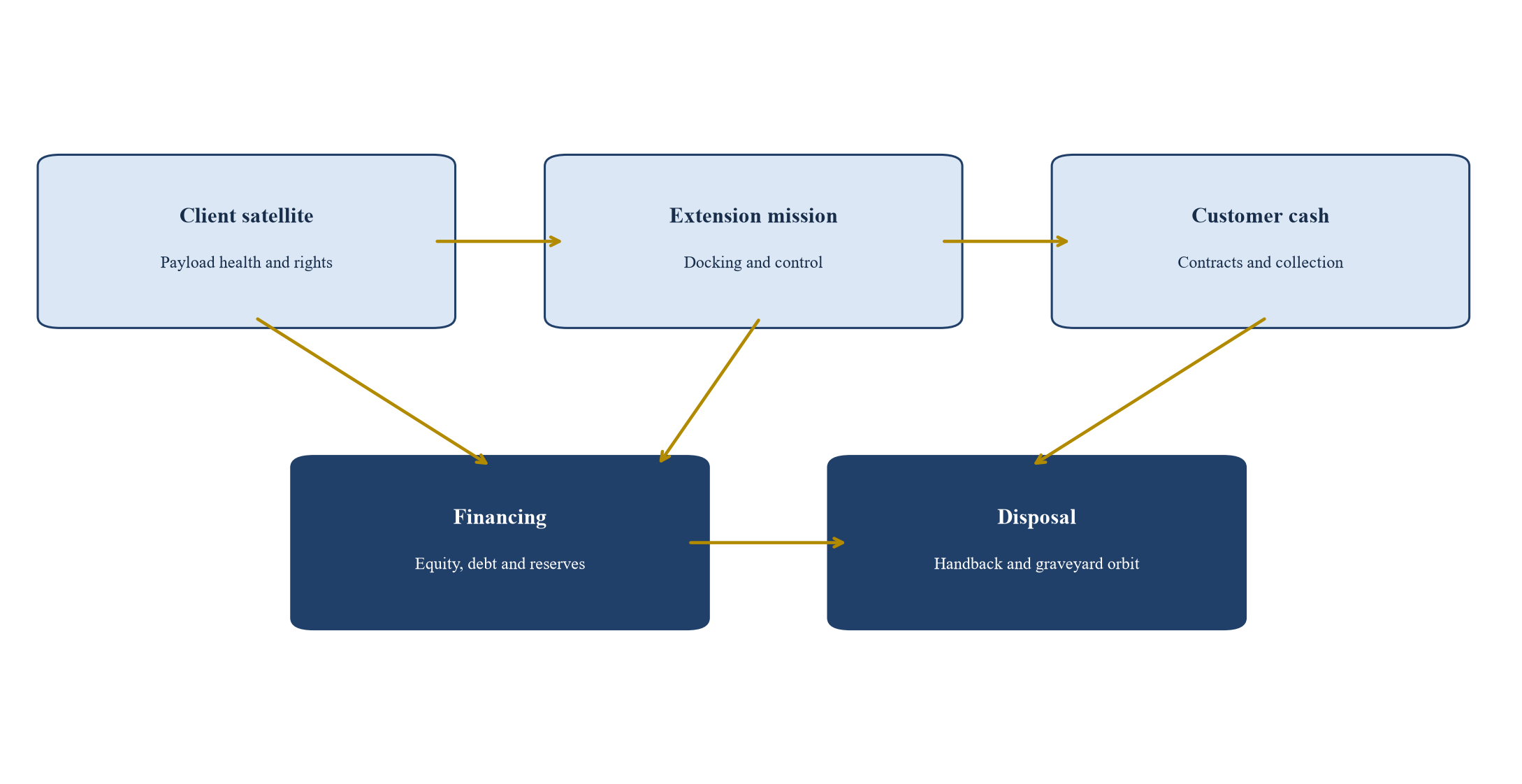
Proposed separation of technical, commercial, mission and financing control.
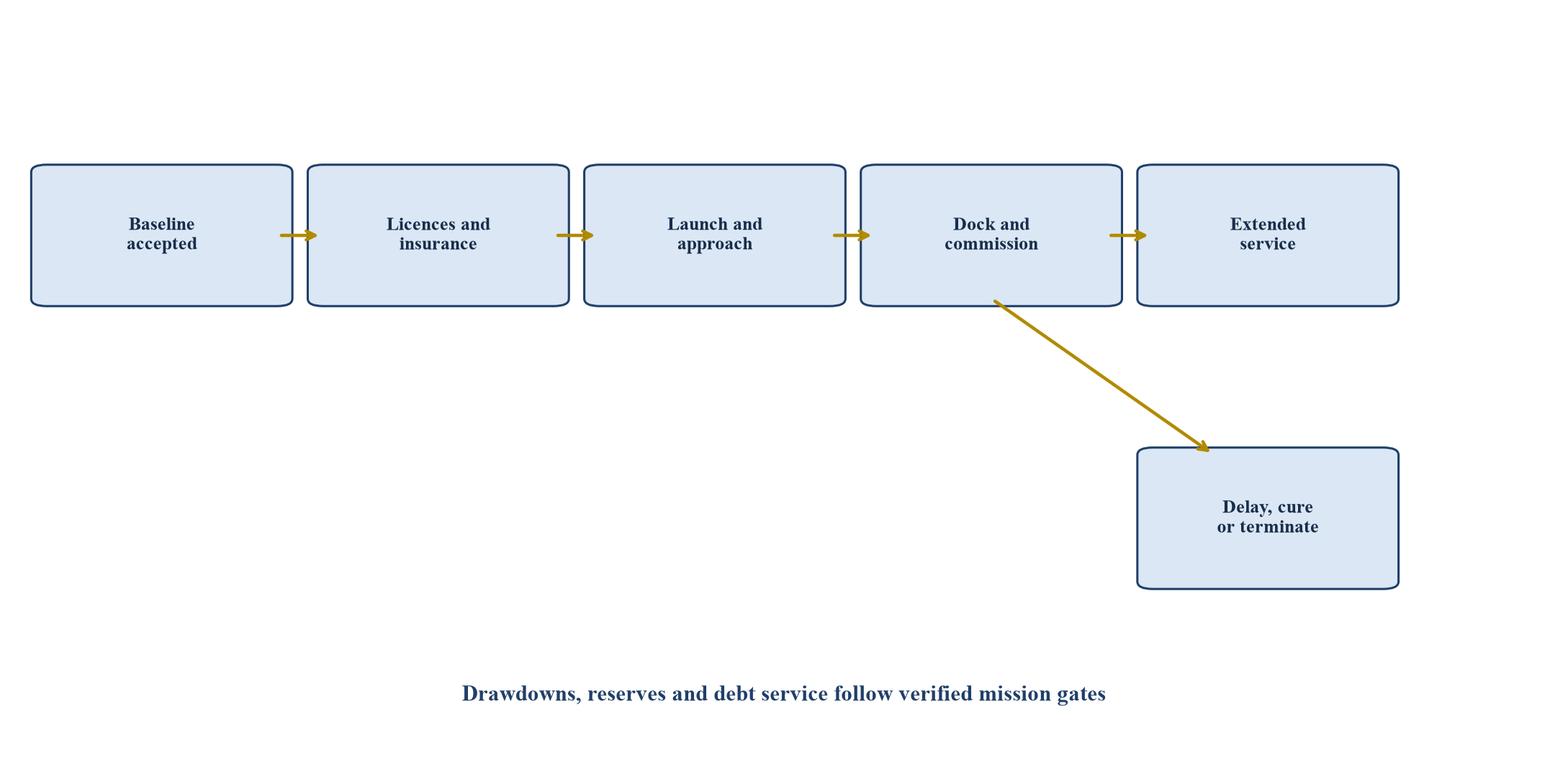
Illustrative sequence; every branch requires satellite-specific evidence.
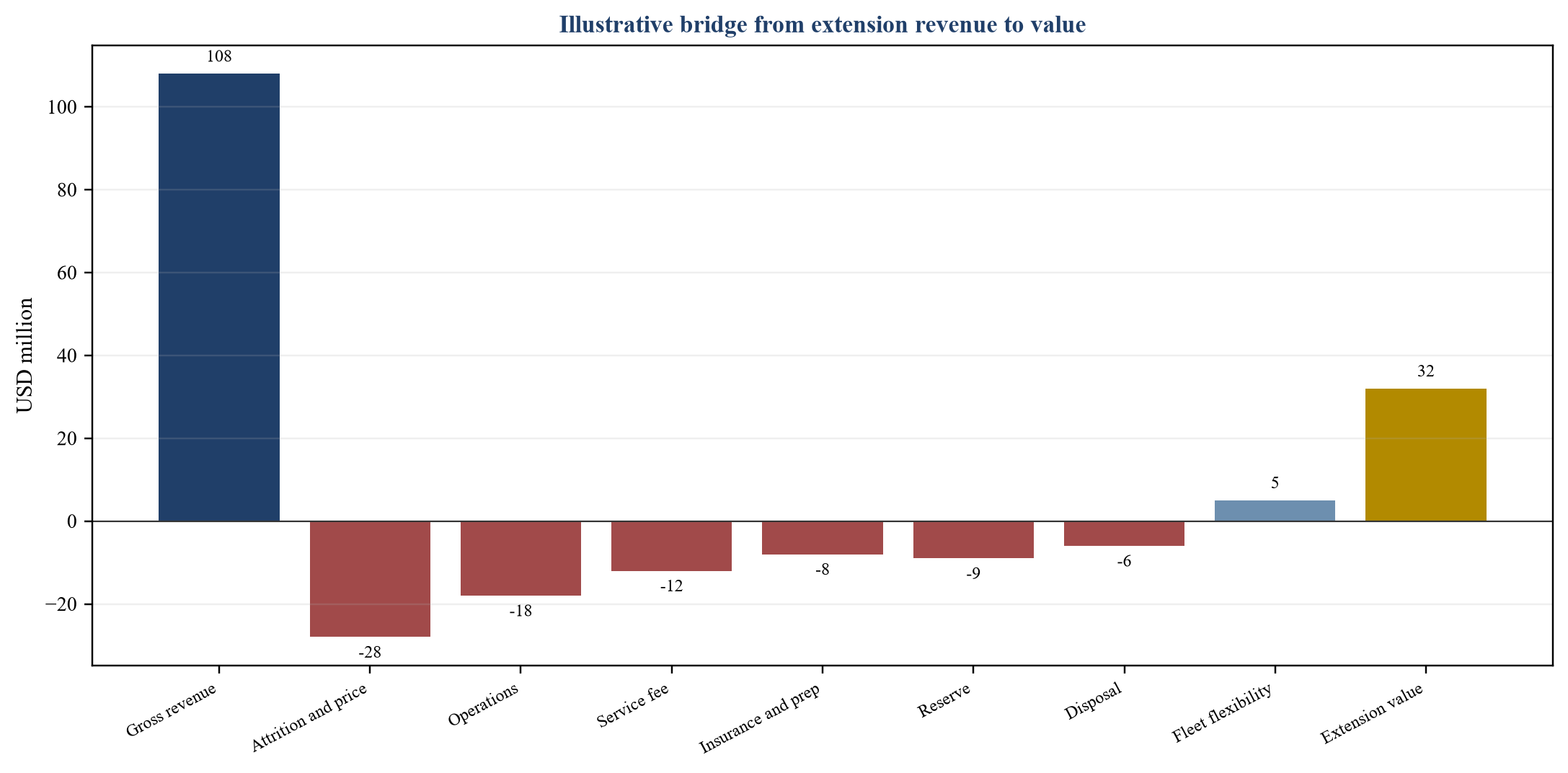
Illustrative USD millions before financing costs.
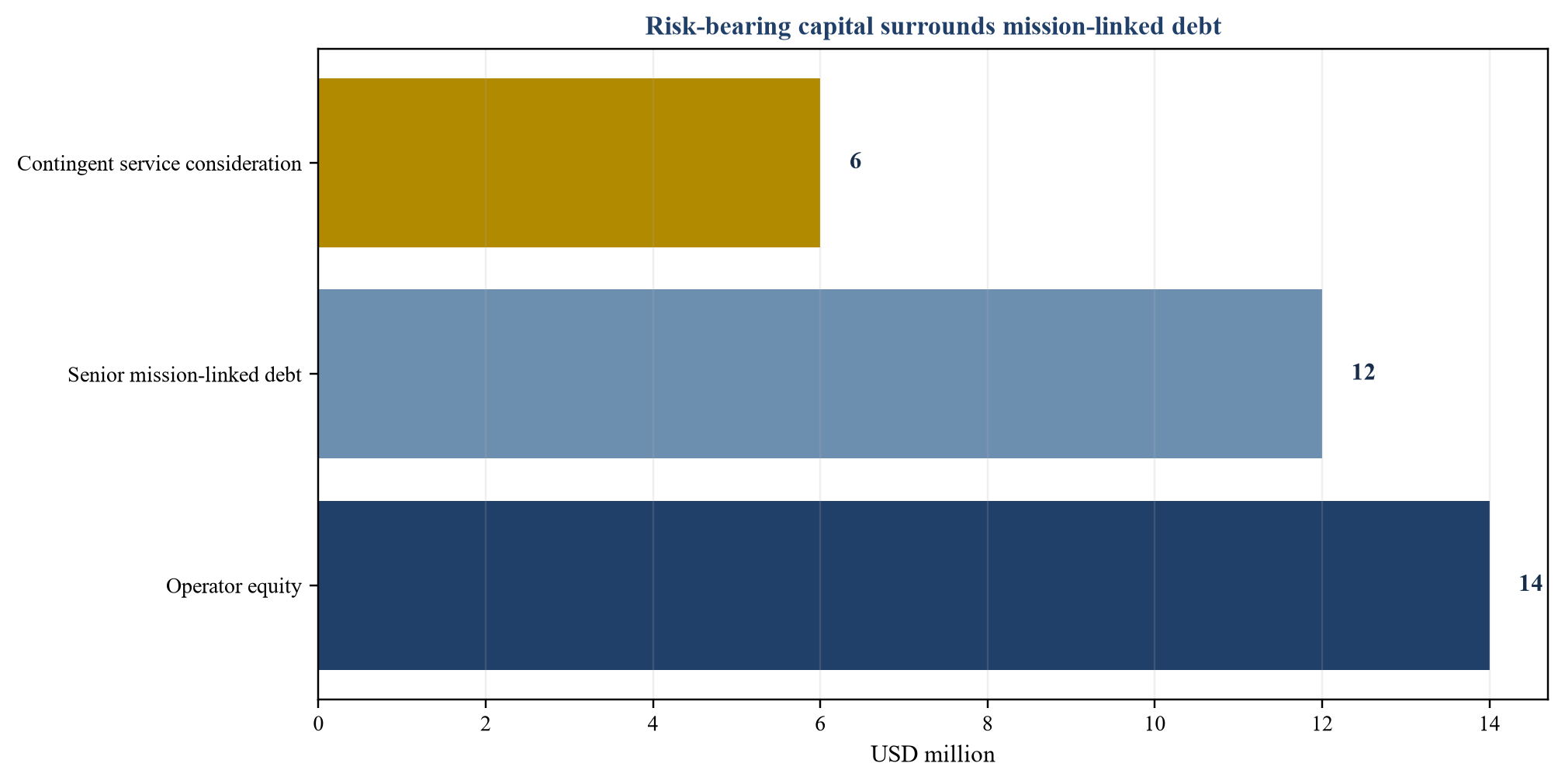
Illustrative USD millions; funding must remain available through downside delay.
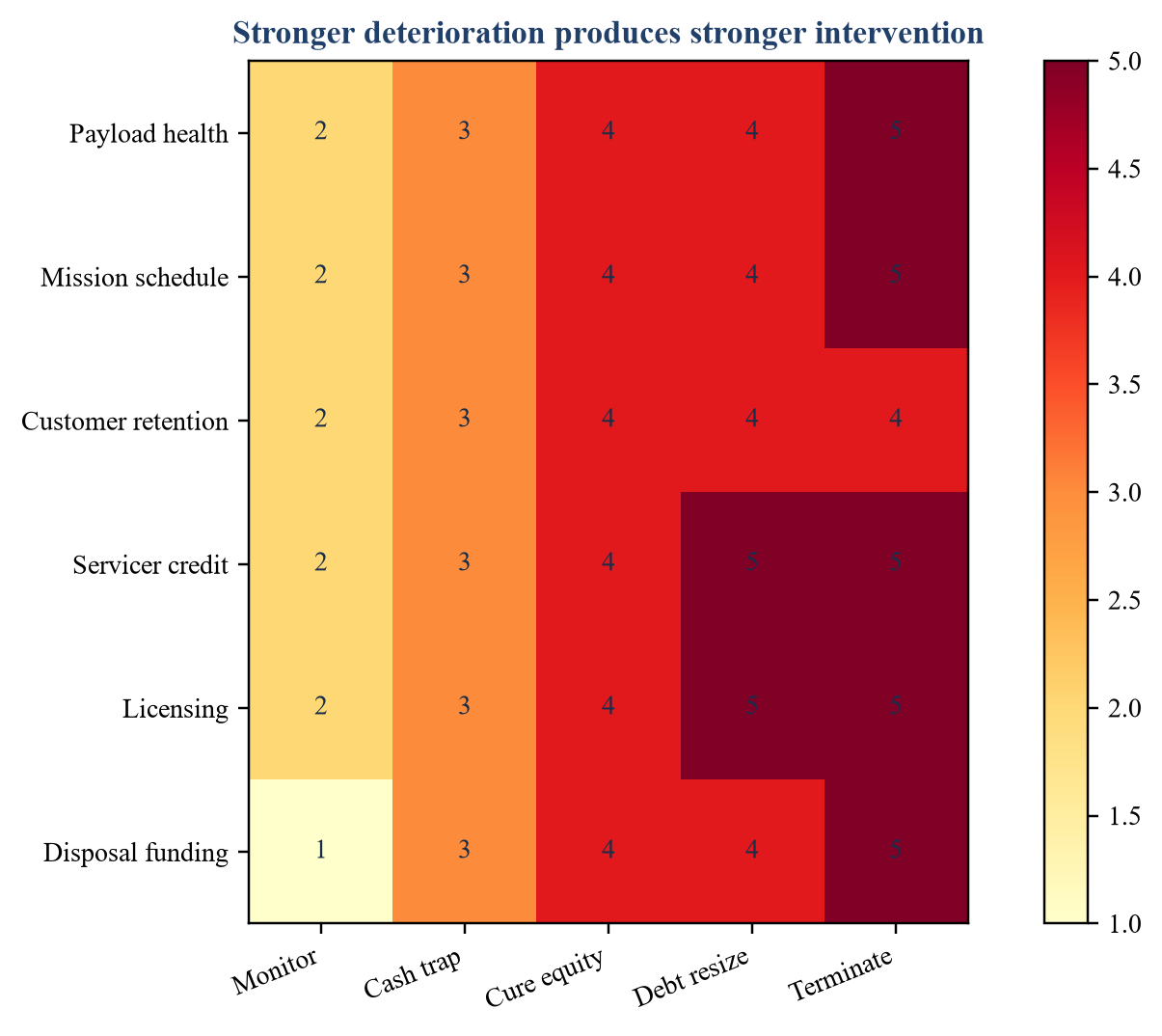
Illustrative severity score from one to five.
| Measure | Evidence | Financing treatment |
|---|---|---|
| Design life | manufacturer commitment and qualification | reference point only |
| Engineering service life | telemetry, fuel and component analysis | technical upper boundary |
| Accounting useful life | reporting policy and management estimate | covenant reconciliation |
| Contracted extension | service scope and acceptance | mission perimeter |
| Financeable life | downside cash and verified technical period | debt tenor boundary |
Proposed reconciliation before financing.
| Evidence | Public observation | Financing relevance |
|---|---|---|
| MEV-1 and Intelsat 901 | five-year contracted extension after docking in 2020 | operational precedent and service term |
| MEV-2 and Intelsat 10-02 | second five-year GEO extension mission | repeat mission evidence |
| FCC Intelsat 901 modification | orbit raising, docking, relocation and combined operation required authority | rights and conditions precedent |
| ESA RISE | planned commercial GEO life-extension demonstration | emerging competition and future capacity |
| GAO 2025 ISAM report | GEO servicing can defer replacement; demand and standards remain constrained | market case and execution limits |
| Operator filings | useful life depends on fuel, performance, degradation and strategy | technical and accounting diligence |
Programme-specific evidence does not establish an unidentified satellite's economics.
| Step | Required evidence | Treatment |
|---|---|---|
| Contracted receipts | customer contract, invoice and bank receipt | gross extension cash |
| Attrition and repricing | renewal date and migration right | downside deduction |
| Satellite operations | ground, staff and network cost | priority operating cash |
| Mission and service payments | accepted milestone and invoice | contracted service cost |
| Insurance and reserve | policy and account balance | protected liquidity |
| Debt service | amortisation and distribution test | paid after protected costs |
| Disposal funding | funded account and mission plan | senior protected obligation |
Proposed route from extension to debt service.
| Step | Amount | Evidence required |
|---|---|---|
| Forecast gross extension revenue | 108 | customer-level receipts |
| Customer attrition and price pressure | minus 28 | renewal and migration stress |
| Operating and ground cost | minus 18 | costed operating plan |
| Service consideration | minus 12 | executed service contract |
| Insurance, licensing and preparation | minus 8 | quotes, filings and budget |
| Reserve and downside liquidity | minus 9 | delay and cure model |
| Disposal and transition provision | minus 6 | funded end-of-service plan |
| Fleet-flexibility benefit | plus 5 | executable fleet plan |
| Illustrative extension value | 32 | integrated evidence set |
All amounts are illustrative USD millions.
| Source | Amount | Core protection |
|---|---|---|
| Operator equity | 14 | first-loss mission and customer risk |
| Senior mission-linked debt | 12 | controlled cash, reserves and amortisation |
| Contingent service consideration | 6 | target-specific mission milestones |
| Total | 32 | fully funded base package |
Illustrative allocation of risk-bearing and senior capital.
| Condition | Evidence | Failure response |
|---|---|---|
| Technical baseline | independent engineering report | defer commitment |
| Docking compatibility | target-specific verification | redesign or decline |
| Customer cash | contracted receipts and stress | resize debt |
| Regulatory authority | effective licences and modifications | no mission draw |
| Insurance | bound coverage and funded deductible | increase equity or reserve |
| Servicer funding | committed cost-to-complete | support, step-in or terminate |
| Disposal | approved and funded plan | trap cash |
Proposed evidence before irreversible funding.
| Dimension | Core measure | Intervention trigger |
|---|---|---|
| Payload | health and redundancy trend | material degradation |
| Mission | probability and schedule | critical-path delay |
| Customer | contracted cash and concentration | churn or repricing |
| Counterparty | operator and servicer liquidity | funding shortfall |
| Regulatory | licence and operating authority | delay or condition change |
| Reserve | liquidity and disposal accounts | required balance breach |
| Debt | coverage, amortisation and maturity headroom | downside covenant breach |
Proposed monthly evidence record.
Sources
- Northrop Grumman, Satellite Services in Space: Extending Life in Orbit. Read the primary source
- Intelsat, Intelsat 901 Satellite Returns to Service Using Northrop Grumman's Mission Extension Vehicle, 17 April 2020. Read the primary source
- Northrop Grumman, On-Orbit Service and Sustainment fact sheet. Read the primary source
- Federal Communications Commission, Intelsat 901 licence modification notice, SAT-MOD-20190207-00009. Read the primary source
- Federal Communications Commission, FCC 20-54, Mitigation of Orbital Debris in the New Space Age. Read the primary source
- Federal Communications Commission, FCC 24-21, Space Innovation proceeding. Read the primary source
- European Space Agency, RISE: ESA's mission extender in geostationary orbit, 15 September 2025. Read the primary source
- European Space Agency, ESA to build first in-orbit servicing mission with D-Orbit, 14 October 2024. Read the primary source
- European Space Agency, ESA moves ahead with In-Orbit Servicing missions. Read the primary source
- European Space Agency, Geostationary Servicing. Read the primary source
- European Space Agency, In-Orbit Servicing of a satellite, 28 June 2023. Read the primary source
- European Space Agency Nebula, ENCORE: In-Orbit Servicing of an Operational Spacecraft. Read the primary source
- U.S. Government Accountability Office, In-Space Servicing, Assembly, and Manufacturing: Benefits, Challenges, and Policy Options, GAO-25-107555, 10 July 2025. Read the primary source
- U.S. Government Accountability Office, GAO-25-107555 full report. Read the primary source
- Viasat, Annual Report for the year ended 31 March 2026. Read the primary source
- Globalstar, Annual Report for the year ended 31 December 2025. Read the primary source
- Hughes Satellite Systems Corporation, Annual Report for the year ended 31 December 2025. Read the primary source
- EchoStar Corporation, Annual Report for the year ended 31 December 2025. Read the primary source
- SES, Annual Report financial statements filed in 2026. Read the primary source
- IFRS Foundation, IAS 16 Property, Plant and Equipment. Read the primary source
- IFRS Foundation, IAS 36 Impairment of Assets. Read the primary source
- IFRS Foundation, IFRS 9 Financial Instruments. Read the primary source
- IFRS Foundation, IFRS 15 Revenue from Contracts with Customers. Read the primary source
- International Valuation Standards Council, IVS 105 Valuation Models, 31 January 2025. Read the primary source
- International Telecommunication Union, Environmental protection of the geostationary-satellite orbit. Read the primary source
- United Nations Office for Outer Space Affairs, Guidelines for the Long-term Sustainability of Outer Space Activities, 2021. Read the primary source
- Inter-Agency Space Debris Coordination Committee, IADC Space Debris Mitigation Guidelines, Rev 3, 2025. Read the primary source
- NASA, In-Space Servicing, Assembly, and Manufacturing. Read the primary source
- NASA Technical Reports Server, In-Space Servicing, Assembly, and Manufacturing State of Play, 2025 edition. Read the primary source
