

Introduction
In-orbit servicing is a system of systems. A mission may require target identification, trajectory design, guidance and navigation, command authority, autonomous collision avoidance, capture or docking hardware, propulsion, manipulation, communications, ground operations, licensing, insurance and customer acceptance. The provider also needs a client asset that can be approached legally and technically, a customer willing to accept operational risk, and enough funding to survive qualification, launch and mission delay.
M&A can accelerate access to one or more of these capabilities. A spacecraft manufacturer may buy rendezvous autonomy. A satellite operator may buy customer-facing servicing capacity. A defence prime may buy robotic manipulation and secure operations. A servicing company may buy a customer portfolio or a mission contract. The acquisition thesis can fail when the purchased capability cannot be transferred, integrated or sold inside the buyer's architecture and regulatory perimeter.
The correct unit of analysis is the combined mission chain. The buyer should identify each controlled interface, each external dependency and each value-changing evidence point from signing through collected service cash. The paper therefore treats robotics, rendezvous and customer access as separable but interdependent assets. It uses a mission architecture, contract waterfall, integration plan and probability-weighted value bridge to convert them into a board decision.
1. Define the acquisition decision
The central diligence issue concerns the buyer's strategic objective, valuation date, acquired perimeter, target mission classes and permitted synergies. The evidence set should begin with board mandate, target cap table, transaction perimeter, product roadmap, mission plan and buyer integration thesis. Successful tests, anomalies, waivers and unresolved work belong in the same record.
The required analytical output is one board-approved acquisition question and evidence cut-off. Link each conclusion to mission probability, integration schedule, cost, funding, customer acceptance and cash collection. A technical asset has transaction value when the buyer can control, transfer, integrate and use it in an authorised mission.
For the transaction, the board should state whether the transaction buys time, technical capability, contracts, market access or a complete operating platform. A transaction described as platform consolidation may in practice acquire only personnel and prototypes. The decision paper should state the missing elements and their funded route to mission use. Identify base value, contingent value, integration investment, downside liquidity and contractual protection. State which conclusion changes if a customer, licence, employee, supplier or mission milestone fails to transfer.
2. Choose the acquisition archetype
The central diligence issue concerns whether the buyer is acquiring robotics, rendezvous autonomy, customer access or an integrated provider. The evidence set should begin with system architecture, mission concepts, contract register, customer interviews, intellectual-property schedule and organisation chart. Successful tests, anomalies, waivers and unresolved work belong in the same record.
The required analytical output is an archetype map with acquired and missing capability layers. Link each conclusion to mission probability, integration schedule, cost, funding, customer acceptance and cash collection. A technical asset has transaction value when the buyer can control, transfer, integrate and use it in an authorised mission.
For the transaction, the board should price each layer separately and identify the party responsible for completing the chain. A robotics acquisition can reduce payload-development time while leaving navigation, licensing and customer conversion untouched. A customer-access acquisition can add pipeline while leaving mission delivery dependent on third parties. Identify base value, contingent value, integration investment, downside liquidity and contractual protection. State which conclusion changes if a customer, licence, employee, supplier or mission milestone fails to transfer.
3. Map the combined mission architecture
The central diligence issue concerns the technical and contractual sequence from customer need to completed service. The evidence set should begin with concept of operations, interface-control documents, trajectory models, software architecture, operations procedures and customer acceptance criteria. Successful tests, anomalies, waivers and unresolved work belong in the same record.
The required analytical output is a mission chain with owned, licensed and externally supplied elements. Link each conclusion to mission probability, integration schedule, cost, funding, customer acceptance and cash collection. A technical asset has transaction value when the buyer can control, transfer, integrate and use it in an authorised mission.
For the transaction, the board should reject synergies that require interfaces or rights absent from the acquired perimeter. Architecture maps should include failure recovery, disposal and data delivery. The same hardware can carry different risk when used against a cooperative client, an unprepared legacy satellite or non-cooperative debris. Identify base value, contingent value, integration investment, downside liquidity and contractual protection. State which conclusion changes if a customer, licence, employee, supplier or mission milestone fails to transfer.
4. Separate robotics from mission completion
The central diligence issue concerns the manipulation function and its dependence on perception, navigation, control and target compatibility. The evidence set should begin with robot-arm test data, end-effector qualification, force-torque telemetry, target geometry, structural limits and fault-management records. Successful tests, anomalies, waivers and unresolved work belong in the same record.
The required analytical output is a robotics evidence matrix tied to specific tasks and targets. Link each conclusion to mission probability, integration schedule, cost, funding, customer acceptance and cash collection. A technical asset has transaction value when the buyer can control, transfer, integrate and use it in an authorised mission.
For the transaction, the board should credit robotics only for operations demonstrated or supported by relevant qualification. A flight-qualified manipulator may still need a new tool, control law or structural interface. The buyer should value the reusable subsystem and separately fund mission-specific engineering. Identify base value, contingent value, integration investment, downside liquidity and contractual protection. State which conclusion changes if a customer, licence, employee, supplier or mission milestone fails to transfer.
5. Diligence rendezvous and proximity operations
The central diligence issue concerns relative navigation, approach corridors, collision avoidance, autonomy, command authority and abort logic. The evidence set should begin with flight telemetry, simulation coverage, hardware-in-the-loop testing, navigation sensor performance, anomaly logs and independent review. Successful tests, anomalies, waivers and unresolved work belong in the same record.
The required analytical output is a phase-by-phase probability and safety case. Link each conclusion to mission probability, integration schedule, cost, funding, customer acceptance and cash collection. A technical asset has transaction value when the buyer can control, transfer, integrate and use it in an authorised mission.
For the transaction, the board should require evidence for the intended orbit, target behaviour, lighting, communications and operating distance. Rendezvous heritage transfers weakly when the next mission changes from a cooperative target to tumbling debris, from low Earth orbit to geostationary orbit, or from supervised to autonomous operations. Identify base value, contingent value, integration investment, downside liquidity and contractual protection. State which conclusion changes if a customer, licence, employee, supplier or mission milestone fails to transfer.
6. Value autonomy and flight data
The central diligence issue concerns the algorithms, labelled datasets, simulation environments and operational learning that improve mission performance. The evidence set should begin with source-code repositories, model documentation, data lineage, access controls, training rights, telemetry archives and configuration history. Successful tests, anomalies, waivers and unresolved work belong in the same record.
The required analytical output is a controlled-asset register with buyer use cases. Link each conclusion to mission probability, integration schedule, cost, funding, customer acceptance and cash collection. A technical asset has transaction value when the buyer can control, transfer, integrate and use it in an authorised mission.
For the transaction, the board should discount assets whose rights, provenance or configuration cannot be established. Flight data can shorten testing and improve navigation models. Its value depends on legal control, target permissions, representative conditions and the buyer's ability to use it after closing. Identify base value, contingent value, integration investment, downside liquidity and contractual protection. State which conclusion changes if a customer, licence, employee, supplier or mission milestone fails to transfer.
7. Test capture, docking and mating interfaces
The central diligence issue concerns mechanical compatibility, target preparation, loads, tolerances, sensing, latching and release. The evidence set should begin with interface-control documents, test articles, qualification reports, docking trials, target-owner approvals and standards mapping. Successful tests, anomalies, waivers and unresolved work belong in the same record.
The required analytical output is an interface-compatibility matrix by mission class. Link each conclusion to mission probability, integration schedule, cost, funding, customer acceptance and cash collection. A technical asset has transaction value when the buyer can control, transfer, integrate and use it in an authorised mission.
For the transaction, the board should treat each new target family as an explicit engineering and qualification branch. A universal-looking capture concept may rely on a launch adapter ring, prepared plate or geometry unavailable on the addressable fleet. The acquisition model should distinguish prepared and unprepared clients. Identify base value, contingent value, integration investment, downside liquidity and contractual protection. State which conclusion changes if a customer, licence, employee, supplier or mission milestone fails to transfer.
8. Reconstruct customer access
The central diligence issue concerns whether the target controls a funded customer relationship, a procurement position, an option or only a non-binding expression of interest. The evidence set should begin with executed contracts, statements of work, framework agreements, memoranda, budget evidence, invoices, collections and customer confirmations. Successful tests, anomalies, waivers and unresolved work belong in the same record.
The required analytical output is a customer-rights waterfall from announcement to collected contribution. Link each conclusion to mission probability, integration schedule, cost, funding, customer acceptance and cash collection. A technical asset has transaction value when the buyer can control, transfer, integrate and use it in an authorised mission.
For the transaction, the board should exclude non-binding pipeline from contracted value and identify change-of-control consent. Government-sponsored demonstrations can create flight opportunity and credibility. They may include cost share, milestone acceptance, termination rights and restrictions that limit transfer to the buyer. Identify base value, contingent value, integration investment, downside liquidity and contractual protection. State which conclusion changes if a customer, licence, employee, supplier or mission milestone fails to transfer.
9. Distinguish customer relationships from mission rights
The central diligence issue concerns the legal and operational rights required to approach, inspect, dock with, manipulate or relocate a client spacecraft. The evidence set should begin with client authorisations, operator licences, command protocols, insurance terms, data-use rights and mission-specific approvals. Successful tests, anomalies, waivers and unresolved work belong in the same record.
The required analytical output is a rights matrix for each forecast mission. Link each conclusion to mission probability, integration schedule, cost, funding, customer acceptance and cash collection. A technical asset has transaction value when the buyer can control, transfer, integrate and use it in an authorised mission.
For the transaction, the board should require a complete rights path before counting a customer as executable backlog. A relationship with an operator does not itself grant control authority or approval for close approach. The customer may also lack the technical data needed to support servicing of an older spacecraft. Identify base value, contingent value, integration investment, downside liquidity and contractual protection. State which conclusion changes if a customer, licence, employee, supplier or mission milestone fails to transfer.
10. Build the contract waterfall
The central diligence issue concerns the conversion of announced awards and pipeline into funded, executable and collectible cash. The evidence set should begin with signed scope, appropriations, purchase orders, milestone schedule, termination clauses, acceptance conditions, cost-to-complete and billing history. Successful tests, anomalies, waivers and unresolved work belong in the same record.
The required analytical output is risk-adjusted contract contribution after fulfilment cost. Link each conclusion to mission probability, integration schedule, cost, funding, customer acceptance and cash collection. A technical asset has transaction value when the buyer can control, transfer, integrate and use it in an authorised mission.
For the transaction, the board should reconcile every headline contract amount to funded scope and cash economics. Backlog should exclude unfunded options and amounts controlled by future task orders. Launch, customer availability and successful service can each sit before acceptance and payment. Identify base value, contingent value, integration investment, downside liquidity and contractual protection. State which conclusion changes if a customer, licence, employee, supplier or mission milestone fails to transfer.
11. Assess standards and interoperability
The central diligence issue concerns the extent to which the acquired capability uses open, accepted or proprietary interfaces. The evidence set should begin with standards mapping, interface-control documents, licence terms, customer fleet data and supplier roadmaps. Successful tests, anomalies, waivers and unresolved work belong in the same record.
The required analytical output is an interoperability score and retrofit requirement. Link each conclusion to mission probability, integration schedule, cost, funding, customer acceptance and cash collection. A technical asset has transaction value when the buyer can control, transfer, integrate and use it in an authorised mission.
For the transaction, the board should treat proprietary lock-in as value only when the buyer controls the ecosystem and customer economics. Standardisation can expand addressable missions and reduce non-recurring engineering. It can also commoditise a component. The value model should separate market expansion from margin pressure. Identify base value, contingent value, integration investment, downside liquidity and contractual protection. State which conclusion changes if a customer, licence, employee, supplier or mission milestone fails to transfer.
12. Audit intellectual-property ownership
The central diligence issue concerns patents, software, designs, trade secrets, flight data, background rights and third-party licences. The evidence set should begin with employment agreements, invention assignments, contractor terms, licence files, grant conditions, open-source register and chain of title. Successful tests, anomalies, waivers and unresolved work belong in the same record.
The required analytical output is an IP schedule connected to each valued capability. Link each conclusion to mission probability, integration schedule, cost, funding, customer acceptance and cash collection. A technical asset has transaction value when the buyer can control, transfer, integrate and use it in an authorised mission.
For the transaction, the board should make clean transfer of critical rights a closing condition. Space programmes often blend company, agency, university, supplier and customer contributions. The buyer should identify restrictions on commercialisation, export, sublicensing and use outside the original mission. Identify base value, contingent value, integration investment, downside liquidity and contractual protection. State which conclusion changes if a customer, licence, employee, supplier or mission milestone fails to transfer.
13. Map export controls and technology transfer
The central diligence issue concerns the movement of spacecraft, servicing technology, software, technical data and controlled access across people and jurisdictions. The evidence set should begin with EAR and ITAR classification, licences, technology-control plans, nationality matrix, data rooms and facility controls. Successful tests, anomalies, waivers and unresolved work belong in the same record.
The required analytical output is a transaction-specific transfer and operating plan. Link each conclusion to mission probability, integration schedule, cost, funding, customer acceptance and cash collection. A technical asset has transaction value when the buyer can control, transfer, integrate and use it in an authorised mission.
For the transaction, the board should treat unavailable licences or restricted access as a condition, carve-out or integration cost. U.S. rules expressly address transfers of ownership or control of certain servicing spacecraft. Cross-border integration can affect source-code access, technical support, staffing and customer eligibility. Identify base value, contingent value, integration investment, downside liquidity and contractual protection. State which conclusion changes if a customer, licence, employee, supplier or mission milestone fails to transfer.
14. Screen national-security and foreign-investment risk
The central diligence issue concerns whether control, material influence, sensitive capability, government contracts or critical technology triggers review. The evidence set should begin with ownership chain, investor rights, target activities, customer base, sensitive data, facility access and government guidance. Successful tests, anomalies, waivers and unresolved work belong in the same record.
The required analytical output is a jurisdiction-by-jurisdiction filing and mitigation plan. Link each conclusion to mission probability, integration schedule, cost, funding, customer acceptance and cash collection. A technical asset has transaction value when the buyer can control, transfer, integrate and use it in an authorised mission.
For the transaction, the board should include timing, information segregation and potential remedies in the deal case. UK guidance places in-orbit servicing, robotics, debris management and operational-control infrastructure inside the satellite and space technology area. U.S. review can also intersect with export controls and classified work. Identify base value, contingent value, integration investment, downside liquidity and contractual protection. State which conclusion changes if a customer, licence, employee, supplier or mission milestone fails to transfer.
15. Test licences, liability and insurance
The central diligence issue concerns mission authorisation, supervision, collision exposure, target damage, third-party loss, re-entry and contractual indemnity. The evidence set should begin with licences, regulator correspondence, launch-state analysis, insurance policies, customer contracts and counsel opinions. Successful tests, anomalies, waivers and unresolved work belong in the same record.
The required analytical output is a mission liability and coverage schedule. Link each conclusion to mission probability, integration schedule, cost, funding, customer acceptance and cash collection. A technical asset has transaction value when the buyer can control, transfer, integrate and use it in an authorised mission.
For the transaction, the board should deduct uninsured or uncapped exposure and preserve compliant post-mission disposal. Change of control can require regulator or customer engagement. A buyer acquiring technology without the operating approvals may own an asset that cannot yet perform the forecast service. Identify base value, contingent value, integration investment, downside liquidity and contractual protection. State which conclusion changes if a customer, licence, employee, supplier or mission milestone fails to transfer.
16. Assess people and tacit knowledge
The central diligence issue concerns the engineers, flight directors, safety leads, customer executives and programme managers required to operate the acquired capability. The evidence set should begin with organisation chart, role descriptions, retention history, compensation, succession, mission logs and interview evidence. Successful tests, anomalies, waivers and unresolved work belong in the same record.
The required analytical output is a key-person and knowledge-transfer plan. Link each conclusion to mission probability, integration schedule, cost, funding, customer acceptance and cash collection. A technical asset has transaction value when the buyer can control, transfer, integrate and use it in an authorised mission.
For the transaction, the board should fund retention and require documented transfer of critical operating knowledge. Robotics and autonomy value may reside in teams that understand failure modes, configuration history and operational judgement. Repositories alone rarely capture every mission constraint. Identify base value, contingent value, integration investment, downside liquidity and contractual protection. State which conclusion changes if a customer, licence, employee, supplier or mission milestone fails to transfer.
17. Identify platform and interface integration
The central diligence issue concerns bus compatibility, power, thermal, data, flight software, cyber security, operations, launch and ground systems. The evidence set should begin with buyer and target architectures, interface tests, software bills of materials, cyber assessments and supplier commitments. Successful tests, anomalies, waivers and unresolved work belong in the same record.
The required analytical output is an integration work breakdown with owners, cost and schedule. Link each conclusion to mission probability, integration schedule, cost, funding, customer acceptance and cash collection. A technical asset has transaction value when the buyer can control, transfer, integrate and use it in an authorised mission.
For the transaction, the board should separate necessary integration from claimed cost synergies. Combining two proven subsystems can create a new unproven system. The integration plan should reopen relevant verification and validation rather than assuming the sum inherits both flight histories. Identify base value, contingent value, integration investment, downside liquidity and contractual protection. State which conclusion changes if a customer, licence, employee, supplier or mission milestone fails to transfer.
18. Model integration probability
The central diligence issue concerns the conditional path from closing to an integrated, licensed, launched and accepted mission. The evidence set should begin with technical reviews, supplier plans, customer dependencies, launch windows, regulatory timetable and funding plan. Successful tests, anomalies, waivers and unresolved work belong in the same record.
The required analytical output is a probability-weighted integration tree. Link each conclusion to mission probability, integration schedule, cost, funding, customer acceptance and cash collection. A technical asset has transaction value when the buyer can control, transfer, integrate and use it in an authorised mission.
For the transaction, the board should multiply dependent stages and preserve correlated failure modes. One blended execution discount hides the interaction between schedule, cash, customer availability and technical rework. Each branch should carry its own cost, timing and recovery path. Identify base value, contingent value, integration investment, downside liquidity and contractual protection. State which conclusion changes if a customer, licence, employee, supplier or mission milestone fails to transfer.
19. Reconcile development cost and replacement cost
The central diligence issue concerns historical spending, usable assets, remaining work and the buyer's make-versus-buy alternative. The evidence set should begin with general ledger, programme accounts, test assets, code base, supplier quotes and buyer internal estimates. Successful tests, anomalies, waivers and unresolved work belong in the same record.
The required analytical output is a replacement-cost cross-check adjusted for obsolescence and failed work. Link each conclusion to mission probability, integration schedule, cost, funding, customer acceptance and cash collection. A technical asset has transaction value when the buyer can control, transfer, integrate and use it in an authorised mission.
For the transaction, the board should avoid treating sunk cost as market value. NASA's OSAM-1 experience illustrates that large accumulated spend can coexist with schedule, integration and transition problems. The buyer should value reusable capability and time saved, not reimbursed history. Identify base value, contingent value, integration investment, downside liquidity and contractual protection. State which conclusion changes if a customer, licence, employee, supplier or mission milestone fails to transfer.
20. Build mission-level economics
The central diligence issue concerns service price, launch, hardware, payload, operations, insurance, licensing, ground network, working capital and disposal. The evidence set should begin with customer scope, supplier quotes, engineering plan, mission simulations, historical actuals and payment terms. Successful tests, anomalies, waivers and unresolved work belong in the same record.
The required analytical output is gross contribution and cash by mission class. Link each conclusion to mission probability, integration schedule, cost, funding, customer acceptance and cash collection. A technical asset has transaction value when the buyer can control, transfer, integrate and use it in an authorised mission.
For the transaction, the board should show economics before and after the acquisition integration. Customer access can be valuable when it raises utilisation or reduces selling time. The model should still account for mission-specific engineering and the probability that the customer remains technically serviceable. Identify base value, contingent value, integration investment, downside liquidity and contractual protection. State which conclusion changes if a customer, licence, employee, supplier or mission milestone fails to transfer.
21. Value standalone capability
The central diligence issue concerns cash flows and controlled assets available without buyer-specific synergies. The evidence set should begin with mission tree, contract waterfall, unit economics, IP schedule, workforce plan and funding requirement. Successful tests, anomalies, waivers and unresolved work belong in the same record.
The required analytical output is a probability-weighted standalone enterprise value. Link each conclusion to mission probability, integration schedule, cost, funding, customer acceptance and cash collection. A technical asset has transaction value when the buyer can control, transfer, integrate and use it in an authorised mission.
For the transaction, the board should anchor price in evidence that transfers at closing. The standalone case should include only missions the target can fund and deliver with controlled resources or enforceable supply arrangements. It should exclude broad strategic narratives. Identify base value, contingent value, integration investment, downside liquidity and contractual protection. State which conclusion changes if a customer, licence, employee, supplier or mission milestone fails to transfer.
22. Value buyer-specific synergies
The central diligence issue concerns accelerated market entry, avoided development, shared launch, customer cross-sell, manufacturing scale and lower operating cost. The evidence set should begin with buyer plans, duplicative cost base, engineering estimates, customer evidence and integration schedule. Successful tests, anomalies, waivers and unresolved work belong in the same record.
The required analytical output is a synergy register with probability, timing, cost and owner. Link each conclusion to mission probability, integration schedule, cost, funding, customer acceptance and cash collection. A technical asset has transaction value when the buyer can control, transfer, integrate and use it in an authorised mission.
For the transaction, the board should pay only for synergies that are specific, executable and appropriately shared. A strategic buyer may create more value than a financial buyer by providing a bus, manufacturing capacity, licences or customers. Integration cost and execution probability belong beside every claimed synergy. Identify base value, contingent value, integration investment, downside liquidity and contractual protection. State which conclusion changes if a customer, licence, employee, supplier or mission milestone fails to transfer.
23. Construct the hypothetical value bridge
The central diligence issue concerns the movement from standalone mission value through controlled assets, customer access, synergies and deductions. The evidence set should begin with transaction-specific technical, contractual, regulatory and financial diligence. Successful tests, anomalies, waivers and unresolved work belong in the same record.
The required analytical output is USD 84 million of illustrative enterprise value. Link each conclusion to mission probability, integration schedule, cost, funding, customer acceptance and cash collection. A technical asset has transaction value when the buyer can control, transfer, integrate and use it in an authorised mission.
For the transaction, the board should show which value is paid at closing and which remains contingent. The worked case admits value for robotics, autonomy, flight data and qualified customer access. It deducts the work and risk required to combine those assets into an executable mission. Identify base value, contingent value, integration investment, downside liquidity and contractual protection. State which conclusion changes if a customer, licence, employee, supplier or mission milestone fails to transfer.
24. Design consideration and protections
The central diligence issue concerns upfront cash, shares, escrow, holdbacks, milestone payments, earn-outs, contingent value and committed funding. The evidence set should begin with value bridge, integration plan, customer consents, regulatory path and milestone definitions. Successful tests, anomalies, waivers and unresolved work belong in the same record.
The required analytical output is consideration aligned to evidence and cash delivery. Link each conclusion to mission probability, integration schedule, cost, funding, customer acceptance and cash collection. A technical asset has transaction value when the buyer can control, transfer, integrate and use it in an authorised mission.
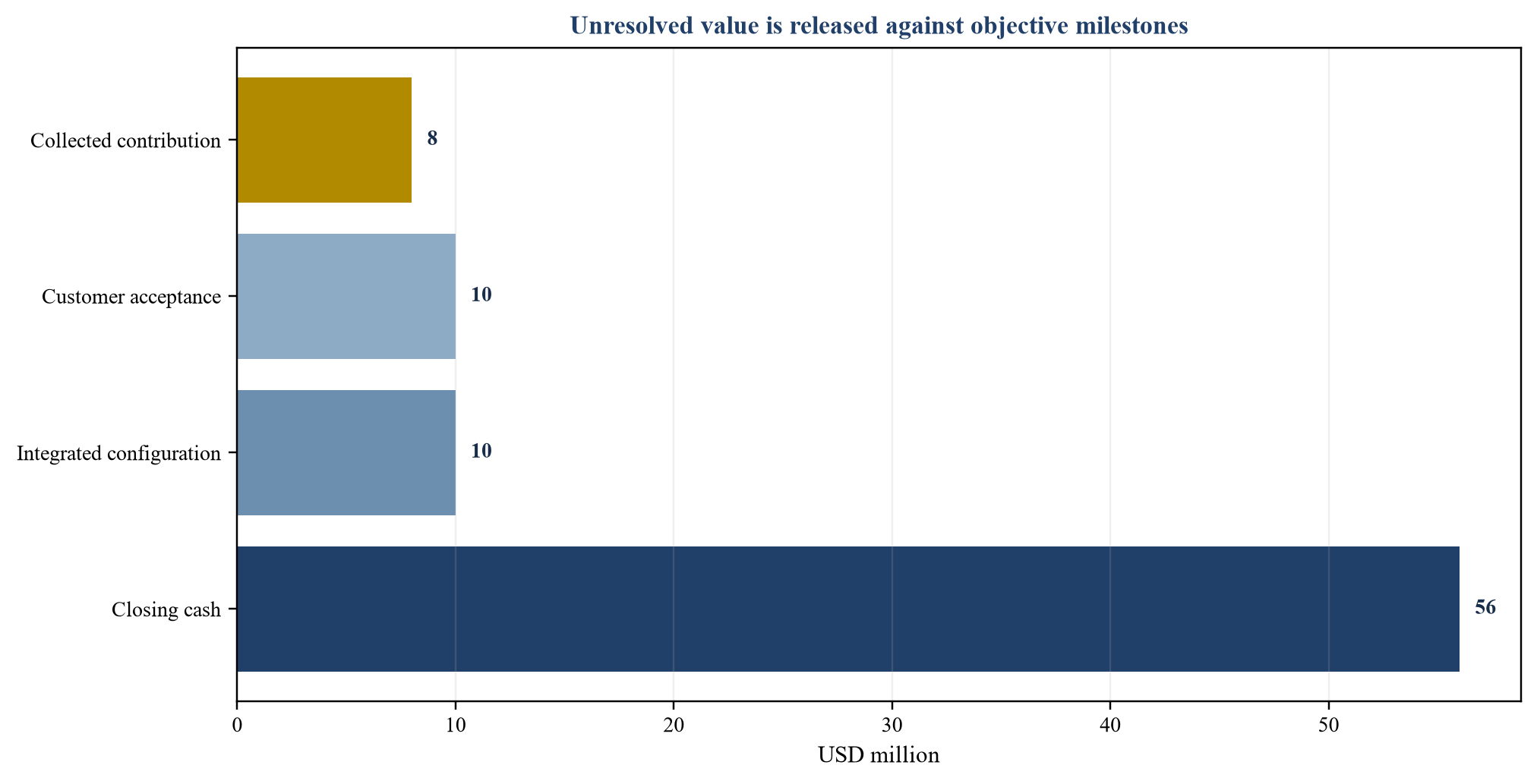
For the transaction, the board should release uncertain value only against objective configuration, mission and collection events. Technical milestones should name the relevant configuration, environment and independent evidence. Commercial milestones should use funded scope, accepted service and collected contribution rather than announcements. Identify base value, contingent value, integration investment, downside liquidity and contractual protection. State which conclusion changes if a customer, licence, employee, supplier or mission milestone fails to transfer.
25. Plan signing-to-close execution
The central diligence issue concerns customer consent, regulatory filings, export licences, information access, employee retention, financing and interim operating covenants. The evidence set should begin with transaction timetable, conditions precedent, clean-team protocol, consent matrix and long-stop analysis. Successful tests, anomalies, waivers and unresolved work belong in the same record.
The required analytical output is a critical-path closing plan. Link each conclusion to mission probability, integration schedule, cost, funding, customer acceptance and cash collection. A technical asset has transaction value when the buyer can control, transfer, integrate and use it in an authorised mission.
For the transaction, the board should protect mission continuity while limiting value leakage and prohibited integration. Space missions can have fixed launch and customer windows. The sale process should preserve supplier orders, configuration control and mission readiness during regulatory review. Identify base value, contingent value, integration investment, downside liquidity and contractual protection. State which conclusion changes if a customer, licence, employee, supplier or mission milestone fails to transfer.
26. Govern post-close integration
The central diligence issue concerns technical baseline, mission readiness, customer commitments, regulatory compliance, cash and synergy delivery. The evidence set should begin with integration management office, configuration board, mission reviews, customer steering and finance reconciliation. Successful tests, anomalies, waivers and unresolved work belong in the same record.
The required analytical output is one evidence-led value dashboard. Link each conclusion to mission probability, integration schedule, cost, funding, customer acceptance and cash collection. A technical asset has transaction value when the buyer can control, transfer, integrate and use it in an authorised mission.
For the transaction, the board should refresh the acquisition case when mission or customer evidence changes. The board should track branch probabilities, remaining funding and customer conversion, not only activity completion. New evidence should change intervention and capital decisions. Identify base value, contingent value, integration investment, downside liquidity and contractual protection. State which conclusion changes if a customer, licence, employee, supplier or mission milestone fails to transfer.
27. Make the board decision
The central diligence issue concerns whether the complete acquired mission chain justifies price, risk allocation and capital commitment. The evidence set should begin with capability map, integration tree, contract waterfall, regulatory plan, value bridge and downside liquidity. Successful tests, anomalies, waivers and unresolved work belong in the same record.
The required analytical output is approve, reprice, restructure, defer or walk away. Link each conclusion to mission probability, integration schedule, cost, funding, customer acceptance and cash collection. A technical asset has transaction value when the buyer can control, transfer, integrate and use it in an authorised mission.
For the transaction, the board should record the evidence supporting each element of price and protection. The strongest transaction case identifies a controlled route from customer need to collected cash. Missing capability can be acceptable when its owner, cost, timing and evidence milestone are explicit and funded. Identify base value, contingent value, integration investment, downside liquidity and contractual protection. State which conclusion changes if a customer, licence, employee, supplier or mission milestone fails to transfer.
Conclusion
An in-orbit servicing acquisition should be valued as a controlled mission chain. Robotics, rendezvous autonomy and customer access can each be scarce and valuable. Each can also become stranded when the other layers, interfaces, rights, people, approvals and funding do not transfer. The buyer therefore needs a capability map, mission tree, contract waterfall, integration work breakdown and jurisdiction-specific control plan before it can assign price.
The framework places standalone value on probability-weighted mission cash and controlled transferable assets. It places buyer-specific value on evidenced acceleration, avoided development, utilisation and customer conversion. It deducts integration, regulatory, change-of-control, concentration and funding exposure. It then aligns consideration with the evidence that remains to be created after signing.
The board decision is practical. The buyer should be able to identify who controls every critical capability, what evidence supports it, what it costs to combine, which customer will pay for the first integrated mission, which authority must approve it, and how the company survives a delay or failure. If those answers are incomplete, the transaction can still proceed through a lower upfront price, committed integration funding and contingent consideration tied to objective mission and cash outcomes.
Appendix A. Acquisition evidence request
Request the transaction perimeter, cap table, board approvals, mission architecture, system requirements, interface-control documents, qualification and acceptance records, flight telemetry, anomaly and waiver logs, source-code and data repositories, intellectual-property chain of title, open-source register, supplier contracts, launch arrangements, licences, export classifications, customer contracts, memoranda, order book, invoices, collections, insurance, programme accounts, cost-to-complete, cash forecast, employee agreements and retention plan. Reconcile each item to a named capability and forecast mission.
Appendix B. Red-flag tests
Red flags include a headline contract without funded scope; a customer memorandum without mission authority; robotics described as flight qualified without target-relevant testing; autonomy code without controlled training data; interfaces owned by a supplier; intellectual property developed under restrictive funding; change-of-control consent absent; export classification incomplete; key mission knowledge held by departing personnel; integration budget omitted; launch and customer windows misaligned; and cash runway ending before the first combined mission.
Appendix C. Hypothetical transaction assumptions
The worked case assumes a strategic buyer, a target with one completed inspection mission, one funded demonstration contract, three non-binding customer memoranda, controlled rendezvous software, a robotic capture mechanism and no repeat paid servicing mission. The target requires platform integration, customer consent, regulatory review and additional capital. All values are illustrative USD millions and do not describe a named company, mandate, forecast or offer.
Appendix D. Worked-case figures and tables
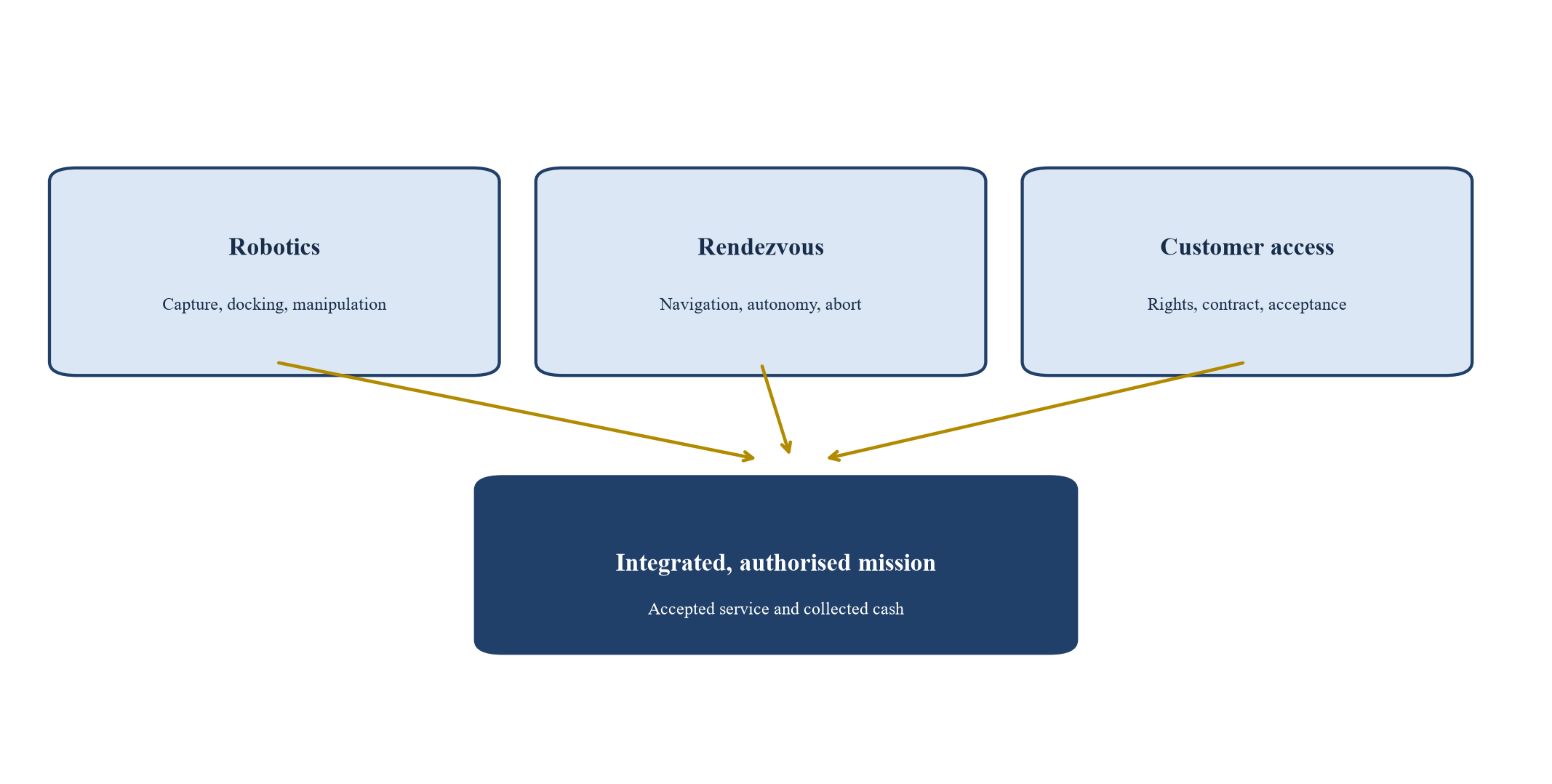
Proposed separation of robotics, rendezvous and customer-access value.
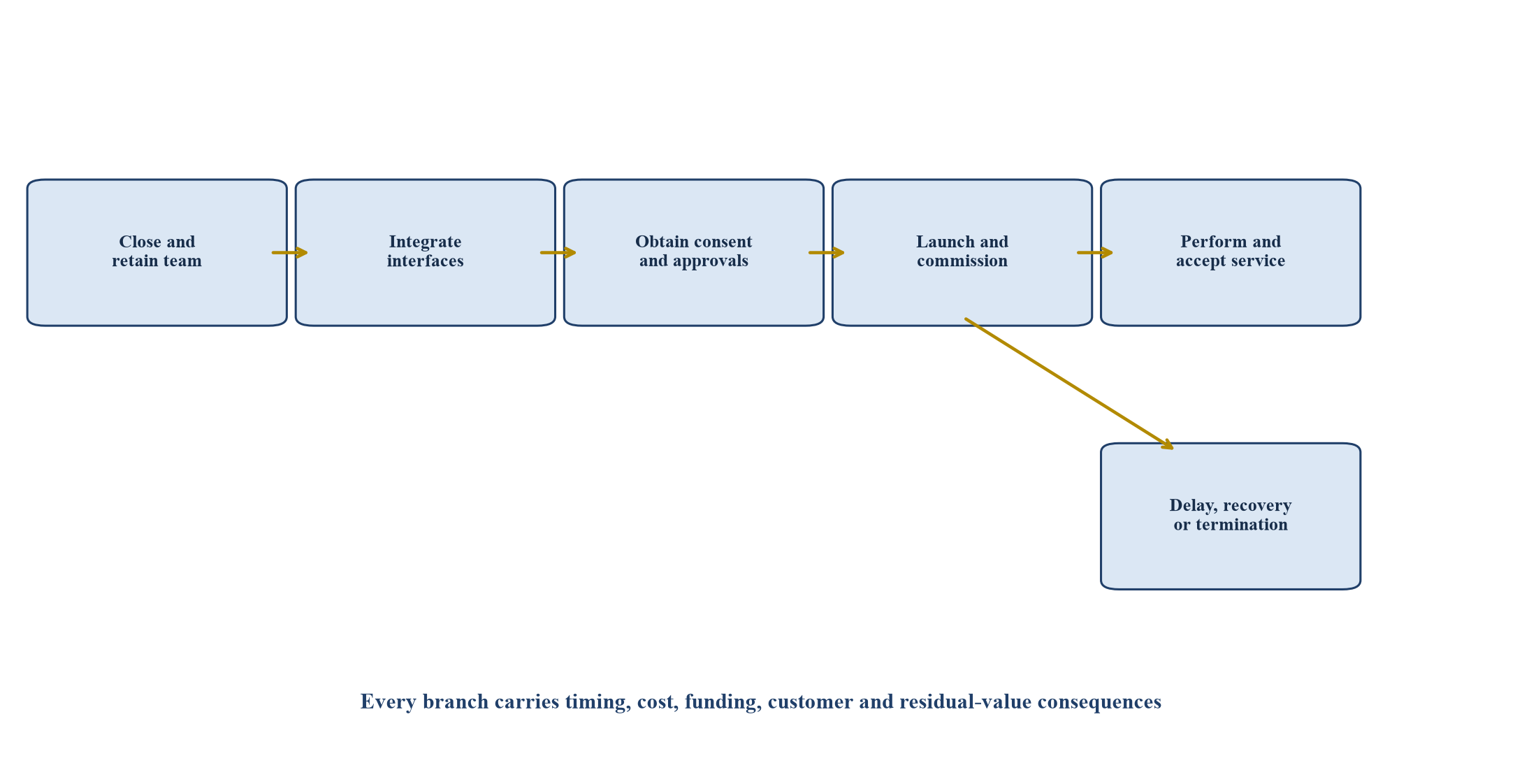
Illustrative sequence; branch probabilities require transaction evidence.
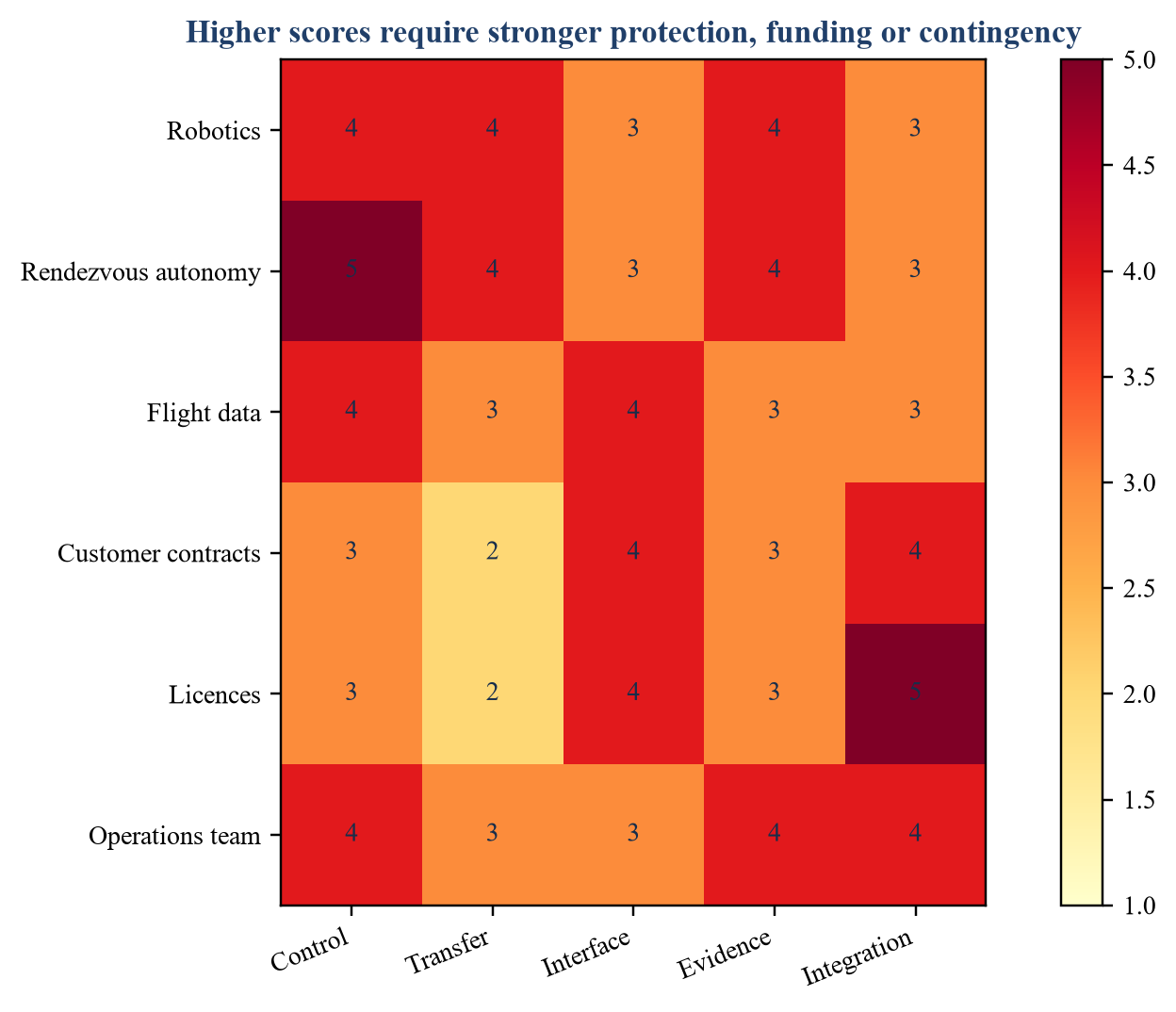
Illustrative risk scoring from one to five.
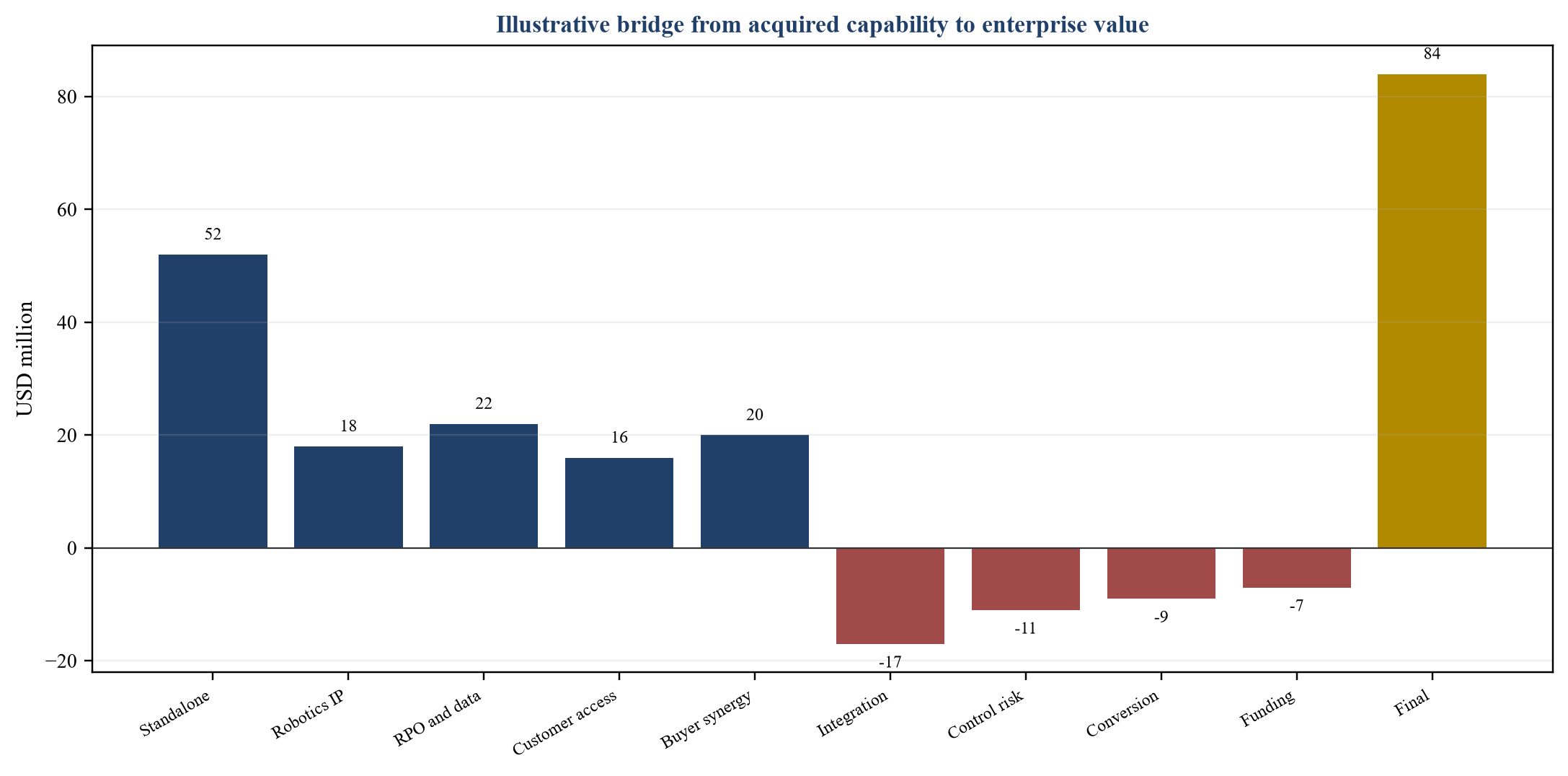
Illustrative USD millions; inputs require transaction-specific evidence.
Illustrative allocation of USD 84 million enterprise value.
| Archetype | Acquired value | Common missing dependency |
|---|---|---|
| Robotics | mechanisms, end-effectors, manipulation software and test heritage | target access, navigation and mission rights |
| Rendezvous autonomy | relative navigation, guidance, simulation and flight data | capture hardware, licences and customers |
| Customer access | contracts, procurement position and operator relationships | executable mission capability and funding |
| Integrated provider | combined platform, operations and customer pathway | repeat heritage, scale and working capital |
Proposed separation of transaction perimeter and missing dependencies.
| Evidence | Public observation | Transaction relevance |
|---|---|---|
| NASA 2025 ISAM State of Play | 11 capability areas across missions, facilities and developers | capability map and market fragmentation |
| GAO 2025 ISAM assessment | robotic servicing is not routine; demand, testing and regulation remain challenges | integration and adoption risk |
| ESA RISE | specialised robotics, sensors and autonomous docking linked to commercial service | integrated mission requirements |
| ESA ClearSpace-1 | publicly procured capture and removal mission | customer access and mission execution |
| JAXA CRD2 | phased demonstration from inspection toward removal | staged evidence and procurement |
| NASA OSAM-1 | cancelled after cost, schedule, technical and transition concerns | sunk cost is not transferable value |
Programme-specific records; they do not establish an unidentified target's value.
| Step | Required evidence | Valuation treatment |
|---|---|---|
| Relationship | named contact and engagement history | strategic context only |
| Mission authority | operator consent and command protocol | executable-right threshold |
| Executed scope | signed statement of work | legal perimeter |
| Funded amount | appropriation, task order or non-refundable deposit | remove unfunded options |
| Remaining cost | integration, launch and operations estimate | deduct fulfilment cash |
| Acceptance | objective customer milestone | probability weight |
| Collection | invoice and bank receipt | realised contribution |
Proposed reconciliation from relationship to collected contribution.
| Step | Amount | Required evidence |
|---|---|---|
| Standalone probability-weighted mission value | 52 | mission cash and downside cases |
| Controlled robotics and interface IP | 18 | ownership, configuration and buyer use |
| Rendezvous software and flight data | 22 | rights, provenance and relevance |
| Qualified customer access | 16 | consent, funded scope and mission rights |
| Buyer-specific synergies | 20 | executable integration and sales plan |
| Platform and integration work | minus 17 | cost, schedule and technical closure |
| Change-of-control and export exposure | minus 11 | filings, licences and mitigation |
| Customer conversion risk | minus 9 | binding scope and acceptance path |
| Remaining funding | minus 7 | downside runway through first mission |
| Final illustrative enterprise value | 84 | integrated evidence set |
All amounts are illustrative USD millions.
| Workstream | Core evidence | Completion trigger |
|---|---|---|
| Architecture | controlled interfaces and configuration | approved combined baseline |
| Software and data | repositories, access and validation | flight configuration accepted |
| Robotics | target-relevant qualification | integrated test passed |
| Customer | consent, scope and mission authority | binding executable order |
| Regulatory | filings, licences and controls | authorisation effective |
| People | retention and knowledge transfer | critical roles staffed |
| Capital | funded cost-to-complete and downside reserve | runway through acceptance |
Proposed work breakdown from signing through the first combined mission.
| Unresolved item | Potential protection | Release evidence |
|---|---|---|
| Interface compatibility | integration milestone | configuration-specific test |
| Customer transfer | consent condition | effective novation or order |
| Export and security | condition or carve-out | licence and clearance |
| Key-person dependency | retention escrow | service through mission review |
| Mission outcome | earn-out | accepted service |
| Commercial conversion | contingent value | collected contribution |
| Funding need | committed financing | downside runway funded |
Proposed allocation of unresolved value and risk.
| Dimension | Core measure | Trigger |
|---|---|---|
| Technical | interfaces closed and tests passed | critical anomaly or waiver |
| Mission | branch probability and schedule | material probability decline |
| Customer | funded executable scope | consent, budget or target change |
| Regulatory | approvals and controlled access | delay, mitigation or breach |
| People | critical-role coverage | departure or knowledge gap |
| Capital | runway through acceptance | downside funding shortfall |
| Value | standalone and synergy bridge | evidence or cost movement |
Proposed monthly board record.
Sources
- NASA Technical Reports Server, In-Space Servicing, Assembly, and Manufacturing State of Play, 2025 edition. Read the primary source
- NASA, In-Space Servicing, Assembly, and Manufacturing. Read the primary source
- U.S. Government Accountability Office, In-Space Servicing, Assembly, and Manufacturing: Benefits, Challenges, and Policy Options, GAO-25-107555, 10 July 2025. Read the primary source
- U.S. Government Accountability Office, GAO-25-107555 full report. Read the primary source
- European Space Agency, ESA to build first in-orbit servicing mission with D-Orbit, 14 October 2024. Read the primary source
- European Space Agency, ESA purchases world-first debris removal mission from start-up, 1 December 2020. Read the primary source
- European Space Agency, ClearSpace-1. Read the primary source
- Japan Aerospace Exploration Agency, JAXA concludes partnership-type contract for Phase II of its Commercial Removal of Debris Demonstration, 20 August 2024. Read the primary source
- Japan Aerospace Exploration Agency, CRD2 Phase I and ADRAS-J fly-around observation, 30 July 2024. Read the primary source
- NASA, On-orbit Servicing, Assembly, and Manufacturing 1. Read the primary source
- NASA, Robotic Servicing Mission Launches with NASA Support, 22 July 2026. Read the primary source
- NASA, Satellite Servicing Technologies Licensed by Northrop Grumman, 18 January 2022. Read the primary source
- NASA, Small Spacecraft Technology State of the Art: Guidance, Navigation, and Control, 2026. Read the primary source
- NASA, Systems Engineering Handbook Appendix: Establishing Technology Readiness Levels. Read the primary source
- NASA, Systems Engineering Handbook, SP-2016-6105 Rev 2. Read the primary source
- U.S. Department of Commerce, Bureau of Industry and Security, EAR Part 734. Read the primary source
- U.S. Department of Commerce, Bureau of Industry and Security, EAR Part 748. Read the primary source
- U.S. Department of the Treasury, CFIUS guidance on information that may facilitate review. Read the primary source
- U.S. Department of the Treasury, 2024 CFIUS Annual Report. Read the primary source
- UK Government, National Security and Investment Act guidance on notifiable acquisitions: Satellite and Space Technology. Read the primary source
- Northrop Grumman Corporation, Annual Report for the year ended 31 December 2025. Read the primary source
- Momentus Inc., Annual Report for the year ended 31 December 2024. Read the primary source
- IFRS Foundation, IFRS 3 Business Combinations. Read the primary source
- IFRS Foundation, IFRS 13 Fair Value Measurement. Read the primary source
- IFRS Foundation, IAS 38 Intangible Assets. Read the primary source
- IFRS Foundation, IAS 36 Impairment of Assets. Read the primary source
- International Valuation Standards Council, IVS 105 Valuation Models, 31 January 2025. Read the primary source
- United Nations Office for Outer Space Affairs, Guidelines for the Long-term Sustainability of Outer Space Activities, 2021. Read the primary source
- Inter-Agency Space Debris Coordination Committee, IADC Space Debris Mitigation Guidelines, Rev 3, 2025. Read the primary source
