
Introduction
A space tug is an orbital vehicle that changes another object's orbit, attitude, condition or useful life. The service can include inspection, relocation, life extension, refuelling, docking, payload installation, active debris removal or logistics between orbital regimes. The same company may use common spacecraft, propulsion, guidance and operations infrastructure across several services, yet each service carries a different mission sequence, customer value, licensing route, liability allocation and capital requirement.
Repeat mission heritage is powerful evidence because it tests more than hardware. It tests mission selection, integration, launch procurement, commissioning, navigation, collision avoidance, command authority, customer coordination, anomaly response, service completion and post-mission disposal. A first mission may validate only part of that chain. Investors should therefore avoid treating a successful photograph, close approach, docking event or propulsion burn as proof that the company can deliver a repeatable commercial service at the assumed margin.
The valuation task is to convert technical maturity into risk-adjusted future cash while keeping the mission sequence visible. This paper builds that conversion from primary programme evidence, transaction-specific diligence and explicit management scenarios. It does not assign a universal multiple to flight heritage. It asks which capability was demonstrated, under what conditions, against which customer obligation, with what remaining work and funding, and whether the evidence can be reused in the next mission.
1. Define the valuation decision
The central question concerns the valuation date, buyer or financing decision, target perimeter, mission classes and required return. Diligence should start with board papers, cap table, programme plan, audited accounts, contract register and technical baseline. Record successful evidence, anomalies and unresolved work against the relevant configuration and date.
The analytical output is one approved decision question and evidence cut-off. Connect technical evidence to mission probability, schedule, cost, cash collection and residual spacecraft capacity. Use named events and preserve correlated failure modes rather than hiding them inside one discount rate.
For the transaction, the board should price only capabilities and contracts that fall inside the acquired or financed perimeter. A valuation prepared for an acquisition may admit integration synergies that a lender cannot underwrite. The report should state the permitted value basis before any model is built. State which evidence supports base value, which supports contingent value and which risks require deductions, liquidity or contractual protection.
2. Map the service architecture
The central question concerns inspection, relocation, life extension, refuelling, docking, installation, debris removal and orbital logistics. Diligence should start with product roadmaps, system architecture, mission concepts, customer statements of work and operating licences. Record successful evidence, anomalies and unresolved work against the relevant configuration and date.
The analytical output is a service-by-service architecture and dependency map. Connect technical evidence to mission probability, schedule, cost, cash collection and residual spacecraft capacity. Use named events and preserve correlated failure modes rather than hiding them inside one discount rate.
For the transaction, the board should separate common platform value from mission-specific payload and integration work. A shared bus can reduce non-recurring engineering, but a new capture mechanism or customer interface may reopen qualification, safety and schedule risk. State which evidence supports base value, which supports contingent value and which risks require deductions, liquidity or contractual protection.
3. Build the mission evidence ladder
The central question concerns subsystem, integrated ground, launch, commissioning, proximity, interaction, outcome and paid repeat evidence. Diligence should start with test reports, telemetry, customer acceptance, independent reviews, anomaly logs and invoices. Record successful evidence, anomalies and unresolved work against the relevant configuration and date.
The analytical output is an evidence state for each material capability. Connect technical evidence to mission probability, schedule, cost, cash collection and residual spacecraft capacity. Use named events and preserve correlated failure modes rather than hiding them inside one discount rate.
For the transaction, the board should apply the strongest evidence only to the mission conditions it actually covers. The ladder prevents one successful activity from being stretched across untested propulsion, target, orbit, autonomy or customer conditions. State which evidence supports base value, which supports contingent value and which risks require deductions, liquidity or contractual protection.
4. Use technology readiness carefully
The central question concerns technology maturity at component, subsystem and integrated mission level. Diligence should start with NASA or equivalent readiness assessments, qualification records, environmental tests and configuration control. Record successful evidence, anomalies and unresolved work against the relevant configuration and date.
The analytical output is a readiness assessment tied to a defined environment. Connect technical evidence to mission probability, schedule, cost, cash collection and residual spacecraft capacity. Use named events and preserve correlated failure modes rather than hiding them inside one discount rate.
For the transaction, the board should treat readiness as one input to probability rather than a substitute for commercial evidence. NASA describes readiness as performance history relative to defined levels and warns that relevance depends on the intended environment. A component score cannot be averaged into proof of system performance. State which evidence supports base value, which supports contingent value and which risks require deductions, liquidity or contractual protection.
5. Define repeat mission heritage
The central question concerns whether completed missions share the target, orbit, propulsion, navigation, capture, autonomy and operating sequence of the forecast service. Diligence should start with mission reports, configuration records, telemetry, customer acceptance and post-flight review. Record successful evidence, anomalies and unresolved work against the relevant configuration and date.
The analytical output is a similarity-weighted heritage score. Connect technical evidence to mission probability, schedule, cost, cash collection and residual spacecraft capacity. Use named events and preserve correlated failure modes rather than hiding them inside one discount rate.
For the transaction, the board should award full heritage only to capabilities repeated under commercially relevant conditions. A second mission can provide weak repeat evidence when it changes every material interface. A first mission can provide strong subsystem evidence when its configuration and environment match the next contracted service. State which evidence supports base value, which supports contingent value and which risks require deductions, liquidity or contractual protection.
6. Construct the mission tree
The central question concerns the conditional path from contract award to collected service revenue. Diligence should start with launch manifests, readiness reviews, probability assessments, insurance terms, acceptance criteria and payment milestones. Record successful evidence, anomalies and unresolved work against the relevant configuration and date.
The analytical output is stage-specific probability and cash for every branch. Connect technical evidence to mission probability, schedule, cost, cash collection and residual spacecraft capacity. Use named events and preserve correlated failure modes rather than hiding them inside one discount rate.
For the transaction, the board should multiply dependent stages rather than applying one headline probability. The tree should include contract effectiveness, financing, hardware completion, launch, commissioning, rendezvous, service, acceptance, collection and disposal. Recovery branches belong in the model when they are operationally available. State which evidence supports base value, which supports contingent value and which risks require deductions, liquidity or contractual protection.
7. Model launch and commissioning
The central question concerns launch availability, rideshare compatibility, separation, early operations, orbit raising and commissioning. Diligence should start with launch contract, interface control documents, mass properties, schedule, licensing and commissioning plan. Record successful evidence, anomalies and unresolved work against the relevant configuration and date.
The analytical output is probability, delay and cash impact for entry into service. Connect technical evidence to mission probability, schedule, cost, cash collection and residual spacecraft capacity. Use named events and preserve correlated failure modes rather than hiding them inside one discount rate.
For the transaction, the board should keep launch-provider performance distinct from target-company execution. A launch delay may defer revenue without destroying the spacecraft. A failed separation or commissioning event can remove the entire mission and trigger replacement capital. State which evidence supports base value, which supports contingent value and which risks require deductions, liquidity or contractual protection.
8. Test rendezvous and proximity operations
The central question concerns relative navigation, trajectory planning, keep-out zones, collision avoidance, communications and command authority. Diligence should start with flight telemetry, simulations, hardware-in-the-loop tests, safety reviews and operator procedures. Record successful evidence, anomalies and unresolved work against the relevant configuration and date.
The analytical output is a condition-specific probability of safe approach. Connect technical evidence to mission probability, schedule, cost, cash collection and residual spacecraft capacity. Use named events and preserve correlated failure modes rather than hiding them inside one discount rate.
For the transaction, the board should distinguish cooperative targets from unprepared or tumbling objects. JAXA's ADRAS-J record provides evidence for observation of a non-cooperative target. A valuation should still test how target dynamics, illumination, sensors, autonomy and stand-off distance compare with the proposed mission. State which evidence supports base value, which supports contingent value and which risks require deductions, liquidity or contractual protection.
9. Assess capture and docking
The central question concerns mechanical interface, contact dynamics, target preparation, robotic manipulation and abort logic. Diligence should start with interface drawings, test articles, contact simulations, ground demonstrations and mission telemetry. Record successful evidence, anomalies and unresolved work against the relevant configuration and date.
The analytical output is a capture or docking evidence score. Connect technical evidence to mission probability, schedule, cost, cash collection and residual spacecraft capacity. Use named events and preserve correlated failure modes rather than hiding them inside one discount rate.
For the transaction, the board should price cooperative docking separately from unprepared capture. Prepared interfaces reduce uncertainty but may narrow the addressable fleet. Unprepared capture expands the market while increasing dynamics, validation and liability requirements. State which evidence supports base value, which supports contingent value and which risks require deductions, liquidity or contractual protection.
10. Reconcile propulsion performance
The central question concerns thrust, specific impulse, propellant mass, duty cycle, thermal constraints, reliability and degradation. Diligence should start with qualification data, acceptance tests, in-orbit burns, telemetry, supplier records and margins. Record successful evidence, anomalies and unresolved work against the relevant configuration and date.
The analytical output is verified delta-v and life for each mission profile. Connect technical evidence to mission probability, schedule, cost, cash collection and residual spacecraft capacity. Use named events and preserve correlated failure modes rather than hiding them inside one discount rate.
For the transaction, the board should deduct reserves before calculating saleable transport or life-extension capacity. The economic model should reconcile dry mass, payload, propellant, navigation reserves, collision-avoidance reserves, disposal and credible performance degradation. State which evidence supports base value, which supports contingent value and which risks require deductions, liquidity or contractual protection.
11. Calculate the delta-v ledger
The central question concerns every planned manoeuvre and the uncertainty around it. Diligence should start with trajectory analysis, mission design, covariance, target state, propulsion data and contingency rules. Record successful evidence, anomalies and unresolved work against the relevant configuration and date.
The analytical output is a mission-level propellant and schedule ledger. Connect technical evidence to mission probability, schedule, cost, cash collection and residual spacecraft capacity. Use named events and preserve correlated failure modes rather than hiding them inside one discount rate.
For the transaction, the board should make unallocated reserve a board-controlled resource. A tug may complete the first customer task and lose residual value because contingency use leaves insufficient propellant for transfer, disposal or a second client. State which evidence supports base value, which supports contingent value and which risks require deductions, liquidity or contractual protection.
12. Value residual mission capacity
The central question concerns the service potential remaining after the anchor mission. Diligence should start with propellant state, component life, orbit, customer pipeline, licensing and inspection evidence. Record successful evidence, anomalies and unresolved work against the relevant configuration and date.
The analytical output is probability-weighted residual cash less repositioning and disposal. Connect technical evidence to mission probability, schedule, cost, cash collection and residual spacecraft capacity. Use named events and preserve correlated failure modes rather than hiding them inside one discount rate.
For the transaction, the board should include residual value only when a feasible next mission and funding route exist. Residual hardware has option value when it can reach a paying client within its life and risk limits. Stranded hardware can carry disposal cost rather than terminal value. State which evidence supports base value, which supports contingent value and which risks require deductions, liquidity or contractual protection.
13. Test spacecraft reusability
The central question concerns whether the platform can serve multiple clients without unacceptable degradation or requalification. Diligence should start with design life, radiation analysis, cycling tests, flight telemetry, maintenance concept and mission plan. Record successful evidence, anomalies and unresolved work against the relevant configuration and date.
The analytical output is expected missions per vehicle by scenario. Connect technical evidence to mission probability, schedule, cost, cash collection and residual spacecraft capacity. Use named events and preserve correlated failure modes rather than hiding them inside one discount rate.
For the transaction, the board should stress one-and-done and degraded-life cases. Reuse economics depend on more than propellant. Sensors, avionics, mechanisms, thermal cycles, docking loads and ground-operations burden can constrain the service count. State which evidence supports base value, which supports contingent value and which risks require deductions, liquidity or contractual protection.
14. Map manufacturing readiness
The central question concerns engineering models, flight units, supply chain, quality, test capacity and rate production. Diligence should start with bill of materials, supplier agreements, non-conformance records, yield, lead times and factory plan. Record successful evidence, anomalies and unresolved work against the relevant configuration and date.
The analytical output is unit cost and schedule at the forecast cadence. Connect technical evidence to mission probability, schedule, cost, cash collection and residual spacecraft capacity. Use named events and preserve correlated failure modes rather than hiding them inside one discount rate.
For the transaction, the board should separate demonstrated build cost from management's rate-production target. A prototype team can deliver a demonstration through intensive engineering effort. Commercial margins require repeatable configuration control, supplier quality and acceptance testing. State which evidence supports base value, which supports contingent value and which risks require deductions, liquidity or contractual protection.
15. Identify single-point failures
The central question concerns components, suppliers, software functions or approvals whose failure removes the mission. Diligence should start with FMEA, fault trees, redundancy analysis, supplier audits, anomaly history and spares policy. Record successful evidence, anomalies and unresolved work against the relevant configuration and date.
The analytical output is probability and cash exposure by critical failure. Connect technical evidence to mission probability, schedule, cost, cash collection and residual spacecraft capacity. Use named events and preserve correlated failure modes rather than hiding them inside one discount rate.
For the transaction, the board should fund redesign or redundancy before attributing high mission probability. The valuation model should show whether one low-cost component can destroy a high-value mission and whether recovery, safe mode or replacement hardware exists. State which evidence supports base value, which supports contingent value and which risks require deductions, liquidity or contractual protection.
16. Reconcile software and autonomy
The central question concerns navigation, perception, planning, control, fault management, operator intervention and cyber resilience. Diligence should start with code baseline, simulation coverage, verification records, flight logs, model updates and incident response. Record successful evidence, anomalies and unresolved work against the relevant configuration and date.
The analytical output is verified software behaviour by mission phase. Connect technical evidence to mission probability, schedule, cost, cash collection and residual spacecraft capacity. Use named events and preserve correlated failure modes rather than hiding them inside one discount rate.
For the transaction, the board should avoid assigning flight heritage to materially changed or untested software. Autonomy may expand mission capacity and reduce operations cost. It can also create validation, explainability, cyber and configuration risks when the flight stack changes between missions. State which evidence supports base value, which supports contingent value and which risks require deductions, liquidity or contractual protection.
17. Assess operations scalability
The central question concerns mission control staffing, ground stations, procedures, licensing, customer interfaces and simultaneous missions. Diligence should start with shift plans, rehearsal records, console logs, ground-network contracts and operating cost. Record successful evidence, anomalies and unresolved work against the relevant configuration and date.
The analytical output is operations hours and cost per mission. Connect technical evidence to mission probability, schedule, cost, cash collection and residual spacecraft capacity. Use named events and preserve correlated failure modes rather than hiding them inside one discount rate.
For the transaction, the board should value automation only after evidence of safe workload reduction. A service can be technically reusable and commercially unscalable when each mission requires scarce engineers, bespoke procedures or round-the-clock manual control. State which evidence supports base value, which supports contingent value and which risks require deductions, liquidity or contractual protection.
18. Build the regulatory map
The central question concerns launch, spectrum, remote sensing, export control, rendezvous, debris mitigation, re-entry and national-security permissions. Diligence should start with licences, regulator correspondence, jurisdiction analysis, customer requirements and mission timeline. Record successful evidence, anomalies and unresolved work against the relevant configuration and date.
The analytical output is an approval path with owners, dates and dependencies. Connect technical evidence to mission probability, schedule, cost, cash collection and residual spacecraft capacity. Use named events and preserve correlated failure modes rather than hiding them inside one discount rate.
For the transaction, the board should treat missing critical approval as a milestone rather than completed value. Regulatory evidence is mission and jurisdiction specific. Prior approval can shorten the next path but may not transfer across target, orbit, sensor, country or change of control. State which evidence supports base value, which supports contingent value and which risks require deductions, liquidity or contractual protection.
19. Allocate liability and indemnity
The central question concerns collision, target damage, failed service, third-party loss, re-entry, data and national responsibility. Diligence should start with contract clauses, insurance, launch-state analysis, counsel opinions and treaty implementation. Record successful evidence, anomalies and unresolved work against the relevant configuration and date.
The analytical output is a loss allocation and insurance-cost schedule. Connect technical evidence to mission probability, schedule, cost, cash collection and residual spacecraft capacity. Use named events and preserve correlated failure modes rather than hiding them inside one discount rate.
For the transaction, the board should deduct uninsured or uncapped exposure from value and liquidity. Commercial pricing can be misleading when the operator retains catastrophic downside or gives broad performance warranties without matching insurance or customer responsibility. State which evidence supports base value, which supports contingent value and which risks require deductions, liquidity or contractual protection.
20. Test debris-mitigation compliance
The central question concerns post-mission disposal, passivation, collision risk and the effect of failure states. Diligence should start with mission disposal plan, regulator rules, reliability analysis, conjunction procedures and end-of-life budget. Record successful evidence, anomalies and unresolved work against the relevant configuration and date.
The analytical output is a funded, licensable disposal outcome. Connect technical evidence to mission probability, schedule, cost, cash collection and residual spacecraft capacity. Use named events and preserve correlated failure modes rather than hiding them inside one discount rate.
For the transaction, the board should reserve propellant, time and cash for responsible end-of-life. A tug that becomes debris can damage the licence, franchise and wider market. Disposal should therefore be part of the service cost and mission probability. State which evidence supports base value, which supports contingent value and which risks require deductions, liquidity or contractual protection.
21. Segment customers and missions
The central question concerns commercial GEO, LEO constellations, civil agencies, defence customers and debris-removal programmes. Diligence should start with customer interviews, procurements, budgets, fleet data, mission requirements and payment records. Record successful evidence, anomalies and unresolved work against the relevant configuration and date.
The analytical output is addressable missions with timing and procurement route. Connect technical evidence to mission probability, schedule, cost, cash collection and residual spacecraft capacity. Use named events and preserve correlated failure modes rather than hiding them inside one discount rate.
For the transaction, the board should use a bottom-up mission set rather than a broad space-economy percentage. Different customers buy different outcomes. A GEO operator may buy years of transponder revenue; a defence customer may buy responsiveness; a civil agency may buy debris removal or technology demonstration. State which evidence supports base value, which supports contingent value and which risks require deductions, liquidity or contractual protection.
22. Reconstruct contract quality
The central question concerns funded backlog, options, indefinite-delivery vehicles, milestones, termination rights, acceptance and payment. Diligence should start with executed contracts, appropriations, purchase orders, change orders, invoices and collections. Record successful evidence, anomalies and unresolved work against the relevant configuration and date.
The analytical output is a contract waterfall from headline award to risk-adjusted cash. Connect technical evidence to mission probability, schedule, cost, cash collection and residual spacecraft capacity. Use named events and preserve correlated failure modes rather than hiding them inside one discount rate.
For the transaction, the board should exclude unfunded options and unsupported pipeline from committed backlog. Government awards can include cost share, milestones or future options. Commercial memoranda may depend on launch, financing or a particular client spacecraft remaining operational. State which evidence supports base value, which supports contingent value and which risks require deductions, liquidity or contractual protection.
23. Build the contract waterfall
The central question concerns the movement from announced award through funded scope, remaining cost, acceptance and cash. Diligence should start with contract schedules, funding notices, earned-value data, cost-to-complete and billing records. Record successful evidence, anomalies and unresolved work against the relevant configuration and date.
The analytical output is contract contribution after probability and fulfilment cost. Connect technical evidence to mission probability, schedule, cost, cash collection and residual spacecraft capacity. Use named events and preserve correlated failure modes rather than hiding them inside one discount rate.
For the transaction, the board should reconcile press-release values to legally funded economics. The waterfall should show funded backlog, customer cancellation, expected modifications, pass-through launch cost, cost share, working capital, tax and collection timing. State which evidence supports base value, which supports contingent value and which risks require deductions, liquidity or contractual protection.
24. Test customer concentration
The central question concerns dependence on one agency, operator, programme, prime contractor or mission class. Diligence should start with contract register, pipeline, budget documents, customer strategy and receivables. Record successful evidence, anomalies and unresolved work against the relevant configuration and date.
The analytical output is revenue and cash concentration under delayed and lost-customer cases. Connect technical evidence to mission probability, schedule, cost, cash collection and residual spacecraft capacity. Use named events and preserve correlated failure modes rather than hiding them inside one discount rate.
For the transaction, the board should apply concentration deductions and liquidity reserves. Anchor customers create credibility and flight opportunity. They can also shape the platform around one requirement and delay payment through procurement or acceptance processes. State which evidence supports base value, which supports contingent value and which risks require deductions, liquidity or contractual protection.
25. Separate service revenue from development funding
The central question concerns non-recurring engineering, grants, cost-sharing, milestone funding and commercial service payments. Diligence should start with general ledger, contracts, grant terms, revenue recognition and cash receipts. Record successful evidence, anomalies and unresolved work against the relevant configuration and date.
The analytical output is revenue quality by economic purpose. Connect technical evidence to mission probability, schedule, cost, cash collection and residual spacecraft capacity. Use named events and preserve correlated failure modes rather than hiding them inside one discount rate.
For the transaction, the board should avoid applying recurring-service multiples to subsidised development income. Development funding can reduce dilution and validate strategic interest. It does not by itself prove sustainable margin, repeat demand or pricing power. State which evidence supports base value, which supports contingent value and which risks require deductions, liquidity or contractual protection.
26. Forecast mission unit economics
The central question concerns price, launch, hardware, payload, operations, insurance, licensing, ground network, working capital and disposal. Diligence should start with bottom-up cost model, supplier quotes, contracts, telemetry and post-mission actuals. Record successful evidence, anomalies and unresolved work against the relevant configuration and date.
The analytical output is gross contribution and cash per mission class. Connect technical evidence to mission probability, schedule, cost, cash collection and residual spacecraft capacity. Use named events and preserve correlated failure modes rather than hiding them inside one discount rate.
For the transaction, the board should show the effect of delay, replacement and contingency use. A mission may report positive gross margin while consuming corporate engineering and test capacity that must be replenished before another customer can be served. State which evidence supports base value, which supports contingent value and which risks require deductions, liquidity or contractual protection.
27. Measure funding to repeat heritage
The central question concerns cash required to reach the next value-changing mission and survive plausible delay. Diligence should start with cash balance, monthly burn, milestone receipts, cost-to-complete, schedule risk and financing terms. Record successful evidence, anomalies and unresolved work against the relevant configuration and date.
The analytical output is base and downside funding requirement. Connect technical evidence to mission probability, schedule, cost, cash collection and residual spacecraft capacity. Use named events and preserve correlated failure modes rather than hiding them inside one discount rate.
For the transaction, the board should treat underfunding as a valuation and execution risk. The company should have enough liquidity for hardware completion, launch delay, anomaly response, insurance, working capital and the next financing process. A thin cash runway can force a weak contract or distressed round. State which evidence supports base value, which supports contingent value and which risks require deductions, liquidity or contractual protection.
28. Select the valuation methods
The central question concerns probability-weighted DCF, milestone option value, cost approach, comparable transactions and replacement cost. Diligence should start with mission tree, contracts, unit economics, funding plan, IP register and market evidence. Record successful evidence, anomalies and unresolved work against the relevant configuration and date.
The analytical output is a triangulated range with visible dependencies. Connect technical evidence to mission probability, schedule, cost, cash collection and residual spacecraft capacity. Use named events and preserve correlated failure modes rather than hiding them inside one discount rate.
For the transaction, the board should give greatest weight to methods supported by observable target evidence. A revenue multiple can obscure mission probability and capital intensity. A cost approach can miss contract and flight-data value. A mission DCF can overstate precision unless its branches are independently supported. State which evidence supports base value, which supports contingent value and which risks require deductions, liquidity or contractual protection.
29. Value transferable technology
The central question concerns software, propulsion, mechanisms, designs, test assets, flight data, patents and know-how. Diligence should start with IP ownership, licences, employee obligations, configuration records, test history and buyer integration plan. Record successful evidence, anomalies and unresolved work against the relevant configuration and date.
The analytical output is cash or avoided cost attributable to transferable assets. Connect technical evidence to mission probability, schedule, cost, cash collection and residual spacecraft capacity. Use named events and preserve correlated failure modes rather than hiding them inside one discount rate.
For the transaction, the board should discount technology that cannot transfer with people, licences or data. IAS 38 distinguishes identifiable rights from internally generated goodwill. Transaction valuation should similarly separate controlled assets from team reputation and future effort. State which evidence supports base value, which supports contingent value and which risks require deductions, liquidity or contractual protection.
30. Price platform options
The central question concerns future services, orbital regimes, customer classes and payloads enabled by the current architecture. Diligence should start with technical interfaces, mission analysis, customer evidence, regulatory path and incremental funding. Record successful evidence, anomalies and unresolved work against the relevant configuration and date.
The analytical output is probability-weighted option value net of exercise cost. Connect technical evidence to mission probability, schedule, cost, cash collection and residual spacecraft capacity. Use named events and preserve correlated failure modes rather than hiding them inside one discount rate.
For the transaction, the board should exclude remote adjacencies that require a new vehicle or market. An option deserves value when the current platform creates a lower-cost route to a defined future service and management retains the resources and right to exercise it. State which evidence supports base value, which supports contingent value and which risks require deductions, liquidity or contractual protection.
31. Build the hypothetical value bridge
The central question concerns standalone cash, transferable technology, platform options, contract evidence and unresolved deductions. Diligence should start with transaction-specific technical, contractual, financial and regulatory diligence. Record successful evidence, anomalies and unresolved work against the relevant configuration and date.
The analytical output is USD 68 million of illustrative enterprise value. Connect technical evidence to mission probability, schedule, cost, cash collection and residual spacecraft capacity. Use named events and preserve correlated failure modes rather than hiding them inside one discount rate.
For the transaction, the board should demonstrate valuation mechanics without representing an actual company. The bridge preserves the distinction between value already evidenced and upside that remains conditional on mission, customer, regulatory and funding outcomes. State which evidence supports base value, which supports contingent value and which risks require deductions, liquidity or contractual protection.
32. Run downside and liquidity cases
The central question concerns launch delay, mission loss, partial service, target unavailability, customer termination, cost growth and financing stress. Diligence should start with mission tree, insurance, contracts, cash forecast, failure analysis and recovery plan. Record successful evidence, anomalies and unresolved work against the relevant configuration and date.
The analytical output is equity value and survival under severe but plausible cases. Connect technical evidence to mission probability, schedule, cost, cash collection and residual spacecraft capacity. Use named events and preserve correlated failure modes rather than hiding them inside one discount rate.
For the transaction, the board should require enough cash and covenant flexibility for the chosen downside. The downside case should consider the interaction of events. A launch delay can increase burn, expire supplier quotes, move a customer window and force financing before mission evidence arrives. State which evidence supports base value, which supports contingent value and which risks require deductions, liquidity or contractual protection.
33. Design transaction protections
The central question concerns price deferral, milestone payments, earn-outs, holdbacks, escrow, warranties, covenants and funding commitments. Diligence should start with value bridge, diligence exceptions, contract terms, mission milestones and integration plan. Record successful evidence, anomalies and unresolved work against the relevant configuration and date.
The analytical output is consideration released against objective evidence. Connect technical evidence to mission probability, schedule, cost, cash collection and residual spacecraft capacity. Use named events and preserve correlated failure modes rather than hiding them inside one discount rate.
For the transaction, the board should tie uncertain value to funded contract, mission completion, repeat service and collected cash. Technical milestones should be defined with configuration, environment, customer acceptance and evidence requirements. Revenue milestones should be based on collected contribution rather than announcements. State which evidence supports base value, which supports contingent value and which risks require deductions, liquidity or contractual protection.
34. Govern post-close value
The central question concerns mission readiness, technical configuration, contract delivery, customer evidence, cash and residual capacity. Diligence should start with board dashboard, readiness reviews, telemetry, contract waterfall, finance reconciliation and risk register. Record successful evidence, anomalies and unresolved work against the relevant configuration and date.
The analytical output is one monthly decision record linked to the acquisition case. Connect technical evidence to mission probability, schedule, cost, cash collection and residual spacecraft capacity. Use named events and preserve correlated failure modes rather than hiding them inside one discount rate.
For the transaction, the board should refresh value and intervention decisions when evidence changes. The board should track probability movement, not only schedule. A passed test, new contract condition, anomaly or funding change should alter the mission tree and capital plan. State which evidence supports base value, which supports contingent value and which risks require deductions, liquidity or contractual protection.
Conclusion
Pre-repeat-heritage space-tug valuation is a mission-evidence problem before it is a multiple problem. The company may control valuable technology, contracts and flight data, while the forecast commercial service still depends on a chain of funded, technical, regulatory and customer events. The valuation should preserve that chain.
The framework separates subsystem maturity, integrated testing, launch, commissioning, proximity operations, client interaction, completed outcome and paid repeat service. It then connects those states to propulsion, residual capacity, contract contribution, liquidity and transaction protections. This approach allows strong evidence to earn value without treating one demonstration as proof of every future mission.
For boards and investment committees, the governing question is whether the price remains supportable when the next mission is delayed, partially completed or lost, and whether sufficient capital survives to reach the following evidence milestone. The answer should determine price, financing, milestone consideration, warranties, integration and post-close governance.
Appendix A. Mission evidence register
Record each capability, configuration, target type, orbit, environment, test or flight event, result, anomaly, independent reviewer, customer acceptance, transferability conclusion and linked valuation claim. Retain unsuccessful tests and superseded configurations.
Appendix B. Contract and cash register
For each customer opportunity, record executed scope, funded amount, options, cost share, milestones, termination rights, acceptance, remaining cost, invoices, collections, launch dependency, spacecraft dependency and probability branch.
Appendix C. Transaction approval checklist
The approval file should include the mission evidence ladder, technology baseline, mission tree, delta-v ledger, residual-capacity model, regulatory and liability map, contract waterfall, unit economics, funding plan, valuation range, downside liquidity, transaction protections and post-close dashboard.
Appendix D. Worked-case figures and tables
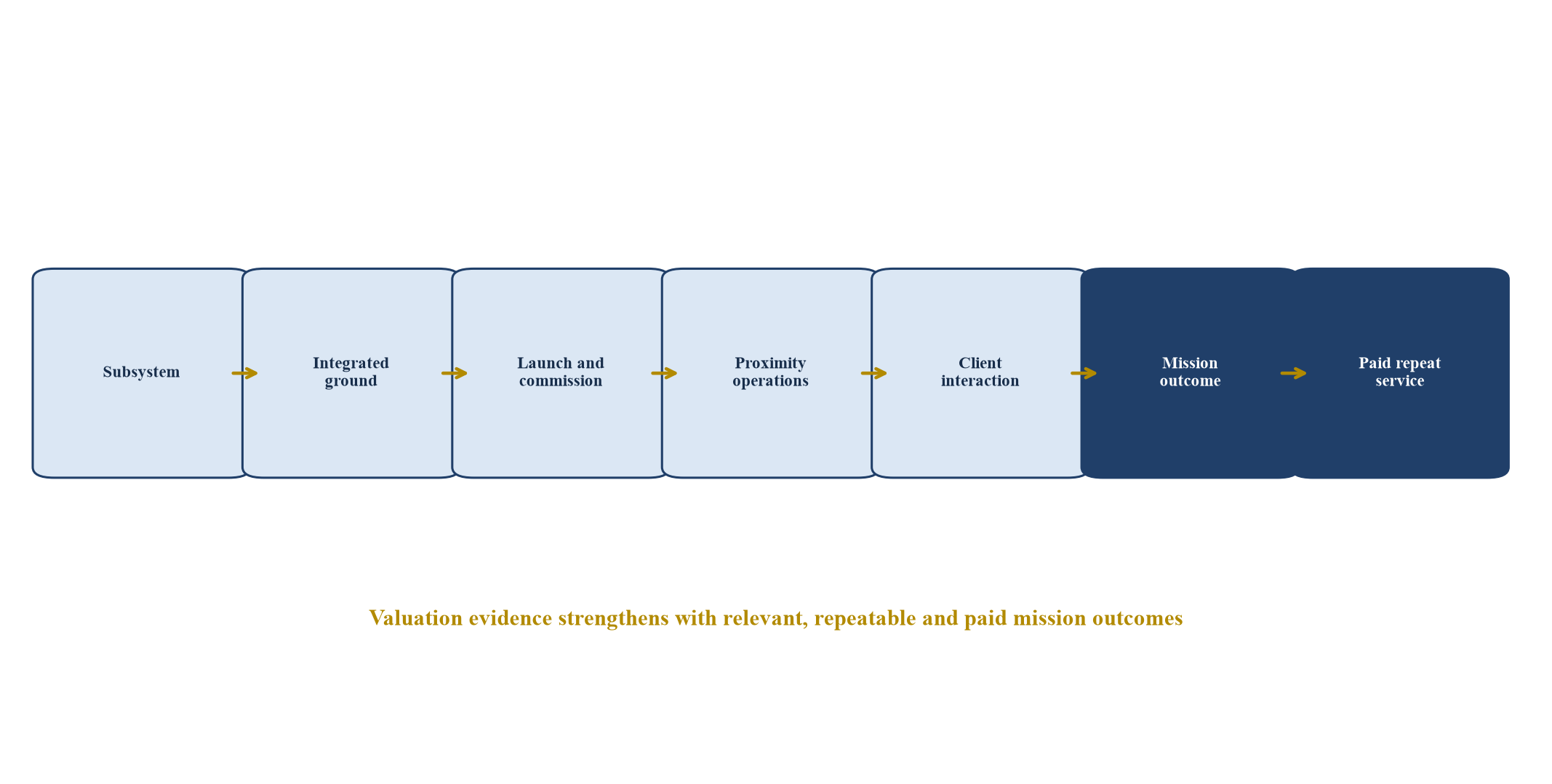
Proposed progression from qualified subsystem evidence to paid repeat service.
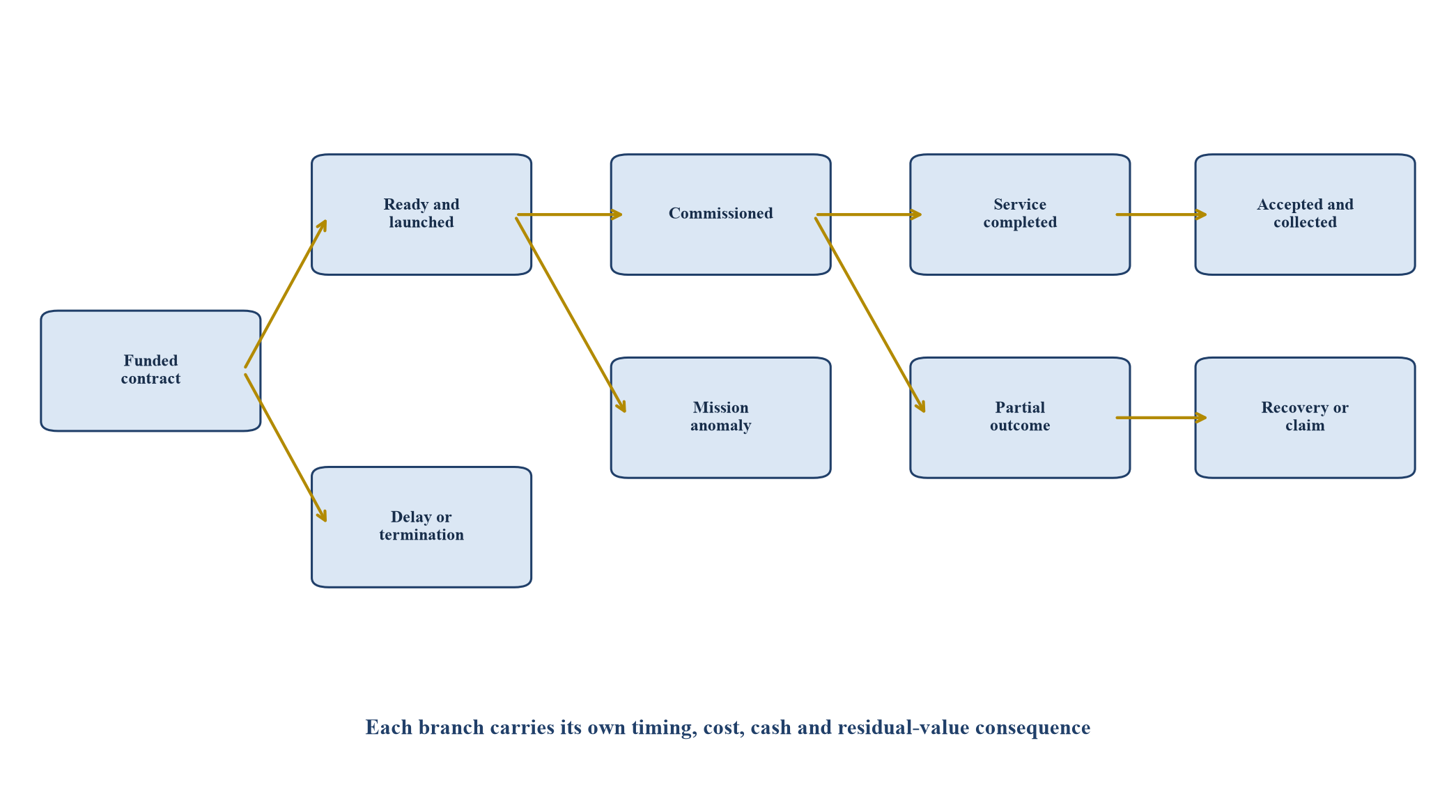
Illustrative branch structure; probabilities must be replaced with transaction evidence.
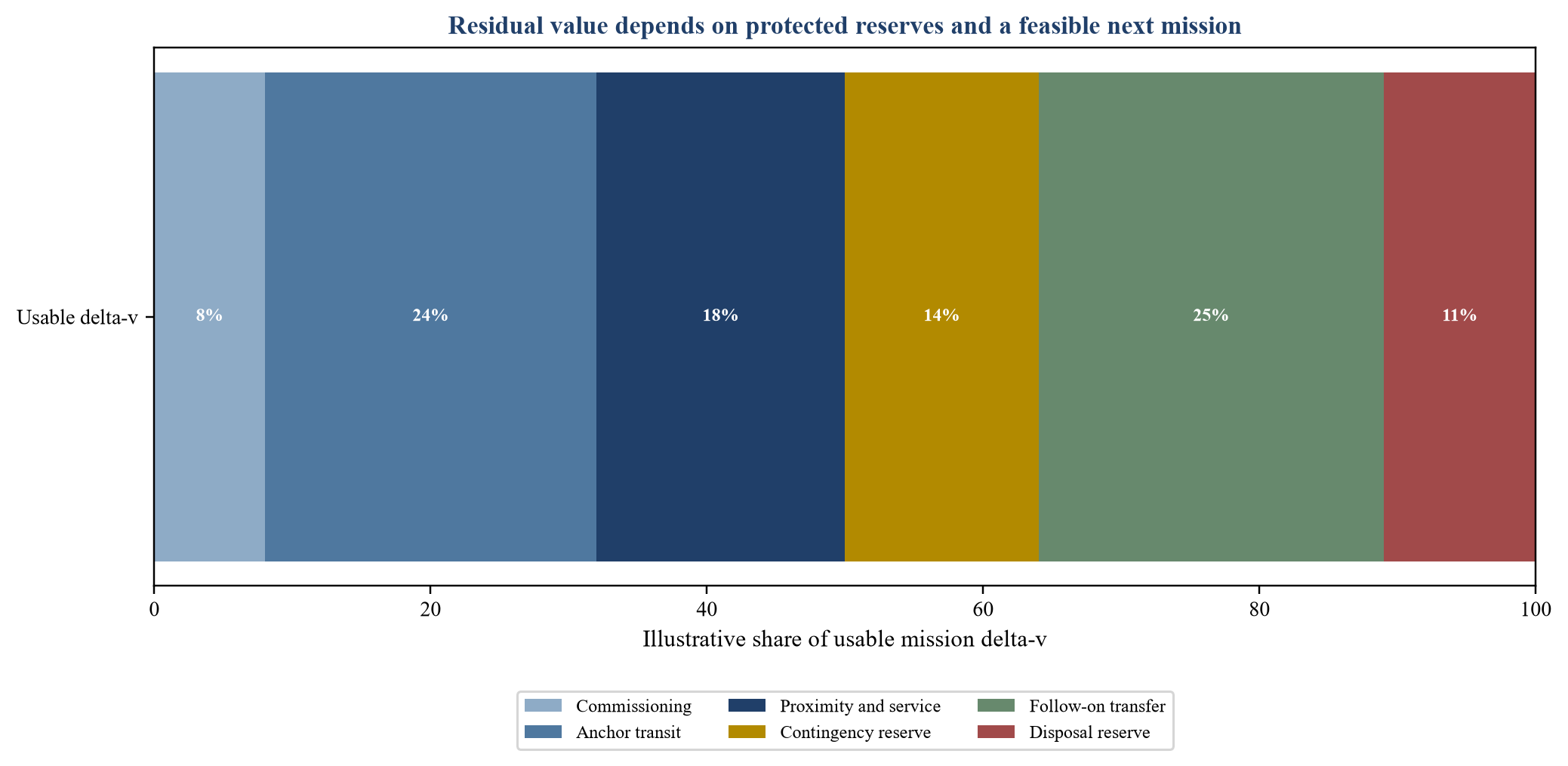
Illustrative allocation of usable delta-v across an anchor and follow-on mission.
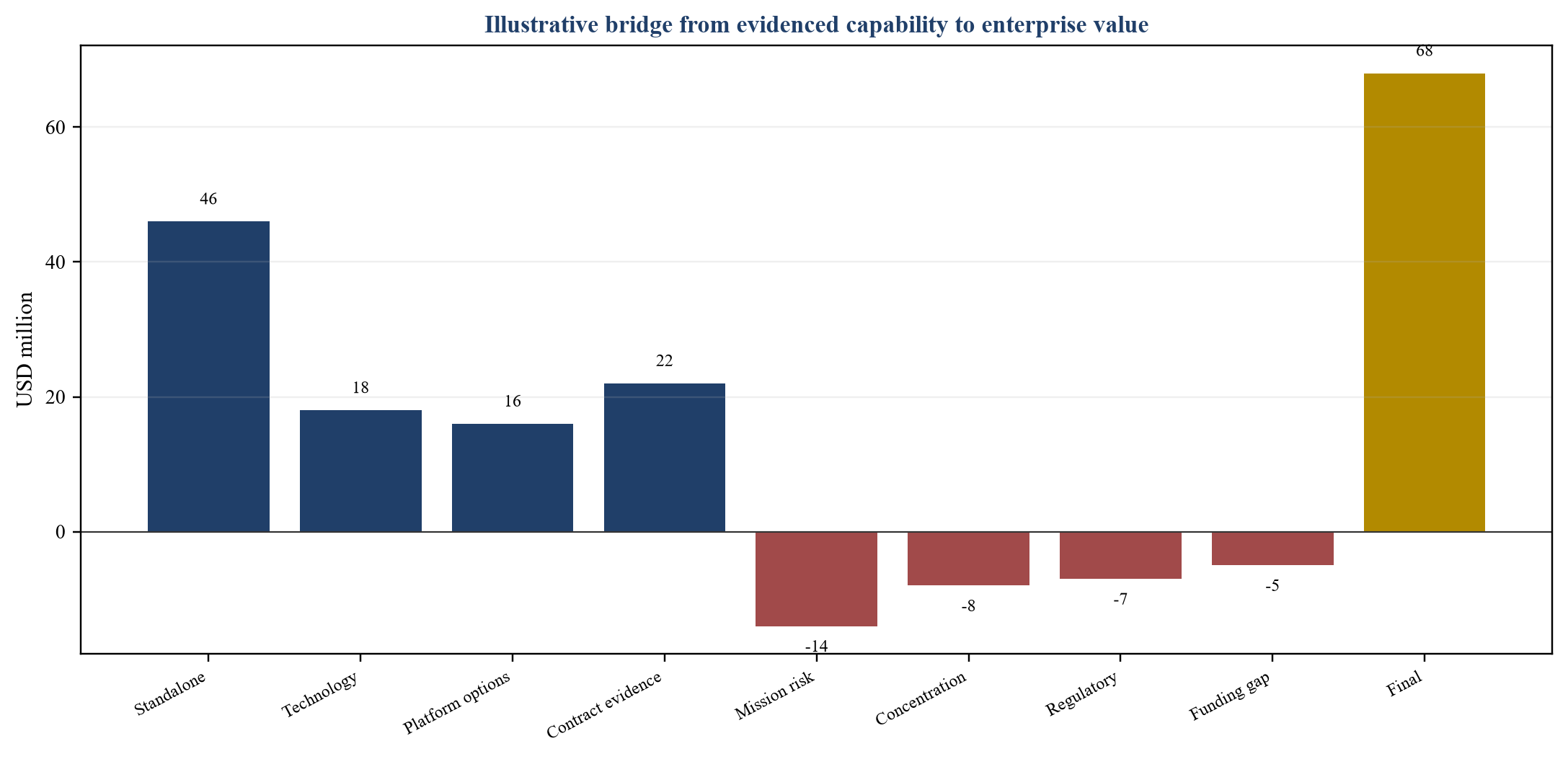
Illustrative USD millions; inputs require transaction-specific evidence.
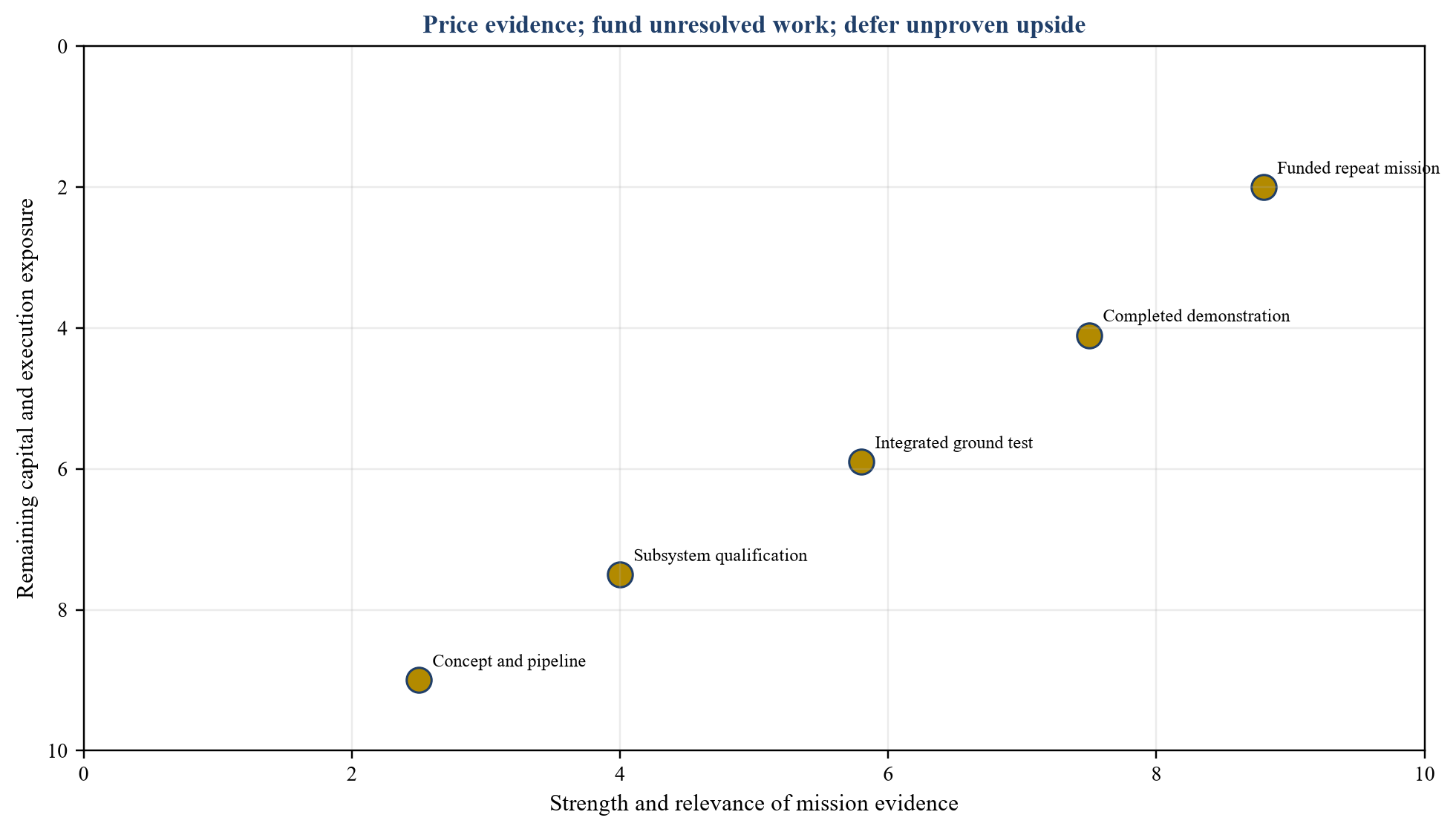
Proposed treatment of mission claims by evidence strength and remaining funding.
| State | Minimum evidence | Valuation treatment |
|---|---|---|
| Subsystem qualified | controlled environmental and functional test | component capability only |
| Integrated ground | flight-like system and interface test | integrated readiness contribution |
| Commissioned | spacecraft healthy in intended orbit | removes launch and early-operations branches |
| Proximity operations | safe, controlled approach to relevant target | navigation and operations evidence |
| Client interaction | docking, capture, installation, refuelling or tow | service mechanism evidence |
| Mission outcome | customer acceptance and disposal or transfer complete | delivered service evidence |
| Paid repeat service | second relevant mission and collected cash | repeat commercial heritage |
Proposed evidence hierarchy for pre-repeat-heritage valuation.
| Evidence | Public observation | Valuation relevance |
|---|---|---|
| JAXA ADRAS-J Phase I | non-cooperative rendezvous and proximity operations demonstrated | flight evidence for inspection and navigation |
| JAXA CRD2 Phase II | partnership contract awarded in August 2024 | funded path toward debris-removal demonstration |
| ESA ClearSpace-1 | planned 2029 capture and removal of 95 kg PROBA-1 | service scope and continuing execution risk |
| NASA OSAM-1 | cancelled after cost, schedule, technical and transition concerns | warning against treating development spend as value |
| Northrop MEV | operational life-extension heritage recorded by NASA | evidence that a paid servicing category can operate |
| NASA RSGS and MRV | launched in July 2026 for GEO servicing operations | continuing expansion of robotic servicing capability |
Programme-specific records; they do not establish an unidentified company's value.
| Step | Evidence | Adjustment |
|---|---|---|
| Announced award | customer release | information only |
| Executed scope | signed statement of work | establish legal perimeter |
| Funded amount | appropriation, order or deposit | remove unfunded options |
| Remaining cost | cost-to-complete and launch exposure | deduct fulfilment cash |
| Acceptance | objective customer milestone | probability weight |
| Collection | invoice and cash receipt | establish realised contribution |
Proposed reconciliation from announcement to collected contribution.
| Step | Amount | Required evidence |
|---|---|---|
| Standalone probability-weighted value | 46 | mission cash and downside cases |
| Transferable technology and flight data | 18 | rights, configuration and buyer use |
| Supported platform options | 16 | feasible mission, customer and funding path |
| Contract evidence | 22 | funded scope and contribution |
| Mission and integration exposure | minus 14 | remaining tests, launch and service risk |
| Customer concentration | minus 8 | anchor-customer stress |
| Regulatory and liability uncertainty | minus 7 | approvals and risk allocation |
| Remaining funding gap | minus 5 | downside liquidity requirement |
| Final illustrative enterprise value | 68 | integrated evidence set |
All amounts are illustrative USD millions.
| Dimension | Evidence | Decision use |
|---|---|---|
| Performance | thrust, specific impulse and telemetry | feasible manoeuvres |
| Mission ledger | burns, margins and uncertainty | mission completion probability |
| Reserve | collision, anomaly and disposal allocation | downside protection |
| Degradation | duty cycle, thermal and component life | repeat mission count |
| Repositioning | next-client transfer requirement | residual option value |
| End of life | passivation and disposal plan | liability and terminal cost |
Proposed mission-capacity controls.
| Unresolved item | Potential protection | Release evidence |
|---|---|---|
| Flight readiness | milestone consideration | completed configuration-specific review |
| Mission outcome | earn-out | customer acceptance of defined service |
| Repeat heritage | contingent value right | second relevant paid mission |
| Contract quality | holdback | funded scope and collected contribution |
| Technology transfer | closing condition | IP, data and key-person transfer |
| Funding need | committed financing | downside runway funded |
Proposed allocation of unresolved value and risk.
| Dimension | Core measure | Trigger |
|---|---|---|
| Technical | tests closed and configuration stable | critical anomaly or waiver |
| Mission | branch probability and schedule | material probability reduction |
| Propulsion | usable delta-v and protected reserve | reserve consumption |
| Contracts | funded backlog and cost-to-complete | scope, funding or acceptance change |
| Customers | concentration and next-mission conversion | anchor delay or loss |
| Capital | runway through next evidence milestone | downside funding shortfall |
| Residual value | feasible follow-on mission and disposal | stranded or non-compliant vehicle |
Proposed monthly board record.
Sources
- Japan Aerospace Exploration Agency, JAXA concludes partnership-type contract for Phase II of its Commercial Removal of Debris Demonstration, 20 August 2024. Read the primary source
- Japan Aerospace Exploration Agency, CRD2 Phase I and ADRAS-J update: fly-around observation images, 30 July 2024. Read the primary source
- Japan Aerospace Exploration Agency, Space Debris Removal Project Underway. Read the primary source
- European Space Agency, ClearSpace-1. Read the primary source
- European Space Agency, Active debris removal. Read the primary source
- NASA, On-orbit Servicing, Assembly, and Manufacturing 1. Read the primary source
- U.S. Government Accountability Office, NASA Assessments of Major Projects, GAO-25-107591, 2025. Read the primary source
- U.S. Government Accountability Office, In-Space Servicing, Assembly, and Manufacturing: Benefits, Challenges, and Policy Options, GAO-25-107555, 2025. Read the primary source
- U.S. Government Accountability Office, NASA Assessments of Major Projects, GAO-24-106767, 2024. Read the primary source
- NASA Technical Reports Server, In-Space Servicing, Assembly, and Manufacturing State of Play, 2025 edition. Read the primary source
- NASA, Robotic Servicing Mission Launches with NASA Support, 22 July 2026. Read the primary source
- NASA, Satellite Servicing Technologies Licensed by Northrop Grumman, 18 January 2022. Read the primary source
- NASA, In-Space Servicing, Assembly, and Manufacturing. Read the primary source
- NASA, The Space Superhighway. Read the primary source
- NASA, Systems Engineering Handbook Appendix: Establishing Technology Readiness Levels. Read the primary source
- NASA, Systems Engineering Handbook, SP-2016-6105 Rev 2. Read the primary source
- NASA TechPort, In-Space Xenon Transfer for Satellite, Servicer and Exploration Vehicle Replenishment and Life Extension. Read the primary source
- European Space Agency, ESA purchases world-first debris removal mission from start-up, 1 December 2020. Read the primary source
- Northrop Grumman Corporation, Annual Report for the year ended 31 December 2025. Read the primary source
- IFRS Foundation, IFRS 13 Fair Value Measurement. Read the primary source
- IFRS Foundation, IAS 38 Intangible Assets. Read the primary source
- IFRS Foundation, IFRS 3 Business Combinations. Read the primary source
- IFRS Foundation, IAS 36 Impairment of Assets. Read the primary source
- International Valuation Standards Council, IVS 105 Valuation Models, 31 January 2025. Read the primary source
- United Nations Office for Outer Space Affairs, Guidelines for the Long-term Sustainability of Outer Space Activities, 2021. Read the primary source
- Inter-Agency Space Debris Coordination Committee, IADC Space Debris Mitigation Guidelines, Rev 3, 2025. Read the primary source
