

1. Define the licensing decision
The board decision is whether a specified bundle of rights can create enough probability-adjusted value after development spending, regulatory risk, commercial execution, payments to the licensor, financing needs and partner obligations. The analysis should identify the rights being acquired, the obligations accepted and the economic exposure retained by each party.
The decision can concern an in-licence, out-licence, option, co-development arrangement, regional partnership or change of control involving an existing licence. Each structure changes control, funding and future value transfer. The board should approve a defined transaction rather than a headline opportunity.
The approval paper should state the product, indication, field, territory, exclusivity, licensed intellectual property, know-how, data, regulatory materials, manufacturing access, sublicensing rights and reserved rights. It should identify the clinical and regulatory evidence available on the decision date.
The economic boundary should include cash at signing, development funding, milestones, royalties, sales-based payments, sublicense income sharing, supply margin, patent costs, taxes and termination exposure. A payment outside the model can make an apparently attractive licence uneconomic.
2. Use a Rights-to-Value Licensing System
The proposed system has eight linked gates: rights and chain of title; evidence and development stage; regulatory pathway; development plan and funding; territory and commercial case; payment waterfall; governance and diligence; and transaction protection. Each gate has an evidence owner, approval threshold and contractual response.
The first gate establishes what the licensor can grant. The second and third establish the evidence supporting further development. The fourth and fifth translate the programme into cost, timing and commercial value. The sixth calculates value transferred through upfront, milestone, royalty and other payments. The final gates establish how the parties control performance and resolve failure.
The system should use one controlled assumptions register. Clinical success, timing, enrolment, regulatory route, price, eligible population, penetration, persistence, manufacturing cost, selling cost, development spend, milestone triggers, royalty tiers, patent life and exclusivity should reconcile across technical reports, forecasts, board papers and transaction documents.
The governing principle is traceability. Every material value driver should point to evidence, an accountable owner and a contract term. Where evidence cannot support a base assumption, the value should move to a contingent or downside case.
3. Start with the precise rights package
The licence grant should be decomposed into product, compound, target, modality, indication, field, territory and activity. Research, development, manufacture, import, use, sale, offer for sale and sublicensing rights may differ. Exclusivity can apply to some rights and not others.
WIPO explains that biotechnology technology transfer can involve patents, know-how, data, materials and agreements across the development continuum [1]. Patent rights alone may be insufficient when successful development depends on assays, cell lines, manufacturing methods, regulatory correspondence or tacit technical knowledge.
Reserved rights require equal attention. A licensor may retain research rights, rights outside the field, rights in excluded territories, public-sector rights or rights to specified improvements. The buyer should identify whether retained activity can compete with, block or dilute the licensed programme.
Territory definitions should address dependencies among regions. Global trials, central manufacturing, pharmacovigilance, reference pricing, cross-border sales and regulatory reliance can connect an exclusive regional licence to decisions made elsewhere. Contractual exclusivity does not create operational independence.
4. Build the rights-to-value evidence chain
The evidence chain begins with ownership and authority. It continues through patent and know-how scope, clinical data, regulatory strategy, development plan, manufacturing readiness, commercial assumptions, payment calculations and cash settlement. Each model line should link to an evidence source and a contractual rule.
The licensee should obtain invention assignments, patent schedules, prosecution records, encumbrance searches, prior licences, material-transfer agreements, sponsored-research terms, government funding conditions and litigation records. It should reconcile these documents to the grant and representations.
Clinical evidence should connect protocol, enrolment, endpoints, statistical analysis, safety findings and regulatory correspondence. ClinicalTrials.gov states that records can include protocols, analysis plans and results, with sponsor-submitted results commonly presented in structured tables [2]. Registry status requires reconciliation with controlled source documents.
Commercial evidence should connect eligible patients, diagnosis, treatment pathway, price, access, duration and market share. The resulting sales model should feed milestones, royalties, supply obligations and working capital without manual overrides.
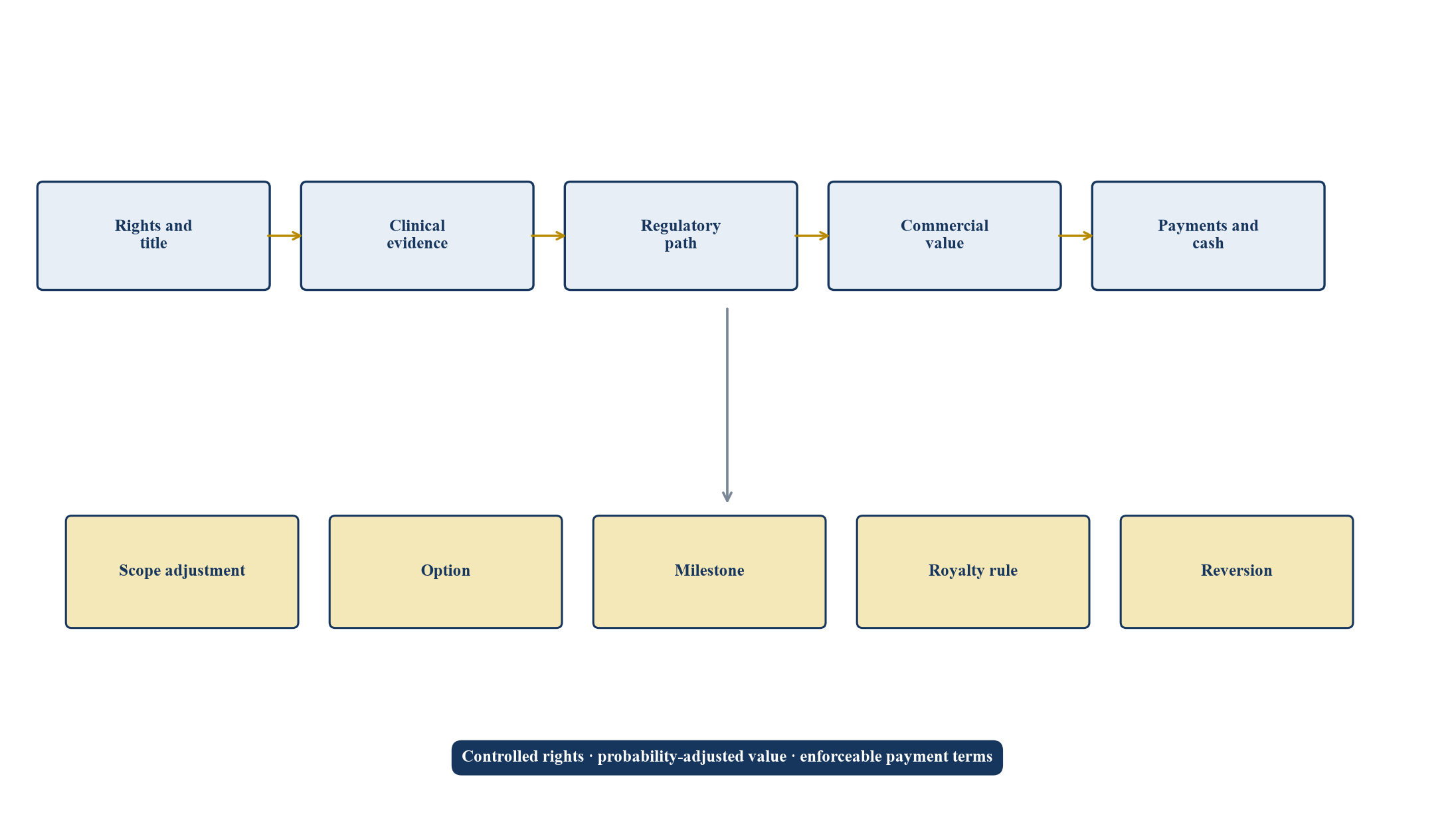
Each stage requires controlled evidence, an accountable owner and a defined contractual response when the threshold is missed.
5. Separate patent rights, know-how and data
Patent scope should be tested claim by claim, country by country and product by product. The analysis should consider ownership, inventorship, priority, prosecution, validity challenges, freedom to operate, expected expiry and responsibility for maintenance and enforcement.
The FDA Orange Book identifies approved drug products and related patent and exclusivity information for relevant products [3]. FDA also explains that patents and regulatory exclusivity are distinct and may run concurrently or independently [4]. A model that treats one expiry date as the entire protection period can misstate value.
Know-how may include manufacturing parameters, analytical methods, stability information and development experience. Its transfer should be specified by content, format, timing and support obligation. A broad promise to provide available know-how can leave essential information unidentified.
Data rights should address access, use, reference, transfer and ownership of new data. The agreement should allocate rights to regulatory submissions, safety databases, real-world evidence and improvements. The territory case may fail if the licensee cannot lawfully rely on necessary data.
6. Confirm the clinical evidence boundary
The FDA describes drug development as discovery, preclinical research, clinical research, regulatory review and post-market monitoring [5]. Clinical phases answer different questions, and the evidence available at each phase has different decision value.
The diligence team should define the population, intervention, comparator, endpoints, follow-up, statistical plan, missing data, protocol deviations and safety findings. It should reconcile published statements and registry records to clinical study reports and regulator correspondence.
Clinical evidence should be separated from management interpretation. A biomarker signal, subgroup result or post hoc analysis may support further research, while its commercial and regulatory value depends on confirmatory work. The model should identify which assumptions require future evidence.
The development plan should address competing trials, standard-of-care changes and enrolment feasibility. A technically valid programme can lose value when patient access, site capacity or treatment practice changes before launch.
7. Model development as conditional decisions
Development is a sequence of decisions rather than a single probability. At each stage, the licensee can continue, redesign, pause, partner or terminate. The valuation should reflect cost and information gained at each decision point.
The FDA notes that clinical trials generally progress from smaller Phase 1 studies through larger Phase 3 studies, with different objectives and participant numbers [6]. These descriptions establish process context. They do not provide asset-specific probabilities for the worked model.
The model should use stage probabilities that management has approved for the product, indication and design. Correlation should be considered where the same biological uncertainty affects multiple milestones or indications.
Expected development spending should be probability weighted only when expenditure is conditional on earlier success. Committed manufacturing work, non-cancellable vendor costs and minimum programme obligations can remain payable after failure and require separate treatment.
8. Test the regulatory pathway by territory
The United States and European Union require distinct submissions, procedures and legal analysis. FDA review considers clinical, manufacturing and other evidence in a marketing application [7]. EMA evaluates quality, safety and efficacy through its procedures and requires a compliant dossier [8].
The transaction model should identify the applicant, sponsor, marketing-authorisation holder, data owner and party responsible for regulator interaction. Rights to use a dossier do not automatically allocate responsibility for completing it.
Regulatory milestones should define the event precisely. Submission, acceptance for review, positive committee opinion, conditional approval, full approval and label expansion are different events. The payment trigger should identify authority, product, indication, territory and documentary evidence.
Accelerated or conditional pathways can change timing, evidence obligations and post-approval commitments. The commercial model should incorporate the approved label and conditions rather than assume that an early pathway produces the broad target profile.
9. Build a territory-specific commercial model
The commercial model should begin with the approved or expected indication and treatment pathway. Eligible population, diagnosis, line of therapy, contraindications, competing products, access restrictions, price, persistence and adherence should be explicit.
Territory rights should be valued from local economics. A global peak-sales estimate allocated by population or gross domestic product can ignore diagnosis rates, reimbursement, price regulation, channel structure and competitive timing.
The forecast should distinguish patients, prescriptions, units, gross sales, deductions and net sales. Royalties and sales milestones normally depend on contract-defined net sales rather than modelled revenue. Every deduction should have a source and owner.
Reference pricing, parallel trade and cross-border supply can connect territory decisions. The agreement should allocate responsibility for pricing actions that affect another party's economics and should establish consultation or consent rights where appropriate.
10. Convert sales into licence economics
The payment model should calculate each element under the contract definition. Upfront consideration is usually certain at effectiveness, while development, regulatory and commercial milestones depend on specified events. Royalties depend on net sales, rate tiers, royalty term and adjustments.
Tiered royalties require marginal or blended calculation according to the agreement. A rate that increases after a threshold may apply only to sales above that threshold, or to all sales in the period. The distinction materially changes value.
The model should address royalty stacking, generic entry, biosimilar competition, patent expiry, lack of a valid claim, compulsory licensing, third-party payments and combination products. Each adjustment should identify sequencing, floors and maximum reductions.
IFRS 15 contains specific requirements for sales-based or usage-based royalties promised in exchange for a licence of intellectual property [9]. Transaction valuation and revenue recognition serve different purposes and should be reconciled with accounting advisers.
| Evidence area | Core diligence test | Value failure | Possible transaction response |
|---|---|---|---|
| Rights | Reconcile grant, title, encumbrances and reserved rights | Licence cannot support planned activity | Narrow scope, condition, representation, termination right |
| Clinical evidence | Reproduce endpoints, safety and regulator history | Probability or development plan is overstated | Option, staged payment, redesign right |
| Territory | Build local access, price and competition case | Global allocation overstates local value | Territory carve-out, opt-in, co-promotion right |
| Milestones | Define event, evidence, timing and duplication | Payment occurs without equivalent risk reduction | Objective trigger, credit, cap, dispute process |
| Royalties | Reconcile net sales, tiers, term and reductions | Cash burden exceeds model | Rate adjustment, stacking rule, floor, audit right |
| Diligence | Test plan, funding and reporting obligations | Rights can revert despite value creation | Cure period, governance, step-in, revised milestones |
The appropriate response depends on materiality, timing, control and the reliability of evidence.
11. Value milestones by event and timing
A nominal milestone schedule should not be added to upfront consideration to describe expected value. Each milestone needs an event probability, expected timing, discount factor, payment amount and relationship to other milestones.
Development milestones can include first dosing, cohort completion or trial initiation. Regulatory milestones can include submission, acceptance, approval or label expansion. Commercial milestones can be based on annual or cumulative net sales. These events carry different probabilities and economic meanings.
Milestone triggers should avoid ambiguity about repeated events, multiple products, indications or territories. The SEC-filed Medicus licence illustrates how annual and cumulative sales milestones and marginal royalties can be separately defined [10]. Public filings often redact important figures, so diligence must use the executed agreement.
The model should prevent double counting. A commercial forecast already reflects approval and launch probability. Applying another full approval probability to royalty cash flows after using probability-adjusted sales can understate value.
12. Model royalties through the contract waterfall
Royalty value depends on more than the headline rate. Net-sales definition, deductions, currency translation, affiliates, distributors, bundled products, samples, returns, rebates, taxes, bad debt and transfer pricing can affect the base.
The royalty term may run to the latest of patent expiry, regulatory exclusivity or a fixed period after first commercial sale. Different countries can enter and exit the royalty term at different times. The model should calculate cash by country and product when those differences are material.
Royalty reductions should be sequenced as the contract requires. A third-party licence deduction followed by a generic reduction can produce a different result from applying both to the original rate. Floors may constrain the combined reduction.
Audit rights should specify records, retention, frequency, auditor independence, confidentiality, underpayment thresholds, interest and cost allocation. NIH technology-transfer materials identify monitoring and unpaid or late royalties as recurring compliance challenges [11].
13. Reconcile sublicensing value
Sublicensing can provide development capability, geographic reach and risk sharing. The agreement should distinguish a sublicense from a subcontract, distributor appointment, change of control or permitted assignment.
The licensor may receive a share of sublicense income, milestones, royalties or a combination. The definition of sublicense consideration should address cash, equity, research funding, debt, in-kind services, bundled assets and contingent payments.
The rate can vary by development stage because the licensee creates value before the sublicense. A high early-stage share may be reasonable where the licensor supplied most of the asset, while a later sublicense after substantial licensee investment may require a lower share.
Consent rights should have a defined standard and response period. An unrestricted veto can impair financing and partnering. Uncontrolled sublicensing can weaken quality, compliance and payment visibility.
14. Test field and indication optionality
A compound or platform can create value across indications and fields. The licence should allocate current programmes, follow-on indications, combinations, formulations, biomarkers and diagnostic uses.
The licensee should distinguish funded base-case development from optional programmes. Paying for all theoretical indications at signing can transfer speculative value before evidence or capital exists.
Options can preserve future access while deferring price. An option should define the right, exercise window, information access, evaluation activity, exercise price and consequences of non-exercise. The licensor should retain a path to develop or relicense unused rights.
Expansion milestones can align payment with evidence. They should avoid triggering twice where the same clinical or regulatory event supports multiple indications. The agreement should also define whether a broad approval counts for each listed indication.
15. Underwrite development obligations
Exclusive rights commonly carry diligence obligations. These may include a development plan, spending commitment, milestones, regulatory submissions, launch dates, minimum sales or minimum royalties.
NIH's licensing materials describe performance milestones and development plans as tools to move technology toward practical application [12]. A commercial agreement should tailor obligations to the programme rather than copy generic dates.
The licensee should test whether deadlines remain feasible under expected enrolment, regulator interaction, manufacturing scale-up and financing. An obligation outside the approved plan can create termination risk and weaken the asset's financeability.
The agreement should contain reporting, consultation, amendment and cure mechanisms. A failure caused by safety, regulator request or force majeure may require a different response from strategic shelving or underfunding.
16. Allocate development cost and control
Co-development arrangements need a controlled budget, work plan, decision matrix and cost-sharing mechanism. The parties should define which costs qualify, how variances are approved and what happens when one party declines additional spending.
Control should follow responsibility and exposure. A party funding a programme may require approval rights, while the party holding the regulatory submission may control regulator interaction. Deadlock procedures should preserve patient safety and legal compliance.
The model should separate reimbursed research, shared development cost and consideration for rights. These flows can have different tax, accounting and valuation treatment.
Budget overruns should be analysed by cause. Scope change, trial delay, manufacturing failure and vendor escalation may require different allocation. An uncapped obligation to fund another party's decisions can destroy residual value.
17. Build the controlled central licensing case
The hypothetical target is a clinical-stage therapy seeking exclusive development and commercial rights in a defined territory. Management assumes an approved development plan, access to required know-how and data, and a pathway that requires a pivotal trial and marketing application.
The probability-adjusted present value of net product contribution before royalties is modelled at USD 310 million. Probability-adjusted present value of development, regulatory and manufacturing-readiness costs is USD 85 million. Value before licence consideration is therefore USD 225 million.
The proposed package includes USD 35 million upfront, development and regulatory milestones with present value of USD 28 million, commercial milestones with present value of USD 18 million, and royalties with present value of USD 72 million. Total present value transferred to the licensor is USD 153 million.
Residual value to the licensee is USD 72 million before financing cost, tax effects and corporate overhead. All values are hypothetical management assumptions. They do not represent an actual asset, offer, valuation opinion or observed licence terms.
18. Build downside cases from underlying drivers
The downside assumes lower clinical success, a twelve-month delay, higher development cost, a narrower label and slower market access. Probability-adjusted present value of net product contribution falls to USD 205 million. Development and manufacturing-readiness cost rises to USD 95 million.
Value before licence consideration is therefore USD 110 million. The upfront remains USD 35 million because it is paid at effectiveness. Reduced event probability and sales lower the present value of milestones to USD 15 million and royalties to USD 40 million. Total licence consideration has present value of USD 90 million.
Residual downside value is USD 20 million before financing cost, tax effects and corporate overhead. A modest additional delay, safety requirement or pricing reduction can eliminate that value.
The model should show which payments remain after programme failure. Non-refundable upfront consideration, committed development spend and termination obligations can create loss even where later milestones and royalties disappear.
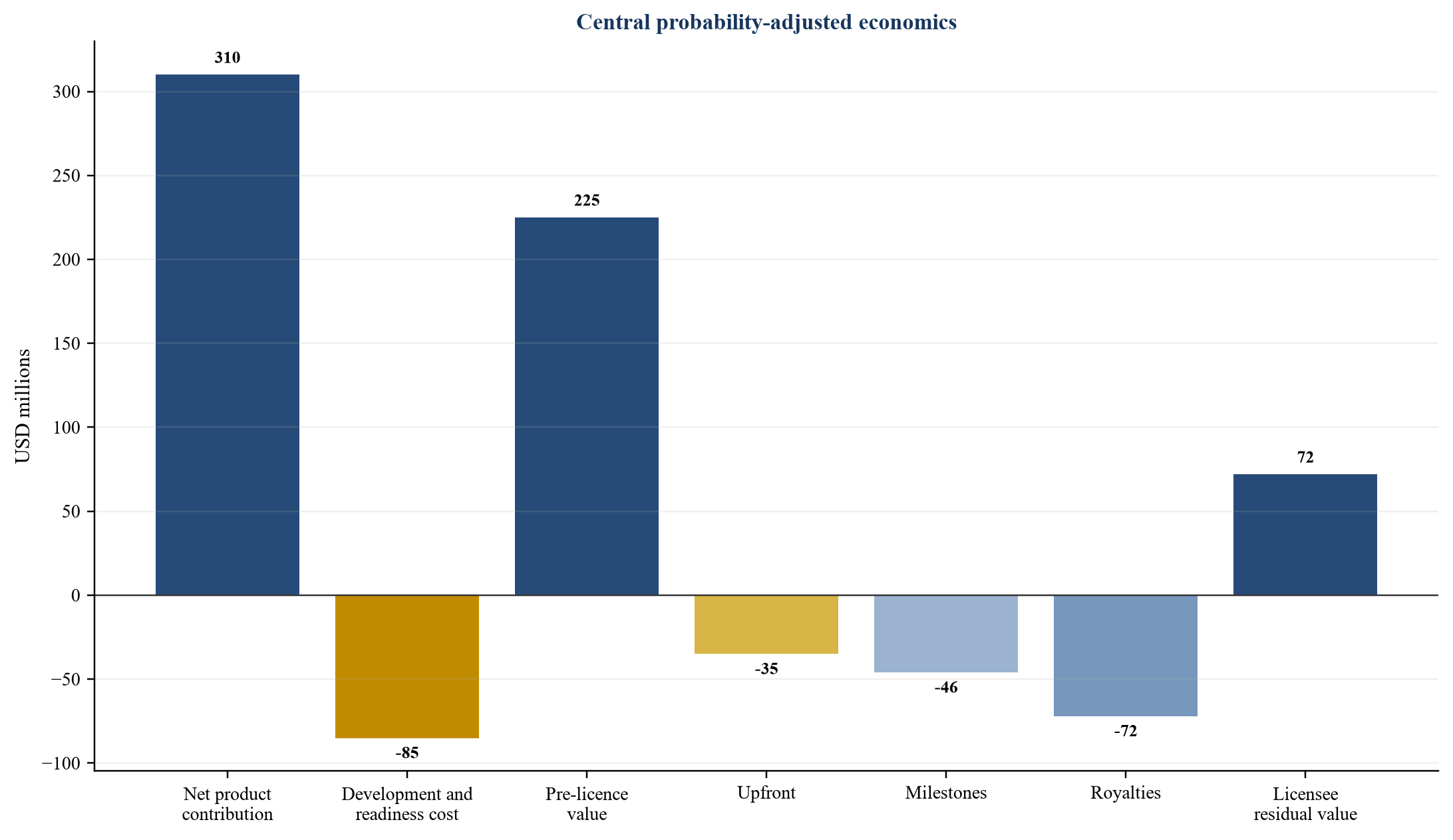
USD millions. All values are illustrative management assumptions and do not describe an actual licence transaction.
19. Use a multidimensional sensitivity model
Licence value is exposed to clinical probability, timing, development cost, label, price, market share, royalty rate and protection period. These variables can move together.
A trial delay can increase cost, shorten effective protection and allow competitor entry. A narrower label can reduce eligible patients and change market access. A manufacturing issue can delay launch and increase cost of goods.
The decision model should use coherent scenarios rather than isolated single-variable changes. Core axes can include probability of approval, launch delay, net sales, royalty burden and development cost.
Reverse stress should identify the combinations that reduce residual value below the board's hurdle or exhaust funding. The decision is stronger when management knows which evidence would move the case across that boundary.
20. Interpret the hypothetical model carefully
The central residual value of USD 72 million is a decision result under specified assumptions. It is not cash available at signing and does not establish a market price.
The model excludes unapproved indication expansion, unrelated platform value and speculative sublicensing proceeds. It also excludes tax attributes and financing effects that require transaction-specific advice.
Nominal headline value can exceed modelled present value because milestones are contingent and delayed. Public announcements commonly describe maximum milestone eligibility rather than expected value. The board should see both measures with clear labels.
Specialist clinical, regulatory, patent, commercial, tax and accounting work remains necessary. The assumptions register should record the owner, source, effective date and approval status of every material input.
| Measure | Central case | Downside case | Decision relevance |
|---|---|---|---|
| Net product contribution present value | USD 310 million | USD 205 million | Captures probability-adjusted territory economics |
| Development and readiness cost present value | USD 85 million | USD 95 million | Tests cost and delay exposure |
| Value before licence consideration | USD 225 million | USD 110 million | Measures value available to share |
| Upfront present value | USD 35 million | USD 35 million | Remains exposed at effectiveness |
| Milestone present value | USD 46 million | USD 15 million | Changes with event probability and timing |
| Royalty present value | USD 72 million | USD 40 million | Changes with sales and royalty term |
| Licensee residual value | USD 72 million | USD 20 million | Tests value after contracted payments |
Figures are illustrative management assumptions and are not forecasts, offers or observed transaction terms.
21. Match uncertainty to the right transaction tool
Known and measurable gaps can adjust the upfront or option exercise price. Future clinical events can support milestones. Future sales can support royalties and commercial milestones. A missing essential right may require a condition or decision not to proceed.
An option can defer major commitment until specified data are available. The option price should reflect exclusivity, information access and the licensor's opportunity cost during the option period.
Milestones should correspond to genuine risk reduction and use objective evidence. A payment on trial initiation rewards activity. A payment on a defined clinical result or regulatory outcome transfers more performance risk.
Reversion can protect the licensor against shelving. Step-in or transition provisions can preserve programme continuity. These tools require access to data, materials, regulatory files and third-party contracts to be effective.
22. Define milestone triggers precisely
Each milestone should identify the actor, product, indication, territory, event, evidence, payment date and one-time or repeatable nature. It should address achievement by affiliates, sublicensees and acquirers.
Regulatory events require careful drafting. Submission and acceptance are different. Approval can be conditional, accelerated, full, limited to a subgroup or subject to post-approval commitments.
Clinical events should identify protocol and endpoint where relevant. A generic reference to successful completion can create dispute over statistical, safety or commercial criteria.
The agreement should contain notice, invoice, review and dispute processes. Interest and audit provisions should apply where reporting or payment is delayed.
23. Use royalties with an auditable base
Net sales should reconcile from gross invoiced sales through defined deductions. Deductions should be actual, consistently applied and attributable to licensed products. Provisions and estimates should be trued up.
Related-party transactions require an arm's-length or deemed-sales rule. Transfers to distributors, bundled arrangements and non-cash consideration should have a defined measurement basis.
Combination-product allocations should use an agreed formula. The formula should remain workable when components are not sold separately.
Reports should provide sales, deductions, currency, rates, adjustments and payment by product and country. Audit rights should survive termination for the record-retention period.
24. Protect territory and supply dependencies
A regional licensee may depend on the licensor or another territory for active ingredient, device components, reference standards, safety data or global trial decisions. Those dependencies require service levels and remedies.
Supply terms should address forecast, binding orders, capacity, specification, price, yield, quality, release, recalls, shortages, technology transfer and second sources. A supply margin can transfer additional value outside the royalty model.
Global governance should allocate safety reporting, labelling, medical information, publication and regulator communication. Delay in one territory can affect another party's approval or reputation.
The agreement should provide a transition plan for termination, supply failure or change of control. A bare right to manufacture has limited value without know-how, validation and regulatory support.
25. Align financing with licence obligations
The licensee should size capital for committed development, milestone timing, manufacturing readiness, launch and working capital. A probability-adjusted valuation does not fund a fixed payment due after an event.
Financing covenants should permit milestone and royalty payments while preserving liquidity. The board should see the largest cash requirement under central and downside schedules.
Assignment and change-of-control provisions can affect financing and exit. Consent rights, additional payments, termination rights or anti-assignment language should be tested before the licence is treated as transferable value.
Security over licence rights may require consent or be prohibited. Lenders need clarity on cure, step-in and continued rights after enforcement. These matters require transaction-specific legal advice.
26. Preserve accounting and tax discipline
IFRS 3 requires an acquirer to recognise and measure acquired assets, liabilities and consideration in a business combination [13]. A licence transaction may be an asset acquisition, business combination, collaboration or revenue contract depending on facts.
IFRS 15 distinguishes licences and contains requirements for sales-based or usage-based royalties [9]. Revenue recognition does not determine economic value, yet the transaction model should reconcile to accounting conclusions and reporting systems.
Withholding tax, transfer pricing, value-added tax, tax residence and permanent establishment can change cash flows. Gross-up provisions and treaty assumptions should be explicit.
Milestones paid in cash, equity or other consideration can have different dilution, tax and accounting effects. Specialist advice should precede final approval.
27. Run diligence through decision rights
The diligence team should include clinical, regulatory, patent, manufacturing, commercial, finance, tax, accounting and legal workstreams. Each workstream should have a defined question, evidence list, materiality threshold and escalation route.
One transaction office should maintain the assumptions register, rights map, milestone schedule, royalty model, risk register and issues list. Findings should connect to value or a contract response.
Material changes in protocol, safety, regulatory advice, patent scope, manufacturing, competition or reimbursement should trigger a documented gate. The team should record whether the case, price, scope or agreement changes.
Delegated authority should identify who can accept a waiver, amend a milestone, approve a territory carve-out or extend a deadline. Board approval should remain valid only within the approved limits.
28. Execute a twenty-four-week licensing roadmap
Weeks one to four should define the rights package, confidentiality perimeter, data room, diligence questions and controlled assumptions. Title, patent and clinical evidence work should begin immediately.
Weeks five to ten should complete the initial clinical, regulatory, manufacturing and commercial assessment. The parties can use a term sheet to align scope, governance and economics before full drafting.
Weeks eleven to sixteen should complete probability-adjusted valuation, development budgets, territory scenarios and tax and accounting analysis. Key evidence gaps should drive option, milestone or closing terms.
Weeks seventeen to twenty-four should finalise the agreement, ancillary supply or services terms, approvals, funds flow, transition plan and reporting controls. Timing is illustrative and should change with programme maturity and regulatory access.
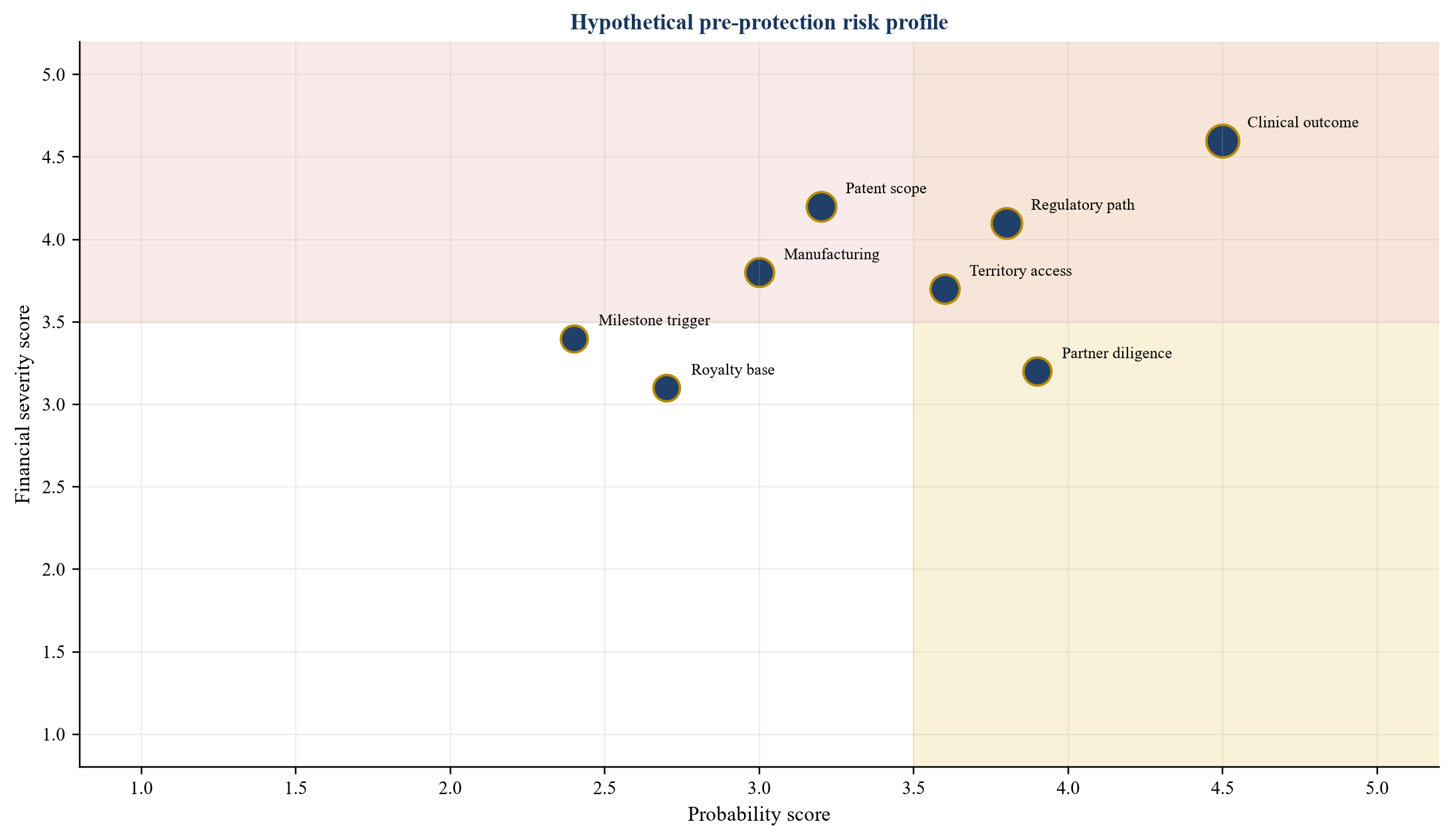
Scores are illustrative and show how probability, financial severity and control strength can guide transaction responses.
29. Establish post-signing controls
The parties should maintain a controlled development plan, budget, regulatory schedule, patent calendar, milestone register and royalty reporting process after signing.
Governance committees should receive evidence before decisions. Minutes should record approvals, dissent, conflicts and action owners. Reserved matters should correspond to contractual authority.
The licensee should forecast milestone liquidity and royalty payments alongside programme spending. The licensor should monitor diligence without directing activities outside its agreed role.
Change control should cover protocol, indication, territory, manufacturing, sublicensing and commercial strategy. Informal operating decisions should not silently change payment obligations or rights.
30. Use a board approval matrix
The board pack should state the rights package, development evidence, regulatory path, territory case, probability-adjusted value, payment present value, committed cash, financing need, residual value and contract protections.
Each gate should have an owner and acceptance threshold. The investment committee can approve assumptions within delegated ranges, while the board reserves material scope, upfront consideration, funding, liability and termination decisions.
The board should see nominal headline consideration and modelled present value separately. It should also see central, downside and reverse-stress liquidity.
Approval should expire if clinical, regulatory, patent, commercial or partner facts change before effectiveness. Confirmatory work should certify the final schedules, ancillary agreements and funds flow.
| Exposure | Evidence needed | Preferred protection | Measurement basis |
|---|---|---|---|
| Uncertain clinical result | Controlled protocol, data and regulator history | Option or outcome milestone | Defined endpoint and evidence date |
| Territory value uncertainty | Local access, price and competition model | Territory carve-out or opt-in | Country-level net sales and timing |
| Patent or know-how gap | Claim map, assignments and transfer inventory | Condition, representation, scope adjustment | Rights required for approved plan |
| Ambiguous milestone | Event definition and documentary proof | Objective trigger and dispute process | One-time event by product and territory |
| Royalty leakage | Net-sales reconciliation and records | Reporting, audit and interest | Contract waterfall by product and country |
| Development shelving | Approved plan, funding and reporting | Diligence covenant, cure and reversion | Milestones and justified extensions |
The table is a decision aid. Final terms require specialist legal, regulatory, tax and accounting advice.
31. Make the licensing decision
A licensing transaction should proceed when the grant supports the approved plan, clinical and regulatory assumptions are evidenced, territory economics cover development and licence payments, obligations are financeable, and governance can manage future decisions.
The board should defer or decline when title is uncertain, essential know-how or data cannot be transferred, the regulatory route is unsupported, territory value depends on unapproved assumptions, payments exceed probability-adjusted value, or termination risk cannot be controlled.
The Rights-to-Value Licensing System creates a controlled chain from legal rights to cash. It keeps nominal headline value separate from economic analysis and assigns unresolved uncertainty to scope, options, milestones, royalties, governance or reversion.
The decision memorandum should distinguish evidence available at signing from future events. Patent schedules, assignments, clinical reports, regulator correspondence, development budgets and executed ancillary agreements can be tested before effectiveness. Clinical outcomes, approval, launch, market access and sales remain future drivers. Upfront value should reflect verified rights and evidence. Contingent payments should correspond to auditable future outcomes.
The model should also distinguish value from liquidity. Probability-adjusted residual value can remain positive while milestone timing creates an unfunded cash requirement. The board should approve funding through the relevant downside period and identify the point at which continued development ceases to meet its hurdle.
Closing readiness should be evidenced through one schedule that identifies each critical assumption, source, owner, acceptance threshold, expiry date and contract response. An assumption without evidence remains outside base value. An essential missing right belongs in a condition or decision not to proceed.
The approval paper should begin with a one-page statement of the decision. It should identify the product or platform, indication and field, licensed territory, exclusivity, development stage, proposed counterparty, requested authority and the date by which authority is required. The page should state the central probability-adjusted residual value, downside residual value, total committed cash before the next material decision point and the largest unresolved exposures. The board can then test a bounded transaction rather than a collection of scientific, legal and commercial workstreams.
The next schedule should reconcile rights to evidence. Each material patent family should be connected to jurisdiction, ownership, expiry, prosecution status, relevant claims and product or process dependency. Know-how should be connected to identifiable materials, protocols, manufacturing methods and transfer steps. Clinical and non-clinical datasets should be connected to study identifiers, reports, access rights and permitted regulatory use. The schedule should identify any third-party consent, retained right, government interest, academic restriction, material-transfer condition or existing collaboration. Where a right is important to the approved plan, its availability should be confirmed before value is assigned.
A clinical and regulatory schedule should show the evidence supporting each probability and timing assumption. The schedule should identify completed studies, enrolled populations, endpoints, safety findings, protocol deviations, regulator interactions, agreed or proposed development steps, manufacturing dependencies and territory-specific filing requirements. ClinicalTrials.gov can support verification of registered studies, while regulator databases and correspondence support the approval-path analysis. A model probability remains a management assumption. Its evidence source, date, owner and sensitivity should therefore appear beside the input.
The commercial schedule should build each territory from addressable patients or units, diagnosis and eligibility, adoption, duration, net price, gross-to-net deductions, manufacturing and distribution cost, launch timing and exclusivity. A global sales curve should not substitute for local access and supply analysis. Territory rights can differ in reimbursement, channel structure, prescribing practice, competition, regulatory timing and partner capability. The board should see both the standalone value of each territory and the effect of shared development, manufacturing and evidence costs.
The consideration schedule should translate contract language into dated cash flows. Upfront consideration is payable because the agreement becomes effective, subject to its exact conditions. Development and regulatory milestones should be linked to objectively defined events and weighted by the probability and expected timing of those events. Commercial milestones should be linked to cumulative or annual sales thresholds, product scope, territory and aggregation rules. Royalties should be applied through the full waterfall, including the net-sales definition, exclusions, deductions, stacking, third-party offsets, compulsory licences, generic entry, patent expiry, step-downs and the royalty term. Sublicence income should be separated by stage, form of consideration and permitted deductions.
The funding schedule should show development spending, manufacturing commitments, milestone payments, launch investment, minimum purchases and working-capital requirements by period. It should include committed liquidity, financing conditions and the next point at which the licensee can stop, narrow or seek additional capital. A positive net present value does not establish that cash is available when a payment falls due. The board should review liquidity under the same downside drivers used in the valuation.
The protection schedule should connect each material risk to one or more transaction responses. A title defect may require cure, consent, exclusion or a condition to effectiveness. Early clinical uncertainty may support an option, staged grant or development milestone. Territory uncertainty may support phased rights, performance thresholds or reversion. Manufacturing uncertainty may support technology-transfer milestones, supply covenants, quality obligations and alternative-source rights. Ambiguity in the royalty base may support definitions, examples, records, reporting and audit rights. Counterparty execution risk may support governance, diligence standards, development plans, cure periods and reversion.
The board should also test interactions among protections. A lower upfront payment can preserve capital, yet an accelerated milestone may recreate the same liquidity burden. A royalty step-down can protect the licensee after generic entry, yet a broad stacking deduction can transfer unrelated third-party costs to the licensor. A narrow field can contain price, yet overlap with adjacent indications can create disputes over combination products or platform improvements. A reversion right can protect the licensor, yet its value depends on usable data, regulatory materials, inventory, manufacturing information and an orderly transition.
The final term sheet and long-form agreement should remain consistent with the approved model. Any change in territory, field, exclusivity, development control, payment timing, royalty deductions, sublicensing share, governance or termination economics should be reflected in the model before execution. The transaction team should maintain a change log showing the provision amended, economic effect, risk effect, approval owner and supporting analysis. Delegated authority should specify quantitative and qualitative limits rather than a general permission to finalise documents.
After signing, the control system should continue through effectiveness and performance. The parties should maintain milestone evidence, development reports, regulatory submissions, sales statements, royalty calculations, sublicence notices, patent-prosecution decisions and diligence records. Finance, legal, clinical, regulatory, intellectual-property and commercial teams should use a shared obligations calendar. Material deviations should reach the designated governance forum with an identified remedy, funding effect and decision deadline.
A licensing decision can therefore be expressed as five questions. Are the granted rights complete enough for the approved plan? Does the evidence support the modelled development and regulatory path? Do territory economics support consideration and funding obligations? Does the agreement allocate uncertainty through auditable mechanisms? Can governance identify deterioration early enough to exercise a remedy? Approval requires an evidenced answer to each question and a documented response for every residual exposure.
The final decision remains transaction specific. The model and agreement support judgement. They do not replace clinical, regulatory, patent, commercial, legal, tax, accounting or financing advice.
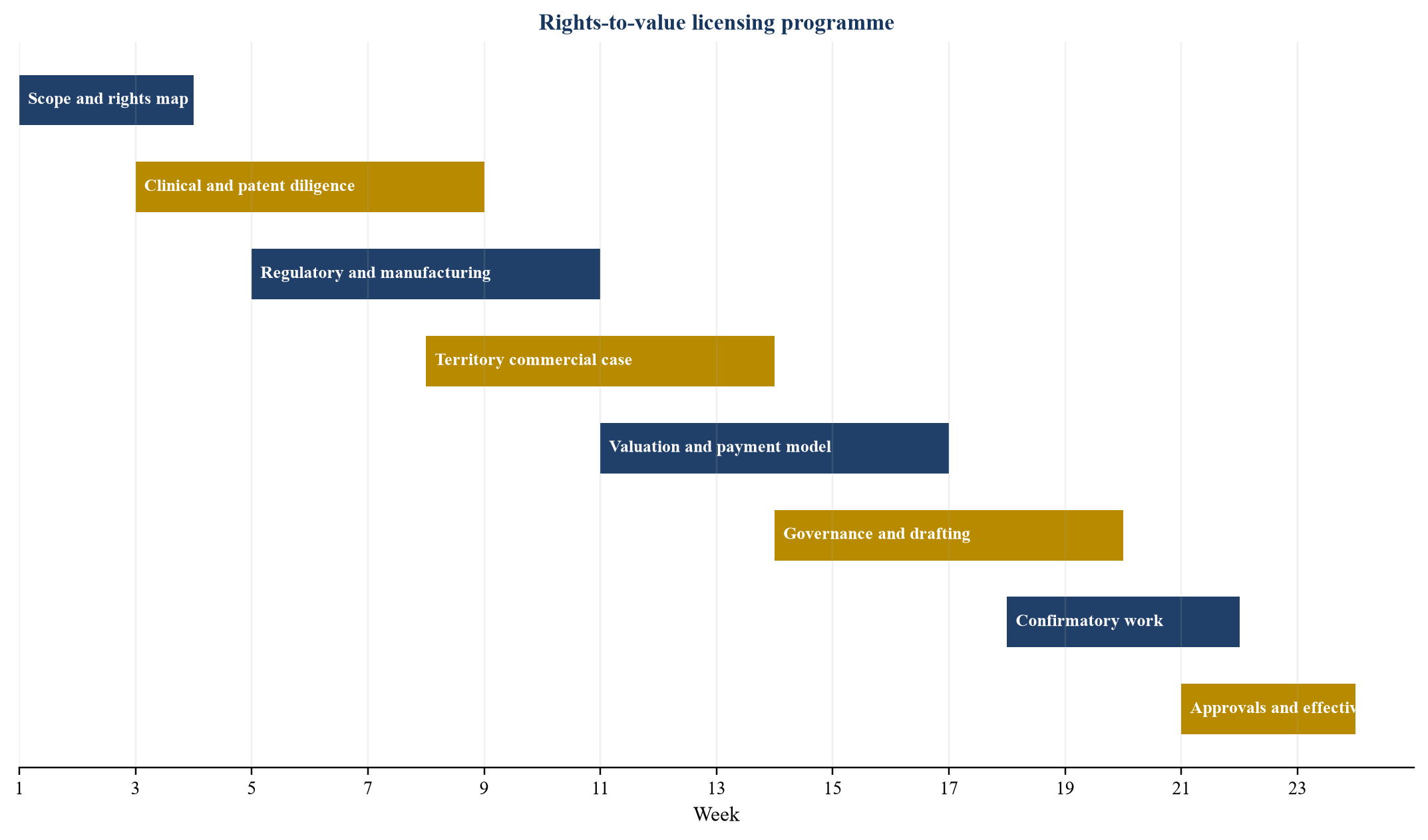
Timing is illustrative and depends on programme maturity, data access, regulatory interaction and negotiation scope.
| Gate | Approval evidence | Minimum threshold | Decision owner |
|---|---|---|---|
| Rights | Grant, title, encumbrances, know-how and data map | Approved plan is legally and operationally supported | Board |
| Evidence | Clinical package, safety, regulator history and development plan | Central assumptions have controlled sources | Investment committee |
| Territory | Patient, access, price, competition and supply model | Local economics support the approved case | Investment committee |
| Economics | Probability-adjusted value and full payment waterfall | Residual value exceeds approved hurdle | Board |
| Funding | Development, milestones, launch and downside liquidity | Funding remains available through decision points | Board |
| Protection | Conditions, options, governance, audit and reversion | Residual exposure remains within approved limit | Board on specialist advice |
Authority should be tailored to the parties, asset, territory and transaction documents.
Sources
- World Intellectual Property Organization, A Primer on Technology Transfer in the Field of Biotechnology, 2026. Read the primary source
- United States National Library of Medicine, About ClinicalTrials.gov, 2026. Read the primary source
- United States Food and Drug Administration, Approved Drug Products with Therapeutic Equivalence Evaluations: Orange Book. Read the primary source
- United States Food and Drug Administration, How Can I Better Understand Patents and Exclusivity? Read the primary source
- United States Food and Drug Administration, The Drug Development Process. Read the primary source
- United States Food and Drug Administration, Step 3: Clinical Research, 2025. Read the primary source
- United States Food and Drug Administration, Step 4: FDA Drug Review. Read the primary source
- European Medicines Agency, How EMA Evaluates Medicines for Human Use. Read the primary source
- IFRS Foundation, IFRS 15 Revenue from Contracts with Customers. Read the primary source
- United States Securities and Exchange Commission, Medicus Pharma Ltd. Licence Agreement Exhibit 10.1, 2026. Read the primary source
- United States National Institutes of Health, Monitoring of Biomedical License Agreements: A Practical Guide. Read the primary source
- United States National Institutes of Health, Licensing Process and Model Agreements. Read the primary source
- IFRS Foundation, IFRS 3 Business Combinations. Read the primary source
- United States Department of Justice and Federal Trade Commission, Antitrust Guidelines for the Licensing of Intellectual Property, 2017. Read the primary source
- World Intellectual Property Organization, Role of Intellectual Property in Biotechnology Commercialization, 2026. Read the primary source
- United States National Institutes of Health, Patent License Agreement Start-Up Exclusive Model, revised 2026. Read the primary source
- United States Securities and Exchange Commission, HCW Biologics Licence, Research and Co-Development Agreement Disclosure, 2026. Read the primary source
- United States Securities and Exchange Commission, Pharmaceutical Licence Agreement Disclosure of Upfront, Milestone and Royalty Terms, 2026. Read the primary source
