

1. Local revenue needs local-duration capital
Infrastructure converts long-lived physical assets into essential services. Water, electricity, transport, digital connectivity, waste treatment and social infrastructure often earn regulated, contracted or user-based revenue in the currency of the host economy. Financing in the same currency reduces one source of mismatch. A project whose revenue is in dirhams or riyals can service local-currency debt without relying on a cross-currency swap, tariff reset or recurring conversion of revenue into dollars.
Currency matching does not remove credit risk. Construction, demand, availability, operating cost, regulation, counterparty strength, force majeure and termination remain. Local-currency debt can also be more expensive, shorter or less liquid than international hard-currency issuance. The decision therefore requires comparison of total risk-adjusted cost, not a simple coupon comparison. Hedging cost, collateral, break cost, basis, refinancing and public-sector contingent liabilities belong in the analysis.
The World Bank identifies domestic savings, willingness to provide long-term debt, capital-market capacity, cost differences, credit skills and project pipelines as core drivers of local infrastructure finance [1]. Banks remain important but face asset-liability and concentration constraints when funding long-dated projects. Institutional investors can hold duration, subject to credit, liquidity, capital, mandate and governance requirements. The transaction challenge is to convert infrastructure cash flow into instruments that those investors can analyse and own.
The UAE and Saudi Arabia provide increasingly relevant sovereign reference markets. The UAE Ministry of Finance publishes scheduled AED Treasury Bond and Treasury Sukuk auctions and their results [2]. Saudi Arabia's National Debt Management Center publishes an annual borrowing plan and domestic sukuk calendar [3]. These programmes support benchmark formation. Private infrastructure requires an additional, transparent spread architecture and repeatable evidence so that each transaction contributes information to the next.
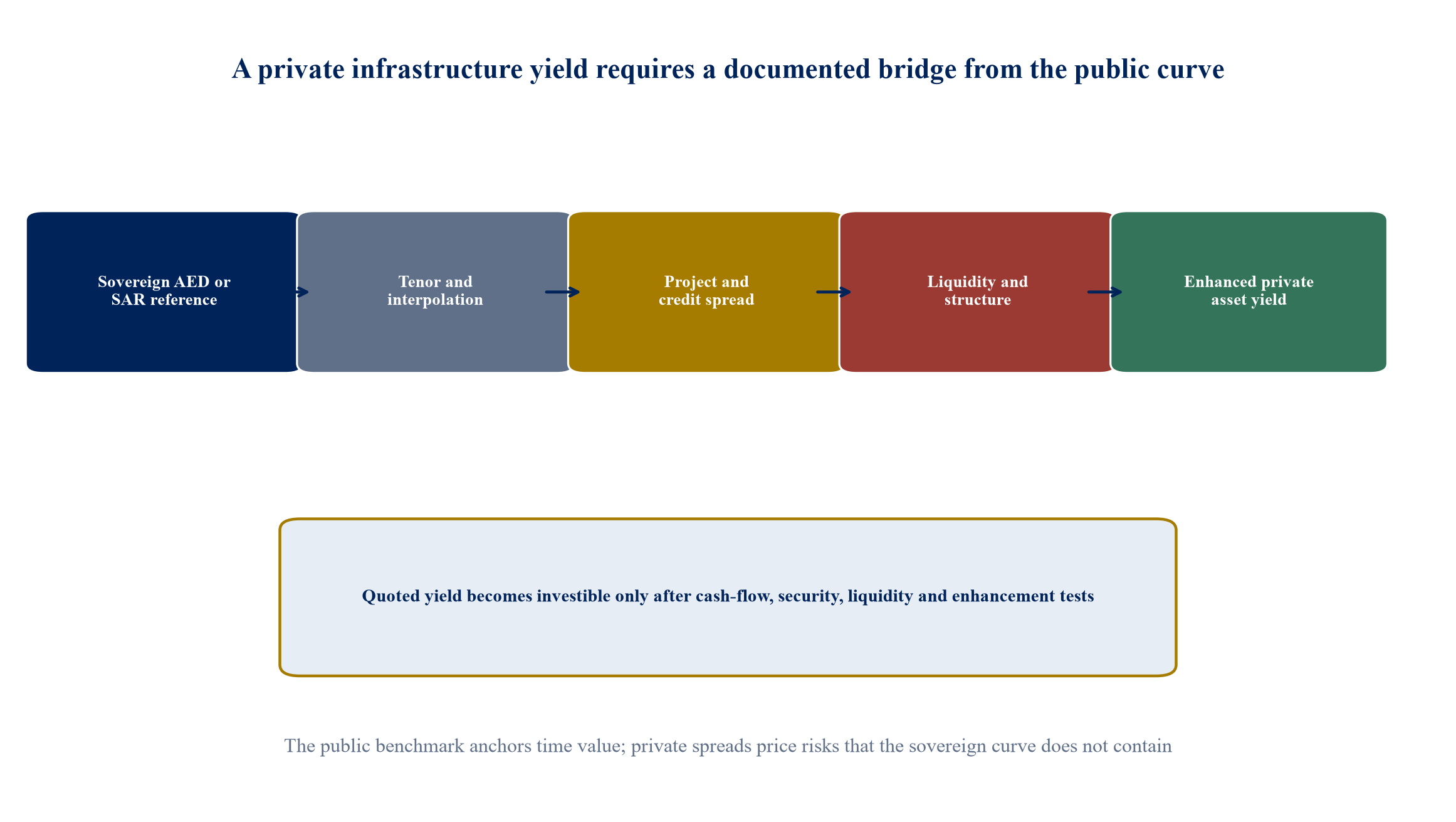
Author-designed framework. Every spread component requires current observable evidence and transaction-specific credit judgement.
2. Treat the sovereign curve as an anchor rather than a project price
A sovereign curve describes yields associated with government obligations across maturities, subject to the instruments, liquidity and market conventions available. It gives investors a local-currency reference for time value and duration. It does not contain the construction, operational, contractual and liquidity risks of a private project. Using a government yield as the project discount rate would understate those differences.
Benchmark selection begins with currency, date, tenor, coupon type, day-count convention and settlement. A fixed-rate private note should be compared with a fixed-rate sovereign reference of similar duration where possible. A floating instrument needs an appropriate money-market or reference-rate basis and a margin. A sukuk requires analysis of its contractual cash flows and legal form while remaining economically comparable on yield and risk. The reference date must be controlled because rates and spreads move.
Interpolation may be necessary when no sovereign instrument matches the private note's weighted average life. The method should be disclosed. Linear interpolation is simple but may miss curve shape. Parametric methods can create smoother estimates but introduce model assumptions. A transaction with amortising principal should consider its cash-flow duration rather than selecting the final maturity alone. Independent pricing and sensitivity cases improve governance when the public curve is sparse.
The UAE programme publishes nominal allotment, cut-off yield, clean price and bid-to-cover information for auctions [2]. Saudi Exchange publishes government and corporate sukuk and bond data, including yields, prices, maturities and conventions [4]. These sources can inform an observable reference set. Usage rights and redistribution restrictions must be respected. A private curve should record source, timestamp, cleaning, exclusions, interpolation and approval so that a lender or investment committee can reconstruct the calculation.
3. Build separate AED and SAR reference architectures
AED and SAR instruments should not be treated as one interchangeable Gulf curve. Both currencies have close relationships with the United States dollar through their respective monetary arrangements, yet their sovereign issuance, investor bases, liquidity, legal infrastructure and project pipelines differ. Each market needs its own reference architecture. Cross-market comparison can inform relative value after currency, basis, liquidity and credit adjustments.
The UAE federal programme includes conventional T-Bonds and Islamic T-Sukuk in dirhams. The Ministry of Finance states that the programmes support development of the dirham-denominated yield curve [5]. January 2026 auctions included AED 1.1 billion across T-Bonds and T-Sukuk, with participation from primary dealers [6]. A February 2026 final-terms document records an AED 550 million Treasury Sukuk tranche due May 2030 with a 4.06 percent fixed profit rate and semi-annual distributions [7]. These are dated public observations, not a current private-project quote.
Saudi Arabia's domestic market includes a large stock of government sukuk and bonds with listed pricing information. Saudi Exchange's index framework uses transactions, dealer quotes and evaluated pricing to support daily valuation, recognising that more liquid observations improve curve accuracy [8]. The National Debt Management Center's predictable calendar can support benchmark continuity and investor planning [3]. The Saudi curve has its own instrument mix, maturity distribution and market conventions.
Private issuers should maintain a benchmark matrix for each currency. It should include sovereign securities, high-quality government-related entities, regulated utilities and comparable project or corporate obligations where reliable data exist. Comparables are supplementary rather than substitutes for project analysis. Each observation should be adjusted for seniority, security, cash-flow profile, rating, sector, call features, tax and liquidity. The matrix should exclude stale or non-comparable prices with documented reasons.
4. Construct a curve that can survive investment-committee review
Curve governance matters because small changes in discount rate can materially change long-dated value. The issuer should define data sources, observation time, eligible instruments, outlier treatment, interpolation, stale-price rules and fallback procedures before pricing. The same framework should be used in mandate materials, rating analysis, hedging, investor discussions and fairness checks. A private model that changes opportunistically weakens credibility.
The curve can be represented through spot rates, par yields or discount factors. Cash flows should be discounted consistently. A project note with sculpted principal may have a final maturity of twenty years and a materially shorter duration. Spread analysis should refer to a clear measure such as yield to maturity, asset-swap spread or spread to an interpolated government curve. Call, prepayment and extension options require option-aware analysis where material.
Data quality needs hierarchy. Executed transactions generally carry more weight than firm executable quotes, which carry more weight than indicative quotes or model-derived values. Sparse markets often require evaluated pricing. The Saudi government sukuk and bond index methodology explicitly combines trades, dealer quotes and curve pricing for less liquid instruments [8]. A private infrastructure framework can adopt the same principle while documenting the judgement applied to each observation.
The curve committee should include treasury, credit, project finance, risk and independent valuation capability. It should approve methodology, exceptional exclusions and final pricing references. The transaction file should retain source evidence and calculations. Post-closing valuations should follow the same rules, allowing investors to distinguish market-rate movement from credit deterioration, liquidity change or revised project performance.
Table 1. Reference-curve inputs and control tests
| Input | Purpose | Control test | Common failure |
|---|---|---|---|
| Sovereign auction result | Primary-market reference | Currency, issue date, maturity, cut-off yield and allocation verified | Using an old auction as a current executable price |
| Listed government security | Secondary-market reference | Bid, ask, trade, timestamp and liquidity recorded | Treating an evaluated or stale price as a liquid trade |
| Government-related issuer | Supplementary credit reference | Ownership, support, rating and seniority mapped | Assuming government ownership equals a guarantee |
| Comparable project debt | Private spread reference | Sector, cash flow, security, tenor and construction status aligned | Comparing greenfield risk with mature operating debt |
| Money-market benchmark | Floating-rate base | Administrator, fixing, tenor and fallback verified | Mismatching reset tenor or ignoring basis |
| Interpolation model | Fill maturity gaps | Method, instruments, residuals and sensitivity retained | Producing false precision from sparse observations |
| Cash-flow duration | Match private instrument | Weighted average life, amortisation and options included | Comparing only final maturities |
The table is an author-designed governance aid. Data licences, market conventions and transaction terms require separate verification.
5. Decompose the private spread into observable risks
The private spread should be a bridge rather than one opaque margin. Project credit reflects the probability and severity of loss from revenue, operating cost, performance, counterparty and regulatory risk. Construction spread reflects completion, cost and delay exposure. Liquidity spread compensates for limited trading and valuation uncertainty. Structural spread reflects subordination, security, covenants, call rights and cash-flow priority. Enhancement can reduce selected risks where the support is legally and financially credible.
Sector labels are insufficient. Two water projects can have different credit profiles because one receives availability payments from a strong public counterparty while another bears user demand and tariff collection risk. A data-centre project with a long-term creditworthy offtaker differs from merchant capacity. A regulated network differs from a single-asset concession. The spread analysis should follow contractual cash flow and loss allocation.
Construction and operating phases can have distinct pricing. Banks may be better placed to manage drawdowns, completion testing and waivers. Institutional investors may prefer a funded note after completion or a delayed-draw instrument with strict conditions. A step-down margin after completion can recognise de-risking, but it should follow objective tests. Calendar time alone does not demonstrate completion.
Liquidity should be measured conservatively. Large issue size, standard documentation, listing, market-making and transparent reporting can support tradability. Buy-and-hold investors may still require compensation for limited exit. IMF analysis of GCC markets identifies low liquidity, concentrated investor bases and market-infrastructure gaps as areas for further development [9]. A curve framework should therefore distinguish modelled value from an executable sale price.
6. Start instrument design with investor liabilities
Banks fund through deposits, wholesale funding and capital. They can provide construction facilities, revolving liquidity, hedging and relationship support, while long tenor may create asset-liability and concentration pressure. A bank take-out assumption requires committed evidence. The World Bank notes that bank-dominated systems can face limitations in providing long-term local-currency infrastructure finance because of maturity mismatch and credit risk [1].
Insurers seek assets that fit long-dated liabilities, subject to capital treatment, rating, concentration, liquidity and asset-admissibility rules. Pensions and retirement pools can value duration and predictable cash flow, while governance and valuation frequency matter. Asset managers need mandate fit, benchmark treatment, liquidity and reporting. Private-credit funds can accept complexity and illiquidity where return and control compensate them, but fund life, distributions and currency commitments can constrain tenor.
Instrument features should reflect these requirements. Fixed-rate amortising notes can match predictable liabilities. Floating-rate notes reduce duration exposure for some investors but leave the project exposed to rising debt service unless tariffs or hedges respond. Inflation-linked payments can match inflation-linked revenue and liabilities, subject to an observable index and lag. Sukuk can widen the investor base where the structure, asset rights and cash flows meet relevant Shariah and legal requirements.
The issuer should build an investor-liability map before launching. It should record target currency, tenor, duration, coupon type, rating, issue size, denomination, listing, liquidity, sustainability classification and governance. Investor conversations then test specific constraints. A vague claim of institutional appetite does not support underwriting. Orders, commitments and allocation evidence should remain distinct from expressions of interest.
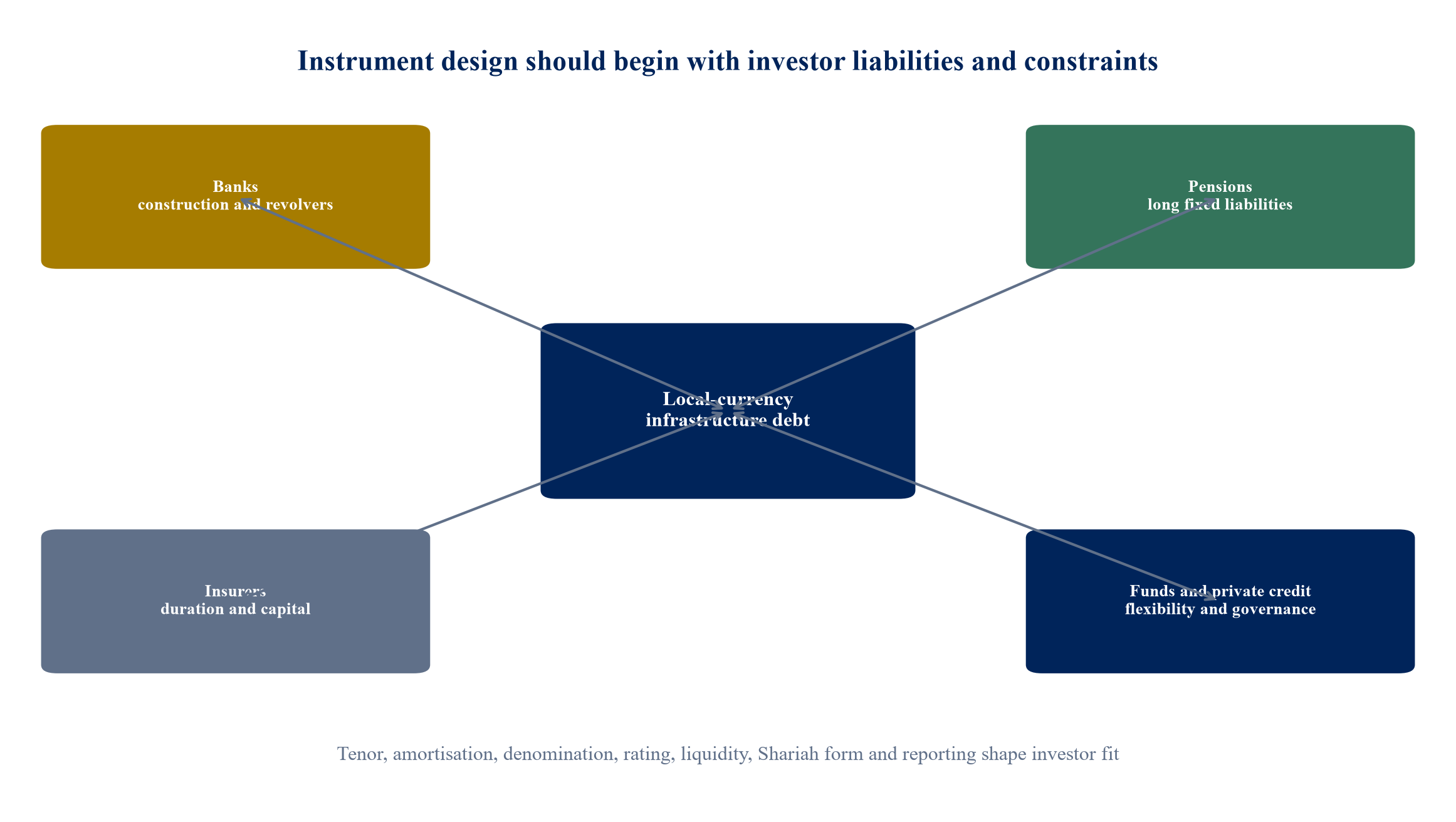
Author-designed framework. Investor eligibility, capital treatment and mandate fit depend on applicable regulation and governing documents.
7. Match debt service to the project's revenue architecture
Local denomination is useful when project revenue is also local. The degree of matching depends on contract detail. Availability-based payments may be stable but subject to deductions, appropriations, indexation and termination. Regulated tariffs can adjust over time but may lag inflation or financing cost. User-pay revenue introduces demand, collection and elasticity risk. Merchant revenue requires greater downside protection.
Debt service should be sculpted to conservative cash flow after operating cost, lifecycle capital, tax and reserve funding. A debt-service coverage ratio is an output of that model, not a substitute for it. Minimum and distribution-lock-up ratios should reflect volatility, cure rights and the consequences of default. Cash sweeps can accelerate deleveraging when performance exceeds the base case.
Revenue indexation should be decomposed. Domestic inflation, imported equipment cost, labour, power, interest and foreign-currency components can behave differently. A tariff indexed only to local consumer prices may not cover a foreign-currency maintenance contract. The sponsor should align debt, hedges and operating contracts to the revenue formula. Residual mismatch belongs in equity or a funded reserve.
Payment-counterparty risk remains central. A sovereign or government-related payer should be analysed through the exact legal obligation, budget process, payment mechanism and termination regime. Government ownership does not automatically create an unconditional guarantee. Private offtakers require credit, concentration and replacement analysis. Direct agreements, cure periods, escrow and assignment can improve continuity where enforceable.
8. Decide between fixed, floating and inflation-linked forms
A fixed-rate instrument gives the project predictable nominal debt service and gives investors duration. It can create mark-to-market sensitivity and prepayment cost. A floating-rate instrument aligns with shorter-term funding and can appeal to banks, but the project bears rate volatility unless revenue or hedging offsets it. A hybrid capital structure can use floating construction debt and fixed institutional take-out after completion.
Inflation-linked debt can align with indexed tariffs or availability payments. The chosen index must be observable, durable and connected to project revenue. Caps, floors, lags and rebasing can create mismatch. Investors need clarity on whether indexation applies to coupon, principal or both. The project should stress nominal and real cash flows and avoid assuming that every cost moves with the same index.
Hedging can convert fixed and floating exposures or manage basis. The hedge should match amount, amortisation, reset dates, day count and maturity. Break costs and collateral can become material on prepayment or restructuring. Counterparty credit and replacement rights matter over long tenors. A hedge that creates a senior collateral drain can weaken project resilience even while reducing rate volatility.
The instrument decision should survive downside scenarios. Rates may rise or fall; inflation may diverge from the tariff index; refinancing may be unavailable; the project may prepay after a change of control. The board should compare expected cost, tail exposure, liquidity and flexibility. One headline yield cannot capture all four.
9. Separate construction capital from institutional duration
Greenfield projects require staged draws, cost verification, engineering oversight and frequent amendments. Banks and specialist private-credit providers often have systems suited to this phase. Institutional investors may prefer a completed asset with operating evidence and stable cash flow. A construction-to-institutional bridge can combine these capabilities.
The take-out should be designed before financial close. Conditions can include completion certificates, performance tests, operating permits, reserve funding, no material claims, contracted revenue, insurance and a minimum operating record. The amount should be linked to the debt capacity proven at take-out, with equity or subordinated capital covering any shortfall. An uncommitted capital-markets assumption leaves refinancing risk with the project.
A forward-purchase, delayed-draw note or warehousing arrangement can provide greater certainty. The World Bank has described models in which development finance or other capital warehouses local-currency debt and sells it to institutional investors after operating risk declines [10]. The warehousing provider needs pricing, duration and exit protection. The institutional investor needs control over eligibility and documentation.
Completion risk should remain with parties able to control it. Fixed-price contracts, contingencies, sponsor support, performance security and independent engineering can help. Force majeure, relief events and change in law require allocation rather than blanket exclusion. Institutional take-out pricing should recognise remaining lifecycle, counterparty and operating risks after construction has ended.
10. Use credit enhancement to solve a defined constraint
Credit enhancement can include partial credit guarantees, first-loss capital, subordinated tranches, liquidity facilities, political-risk cover, revenue support and reserve accounts. Each tool should address a specified risk. A partial guarantee may improve expected recovery or rating. It does not repair an unbankable contract, weak construction plan or unreliable revenue model.
Guarantee terms require careful reading. Coverage amount, tenor, covered events, claim process, waiting period, currency, subrogation, reinstatement, termination and governing law determine value. A guarantee from a highly rated institution can still provide limited protection if exclusions are broad or claims are delayed. The lender should model timing as well as ultimate recovery.
First-loss capital can protect senior investors while concentrating risk in the subordinated layer. The waterfall, cure rights, voting and replenishment rules should be explicit. Liquidity facilities can bridge timing differences but should not finance recurring structural deficits. Reserve accounts need funding rules, permitted investments, release tests and account control. Public support should be priced and disclosed so that contingent liabilities are visible.
World Bank case material describes local infrastructure credit-enhancement platforms designed to mobilise pension and insurance capital [11]. The principle is transferable, while legal and institutional design remains jurisdiction-specific. A UAE or Saudi structure should fit domestic public-finance, securities, insolvency, Shariah and regulatory requirements. The enhancement provider should retain incentives to monitor risk rather than simply transfer it.
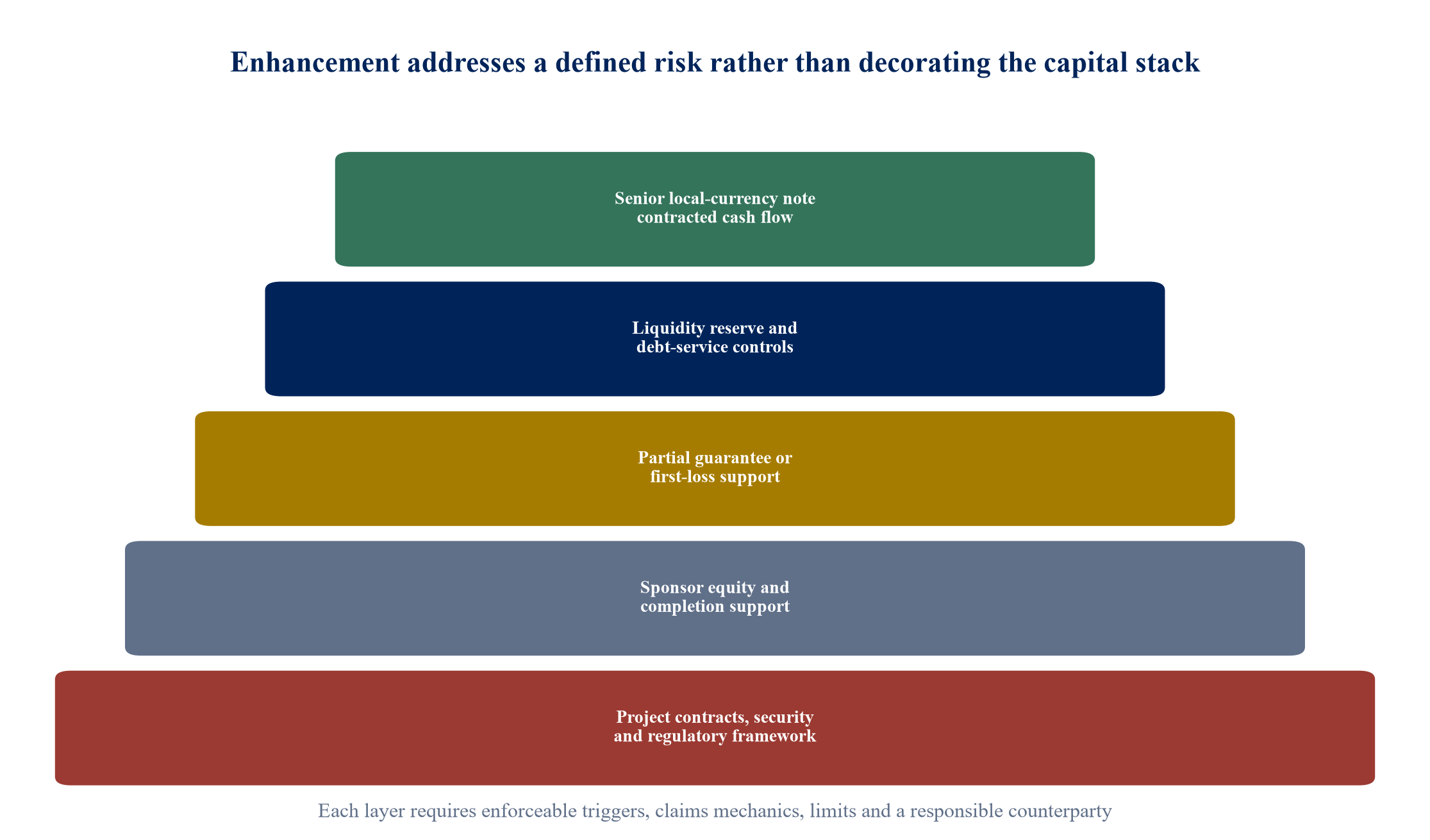
Author-designed structure. Actual guarantees, security and priority require jurisdiction-specific legal, regulatory, tax and Shariah review.
11. Standardise documentation without concealing project risk
Repeat issuance lowers transaction cost when definitions, covenants, reporting and settlement become familiar. Standardisation can cover information memoranda, risk factors, cash-flow waterfalls, reserve mechanics, security, intercreditor terms, reporting, sustainability disclosures and event notices. It should create comparability without pretending that assets are identical.
Project-specific schedules should contain technical scope, contracts, tariff, counterparties, construction, operating standards and environmental obligations. Investors need the ability to identify differences across assets. A standard cover and data schema can make those differences easier to analyse. Hidden exceptions and bespoke definitions weaken the market more than openly described risk.
Post-closing reporting should include construction progress, cost to complete, availability, output, deductions, operating cost, lifecycle capital, insurance, disputes, covenant calculations, reserve balances and material environmental or social events. The data dictionary should be consistent across issuances. Digital reporting can improve timeliness, subject to assurance and cyber controls.
Standard direct agreements and security principles can support enforcement certainty. They should respect concession, public-service and land-right limitations. Step-in rights must be operationally possible. Security over a project company's shares and accounts has limited value if essential permits, land rights or offtake contracts terminate on enforcement. The legal diligence should test continuity under distress.
Table 2. Private-yield bridge for the hypothetical water project
| Component | Illustrative basis points | Cumulative yield | Analytical question |
|---|---|---|---|
| Assumed twelve-year AED sovereign reference | 440 | 4.40% | Which observable instrument and interpolation method anchor time value? |
| Project and counterparty credit | +80 | 5.20% | How resilient are payment, operations and termination cash flows? |
| Construction and ramp-up | +25 | 5.45% | What risk remains after completion support and tests? |
| Liquidity and private placement | +25 | 5.70% | How executable is a sale before maturity? |
| Structural and documentation risk | +15 | 5.85% | Are security, covenants, reporting and direct rights enforceable? |
| Partial guarantee benefit | -60 | 5.25% | Which losses and payment delays does the enhancement actually cover? |
Every value is an author assumption for analytical demonstration. The table is not a current AED quote, valuation or recommendation.
12. Create liquidity through issue design and market infrastructure
Liquidity begins before listing. Issue size, denomination, investor breadth, settlement, custody, documentation and continuing disclosure affect the ability to trade. A large benchmark issue may be more liquid than several small bespoke placements, but project pipelines do not always support scale. Pooling or refinancing vehicles can aggregate operating assets while preserving asset-level transparency.
Market makers need inventory, repo and valuation capability. Investors need reliable prices and settlement. Saudi Exchange publishes a market watch and indices for government and corporate instruments [4]. The IMF identifies repo, collateral, price discovery and investor breadth as relevant to Saudi market development [12]. These features influence how private infrastructure paper can be funded and valued.
Liquidity commitments should be realistic. A listing does not guarantee a bid. A dealer's non-binding indication is different from a committed market-making agreement. The issuer should disclose trading history and valuation sources after issuance. Investors should stress an extended holding period and a sale at a discount. Regulatory liquidity treatment may matter independently of actual market depth.
Redemptions and reopenings can support curve continuity. Sovereign issuers use calendars and taps to build reference points. Private platforms can issue repeat series with common documentation and comparable reporting. A refinancing vehicle can acquire seasoned loans or project bonds and issue larger notes. Risk retention and asset eligibility help align the platform manager with investors.
13. Integrate sukuk and sustainable-finance forms with credit analysis
Infrastructure assets can support sukuk structures through identifiable assets, usufruct, services or other Shariah-compliant arrangements. Legal form, beneficial ownership, cash-flow obligations, purchase undertakings and dissolution events need specialist review. Economic comparison should focus on cash-flow priority, recourse, enforcement, tenor and yield as well as terminology.
The UAE Treasury Sukuk programme and Saudi government sukuk market provide domestic precedents for issuance, settlement and investor participation [3][7]. A private infrastructure sukuk can benefit from familiar conventions while remaining exposed to project-specific risk. Shariah compliance and legal enforceability should be reviewed together. A structure that is formally compliant but operationally unclear can still be difficult to finance.
Green, social or sustainability labels can broaden the investor base where proceeds and assets meet recognised criteria. The ICMA Green Bond Principles emphasise use of proceeds, project evaluation, management of proceeds and reporting [13]. A label does not change debt-service capacity. Investors still require cash-flow and credit analysis. Impact metrics should be specific, measurable and supported by evidence.
Sustainability-linked instruments tie financial terms to performance targets rather than use of proceeds. Targets should be material, ambitious, measurable and independently verifiable. A small coupon adjustment can create limited incentive. A poorly designed target can create disputes or reputational risk. The issuer should align technical methodology, assurance and reporting with the financing documents.
14. Place valuation, accounting and regulatory treatment inside structuring
Institutional investors evaluate expected return, loss, volatility, liquidity and capital use. Accounting classification and expected-credit-loss treatment can affect demand. IFRS 9 requires recognition of expected credit losses for financial assets within its scope [14]. Credit enhancement, staging, modification and impairment should be assessed by each investor under its facts and policies.
Fair value in a thin market may rely on observable sovereign rates plus modelled spreads. Governance should distinguish level-one observations from evaluated inputs and internal assumptions. Model validation, independent price verification and valuation reserves can be appropriate. A transaction price at issuance is evidence, but it may cease to be current when rates or credit conditions change.
Issuer accounting should reflect the legal instrument and any embedded features. Transaction costs, modifications, hedges, guarantees and concession arrangements can affect measurement and disclosure. Public procurers should identify guarantees, termination payments and availability obligations that may create contingent or long-term fiscal exposure. Transparency supports better pricing and public accountability.
Regulatory treatment differs by investor and jurisdiction. Eligible assets, concentration, rating, capital charge, liquidity and related-party rules can shape demand. The issuer should obtain current legal and regulatory advice and should not assume that a local-currency or government-related instrument receives preferential treatment. Investor eligibility should be tested before the issue is sized.
15. Apply the framework to a hypothetical AED water project
Consider a hypothetical availability-based water-treatment project with total capital cost of AED 2.4 billion. Every amount, yield, spread, ratio and repayment assumption in this section is created by the author to illustrate the framework. It is not an observed transaction, market quote, recommended term or forecast. The project has a twenty-five-year service agreement and receives AED payments subject to availability and quality deductions.
The assumed funding plan comprises AED 600 million of sponsor equity, AED 720 million of floating-rate construction debt and AED 1.08 billion of institutional take-out debt. The construction facility is drawn against certified cost. The institutional note funds after completion, performance testing, reserve funding and satisfaction of no-default conditions. The note amortises over twelve years through a sculpted profile.
For illustration, the author assumes a twelve-year sovereign reference of 4.40 percent. Project and counterparty credit add 0.80 percent, construction tail adds 0.25 percent, liquidity adds 0.25 percent and structure adds 0.15 percent. A hypothetical partial guarantee reduces the required spread by 0.60 percent, producing an illustrative 5.25 percent yield. These components must be replaced with current observable data and investor price discovery in a real transaction.
The base case assumes minimum debt-service coverage of 1.35 times and a 1.20 times distribution lock-up. The downside case applies delayed completion, higher operating cost, availability deductions and slower tariff indexation. A six-month debt-service reserve and lifecycle reserve support timing and maintenance. The guarantee covers a defined portion of senior debt after specified payment default, subject to claims conditions. Equity absorbs cost overrun and performance shortfall before take-out.
16. Compare maturity, duration and refinancing outcomes
Final maturity can conceal repayment shape. A twelve-year fully amortising note reduces principal throughout the term. A bullet note leaves most principal outstanding until maturity and creates refinancing or asset-sale dependence. A level-principal profile reduces debt consistently but may not match ramping project cash flow. Sculpted amortisation can align debt service to cash flow, subject to minimum repayment and tail requirements.
Investors view these profiles differently. Insurers and pensions may value longer duration. Banks may prefer amortisation and shorter exposure. Private-credit funds may accept a bullet where exit control and return compensate them. The project should compare weighted average life, duration, annual debt service, refinancing amount and downside coverage. The coupon alone cannot rank the alternatives.
Extension options can provide resilience while transferring risk to investors. Their pricing and exercise conditions should be explicit. A borrower option to extend at the same margin has value and can reduce investor appetite. A lender-controlled extension after a default can support workout. A call option allows refinancing but can truncate investor duration; make-whole or declining call protection can balance interests.
The hypothetical project uses sculpted amortisation and a tail before service-agreement expiry. A downside case delays take-out by one year and assumes a higher yield. Equity and the construction lender must agree how the gap is funded. The transaction should not depend on an uncommitted refinancing merely because the final asset is expected to be attractive.
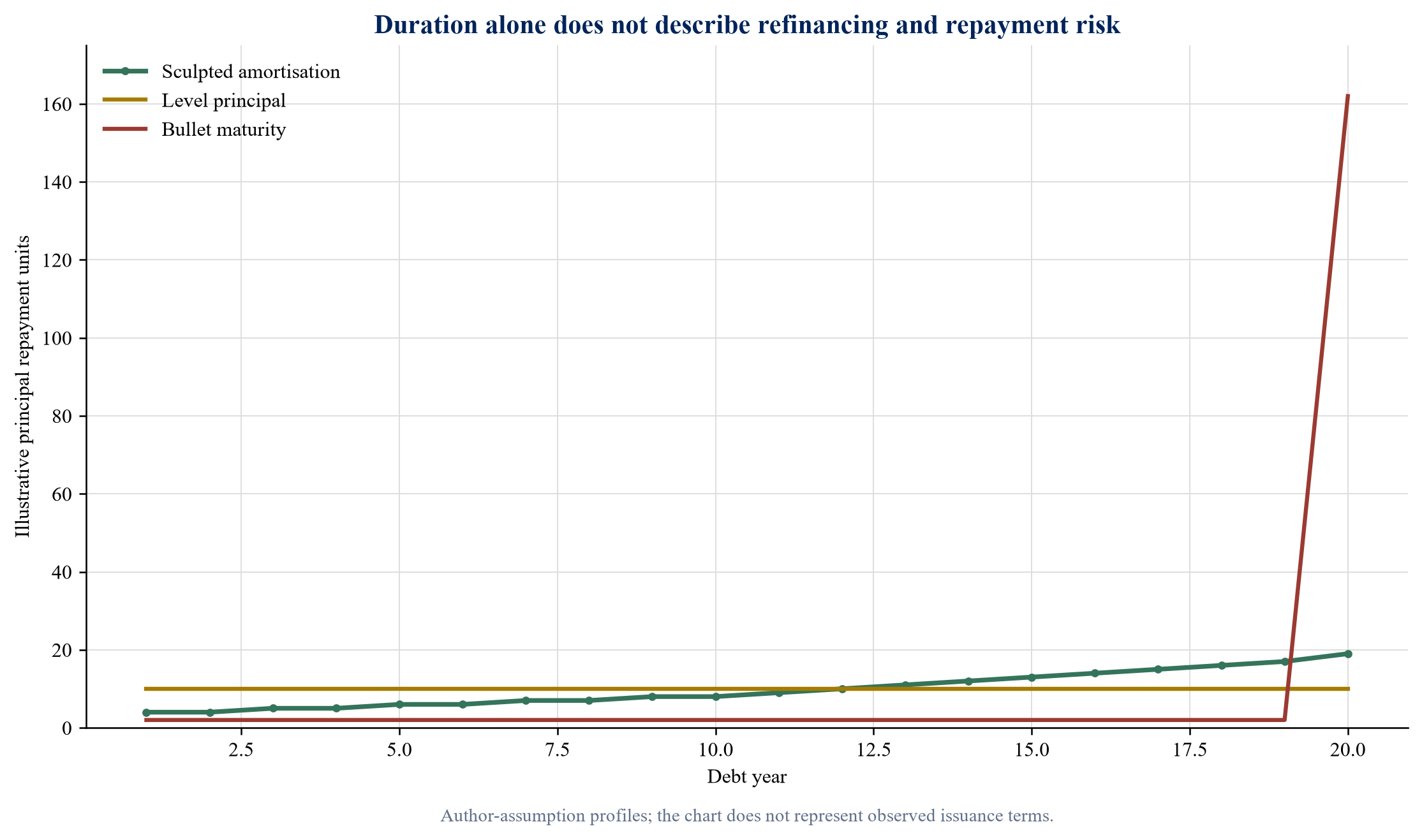
Author-assumption profiles. Units are analytical and do not represent an actual AED or SAR issuance.
Table 3. Investor fit by instrument characteristic
| Investor type | Likely role | Preferred evidence | Common constraint | Structuring response |
|---|---|---|---|---|
| Commercial bank | Construction, revolving liquidity and hedging | Completion package, sponsor support, covenants and security | Tenor, concentration and funding mismatch | Staged take-out and amortisation |
| Insurer | Long fixed or indexed operating debt | Rating, duration, predictable cash flow and valuation | Capital, liquidity and eligible-asset rules | Rated note, standard reporting and enhancement |
| Pension or retirement pool | Long-duration local assets | Stable cash flow, governance and transparent valuation | Illiquidity and internal approval | Larger benchmark size and post-closing data |
| Asset manager | Listed or private fixed income | Benchmark, price, custody, disclosure and tradability | Mandate and daily valuation | Listing, dealer support and independent pricing |
| Private-credit fund | Bespoke tranche, bridge or subordinated risk | Control rights, downside return and exit | Fund life and return threshold | Higher spread, cash sweep and contractual exit |
| Development institution | Anchor, guarantee or warehouse | Development impact, additionality and standards | Mandate, procurement and policy requirements | Defined risk-sharing and institutional sell-down |
The matrix is an author-designed screening tool. Actual appetite requires direct verification with eligible investors.
17. Execute a ninety-day issuance-readiness programme
During days one to thirty, the sponsor and procurer should define currency, revenue, project phase and funding need. They should assemble contracts, permits, construction status, cost to complete, operating model, counterparty evidence, tariff or payment mechanism and existing debt. Treasury should build the AED or SAR sovereign reference set and identify the closest public and private comparables.
During days thirty-one to sixty, the team should develop fixed, floating, inflation-linked and sukuk alternatives. The financial model should calculate cash-flow duration, debt-service capacity, hedging, break cost, reserves, downside coverage and refinancing exposure. Legal advisers should map issuer, security, concession, direct agreement, enforcement, listing and investor-eligibility issues. Enhancement providers should receive a precise risk and claims proposal.
During days sixty-one to ninety, the issuer should complete commercial heads, investor materials and a controlled data room. Rating or independent credit work can begin where relevant. Target investors should be approached with specific instrument features and documented feedback. The curve committee should approve benchmark methodology, comparables and price guidance. The board should approve conditions, sizing range and a fallback financing route.
The output is an issuance-ready proposition: current benchmark evidence, a spread bridge, investor-liability map, term sheet, cash-flow and downside models, enhancement proposal, documentation plan, disclosure index and execution timetable. Investor interest remains unverified until supported by direct evidence. Final pricing remains subject to market conditions, diligence, approvals and allocation.
18. Conclude with a repeatable local-currency market process
Local-currency infrastructure debt can align financing with domestic revenue and mobilise domestic savings into long-lived assets. The opportunity depends on more than denomination. Projects need contractual cash flow, credible completion, transparent reporting and investor-fit instruments. Markets need observable sovereign references, valuation conventions, settlement, liquidity and legal certainty.
An institutional private curve should document the path from the AED or SAR sovereign reference to the project yield. Tenor, credit, construction, liquidity, structure and enhancement belong in separate, reviewable components. The method should use current data, preserve source evidence and avoid false precision. Post-closing performance then updates credit and helps price future transactions.
Investor design should begin with liabilities and constraints. Banks, insurers, pensions, asset managers, private-credit funds and development institutions can occupy different parts of the lifecycle. Construction-to-institutional refinancing, standard documentation, pooled platforms and targeted enhancement can connect those roles. Each structure should allocate risk to the party able to control, absorb or price it.
The market deepens through repetition. Predictable issuance, comparable data, disciplined curve governance and transparent outcomes create evidence. A single project can then become a reference for the next, supporting a broader AED and SAR private-infrastructure debt market without treating every infrastructure asset as sovereign risk.
Table 4. Covenant, trigger and remedy framework
| Control | Measurement | Illustrative trigger | Proportionate response |
|---|---|---|---|
| Completion | Cost to complete, schedule and test evidence | Forecast overrun or missed long-stop | Equity cure, draw stop, contingency use or revised take-out |
| Debt-service coverage | Cash available divided by scheduled debt service | Below lock-up or default threshold | Distribution block, cash sweep, reserve draw or cure |
| Payment deductions | Availability and quality deductions | Rolling deductions exceed base-case band | Operating plan, independent review and enhanced reserve |
| Counterparty credit | Payment record and credit indicators | Delay, downgrade or budget concern | Direct notice, liquidity support or additional security |
| Lifecycle reserve | Required versus funded balance | Underfunded or major maintenance advanced | Mandatory top-up and distribution restriction |
| Guarantee | Coverage, expiry and claims compliance | Coverage decline or missed condition | Replacement, additional enhancement or amortisation |
| Reporting and valuation | Timely data and independent price | Repeated delay or material disagreement | Enhanced reporting, valuation reserve or investor consent |
| Refinancing exposure | Principal due before contract expiry | Uncommitted amount exceeds approved limit | Faster amortisation, call protection or committed take-out |
Thresholds require calibration to verified contracts, investor requirements and project downside analysis.
Frequently asked questions
Why use AED or SAR debt for infrastructure?
Local-currency debt can align debt service with local revenue and reduce reliance on recurring currency conversion or long-dated cross-currency hedging. Credit, rate, liquidity and refinancing risks still require separate analysis.
Does the sovereign yield curve determine the project yield?
The sovereign curve is a time-value reference. A private project requires adjustments for project credit, construction, liquidity, structure and any credible enhancement.
How should an amortising project note be benchmarked?
The analysis should consider the note's cash-flow duration and weighted average life, select or interpolate an appropriate sovereign reference, and document the method and observation date.
Which investors are suited to long-dated local debt?
Banks, insurers, pensions, asset managers, private-credit funds and development institutions can play different roles. Actual fit depends on liabilities, regulation, mandate, return, liquidity and governance.
Can sukuk widen the investor base?
Sukuk can reach investors seeking Shariah-compliant instruments. The transaction still requires project credit, cash-flow, legal, enforcement and liquidity analysis, together with specialist Shariah review.
What does a partial guarantee achieve?
A well-designed guarantee can reduce a specified probability or severity of loss and may improve investor fit. Its value depends on coverage, counterparty, claims mechanics, timing, exclusions and enforceability.
Should construction and operating debt have the same investors?
They can, but the capabilities differ. Banks and specialist lenders often manage construction draws and amendments; institutions may prefer delayed draw or take-out after objective completion and operating tests.
What should be ready before approaching investors?
The issuer should have current benchmark evidence, a spread bridge, project contracts, downside model, investor-liability map, term sheet, enhancement proposal, disclosure index and a credible fallback financing route.
References
- World Bank. Unlocking Local Finance for Sustainable Infrastructure. 2025. https://www.worldbank.org/en/topic/infrastructure/publication/unlocking-local-finance-for-sustainable-infrastructure
- United Arab Emirates Ministry of Finance. Issuance Programme. 2026. https://mof.gov.ae/en/public-finance/public-debt/issuance-programme/
- Saudi Arabia National Debt Management Center. Annual Borrowing Plan 2026 and Calendar of Domestic Sukuk Issuances. 2026. https://ndmc.gov.sa/en/IssuancePrograms/Documents/ABP%202026%20-%20English%20Final.pdf
- Saudi Exchange. Sukuk and Bonds Market Watch. 2026. https://www.saudiexchange.sa/wps/portal/saudiexchange/ourmarkets/sukuk-market-watch?locale=en
- United Arab Emirates Ministry of Finance. Public Debt. 2026. https://mof.gov.ae/en/public-finance/public-debt/
- United Arab Emirates Ministry of Finance. Treasury Sukuk and Bonds Attract AED 5.15 Billion in Bids. 2026. https://mof.gov.ae/en/news/treasury-sukuk-bonds-attracts-aed-5-15-billion-in-bids/
- United Arab Emirates Ministry of Finance. Final Terms for AED 550 Million Treasury Sukuk Due May 2030. 2026. https://mof.gov.ae/wp-content/uploads/2026/02/T-Sukuk-22-May-2030-25.2.26.pdf
- Saudi Exchange and IHS Markit. iBoxx Tadawul SAR Government Sukuk and Bond Index Guide. 2020. https://www.saudiexchange.sa/wps/wcm/connect/9363c181-10ea-4113-9f44-c653e6720bcd/01-Government-Sukuk-Bond-Index-Calculation-and-Sukuk-Selection-Criteria.pdf
- International Monetary Fund. Enhancing Resilience to Global Shocks: Economic Prospects and Policy Challenges for GCC Countries. 2025. https://www.imf.org/-/media/files/publications/pp/2025/english/ppea2025043.pdf
- World Bank and Public-Private Infrastructure Advisory Facility. Mobilising Finance for Infrastructure: A Study for the United Kingdom Department for International Development. https://ppp.worldbank.org/public-private-partnership/sites/ppp.worldbank.org/files/2022-04/61319-DfID_1_Synthesis_Report_Final.pdf
- World Bank. Infrastructure Asset-Backed Securitization Case Studies. https://ppp.worldbank.org/infrastructure-asset-backed-securitization-iabs-case-studies
- International Monetary Fund. Saudi Arabia 2026 Article IV Consultation Staff Report. 2026. https://www.elibrary.imf.org/view/journals/002/2026/210/article-A001-en.xml
- International Capital Market Association. Green Bond Principles. 2025. https://www.icmagroup.org/sustainable-finance/the-principles-guidelines-and-handbooks/green-bond-principles-gbp/
- IFRS Foundation. IFRS 9 Financial Instruments. https://www.ifrs.org/issued-standards/list-of-standards/ifrs-9-financial-instruments/
- International Monetary Fund. Guidance Note for Developing Government Local Currency Bond Markets. 2021. https://www.imf.org/en/Publications/analytical-notes/Issues/2021/03/11/Guidance-Note-For-Developing-Government-Local-Currency-Bond-Markets-50256
- International Organization of Securities Commissions. Principles for Financial Benchmarks. 2013. https://www.iosco.org/library/pubdocs/pdf/IOSCOPD415.pdf
- Bank for International Settlements. Developing the Market for Local Currency Bonds. 2007. https://www.bis.org/publ/bppdf/bispap36.pdf
- Organisation for Economic Co-operation and Development. OECD Guidance Note on National Infrastructure Strategic Planning. 2022. https://www.oecd.org/gov/budgeting/oecd-guidance-note-on-national-infrastructure-strategic-planning.pdf
- World Bank Group. Guidance on PPP Contractual Provisions. 2019. https://ppp.worldbank.org/public-private-partnership/library/guidance-ppp-contractual-provisions-2019-edition
- World Bank Group. Local Currency Facility. https://ida.worldbank.org/en/financing/ida-private-sector-window/local-currency-facility-lcf
- Saudi Exchange. Sukuk and Bonds Market Statistics, Annual Report 2025. 2026. https://www.saudiexchange.sa/wps/wcm/connect/8e569a4e-343e-4a21-ad52-afec4bad1a73/Saudi%2BExchange%2BStatistical%2BAnnual%2BReport%2B%2B2025en.pdf
- Saudi Exchange. Sukuk and Bonds. 2026. https://www.saudiexchange.sa/wps/portal/saudiexchange/rules-guidance/capital-market-overview/sukuk-and-bonds?locale=en
- United Arab Emirates Ministry of Finance. Sovereign Retail Treasury Sukuk Programme. 2026. https://mof.gov.ae/en/news/ministry-of-finance-announces-opening-of-subscription-and-pricing-for-uaes-inaugural-sovereign-retail-t-sukuk-programme/
- World Bank Group. Sustainable Infrastructure Finance. https://www.worldbank.org/ext/en/topic/sustainable-infrastructure-finance
