

1. Define the joint-venture decision
The transaction question is whether a joint venture is the right vehicle for a defined health outcome and operating model. The parties should state which clinical or operational decision will improve, who remains accountable, which data and technology are required, who contracts with customers, who bears delivery and liability, and how value becomes collected cash.
A joint venture should not be justified by generic access. Local healthcare relationships, data, clinical credibility, licences and government alignment can be valuable. External models, software, intellectual property and technical talent can also be valuable. The investment case begins when these assets form an executable service that neither party can deliver as effectively alone.
The clinical perimeter should identify the condition or workflow, target population, licensed user, setting, input, model output, required action, downstream capacity and consequence of error. Documentation support, radiology prioritisation, patient-risk prediction, coding, scheduling and treatment recommendation occupy different regulatory and liability positions.
Value should be separated into current stand-alone contribution, contributed assets, funded capability build, joint-venture operating value, party-specific synergy and unproven expansion. Data access, a regulator discussion, signed memorandum or pilot should support only the evidence layer it proves.
The vehicle choice should compare a joint venture with licensing, distribution, managed service, minority investment, acquisition and contractual alliance. The comparison should address ownership of customer relationships, clinical accountability, regulated data control, product-change authority, capital at risk, speed, reversibility and exit. A joint venture is more defensible when both parties contribute continuing capabilities that cannot be purchased cleanly through an ordinary contract and when shared control is necessary to protect the clinical and economic result.
The board should define the failure case before incorporation. Failure can mean inability to obtain the required authorisation, insufficient local evidence, weak workflow adoption, unavailable data rights, excessive implementation cost, an unresolved liability allocation or a customer proposition that never converts into cash. Each failure case needs an observable indicator, an owner, a funded response and a point at which the parties pause, restructure or terminate the venture.
2. Build the clinical-control architecture
The joint venture should assign five connected control domains: clinical accountability, data governance, product and model governance, commercial operations and corporate governance. Each domain needs a named decision owner, evidence, escalation route and reserved matters.
Clinical accountability remains with appropriately licensed professionals and authorised healthcare entities. The technology party can design, test, monitor and support the product; it cannot replace duties assigned by law, licence, professional standards or patient relationships. The local operating party should not accept technical risks it cannot inspect or control.
Data governance should identify controller, processor and other relevant roles for each purpose. Product governance should connect intended use, model version, validation, change, monitoring, incident and retirement. Commercial governance should connect customer promise, accepted service, invoice and cash. Corporate governance should fund the system and resolve decisions without weakening the first four domains.
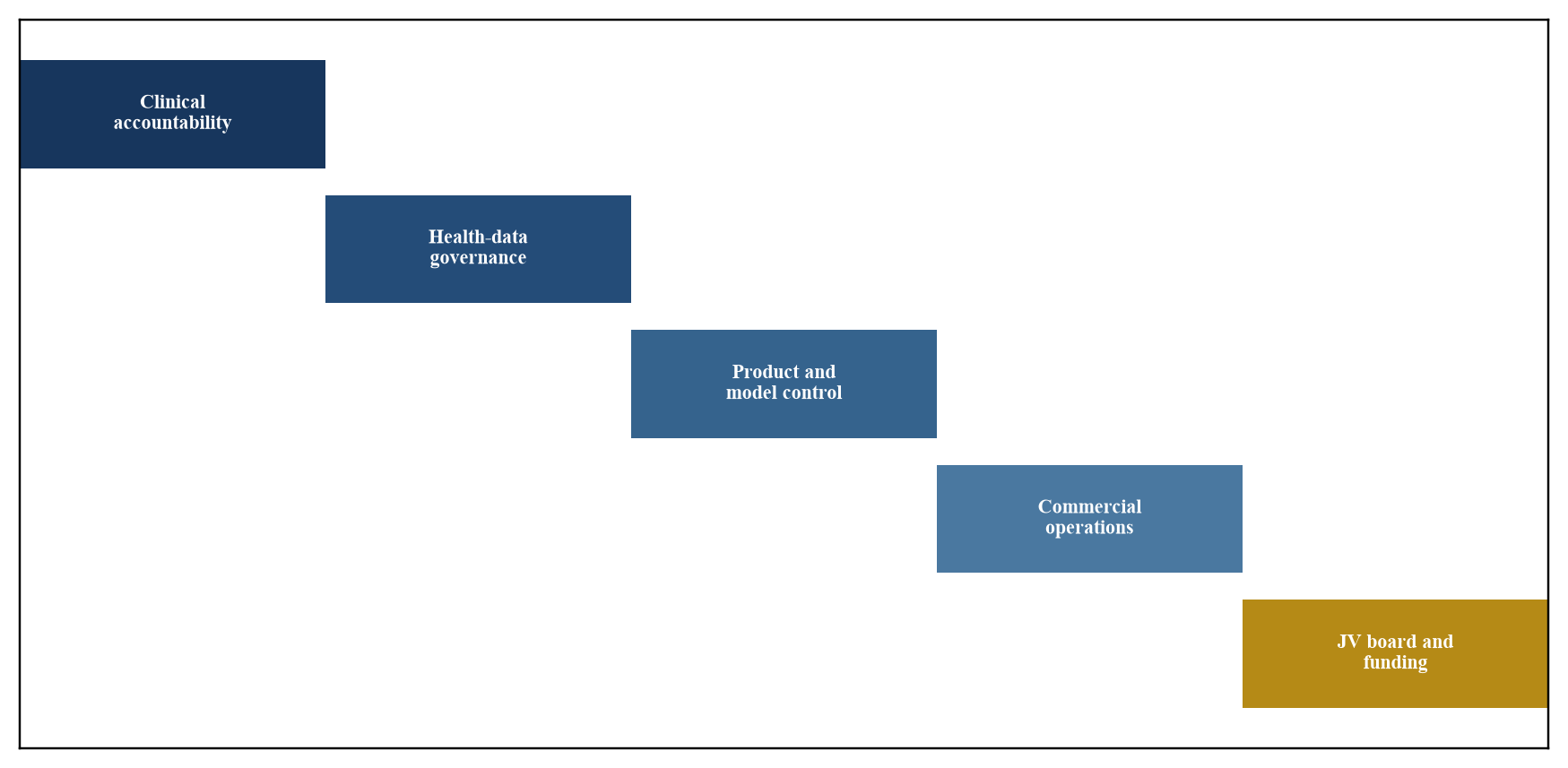
Legal roles and accountabilities require use-case and jurisdiction-specific advice.
| Domain | Accountable evidence | Core reserved matter | Value protected |
|---|---|---|---|
| clinical | intended use, licensed owner and safety case | expansion or material workflow change | patient safety and adoption |
| data | purpose, rights, provenance, location and access | new purpose, transfer or improvement use | lawful data utility |
| product | version, validation, monitoring and incident record | model, supplier or architecture change | performance continuity |
| commercial | customer promise, acceptance, invoice and cash | pricing, service level and channel | revenue quality |
| corporate | budget, funding, audit and decision rights | capital, debt, related parties and exit | investability and control |
Proposed governance map; allocation requires verified contracts, licences and applicable law.
3. Reconstruct the prospective study
The buyer should reconstruct the study from protocol to analysis rather than relying on the abstract or headline endpoint. It should identify registration, protocol version, statistical analysis plan, amendments, sites, enrolment, inclusion and exclusion criteria, comparator, sample-size assumptions, missing-data handling and stopping rules. Prospective registration and reporting frameworks such as SPIRIT-AI, CONSORT-AI and DECIDE-AI improve transparency but do not replace diligence.[32][33][34]
The model version is part of the tested intervention. The buyer should identify weights, thresholds, preprocessing, input devices, software dependencies and user interface. Any difference between the evaluated and commercial versions should be mapped to verification, validation and regulatory assessment. A product described by brand name can contain materially different clinical systems over time.
Site selection can create optimistic performance. Academic centres may have specialist staff, higher-quality data and implementation support unavailable to community sites. The team should compare trial sites with the addressable market across prevalence, demographics, devices, workflows, staffing and care pathways. Excluded or failed cases belong in the economic population.
The comparator should represent actual care. A historical comparator can be affected by secular trends, coding, staffing or protocol changes. A silent deployment tests model performance without measuring behavioural response. A randomised workflow study can identify causal impact more strongly, but contamination, clinician learning and site effects still require analysis.
| Dimension | Evidence | Failure signal | Price response |
|---|---|---|---|
| protocol | registered plan and amendments | endpoint or population changed after data | reduce certainty and test sensitivity |
| model version | reproducible artefact and configuration | commercial version differs | exclude unsupported benefit |
| population | inclusion, exclusion and missing cases | narrow or selected cohort | cap addressable population |
| comparator | contemporaneous care pathway | weak or shifting baseline | lower causal confidence |
| sites | representative operating settings | expert-site dependence | price deployment cost and delay |
| analysis | prespecified methods and uncertainty | selective subgroup emphasis | use conservative central case |
Proposed diligence catalogue; clinical and statistical specialists should determine materiality.
4. Read endpoints through the care pathway
Accuracy, sensitivity, specificity, area under a curve and calibration describe model behaviour under a defined population. Their economic meaning depends on prevalence, threshold, workflow and consequence. A small improvement in discrimination can have limited value when the operating point creates many false positives or when clinicians cannot act on the result.
The buyer should convert endpoints into a patient and work queue. True positives, false positives, false negatives and true negatives should be shown for the intended population. Each category can create investigation, treatment, delay, anxiety, harm, capacity use and cost. Confidence intervals and subgroup results should remain visible.
Process endpoints can be valuable when they connect to capacity or outcomes. Time to report, time to review, length of stay, cancelled procedure, avoided appointment and documentation time can support a purchasing decision. The bridge requires evidence that saved time is releasable, redeployed or converted into additional care.
Patient outcomes should match the mechanism and observation period. Mortality, morbidity, quality of life, diagnostic delay and adverse events differ in importance and statistical power. Composite endpoints should be disaggregated. A favourable surrogate can support value only where its relationship to meaningful outcomes is credible for the intended decision.
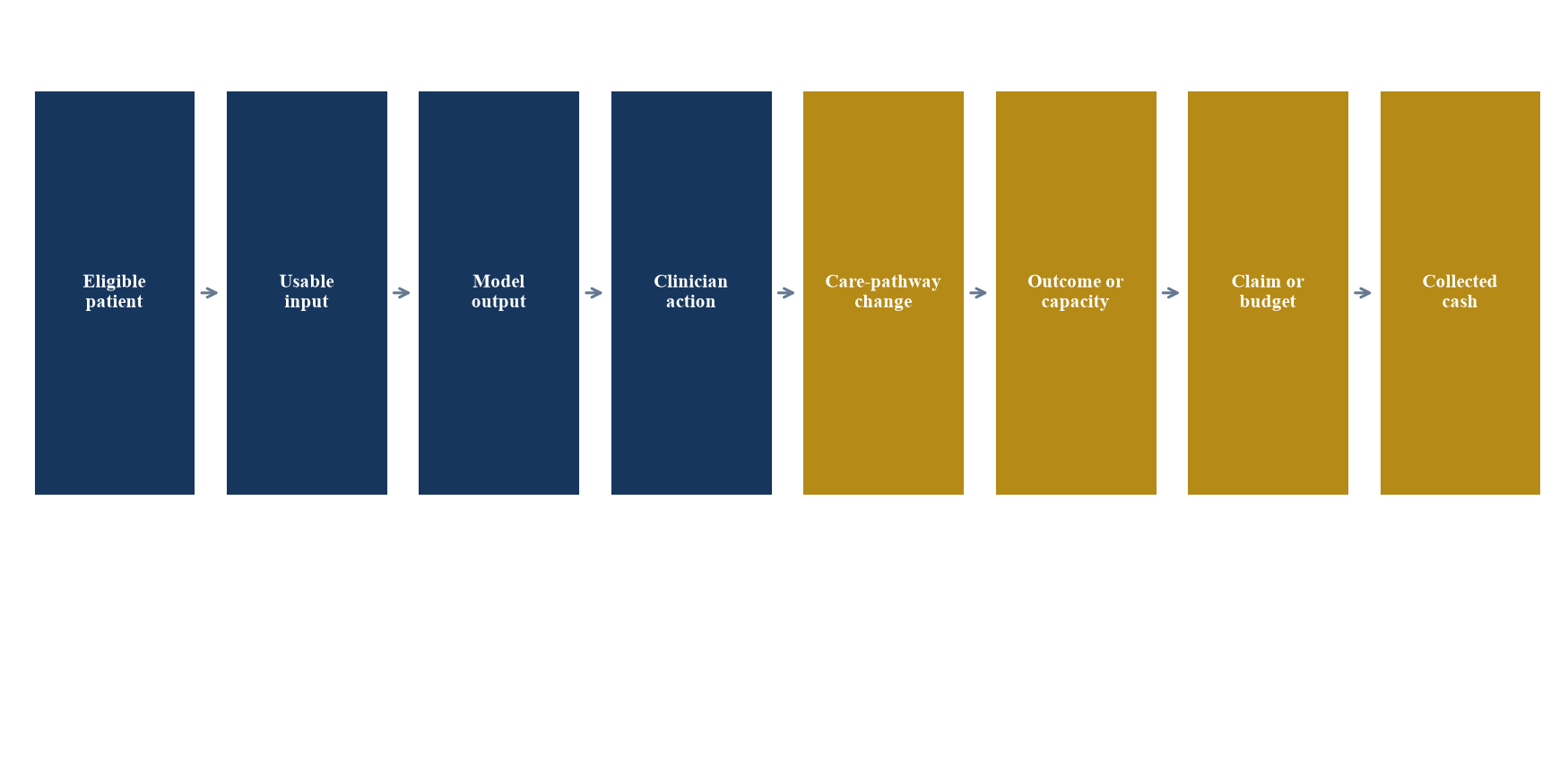
The chain requires evidence at every transition from output to collected economic value.
5. Build a purpose-specific health-data rights ledger
Data should be mapped by purpose rather than described as one asset. The ledger should identify source, category, patient or provider context, legal basis, consent where relevant, controller and processor roles, permitted purpose, hosting, access, transfer, retention, deletion, audit, incident, improvement use, model training, derived data and exit obligations.
Abu Dhabi's responsible-AI standard requires authenticated sources, provenance, privacy safeguards, purpose alignment and due diligence for third-party health data.[5] Its health-information-exchange standards and 2026 minimum datasets connect provider systems to Malaffi through specified clinical and demographic standards.[1][2] Dubai's NABIDH framework likewise operates a secure health-information exchange with adopted interoperability, data-quality, confidentiality, consent, access and audit policies.[3][4]
Saudi Arabia's Personal Data Protection Law and transfer regulation contain additional controls for health data, access minimisation, impact assessment and cross-border transfer.[7][8] The Saudi Food and Drug Authority maintains guidance for AI and machine-learning medical devices.[6] The precise combination depends on location, entity, product, purpose and data flow.
The ledger should distinguish operational processing from model improvement and research. A healthcare provider may authorise processing needed to deliver a service while restricting secondary use, export or training. De-identified or pseudonymised data still require a documented assessment and governance appropriate to residual risk and applicable law.
The operating team should reconcile the legal ledger with the technical data path. Source systems, extracts, message queues, integration engines, feature stores, model services, logs, monitoring tools, support environments and backups can each create a distinct copy or access route. The record should identify where identifiers remain, which transformations occur, who can reverse them, how access is approved and revoked, and how an incident can be contained without interrupting essential care.
Exit rights belong in the initial data design. The parties should specify which records must remain with the healthcare provider, which operational records the joint venture must retain, whether derived parameters can be reused, how models are separated from regulated data, how customer continuity is preserved and how deletion is evidenced. A data asset with unclear exit treatment can become a trapped liability and can make the joint venture difficult to finance, sell or unwind.
6. Separate model performance from clinical utility
A model can be accurate and clinically irrelevant. It may identify information already available to the clinician, arrive after a decision, recommend an unavailable action or add alerts to a saturated workflow. Clinical utility requires a changed decision or action that is appropriate for the patient and feasible for the service.
The buyer should measure receipt, opening, comprehension, agreement, override, action and timing. Each step forms an adoption funnel. An apparent low adoption rate can signal distrust, poor placement, inadequate training, weak relevance or appropriate rejection. Override reasons and subsequent outcomes should be captured rather than classified automatically as user error.
Human factors deserve the same diligence as the model. Interface design, alert wording, prioritisation, explanation, training, escalation and downtime procedures can alter safety and performance. The FDA and WHO emphasise transparency, user needs and human oversight across the lifecycle.[1][3] The tested system includes people, process and technology.
Capacity can reverse value. A detection tool that finds more patients may increase imaging, biopsy, specialist review, treatment or follow-up demand. If downstream capacity is unavailable, the product can create longer queues or displace higher-value care. The economic model should include the complete pathway and any bottleneck investment.
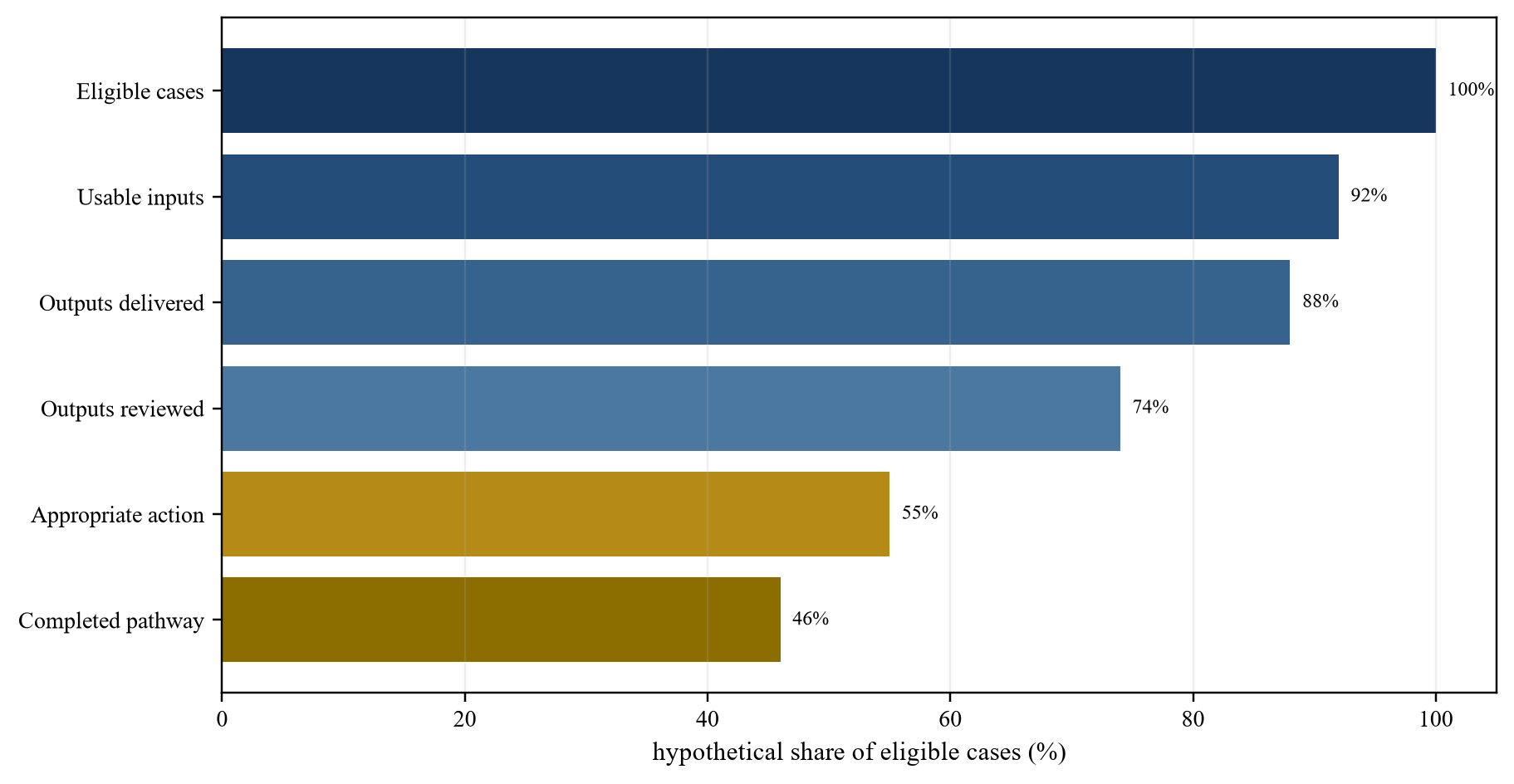
Hypothetical funnel; percentages are illustrative management assumptions and are not clinical benchmarks.
7. Map regulatory and licensed-accountability perimeters
Each product function should be classified by intended use and consequence. A medical-device function may require authorisation, quality systems, clinical evidence and post-market obligations. A non-device administrative function can still create privacy, cybersecurity, professional, employment, payer and patient-safety exposure.
The joint venture should identify the legal manufacturer or equivalent responsible party, local authorised representative where required, importer or distributor, healthcare provider, licensed clinician, data controller, technology processor, hosting provider and customer. Responsibilities should match practical control and evidence.
Local market access does not transfer automatically with software or intellectual property. Regulatory filings, facility licences, professional licences, advertising, procurement, cloud, cybersecurity, health-information exchange and payer obligations should be mapped separately. The operating model should preserve regulator-facing records and authority after any change in ownership, vendor or hosting.
The board should maintain a jurisdiction-and-use matrix covering the UAE federal perimeter, relevant emirate health authority requirements, Saudi requirements and any other GCC market entered. Expansion should pass a new gate rather than inherit an assumption from the first country.
8. Price reimbursement and budget ownership
Regulatory authorisation permits a product to be marketed under defined conditions; it does not create reimbursement or a purchasing budget. The buyer should identify who pays, the covered service, coding, price, evidence requirement, utilisation control, contracting route and renewal decision. Payment can arise through a dedicated code, bundled payment, hospital budget, population contract, subscription or shared-savings arrangement.
The economic beneficiary can differ from the buyer. A hospital department may bear software and implementation cost while savings accrue to a payer, another department or future period. The transaction model should show the value flow and the contracting mechanism that returns an appropriate share to the vendor.
NICE's evidence standards framework connects clinical effectiveness, real-world performance, implementation, budget impact and value to commissioning decisions.[4][26] Early-use HealthTech guidance can support managed adoption with evidence generation, but conditional access should be distinguished from durable routine purchasing.[27][28]
US reimbursement can vary across setting, payer, code and service. A code does not guarantee coverage, payment amount, utilisation or vendor capture. The buyer should reconcile claims, denials, appeals, contract allowances and cash by site and payer. Provider-paid models require the same discipline around budget ownership and renewal.
| Route | Buyer | Evidence needed | Main valuation risk |
|---|---|---|---|
| dedicated reimbursement | provider or supplier | coverage, coding and claim acceptance | code without durable coverage |
| bundled payment | provider system | pathway saving and capacity | benefit absorbed by bundle |
| departmental budget | clinical or operating unit | local utility and budget impact | annual discretionary renewal |
| enterprise licence | health system | multi-site performance and governance | slow procurement and deployment |
| population contract | payer or risk-bearing provider | outcome and total-cost evidence | attribution and contract duration |
| evidence-generation access | public or provider programme | protocol and reporting | temporary adoption mistaken for scale |
Proposed map; payment rules and contracting routes require jurisdiction-specific verification.
9. Contract data, technology and clinical obligations precisely
The customer contract should define the service, intended use, authorised users, supported environment, responsibilities, clinical review, data processing, hosting, security, integration, service levels, change, monitoring, incident response, audit, pricing, acceptance, invoicing, liability and termination.
The shareholders' agreement and operating agreements should then allocate what the joint venture needs from each party. The local party may contribute customer access, clinical operations, licences, regulated hosting, integration capability and personnel. The technology party may license software, models, documentation, engineering support, updates and technical know-how. Each contribution needs scope, duration, cost, performance and exit treatment.
Intellectual-property clauses should distinguish background IP, joint developments, local configurations, clinical protocols, improvements, derived data, model weights, evaluation results and operational know-how. Broad language such as "all improvements" can create dispute when several assets and regulated responsibilities interact.
The commercial agreement should connect payment to evidence the joint venture can control. Per-user, per-study, per-member, subscription, licence, implementation, outcome-linked and shared-savings models create different measurement and working-capital exposures. The parties should test who defines an eligible case, who verifies service delivery, how rejected outputs are treated, when acceptance occurs, which data support an invoice and how a clinical or technical incident changes payment.
Liability allocation should follow authority and causation. The technology party should remain responsible for obligations it controls, including specified product performance, documentation and support. The healthcare operator should remain responsible for clinical practice and local operating duties it controls. Shared events need a fact-finding protocol, preserved records, patient-first response and a mechanism for allocating cost after the immediate risk is contained.
The agreements should preserve continuity. The joint venture needs source materials, documentation, version history, incident support, substitution rights and transition assistance proportionate to product criticality. A licence that terminates on shareholder dispute can make the operating company unfinanceable.
10. Build facility and workflow cohorts
Facility cohorts should progress from memorandum, contract and security approval through integration, validation, go-live, productive use, renewal and collection. Patient or workflow cohorts should trace eligible cases, usable inputs, model output, clinician review, action, downstream service, outcome, invoice and cash.
The hypothetical case includes 24 contracted facilities, 20 technically live facilities, 17 productively active facilities and 14 facilities with at least twelve months of seasoned use. These figures are illustrative. They show why contracted market access and an operating installed base are different evidence states.
Productive use needs a stable definition appropriate to the product. Measures can include eligible-case capture, successful processing, output delivery, clinician interaction, action, exception, turnaround time and completed downstream work. Facility activity should be segmented by product version, workflow, specialty, payer and customer.
The parties should agree who owns cohort measurement and who can audit it. Value-based consideration and funding gates become difficult when one shareholder controls the underlying data or can change definitions without joint approval.
11. Reconstruct unit economics after implementation
Revenue should be reduced by variable and directly attributable cost. Clinical data access, cloud, inference, integration interfaces, cybersecurity, annotation, quality assurance, clinical support, regulatory maintenance, post-market surveillance and customer success can be material. A software gross margin that excludes these functions can overstate contribution.
Implementation cost should include interface configuration, data mapping, validation, workflow design, information governance, training, parallel operation and remediation. Some cost is reusable; some repeats at every site. The buyer should separate platform, country, health-system and site-specific work.
The hypothetical case collects USD 13.5 million. Data, cloud and model operations cost USD 1.7 million; site integration and support cost USD 2.4 million; clinical quality, regulatory and monitoring cost USD 1.5 million; sales, procurement and partner cost USD 1.2 million; and incident, insurance and security cost USD 0.7 million. Contribution before central cost, tax and capital is USD 6.0 million.
Each amount is hypothetical. The example does not claim a representative margin. It demonstrates that prospective evidence creates value only when deployment, governance and monitoring cost remain inside the commercial model.
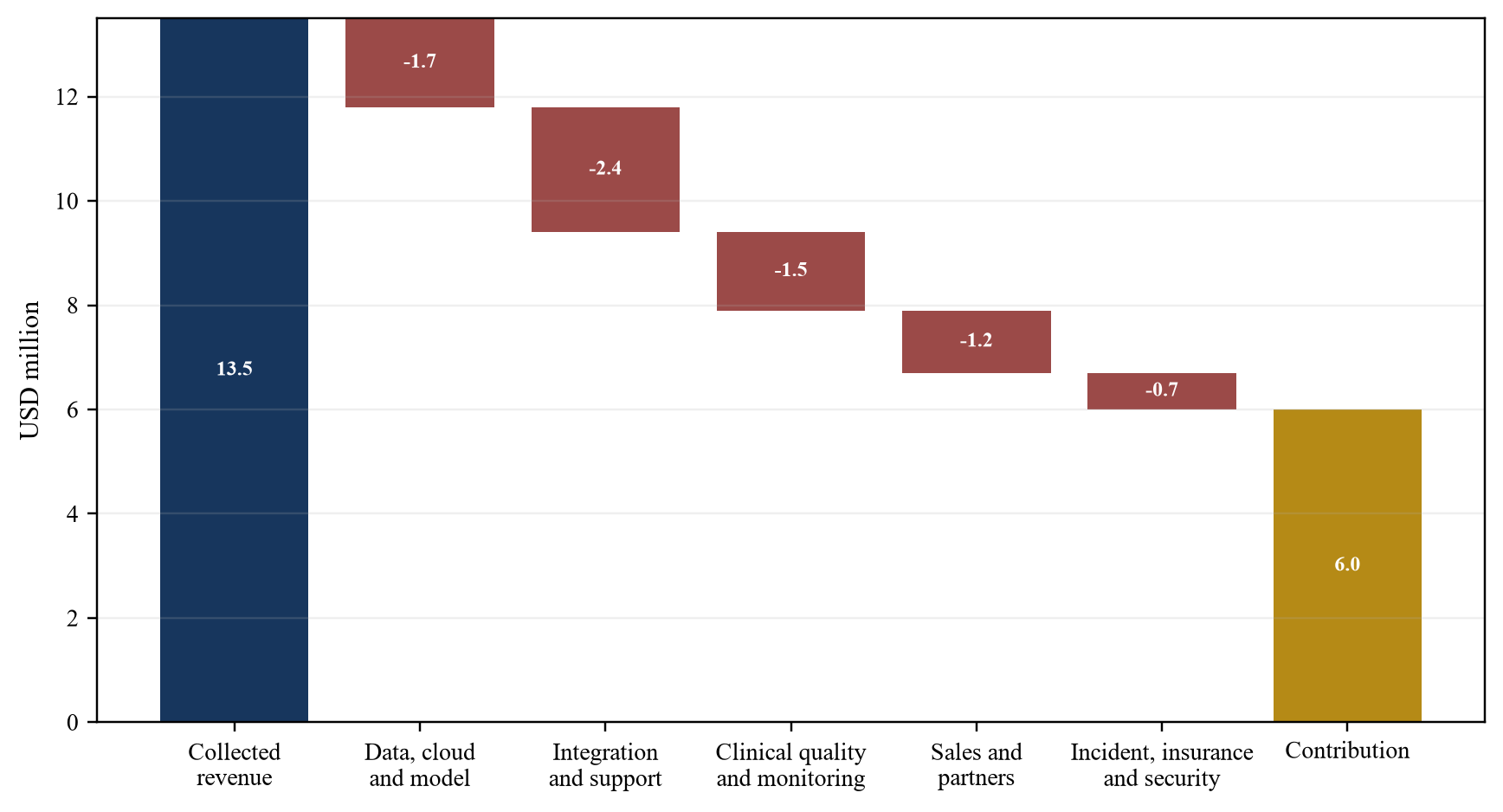
Wholly hypothetical USD millions; central cost, tax and capital remain outside the displayed contribution.
| Measure | Numerator | Denominator | Diligence use |
|---|---|---|---|
| input usability | cases processed without invalid input | eligible cases | data and integration quality |
| output review | outputs opened by intended user | delivered outputs | workflow adoption |
| appropriate action | supported actions completed | reviewed outputs | clinical utility |
| active-site retention | productive sites retained | productive sites at opening | operating durability |
| contribution per case | collected revenue less attributable cost | completed pathways | scalable economics |
| cash conversion | cash collected | recognised revenue | procurement and payer quality |
Proposed structure; financial and clinical populations should reconcile to governed source records.
12. Fund capability transfer and evidence generation
The sources-and-uses plan should cover product localisation, clinical validation, data integration, regulated hosting, security, quality systems, licences, customer implementation, training, monitoring, working capital and contingency. Sales hiring alone cannot create a controlled healthcare operating platform.
Technology transfer should be defined as demonstrated capability rather than document delivery. The joint venture should be able to configure, deploy, monitor, support and recover the product within agreed boundaries. Local clinical, product, data, security and regulatory leaders need authority, systems access and repeatable procedures.
Funding should follow evidence gates. Initial capital can protect continuity and establish the minimum operating system. Later releases can depend on data-rights completion, representative validation, customer go-live, productive use, quality-system readiness, collections or another auditable milestone.
Debt capacity is usually limited before recurring cash and operating control mature. Shareholder funding, grants, customer prepayments, strategic programmes and milestone-linked equity can be compared with their control, dilution and timing consequences.
13. Design a health-economic model
The comparator should be current practice at the purchasing setting. It should include tests, clinician time, treatment, complications, follow-up, administration and capacity. The AI pathway should include software, implementation, training, monitoring, false-positive work-up, false-negative consequence and downstream care.
Time horizon should match outcomes and payment. A hospital may focus on annual budget impact while a payer values multi-year outcomes. Discounted cost per outcome, budget impact, capacity and cash should be presented separately. A favourable cost-effectiveness result does not prove affordability or vendor revenue.
The model should distinguish resource release from theoretical time saving. Five minutes saved per case creates cash value only if staffing, overtime, outsourcing, throughput or avoided delay changes. Capacity released for additional care can be valuable even without cost reduction, but it requires demand and operational execution.
Uncertainty should be explicit. Eligible volume, adoption, prevalence, diagnostic performance, action rate, outcome effect, pathway cost, price and persistence should be varied. Structural assumptions should receive scenarios rather than narrow confidence intervals.
| Layer | Observed evidence | Modelled transition | Value test |
|---|---|---|---|
| population | eligible and usable cases | addressable volume | avoid prevalence inflation |
| performance | threshold results and uncertainty | errors by case type | price harm and work-up |
| action | reviewed outputs and overrides | changed care | separate output from utility |
| outcome | patient and capacity measures | longer-term effect | match time horizon |
| resource | staff, test and pathway use | released or added capacity | distinguish time from cash |
| payment | contract, claim and collection | renewal and price | connect benefit to vendor cash |
Proposed architecture; clinical and economic inputs require source-specific validation.
14. Value the joint venture by contributed and operating evidence
The valuation should separate contributed assets from joint-venture operating value. Background technology and IP can be licensed, sold or contributed. Local commercial access, licences, facilities and operating capability can also be licensed, contracted or contributed. Valuation should follow enforceable rights and economics rather than shareholder narrative.
Operating value begins with collected contribution from productively active and retained customer cohorts. Contracted facilities that have not gone live belong in a conversion schedule with probability, time, cost and customer dependencies. New countries, products and autonomous uses remain option value until evidence matures.
The hypothetical case contains USD 16.0 million of annual contracted revenue and USD 11.2 million of collected revenue. Contribution should deduct channel costs, implementation, cloud and inference, clinical support, quality, security, data governance, regulatory work, customer success and shared corporate functions. All amounts are illustrative.
The model should show ownership, funding and transfer pricing. A high royalty or service fee to one shareholder can remove value from the joint venture while reported revenue grows. Related-party agreements need arm's-length logic, performance obligations, audit and board oversight.
Three valuation views should be reconciled. An asset-and-cost view tests the enforceable rights, development work, licences, integrations and operating capability contributed by each party. An income view values the cash that the joint venture can generate after implementation, quality, clinical support, data governance, customer success, regulatory and central costs. A probability-weighted option view addresses funded countries, products and customer cohorts that have credible gates but have not yet produced seasoned cash.
The model should avoid capitalising unsupported public-policy objectives or counting customer access twice. Procurement support, grants, local hosting and workforce commitments can affect cash and risk when the terms are verified. They do not automatically create transferable enterprise value. The same discipline applies to data: a lawful operating permission can support service delivery while remaining non-exclusive, purpose-limited, revocable or unavailable to a future owner.
Downside cases should reduce value through their causal channels. Licensing delay changes timing and cash burn. Weak adoption changes utilisation and renewal. Limited data rights change product scope and improvement economics. Technology dependency changes continuity cost and exit options. Related-party pricing changes distributable contribution. The board should see these effects separately before viewing a combined case, because each response, covenant and funding decision differs.
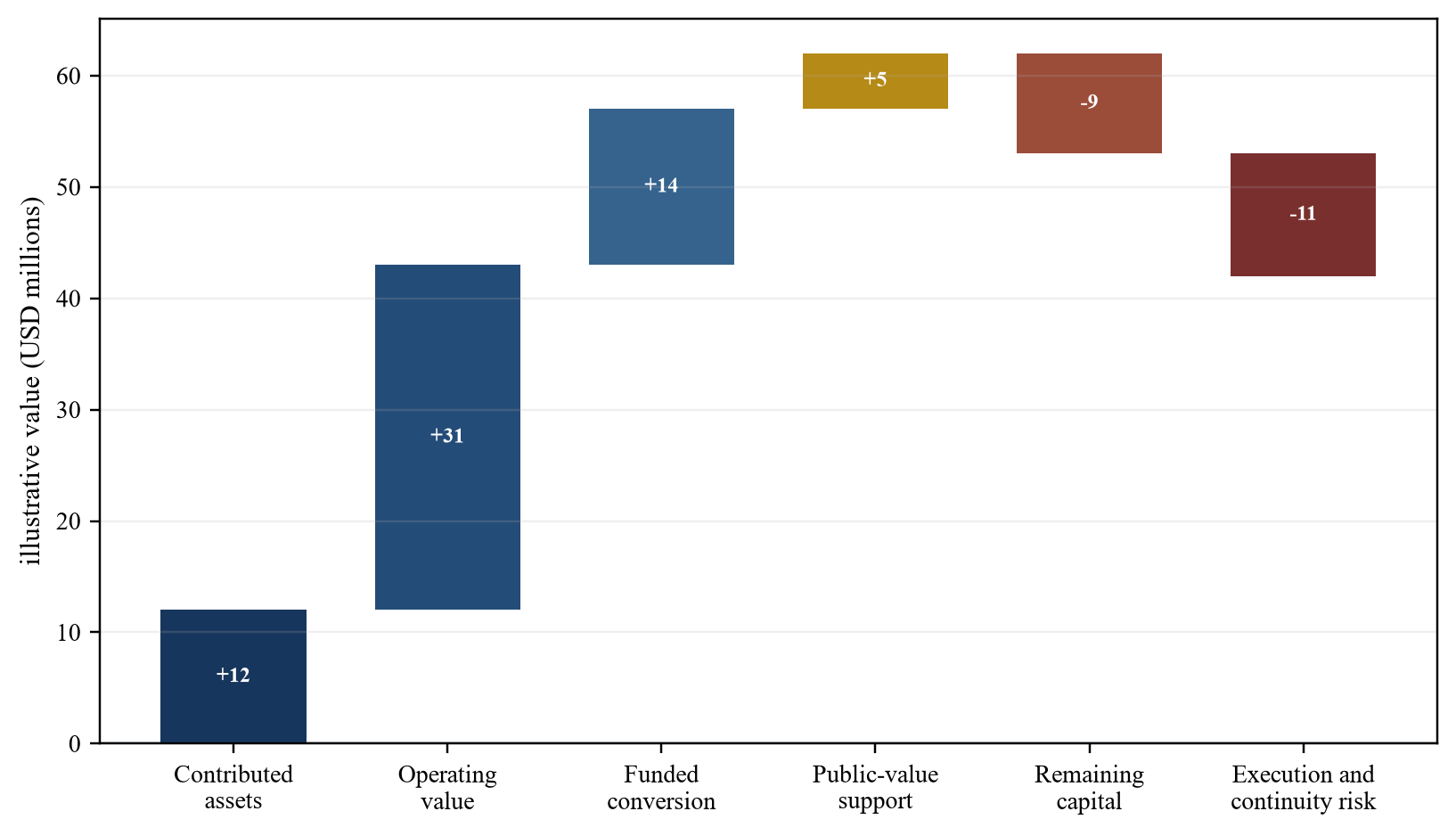
USD millions; all figures are hypothetical management assumptions created solely to demonstrate the method.
15. Design ownership and control around accountable outcomes
Economic ownership and operational control need not be identical. The governance design should reflect licences, clinical accountability, regulated data, technology dependency, capital and customer responsibility. Reserved matters should protect material risk without making ordinary execution impossible.
| Design issue | Evidence required | Control response | Value consequence |
|---|---|---|---|
| clinical accountability | licensed entity, named professional and escalation record | protected clinical authority and stop right | protects adoption and continuity |
| data rights | purpose ledger, access, hosting and transfer evidence | purpose-specific approval and audit | supports lawful data utility |
| technology dependency | licence scope, documentation, support and portability | service obligations, escrow and transition rights | reduces continuity discount |
| capital contribution | approved budget, funding timing and conditions | staged funding and dilution mechanics | aligns ownership with funded risk |
| customer responsibility | contract, acceptance, invoicing and collection evidence | commercial authority and performance reporting | supports revenue quality |
| model change | version, validation and regulatory assessment | classified change control and rollback | protects clinical and regulatory perimeter |
Proposed decision framework; legal allocation requires jurisdiction-specific advice.
Clinical and data decisions require qualified input and defined vetoes. Model changes, new purposes, cross-border transfer, unsupported workflow expansion, safety issues and material incidents should trigger controlled review. Budgets, debt, related-party agreements, senior appointments, dividends and exit require corporate thresholds.
Deadlock should be segmented. A patient-safety or unlawful-data issue may require immediate restriction, not commercial compromise. A budget dispute can follow escalation, mediation, buy-sell or another agreed route. The joint venture should retain service continuity during the process.
Board reporting should connect clinical outcomes, data and model controls, customer cohorts, contribution, cash, incidents, capability transfer, funding and dependencies. Outcome accountability becomes a governance system when the board can see evidence and act.
Ownership should be distinguished from protection. A party may require a reserved matter, information right, licence safeguard, funding condition or exit protection without receiving additional economic ownership. Conversely, a large equity position does not create the clinical licence, data permission or technical capability needed to exercise a decision. The design should assign each control to the party or body that can lawfully and practically use it.
The venture should maintain a decision register for material product, data, clinical, funding and customer choices. Each entry should record the question, evidence, responsible recommendation, conflicts, approval threshold, conditions, monitoring measure and review date. This discipline helps directors demonstrate that approval followed the venture's purpose and control system rather than shareholder pressure or an unsupported growth narrative.
16. Test sensitivities and downside cases
Sensitivity should expose variables management can influence and variables controlled by the environment. Eligible volume, input usability, clinician review, action, price, deployment cost and renewal can be operationally addressed. Regulatory timing, payer coverage and market multiples may have less direct control.
Downside cases should include a failed new-site replication, reimbursement delay, material performance drift, integration outage, cybersecurity incident, regulatory restriction and loss of a clinical champion. The model should show liquidity needs and equity proceeds as well as enterprise value.
The hypothetical contribution sensitivity varies collected revenue and attributable operating cost. It excludes central cost, tax, capital and transaction financing. No cell is a forecast or benchmark.
| Collected revenue; USDm | Attributable cost USD 6.5m | USD 7.5m | USD 8.5m | USD 9.5m |
|---|---|---|---|---|
| 12.5 | 6.0 | 5.0 | 4.0 | 3.0 |
| 13.5 | 7.0 | 6.0 | 5.0 | 4.0 |
| 14.5 | 8.0 | 7.0 | 6.0 | 5.0 |
| 15.5 | 9.0 | 8.0 | 7.0 | 6.0 |
Wholly hypothetical USD millions; no cell is a forecast or market benchmark.
17. Translate diligence into joint-venture protections
Transaction protection should follow the causal risk. Conditions can require licences, data-processing agreements, hosting readiness, quality-system evidence, customer consents, key personnel, technology escrow or representative validation. Price or ownership can reflect a measurable asset or liability gap.
Representations should address contributed IP, licences, health-data rights, privacy, security, regulatory status, clinical evidence, customer contracts, related parties, open source, model dependencies, incidents and claims. Disclosure should be specific enough to support an operational response.
Milestone-linked ownership, funding or consideration can align value with accepted outcomes. The metric should have a stable definition, source, audit right, period, owner and treatment of changes. Clinical outcomes should account for patient mix, workflow, other interventions and control limitations.
Insurance, indemnity, escrow and caps should be tested against likely loss and practical control. The joint venture also needs operating covenants, information rights and remediation budgets because contractual recovery may occur after service and reputation are damaged.
18. Design mobilisation around clinical continuity
Mobilisation should preserve open patient obligations, supported product versions, data access, model monitoring, customer support, incident response and licensed accountability. The joint venture should not change clinical workflows solely to meet a corporate launch date.
The operating architecture should identify the system of record, health-information exchange, model service, integration, identity, consent, audit, support, fallback and recovery. Each interface needs ownership and acceptance evidence. Local infrastructure should be sized for production, monitoring and recovery.
The first deployments should use controlled cohorts with predefined technical, clinical, operational and financial gates. A pilot should have a comparator, representative cases, trained users, fallback, incident route and authority to stop. Learning should feed product, contract and governance decisions.
Continuity extends to shareholder separation. The joint venture needs rights and capability to serve customers during dispute, vendor failure, ownership change or exit. Transition assistance, data return, model portability, configuration records and customer communication should be planned before launch.
19. Govern model change and local post-market evidence
The model register should connect each commercial version to intended use, training and validation data, local evaluation, supported environments, deployed customers, monitoring, incidents, changes and retirement. The joint venture should reproduce which version produced a material output.
Local data can improve representativeness and can reveal heterogeneity. Performance should be examined across relevant languages, clinical settings, devices, populations and workflows. A local dataset does not automatically create a generalisable model or transferable IP.
Change control should classify security patches, interface changes, threshold adjustments, retraining, new populations and expanded autonomy by consequence. Each class needs verification, validation, regulatory assessment, customer communication and monitoring appropriate to risk.
Post-market evidence should connect performance, clinician action, outcomes, incidents, adoption, renewal and cost. The board needs authority to restrict, roll back or stop a product when evidence fails an approved threshold.
20. Build local capability without obscuring dependency
The capability plan should identify which decisions and tasks remain with each shareholder, which transfer to the joint venture and which require third parties. Clinical safety, data governance, regulatory, product, engineering, security, implementation and customer success should have named owners.
Knowledge transfer should be tested through independent execution. Local teams should reproduce deployment, monitoring, incident triage, recovery and approved changes within their authority. Documentation, training attendance and headcount do not establish capability by themselves.
Key-person and supplier dependency should enter the value model. The venture can be locally incorporated and locally hosted while remaining dependent on a remote founder, proprietary model vendor, cloud component or undocumented process. The board should see these dependencies and funded reduction plans.
Localisation should serve the clinical and economic thesis. Hiring, hosting and ownership metrics can support policy goals; durable value still requires useful outcomes, customer retention, operating margin and accountable control.
21. Allocate synergy and public value with evidence
The joint venture can create synergy through customer access, integrated care pathways, local data standards, shared implementation, regulated infrastructure, procurement and complementary capabilities. Each benefit should have an owner, baseline, intervention, cost, timing and evidence gate.
Public value can include care quality, capacity, access, workforce development, resilience and local capability. These outcomes should be measured separately from shareholder return. A policy objective can justify funding or procurement support without becoming private enterprise value automatically.
Data synergy requires lawful purpose, compatible standards, representative coverage and clinical relevance. Abu Dhabi and Dubai health-information exchanges demonstrate the importance of standardised, secure provider integration.[1][3][4] The joint venture should design around the applicable health ecosystem rather than build a parallel ungoverned data pool.
Seller or technology-provider stand-alone value, local-party contributions, joint-venture value and party-specific synergy should remain separate. This prevents the same market access, data or customer relationship from being priced several times.
22. Execute an evidence-gated 180-day programme
Days one to thirty should confirm entity, licences, clinical accountability, data roles, product versions, infrastructure, customer obligations, funding and incident authority. Uncontrolled product and data changes should be restricted.
Days thirty to seventy should complete the purpose-specific data ledger, reproduce representative evidence, map local workflows and health-information exchanges, verify contracts and transfer-pricing, and establish facility cohorts and cash reconciliation.
Days seventy to one hundred and twenty should remediate priority clinical, data, quality, security and integration gaps. The venture should run controlled customer cohorts with predefined acceptance, fallback and stop criteria while testing local capability transfer.
Days one hundred and twenty to one hundred and eighty should season productive use, outcomes, retention, contribution and governance; complete approved integrations; exercise incident and continuity plans; and release contingent funding or value only after agreed gates pass.
Each workstream should have a measurable completion definition. Entity formation is incomplete without bank, tax, delegated authority and related-party controls. Data governance is incomplete without technical enforcement and an exercised response. Product readiness is incomplete without the exact commercial version, supported environment and monitoring. Customer launch is incomplete without authorised users, accepted workflow, support, billing evidence and fallback. Capability transfer is incomplete until the local team performs the agreed task under observation and then independently.
The day-180 decision should classify each proposition as proven, funded for conversion, contingent, paused or stopped. The board should approve the next capital release, ownership adjustment, market expansion or remediation plan against that classification. Unresolved clinical, data or continuity issues should remain visible in the valuation and should not be converted into a general integration assumption.
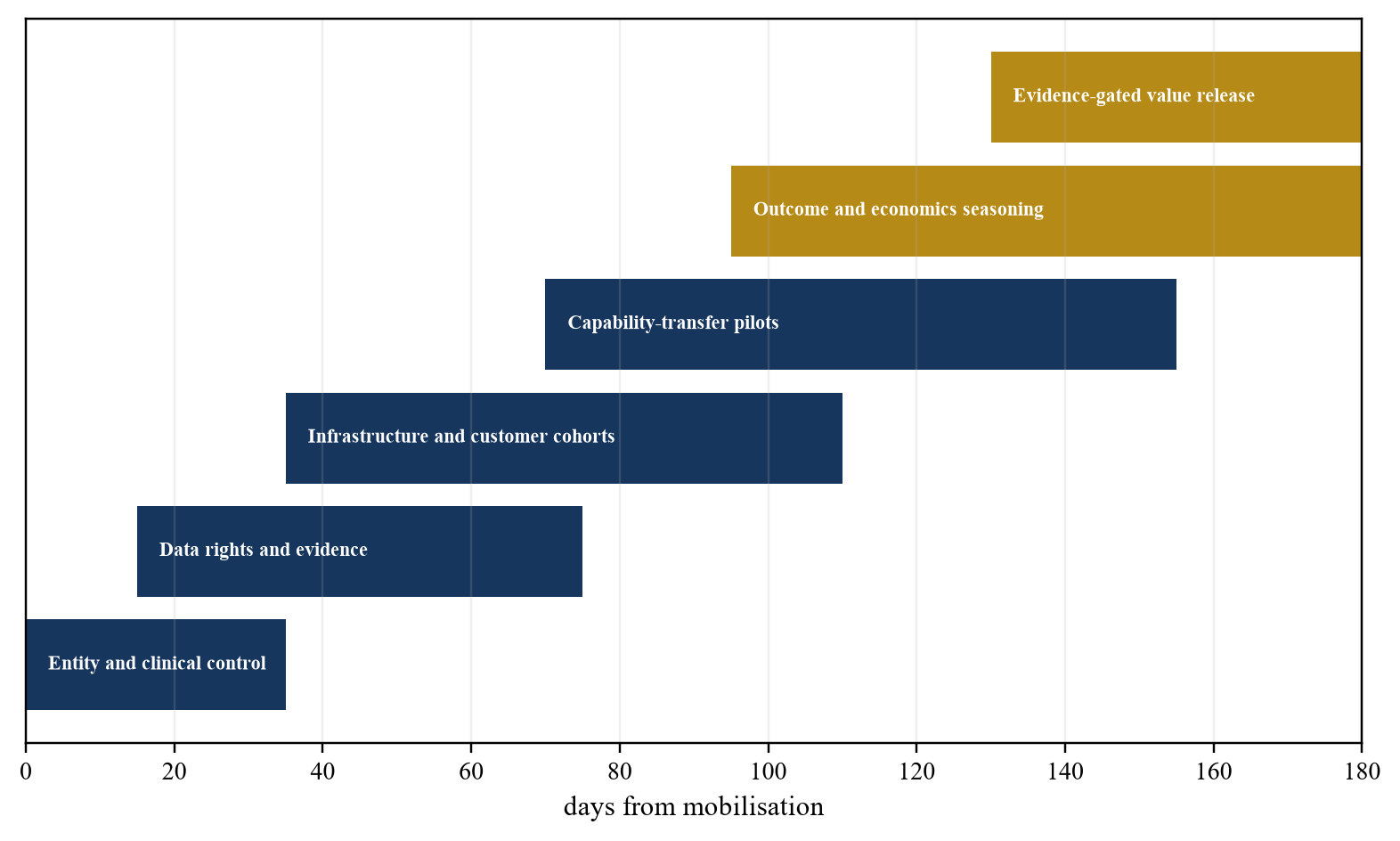
Timing should follow licensing, clinical, data, customer and technology constraints.
23. Decision and conclusion
A GCC health-AI joint venture creates value when the partnership can reproduce a governed clinical or operational outcome under lawful data use and accountable local control. Incorporation, market access, data access and technology licensing are inputs. The operating proof is accepted clinical work, retained customer use, collected contribution and intervention when evidence fails.
The parties should define the patient or workflow problem, intended use, accountable clinician, data purpose, authorised product, customer promise, funding and decision rights before negotiating ownership. Each contribution should be supported by enforceable rights, cost and performance obligations.
Local data can strengthen relevance when provenance, purpose, consent or other lawful basis, security, representativeness and lifecycle control are established. Clinical control requires licensed authority, clear escalation and the practical ability to restrict or stop the product. Technology transfer requires demonstrated operating capability.
The valuation should separate contributed assets, current operating contribution, funded conversion, joint-venture value, public outcomes and party-specific synergy. Governance, consideration and funding should follow evidence and preserve continuity.
The final test is whether the joint venture can show how authorised data become a controlled model output, an accountable clinical action, an accepted outcome, a customer obligation and collected cash while meeting the relevant GCC requirements. Evidence that survives this chain supports value. A break identifies remediation, structure, repricing or a reason to stop.
Sources
- US Food and Drug Administration, Artificial Intelligence-Enabled Device Software Functions: Lifecycle Management and Marketing Submission Recommendations Read the primary source
- US Food and Drug Administration, Predetermined Change Control Plan for AI-Enabled Device Software Functions Read the primary source
- World Health Organization, Regulatory considerations on artificial intelligence for health Read the primary source
- National Institute for Health and Care Excellence, Evidence standards framework for digital health technologies Read the primary source
- European Commission, MDCG endorsed guidance for medical devices Read the primary source
- European Commission, MDCG 2025-6 interplay between medical-device regulation and the AI Act Read the primary source
- Medicines and Healthcare products Regulatory Agency, Software and AI as a Medical Device Change Programme Read the primary source
- US Food and Drug Administration, Health Canada and MHRA, Good Machine Learning Practice for Medical Device Development Read the primary source
- International Medical Device Regulators Forum, Software as a Medical Device Clinical Evaluation Read the primary source
- International Medical Device Regulators Forum, Machine Learning-enabled Medical Devices Key Terms and Definitions Read the primary source
- US Food and Drug Administration, Clinical Decision Support Software Read the primary source
- US Food and Drug Administration, Cybersecurity in Medical Devices Read the primary source
- US Food and Drug Administration, AI and Machine Learning Enabled Medical Devices Read the primary source
- US Food and Drug Administration, Performance Evaluation Methods for Evolving AI-Enabled Medical Devices Read the primary source
- World Health Organization, Ethics and governance of artificial intelligence for health Read the primary source
- World Health Organization, Ethics and governance of AI for health: large multi-modal models Read the primary source
- World Health Organization, Guidance on large multi-modal models for health Read the primary source
- World Health Organization, Artificial intelligence for health Read the primary source
- Abu Dhabi Department of Health, Health Information Exchange Standards 2026 Read the primary source
- Abu Dhabi Department of Health, Mandatory Minimum Dataset On-boarding Circular 2026/10 Read the primary source
- Abu Dhabi Department of Health, Responsible AI Standard Read the primary source
- Abu Dhabi Department of Health, Data Sharing Integration and Interoperability Standard Read the primary source
- Abu Dhabi Department of Health, Malaffi Health Information Exchange Read the primary source
- Dubai Health Authority, NABIDH Health Information Exchange Read the primary source
- Dubai Health Authority, NABIDH Interoperability and Data Exchange Standards Read the primary source
- Saudi Food and Drug Authority, Guidance for AI and Machine Learning Enabled Medical Devices MDS-G010 Read the primary source
- Saudi Data and Artificial Intelligence Authority, Personal Data Protection Law Read the primary source
- Saudi Data and Artificial Intelligence Authority, Regulation on Personal Data Transfer Outside the Kingdom Read the primary source
- Saudi Data and Artificial Intelligence Authority, Binding Common Rules for Personal Data Transfer Read the primary source
- Abu Dhabi Department of Health, Abu Dhabi Healthcare Information and Cyber Security Standard Read the primary source
- Health Canada, Pre-market guidance for machine learning-enabled medical devices Read the primary source
- SPIRIT-AI extension, protocol guidance for clinical trials involving artificial intelligence Read the primary source
- CONSORT-AI extension, reporting clinical trials involving artificial intelligence Read the primary source
- DECIDE-AI, reporting early-stage clinical evaluation of AI decision support Read the primary source
- TRIPOD+AI statement, reporting prediction models using regression or machine learning Read the primary source
- PROBAST+AI, risk of bias assessment for prediction models Read the primary source
- EQUATOR Network, artificial intelligence reporting guidelines Read the primary source
- National Institute of Standards and Technology, AI Risk Management Framework Read the primary source
- National Institute of Standards and Technology, Cybersecurity Framework 2.0 Read the primary source
- International Organization for Standardization, ISO 13485 medical-device quality management Read the primary source
- International Organization for Standardization, ISO 14971 medical-device risk management Read the primary source
- International Organization for Standardization, ISO IEC 42001 AI management systems Read the primary source
- International Organization for Standardization, IEC 62304 medical-device software lifecycle Read the primary source
- International Organization for Standardization, IEC 62366-1 usability engineering Read the primary source
- US Centers for Medicare and Medicaid Services, Medicare Coverage Database Read the primary source
- US Centers for Medicare and Medicaid Services, coverage criteria and use of algorithms in Medicare Advantage Read the primary source
- Organisation for Economic Co-operation and Development, AI principles Read the primary source
- International Valuation Standards Council, International Valuation Standards Read the primary source
- IFRS Foundation, IFRS 3 Business Combinations Read the primary source
- IFRS Foundation, IAS 38 Intangible Assets Read the primary source
