

1. Define the JV decision
A board should begin by identifying the decision that requires a joint venture. The proposed venture may import robots, assemble components, design cells, integrate equipment, develop software, operate robots as a service, maintain an installed base or build local intellectual property. Those are different businesses. Each needs different rights, people, capital, customer contracts and risk controls. A broad ambition to localise robotics can conceal an operating perimeter that remains dependent on a foreign shareholder for every quotation, software change and failure response.
The proposed economic unit is customer-accepted output from a controlled robotic workcell at complete cost. Complete cost includes the robot, end effector, controls, guarding, sensors, integration, factory and site acceptance, software, cybersecurity, training, maintenance, spares, warranty, energy, downtime, intervention, scrap, rework and working capital. The unit can be a welded assembly, packed case, machined component, inspected item or another output defined in the customer contract.
The board should compare an equity joint venture with licensing, distribution, contract manufacturing, systems-integration partnerships, minority investment and acquisition. An equity venture can be appropriate where the parties must combine technology with local industrial capability and share investment over several years. A narrower contractual arrangement can be appropriate where rights, performance and exit can be specified without creating a jointly controlled entity. WIPO distinguishes equity and contractual joint ventures and emphasises early agreement on background intellectual property and technology-transfer terms.[6][7]
The decision memorandum should identify what the venture controls on day one, what remains conditional, and what evidence releases further capital. Announced pipelines, non-binding customer interest, software modules without deployable rights and localisation targets without qualification plans belong outside the verified base case.
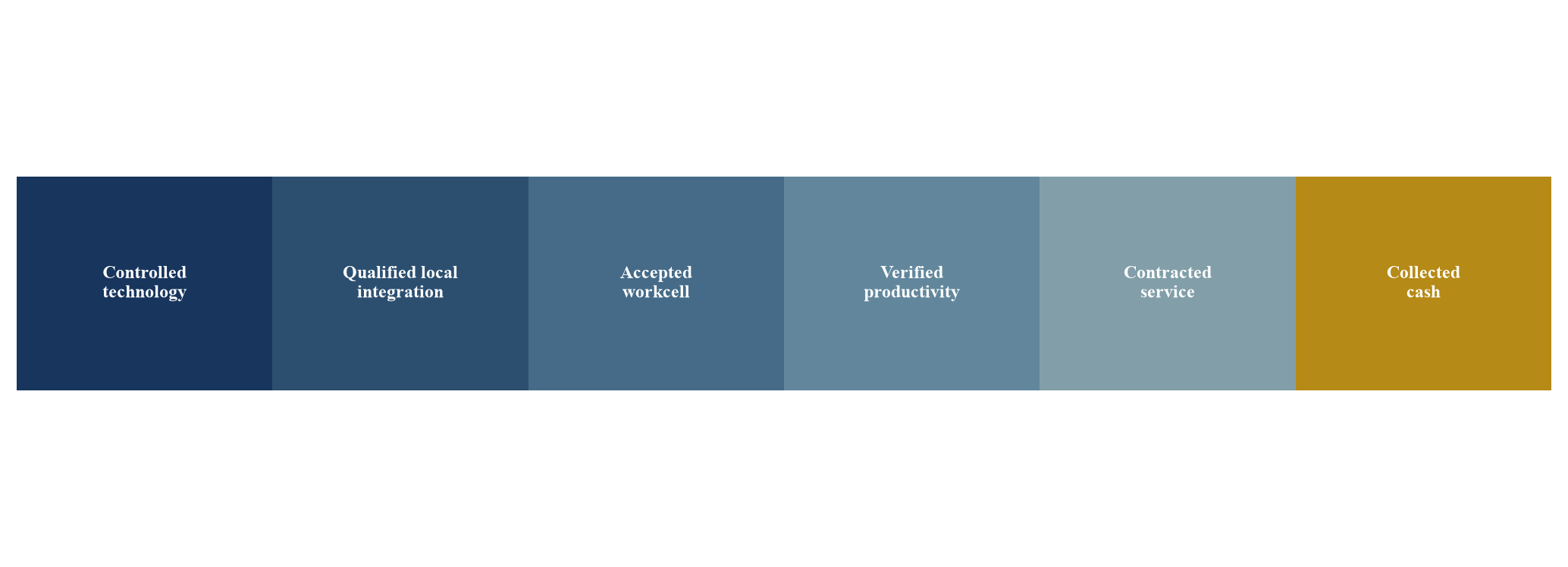
The proposed chain connects controlled technology and local integration to accepted output, service revenue and collected cash.
2. Choose the operating perimeter
The operating perimeter should state which products, industries, territories and lifecycle activities the venture performs. A venture that sells standard collaborative robots requires a different organisation from one that engineers safety-rated welding cells or maintains high-throughput packaging lines. The perimeter should also identify excluded sectors, hazardous environments, regulated processes and applications that require further technical qualification.
The asset perimeter should distinguish legal ownership from operational control. A technology shareholder may retain patents, source code, safety libraries, product road maps and specialist engineering. A local shareholder may control industrial land, licences, customer relationships, procurement access and workforce. The venture may own only inventory, local engineering work product and customer contracts. This arrangement can work when the licences and services are enforceable, durable and sufficient for the business plan. It creates substantial dependency when essential rights can be withheld, repriced or terminated during a shareholder dispute.
The product and service catalogue should be translated into controlled configurations. Each configuration records the robot, controller, end effector, sensors, safety functions, software version, cell layout, supported process, rated payload, cycle time, environmental limits and maintenance plan. Changes require documented engineering review because customer acceptance and safety evidence attach to an integrated cell rather than to a brand name.
The perimeter should also define whether the venture carries product, integration, operational or performance risk. A reseller may pass through manufacturer warranties. A systems integrator can become responsible for the application, cell and commissioning. A robotics-as-a-service provider can retain asset, uptime and operating exposure. Contract language, insurance and pricing should follow the actual allocation.
3. Map GCC industrial policy and incentives
GCC industrial policy can improve the venture's economics through demand access, finance, land, infrastructure, training or local-content recognition. It does not replace a competitive product or an executable customer case. Saudi Arabia's National Industrial Strategy identifies advanced manufacturing, localisation, private investment, global partnerships and joint ventures among its enablers. The UAE's Operation 300bn and Industry 4.0 programmes seek industrial transformation, productivity and advanced-technology adoption.[2][3][8]
Policy benefits should be converted into a jurisdiction-by-jurisdiction register. Each entry should identify the eligible entity, activity, expenditure, employment or technology condition; the awarding body; application status; decision date; value; duration; clawback; reporting duty; and interaction with tax, customs or customer pricing. A press announcement is not an asset until the venture satisfies the conditions and the benefit is legally available.
Local-content systems can influence commercial access. The UAE's Industrial Technology Transformation Index is incorporated into the National In-Country Value framework, and the Ministry has described an advanced-technology bonus linked to assessed adoption. Saudi local-content policy uses procurement and measurement mechanisms intended to develop domestic capability.[9][10] The transaction model should avoid treating local expenditure as the only measure. A durable capability also requires qualified people, controlled processes, supplier performance, technology rights and customer acceptance.
Incentives can create concentration risk. A venture designed around one procurement programme, subsidised financing line or shareholder-linked customer may struggle when eligibility, budget or policy changes. The base case should remain viable under a defined downside in which incentives arrive late or are smaller than expected.
4. Allocate technology and IP rights
Technology rights are the venture's operating constitution. The rights register should cover patents, designs, trade secrets, software, firmware, safety libraries, process know-how, documentation, trademarks, data, improvements and supplier tooling. For each asset, the register identifies the owner, territorial and field-of-use scope, exclusivity, sublicensing, modification, source-code access, support, audit, royalty, change-of-control and post-termination rights.
WIPO describes licences as permission to use intellectual property within agreed terms and notes that a transfer becomes operational when the recipient receives the technology and learns to use and adapt it. WIPO also recommends that joint ventures map background intellectual property, define foreground ownership, set decision rights and establish exit treatment.[6][11][12] These principles should be expressed in schedules that engineers and finance teams can operate.
The venture needs enough rights to quote, configure, integrate, commission, maintain and support customer systems. A manufacturing licence without diagnostic access can leave local engineers unable to restore service. A software licence that terminates on shareholder exit can destroy the installed-base business. A broad exclusive licence can also be uneconomic if minimum payments exceed qualified demand.
Foreground intellectual property requires rules before development starts. Options include ownership by the venture, ownership by the contributing shareholder with venture access, or joint ownership under a detailed management agreement. Filing, prosecution, enforcement, cost, improvements, employee inventions, subcontractor work and export restrictions should be assigned. The value case should discount rights that are incomplete, non-transferable or dependent on continued goodwill.
| Right or asset | Controlled scope | Required evidence | Downside treatment |
|---|---|---|---|
| Robot and controller technology | products, territory and field | executed licence and configuration list | exclude products outside the grant |
| Integration software | source, object code and interfaces | repository access, build and deployment test | fund escrow or replacement path |
| Safety functions | validated libraries and limits | safety manual, certificates and test records | prohibit unqualified modification |
| Process know-how | application engineering methods | complete documentation and witnessed transfer | retain milestone payment until proof |
| Brand | name, marks and quality controls | trademark licence and brand manual | provide transition period after exit |
| Data | machine, process and customer data | rights matrix, consent and security controls | separate non-transferable datasets |
| Foreground IP | local developments and improvements | ownership, filing and access schedule | define survival and buyout mechanics |
The register connects each required capability to its legal scope, operating evidence and downside treatment.
5. Define localisation beyond assembly
Localisation is a capability ladder. Import and distribution sit at the first level. Local assembly adds physical activity but may preserve dependence on imported kits, software and quality decisions. Integration capability adds process design, controls, safety engineering and commissioning. Engineering capability adds configuration, tooling, testing and improvement. Supplier development and locally controlled intellectual property create deeper resilience.
The venture should define target maturity for each capability rather than claim one percentage for the whole business. Mechanical fabrication may localise quickly. Servo drives, controllers, precision reducers, safety components and specialist sensors may remain imported. Software configuration can be local while core firmware remains proprietary. The localisation ledger should identify these differences and connect each to cost, lead time, customer value and risk.
Evidence should include qualified bills of material, process specifications, engineer competence, supplier audits, first-article approvals, measurement-system studies, acceptance results and repeatability. Spending with a local supplier is relevant only when the delivered part meets specification and supports production continuity. Training attendance is relevant only when engineers demonstrate the required task independently.
Localisation can improve bid eligibility, response time, customer trust and service availability. It can also add cost during ramp-up through duplicated facilities, low initial volume, qualification effort and inventory. The investment model should show a transition curve and state which benefits depend on scale.
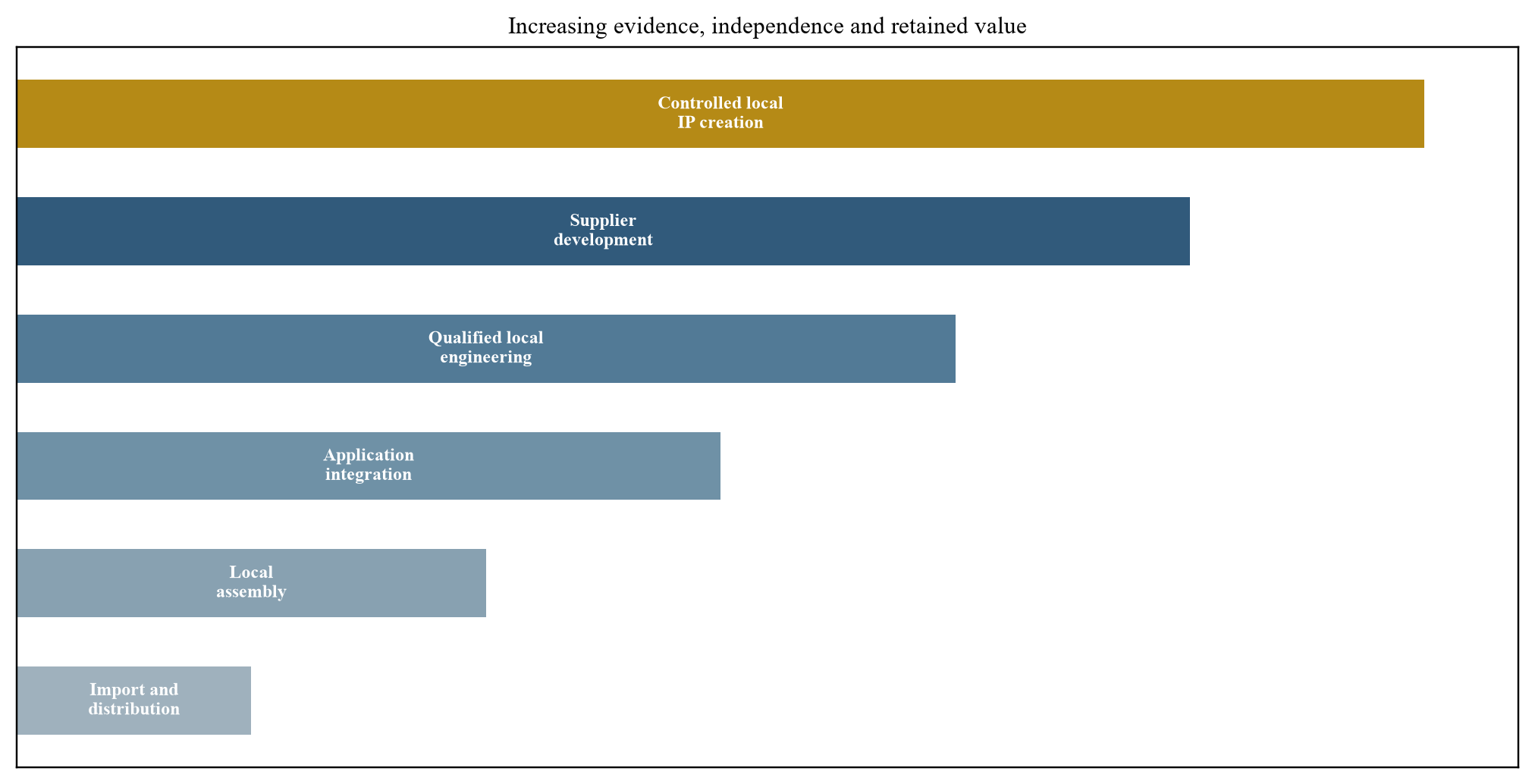
The proposed ladder separates visible local activity from qualified engineering and controlled value creation.
| Capability | Evidence | Acceptance test | Value mechanism |
|---|---|---|---|
| Assembly | controlled work instructions and trained operators | repeat build to specification | lower logistics and faster response |
| Integration | cell design, controls and safety files | factory acceptance without external intervention | local delivery margin |
| Commissioning | site records and customer sign-off | stable production after site acceptance | shorter time to cash |
| Maintenance | diagnostics, spares and service procedures | restore service within contracted time | uptime and recurring revenue |
| Engineering | qualified engineers and change control | approved local modification | lower dependency and faster customisation |
| Supply chain | qualified local parts and dual sources | first article and repeat conformity | lead-time resilience |
| Innovation | foreground IP and protected know-how | deployable product or process improvement | differentiated growth option |
The matrix converts localisation claims into records that can be tested before capital release.
6. Build the installed-base and application ledger
The installed-base ledger is the commercial spine of the venture. Each workcell record should identify customer, site, application, configuration, serial numbers, acceptance date, warranty, service entitlement, utilisation, safety status, software version, change history, spare coverage and revenue. A count of robots shipped cannot show whether cells are operating, supported or economically productive.
Application data should be organised by process rather than by customer narrative. Welding, palletising, machine tending, painting, inspection and material handling have different end effectors, hazards, cycle constraints, quality measures and service needs. Reusable application modules can reduce engineering hours and improve quote accuracy when the venture controls the documentation and knows the limits of reuse.
The ledger should reconcile quotation, order, bill of material, build, factory acceptance, shipment, site acceptance, invoice, warranty and cash. It should distinguish accepted cells, cells awaiting customer infrastructure, demonstration units, idle equipment, decommissioned systems and assets held under service models. This prevents backlog and installed-base claims from overstating operating value.
The same ledger supports post-transaction integration. Duplicate service contracts, incompatible software versions, unmanaged changes and unsupported equipment can be identified early. The venture can then price upgrade, retrofit and obsolescence programmes from controlled facts.
7. Prove productivity at the workcell
Productivity should be measured against a documented pre-automation baseline and an accepted post-commissioning state. A credible baseline records product mix, scheduled time, staffing, cycle time, changeover, first-pass yield, scrap, rework, energy, safety events and maintenance. It should use the same boundary and accounting rules as the automated case.
Overall equipment effectiveness can help organise availability, performance and quality, but it should not become a substitute for customer economics. A cell can report high OEE while producing the wrong mix, excessive work in progress or output that fails downstream inspection. The venture should reconcile cell output with customer acceptance and value created at the process or line level.
The productivity covenant should identify measurement period, sample size, exclusions, data owner, calibration, product mix and dispute process. Ramp-up should be separated from stable operations. Planned downtime, starvation by upstream processes and customer-caused interruptions need consistent treatment without hiding integration defects.
ISO 22400 provides manufacturing-operations management indicators, while ISO 9283 addresses robot performance characteristics and related test methods.[13][14] The venture can use such standards to define comparable measurements, then connect them to contractual acceptance. Capital and earn-out payments should depend on controlled data rather than a presentation of selected best shifts.
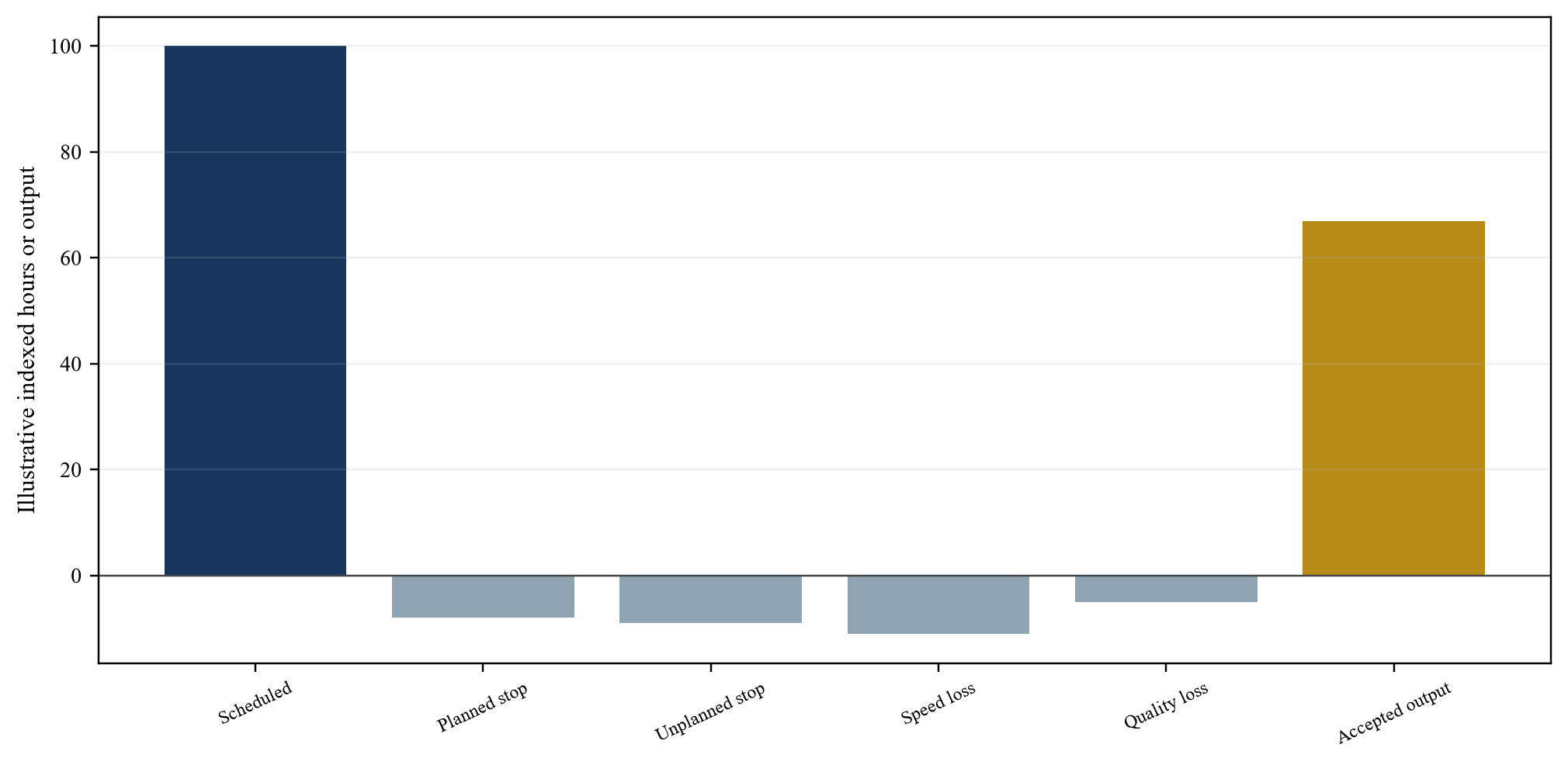
The illustrative waterfall converts scheduled production time into customer-accepted good output.
| Measure | Pre-automation baseline | Acceptance threshold | Stabilised illustrative result |
|---|---|---|---|
| Scheduled shifts per day | 2 | 2 | 2 |
| Available production days | 330 | 320 or more | 327 |
| Availability | 72% | 82% or more | 86% |
| Cycle performance | 76% | 84% or more | 88% |
| First-pass quality | 96.5% | 97.5% or more | 98.2% |
| Throughput index | 100 | 108 or more | 112 |
| Scrap rate | 3.5% | 2.2% or less | 1.8% |
| Unplanned interventions per shift | 5.0 | 2.0 or less | 1.6 |
All figures in this table are hypothetical management assumptions for method illustration.
8. Measure quality, scrap and rework
Robotic output creates value when it conforms to customer requirements. Quality should therefore sit inside the transaction model. The buyer should review measurement-system capability, control plans, inspection methods, traceability, non-conformance records, root-cause analysis and corrective-action closure. A faster cell that moves defects downstream can destroy value.
The baseline should distinguish process scrap from material defects, design changes, operator error and upstream variation. Rework hours, consumables, inspection and delayed delivery belong in complete workcell economics. Customer returns and warranty claims should reconcile with cell configuration and software release.
Data integrity matters because quality and performance incentives create pressure to reclassify losses. The evidence pack should define who can edit production records, how manual overrides are logged, and how source systems reconcile with invoices and customer acceptance. Independent sample testing can be used for milestones with large financial consequences.
The venture should also own a change-control process. A new product variant, end effector, vision model, weld programme or cycle-time setting can change quality and safety. The economic case should fund revalidation where required rather than treating every reuse as free replication.
9. Price uptime, maintenance and service
The installed base can create recurring value through preventive maintenance, corrective service, spares, software support, remote diagnostics, upgrades, training and performance optimisation. That value depends on entitlements, delivery capability and customer renewal. A large installed base without service rights, parts access or trained technicians may carry warranty exposure without recurring margin.
The service ledger should distinguish contracted coverage, billable work, warranty, goodwill, overdue maintenance and unsupported systems. It should track response time, mean time to restore, first-time fix, parts availability, remote resolution, technician utilisation and customer renewal. Service-level penalties and uptime guarantees should be priced as expected cost and tail exposure.
Spare-parts strategy should reflect failure history, lead time, obsolescence and criticality. Stocking every component locally consumes cash. Relying on international emergency shipments can breach service commitments. A segmented policy can hold safety-critical and high-failure parts locally while using supplier agreements for lower-risk items.
An installed-base flywheel emerges when operating data improves preventive maintenance, uptime and customer economics, which supports renewal and expansion. Data rights and cyber controls must allow this learning. The venture should avoid claiming a data advantage where customers prohibit reuse or machines lack consistent telemetry.
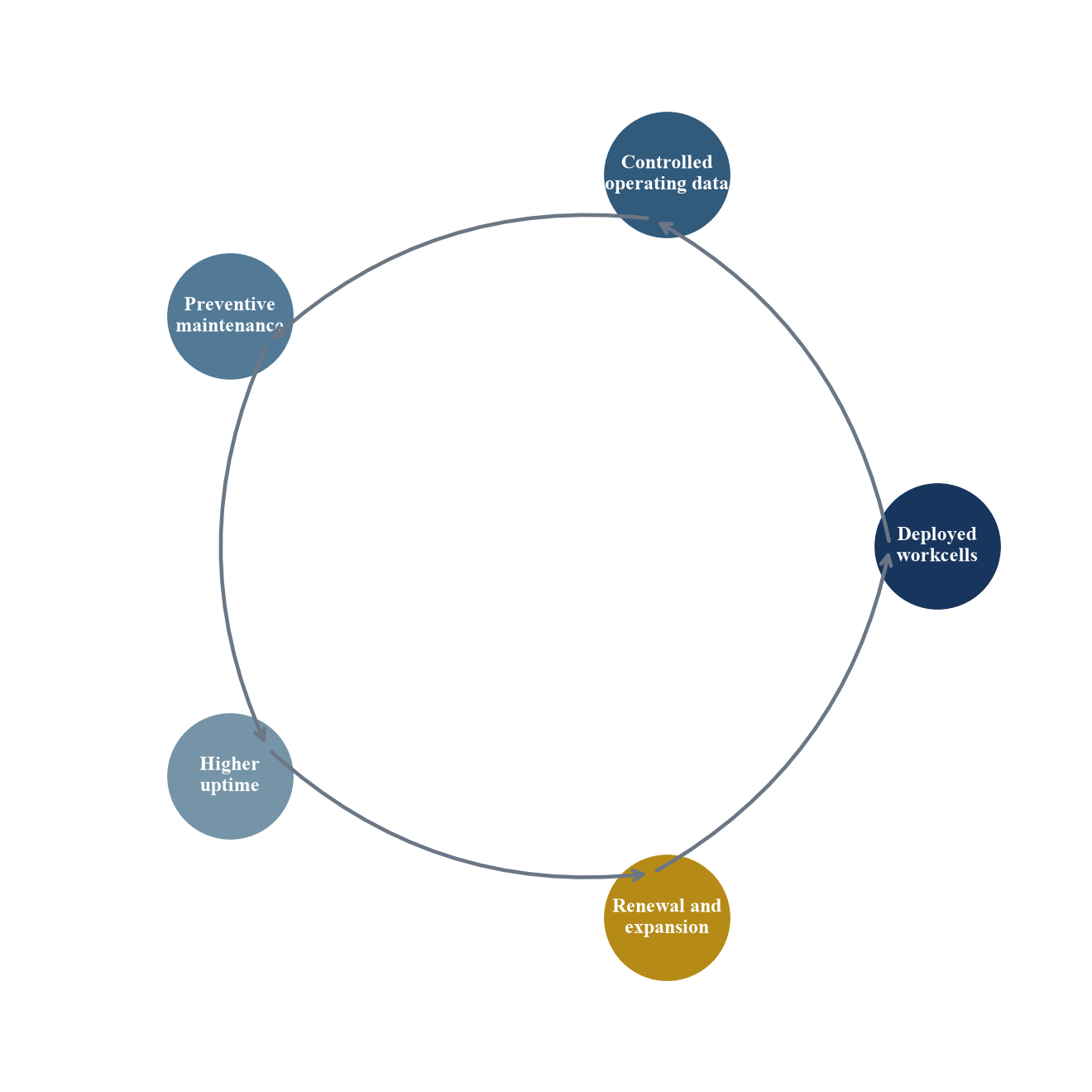
The proposed flywheel connects deployed workcells and controlled operating data to uptime, renewal and expansion.
10. Test safety and human-robot integration
Industrial-robot safety follows the integrated application. ISO 10218-1:2025 addresses safety requirements for industrial robots, while ISO 10218-2:2025 addresses robot applications and cells, including integration, commissioning, operation and maintenance.[4][5] ISO/TS 15066 provides collaborative-robot guidance, and ISO 12100 provides a general machinery risk-assessment and risk-reduction framework.[15][16]
The venture should maintain a safety file for each reusable cell design and site-specific implementation. It should include intended use, reasonably foreseeable misuse, hazard analysis, safety requirements, protective measures, validation, residual risks, training, maintenance and change control. Emergency stops, protective stops, guarding, interlocks, safe speed, safe separation and restart behaviour must match the application.
Human factors belong inside the system. Operators, maintenance staff, cleaners and contractors can enter the work area under different conditions. Production pressure can encourage bypassed guards or undocumented recovery methods. The diligence team should inspect actual shifts, not only the acceptance demonstration.
The EU Machinery Regulation applies from January 2027 and updates the European machinery framework, including digital and safety-related considerations.[17] Exported or imported systems may also face market-specific conformity duties. The rights and responsibilities of manufacturer, integrator, importer, distributor, employer and operator should be identified by jurisdiction and contract.
11. Secure operational technology and data
Robotic workcells connect physical motion with controllers, networks, engineering stations, remote support and enterprise systems. Cybersecurity can therefore affect safety, uptime, quality and intellectual property. NIST SP 800-82 Rev. 3 recommends securing operational technology while recognising performance, reliability and safety requirements. The NIST Cybersecurity Framework 2.0 provides an organisation-level framework for governing and managing cyber risk.[18][19]
The architecture should identify trust zones, conduits, remote access, privileged accounts, software signing, patching, backups, logging, incident response and supplier support. IEC 62443 provides a standards family for industrial automation and control-system security.[20] The venture should map which party owns each control and how an incident can be contained without unsafe shutdown.
Remote support deserves specific attention. A technology shareholder may require access to diagnose systems, while customers may restrict external connectivity. The contract should define approved tools, authentication, recording, data location, subcontractors, emergency access and termination. A venture without lawful and secure diagnostic access can fail its service obligations.
Data rights should distinguish machine telemetry, production data, personal data, customer confidential information and derived models. Rights to use data for maintenance do not automatically grant rights to train commercial models or benchmark customers. The valuation should include only data uses supported by contract and governance.
| Domain | Controlled evidence | Acceptance owner | Transaction risk |
|---|---|---|---|
| Application safety | hazard analysis, requirements and validation | qualified safety engineer and customer | injury, shutdown and liability |
| Configuration | approved hardware and software baseline | engineering change board | invalidated acceptance or safety case |
| OT architecture | asset inventory, zones and conduits | security and operations leadership | lateral movement and production loss |
| Remote access | approved identities, sessions and logs | customer and service owner | unauthorised change or data access |
| Backup and recovery | tested controller, recipe and configuration restore | site operations | extended downtime |
| Incident response | joint playbook and notification path | venture and customer executives | delayed containment and contractual breach |
| Supplier assurance | component and software obligations | procurement and engineering | inherited vulnerability or unsupported product |
The pack connects each risk domain to a controlled record and an accountable decision owner.
12. Build the local supply chain
The supply chain should be designed around criticality, qualification and lead time. Robots, controllers and precision components may come from global manufacturers. Frames, guarding, fixtures, cables, panels and selected end effectors may be localised. The right mix depends on volume, capability, tolerance, safety significance and total landed cost.
The venture should maintain a qualified-source list linked to part numbers, specifications, first-article results, process audits, capacity and continuity plans. A local supplier that passes one sample may still lack repeat production capability. Supplier development should include measurement systems, change notification, traceability and non-conformance closure.
Single-source dependence should be priced. A component can be commercially replaceable yet technically difficult to substitute because the safety file, controller interface, software or customer approval requires revalidation. The bill of material should therefore identify technical switching cost and approval lead time, not only purchase price.
Working capital can rise as the venture localises. Minimum orders, safety stock and slow-moving spares consume cash before scale. The model should segment inventory by project, service, criticality and obsolescence. Customer deposits, supplier terms and staged acceptance can reduce funding pressure.
13. Design workforce and knowledge transfer
Knowledge transfer should produce demonstrated independence for defined tasks. The workforce matrix should identify roles in application engineering, mechanical design, controls, safety, vision, commissioning, service, project management and commercial estimation. Each role should have competence criteria, supervised assignments and an authorised scope.
Training delivery is an input. Evidence of capability includes completed designs, successful code builds, witnessed tests, independently resolved faults and customer acceptance. The technology shareholder should provide documentation, tools, sample projects, engineering hours and access to specialists. Milestone payments can depend on local teams completing tasks without unplanned intervention.
Retention matters because a small number of specialists can carry essential know-how. The venture should map key-person dependencies, succession, non-compete enforceability, incentives and knowledge capture. Visa and labour rules should be reviewed where expatriate specialists support the ramp.
The workforce plan should also address job redesign. Robotics can shift work from repetitive handling toward maintenance, programming, quality and process control. The venture should state how affected employees are selected, trained and redeployed. ILO occupational-safety guidance provides a broader framework for safe systems of work and worker participation.[21]
14. Structure customer contracts and acceptance
Customer contracts should define the process problem, input conditions, output requirements, acceptance method, exclusions and responsibility matrix. Cycle time alone is insufficient. Acceptance can include throughput, quality, uptime, safety validation, integration with upstream and downstream equipment, training, documentation and a stabilisation period.
Factory acceptance confirms specified performance before shipment under controlled conditions. Site acceptance confirms performance within the customer's actual environment. The contract should identify customer prerequisites such as utilities, foundations, material quality, network access and operator availability. Delay and failure caused by unmet prerequisites need a fair process.
Payment milestones should follow evidence. A common structure can include order deposit, design approval, factory acceptance, shipment, site acceptance and retention release. The venture should avoid recognising the economic benefit of a cell that remains unaccepted or unpaid. Warranty should start from a defined event and exclude unauthorised changes without undermining statutory rights.
Performance guarantees require a measurement protocol and remedy ladder. The first remedy can be correction and retest, followed by agreed price adjustment, service credit, replacement or termination. Unlimited exposure to a customer's lost production can overwhelm the project margin. Liability caps, insurance and exclusions require jurisdiction-specific advice.
15. Establish transfer pricing and economic substance
Cross-border robotics JVs often pay royalties, technical-service fees, product margins, software charges, secondment costs and management fees to shareholders. The OECD Transfer Pricing Guidelines apply the arm's-length principle to transactions between associated enterprises and address intangibles, services and financial transactions.[22] The venture should document the functions performed, assets used and risks controlled by each party.
Economic substance should match the value narrative. A venture presented as a regional engineering platform should employ people who make engineering, commercial and risk decisions. If every substantive decision remains abroad, the local entity may operate as a distributor or service provider despite broader branding.
The UAE Federal Tax Authority and Saudi Zakat, Tax and Customs Authority publish transfer-pricing guidance and documentation requirements relevant to associated transactions.[23][24] Local advisers should confirm current thresholds, filing, withholding, customs and corporate-tax treatment. Royalties and imported components can also affect local-content and bid economics.
The financial model should show shareholder charges separately and test alternative pricing. A venture can report customer growth while value migrates through high product margins, royalties or compulsory services. Minority protection should cover related-party approvals, benchmarking, audit rights and access to underlying cost data.
16. Govern the JV and reserved matters
Governance should preserve operating speed and protect fundamental rights. The board needs clear authority over strategy, budget, appointments, technology licences, related-party transactions, borrowing, customer commitments, capital expenditure, safety, cyber risk and material disputes. Reserved matters should be narrow enough to prevent paralysis and strong enough to stop value leakage.
The operating model should define who quotes, designs, accepts risk and commits delivery dates. Shareholder representatives should not bypass venture controls by promising customers non-standard terms. Delegations should include financial limits and technical gates.
Deadlock mechanisms should reflect the issue. Escalation and mediation can resolve ordinary disagreements. Buy-sell rights, put and call options, or liquidation may be needed for fundamental deadlock. Technology continuity during a dispute is critical. Licences, support, source-code access, spares and customer service should not stop while ownership is resolved.
Exit provisions should cover valuation, transfer restrictions, change of control, non-compete, customer data, employees, inventory, warranties and post-exit technology rights. WIPO's joint-venture guidance emphasises decision rights and the treatment of intellectual property at exit.[12] The board should test the documents against an adverse scenario rather than relying on shareholder goodwill.
| Decision | Operating authority | Reserved approval | Evidence before decision |
|---|---|---|---|
| Standard customer quote | commercial and engineering leaders | none within approved limits | costed configuration and capacity |
| Non-standard safety or performance commitment | chief executive and safety leader | board where exposure is material | validated design and liability analysis |
| Technology-licence amendment | none | shareholder and board approval | rights impact and independent benchmark |
| Related-party purchase | procurement within budget | disinterested directors above threshold | alternatives and arm's-length support |
| Capital release | chief financial officer within gate | board for next tranche | milestone and cash evidence |
| New country or application | management feasibility stage | board investment approval | regulatory, customer and capability case |
| Shareholder exit | none | contractual process | continuity and valuation plan |
The map separates operating delegation from matters that can alter control, technology continuity or financial exposure.
17. Build a hypothetical GCC robotics platform
Consider a hypothetical venture that plans to deploy 120 robotic workcells across three GCC industrial clusters over four years. The technology shareholder contributes product licences, controls software, application libraries and specialist support. The local shareholder contributes capital, customer access, facilities, local hiring and supplier development. The venture designs, integrates, commissions and services the cells.
All figures in this section are management assumptions created only to demonstrate the framework. The model assumes two shifts per day, 330 available days, 78 percent starting OEE for mature cells, a 12 percent throughput improvement and a reduction in scrap from 3.5 percent to 1.8 percent. It assumes an average cell selling price of USD 420,000, direct delivery cost of USD 315,000, annual service revenue of USD 32,000 per active cell and a 38 percent service gross margin. No figure represents a quotation, market average or forecast.
The rollout is divided into 20 pilot cells, 40 expansion cells and 60 scaled cells. Capital is released after rights delivery, local integration qualification, customer acceptance and evidence of stable service. The model delays scale where acceptance, productivity or cash conversion misses the threshold.
The base case values accepted cells and contracted service. The gated case adds signed expansion orders that have passed technical review. Uncontracted pipeline is excluded from the transaction base and shown only as a strategic option.
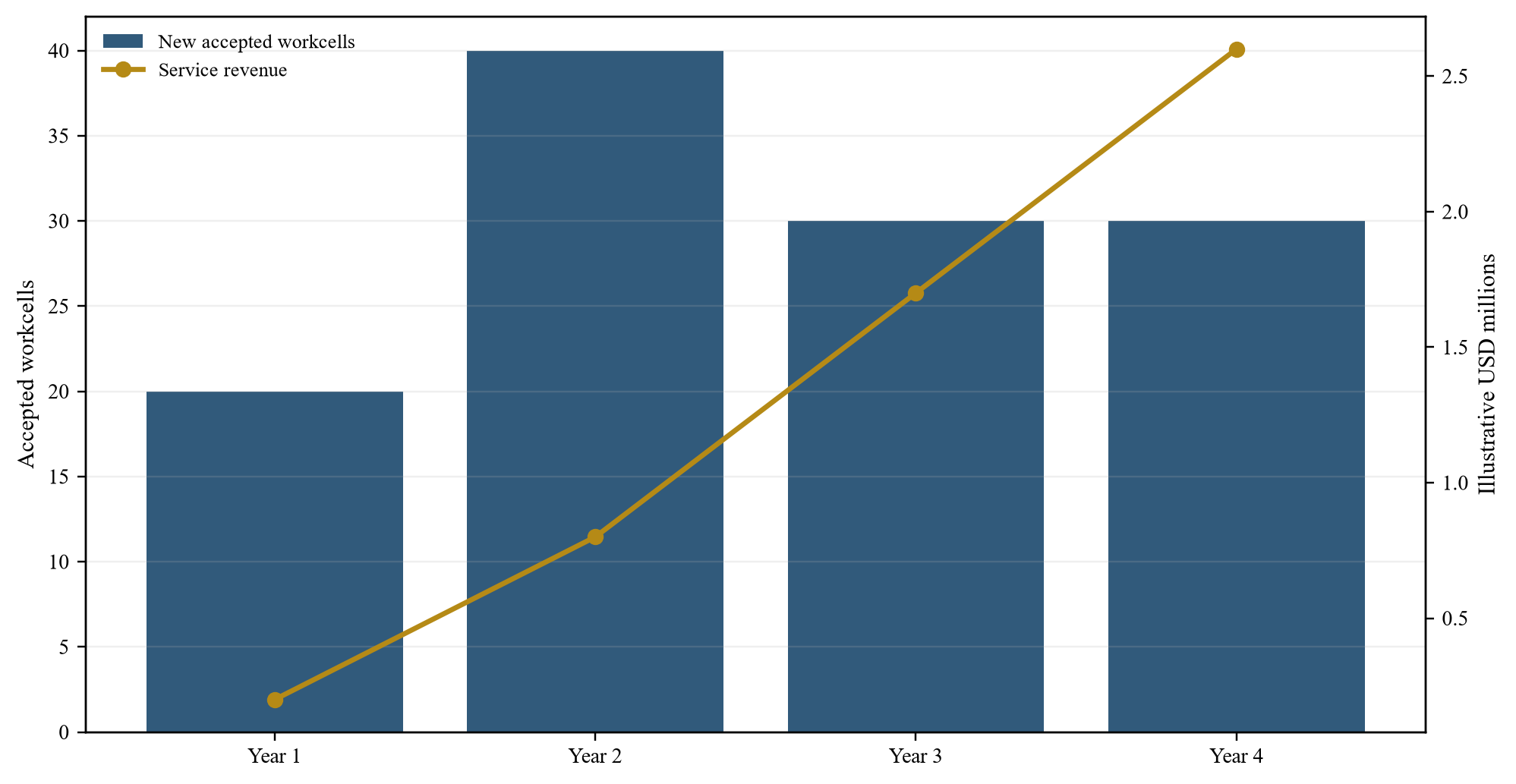
Every value in the figure is a management assumption created only to demonstrate the framework.
| Measure | Pilot stage | Expansion stage | Scaled stage |
|---|---|---|---|
| New accepted workcells | 20 | 40 | 60 |
| Average selling price per cell | USD 420,000 | USD 420,000 | USD 420,000 |
| Direct delivery cost per cell | USD 330,000 | USD 315,000 | USD 300,000 |
| Stable OEE threshold | 75% | 80% | 82% |
| First-pass quality threshold | 97.0% | 97.5% | 98.0% |
| Annual service revenue per active cell | USD 28,000 | USD 32,000 | USD 36,000 |
| Service gross margin | 30% | 38% | 42% |
| Capital release condition | rights and first acceptance | repeat acceptance and paid service | cohort uptime and cash conversion |
All values are management assumptions for method illustration and are not forecasts or market data.
18. Stress the model
The investment case should test delays and correlated failures. A six-month technology-transfer delay can postpone quotation, acceptance and cash while fixed costs continue. A customer infrastructure delay can strand completed equipment. A controller shortage can delay multiple projects. A safety or cyber incident can pause an entire installed base.
The model should separate volume, price, cost, acceptance, uptime and cash. Lower volume can reduce delivery margin and delay localisation scale. Price pressure can arise if customers compare imported robots rather than complete application value. Integration overruns can consume the margin even where equipment prices hold. Slow acceptance shifts revenue and working capital.
Shareholder dependency requires its own stress. The venture should test a royalty increase, reduced engineering support, delayed software release, product discontinuation and change of control at the technology shareholder. Continuity rights and alternative suppliers can reduce the loss.
Management should define a stop-loss for each stage. If pilot cells fail to reach acceptance or productivity thresholds, the venture should diagnose, redesign or stop before committing the scale tranche. This preserves capital and creates a disciplined record for the board.
19. Value the JV in layers
Valuation should begin with verified operating cash flow from accepted cells and enforceable service contracts. The next layer can include contracted rollout that has passed rights, engineering and customer-readiness gates. Installed-base service value depends on entitlement, renewal, delivery capacity and margin. Technology options require controlled rights and a credible route to market.
IFRS 11 defines joint control as contractually agreed sharing of control where relevant-activity decisions require unanimous consent. IAS 28 addresses investments in associates and joint ventures.[25][26] IFRS 13 provides a fair-value framework, IAS 36 addresses impairment and IAS 38 addresses intangible assets.[27][28][29] Accounting classification and transaction value are related but distinct; qualified advisers should determine treatment for the actual arrangement.
The valuation should deduct liabilities and dependency costs. These can include warranties, service deficits, safety remediation, cyber weaknesses, inventory obsolescence, customer concentration, underfunded localisation, unfunded training, related-party leakage and termination exposure. Working capital and future capital expenditure should be modelled explicitly.
Comparable-company multiples can provide a cross-check but require care. Robot manufacturers, distributors, systems integrators, software firms and service platforms have different margin, capital intensity and recurring revenue. A venture with unproven localisation should not receive the multiple of a mature product company solely because both use robotics.
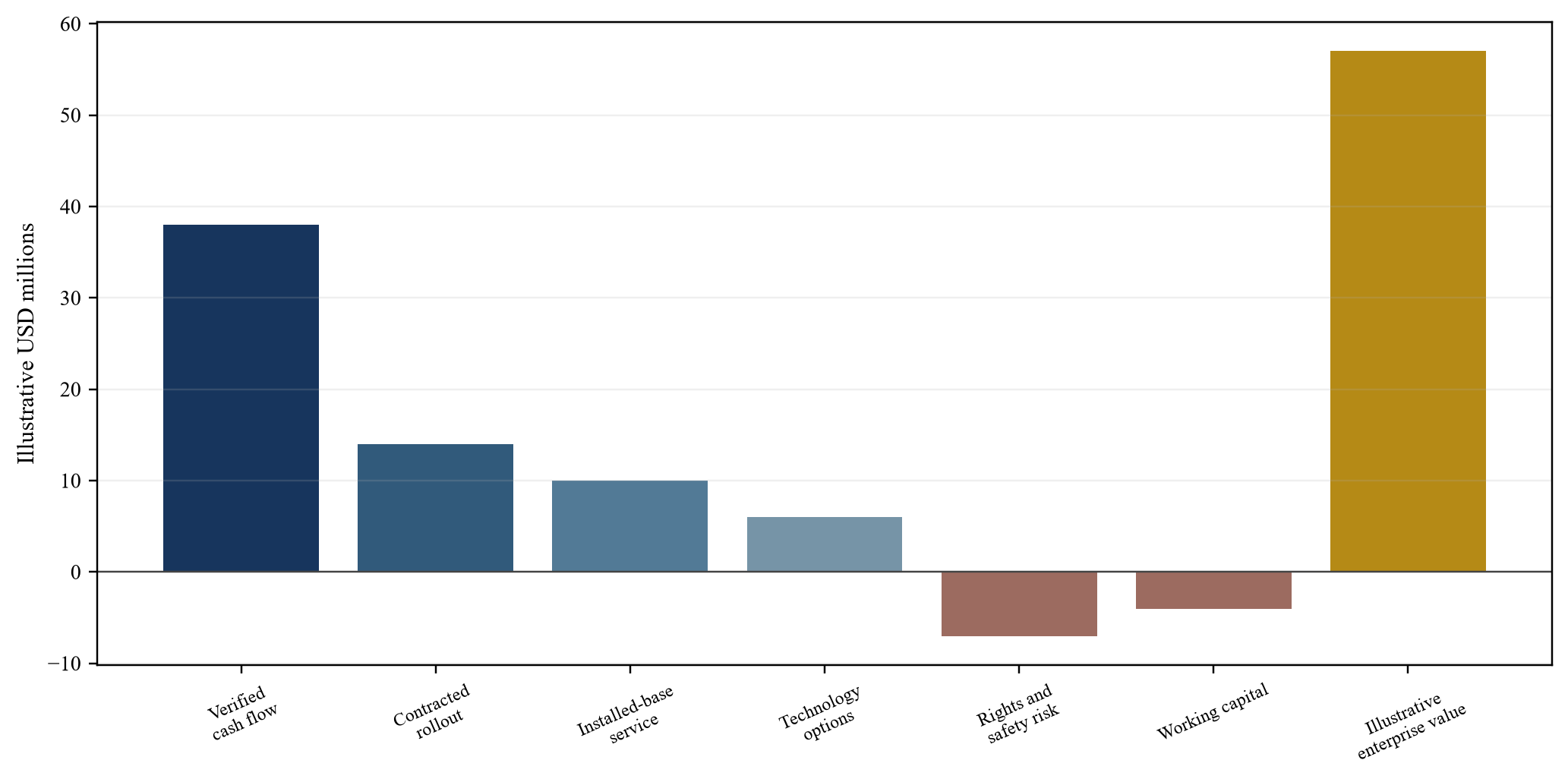
The illustrative bridge separates verified operating value from evidence-gated growth and risk adjustments.
20. Release capital against evidence
Capital release should follow evidence that reduces a specific uncertainty. The first tranche can fund formation, licences and transfer planning after the rights schedules are executed. The second can fund local integration after tools, documentation and competence are delivered. The third can fund pilot deployment after factory acceptance. Scale capital can follow site acceptance, stable productivity, paid service and collected cash.
Each gate needs a named evidence owner, acceptance test, reviewer, cure period and consequence. The consequence can be delayed funding, revised scope, price adjustment, additional shareholder support or termination. A gate described as satisfactory progress without measurable conditions provides little protection.
Earn-outs and contingent consideration can align seller or technology-shareholder payment with accepted output. The metric should resist manipulation and remain within reasonable control. Revenue can be inflated through related-party sales or weak acceptance. EBITDA can be shifted through royalties and services. Accepted workcells, stable uptime and collected third-party cash provide a stronger chain when definitions are precise.
The funding plan should preserve operating continuity during disputes. Employees, customer support, safety remediation and critical spares cannot wait for shareholder arbitration. Minimum liquidity, emergency authority and standby funding should be agreed at formation.
| Gate | Evidence | Capital purpose | Failure response |
|---|---|---|---|
| Rights control | executed licences, software access and continuity terms | formation and core systems | cure rights or reduced perimeter |
| Transfer readiness | documentation, tools and competence plan | local engineering build | retain transfer payment |
| Pilot acceptance | factory and site acceptance for representative cells | first commercial deployment | redesign or stop-loss review |
| Productivity proof | stable OEE, quality, scrap and intervention data | expansion cohort | delay scale tranche |
| Service proof | contracted entitlement, uptime and paid service | spares and technician scale | revise service model |
| Cash proof | invoices reconciled to acceptance and collections | broader rollout | tighten commercial terms |
| Resilience proof | qualified suppliers and continuity tests | localisation investment | preserve alternate sourcing |
The proposed sequence links each funding tranche to completed and reviewable evidence.
21. Integrate ecosystem partners
The venture sits inside an ecosystem of robot manufacturers, component suppliers, integrators, industrial customers, training institutions, financiers, insurers and regulators. Partnership value should be assigned to enforceable roles and measurable outputs. A memorandum of understanding can start collaboration but should not enter the base case as contracted demand or committed capability.
Training institutions can support technician and engineer pipelines when curricula, equipment, instructors and assessment match deployed systems. Research institutions can support new applications and foreground intellectual property. Their work should use clear ownership, publication, confidentiality and commercialisation terms.
Finance can be matched to the asset. Project deposits and working-capital facilities can fund build cycles. Asset finance can support robotics-as-a-service models where equipment ownership and cash flows are clear. Growth equity can fund product and geographic expansion after repeatability is demonstrated. Lenders and investors should receive cohort, acceptance, uptime and cash data rather than only aggregate revenue.
Insurers should understand the allocation among manufacturer, integrator and operator. Coverage can include property, product liability, professional indemnity, cyber, business interruption and employer exposure. Policy conditions and exclusions should be reconciled with actual applications and contractual promises.
22. Execute a 180-day validation programme
The first thirty days establish control. The team confirms the transaction perimeter, rights register, installed-base ledger, customer contracts, shareholder charges and cash reconciliation. It also freezes uncontrolled configuration changes and identifies urgent safety or cyber issues.
Days 31 to 75 baseline representative workcells and localisation claims. Engineers observe shifts, reproduce performance measures, inspect acceptance files, test restore procedures and witness local teams completing defined tasks. Finance reconciles orders, milestones, invoices and collections.
Days 76 to 120 stress the business. The team tests supplier interruption, technology-shareholder dependency, customer delay, service backlog, warranty, incident response and related-party pricing. The hypothetical model is rebuilt from verified data and each assumption is identified.
Days 121 to 180 complete transaction design. The parties agree technology schedules, governance, capital gates, customer remedies, transfer pricing, continuity, deadlock and exit. The board receives a decision pack showing verified value, gated value, excluded options, liabilities and the first-year operating plan.
The programme should end with accountable owners and dated actions. An unresolved issue can remain open only when its value impact, interim control and decision date are explicit.
23. Decision and conclusion
A GCC industrial-robotics JV can create value by combining controlled technology with local engineering, customer access and service capacity. The legal entity alone does not create this capability. Value emerges when the venture can independently convert rights and resources into accepted output, stable productivity, recurring service and collected cash.
The board should require six connected records: the rights register, localisation ledger, installed-base ledger, workcell baseline, safety and cyber evidence pack, and acceptance-to-cash reconciliation. These records provide a common language for engineers, customers, investors and directors. They also reveal dependency that a high-level localisation percentage can hide.
The transaction structure should release capital as uncertainty falls. Rights and continuity come first. Qualified local integration and representative acceptance follow. Productivity, service and cash evidence support scale. Strategic options remain separately valued until their technical, commercial and legal conditions are complete.
The resulting model is practical: control what the venture needs to operate, measure output at the customer process, preserve safety and cyber integrity, localise qualified capability, and make further investment depend on evidence. That discipline aligns industrial policy with customer value and gives shareholders a defensible basis for price, governance and capital allocation.
Sources
- International Federation of Robotics, World Robotics 2025 industrial robot statistics. Read the primary source
- Saudi Vision 2030, National Industrial Strategy. Read the primary source
- UAE Ministry of Industry and Advanced Technology, UAE Industry 4.0. Read the primary source
- International Organization for Standardization, ISO 10218-1:2025 Robotics safety requirements for industrial robots. Read the primary source
- International Organization for Standardization, ISO 10218-2:2025 Robotics safety requirements for industrial robot applications and robot cells. Read the primary source
- World Intellectual Property Organization, Technology Transfer Agreements. Read the primary source
- World Intellectual Property Organization, IP Assignment and Licensing. Read the primary source
- UAE Ministry of Industry and Advanced Technology, Operation 300bn media kit. Read the primary source
- UAE Ministry of Industry and Advanced Technology, National ICV formula and Industrial Technology Transformation Index. Read the primary source
- Local Content and Government Procurement Authority, Saudi local content framework. Read the primary source
- World Intellectual Property Organization, IP Licensing Strategies for Ventures. Read the primary source
- World Intellectual Property Organization, How to Operate a Joint Venture. Read the primary source
- International Organization for Standardization, ISO 22400 manufacturing operations management indicators. Read the primary source
- International Organization for Standardization, ISO 9283 industrial robot performance criteria and test methods. Read the primary source
- International Organization for Standardization, ISO TS 15066 collaborative robot systems and work environment. Read the primary source
- International Organization for Standardization, ISO 12100 machinery safety risk assessment and risk reduction. Read the primary source
- European Union, Regulation EU 2023 1230 on machinery. Read the primary source
- National Institute of Standards and Technology, SP 800-82 Rev. 3 Guide to Operational Technology Security. Read the primary source
- National Institute of Standards and Technology, Cybersecurity Framework 2.0. Read the primary source
- International Electrotechnical Commission, IEC 62443 industrial communication networks and system security. Read the primary source
- International Labour Organization, Occupational safety and health management systems. Read the primary source
- Organisation for Economic Co-operation and Development, Transfer Pricing Guidelines 2022. Read the primary source
- UAE Federal Tax Authority, Corporate Tax Transfer Pricing Guide. Read the primary source
- Saudi Zakat Tax and Customs Authority, Transfer Pricing Guidelines. Read the primary source
- IFRS Foundation, IFRS 11 Joint Arrangements. Read the primary source
- IFRS Foundation, IAS 28 Investments in Associates and Joint Ventures. Read the primary source
- IFRS Foundation, IFRS 13 Fair Value Measurement. Read the primary source
- IFRS Foundation, IAS 36 Impairment of Assets. Read the primary source
- IFRS Foundation, IAS 38 Intangible Assets. Read the primary source
- IFRS Foundation, IFRS 3 Business Combinations. Read the primary source
- IFRS Foundation, IAS 24 Related Party Disclosures. Read the primary source
- IFRS Foundation, IAS 12 Income Taxes. Read the primary source
- International Valuation Standards Council, International Valuation Standards. Read the primary source
- UAE Ministry of Industry and Advanced Technology, Transform 4.0 programme. Read the primary source
- UAE Ministry of Industry and Advanced Technology, Industrial Technology Transformation Index use-case guide. Read the primary source
- Abu Dhabi Department of Economic Development, Abu Dhabi Industrial Strategy. Read the primary source
- Qatar Ministry of Commerce and Industry, Qatar National Manufacturing Strategy. Read the primary source
- Oman Vision 2040, Economy and Development priorities. Read the primary source
- Bahrain Economic Development Board, Manufacturing sector. Read the primary source
- International Federation of Robotics, World Robotics 2025 press releases. Read the primary source
- International Federation of Robotics, Top Five Robot Trends 2026. Read the primary source
- Occupational Safety and Health Administration, Robotics industry safety resources. Read the primary source
- Cybersecurity and Infrastructure Security Agency, Industrial Control Systems resources. Read the primary source
- National Institute of Standards and Technology, Protecting Information and System Integrity in Industrial Control System Environments. Read the primary source
- National Institute of Standards and Technology, Industrial Control System Cybersecurity Performance Testbed. Read the primary source
- International Organization for Standardization, ISO 13849-1 safety-related parts of control systems. Read the primary source
- International Organization for Standardization, ISO 13850 emergency stop function. Read the primary source
- International Organization for Standardization, ISO 3691-4 driverless industrial trucks and their systems. Read the primary source
- World Intellectual Property Organization, Knowledge and Technology Transfer. Read the primary source
- United Nations Industrial Development Organization, Industrial Development Report 2024. Read the primary source
