

1. Start with the contract gate
Supply-chain localisation should begin with a contract, not a factory. The board first identifies the customers, contract categories and award criteria that matter to the market-entry thesis. It then works backwards from eligibility, technical acceptance, commercial evaluation and delivery obligations. This prevents management from investing in local capacity that customers do not value or from preserving a low-cost import model that cannot pass procurement.
The UAE federal procurement system illustrates why entry architecture matters. The Ministry of Finance's Digital Procurement Platform connects federal entities with registered suppliers across tendering, contracting, purchase orders, invoices and supplier evaluation. The Federal Supplier Register accepts domestic, free-zone and foreign suppliers, among other categories. Registration gives access to participation; it does not remove tender-specific qualification, technical, financial or performance requirements. The published process also distinguishes the documents and status associated with each supplier category.
Procurement can carry policy objectives as well as price and specification. The Ministry of Finance describes incentives for qualifying SMEs on the federal platform, including a bonus in evaluation, inclusion in limited tenders and an alternative to a performance bond in specified circumstances. The National In-Country Value programme redirects procurement expenditure towards economic contribution in the UAE. ADNOC states that its procurement-led programme evaluates factors including UAE-manufactured goods, domestic third-party spend and Emiratisation. A company entering sectors influenced by these mechanisms needs a sourcing and operating model that makes its value contribution visible and auditable.
The first board document should therefore be a procurement-gate register. For each target account or contract family, it records the buying entity, supplier-registration route, prequalification, local-content treatment, technical standards, approved-vendor requirements, bid and performance security, service presence, data conditions, payment terms, liability, subcontracting rules and evidence owner. A gate is marked complete only when a document, tested capability or customer confirmation exists.
The register should separate formal rules from commercial preferences. A foreign supplier may be eligible to register, while a local repair response, inventory commitment or in-country value score influences competitiveness. A tender may permit imported equipment, while local integration and maintenance decide technical scoring. Management should avoid presenting customer interviews as binding requirements. The evidence file should preserve the tender clause, platform guidance, clarification response or documented customer process behind every material assumption.
Table 1. Procurement-gate diagnostic for a UAE market entry
| Gate | Board question | Evidence before commitment | Common failure | Decision implication |
|---|---|---|---|---|
| supplier eligibility | which entity can register, bid, invoice and receive payment? | registration category, licence scope, tax records, bank details and customer acceptance | sales activity begins through an entity that cannot contract | change entity, partner or sequence |
| local value | how is local contribution measured and scored? | current programme guidance, certificate inputs, audited evidence and tender formula | management treats local presence as equivalent to local value | redesign spend, assets, employment and evidence |
| technical acceptance | which standards, tests and product approvals apply? | conformity route, laboratory reports, product registration and customer qualification | compliant overseas product is assumed to be UAE-ready | certify, redesign, localise testing or change product |
| delivery capability | what inventory, response, warranty and continuity are required? | service map, stock policy, capacity proof, continuity plan and subcontractor approval | distributor promise exceeds operating capacity | build, contract or acquire capability |
| commercial security | what guarantees, insurance, liabilities and payment terms apply? | tender conditions, bonding lines, insurance and cash-flow model | award consumes more liquidity than expected | reprice, finance or decline |
| responsible sourcing | which labour, integrity, environment and traceability controls apply? | supplier code, diligence files, audit rights and incident process | tier-two risk remains invisible | qualify, remediate or replace suppliers |
| data and cyber | where can customer, employee and operational data be processed? | data map, access model, hosting position, vendor contracts and security evidence | global systems conflict with local or customer controls | segregate, localise or redesign processing |
Requirements vary by buyer, sector, product and tender. The company should retain the current source and customer evidence for every gate.
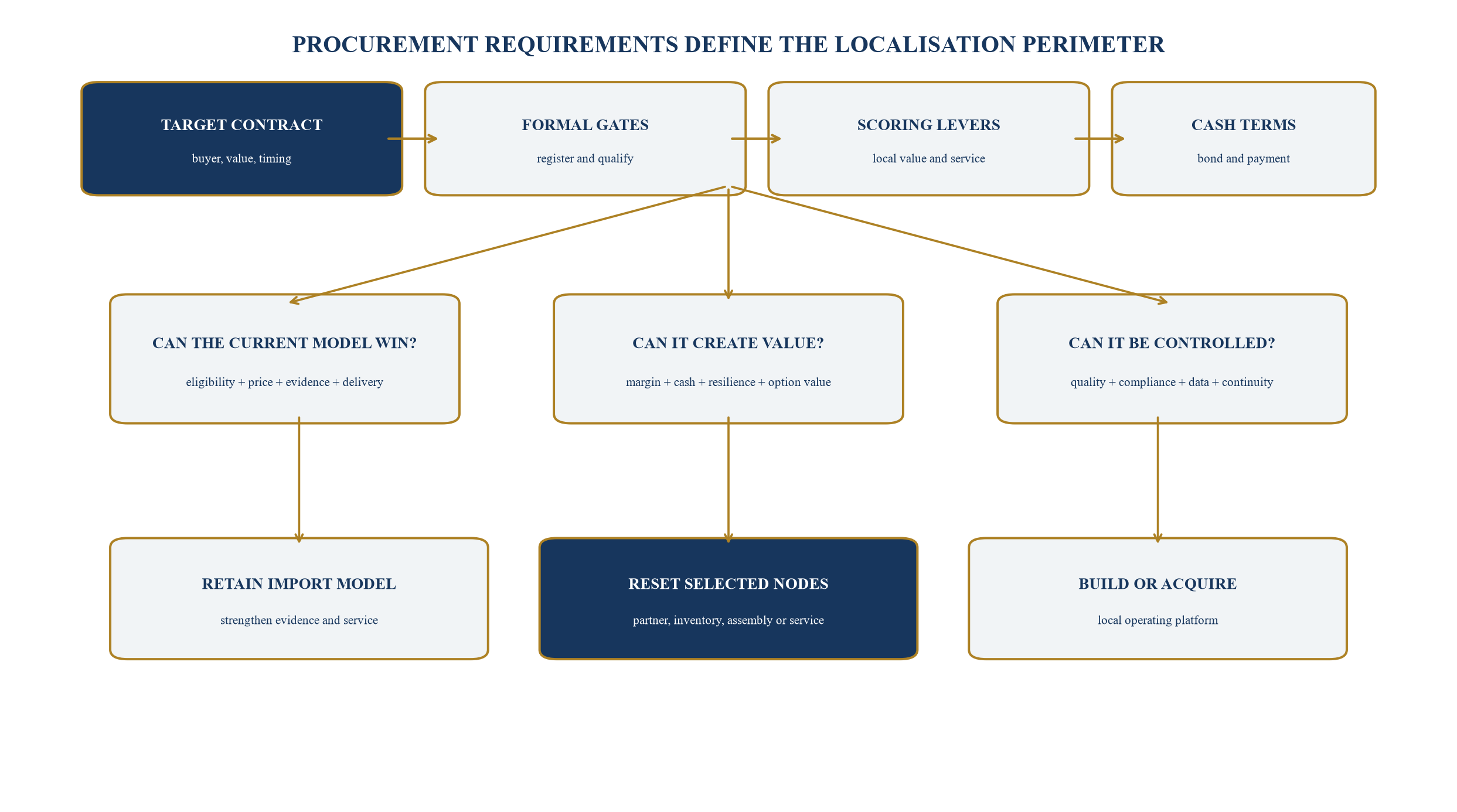
The sequence converts customer requirements into an investment decision. Each gate requires dated evidence.
2. Define localisation as an operating-model choice
Localisation has several forms. A company can hold local inventory, perform final assembly, establish repair capability, source components, contract with local service providers, employ technical staff, transfer selected intellectual property, create a joint venture, acquire a supplier or build manufacturing capacity. These choices create different customer, financial and risk outcomes. A single local-spend percentage cannot describe the operating model.
The localisation perimeter should be defined by activity. The value-chain map begins with product design, raw materials, components, manufacturing, testing, shipping, customs, warehousing, integration, sales, installation, maintenance, warranty, data processing and end-of-life. Each activity is assigned to a legal entity, physical location, supplier, asset base and control owner. Contract and cash flows are mapped alongside the physical flow.
This map exposes dependencies that an entity chart can hide. A UAE sales company may invoice the customer while technical acceptance depends on an overseas factory. A local distributor may hold inventory while warranty authority remains with the principal. Final assembly may occur locally while the bill of materials, production planning and quality records remain overseas. Each arrangement can be commercially valid; the board needs to understand what the local customer receives, what the group controls and what evidence supports the representation.
The right perimeter follows material contract gates and value creation. Local warehousing can improve availability without changing origin. Local testing can shorten acceptance cycles. Local service engineers can improve uptime and customer confidence. Assembly can increase domestic value and flexibility while adding capex, training and quality risk. Component localisation can deepen value but expose the company to supplier qualification and volume uncertainty. A staged model usually gives management better evidence than an immediate full build.
Localisation also changes organisational design. Procurement, finance, quality, legal, tax, technology, operations and sales must share one decision model. A sourcing team rewarded only for purchase-price reduction can resist a supplier that improves tender access or working capital. A sales team rewarded only for bookings can support commitments that create negative cash flow. Measures should reflect contribution margin, cash conversion, service performance, local-value evidence and contract quality.
3. Build the customer-value equation
The board should quantify the customer value of the reset before it quantifies factory cost. The value equation has five elements: contracts newly accessible, probability of award, price or volume advantage, delivery and service improvement, and strategic option value. Each element should be supported by tender evidence, customer interviews, historic bid data or a management assumption that is clearly identified.
Contract access is the first component. Management lists opportunities that the current model cannot bid, cannot score competitively or cannot deliver within the required service level. The relevant value is probability-weighted contribution, not the headline tender size. Pipeline discipline matters because localisation can become a justification for optimistic sales forecasts. The model should distinguish identified tenders, recurring contract pools and strategic customers from an addressable-market estimate.
The second component is scoring. Local content, technical response, SME participation, sustainability, cybersecurity and past performance can influence award. The company should model how a change in operating design affects the actual scoring formula where available. A broad statement that localisation improves win rates is insufficient. The investment paper should identify the score component, maximum points, current position, achievable improvement and evidence needed.
The third component is service economics. Faster delivery, local spares, field repair and approved subcontractors can reduce customer downtime and the company's warranty cost. These benefits can support a premium or protect margin, but only when the contract and customer behaviour recognise them. The service blueprint should connect stock locations, technician coverage, diagnostic systems, response times and escalation authority to the service-level agreement.
Strategic option value captures opportunities that are difficult to forecast yet economically relevant. A local platform can support adjacent products, export under preferential origin when rules are met, participation in national programmes, acquisition integration and deeper customer relationships. Option value should be described through defined future decisions and trigger conditions rather than added as an arbitrary number to the investment case.
4. Understand National In-Country Value as a system
The National In-Country Value programme is a procurement-linked mechanism for measuring economic contribution. MoIAT states that the programme redirects procurement spending and that certified suppliers submit their certificate to participating entities. The September 2025 supplier-certification guidelines describe a score reflecting local products and services, investment, and hiring and development of Emiratis. Certification involves audited financial information and authorised certifying bodies.
The board should treat the score as an output of the operating model. Local third-party spend, assets, employment and other recognised components need documentary support. A company cannot create a durable score through presentation language. Procurement, finance and human-resources records must reconcile to the certificate process. Management should obtain current professional guidance before designing transactions around the formula because definitions, periods, exclusions and evidence requirements matter.
The programme creates a link between sourcing and revenue. A local supplier that improves an entrant's certified contribution may have strategic value beyond unit price. The entrant can in turn become part of a customer's local-value chain. This creates a supplier-development flywheel: identified demand supports investment; investment supports qualification; qualification supports contract access; contract visibility supports financing; financing supports capacity and performance.
ADNOC reports that its ICV programme has supported local manufacturing, supplier growth and employment, and that it evaluates suppliers across defined factors. In 2026, MoIAT, Emirates Development Bank and ADNOC announced the National Industrial Resilience Fund, designed to link confirmed procurement demand with financing for brownfield localisation of priority industries. This development reinforces a practical point. Demand evidence and customer commitment can be as important as the technical production plan when funding capacity.
The company should build an ICV evidence ledger. It records each score driver, legal entity, supplier, account, document, measurement period, owner and certification treatment. Finance controls the source data; procurement validates supplier records; people teams validate workforce data; an authorised certifying body performs the required review. Tender teams should use the current certificate and avoid promising a future score before the operating inputs exist.
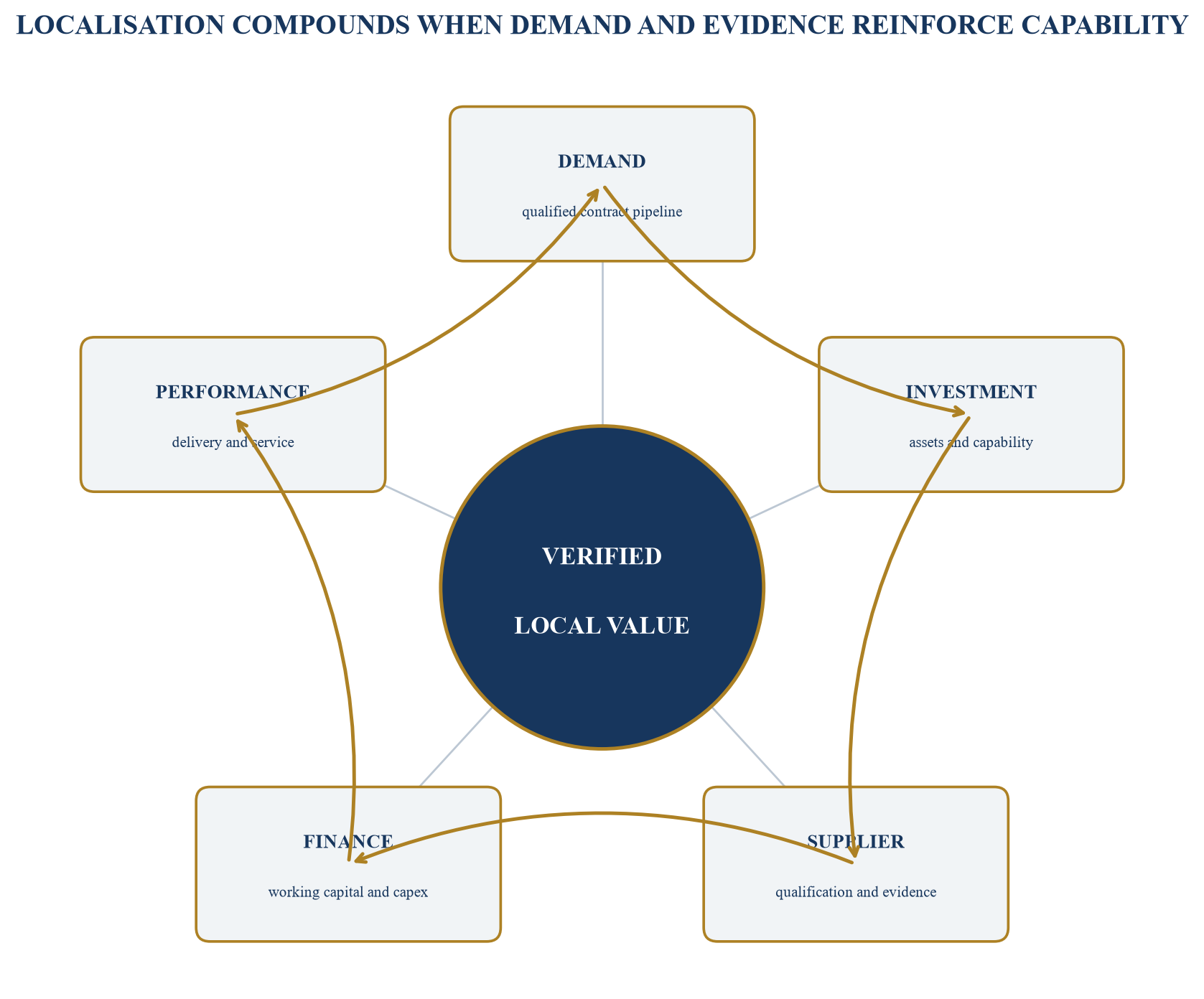
The flywheel depends on real expenditure, assets, employment, evidence and customer demand. It is not a scoring formula.
5. Choose among make, buy, partner and acquire
Every value-chain node should pass a make-buy-partner-acquire screen. The choice depends on strategic differentiation, minimum efficient scale, customer control requirements, qualification time, capital intensity, intellectual property, supplier maturity, reversibility and transaction timing. A company can use more than one route across the chain.
Making locally offers control over capacity, quality, data and improvement. It also creates fixed cost, execution risk and working-capital requirements. It is strongest when demand is visible, the process is differentiating, customer qualification values direct control and the platform can serve several products or markets. A pilot line, contract manufacturing or final-assembly cell can test the economics before a full facility.
Buying from a qualified UAE supplier preserves flexibility and can accelerate local contribution. The company must assess capacity, financial stability, quality systems, beneficial ownership, sanctions, labour and environmental practices, cyber controls, tooling rights, continuity and the supplier's own dependencies. A locally incorporated supplier can still rely on concentrated imported inputs. The diligence should examine the underlying chain.
Partnering can combine customer access, facilities, licences, talent and relationships. The commercial agreement needs clear scope, bid ownership, pricing, intellectual property, customer data, warranties, performance security, audit, subcontracting, change control, non-compete boundaries and exit. A memorandum of understanding without decision rights and economics is not an operating model.
Acquisition can provide an installed supplier base, approvals, people, assets and customer references. It can also import contingent liabilities, weak controls and customer concentration. Due diligence should test whether registrations and approvals transfer, whether key people remain, whether customer contracts permit change of control, whether asset condition supports the plan and whether the target's local-value evidence is sustainable after integration. The valuation should distinguish existing earnings from the buyer-specific procurement advantage.
Table 2. Make-buy-partner-acquire decision matrix
| Dimension | Make | Buy from supplier | Partner or joint venture | Acquire |
|---|---|---|---|---|
| time to initial capability | medium to long | short if supplier is qualified | medium | medium, subject to diligence and closing |
| control | high after ramp-up | contractual | shared through governance | high after integration |
| capital requirement | capex and ramp-up cash | purchase commitments and supplier support | negotiated contribution | purchase price, integration and working capital |
| customer evidence | new qualification often required | supplier and entrant evidence | combined evidence subject to buyer acceptance | target history may help if transferable |
| intellectual property | retained with internal controls | exposed through specifications and tooling | shared boundary must be explicit | target IP ownership requires verification |
| reversibility | low after major investment | relatively high | governed by exit terms | low after acquisition |
| best fit | differentiating process with visible volume | mature non-core input | complementary assets and market access | scarce qualified platform with strategic control value |
Scores should be supported by evidence and refreshed after customer, supplier or transaction diligence.
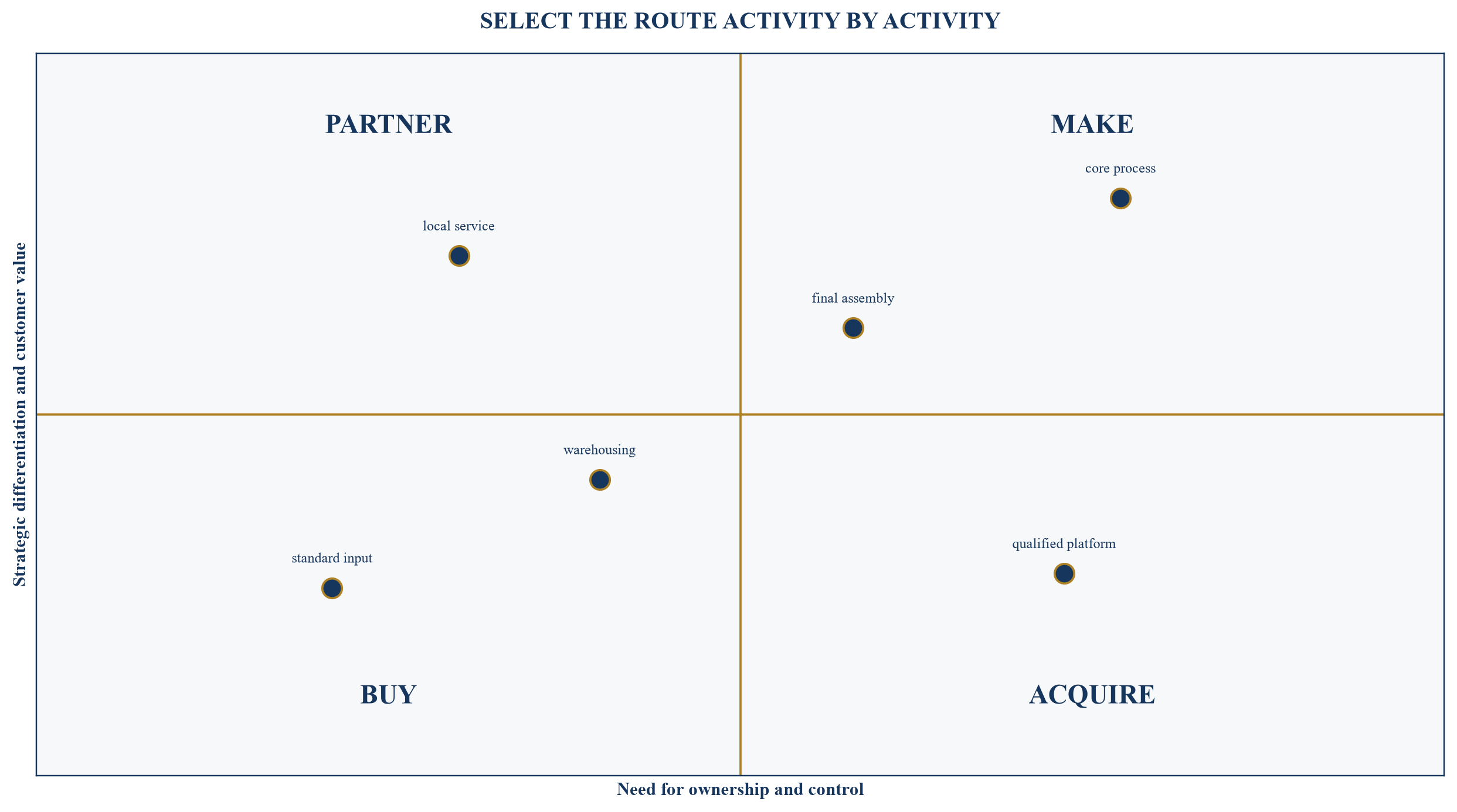
Positions are illustrative. Management should score each activity using customer evidence, economics and risk.
6. Design the legal-entity and contract map
The legal structure should follow the operating model. The board needs to know which entity imports, owns inventory, employs staff, contracts with suppliers, holds licences, provides warranties, invoices customers and bears product liability. A free-zone entity, mainland entity, branch, distributor or joint venture can support different activities. The conclusion depends on the actual business, emirate, sector and licence.
The entity map should reconcile five flows: goods, services, data, contracts and cash. Each intercompany arrangement needs a business rationale, documented scope, price, performance evidence and authority. The UAE Federal Tax Authority states that transfer-pricing rules apply to domestic and cross-border transactions with related parties and connected persons. The arm's-length analysis therefore belongs in the localisation design, not in a year-end clean-up.
Importer-of-record responsibility needs explicit ownership. The importer controls classification, valuation, origin evidence, permits, duties and release. A distributor arrangement can place these responsibilities outside the group, while customer warranties and regulatory expectations remain with the brand. The contract should define data access and audit rights sufficient for the principal to understand landed cost and compliance.
Commercial-agency analysis is also important. The UAE's Federal Law No. 3 of 2022 regulates registered commercial agencies and defines their validity, territory, commission and termination framework. Distribution, representation and agency arrangements should be classified using qualified legal advice. Exclusivity, registration and compensation consequences can materially affect a later procurement reset or acquisition.
The authority matrix completes the design. It identifies who may approve suppliers, sign tenders, issue purchase orders, change specifications, accept quality deviations, release payments, draw guarantees, access customer systems and appoint subcontractors. System permissions and bank mandates should reflect the approved matrix. A local entity creates little control when material decisions remain undocumented.
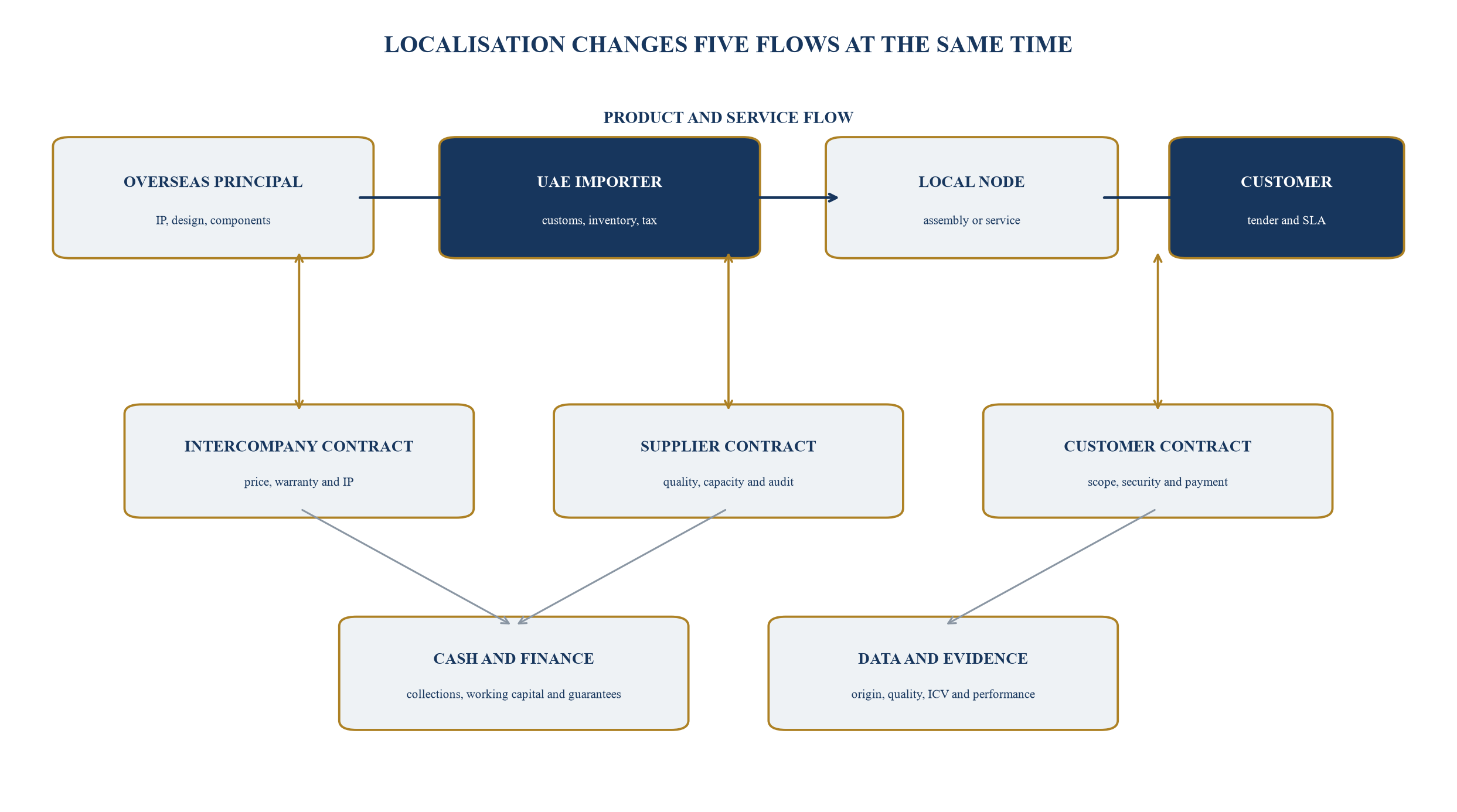
The structure is illustrative. Legal, tax, customs and regulatory advice should confirm the facts and documentation.
7. Model landed enterprise economics
Purchase price is an incomplete measure of localisation. The board needs a landed enterprise economics model that connects sourcing decisions to revenue, contribution, cash, capital, risk and option value. The model should show each activity and scenario with transparent assumptions.
The cost bridge begins with ex-works price, freight, insurance, duty, import VAT timing, brokerage, inspection, warehousing, inventory carrying cost, local handling, yield loss, warranty, service and overhead. Local production adds materials, labour, utilities, rent, depreciation, maintenance, quality, scrap and production working capital. Intercompany charges and tax are modelled using the proposed legal structure and professional advice.
Revenue economics are placed above the cost bridge. The model identifies accessible contracts, award probability, pricing, volume ramp and retention. Contract-specific bid and performance security, liquidated damages and extended payment terms are included. This produces contribution after procurement cost and a cash requirement by month. A project with attractive gross margin can still destroy liquidity during qualification and ramp-up.
Risk-adjusted economics should include expected cost of disruption, quality failure, supplier default, obsolete inventory, delayed approvals and customer concentration. Expected loss is probability multiplied by impact for planning; it is not a prediction. High-impact risks also receive contingency actions because an average expected value can hide a threat to the company's viability.
The valuation view translates operating outcomes into recurring earnings, cash conversion, capital intensity, customer concentration, control quality and growth options. A local platform can increase revenue quality and strategic relevance. It can also reduce return on capital when underutilised. The investment paper should calculate return on invested capital, payback, downside cash and covenant headroom, then state which assumptions the board must believe.
Table 3. Illustrative landed-enterprise economics for three localisation paths
| Annual steady-state item | Import and distribute | Local service and final assembly | Acquire qualified platform |
|---|---|---|---|
| identified contract pool | 180.0 | 260.0 | 310.0 |
| modelled award probability | 18% | 31% | 36% |
| probability-weighted revenue | 32.4 | 80.6 | 111.6 |
| contribution before localisation cost | 9.1 | 25.0 | 35.7 |
| local operating cost | 3.2 | 12.4 | 18.3 |
| expected disruption and quality cost | 2.1 | 1.4 | 1.6 |
| steady-state operating contribution | 3.8 | 11.2 | 15.8 |
| initial investment and integration cash | 4.0 | 24.0 | 62.0 |
| peak incremental working capital | 6.5 | 14.5 | 19.0 |
| modelled cash payback | 3.4 years | 3.6 years | 5.1 years |
| principal value driver | flexibility | contract access and service | speed, approvals and customer base |
| principal downside | low win rate | ramp and utilisation | purchase price and integration |
All amounts and probabilities are management planning assumptions in AED millions. They are not forecasts, quotations or programme thresholds.
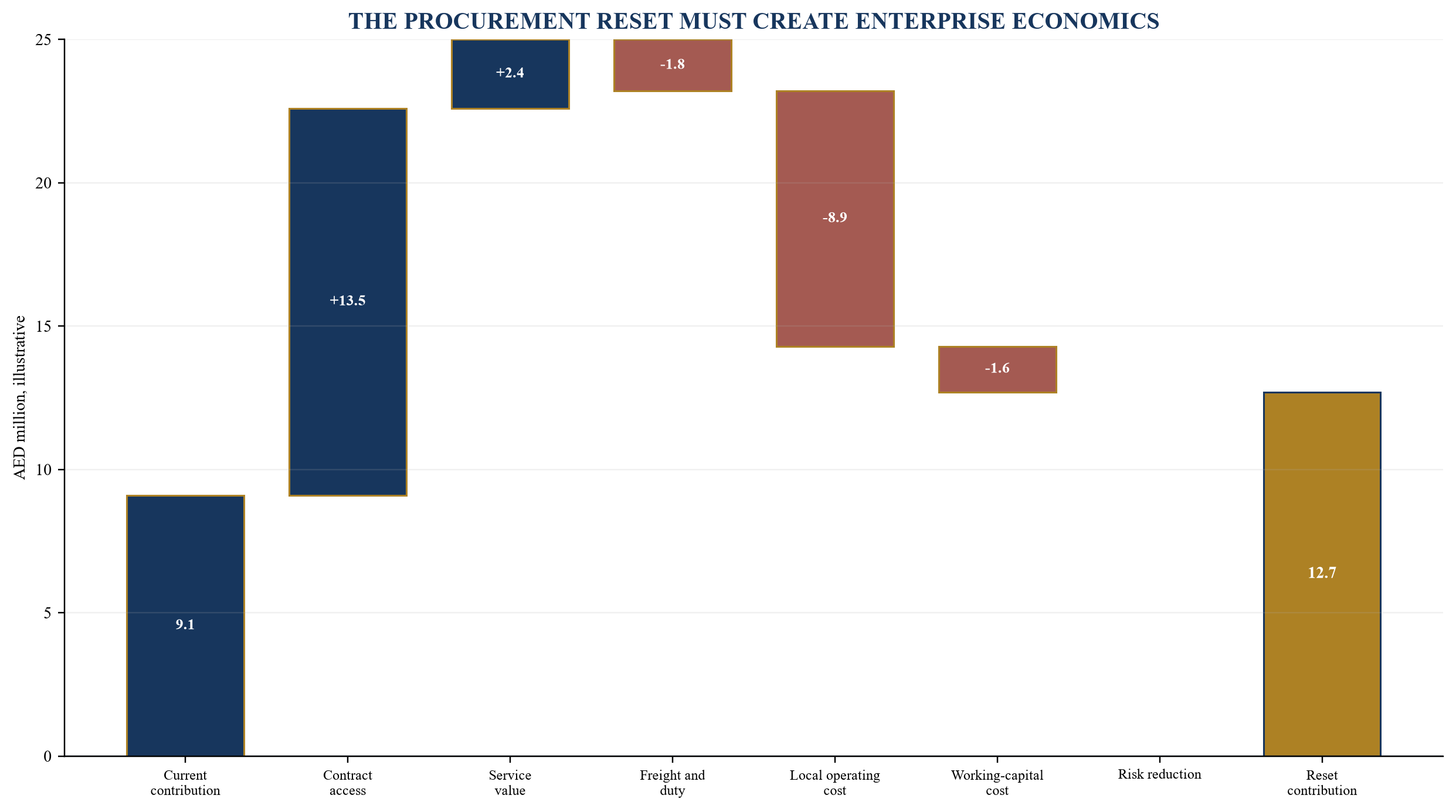
Values are illustrative management assumptions and show the analytical bridge, not a forecast.
8. Protect working capital before volume arrives
Localisation changes the cash-conversion cycle before it changes reported profit. New inventory buffers, supplier deposits, tooling, qualification stock, performance guarantees, receivables and tax timing can create a substantial funding peak. The board should approve a monthly cash model covering pilot, qualification, award, production and collection.
The model should begin with customer terms. Federal and government-related procurement can involve platform processes, acceptance steps and documentation before an invoice becomes payable. Private customers can require milestone certification, retention or back-to-back terms. Management should model the time from supplier payment to cleared customer cash using the contract, not a standard days-sales-outstanding assumption.
Supplier terms are designed around capacity and risk. A strategic UAE supplier may need purchase commitments, deposits or support for equipment. The entrant can use call-off orders, consignment, vendor-managed inventory, customer-backed forecasts or supply-chain finance where commercially available. The agreement should preserve quality and continuity obligations and avoid funding capacity without access or security.
Emirates Development Bank offers supply-chain finance and manufacturing finance, including working capital, equipment and greenfield or brownfield support. Its published supply-chain finance proposition addresses early supplier payment and buyer cash-flow optimisation. In 2026, EDB and Zelo announced a programme for approved government and government-related entity invoices. Eligibility and terms require direct confirmation; the strategic lesson is that finance should be designed around evidenced procurement flows.
Guarantee capacity deserves a separate line. Tender, advance-payment, performance and warranty guarantees can consume bank lines or cash collateral. The bid pipeline should be connected to the treasury forecast so that a cluster of awards does not create a liquidity crisis. Pricing should reflect guarantee fees, collateral and duration.
The downside case should assume slower qualification, lower utilisation, delayed customer acceptance and supplier rework. Management identifies the earliest trigger for stopping further investment. A staged localisation model preserves the ability to pause after warehousing, service or assembly before committing to a larger plant.
9. Rebuild supplier qualification
A procurement reset changes the supplier population and the evidence expected from it. The company should use a risk-based qualification process that tests commercial, technical, financial, integrity, labour, environmental, cyber and continuity dimensions. Supplier onboarding should not be reduced to trade licence and bank details.
The diligence begins with ownership, control, licences, sanctions and conflicts. It then examines customer references, capacity, equipment, workforce, quality certification, process control, non-conformance history, insurance, financial statements and working-capital resilience. For critical components, the company maps sub-tier dependencies, imported inputs, tooling, single points of failure and lead times.
Quality qualification should follow the actual process. A paper audit is supported by sample production, first-article inspection, traceability, calibration, change control and acceptance criteria. The contract identifies who owns specifications, tools, test data and improvements. It also defines the process for deviations and product recalls. Procurement cannot approve a technical deviation alone.
Cyber and data diligence apply where a supplier accesses customer systems, drawings, personal data, telemetry or production networks. The company maps data, identities, connections, storage and subcontractors. It sets least-privilege access, incident notification, evidence retention and termination controls. The UAE Personal Data Protection Law establishes obligations around processing and cross-border transfers; sector and customer rules can add requirements.
Responsible-business conduct is part of value for money. OECD guidance encourages risk-based due diligence across environmental, human-rights, labour and integrity impacts in procurement. The company should prioritise severe and likely impacts, establish contractual expectations, create reporting and remediation routes, and retain audit rights. Termination can be necessary in severe cases; automatic exit without remediation analysis can move the harm elsewhere.
Table 4. Risk-based UAE supplier diligence scorecard
| Dimension | Evidence | Illustrative weight | Escalation trigger | Control owner |
|---|---|---|---|---|
| legal and ownership | licence, beneficial ownership, authority, sanctions and conflicts | 10% | ownership cannot be verified | legal and compliance |
| financial resilience | audited accounts, liquidity, debt, customer concentration and insurance | 15% | supplier depends on unsupported advance funding | finance and procurement |
| capacity and continuity | equipment, shifts, bottlenecks, sub-tier map, recovery and alternative site | 20% | single failure stops customer delivery | operations |
| quality and conformity | certificates, test records, traceability, change control and corrective action | 20% | process cannot reproduce accepted sample | quality |
| local-value evidence | entity, spend, assets, employment and current certification evidence | 10% | claimed contribution lacks records | finance and ICV owner |
| labour and environment | workforce practices, health and safety, permits, waste and grievance routes | 10% | severe impact or missing licence | sustainability and legal |
| cyber and data | architecture, access, incident history, subprocessors and exit controls | 10% | unsegmented access to sensitive systems | security and privacy |
| commercial alignment | price, indexation, tooling, warranty, audit, IP and termination | 5% | contract cannot protect customer obligation | procurement and legal |
Weighting and thresholds should reflect the product, customer, sector and consequence of failure.
10. Treat conformity and qualification as design inputs
Product compliance can determine the feasible localisation sequence. MoIAT provides services for national conformity marks and Emirates Conformity Assessment Scheme certificates. Published requirements can include approved test reports, conformity evidence and factory assessment. Product-specific technical regulations, customer standards and emirate-level approvals may also apply.
The compliance map should begin at the stock-keeping-unit level. It records classification, applicable technical regulation, test standard, certificate holder, factory, model family, label, language, importer, renewal, market-surveillance obligation and change trigger. A change in factory, component or design can affect an approval. Procurement and engineering therefore need formal change control.
Local assembly can create a new manufacturer or conformity position depending on the facts. Management should confirm whether imported modules, local processing and final testing change the responsible entity, documentation or origin. Marketing claims such as Made in the Emirates require the applicable licence and evidence. The board should prevent commercial teams from using a national mark or origin claim before approval.
Customer qualification can be more demanding than legal conformity. Energy, infrastructure, healthcare, aviation, food and technology buyers can impose approved-vendor, cybersecurity, technical and field-performance requirements. The qualification plan should identify sample quantities, testing capacity, duration, failure criteria, retest cost and the customer decision owner. These items drive cash and launch timing.
Evidence should be designed for reuse. The technical file, bill of materials, supplier certificates, test reports, inspection records, non-conformance log and change approvals can support conformity, customer qualification, warranty defence and due diligence. A fragmented evidence system increases cost and weakens the company's credibility during a tender or transaction.
11. Engineer origin, customs and trade preference
Local processing and local origin are different concepts. The UAE Ministry of Economy and Tourism states that producers and exporters must meet defined conditions for certificates of origin, including appropriate licences and product qualification. Comprehensive Economic Partnership Agreements use product-specific rules of origin to determine preferential treatment. A local invoice or warehouse does not itself establish originating status.
The company should create an origin bill of materials. It records tariff classification, input origin, value, processing, supplier declaration and agreement-specific rule. The model tests whether the proposed UAE activity satisfies wholly obtained, tariff-shift, regional-value-content or specific-process criteria where applicable. Qualified customs and trade advisers should confirm classification and origin.
Customs valuation must align with the contract and transfer-pricing model. Royalties, assists, tooling, freight, insurance and related-party prices can affect the analysis. The importer should retain declarations, invoices, transport records, permits, origin evidence and valuation support. A post-entry audit can test records after goods are released.
VAT timing also affects landed economics. The Federal Tax Authority's guidance explains that import VAT treatment depends on importer status and that designated zones have specific rules for qualifying goods and movements. A free-zone location should not be treated as a general tax exemption. Services in designated zones and goods released for consumption can follow different treatment.
Trade preferences can support a regional platform when the production process and documentation meet each agreement's rules. The UAE's expanding CEPA network creates potential tariff and market-access opportunities, but the company should model them product by product. An investment case should avoid counting preference until the rule, documentation, direct-consignment condition and customer market have been validated.
Table 5. Origin, customs, conformity and tax control schedule
| Control | Decision record | Transaction evidence | Review trigger | Owner |
|---|---|---|---|---|
| tariff classification | approved code and rationale | product specification and classification support | design, material or use changes | customs owner |
| origin | agreement-specific rule and calculation | supplier declarations, bill of materials, process and certificate | source, price or process changes | trade compliance |
| customs valuation | valuation method and related-party analysis | invoice, freight, insurance, assists, royalties and adjustments | contract or transfer-price changes | tax and customs |
| importer responsibility | named entity, licence and authority | declaration, permit, broker instruction and release | route or entity changes | supply-chain lead |
| conformity | applicable regulation and certificate route | test reports, certificate, labels and factory records | model, factory or standard changes | quality and regulatory |
| VAT | importer registration and place-of-supply treatment | import record, tax return and designated-zone evidence | movement, consumption or entity changes | tax controller |
This schedule organises responsibilities. Competent authorities and qualified advisers determine the applicable legal treatment.
12. Protect quality while shortening the chain
Localisation can reduce distance and still increase quality risk during ramp-up. A new supplier, process, workforce or facility has a learning curve. The company needs a production-part approval or equivalent qualification discipline suited to its industry.
The control plan identifies critical characteristics, inspection method, sampling, responsible person and reaction to failure. Process capability is measured where appropriate. Incoming inspection, in-process control, final acceptance and field feedback are connected. A quality wall can support early production, with enhanced inspection removed only after evidence meets a defined threshold.
Change control covers materials, source, tooling, equipment, location, software, personnel and test method. The supplier must obtain approval before a controlled change. Emergency substitution follows a documented deviation process with risk, customer consent where required, traceability and expiry. Informal substitutions can invalidate conformity, warranty or origin evidence.
The cost of quality belongs in the economic model. Prevention, appraisal, scrap, rework, returns, warranty, field service, penalties and reputation have different timing and cash effects. Procurement savings should be reported after quality cost. A supplier that is slightly more expensive and consistently passes first time can create more contribution than the nominal lowest bid.
The customer should see a controlled transition. The cutover plan identifies old and new stock, serial or lot traceability, approval status, warranty responsibility and communication. Parallel supply may be appropriate for critical products. The company avoids a single big-bang change where a staged qualification provides safer evidence.
13. Design resilience through alternatives and visibility
Resilience is the ability to fulfil the customer obligation through disruption, not the number of suppliers in a database. The company should identify critical materials, processes, sites, routes, systems and people. It then measures time to recover, maximum tolerable disruption and the cash required for each contingency.
Dual sourcing can reduce concentration, while two suppliers dependent on the same sub-tier factory, port or material provide limited protection. The sub-tier map should identify common dependencies. Alternative suppliers need qualified products, current commercial terms, tooling access and realistic capacity. An unqualified name on a contingency slide is not resilience.
Inventory policy should follow risk and economics. Safety stock is set using demand variability, lead time, service requirement, obsolescence, shelf life and interruption exposure. Critical spares can have low turnover and high customer value. Management should report inventory by purpose and decision rule so that buffers do not become unmanaged working capital.
The OECD Supply Chain Resilience Review emphasises risk management, cooperation and policy frameworks that preserve the benefits of open markets. Australia's Supply Chain Resilience Initiative similarly supports diversification, transparency, digitalisation and collaboration for critical products. These approaches support a balanced UAE model: localise the nodes that create customer and resilience value while maintaining competitive global sources where concentration is controlled.
Resilience testing should use scenarios. Examples include port closure, cyber incident, supplier insolvency, export restriction, product recall, sudden demand increase, utility interruption and loss of a key technician. The exercise records decisions, evidence gaps, recovery time and cash impact. Remediation becomes part of the operating plan.
14. Use procurement technology with accountable controls
Digital procurement can improve visibility from tender to payment. The UAE Ministry of Finance states that its platform supports electronic tendering, contracting, purchase orders, invoicing and supplier-performance evaluation. An entrant should integrate its tender, contract, purchase-order, receiving, quality and invoice records so that the same transaction can be traced end to end.
Supplier master data is the foundation. Each supplier has a verified legal identity, ownership, licence, tax record, bank account, approved categories, contracts, risk status, certificates and renewal dates. Changes in bank account or ownership require independent verification. Duplicate detection and segregation of duties reduce fraud and payment error.
Artificial intelligence can support spend classification, document extraction, supplier-risk signals, tender summarisation, demand forecasting and anomaly detection. Management remains accountable for source accuracy, confidentiality, model access, bias, false positives and decisions. A customer tender or supplier contract may contain confidential information that cannot be placed into an unapproved system.
The control model should state permitted data, approved tools, human review, audit logging, retention, model-change approval and incident response. High-consequence outputs such as supplier exclusion, specification acceptance, customs classification or payment release require qualified review. Automation should make evidence easier to inspect.
Digital twins and control towers can model capacity, stock and routes. Their value depends on data quality and decision rights. A dashboard that reports late data without an escalation owner is a visual layer, not an operating control. Each alert should connect to a response, authority and closure record.
15. Connect localisation to M&A and financing
The procurement reset can create a transaction requirement. A company may need acquisition capital for a qualified supplier, project finance for a local facility, working-capital lines for awarded contracts, bonding capacity or growth equity for a regional platform. The financing structure should follow the cash-flow profile and risk.
Acquisition screening begins with scarce capability. The target may own customer approvals, technical staff, service coverage, equipment, local-value history or licences that would take time to build. The buyer should identify which capability is truly transferable and how much of the target's earnings depend on the current owner, customer or related parties.
Purchase-price allocation should separate operating assets, customer relationships, technology and goodwill. The strategic case should show buyer-specific synergies without paying the seller for value that only the buyer can create. Earn-outs can align payment with retention, qualification or contract renewal, while poorly defined measures create dispute. Representations, indemnities, escrow, warranty insurance and closing conditions should follow the diligence risks.
A joint venture can be appropriate when partners contribute complementary assets. Governance should define reserved matters, funding, business plan, transfer pricing, procurement, related-party contracts, IP, deadlock and exit. The venture's customer and supplier decisions should be operationally executable. Equal ownership without a deadlock mechanism can freeze a time-sensitive bid.
Debt capacity depends on contracted cash, collateral, customer concentration, payment terms and working-capital volatility. Lenders can require assignment of receivables, controlled accounts, guarantees and covenants. The company should align bid obligations with financing conditions early. Winning a contract before the bank approves bonding or working capital can weaken negotiating leverage.
The transaction team should build a procurement data room. It includes target contracts, pipeline evidence, supplier master, capacity, quality, certificates, origin records, local-value evidence, customer approvals, inventory, warranties, systems, cyber controls, working-capital history and contingent liabilities. This data room supports investment approval, lender diligence and integration.
16. Learn from international procurement systems
International comparisons show that local-value systems differ in design and consequence. Saudi Aramco's iktva programme aims to expand in-Kingdom supply capability, local suppliers, research and development, and export potential. Aramco reported in 2026 that the programme had achieved a 70% local-content target and set a 75% target for 2030. A supplier serving both markets needs country-specific data and operating choices.
India's Public Procurement Preference to Make in India framework defines local content and purchase preference, and the current government summary states that locally sourced imported items, royalties and specified foreign technical charges are excluded from local-content calculations. The framework illustrates the importance of tracing imported content through local distributors and engineering, procurement and construction contracts.
The United States Build America, Buy America framework applies domestic-production requirements to covered infrastructure financial assistance and publishes a waiver process. The broader Buy American framework uses statutory and regulatory tests for domestic end products. This demonstrates that localisation decisions can depend on product, funding source, components, agency and waiver.
The United Kingdom's Procurement Act 2023 and National Procurement Policy Statement connect procurement to statutory objectives and strategic priorities. OECD work on responsible-business conduct shows how public buyers increasingly incorporate environmental, human-rights, labour and integrity considerations into supply-chain diligence.
WTO rules create important boundaries. The Agreement on Trade-Related Investment Measures addresses measures affecting trade in goods that conflict with national treatment or quantitative-restriction provisions. The WTO Agreement on Government Procurement establishes non-discrimination and transparency disciplines for covered procurement among its parties and defines offsets. Companies should obtain trade-law advice before assuming that one country's local-content mechanism transfers to another or that every procurement is covered by the same international obligation.
The comparison supports a disciplined global model. The company maintains a common value-chain data architecture and country-specific rulebooks. It avoids a single global local-content number. Each market receives its own eligibility, scoring, origin, procurement, tax, conformity and responsible-sourcing analysis.
17. Sequence the reset through decision gates
A 180-day programme can convert the entry thesis into a controlled procurement model. The first 30 days establish target contracts, customer gates, current-state economics, critical suppliers, entity flows and evidence gaps. The board approves the localisation perimeter for detailed design.
Days 31 to 60 test route options. Management requests supplier information, conducts site and quality assessments, validates conformity and origin, models ICV inputs, designs the entity and tax structure, confirms financing capacity and runs customer discussions. Make, buy, partner and acquisition alternatives remain comparable through a common model.
Days 61 to 90 produce investment-grade decisions. The team completes technical trials, commercial terms, working-capital forecasts, risk allocation, implementation resources and downside cases. The board selects the route for each node and approves spending by gate.
Days 91 to 135 install capability. Contracts are signed, supplier records and systems are configured, equipment or inventory is placed, personnel are trained, evidence controls operate and customer qualification begins. Weekly reporting tracks safety, quality, schedule, cash, supplier actions and customer dependencies.
Days 136 to 180 complete controlled launch. The company closes qualification findings, tests fulfilment and invoice flows, validates origin and local-value records, rehearses continuity and confirms authority. The launch gate requires evidence across customer, operations, cash and control. Remaining risks have named owners and approved limits.
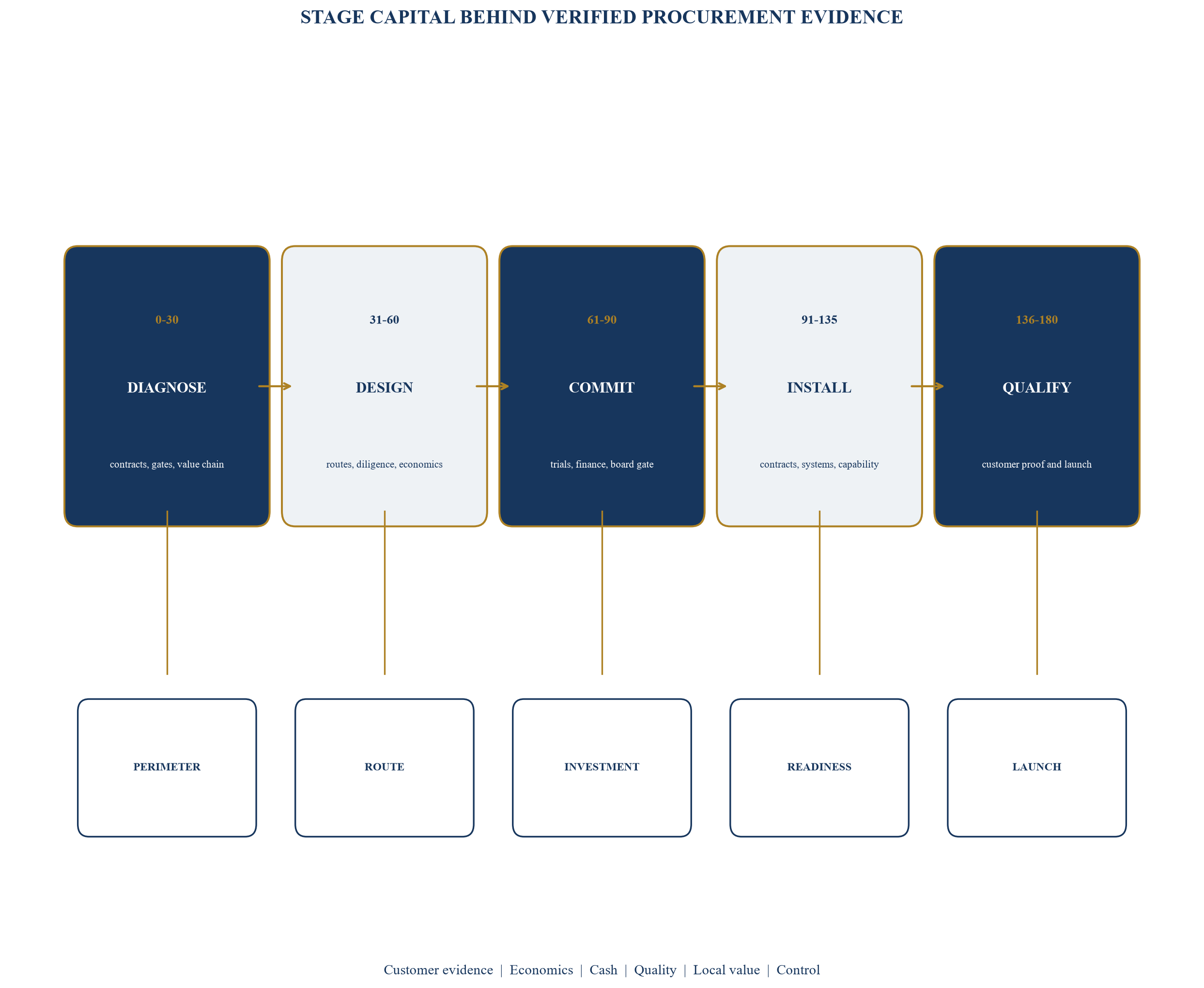
Timing is a management planning framework. Regulatory, customer, facility and transaction work can require longer.
18. Govern the programme through one evidence ledger
The procurement reset crosses functions and counterparties. A single programme office should maintain the integrated plan, decision log, assumptions, evidence, cash forecast, risks and benefits. Functional owners retain accountability for their technical conclusions.
The evidence ledger connects every material claim to a source. Customer eligibility links to a tender clause or platform requirement. ICV treatment links to current guidance and professional confirmation. Origin links to a bill of materials and rule. Quality links to a test record. Cash links to contract terms and financing documents. The ledger records source date and revalidation trigger.
Decision rights should be clear. The board approves capital, acquisition, joint venture, risk appetite and launch. The executive sponsor approves programme trade-offs within delegated limits. Procurement selects suppliers through the approved process. Engineering and quality control specifications and deviations. Finance owns the economic model, treasury and ICV data. Legal, tax, customs, security and regulatory specialists approve within their domains.
Benefits should be measured after launch. Contract access, win rate, contribution, cash conversion, service level, supplier performance, quality, inventory, local-value inputs and resilience are compared with the approved case. Variance analysis should distinguish market, volume, price, execution and model error. Management updates the localisation perimeter when evidence changes.
The programme should protect confidential information and competition. Supplier bids, customer requirements, employee data, technical drawings and transaction material need access controls and retention rules. Information shared among competitors, partners or joint-venture parties requires legal review and a defined purpose.
19. Use a board dashboard focused on value and evidence
The dashboard should answer four questions. Can the company bid? Can it deliver? Can it fund the obligation? Does the model create value? Each measure has a definition, source, owner, target, trend and escalation threshold.
Eligibility measures include supplier registration, tender prequalification, product approvals, ICV certificate status and customer-approved facilities. Delivery measures include capacity, first-pass yield, on-time delivery, service response, critical-supplier recovery and unresolved non-conformance. Cash measures include liquidity headroom, guarantees, inventory, receivables and supplier exposure.
Value measures include probability-weighted qualified pipeline, realised contribution after quality and logistics, return on invested capital, customer concentration and recurring service revenue. A high pipeline without eligibility remains excluded. A high gross margin without cash collection remains incomplete. An ICV score without the target customer's relevant procurement treatment remains context rather than value.
The dashboard should distinguish a verified result from an expected milestone. A submitted registration is not an approval. A supplier's stated capacity is not demonstrated output. A signed customer memorandum is not a purchase order unless legally structured as one. Clear status definitions improve board decisions and lender confidence.
The board should also receive a contract-level bridge between the original bid model and the current operating model. The bridge starts with the opportunity as first approved, then shows changes in specification, local-value requirements, price, volume, guarantee exposure, inventory, supplier terms, qualification cost and timing. This prevents changes from disappearing inside functional budgets. It also reveals whether the company is preserving an attractive contract or funding a deteriorating one because the project has already consumed management attention.
Benefits should be attributed carefully. A contract won after localisation can still reflect price, relationship, technical differentiation or competitor withdrawal. Management should record the award feedback available from the buyer and avoid assigning the whole outcome to one intervention. The same discipline applies to lost bids. A lower score can reveal an evidence or capability gap, while a loss on price can indicate that the local model is structurally uncompetitive. The lessons register should change the next bid and the next capital decision.
The dashboard should expose portfolio effects. Several target contracts may depend on the same assembly cell, supplier, guarantee line or field-service team. Individually acceptable opportunities can collectively exceed capacity or liquidity. A consolidated view should show simultaneous peak demand, shared bottlenecks and downside correlations. The board can then prioritise contracts by contribution, strategic importance, evidence quality and resource consumption.
Management should report customer and supplier concentration on a look-through basis. A local supplier can depend heavily on the same government-related customer that drives the entrant's pipeline. The apparent diversification can therefore be circular. The exposure map should connect end customers, prime contractors, suppliers, lenders and guarantees. A change in one procurement programme can affect revenue, receivables and supplier solvency at the same time.
The dashboard becomes more useful when it includes decision dates. Each amber item has a date by which management must choose, a financial consequence of delay and a pre-approved fallback. Examples include switching to a second supplier, limiting a tender scope, deferring equipment, negotiating customer-owned inventory or seeking additional guarantee capacity. An amber status without a decision rule can remain amber until the launch becomes urgent.
Finally, the board should compare the local platform with the counterfactual at least annually. The counterfactual asks what the company would earn, fund and risk if it retained the import model, used a different partner, acquired capacity or exited the product category. This review prevents an installed platform from becoming permanent by default. Localisation remains an active capital-allocation choice, supported by customer evidence and operating results.
Table 6. Board dashboard for a procurement reset
| Measure | Green evidence | Amber condition | Red condition | Owner |
|---|---|---|---|---|
| contract eligibility | registrations, prequalification and approvals verified | one non-critical gate pending | entity or product cannot bid | commercial lead |
| local-value evidence | current inputs reconciled to finance and certificate process | improvement plan has dated evidence gaps | tender claim lacks support | finance and ICV owner |
| supplier readiness | trial, capacity, quality and continuity evidence complete | corrective actions open within launch tolerance | critical supplier cannot meet acceptance | operations and quality |
| landed contribution | current cost and contract model within approved range | one sensitive assumption outside range | expected contribution below hurdle | finance controller |
| working-capital headroom | funded downside plus guarantee capacity | award cluster approaches limit | contract cannot be funded | treasury |
| conformity and origin | approvals and transaction records complete | renewal or classification issue under review | goods cannot be supplied or preference is unsupported | trade and regulatory |
| customer delivery | rehearsal meets service and invoice criteria | contained exception with owner | launch obligation cannot be fulfilled | country leader |
| enterprise value | return, cash conversion and strategic options remain supported | payback or utilisation approaching limit | downside breaches approved capital or covenant | executive sponsor |
Thresholds are set for the company's contracts, cash capacity and risk appetite.
20. Board decisions and limitations
Before committing to a procurement reset, the board should approve the target contract families, procurement-gate register, localisation perimeter, make-buy-partner-acquire choices, legal-entity map, investment and working-capital envelope, customer qualification plan, ICV evidence design, supplier-risk controls, financing, implementation gates and downside stop rules.
The board should ask ten questions. Which contracts become accessible? Which evidence proves that access? Which value-chain nodes change? What customer outcome improves? How do local-value inputs reconcile to financial records? What happens to margin, cash and capital in the downside case? Which quality, origin, tax and conformity conclusions require professional confirmation? Which supplier or facility is a single point of failure? What capability is owned after three years? Which trigger stops further capital?
This framework supports structured decisions and execution. It cannot determine tender eligibility, certify ICV, approve a product, classify goods, establish origin, calculate tax, value a transaction, approve financing or provide a legal conclusion. Competent authorities, customers and qualified advisers should confirm the current requirements and apply them to complete facts.
Procurement rules, programme formulas, tax treatment, technical standards, customer criteria, financing terms and trade agreements can change. Product, buyer, entity, emirate, free-zone status, sector, ownership, source country, process and contract affect the outcome. Every source and assumption should be dated and revalidated before a bid, investment or transaction.
Illustrative costs, probabilities, timing windows, scores and scenarios in this paper are management planning assumptions. They are not official thresholds, quotations, forecasts or promised outcomes. No contract award, ICV result, origin treatment, financing, tax position, payback or valuation outcome is guaranteed.
The durable output is a procurement operating system. It connects target contracts to suppliers, entities, product evidence, local-value records, quality, cash, risk and decisions. The company localises where the evidence supports contract access and enterprise value, preserves global options where they improve competitiveness, and revisits the perimeter as customers and economics change.
Sources and further reading
- UAE Ministry of Finance, Register Suppliers in the Federal Supplier Register Official source
- UAE Ministry of Finance, Federal Supplier Register Official source
- UAE Ministry of Finance, Digital Procurement Platform Official source
- UAE Ministry of Finance, Government Procurement Official source
- UAE Legislation, Federal Law No. 11 of 2023 Concerning Procurement in the Federal Government Official source
- UAE Legislation, Cabinet Resolution No. 122 of 2024 on the Executive Regulation of Federal Procurement Law Official source
- UAE Ministry of Industry and Advanced Technology, National In-Country Value Program Official source
- UAE Ministry of Industry and Advanced Technology, Issuing an ICV Certification Official source
- UAE Ministry of Industry and Advanced Technology, National ICV Data Official source
- UAE Ministry of Industry and Advanced Technology, ICV Supplier Certification Guidelines, September 2025 Official source
- ADNOC, In-Country Value Creation Official source
- UAE Ministry of Industry and Advanced Technology, Operation 300bn Strategy Official source
- UAE Ministry of Industry and Advanced Technology, Operation 300bn Launch Official source
- Emirates Development Bank, Supply Chain Finance Official source
- Emirates Development Bank, Manufacturing Finance Official source
- Emirates Development Bank, National Industrial Resilience Fund and ADNOC Official source
- Emirates Development Bank, National Supply Chain Finance Platform Official source
- Emirates Development Bank, AED 350 Million SME Liquidity Programme Official source
- Emirates Development Bank, EDB and ADEX Export Financing Framework Official source
- UAE Federal Tax Authority, Transfer Pricing Guide Official source
- UAE Federal Tax Authority, Corporate Tax Frequently Asked Questions Official source
- UAE Federal Tax Authority, Corporate Tax General Guide Official source
- UAE Federal Tax Authority, Designated Zones VAT Guide Official source
- UAE Federal Tax Authority, Taxable Person VAT Guide Official source
- UAE Ministry of Economy and Tourism, Issue a Certificate of Origin Official source
- UAE Ministry of Economy and Tourism, Certificates of Origin Services Official source
- UAE Ministry of Economy and Tourism, Rules and Certificates of Origin Regulation Official source
- UAE Ministry of Economy and Tourism, UAE-Republic of Korea Comprehensive Economic Partnership Agreement Official source
- UAE Ministry of Economy and Tourism, UAE-Jordan Comprehensive Economic Partnership Agreement Official source
- UAE Ministry of Industry and Advanced Technology, National Conformity Marks Official source
- UAE Ministry of Industry and Advanced Technology, Conformity Services Official source
- UAE Legislation, Federal Law No. 3 of 2022 Regulating Commercial Agencies Official source
- UAE Legislation, Federal Decree-Law No. 50 of 2022 Promulgating the Commercial Transactions Law Official source
- UAE Legislation, Federal Decree-Law No. 45 of 2021 Concerning the Protection of Personal Data Official source
- Central Bank of the UAE, SME Market Conduct Regulation Official source
- Central Bank of the UAE, Background of International Trade and Trade Finance Official source
- Saudi Aramco, In-Kingdom Total Value Add Official source
- Saudi Aramco, Commercial Ecosystem Development Official source
- Government of India Department for Promotion of Industry and Internal Trade, Public Procurement Preference to Make in India Official source
- United States Made in America Office, Buy America Waivers for Federal Financial Assistance Official source
- United States Made in America Office Official source
- United Kingdom, Procurement Act 2023 Official source
- United Kingdom Government, National Procurement Policy Statement Official source
- OECD, Responsible Business Due Diligence and Government Procurement Official source
- OECD, Integrating Responsible Business Conduct in Public Procurement Official source
- OECD, Resilient Supply Chains Official source
- OECD, Toolkit for Resilient Public Procurement Strategies Official source
- OECD, Supply Chain Resilience Review Official source
- World Trade Organization, Agreement on Trade-Related Investment Measures Official source
- World Trade Organization, Agreement on Government Procurement Official source
- Australian Government, Supply Chain Resilience Initiative Official source
