

Introduction
The economic value of an energy site begins with physical access to the power system. A generator needs a connection through which it can export. A battery needs import and export rights that match its operating strategy. A data centre, electrolyser, desalination plant or industrial load needs dependable capacity, a commissioning timetable and a price basis that can support long-duration investment. Land, resource and construction cost remain important. The network position determines how those attributes become cash flow.
Locational electricity pricing makes part of this relationship visible. In US nodal markets, a locational marginal price commonly reflects the marginal cost of energy, transmission congestion and losses at a particular location. Other markets settle at zones or regions and express location through network charges, loss factors, curtailment, redispatch, access rights or bilateral contracts. The United Kingdom decided in 2025 to retain national wholesale pricing and pursue reformed national pricing with stronger locational investment signals. Australia uses regional reference prices in the National Electricity Market and applies marginal loss factors to settlement. The mechanisms differ, but the investment question is consistent: what portion of site economics changes because electricity must be delivered to or withdrawn from a specific point on a constrained system?
This paper provides a framework for answering that question. It treats a site as a bundle of physical rights, settlement exposures, contracts, operating choices and financing obligations. It distinguishes observed data from scenarios and uses illustrative values only to demonstrate methodology. The intended readers are boards, investment committees, developers, utilities, infrastructure and private-capital investors, lenders, corporate power buyers, flexible-load operators and transaction advisers. Jurisdiction-specific decisions require qualified legal, regulatory, technical, tax and accounting advice.
1. Decode the price at the node
A locational marginal price represents the short-run value of supplying one additional unit of electricity at a location, subject to the system model and market rules. FERC describes locational marginal pricing as a mechanism that can reflect energy, congestion and losses. PJM similarly explains that the marginal price varies by location when transmission constraints or losses make an additional unit more expensive to serve at one point than another.
The energy component reflects the marginal system resource in the relevant market interval. The congestion component arises when a transmission constraint prevents the least-cost pattern of dispatch. The loss component reflects the incremental electricity lost as power flows through the network. Each component can be positive or negative under the applicable formulation. Their sum becomes the settlement price at the node.
The price is an operating signal, not a complete valuation. It does not include every network charge, tax, certificate, capacity payment, contract settlement, connection cost or curtailment consequence. It can also change after transmission upgrades, retirements, generation entry, load growth or market redesign. A site team should therefore begin with the price decomposition, then reconstruct the full settlement and cash-flow waterfall.
Interval granularity matters. Five-minute, fifteen-minute and hourly prices capture different volatility. Day-ahead and real-time markets can diverge because forecasts, outages and constraints change. A project can schedule at one price and settle deviations at another. Historical averages can hide the combination of favourable base energy and adverse local congestion.
2. Recognise location in every market design
Nodal pricing is the most explicit form of locational settlement, but it is not the only way location affects value. Zonal markets group multiple nodes into a bidding area. Internal constraints can then appear through redispatch, curtailment, constraint payments or network charges. Regional markets can use a reference node and apply loss factors or settlement residues. National markets can retain one wholesale price while connection charges, transmission use-of-system charges, distribution charges, contracts and planning rules create locational differences.
Investors should map the mechanism used in the relevant jurisdiction rather than importing terminology from another market. The map should identify the physical connection point, pricing point, metering point, contract reference, balancing responsibility, loss treatment, constraint regime and network tariff. It should also identify who controls dispatch and who receives compensation when the system operator restricts output or consumption.
The United Kingdom's 2025 Review of Electricity Market Arrangements decision illustrates the distinction. Government decided against zonal pricing and chose a reformed national pricing approach. The decision preserved a national wholesale market while signalling reforms to transmission charging, connections, planning and investment incentives. A UK site should therefore be assessed under the implemented national framework and the published reform pathway. It should not be valued as though zonal pricing had already been introduced.
Australia illustrates another approach. AEMO publishes marginal loss factors that affect settlement between connection points and regional reference nodes. The factors are forward-looking estimates based on network modelling and can change between financial years. A site can therefore face a material location effect even without a separate nodal energy price.
3. Separate price level from basis
The market price most visible to management may be a hub, zone, region or national index. The project receives or pays a price at its physical or contractual settlement point. The difference is basis. Basis can arise from congestion, losses, settlement rules, timing and product definitions.
A generator with a fixed-price financial hedge at a liquid hub can remain exposed to a weak project node. If the project sells electricity at its node and settles the hedge against the hub, its net revenue includes the node-to-hub difference. A flexible load can face the reverse exposure. It may contract power at a hub while paying a local price and network charges at the site. A battery can earn a favourable nodal spread and still lose value when the hedge or tolling contract references a different point.
Basis should be measured as a distribution. The analyst should show the mean, median, volatility, negative tail, seasonal pattern, intraday pattern and relationship with project output or load. A simple average can understate risk because the adverse basis may coincide with the asset's highest volume. Renewable projects often experience this correlation when local production contributes to congestion. Data centres and other large loads may improve local economics when they consume behind a constrained export interface, but their reliability and import requirements create a separate network test.
Forward basis requires a system view. Generation additions, new load, transmission projects, retirements and storage can change constraint patterns. A historical discount can narrow after an upgrade or deepen when several queued projects connect first. The valuation should show the evidence supporting each network assumption and the date on which it is expected to take effect.
4. Build a location-adjusted revenue stack
Site revenue or cost should be assembled from the contract and settlement rules that actually apply. For a generator, the stack can include nodal energy, a power purchase agreement, a financial hedge, capacity, ancillary services, certificates, support payments, curtailment compensation and congestion rights. For storage, it can include charging cost, discharge revenue, reserves, capacity, network services and contracted availability. For a flexible load, it can include energy cost, network charges, demand response, interruptibility and onsite or contracted generation.
The model should begin at the meter. It should apply output or consumption, availability, dispatch, loss factors, constraints, imbalance, reference prices, contract strikes, floors, caps, shaping, collateral and fees. Every line should reconcile to a governing agreement or published market rule. This approach prevents a headline nodal price from being treated as net cash flow.
Revenue quality matters alongside expected value. Contracted cash flow from a creditworthy counterparty can support more debt than a volatile merchant spread. A capacity payment may be stable but subject to performance penalties. Curtailment compensation may be available only for specified instructions and verified availability. Congestion rights can hedge one path while leaving volume or outage risk.
The investment committee should see the contribution and risk of each component. The stack should show which party controls the exposure, which evidence supports the base case, and which downside can trigger a liquidity or covenant event.
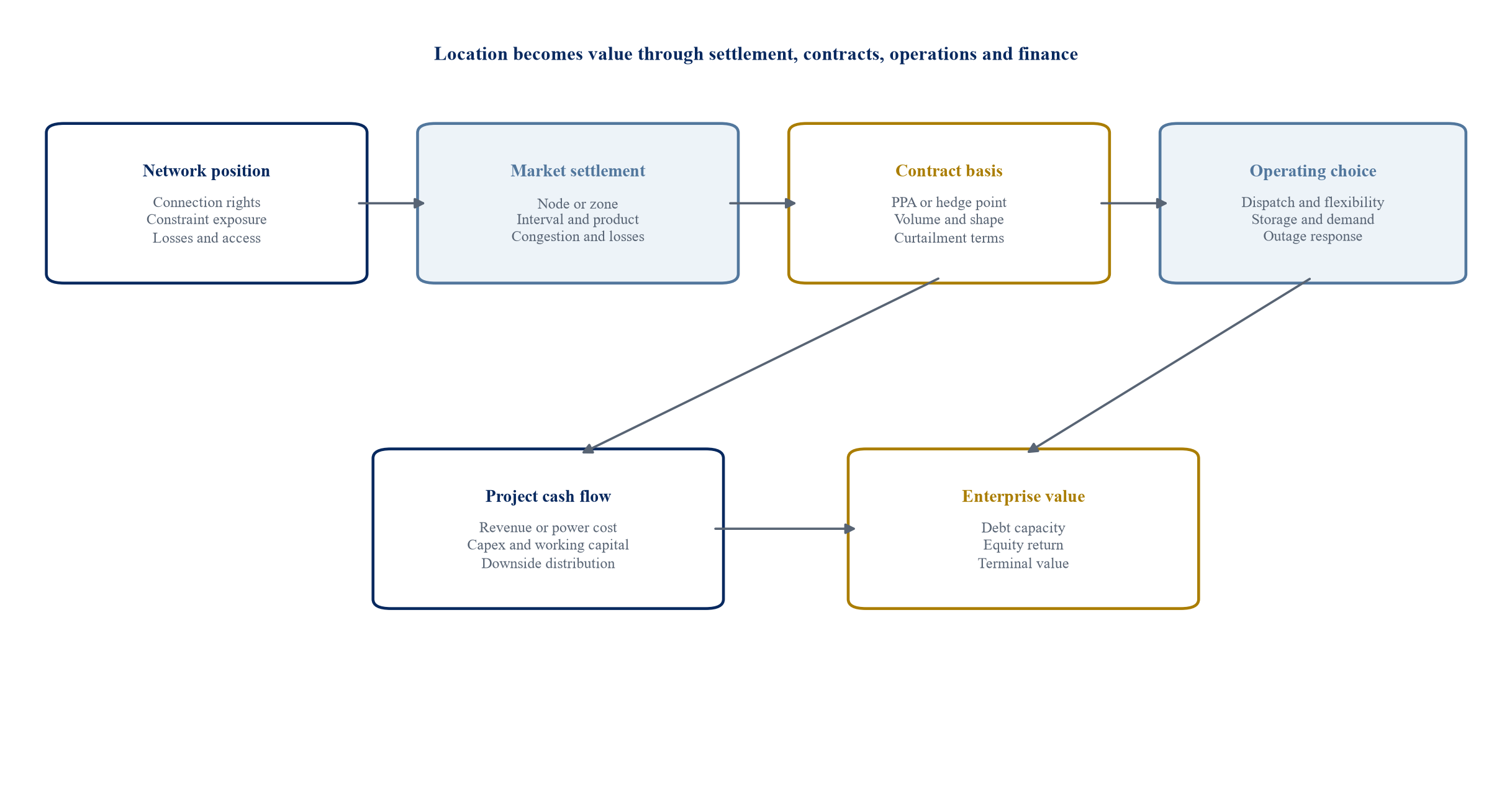
The framework traces physical and market conditions through settlement, cash flow, financing and valuation.
5. Treat congestion as an operating state
Congestion should be modelled as a set of operating states rather than one annual discount. A constraint can bind during high renewable output, peak demand, equipment outages, maintenance or extreme weather. The direction and financial effect can reverse as system conditions change.
The analyst should identify the monitored facility, contingency, constraint direction, historical binding intervals and dispatch response where market data allow. It should then connect those events to project output or load. A generator located behind an export constraint may receive a lower price when it produces most. A load at the same location can benefit from low energy prices, subject to import reliability and network charges. Storage can absorb local surplus and discharge when the constraint relaxes, within connection and state-of-charge limits.
Constraint history needs context. A temporary outage should not be capitalised as a permanent basis pattern. A planned transmission reinforcement should enter the model only when scope, approvals, cost allocation and schedule are sufficiently evidenced. Queue projects that depend on the same upgrade can change both timing and residual capacity.
Scenario design should include at least a current-grid case, a delayed-upgrade case and a changed-resource case. Each scenario should preserve the relationship between production, load, congestion, loss and curtailment. Independent hourly series that ignore correlation can overstate diversification.
6. Measure marginal losses
Electricity is lost as it flows through transmission and distribution networks. Marginal loss pricing estimates the incremental losses associated with an additional injection or withdrawal at a location. A remote generator can deliver fewer settlement units to a reference point than it meters at the connection. A strategically placed generator or load can have a more favourable factor under the applicable methodology.
AEMO's published methodology for the National Electricity Market uses a forward-looking network model, demand forecasts and expected dispatch to calculate marginal loss factors. The factors can change when network topology, generation and demand change. AEMO's 2026 review also addresses stability in the framework. These publications show why a loss factor should be treated as an annually refreshed settlement input rather than a fixed physical constant.
The project model should distinguish technical loss, settlement factor and network charge. It should state whether the factor multiplies metered output or price and how it applies to imports and exports. Historical factors can support a range; forward factors require evidence about the network and operating pattern.
Loss sensitivity can be material for high-volume, low-margin assets. A small percentage change applied to many megawatt-hours can reduce cash available for debt service. The lender should therefore test adverse factors, delayed tariff publication and any mismatch between contract and market loss treatment.
7. Price curtailment and redispatch
Curtailment occurs when available generation cannot export or when system security requires a reduction. Redispatch can move output between resources to manage a constraint. The commercial effect depends on market rules, contract terms, availability evidence and the cause of the instruction.
The diligence team should separate network curtailment, economic curtailment, negative-price shutdown, maintenance, resource shortfall and contract instruction. Each category can have different compensation and performance consequences. A project should maintain interval-level evidence that reconciles the system-operator instruction, plant availability, meter, contract and invoice.
Historical curtailment is a starting point. Future exposure depends on queued projects, transmission delivery, system protection, storage, flexible load and market reform. The model should avoid assuming that a recent low-curtailment year represents a mature operating state.
Contracted compensation needs credit and legal review. Compensation may be capped, delayed or conditional. A deemed-energy formula can use reference resource data that differs from actual output. A lender should examine whether compensation survives counterparty stress and whether it is included in security and step-in arrangements.
8. Connect interconnection rights to value
An interconnection position is a development asset only when its rights, obligations, milestones and costs are understood. A queue position does not guarantee a timely or affordable connection. Studies can identify network upgrades, protection requirements, operating limits and cost allocations. Security postings, deposits and readiness milestones can create substantial funding needs before construction finance is available.
Lawrence Berkeley National Laboratory's Queued Up 2025 dataset covered more than fifty US transmission providers and reported approximately 10,300 active projects at the end of 2024, representing about 1,400 gigawatts of generation and 890 gigawatts of storage. It also reported a median queue-to-operation duration above four years for projects built in 2018 to 2024 in regions with available data, and a low historical completion rate for earlier requests. These figures describe a broad US dataset; they do not predict the outcome of a specific project.
FERC Order No. 2023 introduced reforms including cluster studies, readiness requirements, deadlines and consideration of alternative transmission technologies. Implementation depends on approved transmission-provider compliance. Site underwriting should use the effective tariff and current study process for the relevant provider.
The valuation should distinguish an application, a study position, an executed agreement, completed upgrades and an energised right. It should identify withdrawal risk, shared-upgrade exposure, affected-system studies, construction responsibility, security and milestones. A contingent connection should receive contingent value.
9. Price network upgrades and schedule risk
Network-upgrade cost can change project economics through direct capital, security, schedule and financing carry. The first estimate may be a screening value. Later studies can change scope after other projects enter or leave a cluster. A project can also depend on an upgrade built by the transmission provider, creating schedule risk outside the sponsor's direct control.
The investment case should establish a cost and timing range for each upgrade, identify the party responsible for procurement and construction, and test refund or credit mechanisms. It should state which milestones affect site control, equipment orders, power contracts, tax incentives and debt availability.
Schedule value can exceed the apparent land-price difference between sites. A more expensive site with a credible energisation date may create earlier cash flow and lower development attrition. A cheaper site with uncertain upgrades may require years of option payments, engineering and security before a financing decision.
Decision gates should be tied to evidence. The board can approve limited development spend before the system-impact study, conditional procurement after a cost cap, and full notice to proceed after the connection and offtake package is financeable. The same approach applies to large loads seeking energisation.
Table 1. Location exposure across generators, storage, loads and capital providers
| Participant | Location exposure | Evidence required | Principal decision |
|---|---|---|---|
| Renewable generator | Node-to-hub basis, losses, curtailment and export limits | Interval prices and output; constraints; loss factors; connection agreement | Select site, contract basis, storage and debt structure |
| Thermal or dispatchable generator | Fuel delivery, congestion, capacity accreditation and dispatch | Heat rate; nodal prices; start cost; capacity and transmission rights | Retrofit, contract, relocate or retire |
| Battery storage | Import and export rights, spread, saturation and degradation | Nodal charging and discharge prices; market awards; cycle model | Choose duration, connection and revenue mix |
| Data centre or flexible load | Energisation timing, reliability, local power cost and demand response | Utility study; outage data; tariffs; backup and flexibility design | Select campus, phase capacity and contract power |
| Corporate offtaker | Contract basis, shaping, collateral and delivery | Load profile; hedge point; PPA settlement and credit terms | Align reference point, volume and flexibility |
| Project lender | Cash-flow volatility, completion and reserve adequacy | Interval model; connection rights; downside and covenant schedule | Size debt, sculpt amortisation and set reserves |
| Equity investor | Development attrition, upside and terminal basis | Scenario set; comparable sites; transmission and market reform | Stage capital, price risk and set exit case |
The matrix describes common exposures. Project agreements and market rules determine actual allocation.
10. Locate storage by its use case
Storage location should follow the service it is expected to provide. Energy arbitrage needs a repeatable charging and discharging spread after losses, degradation and charges. Congestion relief needs exposure to the relevant constraint and a mechanism for capturing the benefit. Ancillary services need qualification, telemetry and market depth. Capacity needs accreditation and deliverability.
A battery behind an export-constrained renewable plant can capture energy that would otherwise be curtailed or sold at a weak node. Its value depends on available charging energy, state of charge, export limit, later prices and contract rights. A grid-scale battery at a load pocket may receive a different spread and capacity value. A co-located battery can share land, connection and controls but may face restrictions on grid charging, metering or support eligibility.
Historical spreads can compress as storage enters. The model should account for cannibalisation and co-optimisation. Revenue from one service can restrict availability for another. Degradation should be attached to the actual dispatch strategy, and augmentation should be included in capital and downtime.
The site decision should therefore compare several operating policies under the same network scenarios. A high headline spread is insufficient when the connection, duration or warranty prevents capture.
11. Value flexible demand and data centres
Large flexible loads can create value at locations with surplus generation or constrained exports. Data centres, electrolysers, desalination, cold storage and industrial processes have different tolerance for interruption. Their location value depends on the ability to convert low-cost electricity into a reliable service or product.
Data centres generally require high reliability, firm capacity, power quality and a staged energisation plan. Backup generation and storage can support resilience but do not replace a credible grid supply. A site with low average wholesale prices can remain unattractive if connection delivery is uncertain, outages are frequent, network charges are high or water and fibre constraints are unresolved.
Flexible operation should be evidenced. A load that can shift a small non-critical component should not be modelled as fully dispatchable. The analyst should define the flexible megawatts, duration, notice, recovery, service-level effect and compensation. Demand-response revenue should be based on eligible programmes and realistic event performance.
Co-location between generation and load can reduce some network exposure when market rules and physical configuration allow. It can also create concentration, counterparty and stranded-asset risk. Long-lived infrastructure should be evaluated under alternative tenant, technology and grid scenarios.
12. Align PPAs and hedges to the settlement point
Contracts can transfer energy-price risk while leaving location risk with the project. The term sheet should state the reference point, product, interval, volume, losses, imbalance, curtailment, certificates, negative-price treatment and collateral. The economic model should reproduce those terms.
A hub-settled virtual PPA can be liquid and bankable for the buyer, yet it may leave the generator with node-to-hub basis. A nodal PPA can align settlement but may be less liquid or place location exposure with the offtaker. A busbar physical PPA can allocate delivery and network obligations differently. A retail supply arrangement can bundle tariffs and services that obscure the underlying exposure.
The contracting decision should reflect who can manage the risk. A developer may control site, dispatch and connection development. An offtaker may manage portfolio load and hedge liquidity. A lender may require a minimum contracted floor while accepting a merchant tranche. The contract should place each exposure with the party that has information, control and financial capacity.
Replacement and default matter. If a hedge counterparty fails during severe congestion, the market replacement cost can be high. Credit support, collateral thresholds, termination payments and step-in rights should be modelled alongside expected settlement.
13. Use congestion rights carefully
Financial transmission rights, congestion revenue rights and similar instruments can hedge differences between specified points. Their rules, funding, auction design and credit requirements vary. A right may hedge the day-ahead congestion component for a fixed quantity while leaving real-time deviations, losses, outages, volume and shape exposed.
The hedge path should match the physical and contractual exposure. A generator with variable output can be over-hedged during low production. A load can be under-hedged during peaks. Transmission outages can affect both the physical basis and the funding of rights.
CAISO's Department of Market Monitoring has documented persistent auction-revenue shortfalls for congestion revenue rights sold to non-load-serving entities, including continued losses after reforms. That evidence concerns the California design and should not be generalised to every market. It demonstrates the need to understand auction economics and funding rather than treating the instrument as a mechanical offset.
The investment committee should approve limits for tenor, volume, path, collateral and counterparty. The project should report hedge effectiveness and residual exposure by interval and scenario.
14. Model how nodes evolve
A node is part of a changing network. Generation entry can depress local prices. Load entry can absorb surplus and raise them. Transmission can relieve one constraint and create another. Retirements can change marginal supply, capacity and security. Weather and fuel conditions alter flows.
The forecast should use a small number of coherent system scenarios. Each scenario should include generation build, storage, load, transmission, retirements, fuel and market design. The analyst should identify published projects and distinguish committed, approved, proposed and speculative changes.
Topology matters. A model that adjusts annual energy balance without representing transfer limits can miss locational effects. Where a full production-cost model is unavailable, the team can use constraint history, queue mapping, sensitivity ranges and independent market studies. The limitation should be explicit.
Terminal value needs particular care. A constant historical basis assumption can capitalise a temporary constraint. A zero-basis assumption can ignore persistent network scarcity. The exit case should explain why the node is expected to retain or lose its advantage.
15. Compare sites without false precision
Site selection often starts with a weighted scorecard. The method is useful when its inputs remain transparent. It becomes misleading when uncertain connection, congestion and contract assumptions are converted into precise scores without ranges.
The scorecard should separate observed facts, contractual terms, third-party forecasts and management scenarios. It should show disqualifying conditions before weighted preferences. A site without adequate connection rights, land control, permits, water or fibre may fail regardless of its estimated price.
The financial comparison should use the same operating design, capital structure and horizon. Differences in timing should be discounted. Development spend and security should be included. Optionality can be valued through staged commitments rather than an arbitrary score.
The decision record should retain the evidence available at each gate. This protects governance when later network events change the outcome and helps the team update assumptions without rewriting the rationale.
Table 2. Location underwriting scorecard
| Dimension | Illustrative weight | Evidence | Adverse-case test |
|---|---|---|---|
| Connection certainty and schedule | 20% | Studies, agreement, milestones, utility programme | Upgrade delay and cost reallocation |
| Net locational price or power cost | 18% | Node, hub, tariff and contract settlement data | Persistent adverse basis |
| Curtailment and deliverability | 14% | Constraint and dispatch history; network plan | High-output constraint cluster |
| Losses and network charges | 10% | Published factors and tariff methodology | Factor deterioration and tariff reform |
| Contract alignment | 12% | PPA, hedge, toll or retail terms | Counterparty default and replacement |
| Flexibility and operating control | 10% | Technical design, telemetry and dispatch rights | Reduced availability or market saturation |
| Development and infrastructure | 10% | Land, permits, water, fibre, equipment and logistics | Delay, redesign and cost escalation |
| Financing and exit resilience | 6% | Debt terms, reserve schedule and buyer evidence | Lower leverage and wider exit discount |
The suggested weights are illustrative. Each investment committee should set weights and thresholds for the specific asset and jurisdiction.
16. Translate location into debt capacity
Project debt is serviced from cash flow after operating costs, taxes and required reserves. Locational exposure affects the level and volatility of that cash flow. It can also create completion risk through interconnection and liquidity risk through collateral or settlement timing.
The lender's model should preserve interval or hourly relationships until they are aggregated into covenant periods. It should reproduce node, hub, contract, losses, curtailment and dispatch. An annual basis haircut can miss seasonal deficits and consecutive adverse events.
Debt sizing should distinguish contracted, quasi-contracted and merchant revenue. A hedge can increase stability only to the extent that its point, volume and tenor align with physical exposure and the counterparty remains creditworthy. Capacity and ancillary revenue need performance and market-depth tests.
Downside cases should include delayed energisation, higher upgrades, weaker local price, adverse loss factor, greater curtailment, lower hedge effectiveness, storage saturation and refinancing stress. The model should show debt-service coverage, reserve use, covenant headroom and equity cure requirements.
17. Set reserves and covenants around the exposure
Reserves can address known timing and volatility risks. A debt-service reserve supports temporary cash-flow weakness. A network-upgrade reserve covers defined capital exposure. A major-maintenance or battery-augmentation reserve supports lifecycle obligations. A liquidity facility can address collateral timing.
Covenants should use measurable indicators. Examples include minimum debt-service coverage, maximum merchant exposure, required hedge volume, interconnection milestones, reserve funding, curtailment reporting and restrictions on material contract amendment. The threshold should reflect the asset's control over the risk.
Early-warning indicators can include node-to-hub basis, constraint hours, curtailment, loss-factor change, queue withdrawals, upgrade schedule, hedge effectiveness and collateral. The board and lenders should receive the same reconciled operating dataset where confidentiality permits.
Remedies should be proportionate and sequenced. A trigger can require a forecast update, cash retention, hedge adjustment, reserve top-up, distribution lock-up or mandatory prepayment. Legal documents should define calculation and dispute processes clearly.
18. Underwrite market-design change
Locational design is subject to policy and regulatory change. Pricing zones can be reviewed. Transmission charges, loss methodologies, capacity accreditation, interconnection procedures and curtailment compensation can change. A proposal should remain outside the base case until its status and implementation are sufficiently evidenced.
The policy register should distinguish enacted rules, final decisions, implementation programmes, consultations and stakeholder proposals. It should show the possible cash-flow channel for each item. The UK decision on reformed national pricing and AEMO's marginal-loss review are examples of decisions and processes that require jurisdiction-specific implementation tracking.
Contracts and financing should address change in law, tariff change, market suspension and settlement redesign. A reopener or pass-through can reduce exposure, but enforceability and counterparty credit determine its value. The lender should understand whether a regulatory change can terminate or materially alter a hedge.
Valuation should use scenarios rather than a single probability-weighted adjustment where outcomes are structurally different. The decision can then be revisited as policy milestones occur.
19. Perform acquisition diligence at the meter
M&A diligence should reconcile the commercial model to operational and settlement evidence. The buyer should obtain meter data, market statements, invoices, dispatch instructions, curtailment logs, loss factors, network charges, contract settlements and connection correspondence. Samples should tie to audited financial records where available.
The connection agreement should be reviewed with studies, amendments, security and milestones. The buyer should confirm the rights that transfer, the consents required and any shared facilities or affected systems. A queue position described in marketing materials may differ from the enforceable right.
The commercial model should be rebuilt for a representative historical period. This reveals whether basis, losses, imbalance and curtailment were allocated correctly. It can also identify manual adjustments or disputes that are absent from management EBITDA.
Purchase-price mechanisms can address uncertainty through escrows, earn-outs, completion conditions or specific indemnities. These structures do not replace diligence. They allocate defined residual risks after the parties understand them.
20. Use a hypothetical three-site case
Consider a hypothetical 200-megawatt renewable and storage development evaluating three sites. The values below are educational assumptions and do not describe a market, asset or transaction. Site A has the strongest resource and cheapest land but faces a weak node, higher curtailment and an uncertain upgrade. Site B has moderate resource, a firmer connection and a hedge aligned to its settlement point. Site C has lower resource but can co-locate with flexible demand and storage.
The initial ranking based on resource and land favours Site A. The location-adjusted model changes the result. Site B produces the highest risk-adjusted contracted cash flow because basis and schedule are more stable. Site C has the strongest upside under flexible-load growth but requires execution of the load contract and import rights. Site A retains option value if the network upgrade becomes committed and its cost allocation is acceptable.
The case shows why site selection should be staged. The sponsor can preserve Site A through a limited option, advance Site B toward financing, and condition Site C on customer and connection milestones. This portfolio of decisions can be more valuable than forcing one early winner.
Table 3. Hypothetical location-adjusted site comparison
| Measure | Site A | Site B | Site C |
|---|---|---|---|
| Gross resource index | 108 | 100 | 94 |
| Land and site capex index | 92 | 100 | 104 |
| Expected node-to-hub basis per MWh | -14 | -4 | -7 |
| Illustrative settled loss factor | 0.91 | 0.97 | 0.95 |
| Expected curtailment | 12% | 4% | 6% |
| Connection delay downside | 30 months | 9 months | 15 months |
| Contracted revenue share | 45% | 75% | 55% |
| Flexible-load or storage option | Medium | Low | High |
| Downside debt-service coverage | 1.05x | 1.32x | 1.22x |
| Illustrative decision | Preserve option | Advance to financing | Advance conditionally |
Every value is an illustrative assumption for methodology. The table is not a forecast, benchmark or valuation opinion.
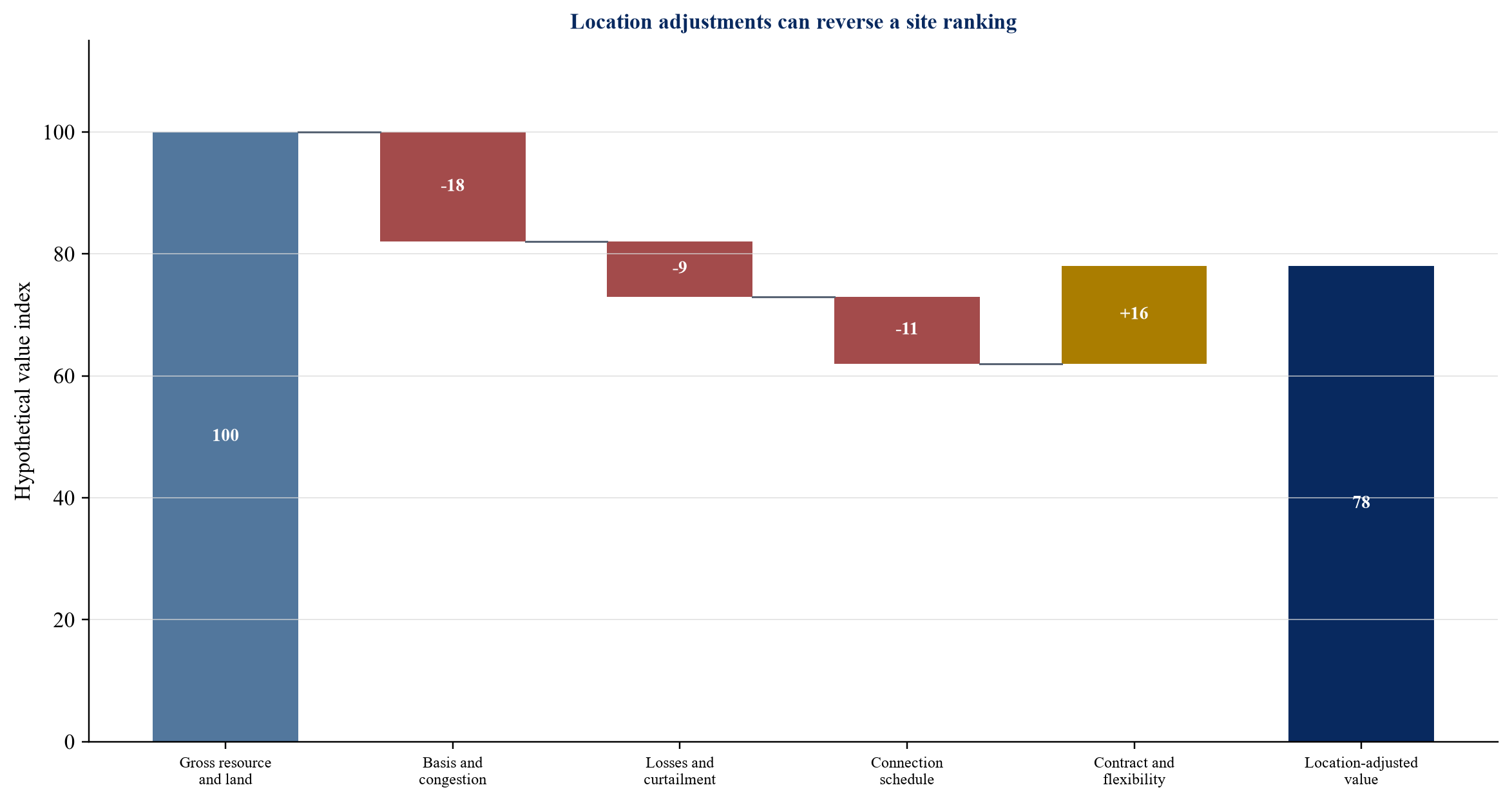
Values are hypothetical index points. They show the structure of a valuation bridge and are not market evidence.
21. Create a first 100 days control plan
The first 100 days after acquisition or investment should establish one location-risk dataset. The owner should reconcile meters, prices, losses, contracts, curtailment, charges and invoices. It should confirm connection rights, milestones, securities and network projects.
During days one to thirty, management should appoint an owner, freeze the baseline model and catalogue data and contracts. It should identify settlement discrepancies and urgent milestone risks. During days thirty-one to sixty, it should rebuild historical settlements, test dispatch and hedging policies, and update network scenarios. During days sixty-one to one hundred, it should approve the operating policy, financing actions, reserves and board dashboard.
Quick wins can include correcting meter mappings, automating settlement reconciliation, aligning curtailment codes, renegotiating hedge volumes, improving battery dispatch or preserving a connection milestone. Structural actions can include contract amendment, augmentation, flexible-load partnership, refinancing or divestment.
The plan should end with named decision rights. Market operations, asset management, treasury, legal, engineering and finance need a common escalation process when a network event changes expected cash flow.
22. Establish a board location-risk dashboard
The dashboard should connect operating indicators to financial consequences. It can show realised node-to-hub basis, capture price, loss factor, curtailment, constraint hours, hedge effectiveness, connection milestones, upgrade cost, collateral and debt-service coverage.
Each indicator needs a definition, data owner, source, frequency and threshold. The dashboard should preserve the difference between observed values and forecasts. Forecast revisions should include driver attribution.
The board should receive exceptions and decisions, not an unfiltered market-data feed. A recurring adverse basis may trigger contract review. A connection delay may trigger capital staging. A loss-factor deterioration may trigger refinancing sensitivity. The response should be recorded and tracked.
Portfolio reporting should retain asset-level detail. Offsetting averages can hide a project that is approaching a covenant or connection deadline.
23. Apply an investment committee decision sequence
The investment committee can use six gates. First, confirm physical feasibility and site control. Second, confirm the connection right, schedule and cost range. Third, reconstruct market and contract settlement. Fourth, test network evolution and flexibility. Fifth, size financing to downside cash flow. Sixth, approve staged capital and monitoring.
Every gate should state the evidence, assumption and unresolved item. The committee should avoid a single blended score where a critical right remains uncertain. Conditions precedent should be specific and time-bound.
The recommendation should identify the source of value. It may be superior connection timing, favourable basis, contract alignment, flexible demand, storage optionality or a credible transmission upgrade. It should also identify how that value can erode.
This sequence makes the site decision auditable. It supports acquisition, development, financing and later exit because the buyer can see which conditions were essential to the thesis.
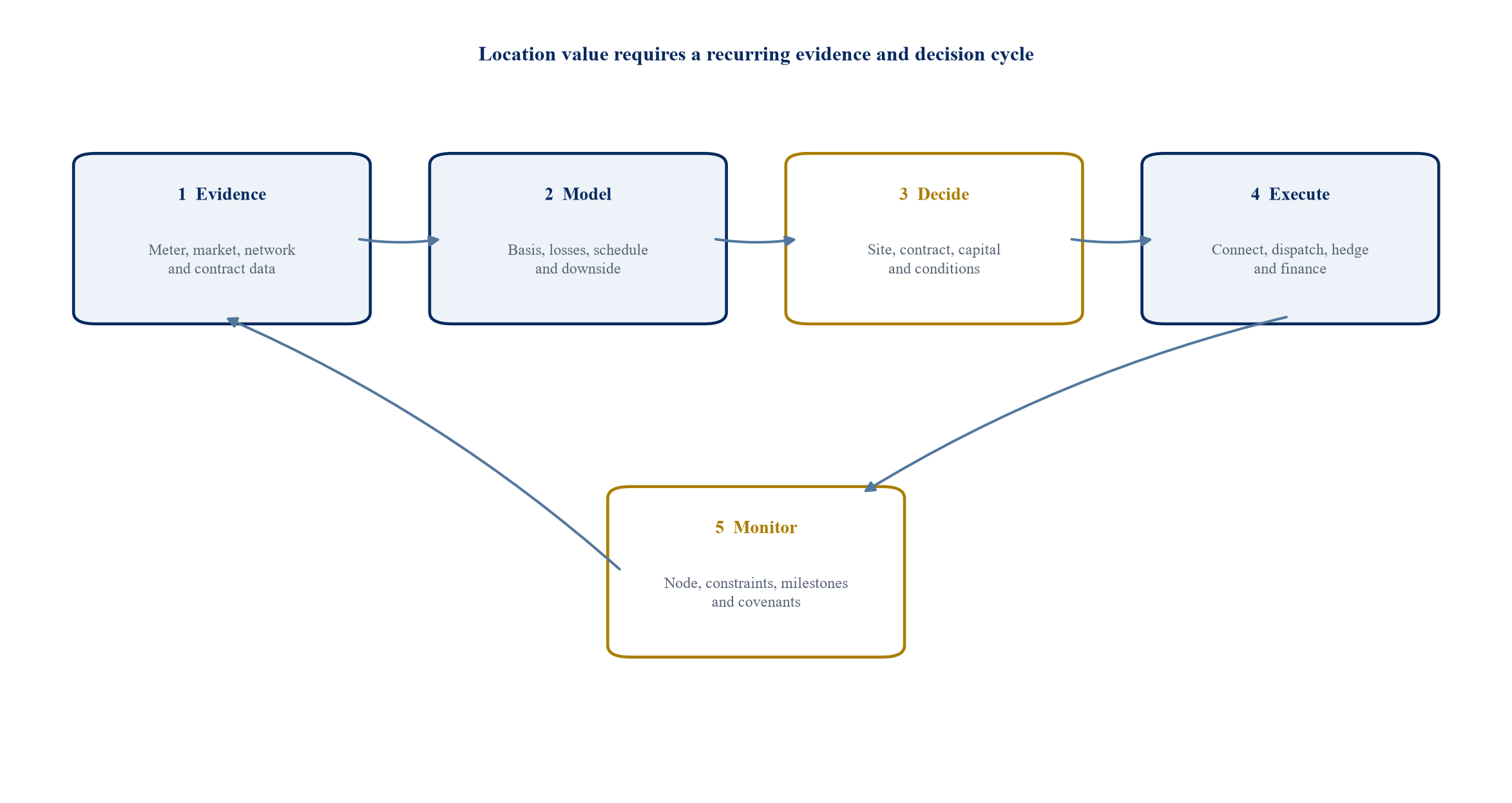
The cycle links evidence refresh, operating control and capital allocation.
24. Recognise analytical limits
Locational models simplify a complex power system. Public price data may omit bilateral settlements. Constraint definitions can change. Network models contain assumptions. Queue data can be incomplete or revised. Market reforms can alter incentives and settlement.
Historical relationships can break after transmission, entry, retirement or load growth. Weather samples may omit extremes. A contract can behave differently from a simplified model because of definitions, notices, credit events or disputes. Technical availability and operating control can limit theoretical arbitrage.
Illustrative values in this paper are educational. They are not forecasts, observed market data or valuation conclusions. A live decision requires current asset data, applicable rules, executed contracts, engineering review and qualified professional advice.
These limits support disciplined governance. They do not prevent decisions. They require ranges, staging, monitoring and explicit decision rights.
25. Adapt the framework across transaction types
The same location framework supports development finance, acquisitions, refinancing, joint ventures and corporate-site decisions, but each transaction emphasises a different risk. A greenfield developer needs to protect capital before connection certainty improves. An acquisition buyer needs to establish whether reported earnings reflect a durable location advantage or a temporary constraint. A refinancing lender needs to understand how the node may behave through the new debt tenor. A joint-venture partner needs decision rights over contracts, dispatch, additional capital and exit when network conditions change.
Development finance should use staged draw conditions. Early capital can secure land, applications and studies. Later capital should depend on defined connection, permitting and contracting evidence. The development budget should include security, option extensions and the possibility that the preferred network solution changes. A sponsor should avoid committing long-lead equipment whose configuration depends on an unresolved connection design.
Acquisition pricing should bridge reported EBITDA to location-adjusted cash flow. The bridge should identify realised basis, loss treatment, curtailment, one-off constraint conditions, disputed settlements and temporary contracts. The buyer should compare management forecasts with an independently reconstructed historical period. Purchase-price protection can address specific residual items, but it should use measurable events such as an upgrade-cost determination, connection milestone or contract renewal.
Refinancing analysis should focus on durability. A node that performed well during the original loan can deteriorate when queued generation connects or a major load leaves. A planned transmission upgrade can improve basis while reducing congestion-related storage revenue. The refinancing case should extend network and contract scenarios beyond the remaining PPA term and test the period in which merchant or re-contracting exposure becomes material.
Joint ventures need a clear allocation of location decisions. The agreement should define who controls queue strategy, network security, PPA reference point, congestion hedges, storage dispatch, flexible-load contracts and settlement disputes. Reserved matters should cover material changes to connection scope, abandonment, additional security and acceptance of operating limits. Deadlock provisions should recognise time-sensitive queue and contractual milestones.
Corporate-site selection uses the same discipline from the buyer's side. A data centre, factory or processing facility needs a reliable power path, commissioning plan, tariff and resilience design. The model should separate wholesale energy, retail margin, network charge, taxes, onsite assets and backup. It should also test expansion rights because the first phase can consume the substation or network capacity needed for later phases.
26. Convert uncertainty into staged optionality
Location uncertainty can be managed through options when the cost and expiry are explicit. A land option can preserve a site through network studies. A conditional equipment reservation can protect schedule while limiting cancellation exposure. A phased connection can support early operations before the full upgrade. A modular battery or data-centre design can align capital with proven market or customer demand.
Optionality should be valued through decision paths rather than optimistic terminal assumptions. Each path should identify the next evidence event, incremental capital, probability range, cash consequence and expiry. Examples include a cluster-study result, transmission approval, anchor-customer contract, tariff decision or PPA award. Management should state which adverse result causes abandonment and which result justifies further capital.
The value of waiting also has a cost. Queue readiness rules, land expiries, equipment slots, permits and customer timetables can penalise delay. The decision should therefore compare staged commitment with immediate commitment and abandonment. A low-cost option is attractive only when it preserves a meaningful right and management can act before expiry.
Portfolio strategy can diversify development paths, but correlation remains. Several sites can depend on the same transmission plan, regulatory decision, equipment supplier or offtaker market. The portfolio model should map common dependencies and aggregate security requirements. A large nominal pipeline can create limited diversification when every project waits for the same network reinforcement.
Staged optionality improves governance because it converts a long-range forecast into a sequence of evidence-based choices. It also makes failure visible. A project that cannot meet its next gate should release capital and management attention for stronger sites.
Conclusion
The node decides how physical electricity becomes financial value. Locational price, congestion, losses, curtailment, interconnection, contract basis and operating flexibility can change site economics more than a superficial comparison of land, resource or headline power price suggests.
A robust process starts at the meter and connection agreement. It decomposes the market price, reconstructs settlement, models network states and aligns contracts with the physical point. It sizes debt to durable cash flow and preserves flexibility through staged capital. It also monitors the grid because location value evolves.
For generators, storage operators and flexible loads, the practical question is not whether one node has the highest recent price. The question is whether the site has an evidence-supported path to reliable, contractible and financeable cash flow across plausible network states. That is the foundation for a defensible investment and valuation decision.
References
- Federal Energy Regulatory Commission. Understanding Energy Markets. https://www.ferc.gov/understanding-energy-markets
- Federal Energy Regulatory Commission. Western Markets Explainer. https://www.ferc.gov/OPP/western-markets-explainer
- Federal Energy Regulatory Commission. Explainer on the Interconnection Final Rule, Order No. 2023. https://www.ferc.gov/explainer-interconnection-final-rule
- Federal Energy Regulatory Commission. Generator Interconnection. https://www.ferc.gov/electric-transmission/generator-interconnection
- Federal Energy Regulatory Commission. FERC Affirms Generator Interconnection Rule, Acts on Compliance Filings. 21 March 2024. https://www.ferc.gov/news-events/news/ferc-affirms-generator-interconnection-rule-acts-compliance-filings
- Federal Energy Regulatory Commission. Marginal Loss Calculations for the DCOPF. 2022. https://www.ferc.gov/sites/default/files/2022-12/marginallosscalculations.pdf
- PJM Interconnection. Locational Marginal Pricing. https://learn.pjm.com/three-priorities/buying-and-selling-energy/lmp
- PJM Interconnection. LMP Model Information. https://www.pjm.com/markets-and-operations/energy/lmp-model-info.aspx
- PJM Interconnection. Dispatch Signal and Locational Marginal Pricing. 2025. https://www.pjm.com/-/media/DotCom/training/nerc-certifications/gen-exam-materials-20251006/1-3-dispatch-signal-and-locational-marginal-pricing.pdf
- California Independent System Operator, Department of Market Monitoring. 2023 Annual Report on Market Issues and Performance. July 2024. https://www.caiso.com/documents/2023-annual-report-on-market-issues-and-performance-jul-29-2024.pdf
- California Independent System Operator. Willing Counterparty Whitepaper. October 2024. https://www.caiso.com/documents/willing-counterparty-whitepaper-oct-23-2024.pdf
- Lawrence Berkeley National Laboratory. Queued Up: 2025 Edition, Characteristics of Power Plants Seeking Transmission Interconnection as of the End of 2024. 2025. https://emp.lbl.gov/publications/queued-2025-edition-characteristics
- Australian Energy Market Operator. Marginal Loss Factors for the 2025-26 Financial Year. 2025. https://www.aemo.com.au/-/media/files/electricity/nem/security_and_reliability/loss_factors_and_regional_boundaries/2025-26-marginal-loss-factors/marginal-loss-factors-for-the-2025-26-fin-year.pdf
- Australian Energy Market Operator. Marginal Loss Factors for the 2026-27 Financial Year. 2026. https://www.aemo.com.au/-/media/files/electricity/nem/security_and_reliability/loss_factors_and_regional_boundaries/2026-27/marginal-loss-factors-for-the-2026-27-financial-year.pdf
- Australian Energy Market Operator. Marginal Loss Factor Framework Review. https://www.aemo.com.au/energy-systems/electricity/national-electricity-market-nem/market-operations/loss-factors-and-regional-boundaries/marginal-loss-factor-framework-review
- Australian Energy Market Operator. Loss Factors and Regional Boundaries. https://aemo.com.au/energy-systems/electricity/national-electricity-market-nem/market-operations/loss-factors-and-regional-boundaries
- Australian Government. National Electricity Market Wholesale Market Settings Review, Final Report. 2025. https://www.energy.gov.au/sites/default/files/2025-12/national-electricity-market-wholesale-market-settings-review-final-report.pdf
- UK Department for Energy Security and Net Zero. Review of Electricity Market Arrangements: Summer Update 2025. https://www.gov.uk/government/publications/review-of-electricity-market-arrangements-rema-summer-update-2025/review-of-electricity-market-arrangements-rema-summer-update-2025-accessible-webpage
- UK Department for Energy Security and Net Zero. Reformed National Pricing Delivery Plan. 2026. https://www.gov.uk/government/publications/reformed-national-pricing-rnp-delivery-plan/reformed-national-pricing-rnp-delivery-plan-accessible-webpage
- Ofgem. Distribution Use of System Charges Significant Code Review Update. https://www.ofgem.gov.uk/policy/distribution-use-of-system-charges-significant-code-review-update
- National Energy System Operator. Connections Reform. https://www.neso.energy/industry-information/connections
- National Energy System Operator. Electricity Market Reform and Locational Signals. https://www.neso.energy/
- US Energy Information Administration. Wholesale Electricity and Natural Gas Market Data. https://www.eia.gov/electricity/wholesale/
- National Renewable Energy Laboratory. Grid Integration and Transmission Research. https://www.nrel.gov/grid/
- International Energy Agency. Electricity 2026. 2026. https://www.iea.org/reports/electricity-2026
- World Bank PPP Resource Center. Power Purchase Agreements. https://ppp.worldbank.org/public-private-partnership/sector/energy/energy-power-agreements/power-purchase-agreements
- World Bank PPP Resource Center. Project Finance Key Concepts. https://ppp.worldbank.org/public-private-partnership/financing/project-finance-concepts
- ACER. Electricity Market Monitoring. https://www.acer.europa.eu/electricity/market-monitoring
- European Network of Transmission System Operators for Electricity. Transparency Platform. https://transparency.entsoe.eu/
- International Renewable Energy Agency. Renewable Power Generation Costs and Grid Integration. https://www.irena.org/
About the Author
Chennakeshav (CK) is a corporate finance and investment banking executive with 25+ years of global experience in deal origination, structuring and execution across M&A, growth capital and corporate strategy. He has led value-creation mandates for founders, corporates and funds — bridging the boardroom view to hands-on execution and close.
His career spans Morgan Stanley, HSBC, Lloyds Banking Group, EWEC, ADQ portfolio companies and Emirates Growth Fund, across TMT, real estate, fintech, deeptech, cleantech, infrastructure and energy. He has partnered with C-suite leaders, private equity and venture funds, sovereign wealth funds and family offices to finance complex fund raises and scale-up ventures, and has led M&A due diligence, post-merger integration and business-transformation initiatives to create value.
At Matchpoint Partners he is Managing Partner, leading the firm's corporate finance, M&A and capital-raising practice. He holds an MBA from London Business School, an engineering degree from VTU and a Master of Laws (LLM, in progress) from UCL London.
An active start-up mentor, CK mentors at Techstars, DIFC FinTech Hive, Startup Grind, Founder Institute and IN5, serves as Entrepreneur Mentor in Residence (EMiR) at London Business School, and judges the Entrepreneurship World Cup.
https://www.linkedin.com/in/ckadya/
https://www.matchpoint-partners.com/team/ck-adya.html
This paper is part of a continuing series on the structure of private and alternative markets. The views expressed are the author's own. The paper is for information only, describes market structure in general terms, and does not constitute investment, legal, tax or regulatory advice or a recommendation in respect of any security, vehicle or counterparty.
