

Introduction
The immediate task is to define the investment decision before projecting a lunar-network market. Spacecraft, payload, software, terrestrial networks and mission operations mature at different rates. Valuation should identify what exists, what remains funded development and what depends on a future mission, approval or launch.
The principal evidence comprises mission schedules, agency architectures, procurement documents and technical standards. Diligence should reconcile presentations to dated original records. Technical evidence should connect to a service, customer, cost or capital milestone. Commercial evidence should identify budget authority and a procurement route.
The main risk is that a broad lunar-economy narrative can conceal the timing and concentration of real demand. The base case should exclude value without an executable service, transferable right or funded commitment. Related launch, mission and programme assumptions should move together in downside cases. The proposed control is to state the perimeter, valuation date, target service and evidence hierarchy before modelling. A named owner should maintain the evidence, probability and next decision date. Consideration and capital should follow the same gate.
1 Define the transaction perimeter
The immediate task is to identify the assets, contracts and capabilities that transfer at closing. Spacecraft, payload, software, terrestrial networks and mission operations mature at different rates. Valuation should identify what exists, what remains funded development and what depends on a future mission, approval or launch.
The principal evidence comprises relay designs, spacecraft work in progress, payloads, spectrum filings, software, patents, user terminals, ground agreements and service orders. Diligence should reconcile presentations to dated original records. Technical evidence should connect to a service, customer, cost or capital milestone. Commercial evidence should identify budget authority and a procurement route.
The main risk is that programmes often depend on parent-company licences, shared staff, government-furnished equipment or non-transferable partnerships. The base case should exclude value without an executable service, transferable right or funded commitment. Related launch, mission and programme assumptions should move together in downside cases. The proposed control is to map legal ownership, control, assignment rights, export restrictions and funding obligations for every value-bearing item. A named owner should maintain the evidence, probability and next decision date. Consideration and capital should follow the same gate.
2 Define an executable lunar service
The immediate task is to translate network ambition into a service a mission can buy and accept. Spacecraft, payload, software, terrestrial networks and mission operations mature at different rates. Valuation should identify what exists, what remains funded development and what depends on a future mission, approval or launch.
The principal evidence comprises coverage region, link budget, data rate, latency, availability, navigation accuracy, interface, priority, security and support terms. Diligence should reconcile presentations to dated original records. Technical evidence should connect to a service, customer, cost or capital milestone. Commercial evidence should identify budget authority and a procurement route.
The main risk is that a relay in lunar orbit does not create service when the user terminal, Earth return path or operating authority is missing. The base case should exclude value without an executable service, transferable right or funded commitment. Related launch, mission and programme assumptions should move together in downside cases. The proposed control is to value only service combinations that can be tested against a named mission profile. A named owner should maintain the evidence, probability and next decision date. Consideration and capital should follow the same gate.
3 Build the anchor-mission demand ledger
The immediate task is to separate funded missions from announced, proposed and aspirational activity. Spacecraft, payload, software, terrestrial networks and mission operations mature at different rates. Valuation should identify what exists, what remains funded development and what depends on a future mission, approval or launch.
The principal evidence comprises appropriations, awarded contracts, task orders, launch bookings, payload manifests, mission design reviews and customer confirmation. Diligence should reconcile presentations to dated original records. Technical evidence should connect to a service, customer, cost or capital milestone. Commercial evidence should identify budget authority and a procurement route.
The main risk is that public mission counts can include duplicated concepts, unfunded payloads and schedules that move together. The base case should exclude value without an executable service, transferable right or funded commitment. Related launch, mission and programme assumptions should move together in downside cases. The proposed control is to assign probability, timing, service need, procurement route and cancellation exposure to each mission. A named owner should maintain the evidence, probability and next decision date. Consideration and capital should follow the same gate.
4 Model coverage from orbital geometry
The immediate task is to measure the service improvement created by each relay and ground path. Spacecraft, payload, software, terrestrial networks and mission operations mature at different rates. Valuation should identify what exists, what remains funded development and what depends on a future mission, approval or launch.
The principal evidence comprises orbit propagation, lunar terrain masks, Earth visibility, antenna patterns, link margins, occultation and station availability. Diligence should reconcile presentations to dated original records. Technical evidence should connect to a service, customer, cost or capital milestone. Commercial evidence should identify budget authority and a procurement route.
The main risk is that average coverage percentages can hide gaps during landing, surface mobility or far-side operations. The base case should exclude value without an executable service, transferable right or funded commitment. Related launch, mission and programme assumptions should move together in downside cases. The proposed control is to calculate availability for representative critical events and disclose modelling assumptions. A named owner should maintain the evidence, probability and next decision date. Consideration and capital should follow the same gate.
5 Value south-polar and far-side access
The immediate task is to identify where relay coverage solves a mission constraint that direct-to-Earth service cannot. Spacecraft, payload, software, terrestrial networks and mission operations mature at different rates. Valuation should identify what exists, what remains funded development and what depends on a future mission, approval or launch.
The principal evidence comprises landing-site coordinates, horizon masks, operational timelines, required data volumes and fallback paths. Diligence should reconcile presentations to dated original records. Technical evidence should connect to a service, customer, cost or capital milestone. Commercial evidence should identify budget authority and a procurement route.
The main risk is that scarcity can be overstated when missions can change sites, use local storage or accept intermittent communication. The base case should exclude value without an executable service, transferable right or funded commitment. Related launch, mission and programme assumptions should move together in downside cases. The proposed control is to link strategic value to funded users, required service windows and credible alternatives. A named owner should maintain the evidence, probability and next decision date. Consideration and capital should follow the same gate.
6 Use LunaNet interoperability as a value gate
The immediate task is to test whether the network can participate in a multi-provider architecture. Spacecraft, payload, software, terrestrial networks and mission operations mature at different rates. Valuation should identify what exists, what remains funded development and what depends on a future mission, approval or launch.
The principal evidence comprises LunaNet services, applicable documents, delay-tolerant networking, navigation signals, security profiles and interface test results. Diligence should reconcile presentations to dated original records. Technical evidence should connect to a service, customer, cost or capital milestone. Commercial evidence should identify budget authority and a procurement route.
The main risk is that nominal standards alignment can coexist with proprietary implementations and untested cross-provider behaviour. The base case should exclude value without an executable service, transferable right or funded commitment. Related launch, mission and programme assumptions should move together in downside cases. The proposed control is to release interoperability value after representative user and provider tests pass. A named owner should maintain the evidence, probability and next decision date. Consideration and capital should follow the same gate.
7 Separate communications, networking and navigation
The immediate task is to value each service line according to its own readiness and customer evidence. Spacecraft, payload, software, terrestrial networks and mission operations mature at different rates. Valuation should identify what exists, what remains funded development and what depends on a future mission, approval or launch.
The principal evidence comprises radio links, store-and-forward routing, time transfer, ranging, navigation messages and service monitoring. Diligence should reconcile presentations to dated original records. Technical evidence should connect to a service, customer, cost or capital milestone. Commercial evidence should identify budget authority and a procurement route.
The main risk is that shared spacecraft can create cost efficiency while one immature payload delays the whole programme. The base case should exclude value without an executable service, transferable right or funded commitment. Related launch, mission and programme assumptions should move together in downside cases. The proposed control is to allocate capital, schedule, acceptance and revenue to distinct service modules. A named owner should maintain the evidence, probability and next decision date. Consideration and capital should follow the same gate.
8 Test spectrum and coordination rights
The immediate task is to confirm that planned links can operate lawfully and without harmful interference. Spacecraft, payload, software, terrestrial networks and mission operations mature at different rates. Valuation should identify what exists, what remains funded development and what depends on a future mission, approval or launch.
The principal evidence comprises ITU allocations and filings, national licences, coordination status, frequency plans, emission characteristics and interference analysis. Diligence should reconcile presentations to dated original records. Technical evidence should connect to a service, customer, cost or capital milestone. Commercial evidence should identify budget authority and a procurement route.
The main risk is that filing activity does not prove priority, completed coordination or operational authority. The base case should exclude value without an executable service, transferable right or funded commitment. Related launch, mission and programme assumptions should move together in downside cases. The proposed control is to condition value on effective rights and funded resolution of coordination risks. A named owner should maintain the evidence, probability and next decision date. Consideration and capital should follow the same gate.
9 Design the capacity model
The immediate task is to convert relay payload capability into saleable mission service. Spacecraft, payload, software, terrestrial networks and mission operations mature at different rates. Valuation should identify what exists, what remains funded development and what depends on a future mission, approval or launch.
The principal evidence comprises bandwidth, coding, data rate, beam coverage, antenna pointing, power, contact schedules, onboard storage and Earth-link capacity. Diligence should reconcile presentations to dated original records. Technical evidence should connect to a service, customer, cost or capital milestone. Commercial evidence should identify budget authority and a procurement route.
The main risk is that aggregate throughput can overstate capacity available at a specific lunar location or priority window. The base case should exclude value without an executable service, transferable right or funded commitment. Related launch, mission and programme assumptions should move together in downside cases. The proposed control is to reconcile theoretical, technically feasible, scheduled, delivered and accepted capacity. A named owner should maintain the evidence, probability and next decision date. Consideration and capital should follow the same gate.
10 Price mission priority and resilience
The immediate task is to distinguish routine data delivery from safety-critical and time-critical access. Spacecraft, payload, software, terrestrial networks and mission operations mature at different rates. Valuation should identify what exists, what remains funded development and what depends on a future mission, approval or launch.
The principal evidence comprises service classes, pre-emption rules, redundancy, restoration time, reserved capacity and incident obligations. Diligence should reconcile presentations to dated original records. Technical evidence should connect to a service, customer, cost or capital milestone. Commercial evidence should identify budget authority and a procurement route.
The main risk is that high-priority commitments can reduce capacity sold to other users and create correlated liability. The base case should exclude value without an executable service, transferable right or funded commitment. Related launch, mission and programme assumptions should move together in downside cases. The proposed control is to model reserved resources and service credits within unit economics. A named owner should maintain the evidence, probability and next decision date. Consideration and capital should follow the same gate.
11 Integrate direct-to-Earth and relay paths
The immediate task is to determine when a hybrid architecture reduces cost or improves resilience. Spacecraft, payload, software, terrestrial networks and mission operations mature at different rates. Valuation should identify what exists, what remains funded development and what depends on a future mission, approval or launch.
The principal evidence comprises user-terminal capability, lunar relay links, Earth stations, deep-space networks, terrestrial backhaul and routing policies. Diligence should reconcile presentations to dated original records. Technical evidence should connect to a service, customer, cost or capital milestone. Commercial evidence should identify budget authority and a procurement route.
The main risk is that parallel paths can duplicate capital and operating cost without creating independent resilience. The base case should exclude value without an executable service, transferable right or funded commitment. Related launch, mission and programme assumptions should move together in downside cases. The proposed control is to test common failure modes and assign traffic to the lowest-risk executable path. A named owner should maintain the evidence, probability and next decision date. Consideration and capital should follow the same gate.
12 Test user-terminal readiness
The immediate task is to confirm that customers can access the service when their missions arrive. Spacecraft, payload, software, terrestrial networks and mission operations mature at different rates. Valuation should identify what exists, what remains funded development and what depends on a future mission, approval or launch.
The principal evidence comprises terminal mass, power, antenna, waveform, software, environmental qualification, integration schedule and test evidence. Diligence should reconcile presentations to dated original records. Technical evidence should connect to a service, customer, cost or capital milestone. Commercial evidence should identify budget authority and a procurement route.
The main risk is that a network can reach orbit before compatible customer terminals complete qualification. The base case should exclude value without an executable service, transferable right or funded commitment. Related launch, mission and programme assumptions should move together in downside cases. The proposed control is to treat terminal integration as a customer acquisition milestone and forecast its engineering cost. A named owner should maintain the evidence, probability and next decision date. Consideration and capital should follow the same gate.
13 Measure technical readiness honestly
The immediate task is to separate laboratory performance from flight-qualified and operational capability. Spacecraft, payload, software, terrestrial networks and mission operations mature at different rates. Valuation should identify what exists, what remains funded development and what depends on a future mission, approval or launch.
The principal evidence comprises NASA technology-readiness definitions, design reviews, environmental tests, hardware-in-the-loop trials, launch acceptance and in-orbit commissioning. Diligence should reconcile presentations to dated original records. Technical evidence should connect to a service, customer, cost or capital milestone. Commercial evidence should identify budget authority and a procurement route.
The main risk is that schedule confidence can be distorted when components at different readiness levels are presented as one system. The base case should exclude value without an executable service, transferable right or funded commitment. Related launch, mission and programme assumptions should move together in downside cases. The proposed control is to assign probability and contingency by subsystem and critical path. A named owner should maintain the evidence, probability and next decision date. Consideration and capital should follow the same gate.
14 Model launch and deployment dependency
The immediate task is to connect capital release and revenue timing to realistic access to lunar orbit. Spacecraft, payload, software, terrestrial networks and mission operations mature at different rates. Valuation should identify what exists, what remains funded development and what depends on a future mission, approval or launch.
The principal evidence comprises launch contract, integration slot, rideshare assumptions, transfer stage, propulsion margin, commissioning plan and insurance. Diligence should reconcile presentations to dated original records. Technical evidence should connect to a service, customer, cost or capital milestone. Commercial evidence should identify budget authority and a procurement route.
The main risk is that a delay can defer revenue while fixed engineering and programme costs continue. The base case should exclude value without an executable service, transferable right or funded commitment. Related launch, mission and programme assumptions should move together in downside cases. The proposed control is to run coordinated launch-delay, replacement and cash-runway cases. A named owner should maintain the evidence, probability and next decision date. Consideration and capital should follow the same gate.
15 Stage capital by evidence
The immediate task is to fund the programme through measurable technical and commercial gates. Spacecraft, payload, software, terrestrial networks and mission operations mature at different rates. Valuation should identify what exists, what remains funded development and what depends on a future mission, approval or launch.
The principal evidence comprises preliminary and critical design reviews, flight hardware, launch, orbit insertion, coverage tests, customer acceptance and cash receipts. Diligence should reconcile presentations to dated original records. Technical evidence should connect to a service, customer, cost or capital milestone. Commercial evidence should identify budget authority and a procurement route.
The main risk is that fully funding the constellation before demand and service evidence mature concentrates downside. The base case should exclude value without an executable service, transferable right or funded commitment. Related launch, mission and programme assumptions should move together in downside cases. The proposed control is to match equity, debt, milestone payments and strategic capital to risk retirement. A named owner should maintain the evidence, probability and next decision date. Consideration and capital should follow the same gate.
16 Build the cost-to-serve model
The immediate task is to capture the continuing cost of reliable off-world infrastructure. Spacecraft, payload, software, terrestrial networks and mission operations mature at different rates. Valuation should identify what exists, what remains funded development and what depends on a future mission, approval or launch.
The principal evidence comprises mission operations, Earth stations, spectrum, software, cyber security, propulsion, collision assessment, spares, insurance and customer support. Diligence should reconcile presentations to dated original records. Technical evidence should connect to a service, customer, cost or capital milestone. Commercial evidence should identify budget authority and a procurement route.
The main risk is that early pricing can exclude lifecycle work and make gross margin appear stronger than cash economics. The base case should exclude value without an executable service, transferable right or funded commitment. Related launch, mission and programme assumptions should move together in downside cases. The proposed control is to forecast cost by mission, service class and network phase. A named owner should maintain the evidence, probability and next decision date. Consideration and capital should follow the same gate.
17 Convert contracts into bankable revenue
The immediate task is to distinguish awarded value from revenue that survives mission delay and service failure. Spacecraft, payload, software, terrestrial networks and mission operations mature at different rates. Valuation should identify what exists, what remains funded development and what depends on a future mission, approval or launch.
The principal evidence comprises funding ceilings, obligated amounts, minimum purchases, milestones, termination rights, customer acceptance and payment terms. Diligence should reconcile presentations to dated original records. Technical evidence should connect to a service, customer, cost or capital milestone. Commercial evidence should identify budget authority and a procurement route.
The main risk is that headline contract value can include options, indefinite-delivery ceilings and reimbursable development. The base case should exclude value without an executable service, transferable right or funded commitment. Related launch, mission and programme assumptions should move together in downside cases. The proposed control is to use only funded, enforceable and deliverable amounts in the contracted base. A named owner should maintain the evidence, probability and next decision date. Consideration and capital should follow the same gate.
18 Address customer concentration
The immediate task is to measure dependence on a small number of agencies, primes and flagship missions. Spacecraft, payload, software, terrestrial networks and mission operations mature at different rates. Valuation should identify what exists, what remains funded development and what depends on a future mission, approval or launch.
The principal evidence comprises revenue, backlog, programme funding, renewal path, technical integration and substitution by customer. Diligence should reconcile presentations to dated original records. Technical evidence should connect to a service, customer, cost or capital milestone. Commercial evidence should identify budget authority and a procurement route.
The main risk is that a single programme change can affect several missions and suppliers simultaneously. The base case should exclude value without an executable service, transferable right or funded commitment. Related launch, mission and programme assumptions should move together in downside cases. The proposed control is to cap concentration value, maintain liquidity and diversify by mission class and jurisdiction. A named owner should maintain the evidence, probability and next decision date. Consideration and capital should follow the same gate.
19 Model government procurement risk
The immediate task is to reflect the role of public buyers in creating and reshaping the market. Spacecraft, payload, software, terrestrial networks and mission operations mature at different rates. Valuation should identify what exists, what remains funded development and what depends on a future mission, approval or launch.
The principal evidence comprises budget authority, procurement vehicle, award protest, continuing resolutions, sovereign priorities and termination rights. Diligence should reconcile presentations to dated original records. Technical evidence should connect to a service, customer, cost or capital milestone. Commercial evidence should identify budget authority and a procurement route.
The main risk is that institutional sponsorship does not remove annual funding, schedule and policy risk. The base case should exclude value without an executable service, transferable right or funded commitment. Related launch, mission and programme assumptions should move together in downside cases. The proposed control is to tie forecasts to obligated funding and model programme-specific downside. A named owner should maintain the evidence, probability and next decision date. Consideration and capital should follow the same gate.
20 Test commercial adoption
The immediate task is to identify services for which non-agency customers will pay from their own mission economics. Spacecraft, payload, software, terrestrial networks and mission operations mature at different rates. Valuation should identify what exists, what remains funded development and what depends on a future mission, approval or launch.
The principal evidence comprises customer interviews, mission budgets, make-or-buy analysis, launch dates, terminal plans, service orders and deposits. Diligence should reconcile presentations to dated original records. Technical evidence should connect to a service, customer, cost or capital milestone. Commercial evidence should identify budget authority and a procurement route.
The main risk is that expressed interest can reflect technical curiosity without approved procurement. The base case should exclude value without an executable service, transferable right or funded commitment. Related launch, mission and programme assumptions should move together in downside cases. The proposed control is to recognise commercial value after the buyer verifies budget, authority and contracting path. A named owner should maintain the evidence, probability and next decision date. Consideration and capital should follow the same gate.
21 Value data and navigation adjacencies
The immediate task is to assess whether shared infrastructure supports incremental products. Spacecraft, payload, software, terrestrial networks and mission operations mature at different rates. Valuation should identify what exists, what remains funded development and what depends on a future mission, approval or launch.
The principal evidence comprises navigation corrections, time distribution, lunar surface mapping, weather and situational information, data custody and analytics. Diligence should reconcile presentations to dated original records. Technical evidence should connect to a service, customer, cost or capital milestone. Commercial evidence should identify budget authority and a procurement route.
The main risk is that adjacent products can require new licences, sensors, processing and customer workflows. The base case should exclude value without an executable service, transferable right or funded commitment. Related launch, mission and programme assumptions should move together in downside cases. The proposed control is to treat each adjacency as a separately funded option until customer acceptance is observed. A named owner should maintain the evidence, probability and next decision date. Consideration and capital should follow the same gate.
22 Protect cyber and mission assurance
The immediate task is to evaluate whether the network can support safety-critical and government missions. Spacecraft, payload, software, terrestrial networks and mission operations mature at different rates. Valuation should identify what exists, what remains funded development and what depends on a future mission, approval or launch.
The principal evidence comprises identity, key management, encryption, secure boot, software supply chain, telemetry integrity, incident response and operational segregation. Diligence should reconcile presentations to dated original records. Technical evidence should connect to a service, customer, cost or capital milestone. Commercial evidence should identify budget authority and a procurement route.
The main risk is that a compromised relay can affect multiple customers and undermine network trust. The base case should exclude value without an executable service, transferable right or funded commitment. Related launch, mission and programme assumptions should move together in downside cases. The proposed control is to fund independent testing, resilient control paths and contractual allocation of incident responsibility. A named owner should maintain the evidence, probability and next decision date. Consideration and capital should follow the same gate.
23 Address sovereign and export controls
The immediate task is to identify ownership and information restrictions that shape financing and M&A. Spacecraft, payload, software, terrestrial networks and mission operations mature at different rates. Valuation should identify what exists, what remains funded development and what depends on a future mission, approval or launch.
The principal evidence comprises foreign-investment rules, export classifications, technical-assistance controls, security agreements, customer consent and data residency. Diligence should reconcile presentations to dated original records. Technical evidence should connect to a service, customer, cost or capital milestone. Commercial evidence should identify budget authority and a procurement route.
The main risk is that cross-border capital can restrict access to technology, facilities, personnel or government work. The base case should exclude value without an executable service, transferable right or funded commitment. Related launch, mission and programme assumptions should move together in downside cases. The proposed control is to design governance, ring-fencing and closing conditions before value is committed. A named owner should maintain the evidence, probability and next decision date. Consideration and capital should follow the same gate.
24 Build an evidence-gated forecast
The immediate task is to connect mission demand, service readiness and phased capacity to cash. Spacecraft, payload, software, terrestrial networks and mission operations mature at different rates. Valuation should identify what exists, what remains funded development and what depends on a future mission, approval or launch.
The principal evidence comprises mission-level start dates, probability, usage, price, acceptance, capital, operating cost, working capital and tax. Diligence should reconcile presentations to dated original records. Technical evidence should connect to a service, customer, cost or capital milestone. Commercial evidence should identify budget authority and a procurement route.
The main risk is that smooth market-growth curves conceal lumpy missions and correlated schedule changes. The base case should exclude value without an executable service, transferable right or funded commitment. Related launch, mission and programme assumptions should move together in downside cases. The proposed control is to forecast every anchor mission separately and keep uncontracted cohorts outside the base case. A named owner should maintain the evidence, probability and next decision date. Consideration and capital should follow the same gate.
25 Select valuation methods
The immediate task is to use methods that reflect early infrastructure risk and strategic options. Spacecraft, payload, software, terrestrial networks and mission operations mature at different rates. Valuation should identify what exists, what remains funded development and what depends on a future mission, approval or launch.
The principal evidence comprises risk-adjusted discounted cash flow, milestone probability, replacement cost, precedent transactions, option value and scenario analysis. Diligence should reconcile presentations to dated original records. Technical evidence should connect to a service, customer, cost or capital milestone. Commercial evidence should identify budget authority and a procurement route.
The main risk is that mature telecom multiples can capitalise demand that has not yet formed. The base case should exclude value without an executable service, transferable right or funded commitment. Related launch, mission and programme assumptions should move together in downside cases. The proposed control is to reconcile methods to the same perimeter, funding need and evidence date. A named owner should maintain the evidence, probability and next decision date. Consideration and capital should follow the same gate.
26 Build the enterprise-value bridge
The immediate task is to show how observed assets and contracts become transaction value. Spacecraft, payload, software, terrestrial networks and mission operations mature at different rates. Valuation should identify what exists, what remains funded development and what depends on a future mission, approval or launch.
The principal evidence comprises completed work, transferable intellectual property, funded backlog, accepted capacity, integration capital, liabilities and strategic options. Diligence should reconcile presentations to dated original records. Technical evidence should connect to a service, customer, cost or capital milestone. Commercial evidence should identify budget authority and a procurement route.
The main risk is that combining programme spend and forecast cash flow can double count value. The base case should exclude value without an executable service, transferable right or funded commitment. Related launch, mission and programme assumptions should move together in downside cases. The proposed control is to identify one evidence source and one valuation treatment for every bridge item. A named owner should maintain the evidence, probability and next decision date. Consideration and capital should follow the same gate.
27 Structure consideration around milestones
The immediate task is to allocate launch, acceptance, adoption and cash risk between buyer and seller. Spacecraft, payload, software, terrestrial networks and mission operations mature at different rates. Valuation should identify what exists, what remains funded development and what depends on a future mission, approval or launch.
The principal evidence comprises completion conditions, holdback, seller rollover, earn-out, milestone payments, warranties and specific indemnities. Diligence should reconcile presentations to dated original records. Technical evidence should connect to a service, customer, cost or capital milestone. Commercial evidence should identify budget authority and a procurement route.
The main risk is that technical milestones can be met without creating retained customer value. The base case should exclude value without an executable service, transferable right or funded commitment. Related launch, mission and programme assumptions should move together in downside cases. The proposed control is to link contingent payments to accepted service, retained funded missions and collected cash. A named owner should maintain the evidence, probability and next decision date. Consideration and capital should follow the same gate.
28 Hypothetical transaction case
The immediate task is to apply the framework to a staged four-relay programme. Spacecraft, payload, software, terrestrial networks and mission operations mature at different rates. Valuation should identify what exists, what remains funded development and what depends on a future mission, approval or launch.
The principal evidence comprises six funded anchor missions, fourteen follow-on missions, USD 420 million total capital and defined acceptance gates. Diligence should reconcile presentations to dated original records. Technical evidence should connect to a service, customer, cost or capital milestone. Commercial evidence should identify budget authority and a procurement route.
The main risk is that the scenario can fail through launch delay, mission cancellation, terminal slippage, cost growth or weak adoption. The base case should exclude value without an executable service, transferable right or funded commitment. Related launch, mission and programme assumptions should move together in downside cases. The proposed control is to use the case only as a transparent demonstration and replace every input in a live mandate. A named owner should maintain the evidence, probability and next decision date. Consideration and capital should follow the same gate.
29 Diligence and post-close governance
The immediate task is to turn the valuation assumptions into a controlled execution plan. Spacecraft, payload, software, terrestrial networks and mission operations mature at different rates. Valuation should identify what exists, what remains funded development and what depends on a future mission, approval or launch.
The principal evidence comprises evidence room, subsystem readiness, mission contracts, link testing, capital baseline, risk register and board reporting. Diligence should reconcile presentations to dated original records. Technical evidence should connect to a service, customer, cost or capital milestone. Commercial evidence should identify budget authority and a procurement route.
The main risk is that value can erode after closing when integration, programme management and customer commitments lack accountable owners. The base case should exclude value without an executable service, transferable right or funded commitment. Related launch, mission and programme assumptions should move together in downside cases. The proposed control is to track mission readiness, coverage, accepted service, capital variance, liquidity and cash collection against the deal case. A named owner should maintain the evidence, probability and next decision date. Consideration and capital should follow the same gate.
30 Decision record and limitations
The immediate task is to preserve the distinction between observed evidence and scenario judgement. Spacecraft, payload, software, terrestrial networks and mission operations mature at different rates. Valuation should identify what exists, what remains funded development and what depends on a future mission, approval or launch.
The principal evidence comprises dated sources, model versions, approvals, customer confirmation, technical tests and assumption owners. Diligence should reconcile presentations to dated original records. Technical evidence should connect to a service, customer, cost or capital milestone. Commercial evidence should identify budget authority and a procurement route.
The main risk is that public information cannot verify confidential contracts, technical performance, liabilities or transferability for a named target. The base case should exclude value without an executable service, transferable right or funded commitment. Related launch, mission and programme assumptions should move together in downside cases. The proposed control is to require refreshed evidence, specialist advice and independent model review before a transaction decision. A named owner should maintain the evidence, probability and next decision date. Consideration and capital should follow the same gate.
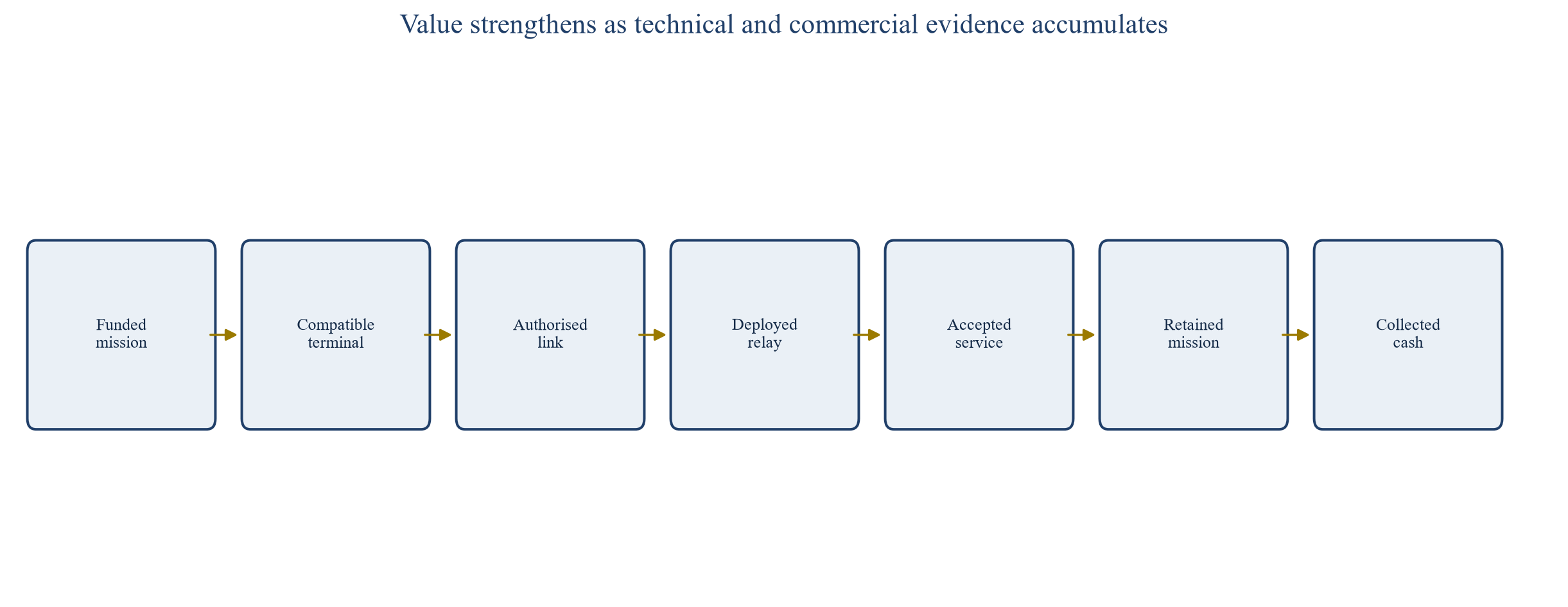
Proposed progression from mission demand to collected service cash.
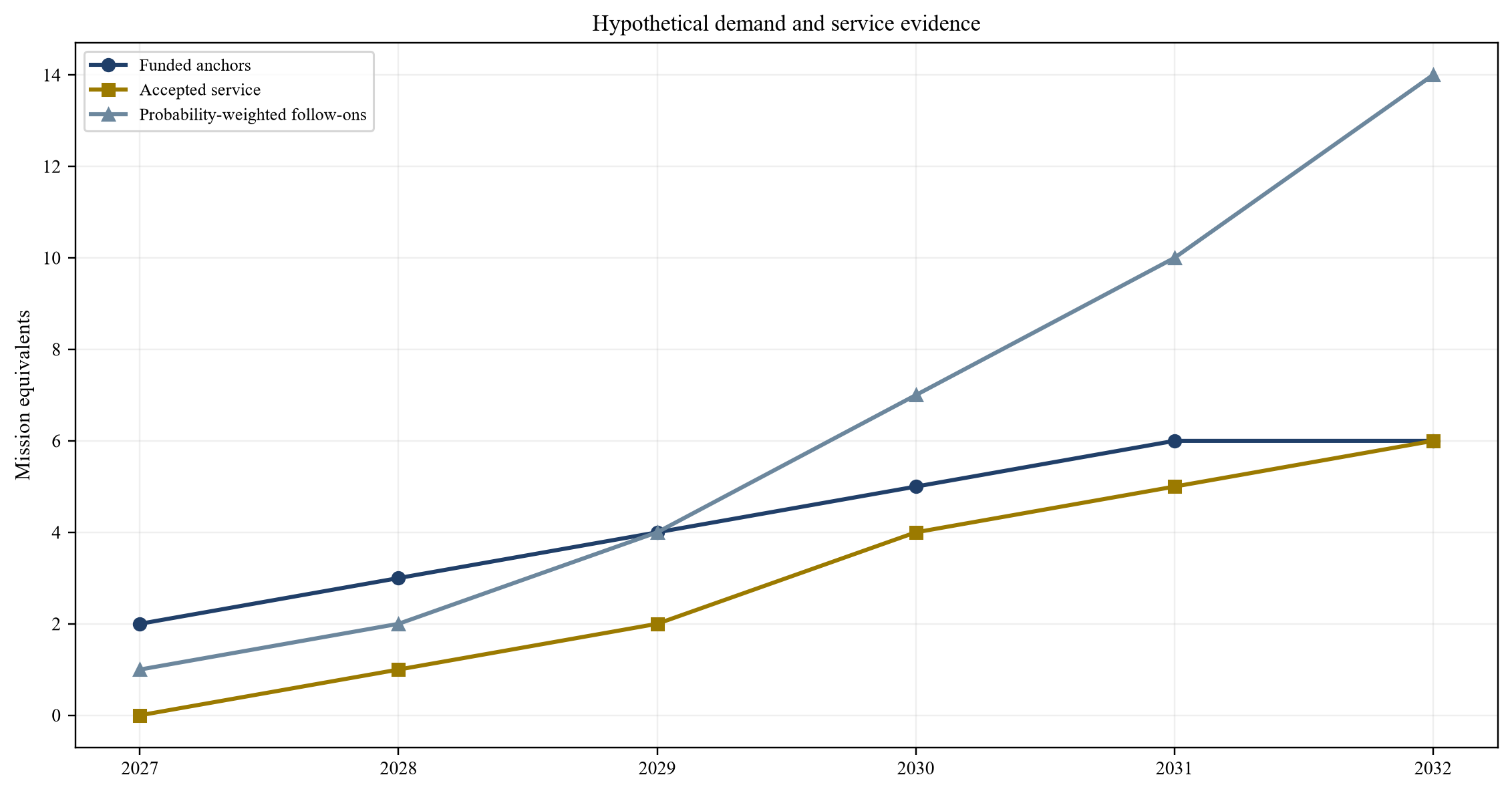
Illustrative mission counts; no programme or company is represented.
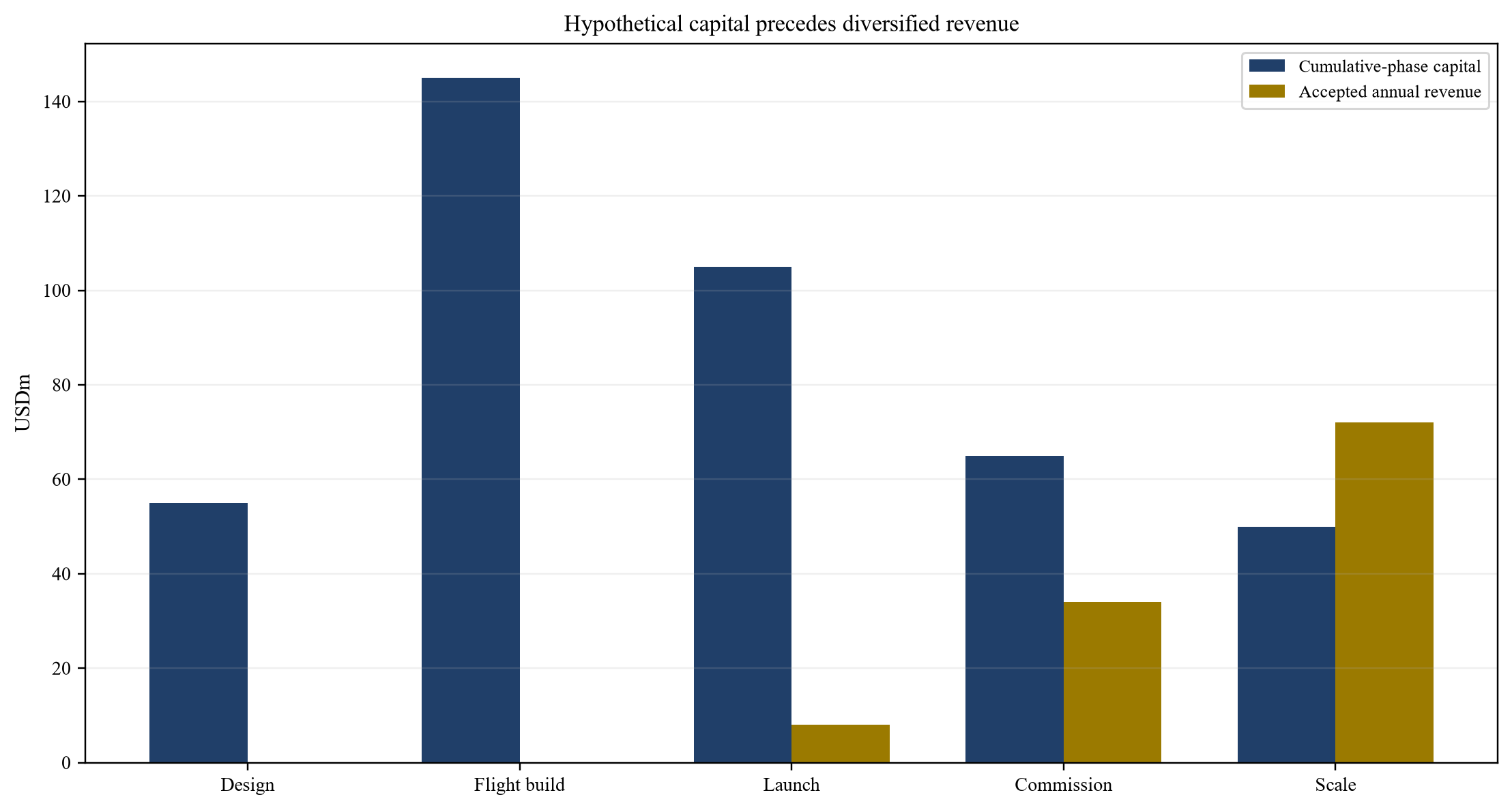
Illustrative USD millions; revenue is shown only after service acceptance.
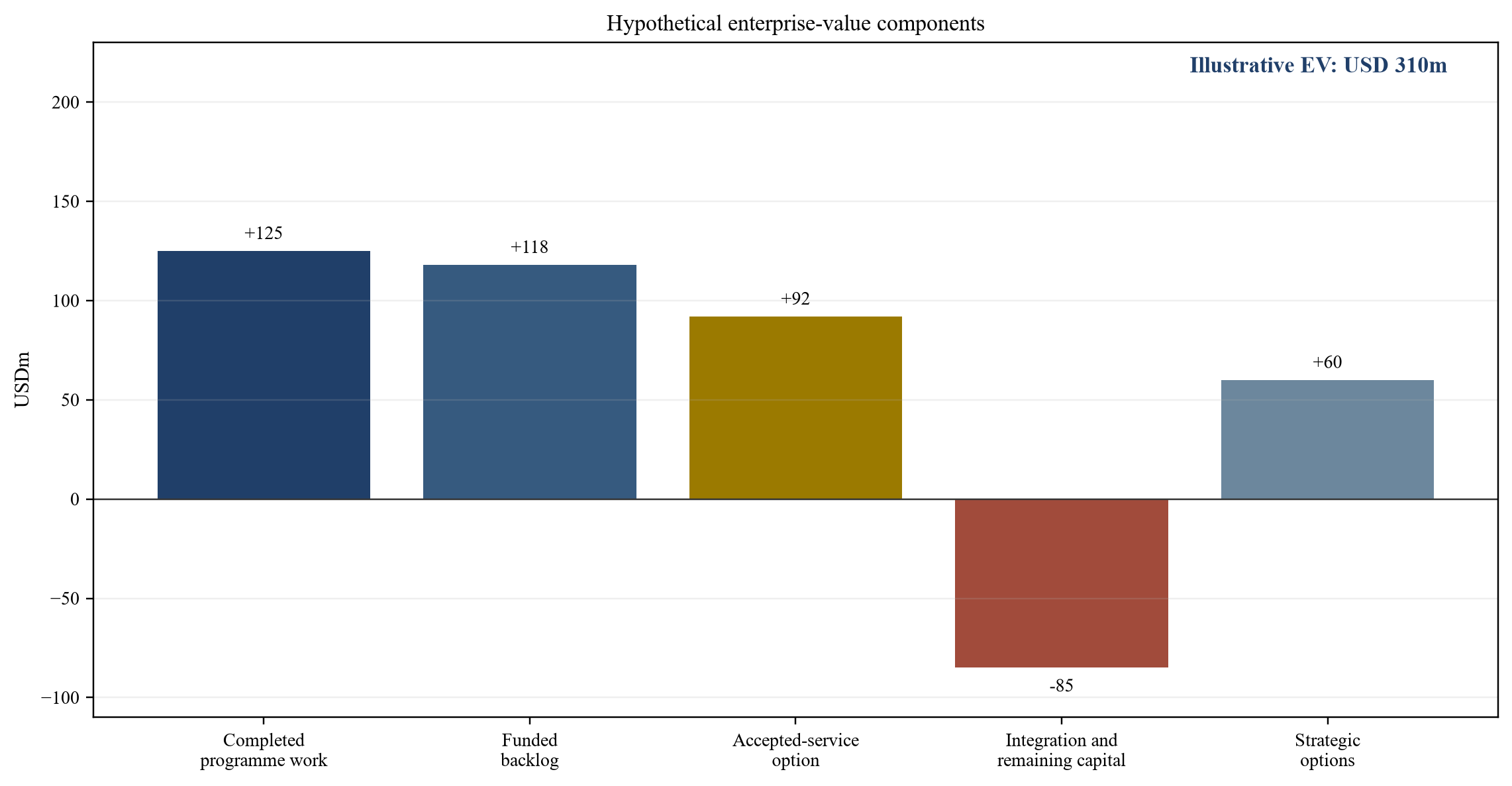
Illustrative USD millions; no named company is represented.
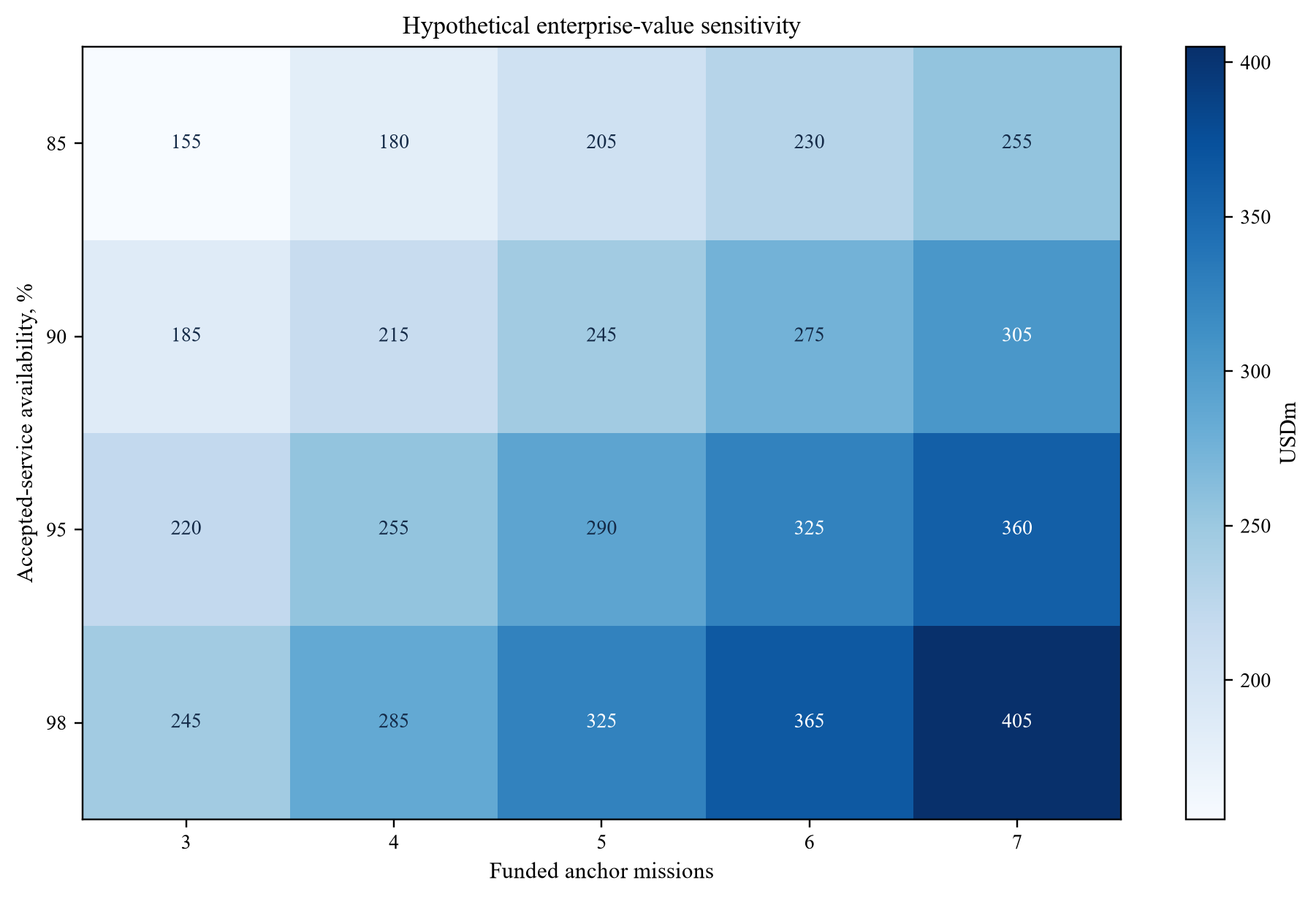
Illustrative enterprise value in USD millions by funded anchors and accepted-service availability.
| Evidence state | Minimum record | Valuation treatment | Principal residual risk |
|---|---|---|---|
| Funded mission | Obligated contract or approved funded order | Contracted demand | Cancellation or schedule change |
| Compatible terminal | Qualified interface and successful test | Customer access option | Integration delay |
| Authorised link | Effective spectrum and operating authority | Executable coverage right | Coordination or renewal |
| Deployed relay | Launch and orbit confirmation | Physical capacity option | Commissioning failure |
| Accepted service | Customer acceptance and service log | Evidenced service revenue | Reliability and concentration |
| Retained mission | Renewal or follow-on order | Relationship value | Programme dependence |
| Collected cash | Reconciled invoice and receipt | Base cash-flow value | Working capital and set-off |
Proposed minimum record for each value state.
| Demand stage | Mission equivalents | Base-case treatment | Required evidence |
|---|---|---|---|
| Publicly announced | 42 | Context only | Official mission source |
| Technically addressable | 27 | Market boundary | Service and terminal fit |
| Funded procurement path | 15 | Probability-weighted | Budget and buyer process |
| Contracted or ordered | 6 | Contracted base | Funded agreement |
| Accepted service | 4 | Recurring revenue base | Service acceptance |
| Collected service cash | 3 | Cash-flow evidence | Invoice and receipt |
Every figure is illustrative and describes no programme.
| Layer | Principal evidence | Value contribution | Failure consequence |
|---|---|---|---|
| User terminal | Qualification and interface test | Addressable mission access | Customer cannot connect |
| Lunar link | Link budget and service test | Surface or orbital coverage | Data or command loss |
| Relay spacecraft | Commissioning and availability | Shared capacity | Regional service gap |
| Earth return | Station and backhaul acceptance | Delivery to customer network | Stranded lunar capacity |
| Network layer | Routing and custody test | Resilient data flow | Delay or loss |
| Navigation layer | Signal and accuracy validation | PNT service | Mission autonomy constrained |
Proposed service decomposition.
| Phase | Capital | Principal gate | Value released |
|---|---|---|---|
| Architecture and design | 55 | Critical design baseline | Transferable design package |
| Flight build and terminals | 145 | Qualified flight hardware | Launch-ready capacity |
| Launch and transfer | 105 | Relays in planned lunar orbits | Physical network option |
| Commissioning and acceptance | 65 | Representative accepted service | Service cash-flow option |
| Scale and redundancy | 50 | Retained anchors and availability | Network and resilience value |
| Total | 420 | All gates | Illustrative programme capital |
Illustrative USD millions; financing terms are omitted.
| Component | USDm | Evidence treatment |
|---|---|---|
| Completed programme work and transferable assets | 125 | Verified cost and usable output |
| Funded mission backlog | 118 | Risk-adjusted contracted contribution |
| Accepted-service growth option | 92 | Probability-weighted follow-ons |
| Integration and remaining capital | -85 | Buyer funding before full service |
| Strategic network options | 60 | Separately risk-adjusted optionality |
| Enterprise value | 310 | Illustrative transaction value |
Illustrative USD millions; no named company is represented.
| Consideration | USDm | Release evidence | Protection |
|---|---|---|---|
| Cash at completion | 180 | Transferable assets, funded backlog and consents | Warranties and escrow |
| Launch and commissioning milestone | 35 | Defined relays in target orbit | Independent technical test |
| Coverage and interoperability milestone | 30 | Representative users complete accepted service | Agreed test protocol |
| Mission-retention milestone | 25 | Named funded anchors remain active | Contribution threshold |
| Collected-cash milestone | 15 | Third-party receipts | Reconciliation and clawback |
| Seller rollover | 25 | Continuing equity | Funding and governance agreement |
Illustrative allocation tied to observable outcomes.
| Gate | Decision question | Minimum evidence | Failure response |
|---|---|---|---|
| Perimeter | Which rights and obligations transfer? | Asset, contract, IP and approval map | Exclude or condition |
| Demand | Which missions have funded authority? | Mission and procurement ledger | Remove from contracted base |
| Service | Can a representative user receive accepted service? | End-to-end test and acceptance | Defer service value |
| Capital | Is funding sufficient through the next gate? | Cost baseline, contingency and liquidity | Resize or stage financing |
| Regulation | Can links operate and ownership close? | Spectrum, export and investment approvals | Ring-fence, condition or stop |
| Valuation | Does each value item have one evidence source? | Evidence-linked bridge | Reprice or restructure |
| Governance | Who owns post-close risk retirement? | Milestones, owners and board dashboard | Withhold capital or consideration |
Proposed decisions and failure responses.
Sources
- NASA, LunaNet Interoperability Specification, Version 5, 7 February 2025. Read the primary source
- NASA, Lunar Networking Standards and LunaNet. Read the primary source
- NASA, Lunar Communications and Navigation Architecture, 2023. Read the primary source
- NASA, Lunar Communications Relay and Navigation Systems. Read the primary source
- NASA, Delay/Disruption Tolerant Networking. Read the primary source
- NASA, Space Communications and Navigation Program. Read the primary source
- NASA, Near Space Network. Read the primary source
- NASA, Deep Space Network. Read the primary source
- NASA, Moon to Mars Architecture Definition Document. Read the primary source
- NASA, Technology Readiness Level Definitions. Read the primary source
- NASA, NASA Selects Intuitive Machines for Lunar Relay Services, 17 September 2024. Read the primary source
- ESA, Moonlight programme. Read the primary source
- ESA, ESA's Moonlight programme: Pioneering the path for lunar exploration, 15 October 2024. Read the primary source
- ESA, Moonlight: connecting Earth with the Moon. Read the primary source
- ESA, Moonlight LCNS Service Concept of Operations. Read the primary source
- ESA, Lunar Economy Applications. Read the primary source
- ESA, ESTRACK ground-station network. Read the primary source
- JAXA, Lunar Navigation Satellite System and international lunar navigation cooperation. Read the primary source
- Consultative Committee for Space Data Systems, standards and publications. Read the primary source
- Interagency Operations Advisory Group, Lunar Communications Architecture. Read the primary source
- International Telecommunication Union, Radio Regulations. Read the primary source
- International Telecommunication Union, Space services and frequency coordination. Read the primary source
- Space Frequency Coordination Group, recommendations. Read the primary source
- National Institute of Standards and Technology, Zero Trust Architecture, SP 800-207, 2020. Read the primary source
- US Government Accountability Office, NASA Artemis Programs: Crewed Moon Landing Faces Multiple Challenges, GAO-24-106256, 2024. Read the primary source
- US Government Accountability Office, NASA Assessments of Major Projects, 2025. Read the primary source
- US Department of Justice and Federal Trade Commission, Merger Guidelines, 2023. Read the primary source
- European Commission, EU merger control. Read the primary source
- IFRS Foundation, IFRS 3 Business Combinations. Read the primary source
- IFRS Foundation, IFRS 13 Fair Value Measurement. Read the primary source
