

1. Frame the actual decision
The decision is not which manager has the most attractive presentation. It is which manager offers the strongest evidence that its organisation can execute the asset owner's stated mandate, within acceptable risk and cost, over the intended holding period. That requires a definition of success before candidates are compared.
The governing body should specify the role of the mandate in the total portfolio, the return objective, benchmark or reference portfolio, risk budget, liquidity requirement, permitted instruments, investment horizon, concentration limits, currency policy, stewardship expectations and reporting needs. A manager that is strong in isolation can be unsuitable for the required role.
Selection should distinguish manager skill from a favourable market exposure. Reported excess return may reflect leverage, illiquidity, sector concentration, factor exposure, vintage conditions, valuation discretion or a small number of outcomes. The diligence question is how much of the result can be connected to a repeatable decision process that remains intact.
The output should be a decision record. It should state the mandate, candidate universe, evidence reviewed, attribution conclusions, organisational dependencies, terms, risks, unresolved conditions, reasons for selection and monitoring triggers. This record supports accountability when future outcomes differ from the base case.
2. Define repeatability as an evidence claim
Repeatability is the proposition that the organisation can apply substantially the same value-creating process to a relevant future opportunity set. It is not a promise that returns will repeat. Markets, competition, capital costs and asset prices change, and even a skilled process can produce weak realised outcomes.
The proposition has five components. The relevant decision makers remain available and empowered. The sourcing engine can continue to access investable opportunities. The investment process is documented and used in practice. Portfolio construction converts individual decisions into the intended risk profile. The operating platform can support the strategy at the proposed scale.
Each component should be tested with contemporaneous evidence. Investment memoranda, committee minutes, portfolio histories, attribution files, realised case studies, pipeline data, staff records, risk reports, valuation committee papers and reference calls are more useful than a polished description alone. Evidence should be dated and reconciled across sources.
A conclusion should identify the boundary of confidence. A process may appear repeatable at the current fund size but uncertain at twice the capital. A team may be stable while decision authority has migrated to one founder. A sourcing advantage may be strong in one geography and untested elsewhere. The mandate can then be sized and constrained around what the evidence supports.
3. Start with an investable manager universe
Universe construction determines which hypotheses can be tested. A narrow list assembled from familiar brands or consultant coverage can embed incumbency bias before diligence begins. A broad list without eligibility criteria can consume resources and reward marketing visibility.
The asset owner should publish minimum criteria linked to the mandate. These may cover regulatory status, strategy, domicile, capacity, vehicle structure, minimum operational infrastructure, track-record length, ownership, key-person coverage, reporting, stewardship and willingness to accept required terms. Criteria should be applied consistently and exceptions documented.
The Principles for Responsible Investment describes a process that moves from a manager universe through longlisting, shortlisting, in-depth diligence and appointment [1]. The United States Department of Labor similarly recommends providing candidate service providers with complete and identical information so that fiduciaries can make meaningful comparisons [2]. A common request for proposal and common data schema support that comparability.
The universe should include credible challengers where the mandate permits them. Emerging managers can lack a long institutional record while offering team continuity, differentiated access or capacity. Their evidence standard should address the shorter organisational history directly rather than applying a seasoned-firm score mechanically.
4. Validate the track record before interpreting it
Track-record analysis begins with provenance. The asset owner should identify the legal entity, strategy, composite or vehicle, inception date, gross and net methodology, cash-flow timing, benchmark, currency, leverage, fees, valuation basis, terminated accounts, portability and the people responsible for each period.
Global Investment Performance Standards provide a recognised framework for presenting performance and maintaining composites. GIPS guidance permits performance from a prior firm to be linked only when substantially all relevant decision makers move, the process remains substantially intact, supporting records exist and there is no break in the record [3]. Even when a manager does not claim compliance, these conditions provide a useful portability test.
Verification increases confidence in the processes used to construct a firm's performance record, but it does not establish investment skill or predict outcomes. The GIPS standards describe verification as firm-wide testing and recommend it, while preserving a separate role for due diligence [4]. The asset owner should obtain underlying data where permitted and reconcile reported figures to audited or administrator records.
Private-market analysis should examine fund-level and investment-level cash flows, write-offs, unrealised value, bridge facilities, subscription lines, follow-on capital, recycling, currency and valuation policy. Public-market analysis should examine composite membership, account dispersion, holdings, factor exposures, turnover, capacity and transaction costs. A number without provenance should carry limited decision weight.
5. Decompose performance into decisions and exposures
Attribution should explain what the manager did, why it created or destroyed value, and whether the mechanism is relevant to the proposed mandate. The analysis should separate market exposure, security or asset selection, sector and geography allocation, leverage, financing, currency, timing, operational improvement, multiple movement and fees.
For private markets, a deal bridge can separate revenue growth, margin change, cash conversion, deleveraging, acquisitions, entry multiple, exit multiple and currency. For liquid strategies, holdings-based and returns-based analysis can identify factor, sector and security effects. The CFA Institute notes that style analysis helps define suitable managers and that due diligence must examine both quantitative results and the qualitative process that produced them [5].
Attribution should also test concentration. A manager whose record depends on two exceptional assets presents a different proposition from one with many smaller contributions. Loss attribution matters because it reveals underwriting boundaries, governance response and capital-protection behaviour.
The team should compare stated process with realised decisions. If the manager claims price discipline, entry valuations and rejected opportunities should demonstrate it. If operational improvement is central, the bridge should identify actions, timing, cost and evidence. If proprietary sourcing is claimed, the transaction history should show how opportunities entered the funnel and whether access affected terms.
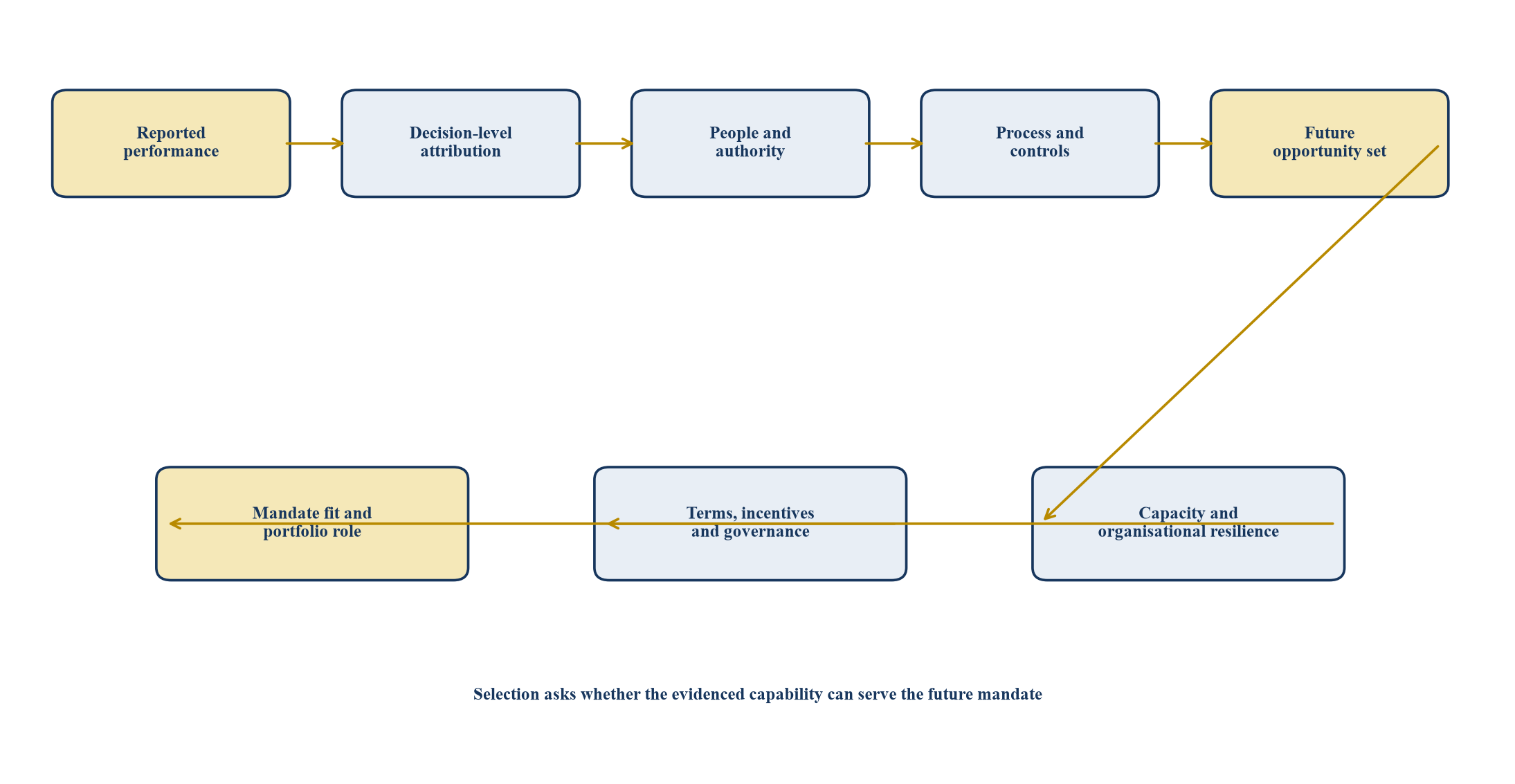
The proposed evidence chain separates outcome, attribution, people, process, opportunity set, capacity and mandate fit.
6. Test persistence without assuming it
Empirical evidence on persistence varies by asset class, period, data set and methodology. Kaplan and Schoar found persistence in private-equity partnership returns in an earlier sample [6]. More recent research has examined how persistence changes as markets and manager populations evolve. An asset owner should therefore treat historical rank as a hypothesis generator rather than a self-validating forecast.
The test should ask whether the economic mechanism behind past success can operate in the next mandate. Scarce access may weaken as capital grows. A pricing anomaly may be arbitraged away. A team may move. A regulatory change may alter the opportunity set. A concentrated geographic network may remain valuable but limit deployment.
Statistical uncertainty also matters. Short records, overlapping holdings, appraisal-based valuations and changing exposures can make ranking unstable. The team should use confidence ranges, peer definitions, vintage or regime controls and sensitivity to benchmarks. A decision committee should see how rankings change when one outlier or favourable period is removed.
The Caltech study of manager-selection heuristics reports that reallocating toward recent winners can produce disappointing subsequent outcomes and challenges common performance-chasing behaviour [7]. The practical lesson is to investigate why the return occurred, how the selected period was defined and whether current pricing already reflects the manager's popularity.
7. Attribute the record to identifiable people
An organisational record belongs to a changing set of contributors. The diligence team should map origination, underwriting, portfolio construction, approval, operations, risk, valuation and exit roles for every material historical investment. It should distinguish title from actual decision authority.
An attribution matrix can identify who sourced an opportunity, led diligence, challenged the case, approved it, managed the asset and led exit. The manager should explain departures, promotions, new hires and changes in committee rights. References can test whether the stated division of labour matches practice.
The relevant question is whether the people and collective routines responsible for the useful parts of the record remain in place. GIPS portability conditions reinforce the importance of decision-maker continuity and supporting records [3]. Key-person clauses can protect investors after appointment, but selection should identify dependencies before terms are negotiated.
The asset owner should examine decision quality across seniority levels. A founder-centric model can be effective, but capacity, succession and challenge become material risks. A distributed model can be resilient, but accountability may be diffuse. Neither structure should receive an automatic premium; evidence should show how it functions under pressure.
8. Examine team stability, incentives and succession
Team stability is more than annual turnover. The analysis should cover voluntary and involuntary departures, regretted loss, tenure by role, promotion, carry allocation, ownership, deferred compensation, non-compete constraints, hiring quality, workload and succession readiness.
A stable team can still be misaligned if economics concentrate at the top or junior professionals cannot progress. A growing firm can show healthy recruitment while weakening the experienced-to-capital ratio. The asset owner should compare headcount, decision makers and operating resources with assets, strategies, offices and portfolio companies over time.
Incentives should be examined at firm, fund, team and individual level. Revenue sharing across products can support collaboration or subsidise weak strategies. Deal-by-deal economics can encourage volume. Carry vesting, good-leaver and bad-leaver provisions, ownership transitions and clawback funding influence behaviour through the mandate life.
Succession should be tested with named scenarios. What happens if the chief investment officer is unavailable? Who can chair the committee? Which relationships are portable? Can the firm raise, invest, monitor and exit without one founder? A credible answer identifies delegated rights, prepared successors and recent examples.
| Claim | Evidence to request | Test | Possible mandate response |
|---|---|---|---|
| Stable investment team | Role-level joiners, leavers, tenure and regretted loss | Recalculate by decision-critical role | Key-person terms, smaller allocation or decline |
| Shared decision process | Committee records and investment attribution | Compare stated and actual authority | Observer rights and escalation reporting |
| Scalable platform | Capital, staffing, pipeline and workload history | Stress current resources at proposed scale | Capacity cap or staged commitment |
| Aligned incentives | Ownership, carry, vesting and compensation policy | Trace economics to mandate contributors | Team-specific retention condition |
| Credible succession | Delegations, named successors and simulations | Test absence of critical leaders | Enhanced key-person and transition rights |
The proposed tests convert broad claims into evidence and decision consequences.
9. Test sourcing as a measurable system
Sourcing claims should be converted into a funnel. For each relevant period, the manager should provide opportunities screened, source channel, exclusivity, conversion, time to decision, price, ownership, rejected opportunities and realised outcomes. The asset owner can then distinguish volume from advantage.
Proprietary sourcing should mean more than direct contact. The analysis should establish whether access produced a better asset, stronger information, improved terms or a lower price. Intermediated deals can also create value when the manager has differentiated sector judgement or execution certainty.
The future opportunity set should be tested against available capital. If the manager doubles fund size while the eligible funnel grows slowly, it may move into larger deals, accept lower ownership, use more leverage or reduce selectivity. Pipeline at one date is weak evidence unless connected to historical conversion and market capacity.
References should include counterparties that did not transact. Rejected sellers, intermediaries, lenders and co-investors can reveal the manager's reputation, speed, certainty and behaviour. The asset owner should record reference selection, relationship, date and potential bias.
10. Examine underwriting and investment-committee behaviour
The diligence team should review a sample that includes successes, losses, unrealised holdings and rejected opportunities. Each case should connect the original thesis, evidence, downside, valuation, committee debate, post-close developments and outcome.
Minutes and memoranda should show whether committees distinguish facts, assumptions and judgement. Repeated challenge should address thesis-specific risks rather than produce generic checklists. Conditions should be tracked to closure. A committee that records unanimous approval for every investment may have weak documentation or weak challenge.
Rejected investments are especially useful. They reveal thresholds, opportunity cost and whether the manager can decline attractive narratives. The team should ask which rejected deals later performed well and whether the manager learned appropriately without rewriting the original decision.
The asset owner should also test speed. A process that works only with long exclusivity may not suit competitive markets. A process optimised for rapid decisions may depend heavily on prior sector work and operating resources. The proposed mandate should match the manager's demonstrated decision environment.
11. Test valuation discipline and reporting integrity
Valuation affects selection before appointment and governance after it. Unrealised private-market performance can be sensitive to comparable sets, discounts, forecasts, capital structures and valuation dates. The diligence team should reconcile valuation policy with actual marks and subsequent exits.
For selected assets, the team should bridge the prior-year mark to the current mark, identify methodology changes and compare marks with financing, secondary transactions or exits. It should examine valuation committee membership, independence, conflicts, external review, override history and escalation thresholds.
APRA's SPS 530 requires an effective valuation governance framework and operational independence in performance assessment for regulated superannuation entities [8]. The principle has broader analytical value: the people rewarded by a valuation should not have unchecked control over it.
The United States SEC's 2023 private-fund rules were vacated by a federal appellate court in 2024 [9]. That episode illustrates regulatory volatility and should not be cited as a current mandatory reporting regime. Asset owners can still negotiate detailed fee, expense, valuation and performance reporting through mandate documents.
12. Assess portfolio construction and capacity
A strong collection of investments can produce a weak portfolio when exposures, correlations, liquidity and sizing are unmanaged. The asset owner should examine how the manager translates conviction into position size and how limits operate in practice.
The analysis should cover concentration, factor and sector exposure, leverage, liquidity, currency, financing, recycling, reserves, follow-ons and exit pacing. Historical breaches and near misses are valuable evidence. The manager should explain what changed after stress events.
Capacity is strategy-specific. It may depend on market turnover, target-company supply, ticket size, ownership, specialist staffing, financing markets, operating partners or governance bandwidth. The diligence team should build a simple capacity bridge from the historical strategy to the proposed capital base.
Mandate design can protect repeatability. A capacity limit, drawdown pace, concentration ceiling, approval right for strategy changes, side-pocket restriction or staged commitment can reduce the risk that commercial growth changes the investment proposition.
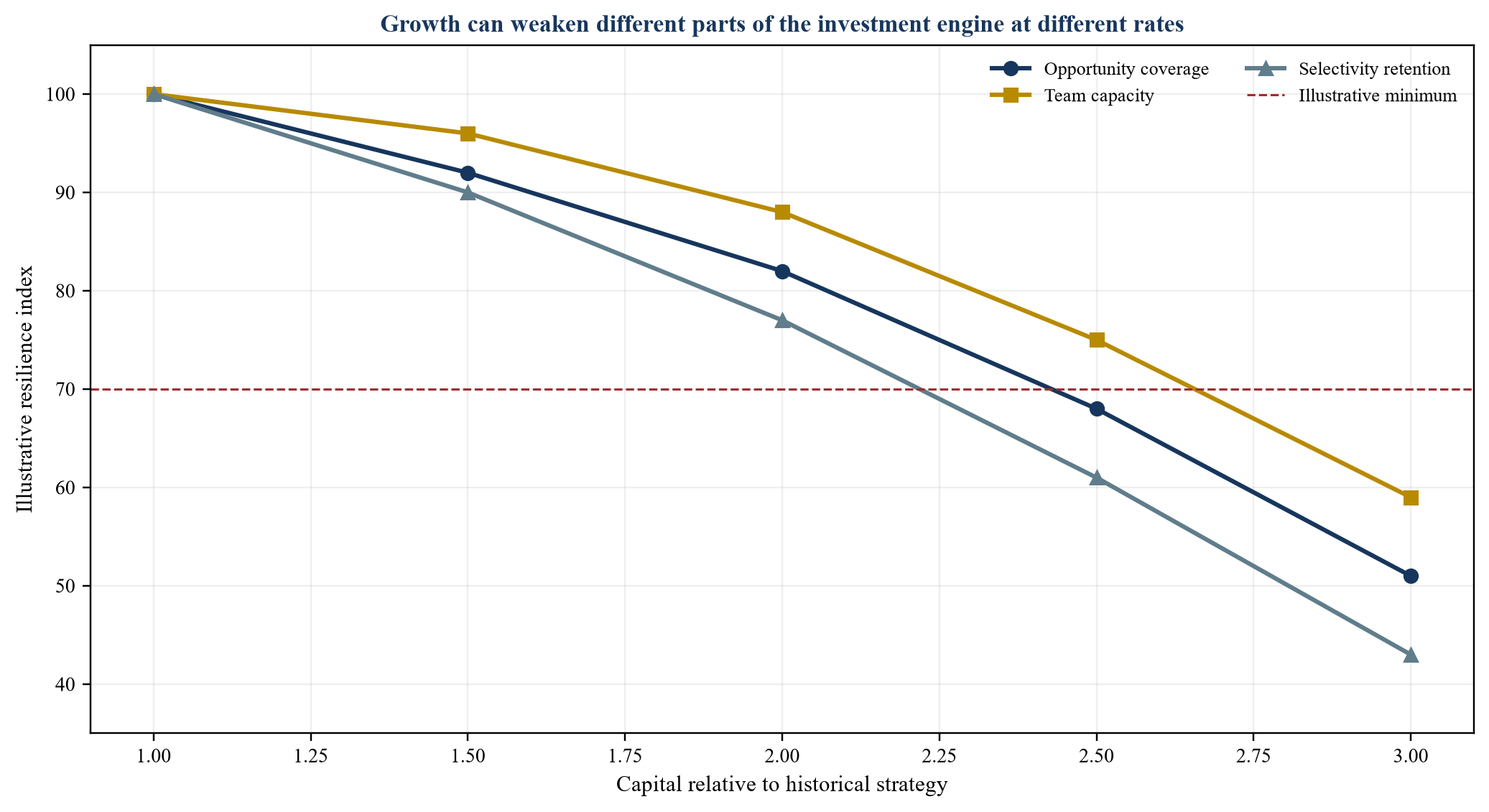
All values are hypothetical management assumptions for illustration.
13. Conduct operational due diligence independently
Investment judgement cannot compensate for weak control over cash, assets, data or authority. Operational due diligence should be sufficiently independent from the team sponsoring the appointment and should have its own escalation rights.
The review should cover legal entities, ownership, regulation, compliance, fund administration, custody, cash controls, valuation, financial statements, cyber security, business continuity, disaster recovery, privacy, personal dealing, conflicts, sanctions, anti-money-laundering controls, insurance, litigation and service-provider oversight.
Documents should be verified with independent sources where possible. Regulatory registrations, audited financial statements, administrator confirmations, insurance certificates, penetration-test summaries and service-organisation reports provide stronger evidence than policy descriptions alone.
Findings should be graded by severity, remediation, owner and deadline. A material control deficiency should not disappear inside a blended investment score. The governance framework should specify which operational findings cause decline, conditional approval, reduced size or enhanced monitoring.
14. Evaluate alignment through economics and control rights
Alignment combines economics, behaviour and enforceable rights. A manager commitment can matter, but its funding source, size relative to wealth, financing and distribution across decision makers affect its meaning.
The asset owner should model management fees, performance fees or carry, preferred return, catch-up, offsets, transaction fees, broken-deal expenses, subscription lines, recycling, continuation transactions, valuation effects and termination economics. Scenario analysis should show who earns what under weak, base and strong outcomes.
Terms should address key person, no-fault suspension or termination, cause, removal, strategy drift, conflicts, related-party transactions, allocation, reporting, valuation, most-favoured-nation treatment, transfer, liquidity, side letters and advisory-committee rights where relevant.
ILPA's Due Diligence Questionnaire 2.0 standardises questions on organisation, strategy, performance, alignment, governance, operations and responsible investment for private funds [10]. A standard questionnaire supports comparison, while mandate-specific questions and negotiated documents should address the asset owner's actual risks.
| Issue | Evidence | Alignment question | Possible protection |
|---|---|---|---|
| Manager commitment | Amount, funding source and ownership | Is meaningful capital exposed on comparable terms? | Minimum commitment and transfer limits |
| Fees and carry | Full cash-flow waterfall | Can revenue be earned without beneficiary value? | Offsets, hurdle, clawback and disclosure |
| Strategy change | Mandate and historical drift | Can risk change without consent? | Defined scope and investor approval |
| Key people | Time allocation and decision rights | Does the mandate depend on named individuals? | Key-person suspension and remedy |
| Conflicts and allocation | Policies and historical examples | Are opportunities and costs allocated fairly? | Disclosure, committee review and records |
| Valuation | Policy, committees and overrides | Can marks affect fees or fundraising without challenge? | Independent governance and audit rights |
Each issue should be assessed in the context of the strategy, jurisdiction and governing documents.
15. Test stewardship and beneficiary alignment
Where stewardship is relevant, the asset owner should examine how the manager integrates it into investment decisions, engagement, voting and escalation. Policies should connect to examples and outcomes.
The UK Stewardship Code 2026 applies from 1 January 2026 and includes principles for asset owners, asset managers and service providers [11]. Its guidance states that asset owners using external managers may report how stewardship requirements are integrated into selection and how delivery is monitored [12].
The asset owner should define expectations in the request for proposal and mandate. Reporting may include material engagements, voting, escalation, conflicts, collaborative action and outcomes. Asset-class differences should be recognised; direct infrastructure ownership and listed-equity voting require different tools.
Stewardship claims should receive the same evidentiary discipline as investment claims. The team should sample cases, compare policy with action and identify situations where commercial incentives conflicted with stated principles.
16. Run structured reference and background work
References should test specific propositions. A standard call guide can cover integrity, decision quality, team dynamics, sourcing, speed, valuation, difficult periods, conflicts, communication and behaviour when an outcome deteriorates.
The reference set should include manager-nominated and independently sourced contacts. Former employees, portfolio executives, limited partners, lenders, service providers and advisers see different parts of the organisation. The team should record how each contact knows the manager and which claims the contact can credibly address.
Contradictions should be investigated rather than averaged away. A difference may reflect time period, role, strategy or bias. The final file should identify the disputed proposition, evidence on each side and the committee's treatment.
Background checks, litigation, regulatory history and sanctions screening should be conducted lawfully and proportionately. The scope and reliance of external checks should be documented.
17. Use an evidence-weighted scorecard
A scorecard can improve consistency when it preserves judgement and evidence quality. Each criterion should have a definition, weight, minimum threshold, score anchors and evidence confidence.
The score should separate capability from confidence. A manager may receive a high provisional capability score based on a persuasive process but a lower confidence score because the strategy is new. Multiplying or otherwise combining the two makes uncertainty visible.
Hard gates should sit outside the weighted total. Regulatory, integrity, operational, authority or mandate-fit failures should not be offset by high performance. A minimum alignment score can also prevent selection of a strong manager on unacceptable terms.
Weights should reflect the mandate. Team and sourcing may dominate a venture strategy; liquidity and execution may matter more in systematic public markets; operating capability and governance may carry more weight in infrastructure.
| Dimension | Weight | Manager Alpha | Manager Beta | Manager Gamma |
|---|---|---|---|---|
| Mandate and portfolio fit | 12% | 8.0 | 8.5 | 7.0 |
| Track-record integrity and attribution | 15% | 7.0 | 8.5 | 6.5 |
| Team, authority and succession | 15% | 6.0 | 8.5 | 7.5 |
| Sourcing and opportunity set | 12% | 7.5 | 8.0 | 8.5 |
| Underwriting and portfolio construction | 14% | 8.0 | 8.5 | 7.0 |
| Operations, valuation and risk | 12% | 7.0 | 9.0 | 7.5 |
| Alignment and terms | 12% | 6.5 | 8.0 | 8.5 |
| Stewardship and reporting | 8% | 7.0 | 8.0 | 7.0 |
| Weighted capability score | 100% | 7.1 | 8.4 | 7.5 |
| Evidence confidence | n/a | 75% | 90% | 70% |
| Evidence-adjusted score | n/a | 5.3 | 7.6 | 5.3 |
Weights and scores are hypothetical management assumptions. The table is a decision aid, not a forecast.
18. Control behavioural bias in the committee
Manager selection creates conditions for halo effects, authority bias, familiarity, performance chasing, narrative fallacy and loss aversion. A famous brand can suppress challenge. A recent winner can anchor expectations. A charismatic founder can dominate evidence.
Controls should be built into the sequence. Committee members can record independent preliminary scores before discussion. Evidence can be circulated in a common format. A designated challenger can present the strongest case against appointment. The team can document what evidence would change its view.
The search adviser or consultant should disclose commercial relationships, ratings processes and conflicts. The UK Competition and Markets Authority found competition concerns in investment consultancy and fiduciary management and introduced remedies including tender requirements in defined circumstances [13]. Current UK requirements should be confirmed for the scheme and mandate at the decision date.
The committee should compare hiring and rejection errors. The CFA curriculum frames a Type I error as hiring or retaining a manager without skill and a Type II error as rejecting or terminating a skilled manager [5]. The relative cost of these errors depends on mandate size, liquidity, transition cost and available alternatives.
19. Negotiate the mandate as part of selection
Selection and appointment should be connected. A highly ranked manager can become unsuitable if final terms change reporting, capacity, key-person protection, fee economics, liquidity or control rights.
The request for proposal should identify required terms early. Material deviations should be scored and returned to the committee. Legal negotiation should translate investment expectations into enforceable obligations, definitions, reporting and remedies.
PRI's manager-selection guide links selection, appointment and monitoring, and recommends embedding responsible-investment requirements into legal documentation [1]. The broader governance principle applies to investment objectives, risk, data, conflicts, valuation and change control.
The decision record should attach a term matrix showing requested, offered and final positions. Conditions precedent, side-letter obligations and post-close deliverables should have named owners and deadlines.
20. Build monitoring from the selection thesis
Monitoring should test whether the reasons for appointment remain valid. The scorecard, attribution map and risk register should become the baseline for oversight.
The UK Pensions Regulator expects governing bodies to monitor investment managers and advisers regularly and consider their performance formally at least every three years [14]. The United States Department of Labor recommends a formal review process at reasonable intervals, including performance, reports, actual fees, business practices and complaints [2]. Jurisdiction-specific duties should be confirmed for each institution.
Monitoring indicators can include people, ownership, strategy, assets, capacity, pipeline, portfolio exposures, valuation, performance attribution, liquidity, leverage, operational incidents, cyber events, breaches, fees, stewardship, reporting quality and remediation.
Triggers should initiate defined actions. A key-person event, unexplained style drift, valuation override, operational breach, material litigation, capacity increase or persistent reporting failure may cause enhanced review, suspension of new commitments, mandate reduction or termination analysis.
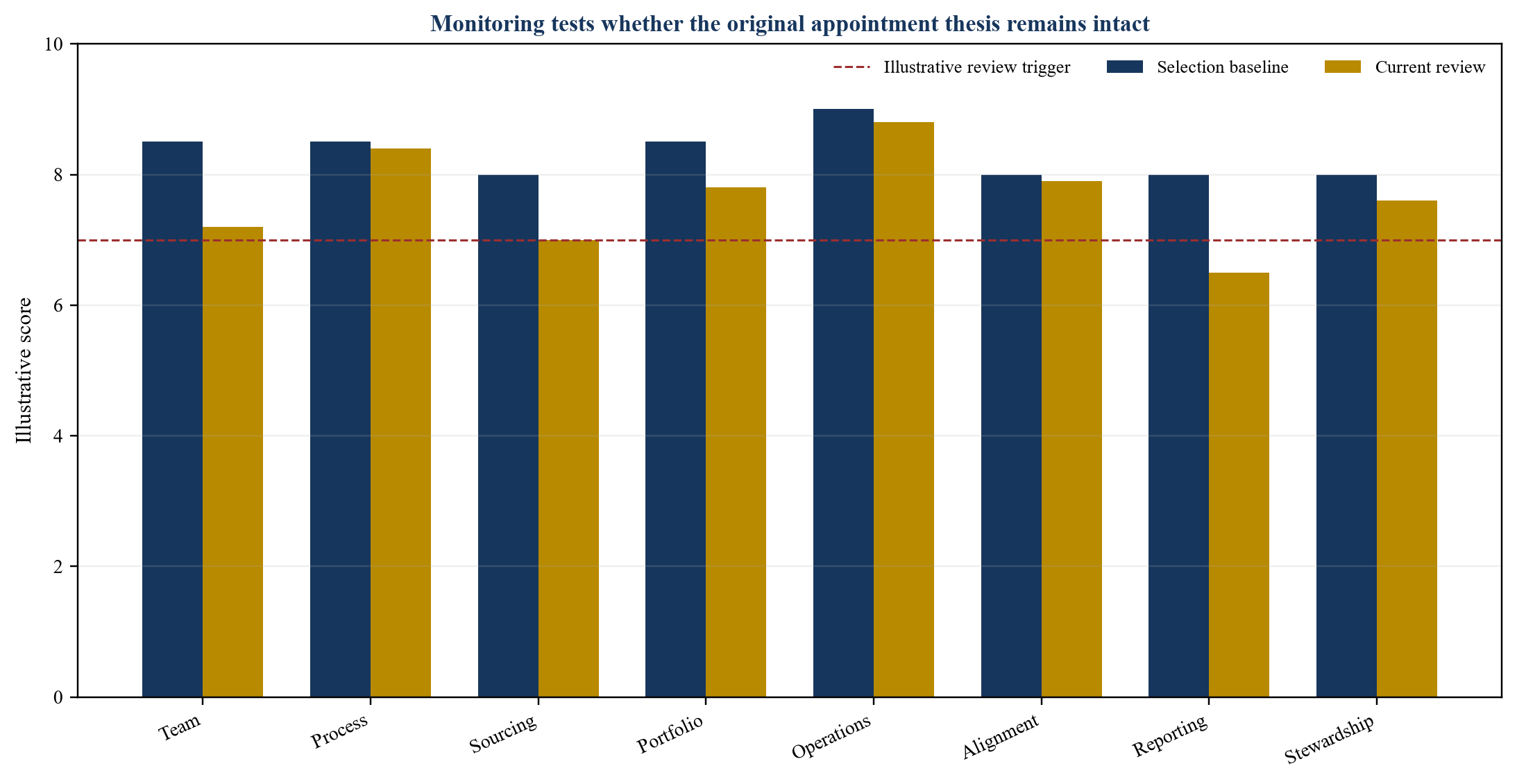
Values are hypothetical management assumptions for illustration.
21. Worked case: define the mandate and candidates
The worked case is wholly hypothetical. A USD 20.0 billion pension institution seeks one manager for a USD 400 million global private-markets mandate. The institution wants diversified exposure, disciplined downside protection, reliable reporting and capacity for selective co-investments.
Manager Alpha reports the highest headline net return. Its record includes two large winners, recent senior departures and rapid asset growth. Manager Beta reports a lower return with broader contribution, stable decision authority, independently verified data and balanced terms. Manager Gamma has differentiated sourcing and attractive alignment but a shorter organisational record.
The institution defines three hard gates: no unresolved integrity issue, acceptable operational controls and legal authority to meet the mandate. It then applies the scorecard in Table 3 and a confidence adjustment based on the quality, independence and relevance of evidence.
All figures in the case are illustrative management assumptions. They do not describe an actual manager, institutional portfolio or expected result.
22. Worked case: reconstruct the headline return
Alpha's reported outcome is decomposed into market exposure, two concentrated investments, leverage and the residual portfolio. Removing the two largest contributors materially changes its relative rank. The team responsible for one contributor has partly departed, and the strategy has grown beyond the size at which both investments were originated.
Beta's return is distributed across more decisions. Attribution shows consistent underwriting and downside controls, although its sourcing advantage is less pronounced. Gamma's early record appears strong, but the small sample and substantial unrealised value reduce confidence.
The committee does not penalise Alpha for concentration automatically. It asks whether concentration was intentional, governed and repeatable under the proposed mandate. The answers produce a lower attribution score and an enhanced key-person concern.
The analysis demonstrates why return ranking and selection ranking can differ. Reported performance remains relevant, but its weight depends on provenance, attribution, people, capacity and mandate fit.
23. Worked case: stress the organisation and terms
The asset owner models three conditions: normal deployment, a two-year fundraising and exit slowdown, and the departure of a senior decision maker. It tests pipeline coverage, staffing, decision rights, reserves, reporting and economics.
Alpha's organisational resilience weakens under the departure scenario. Beta maintains committee coverage and succession but would require a fee reduction to meet the asset owner's value threshold. Gamma remains aligned economically but lacks depth in operations and portfolio monitoring.
Negotiation improves Beta's fee offsets, key-person definition, capacity reporting and co-investment allocation disclosure. Alpha offers limited change. Gamma accepts operating milestones and an initial allocation below the full mandate size.
The committee selects Beta for the main mandate and approves a smaller, staged relationship with Gamma subject to operational milestones. Alpha is declined with recorded reasons. These outcomes are hypothetical and illustrate the use of evidence and terms rather than forecasts.
| Candidate | Headline record | Evidence-adjusted score | Principal issue | Negotiated response | Illustrative decision |
|---|---|---|---|---|---|
| Alpha | Highest | 5.3 | Concentration, departures and scale drift | Limited concessions | Decline |
| Beta | Middle | 7.6 | Initial fee and reporting terms | Improved offsets, reporting and key-person terms | USD 400m mandate |
| Gamma | Shorter | 5.3 | Limited organisational history | Operating milestones and staged size | Smaller pilot relationship |
Amounts, scores and decisions are illustrative management assumptions.
24. Implementation roadmap
During the first thirty days, the asset owner should confirm the mandate, governance, decision rights, timetable, hard gates, data schema and conflict protocol. It should establish a secure evidence room and a controlled candidate universe.
During days thirty-one to seventy-five, the team should complete the request for proposal, track-record reconstruction, attribution, team mapping, sourcing analysis, operational review and initial references. Findings should be logged by proposition, evidence, confidence and unresolved question.
During days seventy-six to one hundred and five, shortlisted managers should undergo case reviews, onsite meetings, independent references, scenario analysis and legal-term comparison. Committee members should submit preliminary scores before the final discussion.
During days one hundred and six to one hundred and twenty, the institution should complete negotiation, conditions, approval and transition planning. The selection thesis, baseline dashboard and monitoring calendar should be transferred to the relationship owner.
25. Governance checklist
The mandate and portfolio role are written before comparison. The manager universe and eligibility criteria are documented. Candidates receive common information and a common request. Track records are reconciled to legal entity, people, strategy and methodology.
Attribution covers successes, losses, unrealised assets and rejected opportunities. Team mapping identifies real decision authority. Sourcing claims are tested through funnel and conversion data. Capacity is stressed against future capital and opportunity supply.
Operational diligence has independent escalation rights. Economics are modelled across scenarios. Required terms are introduced before final selection. Stewardship and reporting expectations are embedded in documents. References test named propositions.
Hard gates remain outside the weighted score. Committee bias controls are used. The decision record explains the selection and rejected alternatives. Monitoring indicators and triggers are linked to the appointment thesis.
26. Limitations
Manager selection remains a judgement under uncertainty. Historical evidence can be incomplete, private-market valuations can be subjective, and organisational behaviour can change after appointment. A structured process improves transparency and challenge but does not guarantee investment performance.
Legal and fiduciary duties differ by jurisdiction, institution and mandate. The regulatory sources in this paper illustrate governance principles and should not replace legal advice. Requirements should be checked at the decision date.
The worked case and all numerical exhibits are hypothetical. The framework does not estimate market demand, manager returns, portfolio outcomes or the probability of mandate success.
Data access may constrain diligence. The asset owner should record unavailable evidence, assess whether alternatives are sufficient and adjust confidence, size or terms accordingly.
27. Conclusion
Institutional manager selection should begin with the future mandate and work backward through the evidence. A track record is an important starting point. Its decision value depends on provenance, attribution, people, process, opportunity set, capacity, organisation, terms and portfolio fit.
An evidence-based system makes claims testable. It separates capability from confidence, prevents hard risks from being averaged away, links negotiation to selection and converts the appointment thesis into monitoring indicators.
The practical objective is a governable decision. The committee should be able to explain why the selected organisation is suited to the mandate, which assumptions remain uncertain, which protections were negotiated and what developments would cause the institution to reconsider.
28. Red-team the evidence before approval
Before final approval, an independent reviewer should test the selection thesis as if the institution were defending the decision after a poor outcome. The reviewer should identify the three claims that contribute most to the recommendation, the weakest evidence supporting each claim and the developments that could invalidate them.
The red team should inspect evidence selection. Managers and internal sponsors can emphasise favourable periods, successful assets and supportive references. A balanced file should include losses, abandoned strategies, team departures, valuation reversals, delayed exits, operational incidents and rejected investments that later succeeded. Missing adverse evidence can create a more serious bias than an error in a reported ratio.
The reviewer should also test comparability. Candidates may use different definitions of gross return, committed capital, realised value, attribution, employee turnover, proprietary sourcing or operating improvement. The team should normalise definitions or state why comparison remains limited. A score based on differently defined inputs can create false precision.
Evidence age matters. A control report from two years earlier may not describe the current platform. A reference may relate to a prior strategy. An investment memorandum may show the initial process but not the current committee. The file should state each material item's date, scope and relevance.
Finally, the red team should examine incentives inside the selection process. Staff may prefer a familiar manager, an adviser may have a commercial relationship, and decision makers may avoid a differentiated candidate because future blame is easier to manage with a large brand. Conflicts should be disclosed, and the committee should record how they were addressed.
29. Match governance intensity to mandate risk
Governance should be proportionate to the consequences and reversibility of the decision. A liquid, daily traded mandate can often be reduced or terminated more readily than a closed-end private-market commitment. A concentrated strategic mandate, an illiquid vehicle or a first-time strategy therefore requires stronger evidence, terms and monitoring.
Proportionality can be expressed through four variables: exposure size, duration, liquidity and complexity. A fifth variable, organisational novelty, captures whether the manager, strategy or relationship is new to the asset owner. Higher combined exposure should increase approval authority, independent review, scenario depth and post-appointment monitoring.
The institution can use staged commitment where uncertainty is material and the structure permits it. A pilot account, smaller first commitment, separately managed account, co-investment trial or milestone-based increase can create evidence before full scale. Staging should have explicit evaluation criteria and should not be used to bypass a hard gate.
Decision rights should be visible. The governing body sets policy and retains matters that can alter the institution's risk posture. An investment committee evaluates the evidence and approves within delegated authority. Staff conduct diligence and monitor the mandate. Risk, legal, compliance and operations should have defined review and escalation roles.
External advisers can add expertise and market coverage, while the asset owner remains responsible for understanding the recommendation. OECD guidance places the governing body at the centre of strategic decisions, service-provider selection and performance oversight [15]. Delegation should therefore identify accountability, information rights and the institution's capacity to challenge advice.
30. Adapt the framework across asset classes
The core questions remain stable across asset classes, although the evidence changes. In listed equities, the asset owner can examine holdings, factor exposures, turnover, transaction costs, capacity, voting and account dispersion. In fixed income, it can examine duration, credit migration, liquidity, trading, covenants, defaults and recovery work.
Private equity and venture capital require investment-level cash flows, vintage analysis, valuation, reserves, ownership, governance, operating intervention and exit attribution. Private credit requires underwriting, documentation, collateral, covenant monitoring, amendments, non-accruals, recoveries and workout capability. Infrastructure and real assets require technical, regulatory, concession, counterparty, construction, operating and long-duration valuation evidence.
Hedge-fund and systematic strategies require model governance, data lineage, leverage, financing, counterparty, liquidity, crowding and operational resilience. Strategies using artificial intelligence should disclose data rights, model change controls, human oversight, cyber controls, concentration in vendors and the extent to which historical simulations reflect executable trading conditions.
For every strategy, the asset owner should connect the historical record to the exact future mandate. A global record may not support a regional product. A long-only record may not support leverage. A team record at a prior firm may not transfer when data, systems, governance or colleagues are absent. A fund record may not represent a separately managed account with different constraints.
The common architecture remains mandate, evidence, attribution, organisation, alignment and monitoring. Asset-class modules then specify the relevant risk drivers, data and legal rights. This combination allows an institution to use one governance language without forcing unlike strategies into the same mechanical checklist.
Clear documentation also strengthens continuity when committee membership changes over time.
Sources
- Principles for Responsible Investment, “Asset owner guide: investment manager selection,” 2020. Read the primary source
- U.S. Department of Labor, “ERISA Fiduciary Advisor: Hiring and monitoring a service provider.” Read the primary source
- CFA Institute, “GIPS Standards Handbook for Firms,” 2020, Provision 1.A.32. Read the primary source
- CFA Institute, “GIPS Standards for Verifiers.” Read the primary source
- CFA Institute, “Investment Manager Selection,” 2026 Curriculum, Level III Portfolio Management. Read the primary source
- Steven N. Kaplan and Antoinette Schoar, “Private Equity Performance: Returns, Persistence and Capital Flows,” Journal of Finance 60(4), 2005. Open version: Read the primary source
- Amit Goyal and Sunil Wahal, “The Selection and Termination of Investment Management Firms by Plan Sponsors,” Journal of Finance 63(4), 2008; related summary: Read the primary source
- Australian Prudential Regulation Authority, “SPS 530 Investment Governance,” in force from 1 January 2023. Read the primary source
- U.S. Securities and Exchange Commission, “Private Fund Advisers,” including notice of the 2024 Fifth Circuit vacatur. Read the primary source
- Institutional Limited Partners Association, “Due Diligence Questionnaire 2.0,” 2021. Read the primary source
- Financial Reporting Council, “UK Stewardship Code 2026,” 2025. Read the primary source
- Financial Reporting Council, “UK Stewardship Code 2026 Guidance,” updated 30 October 2025. Read the primary source
- UK Competition and Markets Authority, “Investment consultants market investigation,” 2019, updated 2022. Read the primary source
- The Pensions Regulator, “Investment governance.” Read the primary source
- OECD, “Policy guidance on developing asset-backed pension arrangements,” OECD Pensions Outlook 2022. Read the primary source
- OECD, “Recommendation of the Council on Core Principles of Private Pension Regulation.” Read the primary source
- U.S. Department of Labor, “Meeting Your Fiduciary Responsibilities.” Read the primary source
- Financial Reporting Council, “Latest UK Stewardship Code signatories confirmed during transition to the 2026 Code,” 9 July 2026. Read the primary source
