

1. Define the pacing decision
Private-market pacing is the annual decision about how much new capital a pension fund can commit while remaining within its strategic allocation and liquidity capacity over the life of existing and future funds. It is not a single percentage applied to current assets. It is a multi-year funding decision that connects commitments made today to capital calls, distributions, net asset values and benefit payments that will occur at different times.
The investment committee should approve a pacing envelope rather than an isolated commitment total. The envelope identifies the minimum, central and maximum annual commitment amount, the conditions that determine which point is used and the events that suspend or reopen commitments. It should be consistent with the investment policy, liability profile, cash-flow forecast, collateral plan and delegated authority.
The pacing model should answer five questions. It should show the expected path to the strategic allocation, the amount and timing of callable capital, the contribution expected from distributions, the liquidity available after other obligations and the actions available when actual experience differs from the model. Each answer should be reconciled to current records and refreshed as new information arrives.
The decision belongs at total-fund level. A private equity team can model its own portfolio accurately and still recommend an unaffordable pace if the total fund also has benefit payments, derivative collateral, currency hedges, real-estate commitments, private-credit drawdowns and asset-allocation transitions. Treasury, actuarial, risk and investment functions need one cash-flow view.
2. Separate commitments from invested exposure
A commitment authorises a general partner to call capital up to an agreed amount during the investment period. The pension fund usually does not control the exact date of each call. The undrawn amount remains a contractual exposure even though it is absent from the private-market net asset value.
Invested exposure is normally represented by the reported net asset value of funded interests. It changes through capital calls, distributions and valuation movements. A new commitment increases callable exposure immediately while leaving current net asset value unchanged. A distribution reduces net asset value and creates cash, while an unrealised gain increases reported exposure without creating cash.
CalSTRS explains this distinction in its published private equity pacing material. Capital contributions increase net asset value, distributions reduce it and investment returns can move net asset value independently from cash flows. It also notes that capital can be called within a multi-year window and that the timing remains uncertain [14]. These relationships are the foundation of a pacing model.
The committee should receive current net asset value, unfunded commitments and total private-market exposure in separate columns. Total exposure can be shown as net asset value plus unfunded commitments, with appropriate qualifications because not every commitment will be called in full and a called dollar can replace an unfunded dollar rather than increase total economic exposure. The distinction prevents the strategic allocation from being assessed through current valuations alone.
3. Understand the J-curve as a cash-flow sequence
The J-curve describes a common pattern in which fees, costs and early investment effects precede realisations and distributions. Its shape varies by strategy, manager, vintage and market conditions. The practical governance point is that the early years often consume cash while the later years are expected to return it.
A mature programme contains overlapping vintages. Older funds can distribute cash while newer funds call capital. This self-funding characteristic depends on a continuing exit market and a diversified vintage profile. It can weaken when sale processes slow, portfolio companies require follow-on capital or managers extend fund lives. New commitments made during a distribution drought can create a larger future funding requirement before the mature portfolio resumes paying cash.
The model should therefore keep gross calls and gross distributions visible. A small net cash outflow can conceal a large call obligation funded by unusually strong distributions. If exits slow, the same commitment programme may require materially more cash. Gross flows also support operational planning because calls and distributions can occur on different dates, in different currencies and through different accounts.
The J-curve should be modelled by vintage and strategy. Buyout, venture capital, private credit, infrastructure and real estate can have different deployment, income and exit patterns. A single average curve can be used as a high-level check, while the operating forecast should retain enough detail to show concentration and timing risk.
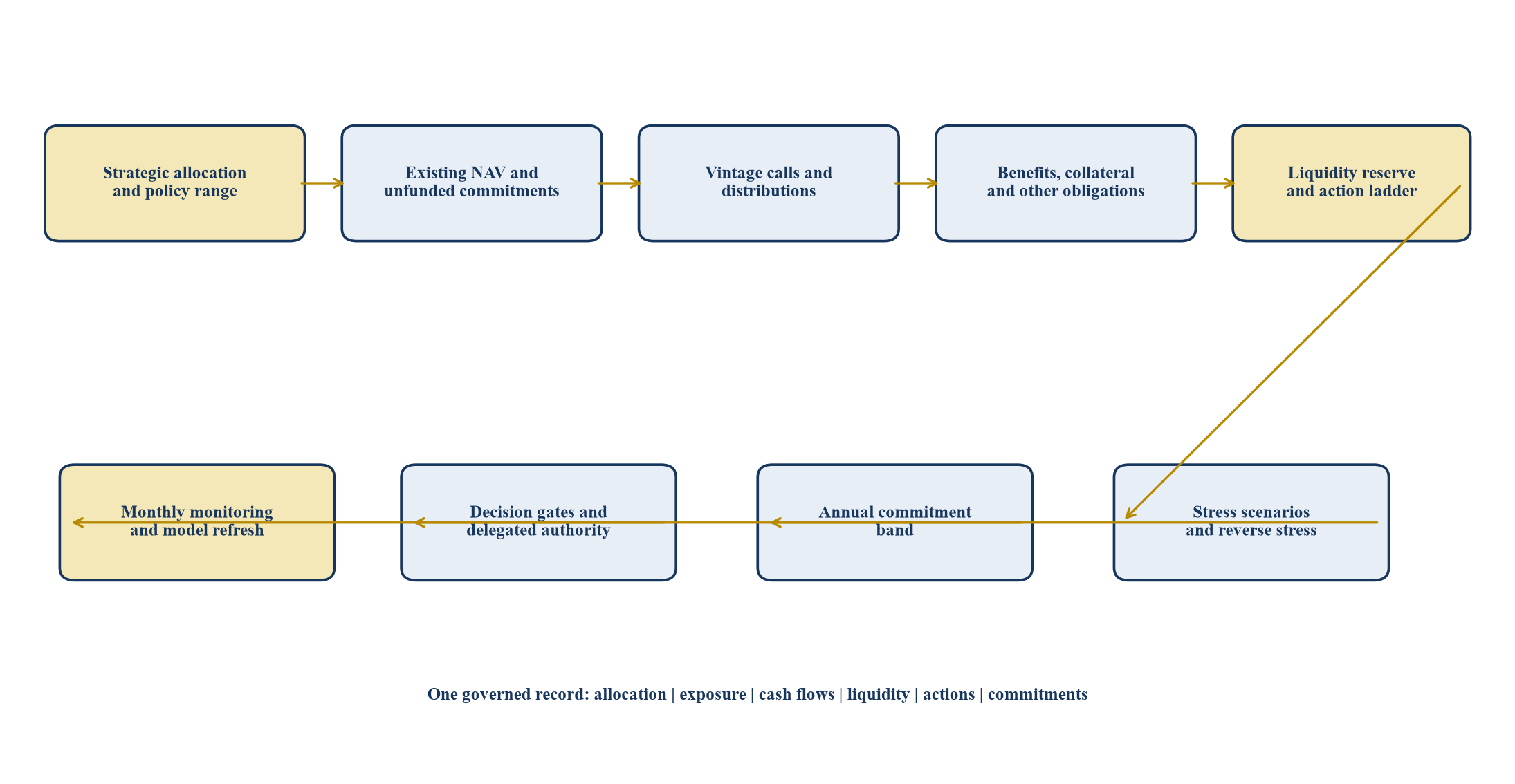
The framework links the strategic allocation to vintage cash flows, total-fund obligations, stress capacity and governed commitment decisions.
4. Ground the programme in current pension evidence
OECD data show the scale and diversity of asset-backed pension systems. Assets earmarked for retirement reached USD 69.8 trillion in OECD member countries and USD 2.9 trillion in non-OECD jurisdictions at the end of 2024 [1]. Preliminary OECD data for 2025 describe materially different asset allocations across jurisdictions and show how interest-rate and currency movements can affect reported portfolio values [2]. These aggregates establish context rather than a suitable private-market allocation for any individual fund.
Private markets have become important sources of external finance. BIS research describes pension funds as dominant investors in private equity and private credit, with pension investors representing a large share of commitments in the data examined [12]. The same research notes that capital is committed for extended periods and that institutional investors bear the resulting illiquidity.
Public pension disclosures show how net asset value, unfunded commitments and cash flows interact in practice. CalSTRS reported USD 55.6 billion of private equity assets at 30 June 2025, USD 19.8 billion of unfunded commitments at 31 March 2025 and a long series of annual contributions and distributions [15]. These are CalSTRS facts and should not be imported into another fund's model.
The evidence supports a general conclusion. Pension funds can be natural long-term investors in private markets, while each fund still requires its own commitment and liquidity limits. Scale, maturity, funded status, contribution policy, benefit profile, collateral needs, currency exposure and governance capacity can produce very different safe pacing outcomes.
5. Apply the prudent-person and liquidity tests
The OECD Core Principles state that pension investment rules should balance security, profitability and liquidity, support diversification and allow asset-liability matching [3]. The principles also recognise that rigid limits can create forced selling under unfavourable conditions. A pacing framework should preserve this prudential balance.
The UK Pensions Regulator requires relevant governing bodies to invest for security, quality, reasonable liquidity and profitability across the portfolio and to maintain effective decision processes [8]. Its private-markets guidance asks trustees to model and monitor calls and distributions, include other funding requirements, stress delayed distributions and accelerated calls, and identify contingent actions [6]. These expectations are directly relevant to commitment pacing.
Legal and regulatory duties differ by jurisdiction, scheme type and governing documents. The framework in this paper is a management process rather than a statement of legal compliance. Trustees should obtain current advice for the pension fund's facts and jurisdiction.
The committee should document how a proposed pace fits the fund's objectives and limits. The record should identify the allocation benefit, the cost and fee implications, the expected cash-flow profile, liquidity capacity, governance demands and conditions that would invalidate the recommendation.
6. Define the hypothetical pension fund
The worked case assumes a pension fund with USD 25.0 billion of total assets and a 20 per cent strategic allocation to private markets. The policy range is 16 to 24 per cent. Current private-market net asset value is USD 4.30 billion, equal to 17.2 per cent of total assets. Unfunded commitments are USD 2.10 billion.
The programme includes private equity, private credit, infrastructure and real estate across multiple vintages. The fund pays USD 1.25 billion of annual benefits and operating costs and receives USD 800 million of contributions, creating a USD 450 million annual net cash outflow before investment cash flows. It also maintains derivatives and currency hedges that can require collateral.
The immediately available liquidity reserve is assumed to be USD 1.40 billion. A second tier of liquid assets worth USD 2.60 billion can be sold or repo-funded within ten business days under normal conditions. The model applies stressed haircuts and settlement lags rather than treating the full market value as immediately available cash.
The central proposal considers USD 1.00 billion of new commitments in year one and annual bands thereafter. Every figure in the worked case is hypothetical. Table 1 records the opening assumptions and the evidence that an actual pension fund would need.
| Item | Illustrative assumption | Decision relevance | Required evidence |
|---|---|---|---|
| Total fund assets | USD 25.0bn | Allocation denominator and liquidity base | Custodian and accounting reconciliation |
| Strategic private-markets allocation | 20% | Long-term exposure objective | Approved investment policy |
| Policy range | 16%-24% | Escalation and rebalancing boundary | Current board authority |
| Current private-markets NAV | USD 4.30bn | Funded exposure | Manager, administrator and custodian records |
| Unfunded commitments | USD 2.10bn | Callable exposure | Executed partnership and commitment schedule |
| Annual benefits and operating outflows | USD 1.25bn | Required cash | Actuarial and treasury forecast |
| Annual contributions | USD 0.80bn | Recurring cash source | Sponsor and contribution schedule |
| Immediate liquidity reserve | USD 1.40bn | First-call capacity | Cash and eligible collateral inventory |
| Tier-two liquid assets | USD 2.60bn | Contingent capacity | Sale, repo, haircut and settlement analysis |
| Year-one commitment proposal | USD 1.00bn | Pacing decision | Vintage model and approved band |
| Model horizon | 5 years | Commitment and cash-flow planning | Committee-approved planning period |
Every value, rate, policy range and timing assumption is illustrative management input rather than observed pension-fund data, a forecast or investment advice.
7. Reconcile the opening portfolio
The pacing model should begin with a fund-by-fund register. Each line should identify manager, vehicle, strategy, currency, vintage, committed capital, called capital, distributions, current net asset value, unfunded amount, investment-period end, fund-life terms and expected extension rights.
The register should reconcile to manager statements, administrator records, custodian positions and the general ledger. Differences should be resolved before the forecast is approved. A missing unfunded balance can understate future calls. A stale net asset value can misstate the current allocation. A distribution recorded on different dates can distort short-term liquidity.
Commitments should be adjusted only through documented rules. Some funds can recycle distributions, call recallable amounts or extend investment periods. Side letters can modify notice periods, concentration rights or reporting. Credit lines at fund level can delay investor calls and make a young vintage appear inactive before a larger call arrives.
The operating register should therefore include contractual flexibility and known manager guidance. The model can apply a probability-weighted call assumption for planning, while treasury should retain the ability to fund the legally callable amount within the agreed stress horizon.
8. Build a vintage-level cash-flow engine
The model should project four movements for each vintage: capital calls, distributions, investment value change and write-offs. New commitments enter as separate vintages. The closing net asset value equals opening net asset value plus calls, less distributions, plus valuation movement. Closing unfunded commitments equal opening unfunded commitments plus new commitments, less calls and contractual reductions.
Call curves should reflect strategy and fund age. A new buyout fund can draw capital over several years. A private-credit vehicle may deploy faster. Infrastructure and development funds can have project-linked draws. A secondary transaction or co-investment can require cash much sooner than a blind-pool commitment.
Distribution curves should reflect the underlying exit and repayment mechanisms. Private credit may provide contractual income and principal repayments. Buyout and venture distributions depend on sales, refinancings, dividends and public listings. Infrastructure and real estate can distribute operating income and sale proceeds. The model should avoid assuming that every strategy responds to a market shock in the same way.
The model should retain manager-level concentration. If several large managers raise successor funds together, commitment decisions can cluster. The fund can then face calls from correlated vintages at the same time. Annual totals alone may obscure this calendar and counterparty concentration.
9. Model distributions independently from calls
Calls and distributions should have separate assumptions and stress factors. A general partner can continue investing committed capital while delaying exits. This produces the combination most relevant to overcommitment: cash calls continue while distributions fall.
The distribution forecast should begin with portfolio-company and fund maturity rather than a fixed percentage of net asset value. Expected realisations should be classified by evidence. Signed sales, announced transactions, active processes, manager estimates and statistical run-rate assumptions have different reliability.
The committee should see a distribution confidence ladder. High-confidence proceeds can support near-term treasury planning after allowing for timing, conditions and currency. Lower-confidence proceeds belong in the strategic projection and should not fund a hard liquidity commitment.
CalSTRS identified slowing distributions as a private equity risk factor in its June 2025 semi-annual report [15]. Its public figures also show that annual gross contributions and distributions can vary materially. The pacing process should treat that variability as a normal feature rather than an exceptional forecasting error.
10. Add liabilities and total-fund cash flows
Private-market cash flows sit inside a pension cash-flow system. The model should include contributions, benefits, expenses, collateral, asset purchases and sales, debt or repo movements, foreign exchange and any sponsor support that is legally available and operationally executable.
Benefit payments should be treated as required outflows. Contributions may be sensitive to payroll, sponsor health, regulation or funding agreements. A mature defined-benefit plan can have persistent negative net member cash flow. A defined-contribution plan can face transfers or switching activity even when aggregate contributions are positive.
Collateral calls can arrive faster than private-market capital calls. EIOPA's 2025 IORP stress test focused on liquidity under sharp yield-curve movements and reported substantial aggregate liquid assets alongside continuing exposure to margin-call risk [4][5]. The Pensions Regulator also notes that capital calls compete with benefit and collateral requirements [7].
The liquidity plan should assign priority, source and authority to each outflow. The model should avoid using the same asset twice, such as counting a government-bond portfolio as both the LDI collateral source and the reserve for private-market calls.
11. Define liquidity by time and certainty
Liquidity should be classified by the time required to produce usable cash and by the reliability of that action under stress. Cash and same-day collateral form the first tier. High-quality securities that can be sold or financed within a few days form another tier after haircuts and settlement. Less liquid securities, secondary sales and sponsor facilities have longer or conditional execution paths.
The fund should maintain a liquidity ladder for one day, five days, ten business days, one month, one quarter and one year. Each horizon should include expected inflows, required outflows, callable commitments, collateral and a reserve. The committee can then see whether a comfortable annual forecast contains a short-term settlement gap.
The FSB's final recommendations on margin and collateral calls emphasise governance, liquidity measurement, stress testing, contingency planning and operational readiness [9]. The March 2026 FSI summary explains that pension funds and other non-bank institutions can amplify stress when rapid collateral needs meet weak preparedness [10]. These principles support a combined call and collateral plan.
Liquidity capacity should be measured after operational restrictions. Assets held in segregated accounts, pledged positions, regulatory pools, transition portfolios or foreign markets may not be available on the assumed timetable. Currency conversion and cut-off times can also matter.
12. Set the commitment pacing band
The annual pacing band should connect the strategic allocation to a range of possible cash-flow outcomes. A central amount supports the expected path. A lower amount protects liquidity when distributions slow or total-fund risk rises. A higher amount can be used when the programme is below target and liquidity evidence remains strong.
The band should be determined by constraints rather than a desire to smooth manager relationships. Relevant constraints include policy exposure, unfunded commitments, liquidity coverage, benefit cash flow, collateral capacity, concentration, governance bandwidth, valuation uncertainty and the timing of known successor funds.
The commitment ceiling should be tested against the combined downside, not only the central case. If the ceiling leaves insufficient cash after accelerated calls, delayed distributions, public-market losses and collateral needs, the band is too high or the reserve is too low.
The floor is also a governance choice. Stopping commitments for several years can create a vintage gap, weaken manager access and reduce future distributions. A constrained fund may maintain a smaller core pace across high-conviction relationships while using secondaries, co-investments or mandate changes to manage exposure.
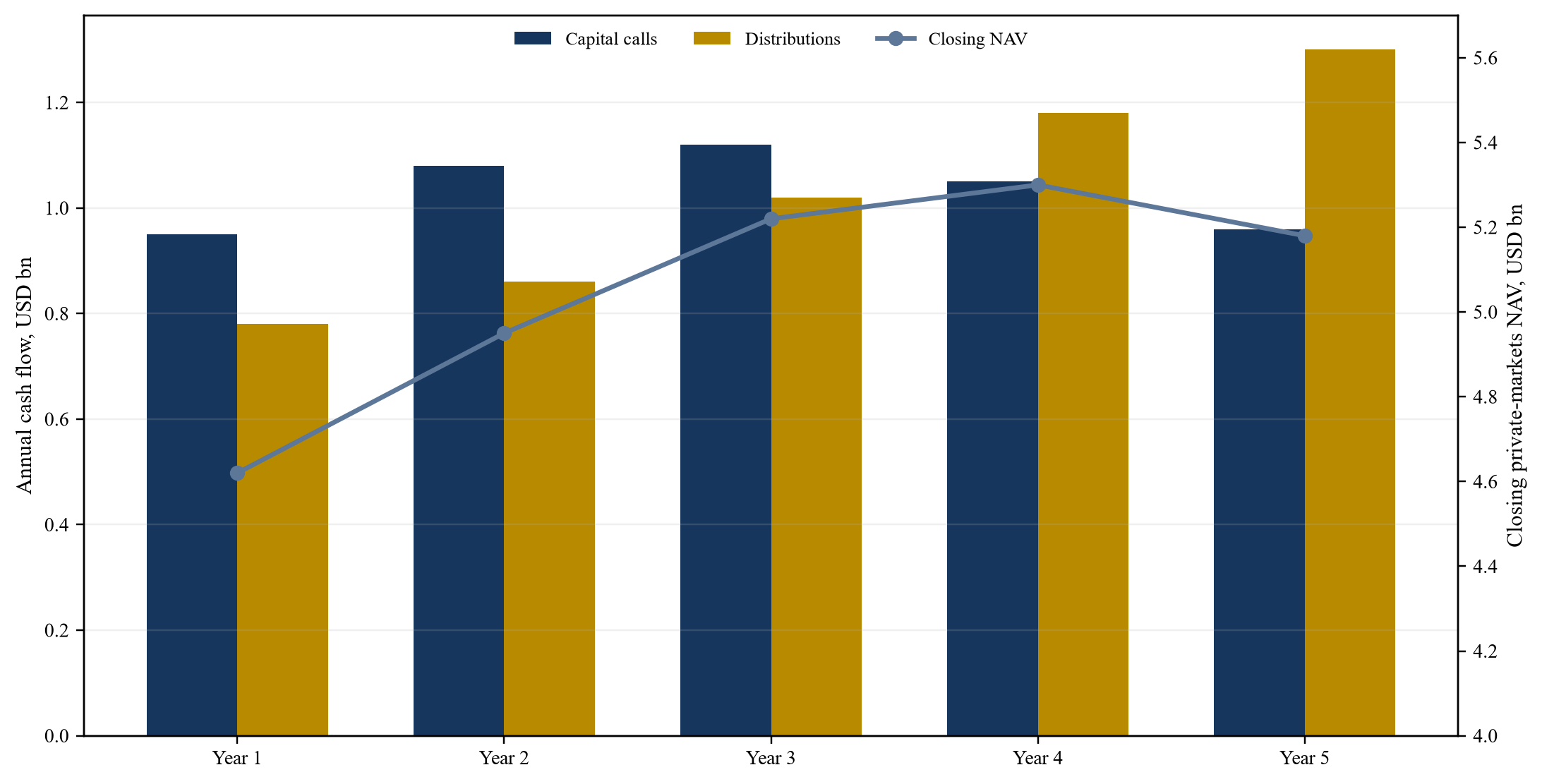
Values are illustrative management assumptions. Bars show annual calls and distributions; the line shows closing private-markets net asset value.
13. Distinguish allocation capacity from funding capacity
Allocation capacity measures the amount of exposure permitted by policy. Funding capacity measures the amount of cash the fund can provide while meeting every other obligation. Both tests should pass before a commitment is approved.
A fund below its strategic private-markets target can still lack funding capacity. Its current net asset value may be low because valuations lag or previous funds have not yet called capital. Benefit outflows, collateral needs or a planned transition can consume the liquid resources needed for new commitments.
A fund above its target can still have strong liquidity. The appropriate response may be to reduce commitments, sell selected interests or wait for distributions rather than force an immediate sale. Policy ranges and correction procedures should reflect transaction costs and illiquidity.
The board pack should show both measures on the same page. The first shows projected net asset value as a percentage of total assets under central and stressed denominators. The second shows available liquidity divided by required outflows over defined horizons. A commitment proceeds only when the governance thresholds are met.
14. Control the denominator effect
Private-market net asset values are often reported later than public-market prices. A public-market fall can reduce total-fund assets quickly while private valuations remain based on an earlier date. The private-markets percentage can rise even without new calls or positive private performance.
The denominator effect can create a policy-range breach, a liquidity strain or both. The committee should distinguish a mechanical percentage increase from an economic increase in private exposure. It should also recognise that later private valuation adjustments can deepen or reverse the apparent effect.
CalPERS policy material recognises lagged and appraisal-based valuations when managing asset-allocation ranges [16]. CalSTRS states that its private assets can be reported with a valuation lag and then adjusted for subsequent cash flows [15]. These practices illustrate why the pacing model needs a valuation-date bridge.
The model should carry reported value, cash-flow-adjusted value and an internal current estimate where governance permits. Any estimate should state method, source, range and uncertainty. IFRS 13 defines fair value as an exit price using market-participant assumptions at the measurement date and requires relevant market conditions to be considered [17]. The pacing model should not convert an internal liquidity stress into an asserted accounting fair value.
15. Design the stress scenarios
The central case is insufficient for a contractual commitment decision. The fund should test at least four coherent scenarios: delayed distributions, accelerated capital calls, a public-market fall with a denominator effect, and a combined liquidity event involving calls, benefits and collateral.
The delayed-distribution scenario should reduce and postpone exits across relevant vintages. The accelerated-call scenario should bring forward deployment and include follow-on needs where plausible. The public-market scenario should reduce liquid-asset values, apply sale haircuts and update allocation ratios. The combined scenario should include collateral demands and operating delays.
The IMF's 2025 work on pension funds and financial stability identifies illiquid assets, derivatives, leverage and unexpected cash needs as interacting sources of liquidity risk [11]. It reports that pension risk depends on plan design, guarantees, withdrawal flexibility and the liquidity characteristics of the portfolio. A scenario should reflect those interactions rather than apply isolated shocks.
The fund should also run a reverse stress. It should solve for the distribution shortfall, call acceleration, collateral demand or public-market decline that exhausts the defined reserve. The result identifies the point at which commitments must stop or additional liquidity actions must be authorised.
| Measure | Central case | Delayed distributions | Accelerated calls | Combined market and collateral shock |
|---|---|---|---|---|
| Five-year new commitments | USD 5.00bn | USD 3.70bn | USD 3.90bn | USD 2.60bn |
| Five-year capital calls | USD 5.16bn | USD 5.02bn | USD 5.64bn | USD 5.38bn |
| Five-year distributions | USD 5.14bn | USD 3.62bn | USD 4.70bn | USD 3.24bn |
| Lowest annual liquidity reserve | USD 1.31bn | USD 0.72bn | USD 0.61bn | USD 0.18bn |
| Peak private-markets allocation | 21.2% | 22.8% | 22.4% | 26.1% |
| Required pacing response | Use central band | Move to lower band | Reduce and re-sequence commitments | Suspend discretionary commitments and execute action ladder |
Values are illustrative management assumptions. Liquidity minimum is measured after benefits, operating cash flows, calls, distributions and the scenario-specific collateral requirement.
16. Set liquidity coverage and warning thresholds
The fund should define a liquidity coverage ratio for each decision horizon. One practical measure divides available liquidity by required cash outflows under the selected scenario. Available liquidity should include only resources that can be used within the horizon after haircuts, operational limits and competing uses. Required outflows should include benefits, expenses, collateral and capital calls.
A single ratio can hide timing and concentration. The dashboard should therefore show the minimum daily or weekly cash balance, the largest expected call, the share of liquid assets already pledged, currency mismatches and the amount dependent on asset sales. It should also show how much of the reserve is needed for ordinary operations.
Thresholds should trigger predefined actions. A green range can permit commitments within the central band. An amber range can require the lower band, enhanced monitoring and committee approval. A red range can stop discretionary commitments, protect cash and execute the liquidity action ladder. Thresholds should reflect the fund's policy and evidence rather than the example values in this paper.
The coverage calculation should be refreshed after every material commitment, call, distribution, valuation update, asset-allocation change or market shock. A quarterly pacing model can be supplemented by a daily treasury view and a monthly investment-risk review.
17. Create a liquidity action ladder
The action ladder identifies the sequence, authority, capacity, timing and cost of each liquidity source. It should be approved before stress occurs. The ladder can include cash, maturing securities, contribution receipts, scheduled income, sales of liquid assets, repo, foreign-exchange conversion, rebalancing, commitment deferral, secondary sales and facilities that the fund is legally permitted to use.
Each action should have a realistic execution amount. A large bond portfolio may have less usable capacity after collateral requirements, market haircuts and policy restrictions. A secondary sale can take months and may require a discount, manager consent and data preparation. Sponsor support can be included only when it is documented and callable on the required timetable.
The ladder should state which assets are protected because selling them would impair liability hedging or create unacceptable risk. It should also identify assets that several functions expect to use. This removes double counting and forces an explicit total-fund priority decision.
Operational readiness matters. Bank accounts, signatories, settlement instructions, repo documentation, counterparty limits, collateral schedules and escalation contacts should be current. A theoretical source of cash is not part of the near-term reserve until the fund can execute it.
18. Use secondaries and portfolio construction deliberately
Secondary transactions can reduce unfunded commitments, sell mature or non-core exposures, acquire seasoned interests or alter the vintage profile. They are portfolio-management tools with price, process and conflict considerations. They should not be treated as guaranteed emergency liquidity.
The Pensions Regulator notes that secondary markets can allow investors to sell commitments and rebalance, while transaction opportunities and conflicts require careful diligence [6]. A pension fund should maintain current fund data and transfer requirements so that it can assess a sale without starting from incomplete records.
Portfolio construction can reduce pacing volatility. Diversifying strategies, geographies, managers and vintages can spread calls and distributions. The diversification should remain economic. Several managers can own similar assets or rely on the same financing and exit markets, producing correlated cash-flow outcomes.
Secondaries, co-investments and evergreen structures affect pacing differently. A secondary purchase can create immediate funded exposure with lower blind-pool duration. A co-investment can require rapid cash and concentrate risk. An evergreen vehicle may provide periodic subscriptions or redemptions but can introduce valuation and liquidity mismatches. Each structure needs its own cash-flow and control assumptions.
19. Govern subscription lines and fund-level leverage
Subscription facilities can bridge capital calls and simplify fund operations. They can also delay the investor's cash call, change the apparent age of invested capital and concentrate later funding. The pacing model should use the contractual and expected call schedule rather than assuming that a quiet early period represents lower ultimate deployment.
The due-diligence record should cover facility purpose, limit, tenor, security, borrowing-base terms, covenants, interest allocation, reporting and the general partner's policy for using the facility. It should also show how facility use affects performance measures and call timing.
Net asset value facilities and other fund-level borrowing can provide portfolio liquidity or support assets, while increasing leverage and priority claims. The limited partner should understand the purpose, security, recourse, consent rights and effect on distributions and recovery.
The model can apply a call-timing overlay for facilities. It should preserve the full unfunded commitment and test a concentrated repayment or call when the facility matures. Performance reporting should distinguish underlying value creation from financing and timing effects.
20. Integrate foreign-exchange and collateral risk
A global pension programme can commit in currencies different from its liabilities and reporting currency. The local-currency amount of an unfunded commitment changes as exchange rates move. The fund should record original commitment currency, remaining commitment, hedge policy and funding source.
The stress model should combine exchange-rate changes with capital calls. A weakening reporting currency can increase the cash needed for foreign commitments. If the fund hedges that exposure, the hedge itself can generate collateral calls. The liquidity plan should reflect both effects and avoid assuming that the hedge removes funding risk.
Collateral assets should be classified by eligibility, haircut, concentration and settlement. The FSB recommends that non-bank entities maintain governance and stress tests for spikes in margin and collateral requirements [9]. A pension fund should include private-market calls in the same total liquidity assessment.
Currency and collateral authority should be clear. Treasury may execute hedges within policy, while the investment committee approves the commitment and the board approves the strategic allocation. The decision record should show how these authorities connect and which function owns the combined stress.
21. Apply a commitment decision scorecard
A scorecard can convert the pacing framework into a repeatable approval record. The scorecard should include strategic fit, policy headroom, liquidity coverage, unfunded exposure, vintage concentration, manager timing, distribution confidence, total-fund risk, governance capacity and downside actions.
Scores should not replace evidence or judgement. Each score should link to a data source, date, owner and explanation. A commitment with high strategic merit can still fail the liquidity gate. A fund with ample cash can still fail diversification, valuation or governance requirements.
The decision can be approve, approve within conditions, defer, resize or decline. Conditions can include a lower amount, a later closing, a side-letter right, a co-investment cap, an improved notice process or completion of an operational control. Every condition needs an owner and deadline.
The committee should record the opportunity cost of the decision. Reducing one commitment can preserve capacity for a stronger manager or another strategy. Approving an oversized commitment can limit future selection and increase concentration.
| Band | Annual new commitments | Illustrative conditions | Required authority |
|---|---|---|---|
| Core continuity | USD 0.45bn-USD 0.65bn | Allocation at or above target; distribution shortfall; amber liquidity coverage | Investment committee within approved programme |
| Central pace | USD 0.80bn-USD 1.05bn | Allocation below target; central coverage above threshold; diversified calendar | Delegated team with committee reporting |
| Catch-up pace | USD 1.10bn-USD 1.30bn | Material under-allocation; strong stress coverage; no concentration breach | Investment committee approval for each period |
| Commitment pause | USD 0-USD 0.25bn | Red liquidity coverage; combined stress breach; policy range exceeded | Chief investment officer and committee escalation |
| Reopening | Set by refreshed model | Reserve restored; actions completed; current valuations and cash flows reconciled | Investment committee approval |
Thresholds are hypothetical. Each pension fund should set its own authorised limits from current legal, actuarial, investment and liquidity evidence.
22. Establish governance and delegated authority
The governing body should approve the strategic allocation, policy range, liquidity principles, pacing methodology and escalation rules. The investment committee should approve the annual band and material deviations. The chief investment officer can allocate commitments within the authorised band and concentration limits.
Treasury should certify funding capacity and operational readiness. Investment risk should challenge assumptions and run independent stresses. Actuarial and finance teams should provide liability, contribution and funded-status inputs. Legal and compliance teams should confirm authority, documentation and jurisdiction-specific duties.
The model owner should control versions, inputs, overrides and approvals. Changes to call curves, distribution expectations, valuation estimates or stress parameters should be logged with source, rationale and date. Overrides should remain visible in the committee pack.
Delegation should be designed for speed within limits. A commitment deadline can be short, while the pacing framework is prepared in advance. The delegated team can act when every gate passes and escalate when a threshold is breached or evidence is stale.
23. Monitor actual experience and attribution
The fund should compare actual calls, distributions, net asset value and liquidity with the approved model each month. Differences should be attributed to timing, manager behaviour, valuation, currency, transactions and assumption error. The purpose is to update decisions and improve the next forecast.
Call accuracy should be measured at total-programme and manager level. Distribution accuracy should distinguish announced, expected and statistical proceeds. The fund should track the share of liquidity provided by distributions, contributions and liquid-asset sales.
The dashboard should show current private-market net asset value, unfunded commitments, total exposure, policy headroom, annual commitments, expected twelve-month calls and distributions, liquidity coverage, concentration and scenario results. Data dates should be prominent.
Valuation lags should be reconciled through a bridge. Cash flows after the valuation date should be added or subtracted. Internal adjustments should be identified separately and replaced when manager valuations arrive. The committee should see how much of the allocation rests on stale or estimated information.
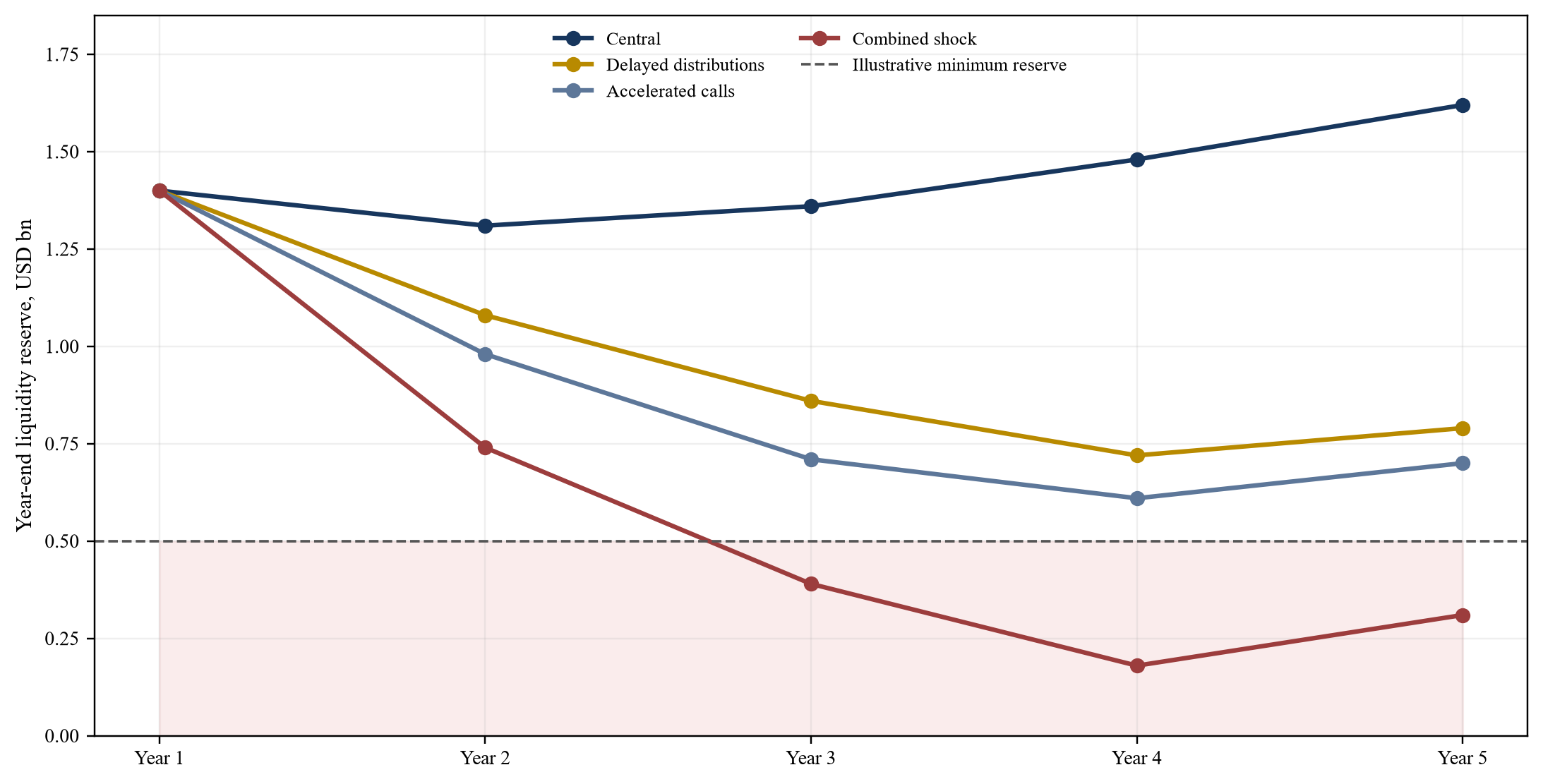
Values are illustrative management assumptions. The horizontal line represents a hypothetical USD 0.50 billion minimum operating and stress reserve.
24. Implement the framework over ninety days
The first thirty days should establish authority and data. The fund confirms the policy, reconciles commitments and net asset values, maps liability and collateral cash flows, inventories liquid assets and records current manager guidance. Material data differences are escalated before modelling proceeds.
Days thirty-one to sixty build and challenge the model. The team develops vintage call and distribution curves, a total-fund cash-flow forecast, valuation-date bridges and central, adverse and reverse-stress scenarios. Treasury tests the liquidity ladder and confirms accounts, documentation and signatories.
Days sixty-one to ninety convert the model into governance. The investment committee approves the pacing band, thresholds, delegation and escalation rules. The team runs a dry exercise using a hypothetical large capital call and simultaneous collateral demand. It records timing, decisions, settlement and residual reserve.
After implementation, the fund refreshes the model monthly and presents a full pacing decision at least annually or after a material change. The timetable is illustrative. A large or complex pension fund may need additional workstreams and independent review.
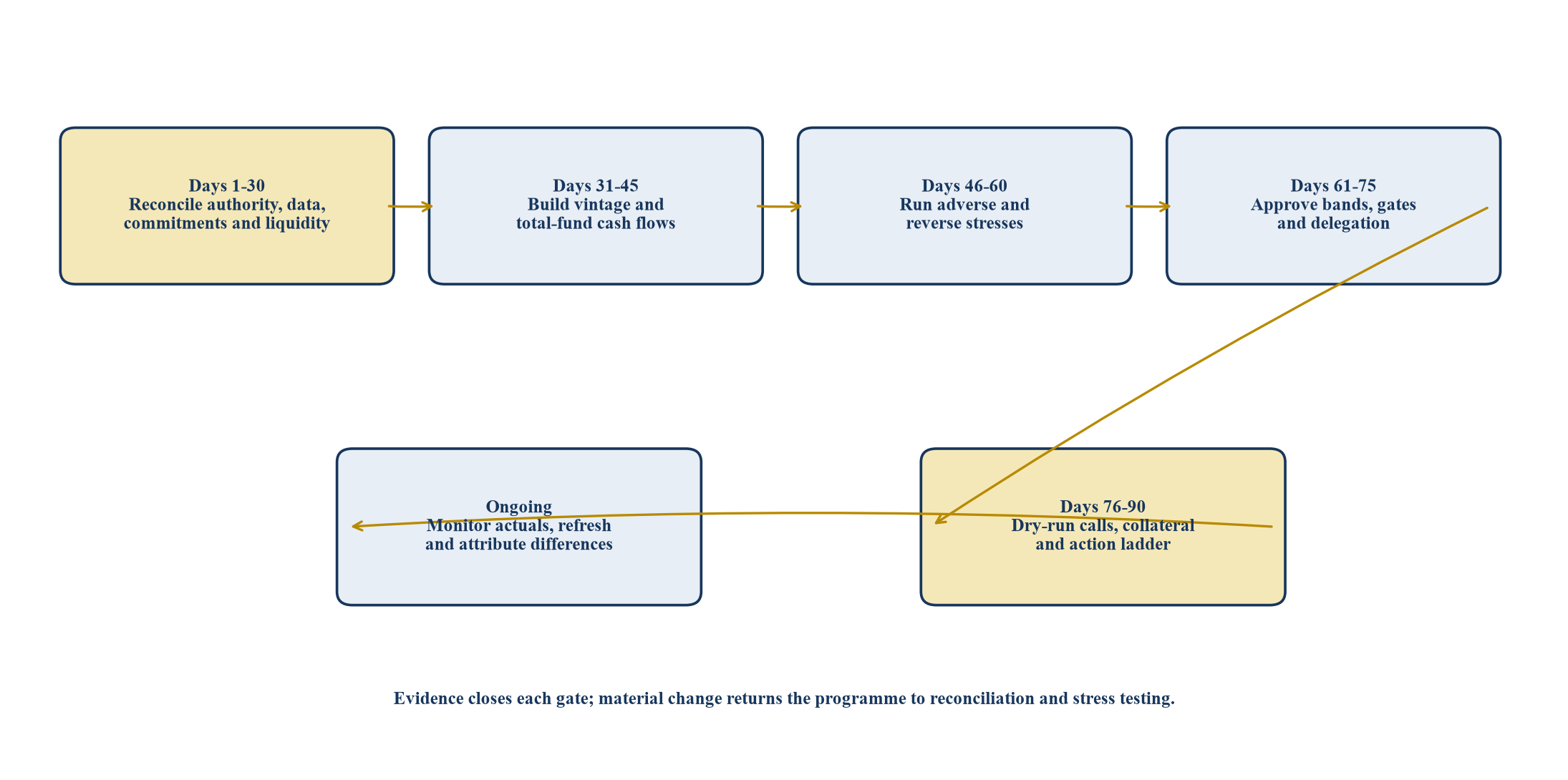
Timing is illustrative. Each stage closes only when its evidence, owner and approval are complete.
25. Control failure modes
Overcommitment often develops through several reasonable-looking decisions rather than one obvious breach. Strong recent distributions can support a high pace, successor funds can arrive together and public-market gains can enlarge the denominator. The position can change quickly when exits slow and liquid assets fall.
Model risk is a principal failure mode. A single call curve, distribution rate or valuation assumption can produce false precision. The fund should use ranges, scenario sets, vintage detail and independent challenge. Actual-versus-model attribution should change future assumptions.
Governance delay is another failure mode. A fund can identify a shortfall and still fail to act because the authority to sell, hedge, defer or draw liquidity is unclear. The action ladder should include named decision-makers, substitutes and settlement steps.
Double counting can create an apparent reserve that is unavailable in practice. The same cash, bond or facility can be assigned to benefits, collateral and capital calls. A central inventory should allocate each source once and show competing claims.
Valuation lag can hide exposure. The fund should bridge valuation dates and stress current values without presenting internal estimates as audited fair values. Commitment decisions should account for uncertainty and policy headroom.
| Failure mode | Observable signal | Programme control | Decision response |
|---|---|---|---|
| Distribution dependence | Calls are funded mainly by one recent exit cycle | Gross call and distribution scenarios | Move to lower band and protect cash |
| Valuation lag | Private allocation uses older dates than public assets | Valuation-date bridge and range | Reduce policy headroom available for commitments |
| Call concentration | Several large successor funds overlap | Manager and calendar concentration limits | Resize or re-sequence commitments |
| Liquidity double counting | Same assets support collateral and calls | Central liquidity inventory | Reallocate reserve before approval |
| Model drift | Actual calls or distributions repeatedly miss assumptions | Monthly attribution and parameter review | Refresh curves and rerun stresses |
| Governance delay | Action requires unavailable signatories or late committee meeting | Delegation and tested action ladder | Pre-authorise bounded actions |
| Currency mismatch | Foreign commitment grows against reporting currency | Currency-level forecast and hedge stress | Add reserve or adjust commitment amount |
| Policy breach | Stressed allocation exceeds approved range | Central and stressed denominator tests | Pause, rebalance or obtain authorised decision |
The control set is a governance framework. Actual duties, limits and remedies depend on the pension fund and applicable law.
26. Limitations and conclusion
This paper provides a governance and cash-flow framework for pension private-market pacing. It does not determine a suitable strategic allocation, expected return, legal duty, actuarial assumption, accounting value, regulatory treatment, manager selection or transaction price for any pension fund.
The worked case is hypothetical. Asset values, allocation ranges, commitments, calls, distributions, benefits, contributions, collateral needs, liquidity reserves, stress factors and thresholds are illustrative management assumptions. They are not observed fund results, forecasts or investment advice.
A pension fund can support a durable private-markets programme when commitments are governed through the entire cash-flow system. Current net asset value, unfunded commitments, vintage calls, distributions, benefit payments, collateral and liquid resources should be modelled together. The decision should remain within a documented band and change when evidence changes.
The practical outcome is a pacing programme that can continue through different market conditions without depending on one exit cycle or one valuation date. The framework provides the board record, stress tests, liquidity actions and delegated authority needed to make that outcome testable.
Sources
- OECD, Pension Markets in Focus 2025, 12 November 2025, accessed 17 September 2026, Read the primary source
- OECD, Pension Markets in Focus: Preliminary 2025 Data, June 2026, accessed 17 September 2026, Read the primary source
- OECD, OECD Core Principles of Private Pension Regulation, 27 September 2016, accessed 17 September 2026, Read the primary source
- European Insurance and Occupational Pensions Authority, 2025 IORP Stress Test Report, 2025, accessed 17 September 2026, Read the primary source
- European Insurance and Occupational Pensions Authority, Occupational Pensions Stress Test 2025, accessed 17 September 2026, Read the primary source
- The Pensions Regulator, Private Markets Investment, accessed 17 September 2026, Read the primary source
- The Pensions Regulator, Market Oversight: How Well Pension Schemes Are Prepared for LDI Risk and What Trustees Need to Know, 18 September 2025, accessed 17 September 2026, Read the primary source
- The Pensions Regulator, Investment Decision-Making, General Code in force 28 March 2024, accessed 17 September 2026, Read the primary source
- Financial Stability Board, Liquidity Preparedness for Margin and Collateral Calls: Final Report, 10 December 2024, accessed 17 September 2026, Read the primary source
- Bank for International Settlements, Liquidity Preparedness for Margin and Collateral Calls: Executive Summary, 25 March 2026, accessed 17 September 2026, Read the primary source
- International Monetary Fund, Pension Funds and Financial Stability, 2025, accessed 17 September 2026, Read the primary source
- Bank for International Settlements, The Rise of Private Markets, 10 December 2021, accessed 17 September 2026, Read the primary source
- European Central Bank, Private Markets, Public Risk? Financial Stability Implications of Alternative Funding Sources, May 2024, accessed 17 September 2026, Read the primary source
- California State Teachers' Retirement System, Private Equity Pacing Report, 11 January 2024, accessed 17 September 2026, Read the primary source
- California State Teachers' Retirement System, Private Equity Semi-Annual Report for the period ending 30 June 2025, accessed 17 September 2026, Read the primary source
- California Public Employees' Retirement System, Total Fund Investment Policy 2024 and Investment Policies page, updated 9 September 2025, accessed 17 September 2026, Read the primary source
- IFRS Foundation, IFRS 13 Fair Value Measurement, accessed 17 September 2026, Read the primary source
- The Pensions Regulator, Defined Benefit Funding Code of Practice, 2024, accessed 17 September 2026, Read the primary source
