

1. Diagnose margin as a system, not a percentage
The reported gross margin is the final line of a long decision chain. Procurement selects a supplier, specification, order quantity, currency and delivery term. Operations determines yield, scrap, rework, service capacity and inventory consumption. Commercial teams set list prices, discounts, bundles, payment terms and channel incentives. Finance records accruals, rebates, credit notes, provisions and foreign exchange. Tax and legal rules affect related-party terms, promotions, price displays and contract enforceability.
A board can therefore see a declining margin without seeing the economic causes. A lower purchase price may be offset by freight, inspection, warranty claims or excess stock. A customer price increase may be offset by a larger rebate, longer payment period or a shift toward a lower-margin channel. A product can appear profitable at standard cost while consuming scarce capacity or generating service obligations that never reach the product ledger.
The reset begins with a shared margin equation. Revenue is reconciled from list price to invoice value, then to collected cash. Cost is reconciled from quoted purchase price to landed cost, consumed cost and cost to serve. The analysis retains product, customer, channel, supplier, location and period dimensions. Each adjustment has a source, owner, authority, accounting treatment and cash effect.
This evidence system changes the board question from "Why is margin down?" to "Which decisions moved price, volume, mix, input cost, yield, service cost and cash, and which actions can management validly control?"
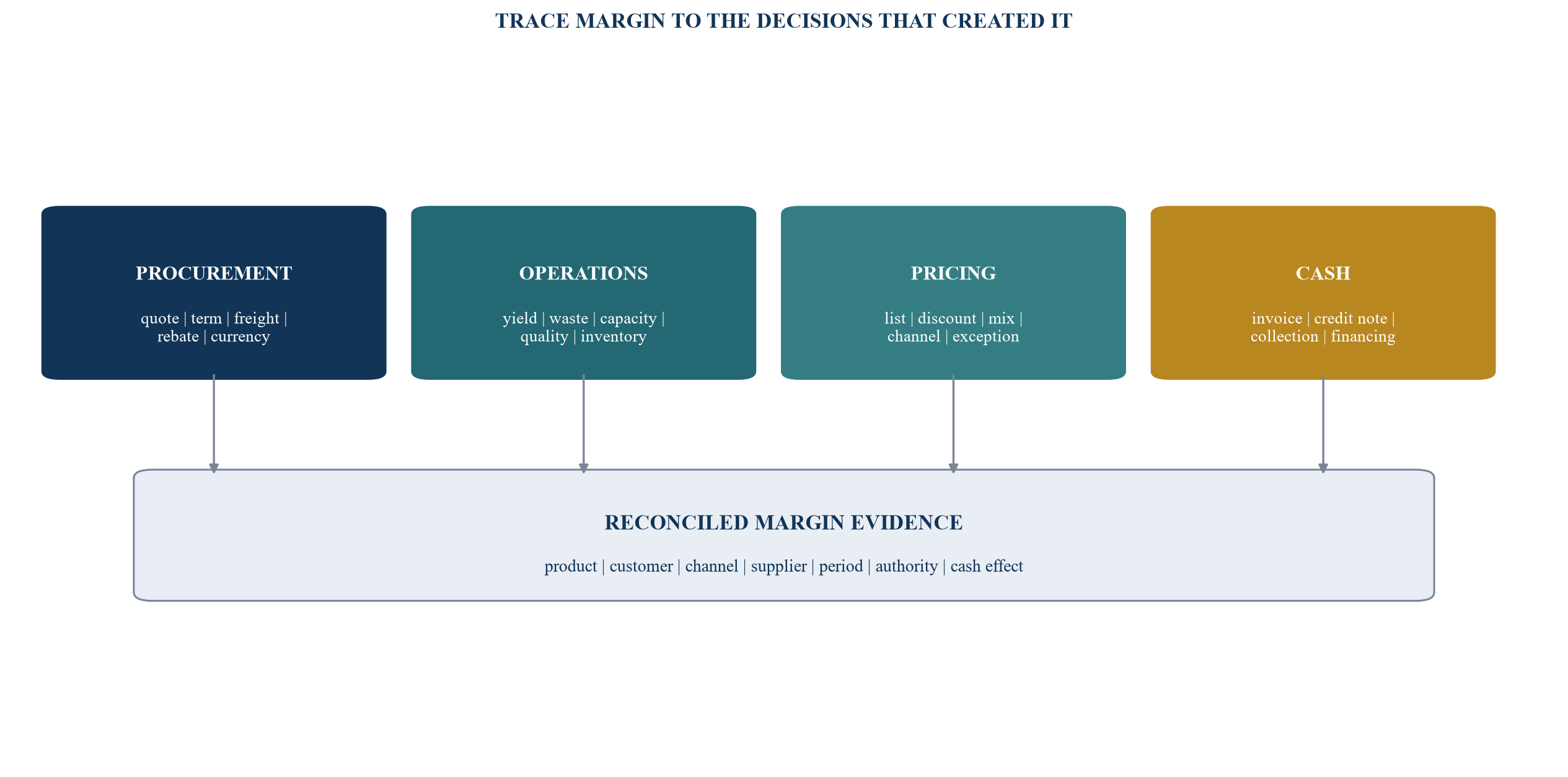
Procurement, operations, pricing and cash data meet in one reconciled decision layer.
2. Establish the legal and commercial perimeter
Pricing and procurement decisions sit inside a legal perimeter. The business should map each selling and buying entity, market, channel, customer type, supplier type and related-party relationship before changing terms. The map should identify applicable competition, consumer, tax, invoice, contract and sector rules, together with licences or approvals needed for promotions.
UAE Federal Decree-Law No. 36 of 2023 addresses restrictive agreements, including conduct that fixes selling or purchase prices contrary to market prices, collusive bidding, restrictions on production or distribution and division of markets. Procurement collaboration, supplier discussions, distributor policies and pricing forums therefore require competition review. Commercial teams should avoid sharing competitively sensitive future prices, costs, capacity or customer allocations without a lawful basis and qualified advice.
UAE consumer-protection legislation requires clear price display, accurate information and detailed invoices. Its executive regulations address unit prices, promotions and price reductions. The national pricing policy for specified essential consumer goods also places controls on price increases and supplier-retailer relationships for covered categories. The exact product and transaction must be checked against the current official scope.
Digital trading adds disclosure obligations. UAE legislation governing modern technology-based trade requires the trader to disclose the price and associated logistics and payment charges, provide terms and electronic invoices, and observe consumer and competition requirements.
The board should approve a jurisdiction-control register showing the legal rule, affected decision, control owner, evidence and escalation route. The register turns compliance into a design constraint for the margin programme.
Table 1. Authoritative obligations and margin-control implications
| Authority | Verified principle | Margin-control implication | Evidence retained |
|---|---|---|---|
| UAE Competition Law, Federal Decree-Law No. 36 of 2023 | restrictive agreements can include improper selling or purchase-price setting, collusive tendering, market division and supply restrictions | competition review for pricing coordination, tender conduct, distributor restrictions and supplier collaboration | training, meeting protocol, approval, tender record and legal review |
| UAE Consumer Protection Law and Executive Regulations | prices should be clear and accurate; promotions and reductions are controlled | govern list prices, unit prices, mandatory fees, promotion approval and invoice accuracy | approved price file, display test, promotion licence and sample invoices |
| UAE modern technology-based trade law | digital sellers disclose price, associated charges, terms and electronic invoice | reconcile website, marketplace, payment and fulfilment charges before publication | release checklist, screen record, terms, electronic invoice and change log |
| UAE Corporate Tax guidance | related-party transactions follow the arm's-length principle | support family, group and owner-linked purchases, sales, services, loans and licences | related-party register, agreement, method, benchmark and approval |
| Saudi ZATCA electronic invoicing | structured electronic invoices and phased integration apply to taxpayers in scope | pricing, tax, credit-note and system changes must flow through compliant invoice logic | schema validation, integration logs, invoice sample and credit-note control |
| IFRS 15 and IAS 2 | variable consideration affects transaction price; inventory includes specified purchase, conversion and other costs | align rebates, discounts, returns, cost allocation and net realisable value with accounting evidence | contract terms, accrual model, cost build-up, inventory test and ledger reconciliation |
| UK CMA and Australian ACCC price guidance | mandatory charges belong in the total price; price claims must not mislead | test advertised, checkout and comparative prices across channels | price-claim substantiation, screen test and approval record |
The table summarises official sources current at publication; qualified advisers should confirm scope and application.
3. Build the gross-to-net and pocket-margin baseline
The baseline should reconstruct revenue from the commercial promise to collected cash. Start with list price by product, service, pack, customer, channel and market. Subtract contractual discounts, discretionary discounts, rebates, promotions, distributor margins, commissions, returns, refunds, service credits, loyalty awards, free goods and credit notes. Add separately disclosed charges only when they are valid, collectable and correctly recognised. The result is pocket revenue.
Next subtract product cost and cost to serve. Product cost should include the relevant landed and conversion costs. Cost to serve can include order handling, customisation, expedited delivery, installation, financing, field support, warranty and returns where those costs differ materially by customer or channel. The result is a decision-oriented pocket margin. Accounting presentation and management decision views should reconcile, while their purposes can differ.
The baseline should cover at least a complete trading cycle and retain invoice-level traceability. Averages can conceal a small set of loss-making transactions. The analysis should identify which customers receive several concessions at once, which products depend on unrecorded service effort and which channels collect slowly.
IFRS 15 treats discounts, rebates, credits, concessions, incentives, bonuses and penalties as forms of variable consideration in relevant circumstances. The finance team should confirm recognition, estimation and constraint requirements for each arrangement. Management should reconcile commercial trackers to contract terms, invoices, credit notes, accruals and cash.
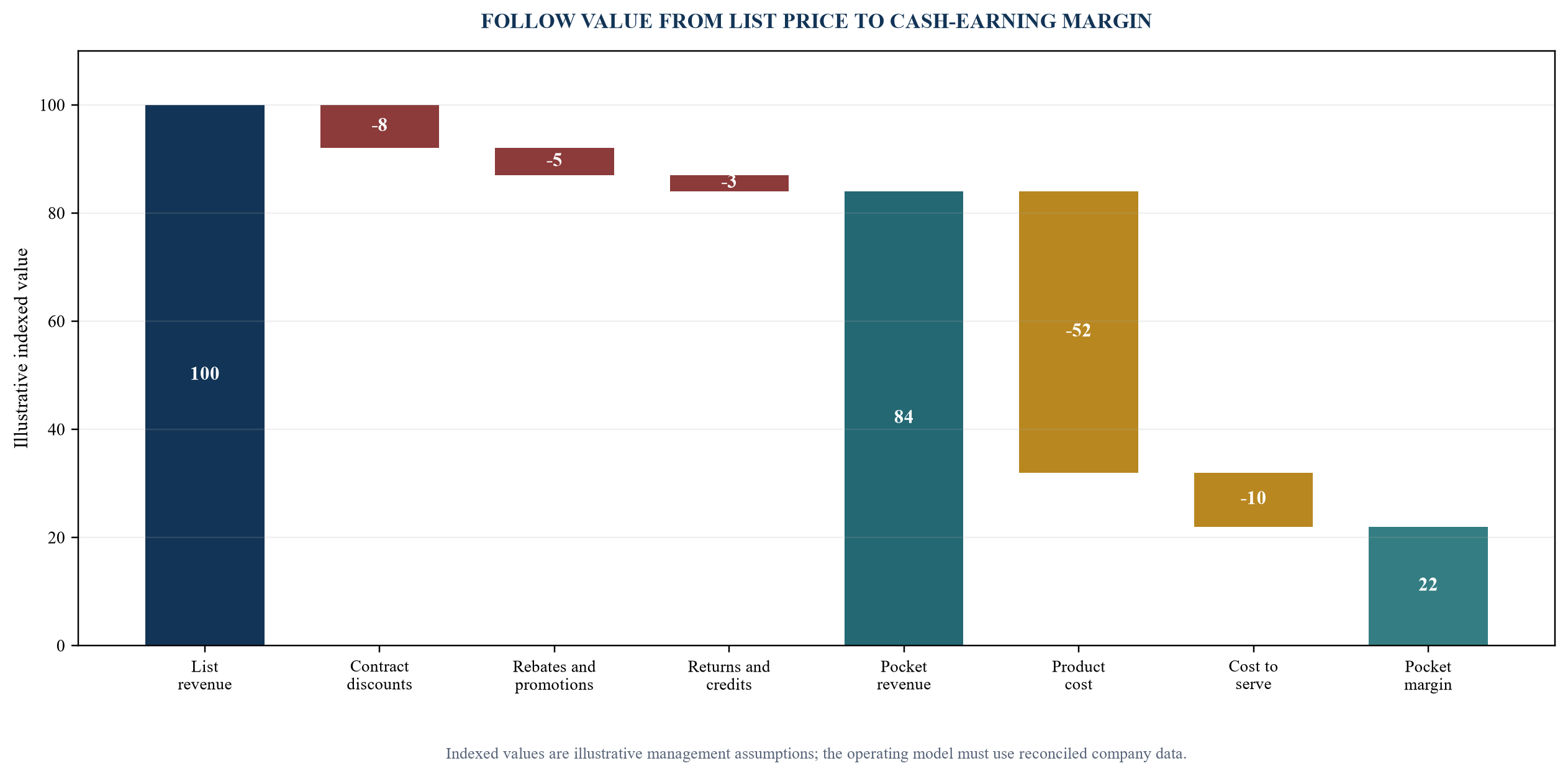
The waterfall exposes each commercial concession and cost-to-serve layer before the customer margin is accepted.
4. Reconcile quoted price to consumed cost
Procurement analysis should separate quoted unit price from the cost of obtaining and consuming the input. The cost bridge can include volume tiers, rebates, currency, freight, insurance, duty, customs clearance, handling, inspection, minimum order quantities, storage, financing, quality failure, yield loss, rework, warranty, obsolescence and disposal. The bridge should use actual invoices, logistics records, receipts, production consumption and claims.
IAS 2 states that inventory cost includes purchase costs, conversion costs and other costs incurred in bringing inventory to its present location and condition. Inventories are measured at the lower of cost and net realisable value. Finance should confirm which elements enter inventory measurement and which remain period costs. The management cost view may add decision-relevant cash or risk factors, provided it reconciles transparently to accounting.
The bridge should also distinguish controllable from structural drivers. Management can renegotiate a freight lane, change order cadence, simplify a specification or improve yield. It may have limited short-term control over a tariff, regulated charge or commodity benchmark. The action plan should assign a valid owner and time horizon to each driver.
Supplier comparisons should use a common specification and demand case. A low quote based on a different quality, delivery term, credit period or volume commitment is not comparable. Procurement should retain the assumptions and run sensitivity for volume, currency, lead time and defect rate before making an award.
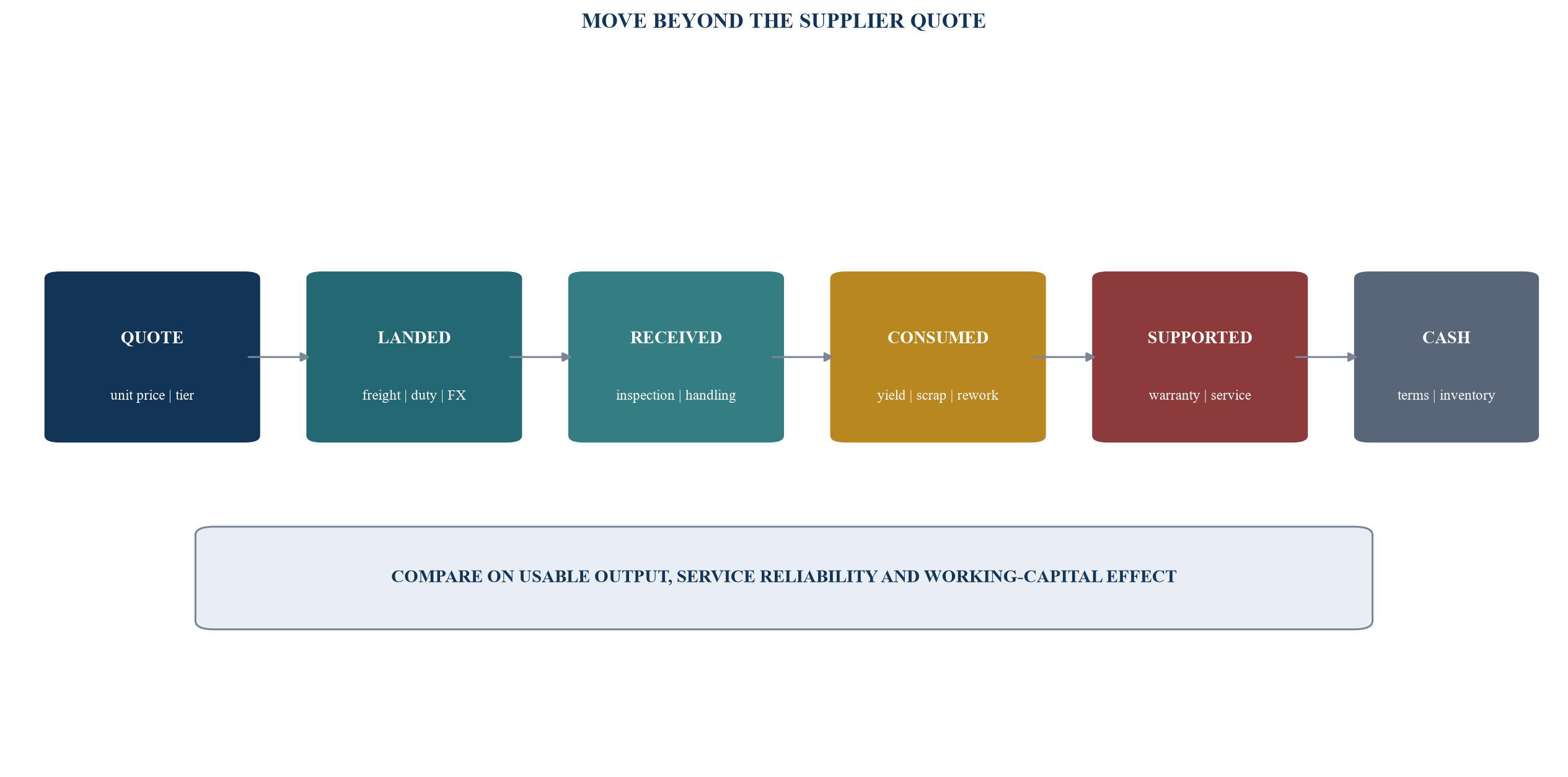
The bridge compares suppliers on the economic cost of usable output and cash exposure.
5. Segment spend by value, risk and substitutability
Spend segmentation should begin with clean supplier and category data. Management should reconcile supplier names, group entities, currencies, categories, purchase orders, invoices, credits, rebates, payment terms, quality incidents and business owners. Related or family-linked suppliers should be identified explicitly. Duplicate vendors and off-contract purchases should be resolved before opportunity estimates are accepted.
Each category can then be assessed on economic value, supply risk and substitutability. Economic value includes annual spend, margin effect, cash effect and demand growth. Supply risk includes concentration, lead time, country exposure, capacity, quality, regulation and financial resilience. Substitutability considers technical qualification, switching cost, tooling, intellectual property and customer approval.
Leverage categories may support competitive sourcing, volume consolidation and specification standardisation. Strategic categories need joint planning, capacity security, quality improvement and open-book economics. Bottlenecks require resilience, redesign or qualification of alternatives. Routine categories benefit from catalogues, automation and reduced transaction cost.
The segmentation should prevent a uniform savings target. A board directive to cut every category by the same percentage can damage critical supply, push risk into quality or encourage unsupported accounting estimates. Opportunity should be built category by category with an evidence owner, baseline, action, supplier response, implementation cost, cash timing and risk.
Table 2. Supplier and spend segmentation
| Segment | Evidence test | Primary action | Value measure | Risk control |
|---|---|---|---|---|
| leverage | meaningful spend, credible alternatives and limited switching friction | competitive sourcing, volume aggregation, term standardisation and price index review | landed-cost reduction, rebate realisation and cash terms | bid integrity, common specification and transition plan |
| strategic | high value with material operational or capacity dependence | joint business plan, open-book cost review, productivity and capacity agreement | total consumed cost, service level, yield and continuity | executive governance, dual scenario and performance rights |
| bottleneck | lower spend with high disruption effect or limited substitutes | demand assurance, redesign, alternative qualification and inventory policy | avoided downtime, expedited cost and revenue-at-risk | continuity plan, approved buffer and escalation triggers |
| routine | fragmented low-value demand and high transaction effort | catalogue, buying channel, blanket order, automation and supplier rationalisation | cost per transaction, compliance and cycle time | controlled catalogue, approval limits and exception report |
| related party | family, shareholder or group relationship affects terms or decision | arm's-length analysis, written agreement, conflict approval and periodic review | supported price, service scope, balance and tax treatment | related-party register, recusal, benchmark and disclosure |
The action depends on verified specification, demand, risk and total-cost evidence.
6. Reset demand and specification before negotiating price
The strongest procurement result can arise before a supplier negotiation. Management should test whether the business needs the current volume, service level, specification, variety and timing. Demand may be inflated by forecast bias, low order discipline, excessive safety stock, obsolete variants, unchallenged consumption or local preferences. A supplier discount on unnecessary demand still destroys value.
Specification creates much of the cost. Engineering, operations, brand and quality teams should review material grade, tolerance, packaging, configuration, testing, delivery frequency, service response and custom features. The question is whether each requirement protects customer value, safety, regulation or operational performance. Requirements without a valid value case become candidates for simplification.
The review should distinguish value engineering from uncontrolled cost reduction. Safety, regulatory compliance, performance and customer commitments remain gates. Changes require testing, approvals, change control and a measured transition. Supplier knowledge can help identify manufacturability, alternative materials and process improvements, subject to intellectual-property and competition safeguards.
Make-or-buy decisions need a complete economic model. Internal cost should include capacity, yield, labour, maintenance, capital, quality, working capital and opportunity cost. External cost should include transition, supplier margin, logistics, control, dependency and exit rights. The board should approve the assumptions and strategic constraints before the sourcing decision.
7. Negotiate total value and executable terms
A negotiation plan should convert the cost bridge and segmentation into fact-based objectives. The buyer should define its demand case, specification, current economics, alternatives, switching constraints, target, walk-away position, approval authority and concession sequence. The supplier view should cover capacity, input exposure, customer concentration, working capital, strategic importance and credible alternatives.
Terms need the same attention as headline price. Volume commitments, indexation, currency, delivery, quality, acceptance, rebates, service levels, warranty, intellectual property, audit rights, payment, termination, transition support and dispute mechanisms can change the realised margin. A rebate that is difficult to measure or collect has limited value. An index clause without an agreed source, base date, frequency, cap, floor and reset logic can create future ambiguity.
The team should record each concession and its exchange. Longer commitment might be exchanged for price visibility, capacity reservation or productivity. Faster payment might be considered only when the cash return exceeds alternative uses and the supplier is operationally important. Procurement should avoid unilateral promises outside authority.
Contracts should be executable in the operating system. Purchase orders, price masters, receipts, quality data, invoices and rebates should reflect the approved term. Legal drafting, tax treatment and accounting need specialist confirmation. The signed contract is the start of benefit realisation.
8. Protect supplier resilience and payment discipline
Margin recovery can fail when it transfers unsustainable working-capital pressure to a critical supplier. Procurement should assess supplier financial and operating resilience, especially for sole-source, high-growth or capacity-constrained categories. The assessment can include payment history, order volatility, capacity, lead time, quality, incident response and concentration. Sensitive financial information should be collected proportionately and governed.
Payment terms should be deliberate. Longer terms improve the buyer's cash timing only when suppliers can absorb or finance them without raising price, reducing service or failing. Shorter terms or approved supply-chain finance may create greater total value for a smaller supplier. The commercial model should compare price, cash, financing cost, resilience and implementation expense.
UK reporting rules require large businesses within scope to publish payment-practices reports at least twice yearly. Published information includes payment timing and late-payment performance. UK prompt-payment policy also uses defined payment-performance criteria in relevant public procurement. European Union late-payment rules provide statutory timing, interest and recovery rights in covered transactions. The applicable contract and jurisdiction require legal review.
India's TReDS framework enables MSME receivables financing through electronic acceptance and competitive financier bidding. It shows how invoice confirmation, buyer credit and transparent processing can improve supplier liquidity. A family business considering receivables or supply-chain finance should assess legal true sale, accounting, tax, data, recourse, pricing and operational integration with advisers and finance providers.
9. Rebuild price architecture by customer, channel and offer
Pricing should begin with the offer and customer decision, rather than a blanket percentage increase. Management should define the unit of value, customer segment, use case, alternative, service level, channel and willingness-to-pay evidence. The architecture then sets the list price, pack or tier, discount corridor, contractual indexation, minimum order, payment term and service boundary.
Segmentation should be operational. Each segment needs observable criteria that sales, finance and systems can apply. Examples include order size, service complexity, delivery window, channel role, commitment, credit risk and product configuration. Labels based only on relationship or negotiation strength invite inconsistency.
The price ladder should make differences intelligible. A basic offer can cover standard product, lead time and support. Higher tiers can provide customisation, faster delivery, assurance, analytics or dedicated capacity when the customer values them and the business can deliver them. Add-on fees should be transparent, contractually valid and clearly disclosed.
Price changes require an evidence pack. It should state cost and value drivers, customer effect, competitive context, contract rights, notice, communication, exception authority, system readiness and expected cash timing. Consumer and competition counsel should review relevant markets. The team should monitor win rate, churn, volume, mix, discount, complaints, receivables and realised pocket margin after implementation.
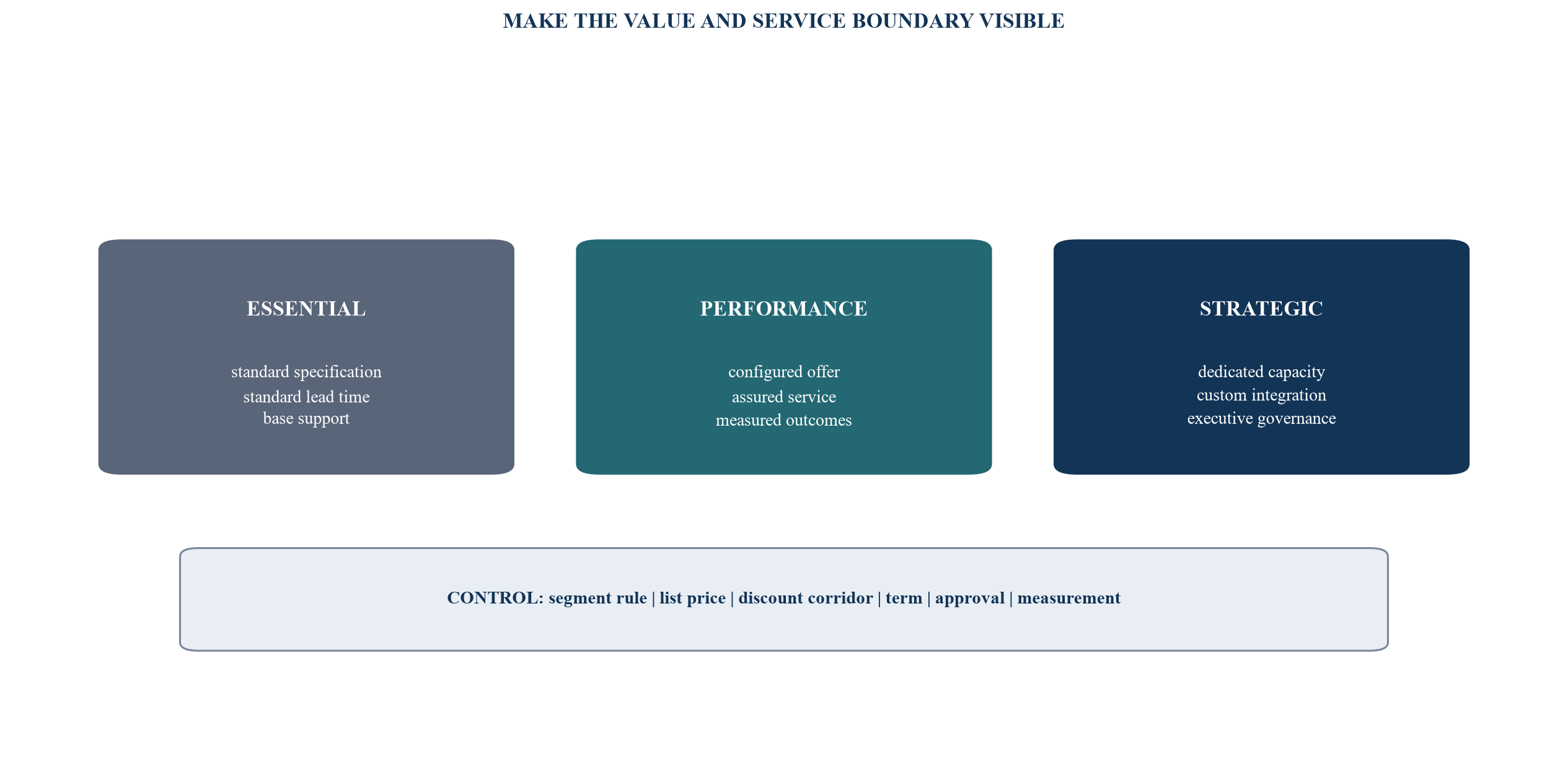
Price is built from a clear offer, value unit, service boundary and controlled corridor.
10. Govern discounts, rebates, promotions and credit notes
Margin leakage frequently occurs after the list price is approved. Sales teams may combine a contractual discount, discretionary discount, free quantity, rebate, extended payment, service inclusion and later credit note. Each concession can be valid; their cumulative effect may never be visible to the approving manager.
The business should maintain a single concession taxonomy. Every discount, rebate, promotion, refund, return, credit, incentive and non-price benefit needs a definition, calculation basis, eligible customer or supplier, period, owner, accounting treatment, approval limit and settlement evidence. Commercial language and finance codes should match.
IFRS 15 requires management to assess variable consideration and the constraint on amounts included in the transaction price. Finance should confirm whether consideration is payable to a customer, whether a material right exists and how returns or refunds are measured. Procurement rebates also require a documented accounting policy linked to the related purchases or inventory where appropriate. The paper does not determine the accounting treatment for a specific arrangement.
Promotions need additional controls. UAE consumer-protection regulations govern price display and promotions. European Union rules require transparency around the prior price for announced reductions in covered consumer sales. Australian guidance warns against misleading discount claims and requires the total minimum price, including unavoidable charges, to be prominent. Current local law and sector rules should be confirmed before launch.
Credit notes deserve a closed loop. Each note should link to the contract, invoice, reason, approval, customer communication, inventory or service event, tax treatment and root cause. Repeated notes may reveal pricing, quality, fulfilment or sales-incentive problems.
Table 3. Commercial concession control register
| Concession | Minimum evidence | Approval logic | Realisation test |
|---|---|---|---|
| contractual discount | executed agreement, eligible products, volume or commitment and period | within approved segment corridor; escalation outside corridor | invoice price and volume condition reconcile to contract |
| discretionary discount | documented reason, customer value, alternative and pocket margin | delegated limit based on cumulative concession and margin | approved amount appears once and customer pays as agreed |
| rebate | formula, base, exclusions, period, cap, data source and settlement | finance review and commercial owner; specialist accounting review | accrual, claim, credit or payment reconciles to verified activity |
| promotion | approved offer, prior or reference-price support, licence where required and channel test | legal, consumer and commercial approval before publication | displayed price, checkout, invoice and redemption agree |
| free goods or service | quantity, cost, purpose, eligibility and revenue treatment | included in cumulative deal economics | fulfilment and cost are captured in pocket margin |
| payment-term extension | cash effect, credit risk, financing cost and authority | credit and commercial approval with limit | due date, collection and expected loss are monitored |
| credit note or refund | invoice, reason, service or return evidence, tax treatment and root cause | independent approval above defined thresholds | note is posted, customer balance is correct and root cause closes |
Limits and escalation levels should be calibrated to the business, market and materiality.
11. Use value and competitive evidence responsibly
Pricing decisions need evidence about customer value, alternatives and commercial response. Sources can include win-loss records, contract renewals, customer interviews, usage, service tickets, competitive tenders, distributor feedback and controlled tests. The analysis should state the period, sample, question, customer type and limitations. Anecdote from a single negotiation should not become a market-wide conclusion.
Value should be expressed in the customer's terms. A component may reduce downtime, speed installation, lower energy use, improve yield, reduce compliance effort or release working capital. The price case should identify which customer receives the benefit, how it is measured and what credible alternative exists. Claims require substantiation and should avoid double counting.
Competitive evidence has boundaries. Teams may collect public prices, tender outcomes, customer feedback and lawful market research. They should not solicit or exchange future prices, costs, customer allocation, output or tender intentions with competitors. Industry meetings, distributors and shared suppliers need protocols where competitively sensitive information may arise.
Price testing should have a defined hypothesis, customer group, offer, authority, duration, measurement and stop rule. The team should evaluate pocket revenue, volume, mix, churn, receivables and complaints together. A higher realised price with materially worse cash collection or service burden may not improve value.
The evidence becomes part of a pricing file that can be reviewed by management, finance and advisers. This gives the board a defensible basis for differentiated actions across markets and channels.
12. Reconcile related-party economics and family governance
Family-owned businesses can have purchases, sales, services, loans, leases, licences, guarantees and employee arrangements involving shareholders, relatives or group entities. These relationships may support the enterprise, yet they can obscure true operating margin, create conflicts or require tax support.
The reset should establish a complete related-party universe. For each relationship, management should identify the parties, ownership or control link, service or product, agreement, annual value, balance, price method, payment, approval, tax treatment and intended future position. Personal expenses and shareholder benefits should be separated from company economics and addressed through qualified tax and legal advice.
UAE Corporate Tax guidance states that related-party transactions should meet the arm's-length principle. The FTA explains that the requirement can apply to transactions between UAE mainland entities, Free Zone persons and foreign related parties. OECD Transfer Pricing Guidelines provide internationally accepted guidance on applying the arm's-length principle to associated enterprises. A benchmark alone does not validate the transaction; functions, assets, risks, contractual terms and actual conduct require analysis.
Family governance should support commercial discipline. The board or authorised committee should approve related-party policy, conflicts, recusal, tender or benchmark expectations, documentation and periodic review. The UAE Family Businesses Law provides a framework for governance and continuity, including family charters and management. Constitutional documents and applicable law remain decisive.
The board should distinguish a market-based continuing arrangement from an owner-specific arrangement that changes after investment, succession or sale. This distinction improves margin analysis and transaction readiness.
13. Convert decisions into contracts, systems and invoices
A negotiated result is unrealised until it appears in the contract, master data, order, receipt, invoice, accrual and cash. The implementation plan should identify every system and document affected by a new supplier term or customer price. Owners should include procurement, sales operations, finance, tax, legal, technology, fulfilment and customer service.
Supplier terms should flow from the executed agreement into the purchase-order catalogue, approved vendor record, price condition, receipt tolerance, quality rule, invoice match, rebate model and payment schedule. Customer terms should flow into the quotation tool, price master, discount authority, order, invoice, tax logic, credit note and collections workflow. Manual overrides need a reason, owner, expiry and review.
Saudi Arabia's electronic-invoicing regime illustrates the importance of system integration. ZATCA defines electronic invoices as invoices generated and stored in a structured electronic format. Phase One began on 4 December 2021; Phase Two integration began on 1 January 2023 in waves for taxpayers notified by the authority. Businesses operating in scope should confirm current technical, security, clearance or reporting requirements directly with ZATCA and qualified advisers.
The UAE modern technology-based trade law also requires disclosure of price and associated fees, terms and an electronic invoice for covered digital trade. A release test should compare advertised price, checkout, contract, fulfilment, invoice, tax, credit note and ledger before a price change reaches customers.
Benefits should be validated from source transactions. Procurement savings should reconcile to actual quantity, price, landed cost and consumption. Pricing benefits should reconcile to invoice-level pocket revenue, volume, mix and cash.
14. Integrate inventory, working capital and cash conversion
Margin and cash must be evaluated together. A procurement action can reduce unit cost while increasing minimum orders, inventory days, obsolescence or supplier deposits. A price action can improve invoice margin while lengthening customer terms, raising disputes or slowing collections. The business should therefore maintain a cash-conversion view by product, supplier, customer and channel.
The cash-conversion cycle combines inventory days, receivable days and payable days. The standard measure is useful, while averages can hide concentration and ageing. The reset should examine slow-moving and obsolete inventory, unbilled work, overdue receivables, disputed invoices, early-payment discounts, supplier arrears and financing arrangements.
Inventory policy should link demand variability, lead time, service requirement, shelf life, substitution and disruption consequence. Buffers for a bottleneck category may be economically justified. The board should see the cash cost, expiry risk and trigger for release. IAS 2's lower-of-cost-and-net-realisable-value requirement also makes obsolete or impaired inventory a financial-reporting issue.
Receivables financing can be considered where the legal, accounting, tax and operational conditions support it. India's TReDS framework shows a structured sequence in which an invoice or factoring unit is accepted, financiers bid, the seller selects funding and the buyer repays the financier. The applicability of any platform or facility depends on entity eligibility, documentation, recourse and provider terms.
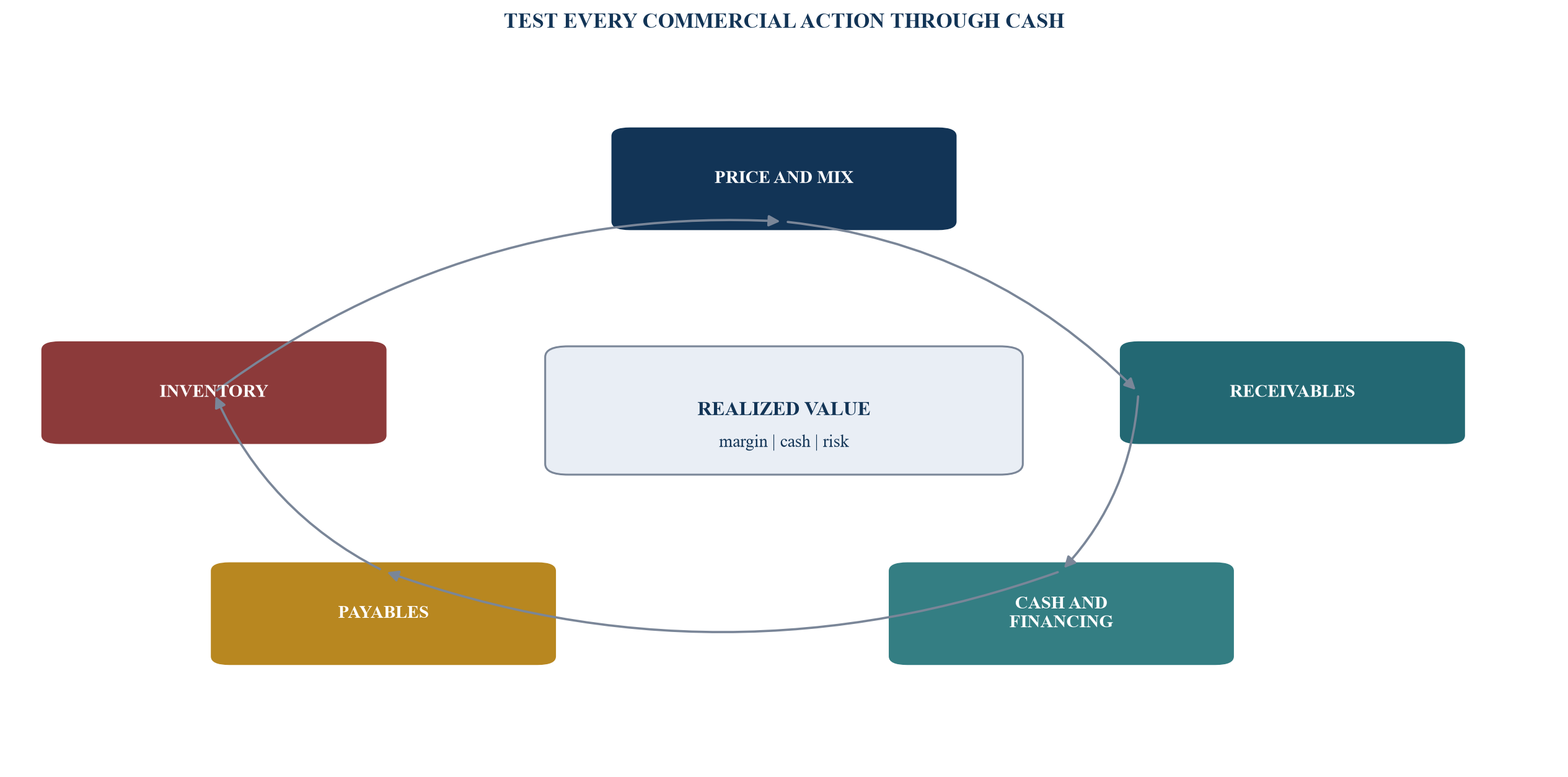
Each procurement or pricing action is tested for operating margin, inventory, receivables, payables and financing effect.
15. Build a compliance and control roadmap
The control roadmap should translate obligations into operating steps. It should identify the legal entity, market, product, channel, customer type, transaction, obligation, control, owner, evidence, test frequency and adviser. Changes in regulation, product mix or geography should trigger reassessment.
Competition controls can include tender protocols, competitor-contact guidance, information barriers, meeting records and legal escalation. Consumer controls can include price-display testing, mandatory-fee reconciliation, promotion approval and complaint analysis. Tax controls can include the related-party register, pricing method, agreements, invoices and periodic review. Accounting controls can include rebate accruals, revenue estimates, inventory costing and net realisable value. Invoice controls can include structured data, tax logic, credit-note linkage and archive.
The board should also understand enforcement and reputation exposure. A technically profitable price change can destroy trust if the invoice differs from the offer or mandatory charges appear late. A supplier initiative can create operational or competition exposure if teams exchange restricted information. The roadmap should therefore sit inside the implementation plan, rather than follow it as a final review.
Controls should be tested with transactions. Select samples across markets, entities, channels and exception types. Trace approval, contract, system, invoice, ledger and cash. Record failures, root causes, remediation and retest. Qualified counsel and advisers should determine legal or regulatory conclusions.
Table 4. Margin reset compliance roadmap
| Control domain | Trigger | Preventive control | Detective evidence | Escalation |
|---|---|---|---|---|
| competition | competitor contact, joint bid, distributor restriction, tender or market allocation issue | protocol, training, agenda and legal pre-clearance | meeting record, tender review and communications sampling | competition counsel and authorised executive |
| consumer pricing | new price, mandatory fee, comparison claim, promotion or discount | total-price build, substantiation, approval and channel release test | screen, checkout, invoice, complaint and refund sample | consumer counsel, commercial and compliance owners |
| related parties | family, shareholder or group transaction or balance | register, written agreement, arm's-length method and conflict approval | ledger scan, balance confirmation and transfer-pricing review | tax adviser, board committee and legal adviser |
| revenue and rebates | new concession, rebate, return right, credit or incentive | finance policy, contract review and system code | accrual-to-settlement reconciliation and estimate back-test | CFO and external accounting adviser where required |
| inventory | new source, specification, minimum order, slow movement or price decline | cost build-up, demand approval and inventory policy | ageing, yield, write-down and net realisable value test | CFO, operations and accounting adviser |
| electronic invoicing | entity, market, system or tax-rule change | schema, tax, security and integration validation | rejection log, invoice sample, credit-note link and archive test | tax, technology and competent authority support |
Each control should be mapped to the current official rule and tested in the relevant operating system.
16. Run the 90-day reset through four gates
Days one to fifteen establish the evidence baseline. The board appoints a sponsor and programme lead, confirms entities and markets, defines margin and cash measures, reconciles sales and purchase data, maps related parties and approves legal and competition protocols. Gate one requires a traceable gross-to-net and purchase-price-to-consumed-cost baseline, with known data gaps.
Days sixteen to thirty-five reset procurement economics. Cross-functional teams segment spend, validate demand and specifications, identify supplier and supply risks, build category strategies and prepare negotiations. They also review payment performance and working-capital effects. Gate two approves category actions, authority, continuity controls and expected value with implementation cost.
Days thirty-six to sixty-five rebuild price architecture. The commercial team defines segment and offer logic, creates list prices and corridors, reviews contracts, prepares customer communication, validates consumer and competition requirements and configures systems. Finance aligns variable consideration, invoice and credit-note controls. Gate three authorises a controlled release by market and channel.
Days sixty-six to ninety realise value and embed governance. Management validates supplier terms, price realisation, volume, mix, service, inventory, receivables, payables and cash. Exceptions and complaints are investigated. The board reviews realised evidence, open risk, capability and the next wave. Gate four approves continued operation, remediation or reversal.
The programme office should maintain a decision log, value register, risk register, dependency plan and weekly scorecard. Benefits remain provisional until verified through contracts, transactions, operations, ledger and cash.
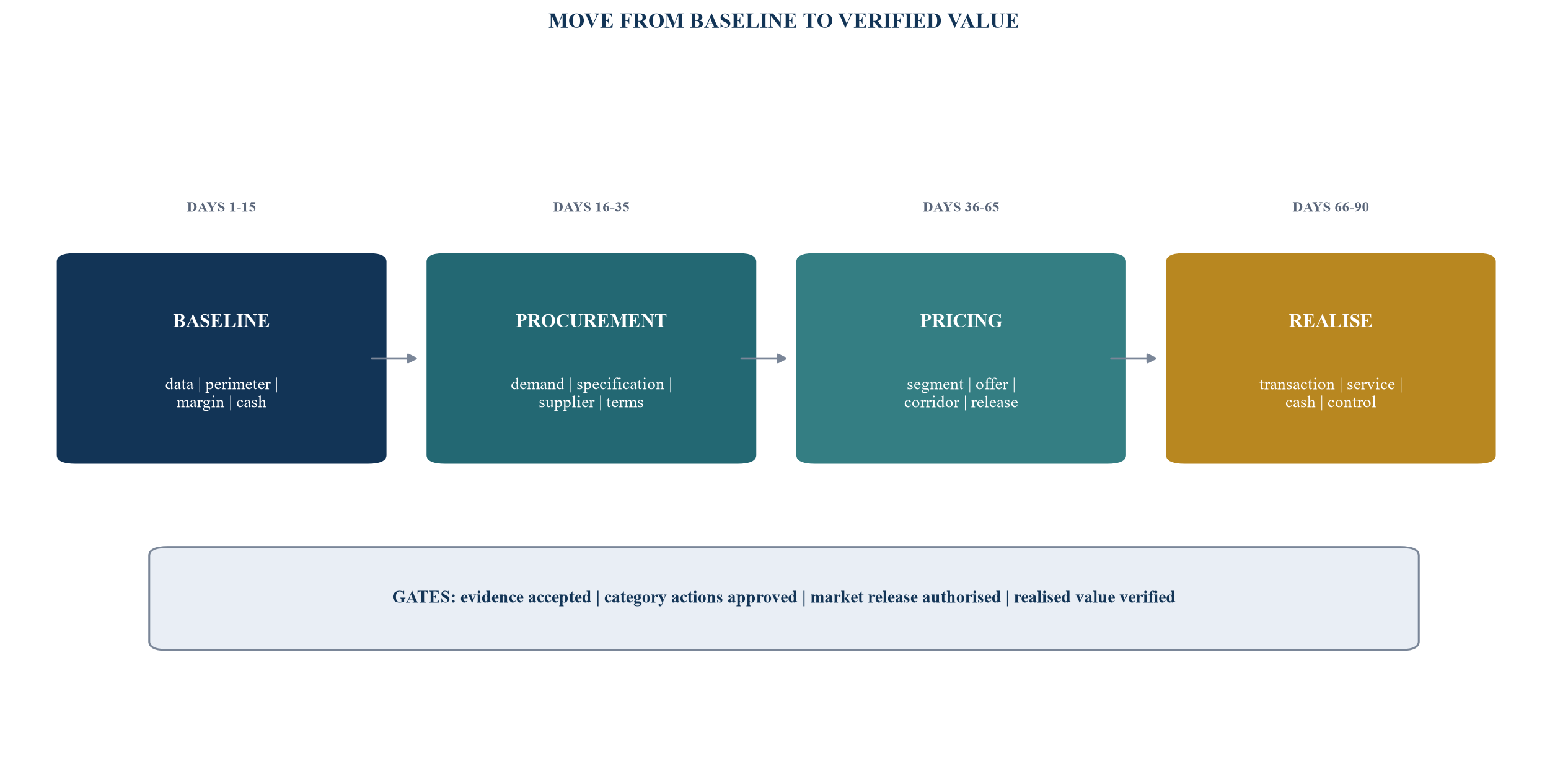
Each phase ends with an evidence gate that the board can approve, qualify or return for remediation.
17. Score execution with evidence
The scorecard should distinguish identified opportunity, contracted value, implemented value, accounting effect and collected cash. These are different states. Identified opportunity comes from an analysis. Contracted value appears in an executed supplier or customer agreement. Implemented value appears in the operating system and transaction. Accounting effect appears in the ledger under the applicable policy. Cash appears through payment and collection.
Procurement measures can include spend coverage, demand removed, specification changes approved, supplier awards implemented, landed-cost variance, yield, quality, service, inventory and payment. Pricing measures can include list-price adoption, exception rate, gross-to-net leakage, pocket margin, win rate, churn, mix, invoice disputes, receivable ageing and collection. Each metric needs a definition, source, frequency, owner and reconciliation.
The scorecard should retain a risk view. A margin action with a service failure, compliance breach, supplier distress or customer loss is not complete. Management should show residual risk, leading indicator and response trigger.
The board can use a value bridge from baseline to current result. The bridge should separate market volume, product mix, input price, currency, yield, procurement action, customer price, discount, service cost and one-off implementation expense. Finance should reconcile the bridge to reported results and cash. Independent review may be appropriate for material incentive or transaction claims.
Table 5. Board margin-reset scorecard
| Metric | Definition | Evidence source | Board question |
|---|---|---|---|
| gross-to-net coverage | revenue traced from list price through concessions to invoice and cash | price master, contracts, invoices, credit notes and bank | do we know where commercial value leaves the price? |
| consumed-cost coverage | material inputs traced from quote through landed and operating consumption | purchase order, logistics, receipt, production and quality data | are supplier comparisons based on usable output? |
| category implementation | approved supplier or specification actions operating in transactions | contract, master data, order, receipt and invoice | has negotiated value reached the business? |
| price realisation | expected price action reconciled to pocket revenue, volume, mix and cash | quotation, invoice, concession codes and collections | did customers pay the intended price without hidden leakage? |
| exception rate | transactions outside approved price, term or sourcing corridor | system override and approval logs | where is authority or system design failing? |
| cash conversion | inventory, receivable and payable effects by action | ageing, stock, supplier and financing records | did margin improvement release or consume cash? |
| compliance exceptions | pricing, competition, tax, accounting or invoice control failures | testing, complaints, audit and adviser review | which action requires correction or specialist decision? |
| verified value | implemented effect reconciled through transaction, ledger and cash | finance bridge and independent evidence review | which benefits can the board rely on? |
Targets and thresholds are illustrative management assumptions until approved against verified company data.
18. Make the board decision explicit
The final board pack should include the legal and commercial perimeter, margin baseline, gross-to-net waterfall, consumed-cost bridge, spend segmentation, supplier strategies, price architecture, related-party register, working-capital effect, compliance roadmap, implementation status, value bridge and risk register. Each item should identify its source, owner, date and unresolved question.
The board should approve specific decisions. It can authorise supplier awards and negotiation limits; approve specification or demand changes; approve price architecture, corridors and exceptions; confirm related-party governance; accept inventory and working-capital policy; authorise system release; and require remediation where legal, accounting or operational evidence is incomplete.
The decision should state conditions and stop rules. A price release may be limited to a market, segment or channel and reversed if complaint, churn, collection or compliance thresholds are exceeded. A supplier transition may depend on qualification, inventory, capacity and customer approval. A rebate may remain outside the benefit forecast until settlement evidence exists.
After the programme, a margin council or existing executive committee can review performance at an agreed cadence. Procurement, commercial, operations, finance, tax and legal owners should attend when their decisions are in scope. The board receives a concise evidence pack with value, cash, risk and capability.
Table 6. Board decision agenda
| Decision | Evidence required | Approval owner | Ongoing control |
|---|---|---|---|
| approve margin baseline | reconciled gross-to-net, consumed-cost and cash bridge with data gaps | board sponsor, CFO and operating executives | monthly source reconciliation and definition control |
| authorise procurement actions | category strategy, demand and specification case, supplier risk, terms and transition | authorised procurement committee or board | contract-to-invoice verification and supplier performance |
| authorise pricing release | segment, offer, value evidence, contract rights, compliance review and system test | authorised pricing committee or board | realised price, volume, churn, complaints, receivables and exceptions |
| approve related-party treatment | relationship, agreement, arm's-length support, conflict and tax analysis | disinterested authorised body with advisers | periodic review, ledger scan and disclosure reconciliation |
| approve working-capital policy | inventory, receivable, payable, financing and resilience effect | board, CFO and operating owner | ageing, limits, stress indicators and cash forecast |
| accept verified value | transaction, operating, ledger and cash evidence net of implementation cost | CFO and board sponsor | value bridge, audit trail and correction process |
| continue, remediate or stop | scorecard, control failures, residual risk and capability | board or delegated committee | documented conditions, owners, dates and retest |
Approval authority depends on constitutional documents, delegations, contracts and applicable law.
Implementation conclusion
A procurement and pricing reset creates durable margin when the business can trace value from supplier economics and customer promise through operations, accounting and cash. The board needs one evidence system, a clear legal perimeter and named owners for every material decision.
The 90-day framework begins with a reconciled baseline, challenges demand and specification, negotiates total value, builds a customer and offer architecture, governs concessions, integrates working capital and converts decisions into systems and invoices. It also protects supplier resilience, related-party transparency and customer trust.
Management should remain explicit about uncertainty. Opportunity estimates, scorecard weights and scenarios are management assumptions until supported by company data and approved decisions. Benefits become reliable when they appear in executed terms, operating transactions, the ledger and cash, with risk and compliance evidence retained.
References
- United Arab Emirates Legislation. Federal Decree-Law No. 36 of 2023 Regulating Competition. https://uaelegislation.gov.ae/en/legislations/2117
- United Arab Emirates Legislation. Federal Law No. 15 of 2020 on Consumer Protection. https://uaelegislation.gov.ae/en/legislations/1455
- United Arab Emirates Legislation. Cabinet Resolution No. 66 of 2023 Concerning the Executive Regulations of Federal Law No. 15 of 2020 on Consumer Protection. https://uaelegislation.gov.ae/en/legislations/2157
- UAE Government. Pricing Policy for Essential Consumer Goods. https://uaelegislation.gov.ae/en/policy/details/sy-s-tsaayr-lslaa-l-sthl-ky-las-sy-fy-ldol
- United Arab Emirates Legislation. Federal Decree-Law No. 50 of 2022 Promulgating the Commercial Transactions Law. https://uaelegislation.gov.ae/en/legislations/1610
- United Arab Emirates Legislation. Federal Decree-Law No. 14 of 2023 on Modern Technology-Based Trade. https://uaelegislation.gov.ae/en/legislations/2150
- Federal Tax Authority. Corporate Tax FAQs. https://tax.gov.ae/en/taxes/corporate.tax/faqs.aspx
- Federal Tax Authority. Corporate Tax General Guide. https://tax.gov.ae/DataFolder/Files/Guides/CT/CT%20General%20Guide%20-%20EN%20-%2010%2009%202023.pdf
- Federal Tax Authority. Accounting Standards and Interaction with Corporate Tax Guide. https://tax.gov.ae/Datafolder/Files/Guides/CT/Accounting%20Standards%20Guide%20-%2006%2011%202023.pdf
- OECD. OECD Transfer Pricing Guidelines for Multinational Enterprises and Tax Administrations 2022. https://www.oecd.org/en/publications/oecd-transfer-pricing-guidelines-for-multinational-enterprises-and-tax-administrations-2022_0e655865-en.html
- OECD. Transfer Pricing. https://www.oecd.org/en/topics/sub-issues/transfer-pricing.html
- IFRS Foundation. IAS 2 Inventories. https://www.ifrs.org/issued-standards/list-of-standards/ias-2-inventories/
- IFRS Foundation. IFRS 15 Revenue from Contracts with Customers. https://www.ifrs.org/content/dam/ifrs/publications/pdf-standards/english/2022/issued/part-a/ifrs-15-revenue-from-contracts-with-customers.pdf?bypass=on
- IFRS Foundation. IFRIC Update, June 2019, compensation for delays or cancellations. https://www.ifrs.org/news-and-events/updates/ifric/2019/ifric-update-june-2019/
- Zakat, Tax and Customs Authority. What is E-Invoicing? https://zatca.gov.sa/en/E-Invoicing/Introduction/Pages/What-is-e-invoicing.aspx
- Zakat, Tax and Customs Authority. E-Invoicing Guidelines. https://zatca.gov.sa/en/E-Invoicing/Introduction/Guidelines/Pages/default.aspx
- UK Competition and Markets Authority. Price Transparency: CMA209. https://www.gov.uk/government/publications/price-transparency-cma209
- UK Government. Large Businesses: Payment Practices and Performance Statistics. https://www.gov.uk/government/collections/large-businesses-payment-practices-and-performance-statistics
- UK Government. Check When Businesses Pay Invoices. https://www.gov.uk/check-when-businesses-pay-invoices
- UK Government. Prompt Payment Policy. https://www.gov.uk/guidance/prompt-payment-policy
- European Commission. Price Indication Directive. https://commission.europa.eu/law/law-topic/consumer-protection-law/unfair-commercial-practices-and-price-indication/price-indication-directive_en
- European Commission. Late Payment. https://single-market-economy.ec.europa.eu/smes/challenges-and-resilience/late-payment_en
- European Commission. EU Payment Observatory Analysis. https://single-market-economy.ec.europa.eu/smes/challenges-and-resilience/late-payment/eu-payment-observatory/observatory-analysis_en
- Australian Competition and Consumer Commission. Price Displays. https://www.accc.gov.au/business/pricing/price-displays
- Reserve Bank of India. Trade Receivables Discounting System FAQs. https://www.rbi.org.in/scripts/FAQView.aspx/FAQView.aspx/FAQView.aspx?Id=132
- Reserve Bank of India. Filing of Factoring Transactions by TReDS on the Central Registry. https://www.rbi.org.in/Scripts/NotificationUser.aspx?Id=12223
- Government of India, Press Information Bureau. CPSE Settlement of MSME Invoices through TReDS, 10 July 2026. https://www.pib.gov.in/PressReleasePage.aspx?PRID=2283195&lang=1®=20
- United Arab Emirates Legislation. Federal Decree-Law No. 37 of 2022 Concerning Family Businesses. https://uaelegislation.gov.ae/en/legislations/1608
- International Finance Corporation. Family Business Governance Handbook. https://www.ifc.org/en/insights-reports/2011/ifc-family-business-governance-handbook
- World Bank. Commodity Markets. https://www.worldbank.org/en/research/commodity-markets
- World Bank. Commodity Markets Outlook, April 2026. https://documents.worldbank.org/en/publication/documents-reports/documentdetail/099842304282633100
