

1. A funding-round price is a dated transaction, not a perpetual mark
The price paid in a private-company financing is valuable evidence. It records the amount negotiated by identifiable parties after a defined diligence process. It can reveal market appetite, company bargaining power, security rights and capital needs at the transaction date. The evidence weakens when it is detached from those facts.
A financing round can involve preferred shares with liquidation preference, conversion rights, anti-dilution protection, protective provisions, information rights and board representation. An employee or founder can hold common shares without those rights. Multiplying the preferred price by every fully diluted share can overstate the value of junior securities. Applying an arbitrary discount can also miss the capital structure and current company outlook.
The round price can contain strategic value. An investor may pay for commercial access, follow-on rights, governance, allocation scarcity, an existing relationship or a package of securities. A primary investment gives cash to the company. A secondary purchase gives cash to a holder. A combined round can price each leg differently. The transaction amount, security and purpose should be reconstructed before calibration.
Time then changes the answer. Revenue and margin can outperform or underperform. Cash runway can shorten. A product can clear a regulatory gate or fail a trial. Public comparables and discount rates can move. A new financing can become more or less likely. A sale process can begin. The mark should respond to information available at the measurement date.
IFRS 13 defines fair value as an exit price in an orderly transaction between market participants at the measurement date. The definition centres the date, asset, market and participant assumptions. It does not support carrying a historical transaction price forward without assessing current conditions.
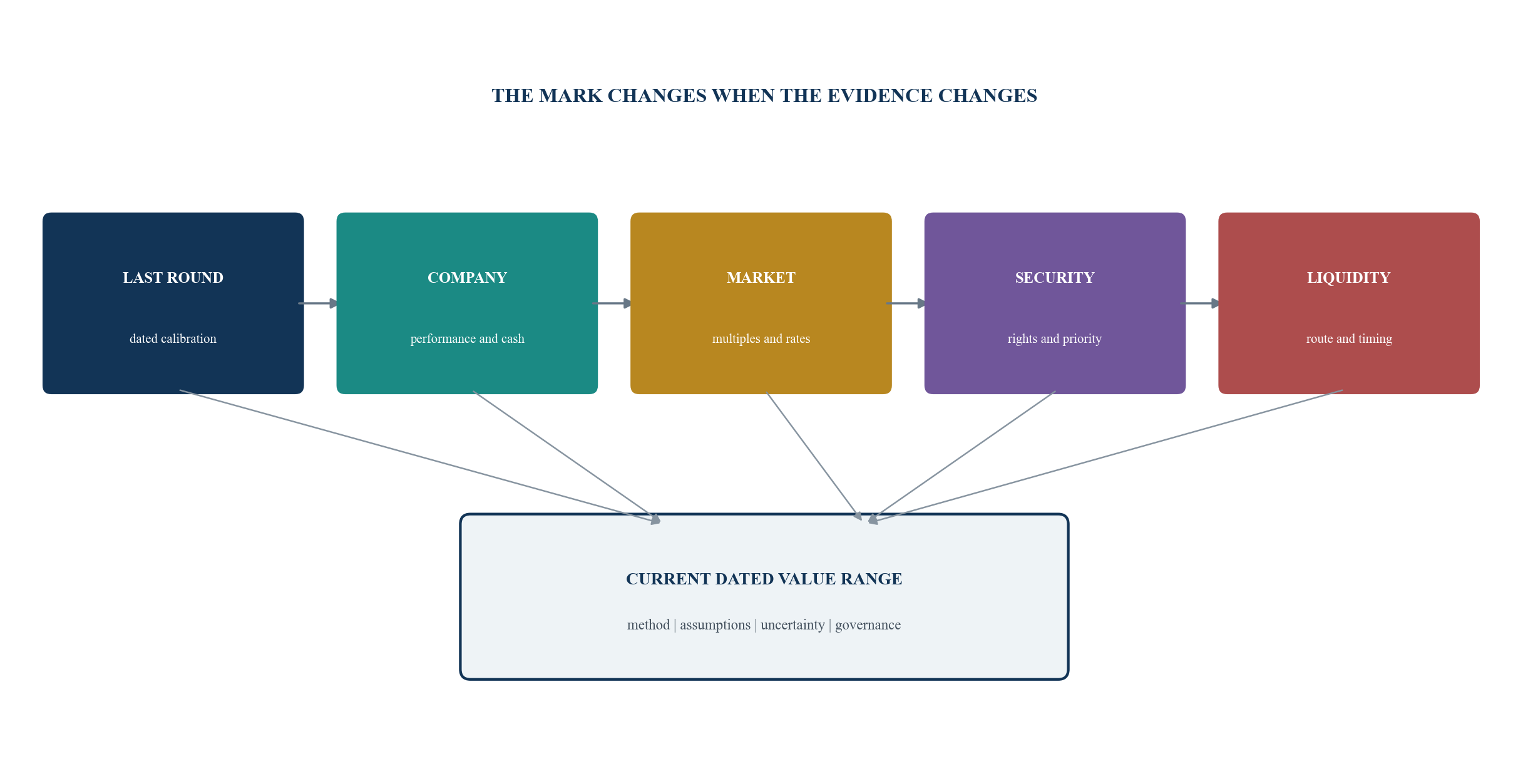
The current value conclusion reconciles the last transaction with current company, market, security and liquidity evidence.
2. Define the valuation mandate before calculating
One company can have several legitimate values on the same date because the purpose, security, unit and standard differ. Financial reporting can require fair value under an accounting framework. An employee option process can require a tax-specific market value. A secondary buyer can calculate an investment value using its return target. A board can assess transaction fairness. A lender can use a downside collateral value. These conclusions should not be mixed.
The valuation mandate should state the purpose, standard, measurement date, subject security, quantity, ownership percentage, rights, restrictions, assumed market, information set and currency. It should identify whether the conclusion is enterprise value, total equity value, class value, price per share, investment value or a transaction range.
The unit of account matters. A ten per cent common holding can have a different price per share from a controlling block because influence and rights differ. HMRC guidance on unquoted shares notes that holding size can be critical to value per share and advises against reusing another taxpayer's valuation. IFRS and US accounting requirements also require attention to the asset or liability being measured.
The information cut-off should be explicit. Management accounts, forecasts, financing discussions, customer contracts, litigation and product milestones can change after the date. A valuation should identify subsequent events and determine whether they provide evidence about conditions at the measurement date or create new conditions after it.
The final report should describe limitations and uncertainty. A private-company value is an estimate supported by current evidence. A narrow number can conceal the sensitivity to revenue, margin, discount rate, multiple, exit timing, preference and financing assumptions.
Table 1. Valuation mandate definition
| Dimension | Decision | Evidence | Common failure |
|---|---|---|---|
| purpose | reporting, tax, compensation, transaction or governance | engagement scope and applicable rules | using one value for every purpose |
| date | exact measurement date and cut-off | dated financial and market record | carrying forward a round price |
| subject | company, class, instrument and quantity | constitutional and security documents | valuing preferred and common alike |
| unit | individual share, lot, minority interest or control block | ownership and rights schedule | ignoring influence or contractual rights |
| information | facts available to market participants at the date | data-room and delivery log | using later knowledge without analysis |
| market | principal or most advantageous market where relevant | transaction and participant evidence | assuming a market the holder cannot access |
| output | enterprise, equity, class, lot or per-share range | calculation bridge | presenting an unsupported single number |
The governing standard and actual transaction determine the precise requirements.
3. Reconstruct what the last round actually priced
The calibration file should begin with executed documents, not a press release. It should identify close dates, cash paid, primary and secondary amounts, security class, share quantity, conversion price, liquidation preference, participation, dividends, anti-dilution, warrants, side letters, governance, information rights and transaction costs.
The headline post-money valuation can be calculated on a fully diluted basis that includes an expanded option pool. It can use a different denominator from the legal outstanding shares. It can assume conversion of existing preferred securities. The team should recreate the announced number and reconcile it to the contract.
The investor's economics can include more than the stated share price. Warrants, discounted follow-on rights, guaranteed allocation, redemption protection or commercial benefits can shift value. A tranched round can make later funding conditional on milestones. A strategic investor can accept an expected financial return that differs from a purely financial market participant.
The transaction may contain distress or scarcity. A company with limited runway can accept protective terms while preserving a high headline valuation. A highly competitive round can price access and future rights. A bridge note can convert at a cap or discount that reflects an earlier negotiation. Each condition affects the calibration weight.
The round should be classified as orderly, related-party or otherwise constrained based on the relevant framework and facts. The valuation team should identify what was known to participants and whether the transaction size is representative of the subject holding.
Table 2. Funding-round calibration file
| Field | Question | Evidence | Valuation effect |
|---|---|---|---|
| capital type | how much was primary, secondary or converted? | funds flow and issuance schedule | separates company cash from holder liquidity |
| security rights | what preference, conversion and protection were bought? | certificate, articles and side letters | distinguishes preferred from common |
| denominator | what did pre-money and post-money include? | capitalisation definition and cap table | reconciles headline valuation |
| package | were warrants, governance or commercial rights included? | complete transaction documents | allocates value beyond stated share price |
| process | was there competition, distress or a related party? | board materials and bids | informs transaction weight |
| information | what forecasts and risks did investors receive? | dated data room and Q&A | anchors participant expectations |
| closing | were funds conditional or tranched? | closing certificates and milestones | adjusts certainty and timing |
Every item should cite the executed document and effective date.
4. Build the event clock from round date to valuation date
The event clock is a chronological bridge. It records company, capital, market and liquidity developments since the calibration transaction. Each event has a date, evidence, affected assumption, expected direction, magnitude range and owner.
Company events include actual revenue, margin, churn, customer concentration, backlog, product launches, regulatory approvals, litigation, leadership changes and cybersecurity incidents. Capital events include option grants, exercises, notes, debt, acquisitions, share repurchases, down-round protections and changes to preferences.
Market events include comparable-company prices, financing volumes, sector multiples, interest rates, currency, risk premiums and M&A activity. Liquidity events include secondary bids, tender offers, transfer restrictions, prospective financing, IPO preparation, sale processes and extension of time to exit.
HMRC's share-scheme guidance provides a clear example of dated-evidence discipline. It states that some agreed valuations end early when a significant event occurs, including changes to capital, arm's-length share transactions, flotation or takeover preparations, dividend declarations and new financial information. The exact HMRC process is purpose-specific, while the underlying event logic is broadly useful.
The event clock should distinguish evidence from interpretation. A lost customer is an observed event. Its effect on recurring revenue, margin and terminal multiple requires analysis. A signed acquisition offer is stronger transaction evidence than an informal expression of interest. Every adjustment should show its factual anchor.
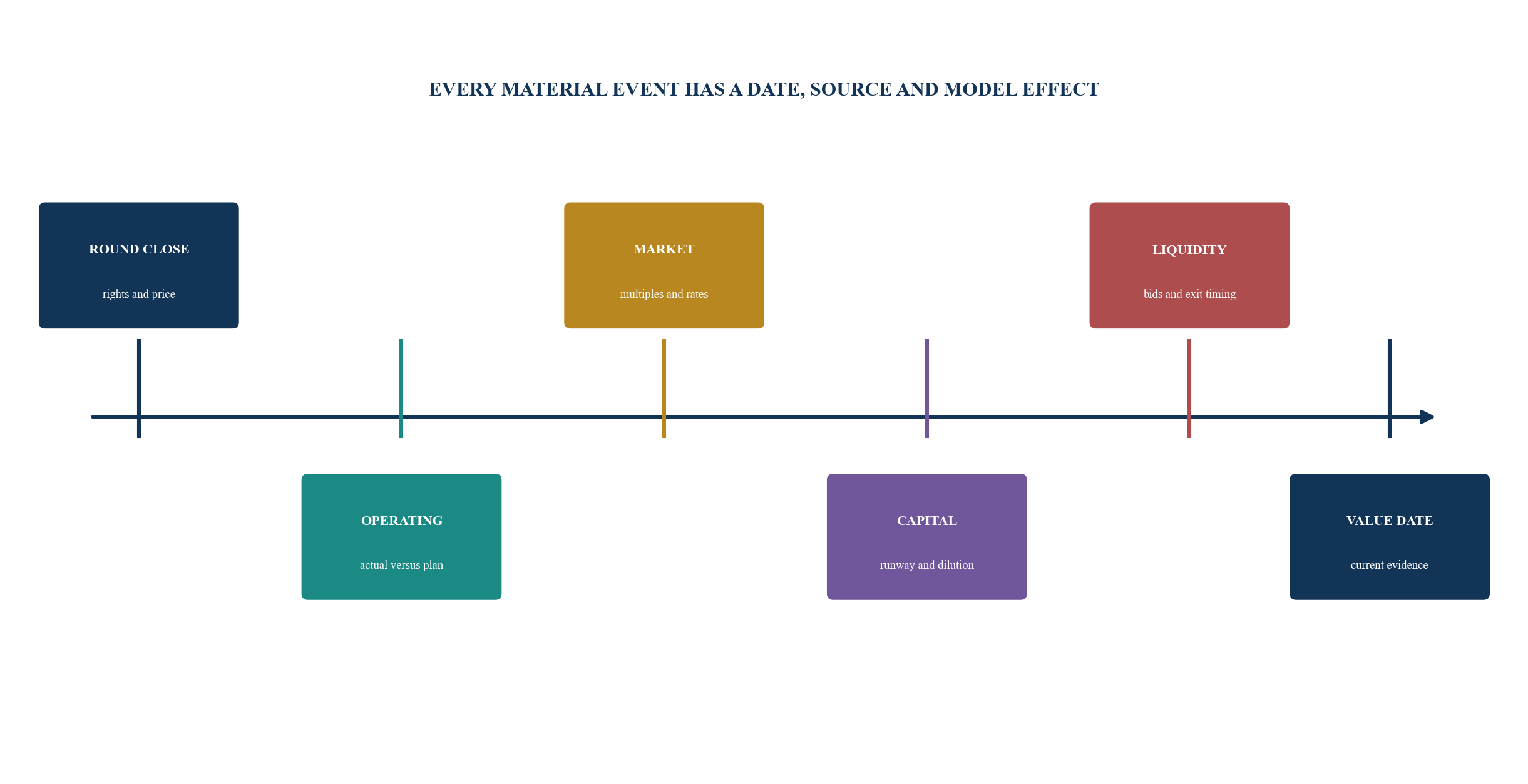
Events update specific assumptions; they do not create automatic percentage adjustments.
5. Separate enterprise value from security value
A current enterprise value does not directly answer the value of one common share. The bridge from operations to security value passes through cash, debt, other claims, dilution and the contractual waterfall. Every layer should use the same measurement date.
Enterprise value can be estimated through a market approach, income approach or calibrated transaction method. Net debt and non-operating assets convert enterprise value to total equity value. The capital structure then allocates value across preferred shares, common shares, options, warrants, convertibles and other claims.
The liquidation waterfall can make the relationship nonlinear. At low exit values, senior preference can absorb most equity value. At higher values, preferred holders can convert and share pro rata. Participating securities, caps, accrued dividends and multiple preferences add breakpoints. The value per common share therefore cannot be derived from a flat discount to preferred without testing the rights.
The fully diluted denominator also changes. New option grants, exercises, cancellations, notes, warrants and anti-dilution adjustments can alter as-converted ownership. The cap table should be brought down to the value date and reconciled to legal records.
The output should show enterprise value, total equity value, each class value and the subject security. A reviewer should be able to trace the conclusion through the entire bridge.
Table 3. Enterprise-to-security value bridge
| Bridge item | Illustrative value | Evidence required | Core sensitivity |
|---|---|---|---|
| enterprise value | USD 240m | methods and market-participant assumptions | revenue, margin, multiple and discount rate |
| cash and non-operating assets | USD 34m | bank and balance-sheet evidence | availability and restrictions |
| debt and senior claims | USD 46m | lender statements and instruments | accrued interest and repayment amount |
| total equity value | USD 228m | reconciled bridge | enterprise and net-debt assumptions |
| preferred allocation | USD 132m | rights and waterfall | preference, participation and conversion |
| common and option allocation | USD 96m | cap table and allocation method | volatility, time to exit and dilution |
| subject common lot | USD 4.8m | quantity and restrictions | marketability and information rights |
Values are management assumptions and do not represent an observed company.
6. Use multiple methods and explain the weights
The market approach uses prices or valuation multiples from comparable public companies, M&A transactions, financing rounds or private secondaries. It can be powerful when comparable businesses, metrics and rights are understood. It can mislead when a company has different growth, margins, size, geography, customer concentration, capital intensity or regulatory risk.
The income approach discounts expected future cash flows. It makes assumptions explicit and can reflect company-specific economics. It is sensitive to forecast quality, terminal value, discount rate and probability of financing. Current market expectations should inform inputs under a fair-value mandate.
The calibration approach begins with the last orderly transaction and solves for the implied enterprise or equity value consistent with that security's rights. It then updates the calibrated assumptions for events. The method can use an option-pricing model or probability-weighted expected-return method when the capital structure has multiple outcomes.
Milestone analysis is particularly relevant for early-stage companies. Technical, regulatory, commercial and financing gates can change the probability distribution. A milestone should affect forecasts, exit scenarios or discount rates through a defined logic. A flat percentage uplift after a positive announcement lacks an analytical bridge.
The valuation committee should explain method selection and weights. A simple average can imply false equivalence. Greater weight can be given to a calibrated round close to the date with unchanged conditions, or to current market and income evidence when the round is stale or structurally different.
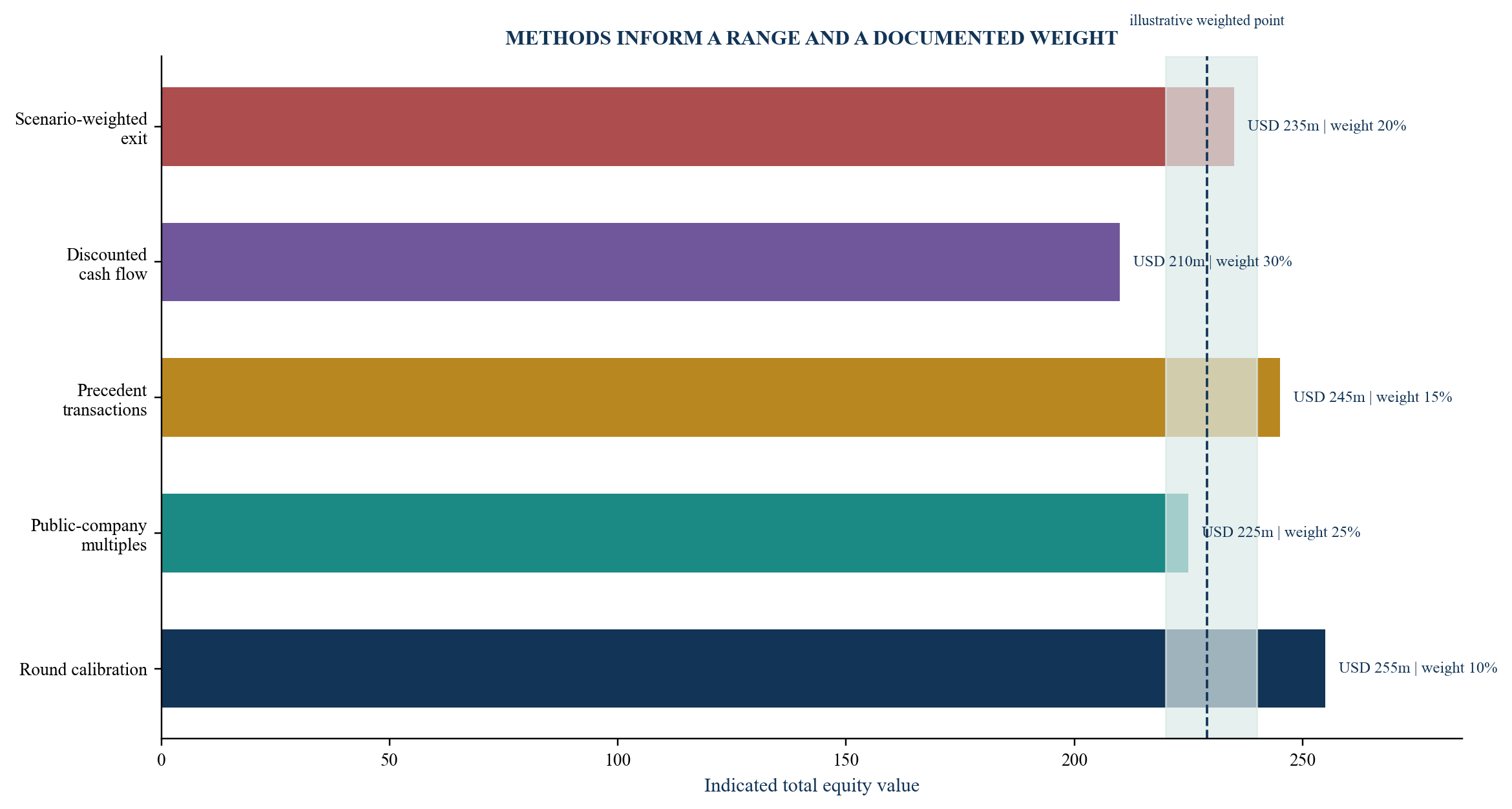
Values and weights are management assumptions; the actual conclusion requires purpose-specific evidence.
7. Calibrate the last round without freezing it
Calibration tests whether the valuation model can reproduce the price of the last transaction using the facts and rights available at that time. The model can solve for implied equity value, volatility, time to exit, scenario probabilities or return assumptions. It should avoid solving for an implausible combination merely to match the price.
An option-pricing backsolve can allocate equity among classes by treating common and preferred claims as options across breakpoints. It can capture conversion and liquidation preference. Its outputs depend on volatility, time, risk-free rate and the capital structure. A probability-weighted expected-return method can model IPO, sale, financing, continuation and downside outcomes explicitly.
The calibrated model becomes a baseline. The team then updates operating forecasts, market inputs, capital structure, rights, exit timing and scenario probabilities. It should show which assumptions changed and why. The last-round price remains a cross-check.
A round close shortly before the valuation date can receive high weight if it was orderly, well informed and structurally comparable. A round completed a year earlier can still matter, but current evidence usually becomes more important. A milestone-based tranche can create more recent calibration evidence when the later funding price was agreed earlier; the team should distinguish agreement date from funding date.
The model should identify calibration residuals. If the current methods produce a value far from the last round, the team should explain whether performance, markets, rights, distress, transaction package or modelling causes the difference. The answer should not be forced back to the headline number.
8. Bring operating performance to the same date
The valuation should replace funding-round forecasts with current evidence. The team compares actual revenue, annual recurring revenue, bookings, margin, burn, cash, churn, customer concentration and capital expenditure with the plan supplied in the last round.
Variance analysis should separate volume, price, mix, timing and one-off items. A missed revenue target caused by delayed contract signing can have a different value implication from lost customers. A gross-margin change driven by temporary launch costs differs from a structural increase in delivery expense.
Forecasts should reconcile with runway and funding. A company can show strong growth while requiring a financing before reaching breakeven. The valuation should model dilution, preference, debt or failure risk associated with that capital need. Management's financing plan is an input, while market-participant assumptions control under fair value.
The forecast should include a base case and relevant alternatives. Early-stage outcomes are often skewed. A single deterministic plan can understate the probability of both failure and exceptional success. Probability weights should be supported by milestones, comparable outcomes and current financing conditions.
The valuation file should preserve the round-date forecast, current actuals, current forecast and explanation. This creates an audit trail and prevents quiet replacement of assumptions.
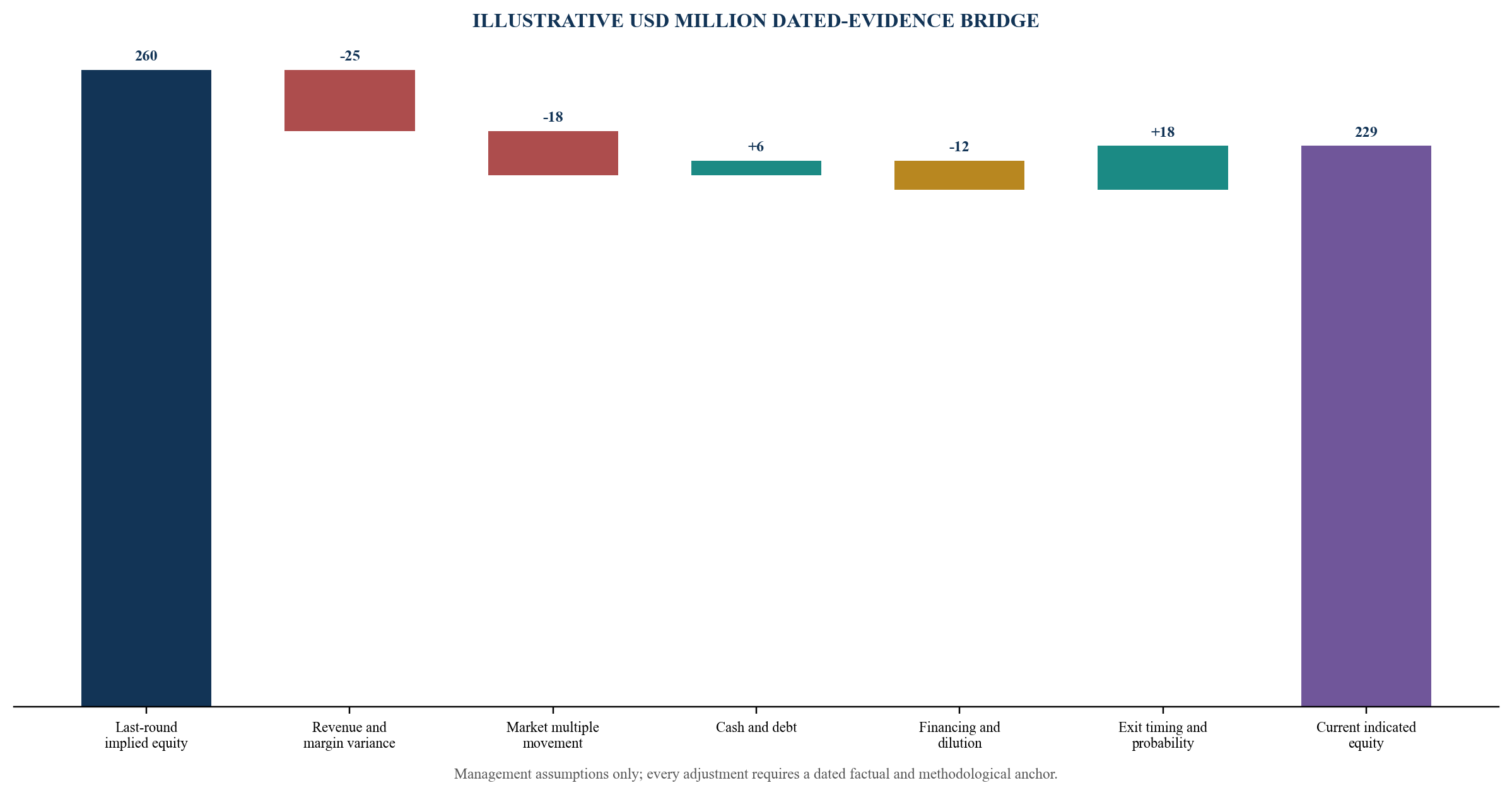
Values are management assumptions and do not represent an observed company or valuation conclusion.
9. Update market multiples, discount rates and exit conditions
Market evidence should match the value date. Comparable-company multiples can move because of interest rates, growth expectations, sector risk, regulation, profitability and capital availability. The company-specific multiple should also reflect size, growth, margins, concentration, geography and liquidity.
The peer set should be documented. Each peer should have a reason for inclusion, comparable metric, period, source and adjustments. Outliers should not be removed solely because they move the conclusion. The analysis can use median, quartile or regression evidence with a stated rationale.
Discount rates should reflect current time value and risk. A stale rate can preserve an old value even when market financing costs have changed. The income approach should reconcile risk-free rate, market risk, size, country, company-specific risk, debt cost and capital structure without double-counting the same risk in cash flows and rate.
Exit timing matters. Extending the expected IPO or sale date delays proceeds and can require additional financing. Shortening the horizon can raise value if the path is credible. The model should test exit route, timing, value and probability together.
Currency should be consistent. A company can earn in several currencies and report in another. The valuation should use dated exchange rates and consider whether currency risk is reflected in cash flows, discount rate or transaction evidence.
10. Allocate value through the actual capital structure
The allocation model should begin with a rights map. It identifies seniority, preference amount, accrued dividends, participation, cap, conversion, redemption, anti-dilution, warrants, options and convertibles. It then defines economic breakpoints where a security changes from preference to conversion or reaches a participation cap.
The current cap table should reconcile authorised, issued, outstanding, reserved, fully diluted and as-converted quantities. Share splits, exercises, grants, cancellations, notes and rights changes since the last round should be included. A stale denominator can offset or amplify the effect of enterprise-value changes.
Option-pricing methods can distribute value across uncertain future outcomes. A current-value method can be relevant when a liquidity event is imminent and the outcome is sufficiently known. A probability-weighted expected-return method can capture distinct exit scenarios. Method selection should reflect the facts.
The common-share value should be cross-checked against recent employee transactions and tax valuations where appropriate, while recognising different purpose, date, quantity and information. A transaction involving a small restricted lot can differ from the value of the whole class.
The report should show allocation sensitivities. Volatility, time to exit, preference, participation, new financing and option-pool changes can materially affect common even when total equity value stays constant.
Table 4. Capital-structure allocation controls
| Control | Evidence | Model action | Failure consequence |
|---|---|---|---|
| seniority | constitutional and financing documents | order claims by class and instrument | value allocated to junior shares too early |
| preference | invested capital, multiple and dividends | calculate claim at each outcome | preferred value understated or overstated |
| conversion | current ratio and triggers | identify conversion breakpoint | wrong as-converted ownership |
| participation | participation and cap terms | share residual proceeds as defined | common residual misstated |
| dilution | current options, warrants and convertibles | update fully diluted denominator | per-share value uses stale quantity |
| financing | expected new capital and terms | model dilution and preference | runway risk omitted |
| liquidity | timing and transaction route | select allocation and marketability inputs | security value detached from exit path |
Executed rights and a current legal cap table are required for the actual company.
11. Use secondary transactions as evidence with context
A private secondary transaction can provide direct evidence for the subject security. Its weight depends on size, date, parties, information, process, restrictions, buyer motivation, seller pressure and company involvement. A single small trade should not automatically reprice the entire class.
The diligence file should identify whether the trade closed, the exact class and lot, price, fees, payment terms, right-of-first-refusal process, company consent, buyer rights and any linked commercial arrangement. An indicative bid is different from an executable funded offer. A platform indication can have different information and settlement certainty from a company-sponsored tender.
Seller circumstances can affect price. A rushed tax or exercise deadline can produce a lower price. A strategic buyer can pay more for access. A company-sponsored programme can provide common information and controlled settlement. The analysis should describe these features rather than apply a generic secondary discount.
Information parity matters. The FCA's 2025 review noted that fairness in private-asset transfers depends heavily on whether incoming investors have sufficient access to information to form their own view. The principle applies directly to private-company secondaries.
The transaction evidence register can assign weight based on recency, comparability, orderliness, information quality and size. The weighting is a documented analytical judgement. Legal and accounting frameworks can impose additional requirements.
Table 5. Secondary transaction evidence hierarchy
| Evidence | Recency | Security match | Information and process | Indicative weight |
|---|---|---|---|---|
| completed company-sponsored tender for same common class | current | exact | common disclosure, broad participation, controlled settlement | high |
| completed arm's-length secondary for same class | current | exact | buyer diligence and company consent documented | high to medium |
| signed funded bid subject to final consent | current | exact | executable terms with remaining condition | medium |
| completed preferred financing | recent | different rights | full diligence but rights normalisation required | medium |
| platform indication or broker quote | current | stated match | limited verification and no completed settlement | low to medium |
| employee transfer under urgent personal constraint | recent | exact | seller-specific pressure | low unless normalised |
| old trade before material company or market events | stale | exact or similar | date no longer representative | low |
Scores are illustrative management assumptions; the actual facts and governing standard control.
12. Model uncertainty instead of smoothing it away
Private-company valuation uses unobservable inputs and judgement. The conclusion should communicate this uncertainty rather than manufacture public-market smoothness. A stable reported mark can be appropriate when evidence is stable. It can also result from delayed recognition or process incentives.
Sensitivity analysis should focus on inputs that can change the decision: revenue, margin, multiple, discount rate, exit timing, financing terms, volatility, probability of success and preference. A large table of immaterial sensitivities can obscure the key risks.
Scenario analysis can show downside, base, upside and exceptional outcomes. Each scenario should have a coherent operating, financing and exit story. Probabilities should be approved and tracked over time. The sum should reconcile to the selected method.
The value conclusion can be a point within a range. The range should reflect method and input uncertainty. It should not be so wide that it avoids judgement. The report should explain why the selected point is reasonable and what evidence would move it.
Back-testing compares prior marks with later financing, sale, IPO, impairment or failure outcomes. It should distinguish new information from errors in the earlier process. Repeated directional bias can reveal method, data or governance weaknesses.
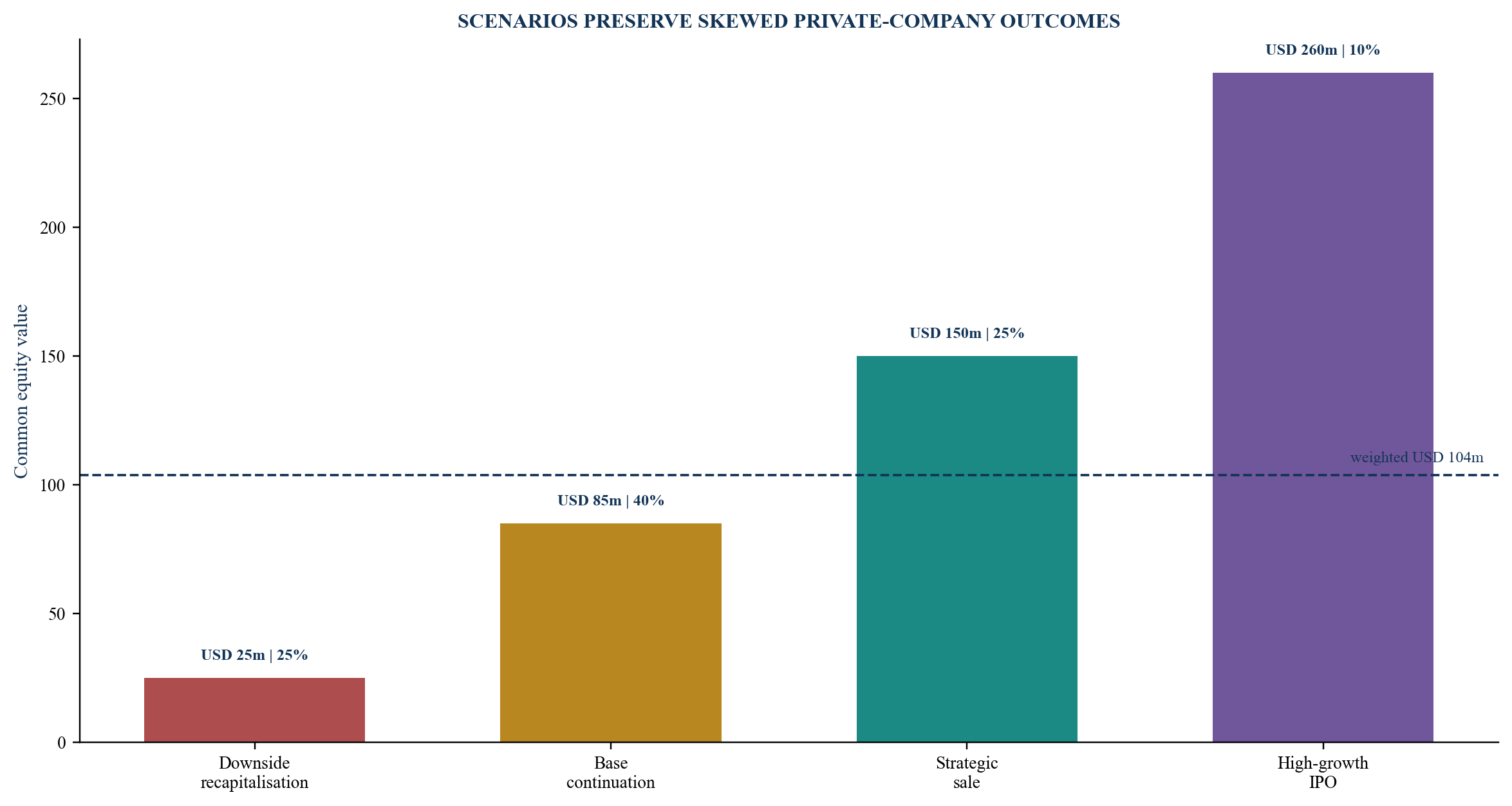
Values and probabilities are management assumptions and do not represent a forecast.
13. Govern conflicts and independent challenge
Valuation can affect management fees, performance fees, employee option strike prices, portfolio returns, fundraising, collateral, redemptions, subscriptions, transfers and compensation. These uses create conflicts that should be identified specifically.
The FCA's 2025 review found stronger processes where firms could evidence independence, expertise, transparency and consistency. It highlighted incomplete documentation of conflicts around investor marketing, secured borrowing, asset transfers, redemptions, subscriptions, uplifts and volatility. It also identified weak ad hoc revaluation processes at many firms.
The governance model should assign preparer, reviewer, valuation committee, board or investment committee and final approver. Voting rights and escalation should avoid dominance by people whose remuneration or fundraising depends on the outcome. Third-party advisers can add expertise and independence while management retains accountable oversight.
Committee materials should show purpose, prior value, methods, assumptions, events, sensitivities, conflicts, challenges, overrides and conclusion. Minutes should record how decisions were reached. A short approval stating only the final value is weak evidence of oversight.
The SEC's Rule 2a-5 framework for registered funds addresses good-faith fair-value determinations, board oversight, valuation designees and recordkeeping. Its legal scope is specific, while its process elements illustrate the importance of risk assessment, method selection, testing, pricing-service oversight and records.
Ad hoc triggers should be defined. Significant financing, M&A, customer, regulatory, legal, market, capital or liquidity events can require a valuation before the normal cycle. The trigger log should identify who assesses materiality and within what time.
14. Reconcile values used across the organisation
A company or fund can maintain several values: financial-reporting fair value, tax value, option strike, tender price, secondary indication, board planning value and financing headline. These values can differ legitimately. The organisation should maintain a purpose-and-date register rather than allowing an unexplained number to circulate.
The register records purpose, date, security, quantity, standard, preparer, approver, range, selected point, validity period, significant-event triggers and permitted use. It should link to the supporting report and cap table.
Differences should have a bridge. A common-share tax value can differ from a preferred financing price because of rights, purpose and date. A tender price can include an execution discount or strategic premium. A fund mark can use market-participant assumptions that differ from a specific buyer's investment value.
Communications should state the context. An employee should know whether a number is an option valuation, the price of a completed tender or an illustrative company valuation. Investors should know whether performance is realised or based on manager valuations. Lenders should understand haircuts and collateral assumptions.
The register reduces accidental misuse in board decks, data rooms, compensation discussions and transaction negotiations. It also speeds diligence because the team can explain every value rather than reconcile conflicting spreadsheets late in a process.
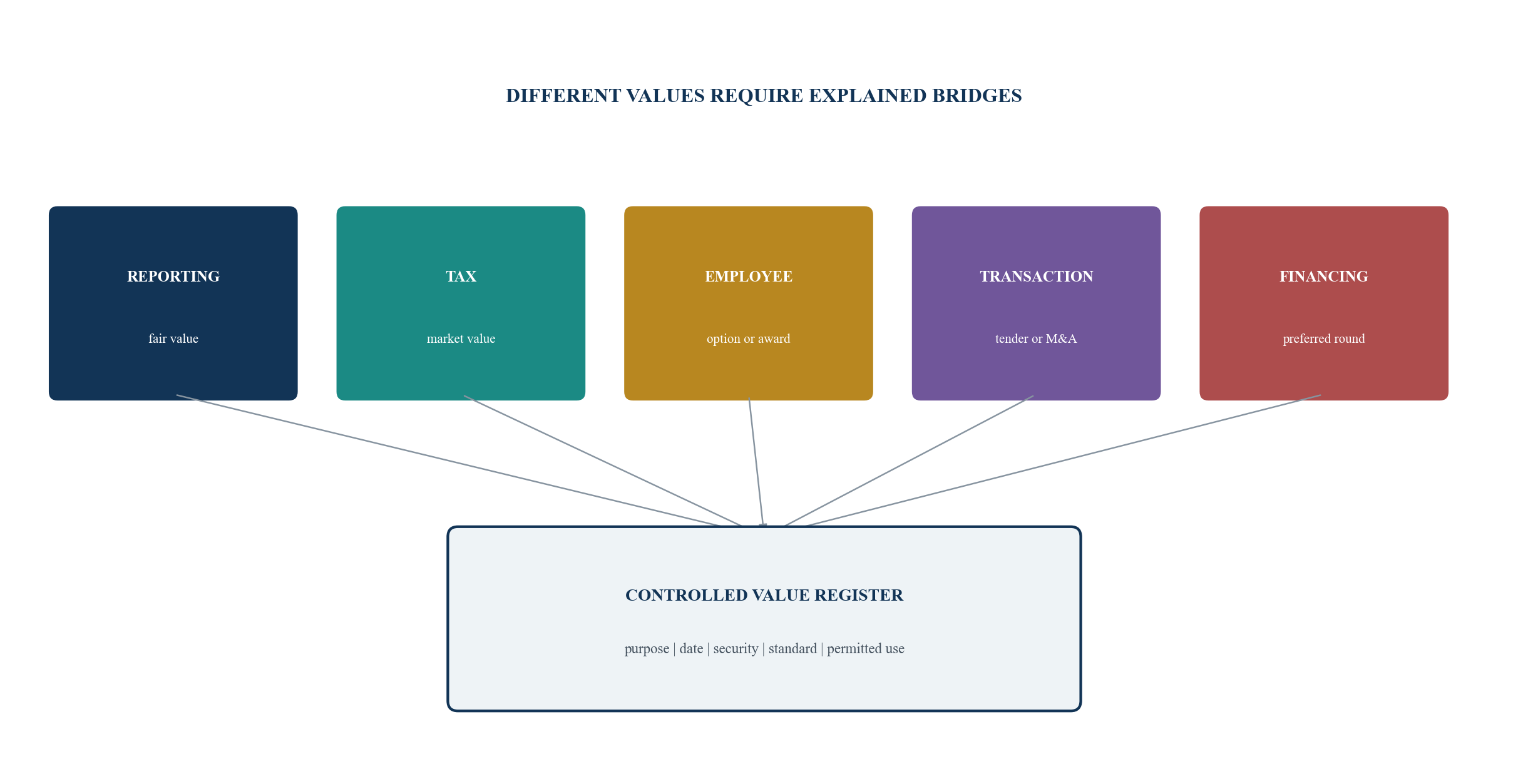
Every value is labelled by purpose, date, security, standard and permitted use.
15. Run a ten-day between-round valuation diagnostic
Days one and two define the mandate and gather the last-round documents, current cap table, constitutional rights, financial statements, management accounts, forecasts, debt, secondary evidence and market data. The team fixes the value date and information cut-off.
Days three and four reconstruct the last round. It reconciles the announced valuation, security package, primary and secondary capital, denominator, preferences, warrants, governance and investor information. The team calibrates the model.
Days five and six build the event clock and operating bridge. It compares actual performance with the round plan, updates cash and funding needs, and records company and capital events.
Days seven and eight refresh comparable companies, transactions, multiples, discount rates, exit conditions and scenario probabilities. The team updates the capital-structure allocation and tests current secondary evidence.
Day nine completes sensitivities, conflicts, cross-checks and the value register. Day ten is the governance meeting: approve the range and point; approve subject to conditions; obtain further evidence; appoint independent review; or defer.
The ten-day period is an operating target. Complex rights, multiple jurisdictions, poor records, distressed financing or advanced transaction discussions can require longer. The purpose is early transparency about evidence and judgement.
Table 6. Ten-day between-round valuation diagnostic
| Period | Output | Decision | Evidence of completion |
|---|---|---|---|
| days 1-2 | mandate and evidence perimeter | what is valued, why and at what date? | signed scope, data index and cut-off |
| days 3-4 | round reconstruction and calibration | what did the transaction price? | executed-terms bridge and calibrated model |
| days 5-6 | event and performance bridge | what changed since the round? | dated event register and variance analysis |
| days 7-8 | current methods and allocation | what do market, income and scenarios indicate? | triangulation, waterfall and sensitivities |
| day 9 | governance and value register | where are conflicts and uncertainty? | review pack and independent challenge |
| day 10 | valuation gate | approve, condition, expand work or defer? | signed conclusion and action log |
Owners and dates should be adapted to the actual purpose and company.
16. Implement a thirty-day valuation operating system
The first week creates governance. The organisation approves valuation policies, purposes, frequency, ad hoc triggers, method hierarchy, conflict controls, committee membership, adviser use, documentation and escalation. Accountabilities are named.
The second week builds controlled data. Current cap tables, rights maps, historical rounds, secondary trades, forecasts, actuals, market data and valuation reports enter a governed repository. Each input receives an owner and date.
The third week builds repeatable models. The team implements round calibration, market and income methods, scenario analysis, capital-structure allocation, sensitivities and value registers. Model changes and overrides require review.
The fourth week performs a parallel close or transaction simulation. The team produces a valuation pack, committee challenge, investor or board communication, employee-value bridge where relevant and an audit-ready archive. It measures elapsed time and exceptions.
The operating system should retain independence and proportionality. A smaller company can use a controlled model and external adviser. A complex fund or late-stage company may need a dedicated valuation function, specialist software and multiple review layers.
Ongoing monitoring matters. Monthly event screening can identify material changes between quarterly valuations. Back-testing and realised outcomes should feed method review. The value register should update when a significant event invalidates the prior conclusion for its intended use.
17. Connect valuation discipline to transactions and retained work
Accurate between-round valuation supports financing, employee liquidity, tender offers, M&A, continuation transactions, secured lending, portfolio reporting and fund raising. The transaction team can use the event clock and value bridge to identify what must be resolved before a buyer or investor relies on the number.
For a financing, the work can support valuation expectations, security design, dilution analysis and negotiation. For employee liquidity, it can distinguish common from preferred rights and set a defensible process. For M&A, it can reconcile stand-alone value, synergies, preferences and proceeds. For a lender, it can identify downside value and collateral sensitivity.
A retained service pathway can begin with a ten-day diagnostic and continue through data remediation, cap-table and rights mapping, quarterly valuation office, transaction modelling, independent review, buyer or capital sourcing and deal execution. Professional roles should be clearly defined.
Commercial evidence includes signed diagnostic engagements, monthly or quarterly retainers, transaction mandates, success fees and collected payments. Website traffic, downloads, enquiries and meetings remain leading indicators. Revenue potential should remain unverified until supported by contracts and collected funds.
Quality should be judged through review findings, back-tests, transaction outcomes, correction rates, committee challenge and stakeholder use. A credible valuation helps people make decisions while preserving the uncertainty inherent in private markets.
18. Conclusion
A funding-round price is a dated piece of evidence. It describes one transaction, one security and one information set. Between rounds, company performance, markets, capital structure, rights and liquidity can change materially.
The dated-evidence framework begins with purpose, value date, unit of account and subject security. It reconstructs the last round, builds an event clock, updates operating and market assumptions, triangulates methods, allocates through the actual rights and tests secondary evidence. It records uncertainty, conflicts and governance.
IFRS, FCA, SEC, HMRC and IPEV materials reinforce the importance of market-participant assumptions, current dates, established methods, documented judgement, independent challenge and event-responsive revaluation. Their scopes differ, so the actual mandate requires current professional advice.
For investors and boards, the framework turns an inherited headline into an explainable value range. For employees and sellers, it clarifies why common value can differ from preferred price. For advisers, it creates a retained route from diagnostic through valuation office and transaction execution. Commercial demand and fees remain unverified until evidenced by signed engagements and collected payments.
References
- IFRS Foundation. IFRS 13 Fair Value Measurement. https://www.ifrs.org/issued-standards/list-of-standards/ifrs-13-fair-value-measurement/
- IFRS Foundation. Educational Material on Fair Value Measurement: Unquoted Equity Instruments. https://www.ifrs.org/content/dam/ifrs/supporting-implementation/ifrs-13/education-ifrs-13-eng.pdf
- Financial Conduct Authority. Private Market Valuation Practices. 5 March 2025. https://www.fca.org.uk/publications/multi-firm-reviews/private-market-valuation-practices
- Financial Conduct Authority. Shining a Light on Private Markets. 2 July 2025. https://www.fca.org.uk/news/speeches/shining-light-private-markets
- US Securities and Exchange Commission. Good Faith Determinations of Fair Value: Small Entity Compliance Guide. https://www.sec.gov/resources-small-businesses/small-business-compliance-guides/good-faith-determinations-fair-value-small-entity-compliance-guide
- US Securities and Exchange Commission. SIFMA Private Markets Valuation Roundtable Remarks. 4 September 2025. https://www.sec.gov/newsroom/speeches-statements/uyeda-remarks-sifma-private-markets-valuation-roundtable-090425
- US Securities and Exchange Commission. Private Markets Valuation Roundtable Press Release. 2026. https://www.sec.gov/newsroom/press-releases/2026-21-sec-announces-roundtable-private-markets-valuation-retail-investor-access-accelerates
- HM Revenue & Customs. Shares and Assets Valuations for Tax Purposes. https://www.gov.uk/government/collections/shares-and-assets-valuation-for-tax-purposes
- HM Revenue & Customs. Get a Share Scheme Valuation from HMRC. https://www.gov.uk/guidance/get-a-share-scheme-valuation-from-hmrc
- HM Revenue & Customs. Share and Assets Valuation Manual, Information Standards. Updated 7 April 2026. https://www.gov.uk/hmrc-internal-manuals/shares-and-assets-valuation-manual/svm114010
- HM Revenue & Customs. Employee Tax Advantaged Share Scheme User Manual, Share Valuations. Updated 7 July 2026. https://www.gov.uk/hmrc-internal-manuals/employee-tax-advantaged-share-scheme-user-manual/etassum10050
- HM Revenue & Customs. Capital Gains Manual, Unquoted Shares: What Is to Be Valued and at What Date. Updated 17 July 2026. https://www.gov.uk/hmrc-internal-manuals/capital-gains-manual/cg59562
- International Private Equity and Venture Capital Valuation Board. IPEV Valuation Guidelines 2025. https://www.privateequityvaluation.com/Portals/0/Documents/Guidelines/2025%20IPEV%20Valuation%20Guidelines.pdf
- US Securities and Exchange Commission. Private Secondary Markets. Last reviewed or updated 24 April 2026. https://www.sec.gov/resources-small-businesses/capital-raising-building-blocks/private-secondary-markets
About the Author
Chennakeshav Adya, Independent Researcher
