

1. Underwrite accessible revenue
Global total addressable market can be a useful description of need. Investment underwriting requires accessible revenue: customers the company can identify, contract, serve, invoice, collect and retain through a compliant and economically attractive operating model.
A product built in MENA can have genuine international advantages. It may be multilingual, mobile-first, adapted to fragmented infrastructure, experienced with regulated customers or designed for demanding security and data environments. These capabilities should be translated into customer evidence rather than assumed to travel automatically.
The board should begin with seven questions. Which buyer has the problem? How frequently and expensively does the problem occur? Which product outcome changes the buyer's economics? Which proof meets procurement requirements? Which legal and operating structure can deliver it? What does the complete contract contribution look like? Which evidence earns the next tranche of capital?
The resulting expansion thesis should name a segment, use case, country, channel and economic objective. “Europe” or “Asia” is too broad to govern execution. A useful thesis can state that the company will test one regulated-enterprise use case with a defined buyer in two selected markets through an approved contracting and delivery route.
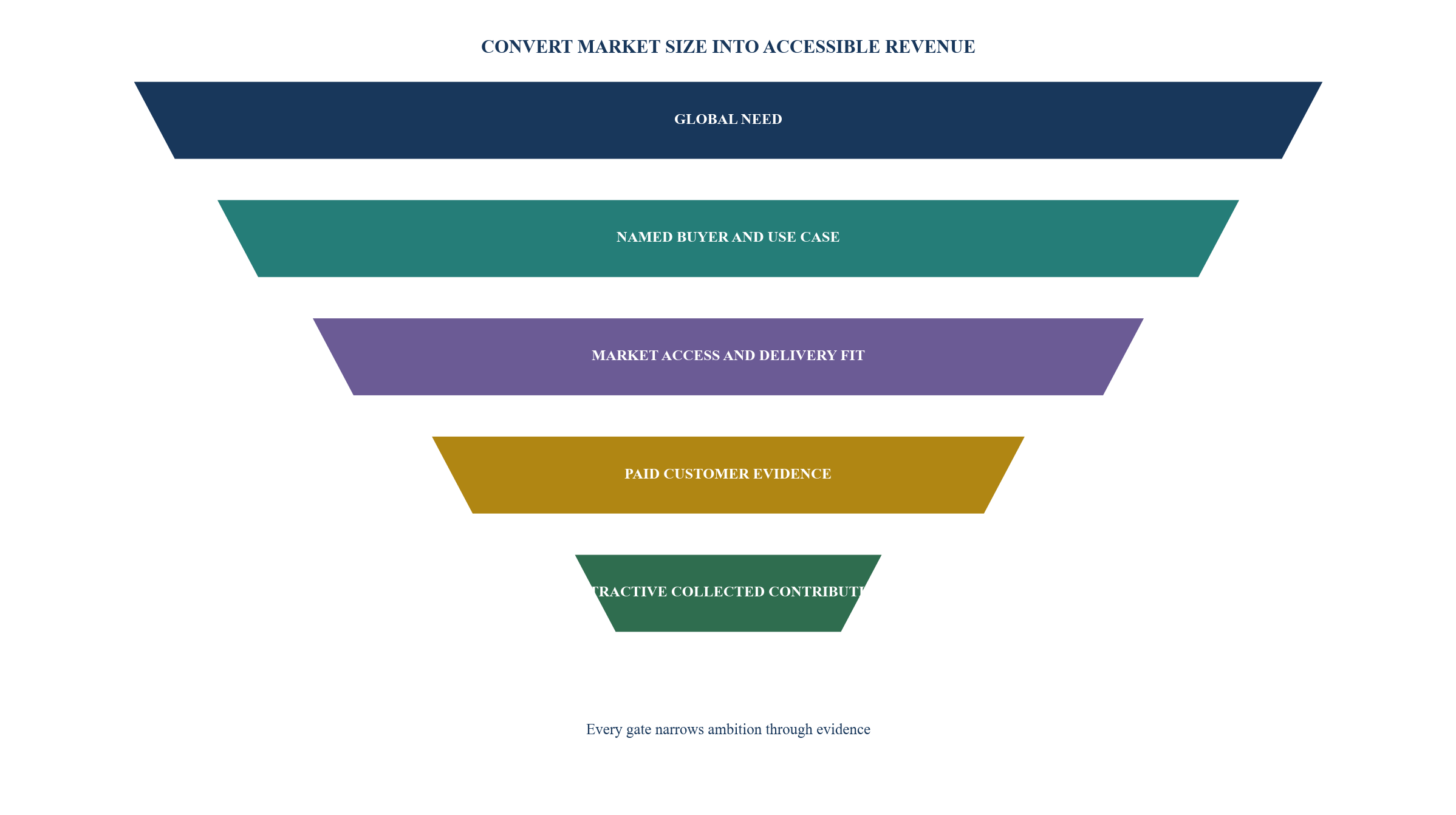
Author framework. A market reaches the investment case only after customer, access, delivery and economic evidence align.
2. Use trade evidence to frame the opportunity
The WTO defines digitally delivered services as services supplied through computer networks. Its dataset includes more than 200 economies and regions, spans 2005 to 2025 and covers eight subsectors.[1] The definition includes delivery through the internet, applications, email, voice and video calls and digital intermediation platforms.
The WTO and OECD bilateral services dataset provides another useful lens. WTO analysis of 2023 flows reported that regions including the Middle East, Africa, and South and Central America and the Caribbean focused a substantial share of digitally deliverable services exports on external markets.[2] This supports a serious export thesis for a MENA product company. It does not identify the product, customer or route that will work.
The board should use trade evidence to select research priorities rather than forecast company revenue. Category growth can attract competitors and raise buyer expectations. Bilateral flow data can show where trade relationships already exist. Company underwriting still needs buyer interviews, procurement evidence, pipeline quality, conversion, implementation and collection.
The market thesis should separate digitally delivered services, professional services, licensed financial services, physical products with software and software that creates a local taxable or regulated presence. The operating requirements can differ even when all are described as technology exports.
3. Build a market score before a launch plan
The scorecard should compare a manageable list of candidate markets through identical criteria. Demand should measure the target segment and use case. Access should cover regulation, tax, data, intellectual property, contracting and payment. Delivery fit should consider product, language, integrations, service levels and time zones. Economics should use complete cost. Strategic value can include reference customers, talent, partners and an acquisition or financing path.
Weights should reflect the company's strategy and risk appetite. A regulated fintech can assign more weight to licensing and data. An enterprise software company may emphasise buyer concentration, security certification and integration cost. A consumer product may place more weight on acquisition channels, tax, content and customer support.
Every score needs a source and date. Management estimates should be identified as estimates. Country averages should not replace analysis of the target buyer. A national market can be attractive while the accessible segment remains small or locked behind procurement requirements.
Table 1. International market underwriting scorecard
| Domain | Core question | Evidence | Stop condition |
|---|---|---|---|
| Customer problem | is the same expensive problem present in a named segment? | interviews, workflow, budget and current alternative | no budget owner or weak problem frequency |
| Market access | can the company market, contract, deliver and collect? | legal, regulatory, tax, data and payment analysis | prohibited route or uneconomic required structure |
| Product and delivery | can the offer meet local requirements and service levels? | gap analysis, pilot, security review and implementation plan | localisation changes the core product or exceeds capacity |
| Commercial engine | can the company reach buyers and convert repeatedly? | channel tests, pipeline, win-loss and cycle evidence | acquisition depends on founder relationships alone |
| Complete economics | does collected contribution clear the hurdle? | contract cohort, cost-to-serve and cash collection | persistent negative contribution after realistic scale |
| Strategic value | does the market improve references, talent or option value? | buyer ecosystem, partners, investors and transaction map | distraction outweighs credible strategic benefit |
Weights and scoring criteria should be approved before markets are rated.
4. Map barriers before selecting geography
Services trade remains regulated and fragmented. The OECD's 2025 Services Trade Restrictiveness Index report covers 51 countries and 22 sectors and identified persistent barriers, with many changes involving market access, movement of people, data flows and telecommunications.[3] Its 2026 update reported that barriers remained high in 2025 and that new restrictions offset some opening reforms.[4]
A product company should map the precise service and mode of supply. Cross-border digital delivery can be treated differently from delivery through a local establishment or personnel. Regulated finance, health, defence, communications, education and professional advice can require sector-specific authorisation.
Data requirements can affect architecture. The UK Information Commissioner's Office provides current guidance for identifying restricted international transfers and selecting a lawful transfer route.[5] Other countries can impose localisation or sector-specific restrictions. The assessment should follow the data category, controller and processor roles, transfer path, destination, vendor chain and customer contract.
The regulatory map should be completed before the company promises a launch date. It should remain a live register because product features, customer types, vendors and rules change.
Table 2. Market-access evidence map
| Workstream | Europe example | United Kingdom example | United States and Asia example |
|---|---|---|---|
| Service and product classification | EU and member-state sector rules | UK sector regulator and general law | federal, state and country-specific classification |
| Indirect tax | VAT place-of-supply and applicable OSS route | UK VAT and establishment analysis | sales, use, GST or consumption-tax analysis by jurisdiction |
| Data | GDPR roles, transfer mechanism and localisation | UK GDPR restricted-transfer analysis | federal, state, national and sector transfer requirements |
| Intellectual property | EU and national rights plus international filing route | UK rights and contract chain | national rights, WIPO route and local enforcement |
| Employment and presence | entity, permanent establishment and worker rules | UK presence, payroll and worker status | state, federal or country presence and employment rules |
| Export and sanctions | EU dual-use, sanctions and customer screening | UK export controls and sanctions | US-origin technology and relevant national controls |
The register should use current official sources and jurisdiction-specific advice.
5. Choose the beachhead customer
A beachhead is a narrow segment whose problem, procurement and delivery pattern can be repeated. The company should define industry, size, business model, buyer role, operating trigger, current alternative, required integrations, security standard and budget source.
Existing MENA customers can reveal the most portable use case. A product sold through sovereign relationships or bespoke implementation may need a different international route from a standard subscription. The team should identify which parts of the outcome come from the product, which come from founder access and which come from intensive service.
Reference value matters. A first customer that represents the target segment, permits a case study and supports a reference call can accelerate subsequent sales. A logo with an unusual use case and heavy discount can distort product direction.
The beachhead hypothesis should be falsifiable. Management should state what it expects to observe in interviews, pilots, conversion and delivery. Missing evidence should trigger a redesign or pause.
6. Run an evidence funnel before building scale
The customer funnel should distinguish interest from commitment. A positive interview is weak evidence. A paid design partnership, completed security review, signed contract, implementation, active use, collected invoice and renewal provide progressively stronger evidence.
The company should record who initiated the conversation, whether the problem is funded, who controls procurement, which requirements block purchase, why the customer chose the product and whether the contract can be repeated without founder intervention.
Free pilots can be useful when they test a specific uncertainty and include success criteria, data access, buyer ownership and an agreed decision date. Open-ended pilots consume delivery capacity and can create false pipeline.
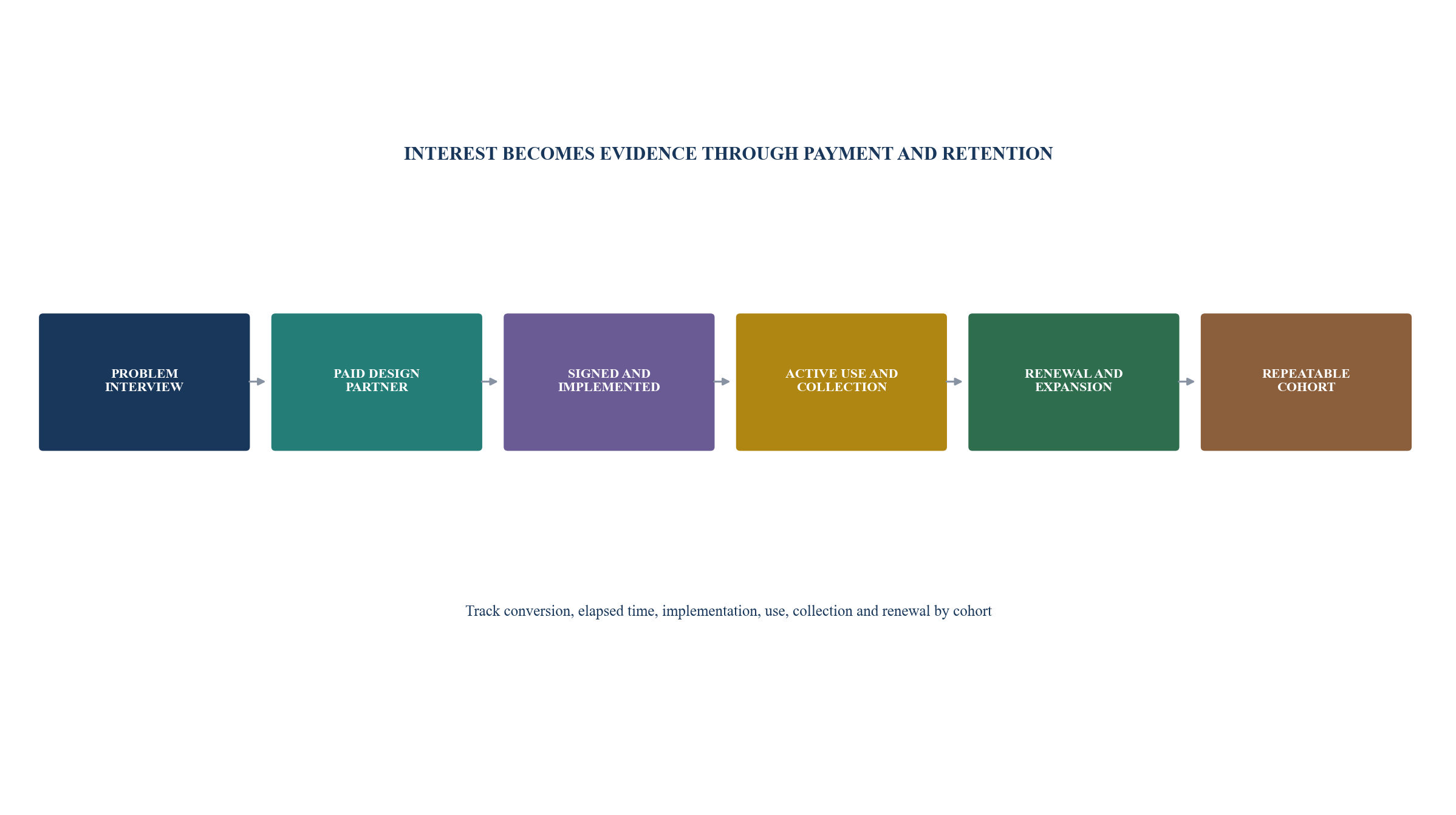
Author framework. Capital follows stronger evidence from problem discovery through collected renewal.
Table 3. Customer-proof register
| Stage | Evidence | Principal question | Release implication |
|---|---|---|---|
| Discovery | interview, workflow, quantified cost and buyer | is the problem frequent, material and funded? | continue research or revise segment |
| Design partner | paid agreement, scope, data and success criteria | will a customer commit resources and money? | fund a bounded localisation test |
| Procurement | security, legal, tax and integration review | can the offer pass the real buying process? | build only repeatable requirements |
| Delivery | implementation plan, active use and outcome | can the company deliver without hidden service intensity? | measure complete cost and capacity |
| Collection | invoice, acceptance and cash receipt | does contractual revenue become cash? | validate working capital and credit risk |
| Renewal | retained use, expansion, price and reference | is value durable and transferable to the next customer? | approve cohort scaling |
Evidence should be stored at account level and reconciled to contracts, product data and finance.
7. Choose the entry architecture
The main routes are cross-border direct sales, channel or reseller, strategic partner, local entity, acquisition and deferred entry. The choice affects control, speed, fixed cost, margin, data, customer ownership and regulatory responsibility.
Direct cross-border sales can preserve product and customer control while evidence is limited. The company must still address tax, data, sector regulation, payment, employment and contract enforcement. A channel can provide relationships and local support. Its incentives, capability, data access, customer ownership and economics require diligence.
A local entity can support hiring, procurement, banking, regulated activity and customer confidence. It creates continuing cost and governance. Acquisition can add customers, licences, talent and a recognised brand; it also introduces valuation, integration and legacy risk.
The route should follow verified constraints. Management should avoid opening an entity solely because a prospective customer suggests local presence. The requirement should be confirmed and the economics approved.
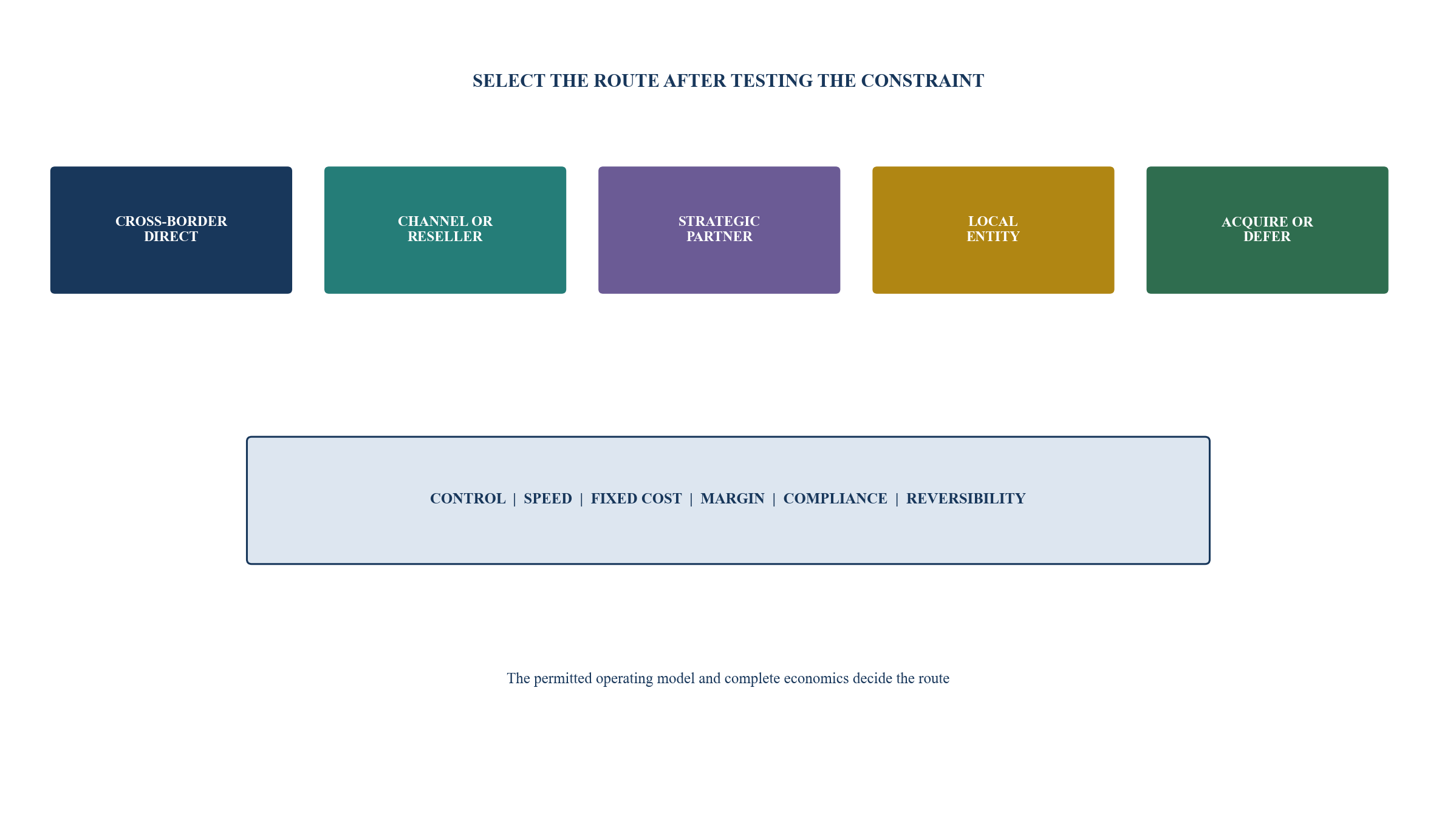
Author framework. Each route should be assessed for control, timing, economics, compliance and reversibility.
8. Price for the market and delivery model
International pricing should reflect customer value, local alternatives, procurement norms, tax, currency, support and complete delivery. A simple conversion of the MENA price can underprice service intensity or overprice an unknown brand.
The company should test willingness to pay through paid design partners, proposals and negotiation. Discounting should have a reason, duration and give-get. Useful consideration can include a case study, reference, prepaid term, standard scope, product feedback or defined expansion.
Currency exposure should be assigned. Contracts can price in a customer currency while cloud, vendor and payroll costs sit in other currencies. Finance should model collection timing, bank fees, withholding, indirect tax and the cost of hedging or holding balances.
List price and annual contract value should be reconciled to net collected revenue. Credits, implementation, free periods, reseller share and service obligations can materially change economics.
9. Include indirect tax and establishment analysis
Digital delivery does not remove tax obligations. The EU's VAT One Stop Shop includes defined supplies of services by EU and non-EU sellers to consumers in the Union. Its non-Union scheme can allow an eligible non-EU supplier to register in one member state and declare covered services to consumers in member states of consumption.[6] Exact treatment depends on the customer and supply.
Business-to-business and business-to-consumer rules can differ. Customer location, tax status, product classification, invoicing and evidence requirements should be mapped. Sales through a marketplace or reseller can allocate responsibilities differently.
Local people, offices, agents or repeated contracting activity can create corporate-tax, payroll or permanent-establishment questions. Management should identify who negotiates, concludes and performs contracts and where value is created.
The commercial model should show tax-inclusive and tax-exclusive prices, registrations, filing cost, withholding and cash timing. Tax analysis belongs before the quote is approved.
10. Design data and security for enterprise procurement
International buyers can require data-flow maps, security standards, penetration testing, audit rights, incident notification, data location, subprocessors, deletion and business continuity. These are product and cost requirements as well as legal terms.
The company should establish a reusable evidence room containing architecture, certifications, policies, test results, data-processing terms, subprocessor register, incident process and continuity evidence. Gaps that recur across target customers should enter the product roadmap.
Customer-specific hosting or dedicated environments can change gross margin and operational complexity. The bid model should identify the incremental infrastructure, assurance and support cost. A promise made during procurement should become a controlled operating requirement.
International transfer mechanisms should follow the actual data path. The company should monitor vendor and legal changes and preserve evidence of its assessment.
11. Protect the brand and product
The product name, trademarks, code, documentation, designs, data rights and domain names should be reviewed before launch. WIPO's Madrid System allows an eligible applicant with a basic national or regional mark to seek protection in multiple member countries through one international application, while each designated member applies its domestic law.[7]
WIPO recommends searching target markets before filing. Its Global Brand Database covers records from multiple national and international databases, and national registers can add relevant evidence.[8] Availability of a corporate name or domain does not establish trademark freedom.
Employee and contractor assignments should cover the jurisdictions and work created. Open-source and model licences should be reconciled to distribution. Channel and partner agreements should govern brand use, customer materials, derivative work and termination.
The board should sequence protection with market evidence. Filing everywhere can consume capital. Delaying a priority market can create rebranding or enforcement risk.
12. Build complete contract contribution
Gross margin should reflect everything required to acquire, implement, serve and retain the customer. Direct costs can include channel share, sales engineering, security review, implementation, integration, cloud, model use, data, support, travel, local advisors, tax compliance, currency and customer-specific reporting.
Some costs sit below gross margin in accounting. The investment decision can still use contract contribution after attributable sales and delivery expense. This exposes customers whose reported subscription margin depends on unpriced founder time or central engineering.
The following model is hypothetical. It demonstrates the bridge from annual contract value to collected contribution for one market cohort. Every amount and rate should be replaced with verified company data.
Table 4. Hypothetical first-year international cohort economics
| Item | Five-customer cohort | Per customer | Diligence question |
|---|---|---|---|
| Contracted annual value | 750 | 150 | do signed scope and price reconcile to the model? |
| Discounts, credits and reseller share | (90) | (18) | which concessions repeat in the target market? |
| Net invoiced revenue | 660 | 132 | does invoicing depend on acceptance or milestones? |
| Uncollected at year end | (55) | (11) | what credit, withholding and timing explain the balance? |
| Collected revenue | 605 | 121 | does cash reconcile to customer and invoice? |
| Product, cloud and data cost | (105) | (21) | how does usage change cost? |
| Implementation and support | (175) | (35) | which work can become repeatable product? |
| Attributable acquisition and compliance | (145) | (29) | what is the full cost to win and enable the cohort? |
| First-year collected contribution | 180 | 36 | does contribution clear the capital and capacity hurdle? |
All values are hypothetical management assumptions in USD thousands and are not benchmarks or forecasts.
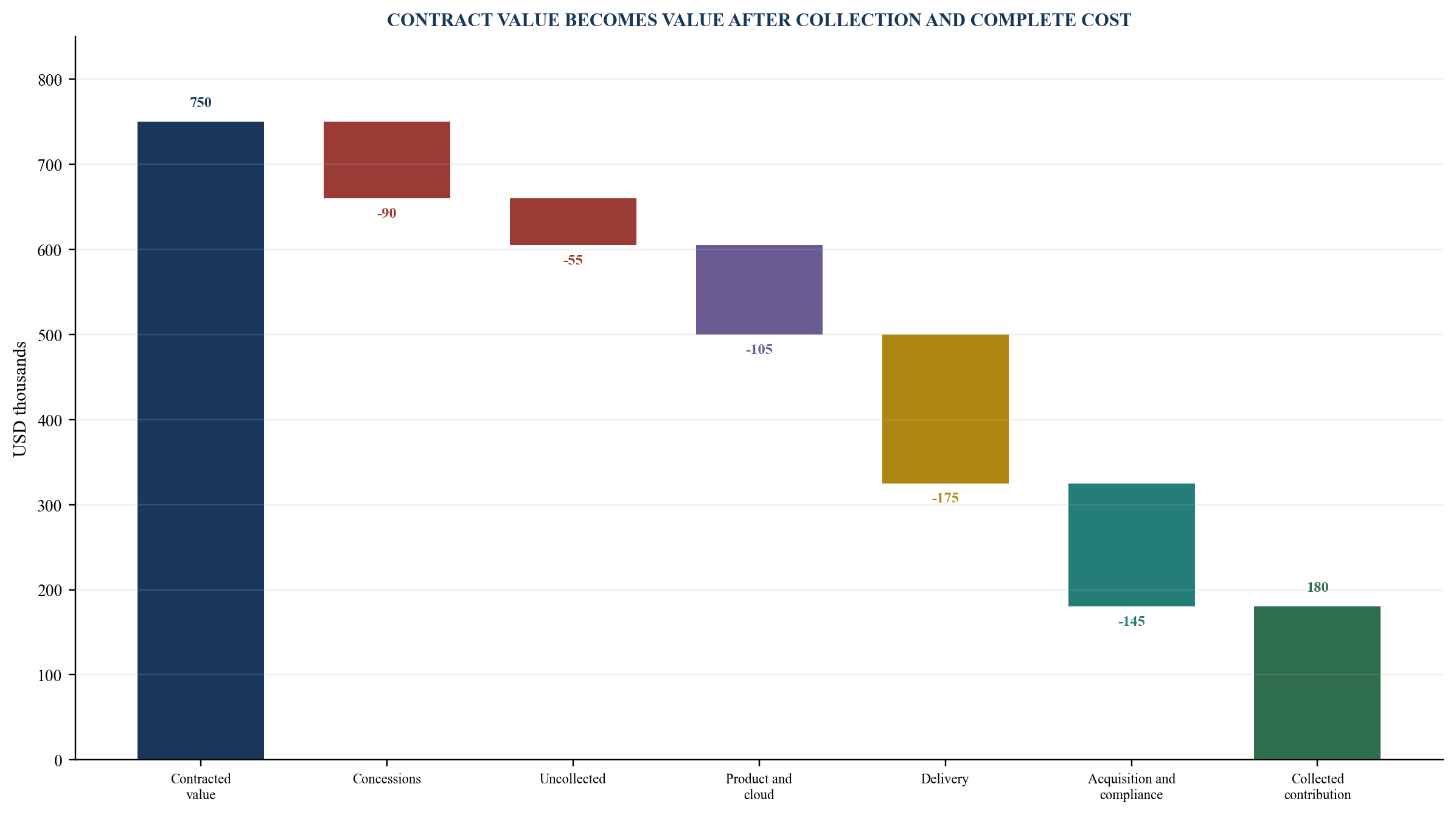
All amounts are hypothetical management assumptions in USD thousands.
13. Measure cycle, capacity and cash
International sales cycles can extend through legal, security, tax, procurement and integration. Pipeline value should be weighted through company evidence by stage, segment and market. A management percentage copied across countries provides weak insight.
The capacity model should show account executives, sales engineers, implementation, security, legal, support and product. A constrained role can delay every contract. Founder participation should be measured and gradually replaced by a repeatable process.
Cash timing can differ from accounting revenue. Milestone acceptance, annual prepayment, withholding, slow-paying enterprises and reseller settlement affect working capital. The board should model a delayed-conversion and delayed-collection case before approving fixed local cost.
14. Govern localisation through a requirements register
Localisation should follow a documented customer, legal or operating requirement. The register should capture language, currency, tax, identity, data, integrations, accessibility, contract, security, support and reporting.
Each variation needs a source, customer relevance, owner, build estimate, recurring cost, test and release decision. Common requests should become configurable product. One-customer changes should carry explicit economics and strategic value.
The company should protect one core platform. Uncontrolled country forks increase defects, support cost and delayed releases. Configuration and modular integration can preserve global scale while meeting justified requirements.
Table 5. Country operating requirements register
| Domain | Common baseline | Market variation | Approval evidence |
|---|---|---|---|
| Product | core use case and supported workflow | language, currency, local integration and accessibility | customer proof, design and tested release |
| Data and security | classification, access, encryption and incident standard | transfer, localisation, audit and notification | legal assessment, architecture and assurance |
| Commercial | approved segment, price and contract | local price, reseller, procurement and payment term | cohort economics and signed authority |
| Tax and entity | group contracting and tax model | VAT, GST, withholding, payroll or establishment | current advice, registration and control calendar |
| Delivery | implementation, support and service level | time zone, local presence and customer reporting | capacity plan and measured cost |
| Brand and rights | corporate identity and ownership chain | trademark, domain, licence and marketing rule | search, filing, contract and register |
Each requirement should be traced to authoritative evidence or a named customer commitment.
15. Build an expansion cell
An expansion cell is a small cross-functional team with a market thesis, bounded capital and authority to test it. It can include commercial, product, delivery, finance, legal, security and data owners. Local expertise can be added through advisors or partners.
The cell should own a weekly evidence register: customer interviews, paid pilots, pipeline movement, procurement requirements, product gaps, delivery cost, cash, risks and decisions. It should close weak hypotheses quickly.
The cell should not become a permanent shadow organisation. Its goal is to establish a repeatable market playbook, transfer it to accountable operating teams or recommend that the market be paused.
16. Manage a portfolio of markets
The company should treat countries as an option portfolio. One market can be in research, another in paid design, another in repeatable scale and another in exit or pause. Capital and leadership attention should reflect evidence stage.
Market correlation matters. Several countries can depend on the same vendor, regulatory interpretation, channel or buyer segment. A diversified geographic presentation can conceal one underlying risk.
The portfolio should also reflect strategic sequence. A reference in the United Kingdom can support European enterprise sales. A Singapore customer can provide an Asia-Pacific signal. A United States buyer can validate scale while creating demanding security and support requirements. These are hypotheses until customer evidence supports them.
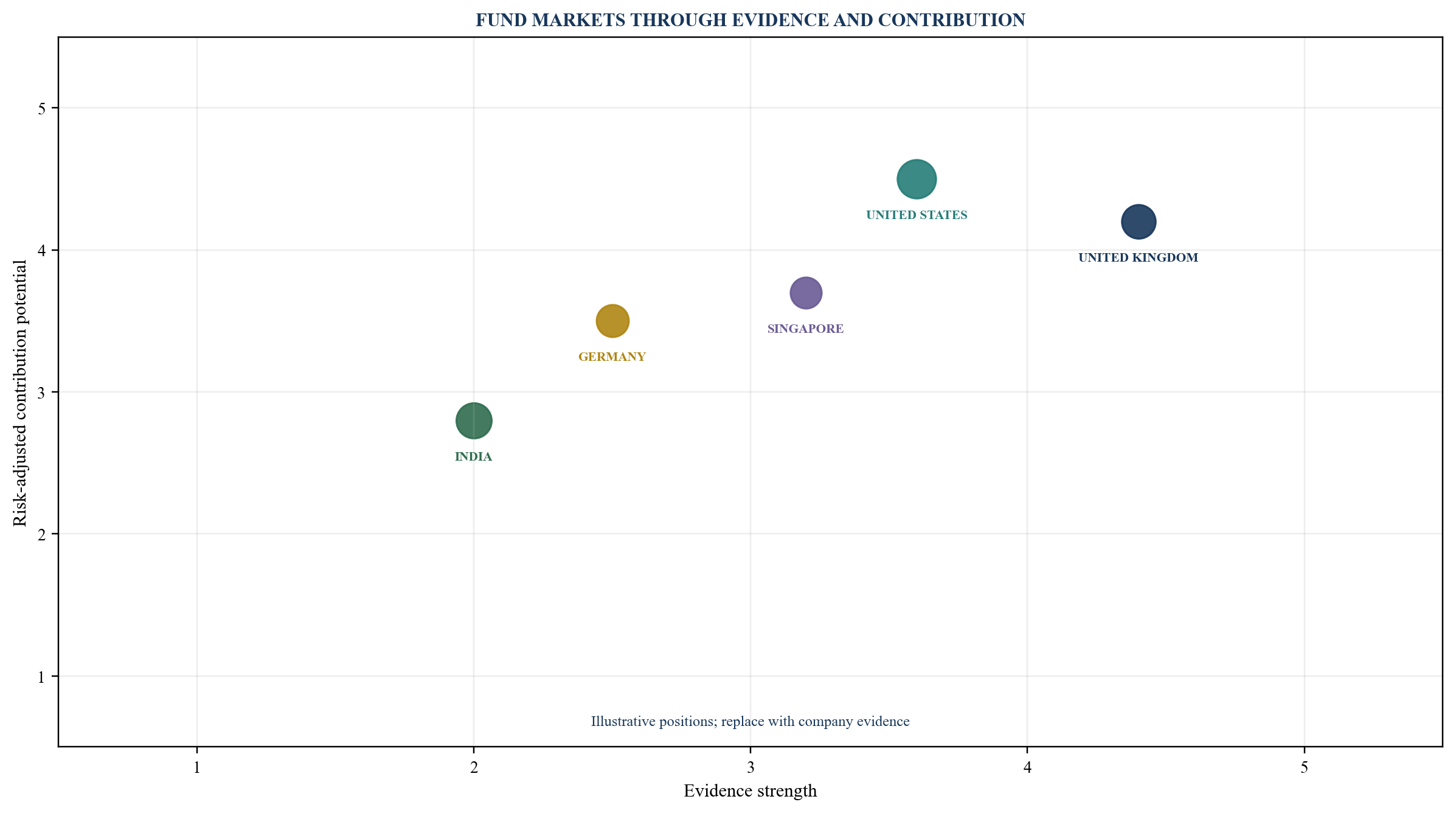
Positions are hypothetical management assumptions used solely to demonstrate capital prioritisation.
17. Release capital through stage gates
The first gate funds problem research and market-access analysis. The second funds paid design partners after a named segment demonstrates budget and procurement engagement. The third funds a repeatable commercial cell after signed, delivered and collected contracts. The fourth funds local fixed cost after cohort economics and capacity are credible.
Each gate should name the cash limit, timetable, evidence and stop condition. A pipeline target alone can reward low-quality opportunities. Evidence should include conversion, time, price, implementation, use, collection and renewal.
Management should protect reversibility. Contractor support, partners and cross-border delivery can test the market before a permanent entity and broad hiring. Reversibility cannot override legal requirements; it should operate within an approved route.
18. Run a 180-day global-revenue programme
During the first thirty days, management should select candidate segments and markets, build the market-access score, complete buyer interviews and identify the first beachhead hypothesis. Finance should create the cohort model.
During days 31 to 60, the expansion cell should secure paid design partners, map procurement, validate data and tax requirements and compare entry routes. The board should select one or two controlled tests.
During days 61 to 120, the company should deliver the pilots, measure outcome and effort, complete contracts, invoice and collect. Product should separate reusable requirements from customer-specific work. Security and legal evidence should enter a standard diligence room.
During days 121 to 180, management should test the second and third customer through the same playbook, assess renewal and reference quality, update contribution economics and decide whether to scale, redesign, partner or pause.
19. Diligence the international revenue case
Investors and directors should reconcile the international narrative across the board plan, customer pipeline, contracts, product roadmap, entity structure, tax analysis, data map, staffing and financial model. The same market should not have different launch dates or economics in separate materials.
Pipeline should be sampled at account level. The reviewer should inspect customer source, buyer, problem, stage evidence, procurement, competition, scope, price, probability basis, delivery requirements and expected cash. Signed contracts should reconcile to invoices, product use and collection.
Table 6. Global go-to-market diligence plan
| Workstream | Core evidence | Principal question | Escalation trigger |
|---|---|---|---|
| Market thesis | scorecard, interviews and segment definition | is accessible demand supported by named buyers? | narrative relies on national market size alone |
| Access and structure | regulatory, tax, data, IP and entity analysis | can the company lawfully contract, deliver and collect? | unresolved required licence or uneconomic presence |
| Pipeline and contracts | account records, proposals, contracts and win-loss | does stage probability reflect observed evidence? | founder-led or partner-reported pipeline cannot be verified |
| Product and delivery | gap register, implementation, use and support | is international revenue repeatable without hidden service intensity? | product forks or capacity bottleneck |
| Economics and cash | cohort model, invoices, vendor cost and receipts | does collected contribution clear the hurdle? | revenue growth consumes disproportionate cash and people |
| Governance | owners, gates, budget and stop conditions | can the board scale, redesign or stop a market promptly? | continuing spend after failed evidence gate |
Evidence should be current and attributable to a named owner.
20. Use a board gate that can stop expansion
The board should approve scale only when five conditions align: verified customer problem, lawful and practical market access, repeatable conversion, stable delivery and attractive collected contribution. Strategic value can strengthen the case and should not replace economic evidence.
The decision can be to scale, continue the controlled test, change segment, use a partner, acquire capability, defer or exit. The board paper should name the next evidence gate and capital ceiling.
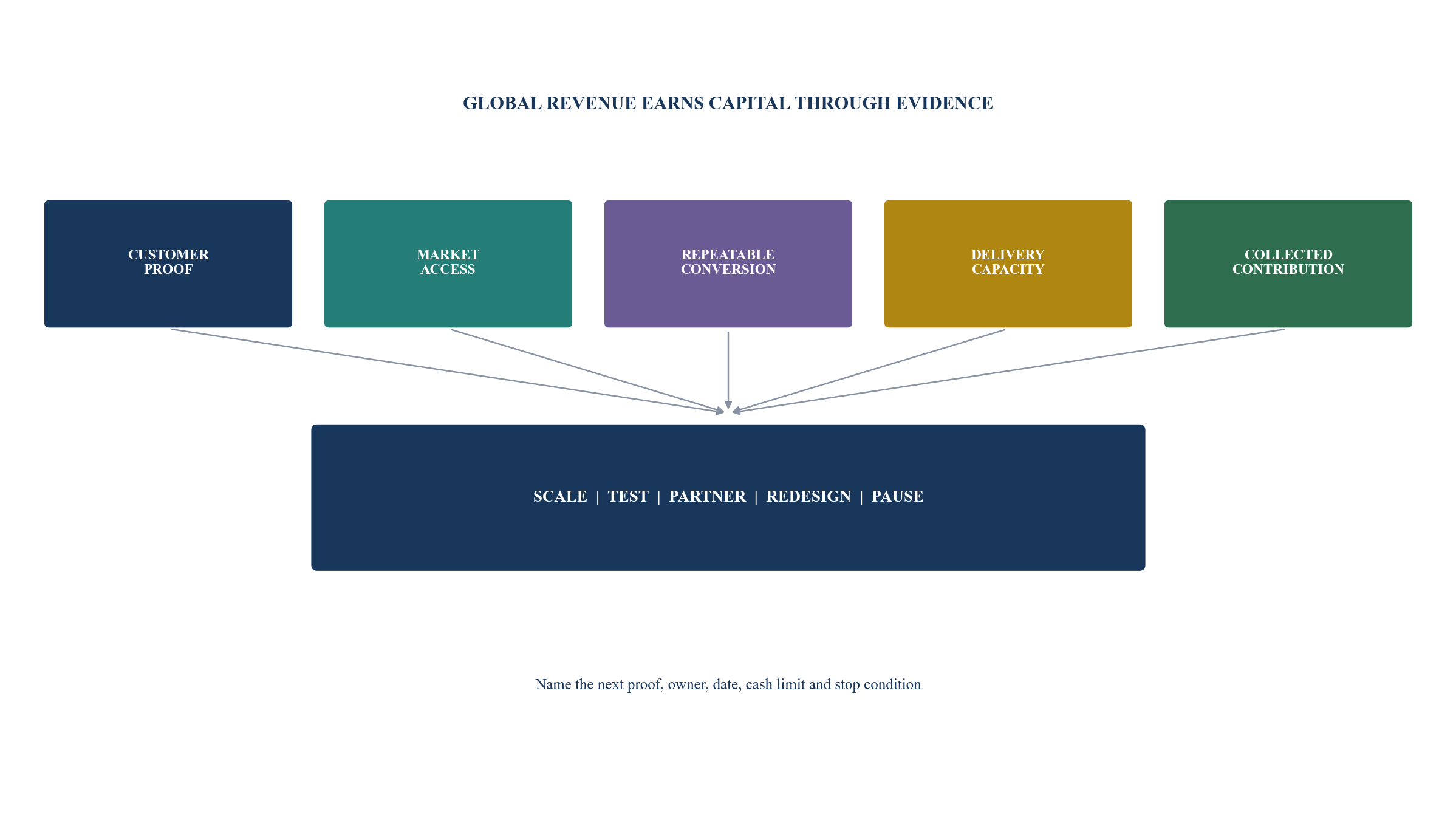
Author framework. The gate links customer proof, access, delivery, economics and capital discipline.
Conclusion
Digital delivery gives MENA product companies a credible route to customers in Europe, North America and Asia. WTO data demonstrate the scale and breadth of digitally delivered services trade. OECD evidence demonstrates that market access remains fragmented.
The board should convert global ambition into a series of narrow, evidence-led market options. It should define the beachhead customer, map the permitted operating route, test paid demand, measure delivery and collection and calculate contribution after complete attributable cost.
An expansion cell can establish the playbook with bounded capital. A market portfolio can sequence research, design partnerships, repeatable scale and exit. Stage gates preserve capital and management attention when evidence weakens.
Global revenue becomes investable when contracts are lawful, delivery is controlled, customer value is repeatable and collected contribution supports the operating model. The outcome is a scalable international business built from verified customer and economic evidence.
References
- World Trade Organization, Digitally Delivered Services Trade Dataset, https://www.wto.org/english/res_e/statis_e/gstdh_digital_services_e.htm
- World Trade Organization, WTO and OECD release expanded dataset on trade in services covering over 200 economies, https://www.wto.org/english/news_e/news25_e/stat_17feb25_e.htm
- Organisation for Economic Co-operation and Development, Services Trade Restrictiveness Index 2025, https://www.oecd.org/en/publications/2025/02/oecd-services-trade-restrictiveness-index_6da4127e.html
- Organisation for Economic Co-operation and Development, Economies risk missing out on AI-driven growth as services trade reforms stall, 2026, https://www.oecd.org/en/about/news/announcements/2026/02/economies-risk-missing-out-on-ai-driven-growth-as-services-trade-reforms-stall.html
- United Kingdom Information Commissioner's Office, A brief guide to international transfers, https://ico.org.uk/for-organisations/uk-gdpr-guidance-and-resources/international-transfers/a-brief-guide-to-international-transfers/
- European Commission, The One Stop Shop, VAT e-Commerce, https://vat-one-stop-shop.ec.europa.eu/one-stop-shop_en
- World Intellectual Property Organization, Madrid System, https://www.wipo.int/en/web/madrid-system/
- World Intellectual Property Organization, Search before filing an international trademark application, https://www.wipo.int/en/web/madrid-system/how_to/search/index
- United States International Trade Administration, Learn How To Export, https://www.trade.gov/learn-how-export
- World Bank, Digital Progress and Trends Report, https://www.worldbank.org/en/publication/digital-progress-and-trends-report
- World Trade Organization, Global Services Trade Data Hub, https://www.wto.org/english/res_e/statis_e/statis_e.htm
- Organisation for Economic Co-operation and Development, Services trade, https://www.oecd.org/en/topics/policy-issues/services-trade.html
About the Author
Chennakeshav Adya is an independent researcher and Managing Partner of Matchpoint Partners. His work examines strategy, capital formation, valuation, transactions and operating execution across private and public markets.
