

1. Merger control begins before the term sheet
The commercial instinct in an acquisition is to agree price, structure, exclusivity and financing before investing heavily in regulatory analysis. That sequence can place the board in a weak position. If merger control is material, the filing perimeter affects the earliest closing date, the probability-weighted value of the transaction, the seller's willingness to remain exposed, the buyer's financing period, the remedies that may be acceptable and the conduct permitted between signing and closing. These matters belong in the investment thesis before a term sheet creates negotiating momentum.
The UAE regime applies to economic concentrations that affect competition in a relevant market in the country. An acquisition, merger or joint venture may create a concentration when it produces a direct or indirect change of control or decisive influence. The analysis must identify the parties, their groups, the rights being acquired, the activities involved, the economic substance of the arrangement and the transaction's connection with UAE markets. A foreign-to-foreign transaction can require analysis when it affects competition in the UAE. A transaction involving a regulated sector may also require review by, or coordination with, the competent sector authority.
The current threshold decision establishes two alternative triggers. A filing perimeter can arise when the parties' combined annual sales in the relevant UAE market exceed AED 300 million in the preceding fiscal year, or when their combined share exceeds 40 percent of transactions in that market. The presence of a sales test and a market-share test changes the diligence burden. A low UAE revenue figure cannot close the analysis if the share test could be met. A high group revenue figure does not itself answer the question because the test refers to the relevant market in the UAE. Control, market definition, attribution of sales, group boundaries and the applicable sectoral regime must be established from current facts.
The board should commission a preliminary jurisdiction memorandum before approving exclusivity. That memorandum should state the proposed control rights, identify every plausible UAE product and geographic market, show the sales and share evidence, map regulated activities and list factual gaps. It should also distinguish a notification, a reasoned no-filing position and any request for non-objection or informal engagement. The purpose is to protect decision quality. A confident conclusion supported by thin data creates timetable risk that can surface after signing, when each week of delay has a direct commercial cost.
The preliminary analysis should appear in the investment committee pack alongside valuation and financing. It should identify who owns the conclusion, when external competition counsel will be engaged, which data the seller must provide, and which assumptions can change the answer. If the transaction could fall within more than one jurisdiction, the pack should include an integrated filing map. The deal team can then negotiate a term sheet that reflects the likely route rather than adding a generic regulatory condition after the price and long-stop date have already hardened.
Table 1. UAE merger-control rule card for transaction planning
| Planning question | Current rule or process | Evidence required | Board consequence |
|---|---|---|---|
| what transaction is caught? | an economic concentration involving a change of control or decisive influence and affecting UAE competition | rights, ownership, governance, agreements, group structure and UAE activity | start scope analysis before exclusivity |
| what financial trigger applies? | combined annual sales exceeding AED 300 million in the relevant UAE market | audited revenue bridge, product and customer mapping, group attribution | seller information request must be market-specific |
| what share trigger applies? | combined share exceeding 40 percent of relevant-market transactions | market definition, numerator, denominator, source and period | low revenue does not end the analysis |
| when must filing occur? | at least 90 days before completion when notification conditions apply | transaction timetable and filing readiness | closing date must accommodate the regulatory path |
| when does substantive review begin? | after the application is treated as complete | prescribed form, documents, translations and data | submission date and clock-start date may differ |
| can the review extend? | the substantive period can be extended by up to 45 days and affected by information procedures | authority notices, request log and response plan | long-stop and financing periods require headroom |
| what outcomes are possible? | approval, conditional approval, rejection or a determination that notification conditions do not apply | effects evidence, efficiencies and possible undertakings | remedy authority and walk-away rights need advance design |
| can parties close during review? | standstill applies to a notifiable transaction pending the decision | closing controls and conduct protocol | integration and control cannot be implemented early |
The rule card summarises current official sources available in August 2026. Counsel should confirm the application to the complete transaction facts.
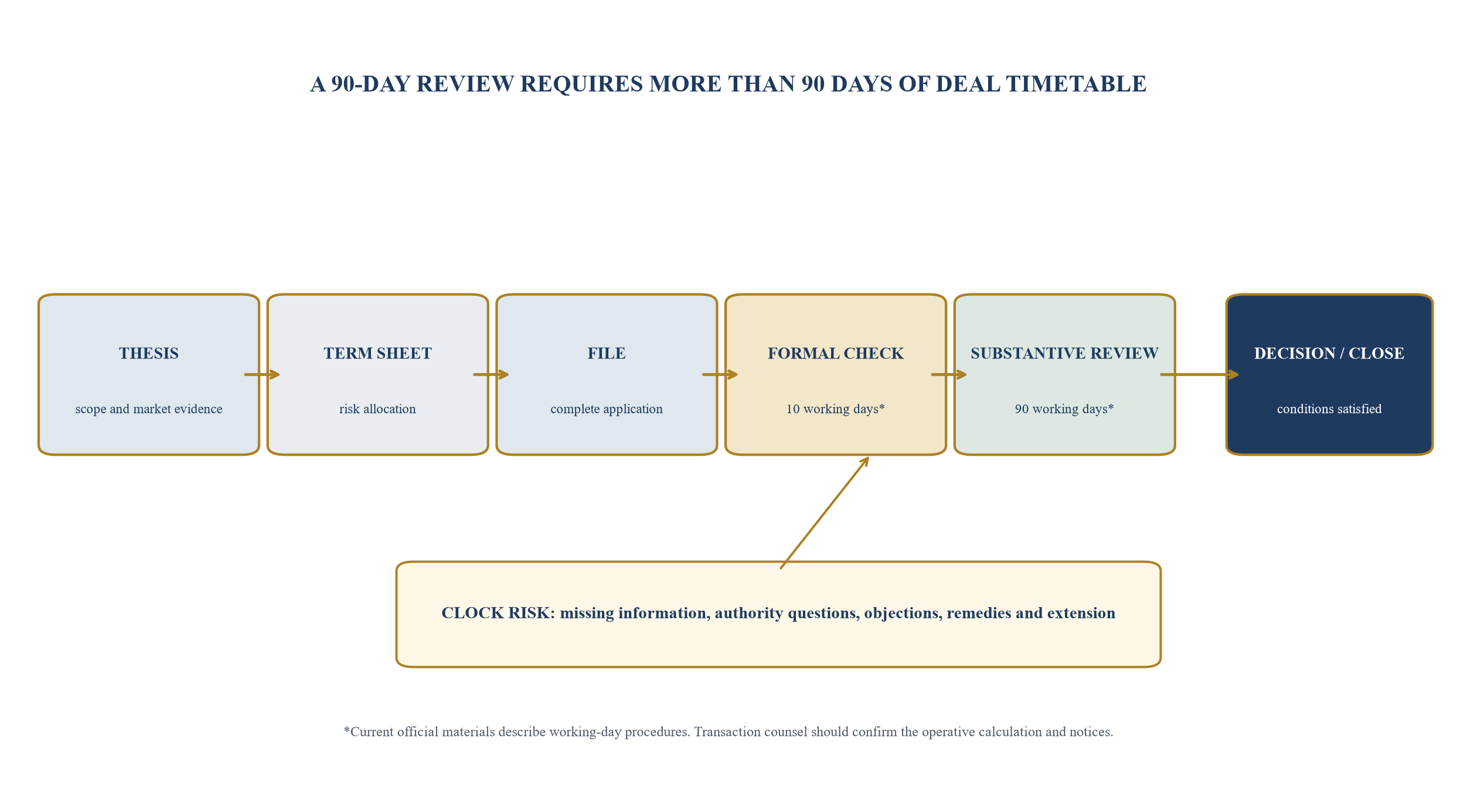
The figure separates management preparation, formal completeness and substantive review. Periods outside the statutory review are planning assumptions.
2. The headline period is a sequence of gates
The term “90-day clock” is useful shorthand and an incomplete schedule. Federal Decree-Law No. 36 of 2023 requires notification at least 90 days before completion when the statutory conditions apply. The Ministry's published explanation describes a 90-working-day substantive review from receipt of a complete application, with a possible extension of 45 working days. The 2026 Executive Regulations add a formal examination stage and specify information, document and procedural requirements. The date on which a draft filing is delivered can therefore be different from the date on which the substantive period begins.
The formal examination is a critical path in its own right. The Executive Regulations provide for an initial review of the application within ten working days, subject to a possible extension. The authority can request missing material and give the applicant a response period of up to ten working days. The application must contain the parties' and groups' details, a description of the transaction, products and markets, UAE sales and market shares, and transaction history for the previous three years. Documents may require an original-language copy and translation. Confidential and non-confidential versions add production and review work. A signature, authorization or translation gap can defer completeness even when the economic analysis is advanced.
Once the substantive phase begins, information requests and third-party procedures can change elapsed time. The law permits the authority to seek information from parties and relevant entities. The Executive Regulations provide for publication of basic transaction information and a period for interested-party observations. They also establish an objection procedure with form and substantive stages, an opportunity for the transaction parties to respond and time extensions. A complex or visible transaction can therefore require rapid answers to factual assertions that the core team did not originate.
The authority's assessment can result in unconditional approval, approval subject to conditions and undertakings, rejection, or a determination that the filing conditions do not apply. A remedy discussion introduces design, verification and implementation time. The Ministry's current guidance states that failure to receive a decision at the end of the applicable review period is treated as rejection. A transaction timetable cannot rely on silence as clearance.
The board should receive three dates rather than one. The “filing-ready date” is the earliest date on which the parties expect to have a complete and internally approved package. The “decision-range date” reflects the base review, extension and likely information work. The “closing-ready date” adds all remaining financing, sectoral, contractual and mechanical conditions. These dates should be maintained by one regulatory programme owner and reconciled weekly with the transaction critical path.
3. Control analysis should reflect rights and conduct
Legal ownership percentage is a starting point. Merger-control analysis focuses on control or decisive influence, which can arise through shares, assets, agreements, voting rights, board rights, vetoes, appointment powers, strategic budgets, business plans, technology, essential inputs or other means. The agreement should be analysed together with side letters, shareholder arrangements, financing rights and the commercial context. A minority investment can require careful analysis when its rights reach strategic decisions. A joint venture can be within scope when the arrangement creates a durable controlled undertaking or changes control over existing activities.
The scope memorandum should map rights at three levels. The first level is constitutional control: equity, votes, board appointment and reserved matters. The second is contractual control: exclusive supply, intellectual-property licences, operating agreements, management contracts, financing covenants and termination rights. The third is practical dependence: whether one party controls data, customers, a licence, a platform, critical staff or another asset without which the business cannot compete. The analysis should record the source document for every material right and distinguish current rights from proposed amendments.
This discipline protects both jurisdiction and conduct. Before closing, a buyer needs enough information to value the target and protect the asset. It cannot implement control prematurely. Broad consent rights over ordinary-course commercial decisions, buyer direction of pricing or customers, early transfer of staff, integration of systems, coordinated bidding, uncontrolled sharing of competitively sensitive information or public conduct inconsistent with separate ownership can create standstill and competition risk. The term sheet and sale agreement should provide protection through proportionate covenants, clean-team arrangements and escalation processes.
Control analysis also shapes filing responsibility. The Executive Regulations identify the acquirer as the applicant for an acquisition and provide for the parties to file a merger or joint venture, including through an authorized representative. This allocation should be reflected in the process letter, counsel engagement, information protocol, signing authority and responsibility for fees. The seller remains essential because much of the market, customer, revenue and strategy evidence is held by the target.
The board should request a rights schedule before approving definitive documents. The schedule should show every right relevant to control, whether it exists before or after closing, the commercial purpose, the competition assessment and the document location. A clean rights schedule reduces the risk that a late drafting change unintentionally changes the regulatory conclusion.
4. The notification-perimeter decision must be documented
A defensible perimeter analysis follows a sequence. First, identify whether the arrangement creates a merger, acquisition or joint venture that changes control or decisive influence. Second, establish whether the transaction affects competition in a UAE relevant market. Third, identify sectoral exclusions, concurrent competence or additional approvals. Fourth, test the AED 300 million UAE relevant-market sales threshold and the 40 percent share threshold. Fifth, determine the filing route, the parties responsible and the intended timing. Each step should have named evidence and an owner.
The revenue bridge is often harder than the number suggests. Group reporting may classify revenue by legal entity, customer billing address, contracting entity, delivery location, business unit or accounting segment. Merger-control analysis may require sales allocated to a particular product and geographic market. The target's accounting ledger can therefore be insufficient without product mapping, customer-location data, intercompany eliminations, currency conversion and a clear fiscal period. The bridge should reconcile to audited accounts and explain every adjustment.
The market-share bridge requires a numerator and denominator derived on a consistent basis. The parties need a view of their own sales or transaction volume and credible evidence for the total market. Industry reports, regulatory data, customer procurement records, competitor disclosures, tender databases and internal strategy materials can help, although their definitions may differ. A share calculation with a precise percentage and an uncertain denominator can mislead a board. The calculation should show source, coverage, period, methodology, sensitivity and confidence.
Sectoral analysis should begin early. The competition law and implementing framework interact with competent authorities in sectors governed by specific rules. Banking, insurance, telecommunications, energy, transport and other regulated activities can involve separate change-of-control, ownership, fit-and-proper or foreign-investment requirements. Parallel approvals can have different information sets and decision paths. The transaction conditions should list them separately while the programme coordinates shared facts.
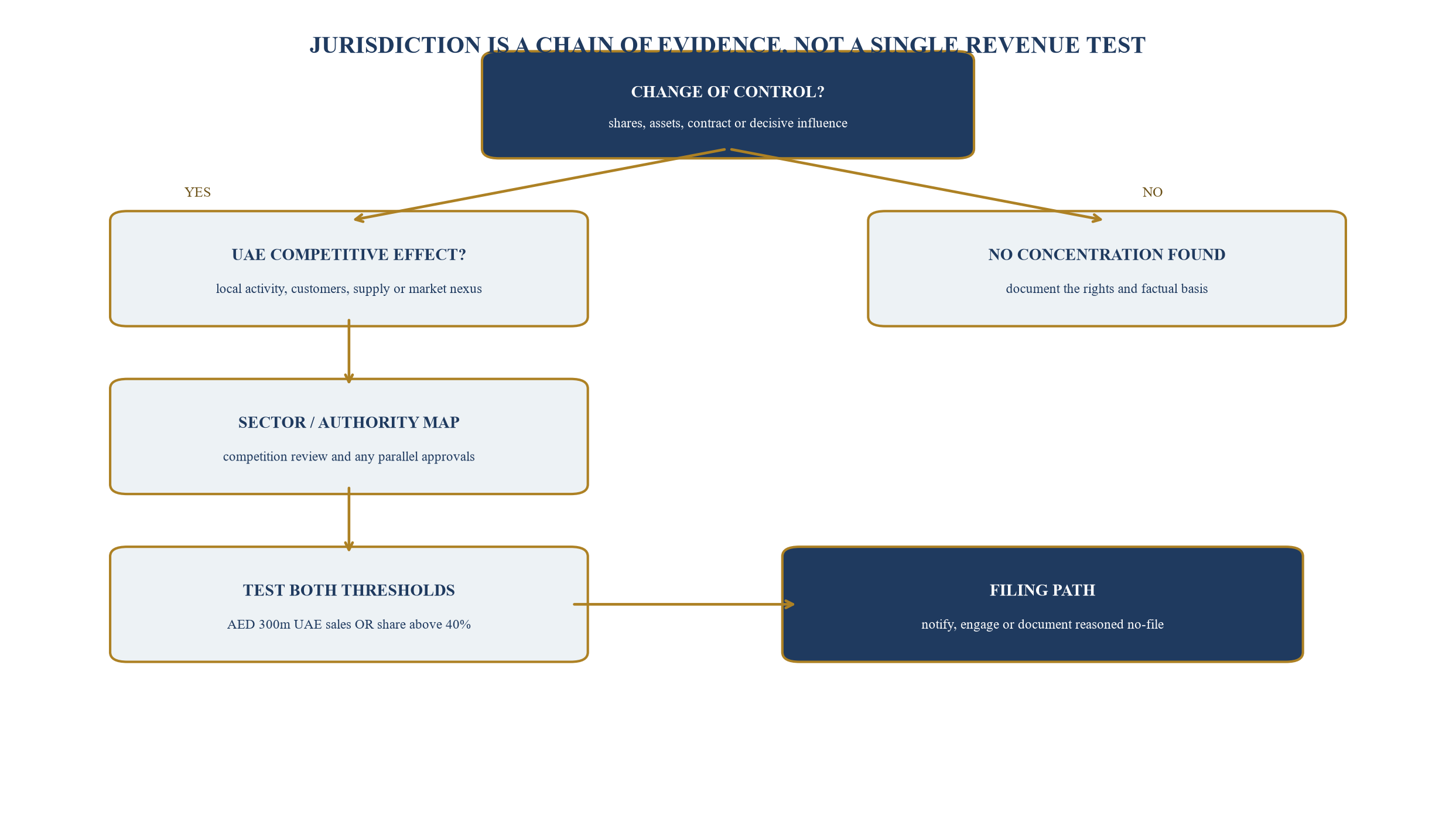
The tree is a governance aid. Current law, sector rules and complete facts determine the filing position.
5. Relevant-market definition is an evidence exercise
The relevant market gives meaning to the sales and share thresholds and to the substantive competition assessment. The Ministry's 2026 market-definition guidance describes a relevant product market through substitutability based on characteristics, price and use, and a relevant geographic market through the area in which competitive conditions are sufficiently similar. Physical and digital supply can require different evidence. A platform or multi-sided business can involve linked customer groups, network effects, data access and zero-price services that do not fit a simple product list.
The deal team should build the market definition from customer choice. It should ask what customers would switch to if the combined business increased price, reduced quality, limited capacity, changed service, slowed innovation or restricted access. It should examine how suppliers reposition, the cost and time of switching, qualification requirements, regulation, transport, language, data location, installed systems, contracts and procurement practice. Internal documents that describe competitors, alternatives and addressable markets deserve particular attention because regulators can compare advocacy with contemporaneous strategy material.
Product and geographic boundaries should be tested through multiple evidence streams. Transaction data can show customer switching and win-loss patterns. Price and margin data can reveal competitive constraints. Customer interviews and tender records can show who is considered a credible supplier. Capacity and entry evidence can show whether competitors can expand. Regulatory licences and technical standards can constrain substitution. Digital services may require analysis of user location, data, language, payment rails, platform access and multi-homing.
The market-definition file should contain more than a conclusion. It should include candidate markets, reasons for inclusion and exclusion, data sources, sensitivity cases and the effect of each case on thresholds and competitive assessment. If a broad market produces a share below the threshold while a plausible narrow market produces a share above it, that sensitivity belongs in the board pack. The parties can then collect evidence before the authority asks for it.
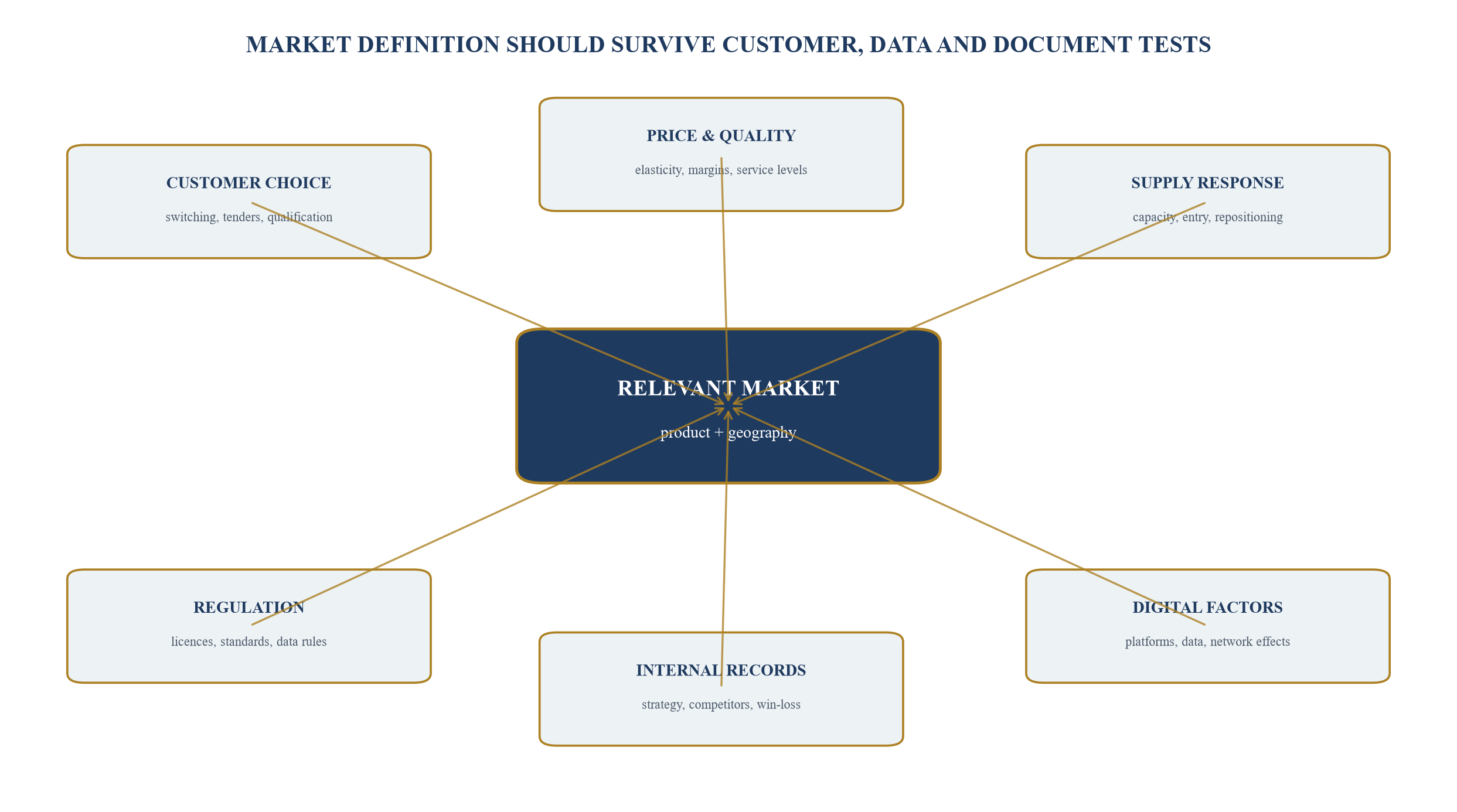
The map identifies evidence categories. Weight and relevance depend on the sector, business model and transaction.
Table 2. Filing data-room request matrix
| Workstream | Core request | Reconciliation test | Primary owner |
|---|---|---|---|
| transaction and control | structure chart, term sheet, draft agreements, governance rights, side letters and financing rights | every control right traced to a document and timing state | legal lead |
| corporate group | ownership, affiliates, controlled entities and beneficial owners | group perimeter reconciles across filing, accounts and structure chart | company secretariat |
| financials | audited accounts, management accounts and UAE revenue by product, customer and period | market sales bridge to audited totals with adjustment schedule | finance lead |
| markets | products, pricing, customer segments, geographies, competitors, channels and substitution evidence | candidate markets tested with consistent definitions | competition economics lead |
| shares | party sales or volume, total-market denominator and source support | numerator and denominator use same market, period and units | commercial analytics lead |
| customers | top customers, tenders, switching, contracts, churn and concentration | customer data agrees with sales ledger and market narrative | sales operations lead |
| competitors | win-loss data, capacity, entry, innovation and strategic documents | filing description agrees with board and strategy materials | strategy lead |
| efficiencies | merger-specific savings, investment, capacity, quality and innovation evidence | benefits are quantified, achievable and not double-counted | integration and finance leads |
| regulatory | licences, sector approvals, correspondence and prior filings | all competent authorities and critical-path dependencies mapped | regulatory lead |
| document production | prescribed form, authorizations, translations, confidentiality versions and appendices | completeness checklist signed before submission | filing programme manager |
Scope and depth should be tailored to the transaction, markets and authority requirements.
6. Completeness is a deal capability
A complete filing is the product of governance, data and drafting. The authority's formal review asks whether the application contains the information needed to begin substantive assessment. Deal teams often treat completeness as counsel's document task. In practice, counsel depends on finance, commercial, strategy, tax, regulatory, technology and target teams. A missing revenue cut, unexplained market-share source or inconsistent description can delay the clock.
The filing programme should start with a data dictionary. Every recurring term, including sales, UAE customer, product, affiliate, market share, transaction, customer and competitor, should have a definition, source system, owner and measurement period. This prevents different workstreams from producing internally consistent answers that conflict with one another. The revenue bridge, market-share model, customer list and narrative should use the same definitions or explain differences.
Version control is equally important. A merger filing can contain forms, annexes, data tables, agreements, corporate records, translations, economic evidence and confidential material. The team should maintain a single index recording document owner, version, confidentiality status, translation status, filing status and source. A late change to the sale agreement or transaction structure should trigger an impact review across the form, structure chart, control analysis and market narrative.
The Executive Regulations contemplate confidential and non-confidential material. Redaction should protect legitimate secrets while leaving a coherent public account. Over-redaction can obstruct stakeholder understanding; under-redaction can expose sensitive data. A designated confidentiality lead should maintain the basis for each claim and ensure that public and confidential versions remain aligned.
The completeness gate should have formal sign-off. The chief financial officer should approve revenue reconciliations. The commercial lead should approve customer, market and competitor evidence. Transaction counsel should approve control and document descriptions. Competition counsel should approve jurisdiction and substantive analysis. The filing representative should approve form, authorization and production requirements. The deal executive should confirm that the submission is consistent with investment-committee materials and transaction documents.
The programme should reserve time for authority questions during formal review. Named response teams can pre-clear access to systems and management. Draft source packs can be assembled for market share, top customers, internal strategy and efficiency claims. Fast, accurate responses protect the timetable. Speed without reconciliation can create a second question and weaken credibility.
7. Standstill should shape pre-closing conduct
Standstill separates signing from implementation. The buyer can protect the value of the target through appropriately designed covenants and information rights. It must avoid exercising control or coordinating competitive behaviour before clearance and completion. The operational boundary is fact-specific and should be converted into a practical protocol for executives and employees.
Ordinary-course covenants should focus on exceptional actions that could materially change the asset, such as major capital commitments, disposals, unusual borrowing, changes to key contracts or senior leadership. They should not give the buyer routine control over pricing, customer negotiations, production, hiring, marketing or procurement. Consent processes should have thresholds, response times, independent seller decision-making and legal escalation. The purpose and application of each consent right should be documented.
Information sharing requires structure. Due diligence can require customer, price, margin, pipeline, capacity and strategy data that is competitively sensitive. A clean team limits access to approved external advisers or internal individuals separated from competitive decisions. Data can be aggregated, anonymized, delayed or redacted. Reports to the transaction team can communicate valuation-relevant conclusions without exposing unnecessary detail. The clean-team protocol should cover permitted recipients, systems, purpose, onward sharing, retention and destruction.
Integration planning can proceed within boundaries. Teams can design Day-One governance, reporting, systems migration, communications and synergy work at a conceptual level. They should not direct the target, combine operations, allocate customers, coordinate bids, move employees, exchange live competitive plans or implement joint purchasing before closing. A competition-law workstream should review integration requests and maintain a decision log.
Public communications also matter. Announcements, customer messages, employee communications and branding should accurately describe the transaction as pending. Language that presents the businesses as already combined can create confusion and evidential risk. Communications should be pre-cleared against the transaction state and applicable securities, competition and contractual duties.
8. Term sheets should allocate regulatory risk early
A term sheet can create commercial expectations that later drafting struggles to reverse. It should address the regulatory perimeter at a level proportionate to current knowledge. The parties can identify expected filings, responsibility for preparation, information cooperation, anticipated signing-to-closing period, remedy principles, cost allocation, exclusivity length and a route if the jurisdiction analysis changes.
The long-stop date should be built from the filing-ready date and decision range. A simple 90-day addition can fail when data collection, translation, formal completeness, extension, stakeholder process, remedies or parallel approvals are material. The term sheet should permit an extension linked to a defined regulatory event and should address financing consequences. An open-ended extension transfers risk to the seller and can weaken deal discipline.
Efforts obligations should have operational meaning. Terms such as reasonable efforts or best efforts need a shared understanding of actions, cost, litigation, information, undertakings and divestiture exposure. A buyer may be prepared to accept behavioural commitments and unwilling to divest a strategic business. A seller may seek certainty and a reverse break fee if the buyer cannot obtain approval. The negotiation should expose these positions before diligence costs and announcement risk increase.
The parties should also address information asymmetry. The seller controls much of the target data. The buyer often controls global overlaps, strategy and remedy capacity. A mutual cooperation clause should define response deadlines, accuracy obligations, counsel access, privilege, authority meetings and review rights. A governance committee can resolve disputes without slowing routine production.
Exclusivity should match evidence milestones. The buyer can commit to a market-definition workshop, revenue bridge, initial filing assessment and counsel view within a short period. Continued exclusivity can depend on the seller's timely data delivery and the board's confirmation that the regulatory case remains acceptable. This preserves negotiating momentum while preventing an unclear filing position from becoming a sunk-cost commitment.
9. The sale agreement is a regulatory operating model
Definitive documents convert the regulatory plan into enforceable obligations. The conditions precedent should identify relevant competition and sectoral approvals with enough precision to avoid later disagreement. The agreement should state what counts as satisfaction, which party controls the filing, how the parties consult and when either party can waive or terminate. A generic “all approvals” condition can leave material questions unanswered.
The cooperation covenant should define preparation, submission, meetings, information requests and access to correspondence. Each party should provide accurate information within agreed periods. Counsel should manage confidential material and privilege. The filing party should control routine strategy while consulting the other party on material positions, commitments and remedies. The agreement can prevent either party from taking actions that materially increase regulatory risk, subject to negotiated limitations.
Interim operating covenants should protect value and respect standstill. A schedule can divide actions into ordinary course, notice-only, consent-required and prohibited categories. The seller should retain independent commercial decisions. The buyer should receive prompt information on exceptional events and access to assess material breaches. A rapid escalation process can keep business decisions from waiting on the transaction team.
Remedy provisions require clarity. The agreement can state whether the buyer must offer behavioural commitments, asset divestitures, licence arrangements or other measures; whether there is a materiality cap; which businesses are protected; who selects a divestiture buyer; and how costs are borne. If remedy exposure cannot be defined at signing, the agreement can use objective value, revenue, earnings or strategic-perimeter limits. Counsel must tailor the mechanism to applicable law and enforceability.
Termination and fee provisions should align incentives. A reverse break fee can compensate the seller for agreed regulatory failure risk. Its amount, triggers, exclusions and sole-remedy status require careful design. The seller may also seek reimbursement of documented costs or an extension right. The buyer may seek termination if the required remedy exceeds the negotiated perimeter. These economics belong in the valuation bridge because they change downside value.
Table 3. Term-sheet and sale-agreement control checklist
| Clause area | Decision to settle | Evidence supporting the decision | Control owner |
|---|---|---|---|
| conditions precedent | which approvals, clearances or no-objection outcomes are required | jurisdiction map and sector analysis | transaction counsel |
| long-stop date | base date, extension triggers and outer date | integrated filing and financing timetable | deal executive |
| filing control | lead party, consultation rights and meeting attendance | applicant rules and information ownership | competition counsel |
| cooperation | data deadlines, accuracy, correspondence and privilege | data-room plan and response capacity | programme manager |
| interim covenants | ordinary course, consent thresholds and exceptions | value-protection rationale and standstill review | transaction counsel |
| clean team | recipients, data controls, purpose and destruction | diligence and competition sensitivity map | compliance lead |
| remedies | permitted measures, cap, protected perimeter and approval authority | strategic asset map and remedy sensitivity | board / investment committee |
| efforts standard | actions, appeals, litigation, cost and divestiture exposure | regulatory risk appetite | board / transaction sponsor |
| termination | regulatory triggers, cure, extension and notice | decision-range scenarios | transaction sponsor |
| reverse break fee | amount, trigger, exclusions and remedy status | seller exposure and buyer control of risk | finance and legal leads |
| communications | announcement state, employee and customer messages | signing / clearance / closing plan | communications lead |
Drafting choices require transaction-specific legal advice. The checklist identifies commercial decisions for the deal team.
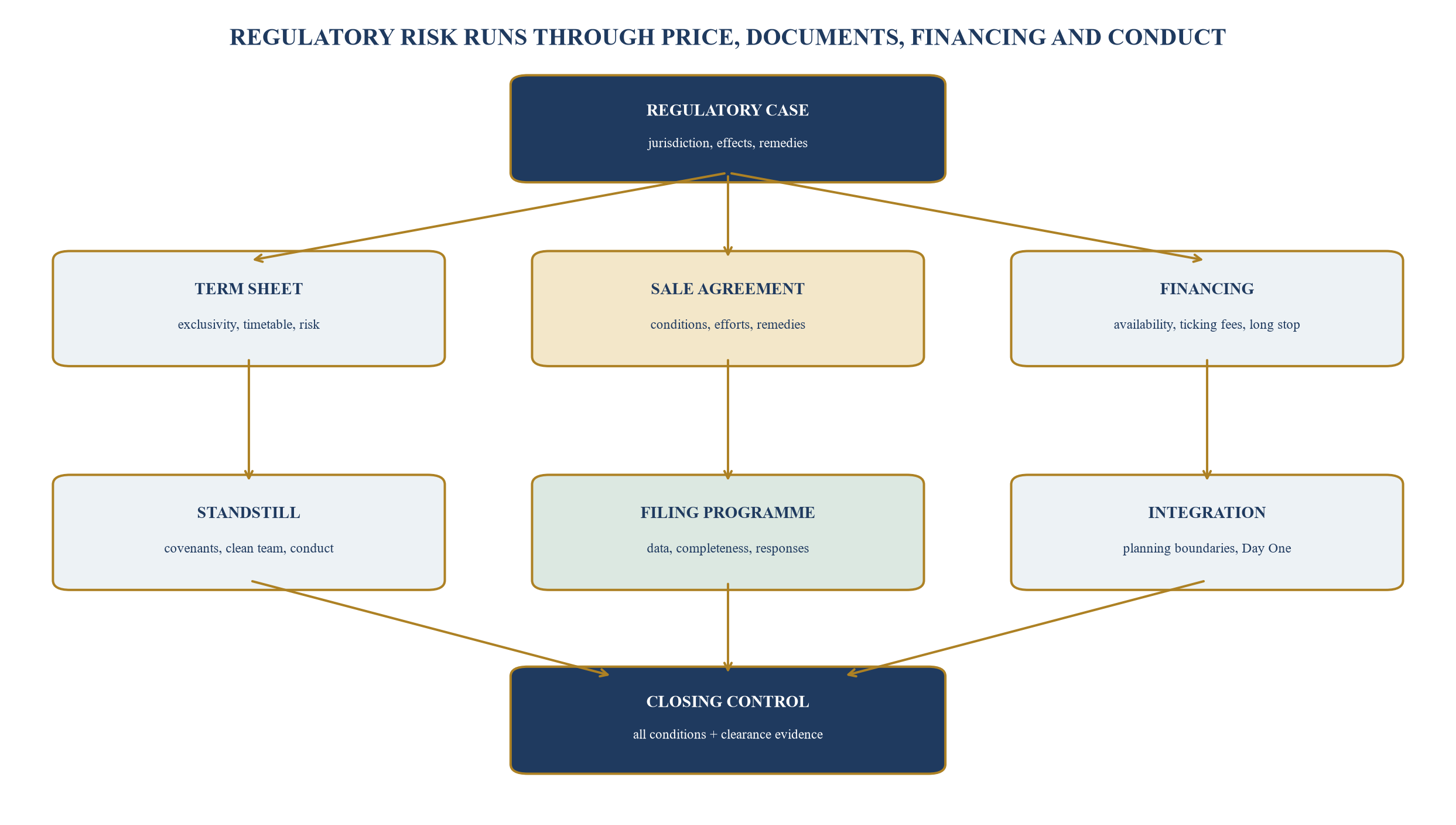
The map illustrates dependencies. The definitive sequence depends on the transaction, law, financing and authority process.
10. Financing must survive the regulatory timetable
Acquisition financing can expire, reprice or accumulate cost while a filing remains under review. Commitment periods, bridge maturities, ticking fees, hedging, flex rights, market-disruption provisions and conditions precedent should be compared with the decision range rather than the headline clock. A financing source also needs confidence that the buyer can satisfy remedies without undermining the credit case.
The sources-and-uses model should include regulatory elapsed time. Financing fees can accrue before closing. Hedging can create break costs if the transaction is delayed or fails. Cash retained for a reverse break fee or remedy implementation can reduce liquidity. A divestiture remedy can alter earnings, security, leverage and covenant calculations. The base case and downside cases should capture these effects explicitly.
Commitment documentation should align with the acquisition agreement. The definitions of required approvals, long-stop date and permitted amendments should be consistent. A buyer should understand whether extending the sale agreement automatically extends financing, requires lender consent or triggers new fees. If financing is conditional on no material remedy, the acquisition agreement should not commit the buyer to a broader remedy obligation without secured funding.
Funds certainty also depends on information. Lenders may require access to filing status, authority requests and remedy discussions. Disclosure must respect confidentiality, privilege and process rules. A regulatory reporting protocol can define what is shared, when and by whom. The programme manager should maintain one verified status rather than allowing different descriptions to circulate among the board, seller and lenders.
For a sponsor transaction, fund life, investment period, capital-call timing and co-investment approvals may add constraints. For a strategic buyer, board authority, treasury limits and accounting treatment can matter. The regulatory timetable should be represented as a capital commitment period with a measurable cost, not an administrative wait.
11. Stakeholders can change the evidence burden
The Executive Regulations permit publication of basic information about a proposed concentration and provide time for interested parties to submit views. Customers, competitors, suppliers, employees, trade bodies or other stakeholders may raise questions about price, capacity, access, quality, innovation, foreclosure or market definition. The deal team's preparation should anticipate those questions without attempting to coordinate or influence independent responses.
A stakeholder map can identify who buys, supplies, competes, regulates and depends on the relevant products. It should record the relationship, information likely held, possible concern and factual evidence available. The purpose is to prepare accurate answers and to detect risks that the commercial thesis may have overlooked. A major customer with credible switching difficulty can affect both competition analysis and transaction value.
Internal documents often provide the strongest preparation source. Board papers, strategy plans, pricing reviews, sales presentations, win-loss analyses and investment memoranda may describe market power, barriers, competitor weakness or expected pricing. The filing narrative should be accurate and consistent with these records. Differences should be explained through facts and context, not drafting.
If a formal objection is accepted, the parties may have a limited period to respond. A response cell should include legal, economics, commercial and document specialists. It should maintain a claim-and-evidence matrix: each allegation, source, factual answer, supporting document, confidentiality status and approval. This prevents a rapid response from becoming a collection of inconsistent emails.
The board should know which concerns could require a remedy. Horizontal overlaps may lead to divestiture or access questions. Vertical relationships may raise input or customer foreclosure. Conglomerate or digital combinations may raise tying, bundling, data or ecosystem concerns. The analysis should remain tied to evidence and current law. Remedy appetite should already have been set in the transaction documents.
12. Remedies need a value and execution model
A remedy is a change to the transaction or future conduct intended to address competition concerns. It can affect the assets acquired, the operating model, synergies, customer proposition and valuation. Remedy analysis should therefore be led jointly by competition counsel, business management, finance and integration teams. A legally acceptable remedy can still destroy the investment thesis if it removes a scarce asset or imposes an unworkable operating dependency.
Structural remedies can include divestiture of a business, assets, rights or capacity. Their value effect depends on perimeter, stand-alone viability, buyer availability, separation cost, shared systems, transitional services and timing. Behavioural commitments can govern access, supply, interoperability, pricing, information or non-discrimination. Their value effect depends on monitoring, duration, flexibility, compliance systems and enforcement exposure. Hybrid remedies can combine both.
The remedy model should include four bridges. The earnings bridge shows revenue and cost removed or constrained. The cash bridge includes separation, duplicated functions, advisers, trustee or monitoring cost, transitional services and tax. The strategic bridge identifies capabilities, customers, data, technology and geographic options lost. The execution bridge shows approvals, buyer process, hold-separate obligations and management capacity.
Potential undertakings should be tested before they are offered. The team should ask whether the measure addresses the identified theory of harm, can be implemented, can be monitored, preserves a viable business and fits the agreement's remedy covenant. It should identify who has authority to propose, amend and accept it. A board should never discover during a deadline-driven negotiation that management and the transaction agreement define the acceptable perimeter differently.
Table 4. Regulatory risk and control matrix
| Risk | Early indicator | Preventive control | Contingency | Escalation owner |
|---|---|---|---|---|
| filing perimeter discovered late | incomplete UAE sales or control map | pre-term-sheet jurisdiction memorandum | reset timetable and documents | transaction sponsor |
| completeness delay | unreconciled data, missing translations or changing drafts | data dictionary, index and sign-off gate | dedicated response sprint | filing programme manager |
| narrow market definition | internal documents or customers support limited substitution | sensitivity cases and customer evidence | alternative effects analysis | economics lead |
| authority information burden | inconsistent narratives or weak source trails | source-linked filing and document review | claim-and-evidence response cell | competition counsel |
| standstill breach | buyer consent over ordinary decisions or sensitive data flow | conduct protocol, clean team and legal escalation | stop conduct, preserve record, advise board | compliance lead |
| objection or adverse stakeholder view | concentrated customers, foreclosure concern or contested shares | stakeholder risk map and evidence pack | formal response and remedy analysis | transaction sponsor |
| remedy erodes value | strategic asset lies within overlap | pre-agreed remedy perimeter and value bridge | renegotiate, restructure or exercise rights | board / investment committee |
| financing expires | base approval date approaches commitment end | headroom and extension mechanics | lender extension or alternative capital | chief financial officer |
| long-stop mismatch | transaction conditions use different clocks | integrated critical-path schedule | negotiated extension or termination | deal executive |
| parallel filing inconsistency | markets and data described differently across jurisdictions | global core record with local supplements | reconcile and notify counsel | global regulatory lead |
Probability and impact assessments are management judgments requiring current evidence and board approval.
13. Cross-border reviews need one factual core
Many UAE transactions form part of a wider acquisition that requires notifications in several jurisdictions. Review systems differ in thresholds, timing, legal tests, filing responsibility, suspension, confidentiality and remedies. The deal team needs one verified factual core and jurisdiction-specific analysis. Copying language between filings can create errors when market definitions, accounting periods or legal concepts differ.
The global core should include transaction documents, structure, parties and affiliates, control rights, revenue by geography and product, customer and competitor data, internal documents, transaction rationale and efficiency evidence. Each jurisdiction module should state its threshold, market approach, required period, form, language, fee, publication process and decision path. A reconciliation table should explain any difference in figures or descriptions.
Timetable coordination should use dependencies. The European Commission's Phase I period is generally 25 working days after a complete filing; the United Kingdom's CMA Phase 1 has a 40-working-day statutory period; the United States usually begins with an HSR waiting period; Australia has a mandatory regime with a Phase 1 assessment period; Singapore indicates an expected Phase 1 period from a complete notification; India applies its statutory combination process; and COMESA has its own filing and review timetable. Saudi Arabia also uses a pre-completion economic-concentration system. These periods have distinct triggers and extension mechanisms.
A board dashboard should show filing-ready, clock-start, expected decision and long-stop dates for each jurisdiction. It should also show the most likely driver of delay, information owners and remedy linkage. The critical jurisdiction may change during review. One authority's questions can reveal evidence relevant elsewhere, so counsel should coordinate responses while respecting confidentiality and legal obligations.
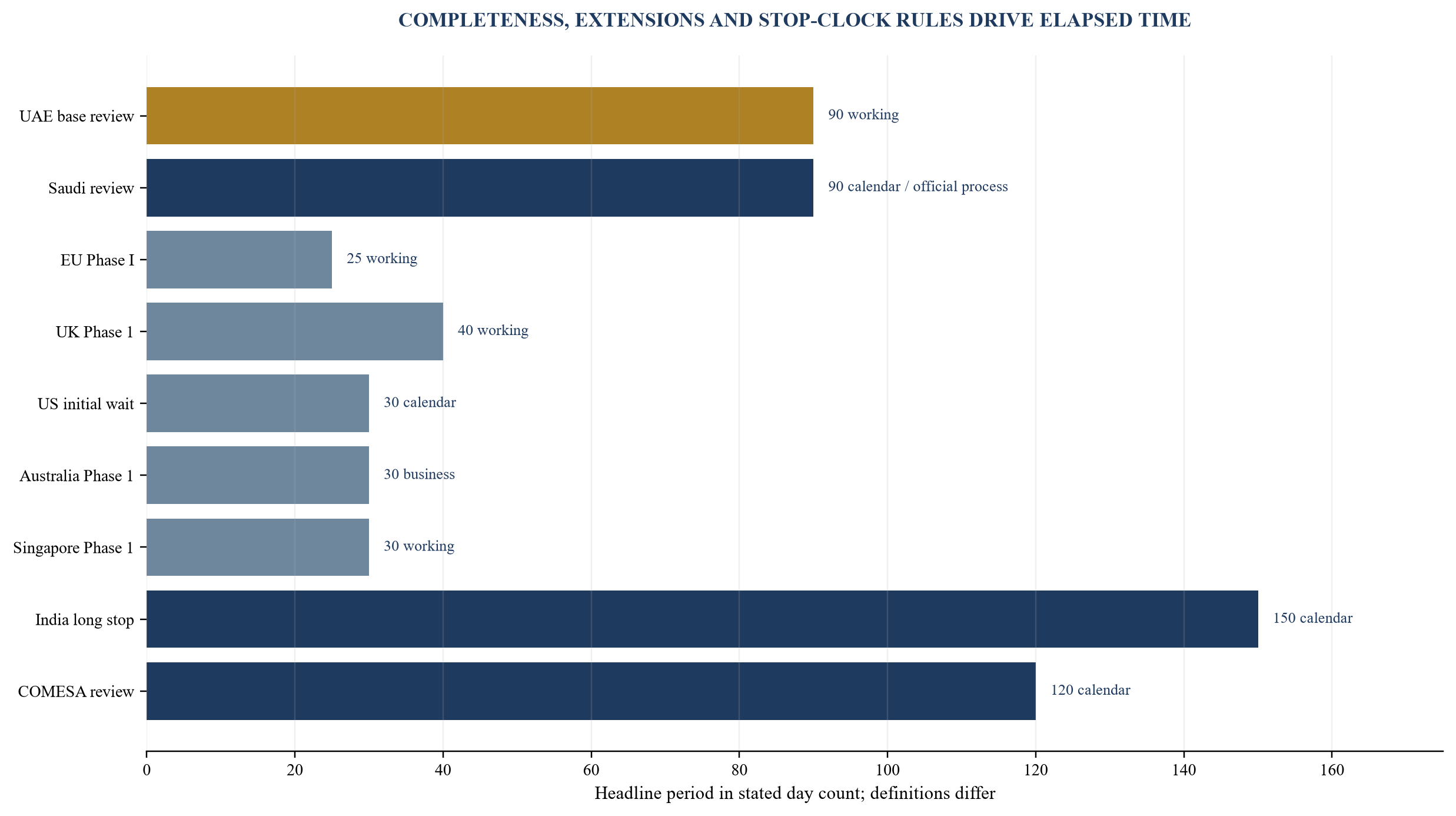
Periods are simplified from current official sources for programme design. They have different triggers, units, extensions and legal effects and are not directly equivalent.
14. Scenario timetables should show assumptions
A timetable forecast should be a range tied to explicit events. The baseline can assume that jurisdiction analysis is substantially complete before signing, the data room is responsive, the filing is submitted promptly, the authority accepts completeness after formal review and no extension or remedy is required. A managed-complexity case can assume one material information cycle, an extended review and parallel sector approval. A stressed case can assume disputed market definition, objection, remedy discussion or transaction amendment.
The model should begin before signing. Data collection, market definition, counsel review, translation, authorization and board approvals can consume weeks. The post-signing period should distinguish submission from completeness. It should then include substantive review, possible extension, satisfaction of conditions and closing mechanics. Weekends, public holidays and working-day definitions should be calculated in the operative calendar by counsel.
The cost model should run beside the time model. Each additional week can create commitment fees, financing carry, hedging exposure, adviser costs, employee retention payments, seller operating risk and delayed synergy. It can also create value through better preparation or a more robust remedy. The board should understand both directions rather than treating speed as the only objective.
The probability weights in a scenario model are management judgments. They should be supported by transaction facts, market complexity, data readiness, authority engagement and relevant precedents. They are not claims about regulator behaviour. The model should be updated when an application is accepted as complete, a request is received, an extension is notified or a remedy issue emerges.
Table 5. Illustrative management-assumption timetable scenarios
| Stage | Prepared case | Managed-complexity case | Stressed case | Evidence that changes the estimate |
|---|---|---|---|---|
| pre-signing scope and market work | 20 working days | 35 working days | 50 working days | data access, control complexity and candidate markets |
| filing production after signing | 15 working days | 25 working days | 40 working days | seller response, translations and transaction stability |
| formal completeness process | 10 working days | 20 working days | 30 working days | missing material and authority questions |
| substantive review | 90 working days | 135 working days | 135+ working days | extension, information and stakeholder procedures |
| remedy / final conditions | 0-10 working days | 20 working days | 40+ working days | theory of harm, remedy design and parallel approvals |
| closing mechanics | 5 working days | 10 working days | 15 working days | financing, sector conditions and document readiness |
| management planning range | 140-150 working days | 245 working days | 310+ working days | integrated programme evidence |
Periods are management assumptions for programme design. They are not statutory calculations, regulator forecasts or transaction commitments.
15. A 120-day readiness programme can protect the clock
The best time to prepare a filing is before the transaction has a fixed announcement date. A 120-day readiness programme can be scaled to deal certainty. At the beginning, the buyer can map control, sectors, UAE activities and possible thresholds using available evidence. As discussions progress, the seller can populate a focused data request under confidentiality. Competition counsel can test candidate markets and identify missing sources. The purpose is to bring uncertainty forward.
Between 120 and 90 days before the intended filing, the team should settle the transaction perimeter, group structure, preliminary market definitions and revenue bridge. It should identify sector authorities, translations, authorizations and key internal documents. The term sheet should reflect the resulting timetable and remedy appetite.
Between 90 and 60 days, the parties should draft the form and narrative, reconcile sales and shares, conduct document review and establish clean-team controls. Customer and competitor evidence should be organized. The sale agreement should incorporate the regulatory operating model. Financing should be tested against decision scenarios.
Between 60 and 30 days, the team should resolve inconsistencies, prepare confidential and non-confidential versions, finalize translations and hold a completeness challenge. Senior management should review transaction rationale, market descriptions, efficiencies and possible concerns. A mock information request can test response capacity.
During the final 30 days, the filing package should be frozen through change control, approvals and signatures should be completed, and the authority engagement plan should be confirmed. The board should receive the filing-readiness certificate, updated decision range and conduct protocol. Submission should occur only when the package meets the agreed completeness standard or the board explicitly accepts the residual risk.
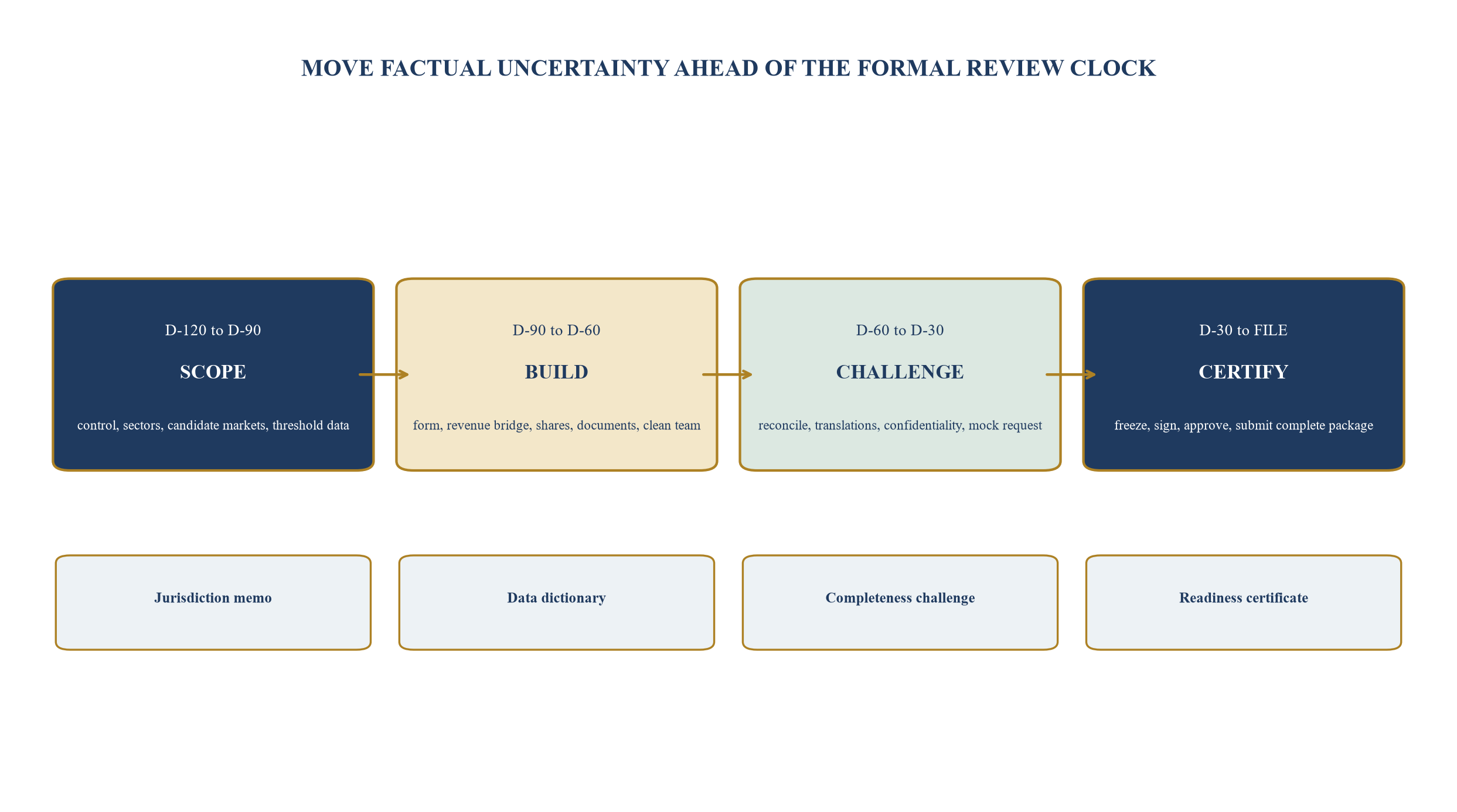
Timing is an illustrative management design and should be tailored to transaction certainty, authority requirements and available evidence.
16. Governance should turn the filing into a controlled programme
The transaction sponsor remains accountable for the regulatory case. Competition counsel owns legal analysis and authority strategy. A filing programme manager owns the integrated plan, data index, decisions, requests and reporting. Finance owns reconciled sales. Commercial management owns market and customer evidence. The company secretary owns corporate records and authority. Compliance owns standstill controls. The integration lead owns permitted planning. Clear ownership prevents counsel from becoming the default owner of facts held elsewhere.
A weekly regulatory steering committee should review five items: scope changes, completeness, clock status, authority questions and transaction dependencies. It should use a single decision log. Material changes to price, structure, rights, parties, financing, business perimeter or market evidence should trigger an impact assessment. The committee should escalate decisions that affect remedy appetite, long-stop, public disclosure or board authority.
The board dashboard should be concise and source-linked. It should show the current jurisdiction conclusion, confidence and open facts; filing readiness; statutory and management dates; information requests; stakeholder issues; remedy exposure; standstill incidents; financing headroom; and required board decisions. Traffic-light status should be supported by a written basis. A green status should mean that evidence and control thresholds are satisfied, not that no one has raised a concern.
Quality assurance should test consistency across the filing, sale agreement, financing documents, board papers, press release, investor communications and integration plan. The same transaction should not be described as an acquisition of control in one document and a passive investment in another. Market share and synergy figures should reconcile or explain different purposes and definitions.
Table 6. Board merger-control dashboard
| Dashboard item | Green evidence | Amber trigger | Red trigger | Board question |
|---|---|---|---|---|
| jurisdiction | signed memorandum, reconciled facts and stable rights | one material fact or candidate market open | filing position unsupported or changed | can the board rely on the current route? |
| completeness | indexed package, reconciliations and approvals complete | limited translation or evidence gap | core sales, share or control data missing | when can the formal clock credibly start? |
| timetable | decision range fits long-stop and funding | headroom below approved buffer | base case exceeds contract or financing | what must change to protect completion? |
| conduct | trained teams, clean team and decision log | one unresolved information or consent request | early control, coordination or data breach concern | is immediate remediation required? |
| substantive case | evidence supports market, effects and efficiencies | stakeholder or internal-document tension | credible theory of harm without response | what value is at risk? |
| remedies | board-approved perimeter and value bridge | possible commitment within cap | likely measure outside approved perimeter | renegotiate, restructure or stop? |
| financing | commitments cover decision range and scenarios | extension requires consent or fee | financing expiry before expected decision | what capital alternative is available? |
| parallel approvals | one reconciled fact core and aligned calendar | divergent data or timing emerges | conflicting obligation or critical delay | which jurisdiction controls the closing path? |
Status labels should be supported by named evidence and dated owner confirmation.
17. The board decision rule
The board should approve signing only when the merger-control case is investable. That standard does not require certainty about the authority's decision. It requires a reliable factual base, a reasoned jurisdiction position, a credible substantive case, a complete-enough filing plan, an executable timetable, acceptable remedy exposure, financing headroom and enforceable transaction protections.
The decision pack should state the transaction thesis before synergies and after the approved remedy perimeter. It should show the sales and share threshold evidence, candidate markets, key competitors and customers, control rights, parallel approvals and current data gaps. It should include prepared, managed-complexity and stressed timetables with cash effects. It should identify the maximum remedy that management can negotiate without renewed board authority.
The signing resolution can attach conditions. Management may be required to complete a revenue reconciliation, secure a seller data covenant, extend financing, narrow buyer consent rights, approve a clean-team protocol or revise the long-stop. A conditional approval should have objective evidence and a named certifier. Open-ended comfort language weakens accountability.
During review, the board should receive updates at defined events: submission, completeness, material information request, stakeholder objection, extension, remedy discussion and decision. Management should escalate immediately if the filing position changes, the expected date exceeds approved headroom, conduct risk arises or remedy exposure crosses the authorized perimeter.
The value of this governance is measured in avoided surprise and better choices. A well-prepared team can still face a long or difficult review. It can explain the timetable, respond with verified evidence, protect separate operations, evaluate remedies and exercise contractual rights with discipline. That capability improves transaction control even when the regulatory outcome remains uncertain.
18. Clearance should be converted into closing controls
A clearance decision completes one regulatory stage and can create obligations for closing and operation. The closing checklist should identify the decision, its date, scope, conditions, undertakings, continuing information duties and any separate sector approvals. Transaction counsel should confirm that every condition precedent has been satisfied or validly waived and that the transaction being closed is the transaction that was reviewed. A change in assets, rights, parties or structure can require renewed analysis.
Conditional approval needs an implementation plan with the same discipline as the filing. Each undertaking should have an owner, deliverable, deadline, evidence standard, reporting route and escalation threshold. Structural measures can require separation planning, buyer approval, trustee interaction, transitional arrangements and preservation of business viability. Behavioural measures can require policies, systems, training, monitoring and periodic reporting. The cost and management capacity required should be included in the transaction value bridge.
The standstill protocol should remain active until legal closing has occurred and counsel confirms that control may pass. Signing a clearance document, satisfying another jurisdiction's condition or funding an escrow does not itself authorize integration. The closing call should verify all approvals, financing, documents and mechanical steps. A written release can then identify which pre-closing restrictions end and which commitments continue.
Day-One execution should respect the approved perimeter. Integration teams should receive a concise summary of remedies, protected information, access rules, supply commitments, non-discrimination duties, divestiture boundaries and monitoring requirements. Systems and authority matrices should reflect the legal state from the effective time. A board-approved synergy plan should be refreshed for any assets, timing or operating constraints introduced during review.
Post-closing assurance should test evidence rather than intention. Internal audit or an independent compliance function can review data access, customer treatment, pricing controls, separation obligations, reporting and remedy milestones. Exceptions should be recorded, remediated and escalated. This closes the regulatory programme with an auditable path from term-sheet assumptions through filing, decision, closing and operational compliance.
19. Limitations and professional-use boundary
This paper reflects official sources available in August 2026. UAE legislation, Executive Regulations, fee decisions, market-definition guidance, authority practice, forms and sectoral rules can change. Official English translations and web summaries should be checked against the legally operative text and current authority requirements. Working-day calculations, filing triggers and procedural notices require transaction-specific advice.
The analysis depends on complete facts concerning parties, groups, rights, markets, sales, shares, customers, competitors, sectors, financing and transaction documents. A change to voting, governance, veto, option, financing, asset or contractual rights can change the control analysis. A different relevant market can change thresholds and substantive assessment. Foreign-to-foreign transactions and regulated activities can require UAE analysis.
All scenario periods, cost effects, probabilities, ratings and programme designs in this paper are management assumptions for decision architecture. They are not forecasts of regulator conduct, legal conclusions, transaction recommendations or evidence that a specific deal will be cleared. Commercial demand, retainer potential, revenue and valuation outcomes remain uncertain until supported by signed contracts, delivered work and collected cash.
Selected international regimes are included as procedural comparators. Their thresholds, tests, day definitions, completeness rules, suspension, publication, remedies and legal effects differ. The comparison does not determine any filing obligation. Local counsel should advise in every relevant jurisdiction.
This paper does not constitute legal, competition, regulatory, tax, accounting, financing, securities, investment or other professional advice. Boards and parties should obtain current advice based on the complete transaction. Management remains responsible for information accuracy, approvals, contractual choices, conduct before closing, financing, implementation and compliance with authority decisions.
Sources and further reading
- UAE Legislation, Federal Decree-Law No. 36 of 2023 Regulating Competition Official source
- UAE Legislation, Federal Decree-Law No. 36 of 2023, Official Download Official source
- UAE Legislation, Cabinet Resolution No. 3 of 2025 on Competition Ratios and Thresholds Official source
- Ministry of Economy and Tourism, Cabinet Decision No. 3 of 2025 Thresholds PDF Official source
- UAE Legislation, Cabinet Resolution No. 59 of 2026 Executive Regulations Official source
- UAE Legislation, Cabinet Resolution No. 59 of 2026, Official Download Official source
- Ministry of Economy and Tourism, Cabinet Decision No. 105 of 2026 on Competition Service Fees Official source
- Ministry of Economy and Tourism, Economic Concentration Official source
- Ministry of Economy and Tourism, Regulation of Competition Legislations Official source
- Ministry of Economy and Tourism, Regulation of Competition Official source
- Ministry of Economy and Tourism, Competition Services Official source
- Ministry of Economy and Tourism, Guidelines on Relevant Market Definition Official source
- Ministry of Economy and Tourism, Review of Competition Thresholds and Controls, 20 February 2025 Official source
- Ministry of Economy and Tourism, Economic Concentration Form Official source
- Ministry of Economy and Tourism, Economic Concentration Case Register Official source
- General Authority for Competition, Saudi Economic Concentration Review Guidelines Official source
- General Authority for Competition, Saudi Economic Concentration Service Official source
- European Commission, Merger Procedures Official source
- European Commission, EU Merger Regulation Official source
- UK Competition and Markets Authority, Quick Guide to UK Merger Assessment Official source
- UK Competition and Markets Authority, Mergers: How They Are Investigated Official source
- UK Competition and Markets Authority, Guidance on Jurisdiction and Procedure Official source
- US Federal Trade Commission, Premerger Notification and Merger Review Process Official source
- US Federal Trade Commission, Hart-Scott-Rodino Rules Official source
- Australian Competition and Consumer Commission, Mergers and Acquisitions Official source
- Australian Competition and Consumer Commission, Assessment Process and Review Timelines Official source
- Australian Competition and Consumer Commission, Notifying an Acquisition Official source
- Competition and Consumer Commission of Singapore, Guidelines on Merger Procedures Official source
- Competition Commission of India, Regulation of Combination Official source
- Competition Commission of India, Competition Amendment Act 2023 Salient Features Official source
- COMESA Competition Commission, How to File a Merger Official source
- International Competition Network, Recommended Practices for Merger Notification and Review Procedures Official source
- OECD, Recommendation of the Council on Merger Review Official source
