

1. Capital should purchase a proof transition
A financing round should connect the company's present evidence to a more valuable and less uncertain operating state. The useful question is therefore not simply how much cash the company can raise. The board should ask what the capital must prove, which risks it must retire, what evidence will demonstrate progress and which financing choices remain available after the work is complete.
Forecast-led fundraising often begins with a future revenue curve and works backwards to an amount requested. That approach can hide the most important dependencies. Revenue may depend on a product release, a regulatory permission, manufacturing qualification, customer integration, channel performance or a hiring plan that has not yet been tested. A headline forecast can aggregate all of those uncertainties into one number. Investors then have to reconstruct the evidence behind it, while management risks funding a plan that has no clear decision gates.
An evidence-led approach preserves the forecast and changes its role. The forecast becomes a model of how verified operating relationships could compound. Each important assumption is connected to a source, a test and a review date. A customer-conversion assumption is linked to cohort data and signed commercial evidence. A gross-margin assumption is linked to invoices, cloud usage, bills of materials or delivery records. A technical claim is linked to a repeatable test protocol. A regulatory claim is linked to the current rule, submission status and qualified advice. A team-capacity claim is linked to named roles, delivery throughput and recruitment evidence.
The round then purchases a specific proof transition. A concept-stage company may need to demonstrate technical feasibility and a credible user problem. A working-product company may need to demonstrate repeated customer adoption and controlled delivery. A revenue-stage company may need to demonstrate retention, gross-margin quality and a repeatable acquisition motion. A regulated or deep-technology company may need to reach an approval, validation, certification or manufacturing threshold. The transition should be material enough to change the next financing conversation.
This discipline protects strategic choice. If the company raises only enough to reach a vague activity target, it may return to market with more work completed and the same fundamental uncertainty. If it raises enough to create a verified proof state, it can approach the next decision with evidence that supports valuation, instrument selection, investor fit and negotiating leverage. No milestone guarantees a financing or valuation outcome. Market conditions, investor mandates, competition, legal structure and execution quality still matter.
2. Build the evidence chain before setting the milestone
A milestone is a decision rule supported by evidence. It is more demanding than a task, deliverable or target. "Launch the product" describes an event. "Demonstrate that the released product can complete the defined customer workflow at the required performance level, with documented security controls and repeated use by an agreed customer cohort" describes a proof state. The second formulation gives management, the board and investors a common basis for review.
The evidence chain has six elements. First, the decision question states what uncertainty must be reduced. Second, the baseline records the present condition using a defined measurement period and source. Third, the intervention describes what the company will build, change or test. Fourth, the success criterion states the observable result. Fifth, the evidence package identifies the records needed to support the result. Sixth, the consequence determines what happens after review.
The evidence package should be proportionate to the claim. A product-performance milestone may require version-controlled test scripts, raw results, exception logs and independent replication. A customer milestone may require executed contracts, onboarding evidence, usage records, invoices, collections and renewal behaviour. A regulatory milestone may require correspondence, a submission receipt, advice on outstanding conditions and an operating plan that reflects the current permission. A manufacturing milestone may require qualified suppliers, yield data, quality records and a reproducible costed bill of materials.
Evidence also needs ownership. Each metric should have a business owner, a source-system owner and a reviewer. The business owner explains the commercial meaning. The source-system owner protects data integrity and reproducibility. The reviewer challenges definition, completeness and exceptions. Finance should reconcile financial claims. Product or engineering leaders should validate technical claims. Counsel and regulated specialists should review legal or regulatory conclusions within their mandates.
The board should avoid designing milestones whose result can be changed by management after the measurement period. Definitions, inclusions, exclusions, cohort dates, currency treatment, accounting policies and acceptable exceptions should be fixed before the test. A change may still be justified when facts change. It should be documented, approved and shown alongside the original definition. This protects learning from becoming retrospective target editing.
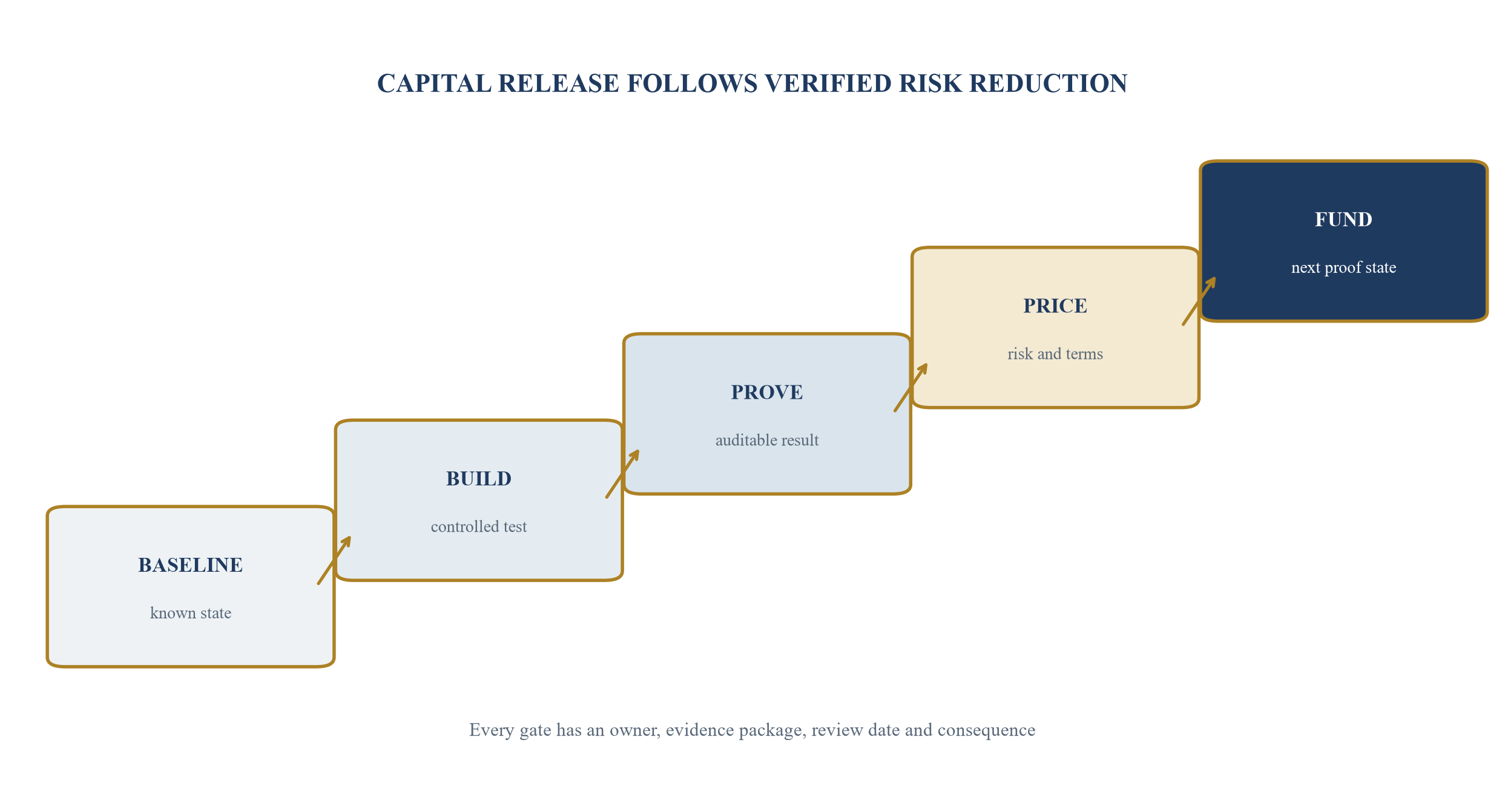
The roadmap links each proof state to a financing decision. Gate definitions and timing are management assumptions.
3. Separate milestone families
Founders often compress several types of progress into one headline milestone. A large pilot can be technically successful while commercially unattractive. Revenue can grow while unit economics deteriorate. A regulatory submission can be complete while approval timing remains uncertain. A product can attract users while the company lacks the data rights or security controls needed to scale. The roadmap should therefore separate milestone families and show how they interact.
Technical milestones address feasibility, performance, reliability, safety, scalability and integration. The evidence may include test conditions, samples, tolerances, failure modes and repeatability. Commercial milestones address customer problem, willingness to adopt, contracted economics, usage, retention, expansion and concentration. Financial milestones address revenue quality, gross margin, working capital, cash conversion, burn and forecast accuracy. Regulatory milestones address classification, submission, permission, conditions, reporting and ongoing compliance.
Operational milestones address delivery capacity, supplier qualification, manufacturing yield, service quality, implementation time and support load. Governance milestones address entity control, cap-table accuracy, intellectual-property ownership, data protection, financial reporting, delegated authority and board oversight. Team milestones address role coverage, leadership capacity, hiring, incentives, succession and concentration in a single founder or technical expert.
The board should identify the dominant uncertainty. A company facing technical feasibility risk should not define the next financing solely around sales activity. A company with a proven product and weak collections should not treat bookings as equivalent to cash evidence. A regulated company should not treat a positive regulatory meeting as equivalent to formal permission. The dominant uncertainty determines where capital and board attention should be concentrated.
Milestones also need hierarchy. A primary gate changes the financing decision. Supporting gates provide evidence that the primary result can be repeated or scaled. Guardrails protect the company from creating value in one area while damaging another. For example, a primary gate may require a defined level of recurring customer use. Supporting gates may require implementation time and support cost within management-approved ranges. Guardrails may limit customer concentration, security exceptions and cash consumption.
Table 1. Milestone definition standard
| Field | Board question | Required content | Weak substitute |
|---|---|---|---|
| decision | what uncertainty must change before more capital is committed? | one material financing or operating decision | broad ambition |
| baseline | what is true at the start and how is it measured? | period, cohort, source, owner and known limitations | undocumented estimate |
| test | what action will create new information? | intervention, scope, timing, cost and dependencies | activity list |
| criterion | what observable result constitutes success? | fixed definition, threshold, exceptions and review date | adjustable target |
| evidence | what records prove the result? | source files, reconciliations, approvals and audit trail | slide or verbal claim |
| consequence | what follows a pass, partial result or failure? | scale, redesign, bridge, pause or stop decision | automatic continuation |
Each company should set its own definitions, thresholds and evidence requirements with relevant professional advisers.
4. Use external programmes as design evidence, not as a universal template
Public and institutional funding programmes show how staged capital can be linked to evidence. Their rules serve particular policy objectives and do not establish private-market terms. Their value for founders lies in the observable design choices: quantitative criteria, defined reporting, stage gates, documented review and conditional access to later capital.
The European Innovation Council describes an investment process that progresses through selection, due diligence, co-investment search, term-sheet approval, investment and milestone-based monitoring with optional follow-on rounds. Its published materials cover equity and quasi-equity for deep-technology companies. A founder should read the applicable programme documents and conditions; the broader design lesson is that technical ambition becomes financeable through a sequence of reviewable states.
India's Startup India Seed Fund Scheme provides grants in milestone-based instalments, with milestones such as prototype development, product testing and market-launch readiness. The scheme also requires progress updates and utilisation evidence before subsequent disbursement. This illustrates a useful separation between spending proof and outcome proof. A company should show both where capital went and what uncertainty the spending reduced.
The US National Science Foundation requires detailed research plans, quantitative technical performance targets, milestones and deliverables in its small-business innovation programmes. Its post-award framework uses reports, stage gates and tranche-linked funding. The published guidance also connects technical objectives to commercial objectives. That connection is central to private financing: a technically successful experiment has greater financing relevance when management can explain how it changes adoption, unit economics, regulatory pathway or market access.
Hub71's Access Programme provides a UAE example of staged selection and support. Its published process assesses the problem, solution, business model, competition, market, traction, funding and team, together with the founder's plan for Abu Dhabi. The programme describes an initial incentive and SAFE-linked package and potential additional support for high-performing companies. These terms can change; founders should verify the current programme directly.
The National Venture Capital Association's current model legal-document materials expressly include mechanics for time- or milestone-based tranched financings. The model documents are starting points and require tailored advice. Their inclusion demonstrates that tranche mechanics need to be integrated across the financing documents rather than left as an informal side understanding.
5. Design a proof portfolio, not a single vanity metric
A single metric can become fragile when it carries the entire financing story. Monthly recurring revenue may conceal discounts, services, cancellation rights, uncollected invoices or high delivery costs. User growth may conceal low engagement or paid acquisition that does not recover its cost. A technical benchmark may conceal laboratory conditions that cannot be reproduced in production. A regulatory submission may conceal unresolved questions.
The founder should build a proof portfolio with four dimensions. Outcome evidence shows what changed for the customer or system. Economic evidence shows whether the result can support an attractive business. Reproducibility evidence shows whether the result can be repeated across periods, customers, environments or operators. Control evidence shows whether the company can govern the result as it scales.
For a software company, outcome evidence may include a completed workflow and measured customer benefit. Economic evidence may include contracted recurring revenue, gross margin after infrastructure cost and an acquisition-payback analysis. Reproducibility evidence may include cohort retention and implementation time across multiple customers. Control evidence may include security testing, data rights, release governance and incident management.
For a deep-technology company, outcome evidence may be a verified performance threshold. Economic evidence may be a costed production route and credible customer value. Reproducibility evidence may include yield, repeat tests and independent validation. Control evidence may include intellectual-property ownership, quality systems, safety, regulatory strategy and supplier resilience.
Each proof claim should receive an evidence grade. A management estimate has value for planning and should remain clearly identified. An internal operational record is stronger when definitions and controls are stable. A customer-generated record, executed agreement, cash receipt, independent test or formal regulatory action may provide stronger external support. The grade depends on relevance and integrity, not merely on who produced the document.
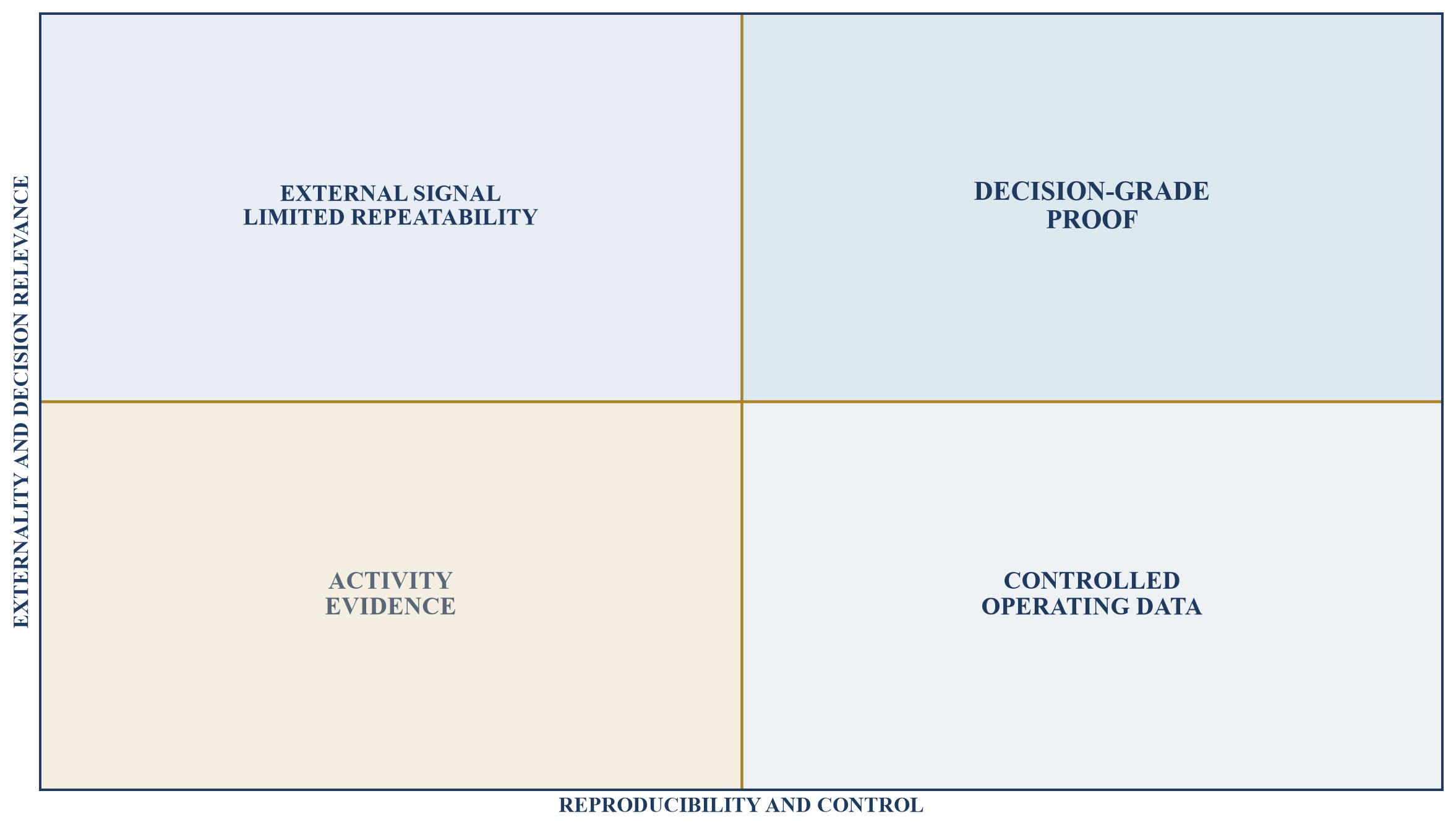
The matrix is a management assessment tool. Placement does not represent an external rating or probability.
6. Translate customer activity into commercial evidence
Commercial milestones should follow the customer decision journey. An expression of interest is evidence of attention. A discovery interview can clarify the problem and buying process. A letter of intent may document intention and conditions. A paid pilot tests willingness to commit resources. A production contract establishes legal and economic obligations. Deployment evidence shows whether the customer can realise the product. Usage, renewal, expansion and collection then test durability.
These states should not be collapsed into one pipeline figure. The board should know how much value sits at each evidence level, how long transitions take, which conditions remain open and where concentration exists. Management should reconcile customer records to signed agreements, invoices, cash receipts and product usage. If the business uses consumption, marketplace or usage-based pricing, definitions should connect operational events to invoicing and collection.
The milestone should also address selection bias. Founder-led pilots with unusually supportive design partners may not represent the broader market. A technically sophisticated customer may tolerate implementation effort that the target segment will reject. A large customer may generate attractive revenue while imposing bespoke development, security or service obligations. Management should explain why the tested cohort is relevant to the intended market.
Evidence of willingness to pay is stronger when the consideration is meaningful, the buyer has authority, the agreement defines the product, the implementation succeeds and collection follows. Discounted or conditional arrangements can still be informative. Their economics and conditions should remain visible. The company should avoid converting a non-binding conversation into an implied contract or describing an unpaid pilot as recurring revenue.
Customer proof should connect to a repeatable commercial system. The company should document target account characteristics, buyer role, sales stages, qualification rules, win-loss reasons, implementation capacity, adoption measures, renewal process and expansion path. The next round is then supported by evidence that the company can find, win, serve and retain customers within an economic model.
Table 2. Commercial proof ladder
| Evidence state | What it supports | What remains uncertain | Useful verification |
|---|---|---|---|
| problem interview | relevance of a pain point and buying context | willingness to adopt or pay | interview record, role and selection method |
| design-partner agreement | commitment to shape a solution | production economics and broad demand | signed scope, contributions and decision path |
| paid pilot | willingness to spend and test | renewal, scale and delivery cost | contract, invoice, collection, use and outcome |
| production contract | agreed commercial terms | adoption, retention and margin quality | executed agreement, implementation and revenue policy |
| repeated cohort | reproducible customer behaviour | performance across later cohorts or markets | cohort definitions, usage, retention and collection |
| renewal or expansion | durability and deeper customer value | concentration and long-term competition | renewal terms, expanded use, margin and decision record |
Evidence strength depends on terms, counterparty authority, performance, collection and repeatability.
7. Make unit economics traceable
Unit economics turn growth into an operating relationship. They should be defined from the way value is delivered and cash is earned. A subscription business may focus on recurring revenue, gross retention, net retention, gross margin, acquisition cost, implementation effort and payback. A marketplace may focus on transaction volume, take rate, contribution margin, loss rate and participant retention. A hardware business may focus on yield, bill of materials, warranty, channel margin, installation and working capital. A services-enabled product may need to separate recurring software economics from implementation and ongoing labour.
The company should build a bridge from customer activity to cash. Contracted value is adjusted for implementation conditions, variable consideration, cancellation, credits and collectability. Recognised revenue is determined under the applicable accounting framework. Direct delivery costs are allocated using a consistent rule. Contribution margin then incorporates the costs that vary with service volume or customer support. Cash conversion reflects billing, collection, supplier terms, inventory and tax.
IFRS 15 requires companies within its scope to identify performance obligations and determine how revenue reflects transfer of promised goods or services. It permits output or input methods in relevant over-time arrangements when they faithfully depict performance. A financing dashboard should not substitute a bespoke operating metric for the accounting ledger. It should show how non-GAAP operating measures reconcile to recognised revenue and cash.
The milestone should specify the cohort, period and source. A blended gross margin can improve because the customer mix changed. Acquisition payback can appear shorter when implementation cost is excluded. Retention can appear stronger when small or inactive accounts are removed. The board should therefore approve definitions and review reconciliations and exclusions.
The bridge also reveals which improvement capital is intended to buy. Product automation may reduce implementation labour. Infrastructure work may reduce compute cost. Pricing changes may improve gross margin while affecting conversion. A channel partnership may reduce acquisition cost while reducing take rate. The financing case should show the mechanism, test and expected evidence for each relationship.
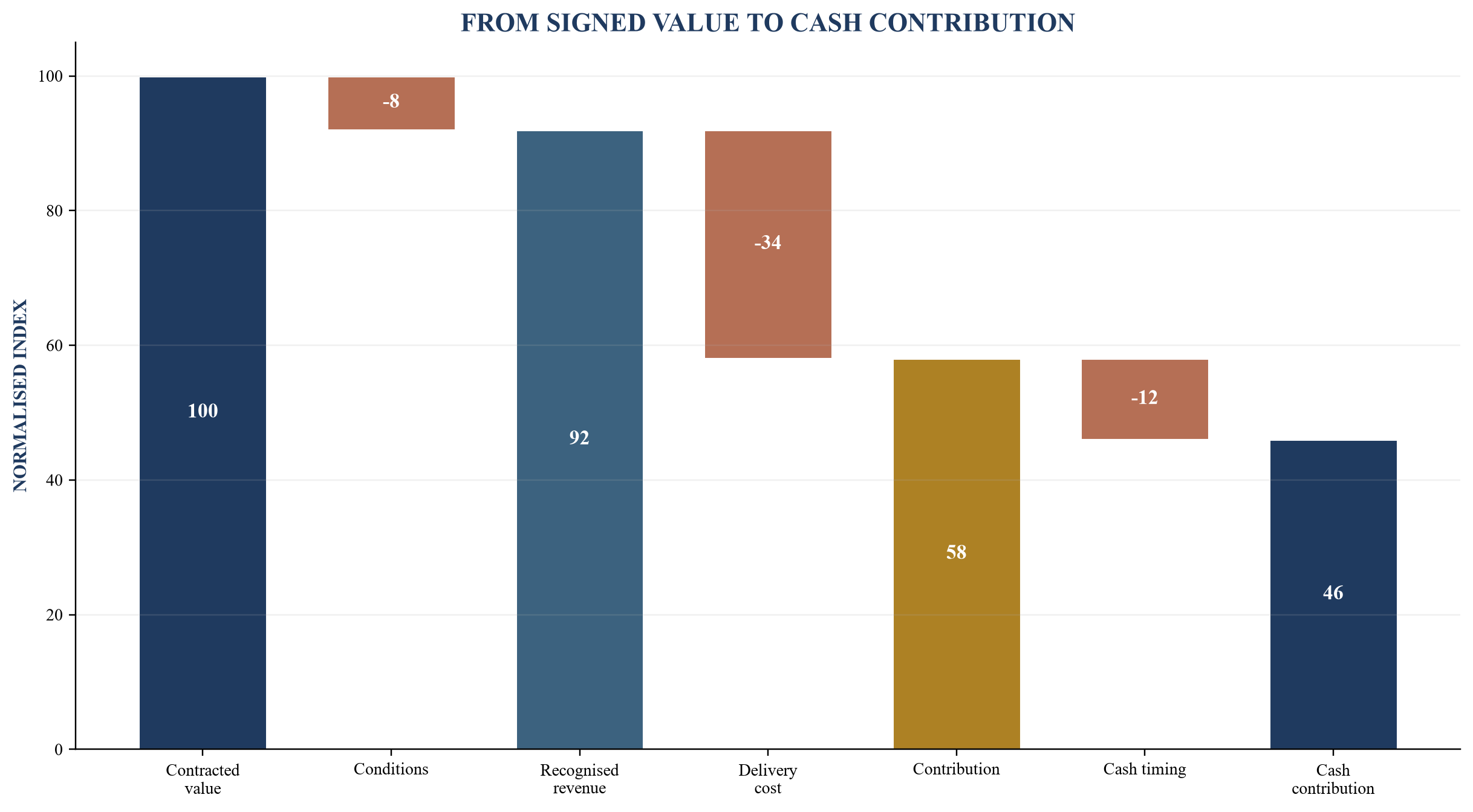
Normalised values are management assumptions used only to demonstrate the bridge.
8. Match technical milestones to the commercial decision
Technical milestones should measure the property that determines customer, regulatory, manufacturing or economic value. A generic product-completion percentage rarely provides that information. The company should identify the critical performance claim, test environment, comparator, tolerance, sample, failure condition and required reproducibility.
For software, the critical claim may concern accuracy, latency, availability, security, integration or task completion. For artificial intelligence, management should define the test set, data provenance, model version, human review, error taxonomy, drift monitoring and permitted use. For hardware, the claim may concern output, yield, durability, energy consumption, component availability or certification. For biotechnology, it may concern assay performance, preclinical results, manufacturing consistency, safety or a defined regulatory interaction.
The US National Science Foundation asks applicants to provide detailed research plans, quantitative technical performance targets, milestones, timelines, risks and commercial relevance. This provides a useful discipline for private capital even when the company is outside the programme. The founder should state what result would strongly suggest viability, which result would reject the current approach and which information would justify another experiment.
A technical milestone should include negative evidence. Exception logs, failed tests, unresolved defects and outliers show the boundary of the claim. Removing them can make the result appear cleaner and reduce its decision value. The review pack should explain whether failures are random, systematic, safety-relevant, economically material or connected to a dependency.
Independent verification should be used where the claim is technically complex, safety-critical, regulated or central to valuation. Independence can range from a separate internal team with controlled data to an accredited laboratory, external auditor, customer test or regulator. The company should state the verifier's scope and limitations. A third-party logo or test report does not automatically prove every operating claim.
9. Treat regulatory progress as a portfolio of decisions
Regulatory milestones are often described as dates. Their financing value depends on the substance achieved and the uncertainty remaining. A submission, validation, acceptance for review, information request, inspection, approval and operating permission are different states. The milestone should identify the competent authority, legal basis, product or activity scope, jurisdiction, conditions, dependencies and post-approval obligations.
Management should maintain a regulatory evidence file with current classification analysis, adviser conclusions, meeting records, submissions, authority correspondence, testing, quality records, commitments, open questions and a controlled timeline. The board should see a decision tree rather than a single expected approval date. Each branch should state the evidence required, capital consumed, operating consequence and fallback.
Regulated milestones interact with commercial evidence. A pilot may be permitted in one environment and unavailable for general sale. A customer may sign subject to approval. Revenue may depend on a claim or use that exceeds the current permission. A geographical expansion may require a new entity, licence, data arrangement or product modification. The funding roadmap should not count contingent revenue as if every condition has been satisfied.
The company should also separate regulatory capital from operating runway where applicable. Financial services, insurance, payments, healthcare and other regulated models may require capital, guarantees, insurance or reserves that cannot be used freely. Milestone financing should show restricted and unrestricted cash separately.
External programmes and investors may use technology-readiness, clinical, certification or regulatory stages as shorthand. The founder should map that shorthand to the company's precise evidence. A stage label does not replace the underlying protocol, data, correspondence and legal analysis.
10. Choose the instrument after defining the risk
The financing instrument allocates economics, control, timing and downside. Founders should choose it after defining the proof transition, cash need, timing, investor type, legal framework and likely next event. Instrument speed should not displace analysis of dilution, maturity, conversion, seniority, governance and failure consequences.
The US Securities and Exchange Commission describes common startup securities including stock, convertible notes, SAFEs and debt. It notes that a SAFE generally provides a future ownership interest upon a triggering event and that convertible notes are loans that can convert into another security. The legal, tax and accounting treatment depends on the document and jurisdiction. Founders should avoid assuming that a familiar instrument name produces the same outcome everywhere.
A priced equity round can establish valuation, rights and governance for a substantial proof transition. A SAFE or convertible instrument may support a shorter bridge when the next priced event is credible and the conversion mechanics are understood. Tranched equity can commit a larger amount while releasing capital against defined milestones. Venture debt may extend runway for a company with appropriate revenue, institutional support or assets, while adding repayment, covenant and maturity risk. Grants and customer-funded development can reduce dilution but may restrict use, reporting, intellectual property or timing.
Milestone-linked financing creates its own risks. An ambiguous milestone can transfer control of interpretation to the investor. A milestone tied to an external authority can make funding dependent on a timetable outside management's control. A binary release can leave the company underfunded after partial progress. Multiple investors may have inconsistent consent rights. The documents should define evidence, review process, cure, dispute, waiver, funding mechanics and consequences.
NVCA model documents now include mechanics for tranched financings. These materials should be tailored by qualified counsel. Founders should also model whether a committed tranche is legally binding, subject to conditions, terminable, subordinated to new financing or affected by a material-adverse-change clause.
Table 3. Instrument decision matrix
| Instrument | Potential fit | Evidence focus | Principal board risks |
|---|---|---|---|
| priced equity | material proof transition with governance and valuation negotiation | full diligence, plan, ownership, rights and use of funds | dilution, control, preferences, execution time |
| SAFE or future equity | shorter bridge toward a credible trigger | cap-table model, trigger, cap, discount and priority | hidden dilution, instrument stacking, uncertain timing |
| convertible note | bridge with defined maturity and conversion path | repayment capacity, trigger, interest and security | maturity pressure, default, conversion complexity |
| tranched equity | committed programme with reviewable gates | objective milestones, evidence, cure and release process | ambiguous tests, funding interruption, investor discretion |
| venture debt | runway extension for a suitable operating profile | cash forecast, covenants, repayment and downside | liquidity, security, warrants, covenant breach |
| grant or customer funding | technical or market proof aligned to programme or contract | eligible use, reporting, deliverables and rights | restricted use, reimbursement timing, IP and delivery obligations |
This is a board discussion tool. It is not legal, tax, accounting, securities or investment advice.
11. Size the round from uses, timing and decision buffer
Round size should be derived from the cost and time required to achieve the proof transition, the operating buffer required to absorb normal variance and the cost of financing execution. A simple monthly burn multiple can conceal working-capital swings, restricted cash, annual renewals, hardware deposits, regulatory costs, tax, transaction fees and currency exposure.
The board should build the cash plan by workstream. Product and technical spending should connect to the defined test. Commercial spending should connect to the customer cohort and delivery capacity. Regulatory and legal spending should connect to submissions and permissions. Hiring should connect to roles required for the proof transition. Infrastructure, manufacturing and working capital should connect to volumes and supplier terms. Contingency should be explicit rather than hidden across budgets.
Timing also needs three clocks. The operating clock measures time to complete the work. The evidence clock measures time to observe and verify the result. The financing clock measures time to prepare, market, negotiate, diligence and close the next round. A customer-retention milestone may require months of observation after deployment. A regulatory result may arrive after the company has completed its work. A future round may take longer than management expects. The board should see the combined cash requirement.
The cash plan should include trigger points for action. A financing launch date can be set before the milestone completes, provided the company describes what is verified and what remains in progress. Cost reduction, bridge financing, customer prepayment or strategic alternatives may be prepared before liquidity becomes critical. Waiting until the company has little runway can reduce decision quality and negotiating capacity.
All buffer periods should be treated as management assumptions. The appropriate buffer depends on cost variability, financing market, investor concentration, regulatory timing, revenue reliability and available contingency actions. A board should stress-test delays, lower conversion, cost overruns, foreign exchange movements and investor withdrawal.
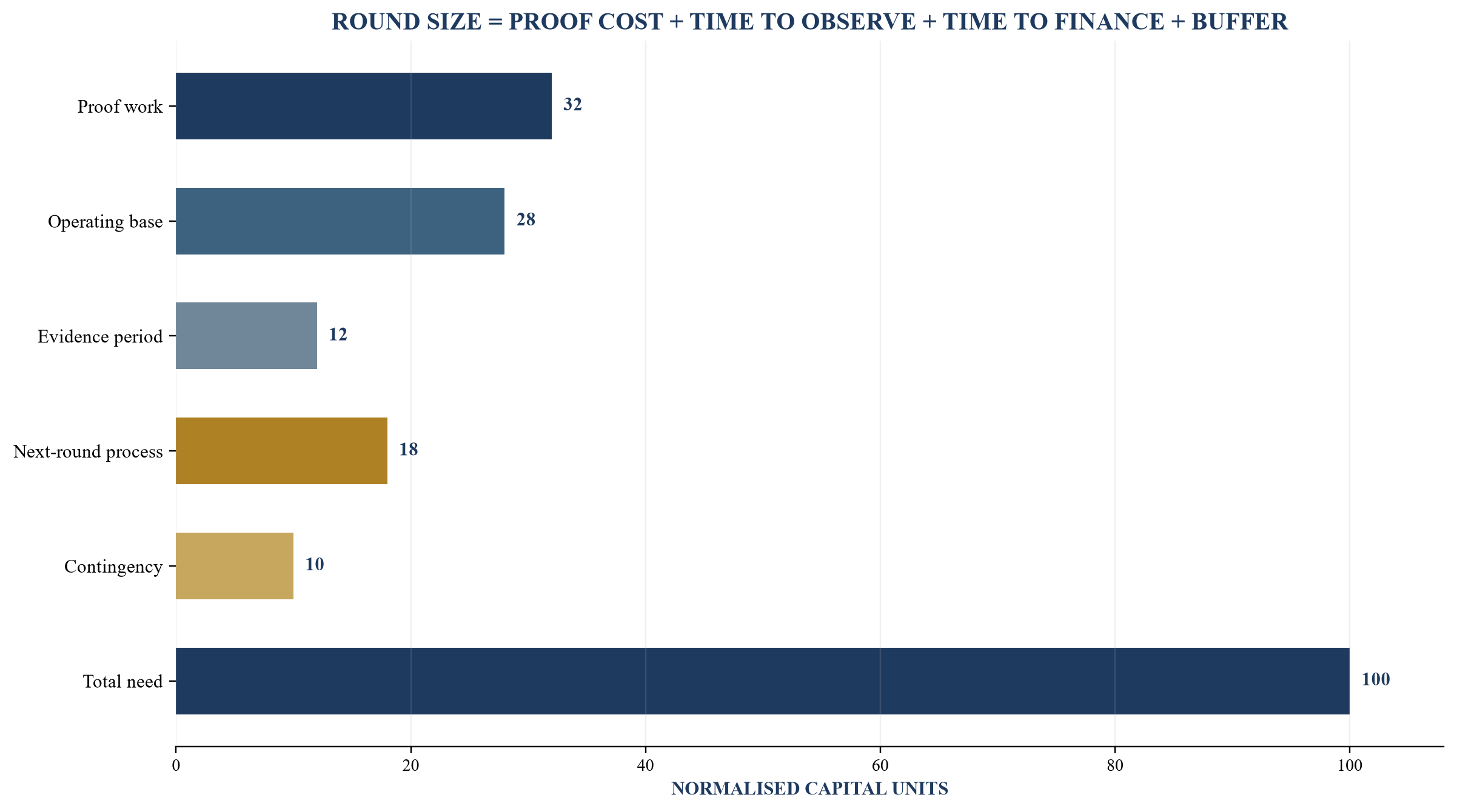
Amounts are normalised management assumptions for illustrating round-size logic.
12. Govern tranche release as a decision process
A milestone-linked tranche needs a defined review process before documents are signed. The process should identify the evidence owner, company reviewer, investor reviewer, notice period, decision date, information rights, confidentiality, cure period, dispute mechanism, waiver authority and release mechanics. Ambiguity can turn an operating disagreement into a liquidity crisis.
The milestone should be objective where possible and bounded where judgement remains necessary. Technical performance can be stated through a protocol and tolerance. Customer evidence can be stated through executed terms, deployment and collection. A regulatory event can be identified precisely. Qualitative matters such as team quality or market readiness require a documented assessment basis and should not be disguised as mechanical tests.
The company should define partial outcomes. A milestone may be achieved for one customer segment and not another. A test may meet performance and miss cost. A regulatory process may produce a narrower permission than expected. The review should allow scale, redesign, further test, conditional release or stop. The financing documents determine which options are available and who controls them.
Board authority should be clear. Management prepares the evidence package and recommendation. Finance confirms liquidity and use of funds. Relevant technical, commercial and legal leaders validate their domains. The board determines the company's position and approves any material waiver, financing amendment or alternative. An investor may have contractual consent or release rights; those rights should be reflected in the governance calendar.
Information should be staged. Investors need enough evidence to make the tranche decision. The company still needs to protect personal data, trade secrets, privileged advice, security information and customer confidentiality. The evidence index should define release tier, redaction, clean-team treatment and permitted recipients.
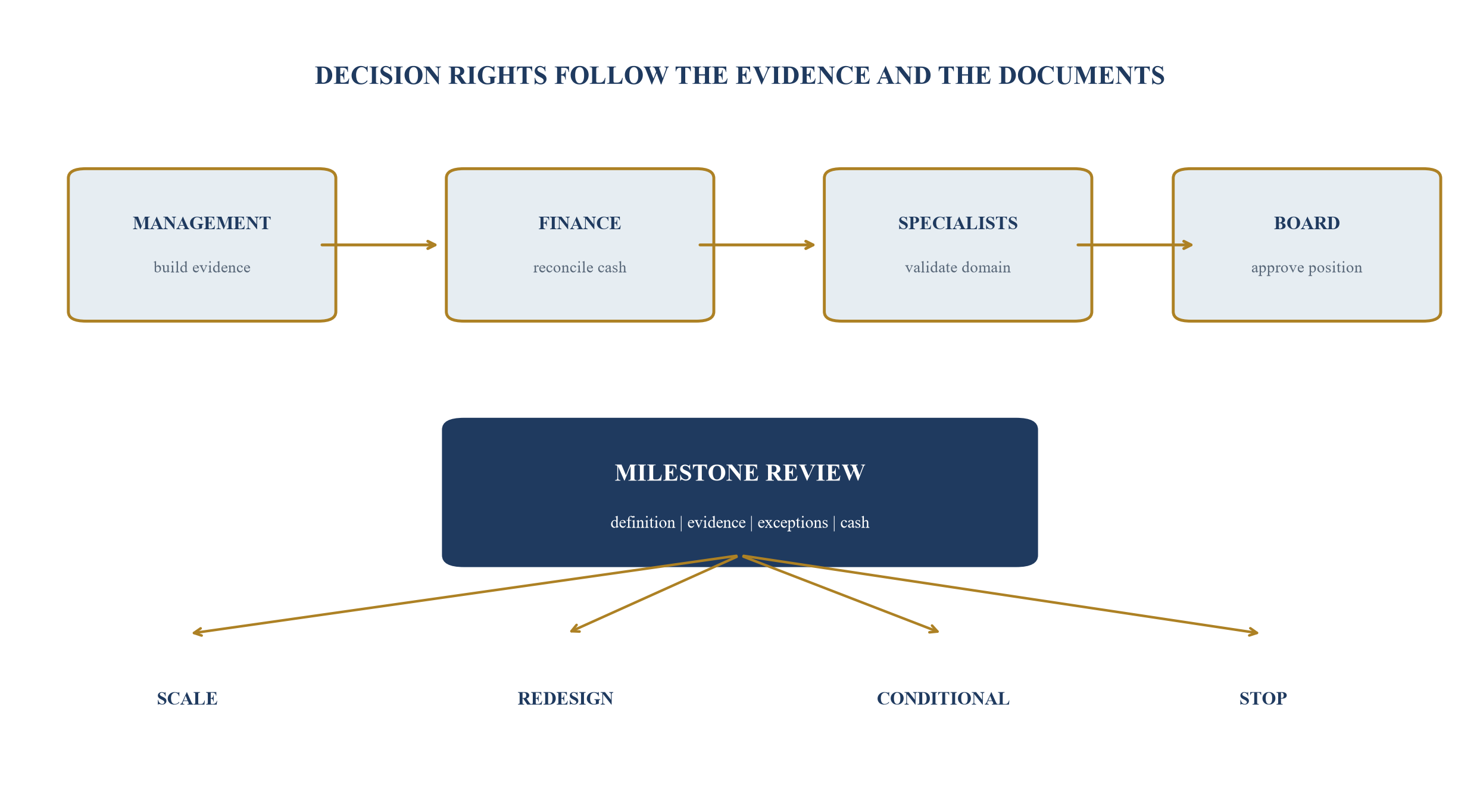
Governance rights and remedies must be documented for the actual financing and jurisdiction.
13. Model dilution across the full financing path
Founders should model dilution across instruments, option pools, tranches and future rounds. A single post-money percentage can omit SAFEs, convertible notes, warrants, accrued interest, option-pool increases, milestone shares, anti-dilution adjustments or rights issued with debt. The cap table should reconcile legal records and show fully diluted ownership under defined scenarios.
The model begins with the current issued and fully diluted position. It then adds each outstanding instrument according to its actual terms. The next financing is modelled with pre-money valuation, new money, pool treatment and transaction expenses. Later tranches are modelled according to price, fixed share count or formula. The model should show founder, employee, existing investor and new investor ownership at each step.
Scenario analysis is essential where conversion depends on a future price, cap, discount or maturity event. A high valuation can reduce the number of shares issued under one instrument and activate another term. A lower valuation can increase dilution and affect voting thresholds. A delayed financing can increase note interest or produce maturity negotiations. A top-up pool can shift dilution between pre- and post-money holders depending on the documents.
The board should also model control. Voting rights, protective provisions, board appointment, consent thresholds, information rights, pro rata rights and liquidation preferences can matter as much as headline ownership. A financing that appears modest in percentage terms may materially change future decision rights.
The waterfall in this paper uses normalised assumptions to demonstrate method. It is not a valuation recommendation. The company should use its definitive legal documents, current register, tax advice and accounting treatment.
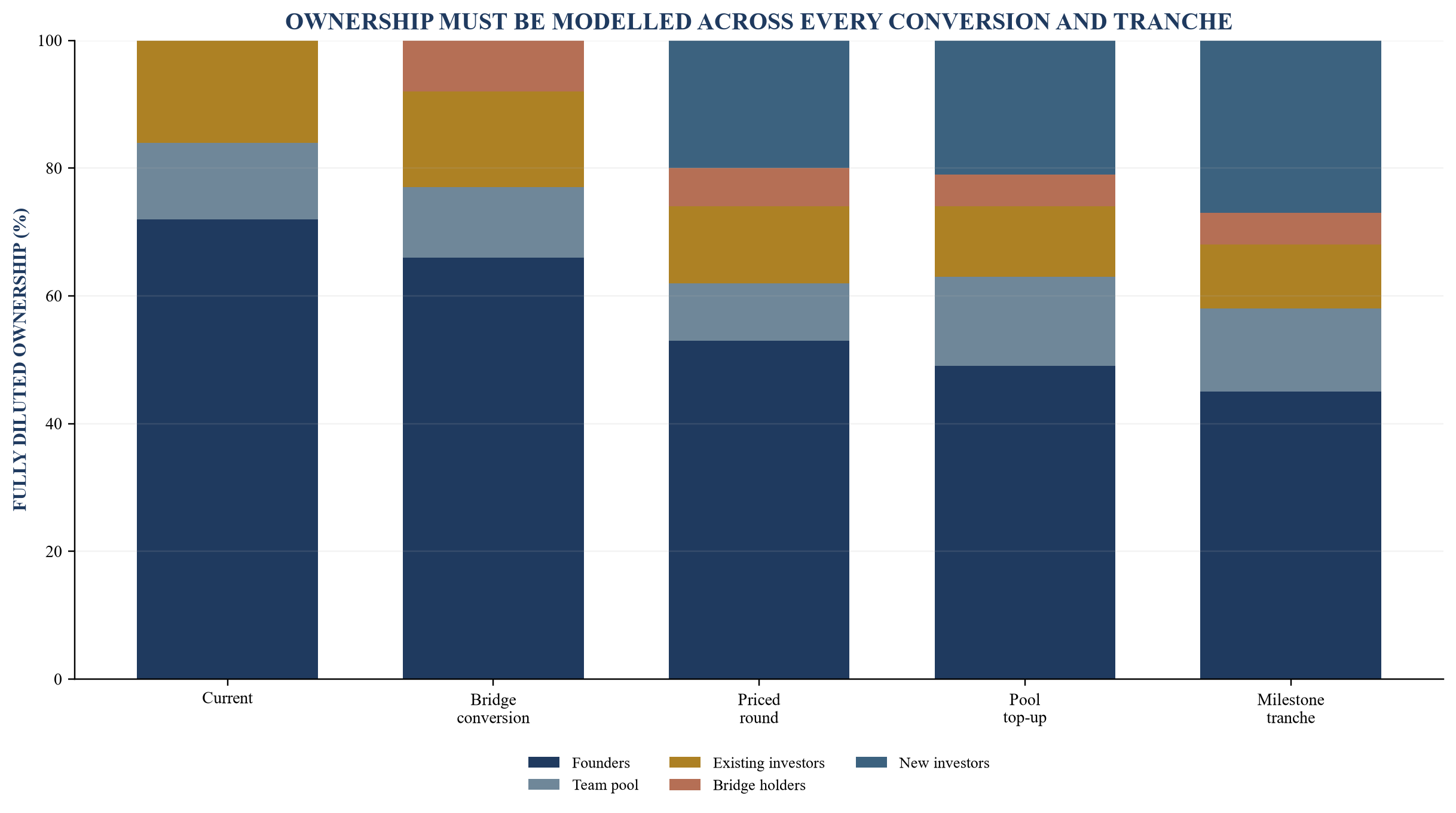
Percentages are management assumptions for method demonstration. They are not proposed terms or market benchmarks.
Table 4. Cap-table control checks
| Control | Evidence | Decision risk if missing | Review owner |
|---|---|---|---|
| issued ownership | register, issuances, transfers and cancellations | wrong voting or economic baseline | company secretary and counsel |
| fully diluted position | options, warrants and reserved pool | understated future ownership | finance and counsel |
| future equity instruments | cap, discount, MFN, trigger and priority | hidden or scenario-dependent dilution | finance and counsel |
| convertible debt | principal, interest, maturity, security and conversion | maturity pressure and conversion dispute | finance and counsel |
| tranche mechanics | price, share count, conditions and release | funding and ownership uncertainty | board and counsel |
| rights and preferences | votes, board seats, consents, liquidation and pro rata | control or proceeds differ from headline percentage | board and counsel |
Calculations require the definitive instruments and current legal records.
14. Build a financing data room around claims
An investor data room should make the financing case verifiable. It should not become a warehouse of unclassified files. The company should maintain an evidence index that maps each material claim to its definition, source record, owner, period, reviewer, limitations and release tier.
The financial section should include current management accounts, historical financial statements, cash, debt, working capital, revenue reconciliation, forecast, budget-to-actual analysis and the assumptions behind the raise. The commercial section should include customer segmentation, pipeline definitions, contracts, usage, retention, concentration, pricing and collection evidence. The technical section should include product architecture, roadmap, test results, incidents, security, data rights, intellectual property and material dependencies.
The corporate section should include constitutional documents, registers, board approvals, cap table, instruments, employee equity, material contracts and disputes. The regulatory section should include permissions, submissions, correspondence, compliance framework and open matters. The people section should include organisation, key roles, incentives and critical dependencies, subject to privacy controls.
Each metric in the pitch should have a source trail. If the deck says customers save time, the room should identify the measurement and sample. If the deck says a market is contracted, the room should distinguish signed, conditional, implemented and collected value. If the deck says gross margin will improve, the room should show the cost mechanism, work programme and test.
The response log records questions, answer owner, evidence links, adviser review, date released and qualification. It reduces inconsistent answers and gives the board visibility over issues discovered during diligence. The room should preserve privilege, personal data, customer confidentiality, cybersecurity and trade secrets through staged access.
Table 5. Financing evidence register
| Claim domain | Claim example | Evidence path | Control |
|---|---|---|---|
| customer | target users repeatedly complete the critical workflow | cohort definition, product logs, customer records and exceptions | fixed period and source reconciliation |
| revenue | contracted value converts into recognised revenue and cash | agreements, invoices, ledger, bank and accounting policy | finance review and ageing |
| product | performance meets the defined operating requirement | protocol, version, data, results and failure log | reproducible test and approval |
| market | the company can reach qualified buyers in the target segment | account universe, outreach, stages, wins and losses | stage definitions and duplicate control |
| economics | scale changes contribution through an identified mechanism | cost drivers, cohort margin and bridge | consistent allocation and sensitivity |
| governance | the company owns and controls what it finances | register, approvals, IP assignments, policies and contracts | current definitive documents |
Release tiers and review roles should reflect legal, privacy, security and transaction requirements.
15. Run the investor process as an evidence sequence
The investor process should be designed around decision progression. A broad initial approach tests mandate and problem relevance. A first meeting tests team, thesis and the critical proof. A second meeting can examine evidence and operating mechanics. Diligence validates the claims, risks and ownership. Term-sheet negotiation allocates economics and control. Documentation and closing convert commitment into available cash.
The company should define its investor universe by stage, geography, sector, cheque size, instrument, reserve strategy, follow-on capacity, regulatory status, portfolio conflicts and value-add requirements. A large list with little fit can consume management attention and create inconsistent market signals. A smaller qualified universe can support disciplined sequencing.
Materials should match the stage. The teaser or short deck communicates the decision problem, proof achieved, proof to be purchased, business model, team and financing ask. The detailed deck shows evidence, unit economics, roadmap, risks, use of funds and cap-table implications. The data room supports verification. The management model should reconcile to the deck and source records.
The founder should maintain a live question log. Repeated investor questions can reveal an unclear definition, missing evidence or a genuine risk. Management should correct the underlying issue and update all materials consistently. Different investors may reasonably assign different value to the same evidence because mandates, portfolio construction and risk appetite differ.
Process timing should preserve operating delivery. Milestone work cannot stop because management is fundraising. The board should assign owners, communication rules, decision thresholds and a financing committee where appropriate. External advisers can support materials, investor targeting, financial modelling, diligence and execution. Management remains responsible for the truth and completeness of the claims.
16. Apply a jurisdiction screen before outreach
Capital raising is regulated. The company should identify the issuer, instrument, place of offer, investor type, communication channel, intermediary, exemption or offering route, filings, disclosures and transfer restrictions before approaching investors. Social-media communication can create legal consequences. A private-company label does not remove securities-law obligations.
The SEC states that every offer and sale of securities in the United States must be registered or conducted under an exemption, including offers by private companies. Regulation D includes distinct routes and filing obligations. The FCA applies financial-promotion requirements to relevant communications in the United Kingdom, including rules for high-risk investments and investor categorisation. ASIC provides fundraising and crowd-sourced-funding guidance in Australia. Singapore maintains formal offer and prospectus processes through the Monetary Authority of Singapore.
The UAE requires a transaction-specific analysis of the issuer's jurisdiction, place of offer, target investors, relevant financial free zone or mainland rules, and any licensed intermediary. A Hub71 programme offer does not establish the legal route for an unrelated private raise. Founders should obtain current advice before outreach and document who may communicate what material to which recipient.
Cross-border investors introduce additional questions: foreign ownership, national-security screening, sanctions, data transfer, tax, beneficial ownership, currency, investment limits and outbound-investment rules. The company should screen these matters before promising timing or using a standard instrument from another jurisdiction.
The milestone itself may also need local adaptation. A customer proof from one market may not demonstrate regulatory or commercial readiness in another. A SAFE form intended for a particular legal system should not be assumed to work elsewhere. The market-entry evidence plan should state entity, licence, product, customer, data, tax and operating requirements for each target geography.
Table 6. Cross-border financing and market-entry screen
| Screen | Question | Evidence before outreach | Decision consequence |
|---|---|---|---|
| securities route | what registration, exemption or private-offer route applies? | legal analysis, investor criteria, filings and restrictions | audience, materials and process |
| intermediary | is placement, advice or arranging activity regulated? | role map and licence verification | permitted communications and fees |
| issuer structure | which entity issues and owns the financed assets? | group chart, registers, IP and contracts | instrument and diligence scope |
| foreign investment | do sector, ownership or national-security rules apply? | jurisdiction and sector screening | investor eligibility and timetable |
| tax and currency | how do issue, conversion, returns and cash movement operate? | tax advice, banking and currency plan | net proceeds and instrument choice |
| market entry | what evidence transfers to the target geography? | customer, product, data, licence and delivery map | local milestone and capital need |
Qualified advisers should confirm current requirements for the issuer, investors, instrument and communications.
17. Prepare responses for milestone failure
Milestone financing should improve learning before cash becomes scarce. A missed milestone may show that the test was poorly designed, execution was weak, the hypothesis was wrong, the market changed or an external dependency moved. The board response should be based on cause, evidence and liquidity.
A redesign decision is appropriate when the evidence identifies a credible alternative and the company has enough capital and time to test it. A bridge may be appropriate when value is visible, the remaining work is bounded and the financing terms do not create disproportionate risk. A pause may preserve cash while a dependency resolves. A stop decision may protect remaining capital when the expected value of further work no longer justifies the cost.
Founders should avoid automatic continuation because substantial capital has already been spent. Historical spending is evidence about the process and does not by itself justify future spending. The board should evaluate the incremental capital, new information expected, probability range, strategic alternatives and downside.
The company should also plan communications. Employees, customers, suppliers, existing investors and prospective investors may be affected by a funding change. Statements should be accurate, controlled and consistent with legal duties. Management should avoid describing an unresolved financing as committed.
Cash reporting should intensify as a gate approaches. A rolling forecast, payment calendar, collection plan, covenant view and contingency actions give the board time to choose. The objective is controlled adaptation rather than a dramatic response after liquidity becomes critical.
18. Execute the operating system in 180 days
The first thirty days establish truth. Management confirms the cap table, cash, instruments, legal entity, intellectual-property ownership, customer evidence, accounting records and current product state. The board identifies the dominant uncertainty and approves the financing decision question. The company creates the evidence index and owner map.
Days thirty-one to sixty define the proof transition. Teams set baselines, protocols, customer cohorts, unit-economics definitions, regulatory dependencies and success criteria. Finance builds the uses-and-runway model and cap-table scenarios. Counsel maps the financing route and documents needed. The board approves the milestone and its consequences.
Days sixty-one to one hundred execute controlled tests and remediate evidence gaps. The company records exceptions and failed results as well as successes. Investor mapping begins with mandate, geography, instrument and cheque-size qualification. Materials are drafted from the evidence register.
Days one hundred and one to one hundred and forty validate and prepare. Finance reconciles metrics. Technical and commercial leaders confirm results. Advisers review legal, regulatory, tax, accounting and valuation matters. The data room is populated by release tier. The board reviews the funding roadmap, dilution and contingency plan.
Days one hundred and forty-one to one hundred and eighty run the initial investor sequence while the operating teams continue delivery. Management tracks questions, updates evidence and reports progress to the board. The process may start earlier or later according to runway and market conditions. The timeline is a management planning assumption, not a promised financing period.
The system continues after a round. New capital should be governed against the next proof transition. Budget-to-actual performance, evidence quality, cash, milestone progress, risks and financing choices should return to the board on an agreed cycle. A company that maintains this discipline can explain what it has proved, what remains uncertain, what capital will purchase and how the decision changes if evidence does not support the plan.
Sources and further reading
- Organisation for Economic Co-operation and Development, Financing SMEs and Entrepreneurs 2026 Official source
- Organisation for Economic Co-operation and Development, Financing SMEs and Entrepreneurs Scoreboard 2025 Highlights Official source
- World Bank, Pipeline of Investable SMEs: Policy Support Official source
- World Bank, Can Business Grants Mitigate a Financing Crisis? Investment Readiness Evidence Official source
- International Monetary Fund, Stepping Up Venture Capital to Finance Innovation in Europe Official source
- United States Securities and Exchange Commission, Capital-Raising Building Blocks Official source
- United States Securities and Exchange Commission, Common Startup Securities Official source
- United States Securities and Exchange Commission, Private Companies and the SEC Official source
- United States Securities and Exchange Commission, Regulation D Offerings Official source
- National Venture Capital Association, Model Legal Documents Official source
- Y Combinator, Safe Financing Documents Official source
- US National Science Foundation, SBIR/STTR Project Description Instructions Official source
- US National Science Foundation, SBIR/STTR Post-Award Expectations and Reporting Official source
- US National Science Foundation, Apply for Phase II Official source
- European Innovation Council, EIC Fund Investment Guidelines and Approach Official source
- European Innovation Council, Investment Opportunities Official source
- Startup India, Startup India Seed Fund Scheme FAQ Official source
- Startup India, Startup India Seed Fund Scheme Guidelines Official source
- Hub71, Access Programme Official source
- Hub71, Initiate Programme Official source
- British Business Bank, Are You Ready for Finance? Official source
- British Business Bank, Equity Financing Official source
- British Business Bank, Small Business Equity Tracker 2026 Official source
- UK Financial Conduct Authority, Strengthening Financial Promotion Rules for High-Risk Investments Official source
- Australian Securities and Investments Commission, Fundraising Regulatory Resources Official source
- Monetary Authority of Singapore, Offers and Prospectuses Electronic Repository and Access Official source
- IFRS Foundation, Clarifications to IFRS 15 Revenue from Contracts with Customers Official source
- IFRS Foundation, IAS 38 Intangible Assets Official source
- World Intellectual Property Organization, Accelerate by Working with Investors and Buyers Official source
- World Intellectual Property Organization, Intellectual Property Finance Official source
