

1. One mission, several forms of capital
A family can care deeply about education, health, climate resilience, employment, food systems, water security or financial inclusion while holding most assets in a conventional investment portfolio. Annual grants support selected causes. The investment office manages risk, return and liquidity. The two activities can remain operationally distant even when they reflect the same long-term purpose.
Mission-related investing creates a governed bridge. It asks which outcome the family seeks, which form of capital fits the need, what financial result is expected, how the family's contribution changes the outcome and how evidence will inform future decisions.
Common terminology requires precision. PRI, CFA Institute and the Global Sustainable Investment Alliance describe impact investing as investing with the intention to generate positive, measurable social or environmental impact alongside a financial return.[1] This separates an impact investment from a grant and from an investment that merely has incidental effects. A mission-related portfolio can contain all three, provided each is labelled and governed according to its actual objective.
The portfolio should therefore avoid a single blended performance number. A grant has expenditure, programme and outcome measures. A catalytic loan can accept a defined concession to address an evidenced barrier. A market-rate impact investment should face commercial underwriting and an impact test. A screened public portfolio can align exposure with family values without supporting a claim of investor contribution to a particular outcome.
The family's governing body should approve the mission, capital sleeves, risk appetite, liquidity budget, authority and reporting. The architecture then lets the appropriate committee make each decision through the correct entity.
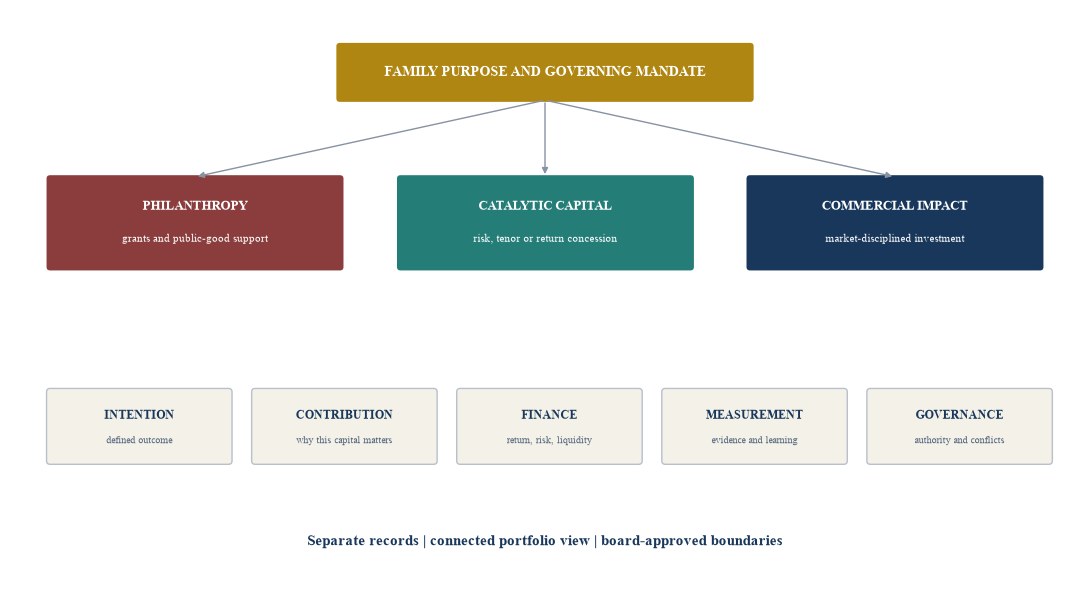
Author framework. Each sleeve retains its purpose, authority, evidence and performance basis.
2. Write a decision-useful mission charter
A broad ambition such as supporting sustainability creates little investment discipline. The mission charter should define the problem, affected stakeholders, geography, time horizon, desired outcomes and activities the family will support or exclude. It should state how the mission relates to family history, operating expertise, networks and risk capacity.
The charter distinguishes outcome from activity. Financing solar equipment is an activity. The intended outcome can concern reliable energy access, lower emissions, productive capacity or system resilience. The office should identify the stakeholder who experiences the change and the baseline against which progress will be assessed.
The charter also defines financial ambition. Some outcomes can be pursued through market-rate strategies. Others need patient, subordinated or concessional capital. Public-good activity can require grants. The family should state whether capital preservation, a minimum return, recycling, inflation protection or full commercial return applies to each sleeve.
Liquidity belongs in the charter. Grant commitments, unfunded fund commitments, guarantees and follow-on reserves can create cash demands after the initial approval. The governing body should approve annual and multi-year limits by entity and currency.
The mandate names decision rights. A philanthropy committee can approve grants. An investment committee can approve market-rate investments. A joint mission-capital committee can review catalytic structures, with legal, tax, finance and investment approvals retained by the relevant entities.
Table 1. Minimum mission-related investment mandate
| Field | Required decision | Evidence | Review question |
|---|---|---|---|
| Mission | problem, stakeholders, geography and desired outcomes | family charter and current needs assessment | is the intended change specific enough to guide capital? |
| Capital sleeves | grant, catalytic and commercial boundaries | approved definitions and accounting treatment | which financial objective applies to each sleeve? |
| Eligibility | sectors, instruments, beneficiaries, exclusions and jurisdictions | policy, legal review and screening rules | does the opportunity fit the authorised perimeter? |
| Financial objective | expenditure, capital preservation, concession or market return | sleeve-level policy and benchmark | is the expected financial result explicit? |
| Impact objective | outcome, baseline, target, duration and affected stakeholder | theory of change and metric definition | what change should occur and for whom? |
| Contribution | finance, expertise, network, governance or signalling role | counterfactual and market evidence | why is this family's participation expected to matter? |
| Risk appetite | financial, impact, execution, integrity and reputation limits | risk framework and escalation rules | which downside requires redesign or rejection? |
| Liquidity | annual budget, commitments, reserves and guarantee capacity | entity-aware cash forecast | can the correct entity fund the commitment? |
| Governance | committee, authority, conflicts, advisers and reporting | terms of reference and delegations | who prepares, challenges, approves and monitors? |
| Learning | review cadence, evaluation and adaptation | reporting calendar and decision log | how will evidence change the strategy? |
The governing body should approve every field and link it to the relevant entity authority.
3. Build a capital spectrum with clear boundaries
The family should select capital according to the problem and financing barrier. A grant can support research, capacity, public infrastructure, beneficiary subsidy or services without a credible repayment source. A recoverable grant can recycle funds when defined conditions are met. A catalytic loan can offer longer tenor, junior security or a lower return where an evidenced constraint prevents a viable project from attracting suitable capital. A guarantee can absorb a specified risk and release only upon a defined event.
Market-rate impact debt or equity requires the same commercial discipline as other investments within its mandate. The office should underwrite revenue, unit economics, capital structure, governance, management, valuation, liquidity and exit. Impact intention and measurement form additional approval dimensions.
Mission-aligned public investments can use screening, thematic exposure, ESG integration or stewardship. These approaches differ from impact investing. The harmonised definitions published through PRI emphasise intention, positive measurable impact and financial return as essential elements of impact investing.[1]
Every instrument receives one primary classification at approval. A market-rate investment should not move into the grant ledger after underperformance without an authorised decision. A grant should not be presented as an investment return. Concessions should be measured against an approved reference case and recorded over the life of the instrument.
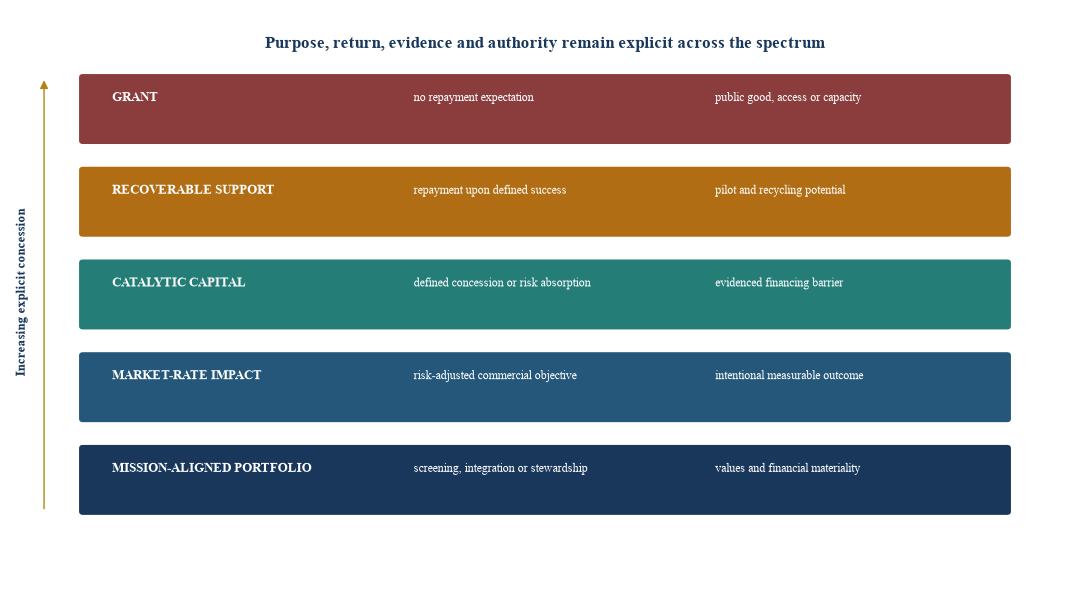
Author framework. Instrument terms and expected returns require transaction-specific underwriting.
Table 2. Capital and instrument selection
| Need | Potential instrument | Financial objective | Impact requirement | Principal control |
|---|---|---|---|---|
| Public good without repayment source | grant | approved expenditure | beneficiary need, delivery and outcome evidence | eligible recipient, purpose restriction and grant monitoring |
| Early pilot with possible recovery | recoverable grant | contingent recycling | test defined outcome and operating model | repayment trigger, use of funds and learning plan |
| Viable project with tenor gap | patient or subordinated loan | defined return concession | additional capacity or access linked to longer tenor | reference terms, concession record and repayment case |
| First-loss barrier | capped guarantee or junior tranche | priced or approved risk absorption | mobilise senior capital for eligible outcomes | loss trigger, cap, portfolio rules and claims governance |
| Scaling enterprise | preferred equity or ordinary equity | risk-adjusted return by mandate | intentional product or business-model outcome | commercial diligence, impact thesis and governance rights |
| Operating asset | project debt or equity | contracted or market return | measurable service and stakeholder outcome | construction, demand, counterparty and performance controls |
| Public markets | screened, thematic or stewardship strategy | market return | precise claim aligned to actual approach | holdings, methodology, stewardship evidence and disclosure |
| Specialist manager | fund commitment | sleeve return and liquidity objective | manager impact system and portfolio evidence | mandate, fees, key terms, reporting and independent review |
Legal, tax, accounting and regulatory treatment requires current transaction-specific advice.
4. Translate mission into a theory of change
Impact intention becomes decision-useful through a theory of change. The office identifies the problem and baseline, inputs, activities, outputs, outcomes and longer-term impact. It then states the assumptions and external conditions that connect each stage.
IRIS+ describes impact across what, who, how much, contribution and risk.[2] These dimensions help the committee ask which outcome occurs, who experiences it, its scale and duration, what would have happened otherwise and what can prevent the intended result.
Investor contribution deserves separate analysis. Capital can contribute through flexible terms, scale, speed, signalling, active ownership, networks, technical support or willingness to finance an underserved risk. The enterprise or project produces the operational outcome. The investor should avoid claiming every observed change as caused by its capital.
The baseline should use credible current evidence. Where data are limited, the committee records the assumption, collection plan and decision consequence. A simple metric with an auditable definition can be more useful than a long list of indicators.
The Operating Principles for Impact Management provide nine voluntary principles across the investment lifecycle, including strategic intent, contribution, expected impact, monitoring, exits and independent verification of the impact-management system for signatories.[3] A family office can use the lifecycle as a design reference without claiming signatory status or verified alignment.
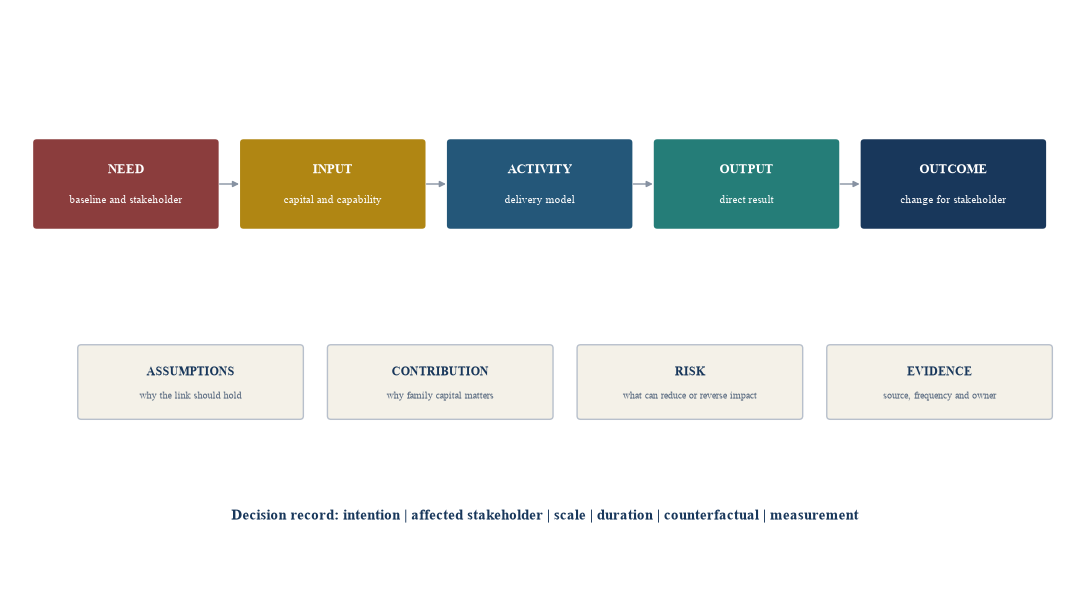
Author framework informed by established impact-management concepts. Causal claims require proportionate evidence.
5. Underwrite financial viability with commercial discipline
A mission fit cannot repair weak economics. The investment team should assess the customer need, payer, revenue model, price, gross margin, operating cost, capital intensity, working capital, management, governance and competitive position. It should model the path to cash generation and the further capital required.
The downside case should identify which stakeholder outcomes continue if growth slows. A business whose impact depends on sustained subsidy faces a different risk from one whose product economics support expansion. A project with a government or corporate payer requires counterparty and contract analysis. An inclusive-finance strategy requires credit, conduct, affordability and collections controls.
Valuation remains important. Paying an excessive price can weaken future returns, constrain follow-on capacity and encourage impact claims that defend the entry valuation. The committee should separate enterprise value from the value it attributes to mission alignment.
For debt, the office reviews cash-flow coverage, security, covenants, tenor, refinancing and recovery. For equity, it reviews dilution, governance rights, liquidity, follow-on needs and exit pathways. For funds, it reviews mandate, team, track record, fees, valuation, reporting, key-person and conflict provisions.
The return objective is recorded before approval. A deliberate concession belongs in the catalytic sleeve. Underperformance against a market-rate case remains financial underperformance even when reported impact is positive.
6. Test additionality and calibrate catalytic capital
Catalytic capital should address an evidenced barrier. The committee identifies what suitable commercial capital is unavailable, why the gap exists, which term changes the decision and how the intervention avoids transferring unnecessary value to private parties.
IFC's blended-finance approach emphasises additionality, minimum concessionality, commercial sustainability, market reinforcement and high standards.[4] Its governance applies to IFC and DFI practice. The concepts provide a useful test for a family office considering risk-absorbing capital.
OECD's 2025 blended-finance guidance discusses development, financial and value additionality, documentation of assumptions, mobilisation of commercial finance, commercial sustainability and exit from concessionality.[5] The OECD definition concerns development finance and mobilised additional finance. A privately funded family structure should describe its own arrangement accurately and avoid implying official-development-finance status.
The office creates a reference case using market terms or a documented risk-based model. It compares the approved terms, quantifies the concession where practicable and identifies the expected catalytic effect. A guarantee records its capped exposure and expected-loss basis. A junior investment records subordination, return and loss allocation. Technical assistance is budgeted separately.
The structure includes an expiry, review or step-up. Concessional support can reduce as the model demonstrates viability, data improve or the market enters. The committee monitors mobilisation, pricing and market effects alongside beneficiary outcomes.
Table 3. Integrated financial and impact underwriting record
| Dimension | Core question | Evidence | Approval condition |
|---|---|---|---|
| Mission fit | does the opportunity advance an authorised outcome for defined stakeholders? | charter, needs assessment and theory of change | outcome and eligibility confirmed |
| Intentionality | is positive impact part of the strategy and decision? | business plan, product design and governing commitment | intention documented in investment record |
| Contribution | why should this capital or involvement affect the outcome? | financing gap, term comparison and engagement plan | plausible contribution with monitoring route |
| Commercial case | can revenue, margin, capital and management support the financial objective? | commercial diligence and integrated model | base and downside cases approved |
| Instrument | do security, tenor, rights and price fit the risk and outcome? | term sheet, legal documents and reference case | terms and any concession explicitly classified |
| Impact performance | what outcome, baseline, target and evidence apply? | metric dictionary, data source and stakeholder evidence | material metrics, owners and frequency agreed |
| Impact risk | what can fail, exclude stakeholders or create harm? | risk assessment and safeguards | mitigation, escalation and remedy defined |
| Governance | who prepares, challenges, approves and monitors? | authority, conflicts and committee terms | correct entity and decision rights confirmed |
| Exit | how can financial exit affect the mission and stakeholders? | buyer universe, continuity and mission-lock analysis | responsible exit considerations recorded |
Each conclusion should link to source evidence, owner, date and approval status.
7. Keep philanthropy and investment legally distinct
Philanthropic activity can involve grants, donations, endowments and fundraising. Investment activity can involve equity, debt, guarantees and fund commitments. The applicable legal and tax treatment depends on the entity, source of funds, recipient, solicitation, jurisdiction and instrument.
UAE Federal Law No. 3 of 2021 regulates donations and defines licensed and authorised entities within its scope.[6] The official UAE legislation platform should be consulted together with the executive regulations and current competent-authority requirements. Public fundraising and a family deploying its own capital can raise different questions. The family should obtain current advice before collecting funds, advertising a campaign, transferring charitable funds or structuring a programme.
The operating model should use separate bank accounts, ledgers, authorities, agreements and reports where the legal structure or policy requires. A grant agreement states purpose, permitted use, reporting, safeguarding, unused funds and remedies. An investment agreement states the commercial rights and obligations. A catalytic instrument records both its financial terms and mission conditions.
Anti-money-laundering, sanctions, counter-terrorist-financing, beneficiary, source-of-funds and recipient diligence apply according to the facts and governing requirements. The mission does not reduce the need for integrity controls.
The family should avoid describing a commercial investment as a donation or presenting a grant as an investment. Accurate classification supports governance, accounting, tax, regulatory compliance and public trust.
8. Build an entity-aware liquidity ladder
Mission commitments compete for liquidity with family distributions, taxes, debt service, capital calls, acquisitions and operating costs. The office should consolidate commitments while preserving legal ownership and purpose restrictions.
The ladder includes approved grants, multi-year programme commitments, undrawn catalytic facilities, expected guarantee exposure, fund commitments, direct-investment follow-ons and operating reserves. It classifies every use by date, currency, entity and confidence.
Recycling assumptions require caution. A catalytic loan can repay later than expected or suffer loss. A guarantee can remain outstanding for years. An impact fund can call capital during a distribution drought. The budget should stress each sleeve rather than treating recoverable capital as cash.
The governing body can approve annual grant expenditure and a separate multi-year mission-investment allocation. It can hold reserves for follow-ons and guarantee claims. New commitments should be tested against the whole family balance sheet.
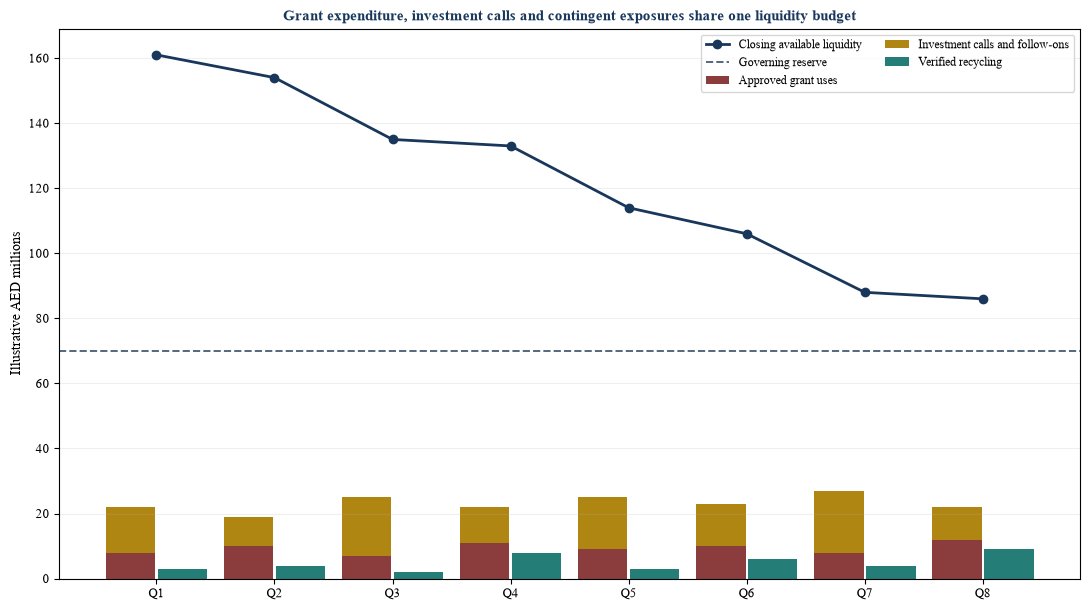
Values are illustrative management assumptions used solely to demonstrate liquidity design.
9. Integrate impact into the investment-committee process
The investment paper should present financial and impact cases together. The requested decision states entity, instrument, amount, use, return objective, mission objective, affected stakeholders, contribution, risks, conditions and monitoring.
The committee should test commercial viability and impact integrity through distinct questions. A strong impact case does not answer whether the valuation is sound. A strong financial case does not establish intentional contribution to an outcome. Approval requires both according to the chosen sleeve.
The committee may use specialist reviewers for climate science, education, healthcare, safeguarding, data or development economics. The adviser scope and conflicts are disclosed. Evidence gaps remain visible as conditions or reasons to pause.
Impact targets belong in the term sheet or side letter where they are material to the decision and enforceable within the relationship. Governance rights can support data access, stakeholder safeguards and corrective action. The committee should understand how financial remedies interact with beneficiaries.
The final minutes record the capital classification, approved reference case, any concession, key assumptions, financial conditions, impact conditions and monitoring owner. Overrides require named authority and written reason.
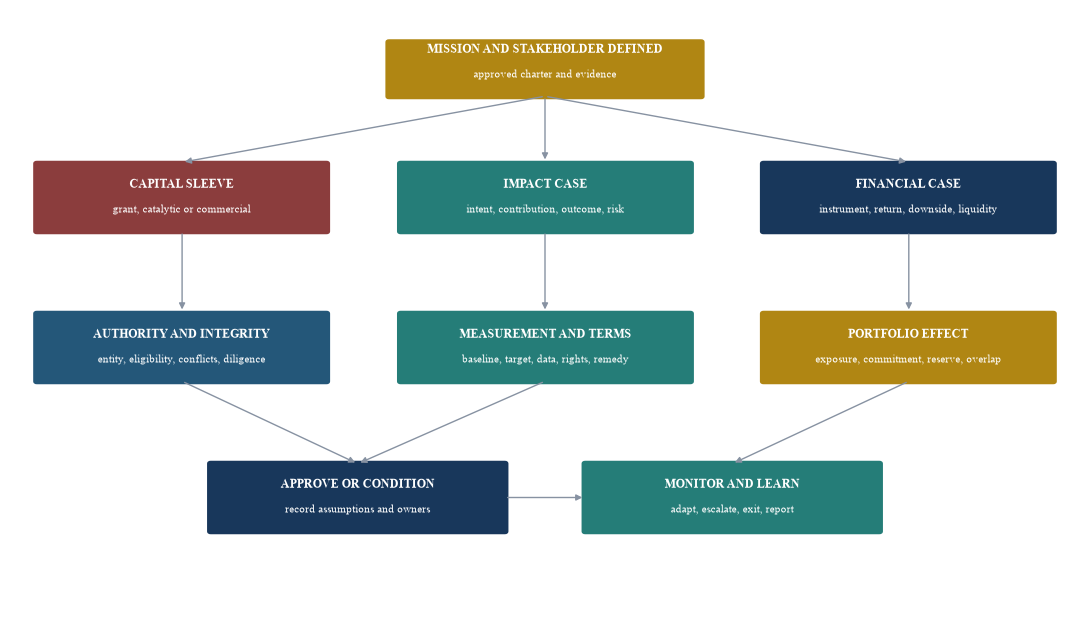
Author framework. Current governing documents and professional advice determine transaction-specific authority.
10. Design a proportionate impact-measurement system
Measurement should support decisions. The office begins with a small set of material outcome metrics, operating indicators and risk indicators. Each metric receives a definition, unit, population, boundary, source, frequency, owner, baseline, target and quality status.
IRIS+ provides a thematic taxonomy, core metric sets and a catalogue of metrics designed to help impact investors measure and manage outcomes.[2] The office can use relevant definitions while preserving transaction-specific context. Alignment to a metric does not establish that the investment caused the outcome.
Outputs count direct activity, such as people served or units installed. Outcomes assess change, such as improved access, reliability, income, health or emissions. The office should identify negative effects and excluded stakeholders. Stakeholder evidence can reveal whether a reported service is affordable, accessible and useful.
Data quality receives a visible status. Management-reported data, audited records, third-party studies and direct beneficiary evidence have different strengths. Estimates should state method and uncertainty. The committee can require external evaluation when the decision, claim or risk warrants it.
IFRS S1 requires disclosures concerning governance, strategy, risk management, metrics and targets for sustainability-related risks and opportunities that could reasonably affect an entity's prospects.[7] Its investor-focused financial-materiality scope differs from impact measurement concerning outcomes for people or planet. A family office can connect the two information sets while keeping their purposes clear.
Table 4. Impact metric and evidence dictionary
| Metric field | Required definition | Example evidence | Quality control |
|---|---|---|---|
| Outcome | change expected for a defined stakeholder or environmental system | verified service, survey, operating or environmental data | baseline, boundary and attribution language stated |
| Output | direct product, service or activity delivered | system record, invoice or programme report | unique counting, period and eligibility rules |
| Reach | number and characteristics of people, organisations or assets affected | beneficiary or customer register | privacy, duplicates and representative coverage |
| Depth | magnitude or importance of change | before-after measure or validated proxy | method, sensitivity and stakeholder relevance |
| Duration | period over which outcome persists | longitudinal or repeat observation | follow-up period and attrition disclosed |
| Contribution | role of capital, terms, engagement or network | reference financing case and action record | counterfactual stated without unsupported causality |
| Impact risk | likelihood and severity of underperformance or harm | risk indicators, complaints and incident data | threshold, owner, escalation and remedy |
| Financial link | revenue, cost, cash flow or value connected to outcome | audited or controlled management reporting | measure definition and reconciliation |
| Data status | source, date, method, assurance and limitation | data register and reviewer sign-off | observed, estimated and independently reviewed values distinguished |
Metric selection should reflect the actual theory of change and stakeholder context.
11. Manage impact, integrity and reputation risk
Impact risk includes the possibility that the intended outcome falls short, reaches different stakeholders, fades quickly or creates harm. Financial success can coexist with weak impact. Positive outputs can coexist with affordability, privacy, labour, environmental or exclusion concerns.
The office should assess evidence risk, execution risk, stakeholder-participation risk, alignment risk, endurance risk and unexpected-impact risk. It should also review management integrity, related parties, sanctions, corruption, procurement, safeguarding and use of funds.
Impact washing arises when claims exceed intention, contribution or evidence. Communications should state the capital sleeve, metric boundary, reporting period, source and limitations. A thematic label does not establish outcome. A commitment to measure does not equal measured performance.
Conflicts can arise when the family or adviser owns a business that receives mission capital, supplies a portfolio company or gains reputation from a programme. The decision process should disclose economics, use independent evidence, apply recusal and obtain the required approval.
The monitoring process includes complaints, incidents and remedy. A beneficiary or worker should have an appropriate path to raise harm where the operating model supports it. Material failures reach the governing body.
Table 5. Mission-related investment risk and control map
| Risk | Example | Early indicator | Control response |
|---|---|---|---|
| Mission drift | revenue growth shifts activity away from intended stakeholders | eligible-customer share or service mix changes | mission terms, board review and corrective plan |
| Weak additionality | concession supports a transaction already financeable on suitable terms | commercial offers appear without family support | refresh reference case and reduce or withdraw concession |
| Impact underperformance | outputs grow while intended outcome remains flat | outcome metric misses agreed trajectory | investigate theory, adapt delivery and reassess capital |
| Stakeholder harm | access, affordability, privacy or safety deteriorates | complaints, incidents or exclusion measures rise | safeguard, remedy, independent review and escalation |
| Financial weakness | capital needs exceed approved case | burn, covenant or margin variance | financing plan, intervention or controlled exit review |
| Data weakness | self-reported metrics lack definitions or source support | late, changing or unreconciled data | metric dictionary, sampling and assurance where warranted |
| Private windfall | concessional terms create value without evidenced public benefit | return transfer exceeds approved rationale | cap concession, use clawback or redesign economics |
| Conflict | related party influences selection, terms or reporting | undisclosed ownership or adviser economics | disclosure, independent diligence, recusal and approval |
| Reputation | public claim exceeds evidence or legal permission | promotional language differs from decision record | communications review, correction and claim register |
Risk ratings and remedies require case-specific calibration and professional review.
12. Use Gulf sustainable-finance frameworks within scope
The UAE Sustainable Finance Working Group has issued principles concerning climate-related financial risk and sustainability-related disclosures for reporting entities.[8] The CBUAE describes these as collaborative work across UAE authorities. Their application depends on the relevant regulatory perimeter and entity.
ADGM implemented a sustainable-finance regulatory framework covering ESG disclosures and designated funds, portfolios, bonds and sukuk.[9] Its supplementary guidance addresses green and climate-transition categories within that framework. A family office should use current rules and professional advice when establishing, marketing or investing through regulated products.
These frameworks can improve classification and disclosure. The family mission can extend beyond financially material sustainability risks to outcomes for people or planet. The office should keep the regulatory product label, issuer disclosure, investor impact thesis and observed outcome as distinct records.
Gulf opportunities can arise across renewable energy, efficiency, water, food systems, healthcare, education, affordable services, SME finance, employment and climate adaptation. Each opportunity requires local stakeholder evidence, commercial diligence, regulatory review and a credible delivery model. Sector relevance alone does not establish investability or impact.
13. Govern managers, funds and co-investments
External managers can provide sector expertise, portfolio construction, reporting and access. The family should assess the manager's impact intention, governance, team, sourcing, underwriting, measurement, conflicts, valuation, fees, key-person provisions and exit discipline.
UNDP's SDG Impact Standards for Private Equity Funds provide voluntary practice guidance for integrating sustainable-development contribution into strategy, management approach, transparency and governance.[10] The standards can support manager diligence. Use of SDG language alone does not demonstrate alignment or performance.
The Operating Principles require signatories to publish alignment disclosures and obtain periodic independent verification of their impact-management systems.[3] Such verification concerns system alignment within its stated scope. It does not automatically verify the quality of every impact data point or reported result.
The family should review fund documents and side letters for reporting, advisory rights, conflicts, key persons, strategy change, valuation and transfer. Co-investments require independent underwriting and should avoid assuming that fund approval satisfies the family mandate.
The portfolio view looks through managers where data permit. It identifies overlap by theme, geography, stakeholder, enterprise and risk. Unavailable look-through remains visible.
14. Plan responsible exits and recycling
Exit should be considered at entry. A sale can provide liquidity and scale while changing the owner, governance, pricing or stakeholder focus. The investment committee should identify mission-critical features and assess how potential exits affect them.
Possible tools include buyer diligence, transition commitments, governance protections, staged transfer, mission-aligned shareholders and continued reporting. Enforceability and effect depend on the transaction and law. A permanent mission lock can reduce buyer flexibility and value, so the family should approve the trade-off deliberately.
Catalytic capital should have a path to repayment, step-up, refinancing or conversion according to its terms. The family records whether recovered capital returns to the same mission sleeve. A guarantee release restores contingent capacity only after all obligations end.
Grants can create durable capacity even without financial recycling. The office evaluates whether the programme, institution or market can continue after the grant and whether future support remains justified.
The exit review compares actual financial and impact performance with the approved case. It records which assumptions held, what changed and how the evidence affects future allocation.
15. Demonstrate the framework with a hypothetical UAE family office
Consider a hypothetical UAE family office with management-estimated investable assets of AED 3.0 billion and an annual philanthropy budget of AED 24 million. The family approves a mission concerning reliable water, productive energy and inclusive employment across selected Gulf and adjacent markets. Every number and circumstance is a management assumption created solely to demonstrate the framework. It does not describe a client or market observation.
The governing body establishes three sleeves. The grant sleeve can commit AED 30 million over three years to research, beneficiary access and operating capacity. The catalytic sleeve can commit AED 60 million to patient debt, capped guarantees and junior capital. The commercial impact sleeve can build toward AED 180 million of market-rate investments. The main investment portfolio remains governed under its existing mandate.
The first pipeline contains 32 opportunities. Eligibility screening removes nine outside the mission geography or stakeholder scope. Evidence screening removes six whose impact claim concerns activity without a defined outcome. Commercial screening routes five public-good programmes to the grant committee, seven potentially viable enterprises to commercial impact and five financing-gap opportunities to catalytic review. These counts are illustrative.
One hypothetical water-efficiency platform seeks AED 45 million of growth equity. Its customers pay for monitored reductions in industrial water use. The investment committee reviews revenue contracts, unit economics, equipment performance, working capital, management, valuation and exit. The impact record defines the baseline water intensity, verified savings, customer boundary and rebound risk. The proposed AED 18 million family investment sits in the commercial sleeve.
A second project finances distributed cooling upgrades for small facilities. Senior lenders require operating history the project lacks. The family considers an AED 10 million capped guarantee against a defined first-loss portfolio. The reference case, expected loss, commercial lender terms, eligibility and claim process are documented. The guarantee declines after performance thresholds and expires after four years. Every term is an illustrative assumption.
A third programme trains and places young people into technical maintenance roles. Its public-good and access components lack a repayment source. The grant committee approves AED 4 million in milestones tied to eligible participation, completion, placement quality, retention and safeguarding. The office avoids forcing the programme into a loan.
The two-year liquidity ladder includes approved grants, commercial-fund calls, direct follow-ons and contingent guarantee exposure. The board maintains an assumed AED 70 million mission-capital reserve. Recycling from catalytic loans is excluded until receipt.
At the first annual review, the office reports capital committed, cash deployed, stakeholders reached, outcome progress, financial value, mobilisation, data quality, incidents and unresolved assumptions by sleeve. It avoids presenting grants and investments through one return measure. The dashboard identifies three metrics awaiting independent review and one opportunity whose concession is under reassessment. These are illustrative conditions.
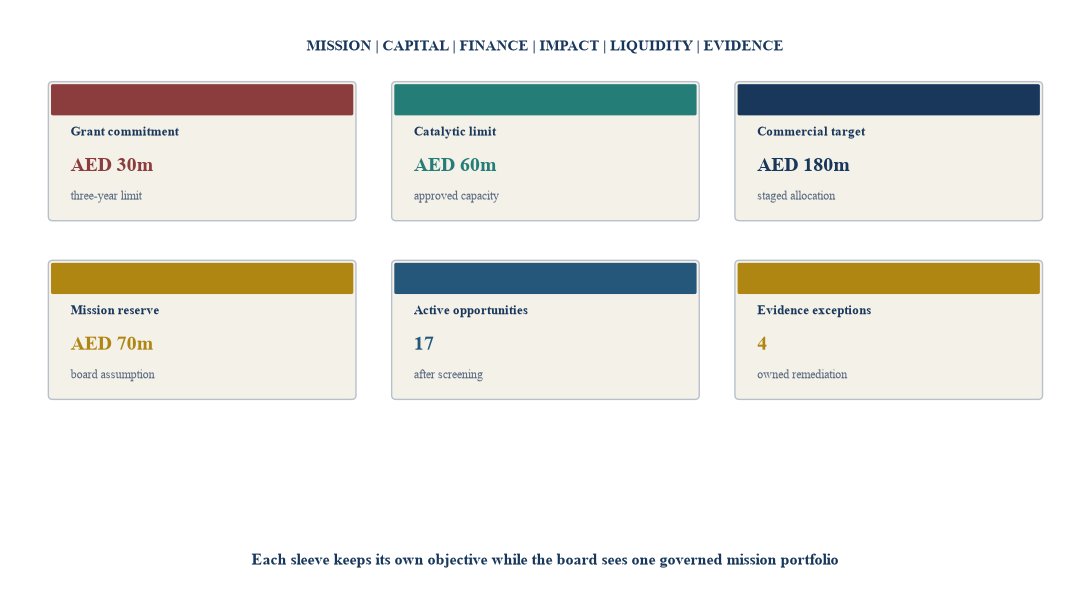
Every displayed value is an illustrative management assumption used solely to demonstrate dashboard design.
16. Monitor a portfolio through finance, impact and learning
The board dashboard should show commitments, deployments, fair or carrying values according to the applicable basis, cash flows, remaining capacity, guarantees, financial performance and liquidity by sleeve. It should also show outcome progress, affected stakeholders, contribution, impact risk, data quality and incidents.
Portfolio aggregation requires careful denominators. People served across investments can overlap. Emissions or resource metrics can use different boundaries. The office should aggregate only comparable measures and retain asset-level context.
The dashboard distinguishes actual, estimated and target values. It shows the reporting period, source and assurance status. Missing data remain visible. A red status should trigger a defined action rather than serve as a decorative score.
Learning affects allocation. Strong outcome evidence can support follow-on capital or replication. Weak evidence can lead to a redesigned metric, a revised theory of change, operational support, changed terms or exit. Financial outperformance can allow the family to recycle more capital. Losses should be analysed against the approved risk and contribution thesis.
Public communications should follow the evidence. The family can describe commitments, systems and observed outcomes with boundaries. Claims concerning causality, mobilisation or systemic change require stronger support.
17. Implement the capability in 100 days
Days one to 20 establish family purpose, mission outcomes, scope, entities, current philanthropy, existing aligned investments and decision rights. The team creates a baseline of commitments and liquidity.
Days 21 to 40 define the capital spectrum, eligibility, financial objectives, impact framework, additionality test, risk appetite, metric dictionary and reporting architecture. Current legal, tax, accounting and regulatory advice informs the design.
Days 41 to 60 build the pipeline, manager and direct-opportunity due diligence, committee paper, conflicts process, reference-case method and document repository. Representative opportunities test the framework before launch.
Days 61 to 80 establish grant, catalytic and commercial workflows, liquidity reserves, data agreements, monitoring and stakeholder safeguards. The office selects a small first portfolio according to approved gates.
Days 81 to 100 run the first committee cycle, validate data, test reporting, approve the dashboard and document unresolved conditions. The board sets quarterly monitoring and an annual strategy review.
Table 6. One-hundred-day mission-related investing programme
| Days | Workstream | Controlled deliverable | Gate |
|---|---|---|---|
| 1 to 10 | purpose | family mission, outcomes, stakeholders and geography | governing sponsor approves the problem and scope |
| 11 to 20 | baseline | entities, grants, investments, commitments and liquidity | current population reconciled to source records |
| 21 to 30 | capital design | grant, catalytic and commercial definitions and limits | sleeve objectives and authority approved |
| 31 to 40 | impact design | theory of change, contribution, risk and metric dictionary | material outcomes and evidence plan approved |
| 41 to 50 | underwriting | integrated diligence, reference case, conflicts and committee pack | representative opportunities pass design review |
| 51 to 60 | pipeline | sourcing, eligibility, manager diligence and routing | opportunities classified through documented gates |
| 61 to 70 | operations | agreements, accounts, data, monitoring and escalation | legal and operating paths confirmed by entity |
| 71 to 80 | portfolio | liquidity reserve, exposure, follow-ons and guarantee capacity | whole-balance-sheet stress test approved |
| 81 to 90 | pilot | first decisions, conditions and data validation | evidence and authority complete for each approval |
| 91 to 100 | governance | dashboard, learning cycle, assurance plan and board review | controlled production scope approved |
Timing depends on family governance, entity structure, professional advice, pipeline and data availability.
18. Limitations and conclusion
Mission-related investing uses several legal entities, instruments and reporting purposes. Current professional advice should determine the treatment of donations, grants, fundraising, endowments, investment vehicles, securities, guarantees, tax, accounting, sanctions, anti-money-laundering, privacy and cross-border flows.
Harmonised responsible-investment definitions help distinguish impact investing, screening, thematic investing, integration and stewardship.[1] They do not determine whether a particular product achieves its stated outcome.
IRIS+ supplies impact-management tools and metric definitions.[2] The Operating Principles and UNDP SDG Impact Standards provide voluntary practice frameworks.[3][10] Use of these resources does not establish signatory status, verified alignment, causality or impact performance.
IFC and OECD blended-finance guidance arises within development-finance contexts.[4][5] A family office can use the disciplines of additionality, minimum concession, mobilisation, commercial sustainability and exit while accurately describing its private arrangement and purpose.
IFRS S1 concerns sustainability-related financial disclosures useful to users of general purpose financial reports within its scope.[7] Impact measurement can address outcomes for affected stakeholders through a different materiality lens. The two can share data while retaining distinct objectives.
UAE and ADGM sustainable-finance requirements apply according to entity, activity and regulatory perimeter.[8][9] UAE donations and fundraising rules require current review for the actual activity.[6]
The hypothetical example contains management assumptions solely for framework demonstration. It does not describe a client, expected outcome, market return or recommendation.
A mission-related portfolio becomes credible when purpose, capital, finance and evidence meet in one governed process. The family defines the outcome, selects the suitable capital sleeve, underwrites the financial case, tests contribution and additionality, protects liquidity, measures material outcomes and learns from performance.
Grants remain grants. Catalytic capital carries an explicit rationale and concession. Commercial impact investments carry market-disciplined underwriting and measurable intention. The board sees all three through one portfolio view while preserving their separate authorities and performance bases.
This operating model allows Gulf family capital to support public goods, help viable solutions cross financing barriers and scale commercially durable enterprises. It joins philanthropy, impact and commercial discipline through clear boundaries, current evidence and accountable decisions.
References
- [1] Principles for Responsible Investment, CFA Institute and Global Sustainable Investment Alliance, Definitions for Responsible Investment Approaches, 1 November 2023. https://public.unpri.org/investment-tools/definitions-for-responsible-investment-approaches/11874.article
- [2] Global Impact Investing Network, IRIS+ system and introduction to impact measurement and management, accessed 13 August 2026. https://iris.thegiin.org/introduction/
- [3] Operating Principles for Impact Management, The Nine Principles and disclosure and verification framework, accessed 13 August 2026. https://www.impactprinciples.org/
- [4] International Finance Corporation, How Blended Finance Works and DFI Enhanced Blended Concessional Finance Principles for Private Sector Projects, accessed 13 August 2026. https://www.ifc.org/en/what-we-do/sector-expertise/blended-finance/how-blended-finance-works
- [5] OECD, OECD DAC Blended Finance Guidance 2025, published 2025. https://www.oecd.org/en/publications/oecd-dac-blended-finance-guidance-2025_e4a13d2c-en.html
- [6] United Arab Emirates, Federal Law No. 3 of 2021 Regulating Donations, official legislation platform, accessed 13 August 2026. https://uaelegislation.gov.ae/en/legislations/1500
- [7] IFRS Foundation, IFRS S1 General Requirements for Disclosure of Sustainability-related Financial Information, issued June 2023, effective for annual periods beginning on or after 1 January 2024. https://www.ifrs.org/issued-standards/ifrs-sustainability-standards-navigator/ifrs-s1-general-requirements/
- [8] Central Bank of the UAE, Sustainable Finance, including UAE Sustainable Finance Working Group principles on climate-related financial risk and sustainability-related disclosures, accessed 13 August 2026. https://www.centralbank.ae/en/our-operations/sustainable-finance/
- [9] Abu Dhabi Global Market, ADGM Implements its Sustainable Finance Regulatory Framework, 4 July 2023. https://www.adgm.com/media/announcements/adgm-implements-its-sustainable-finance-regulatory-framework
- [10] United Nations Development Programme, SDG Impact Standards for Private Equity Funds, issued October 2020. https://sdgfinance.undp.org/our-services/private-finance/aligning-capital
About the Author
Chennakeshav Adya is an independent researcher and Managing Partner of Matchpoint Partners. His research focuses on investment strategy, capital formation, transaction execution, governance and operating-model design across the Gulf and international markets.
