

1. Define the acquisition decision
The investment committee must decide which capabilities to acquire, what dependable capacity is being purchased and how much regulatory or customer risk should be reflected in price and structure. State the target product classes, aircraft or engine families, approval jurisdictions, locations, customers and cash outcomes before diligence begins. The analysis should distinguish observed regulatory, contractual, operational and financial evidence from management assumptions and connect each material judgment to airworthiness, capacity, timing and cash. Approval should define minimum capacity, margin, customer retention, approval continuity and cash-conversion thresholds. The work should cover a central case and a severe-but-plausible downside, with correlated sensitivities for approval timing, labour availability, productivity, turnaround time, material cost, customer retention, pricing, remediation and integration. Exceptions require a named owner, source, due date and decision consequence. Unsupported benefits remain outside the base case until actions are implemented and evidence confirms the result. The section output should identify the controlling evidence, decision threshold, accountable owner, review cadence and explicit safety, capacity, customer or cash consequence. This creates a controlled bridge from diligence to transaction terms and integration action.
The acquisition should be assessed through four linked views. The regulatory view tests whether each entity and site may continue to perform and release the work assumed in the plan. The operating view converts approved scope, qualified labour, facilities, tooling, technical data and parts into usable capacity. The commercial view tests whether customer demand is committed, profitable and retained under the proposed ownership. The cash view reconciles work orders, inventory, work in progress, invoices, claims and collections. Each view should use the same capability, site, customer and period identifiers. This prevents a forecast from counting work that lacks approval, staff, material or contractual support. It also gives management a repeatable basis for comparing targets and sequencing integration without weakening airworthiness control. Group averages can hide a critical certifying-staff gap, a constrained engine type, an expiring customer contract or a site-specific regulator finding. Exceptions therefore remain visible until the underlying evidence or corrective action is approved and complete.
2. Use the Capacity-to-Cash Consolidation Framework
The framework links nine evidence blocks: approval scope, accountable management, workforce, facilities, tooling, technical data, parts, customers and cash. Each block should reconcile to legal entity, site, capability, regulatory certificate, customer contract and financial record. The analysis should distinguish observed regulatory, contractual, operational and financial evidence from management assumptions and connect each material judgment to airworthiness, capacity, timing and cash. The committee should prevent commercial forecasts from running ahead of approval, people or material evidence. The work should cover a central case and a severe-but-plausible downside, with correlated sensitivities for approval timing, labour availability, productivity, turnaround time, material cost, customer retention, pricing, remediation and integration. Exceptions require a named owner, source, due date and decision consequence. Unsupported benefits remain outside the base case until actions are implemented and evidence confirms the result. Evidence should remain traceable to certificate, site, capability, customer, work order and legal entity, with control totals to financial reporting and a documented path for exceptions. The resulting decision should update value, structure, conditions and operating plan together.
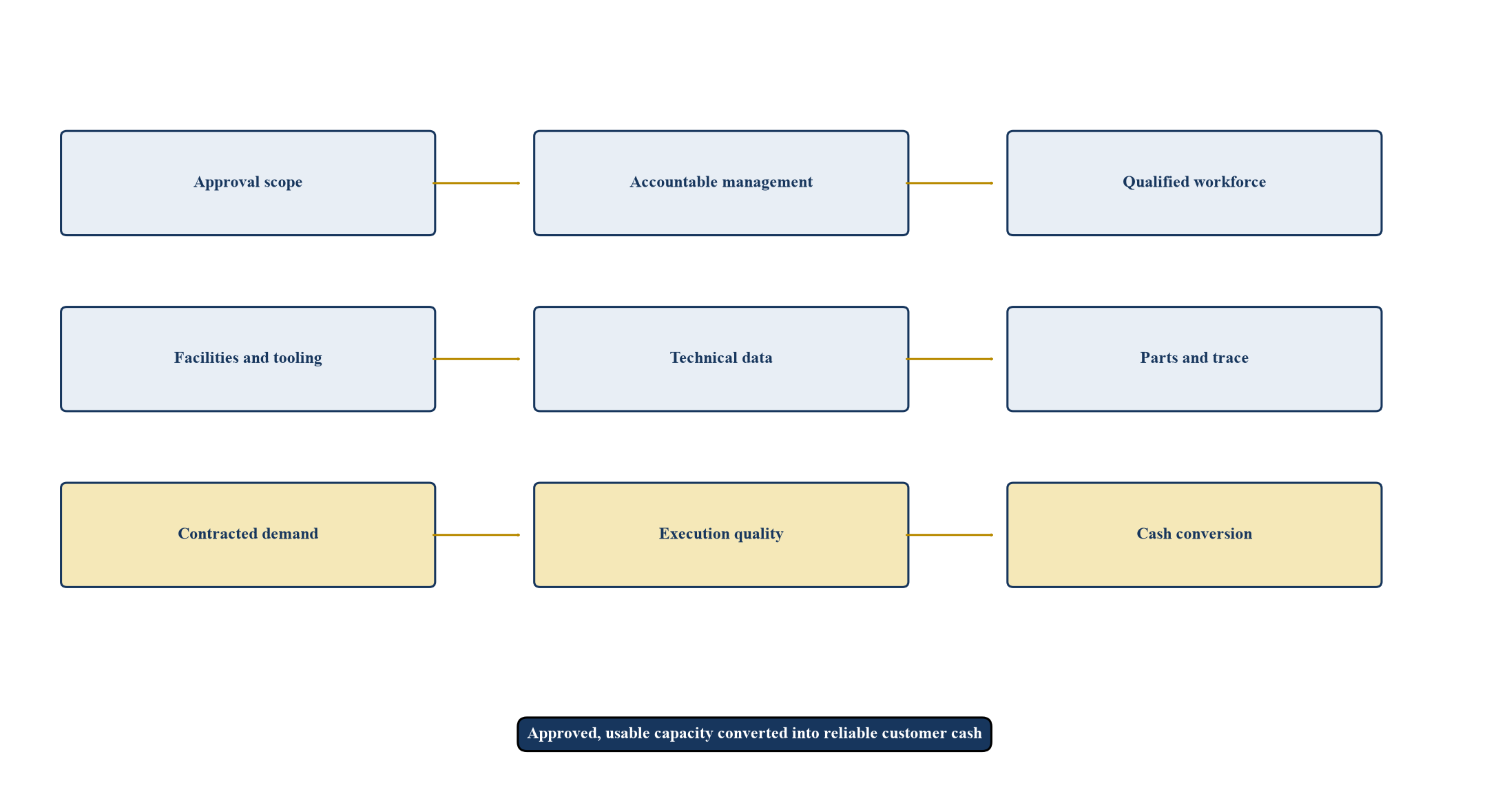
Nine evidence blocks connect regulatory permission and operating resources to cash.
3. Fix the legal and regulatory perimeter
A group may operate through multiple repair-station certificates, Part-145 approvals, subsidiaries, branches and subcontracting arrangements. Map certificate holder, competent authority, ratings, limitations, exposition, locations, line stations, privileges and subcontracted work. The analysis should distinguish observed regulatory, contractual, operational and financial evidence from management assumptions and connect each material judgment to airworthiness, capacity, timing and cash. The acquisition perimeter should identify every approval, activity and interface required to deliver the forecast revenue. The work should cover a central case and a severe-but-plausible downside, with correlated sensitivities for approval timing, labour availability, productivity, turnaround time, material cost, customer retention, pricing, remediation and integration. Exceptions require a named owner, source, due date and decision consequence. Unsupported benefits remain outside the base case until actions are implemented and evidence confirms the result. Management should define the earliest warning indicator, intervention trigger and funded response. Reporting should preserve the original case, approved changes and realised cash so the board can distinguish execution from favourable timing or presentation.
4. Build the minimum evidence stack
Decision-grade diligence requires regulatory, operational, commercial, technical, workforce, supply-chain and financial records on a common time basis. Reconcile approvals, audit findings, work orders, labour hours, turnaround time, quotes, contracts, material usage, warranty, revenue and cash. The analysis should distinguish observed regulatory, contractual, operational and financial evidence from management assumptions and connect each material judgment to airworthiness, capacity, timing and cash. Preserve source, period, owner and exceptions so the model remains traceable through signing and integration. The work should cover a central case and a severe-but-plausible downside, with correlated sensitivities for approval timing, labour availability, productivity, turnaround time, material cost, customer retention, pricing, remediation and integration. Exceptions require a named owner, source, due date and decision consequence. Unsupported benefits remain outside the base case until actions are implemented and evidence confirms the result. The section output should identify the controlling evidence, decision threshold, accountable owner, review cadence and explicit safety, capacity, customer or cash consequence. This creates a controlled bridge from diligence to transaction terms and integration action.
| Layer | Core evidence | Primary decision | Economic consequence |
|---|---|---|---|
| Regulatory | Certificates, ratings, limitations and findings | Approval continuity | Revenue eligibility and remediation |
| Workforce | Licences, authorisations, skills and roster | Executable labour | Capacity and retention cost |
| Operations | Work orders, turnaround, rework and tooling | Usable capacity | Throughput and margin |
| Supply chain | Trace, inventory, suppliers and lead times | Material availability | Working capital and delay |
| Customers | Contracts, backlog, concentration and claims | Revenue durability | Price and structure |
| Finance | Work-order margin, WIP, receivables and cash | Quality of earnings | Value and debt capacity |
Evidence should reconcile to certificate, site, capability and legal entity.
5. Test approval continuity
A change of ownership can require notification, acceptance, amended manuals, management approval or a new certificate depending on jurisdiction and transaction structure. Obtain regulator-specific advice and map ownership, control, accountable manager, nominated persons, facilities, scope and timing. The analysis should distinguish observed regulatory, contractual, operational and financial evidence from management assumptions and connect each material judgment to airworthiness, capacity, timing and cash. Use conditions precedent, long-stop dates and interim operating covenants where approval continuity affects closing value. The work should cover a central case and a severe-but-plausible downside, with correlated sensitivities for approval timing, labour availability, productivity, turnaround time, material cost, customer retention, pricing, remediation and integration. Exceptions require a named owner, source, due date and decision consequence. Unsupported benefits remain outside the base case until actions are implemented and evidence confirms the result. Evidence should remain traceable to certificate, site, capability, customer, work order and legal entity, with control totals to financial reporting and a documented path for exceptions. The resulting decision should update value, structure, conditions and operating plan together.
6. Verify ratings and actual scope
A certificate headline can conceal limitations by aircraft type, engine, component, process, location or maintenance level. Compare certificates, operations specifications, capability lists, maintenance organisation exposition and recent release-to-service records. The analysis should distinguish observed regulatory, contractual, operational and financial evidence from management assumptions and connect each material judgment to airworthiness, capacity, timing and cash. Exclude forecast work that falls outside evidenced scope or requires unapproved facilities, data, tooling or staff. The work should cover a central case and a severe-but-plausible downside, with correlated sensitivities for approval timing, labour availability, productivity, turnaround time, material cost, customer retention, pricing, remediation and integration. Exceptions require a named owner, source, due date and decision consequence. Unsupported benefits remain outside the base case until actions are implemented and evidence confirms the result. Management should define the earliest warning indicator, intervention trigger and funded response. Reporting should preserve the original case, approved changes and realised cash so the board can distinguish execution from favourable timing or presentation.
7. Assess compliance history
Open findings, repeat findings, voluntary disclosures, enforcement, occurrence reports and overdue corrective actions can indicate control weakness. Review regulator correspondence, internal audits, root-cause analysis, closure evidence and surveillance cadence. The analysis should distinguish observed regulatory, contractual, operational and financial evidence from management assumptions and connect each material judgment to airworthiness, capacity, timing and cash. Price remediation, protect closing conditions and retain accountable owners for every material finding. The work should cover a central case and a severe-but-plausible downside, with correlated sensitivities for approval timing, labour availability, productivity, turnaround time, material cost, customer retention, pricing, remediation and integration. Exceptions require a named owner, source, due date and decision consequence. Unsupported benefits remain outside the base case until actions are implemented and evidence confirms the result. The section output should identify the controlling evidence, decision threshold, accountable owner, review cadence and explicit safety, capacity, customer or cash consequence. This creates a controlled bridge from diligence to transaction terms and integration action.
8. Evaluate the safety-management system
A compliant manual has limited value when hazard reporting, risk assessment, assurance and management action do not operate in practice. Test safety policy, reporting culture, safety-performance indicators, investigations, management reviews and action closure. The analysis should distinguish observed regulatory, contractual, operational and financial evidence from management assumptions and connect each material judgment to airworthiness, capacity, timing and cash. Integration should preserve independent safety decisions and avoid suppressing reporting through cost or schedule pressure. The work should cover a central case and a severe-but-plausible downside, with correlated sensitivities for approval timing, labour availability, productivity, turnaround time, material cost, customer retention, pricing, remediation and integration. Exceptions require a named owner, source, due date and decision consequence. Unsupported benefits remain outside the base case until actions are implemented and evidence confirms the result. Evidence should remain traceable to certificate, site, capability, customer, work order and legal entity, with control totals to financial reporting and a documented path for exceptions. The resulting decision should update value, structure, conditions and operating plan together.
9. Convert stated hours into usable capacity
Rostered labour hours do not equal productive, approved and saleable capacity. Bridge paid hours to attendance, training, certification, skill mix, shift coverage, tooling, bays, material, rework and planned downtime. The analysis should distinguish observed regulatory, contractual, operational and financial evidence from management assumptions and connect each material judgment to airworthiness, capacity, timing and cash. Value only the capacity that can execute forecast work within approval and quality constraints. The work should cover a central case and a severe-but-plausible downside, with correlated sensitivities for approval timing, labour availability, productivity, turnaround time, material cost, customer retention, pricing, remediation and integration. Exceptions require a named owner, source, due date and decision consequence. Unsupported benefits remain outside the base case until actions are implemented and evidence confirms the result. Management should define the earliest warning indicator, intervention trigger and funded response. Reporting should preserve the original case, approved changes and realised cash so the board can distinguish execution from favourable timing or presentation.
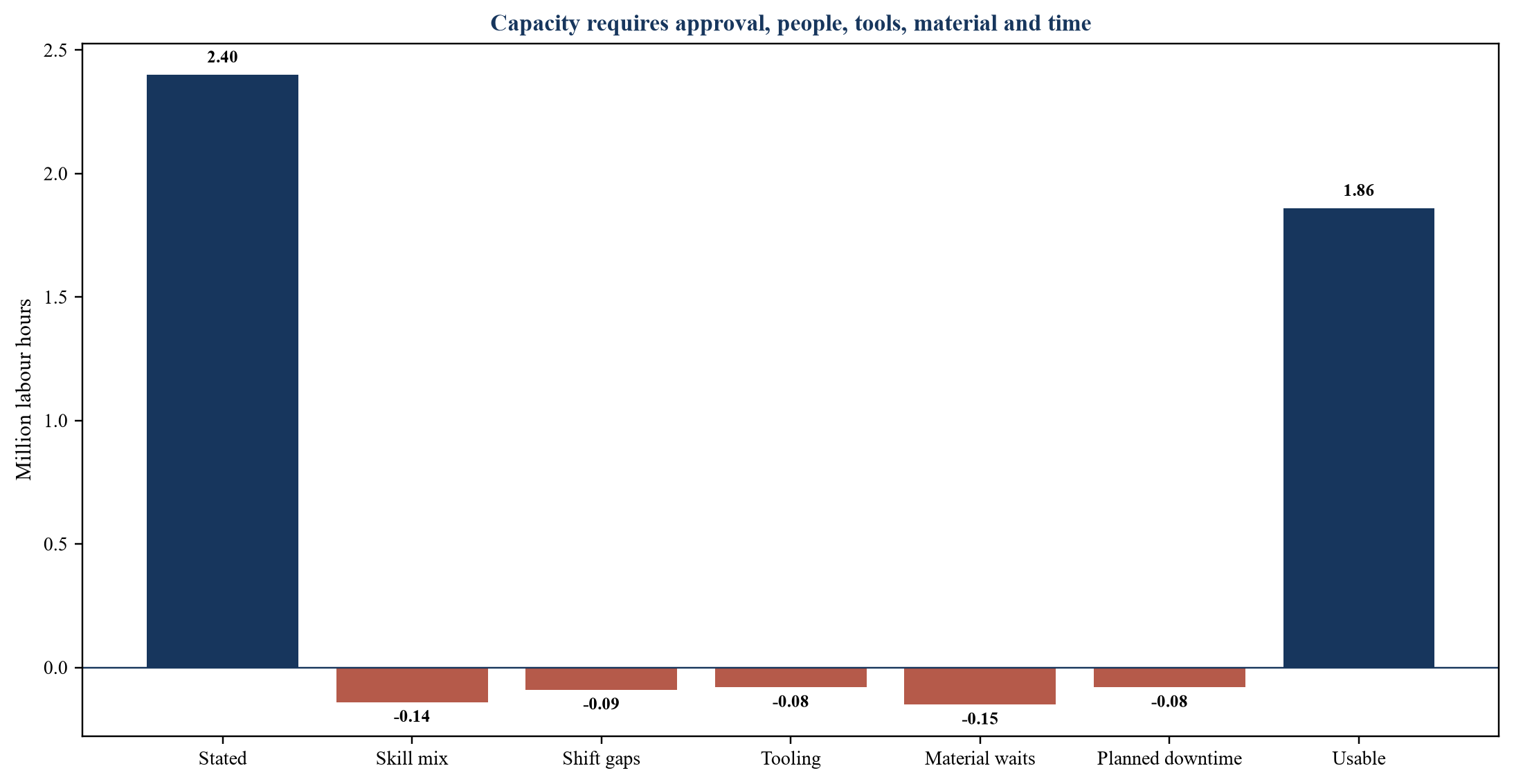
Million labour hours; every value is an illustrative management assumption.
10. Map certifying staff and competence
A small group of licensed or authorised personnel can constrain release-to-service capacity and create key-person dependence. Map licence category, type rating, company authorisation, recency, shift, location, retirement, contractor status and succession. The analysis should distinguish observed regulatory, contractual, operational and financial evidence from management assumptions and connect each material judgment to airworthiness, capacity, timing and cash. Retention, training and authorisation plans should be funded before synergy depends on redeployed labour. The work should cover a central case and a severe-but-plausible downside, with correlated sensitivities for approval timing, labour availability, productivity, turnaround time, material cost, customer retention, pricing, remediation and integration. Exceptions require a named owner, source, due date and decision consequence. Unsupported benefits remain outside the base case until actions are implemented and evidence confirms the result. The section output should identify the controlling evidence, decision threshold, accountable owner, review cadence and explicit safety, capacity, customer or cash consequence. This creates a controlled bridge from diligence to transaction terms and integration action.
11. Test workforce productivity
Reported productivity can be distorted by overtime, contractors, deferred training, work-mix changes or incomplete time booking. Reconcile clocked hours, booked hours, standard hours, overtime, rework, absence, training and contractor invoices by product line. The analysis should distinguish observed regulatory, contractual, operational and financial evidence from management assumptions and connect each material judgment to airworthiness, capacity, timing and cash. Use cohort-level productivity and quality evidence instead of group averages. The work should cover a central case and a severe-but-plausible downside, with correlated sensitivities for approval timing, labour availability, productivity, turnaround time, material cost, customer retention, pricing, remediation and integration. Exceptions require a named owner, source, due date and decision consequence. Unsupported benefits remain outside the base case until actions are implemented and evidence confirms the result. Evidence should remain traceable to certificate, site, capability, customer, work order and legal entity, with control totals to financial reporting and a documented path for exceptions. The resulting decision should update value, structure, conditions and operating plan together.
12. Underwrite facilities and tooling
Hangars, shops, docks, test cells, stands, ground-support equipment and calibrated tools determine executable scope. Inspect ownership, leases, permits, environmental conditions, maintenance, calibration, utilisation, redundancy and capital needs. The analysis should distinguish observed regulatory, contractual, operational and financial evidence from management assumptions and connect each material judgment to airworthiness, capacity, timing and cash. The model should include downtime, relocation, certification and commissioning before counting new capacity. The work should cover a central case and a severe-but-plausible downside, with correlated sensitivities for approval timing, labour availability, productivity, turnaround time, material cost, customer retention, pricing, remediation and integration. Exceptions require a named owner, source, due date and decision consequence. Unsupported benefits remain outside the base case until actions are implemented and evidence confirms the result. Management should define the earliest warning indicator, intervention trigger and funded response. Reporting should preserve the original case, approved changes and realised cash so the board can distinguish execution from favourable timing or presentation.
13. Verify technical data and digital rights
Maintenance depends on current manuals, service information, engineering orders, software, records and customer-authorised data. Map licences, subscriptions, access rights, cybersecurity, revision control, data migration and contractual restrictions. The analysis should distinguish observed regulatory, contractual, operational and financial evidence from management assumptions and connect each material judgment to airworthiness, capacity, timing and cash. Integration must preserve approved data access and record integrity across every release-to-service workflow. The work should cover a central case and a severe-but-plausible downside, with correlated sensitivities for approval timing, labour availability, productivity, turnaround time, material cost, customer retention, pricing, remediation and integration. Exceptions require a named owner, source, due date and decision consequence. Unsupported benefits remain outside the base case until actions are implemented and evidence confirms the result. The section output should identify the controlling evidence, decision threshold, accountable owner, review cadence and explicit safety, capacity, customer or cash consequence. This creates a controlled bridge from diligence to transaction terms and integration action.
14. Audit parts traceability and inventory
Inventory value can be overstated by missing trace, shelf-life, condition, interchangeability, sanctions, obsolescence or customer ownership. Test authorised release certificates, back-to-birth records where relevant, lot control, quarantine, scrap, consignment and cycle counts. The analysis should distinguish observed regulatory, contractual, operational and financial evidence from management assumptions and connect each material judgment to airworthiness, capacity, timing and cash. Apply valuation reserves and closing adjustments to unsupported, slow-moving or non-transferable material. The work should cover a central case and a severe-but-plausible downside, with correlated sensitivities for approval timing, labour availability, productivity, turnaround time, material cost, customer retention, pricing, remediation and integration. Exceptions require a named owner, source, due date and decision consequence. Unsupported benefits remain outside the base case until actions are implemented and evidence confirms the result. Evidence should remain traceable to certificate, site, capability, customer, work order and legal entity, with control totals to financial reporting and a documented path for exceptions. The resulting decision should update value, structure, conditions and operating plan together.
15. Model supply-chain resilience
Long lead times, sole-source components, engine-shop constraints and logistics disruption can turn demand into grounded work in progress. Measure supplier concentration, lead time, fill rate, price escalation, repair loop, pool access and alternative approvals. The analysis should distinguish observed regulatory, contractual, operational and financial evidence from management assumptions and connect each material judgment to airworthiness, capacity, timing and cash. Fund buffers selectively and connect procurement actions to specific turnaround-time and cash outcomes. The work should cover a central case and a severe-but-plausible downside, with correlated sensitivities for approval timing, labour availability, productivity, turnaround time, material cost, customer retention, pricing, remediation and integration. Exceptions require a named owner, source, due date and decision consequence. Unsupported benefits remain outside the base case until actions are implemented and evidence confirms the result. Management should define the earliest warning indicator, intervention trigger and funded response. Reporting should preserve the original case, approved changes and realised cash so the board can distinguish execution from favourable timing or presentation.
16. Reconstruct turnaround time
Customer value depends on reliable induction, work-scope control, parts availability, rectification and release. Measure elapsed and touch time from induction to redelivery, separating planned work, discoveries, customer approvals, material waits and rework. The analysis should distinguish observed regulatory, contractual, operational and financial evidence from management assumptions and connect each material judgment to airworthiness, capacity, timing and cash. Forecast throughput only after removing delay that cannot be controlled or economically reduced. The work should cover a central case and a severe-but-plausible downside, with correlated sensitivities for approval timing, labour availability, productivity, turnaround time, material cost, customer retention, pricing, remediation and integration. Exceptions require a named owner, source, due date and decision consequence. Unsupported benefits remain outside the base case until actions are implemented and evidence confirms the result. The section output should identify the controlling evidence, decision threshold, accountable owner, review cadence and explicit safety, capacity, customer or cash consequence. This creates a controlled bridge from diligence to transaction terms and integration action.
| Delay source | Evidence | Corrective action | Value consequence |
|---|---|---|---|
| Customer approval | Quote-to-authorisation timestamps | Pre-agreed limits and escalation | Reduced idle WIP |
| Material wait | Requisitions, lead time and shortage logs | Pooling, alternates and buffers | Higher throughput and cash |
| Labour or skill | Roster, authorisation and task hours | Training, shift and retention plan | Capacity recovery |
| Tool or bay | Usage, calibration and downtime | Scheduling and targeted capital | Fewer bottlenecks |
| Rework | Non-conformance and repeat task | Root cause and quality action | Margin protection |
Delay should be assigned to an evidence-backed cause and accountable owner.
17. Measure quality and rework
High throughput can conceal repeat defects, warranty claims, escapes, concessions and uncompensated labour. Reconcile non-conformances, inspection findings, repeat removals, warranty, customer claims, scrap and quality cost by product family. The analysis should distinguish observed regulatory, contractual, operational and financial evidence from management assumptions and connect each material judgment to airworthiness, capacity, timing and cash. Synergy plans must protect inspection independence and include the cost of achieving target first-pass yield. The work should cover a central case and a severe-but-plausible downside, with correlated sensitivities for approval timing, labour availability, productivity, turnaround time, material cost, customer retention, pricing, remediation and integration. Exceptions require a named owner, source, due date and decision consequence. Unsupported benefits remain outside the base case until actions are implemented and evidence confirms the result. Evidence should remain traceable to certificate, site, capability, customer, work order and legal entity, with control totals to financial reporting and a documented path for exceptions. The resulting decision should update value, structure, conditions and operating plan together.
18. Test customer concentration
A strong order book can depend on a few airlines, lessors, original-equipment manufacturers or defence customers. Measure revenue, gross margin, receivables, slots and capacity allocation by customer, contract, fleet and decision maker. The analysis should distinguish observed regulatory, contractual, operational and financial evidence from management assumptions and connect each material judgment to airworthiness, capacity, timing and cash. Use retention conditions, earn-outs, rollover equity or price protection where concentrated revenue lacks durable commitment. The work should cover a central case and a severe-but-plausible downside, with correlated sensitivities for approval timing, labour availability, productivity, turnaround time, material cost, customer retention, pricing, remediation and integration. Exceptions require a named owner, source, due date and decision consequence. Unsupported benefits remain outside the base case until actions are implemented and evidence confirms the result. Management should define the earliest warning indicator, intervention trigger and funded response. Reporting should preserve the original case, approved changes and realised cash so the board can distinguish execution from favourable timing or presentation.
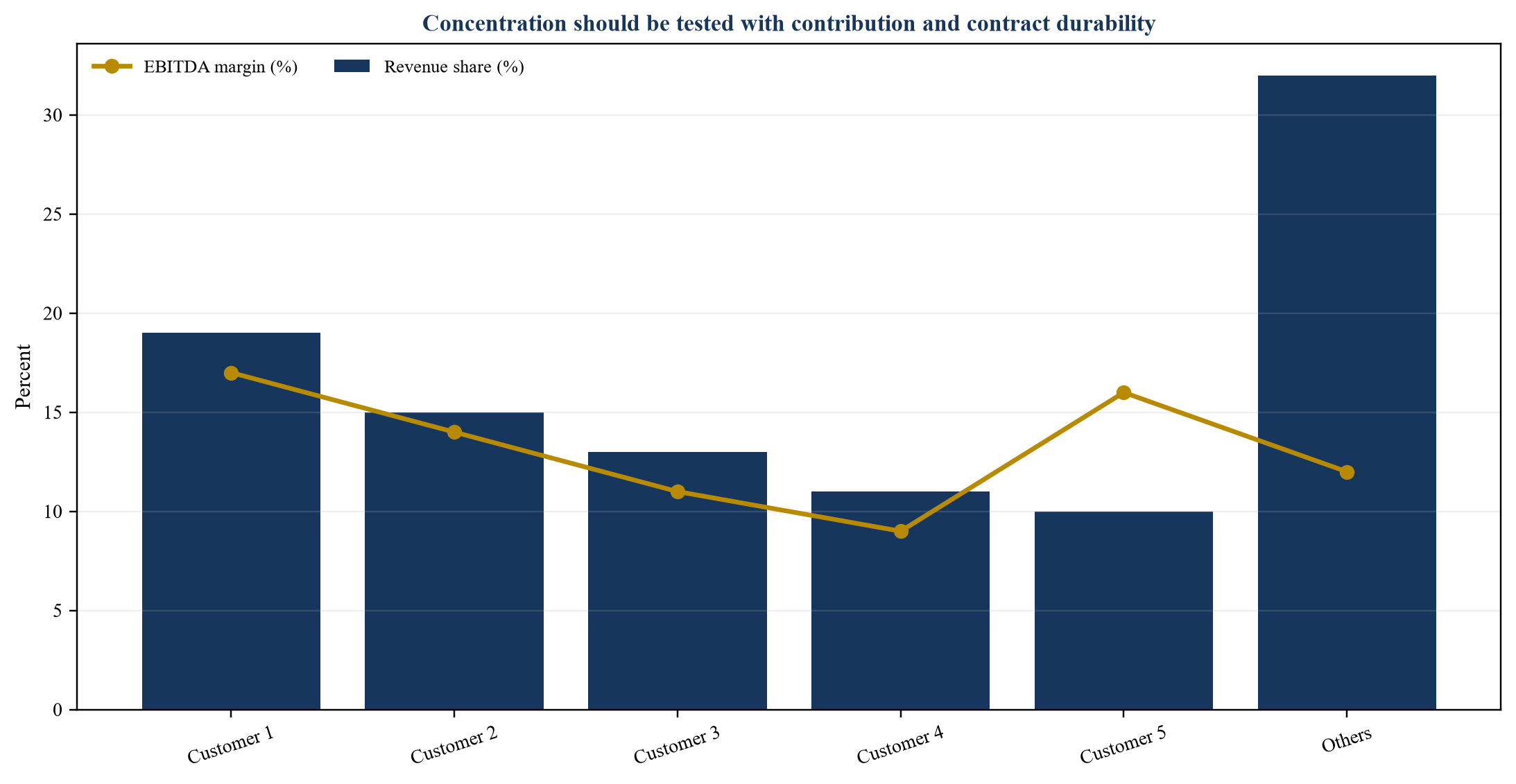
Revenue share and EBITDA margin are illustrative management assumptions.
19. Distinguish contracted demand from expectations
Framework agreements, preferred-provider status and forecast work packages can provide limited minimum volume. Review term, exclusivity, pricing, escalation, volume commitment, termination, performance credits, change control and assignment. The analysis should distinguish observed regulatory, contractual, operational and financial evidence from management assumptions and connect each material judgment to airworthiness, capacity, timing and cash. Model committed, probable and uncommitted demand separately and disclose the conversion assumptions. The work should cover a central case and a severe-but-plausible downside, with correlated sensitivities for approval timing, labour availability, productivity, turnaround time, material cost, customer retention, pricing, remediation and integration. Exceptions require a named owner, source, due date and decision consequence. Unsupported benefits remain outside the base case until actions are implemented and evidence confirms the result. The section output should identify the controlling evidence, decision threshold, accountable owner, review cadence and explicit safety, capacity, customer or cash consequence. This creates a controlled bridge from diligence to transaction terms and integration action.
20. Test pricing and margin quality
Revenue growth can be offset by fixed-price exposure, inflation, overtime, parts escalation and uncompensated findings. Rebuild margin by work order using labour, material, subcontract, warranty, logistics, credit and billing data. The analysis should distinguish observed regulatory, contractual, operational and financial evidence from management assumptions and connect each material judgment to airworthiness, capacity, timing and cash. Protect value through indexed pricing, scope discipline, approval thresholds and customer-level contribution reporting. The work should cover a central case and a severe-but-plausible downside, with correlated sensitivities for approval timing, labour availability, productivity, turnaround time, material cost, customer retention, pricing, remediation and integration. Exceptions require a named owner, source, due date and decision consequence. Unsupported benefits remain outside the base case until actions are implemented and evidence confirms the result. Evidence should remain traceable to certificate, site, capability, customer, work order and legal entity, with control totals to financial reporting and a documented path for exceptions. The resulting decision should update value, structure, conditions and operating plan together.
21. Reconcile backlog with capacity
Backlog is valuable only when scope, price, slot, material, labour and customer approval support execution. Age open work and orders, identify duplicates or contingent awards, and schedule each package against constrained resources. The analysis should distinguish observed regulatory, contractual, operational and financial evidence from management assumptions and connect each material judgment to airworthiness, capacity, timing and cash. Use a capacity-feasible backlog rather than the sales register as the revenue bridge. The work should cover a central case and a severe-but-plausible downside, with correlated sensitivities for approval timing, labour availability, productivity, turnaround time, material cost, customer retention, pricing, remediation and integration. Exceptions require a named owner, source, due date and decision consequence. Unsupported benefits remain outside the base case until actions are implemented and evidence confirms the result. Management should define the earliest warning indicator, intervention trigger and funded response. Reporting should preserve the original case, approved changes and realised cash so the board can distinguish execution from favourable timing or presentation.
22. Convert accounting profit into cash
MRO cash conversion can be weakened by inventory, work in progress, milestone billing, customer approvals, claims and delayed collections. Reconcile work-order revenue to invoicing, receivables, material purchases, deposits, provisions and cash by customer. The analysis should distinguish observed regulatory, contractual, operational and financial evidence from management assumptions and connect each material judgment to airworthiness, capacity, timing and cash. Set working-capital and completion-account protections around normalised operational drivers. The work should cover a central case and a severe-but-plausible downside, with correlated sensitivities for approval timing, labour availability, productivity, turnaround time, material cost, customer retention, pricing, remediation and integration. Exceptions require a named owner, source, due date and decision consequence. Unsupported benefits remain outside the base case until actions are implemented and evidence confirms the result. The section output should identify the controlling evidence, decision threshold, accountable owner, review cadence and explicit safety, capacity, customer or cash consequence. This creates a controlled bridge from diligence to transaction terms and integration action.
23. Identify capital expenditure
Growth can require hangar modification, test equipment, tooling, digital systems, training, certification and environmental remediation. Separate maintenance, compliance, capacity and transformation capital with timing, approval and commissioning dependencies. The analysis should distinguish observed regulatory, contractual, operational and financial evidence from management assumptions and connect each material judgment to airworthiness, capacity, timing and cash. The investment case should fund required capital before distribution or debt-capacity assumptions. The work should cover a central case and a severe-but-plausible downside, with correlated sensitivities for approval timing, labour availability, productivity, turnaround time, material cost, customer retention, pricing, remediation and integration. Exceptions require a named owner, source, due date and decision consequence. Unsupported benefits remain outside the base case until actions are implemented and evidence confirms the result. Evidence should remain traceable to certificate, site, capability, customer, work order and legal entity, with control totals to financial reporting and a documented path for exceptions. The resulting decision should update value, structure, conditions and operating plan together.
24. Assess customer and competition risk
Consolidation can reduce alternatives for specialised capabilities, airport locations, fleets, engines or component classes. Define relevant product and geographic markets, competitor capacity, switching constraints, entry requirements and customer procurement behaviour. The analysis should distinguish observed regulatory, contractual, operational and financial evidence from management assumptions and connect each material judgment to airworthiness, capacity, timing and cash. Engage competition counsel early and model remedies or timing where concentration risk is material. The work should cover a central case and a severe-but-plausible downside, with correlated sensitivities for approval timing, labour availability, productivity, turnaround time, material cost, customer retention, pricing, remediation and integration. Exceptions require a named owner, source, due date and decision consequence. Unsupported benefits remain outside the base case until actions are implemented and evidence confirms the result. Management should define the earliest warning indicator, intervention trigger and funded response. Reporting should preserve the original case, approved changes and realised cash so the board can distinguish execution from favourable timing or presentation.
| Risk | Evidence gap | Possible structure response | Continuing control |
|---|---|---|---|
| Approval continuity | Uncertain change process | Condition precedent and long-stop | Regulator workstream |
| Customer concentration | Limited committed volume | Retention, earn-out or price holdback | Customer-level dashboard |
| Key staff | Sparse certifying bench | Retention and funded training | Authorisation coverage |
| Inventory trace | Unsupported or aged stock | Closing adjustment and indemnity | Trace and quarantine controls |
| Remediation capital | Incomplete facility or system plan | Escrow or seller contribution | Approved capital gate |
Transaction protections should match the evidence gap and decision consequence.
25. Compare transaction structures
A share purchase, asset purchase, carve-out, joint venture or staged acquisition creates different approval, liability and continuity risks. Compare transferability of certificates, contracts, staff, facilities, inventory, data, warranties and environmental obligations. The analysis should distinguish observed regulatory, contractual, operational and financial evidence from management assumptions and connect each material judgment to airworthiness, capacity, timing and cash. Select the structure that preserves operating continuity and allocates legacy exposure explicitly. The work should cover a central case and a severe-but-plausible downside, with correlated sensitivities for approval timing, labour availability, productivity, turnaround time, material cost, customer retention, pricing, remediation and integration. Exceptions require a named owner, source, due date and decision consequence. Unsupported benefits remain outside the base case until actions are implemented and evidence confirms the result. The section output should identify the controlling evidence, decision threshold, accountable owner, review cadence and explicit safety, capacity, customer or cash consequence. This creates a controlled bridge from diligence to transaction terms and integration action.
26. Model a hypothetical consolidation
The hypothetical targets have assumed combined revenue of USD 420 million, EBITDA of USD 52 million and stated capacity of 2.4 million labour hours. Usable capacity is assumed at 1.86 million hours after constraints, and the five largest customers represent 68 percent of revenue. The analysis should distinguish observed regulatory, contractual, operational and financial evidence from management assumptions and connect each material judgment to airworthiness, capacity, timing and cash. The central case assumes enterprise value of USD 390 million and year-three value creation of USD 34 million; the downside recognises only USD 11 million. All values are illustrative management assumptions. The work should cover a central case and a severe-but-plausible downside, with correlated sensitivities for approval timing, labour availability, productivity, turnaround time, material cost, customer retention, pricing, remediation and integration. Exceptions require a named owner, source, due date and decision consequence. Unsupported benefits remain outside the base case until actions are implemented and evidence confirms the result. Evidence should remain traceable to certificate, site, capability, customer, work order and legal entity, with control totals to financial reporting and a documented path for exceptions. The resulting decision should update value, structure, conditions and operating plan together.
| Measure | Central case | Downside case | Decision meaning |
|---|---|---|---|
| Combined revenue | 420 | 374 | Customer retention and throughput |
| Reported EBITDA | 52 | 39 | Pre-remediation earnings |
| Stated capacity, million hours | 2.40 | 2.40 | Headline operational claim |
| Usable capacity, million hours | 1.86 | 1.62 | Constraint-adjusted throughput |
| Assumed enterprise value | 390 | 345 | Transaction value |
| Year-three run-rate value creation | 34 | 11 | Risk-adjusted integration outcome |
USD millions unless stated; every value is an illustrative management assumption.
27. Price synergies through constraints
Procurement, network, pricing, insourcing, cross-selling and shared services may create value after approvals and operating interfaces are protected. Give each synergy a baseline, action, cost, owner, regulatory dependency, customer dependency and cash date. The analysis should distinguish observed regulatory, contractual, operational and financial evidence from management assumptions and connect each material judgment to airworthiness, capacity, timing and cash. Keep unsupported or approval-dependent benefits outside the base case until evidence and implementation confirm them. The work should cover a central case and a severe-but-plausible downside, with correlated sensitivities for approval timing, labour availability, productivity, turnaround time, material cost, customer retention, pricing, remediation and integration. Exceptions require a named owner, source, due date and decision consequence. Unsupported benefits remain outside the base case until actions are implemented and evidence confirms the result. Management should define the earliest warning indicator, intervention trigger and funded response. Reporting should preserve the original case, approved changes and realised cash so the board can distinguish execution from favourable timing or presentation.
28. Design the integration sequence
Rapid legal or systems integration can disrupt manuals, authorisations, records, work cards, material control and safety reporting. Sequence Day 1 continuity, approval changes, customer consents, people retention, systems migration and operating-model decisions. The analysis should distinguish observed regulatory, contractual, operational and financial evidence from management assumptions and connect each material judgment to airworthiness, capacity, timing and cash. Use regulator and customer readiness gates before combining safety-critical processes or sites. The work should cover a central case and a severe-but-plausible downside, with correlated sensitivities for approval timing, labour availability, productivity, turnaround time, material cost, customer retention, pricing, remediation and integration. Exceptions require a named owner, source, due date and decision consequence. Unsupported benefits remain outside the base case until actions are implemented and evidence confirms the result. The section output should identify the controlling evidence, decision threshold, accountable owner, review cadence and explicit safety, capacity, customer or cash consequence. This creates a controlled bridge from diligence to transaction terms and integration action.
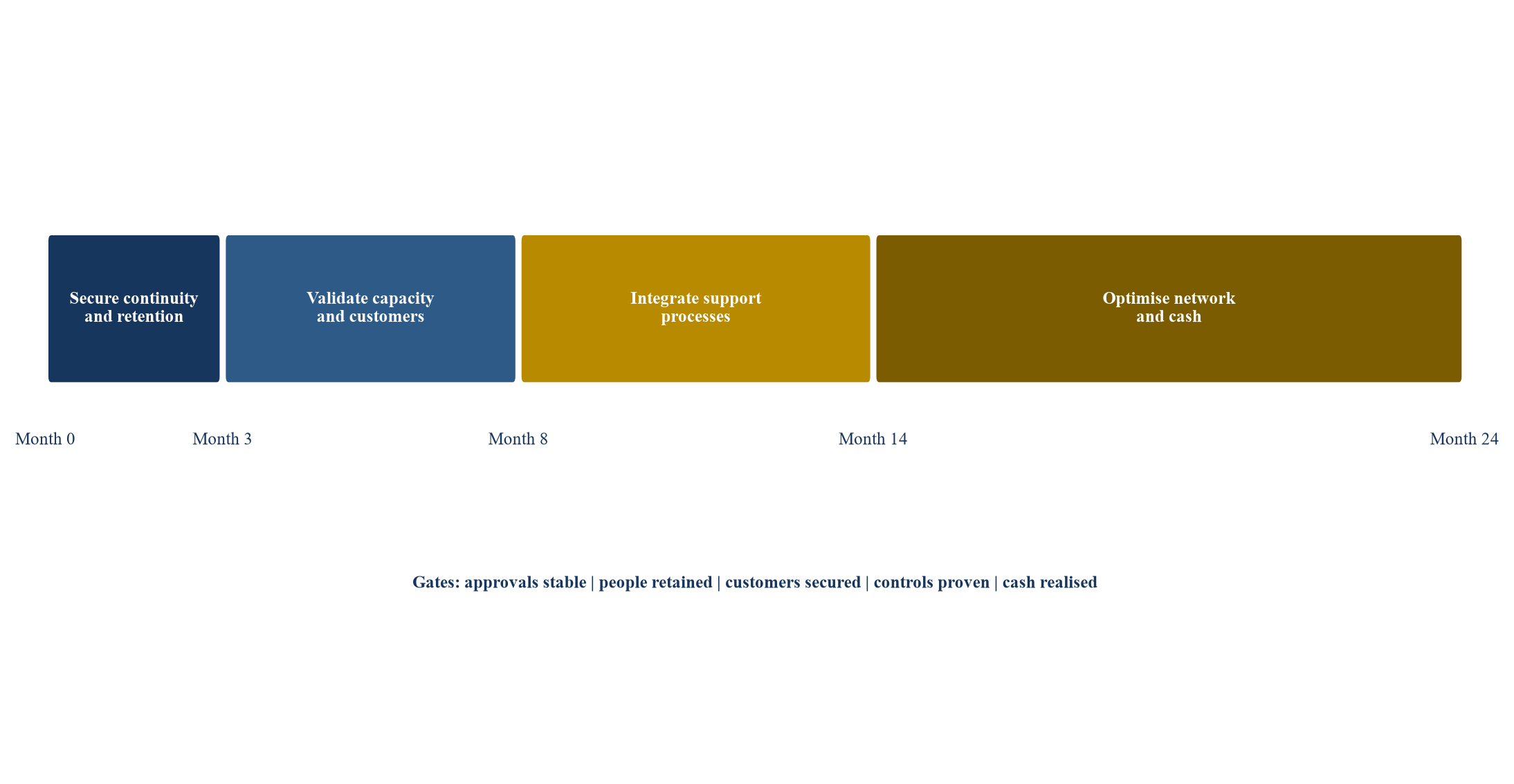
The roadmap protects approval continuity before operational integration.
29. Establish Day 1 controls
Closing must preserve accountable management, approvals, release authority, access, materials, insurance, payroll, suppliers and customer communication. Run site-level control rooms with named owners, evidence packs, escalation rules and continuity rehearsals. The analysis should distinguish observed regulatory, contractual, operational and financial evidence from management assumptions and connect each material judgment to airworthiness, capacity, timing and cash. No work should proceed under ambiguous approval, data, authorisation or material status. The work should cover a central case and a severe-but-plausible downside, with correlated sensitivities for approval timing, labour availability, productivity, turnaround time, material cost, customer retention, pricing, remediation and integration. Exceptions require a named owner, source, due date and decision consequence. Unsupported benefits remain outside the base case until actions are implemented and evidence confirms the result. Evidence should remain traceable to certificate, site, capability, customer, work order and legal entity, with control totals to financial reporting and a documented path for exceptions. The resulting decision should update value, structure, conditions and operating plan together.
30. Govern value after closing
The acquisition succeeds when approved capacity produces safe, on-time work, durable customer revenue and cash. Track capacity, qualified labour, turnaround, first-pass yield, findings, backlog, concentration, margin, working capital and synergy cash against the approved case. The analysis should distinguish observed regulatory, contractual, operational and financial evidence from management assumptions and connect each material judgment to airworthiness, capacity, timing and cash. The board should retain the original underwriting case, approved changes and realised outcomes for accountability. The work should cover a central case and a severe-but-plausible downside, with correlated sensitivities for approval timing, labour availability, productivity, turnaround time, material cost, customer retention, pricing, remediation and integration. Exceptions require a named owner, source, due date and decision consequence. Unsupported benefits remain outside the base case until actions are implemented and evidence confirms the result. Management should define the earliest warning indicator, intervention trigger and funded response. Reporting should preserve the original case, approved changes and realised cash so the board can distinguish execution from favourable timing or presentation.
Sources
- European Union Aviation Safety Agency. Easy Access Rules for Continuing Airworthiness, Regulation EU No 1321/2014, Revision September 2025. Read the primary source
- European Union Aviation Safety Agency. AMC and GM to Part-145, Issue 2. Read the primary source
- European Union Aviation Safety Agency. Foreign Part-145 Organisations. Read the primary source
- European Union Aviation Safety Agency. Maintenance Organisations and Maintenance Training Organisations FAQs. Read the primary source
- European Union Aviation Safety Agency. Part-IS applicability. Read the primary source
- US Federal Aviation Administration. 14 CFR Part 145 Repair Stations. Read the primary source
- US Federal Aviation Administration. AC 145-9A, Guide for Developing and Evaluating Repair Station and Quality Control Manuals. Read the primary source
- US Federal Aviation Administration. AC 145-10, Repair Station Training Program. Read the primary source
- US Federal Aviation Administration. Repair Station Operators. Read the primary source
- US Federal Aviation Administration. 2025 Airman Knowledge Tests. Read the primary source
- International Civil Aviation Organization. Annex 19 Safety Management, Standards and Recommended Practices. Read the primary source
- International Civil Aviation Organization. Safety Management Manual, Doc 9859. Read the primary source
- International Civil Aviation Organization. Annex 6, Operation of Aircraft. Read the primary source
- International Air Transport Association. Maintenance Cost Data eXchange. Read the primary source
- International Air Transport Association. Maintenance Cost Technical Group. Read the primary source
- International Air Transport Association. Aviation Supply Chain. Read the primary source
- US Department of Justice and Federal Trade Commission. 2023 Merger Guidelines. Read the primary source
- European Commission. Review of the Merger Guidelines. Read the primary source
- IFRS Foundation. IFRS 3 Business Combinations. Read the primary source
- IFRS Foundation. IAS 36 Impairment of Assets. Read the primary source
