

1. Define the decision that one balance sheet must support
One family balance sheet is a governed decision record, rather than a large spreadsheet that adds every statement total. Its purpose is to answer a defined set of questions: what the family owns and owes; which person or entity legally holds each item; where cash can be accessed; which exposures are concentrated; how much capital is committed; what values are current; which figures remain estimates; and who can act. The reporting architecture should be designed from those decisions back to the data.
Relocation increases the importance of that design. A family can open UAE accounts while retaining UK custody, Swiss private banking, Singapore portfolios, offshore vehicles, direct businesses and private funds. The same asset may appear in a bank statement, portfolio-management system and entity ledger. A loan may sit outside the investment report. A private fund may be shown at the last reported net asset value while a separate capital-call notice changes the family's near-term liquidity. The total can look precise while its economic perimeter remains incomplete.
The first governance act is a reporting charter. It should name the reporting entity or family group, intended users, consolidation currency, reporting frequency, materiality policy, valuation date, permissible estimates, source hierarchy, sign-off roles and escalation thresholds. The charter should distinguish a management balance sheet from statutory financial statements and tax filings. IFRS 10 establishes principles for consolidated financial statements based on control; a family management view may also include items outside an accounting group when they affect liquidity, exposure or governance [10]. The difference should be explicit and reconciled.
The charter should also state what the balance sheet does not decide. It does not establish legal title where records conflict, determine tax residence, certify market value or replace bank and custodian statements. Those matters require appropriate evidence and specialist review. A useful reporting system makes uncertainty visible, preserves the authoritative source, assigns an owner and creates a path to resolution. Confidence comes from traceability and control rather than visual polish alone.
2. Establish the family and economic reporting perimeter
The perimeter begins with people and legal structures. The office should list principals, family branches, companies, partnerships, foundations, trusts, nominees, special-purpose vehicles and operating businesses that may hold assets or liabilities. Each record needs legal name, jurisdiction, registration or identification number, beneficial owner, controller, reporting currency, tax adviser, authorised signatories and relationship to the family. Legal ownership, beneficial ownership, control and economic exposure are separate fields.
FATF guidance stresses the need for adequate, accurate and current beneficial-ownership information and recognises the value of using more than one information source [26]. The Global Legal Entity Identifier system offers a unique identifier for eligible legal entities and links to reference and ownership data [27]. These sources support a practical rule: entity identity should be mastered once, supported by authoritative documents, and referenced consistently across bank accounts, portfolios, debts and transactions. A nickname or bank-specific abbreviation should remain an alias rather than becoming a second entity.
The perimeter should include obligations as rigorously as assets. Debt, guarantees, pledged collateral, capital commitments, tax estimates, property completion payments, related-party balances and operating-company support can determine available wealth. The reporting team should record the legal obligor, beneficiary, currency, maturity, security, covenant, payment priority and evidence date. Contingent items should be separated from recognised liabilities and labelled with an approved scenario treatment.
The committee can approve three related views. The legal-entity view follows books and ownership. The beneficial family view aggregates economic interests after documented adjustments. The liquidity view includes claims and obligations that can affect cash over a defined horizon. Reconciliation bridges explain why totals differ. A report that collapses these perspectives into one number can create false comfort, especially when a family has recently changed residence, advisers, banking relationships or holding structures.
Table 1. Reporting questions, views and evidence owners
| Decision question | Primary view | Minimum evidence | Report owner | Escalation trigger |
|---|---|---|---|---|
| what is legally owned and owed? | legal-entity balance sheet | constitutional records, contracts and signed statements | group controller | ownership conflict or missing title record |
| what is the family's economic exposure? | beneficial family view | ownership map, look-through data and approved adjustments | chief investment officer | unverified interest or duplicate exposure |
| what cash can meet obligations? | liquidity view | account access, settlement terms, encumbrances and payment schedule | treasury lead | insufficient runway or inaccessible account |
| what changed during the period? | movement and performance view | transactions, cash flows, valuations and foreign-exchange rates | investment reporting lead | unexplained movement above tolerance |
| what requires adviser action? | tax, legal and compliance view | jurisdictional records, adviser memoranda and filing calendar | chief operating officer | expired record or unresolved change of circumstance |
| what can the board approve now? | decision dashboard | signed control pack and open-exception register | board secretary | critical exception or overdue sign-off |
The table defines governance responsibilities. It does not determine legal, tax or accounting treatment for any family.
3. Create one ownership and authority map
The ownership map connects each person and legal entity to accounts, assets, liabilities and authority. It should show percentage interests, control rights, trustee or director roles, mandates, powers of attorney, signatory limits and succession arrangements. The map should be dated and supported by documents. It should also record which relationship is a management assumption awaiting confirmation so that an unverified link cannot silently drive consolidation.
Authority deserves equal prominence. A family can own liquid assets and still be unable to move cash when the relevant signatory is travelling, incapacitated, subject to a bank review or no longer resident in the account jurisdiction. The map should identify who can view information, approve transactions, instruct advisers, sign bank forms and appoint delegates. Dual controls, transaction limits and emergency authority should be represented as operational facts rather than as generic governance language.
ADGM describes family-office structures as a means of organising governance, wealth management, succession and related activities [5]. The DFSA rulebook sets conditions for a single family office within its regulatory framework [6]. These official materials show why an office must distinguish its family-service role from regulated financial-service activities and obtain jurisdiction-specific advice. The reporting architecture should record the regulated or contractual capacity in which each provider acts.
The map becomes a control when it drives completeness testing. Every active entity should have a documented owner and a report status. Every bank or custodian account should link to one legal owner. Every asset and liability should link to an account, contract or direct ownership record. Every authority should have an effective date and review date. Orphaned accounts, dormant entities with balances, expired mandates and unexplained related-party links become exceptions rather than footnotes.
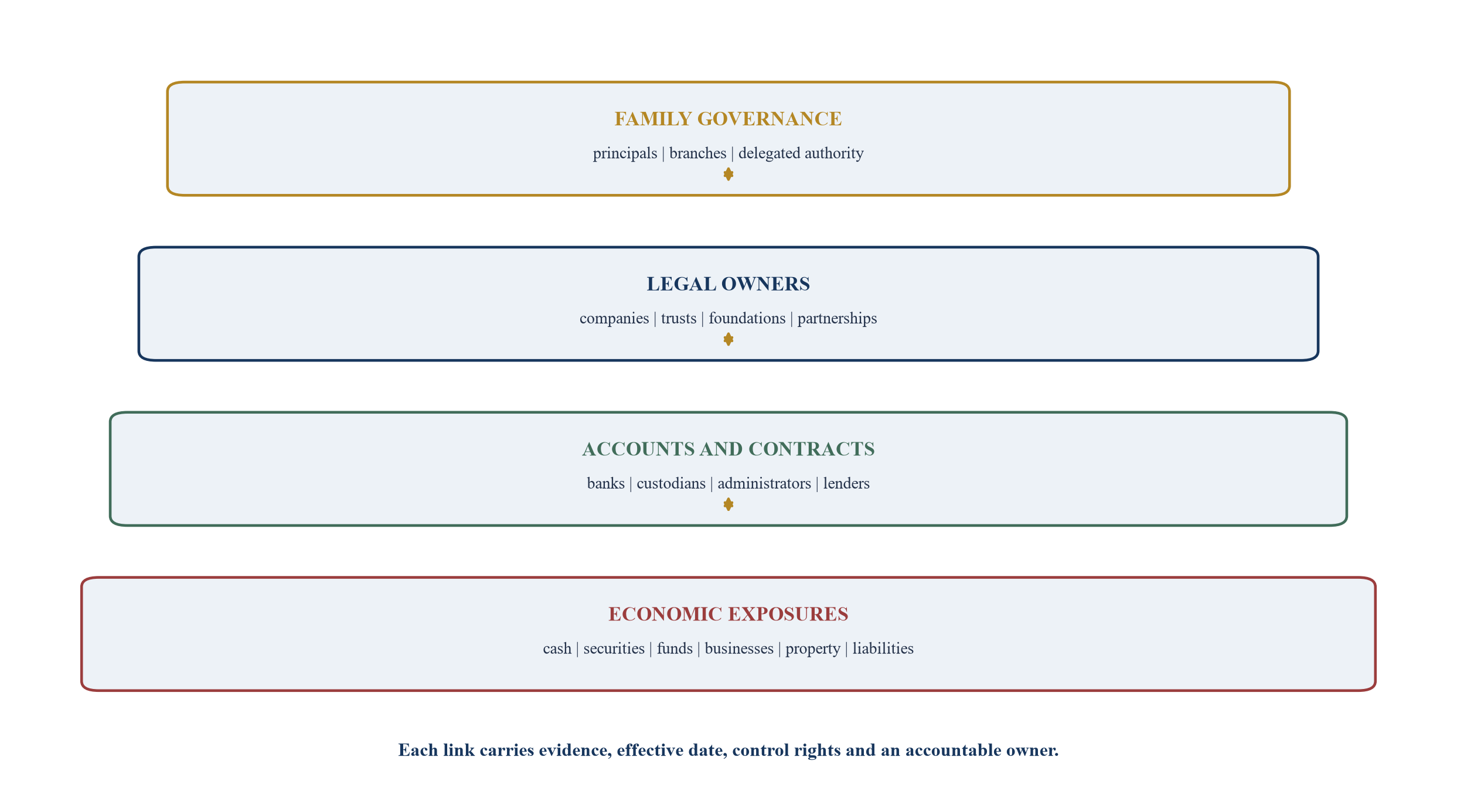
The diagram is a governance model. Legal relationships and percentages must come from verified documents and professional advice.
4. Inventory every bank, custodian, administrator and source
A multi-bank report starts with a controlled source register. The office should inventory current accounts, deposits, securities custody, loans, cards, digital-asset arrangements, fund-administrator portals, property managers, insurance providers, company ledgers and adviser files. For each source it should record institution, legal owner, account identifier, product type, base currency, reporting frequency, delivery channel, available history, valuation convention, responsible relationship manager and access owner.
The register should distinguish authoritative source records from convenience feeds. A signed or institution-issued statement may be authoritative for account positions at a stated date. An API feed can be timelier and easier to process, yet its coverage, field definitions and correction behaviour require testing. A downloaded spreadsheet can support analysis but may lack stable identifiers. An emailed screenshot provides weak evidence. The architecture preserves the original file or message, its checksum, receipt time, period and source so that every reported number can be traced.
Completeness requires active confirmation. The office can compare the source register with bank confirmations, entity ledgers, tax records, commitment schedules, insurance lists, relationship-manager confirmations and prior-period reports. Closed accounts should remain in history with closure evidence. Dormant accounts should be reviewed for residual cash, fees or standing instructions. Accounts opened during a move should not wait for year-end onboarding into the reporting system.
Coverage is a board metric. The numerator should include sources that arrived, passed validation and reconciled for the reporting date. The denominator should include every source within the approved perimeter. A ninety-five per cent data-coverage score can be unacceptable if the missing five per cent contains a leveraged account or major private asset. Materiality and risk therefore qualify the percentage. Critical-source status, expected delivery time and contingency method should be approved in advance.
5. Build a canonical entity, account and instrument dictionary
Banks describe the same economic item differently. One custodian may report an ISIN, another a ticker, another an internal security code, and a private bank may bundle cash and accrued income into a portfolio total. A canonical dictionary converts these source-specific fields into stable business concepts. It should cover entities, accounts, instruments, transactions, prices, exchange rates, commitments, liabilities, ownership and classifications.
ISO 20022 provides a reusable financial-services data dictionary and business-process catalogue, together with approved message definitions [14, 15]. A family office does not need to reproduce the full standard. It can adopt the principle that business concepts are defined once, have controlled code lists and retain mappings back to source fields. Common identifiers such as ISIN, LEI, bank identifier, internal entity ID and contract ID should be stored without assuming that one identifier covers every asset class.
The dictionary needs explicit definitions. Market value should specify price, quantity, accrued income, currency, valuation date and source. Available cash should specify whether unsettled trades, holds, overdrafts and pledged balances are included. Commitment should separate total commitment, called capital, funded capital, recallable distributions, remaining commitment and any approved forecast. Performance should define cash-flow timing, fee treatment and currency translation.
Data stewardship should be assigned by domain. The controller owns legal entities and accounting classifications. Treasury owns accounts, debt and accessible cash. The investment team owns instruments, exposures and performance classifications. Operations owns source delivery and workflow. Specialists approve tax, legal or regulatory fields. Changes to a definition or mapping should be versioned, tested and documented. Historical reports should remain reproducible after a taxonomy changes.
Table 2. Canonical data dictionary for a multi-bank reporting core
| Domain | Canonical key | Required fields | Source examples | Control |
|---|---|---|---|---|
| entity | entity ID | legal name, jurisdiction, owner, control, status | registry extract, constitutional record, LEI | dual review of identity and ownership |
| account | account ID | institution, legal owner, currency, product, access, status | bank mandate, custody statement, facility letter | one active owner and one source record |
| instrument | instrument ID | name, asset class, identifiers, issuer, currency, look-through status | custodian master, prospectus, manager report | duplicate and classification checks |
| position | account plus instrument plus date | quantity, price, accrued amount, value, valuation source | statement, API, administrator file | tie to source total and prior movement |
| transaction | source transaction ID | trade date, settle date, amount, currency, type, counterparty | bank or custodian feed | duplicate, sequence and cash checks |
| liability | contract ID | obligor, lender, principal, currency, maturity, security, covenant | signed agreement and lender statement | legal review and payment reconciliation |
| commitment | fund or contract ID | committed, called, funded, distributed, remaining, notice date | subscription record, capital notices | independent roll-forward and notice check |
| valuation | valuation ID | methodology, hierarchy level, timestamp, reviewer, adjustment | market source, administrator NAV, model | approval by asset class and staleness rule |
Fields are illustrative. The implemented schema should reflect the approved perimeter, systems and reporting obligations.
6. Ingest data while preserving provenance and consent
The ingestion layer should support APIs, secure file transfer, portal downloads, structured email, manually controlled templates and accounting-system extracts. Its job is to acquire source data, validate its structure and store it without erasing provenance. The raw zone should remain immutable. Transformations occur in a governed processing layer, and each output carries the source file, field mapping, rule version and processing time that produced it.
The UAE Open Finance Regulation and Framework establish a licensed framework for consent-based access to financial data and services [1, 2]. CBUAE describes open finance as supporting innovation while addressing soundness, consumer protection and secure data sharing [3]. The United Kingdom regulates account-information services and requires explicit user consent for access to online payment-account data [16]. Its open-banking standards provide common APIs, security profiles and consent-management guidance [18, 19]. These frameworks can improve access to some financial data. Coverage differs by product, institution, permission and jurisdiction, so the reporting design should retain controlled alternatives for investments, private assets and unsupported accounts.
Consent is a lifecycle. The register should identify the data owner, recipient, purpose, scope, duration, onward sharing, revocation method and evidence. The UAE Personal Data Protection Law provides a federal framework for personal-data processing [4]. Data minimisation, access control, encryption, retention and incident handling should follow legal advice and approved policies. A family dashboard should never become a broad pool of credentials or unrestricted source files.
The ingestion service should fail visibly. Missing files, stale feeds, schema changes, incomplete pages, currency-field errors and unexpected total movements become named exceptions. A prior-period carry-forward can be permitted for a limited time if policy allows; the report should show the original valuation date and staleness flag. Silent substitution undermines the reliability of the full balance sheet.
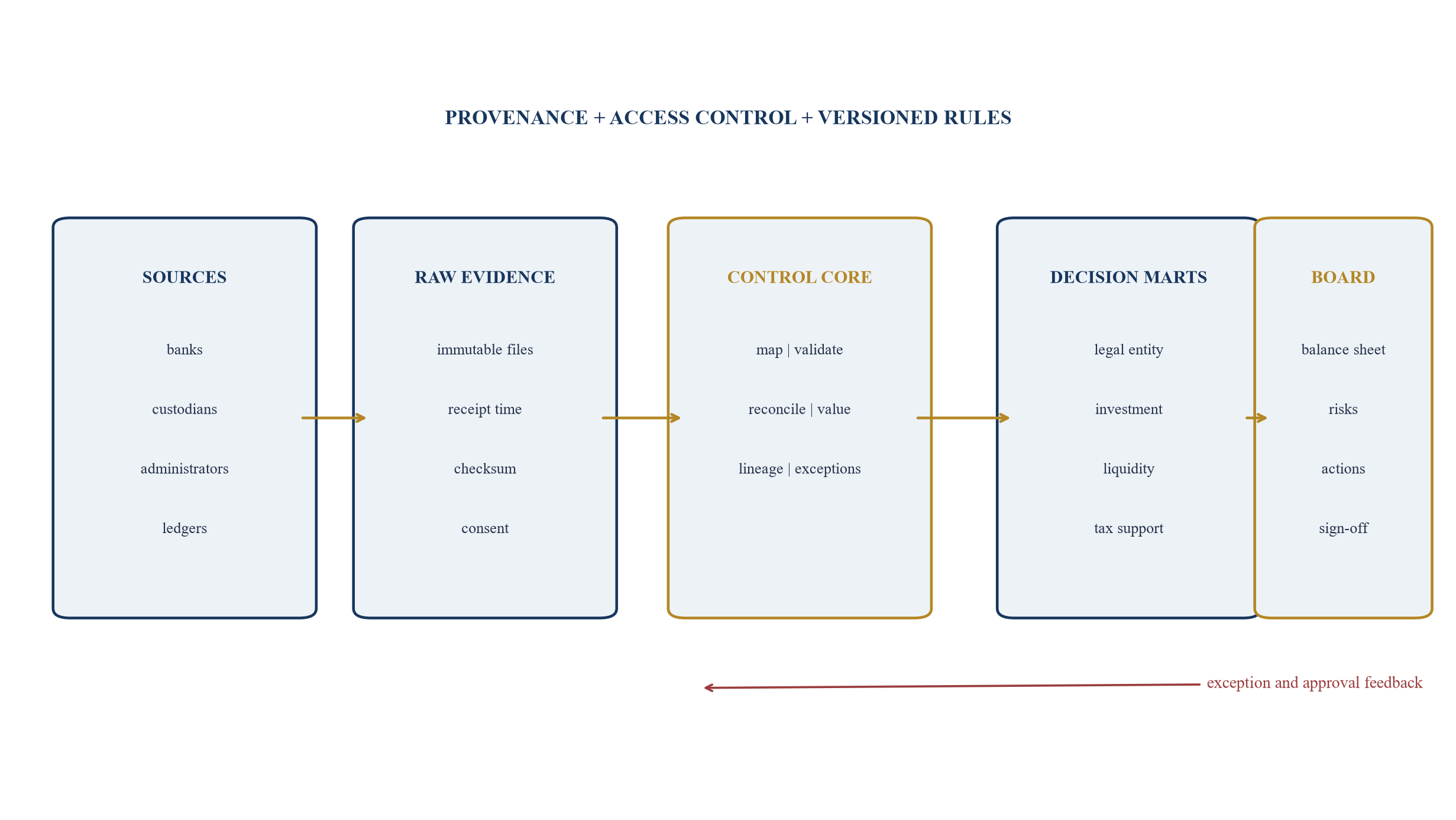
Bank and custodian records remain the source evidence. Transformations are controlled, versioned and reversible.
7. Normalise instruments, currencies and dates without losing meaning
Normalisation makes sources comparable. It should standardise identifiers, sign conventions, decimal precision, date formats, currency codes, transaction types and asset classifications. It should not overwrite legitimate differences. Trade date and settlement date serve different purposes. Local book value and market value can both be valid. A bank's product category may need to remain visible beside the family's asset taxonomy.
Instrument resolution is a controlled matching problem. Strong matches use stable identifiers and issuer attributes. Fuzzy name matching can propose a candidate; an accountable reviewer should approve ambiguous cases. Private funds, structured products, direct companies, property and bespoke debt require internal IDs and documentary attributes. The system should prevent two source instruments from being merged solely because their labels look similar.
Currency translation needs an approved policy. IAS 21 addresses functional currency, foreign-currency transactions and translation into a presentation currency [12]. A management report should specify rate source, spot or period-average treatment, valuation timestamp, rounding and handling of non-exchangeability. It should retain local-currency value and the rate used so that translation effects can be separated from investment movements. The consolidation currency is a presentation choice; it does not replace the currencies of liabilities or cash access.
Dates should support as-of integrity. Positions, prices, accrued income, transactions and foreign-exchange rates can arrive on different calendars and time zones. The report should define cut-off rules and show material timing gaps. A Sunday UAE report may rely on Friday prices for some markets while a private-bank statement closes on another calendar. The architecture should expose the age of each value and prevent a fresh timestamp from making an old underlying valuation appear current.
8. Reconcile cash, positions and movements before reporting totals
Reconciliation establishes whether transformed data still represents the source. The office should reconcile opening positions, purchases, sales, transfers, income, fees, corporate actions, capital calls, distributions, foreign-exchange movements and closing positions. Cash should be reconciled by account and currency. Securities should be reconciled by account, instrument and quantity. Value differences should be decomposed into price, foreign exchange, accrual and genuine unexplained movement.
A layered process is more informative than a single pass or fail. File-level validation checks whether the expected source arrived and contains required fields. Control totals tie imported balances to the statement. Position checks identify missing or duplicate lines. Movement checks roll opening positions through transactions to closing positions. Cross-source checks compare custody, portfolio-management and accounting views. Consolidation checks identify duplicated ownership and internal balances. Board controls test materiality and unresolved critical exceptions.
Tolerance policy should reflect the risk. A small rounding difference can be auto-cleared when its cause is known. A zero-value security with an unexpected quantity change can be critical. A missing capital-call notice may be more important than a modest market-value mismatch. Tolerances should consider absolute value, percentage, asset type, liquidity, leverage, age and decision consequence. Auto-clear rules should be approved and reviewed for patterns.
The exception register is part of the balance sheet. Each item needs source, account, amount, currency, category, suspected cause, materiality, owner, due date, status, evidence and approval. Repeated exceptions can reveal a broken mapping, poor source quality or weak provider process. Closing a period with unresolved items requires named acceptance, an explanation of report impact and a defined remediation date.
Table 3. Reconciliation waterfall and control ownership
| Layer | Control | Example exception | Resolution evidence | Accountable role |
|---|---|---|---|---|
| source receipt | expected file, period and checksum | custodian file missing or duplicated | delivery record and immutable source file | data operations lead |
| control total | statement total to imported total | page or account omitted | statement tie-out | fund or bank accountant |
| position | quantity and instrument by account | security mapped to wrong identifier | instrument master and corrected mapping | investment reporting lead |
| movement | opening plus transactions to closing | transfer or corporate action unexplained | transaction advice and roll-forward | operations controller |
| cash | bank or custody cash by currency | unsettled trade or fee missing | cash ledger and settlement evidence | treasury lead |
| consolidation | entity and related-party eliminations | asset counted in entity and family view | ownership record and elimination entry | group controller |
| board close | critical exceptions and materiality | stale private value affects allocation decision | signed exception acceptance or updated evidence | CFO and investment committee |
Tolerances and close rules are hypothetical management assumptions and require approval for the implemented system.
9. Govern valuation through a documented hierarchy
One balance sheet combines values produced in different ways. Exchange-traded instruments may have observable prices. Bank deposits and debt may be reported at principal or carrying amount. Private funds often provide periodic administrator or manager net asset values. Direct companies, property, art and other illiquid assets may depend on appraisals or models. A total is meaningful only when the valuation basis and date remain visible.
IFRS 13 defines fair value and a hierarchy based on the observability of valuation inputs [11]. IFRS 9 addresses classification and measurement of financial instruments [13]. A family management report can use these standards as reference points while keeping its purpose distinct from statutory compliance. The valuation policy should name the source hierarchy, frequency, permitted adjustments, review authority, staleness thresholds and disclosure conventions for each asset and liability class.
Staleness should be measured from the underlying valuation date, rather than the date a file was received. A private-fund NAV received this week may describe the prior quarter. The report should display both dates and any known post-period capital activity. A management adjustment should appear as a separate line with rationale, inputs, approver and sensitivity. It should never overwrite the manager or administrator value in the source record.
Valuation confidence is a governance attribute. The board may group positions by observable, externally reported, independently appraised and management-estimated values. Concentrations in less observable categories should be visible beside the total. Decision rights can depend on confidence: asset-allocation changes may use reported values, while lending, succession or transaction decisions may require updated independent work. Every limitation should lead to a decision about timing, evidence or prudence.
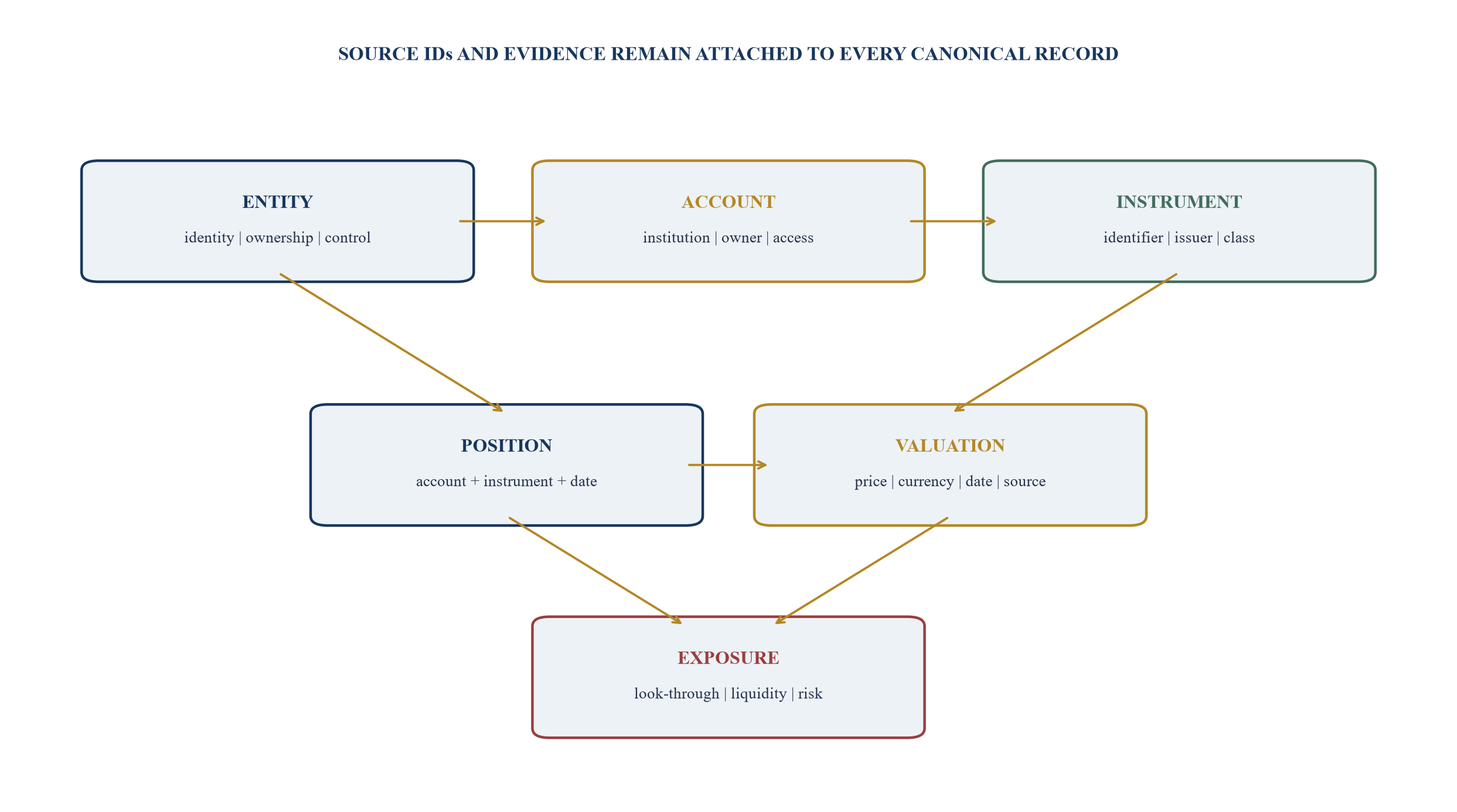
The model retains separate source, canonical and valuation records so that evidence is traceable and adjustments are reversible.
10. Consolidate entities and eliminate internal balances deliberately
Consolidation is a rule set. The office should define which entities are fully consolidated, proportionately included, shown as investments, or disclosed outside the total. It should document the basis for each treatment and separate accounting conclusions from management views. Control, beneficial ownership, economic exposure and decision relevance can point to different presentations.
Internal balances require matched records. A loan from one family company to another is an asset in one ledger and a liability in the other. An investment holding company may own a portfolio that also appears in a custodian feed. A family trust may hold shares in an operating company whose enterprise value is separately reported. Without eliminations, the consolidated total can double count assets and inflate gross exposure. Each elimination should link the two records, amount, currency, valuation date, rule and approver.
Minority interests and shared family assets need transparent treatment. The balance sheet should show gross asset, external debt, net equity and the family's supported interest. Control rights, distributions and liquidity may differ from percentage ownership. A jointly owned property cannot always be liquidated proportionately. A minority business stake may carry governance rights or transfer restrictions that affect its economic profile.
The report should offer drill-down. The board sees the family total and material concentrations. The controller can trace each consolidated figure to an entity trial balance or statement. The investment team can view economic exposures across vehicles. Treasury can see which legal owner holds accessible cash and which account supports a liability. This shared data core avoids competing spreadsheets while respecting the distinct purpose of each view.
11. Capture debt, guarantees, collateral and capital commitments
A family balance sheet that reports investments without funding obligations is incomplete. Debt records should include lender, borrower, principal, accrued interest, currency, maturity, repayment profile, rate basis, security, collateral value, covenants, undrawn availability and next action date. Guarantees should identify beneficiary, guaranteed party, cap, trigger, expiry, governing law and recourse. Capital commitments should reconcile subscriptions, calls, contributions, recallable amounts, distributions and remaining obligations.
Liquidity depends on legal location. Cash held by one entity may not be available to another without a lawful transfer, distribution, loan, board approval or tax consequence. The dashboard should avoid netting cash and debt across entities unless the management view clearly explains the adjustment. Pledged assets should remain in gross wealth and be marked unavailable for liquidity. Credit lines should be shown with conditions and renewal risk rather than counted as certain cash.
Commitment forecasting requires discipline. Historical call patterns and manager guidance can inform a scenario, but future calls and distributions remain uncertain. The report should separate contractual remaining commitment from a management liquidity scenario. Assumed call timing, distribution timing and exchange rates should be documented. The committee can then stress faster calls, delayed distributions and market falls without presenting those assumptions as forecasts.
Debt and commitment data should drive alerts. Covenant measurement dates, rate resets, margin thresholds, guarantee expiries, fund notice periods and concentration limits belong in the reporting calendar. A material obligation with no assigned funding account is a critical exception. A liquidity view should show which source, currency, entity and authority can meet each near-term payment.
Table 4. Valuation hierarchy and reporting treatment
| Value category | Typical evidence | Reporting treatment | Staleness control | Decision limitation |
|---|---|---|---|---|
| observable market | exchange or approved pricing source | price times reconciled quantity plus approved accrual | daily or report-date check | market depth and settlement still assessed |
| externally reported | bank, custodian or administrator statement | preserve reported value and underlying date | age flag and post-period cash roll-forward | methodology may differ across providers |
| independent appraisal | qualified external valuation | show appraisal date, scope and basis | refresh by policy or event | may not equal executable price |
| model-supported | approved internal or adviser model | separate management estimate from source value | assumption review and sensitivity | unsuitable for high-stakes action without validation |
| nominal or contractual | deposit, receivable, debt or commitment record | show principal, accrued amount and relevant terms | reconcile to counterparty evidence | credit, liquidity and collectability remain separate |
| unavailable or disputed | missing, conflicting or obsolete evidence | disclose separately or apply approved conservative treatment | critical exception until resolved | total confidence is reduced and action may be gated |
The hierarchy adapts official valuation concepts for management reporting. Specialist advice determines accounting or transaction use.
12. Look through funds, businesses and structures to economic exposure
Vehicle labels can hide concentration. A portfolio may contain several private funds that all own the same technology companies, geographies or managers. A diversified public portfolio may sit beside a family operating business whose revenue and debt create similar factor exposure. Property, private credit and bank deposits can concentrate the balance sheet in one country or financial system even when account count is high.
Look-through should be proportional to decision relevance and available evidence. Listed funds can often be decomposed using published holdings. Private funds may provide sector, geography, strategy, currency, vintage, leverage and top-exposure data. Direct businesses can be mapped by revenue, costs, debt, customers and operating geography. Property can be classified by location, use, tenant concentration, debt and completion status. The report should state when look-through data is partial or aged.
Exposure allocation should avoid false precision. A fund with reported sector percentages can be allocated accordingly. A private investment with limited disclosure may remain in an unknown bucket until evidence improves. The system should not force every position into an exact classification that is unsupported. Unknown exposure is a useful metric because it tells the board how much of the portfolio cannot yet be analysed reliably.
The consolidated exposure mart should connect legal ownership to economic risk without replacing either. The board can see the family's total bank-counterparty exposure across cash, custody and lending. It can see sector exposure across public securities, funds and direct businesses. It can compare geographic exposure with future spending and obligations. The lineage allows each aggregate to be traced back to holdings and source reports.
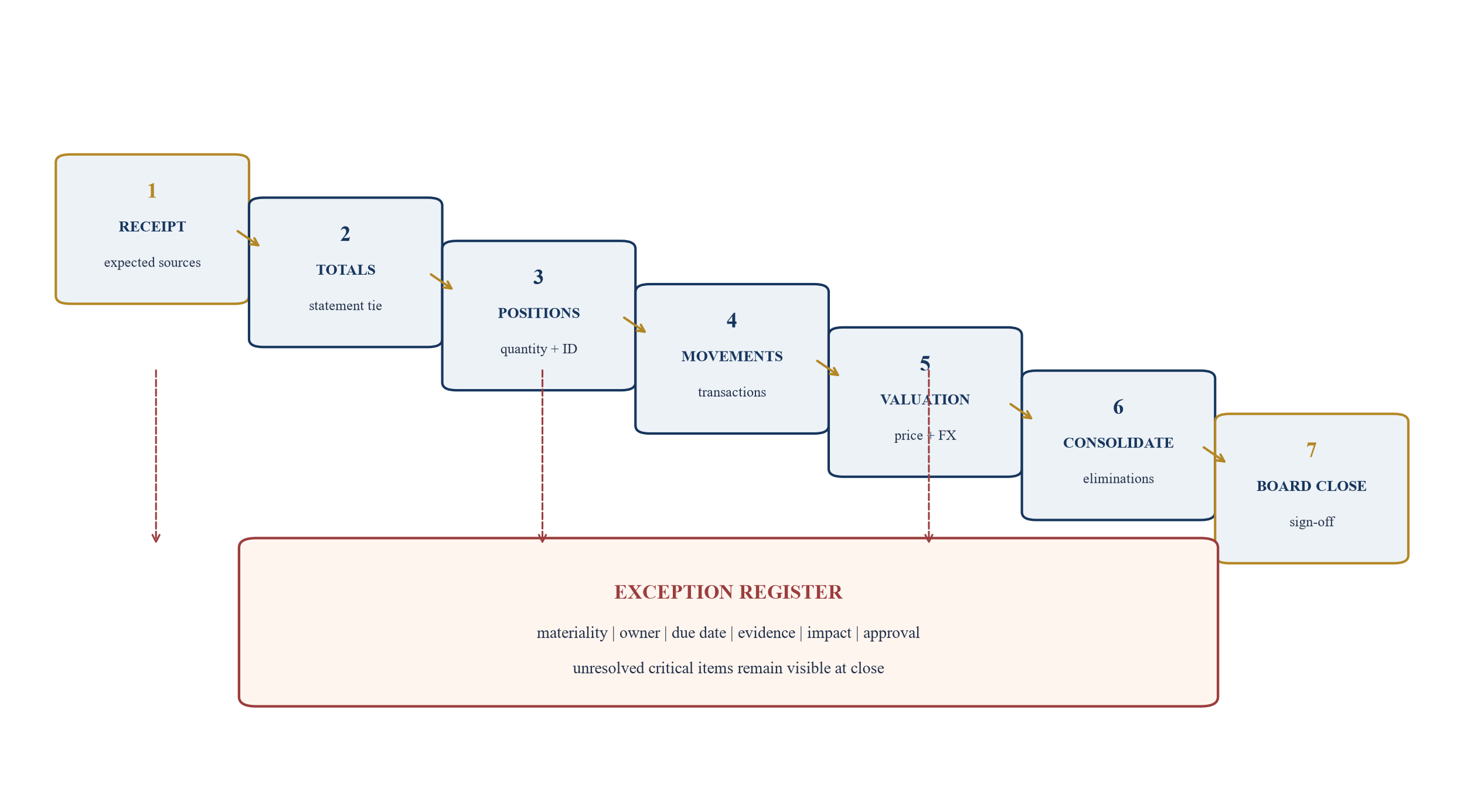
Each stage has an accountable control and produces explicit exceptions before board close.
13. Separate accounting, investment, liquidity and tax-support views
A single data core can produce several governed outputs. The accounting view follows ledgers, legal entities and applicable standards. The investment view groups economic exposures and performance. The liquidity view focuses on cash availability, obligations, settlement and access. The tax-support view organises account ownership, income, gains, balances and jurisdictional attributes for advisers. The board view selects the indicators needed for decisions and retains links to every underlying view.
These views can legitimately differ. An operating company can be consolidated for accounting and shown as one strategic exposure for investment. A bank deposit can be a current asset and still be excluded from available liquidity because it is pledged. A private-fund commitment may not be a recognised liability in the same way as debt, yet it belongs in the liquidity forecast. A tax adviser may require local-currency transaction data and ownership attributes beyond the board dashboard.
Bridges make differences intelligible. The report should reconcile statutory net assets to the family management total, gross to net exposure, total cash to accessible cash, and manager-reported performance to the office's methodology. Each bridge uses named adjustments with evidence and ownership. The committee should avoid manual overlays that cannot be reproduced in the next period.
The OECD Common Reporting Standard specifies financial-account information, covered institutions, account holders and due-diligence procedures for automatic exchange between jurisdictions [24, 25]. The reporting office should maintain accurate account-holder, controlling-person, residence, tax-identification and account attributes for qualified advisers and institutions. It should not use the management report to reach independent tax conclusions. A well-structured data model improves readiness for advice, review and corrections.
14. Measure performance without confusing flows, valuation and currency
Performance analysis across banks requires one methodology. Custodians may calculate returns with different cash-flow timing, fee treatment, accrued income, benchmark conventions and currency bases. Combining reported percentages is usually invalid. The central system should use reconciled positions, valuations and external cash flows to calculate returns under an approved method, while retaining provider-reported figures for comparison.
The report should decompose change in wealth. Opening value plus contributions, minus withdrawals, plus investment return, plus or minus currency translation, plus ownership or perimeter changes, minus fees and taxes where included, should reconcile to closing value. Private assets need a clear rule for dated valuations and intervening cash flows. Internal transfers between family accounts should be eliminated from consolidated external flows.
Currency contribution should be explicit. A USD presentation can show gains caused by the translation of GBP or CHF assets even when local prices are unchanged. IAS 21 provides a formal accounting framework for foreign-currency translation [12]. The management system should define whether its performance view uses local, account, presentation or liability-linked currencies. Decisions about hedging and spending require more than one lens.
The board should see data confidence beside return. A strong reported quarter can include stale private values, missing fees or an unresolved transfer. The dashboard can show the percentage of value reconciled, externally valued, current within policy and fully classified. This reduces the risk that apparent precision in the return number overwhelms the quality of the underlying evidence.
15. Protect privacy, credentials and operational resilience
A family balance sheet concentrates sensitive information: identities, ownership, account numbers, balances, transactions, tax attributes, residences, advisers and authority. Security should be designed into the architecture. Data should be classified, minimised, encrypted in transit and at rest, restricted by role, logged, retained under policy and removed when no longer required. Production credentials should not appear in reporting files, shared mailboxes or analyst workbooks.
Access should follow purpose and least privilege. Data engineers may operate pipelines without seeing board commentary. Investment staff may see holdings without receiving personal identity documents. External advisers should receive scoped records through approved channels. Administrators should not approve their own access. Privileged activity, data exports, failed logins and changes to bank connectivity should be monitored and reviewed.
NIST Cybersecurity Framework 2.0 organises cybersecurity outcomes around govern, identify, protect, detect, respond and recover [30]. Basel operational-resilience principles emphasise governance, mapping of interconnections, third-party dependencies, incident management, business continuity and resilient information technology [28]. Basel's third-party risk principles set a common baseline for due diligence, monitoring, contingency and exit planning [29]. A family office can adapt these frameworks proportionately and obtain specialist assurance.
Resilience requires a tested fallback. If an aggregator, reporting vendor, custodian portal or office system fails, the team should know how to recover source statements, restore the last approved data, access critical accounts and produce a minimum liquidity report. Backups should be separated from the production environment and recovery tested. Vendor exit should include data export, field definitions, history, lineage and deletion confirmation. Concentrating every account connection in one provider creates a dependency that should be visible to the board.
16. Compare jurisdictional data-sharing models without assuming equivalence
The UAE, United Kingdom, Singapore and Switzerland illustrate different approaches to financial-data sharing. The UAE has established an Open Finance Regulation and Framework under CBUAE [1, 2, 3]. The United Kingdom regulates account-information services and operates common open-banking standards, with policy work extending toward open finance [16, 17, 18]. Singapore's SGFinDex enables consenting users to retrieve financial information from participating public and private sources for a consolidated view [20, 21]. Switzerland follows a market-oriented open-finance approach and highlights private multibanking and wealth-management interface initiatives [22, 23].
These models should inform architecture choices, while connection coverage must be verified institution by institution. Payment-account APIs may not cover custody, private funds, loans, structured products, company ledgers or all private-bank arrangements. A consolidated consumer view may not provide the fields, history, legal-owner structure or audit evidence needed by a family office. Participation, consent duration and commercial terms can change.
Cross-border data movement requires legal and security review. The location of the family, entity, bank, system operator, cloud service and adviser can all matter. Data residency, secrecy, privacy, outsourcing, recordkeeping and regulatory perimeter questions should be documented for the actual architecture. A technical ability to retrieve data does not establish permission to consolidate, store or share it.
The practical design is modular. Use regulated or institution-approved APIs where they provide reliable coverage. Add secure structured files for custody and administration. Maintain controlled templates for private and direct assets. Preserve documentary evidence for ownership and liabilities. Apply the same canonical definitions and reconciliation controls across every channel. This allows the family balance sheet to improve as ecosystems mature without depending on one national model.
Table 5. Jurisdiction comparison for multi-bank reporting design
| Jurisdiction | Official model highlighted | Reporting opportunity | Design question | Governance response |
|---|---|---|---|---|
| UAE | CBUAE Open Finance Regulation and Framework | consent-based access and service innovation | which licensed participants, products and data fields cover the family's institutions? | verify permissions, coverage, consent and fallback by source |
| United Kingdom | regulated account-information services and Open Banking Standard | common payment-account APIs and consent controls | how far does coverage extend beyond payment accounts into investments and pensions? | separate verified API data from custody and private-asset feeds |
| Singapore | SGFinDex consolidated financial-data exchange | user-authorised view across participating institutions and agencies | which family, entity and institutional use cases are supported? | confirm participant, user, purpose and field-level eligibility |
| Switzerland | market-led open finance and multibanking initiatives | standardised interfaces for banking and wealth data | which institutions and third parties participate voluntarily? | document bilateral or platform coverage and retain alternate delivery |
| cross-border estate | multiple regimes and contracts | one governed economic view | where may data be processed, stored and shared? | legal review, data map, access matrix and transfer controls |
The table summarises official frameworks and design questions. It does not state that a particular provider, account or activity is covered.
17. Choose the architecture and vendor boundary from control requirements
The office can buy a platform, build a data layer, use a managed service or combine them. The decision should follow requirements rather than demonstrations. Core requirements include source coverage, ownership complexity, private-asset support, transaction history, reconciliation, valuation controls, look-through, multi-currency treatment, permissions, lineage, export, cybersecurity, service continuity and cost. The team should test realistic samples from several institutions before selecting a model.
The control boundary matters. A vendor may aggregate and display information while the family office remains responsible for source completeness, entity ownership, private valuations and approval. A managed reporting provider may perform reconciliations under a service agreement. An internal team may control logic but depend on external bank connectivity and cloud infrastructure. The operating model should assign every control to the family, provider or adviser and define evidence, frequency and escalation.
Procurement should cover data rights and exit. The family should understand whether it can retrieve raw and transformed history, mappings, documents, exception records and user logs in usable formats. Contracts should address confidentiality, subcontractors, locations, incident notification, recovery, service levels, change management, audit rights, deletion and termination assistance. The report should identify critical providers and substitution plans.
A pilot should prove the difficult cases. It should include at least one multi-currency bank, a custodian with transaction detail, a private fund with commitments, a direct asset, an intercompany balance and a debt facility. Success means the data ties to evidence, controls operate, exceptions are understandable, and users can reproduce a board figure. A visually impressive dashboard with unresolved ownership or reconciliation gaps has not passed the operating test.
18. Run exception, lineage and data-quality governance as a standing process
Data quality is a portfolio of controls. Completeness asks whether every expected source and item is present. Accuracy asks whether values and classifications match evidence. Timeliness asks whether data is current for the decision. Consistency asks whether definitions are applied across sources and periods. Uniqueness asks whether entities, accounts and positions are duplicated. Validity asks whether fields conform to approved rules. Lineage asks whether every output can be traced to source and transformation.
BCBS 239 established principles for risk-data aggregation and reporting, including governance, architecture, accuracy, completeness, timeliness, adaptability, clarity and review [7]. Basel's later progress work and 2026 implementation newsletter continue to identify the importance of robust data governance and aggregation capability [8, 9]. These principles were developed for banks. Their control logic remains useful for a family office managing fragmented financial data, provided the implementation is proportionate.
The office should maintain data-quality indicators by source and domain. Examples include percentage of expected sources received, value reconciled, stale valuations, positions with stable identifiers, commitments rolled forward, exceptions past due and dashboard metrics with complete lineage. Aggregate scores should not hide critical items. A missing leveraged account can override a strong overall percentage.
Governance should include a weekly operational review, monthly close certification and quarterly data-owner committee. Root causes should be tracked separately from symptoms. If the same custodian feed repeatedly drops accrued interest, the solution is a source or mapping change, rather than repeated manual correction. Changes to taxonomies, models, tolerances and reporting perimeter should follow version control, testing, approval and effective dates.
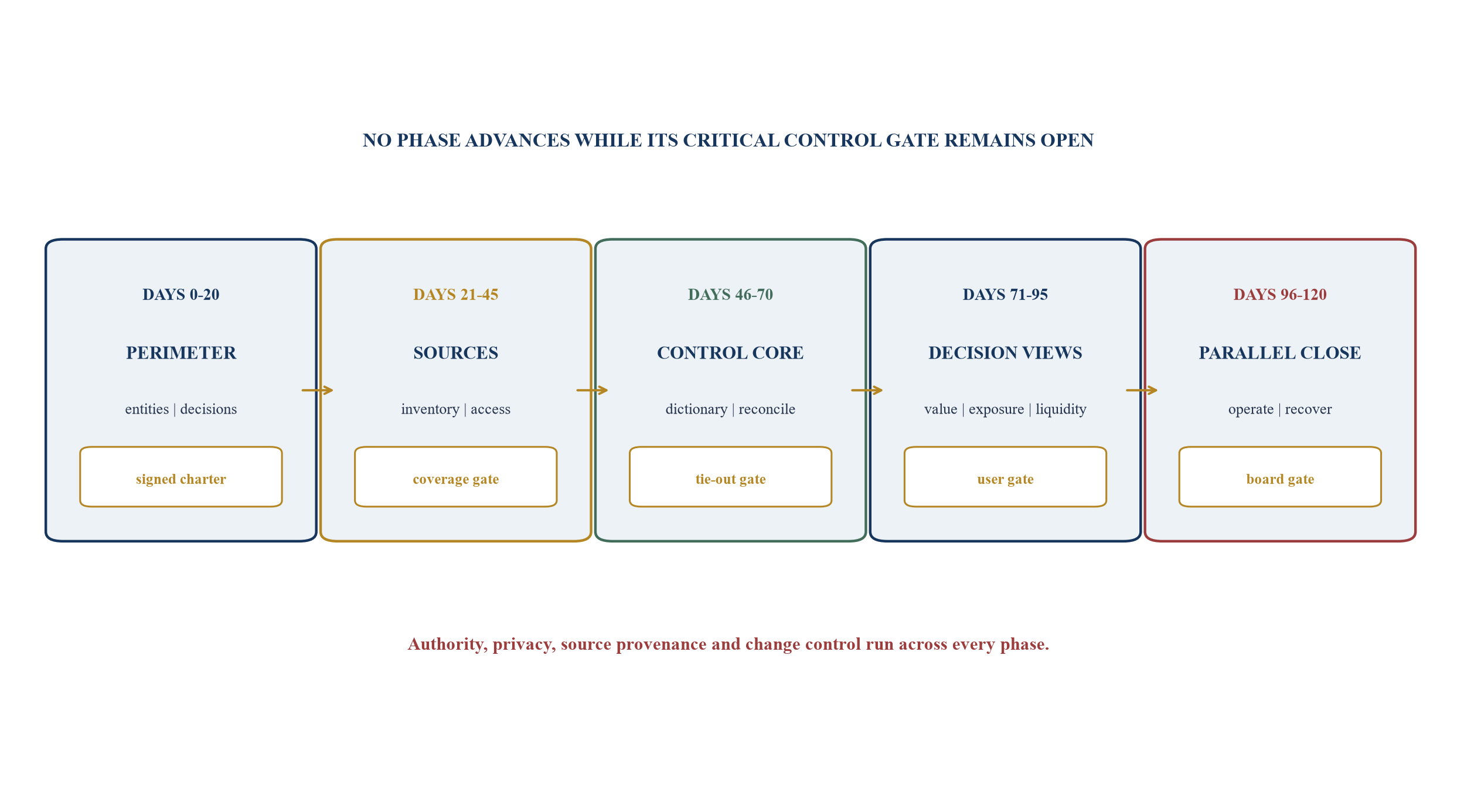
Timing is a hypothetical implementation assumption. Complexity, provider access, legal review and source quality can change the sequence.
19. Implement through a controlled 120-day programme
The first phase approves the reporting charter, entity perimeter, users, decisions, currencies, materiality and critical risks. The team collects ownership and authority evidence and identifies advisers who must confirm legal, tax, accounting or regulatory matters. The gate is a signed perimeter and an exception list for unresolved relationships. Data acquisition should not proceed on ambiguous ownership.
The second phase inventories sources, obtains approved access and tests sample files. The team classifies each source by authority, frequency, coverage, format and contingency. Consent and data-processing records are established. The gate requires complete material-source coverage or an approved interim method with clear limitations. A missing minor statement and a missing leveraged custodian are treated differently.
The third phase builds the canonical dictionary, mappings, valuation hierarchy, reconciliation rules, exception workflow and security roles. Historical periods are loaded to test movements and detect duplicates. The gate requires source totals to tie, critical positions and cash to reconcile, and lineage to work from dashboard candidate back to evidence. Manual adjustments require owners and documentation.
The fourth phase produces legal-entity, investment, liquidity and board views. Users test decisions: identify cash available for a payment, trace a concentration, explain a return, find a commitment and inspect a stale valuation. The final phase runs the new process in parallel with existing reporting, tests recovery, resolves differences and secures formal sign-off. The office then retires superseded workbooks under retention policy and moves to a controlled close calendar.
Table 6. 120-day workplan, gates and measurable evidence
| Phase | Core work | Required evidence | Gate | Illustrative measure |
|---|---|---|---|---|
| days 0-20 | charter, entity map, authority and decision catalogue | signed perimeter, ownership records and open-issue list | every material item has an owner and treatment | critical orphan records equal zero |
| days 21-45 | source inventory, access, consent and sample acquisition | source register, delivery tests and data map | material coverage approved | critical sources received and validated |
| days 46-70 | dictionary, mappings, valuation and reconciliation | control totals, mappings, lineage and exception workflow | balances and movements tie within approved rules | material unexplained difference below threshold |
| days 71-95 | decision marts, look-through, performance and dashboard | user test cases and reconciled view bridges | users can reproduce material board metrics | all critical metrics trace to source |
| days 96-120 | parallel close, recovery, procedures and training | signed close pack, recovery test and operating manual | board accepts controlled production process | critical exceptions resolved or formally accepted |
| steady state | close calendar, quality review and improvement | monthly certification and quarterly owner review | change control and recurring-source accountability | overdue critical exceptions remain visible |
Days and completion measures are hypothetical management assumptions for planning, rather than a commitment or guarantee.
20. Operate a monthly close and event-driven refresh
The operating calendar should specify source cut-offs, processing windows, reconciliation deadlines, valuation review, exception meetings, management sign-off and board delivery. It should align with bank and fund reporting cycles while preserving a clear as-of date. Late sources should follow a documented policy: carry forward with staleness disclosure, estimate with approval, exclude with impact, or delay the affected view.
A monthly close can include daily treasury monitoring and quarterly deep review. Cash, debt, margin and near-term obligations may need daily or weekly data. Public positions and bank balances can update more frequently than private valuations. Quarterly review can refresh look-through, entity records, adviser conclusions, risk limits and scenario assumptions. The architecture supports different frequencies while maintaining one definition and lineage system.
Events can trigger an out-of-cycle refresh. Examples include relocation, death or incapacity, entity restructuring, new banking relationship, major acquisition or sale, loan draw, covenant breach, large capital call, cyber incident, valuation impairment, sanctions change or significant market disruption. The event policy should identify who can initiate a close, which sources are required and what decisions are gated until the refresh is complete.
The close certificate should state the perimeter, valuation date, source coverage, reconciliation status, unresolved exceptions, manual adjustments, data-quality limits and approvers. This short record protects institutional memory. When figures change later, the office can identify whether the cause was a source correction, mapping change, valuation update, perimeter change or prior error. Restatement policy should be explicit and board reports should retain version history.
21. Govern through a board-ready family balance-sheet decision file
The board pack should lead with decisions. It can show net and gross wealth, accessible liquidity, near-term obligations, debt and pledged assets, commitments, counterparty concentrations, major economic exposures, valuation confidence, data coverage and critical exceptions. Each indicator needs an approved definition, threshold, owner and action. Trend matters because deterioration in source coverage or valuation freshness can be as important as a market movement.
A board-ready total includes confidence bands and limitations. Observable and reconciled values can be distinguished from dated external values and management estimates. Cash availability should be separated from total cash. Commitments should show contractual remaining amounts beside approved liquidity scenarios. Ownership disputes or incomplete records should remain prominent. The report should never make uncertainty disappear through aggregation.
The decision log connects information to execution. For each matter it records question, evidence, options, adviser input, conflicts, authority, approval, action owner, deadline and outcome. Examples include moving excess cash, diversifying a bank concentration, updating a private valuation, replacing a data provider, curing a covenant issue or revising a family distribution. Subsequent packs track whether the decision was implemented and whether the expected control effect occurred.
The architecture creates value by shortening the path from evidence to action. It gives principals a coherent view after relocation, supports advisers with traceable records, reduces duplicate and missing items, strengthens liquidity planning and makes data risk visible. Its quality depends on maintained governance: an approved perimeter, accurate identity, source provenance, disciplined reconciliation, transparent valuation and accountable exceptions. One family balance sheet becomes reliable because the process behind every figure can be inspected.
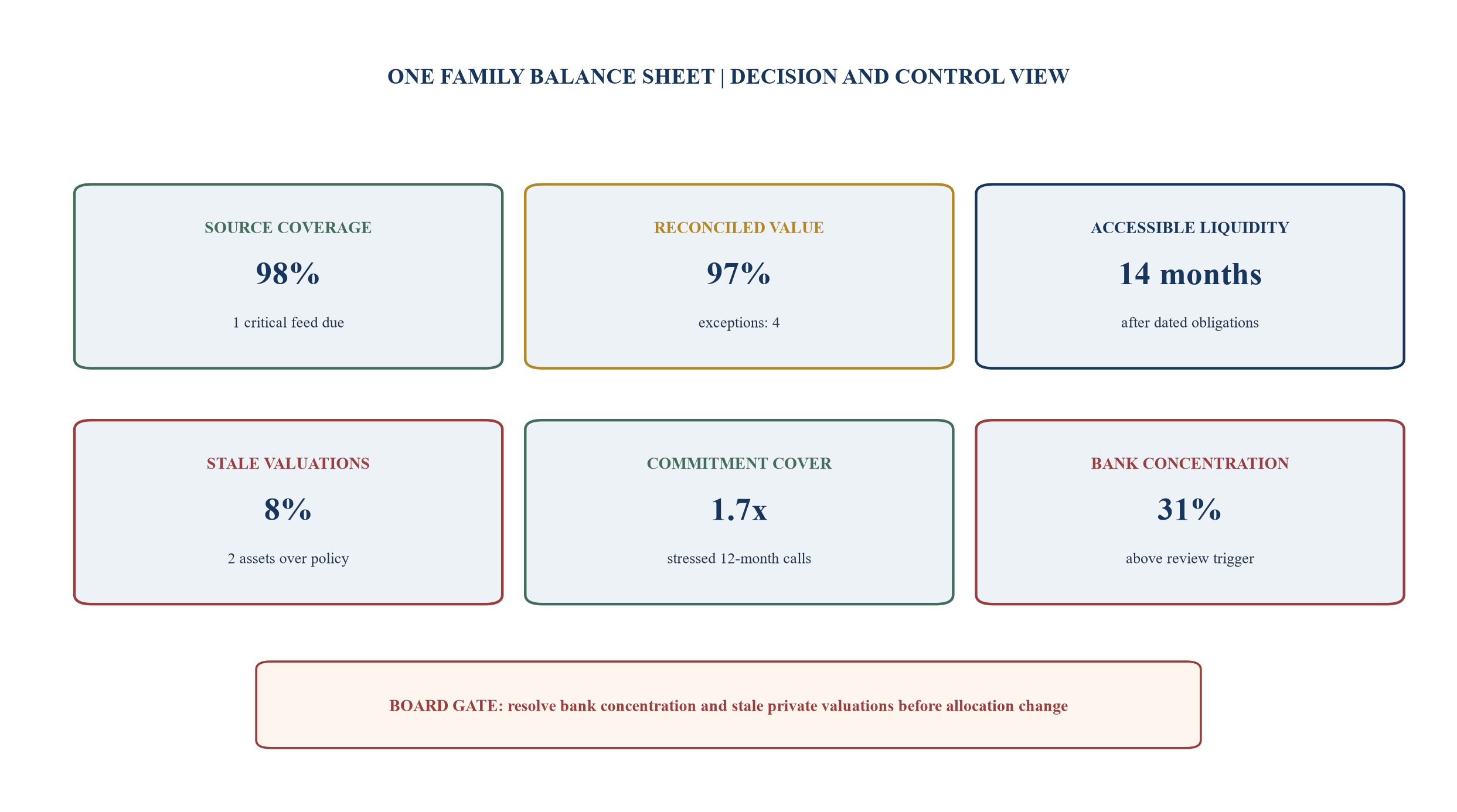
Values and thresholds are hypothetical management assumptions used only to demonstrate the reporting design.
Sources and further reading
- Central Bank of the UAE, “Open Finance Framework,” 10 July 2025. Official source
- Central Bank of the UAE, “Open Finance Regulation.” Official source
- Central Bank of the UAE, “CBUAE issues the Open Finance Regulation,” press release. Official source
- United Arab Emirates Legislation, Federal Decree-Law No. 45 of 2021 Regarding the Protection of Personal Data. Official source
- Abu Dhabi Global Market, “Family Offices.” Official source
- Dubai Financial Services Authority, GEN 2.3.5, Single Family Office. Official source
- Basel Committee on Banking Supervision, “Principles for effective risk data aggregation and risk reporting,” January 2013. Official source
- Basel Committee on Banking Supervision, “Progress in adopting the Principles for effective risk data aggregation and risk reporting,” November 2023. Official source
- Basel Committee on Banking Supervision, “Implementation of the Principles for effective risk data aggregation and risk reporting,” newsletter, January 2026. Official source
- IFRS Foundation, “IFRS 10 Consolidated Financial Statements.” Official source
- IFRS Foundation, “IFRS 13 Fair Value Measurement.” Official source
- IFRS Foundation, “IAS 21 The Effects of Changes in Foreign Exchange Rates.” Official source
- IFRS Foundation, “IFRS 9 Financial Instruments.” Official source
- ISO 20022, “The ISO 20022 Repository.” Official source
- ISO 20022, “Catalogue of messages.” Official source
- Financial Conduct Authority, “Account information services and payment initiation services,” updated 17 September 2024. Official source
- Financial Conduct Authority, “Open banking and open finance.” Official source
- Open Banking Limited, “The Open Banking Standard.” Official source
- Open Banking Limited, “Data management,” Open Banking Standards. Official source
- Singapore Financial Data Exchange, “SGFinDex Frequently Asked Questions.” Official source
- Government Technology Agency of Singapore, “SGFinDex,” updated 29 April 2026. Official source
- Swiss State Secretariat for International Finance, “Open Finance.” Official source
- Swiss Federal Department of Finance, “Open finance implementation in Switzerland,” 12 December 2025. Official source
- OECD, “Standard for Automatic Exchange of Financial Account Information in Tax Matters,” Second Edition, 27 March 2017. Official source
- OECD, “Amendments to the Common Reporting Standard,” 2023. Official source
- Financial Action Task Force, “Guidance on Beneficial Ownership of Legal Persons,” 10 March 2023. Official source
- Global Legal Entity Identifier Foundation, “Introducing the Legal Entity Identifier.” Official source
- Basel Committee on Banking Supervision, “Principles for operational resilience.” Official source
- Basel Committee on Banking Supervision, “Principles for the sound management of third-party risk,” 10 December 2025. Official source
- National Institute of Standards and Technology, “The NIST Cybersecurity Framework 2.0,” 26 February 2024. Official source
