

1. Introduction
A family office can receive accurate statements from every institution and still lack an accurate whole-balance-sheet view. Each statement answers a bounded question for a particular account, legal owner, reporting date and product. The governing body asks broader questions: how much cash is available by currency and entity; which obligations fall due; what exposures recur through funds and direct deals; how much of reported value is current; what is pledged; which position has failed to reconcile; and who has authority to act.
The operating challenge becomes harder as the estate grows. A bank balance can update intraday. A custody position can update after settlement. A private-fund net asset value can arrive weeks after quarter end. A property SPV can use a periodic appraisal. A direct company can require a fresh valuation judgement. A loan, guarantee, capital call or pending acquisition can change liquidity without changing the latest portfolio value.
A control tower creates a governed decision view across these sources. It does not replace the bank ledger, custodian book, fund administrator statement, company register, loan agreement or valuation file. It preserves their authority, records their dates and joins them through controlled identifiers. Every reported value carries a source, owner, timestamp, valuation basis, currency, confidence state and reconciliation status.
Current standards provide useful building blocks. ISO 20022 bank-to-customer messages define structured account reports, statements and debit-credit notifications.[1] Swift's Instant Cash Reporting API describes a single multibank channel using a unified ISO 20022 format for connected accounts.[2] ILPA's 2025 templates support more uniform private-fund capital-account, fee, capital-call and distribution reporting.[3][4] GLEIF's Legal Entity Identifier system separates entity identity from relationship information and includes fund relationships.[5][6]
The governance references require careful scope. BCBS 239 applies to bank risk-data aggregation, principally systemically important banks. A family office is not brought within that supervisory perimeter by using its concepts. Its principles concerning governance, accuracy, completeness, timeliness, adaptability and data lineage offer a useful design reference. The Basel Committee's January 2026 implementation note identifies data lineage, fragmented estates and timely ad hoc reporting as continuing challenges for banks.[7][8] This paper applies those ideas as voluntary operating disciplines.
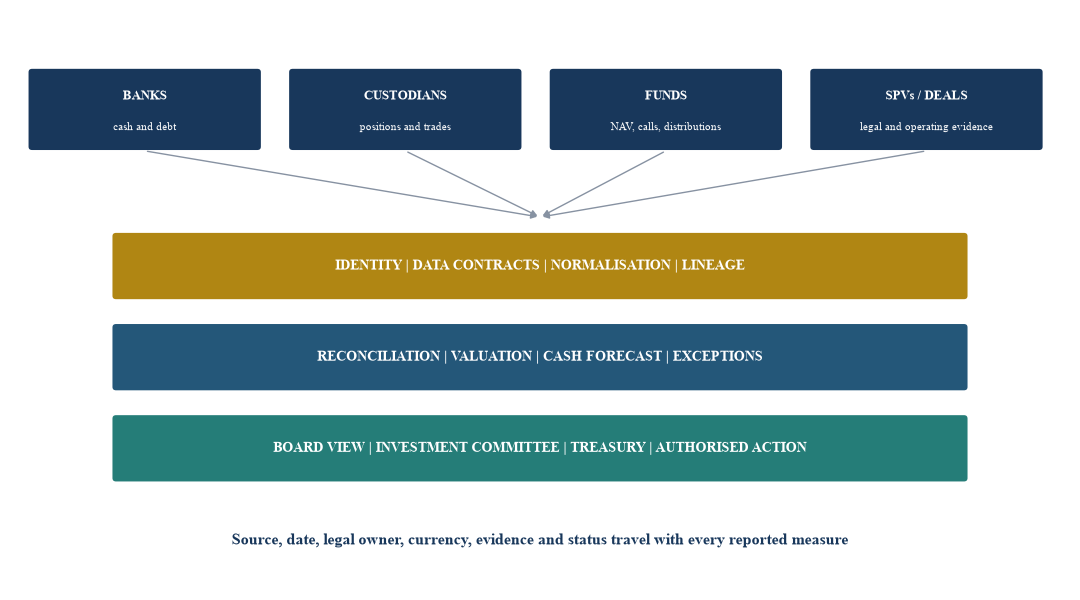
Author framework. Source systems retain authority; the decision layer joins governed records and exceptions.
2. Define the control objective
The governing body should define the decisions the tower must support before choosing technology. A broad request for a single dashboard can combine incompatible objectives. Daily liquidity, quarterly performance, tax reporting, entity governance, risk monitoring and investment underwriting use different sources, frequencies, classifications and approval standards.
A practical charter names the population, decisions, reporting frequency, materiality, authority and service level. The population includes family members, trusts, foundations, companies, partnerships, funds, SPVs and accounts that are lawfully within scope. It records exclusions and information barriers. The decision list can include payment capacity, capital-call readiness, currency exposure, asset allocation, manager concentration, direct-deal monitoring, leverage, guarantees and investment-committee approvals.
Every answer should expose its evidence. Cash reporting should show legal owner, bank, account, currency, value time, restriction and authority. Private-markets reporting should show period, commitments, expected cash flows, valuation source and post-period events. Performance should show methodology, cash-flow treatment, fee basis and period. The charter also defines acceptable delay for each decision.
3. Map the legal and economic balance sheet
Consolidation begins with ownership. Similar account names can belong to different legal persons. One family member can be the beneficial owner of an entity while a director, trustee, protector, investment manager or authorised signatory holds a different power. The control tower should store each relationship separately and link it to current evidence.
The Legal Entity Identifier provides a unique identifier and verified reference information for legal entities. GLEIF describes Level 1 data as identifying who is who and Level 2 data as recording selected relationships concerning who owns whom.[5] Its relationship format includes accounting-consolidation and fund relationships.[6] These records can strengthen identity matching. They do not establish every form of legal ownership, beneficial ownership, control, trust interest or transaction authority.
The master map connects each entity to its accounts, holdings, liabilities, commitments, guarantees, service providers and documents. It distinguishes legal ownership, economic exposure and decision authority. An SPV can legally own a property, owe bank debt and distribute cash to a holding company. A fund interest can be held through a nominee while the family vehicle bears the economics. A direct deal can contain ordinary shares, preferred rights, shareholder loans and unfunded obligations.
The economic map needs look-through rules because fund, SPV and direct exposures can overlap. The view should identify dated or unavailable look-through data and prevent double counting.
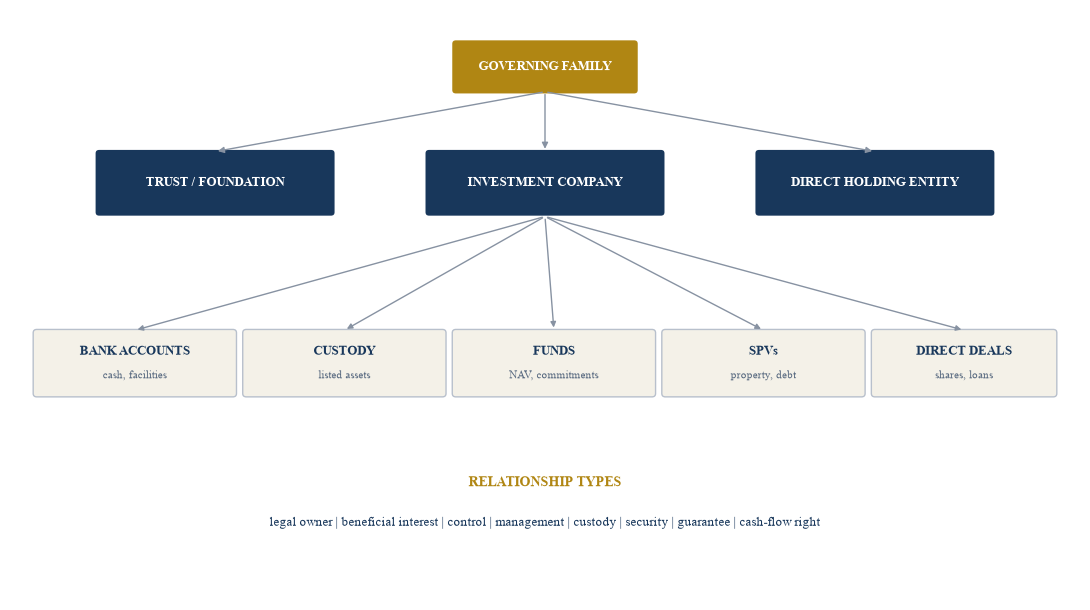
Author framework. Relationship types and evidence remain separate throughout consolidation.
Table 1. Minimum control-tower master record
| Object | Minimum record | Decision use | Authoritative evidence |
|---|---|---|---|
| Entity | legal name, jurisdiction, identifier, status, beneficial-ownership and control relationships | defines scope and legal owner | official register, constitutional document and approved KYC file |
| Account | institution, account number token, legal owner, currency, type, restriction and signatories | cash and custody authority | institution confirmation and mandate |
| Holding | instrument identifier, quantity, owner, account, cost, market value, currency and date | allocation, concentration and performance | custodian, administrator, register or approved valuation file |
| Fund interest | vehicle, commitment, funded, unfunded, recallable amount, NAV and reporting date | liquidity and private-market exposure | administrator statement, GP notice and governing documents |
| SPV or direct deal | security, ownership, rights, debt, guarantee, valuation and operating evidence | look-through, governance and exit | register, agreements, board records and valuation file |
| Cash flow | amount, currency, date, type, payer, payee and related object | reconciliation, performance and forecast | bank entry, notice and accounting record |
| Liability | borrower, lender, amount, maturity, rate, covenant, collateral and recourse | leverage and liquidity | executed facility and lender statement |
| Authority | role, person, limit, scope, dual-control rule and validity | action and payment control | board resolution, mandate and delegation schedule |
| Evidence | source, date, location, hash where used, reviewer and exception state | auditability and challenge | controlled repository and review record |
Each field requires an owner, source, effective date and review status.
4. Establish source hierarchy and data contracts
A single figure can arrive from several systems. The bank statement, general ledger and treasury workbook may show different cash because of timing, cut-off, pending items or classification. The control tower should define the source hierarchy for each field and preserve differences until they are reconciled.
A data contract specifies what a provider or internal owner supplies, in which format, at what frequency, with which identifiers, cut-off, quality rules and escalation. It covers automated feeds and documents. A quarterly PDF from a fund administrator still has a data contract: expected period, vehicle identifier, capital-account fields, currency, delivery date, reviewer and exception path.
ISO 20022 provides a structured vocabulary for financial messages. The bank-to-customer cash-management set includes account reports, statements and debit-credit notifications.[1] The ISO catalogue was updated in March 2026.[9] Swift describes real-time balances and transactions across connected banks through its Instant Cash Reporting API.[2] Availability depends on the participating institutions, permissions, product and implementation.
Private markets require a different cadence. ILPA's Reporting Template version 2.0 includes a capital-account statement and fee schedule, with the updated template intended for defined funds from 2026.[3] ILPA's Capital Call and Distribution Template version 2.0 was released in September 2025 to improve uniformity and transparency in notices.[4] A family office can map these fields into its model while preserving the manager's original statement and definitions.
Document extraction requires review. The fund-operations owner should confirm extracted commitments, NAVs and call dates against the cited source before decision use. Conflicting values remain visible as exceptions.
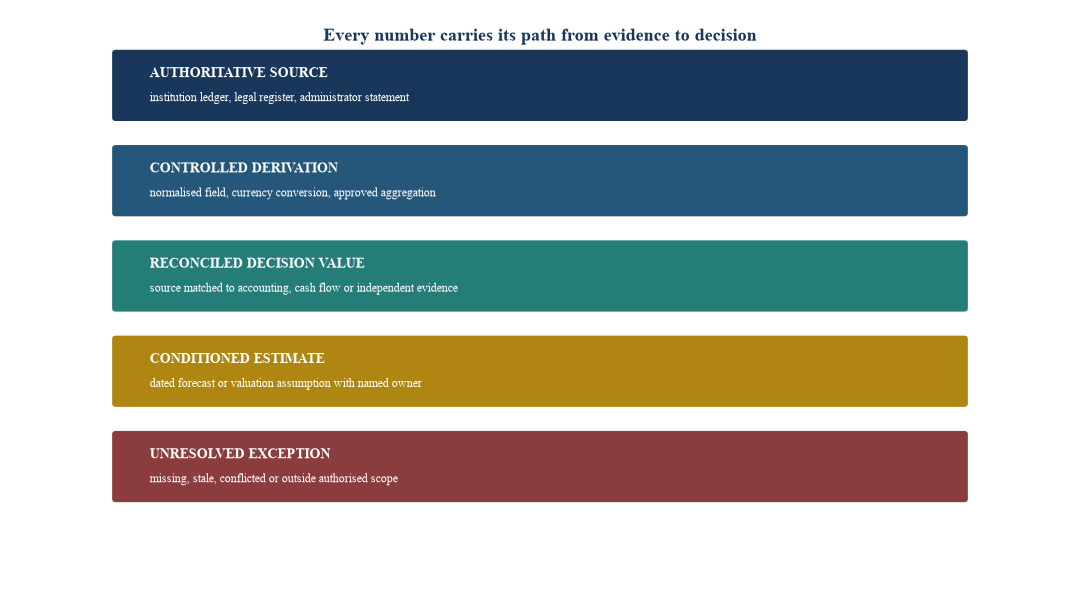
Author framework. Confidence reflects evidence and reconciliation; it does not convert an estimate into an observed fact.
Table 2. Data contracts by source class
| Source | Core fields | Frequency and cut-off | Validation | Escalation |
|---|---|---|---|---|
| Bank cash | account, balance type, available amount, currency, booked and pending entries | intraday or daily, institution timestamp | account master, duplicate, sequence, balance and transaction checks | treasury operations and bank service owner |
| Custody | security, quantity, price, value, accrued income, transaction and settlement status | daily or agreed statement cycle | identifier, position roll-forward, price source and corporate action | investment operations and custodian |
| Private fund | commitment, contribution, distribution, NAV, fees, unfunded and period | notice-driven and quarterly | capital-account roll-forward, currency and notice-to-cash match | fund operations and manager or administrator |
| SPV | ownership, bank, debt, asset, income, cost and intercompany balances | monthly and event-driven | ledger-to-bank, ownership, debt and intercompany reconciliation | entity controller and directors |
| Direct deal | security, rights, operating metrics, financing, valuation and governance events | monthly, quarterly and event-driven | register, board pack, financing and valuation evidence | deal lead and authorised board representative |
| Market data | identifier, price, foreign exchange and timestamp | daily or decision-specific | approved provider, stale-price and outlier checks | investment control |
| Documents | type, entity, period, execution state, version and source location | event-driven | completeness, signature, date, hash and reviewer | legal or document owner |
Actual availability and delivery terms require confirmation with each provider.
5. Create a canonical investment record
Normalisation should retain detail rather than flatten it. Every security has an identifier where available, instrument type, currency, quantity, price, value, accrued amount, valuation date and source. Every account has a legal owner. Every cash flow links to an account, entity, investment and economic category.
The canonical record separates trade date, settlement date, effective date, reporting date and system receipt date. A purchase can affect exposure on trade date and cash on settlement. A fund NAV can be effective at quarter end and received later. A direct-deal valuation can be approved after the measurement date. These dates should remain distinct.
Currency handling requires similar discipline. Source value remains in source currency. The tower records the approved translation rate, provider, timestamp and reporting currency. It separates economic currency exposure from reporting currency. A USD-denominated fund can hold assets with different underlying currencies, and a hedging instrument can sit in another entity.
Tax lots, accounting book values and investment values serve different purposes. The model should use defined measures and expose unavailable data.
6. Reconcile before aggregating
Aggregation can conceal breaks. The control tower should reconcile the smallest material unit before reporting the total. Cash is matched between bank data and the ledger. Custody positions roll forward from opening quantity through settled activity and corporate actions. Private-fund capital accounts roll from opening NAV through contributions, distributions, income, gains, fees and foreign exchange to closing NAV.
Reconciliation results need states. Matched means the approved fields agree within tolerance. Timing means a known dated item explains the difference. Conditioned means a named external event or evidence is pending. Unresolved means the difference lacks an approved explanation. Written off means an authorised person approved a defined accounting or data treatment.
Materiality depends on the decision. A small cash break can block a payment if it affects the sending account. A small security quantity can matter if it changes voting or transfer rights. The rule should therefore combine value, legal significance, liquidity and age.
The exception queue is part of the board view. It shows owner, age, value, decision affected, next action and deadline. A consolidated total without unresolved breaks can be decision-ready within its stated scope. A larger total with material aged exceptions should be conditioned.
Table 3. Reconciliation and exception rules
| Test | Expected relationship | Common break | Control response |
|---|---|---|---|
| Cash | opening plus booked entries equals closing balance | cut-off, pending item, duplicate, fee or missing account | match transaction, classify timing and escalate unsupported difference |
| Listed position | opening plus settled activity and corporate actions equals closing quantity | failed trade, split, transfer or identifier mismatch | verify settlement and corporate-action evidence |
| Private-fund NAV | opening NAV plus contributions less distributions plus net movement equals closing NAV | late statement, recallable amount, fee classification or FX | use administrator roll-forward and retain definitions |
| Commitment | original commitment plus amendments less funded and approved reductions equals unfunded | recycling, recall, transfer or amendment | review governing documents and current notice |
| SPV equity | assets less liabilities and non-controlling interests supports reported equity | intercompany mismatch, stale appraisal or missing debt | reconcile entity ledger, ownership and valuation file |
| Direct security | register, agreement and internal position agree on class and quantity | conversion, transfer, option or record delay | obtain authorised register and legal review where required |
| Performance | beginning value, external flows and ending value use one approved methodology | flow timing, fee basis, stale values or FX | recalculate with documented policy and source cash flows |
| Authority | proposed action is within current role, limit and dual-control rule | expired mandate, wrong entity or conflicting delegation | stop action and obtain valid authority evidence |
Tolerances and materiality require governing approval and instrument-specific calibration.
7. Govern valuation and stale data
A control tower should display value and valuation provenance together. IFRS 13 defines fair value as an exit price in an orderly transaction between market participants at the measurement date and provides a measurement framework where another IFRS requires or permits fair value.[10] The 2025 IPEV Guidelines provide current best-practice recommendations for private-capital investments reported at fair value.[11] The applicable accounting basis and valuation policy depend on the entity and reporting purpose.
For listed assets, the tower records market, price type, time and any stale or suspended status. For private funds, it records manager or administrator NAV, period, receipt date, currency and subsequent calls or distributions. For direct deals and SPVs, it records the approved technique, key inputs, calibration, reviewer, sensitivity and next review trigger.
Valuation age should be visible. A quarter-end NAV can remain the approved source while being aged. An approved liquidity-stress adjustment should remain separate from the original NAV.
An investment committee should understand which changes came from new external evidence, market movement, foreign exchange, cash flow, methodology or management judgement. A change log records these drivers and the approval.
Table 4. Valuation provenance and stale-data controls
| Asset class | Primary value record | Required context | Stale trigger | Decision response |
|---|---|---|---|---|
| Cash and deposits | institution balance and accrued amount | restriction, credit exposure and currency | feed or statement outside service level | use last verified value with age flag or block payment decision |
| Listed securities | approved market price | market, close time, liquidity and corporate action | no qualifying price or suspended market | obtain approved alternative and disclose basis |
| Private funds | manager or administrator NAV | period, receipt date, cash flows and underlying concentration where available | newer reporting expected or material post-period event | preserve NAV and add separate conditioned adjustment if policy permits |
| Property SPV | approved asset valuation less liabilities | valuation date, debt, tax, cash and ownership | policy interval or material event | commission update or run approved sensitivity |
| Direct company | approved technique and equity bridge | operating data, capital structure, rights and market evidence | financing, underperformance, exit event or policy interval | refresh valuation file and committee approval |
| Loan | principal, accrued interest and impairment assessment | borrower performance, collateral, covenant and maturity | missed payment, covenant event or stale borrower data | credit review and authorised valuation conclusion |
The table supports governance and does not prescribe an accounting conclusion.
8. Build a forward liquidity ladder
Current cash is one part of liquidity. The family office needs a dated ladder of sources and uses by legal entity and currency. Sources include available cash, deposits, committed facilities, expected income, asset sales and distributions. Uses include operating expenditure, family distributions, tax, debt service, capital calls, acquisitions and approved commitments.
Each source receives an availability class. Freely available cash differs from cash pledged to a facility, subject to local restrictions, reserved for an entity or awaiting transfer approval. Expected private-fund distributions require a confidence band. A committed facility requires tested conditions and headroom.
The ladder should cover normal, downside and severe but plausible cases. It should avoid counting an expected distribution as both a source and a debt-repayment assumption. Currency conversion requires market access, authority and timing. Intercompany transfers require legal, tax and governance review where applicable.
A capital call changes the tower immediately. The notice is matched to the fund master, commitment, due date, payment instructions and authorising entity. The forecast updates, cash is reserved and payment follows dual verification. ILPA's 2025 Capital Call and Distribution Template provides a current reference for more uniform notice fields.[4]
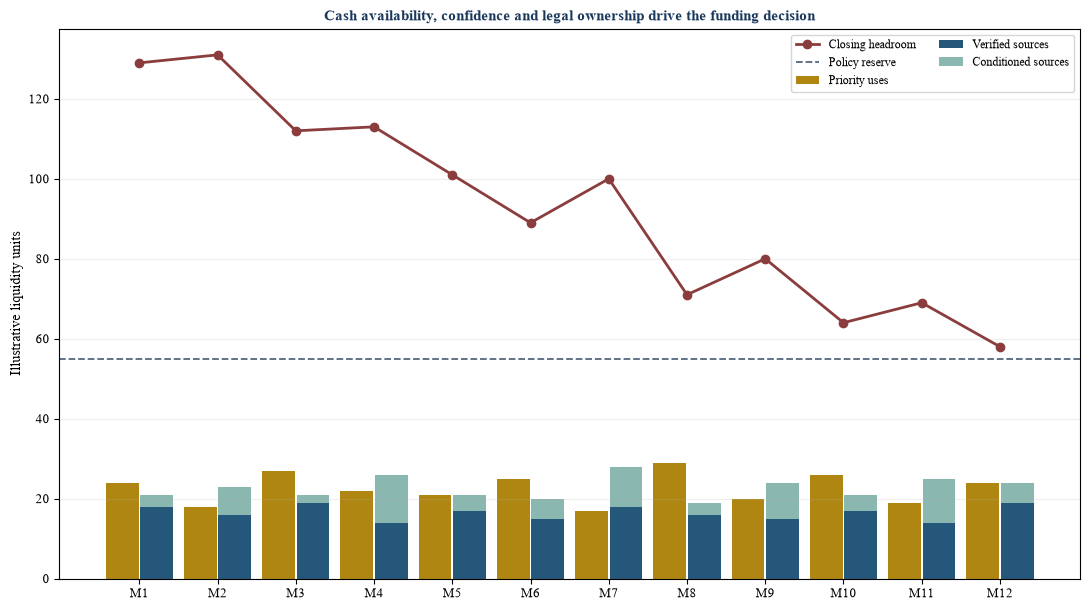
Values are illustrative units; they do not describe an investor or forecast.
9. Measure performance with documented boundaries
Performance should be calculated from reconciled values and external cash flows under a documented policy. The GIPS standards are voluntary ethical standards for calculating and presenting investment performance, built around fair representation and full disclosure.[12] Asset owners have their own GIPS provisions. A family office that does not claim compliance can still use the concepts of consistent definitions, supported records and clear disclosure.
Whole-estate performance can be difficult when entities have different objectives, leverage, currencies, tax positions and control. The reporting policy defines reporting currency, valuation frequency, fee treatment, external cash flows, internal transfers, beginning and ending values and benchmark use. It identifies portfolios where time-weighted or money-weighted analysis is appropriate.
An internal transfer between two family entities is not an external family cash flow for a consolidated view, yet it remains a legal and accounting transaction for each entity. A capital call is an external flow to a fund position. A distribution can contain return of capital, income or gain according to the relevant source and accounting treatment.
The dashboard should separate reported performance from value creation still subject to stale private marks. Simulated or conditioned values require explicit disclosure.
10. Connect risk, concentration and commitments
A single view enables risk questions that no institution can answer alone. The office can aggregate exposure by legal entity, bank, custodian, manager, strategy, sector, geography, currency, vintage, counterparty and liquidity class. Look-through should be used only where supported and dated.
Concentration limits need a defined denominator. Bank concentration can use available cash, deposits or total counterparty exposure; manager concentration can use NAV, commitment or stressed exposure. Direct and indirect exposure requires overlap testing. Commitments receive a separate view of unfunded amounts, recallable distributions, call forecasts, remaining investment periods and currencies linked to the liquidity ladder.
Guarantees, pledges and recourse belong in risk reporting. An asset can appear liquid while being pledged. An SPV facility can have recourse or covenants that affect distributions. The governing dashboard should show encumbrance and headroom.
11. Design the investment-committee decision pack
The control tower should shorten the path from evidence to decision. It should not turn a complex investment into a coloured score. The committee pack states the requested decision, legal owner, authority, amount, source of funds, portfolio effect, liquidity effect, risk, valuation, conflicts, advice and conditions.
The current portfolio view provides a common starting point. The proposed transaction is inserted into a pro forma view. The system shows changes in allocation, liquidity, unfunded commitments, currency, leverage, manager and asset concentration. It identifies data that is aged or unresolved.
Decision thresholds create routing. A proposal can require additional approval when it breaches concentration, reduces liquidity below reserve, uses an entity outside its objective, creates a related-party conflict or depends on an unresolved valuation. Overrides require a named authority and written reason.
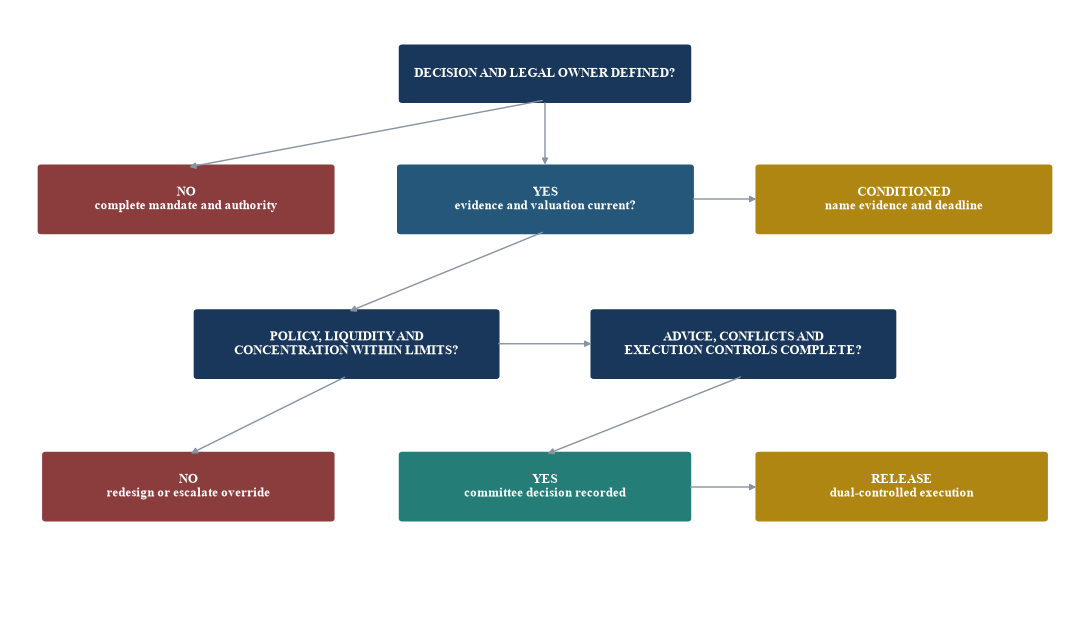
Author framework. Specialist advice and governing documents determine transaction-specific requirements.
Table 5. Board and investment-committee decision pack
| Section | Required content | Control question |
|---|---|---|
| Decision | action, amount, currency, legal owner, timing and authority | is the requested decision precise and within mandate? |
| Evidence | source list, reporting dates, reconciliation and exceptions | which claims are observed, derived, conditioned or unresolved? |
| Portfolio | current and pro forma allocation, concentration and commitments | what changes across the whole controlled estate? |
| Liquidity | entity and currency ladder, reserve and downside case | can the correct entity fund the action when required? |
| Valuation | source, date, method, sensitivity and approval | is value fit for this decision and properly qualified? |
| Risk | leverage, guarantee, counterparty, operational and exit risks | which threshold is approached or breached? |
| Conflicts | related parties, adviser economics and recusals | is the conflict controlled by an authorised process? |
| Advice | legal, tax, accounting, regulatory and specialist scope | which conclusions depend on current professional advice? |
| Execution | documents, conditions, signatories, payment and settlement | can the approved decision be executed through dual control? |
| Monitoring | owner, milestones, reporting, triggers and next review | how will the committee know whether the case remains valid? |
The pack should link every material claim to its source and current status.
12. Control documents, authority and payments
Data visibility should never become transaction authority. The person who prepares a dashboard may lack authority to trade, sign, transfer or pay. The tower links each action to the current delegation, entity, account, limit and required co-signature.
Documents are indexed to the objects they govern. An LPA links to a fund interest. A side letter links to the investor and vehicle. A shareholder agreement links to a company and security. A facility links to borrower, lender, collateral and covenant. The system records version, execution status, effective date and review.
Payment instructions require independent verification through a known channel. Changes received by email receive heightened review. Capital-call, acquisition and distribution payments follow segregation between preparation, approval and release. The bank's own controls remain part of the final execution path.
The archive preserves the approved committee paper, advice, authority, payment evidence, settlement and post-transaction reconciliation under applicable retention and access policy.
13. Protect confidentiality and operational resilience
A family-office data estate contains sensitive financial, identity, ownership and transaction information. Access should be based on role, entity, purpose and minimum necessary scope. A broad family group, external manager or service provider should not receive every account, document or beneficial-ownership record by default.
NIST Cybersecurity Framework 2.0 provides a voluntary outcome-based framework organised around Govern, Identify, Protect, Detect, Respond and Recover.[13] It is designed for organisations of different sizes and sectors. A control-tower implementation can use these functions to establish governance, asset inventory, identity and access, protection, monitoring, incident response, recovery and supplier controls.
The operating design should include strong authentication, privileged-access review, encryption, logging, backup, recovery tests, secure development, vendor diligence and incident playbooks. Exports and spreadsheets require control because they can bypass application permissions. Non-production environments should not contain uncontrolled copies of live family data.
Resilience includes service continuity. The office needs a documented fallback for cash position, upcoming obligations, payment authority and critical records if an aggregator, custodian feed or office platform fails. Periodic tests should demonstrate that the family can identify priority payments and act through approved channels.
14. Build a clear operating model
The governing body owns the charter, scope, risk appetite and material policies. The investment committee owns investment decisions within delegation. Treasury owns liquidity and payment readiness. Investment operations owns positions, cash flows and reconciliations. Finance owns ledgers and reporting basis. Legal and compliance functions own their professional determinations. Technology and security own platform controls. Each source institution has an accountable relationship owner.
A data owner defines a field and approves its use. A data steward monitors quality. A system owner operates the platform. An evidence owner resolves a source question. A decision owner accepts or rejects a proposal. Combining all roles in one person can weaken challenge and continuity.
Service levels cover feed receipt, reconciliation, exception ageing, valuation review, capital-call processing and board reporting. Vendor selection follows the target model and evaluates coverage, private-market handling, entity support, lineage, permissions, security, portability and implementation capacity through representative acceptance tests.
15. Demonstrate the framework with a hypothetical family office
Consider a hypothetical UAE family office with management-estimated gross assets of AED 6.2 billion across three banks, four custody relationships, 27 private funds, eight SPVs and six direct deals. It also has AED 420 million of gross debt, AED 310 million of unfunded private-fund commitments and two guarantees. Every number and circumstance is a management assumption created solely to demonstrate the framework. It does not describe a client or market observation.
The first inventory identifies 19 legal entities and 54 financial accounts. Twelve account names do not match the approved entity master exactly. Three private-fund interests appear under nominee names. Two SPVs use the same internal asset name. These are illustrative data-quality conditions.
The source-of-record mapping establishes daily cash and custody feeds for participating institutions, quarterly fund statements, event-driven capital notices, monthly SPV ledgers and quarterly direct-deal packs. The office records statement dates and receipt dates separately. It creates a document path for every fund, SPV and direct deal.
The first consolidated view reports AED 530 million of cash and deposits. AED 115 million is restricted, pledged or reserved within operating entities. AED 415 million is therefore classified as available within its existing legal owners before transfer constraints. The 12-month priority-use forecast is AED 470 million. Verified sources other than opening cash total AED 145 million. Conditioned private-fund distributions total AED 90 million. The governing reserve is an assumed AED 80 million.
Under the illustrative base case, available cash plus verified sources cover uses and reserve with AED 10 million of headroom. Excluding conditioned distributions keeps the calculation conservative. In a downside case, an additional AED 75 million of capital calls and an AED 40 million direct-deal follow-on create a shortfall. The committee therefore freezes a proposed new commitment and asks treasury to compare asset-sale, credit and pacing options.
The portfolio view also finds that two custodian accounts hold securities issued by companies already present through direct funds. Look-through data supports a conditioned concentration estimate. The dashboard displays the source and date rather than presenting a precise consolidated exposure.
The office resolves entity names, establishes dual-controlled capital-call processing, documents valuation age and creates an aged-exception queue. It does not overwrite administrator NAVs with modelled values. Planning adjustments remain separate. The committee can now see cash availability, pending obligations, stale values, concentration and unresolved data on the same page.
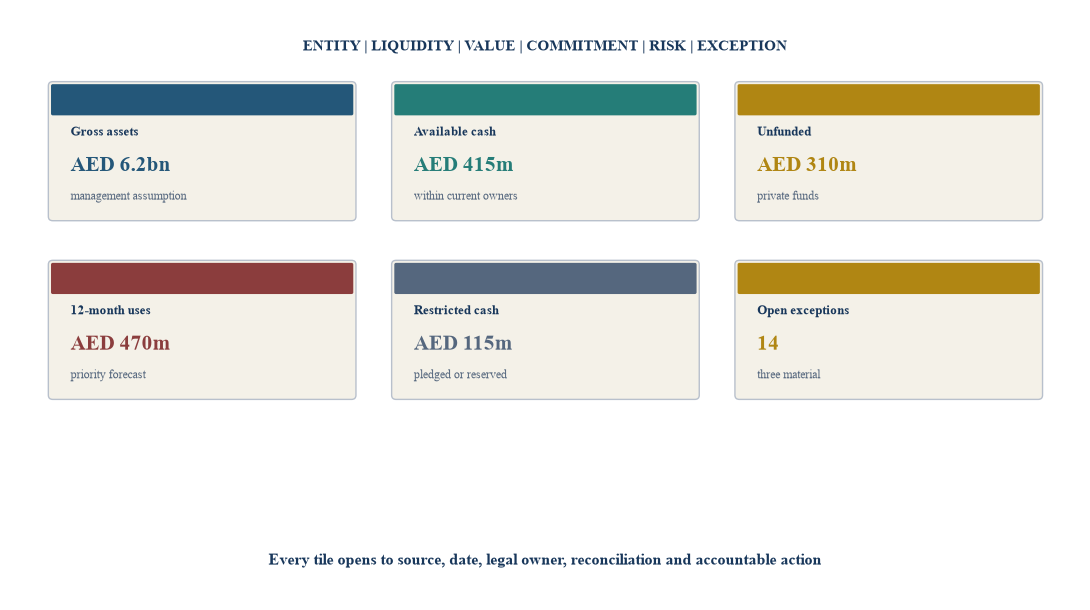
Every displayed value is an illustrative management assumption used solely to demonstrate dashboard design.
16. Monitor decision quality and operating performance
The control tower needs a scorecard. Coverage measures the percentage of in-scope entities, accounts and assets linked to an approved source. Freshness measures compliance with the service level appropriate to each source. Reconciliation measures matched records and material exceptions. Lineage measures whether a reported total can be traced to source.
Operating measures include feed success, statement receipt, exception age, capital-call cycle time, valuation review and payment failure. Decision measures include packs delivered on time, conditions closed, overrides, post-investment monitoring and realised outcomes compared with the approved case.
Exceptions are ranked by decision impact. The dashboard highlights items that can block a payment, breach a reserve, misstate a material exposure or impair an investment decision. Normal-period testing should trace ad hoc totals by entity, bank, currency or manager. BCBS 239's emphasis on adaptable, accurate and timely reporting provides a useful voluntary reference within its stated banking scope.[7][8]
17. Implement the capability in 100 days
Days one to 20 establish governance, scope and the master inventory. The office identifies entities, accounts, institutions, funds, SPVs, direct deals, liabilities, documents, owners and decisions. It records current reports and gaps before selecting a platform.
Days 21 to 40 define the canonical model, identifiers, data contracts, source hierarchy, reporting currency, valuation policy interfaces, reconciliation states and access roles. The team pilots representative sources.
Days 41 to 60 connect priority banks and custodians, load private-fund and entity records, establish document links and reconcile opening positions. The office avoids a big-bang cutover. Each source receives acceptance criteria and an accountable owner.
Days 61 to 80 implement liquidity forecasting, performance policy, concentration, commitments, valuation age, authority and exception workflows. A parallel run compares the tower with existing board reporting.
Days 81 to 100 complete user testing, security review, recovery test, operating procedures, committee pack and governance approval. Unresolved gaps remain visible with owners and dates. The launch scope can exclude sources that have not passed acceptance.
Table 6. One-hundred-day multi-custodian implementation
| Days | Workstream | Controlled deliverable | Gate |
|---|---|---|---|
| 1 to 10 | charter | decisions, scope, entities, authority and materiality | governing sponsor and decision owners confirmed |
| 11 to 20 | inventory | accounts, assets, liabilities, commitments, documents and providers | population reconciled to existing records |
| 21 to 30 | design | canonical model, identifiers, source hierarchy and dates | definitions and ownership approved |
| 31 to 40 | contracts | feeds, documents, frequencies, validation and escalation | representative sources accepted for pilot |
| 41 to 50 | cash and custody | priority feeds, account master and opening reconciliation | material cash and positions matched |
| 51 to 60 | private assets | fund, SPV, direct-deal and document workflows | capital accounts and legal owners linked |
| 61 to 70 | analytics | liquidity, commitment, concentration and valuation-age views | calculations traced to source |
| 71 to 80 | governance | authority, access, exceptions, committee pack and controls | roles and thresholds approved |
| 81 to 90 | assurance | parallel run, security review, recovery and user tests | material failures resolved or conditioned |
| 91 to 100 | launch | operating procedures, service levels and board approval | approved sources move to controlled production |
Timing depends on source access, contracts, data quality, security review and organisational capacity.
18. Limitations and conclusion
Data availability depends on institution, product, jurisdiction, contractual right and technical implementation. ISO 20022 structures and Swift services can improve standardisation where supported; they do not create universal access to every institution or asset.[1][2][9]
Private-fund reporting remains periodic and manager-dependent. ILPA templates improve uniformity and transparency within their scope, while fund documents and actual provider outputs govern the specific record.[3][4] Look-through data can be incomplete or dated.
GLEIF data can strengthen legal-entity identity and selected relationship records. It does not replace beneficial-ownership, trust, legal-title, control or transaction-specific diligence.[5][6]
IFRS 13 and IPEV guidance inform valuation within their respective scope. The applicable accounting policy, entity facts and reporting purpose require current professional judgement.[10][11] A planning adjustment, administrator NAV and transaction price should remain distinct.
BCBS 239 is bank supervisory guidance and the GIPS standards are voluntary standards with defined provisions.[7][8][12] Their use in this paper is a design reference. NIST CSF 2.0 is an outcome-based cybersecurity framework and does not prescribe one implementation.[13]
Cybersecurity, privacy, legal privilege, data residency, regulation, tax and fiduciary duties require current advice and controls. A consolidated platform can increase the impact of a security failure, access error or inaccurate master record. The office should apply defence in depth and tested recovery.
The hypothetical example contains management assumptions solely for framework demonstration. It does not describe a client, expected result, software capability or investment recommendation.
A multi-custodian control tower creates value when it joins authority, evidence and action. The office begins with legal owners and decision questions, defines source hierarchy and data contracts, reconciles before aggregating, exposes valuation age and exceptions, builds an entity-aware liquidity ladder and controls every action through valid authority.
The result is one governed view across banks, funds, SPVs and direct deals. The governing body can see which cash is available, which commitments are coming, which exposures overlap, which values are dated, which records disagree and which person owns the next action. That view supports faster decisions because the evidence, limits and residual uncertainty remain visible.
References
- [1] ISO 20022, Bank-to-Customer Cash Management Message Definition Report, including account report, statement and debit-credit notification definitions, accessed 13 August 2026. https://www.iso20022.org/sites/default/files/documents/messages/mdr_part_2/ISO20022_MDRPart2_BankToCustomerCashManagement_2018_2019_v1_0.pdf
- [2] Swift, Instant Cash Reporting API, accessed 13 August 2026. https://www.swift.com/products/instant-cash-reporting-api
- [3] Institutional Limited Partners Association, ILPA Reporting Template v. 2.0 and Supplemental Guidance, released January 2025, accessed 13 August 2026. https://ilpa.org/industry-guidance/templates-standards-model-documents/ilpa-templates-hub/ilpa-reporting-template/
- [4] Institutional Limited Partners Association, Capital Call and Distribution Template v. 2.0 and Suggested Guidance, released September 2025, accessed 13 August 2026. https://ilpa.org/industry-guidance/templates-standards-model-documents/ilpa-templates-hub/ilpa-capital-call-distribution-template/
- [5] Global Legal Entity Identifier Foundation, The Legal Entity Identifier, accessed 13 August 2026. https://www.gleif.org/en/organizational-identity/lei-vlei/the-legal-entity-identifier-lei
- [6] Global Legal Entity Identifier Foundation, Level 2 Relationship Record Common Data File Format 2.1, including fund relationships, accessed 13 August 2026. https://www.gleif.org/en/lei-data/access-and-use-lei-data/level-2-data-relationship-record-rr-cdf-2-1-format
- [7] Basel Committee on Banking Supervision, Principles for Effective Risk Data Aggregation and Risk Reporting, 9 January 2013. https://www.bis.org/publ/bcbs239.htm
- [8] Basel Committee on Banking Supervision, Implementation of the Principles for Effective Risk Data Aggregation and Risk Reporting, 6 January 2026. https://www.bis.org/publ/bcbs_nl36.htm
- [9] ISO 20022, Bank-to-Customer Cash Management message definitions, updated 19 March 2026, accessed 13 August 2026. https://www.iso20022.org/iso-20022-message-definitions?business-domain%5B0%5D=1&search=Bank-to-Customer+Cash+Management
- [10] IFRS Foundation, IFRS 13 Fair Value Measurement, accessed 13 August 2026. https://www.ifrs.org/issued-standards/list-of-standards/ifrs-13-fair-value-measurement/
- [11] International Private Equity and Venture Capital Valuation Board, IPEV Valuation Guidelines, December 2025. https://www.privateequityvaluation.com/Valuation-Guidelines
- [12] CFA Institute, Global Investment Performance Standards, accessed 13 August 2026. https://rpc.cfainstitute.org/gips-standards
- [13] National Institute of Standards and Technology, The NIST Cybersecurity Framework 2.0, 26 February 2024. https://doi.org/10.6028/NIST.CSWP.29
About the Author
Chennakeshav Adya is an independent researcher and Managing Partner of Matchpoint Partners. His research focuses on investment strategy, capital formation, transaction execution, governance and operating-model design across the Gulf and international markets.
