

1. Begin with the rights, rather than the labels
A family can describe one relative as an owner, another as a voting owner, a third as a director and a fourth as the chief executive. Each position arises from a different source of authority. Ownership comes through valid legal or beneficial interests. Voting rights arise from applicable law and constitutional documents. Board authority belongs to directors acting through the company’s governance process. Executive authority comes through appointment, delegation and employment. A family title alone does not establish any of them.
The first design task is therefore to identify the rights required by the enterprise and its owners. Economic rights can include dividends, liquidation proceeds, redemption value and participation in a sale. Ownership-control rights can include votes, class consent, pre-emption, transfer approval and information. Board rights can include nomination, appointment, observation and reserved-matter approval. Management rights can include a role, remuneration, delegated authority and performance accountability.
These rights should be separated before a class label is selected. “Founder shares,” “family shares,” “growth shares” and “preference shares” can mean different things across documents and jurisdictions. The legal effect follows the governing instrument and applicable law. A rights register should state the exact entitlement, holder, source document, conditions, duration, decision body and amendment route.
The G20/OECD Principles identify core shareholder rights including secure ownership registration, transfer, timely information, participation and voting in shareholder meetings, election and removal of board members, participation in profits and approval of fundamental changes. They also state that shares within the same series of a class should receive equal treatment and that investors should be able to obtain information about class rights before purchase. Those principles provide a useful governance baseline even where the family enterprise is private and the local legal rules differ.
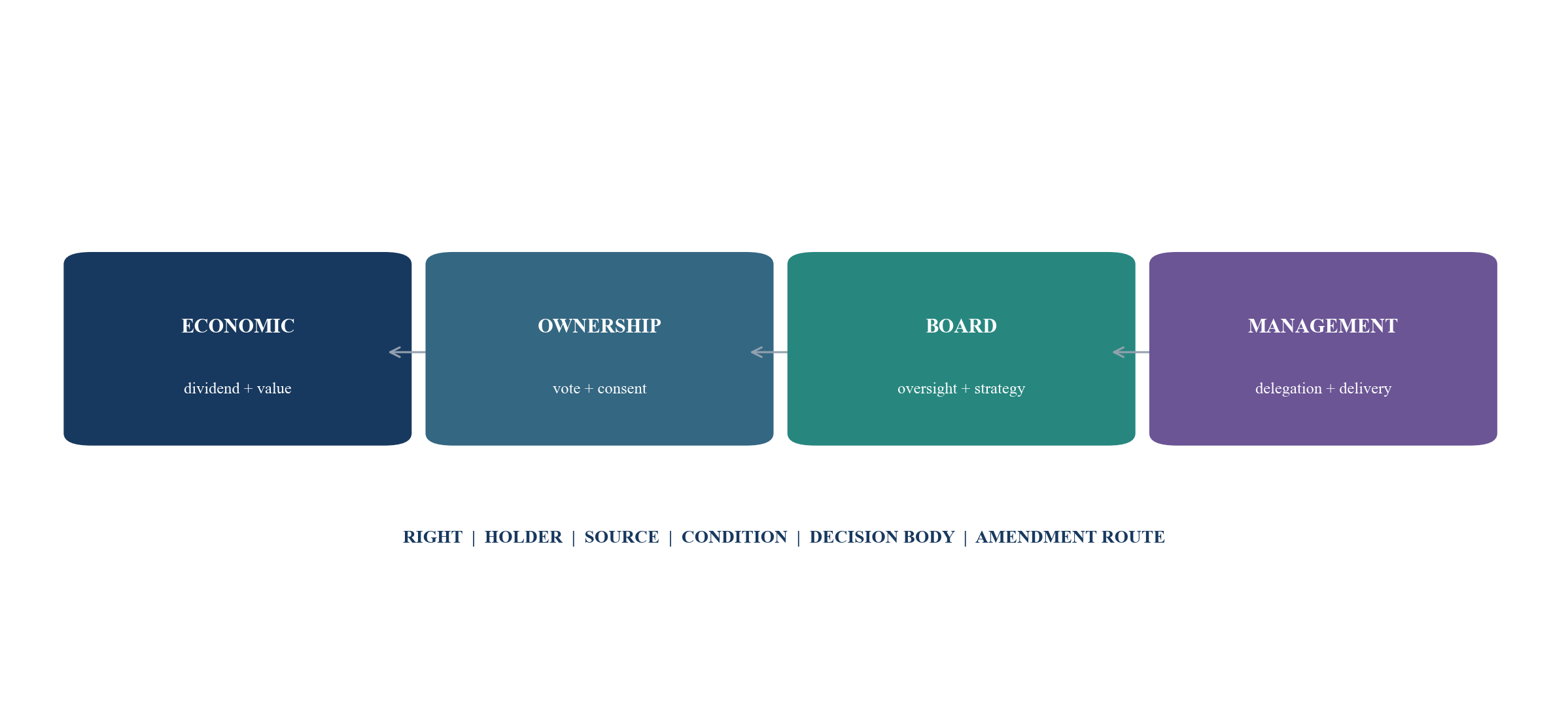
Each layer requires its own authority, record and accountability. Connections between layers should be explicit.
2. Define the enterprise purpose before distributing authority
Capital rights should serve an articulated enterprise purpose. The family may want to preserve control, reward active stewardship, provide income to non-working owners, fund growth, create liquidity, attract professional management or admit external capital. Some objectives can be combined. Others create trade-offs that require an explicit priority.
The enterprise also has its own interests. It needs sufficient capital, a functioning board, competent management, credible decision speed and the ability to enter contracts and raise finance. A dividend promise that ignores working capital can weaken the business. A voting structure that requires unanimous approval for routine matters can prevent timely action. A permanent management entitlement can restrict the board’s ability to appoint qualified executives.
The purpose statement should identify the operating companies, holding entities, trusts and owners in scope. It should record the intended duration of family control, funding strategy, acquisition ambition, distribution philosophy, external-investor route, succession horizon and principles of equitable treatment. “Equal” and “fair” need operational definitions. Equal voting can coexist with different economic participation, and equal economic ownership can coexist with different board or management roles, provided the structure is valid, disclosed and deliberately governed.
Family purpose cannot displace directors’ duties, creditor protection, minority remedies, tax rules or other applicable law. The relevant entities and jurisdictions should be mapped at the start. Qualified legal, tax and accounting advisers should confirm how the proposed structure operates for each company, trust, estate and holder.
3. Build a verified ownership and authority map
The cap table is one part of an ownership map. The complete map connects registered holders, beneficial owners, trusts, nominees, holding companies, voting arrangements, pledges, options, convertibles, shareholder loans and expected future transfers. It should reconcile constitutional documents, registers, certificates, agreements and reliable identity records.
The map should also show where authority sits. A trust can hold shares while trustees exercise legal powers subject to the trust instrument and their duties. A family holding company can consolidate votes while underlying family branches have governance rights at the holding-company level. An employee incentive vehicle can hold economic interests subject to vesting. A lender may have security and covenant rights without being a shareholder.
Every connection needs a source and review date. A family diagram prepared for discussion may omit legal distinctions. The implementation record should distinguish legal ownership, beneficial interest, voting direction, economic entitlement and control. Cross-border structures require advice in each relevant jurisdiction, including succession, marital-property, capacity, disclosure and tax considerations.
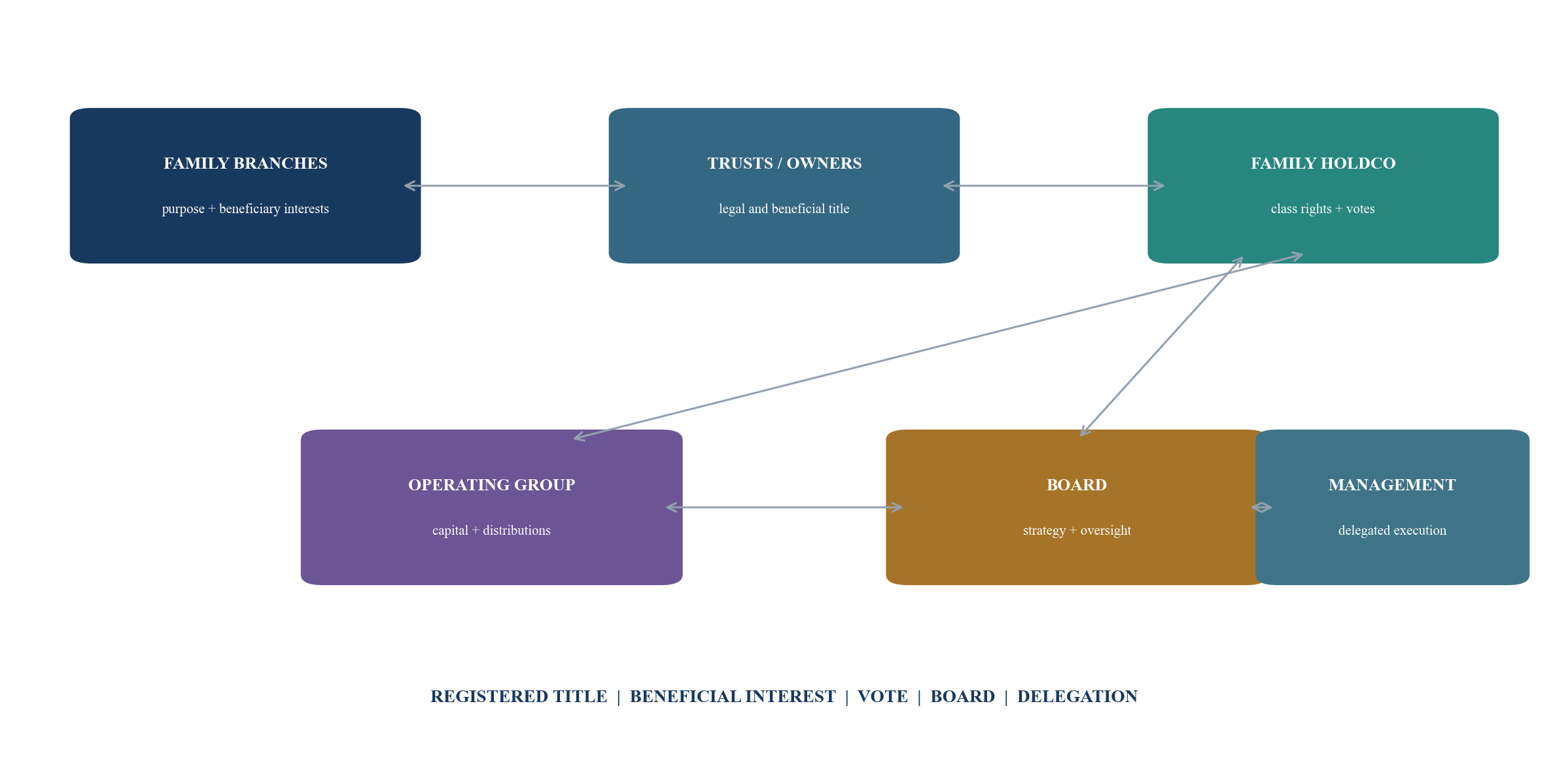
The map separates legal title, economic benefit, voting direction, board authority and management delegation.
4. Create a rights taxonomy for every class
A class-design process should inventory each right before drafting. The taxonomy covers cash-flow rights, capital rights, votes, appointments, consent, information, transfer, liquidity, conversion, protection and obligations. It should also state how rights interact. A preferred dividend can accumulate, lapse or depend on declaration. A board nomination can end below an ownership threshold. A transfer can trigger pre-emption, tag, drag, consent or conversion.
Table 1. Capital-rights taxonomy
| Domain | Design question | Evidence in the rights register |
|---|---|---|
| dividend | is participation fixed, preferred, cumulative, discretionary, formula-based or residual? | rate or formula, priority, declaration authority, arrears and conditions |
| capital and exit | how are sale, liquidation, redemption and buyback proceeds allocated? | waterfall, preference, participation, cap, valuation and funding route |
| voting | which matters carry votes and how many votes attach to each share or holder? | vote ratio, meeting method, thresholds, class consent and sunset |
| board | who can nominate, appoint, remove or observe directors? | eligibility, number, term, threshold and vacancy process |
| reserved matters | which actions require shareholder, class, board or independent approval? | matter, threshold, quorum, conflict rule and emergency route |
| information | what financial, operating and ownership information is provided, when and to whom? | content, frequency, access, confidentiality and exception |
| new capital | what pre-emption, anti-dilution, participation or consent applies? | issue scope, exclusions, notice, election and waiver |
| transfer | what restrictions, permitted transfers, tag, drag or compulsory-transfer rules apply? | trigger, process, valuation, timetable and dispute route |
| conversion and sunset | when do rights convert, expire, reduce or become exercisable? | event, date, threshold, holder action and resulting class |
| holder obligations | what confidentiality, compliance, funding or conduct obligations apply? | undertaking, consequence, cure and enforcement route |
The legal effect depends on the governing law and documents. The table is a design and review aid.
The taxonomy should include negative space. If a class receives no vote on a matter, the documents should say so where appropriate and local law should be checked for mandatory rights. If a dividend is non-cumulative, the treatment of an undeclared amount should be clear. If a right depends on a person remaining employed, the good-leaver, bad-leaver and incapacity provisions require precise drafting and proportionate consequences.
5. Treat economic participation as a policy system
Dividends are one route for transferring value from the company to shareholders. Salary, bonus, benefits, rent, interest, management charges, related-party transactions, redemptions, buybacks and sale proceeds create other value flows. The governance system should distinguish compensation for work, return on debt, payment for assets or services and return on equity.
A dividend policy should begin with legal capacity and board authority in the relevant jurisdiction. For example, the UK Companies Act 2006 restricts distributions to profits available for the purpose and requires relevant accounts. Delaware law provides statutory rules for dividends and capital. The applicable rules can differ materially, and local advice should address solvency, capital maintenance, directors’ duties, lender covenants, tax and documentation.
After the legal gate, the policy should consider operating liquidity, debt service, covenant headroom, committed capital expenditure, acquisitions, contingency reserves and an approved reinvestment plan. The residual capacity can then be tested against the rights of each class. A predictable policy can reduce conflict while preserving board judgement where the law and documents require it.
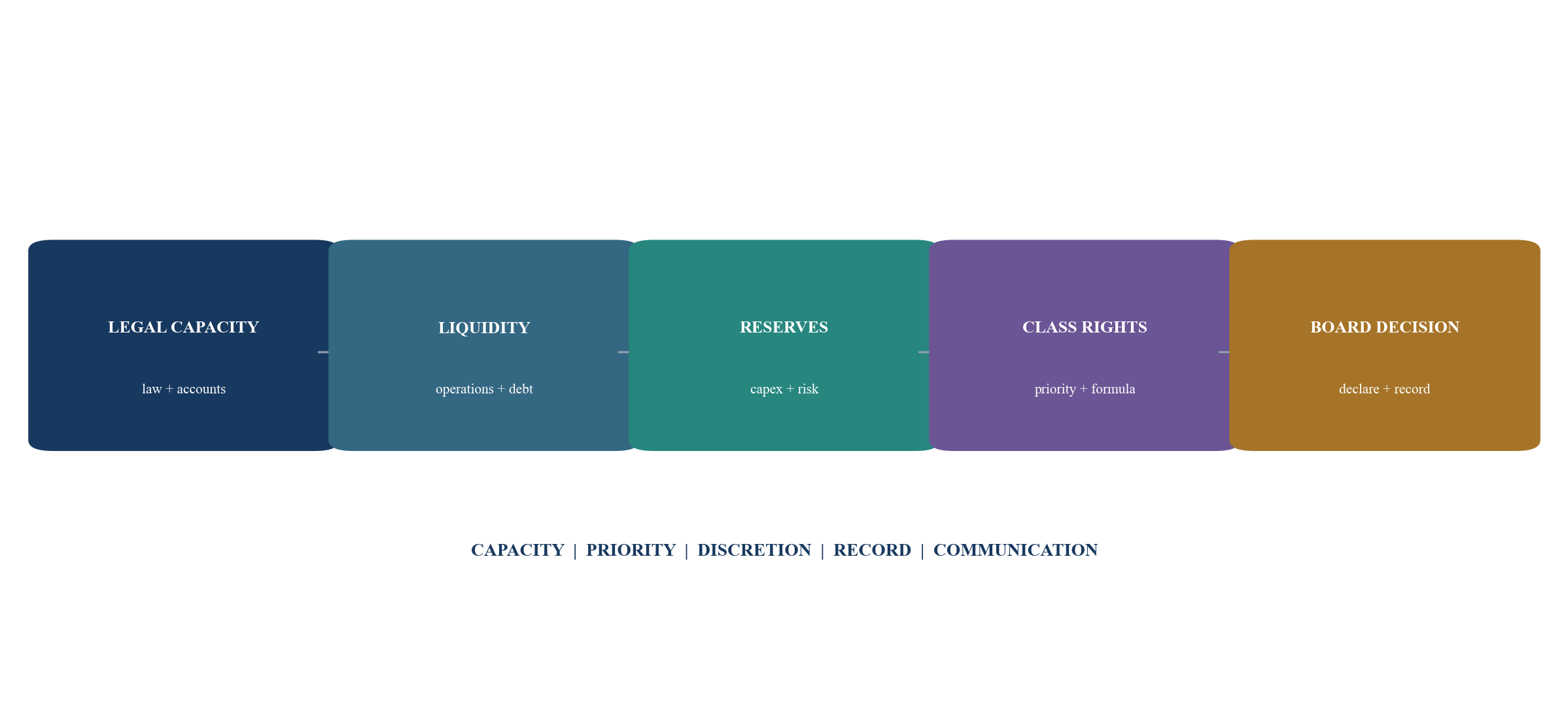
A formula should remain subject to applicable law, valid authority and current financial evidence.
Table 2. Share-class design record
| Class | Intended holder | Economic rights | Governance rights | Conversion or sunset | Controlling evidence |
|---|---|---|---|---|---|
| control class | qualifying family ownership vehicle | defined participation in dividends and exit | enhanced or specified votes, class consent and nomination rights | ownership, generation, time or transfer trigger | constitutional documents, agreement and register |
| economic family class | family owners without control allocation | stated dividend and capital participation | ordinary or limited votes plus mandatory class rights | transfer, election or agreed reclassification | constitutional documents and family ownership policy |
| stewardship class | eligible active stewards | participation linked to long-term stewardship design | bounded nomination or consent rights | employment, qualification, time and ownership tests | constitutional, shareholder and employment documents |
| employee growth class | eligible executives and employees | growth above a defined threshold, subject to vesting | limited information or votes as validly designed | vesting, leaver, exit and lapse events | plan rules, awards, valuation and tax advice |
| external capital class | approved outside investor | negotiated preference, participation or return profile | information, protection, board and consent rights | redemption, conversion, exit or threshold | investment and constitutional documents |
Each row should link to jurisdiction-specific advice and the controlling document.
6. Define a dividend policy that owners can understand
The policy should state the objective, legal entities, review frequency, decision body, evidence pack and communication process. It can set a target payout range or a formula while preserving required legal and board discretion. It should explain the order of priority among classes and how arrears, catch-ups, participating preferences, withholding, currency and fractional amounts are handled.
Table 3. Board-ready dividend policy
| Policy element | Board question | Required evidence |
|---|---|---|
| lawful capacity | can the relevant entity make the proposed distribution? | current accounts, legal analysis and solvency or capital tests |
| operating floor | what cash and working-capital headroom must remain? | rolling forecast, seasonality, commitments and downside cases |
| debt and covenants | does payment remain consistent with financing terms? | facility terms, covenant model, lender consent where required |
| reinvestment | which approved projects require retained capital? | returns case, milestones, timing and accountable sponsor |
| class allocation | how do priority, participation and arrears operate? | verified rights register and distribution model |
| conflicts | do directors or controllers have interests requiring disclosure or recusal? | declarations, minutes and independent review where applicable |
| decision and notice | who declares, approves, pays and communicates the distribution? | resolutions, record date, payment mechanics and holder notice |
| review | did the policy support enterprise resilience and owner expectations? | actual versus forecast cash, investment and distributions |
All percentages and thresholds require company-specific financial, legal, tax and accounting analysis.
Non-working owners often rely on dividends for liquidity. Active family executives can receive employment income as well as dividends. The policy should make those routes visible and independently govern related-party remuneration. It should also address periods when no distribution is prudent. Advance communication around evidence, timing and trade-offs can reduce the perception that a board decision rewards one family branch at another’s expense.
7. Design voting around fundamental ownership decisions
Voting power determines influence over specified shareholder matters. It should be designed alongside quorum, meeting notice, proxy, written-resolution, information and class-consent rules. A ratio such as ten votes per share tells only part of the story. The matters subject to the vote, the duration of the right, the persons eligible to hold the class and the amendment process determine its practical effect.
Delaware General Corporation Law section 151 permits classes or series with full, limited or no voting powers when properly stated in the certificate or authorised resolutions. Section 212 addresses voting rights and recognises that a certificate can provide more or less than one vote per share. The UK Companies Act contains provisions on classes and variation of class rights. Singapore ACRA explains that rights depend on share type and voting method, and its model constitution addresses special rights and class variation. DIFC Companies Law provides another distinct statutory framework. These examples reinforce the need to design within the law governing the specific company.
Enhanced-vote structures should include a documented purpose and review. Possible sunset events include death or incapacity, transfer outside a permitted group, a generation date, a time period, loss of a qualifying role, dilution below a threshold or admission to a public market. A sunset can reduce entrenchment risk, although its validity and consequences require advice.
Class voting should protect affected holders without turning routine management into a shareholder referendum. OECD guidance distinguishes fundamental ownership matters from the board and management’s responsibility for strategy and operations. The governance map should preserve that separation.
8. Place decisions with the correct governing body
The family assembly can articulate values and educate owners. A family council can coordinate family policy and nominations within its valid remit. Shareholders exercise rights granted by law and the company’s documents. The board governs the company, appoints and oversees management and owes applicable duties. Management executes within delegated authority. Each body should have a written charter and a clear interface.
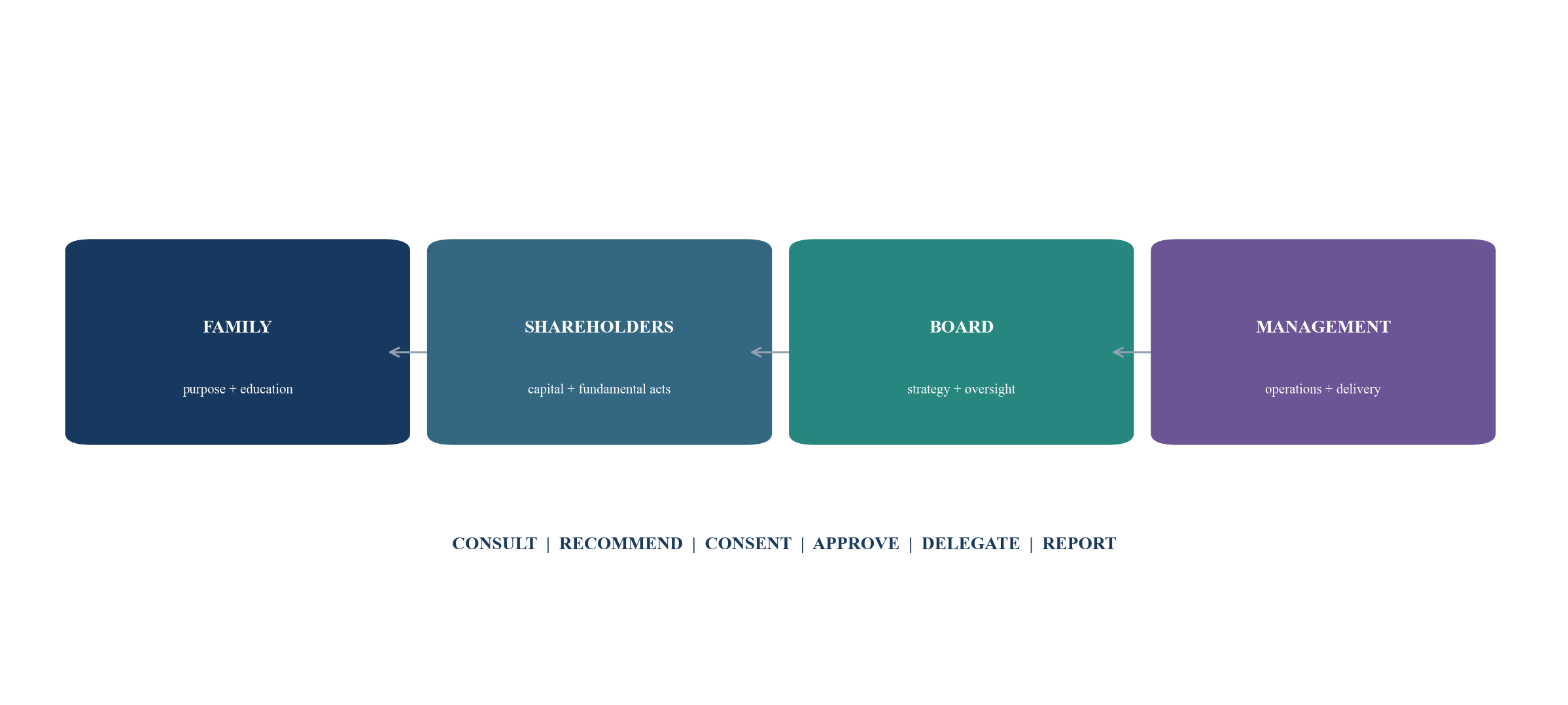
Escalation follows the legally valid decision route. Family consultation does not replace company authority.
Table 4. Reserved-matter and authority matrix
| Matter | Family forum | Shareholder or class role | Board role | Management role |
|---|---|---|---|---|
| family purpose and owner education | develop and review policy | receive relevant recommendations | consider enterprise implications | provide authorised information |
| amendment of class rights | consultation where agreed | approve through required overall and class process | propose or recommend within authority | supply impact analysis |
| dividend | communicate owner context | exercise any valid class or approval right | assess capacity, decide and record as authorised | prepare forecasts and execute payment |
| director appointment | nominate through agreed family process | elect or appoint under valid rights | manage induction, committees and evaluation | support information flow |
| chief executive appointment | express capability principles | no operational role unless documents validly provide one | select, appoint, evaluate and remove | execute mandate and succession plan |
| major acquisition or disposal | receive appropriate communication | approve where law, documents or thresholds require | evaluate, approve and oversee | originate, analyse and implement |
| related-party transaction | maintain family conflict norms | exercise applicable approval rights | identify, manage conflict and decide through valid process | disclose, analyse and implement controls |
| routine operations | no decision role | no decision role | oversee through plan and delegation | decide and deliver within authority |
The actual allocation must follow applicable law and valid documents.
9. Keep management roles merit-based and revocable
Share ownership can remain after an individual leaves management. Employment should therefore have its own eligibility, selection, performance, remuneration, development and exit framework. IFC’s Family Business Governance Handbook discusses family employment policy, boards, independent directors, senior management and chief-executive succession. Its institutional separation is useful for families designing next-generation roles.
A family employment policy can define education, outside experience, vacancies, selection, reporting lines, remuneration benchmarking, performance review, conflict management and removal. It should apply through valid corporate and employment processes. A family council can prepare and educate candidates, while the board retains the appointment authority that applicable law and company documents assign to it.
Stewardship should also be broader than executive employment. A next-generation owner can contribute through owner education, a family council, a board seat earned through a valid process, a committee, philanthropy or a separate venture. Ownership literacy helps every holder understand financial statements, capital allocation, duties, confidentiality, conflicts and the difference between owner expectations and management instruction.
If a share class is linked to an active role, leaver and incapacity rules need careful design. Automatic forfeiture, compulsory transfer or value adjustment can have significant legal and tax effects. The trigger, valuation, funding, timing, dispute and hardship process should be reviewed before the class is issued.
10. Protect minority owners and each affected class
Control can be concentrated while minority rights remain credible. Protection can include timely information, pre-emption, class consent, qualified majorities, independent directors, conflict rules, related-party approval, tag rights, valuation processes and access to remedies. The appropriate package depends on the company, ownership concentration, jurisdiction and financing strategy.
The OECD Principles state that negatively affected classes should approve changes in economic or voting rights and identify pre-emptive rights, qualified majorities and other mechanisms as possible minority protections. The EU Shareholder Rights Directive includes safeguards for material related-party transactions in its listed-company scope. Private family companies can use these sources to frame governance questions while relying on their own applicable law.
Information rights need boundaries. Owners require enough information to exercise their rights. The company also needs confidentiality, data protection, privilege, market-abuse and competitive controls. The rights register should specify the content, frequency, recipient, secure route and permitted use of information, including what happens during a dispute or proposed transfer.
Related-party value flows deserve independent evidence. Transactions with a family member, affiliate or controlled entity should record the interest, commercial rationale, terms, benchmark, approval and recusal. The process protects the company, decision-makers and the family relationship.
11. Model dilution, conversion and future financing
A class structure should be tested through the next financing round before it is implemented. New capital can alter votes, economic participation, board composition, pre-emption and control. Options, convertibles, warrants and contingent shares should be included on an appropriately defined fully diluted basis.
The model should test a strategic investor, employee pool expansion, acquisition consideration, rights issue, down round, preference conversion, redemption and partial sale. It should identify which approvals are required and whether a class right unintentionally blocks financing. It should also show the value and voting consequences for every branch and vehicle.
Rights with formulas require worked examples in the governing documents or an approved operating schedule. Definitions such as “sale,” “control,” “fair market value,” “qualifying holder,” “active family member,” “distribution,” “fully diluted” and “cause” can determine material outcomes. Drafting should reconcile the same term across articles, shareholder agreements, plans, trusts and employment documents.
12. Create liquidity routes before owners need them
Family owners can have different liquidity needs and investment horizons. A transfer restriction without an internal route can trap owners. An unrestricted transfer route can fragment control or introduce an unsuitable holder. The design should provide a sequence of permitted transfers, internal offers, company or family-vehicle purchases, third-party sales and exit rights where legally and financially feasible.
Liquidity policy should address valuation, funding, timing, discounts or premiums, instalments, security, tax, disputes and priority when several owners seek liquidity. The company’s ability to buy back or redeem shares depends on applicable law, documents, capital, solvency, approvals and financing covenants. A standing liquidity reserve may help, while it also competes with reinvestment and dividends.
Death, incapacity, divorce, bankruptcy, sanctions, creditor enforcement and loss of eligibility can create involuntary transfers. The response should align company documents with trust, estate, marital and insurance planning. Local advice is essential because private agreements may not achieve the intended outcome in every jurisdiction.
13. Design deadlock and dispute resolution as a sequence
Deadlock provisions should distinguish disagreement from institutional failure. A board can escalate a reserved matter to shareholders, use an independent committee, obtain expert determination for valuation or technical issues, mediate a family conflict or follow a defined buy-sell process. The chosen route should fit the matter and preserve the business where possible.
Unanimity should be used selectively. It can protect a fundamental bargain and can also allow one holder to block essential action. Thresholds, quorum and class consent should be tested against absence, incapacity, conflict and strategic disagreement. A casting vote, deemed consent or forced sale has significant consequences and requires careful legal design.
The dispute system should preserve records and confidentiality. Owners should know the notice, cure, escalation, interim authority, cost and governing-law rules. The company needs an operating route while the dispute proceeds, including authority for payroll, safety, regulatory obligations and critical customer or lender decisions.
14. Connect ownership succession to leadership succession
Ownership can transfer on a date or event. Capability develops over years. The succession plan should therefore maintain separate pathways for ownership readiness, board readiness and management readiness. A person can advance at different speeds in each pathway.
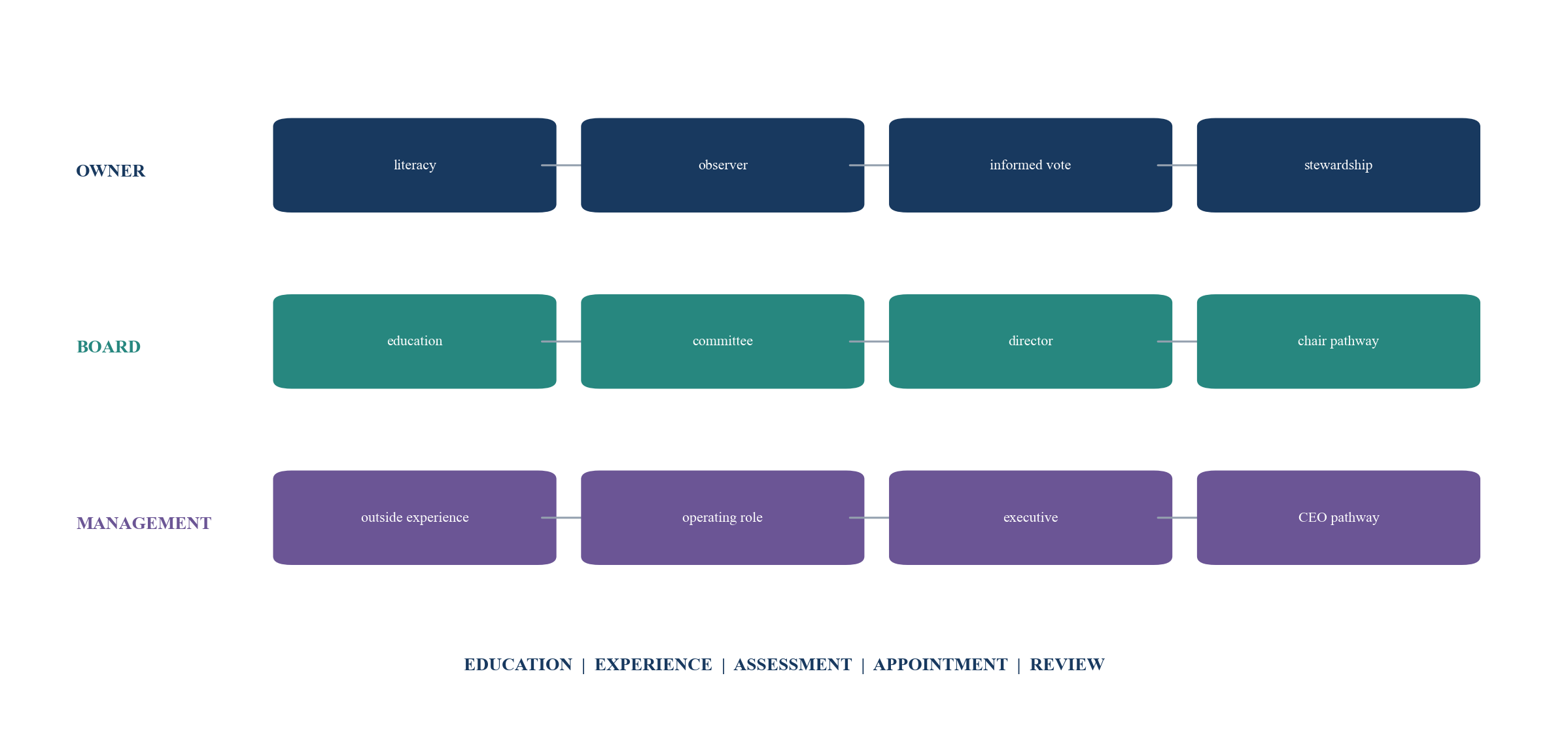
Advancement depends on valid authority and demonstrated readiness in the relevant pathway.
Owner readiness can cover enterprise economics, financial statements, capital allocation, class rights, duties, confidentiality and conflict. Board readiness adds strategy, risk, oversight, judgement and collective decision-making. Management readiness requires operating capability, leadership, delivery and accountability. External education and experience can strengthen all three.
The incumbent generation should also plan its own transition. Decision rights, board roles, executive roles, information access and informal influence should change through an agreed sequence. An honorary title should not create ambiguous executive authority.
15. Demonstrate the framework with a hypothetical transition
Consider a hypothetical global family group valued at USD 600 million before any transaction. The founder owns all voting ordinary shares through a holding company. Three adult children have different roles: one is the operating chief executive, one is a non-executive director with investment experience, and one pursues a career outside the group. The enterprise wants to fund acquisitions, retain family control and create predictable owner liquidity. Every value and outcome in this example is a management assumption for illustration.
The family considers a control class held through a qualifying family vehicle, an economic family class for broader participation, an employee growth class and an external preference class for a future financing. It does not allocate permanent management rights through the shares. The board retains executive appointment and performance authority under the applicable governance system.
Table 5. Hypothetical next-generation capital-rights transition
| Design stage | Illustrative decision | Evidence and control |
|---|---|---|
| purpose | preserve qualifying family control while funding global acquisitions | approved owner-purpose statement and enterprise funding plan |
| ownership | 60% economic participation through qualifying family vehicles; 20% next-generation direct or trust interests; 10% employee pool; 10% external financing capacity | legal, tax, trust and fully diluted ownership analysis |
| votes | enhanced control-class votes with transfer and time-based sunset events | jurisdiction opinion, constitutional drafting and worked voting scenarios |
| dividend | annual board review after legal capacity, operating floor, debt, reserves and approved reinvestment | audited or relevant accounts, rolling forecast and class-allocation model |
| board | family nomination rights subject to ownership thresholds and candidate criteria; independent directors added | nomination policy, skills matrix and shareholder approval route |
| management | chief executive selected and reviewed by the board under a family employment policy | role specification, assessment, contract and annual evaluation |
| liquidity | periodic internal window subject to funding capacity, valuation process and transfer controls | independent valuation method, priority rules and financing plan |
| review | annual rights-register review plus event-driven review before financing, transfer or succession | board and owner calendar, exception log and adviser confirmation |
All values and outcomes are illustrative management assumptions, with no statement of market practice or expected performance.
The worked model tests death, incapacity, departure from management, a sale of shares outside the permitted group, a new financing, an acquisition issue, a dividend suspension and a strategic sale. It reveals that a proposed management-linked voting right would create uncertainty after an executive departure. The family removes that feature and uses board appointment, employment and performance processes for management authority.
The example does not identify the optimal allocation. It demonstrates how the rights register, authority matrix and scenario model expose interactions before documents are signed.
16. Implement the structure through controlled workstreams
The first workstream establishes facts. Advisers verify entities, governing law, ownership, beneficial interests, constitutional documents, agreements, trusts, estates, pledges, options, loans, disputes, tax positions and financing constraints. The board and owners record the enterprise purpose and current authority gaps.
The second workstream develops options. Each option includes a rights register, cap table, voting model, distribution model, board design, management policy, transfer route, funding consequences, tax and accounting analysis, minority protection, deadlock and scenarios. The options should be compared against explicit criteria rather than a preferred label.
The third workstream obtains advice and approvals. Company, trust, estate, tax, employment, regulatory and accounting specialists review the relevant elements. Conflicts are disclosed. Affected classes and decision bodies receive sufficient information and time. Required consents, resolutions, filings and registrations are sequenced.
The fourth workstream executes and reconciles. Documents are signed, consideration and allotments are completed, registers and certificates are updated, elections and appointments occur, plans and employment arrangements are aligned, and every final right is reconciled to the implementation model.
The fifth workstream embeds governance. Owners receive education. The board adopts the dividend, nomination, conflict, information and delegation policies. Management implements reporting. The family forum establishes its calendar and remains within its remit.
17. Establish a recurring governance calendar
Capital rights require maintenance. A new issue, transfer, death, trust change, financing, acquisition, restructuring, employment departure or legal reform can make the rights register incomplete. The company should assign an owner for the register and require event-driven updates.
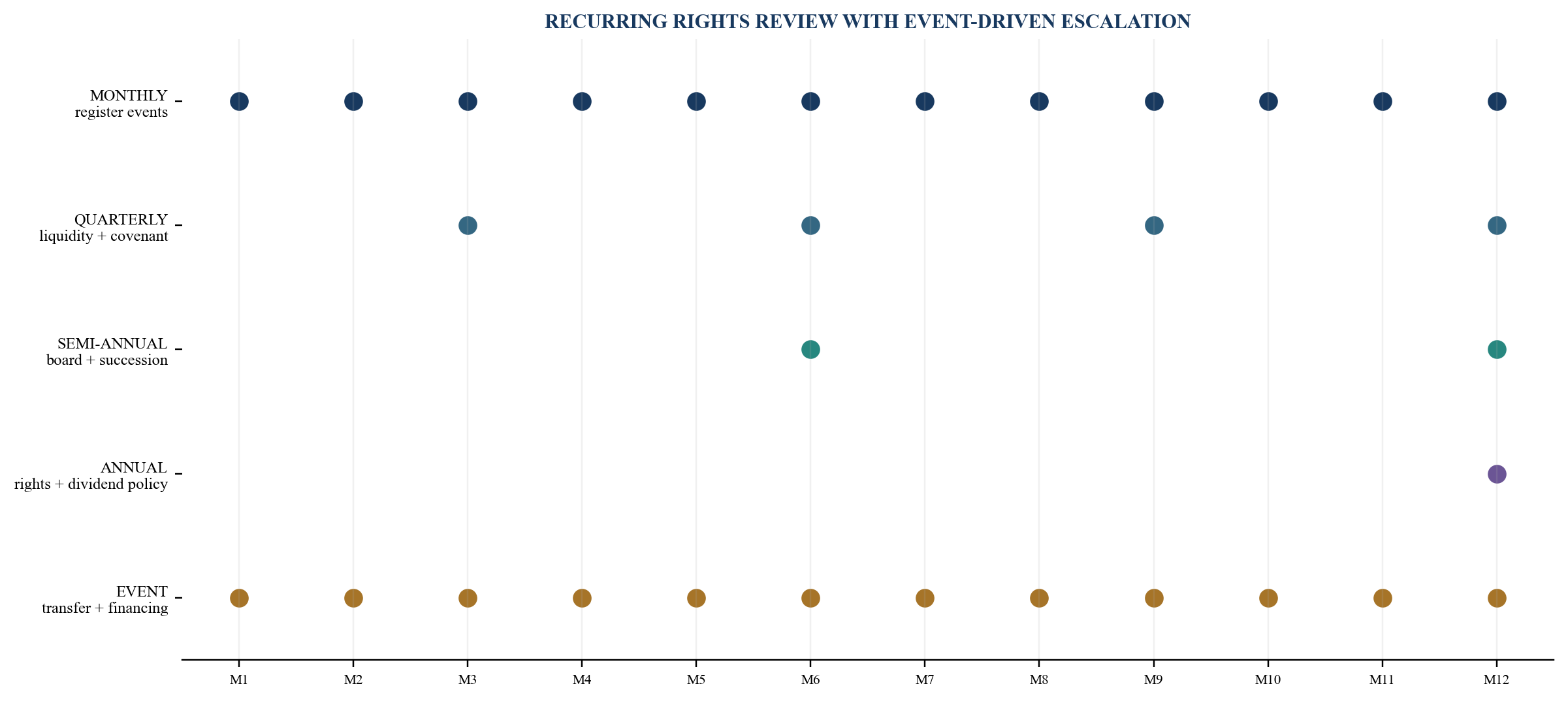
Event-driven review supplements the recurring cycle whenever ownership, finance, roles or law changes.
The monthly review can capture ownership and role events. The quarterly review can test distributions, liquidity, covenants and financing capacity. The semi-annual review can assess board composition, next-generation development and management succession. The annual review can reconcile every right, evaluate the dividend policy and test scenarios.
The calendar should include owner communication. Holders need current class-right summaries, financial information within their entitlement, meeting materials and notice of material changes. Education sessions can use worked examples without replacing the formal documents.
18. Give the board a capital-rights implementation scorecard
The board and authorised owner bodies need evidence that the structure works as documented. The scorecard should cover legal validity, ownership accuracy, economic mechanics, governance, people, liquidity, disputes and operating adoption.
Table 6. Board-ready capital-rights implementation scorecard
| Domain | Governing question | Acceptance evidence |
|---|---|---|
| purpose | does the design support enterprise funding, owner objectives and the intended control horizon? | approved purpose, alternatives analysis and board rationale |
| ownership | can legal, beneficial, voting and economic interests be reconciled? | current registers, documents, ownership map and confirmation process |
| rights | is every dividend, vote, consent, appointment, information, transfer and conversion right explicit? | signed rights register linked to controlling provisions |
| economics | do distribution, dilution, preference and exit models produce the documented outcomes? | reviewed models, worked examples and accounting or tax analysis |
| governance | are shareholder, class, board, management and family decisions separated? | authority matrix, charters, delegations and calendar |
| minority and conflicts | can affected holders understand changes and are related interests governed? | class process, disclosures, recusals and independent evidence |
| management | are executive roles selected, remunerated and reviewed through a merit-based process? | employment policy, contracts, performance and succession records |
| liquidity | can voluntary and involuntary transfers follow a feasible, funded and documented route? | transfer rules, valuation, funding and event scenarios |
| implementation | have approvals, filings, registers, certificates, appointments and policies been completed and reconciled? | closing checklist and independent post-close review |
| resilience | does the structure operate through death, incapacity, dispute, financing and strategic change? | scenario tests, exception actions and annual reassessment |
Acceptance requires current evidence and a named owner for every material exception.
19. Use the rights register as a living constitution
The most useful output is a current operating view of who may receive, decide, supervise and manage. It should allow a director, owner, trustee, executive and adviser to trace each material right to its source and understand the conditions around it. Formal legal documents remain controlling; the rights register provides the reconciled governance interface.
The register should record amendments and historical states. A board considering a dividend needs the current economic rights. A company secretary preparing a vote needs the current voting and class-consent position. A family council planning education needs the owner population and governing calendar. An acquisition team issuing consideration needs the dilution and approval model.
Annual review should ask whether the structure still serves its purpose. The next generation develops, enterprises diversify, families expand and financing changes. A valid design can become operationally unsuitable. Change should follow the required legal, class, board, trust and family processes, supported by current evidence and advice.
Next-generation capital rights work when the economic bargain, ownership control, board accountability and management authority are understandable and executable. The objective is a durable system in which capital can move, leaders can lead, owners can exercise their rights and the enterprise can adapt without relying on undocumented family expectations.
References
- Organisation for Economic Co-operation and Development, G20/OECD Principles of Corporate Governance 2023, 11 September 2023, https://www.oecd.org/en/publications/g20-oecd-principles-of-corporate-governance-2023_ed750b30-en.html
- Organisation for Economic Co-operation and Development, The Rights and Equitable Treatment of Shareholders and Key Ownership Functions, 2023, https://www.oecd.org/en/publications/g20-oecd-principles-of-corporate-governance-2023_ed750b30-en/full-report/component-5.html
- International Finance Corporation, Family Business Governance Handbook, https://www.ifc.org/en/insights-reports/2011/ifc-family-business-governance-handbook
- International Finance Corporation, Family Business Governance, https://www.ifc.org/en/what-we-do/sector-expertise/corporate-governance/family-business-governance
- United Kingdom, Companies Act 2006, including Parts 17 and 23, https://www.legislation.gov.uk/ukpga/2006/46/contents
- United Kingdom, Companies Act 2006 Explanatory Notes, including sections 629 and 630, https://www.legislation.gov.uk/ukpga/2006/46/notes/contents
- Delaware General Assembly, Delaware General Corporation Law, Title 8, section 151, https://www.delcode.delaware.gov/title8/c001/sc05/index.html
- Delaware General Assembly, Delaware General Corporation Law, Title 8, section 212, https://www.delcode.delaware.gov/title8/c001/sc07/index.html
- Dubai International Financial Centre, Companies Law, DIFC Law No. 5 of 2018, https://www.difc.com/business/laws-and-regulations/legal-database/difc-laws/companies-law-difc-law-no-5-2018
- Accounting and Corporate Regulatory Authority Singapore, Understanding Share Types and Shareholding, updated 29 January 2026, https://www.acra.gov.sg/manage/companies/shares/share-types-and-shareholding/
- Accounting and Corporate Regulatory Authority Singapore, Companies Model Constitutions Regulations 2015, consolidated 9 December 2024, https://www.acra.gov.sg/docs/default-source/default-document-library/how-to-guides/setting-up-a-local-company/companies-%28model-constitutions%29-regulations-2015-%2810-may-2024%29.pdf
- European Union, Directive (EU) 2017/828 Amending Directive 2007/36/EC as Regards the Encouragement of Long-Term Shareholder Engagement, https://eur-lex.europa.eu/legal-content/EN/ALL/?uri=CELEX:32017L0828
About the Author
Chennakeshav Adya is an independent researcher and Managing Partner of Matchpoint Partners. His work examines strategy, capital formation, valuation, transactions and operating execution across private and public markets.
