
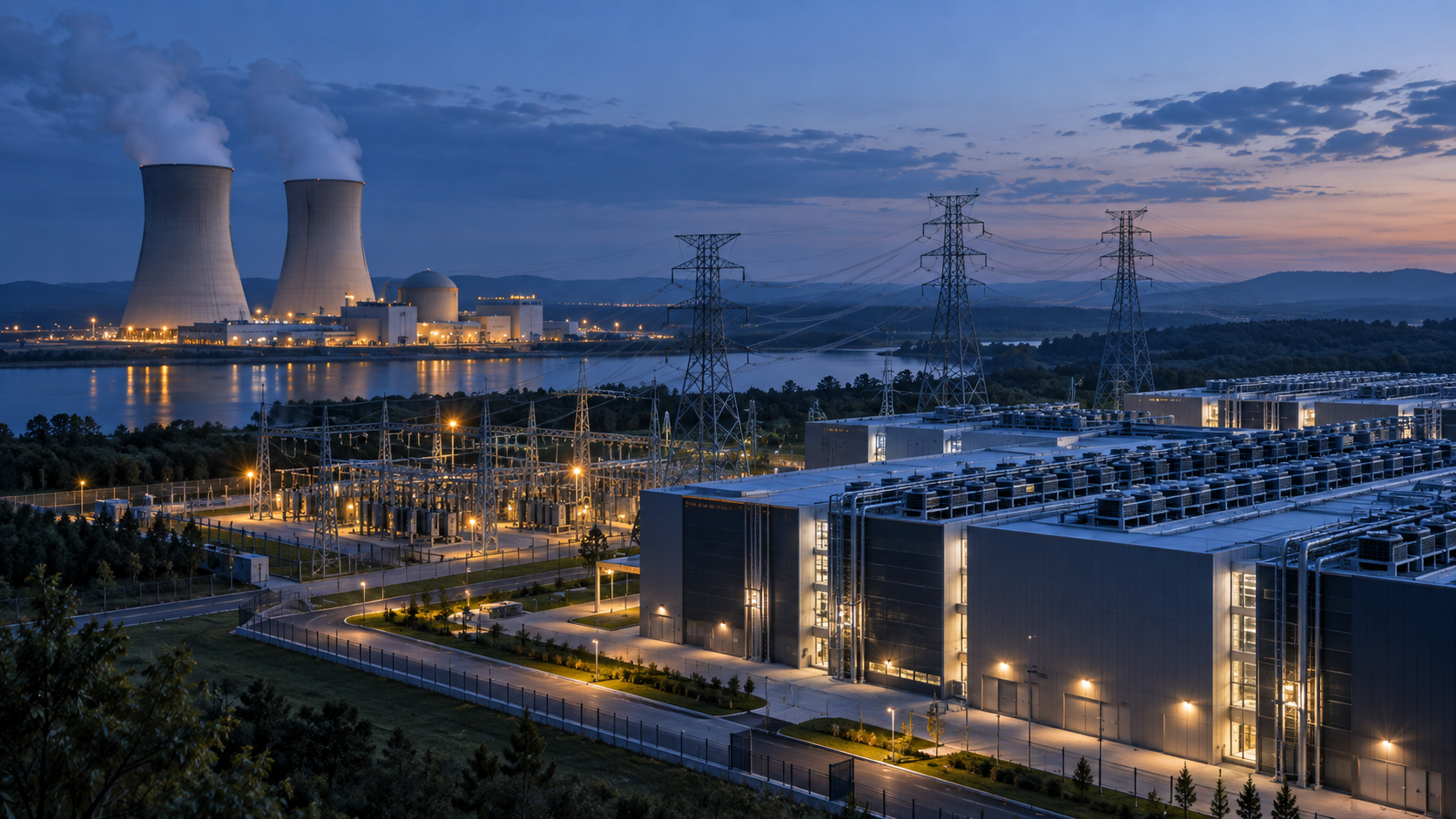
1. The investment decision
An AI data-centre sponsor does not buy electricity as a standard operating input. It secures a long-duration right to convert electrical capacity into compute output. The commercial value of a site depends on when power arrives, how much firm capacity is available, what happens during grid or reactor outages, how costs change with utilisation, and whether expansion can be financed before demand shifts elsewhere.
The central decision is the architecture that connects generation, grid and compute. A campus can take ordinary or specially contracted utility service, procure nuclear output through a grid-delivered power purchase agreement, or locate physically beside a nuclear plant. Each route creates a different allocation of infrastructure, market, regulatory and operating risk. The correct comparison begins with delivered compute capacity rather than a headline electricity price.
2. Why AI changes the power requirement
Training and inference infrastructure concentrates demand in fewer, larger sites. The International Energy Agency reported that data centres used about 415 TWh globally in 2024 and projected consumption of about 945 TWh in 2030 in its base case. The IEA also emphasised the local character of the constraint: data-centre loads can cluster around network, fibre, land and workforce, creating grid pressure that national averages conceal.
An AI campus may seek hundreds of megawatts in a timetable shorter than the development cycle for new transmission or nuclear capacity. Electrical infrastructure therefore becomes a gating asset. A month of delayed energisation can defer server commissioning, customer revenue and contracted cloud capacity. The opportunity cost can exceed a modest difference in the nominal energy price.
3. Nuclear power as a compute input
Nuclear plants can deliver high annual output, low operational carbon emissions and long asset lives. Existing plants also possess operating teams, grid connections and established sites. New reactors can add firm capacity, though licensing, construction, fuel and commissioning schedules remain material. The underlying generation asset must be assessed separately from the commercial structure used by the data centre.
The US Department of Energy describes both opportunities and challenges for nuclear-powered data centres. Potential advantages include continuous generation and possible co-location. Challenges include grid-fee treatment, backup, fuel, waste, security and the effect on other electricity users. These issues place contract and regulatory design at the centre of the transaction.
4. Three commercial architectures
The first architecture is utility supply. The data centre receives power under a utility tariff or negotiated large-load arrangement, while the utility manages generation procurement, transmission, balancing and reserves. The second is a grid-delivered nuclear PPA or related commercial agreement. The data centre contracts with a generator or utility for energy, capacity or clean-energy attributes, with delivery and settlement through the grid. The third is physical co-location, where the campus sits adjacent to generation and may take power behind the meter or through a dedicated configuration.
These labels conceal variants. A utility can create a special tariff linked to a nuclear investment. A PPA can be physical, sleeved or financially settled. A co-located campus can remain grid connected and depend on the network for backup. Decision documents should define the actual metering, dispatch, title, settlement and reliability arrangements.
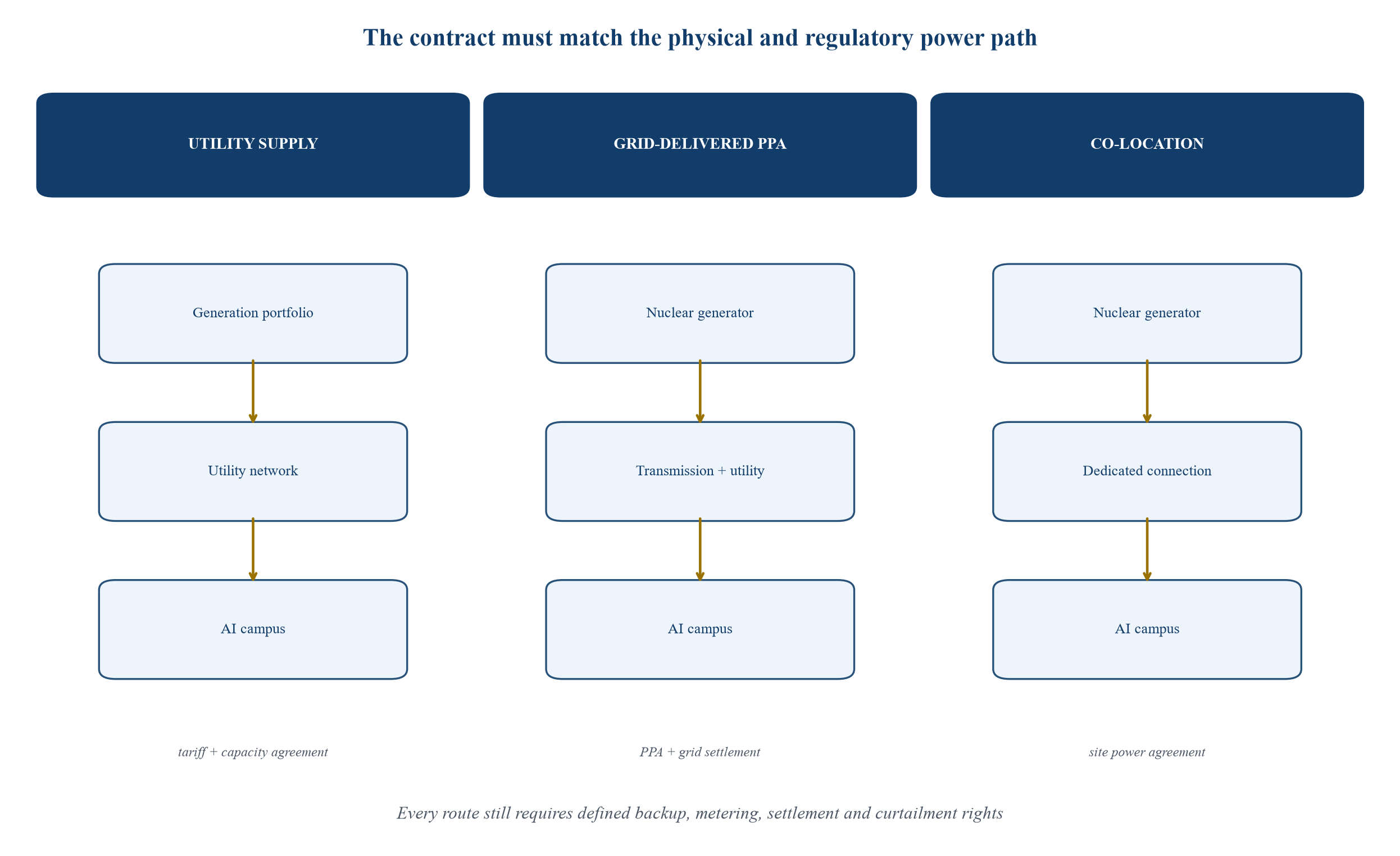
Generic commercial structures. Physical flows, title, balancing responsibility and regulatory treatment depend on the jurisdiction and contracts.
5. Utility supply
Utility supply places the network and portfolio between the plant and the campus. The utility procures or generates electricity, maintains system balance and charges the customer under an approved tariff or negotiated contract. This structure can provide access to a diversified generation fleet and established reliability services. It can also integrate the customer into broader transmission and distribution planning.
The customer remains exposed to energisation timing, tariff evolution, network constraints and the utility's ability to procure new firm supply. A standard tariff may not provide enough cost certainty for a multibillion-dollar compute investment. A large-load agreement can add minimum demand, security, construction contributions, ramp schedules and termination payments.
6. Special tariffs and clean transition tariffs
Utilities increasingly consider tariffs designed for large customers seeking new clean generation. A tariff can recover the cost of a dedicated resource, allocate development risk to the sponsoring customer and preserve regulatory oversight. It may also pool balancing and reserve services across the system.
The sponsor should examine cost causation, prudency review, stranded-cost protection, resource substitution and treatment of unused capacity. A tariff that merely references clean energy without binding resource, delivery or timing rights may provide weak commercial protection. The financing package should identify which obligations are enforceable by the customer and which depend on future regulatory decisions.
7. Grid-delivered nuclear PPA
A grid-delivered PPA aligns a data centre with a specified nuclear plant or portfolio while retaining grid delivery. The agreement may cover energy, capacity, environmental attributes or a fixed commercial payment. It can support continued operation, uprates, restart or new construction. Recent corporate agreements involving operating nuclear plants illustrate long-tenor demand for carbon-free supply.
Grid delivery preserves access to network backup and allows the generator and campus to remain at different locations. The customer still depends on transmission availability, market rules and settlement. A contract for output at the generator node does not automatically guarantee physical delivery or price certainty at the load node.
8. Physical and financial settlement
A physical PPA specifies sale and delivery within the electricity market and usually requires a licensed utility, supplier or scheduling entity. A sleeved structure places an intermediary between generator and customer. A virtual PPA settles the difference between a contract price and a market reference while the customer continues to buy physical electricity separately.
The accounting, credit and risk profile differs across these forms. A financial settlement can hedge revenue or prices and transfer environmental attributes, while leaving the campus exposed to local utility charges and basis. The investment committee should reconcile every payment under the PPA with every payment needed to operate the site.
9. Co-location
Co-location places the data centre near a nuclear plant and links them through dedicated infrastructure. The arrangement may sit behind the generator meter, use a separate load meter, or combine direct supply with grid service. Physical proximity can reduce certain transmission dependencies and create a clear relationship between generation and compute load.
The structure raises questions about grid charges, use of an existing interconnection, backup, reliability services and impacts on other customers. FERC proceedings concerning large co-located loads in PJM show that tariff clarity is central. Commercial parties should not treat geography as a substitute for an approved service and settlement design.
10. The delivered-power boundary
Each proposal needs one defined boundary for price and performance. The price can be quoted at the generator bus, site substation, utility meter or server hall. Losses, congestion, transmission, distribution, ancillary services, backup and taxes may sit outside the headline price.
A comparable model should calculate the all-in cost at the campus meter and then adjust for availability and curtailment. Capital contributions for substations, transmission and backup should be annualised or included in project returns. The same boundary should be used across all architectures.
11. Speed to power
Energisation date can dominate the business case. Utility supply may be quick where spare network capacity exists and slow where upgrades or new generation are required. A PPA can be signed quickly while physical delivery remains constrained. Co-location can shorten part of the network path, while site approvals, dedicated infrastructure and regulatory treatment can extend the timetable.
The schedule should show the critical path through land, permitting, interconnection, equipment, construction, commissioning and staged load ramp. Contract dates should distinguish initial energisation, firm capacity, full campus capacity and commercial remedy dates.
12. Interconnection and transmission
Large-load interconnection determines whether the system can serve the campus without unacceptable reliability effects. Studies may identify network upgrades, protection changes, reactive-power needs and operating restrictions. Generation interconnection rights do not necessarily confer the right to serve a large adjacent load under unchanged terms.
The project should secure clarity on study scope, cost responsibility, upgrade ownership, refundability, queue position and milestone security. Transmission availability should be tested at the load level and the generator level. A nominal 500 MW contract has limited value where network conditions permit materially less delivery during critical periods.
13. Regulatory jurisdiction
Utility supply usually sits within established retail and wholesale regulation. A PPA can engage market, licensing and financial-settlement rules. Co-location can change how regulators view the generator's interconnection service, load service and contribution to grid costs. The governing regime may differ between vertically integrated and competitive markets.
Legal analysis should map the physical assets, contractual title and market roles to each regulator. It should identify approvals, tariff filings, affiliate rules, consumer protections and possible changes in law. A structure that depends on an unsettled interpretation should carry explicit schedule and capital contingency.
14. Fair allocation of grid costs
A co-located customer may use the grid for backup, exports, balancing, black start, reserves or emergency support even when most energy comes directly from a plant. Regulators therefore examine whether the customer pays an appropriate share of system costs. Other users may object if a large load avoids charges while retaining valuable network services.
The transaction should quantify each service used and the corresponding payment. Transparent allocation can improve durability and reduce litigation risk. The customer can preserve the economics of proximity while paying for measurable system support.
15. Firm and non-firm service
Firm service gives the customer a stronger right to take capacity subject to defined reliability rules. Non-firm or interruptible service allows curtailment under wider conditions and may accelerate connection. A campus can combine a firm base tranche with flexible growth tranches.
The value of non-firm capacity depends on workload flexibility, notice, duration and frequency. A promise to curtail is credible only where the compute operator can execute it without breaching customer commitments or damaging equipment. The power contract, workload scheduler and revenue model should use the same curtailment assumptions.
16. Reactor outages
Nuclear plants undergo planned refuelling and maintenance outages and can experience unplanned trips. A co-located campus cannot assume continuous direct supply from one unit. A grid-delivered structure may diversify physical supply while retaining exposure to contract replacement-cost provisions.
The sponsor should model outage frequency, duration, coincidence and restart. Backup can come from the grid, another reactor, gas generation, storage or demand reduction. The agreement should define who procures replacement power and who bears the cost.
17. Grid outages and network events
Utility and PPA structures depend on network availability. A direct co-located connection can reduce exposure to some transmission events, while creating a concentrated site dependency. The system design should consider common-cause events affecting the plant, substation and campus.
Redundant feeds, independent substations, sectionalised buses and geographically separate backup can reduce concentration. The required resilience standard should follow the economic consequences of interruption and the service commitments made to compute customers.
18. Load loss and return
NERC has examined emerging large loads because rapid loss and restoration of hundreds of megawatts can affect frequency, voltage and system operations. Data-centre controls, power electronics and ride-through settings can create system behaviour that differs from traditional industrial loads.
Interconnection studies should include credible load-trip and return sequences. Operating protocols should define ramp rates, restoration, communications and emergency actions. The campus and system operator need tested control interfaces before full load is admitted.
19. Compute flexibility
Some workloads can move by time or location. Batch training, model evaluation and certain inference tasks may tolerate delay or transfer. Other services require immediate local response. Flexibility has financial value when it reduces grid-upgrade needs, curtailment cost or peak-energy exposure.
The sponsor should measure flexibility by workload, duration, notice and recovery. Contracted flexibility should be supported by orchestration systems and customer terms. A generic statement that AI load is flexible does not establish an operating capability.
20. Capacity ramp
A campus typically energises in phases. The power agreement should match substations, data halls, server delivery and customer demand. Taking full contracted capacity too early can create demand charges and stranded power. Taking too little can breach minimum commitments or weaken the generator's financing.
A ramp table should specify monthly or quarterly capacity, firmness and take-or-pay. Expansion options should carry defined exercise dates, price methodology and interconnection rights. The counterparty should understand whether unused capacity can be resold.
21. Contract tenor
Nuclear assets favour long revenue visibility. AI hardware and business models can change more quickly. A 20-year power contract can outlive several server generations and changes in compute demand. The resulting maturity mismatch requires careful termination and assignment design.
The customer can use phased commitments, capacity options, portfolio transfer and credit support that declines with amortisation. The generator needs enough certainty to finance the relevant investment. The negotiated solution should connect termination value to unrecovered capital rather than a broad penalty detached from loss.
22. Credit support
The power seller, utility and infrastructure providers may invest in reliance on the campus commitment. They can require parent guarantees, letters of credit, prepayments or collateral. The data-centre project company may have limited assets before operation, while its sponsor may seek ring-fencing.
Credit support should vary with construction exposure, energised capacity and counterparty replacement options. It should also cover decommissioning of dedicated infrastructure where applicable. Lenders need direct agreements, cure rights and assignment provisions.
23. Price architecture
The commercial price can include energy, capacity, network, balancing, environmental attributes, fuel, operation and maintenance, escalation and taxes. A single fixed price can transfer risk to a counterparty that may lack capacity to absorb it. A pass-through structure can leave the customer exposed to volatile components.
The model should identify each index, cap, collar and reopening right. Nuclear fuel is a smaller share of total cost than in fossil generation, yet capital recovery and operating performance remain central. Price protection should be tested against counterparty solvency.
24. Basis and congestion
A PPA settled at the generator node can diverge from the price at the data-centre load. Congestion and losses create basis risk. The spread can increase when network conditions change or new generation and load alter flows.
The sponsor can use a delivered contract, transmission rights, hub settlement, collars or a portfolio hedge. Each tool has liquidity and tenor limits. The downside case should include persistent basis widening rather than relying only on historic averages.
25. Environmental attributes
A nuclear agreement may transfer energy attributes or other recognised certificates. The legal status and reporting treatment depend on jurisdiction and programme rules. A claim about carbon-free energy should match the attributes owned, the time interval and the physical or contractual arrangement.
Hourly matching creates a more demanding standard than annual volume matching. Nuclear output can contribute materially because it is available across many hours. Planned outages and residual grid supply should remain visible in reporting.
26. Additionality
An agreement can support continued operation of an existing plant, restart a retired unit, uprate capacity or finance new construction. Each pathway has a different additionality case. The commercial narrative should specify the causal role of the customer contract and avoid treating all nuclear procurement as equivalent.
Microsoft's agreement associated with the planned restart of Three Mile Island Unit 1, Google's agreements involving Kairos Power and TVA, and corporate support for operating fleets show several models. Their terms and physical arrangements differ, so they should be used as transaction references rather than interchangeable templates.
27. Existing plant economics
An operating plant offers performance history, licensed capacity and established infrastructure. A long-term corporate agreement can strengthen revenue certainty and support investment. The customer should review licence term, capital requirements, outage record, uprate potential, labour, fuel and decommissioning obligations.
Life-extension expenditure and market revenue may interact with the contracted price. The agreement should address retirement, licence failure and material capital projects. Replacement power provisions become important because an existing unit can retire before a long data-centre lease ends.
28. Restart economics
Restarting a plant can add firm capacity faster than greenfield construction where the facility, licence pathway and supply chain remain viable. The project still requires equipment assessment, regulatory approval, workforce mobilisation, fuel and commissioning. Historic operation does not eliminate restart risk.
The data-centre customer should stage payments against verified milestones and preserve alternatives if the restart slips. The generator needs adequate funding and a clear route to recover approved costs. Completion support should reflect remaining technical uncertainty.
29. New-build nuclear
New large reactors and small modular reactors can expand supply beyond the existing fleet. Their schedules and costs depend on design maturity, licensing, site, supply chain, fuel and construction. A data-centre contract can improve revenue certainty, while the campus should avoid bearing risks it cannot control.
A long-term agreement should separate development support, construction commitments and operating purchases. Financial close, notice to proceed, commercial operation and performance tests need distinct conditions. The customer should retain staged capacity alternatives until delivery confidence is sufficient.
30. Small modular reactors
SMRs may offer smaller increments, modular construction and closer matching to campus growth. First deployments carry technology, licensing and supply-chain risk. Fleet economics depend on repetition and order cadence.
Google's agreement with Kairos Power and Amazon's support for X-energy-related development illustrate customer interest in advanced reactors. Investment committees should distinguish announced targets from operating evidence. Contract value should be released against measurable development and delivery gates.
31. Utility-mediated nuclear procurement
A utility can purchase output from a nuclear project and supply the data centre under a tariff or bilateral arrangement. TVA's announced structure involving Kairos and Google illustrates a utility-mediated pathway. The utility can integrate generation into system planning and manage delivery to the customer.
This route may align generation, network and regulatory decisions. The customer should understand the utility's resource commitment, cost-recovery approval and substitution rights. The generator should understand whether utility credit and regulatory recovery support financing.
32. Direct co-location precedent
Amazon's transaction involving a data-centre campus adjacent to the Susquehanna nuclear plant brought national attention to co-location. The commercial attraction includes proximity to firm generation and existing infrastructure. Regulatory proceedings have focused on tariff treatment and the relationship between generator interconnection service and large adjacent load.
The lesson is structural. A transaction can be commercially signed while material market-rule questions remain. Sponsors should include regulatory conditions precedent, alternate service paths and termination rights tied to enforceable outcomes.
33. Front-of-meter corporate agreements
Meta's 20-year agreement supporting the Clinton nuclear plant and Microsoft's agreement associated with the planned Three Mile Island Unit 1 restart use front-of-meter structures. The generation remains connected to the broader grid, and the corporate agreement supports economic or development objectives.
Such structures can preserve grid-wide benefits and avoid a dedicated physical link. The customer still requires a separate path for physical electricity at its data centres. Claims, price risk and regional matching should follow the actual agreement.
34. Integrated energy and compute campuses
Projects such as Fermi America's proposed campus in Texas combine generation and very large AI infrastructure within one development. Integrated campuses can coordinate land, power, cooling, transmission and compute phasing. They also concentrate development, capital and execution risk.
The financing should separate common infrastructure, generation assets and data-centre assets where their risk and investor bases differ. Cross-defaults, shared security, completion tests and transfer rights need deliberate design. Common ownership does not remove the need for arm's-length risk allocation.
35. Site and land rights
Co-location requires land, easements, security boundaries, construction access and rights for dedicated electrical infrastructure. Nuclear sites carry security and emergency-planning requirements. Data-centre operations introduce a separate workforce, supply chain and cyber perimeter.
The site plan should preserve regulated nuclear operations and future reactor needs. Lease term, renewal, expansion, casualty and termination should align with the power contract. A data centre that loses its site right can lose the practical value of its energy agreement.
36. Cooling and water
Nuclear plants and data centres can both require substantial cooling infrastructure, depending on technology and climate. Co-location may create opportunities for shared water or heat systems, while also increasing site resource competition. Water permits and drought resilience can constrain expansion.
The transaction should model water source, treatment, discharge, temperature, redundancy and capital responsibility. Alternative cooling systems may reduce water use while raising electricity consumption or capital cost. The power price comparison should include these interactions where material.
37. Security and cyber separation
Nuclear facilities operate under specialised physical and cyber-security regimes. A neighbouring data centre brings high-value digital infrastructure and substantial communications. Shared systems can create efficiency and common-cause risk.
The design should separate operational technology, corporate networks, access control and emergency communications. Interfaces should be minimised, authenticated and monitored. Contracts should define incident reporting, audit, liability and regulator access without exposing protected information.
38. Metering and settlement
Meters establish who bought, sold and used each unit of electricity. A co-located configuration can include generator output, grid imports, grid exports, station service, storage and campus load. Ambiguous metering can create billing, tax and regulatory disputes.
The parties should approve a single-line diagram, meter hierarchy, loss factors, time intervals, testing and data rights. Settlement should address outages, curtailment, negative prices, auxiliary load and meter failure. Lenders need access to the same data used for payment.
39. Islanding
Islanding allows a campus and generation source to operate separately from the wider grid under defined conditions. It requires technical controls, protection, stable frequency and voltage, and sufficient generation balance. A nuclear unit may not be designed to follow rapid load changes or restart an isolated system without support.
The project should treat islanding as an engineered operating mode, not a marketing label. It needs system studies, regulator and operator approval, commissioning tests and recurring drills. Backup generation or storage may be required to manage transitions.
40. Backup architecture
Backup can be provided by dual grid feeds, gas turbines, batteries, diesel generators, another nuclear unit or contracted load reduction. Each option has limits on duration, emissions, fuel, permitting and response. Short-duration batteries can bridge trips while longer outages require sustained supply or workload relocation.
The resilience plan should connect electrical design with compute recovery. It should state which loads remain online, how long, and at what service level. The cost of backup belongs in the architecture comparison.
41. Financing the data-centre side
Lenders to a data centre underwrite energisation, lease-up, customer credit, technology refresh and residual value. The power package affects each element. A delayed or interruptible connection can reduce achievable utilisation. A long take-or-pay power commitment can create fixed cost before compute revenue stabilises.
Financing conditions can require executed utility and power agreements, completed interconnection works, redundancy tests and adequate delay liquidity. The base case should reconcile megawatts of electrical capacity with sellable IT capacity after cooling and facility overhead.
42. Financing the nuclear side
Nuclear lenders and investors require durable revenue, completion protection, operating evidence and regulatory clarity. A data-centre customer can provide long-term demand and strong credit. It may also create concentration where one customer supports a large share of the plant.
The agreement should address customer default, demand reduction, assignment and replacement. The generator's financing should survive plausible changes in the compute sponsor. A utility or portfolio of customers can diversify exposure.
43. Shared infrastructure finance
Substations, transmission, water, roads and common site systems may serve generation and compute. They can be funded by the utility, generator, campus, infrastructure investor or a separate project company. Ownership affects tariff recovery, security and operational control.
A shared-infrastructure vehicle can allocate capacity and costs transparently. Its contracts should define construction, access, expansion, maintenance and step-in. Financing requires predictable payments and clear treatment when one linked project is delayed.
44. Hypothetical architecture comparison
Table 1. Decision comparison for three nuclear-to-compute architectures
| Criterion | Utility supply | Grid-delivered nuclear PPA | Physical co-location |
|---|---|---|---|
| initial commercial simplicity | established tariff pathway where capacity exists | requires PPA, delivery and settlement arrangements | requires site, direct connection and specialised tariff treatment |
| generation diversification | generally high across utility portfolio | physical supply remains grid diversified | can be concentrated on adjacent unit unless backup is secured |
| price visibility | depends on tariff and pass-throughs | can be high for contracted components | can be high for direct energy, with backup and grid charges separate |
| speed to power | strong where spare capacity exists; weak where upgrades are extensive | contract can precede physical network capacity | may reduce some network scope; regulatory and site work remain |
| carbon-free matching | depends on utility mix and attributes | strong where nuclear attributes and intervals are defined | strong direct relationship, subject to outage and backup treatment |
| grid exposure | full | transmission, basis and utility exposure remain | lower for direct flow; backup and system-service exposure remain |
| regulatory novelty | usually lower | moderate and market-specific | potentially high where tariffs do not address co-location |
| lender bankability | established if capacity and tariffs are durable | strong with creditworthy parties and delivered-risk clarity | strong only after metering, backup, grid charges and approvals are settled |
Generic framework. Ratings depend on the actual grid, contracts, reactor, utility and regulatory regime.
45. Hypothetical 500 MW capacity economics
The following model compares three architectures for a 500 MW contracted campus. It uses identical campus utilisation and excludes server, building and land costs. Values are illustrative monetary units per MWh or annual monetary units. They do not represent an observed market quote.
Table 2. Illustrative annual delivered-power economics for a 500 MW campus
| Component | Utility supply | Grid-delivered PPA | Co-location |
|---|---|---|---|
| energy and generation | 58 | 54 | 49 |
| transmission, distribution and losses | 14 | 13 | 4 |
| balancing, reserves and backup | 5 | 6 | 11 |
| annualised dedicated infrastructure | 2 | 3 | 7 |
| indicative delivered cost per MWh | 79 | 76 | 71 |
| annual delivered-power cost | 294.1m | 282.9m | 264.3m |
| assumed delay to full 500 MW | 24 months | 30 months | 36 months |
| assumed firm availability | 99.95% | 99.95% | 99.90% |
Hypothetical decision tool. Assumes 85 percent campus load factor and 3.723 million MWh annual consumption. Values exclude taxes and data-centre capital expenditure.
The apparent co-location cost advantage in this illustration is sensitive to backup, delay and dedicated infrastructure. The table therefore should not be read as a ranking. It demonstrates why the investment committee must place cost, timing and availability on one page.
46. Delay economics
A lower long-run power price can be outweighed by later energisation. The sponsor should calculate lost contribution from delayed compute, additional capitalised interest, idle site cost, equipment holding and customer remedies. Delay value should reflect the expected ramp rather than full capacity from day one.
The comparison should also recognise option value. Utility capacity available earlier can support an initial phase while a nuclear-linked structure serves later expansion. A staged portfolio may dominate an all-or-nothing commitment.
47. Stranded capacity
The campus may contract power before server demand is certain. Technology efficiency, customer mix, export controls or market competition can reduce required capacity. Long take-or-pay commitments then become stranded obligations.
Mitigants include phased capacity, resale rights, affiliate transfer, colocation customers, grid export and termination schedules linked to unrecovered investment. Each option depends on market rules and infrastructure. The financial model should assign probability and recovery value rather than assuming full redeployment.
48. Downside sensitivities
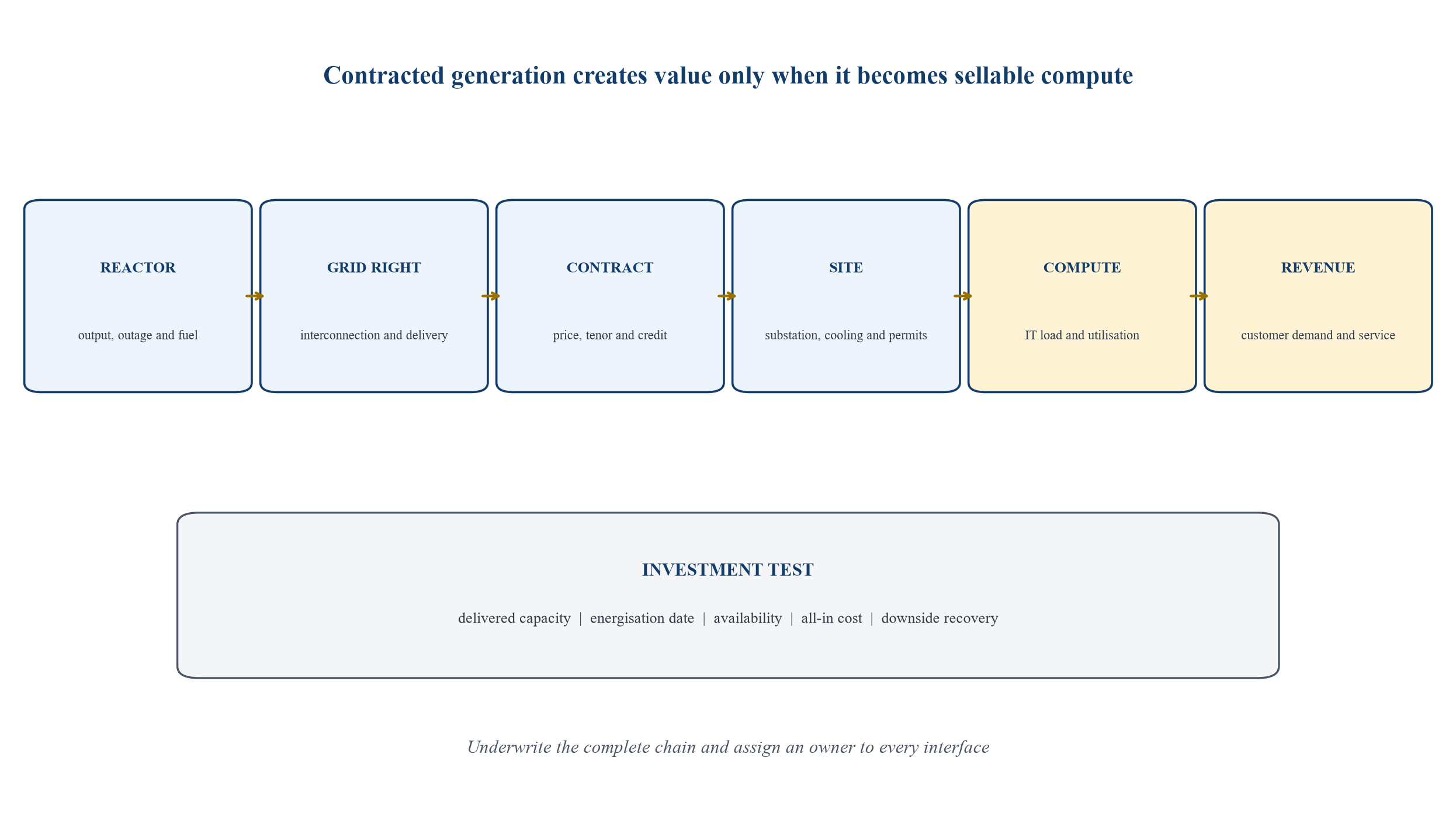
The commercial value of contracted megawatts depends on every link. A failure upstream can delay or reduce sellable compute output.
49. Quantified stress cases
The main sensitivities are energisation delay, power unavailability, basis widening, tariff reopening, unused capacity and early reactor retirement. They affect different parts of the capital structure. Delay consumes liquidity. Availability affects compute revenue. Price changes affect margin. Stranded capacity creates fixed obligations without corresponding income.
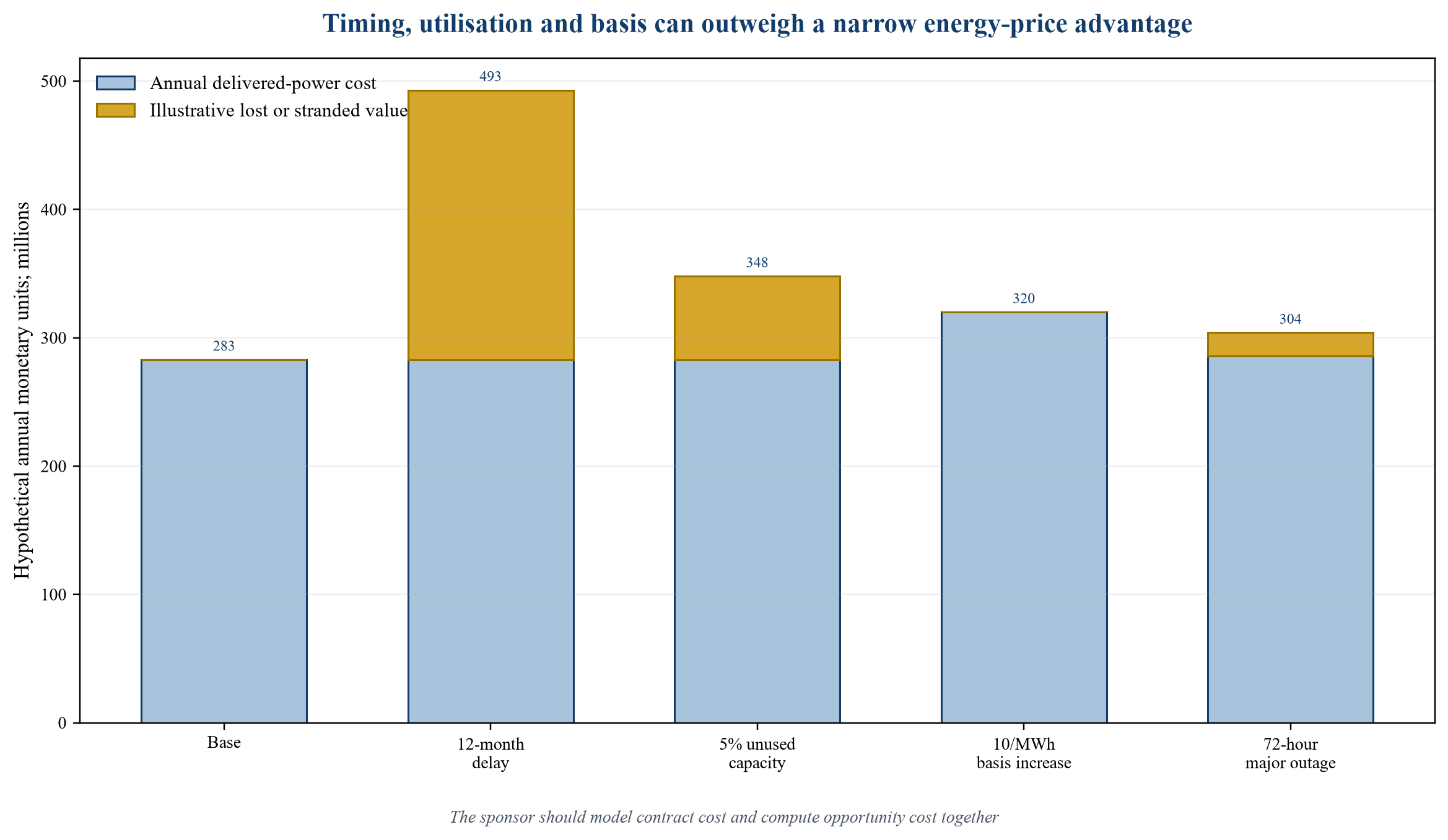
Hypothetical scenario display for a 500 MW campus. Values are decision aids and do not represent a forecast or named transaction.
50. Risk allocation
Table 3. Nuclear-to-compute risk allocation matrix
| Risk | Primary controller | Commercial bearer | Bankability instrument | Evidence gate |
|---|---|---|---|---|
| reactor delivery or restart | generator, vendor and contractors | generator equity, public support and completion providers | staged commitments, completion support and long-stop rights | licence, funded construction plan and tested milestones |
| large-load interconnection | utility, transmission owner and system operator | campus sponsor within agreed contributions | interconnection agreement, upgrade budget and milestone protection | completed studies and executable service agreement |
| grid charges and tariff | regulator and utility | customer under approved tariff | filed tariff, cost-allocation principles and change-in-law process | effective regulatory approval |
| outage and replacement power | generator, utility and customer | allocated under PPA or site agreement | availability standard, backup contract and liquidated remedies | tested backup and operating protocol |
| basis and congestion | generator and customer under agreed delivery point | customer or intermediary | delivered price, hub settlement or hedge | modelled node-to-load exposure and hedge capacity |
| unused capacity | compute sponsor | customer, subject to resale and transfer | phased ramp, options, resale and termination schedule | customer pipeline and approved capacity plan |
| customer credit | compute sponsor | generator, utility and lenders after security | guarantee, letter of credit and direct agreement | credit approval and enforceable collateral |
| nuclear operating life | generator and regulator | generator and customer as contracted | licence covenant, maintenance plan and replacement rights | operating record and funded life-extension plan |
| common infrastructure | infrastructure owner and users | parties according to capacity rights | shared-use agreement, step-in and expansion protocol | completed design, permits and funded construction |
Generic framework. Allocation requires enforceable contracts, approvals and jurisdiction-specific advice.
51. Decision scorecard
The investment committee should score each architecture across five groups. The first is delivery: energisation date, phased capacity and completion evidence. The second is resilience: firm rights, backup, outage exposure and restoration. The third is economics: all-in delivered cost, capital contributions, escalation and stranded obligations. The fourth is regulation: approvals, tariff durability, grid charges and change in law. The fifth is financeability: counterparty credit, assignment, lender rights and downside recovery.
Scores should be supported by documents rather than management labels. A red item should state the missing evidence, owner, capital impact and decision date. Weighted scores can support discussion while the binding decision remains the downside case.
52. Stage-gated commitment
The sponsor can divide commitment into site control, study funding, early infrastructure, initial capacity and expansion. Each stage should require evidence appropriate to the capital at risk. This approach preserves schedule while avoiding a full commitment before regulatory and technical facts are settled.
Deposits and development payments should secure defined rights, data and refund conditions. Later commitments can depend on interconnection approval, construction milestones and reactor evidence. The agreement should prevent repeated deferral without a clear long-stop outcome.
53. Contract governance
Long-duration power and site arrangements need governance that can respond to operational and market change. A joint committee can oversee forecasts, outages, upgrades, meter disputes and expansion. Reserved matters should cover capacity changes, major infrastructure, assignment and amendments affecting lenders.
Governance should preserve the authority of the nuclear operator, utility and system operator. The data-centre sponsor needs information and consultation rights without directing regulated safety or dispatch decisions. Escalation and expert determination can resolve technical disputes faster than general litigation.
54. Information and data rights
The customer requires generation, outage, meter, grid and settlement data. The generator and utility need load forecasts, ramp plans and operating characteristics. Lenders need verified data for covenant testing. Security and market rules can limit disclosure.
Contracts should define data fields, frequency, quality, retention and audit. Forecast changes should be version controlled. Protected nuclear and customer information should remain within approved access arrangements.
55. Implementation roadmap
The first phase defines compute capacity, timing, flexibility and resilience. The second maps utility, PPA and co-location routes available at the target site. The third runs interconnection, site and regulatory diligence in parallel with commercial negotiation. The fourth selects a preferred route and a viable fallback. The fifth executes staged agreements and begins infrastructure only after the relevant evidence gates.
The delivery office should maintain one integrated schedule linking reactor, network, campus and customer milestones. Cost and risk reporting should reconcile to that schedule. A separate workstream should prepare backup and transition if the preferred source is delayed.
56. Investment committee questions
The committee should ask when each megawatt becomes firm, who pays if it does not, and which assets exist at that date. It should ask how the campus operates during reactor and grid outages, what charges apply to backup, and whether curtailment obligations are executable. It should test the effect of delay, lower utilisation, wider basis and early termination.
It should also examine the generator's operating or construction evidence, the utility's regulatory approvals, the legal status of environmental attributes and the customer's rights to assign or resize. The final approval should state the selected architecture, fallback path, unresolved conditions and capital exposed before each condition closes.
57. Conclusion
The nuclear power deal for AI is an integrated decision about electricity, infrastructure, regulation and compute revenue. Utility supply, a grid-delivered PPA and physical co-location each provide credible pathways under the right conditions. Their value changes with local network capacity, reactor status, tariff design, outage protection and the cost of delayed compute.
The financeable structure defines delivered capacity, matches contract tenor to asset and business risk, pays transparently for grid services, secures backup and releases capital against evidence. Sponsors that compare all-in power, schedule, availability and stranded-capacity downside on one basis can choose a structure that remains durable after the announcement and through the operating life of the campus.
References
- Federal Energy Regulatory Commission. FERC Orders Action on Co-Location Issues Related to Data Centers Running AI. 20 February 2025. https://www.ferc.gov/news-events/news/ferc-orders-action-co-location-issues-related-data-centers-running-ai
- Federal Energy Regulatory Commission. Fact Sheet: FERC Directs Nation's Largest Grid Operator to Create New Rules to Embrace Innovation and Protect Consumers. 18 December 2025. https://www.ferc.gov/news-events/news/fact-sheet-ferc-directs-nations-largest-grid-operator-create-new-rules-embrace
- Federal Energy Regulatory Commission. Order on PJM co-location tariff matters, Docket EL25-49-000. 18 December 2025. https://www.ferc.gov/sites/default/files/2025-12/E-1%20EL25-49-000.pdf
- Federal Energy Regulatory Commission. Rulemaking concerning interconnection of large loads, RM26-4. https://www.ferc.gov/rm26-4
- Federal Energy Regulatory Commission. Major Orders and Regulations; Order No. 1920 materials. https://www.ferc.gov/major-orders-regulations
- US Department of Energy. Advantages and Challenges of Nuclear-Powered Data Centers. 8 April 2025. https://www.energy.gov/ne/articles/advantages-and-challenges-nuclear-powered-data-centers
- International Energy Agency. Energy and AI. 2025. https://www.iea.org/reports/energy-and-ai
- International Energy Agency. Energy and AI; Energy demand from AI. 2025. https://www.iea.org/reports/energy-and-ai/energy-demand-from-ai
- International Energy Agency. Energy and AI; Energy supply for AI. 2025. https://www.iea.org/reports/energy-and-ai/energy-supply-for-ai
- International Energy Agency. Data centre electricity use surged in 2025 even with tightening bottlenecks driving a scramble for solutions. 16 April 2026. https://www.iea.org/news/data-centre-electricity-use-surged-in-2025-even-with-tightening-bottlenecks-driving-a-scramble-for-solutions
- International Energy Agency. Key Questions on Energy and AI; Executive Summary. 2026. https://www.iea.org/reports/key-questions-on-energy-and-ai/executive-summary
- North American Electric Reliability Corporation. Characteristics and Risks of Emerging Large Loads. 2025. https://www.nerc.com/globalassets/who-we-are/standing-committees/rstc/whitepaper-characteristics-and-risks-of-emerging-large-loads.pdf
- North American Electric Reliability Corporation. 2025 Long-Term Reliability Assessment. 2025. https://www.nerc.com/globalassets/our-work/assessments/nerc_ltra_2025.pdf
- Microsoft. Accelerating the addition of carbon-free energy: an update on progress. 20 September 2024. https://www.microsoft.com/en-us/microsoft-cloud/blog/2024/09/20/accelerating-the-addition-of-carbon-free-energy-an-update-on-progress/
- Google. New nuclear clean energy agreement with Kairos Power. 14 October 2024. https://blog.google/company-news/outreach-and-initiatives/sustainability/google-kairos-power-nuclear-energy-agreement/
- Tennessee Valley Authority. Nuclear's New Horizons. 18 August 2025. https://www.tva.com/the-powerhouse/stories/nuclear-s-new-horizons
- Amazon. Amazon signs agreements for innovative nuclear energy projects to address growing energy demands. 16 October 2024. https://www.aboutamazon.com/news/sustainability/amazon-nuclear-small-modular-reactor-net-carbon-zero
- Amazon. How Amazon is powering the next era of carbon-free energy. https://sustainability.aboutamazon.com/stories/how-amazon-is-powering-the-next-era-of-carbon-free-energy
- Meta. Meta and Constellation Partner on Clean Energy Project. 3 June 2025. https://about.fb.com/news/2025/06/meta-constellation-partner-clean-energy-project/
- Meta. Meta Announces Nuclear Energy Projects to Power American AI Leadership. 9 January 2026. https://about.fb.com/news/2026/01/meta-nuclear-energy-projects-power-american-ai-leadership/
- US Nuclear Regulatory Commission. Fermi America President Donald J. Trump Advanced Energy and Intelligence Campus Units 1-4; environmental review. https://www.nrc.gov/facilities-safety/new-reactors/large-light-water-reactors/combined-license-applications-for-new-reactors/fermi-america-president-donald-j-trump-advanced-energy-and-intelligence-campus-units-1-4/eis
- International Atomic Energy Agency. Artificial Intelligence and Nuclear Energy. 2025. https://www.iaea.org/sites/default/files/gc/gov-inf-2025-8-gc69-inf-4.pdf
- International Atomic Energy Agency. Power Reactor Information System. https://pris-stats.iaea.org/
About the Author
Chennakeshav (CK) is a corporate finance and investment banking executive with 25+ years of global experience in deal origination, structuring and execution across M&A, growth capital and corporate strategy. He has led value-creation mandates for founders, corporates and funds — bridging the boardroom view to hands-on execution and close.
His career spans Morgan Stanley, HSBC, Lloyds Banking Group, EWEC, ADQ portfolio companies and Emirates Growth Fund, across TMT, real estate, fintech, deeptech, cleantech, infrastructure and energy. He has partnered with C-suite leaders, private equity and venture funds, sovereign wealth funds and family offices to finance complex fund raises and scale-up ventures, and has led M&A due diligence, post-merger integration and business-transformation initiatives to create value.
At Matchpoint Partners he is Managing Partner, leading the firm's corporate finance, M&A and capital-raising practice. He holds an MBA from London Business School, an engineering degree from VTU and a Master of Laws (LLM, in progress) from UCL London.
An active start-up mentor, CK mentors at Techstars, DIFC FinTech Hive, Startup Grind, Founder Institute and IN5, serves as Entrepreneur Mentor in Residence (EMiR) at London Business School, and judges the Entrepreneurship World Cup.
LinkedIn: https://www.linkedin.com/in/ckadya/
Profile: https://www.matchpoint-partners.com/team/ck-adya.html
