

1. Define the financing decision
The board decision is whether a specific package of buyer commitments can support construction funding without transferring unmanageable price, volume, completion or counterparty risk into the project. The decision should compare a contract-backed project-finance structure with corporate funding, strategic equity, streaming or royalty capital, buyer prepayment, export-credit support and a staged development route.
The financing perimeter must identify the mine, refinery, processor or recycling asset; the legal issuer; the products to be sold; the customers; the construction budget; and the cash flows available for debt service. A supply memorandum or non-binding expression of interest can support commercial diligence. It should not be modelled as contracted revenue or committed finance.
The proposed structure should show how each dollar of construction cost is funded and which risk each provider accepts. Senior lenders may rely on completion support and contracted cash flow. A strategic buyer may accept product and market risk to secure supply. Equity absorbs residual uncertainty. Public finance can address eligible policy or country risks subject to its own requirements [3][4][5].
Approval should be bounded by maximum debt, minimum equity, committed contingencies, acceptable counterparties, pricing floors, contract tenor, product qualification and downside coverage. Any change outside those limits should return to the board because it can alter completion probability, debt capacity and control of future production.
2. Use an eight-gate Offtake-to-Finance System
The system uses eight gates: resource and technical evidence; product definition and qualification; production and logistics; offtake economics; buyer credit; financing integration; responsible-sourcing compliance; and closing readiness. Each gate has evidence, an accountable owner, a decision authority and a stop condition.
The gates prevent a common sequencing error in which parties negotiate headline volume before proving specification, recoveries, ramp-up, logistics or sustainable production cost. The resulting contract can look substantial while containing broad rejection rights, trial periods or pricing deductions that make cash flow too uncertain for lenders.
The process is iterative. Buyer testing can refine product specifications. Lender feedback can reveal the need for a minimum-price mechanism, parent guarantee or longer contract tenor. Technical diligence can change the quantity that can prudently be committed. Iteration should occur through one controlled term sheet and one integrated financial model.
Every gate should state unresolved matters. Conditional approval should carry an owner, evidence requirement and deadline. Conditions affecting product acceptance, payment, enforceability, completion, environmental and social performance, security or debt service cannot be treated as administrative follow-ups.
3. Translate the mineral value chain into a financing map
Critical-minerals projects sit inside a chain that can include extraction, concentration, refining, chemical conversion, component production, recycling and final manufacturing. Financing risk changes at every stage. A mine can have geological and recovery risk. A refinery can depend on third-party feedstock and energy. A recycler can depend on collection, yield and product certification.
The transaction map should identify every material supplier, processor, transporter, warehouse, buyer and payment route. It should show title transfer, quality testing, provisional invoices, final settlement, taxes, royalties, treatment and refining charges, logistics costs and working-capital timing. Contracted revenue cannot be evaluated separately from the physical path that creates it.
The map should also identify policy dependencies. The IEA reports continuing concentration and vulnerability across major critical-mineral supply chains, while the European Critical Raw Materials Act establishes extraction, processing, recycling and supplier-diversification objectives [1][10]. Policy relevance can expand financing options, though eligibility and commitment require separate verification.
The financing structure should therefore match the actual value-chain node. A processor with contracted feedstock and qualified output can support a different risk allocation from a greenfield mine with untested metallurgy. The credit memorandum should explain that distinction before presenting leverage or offtake coverage.
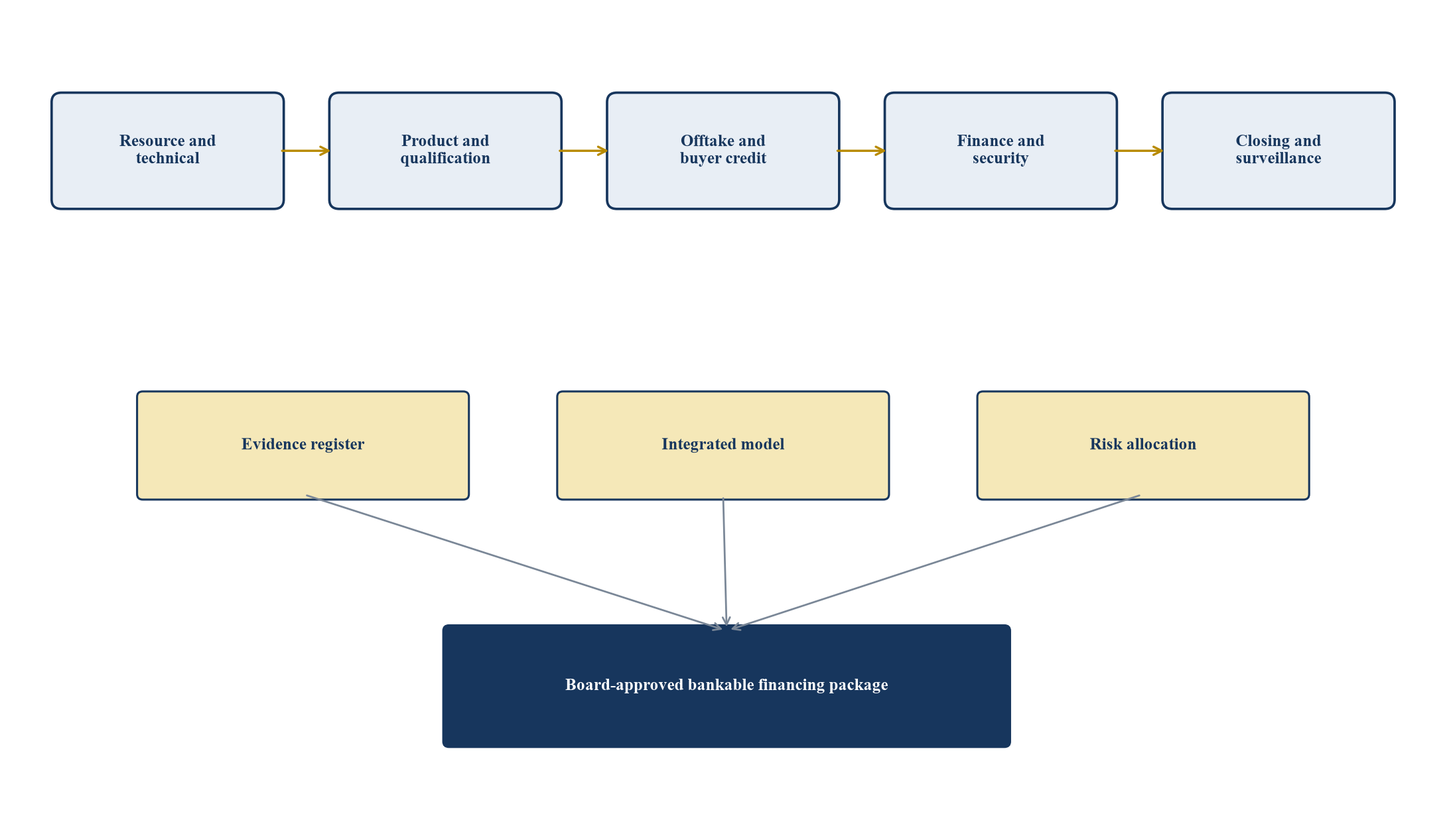
Bankability requires aligned technical, commercial, credit, sustainability and financing evidence.
4. Prove resource and reserve evidence
Financing begins with the quantity, quality and confidence of the mineral inventory. The technical report should distinguish exploration results, resources and reserves under the applicable reporting code. The model should use the mine plan and recoverable saleable product supported by the relevant level of technical confidence, rather than applying headline resource tonnage directly.
The diligence record should cover geology, sampling, assay, estimation, geotechnical conditions, hydrogeology, mine design, recovery, dilution, losses, tailings, waste, infrastructure and closure. Independent review should identify the assumptions that control schedule, grade, throughput, recovery and unit cost. USGS commodity reporting provides market context and definitions; it does not replace project-specific technical evidence [2].
Reserve conversion and mine-life extensions should be separated from the financing base case unless funded, scheduled and supported by appropriate evidence. Lenders can recognise upside through prepayment rights or cash sweeps without relying on it for initial debt service. The same discipline applies to third-party feedstock assumptions for refineries and processors.
The offtake quantity should fit the prudent production profile after commissioning losses, internal consumption, inventory build, specification failures and transport constraints. Overcommitting volume can create replacement-purchase liabilities precisely when the project is experiencing operational stress.
5. Define the deliverable product precisely
The offtake contract should define chemical composition, moisture, particle size, impurities, packaging, certification, delivery point and testing protocol. It should state who samples, which laboratory controls, how umpire testing works and when provisional title and final acceptance occur. Product ambiguity converts technical variance into payment and dispute risk.
Pricing formulas should use the same payable content and deductions as the specification. Treatment charges, refining charges, penalties, payabilities, quotational periods and provisional pricing can materially change realised revenue. The model should calculate netback at the contractual delivery point rather than apply a headline commodity price to gross production.
Qualification may require samples, pilot campaigns, customer testing or regulatory approval. A contract signed before qualification can contain conditions that allow rejection or delay. Those conditions should be visible in the completion schedule and debt-draw requirements. They should not be described as ordinary operational matters.
For emerging materials, the product may lack a liquid reference market or standard grade. The parties then need a transparent valuation mechanism, comparable basket, cost-plus formula, floor, cap, reopeners and dispute process. The contract should preserve financeability while allowing commercially necessary adaptation.
6. Distinguish take-or-pay from take-if-offered
Offtake labels can conceal different obligations. A take-or-pay structure can require payment for a minimum quantity subject to defined relief. A take-if-offered contract may require the buyer to purchase only conforming product actually delivered. A requirements contract can make volume depend on the buyer's needs. Each structure produces a different revenue floor.
The financial model should translate clauses into monthly cash-flow logic. It should identify minimum quantity, flexibility bands, make-up rights, carry-forward, force majeure, specification relief, market disruption, buyer nominations and the consequences of project underdelivery. Contracted percentage of production is not equivalent to contracted percentage of revenue.
The buyer may have optionality over delivery timing, destination or quantity. Optionality has financing value to the buyer and risk value to the project. Its effect should be priced, capped or supported through inventory, working capital and liquidity. A broad buyer option can undermine the apparent stability of a long contract.
Lenders should review whether payment obligations survive events that also interrupt production or end-market demand. Correlated relief can remove the cash flow when it is most needed. The contract and financing downside should use the same interpretation of those provisions.
7. Design a bankable pricing formula
A bankable formula should be observable, reproducible and aligned with the project's cost and debt-service profile. It can reference an exchange price, published index, negotiated benchmark, product basket or downstream value. Every adjustment should be defined with timing, currency, units, taxes, logistics and quality consequences.
Price floors can support debt capacity, but their value depends on buyer credit, duration, volume and enforceability. A floor with broad market-disruption relief or annual renegotiation may provide little protection. A fixed price transfers upside and downside differently and can create substantial mark-to-market exposure for either party.
The model should test benchmark discontinuation, illiquidity, negative basis, lagged settlement and divergent regional prices. For co-products and by-products, it should state whether revenue is retained by the project, shared with the buyer or credited against processing charges. Unmodelled by-product terms can distort margins.
Price reopeners need triggers, information rights, negotiation periods and a fallback. An undefined agreement-to-agree can weaken both revenue visibility and enforceability. Arbitration can resolve disputes, though it may not provide liquidity during the dispute period. The financing plan should include that timing risk.
8. Match contract tenor to the debt case
The contract should cover the period on which lenders rely, including ramp-up and a prudent portion of debt tenor. EXIM's project-finance guidance generally seeks long-term offtake contracts and highlights creditworthy buyers, predictable revenue and price-risk mitigants [5]. A shorter offtake can still be viable when the project has a deep market and conservative refinancing or merchant assumptions.
The term should begin when qualified commercial production starts, not simply when construction is scheduled to finish. Delayed start provisions, long-stop dates and commissioning supply should align with the construction model. If debt begins amortising before the contract delivers reliable cash, the structure needs capitalised interest or committed liquidity.
Renewal options should be modelled according to the party that controls them. A buyer option to extend is not equivalent to project-controlled contracted revenue. A mutual negotiation right has uncertain value until exercised. The base case should separate executed term, option term and merchant tail.
Termination payments should address buyer default, project default, prolonged force majeure, sanctions, change in law and failure to qualify. The amount, timing, security and set-off rights determine whether termination protects debt or merely creates an unsecured claim.
9. Establish an approval matrix for each contract
A lender-ready contract matrix should allow a reviewer to compare commercial and credit quality across buyers. Each row should state product, quantity, tenor, pricing, delivery point, credit support, relief, termination, assignment, set-off, governing law and dispute resolution. Differences should flow into the model rather than disappear inside a blended revenue assumption.
| Gate | Required evidence | Decision owner | Stop condition |
|---|---|---|---|
| Product | Specification, test protocol and qualification evidence | Technical and commercial committees | Acceptance remains discretionary or untested |
| Volume | Prudent production profile and delivery logistics | Technical and operations teams | Committed volume exceeds resilient output |
| Price | Reproducible netback formula and downside support | Finance and risk committees | Debt capacity depends on an unenforceable floor |
| Buyer credit | Accounts, ratings, exposure and committed support | Credit committee | Payment capacity or concentration remains unacceptable |
| Contract | Executed terms, assignment, remedies and legal opinions | Board and legal counsel | Material financeability condition remains open |
| Financing | Integrated model, security and intercreditor terms | Board and lenders | Contract cash flow cannot be controlled for debt service |
The matrix requires transaction-specific technical, legal, tax, market and credit review.
The matrix should distinguish signed, effective and financeable status. Conditions precedent can include permits, qualification, financing, internal buyer approvals, sanctions clearance or construction milestones. A signed contract with unsatisfied conditions can remain commercially valuable while contributing no committed debt capacity.
The final approval should state the portion of production and revenue recognised in the lender base case. It should also identify the residual merchant exposure, buyer concentration and any additional support required. This creates a traceable bridge from contract to debt sizing.
10. Underwrite the buyer as a credit exposure
The project is exposed to the buyer's ability and willingness to pay through construction, ramp-up and operations. Diligence should cover ownership, audited accounts, leverage, liquidity, profitability, ratings, market position, procurement need, sanctions, litigation, jurisdiction and historical payment behaviour. Strategic importance does not establish creditworthiness.
The analysis should identify the paying entity and compare it with the group presented during negotiations. A procurement subsidiary or special-purpose buyer can have limited assets. Parent guarantees, bank letters of credit, cash collateral, insurance or sovereign support can improve the exposure when properly committed and enforceable.
Credit support should match the stress path. A short-dated letter of credit can expire before the offtake term. A guarantee can contain caps, exclusions, notice requirements and defences. Insurance can cover selected political or commercial events with waiting periods and claim conditions. The model should reflect timing and residual exposure.
The credit committee should approve counterparty limits and replacement procedures. If one buyer supports most debt capacity, the financing should test its downgrade, delayed payment, dispute and insolvency. Diversification has value only when buyers are economically and legally independent.
11. Separate strategic demand from enforceable demand
Government policy and corporate supply-chain targets can create strong interest in critical minerals. The IEA's outlook and the EU's policy framework document the strategic importance of diversified supply [1][10][11]. That context can support buyer engagement and public-finance eligibility; it does not define an individual buyer's binding purchase obligation.
The evidence register should classify letters of intent, memoranda, reservation agreements, qualification agreements, framework contracts and executed offtakes. Each category should state binding provisions, conditions, termination rights and financial contribution. Communications should use precise terms so that lenders and the board do not mistake pipeline for contracted cash flow.
Demand forecasts should be reconciled with customer capacity, technology choice, inventory, substitution and end-market cycles. A buyer can support a project strategically while retaining flexibility because its own production plan is uncertain. The contract must show how that uncertainty is allocated.
The financing case should carry a merchant or re-contracting scenario for uncommitted output. It should state market depth, alternative buyers, qualification time, logistics, discounts and working capital. Strategic relevance is most valuable when the project remains resilient if one procurement thesis changes.
12. Control buyer concentration and correlation
A two-buyer structure can remain concentrated when both buyers operate in the same region, technology or downstream cycle. The project should map common exposure to electric vehicles, semiconductors, defence, grid investment, battery chemistry, trade policy or a single logistics corridor.
Concentration analysis should use contracted volume, expected revenue, downside revenue, receivables and termination exposure. It should distinguish a high-volume buyer with strong support from a smaller buyer whose flexibility reduces cash certainty. Percentage of nominal offtake alone is incomplete.
The financing structure can mitigate concentration through caps, multiple buyers, staged contracting, inventory finance, replacement rights, price floors or contingent liquidity. These mitigants carry cost and execution conditions. A lender should see how quickly the project can redirect product after a default or rejection.
The board should approve concentration limits and a re-contracting plan. The plan should identify alternate buyers, qualification evidence, transport routes, pricing implications and the cash runway available during transition. It should be maintained after closing as market and customer conditions change.
13. Integrate construction and completion risk
Offtake supports revenue after delivery. It does not build the project or guarantee that it will produce specification-compliant material. The financing package requires a completion regime covering budget, schedule, performance, permits, commissioning, ramp-up, product qualification and the funding of overruns.
The engineering review should test scope, design maturity, procurement, contractor strategy, critical equipment, infrastructure interfaces, contingency, schedule float and performance guarantees. The model should distinguish physical completion, legal completion, financial completion and offtake qualification. These milestones may occur at different times.
Completion support can include sponsor guarantees, committed equity, cost-overrun facilities, letters of credit, performance bonds, liquidated damages and contingency. Each support item needs amount, duration, conditions and credit analysis. Uncommitted sponsor intention cannot fill a quantified funding gap.
Debt draw conditions should require evidence appropriate to the stage without making the facility unusable. Independent engineer certification, budget-to-complete tests and minimum equity funding can protect lenders. The project also needs enough flexibility to manage ordinary construction changes through controlled approvals.
14. Model ramp-up and qualification as distinct risks
Commissioning proves that equipment operates. Ramp-up proves that throughput, recovery, cost and availability stabilise. Qualification proves that buyers accept the product. A project can achieve one milestone while failing another. The financing schedule should model all three.
The base case should use a monthly ramp-up curve supported by technical evidence. It should include lower recovery, off-spec production, reprocessing, inventory, delayed buyer acceptance and temporary operating costs. Sales receipts should begin only when the contract and testing process support payment.
Qualification samples can be produced from pilot or early operations, though commercial consistency can require further evidence. A lender should understand whether the buyer can reject all production, accept at a discount or require remediation. The contract should define the process and consequences.
The liquidity plan should cover the period between first production and reliable cash collection. Capitalised interest, working-capital facilities, equity contingency and buyer advances can contribute. Each source should be committed and available under the same downside conditions.
15. Control logistics, title and inventory
Delivery risk can arise at the mine gate, plant gate, port, warehouse or buyer facility. The contract should use defined Incoterms where appropriate and state title, risk, insurance, customs, storage, demurrage and loss allocation. The financial model should use the same delivery point for revenue and cost.
Infrastructure constraints can limit bankable volume. Roads, rail, ports, power, water, reagents and border processes should be included in technical and legal diligence. A dedicated corridor can create single-point exposure. Alternative routes should be evaluated for capacity, cost, permits and qualification.
Provisional pricing and assay settlement can create substantial working capital. The project may ship before final price and quality are known. Borrowing-base rules should address eligible inventory and receivables, advance rates, concentration, price haircuts, custody and control.
Title-transfer and security provisions must work together. A buyer prepayment can create rights over inventory or future production that conflict with senior lenders. The intercreditor agreement should establish priority, permitted deliveries, remedies and access to the physical product after default.
16. Convert contractual economics into a lender model
The model should reproduce each contract at shipment and invoice level. It should calculate payable content, benchmark, quotational period, payability, treatment and refining charges, impurity penalties, freight, insurance, taxes, royalties, provisional settlement and final true-up. Simplified average prices should reconcile to this logic.
| Contract provision | Model variable | Principal financing risk | Control response |
|---|---|---|---|
| Minimum volume | Monthly eligible sales | Production shortfall and cover purchase | Conservative commitment and cure bands |
| Price formula | Net realised price | Benchmark, basis and deduction risk | Formula audit, floor and sensitivity |
| Qualification | Eligible product start date | Delayed cash generation | Testing milestones and liquidity |
| Buyer flexibility | Nomination and deferral | Revenue timing and inventory | Limits, fees and working capital |
| Credit support | Recoverable payment amount and timing | Buyer default and claim delay | Guarantee, letter of credit or insurance |
| Termination | Compensation and replacement period | Loss of contracted revenue | Termination support and re-contracting plan |
Every provision should be reflected in the financial model, legal review and security package.
The model should maintain separate observed, contracted, engineering and management inputs. It should flag which terms remain conditional or subject to future determination. A lender case should not use the most favourable interpretation of an unresolved clause.
Model audit should test calculations, contract implementation, taxes, currencies, units and scenario switches. Legal counsel should verify that the model's interpretation matches executed documents. The model then becomes the common language linking contracts, credit and debt sizing.
17. Size debt from resilient cash flow
Debt capacity should be constrained by completion funding, contracted and merchant cash flow, debt-service coverage, loan-life coverage, reserve adequacy, buyer concentration, price exposure, marketability and policy-finance requirements. The controlling amount is the lowest supported across these dimensions.
The base case should use prudent production, contractual netback and payment timing. It should deduct sustaining capital, royalties, taxes, closure funding, working capital and required reserves consistently. Cash that is trapped, subordinated or subject to buyer set-off may be unavailable for senior debt service.
The downside case should combine plausible correlated shocks. Lower prices can coincide with buyer weakness, inventory build and restricted capital markets. Technical underperformance can trigger delivery shortfalls and qualification disputes. Country or logistics events can affect both production and collection.
The board should review a smaller debt case alongside maximum capacity. Lower leverage can reduce reliance on a price floor, concentrated buyer or public guarantee. Retained resilience can preserve future expansion value and improve the project's ability to withstand re-contracting.
18. Build a hypothetical funding package
The hypothetical project develops a processing facility with a total construction requirement of USD 680 million. The proposed package includes USD 250 million of sponsor equity, USD 350 million of senior project debt and an USD 80 million buyer prepayment. Two buyers contract for 70 percent of planned qualified output for twelve years.
The model assumes annual steady-state saleable output of 40,000 tonnes, an opening benchmark price of USD 24,000 per tonne and a contractual netback equal to 82 percent of the benchmark after payability and processing adjustments. These are illustrative management assumptions and do not represent observed prices, project forecasts or financing offers.
Buyer A covers 45 percent of planned output and provides a parent guarantee. Buyer B covers 25 percent and posts a renewable bank letter of credit equal to ninety days of expected invoices. The remaining 30 percent is modelled through a conservative merchant route with additional logistics and price discounts.
The proposed senior debt has a ten-year final maturity after construction, sculpted amortisation and a six-month debt-service reserve. Minimum modelled coverage is 1.42x in the central case. The financing decision still depends on completion, qualification, responsible-sourcing evidence, support enforceability and the combined downside.
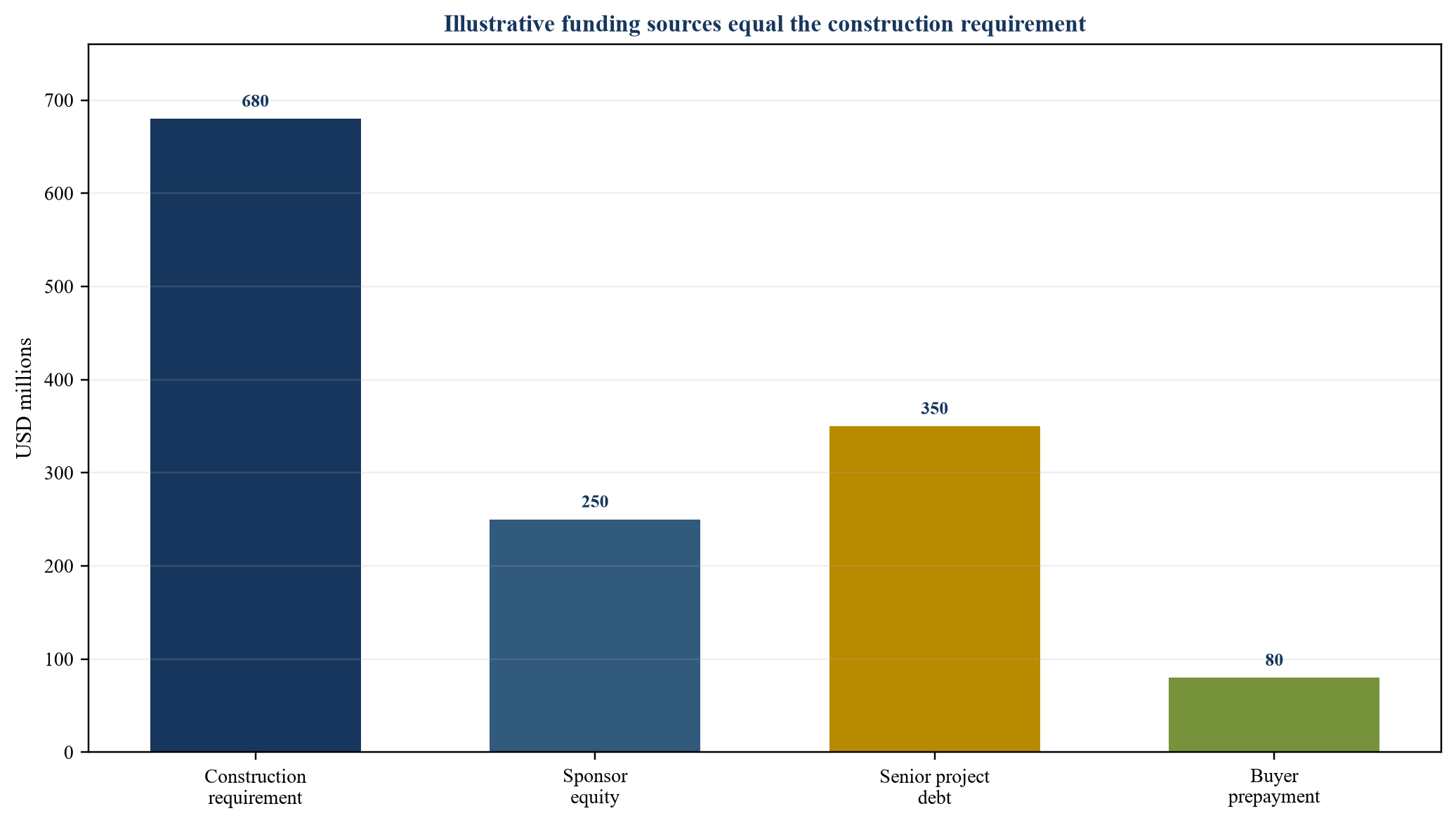
All amounts are illustrative management assumptions in USD millions. They are not observed project data, forecasts, offers or investment advice.
19. Stress price, volume and credit together
The central case is only a reference. The financing committee should test ramp-up delay, lower recovery, product discount, benchmark decline, buyer deferral, buyer default, logistics interruption, foreign-exchange movement and higher operating cost. Combined cases should reflect economic relationships and avoid double counting.
| Scenario | Minimum coverage | Peak liquidity need | First control response | Decision implication |
|---|---|---|---|---|
| Central | 1.42x | None | Normal surveillance | Supports proposed package subject to conditions |
| Six-month qualification delay | 1.23x | USD 38m | Draw committed ramp-up liquidity | Confirm facility availability through testing |
| Benchmark down 25 percent | 1.16x | USD 21m | Distribution lock and cash sweep | Validate floor volume and merchant discount |
| Buyer B default plus price stress | 0.98x | USD 64m | Letter-of-credit claim and cash trap | Requires replacement plan and larger liquidity |
| Combined construction and ramp-up stress | 1.05x | USD 92m | Cost-overrun support and debt resculpting | Equity and contingency must be committed |
All values are illustrative management assumptions. Coverage equals cash available for debt service divided by scheduled senior debt service.
The model should show covenant triggers, reserve use, support claims, distributions and cash runway. It should distinguish temporary timing pressure from structural undercoverage. A guarantee or letter of credit can provide liquidity; it cannot restore a permanently uneconomic product.
Scenario governance should state who can change production, inventory, hedging, capital expenditure, buyer allocation or distributions. The first response often determines whether a manageable shortfall becomes a default. Those actions should be executable under the contracts and financing documents.
20. Structure buyer prepayments carefully
A buyer prepayment advances cash against future deliveries. It can fund construction and demonstrate strategic commitment, but it also encumbers future production and creates repayment or delivery obligations. Its economic cost should include discount, interest, fees, product allocation, security and foregone marketing flexibility.
The structure should define whether the advance is debt, deferred revenue or another obligation under applicable law and accounting. It should state amortisation through deliveries, cash repayment events, interest, taxes, security, title, force majeure, termination and buyer set-off.
Senior lenders will examine priority and control. The prepay buyer may seek security over inventory, receivables, accounts or project assets. Intercreditor terms should prevent unilateral enforcement that disrupts operations or senior debt service. They should also preserve the buyer's legitimate delivery rights.
The model should compare prepayment with strategic equity, streaming, royalty and senior debt. A low stated interest rate can conceal a large commodity discount or valuable optionality. The decision should use a common valuation date and scenario set.
21. Match public and export finance to the risk
Public finance can support strategic supply chains through loans, guarantees, insurance, export credit and policy programmes. EXIM describes critical-minerals products including long-term buyer financing, structured and project finance, working-capital support and supply-chain programmes [3][4]. DFC states that significant offtake can influence its financing participation, subject to project and credit requirements [6].
Eligibility should be tested early. Content, destination, ownership, national-security, environmental, social, procurement and country requirements can determine access. A letter of interest can guide development while remaining non-binding. The base financing case should recognise only approved and committed support.
Public support should address a defined gap such as political risk, tenor, buyer credit, completion or eligible equipment. It should not obscure product, cost or market weaknesses. The project should quantify fee, conditions, reporting, policy undertakings and residual risk.
The financing timetable should reflect application, diligence, public consultation, board approval and documentation. Government support can have a different critical path from commercial debt. The project needs a fallback if eligibility, amount or timing changes.
22. Integrate responsible sourcing and traceability
Critical-minerals buyers increasingly require evidence on origin, human rights, conflict, labour, environment and chain of custody. The OECD framework calls for management systems, risk identification, mitigation, independent audit and reporting in relevant mineral supply chains [7][8][9]. These obligations can become conditions to purchase and therefore conditions to revenue.
The offtake should define the standard, data, audit rights, corrective-action process, suspension and termination consequences. Broad compliance representations should be translated into operational systems. The project needs responsible owners, supplier controls, grievance mechanisms and documented escalation.
Traceability should follow material through extraction, processing, transport, blending and sale. Technology can support records, but governance, source verification and data quality remain decisive. The system should protect commercially sensitive information while meeting buyer, lender and legal requirements.
Failure can affect more than reputation. It can delay qualification, trigger rejection, suspend payment, breach financing undertakings or restrict alternative buyers. The downside model should include the operational and liquidity effect of a serious compliance event.
23. Align environmental and social performance with finance
Mining and processing can create material impacts involving land, water, biodiversity, communities, labour, tailings and closure. IFC's work on critical-minerals projects illustrates how alignment with Performance Standards can form part of preparation for international financing [12]. Project-specific requirements remain subject to formal diligence and approvals.
The financing case should integrate permits, impact assessment, stakeholder engagement, land access, resettlement, indigenous peoples where applicable, biodiversity, water, tailings, emergency response and closure funding. Technical and financial models should use consistent mitigation costs and schedules.
Buyer standards can exceed host-country law. The offtake should avoid vague obligations that allow discretionary termination while the project lacks a clear compliance route. Standards, evidence, cure periods and independent review should be defined with legal and specialist advice.
Community and environmental performance can affect schedule, output and licence to operate. These are cash-flow and completion risks. They belong in the lender model, contingency and reporting system rather than a separate narrative appendix.
24. Control security and intercreditor rights
The security package can include shares, licences where permitted, project assets, accounts, receivables, inventory, material contracts, insurance and sponsor support. The legal review should address creation, perfection, priority, enforcement, insolvency, government consent and transfer restrictions.
| Workstream | Minimum evidence | Independent challenge | Approval output |
|---|---|---|---|
| Technical | Resource or feedstock, design, schedule, budget and completion tests | Independent engineer and model audit | Bankability memorandum |
| Commercial | Specifications, qualification, offtakes, logistics and market alternatives | Technical, market and legal review | Contracted-revenue case |
| Credit | Buyer accounts, limits, guarantees and replacement plan | Credit committee review | Approved counterparty exposure |
| Sustainability | Permits, standards, traceability and action plans | Environmental and social review | Conditions and monitoring plan |
| Financing | Sources, debt capacity, reserves, security and intercreditor terms | Lender, tax and legal review | Executable financing package |
| Closing | Conditions, funds flow, perfection and reporting controls | Verification and board review | Draw and close authority |
The register should be tailored to the mineral, project stage, jurisdiction and financing providers.
The offtake must be assignable or otherwise available to lenders following enforcement, subject to reasonable buyer protections. Restrictions, consent rights and termination upon change of control can impair collateral value. Direct agreements can establish notice, cure and step-in rights.
Intercreditor terms should reconcile senior debt, working capital, buyer prepayment, hedging, equipment finance and public support. They should govern payment priority, standstill, enforcement, product delivery, proceeds, cure and voting. A term sheet-level conflict should be resolved before documentation is advanced.
25. Manage currency, interest and commodity risk
The project can earn revenue in one currency while paying construction, operating, tax and debt obligations in others. The model should map every material cash flow by denomination, payment currency and conversion timing. A dollar benchmark does not guarantee dollar collection when settlement or transfer restrictions apply.
Commodity hedging can complement offtake where liquid instruments and governance exist. The project should define purpose, eligible instruments, counterparties, collateral, tenor, volume limits, accounting and termination. Hedging should protect debt service rather than create speculative exposure.
Interest-rate risk depends on debt basis and construction draw schedule. Fixed, floating and hedged structures should be compared on all-in cost, collateral, breakage and downside coverage. A buyer floor and a commodity hedge should be modelled together to avoid overlapping protection.
Basis risk remains when the product, location, quality or timing differs from the reference. The financing committee should see benchmark and realised-netback sensitivities separately. Residual currency, rate and commodity risks should have limits, owners and reporting triggers.
26. Execute through a controlled roadmap
The transaction plan should integrate technical diligence, permitting, product testing, offtake, buyer credit, financing, public support, environmental and social work, documentation and closing. Every dependency should have an owner, evidence output and decision date.
One controlled model and one approved term sheet should govern negotiations. Changes in quantity, pricing, floor, tenor, support, prepayment, debt, reserve or security should flow through the model and risk allocation. Version control is part of transaction governance.
Verification should cover every material statement provided to lenders, buyers, public agencies and the board. The record should identify source, reviewer, exception and approval. Material unresolved issues should remain visible rather than being softened through drafting.
The critical path should include long-stop dates and fallback decisions. If qualification, buyer approval, public finance or permits delay, the project needs a funded response. Restart conditions should specify which evidence expires and must be refreshed.
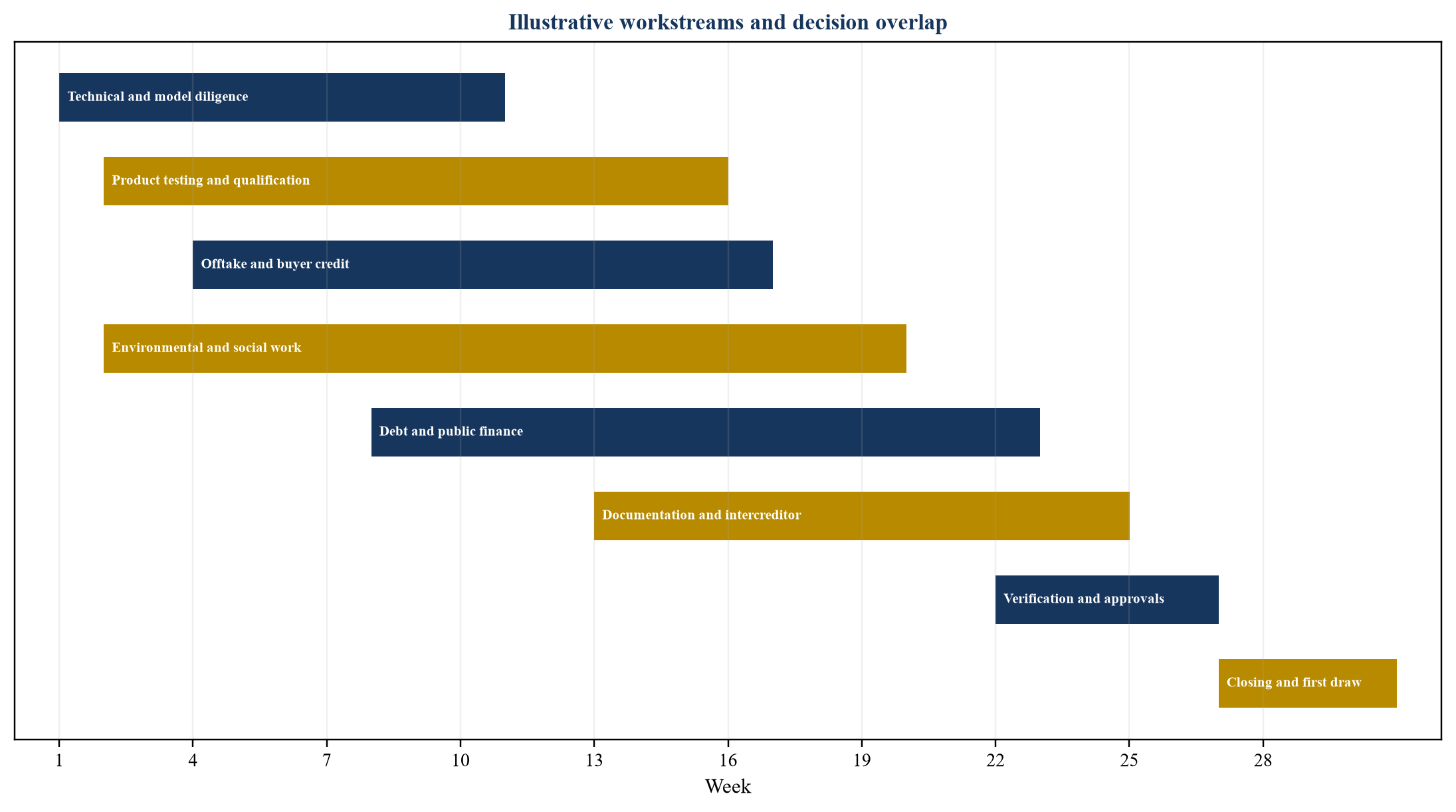
Timing is illustrative and should be adapted to project evidence, permitting, counterparties and finance processes.
27. Prepare for failure and re-contracting
The project should know its response if a buyer does not sign, fails qualification, delays payment, seeks renegotiation or terminates. Alternatives can include replacement buyers, reduced construction scope, staged commissioning, additional equity, inventory finance, bridge liquidity or deferral.
The re-contracting plan should state qualified alternative buyers, sample and approval requirements, transport routes, price discounts, contract lead time and cash runway. It should distinguish a liquid commodity with broad markets from a specialised product requiring lengthy customer approval.
Communication should be controlled across lenders, public agencies, contractors, communities and other buyers. Inaccurate or inconsistent explanations can damage later financing. Disclosure duties and confidentiality should be reviewed before a default or dispute occurs.
The board should approve withdrawal thresholds. A project should be able to reject an offtake that transfers excessive value or control merely because financing is advanced. The contingency plan gives management a credible alternative at that decision point.
28. Govern continuing obligations after closing
Post-close surveillance should track construction, budget, schedule, qualification, deliveries, prices, invoices, collections, buyer credit, compliance, reserves, covenants and support. The reporting pack should compare actual outcomes with the approved financing case.
The project should maintain a contract calendar for nominations, forecasts, pricing periods, tests, invoices, credit-support renewals, notices, audits and reopeners. Missed procedural steps can weaken rights even when economic performance is sound. Owners and back-up owners should be assigned.
Buyer and lender reporting should use consistent definitions. Production, saleable output, delivered volume, accepted volume and paid volume are different metrics. Reconciliation from physical production to cash collection should be a standing control.
The board should review realised financing value after ramp-up and annually thereafter. It should compare price, netback, volume, support cost, debt service, liquidity and flexibility with the original case. The review informs amendments, refinancing and future contracting.
29. Build optionality without weakening the base case
A project can preserve value through uncommitted production, multiple products, alternate delivery points, processing flexibility and expansion rights. Optionality should be designed deliberately and valued separately from base debt capacity.
An offtake covering all production can maximise early financeability while limiting future marketing and strategic choices. A smaller contracted share can preserve upside but increase merchant exposure. The decision should compare financing value with the economic value of retained flexibility under common scenarios.
Expansion should not depend on rights already granted to buyers unless the contract and financing allow it. Rights of first refusal, matching rights, exclusivity and change-of-control provisions can affect future capital raising or M&A. Their value transfer should be considered when negotiating price and support.
The board paper should state which optionality is retained, granted or conditional. Future value should not be used to justify construction debt unless appropriately evidenced. It can support an equity thesis and later refinancing after performance is established.
30. Apply the framework through a disciplined board decision
The final board paper should begin with the decision and authority requested. It should state project perimeter, product, buyers, contracted volume, price formula, tenor, support, construction cost, sources of funds, debt, reserves, security, conditions and timetable. It should identify which terms remain subject to negotiation and the limits within which management can act.
The evidence appendix should permit reconstruction of the transaction. It should include technical reports, product and qualification records, contracts, buyer credit, market analysis, logistics, responsible-sourcing systems, environmental and social work, the integrated model, financing terms, legal opinions, tax advice, security, intercreditor terms and contingency plans.
The route comparison should retain common assumptions across project debt, corporate debt, strategic equity, prepayment, streaming, royalty and staged development. It should include discounts, fees, reserves, support, tax, flexibility, control rights and execution probability. A route should not appear inexpensive because its commodity or governance cost is omitted.
The value bridge should reconcile gross construction funding to net project value. It should show interest, fees, price concessions, buyer optionality, support cost, working capital, retained upside and downside resilience. Value dependent on future refinancing or uncommitted expansion should be separated from value secured at closing.
Risk acceptance should be explicit. The paper should list residual technical, qualification, price, volume, buyer, logistics, currency, environmental, social and enforcement risks. Each item should show owner, indicator, trigger and approved response. Disclosure without an executable response does not establish control.
The closing report should reconcile executed documents with the approved case. It should confirm conditions, equity, debt, prepayment, security, reserves, credit support, permits and funds flow. Deviations should be quantified and approved. This creates the baseline for continuing surveillance and later refinancing.
Offtake-backed finance can turn strategic demand into construction capital when physical delivery, contractual payment and credit support operate as one system. The result should be measured through completed assets, accepted product, collected cash, resilient debt service and preserved capacity to respond when technology, prices or buyers change.
Sources
- International Energy Agency, Global Critical Minerals Outlook 2025, 21 May 2025. Read the primary source
- U.S. Geological Survey, Mineral Commodity Summaries 2026, version 1.3, May 2026. Read the primary source
- Export-Import Bank of the United States, EXIM Support for Critical Minerals Transactions. Read the primary source
- Export-Import Bank of the United States, Supply Chain Resiliency Initiative. Read the primary source
- Export-Import Bank of the United States, Guidelines for Submitting a Successful Project Finance Application. Read the primary source
- U.S. International Development Finance Corporation, Financing Terms and Processes. Read the primary source
- OECD, Due Diligence Essentials for Responsible Minerals, 26 February 2026. Read the primary source
- OECD, Due Diligence Guidance for Responsible Supply Chains of Minerals from Conflict-Affected and High-Risk Areas, third edition. Read the primary source
- OECD, Handbook on Environmental Due Diligence in Mineral Supply Chains, 2023. Read the primary source
- European Commission, European Critical Raw Materials Act. Read the primary source
- European Commission, RESourceEU Action Plan, 3 December 2025. Read the primary source
- International Finance Corporation, IFC Supports McEwen Copper on Sustainable Financing for Los Azules, 24 September 2025. Read the primary source
- Extractive Industries Transparency Initiative, Contract Transparency. Read the primary source
- World Bank, Africa's Resource Future, 2024. Read the primary source
- International Finance Corporation, Performance Standards on Environmental and Social Sustainability, 2012. Read the primary source
- World Bank Group, Environmental, Health, and Safety Guidelines for Mining, 2007. Read the primary source
- The Equator Principles Association, Equator Principles EP4, July 2020. Read the primary source
- The White House, Immediate Measures to Increase American Mineral Production, Executive Order 14241, 20 March 2025. Read the primary source
