

Introduction
Satellite constellations increasingly require data to move between spacecraft before reaching a ground station. Earth-observation satellites can relay imagery to a node with ground visibility. Communications constellations can route packets across a mesh. Defence architectures can transmit sensor data with low latency across multiple orbital planes. Lunar and deep-space missions can use optical relays to increase data return. Optical communication terminals are therefore moving from experimental payloads toward repeatable network components.
The economic transition is incomplete. Optical links require precise acquisition, pointing and tracking across moving spacecraft. Terminal performance depends on optics, detectors, lasers, thermal control, software, vibration tolerance, timing, encryption interfaces and spacecraft integration. A unit can satisfy a laboratory test and still fail to establish a sustained on-orbit link. Two terminals can each claim compliance and remain unable to interoperate because implementation choices differ. A vendor can win a large programme and lack the supplier capacity, working capital or manufacturing yield required to deliver on time.
Transaction valuation must connect technical capability to network adoption. This paper addresses acquisitions, minority investments and joint ventures involving companies that design, manufacture or operate optical communication terminals and related network software. It does not value a named company or recommend a security. The worked case is hypothetical and must be replaced by verified transaction evidence in a live mandate.
1 Define the acquired capability
An optical-link business can contain several distinct assets. These include terminal designs, optical benches, lasers, detectors, modems, pointing systems, embedded software, test equipment, clean-room capacity, calibration processes, supplier agreements, patents, export approvals, customer contracts and on-orbit operating data. The transaction perimeter should distinguish owned capability from licensed technology, customer-funded development and supplier-controlled know-how.
The buyer should map each product variant to its intended orbit, link range, data rate, waveform, aperture, size, mass, power, thermal envelope and security requirement. A terminal designed for short low-Earth-orbit crosslinks may require material redesign for long-range links, space-to-ground transmission or a different modulation standard. Product names and common housings should not conceal different hardware, firmware or qualification status.
Ownership review should cover background intellectual property, foreground intellectual property created under customer contracts, government-purpose rights, source-code access, manufacturing drawings, test scripts and rights to modify designs after change of control. A buyer that acquires the workforce and factory while losing critical licensed algorithms or customer-furnished equipment has not acquired the operating system it modelled.
2 Build an evidence ladder from bench to network
The valuation should classify every claimed capability on a common evidence ladder. The first state is analytical design. The second is component and engineering-unit testing. The third is qualification against environmental and interface requirements. The fourth is delivery and customer acceptance. The fifth is successful launch and commissioning. The sixth is a sustained optical link. The seventh is cross-vendor interoperability. The eighth is operational traffic with measured availability and error performance. The final state is recurring contracted use and collected cash.
Each state supports a different value. A laboratory demonstration can reduce technical uncertainty but does not establish industrial delivery. A delivered terminal can support revenue recognition under the applicable contract but may not establish on-orbit performance. A link between two units from one vendor proves less about open-network adoption than a sustained link between independent vendors. Network traffic supports value only when the buyer can reconcile usage, service levels, customer acceptance and payment.
The evidence ladder should be applied by product, standard version, customer and production batch. Success on an earlier terminal cannot automatically qualify a later design. A change in detector, supplier, modem, firmware or assembly route can require new evidence. The acquisition model should record the evidence state and the remaining cash required to reach the next state.
3 Treat interoperability as an earned asset
Interoperability is central to a multi-vendor satellite mesh. It allows a constellation owner to buy terminals from more than one supplier, connect spacecraft built by different primes and preserve network flexibility across deployment tranches. A written standard is necessary, although compliance statements alone cannot prove that separate implementations will establish and maintain a link.
The Space Development Agency's Optical Communications Terminal standard defines interfaces for space-to-space and space-to-terrestrial optical communications. Published versions identify data rates, waveforms, acquisition procedures and version-control expectations. The standard has evolved across acquisition tranches. GAO reported that contractors continued to identify ambiguity and that changes made during overlapping development phases increased interoperability risk. GAO also reported that, as of July 2025, only two of four Tranche 0 contractors had demonstrated a cross-contractor on-orbit link, with both using terminals from the same supplier. [3][4][5][6]
The buyer should review test vectors, compliance matrices, deviation waivers, interoperability-test results and on-orbit link logs. It should identify the exact standard version and optional modes supported by each unit. Interoperability value should be recognised when an independent test or operational record demonstrates acquisition, tracking, data transfer, link recovery and error performance across the relevant counterparties.
4 Separate data rate from useful network throughput
Headline data rate is only one part of economic performance. Useful throughput depends on acquisition time, pointing stability, link duration, coding overhead, packet loss, weather for space-to-ground links, route availability, encryption, network scheduling and terminal duty cycle. A terminal capable of a high peak rate can deliver limited daily data when links are brief or frequently interrupted.
NASA's Laser Communications Relay Demonstration and ILLUMA-T established an end-to-end optical relay with links up to 1.2 gigabits per second. NASA's TBIRD demonstration transmitted 4.8 terabytes of error-free data in five minutes at 200 gigabits per second during a pass. These results demonstrate technical potential under defined mission conditions. They do not provide a generic revenue rate for a commercial terminal supplier. [1][2][11][12]
Valuation should use an operational throughput ledger. For each mission, it should record scheduled contact time, acquisition success, usable link time, delivered bytes, error rate, re-transmission, outages and customer acceptance. The economic metric is accepted service or accepted hardware under the contract. Peak laboratory performance supports a technical case while sustained useful throughput supports network value.
5 Model the installed base by accepted terminal
An installed-base schedule should begin with accepted flight units rather than announced constellation size. The model should distinguish ordered units, funded options, units in production, delivered units, launched units, commissioned units and operational units. It should also identify units held as spares, engineering models or replacements.
Constellation plans change. Satellite counts can be resized, delayed or divided among several prime contractors. A programme award to a spacecraft manufacturer does not necessarily create a firm order for every terminal. The supplier may receive an initial purchase order, a framework agreement or customer-funded non-recurring engineering before production quantities are released.
The valuation model should therefore use contract-level quantities and cancellation provisions. Firm units with customer funding and accepted pricing can enter the backlog. Options remain probability-weighted until exercised. Future tranches can receive strategic option value when procurement authority, programme funding and competitive position are evidenced. They should not be included as contracted revenue.
6 Reconcile backlog to contractual economics
Backlog quality depends on enforceability, funding, price, delivery date, acceptance, termination rights and customer credit. Government programmes can include termination for convenience, change orders, security requirements and customer-controlled schedule shifts. Commercial constellation orders can depend on financing, launch schedules and satellite-bus decisions. A headline backlog can therefore overstate the cash a buyer will collect.
The buyer should obtain every purchase order, statement of work, amendment, delivery schedule and acceptance record. It should reconcile unit quantities and price to the general ledger, invoices and cash receipts. It should separate non-recurring engineering, production hardware, spares, integration support and warranties. Contract assets, deferred revenue and customer advances should be traced to performance obligations.
The model should calculate backlog contribution after materials, labour, test time, warranty, liquidated damages and programme-specific overhead. A low-margin strategic order can build qualification and market position, although it should not be valued like mature recurring margin. The board should see gross backlog and risk-adjusted contribution side by side.
7 Test manufacturing yield and cycle time
Industrial value depends on repeatable output. Optical terminals require precision assembly, alignment, calibration and environmental testing. Production can be constrained by specialised components, clean-room stations, skilled technicians, test chambers and long supplier lead times. Low first-pass yield can absorb labour and test capacity, delay customer satellites and consume working capital.
The diligence team should obtain a unit-level manufacturing history. It should track first-pass yield, rework loops, scrap, calibration time, environmental-test failures, software defects, supplier escapes and final acceptance. It should compare engineering builds with production batches because early units often receive exceptional attention that cannot scale.
Cycle time should be measured from released materials through customer acceptance. Capacity should be constrained by the bottleneck station rather than nominal factory floor area. A plan to multiply annual output should specify equipment, people, suppliers, training, quality controls and cash. Valuation credit should follow demonstrated throughput and yield milestones.
8 Identify the true bottleneck
The limiting resource can move as production scales. Early in development, the bottleneck may be design closure or qualification. During ramp-up, it may be detectors, lasers, radiation-tolerant electronics, optical coatings, precision mechanisms, test equipment or security-certified components. Later, customer integration and acceptance can become the constraint.
The buyer should construct a bill-of-materials risk map. For every critical component, it should identify the supplier, country, lead time, minimum order, qualification status, substitute route, export classification and inventory coverage. A second source has limited value until qualified in the actual design. Inventory accumulated before a design change can become obsolete.
Supply security is part of enterprise value. The transaction model should deduct cash required for long-lead inventory, second-source qualification and supplier tooling. It should also test whether a change of control affects preferred pricing, allocation or government approvals. A vertically integrated buyer may create value by securing components, although the synergy should be separated from standalone value.
9 Value qualification by configuration
Space hardware qualification establishes that a configuration can survive launch and operate in its intended environment. Optical terminals can require vibration, shock, thermal-vacuum, radiation, electromagnetic and lifetime testing. Qualification evidence should identify the exact configuration, test level, duration, anomalies, waivers and customer acceptance.
A vendor may use a qualified platform with customer-specific changes. The buyer should determine which changes remain within the qualified envelope and which require delta qualification. Firmware changes can affect acquisition and tracking. Component substitutions can alter thermal or radiation behaviour. A new orbital regime can change range, relative motion and link budget.
The valuation ledger should assign qualification value to transferable evidence and reusable design. Customer-specific qualification paid for under a restricted contract may have limited use elsewhere. Reusable test methods, calibrated equipment and accepted product baselines can reduce future cost and schedule. The purchase agreement should include warranties concerning configuration records and undisclosed deviations.
10 Analyse customer adoption as a network sequence
Network adoption occurs through a sequence: programme selection, terminal order, spacecraft integration, launch, commissioning, link establishment, operational routing and follow-on procurement. Each stage reduces a different risk. A customer can select a product and later redesign the spacecraft. It can launch units and use optical links only intermittently. It can establish links and still choose another vendor for the next tranche.
The model should track adoption by customer and network. Unit deliveries are the primary revenue driver for a hardware supplier. Network utilisation provides evidence for renewal, spares, software, operations and later tranches. Cross-network compatibility can broaden the addressable market when standards and security rules allow.
Follow-on probability should be linked to measured performance, delivery reliability, price, architecture continuity and procurement rules. Incumbency can create integration advantage, but open standards can lower switching costs. A buyer should value repeat business through an explicit probability tree rather than a blanket terminal multiple.
11 Distinguish sovereign demand from commercial demand
Government and commercial customers can require similar hardware while producing different economics. Sovereign programmes may value security, resilience, interoperability, domestic production and assured supply. They can fund development and qualification but impose export, information-security, audit and change-control obligations. Commercial constellations may emphasise cost, volume, schedule and proprietary network optimisation.
European programmes such as ESA's ScyLight and HydRON support optical communication technology, interoperability and integration with terrestrial networks. The European Union's IRIS2 programme reflects strategic demand for secure, resilient satellite connectivity. SDA's architecture supports substantial procurement demand for interoperable terminals. These programmes create credible market pull, while each opportunity remains subject to budgets, competition, qualification and delivery. [3][7][8][9][13][14]
The valuation should segment revenue and margin by customer type. It should model security cost, domestic-content requirements, programme audits and export constraints. It should also identify whether the target's production footprint qualifies for future sovereign procurement after acquisition.
12 Examine export control and foreign-investment review
Optical communication terminals can involve controlled hardware, software, technical data and defence end uses. Cross-border diligence should identify export classifications, licences, provisos, authorised destinations, technical-assistance agreements and restrictions on foreign-person access. A buyer should also assess foreign-investment review, security agreements and government consent.
Rocket Lab's 2026 acquisition of Mynaric required review and approval by Germany's Federal Ministry for Economic Affairs and Energy. The transaction also illustrates strategic logic around supply-chain control, European presence and optical-terminal production. Public filings report aggregate consideration of USD 155.3 million, preliminary goodwill of USD 60.0 million and acquired-quarter revenue and operating loss of approximately USD 13.2 million each. Those facts describe that transaction only and do not establish a market multiple. [15][16][17]
The acquisition timetable should reflect regulatory review and mitigation. The merger agreement may need conditions for licences, security clearances, government contracts and key-customer consent. The valuation should include the cost of maintaining separated systems, restricted facilities or proxy governance when required.
13 Value intellectual property with dependency mapping
Patent counts provide limited insight without claim scope, remaining life, jurisdiction, freedom to operate and connection to products. Valuable know-how may reside in calibration, alignment, firmware, test automation, supplier tolerances and failure analysis. These capabilities can be difficult to document and easy to lose when key engineers depart.
The buyer should map intellectual property to the product bill of materials and manufacturing process. It should identify employee inventions, university licences, customer-funded developments, open-source software and third-party code. Source repositories, design history, test data and configuration management should be inspected for completeness.
Value should follow control and replaceability. A patent that blocks a critical alternative can support strategic value. A non-exclusive licence with termination rights should be treated as dependency. Undocumented knowledge requires retention and transfer planning. Consideration can be held back until source code, drawings, test procedures and designated personnel transfer successfully.
14 Model software and network-control value
Optical terminals rely on software for acquisition, pointing, tracking, modem control, diagnostics, security interfaces and network management. Network-control software can schedule links, route traffic and respond to outages. The buyer should distinguish embedded firmware from a transferable network-management platform.
Software diligence should cover architecture, code ownership, release quality, cybersecurity, dependencies, update rights and compatibility across terminal generations. Operational logs can reveal acquisition time, link stability, component degradation and failure modes. These data can improve maintenance and future design, creating value beyond the hardware margin.
Recurring software revenue should be recognised only when the contract defines a paid licence, service or support obligation. Internal tools can improve manufacturing economics without creating external revenue. The valuation model should avoid capitalising a software narrative twice through both terminal margin and a separate platform premium.
15 Build the unit economics from accepted output
Unit economics should begin with contracted price and accepted units. Direct materials, direct labour, test occupancy, scrap, rework, warranty, customer support and programme engineering should be assigned to the relevant product. Gross margin should be reconciled to actual production batches rather than a target bill of materials.
The hypothetical target has a central unit price of USD 560,000 and mature direct cost of USD 335,000. Current production cost is higher because first-pass yield is 72 per cent and rework occupies test capacity. The plan assumes yield rises to 88 per cent over eight quarters, reducing direct cost and supporting a 40 per cent mature gross margin. These assumptions describe no company.
The buyer should stress unit price, yield, component inflation, warranty and delivery delay. It should separate non-recurring engineering contribution from hardware margin. A factory can report improving accounting margin while cash remains negative because long-lead materials and customer milestones absorb working capital.
16 Convert orders into a cash-flow schedule
The cash-flow model should schedule deposits, progress payments, delivery invoices, acceptance holdbacks and warranty reserves. Customer advances can fund production, although they may also create refund or performance obligations. Revenue recognition and cash collection should be modelled separately.
The hypothetical case begins with 620 contracted terminals. It assumes 510 units are sufficiently funded and technically defined to enter the central delivery schedule. Of those, 440 are expected to reach customer acceptance within the forecast period after yield and schedule adjustments. At USD 560,000 per accepted unit, hardware revenue is USD 246.4 million. Non-recurring engineering and support add USD 34 million. The model deducts production cost, programme engineering, overhead, warranty, capital expenditure and working capital.
The schedule should show the cash required before each customer milestone. A profitable backlog can still create a financing gap when suppliers require early payment and customers pay after acceptance. The transaction value should deduct the capital needed to deliver contracted units.
17 Assess concentration and programme dependence
Optical-terminal companies can depend on a small number of constellation programmes and prime contractors. Concentration should be measured by backlog, revenue, cash receipts, engineering resources and future pipeline. Several contracts can still represent one end programme and one budget authority.
The buyer should model the effect of a delay, redesign or cancellation in the largest programme. The impact can extend beyond lost units. Dedicated inventory can become obsolete, customer-funded equipment can require return, and engineering teams can be stranded. A public programme can also define the product standard used to win other customers, creating both concentration and certification value.
The merger agreement should address backlog accuracy, undisclosed programme disputes, termination notices and customer claims. Earnout measures should exclude orders that are cancelled, materially repriced or delivered at negative contribution. A concentration adjustment belongs in valuation even when the customer has high credit quality.
18 Test retention and production transfer
The acquired capability may depend on a small group of optical, mechanical, firmware and manufacturing specialists. The buyer should identify critical roles by process and product, rather than relying on seniority. It should assess employment terms, works-council obligations, security clearances, non-competes where enforceable and geographic constraints.
Retention should be connected to deliverables. Key engineers can be responsible for configuration transfer, supplier qualification, test automation and next-generation design. Manufacturing leaders can be responsible for yield and cycle-time milestones. Payments based only on continued employment can preserve headcount without completing capability transfer.
The integration plan should protect customer programmes during ownership change. Systems migration, reporting changes and factory consolidation should be sequenced around delivery and test windows. The buyer should maintain configuration control and quality authority throughout integration.
19 Evaluate build buy and partner alternatives
The buyer should compare acquisition with internal development, supplier partnership, minority investment and long-term purchase agreement. The relevant question is how quickly and reliably each route secures qualified terminals, production capacity, technical control and customer access.
Internal development can avoid a control premium but requires engineering, qualification and supplier learning. A purchase agreement can secure units without acquiring factory risk, although it may leave the buyer exposed to allocation and pricing. A minority investment can improve alignment while preserving supplier independence. Acquisition can secure scarce capability and eliminate a supply constraint, but it concentrates execution risk inside the buyer.
The alternatives analysis should include time, cash, probability of qualification, interoperability, customer consent and opportunity cost. The acquisition premium should reflect value unavailable through a contract. Synergies should be supported by accountable actions, owners and implementation costs.
20 Structure consideration around operational evidence
Consideration can be divided between cash at completion, performance payments and seller rollover. Closing value should reflect transferred intellectual property, accepted backlog, working assets and qualified production capability. Deferred consideration can follow manufacturing yield, accepted deliveries, on-orbit performance, interoperability and collected cash.
Milestones must be precisely defined. A terminal launch is insufficient when the value depends on a sustained link. A link between two terminals from the same batch may not prove cross-vendor interoperability. A delivery milestone should require customer acceptance without unresolved material waiver. A revenue milestone should require collection and specified contribution margin.
The agreement should prevent double counting across milestones. It should define data access, independent testing, excluded events, customer-caused delay and change-control rules. Holdbacks and escrow can protect warranty, tax, export and contract claims. Seller rollover can align long-term performance when governance and future funding are clearly agreed.
21 Hypothetical acquisition case
The hypothetical target supplies three optical-terminal variants for low-Earth-orbit crosslinks and selected space-to-ground applications. It reports 620 contracted units across four programmes and a pipeline of 1,400 additional units. The company operates two facilities, has 310 employees and remains loss-making during production ramp-up. The case assumes no named company, customer or security.
The buyer validates 510 centrally scheduled units after removing unfunded options and poorly defined quantities. It forecasts 440 accepted units within five years. Central hardware revenue is USD 246.4 million, supplemented by USD 34 million of engineering and support. Yield rises from 72 to 88 per cent, and cycle time falls from 28 to 18 weeks. The plan requires USD 118 million of additional working capital, capital expenditure and supplier security.
The valuation uses three components. Evidenced cash flow from contracted and accepted production contributes USD 430 million. Probability-weighted follow-on programmes and reusable technology contribute USD 270 million. Future funding, concentration, execution and retention adjustments deduct USD 160 million, producing illustrative enterprise value of USD 540 million. The proposed consideration includes USD 350 million at completion, USD 110 million of evidence-linked contingent payments and USD 80 million of seller rollover.
22 Valuation methods and cross-checks
A discounted cash-flow model should use contract-level delivery, contribution and funding schedules. Comparable-company multiples can provide a reasonableness check, but diversified space companies, component suppliers and early-stage optical specialists have different growth, margin and risk. Transaction multiples can be distorted by restructuring, strategic supply-chain value and buyer-specific synergies.
The model should cross-check enterprise value against value per accepted unit, value per risk-adjusted backlog dollar, replacement cost and strategic bottleneck value. None of these measures should replace cash flow. A high value per accepted unit may be justified by reusable technology and future programmes, while a high backlog multiple requires margin, delivery capacity and renewal evidence.
IFRS 3 and IFRS 13 provide accounting frameworks for business combinations and fair-value measurement. IAS 36 addresses impairment when the acquired capability underperforms. Purchase-price allocation should distinguish technology, customer relationships, backlog and goodwill without using accounting values as the transaction decision. [26][27][28]
23 Investment committee gates
The investment committee should require clear gates before signing. The perimeter gate confirms ownership and transfer of technology, equipment, contracts and data. The qualification gate confirms product configurations and accepted evidence. The manufacturing gate confirms yield, bottlenecks and funded capacity. The adoption gate confirms firm orders, launched units, operational links and follow-on probability. The regulatory gate confirms export, foreign-investment and security pathways.
The valuation gate reconciles price to evidenced cash flow, probability-weighted options and future funding. The agreement gate links consideration to operational evidence and preserves audit rights. The integration gate protects configuration control, employees, suppliers and customer deliveries.
A failed gate should change price, structure, scope or timing. The committee should record the evidence, owner, residual risk and agreed response. This decision record creates accountability after closing and supports impairment and earnout governance.
24 Post-close value creation
The first post-close objective is delivery reliability. The buyer should establish a weekly unit-control room covering materials, yield, rework, test capacity, acceptance and cash. Product and factory metrics should reconcile to financial reporting. Customer issues should be assigned to named owners with closure dates.
The second objective is qualification reuse. The combined business should standardise product baselines, test evidence, software releases and approved suppliers. Customer-specific variants should be controlled to protect scale. The third objective is network evidence. On-orbit link records, traffic, outages and recovery should inform product improvement and customer renewal.
Strategic growth can follow verified delivery. The buyer can expand into adjacent orbits, space-to-ground links, network software and sovereign programmes when the existing platform supports them. Capital should be released by stage. The acquisition case should be updated quarterly using accepted units, collected cash, interoperability results and funded pipeline.
25 Decision record and value governance
The transaction team should maintain a value ledger from initial indication through post-close review. Every material value component should identify its source evidence, cash-flow mechanism, owner, probability, required future funding and overlap with other components. The ledger should separate accepted backlog, reusable technology, customer relationships, manufacturing capability, operational data and strategic control. This structure prevents a single programme from appearing in backlog value, technology value and strategic premium without an explicit reconciliation.
The ledger should also preserve rejected claims. If an announced order is excluded because funding is incomplete, the record should state what evidence would permit its inclusion later. If a standard-compliance claim lacks an independent cross-vendor test, the model should identify the required test and the value held outside the base case. This approach allows management to update the decision as evidence changes without rewriting the original investment rationale.
Scenario governance should use a central case, a delivery-delay case and a programme-loss case. The delivery-delay case should extend payroll and overhead, increase working capital, move customer cash and test liquidated damages. The programme-loss case should remove the affected units, write down dedicated inventory, reallocate engineering resources and reassess qualification value. A successful-yield case can show upside, but its probability should reflect demonstrated process control rather than management aspiration.
The board should receive the same operating definitions used in the purchase agreement. Accepted units, first-pass yield, sustained link, interoperability, funded order and collected cash should have one meaning across valuation, earnout calculation and operating reports. Definitions that change after closing create disputes and weaken control. Independent verification should be specified for technical milestones whose result can materially change consideration.
Post-close valuation should be refreshed at defined evidence events. These include completion of a qualification campaign, customer acceptance of a production batch, an independent on-orbit link, a major order amendment, a material supplier disruption and achievement of target yield. The update should show which value moved from option to evidenced cash flow, which assumptions deteriorated and how much capital remains before the next gate.
Governance should also protect downside action. If production yield remains below the agreed threshold, expansion capital can be paused while root causes are resolved. If a programme is delayed, inventory commitments can be resized. If interoperability fails, option value can be removed and the product roadmap revised. These responses convert diligence findings into operating choices and keep the acquisition case tied to observable performance.
26 Limitations
Public evidence cannot establish the confidential cost, contract, security or technical position of a specific optical-terminal company. Programme requirements and standard versions continue to evolve. Customer orders can contain termination, funding and acceptance provisions unavailable in public announcements. Export and foreign-investment outcomes are transaction-specific.
The hypothetical case is a decision framework rather than a forecast. Its quantities, prices, yields, costs, probabilities and valuation are assumptions. A live mandate requires verified contracts, technical data, factory records, legal advice, customer confirmation and an independent financial model. The framework is designed to show which evidence should move value and which claims should remain outside the base case.
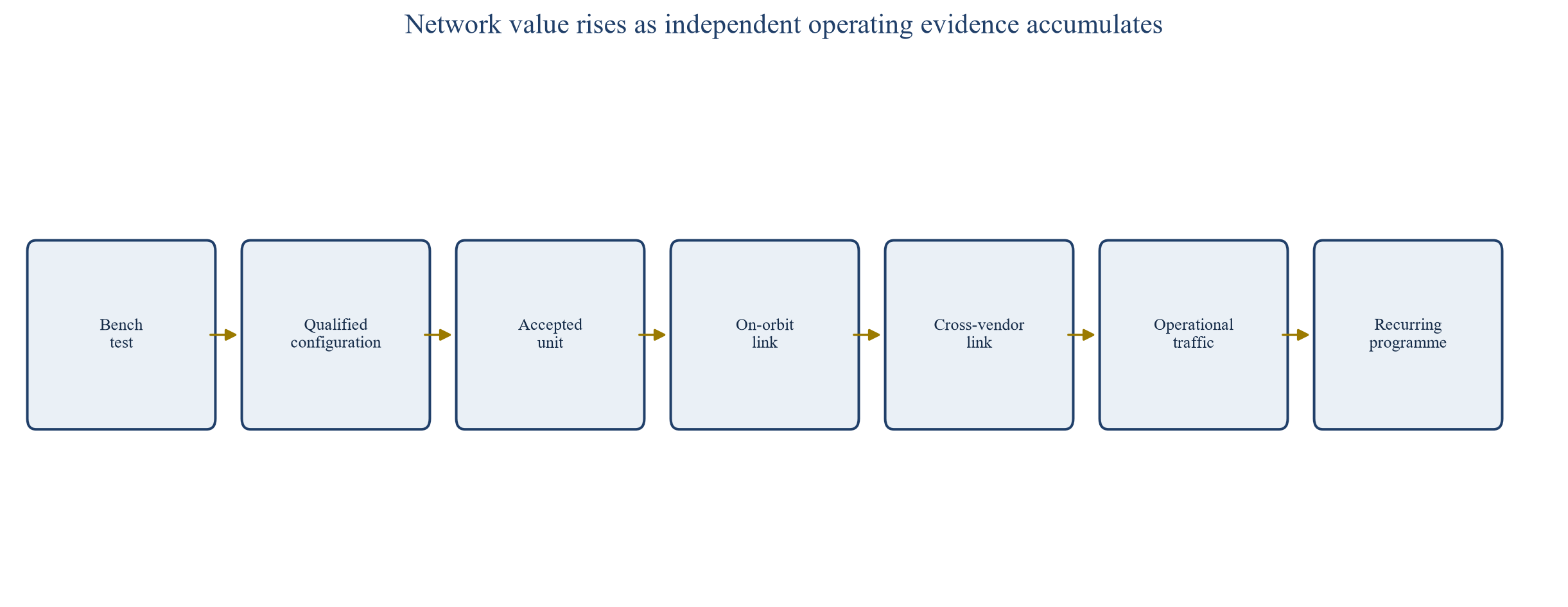
Proposed progression from engineering claim to recurring network value.
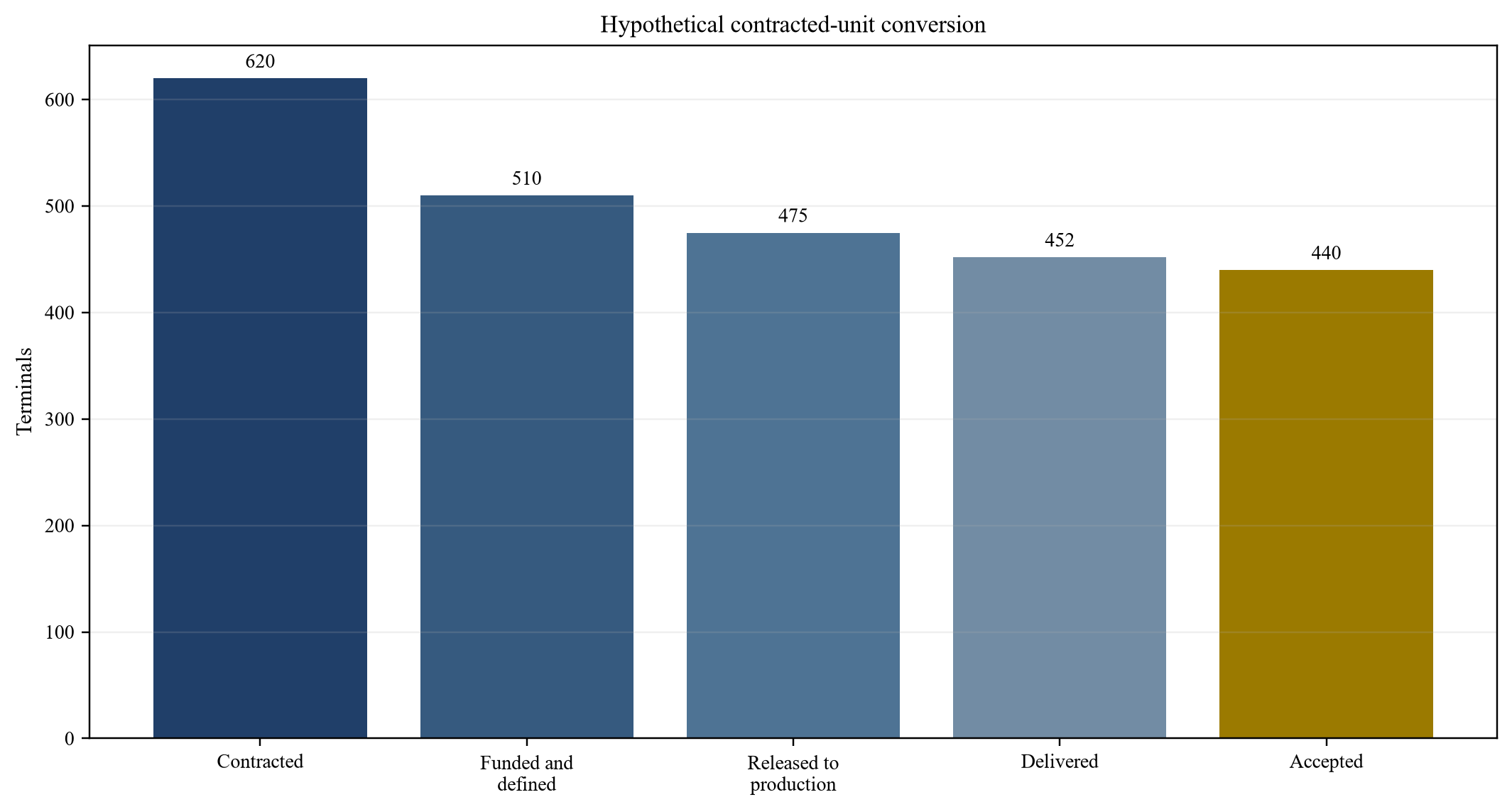
Illustrative terminal counts from announced contract through customer acceptance.
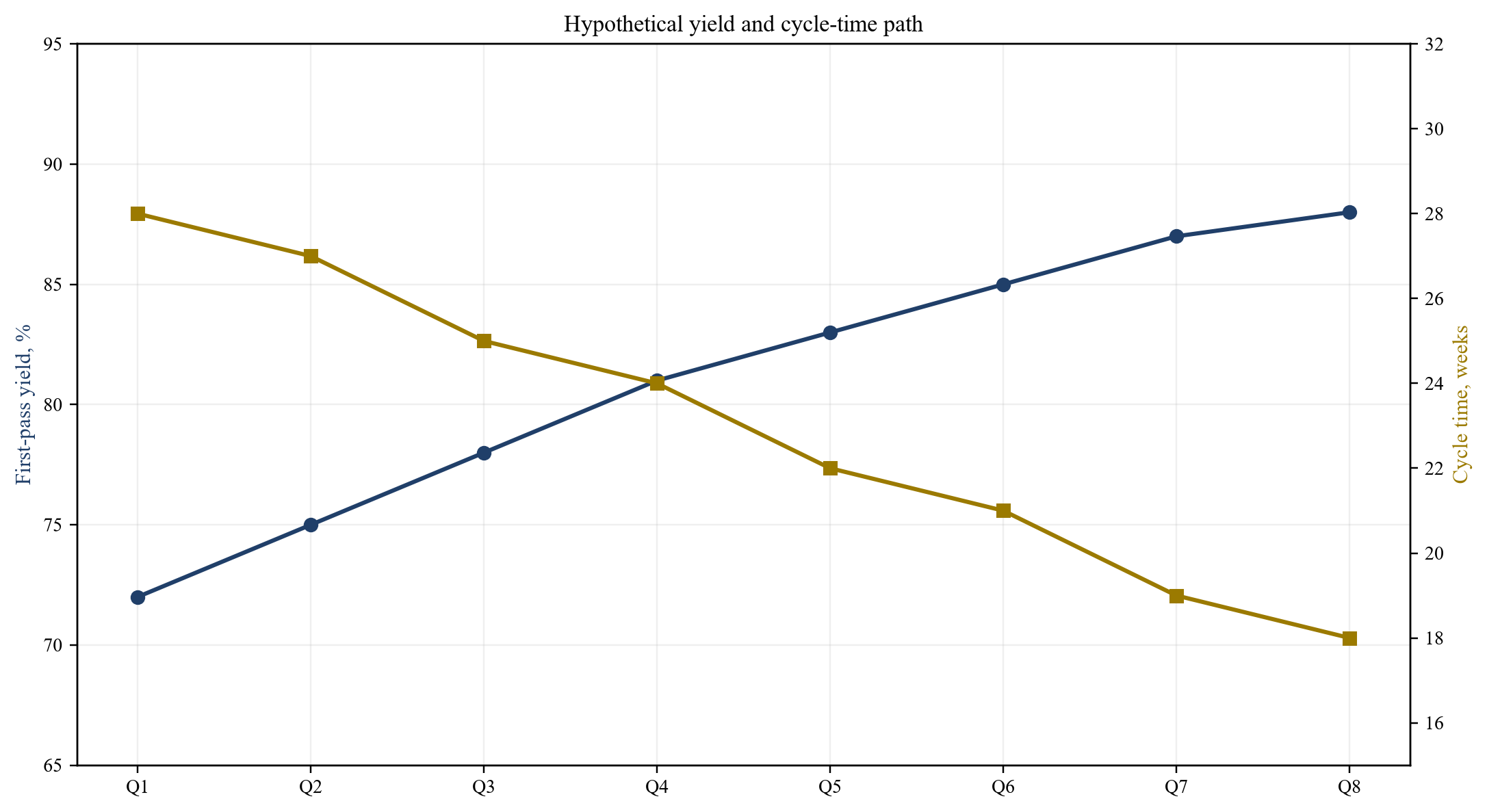
Illustrative eight-quarter operational improvement; yield is left axis and weeks are right axis.
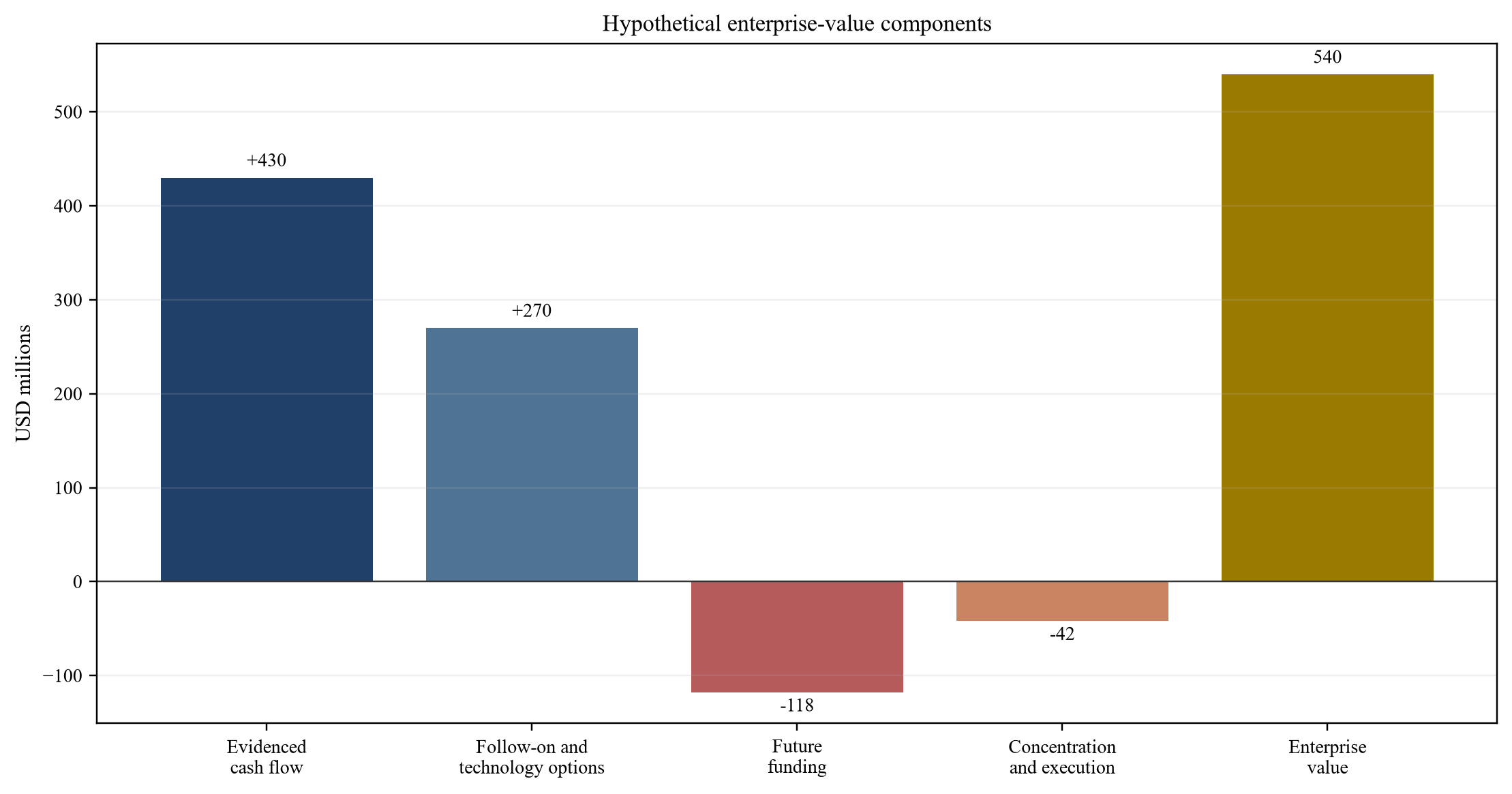
Illustrative USD millions; no named company is represented.
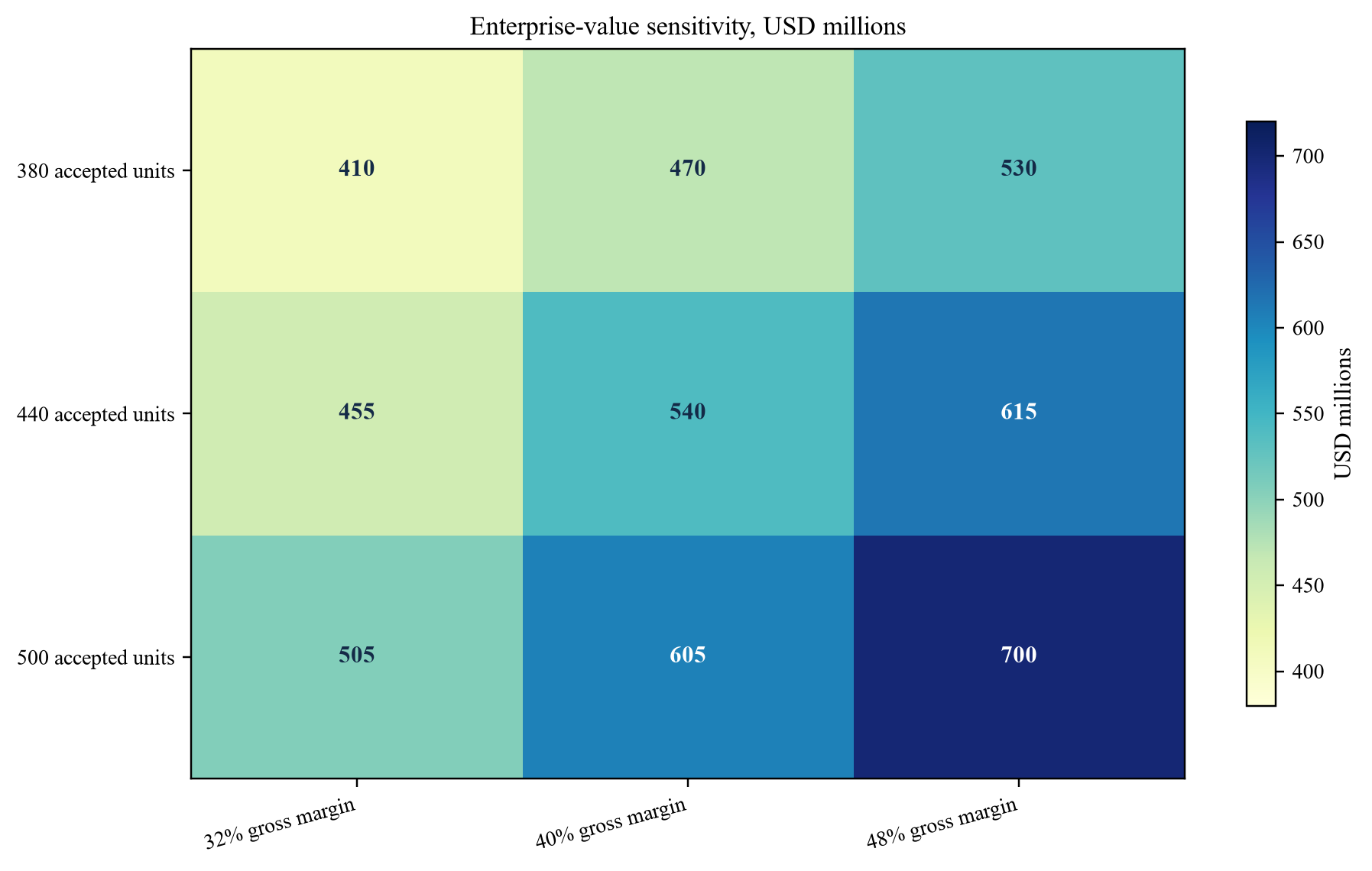
Illustrative enterprise value in USD millions.
| Evidence state | Minimum record | Valuation treatment | Principal residual risk |
|---|---|---|---|
| Engineering design | Controlled drawings and analysis | Development option | Design may not qualify |
| Qualified configuration | Complete test record and accepted waivers | Reusable technology value | Production may not repeat |
| Accepted unit | Customer acceptance and invoice | Contracted unit cash flow | Launch and on-orbit risk |
| Sustained on-orbit link | Link logs and performance data | Operating evidence premium | Counterparty dependence |
| Cross-vendor link | Independent terminals and verified test | Interoperability value | Standard-version drift |
| Operational traffic | Accepted throughput and availability | Renewal and service value | Scale and duty cycle |
| Recurring programme | Follow-on order and collected cash | Base cash-flow and franchise value | Concentration and funding |
Proposed minimum evidence for each operating state.
| Stage | Units | Conversion | Required evidence |
|---|---|---|---|
| Contracted headline | 620 | 100% | Executed contracts and orders |
| Funded and technically defined | 510 | 82% | Funding, specification and schedule |
| Released to production | 475 | 77% | Materials and approved baseline |
| Delivered | 452 | 73% | Shipping and customer receipt |
| Accepted | 440 | 71% | Acceptance, invoice and no material waiver |
Every figure is an assumption and describes no company.
| Dimension | Core measure | Source | Transaction use |
|---|---|---|---|
| Yield | First-pass and final yield by batch | Manufacturing execution records | Margin and capacity |
| Cycle time | Release to acceptance | Unit history | Delivery schedule |
| Rework | Hours and test loops | Quality records | Cost and bottleneck |
| Components | Lead time and qualified sources | Bill of materials and purchase orders | Working capital and continuity |
| Test | Station occupancy and failures | Test logs | Capacity and qualification |
| Warranty | Returns, repairs and reserves | Customer and finance records | Cash-flow adjustment |
Proposed unit-level operating evidence.
| Component | USDm | Evidence treatment |
|---|---|---|
| Evidenced contracted cash flow | 430 | Accepted production and contract schedule |
| Follow-on programmes and reusable technology | 270 | Probability-weighted gates |
| Future production and working-capital funding | -118 | Cash required before delivery |
| Concentration, execution and retention adjustment | -42 | Programme and capability risk |
| Enterprise value | 540 | Illustrative transaction value |
Illustrative USD millions.
| Consideration | USDm | Release evidence | Protection |
|---|---|---|---|
| Cash at completion | 350 | Essential rights, contracts and consents | Warranties, escrow and holdback |
| Manufacturing milestone | 35 | Defined yield and accepted units | Batch and margin test |
| Interoperability milestone | 30 | Sustained independent cross-vendor link | Independent verification |
| Customer milestone | 25 | Accepted follow-on units | No cancelled or loss-making orders |
| Collected-cash milestone | 20 | Reconciled third-party receipts | Audit and clawback |
| Seller rollover | 80 | Continuing equity | Funding and governance agreement |
Proposed evidence-linked release of value.
| Dimension | Metric | Trigger | Board response |
|---|---|---|---|
| Delivery | Accepted units versus plan | Two-period miss | Recovery plan and forecast reset |
| Quality | First-pass yield and escapes | Yield below gate | Hold expansion capital |
| Network | Link acquisition and availability | Material performance miss | Product and customer review |
| Interoperability | Independent links by standard version | Failed cross-vendor test | Limit option value |
| Commercial | Funded orders and contribution | Cancellation or repricing | Revalue backlog |
| Cash | Funding to next accepted batch | Unfunded gap | Finance, resize or suspend |
Proposed post-close control record.
| Gate | Decision question | Minimum evidence | Failure response |
|---|---|---|---|
| Perimeter | What capability transfers? | IP, contracts, people and equipment map | Exclude unsupported assets |
| Qualification | Which configurations are accepted? | Complete test and waiver record | Reduce reusable value |
| Manufacturing | Can output scale at target economics? | Unit history, yield and bottleneck model | Deduct funding and delay value |
| Adoption | Which networks use the product? | Orders, launches, links and traffic | Remove unsupported pipeline |
| Regulation | Can ownership and technology transfer? | Export and investment approvals | Make approval a condition |
| Valuation | What evidence supports each value component? | Cash flow, options and funding ledger | Reprice or restructure |
| Integration | Can delivery continue through control change? | Retention, supplier and customer plan | Holdback or staged closing |
Proposed minimum record before signing.
Sources
- NASA, Laser Communications Relay Demonstration Overview. Read the primary source
- NASA, Integrated LCRD LEO User Modem and Amplifier Terminal. Read the primary source
- Space Development Agency, Optical Communications Terminal Standard v3.0.1. Read the primary source
- Space Development Agency, Optical Communications Terminal Standard resources, versions 3.2.0 and 4.0.0. Read the primary source
- US Government Accountability Office, Laser Communications: Space Development Agency Should Create Links Between Development Phases, GAO-25-106838, February 2025. Read the primary source
- US Government Accountability Office, Missile Warning Satellites: Space Development Agency Should Be More Realistic and Transparent About Risks to Capability Delivery, GAO-26-107085, 2026. Read the primary source
- European Space Agency, Optical and Quantum Communications - ScyLight. Read the primary source
- European Space Agency, High thRoughput Optical Network. Read the primary source
- European Space Agency, ESA Specifications for Terabit/sec Optical Links. Read the primary source
- European Space Agency, ESA and Space Compass partner on next-generation optical network, 25 March 2025. Read the primary source
- NASA, Record-Breaking Laser Demo Completes Mission, 25 September 2024. Read the primary source
- NASA, Streams First 4K Video from Aircraft to Space Station and Back, 24 July 2024. Read the primary source
- European Commission, IRIS2 Secure Connectivity. Read the primary source
- European Commission Joint Research Centre, IRIS2 Europe's space-based secure connectivity system. Read the primary source
- Rocket Lab, Quarterly Report on Form 10-Q for the quarter ended 30 June 2026. Read the primary source
- Rocket Lab, Completion of Mynaric acquisition, Form 8-K exhibit, 14 April 2026. Read the primary source
- Mynaric, Completion of financial restructuring under StaRUG, 19 August 2025. Read the primary source
- Mynaric, Selection to supply optical terminals for SDA Tranche 2 Transport Layer Beta, 7 May 2024. Read the primary source
- Space Development Agency, Transport Layer. Read the primary source
- Space Development Agency, DoD to Test Laser Communications Terminals in Low Earth Orbit. Read the primary source
- UK Defence Science and Technology Laboratory, UK's first optical downlink from space, 2026. Read the primary source
- NASA, Deep Space Optical Communications. Read the primary source
- Consultative Committee for Space Data Systems, Optical Communications standards. Read the primary source
- US Department of Commerce, Export Administration Regulations. Read the primary source
- US Department of State, International Traffic in Arms Regulations. Read the primary source
- IFRS Foundation, IFRS 3 Business Combinations. Read the primary source
- IFRS Foundation, IFRS 13 Fair Value Measurement. Read the primary source
- IFRS Foundation, IAS 36 Impairment of Assets. Read the primary source
- US Department of Justice and Federal Trade Commission, Merger Guidelines, 18 December 2023. Read the primary source
- European Commission, EU Merger Regulation. Read the primary source
