

1. Treat site control as a funded decision path
Land control is valuable when it gives the developer enough protected time and access to turn uncertainty into evidence. A signature alone does not achieve that outcome. The right must survive the feasibility period, bind the correct owner, permit the required investigations, protect the developer against competing disposals, and lead to an acquisition or development right that capital providers can support.
The decision path begins with an identified legal parcel and authorised owner. It continues through title, site access, survey, planning, density, utilities, environmental and technical diligence. The developer then tests product, revenue, development cost, programme, finance and exit. Conditions are satisfied or waived through named authorities. The land is acquired, leased or developed under the agreed right only after the board and funders can see a viable project.
Capital-light does not mean cost-free. The developer may pay an option fee, deposit, exclusivity payment, professional costs, planning fees and extension amounts. Management time and opportunity cost also matter. These expenditures purchase information and time. Their value depends on whether the agreement protects the resulting work, controls the site and preserves a clean choice at the decision date.
The board should approve a site-control budget, evidence plan and maximum exposure. It should distinguish recoverable payments, creditable payments, sunk costs and contingent obligations. It should also define the decision that each tranche funds. A survey budget without access rights has limited value. A planning application without owner cooperation or a transferable benefit can create value for the landowner while leaving the developer exposed.
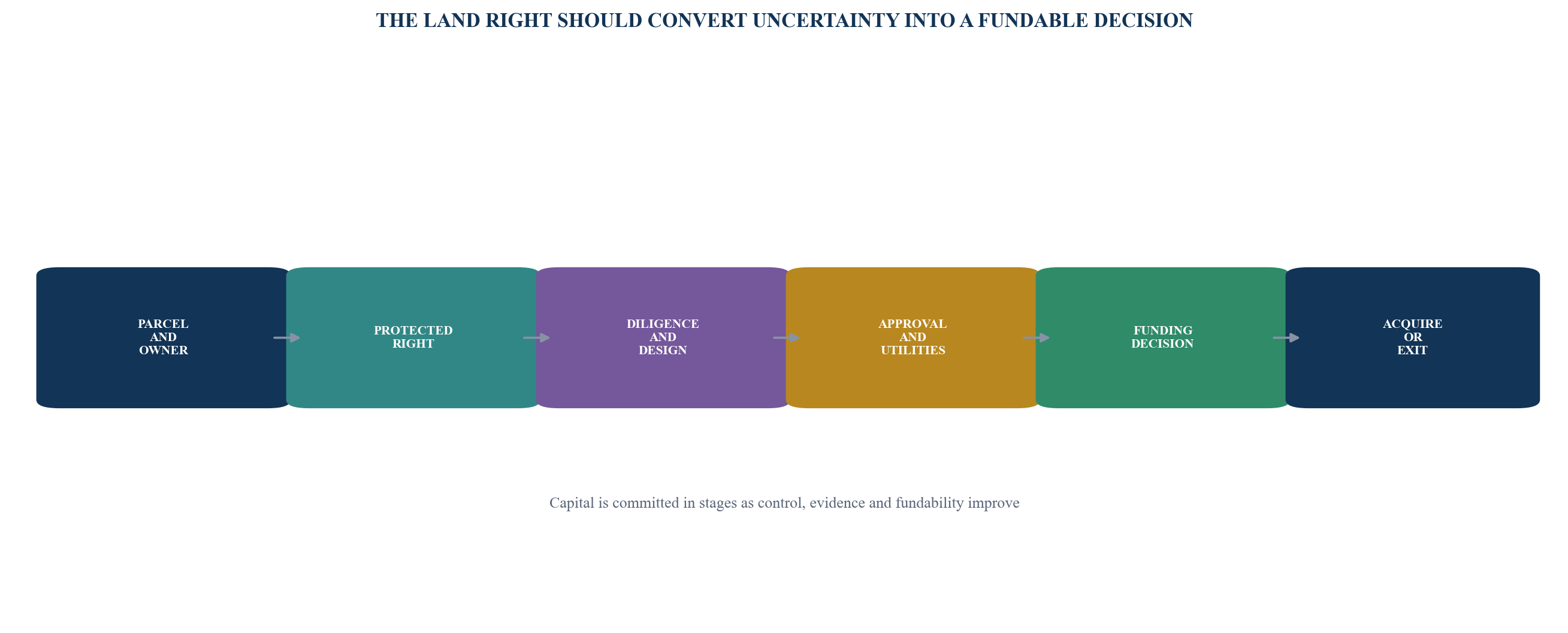
The sequence is illustrative; rights, registrations and approvals depend on the jurisdiction and transaction.
2. Select the right before negotiating the price
An option gives the grantee a defined right to acquire or take another interest during a period and on agreed terms. A conditional contract commits the parties subject to stated conditions. A pre-emption right may give priority if the owner decides to sell. A promotion agreement can appoint a party to pursue planning and market the land. A long lease, usufruct or Musataha can create a development and operating interest without freehold acquisition. A landowner joint venture can contribute land to a shared vehicle or economics. A development-management agreement can give delivery responsibility without transferring the underlying land.
These structures allocate control differently. An option can protect a developer while investigations proceed, but its exercise mechanics, price formula, protection and assignability must work. A conditional acquisition can create firmer commitment and may bring greater deposit or completion exposure. A registered real right can support long-duration development and financing, subject to the applicable law and actual registration. A joint venture can reduce initial cash cost while creating governance, valuation, dilution and deadlock issues.
The selection should begin with the intended use of the land. A short planning trade has different requirements from a twenty-year operating asset. A residential sell-down requires a path from land control to project licensing, purchaser contracts and escrow. A lender needs a right that can support security, enforcement and completion. A landowner may require minimum value, a participation mechanism or a reversionary interest.
The parties should compare duration, registration, price, control, capital requirement, financeability, tax, approvals, transfer, default and exit. Local counsel and the responsible registration authority determine what can be created and protected for the specific parcel.
Table 1. Site-control structure-selection matrix
| Structure | Primary economic purpose | Capital profile | Critical control question |
|---|---|---|---|
| call option | preserve a choice while evidence is built | fee and diligence before exercise | can the right be protected, extended, assigned and exercised cleanly? |
| conditional acquisition | bind sale subject to defined outcomes | deposit, costs and potential completion duty | are conditions objective and within a workable long-stop? |
| long lease, usufruct or Musataha | develop and operate without freehold purchase | staged rent, fees and development capital | is the registered term and permitted use sufficient for finance and exit? |
| landowner joint venture | share land and development economics | reduced acquisition cash with shared governance | how are land value, control, funding, dilution and distributions governed? |
| promotion or development agreement | create planning or project value for owner | professional and promotion expenditure | who owns the work product and controls sale, delivery and fee payment? |
The matrix is conceptual; transaction-specific law and registration determine the available rights.
3. Confirm the parcel, owner and power to grant the right
Every model depends on a legally identifiable parcel and a party with authority to bind it. The diligence file should reconcile the official record, plot plan, boundaries, area, current owner, encumbrances, mortgages, leases, easements, acquisition rights, court matters and restrictions. Corporate records should establish authority, beneficial ownership, approvals and signatory capacity. Estate, trust, government, minor or jointly owned interests may require additional evidence or consent.
Dubai Land Department states that it is the legally authorised entity for documenting real-estate transactions in Dubai and describes registration through its electronic and trustee systems. Abu Dhabi's published material treats relevant dealings and Musataha and usufruct terms as registrable matters. HM Land Registry's practice guidance explains why third-party interests in registered land may require protection through notices or restrictions in England and Wales. These frameworks differ, yet each reinforces a common execution principle: private agreement and public protection must be analysed together.
The developer should search for competing rights and future constraints. Existing tenants may limit possession. A lender may control disposal. A master developer may retain consent rights. Access can depend on another parcel. Utilities can require wayleaves. A zoning or infrastructure condition can affect capacity. A right that covers the main plot but excludes required access, staging or services may not control the developable site.
The evidence file should include dated official extracts and a gap register. It should identify which facts are verified, which require confirmation, who owns each action and whether the issue blocks signing, investigation, exercise, funding or launch.
4. Convert uncertainty into objective conditions precedent
A condition precedent should answer a decision question with an identifiable outcome. Useful conditions can cover satisfactory title, specified planning approval, minimum developable area, access, utility capacity, environmental results, financing, board approval, master-developer consent, foreign ownership, project registration or another authority outcome. Vague satisfaction language can preserve discretion but may also create dispute. Excessively narrow conditions can force completion despite a material change.
The condition register records the clause, required evidence, responsible party, submission date, target date, dependency, discretion, waiver authority and consequence. Conditions should be grouped by control gate. Signing conditions establish that the agreement exists and can be protected. Investigation conditions give access and information. Exercise conditions establish whether the developer can acquire the intended right. Completion conditions manage transfer, funds, releases and possession.
Seller obligations matter because many approvals depend on the registered owner. The owner may need to sign applications, provide title documents, grant survey access, answer authority queries, procure a lender consent or refrain from changing the site. The agreement should state response times and remedies for non-cooperation.
The long-stop should reflect the critical path and realistic authority sequence. It needs extension rules for pending applications, appeals, third-party infrastructure and owner-caused delay. The board should see how much cash and time each extension buys and which evidence should exist before it is paid.
Table 2. Condition-precedent control register
| Condition | Evidence of satisfaction | Dependency | Decision effect |
|---|---|---|---|
| title and authority | current official records, approvals and enforceable execution | owner, registry and secured creditor | protects validity and disposal path |
| planning and density | final or acceptable authority decision with usable parameters | owner cooperation, studies and application | determines product, area, time and residual value |
| access and utilities | documented route, capacity, cost, programme and responsible party | utility, master developer and adjoining rights | establishes buildability and opening path |
| funding | approved terms, diligence completion and executable security package | land right, model, lender and registrations | determines exercise and completion capacity |
| project and off-plan approvals | required developer, project, escrow and marketing permissions | title or landowner agreement, design and feasibility | controls lawful launch and buyer-fund access |
Conditions and remedies require transaction-specific drafting and legal advice.
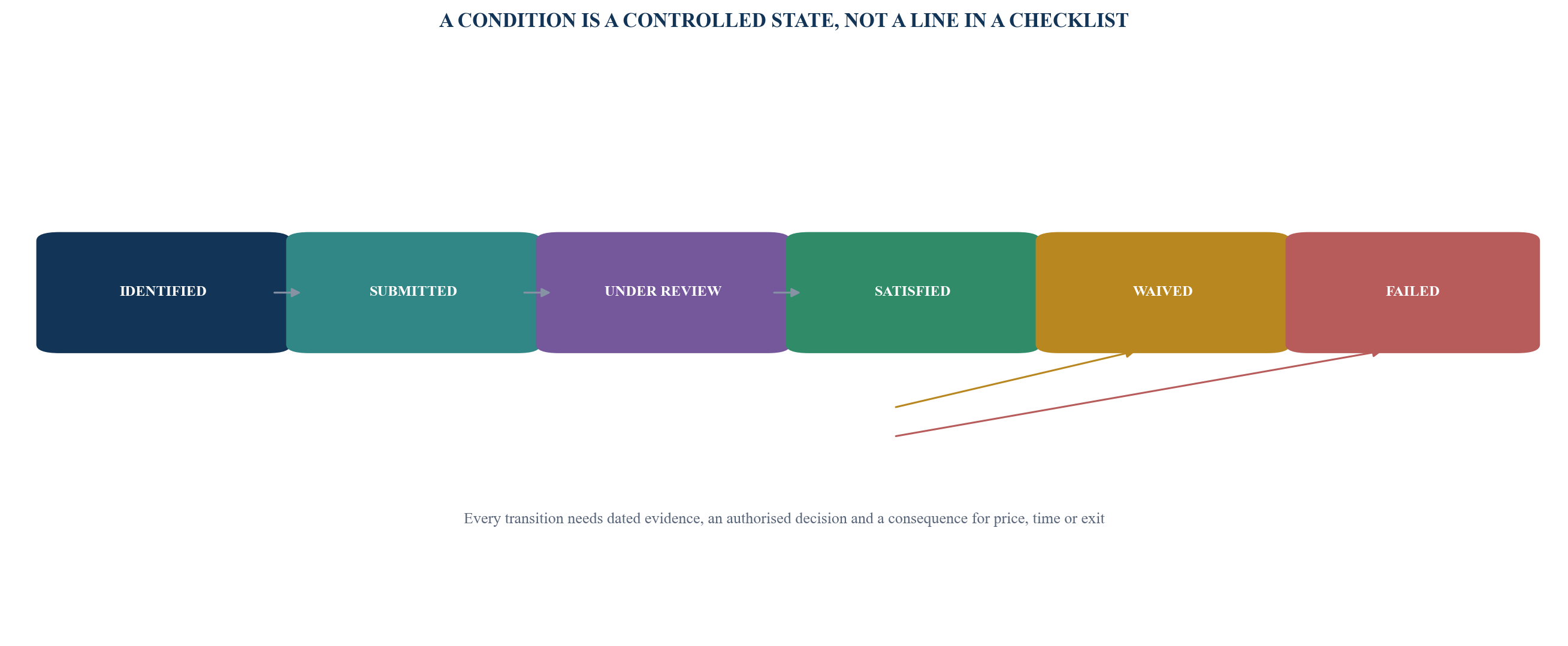
Conditions can move backward when evidence expires or the project changes.
5. Price time, exclusivity and information
The option price pays for more than a future purchase choice. It can pay for exclusivity, access, owner cooperation, document delivery, application rights and protection against a competing disposal. The fee should therefore be analysed against the control actually received.
The payment schedule can include a signing fee, refundable deposit, non-refundable option payment, milestone amounts and extensions. Some payments may be credited against the purchase price. Others remain sunk. The model records timing, recoverability, crediting, tax treatment and the event that triggers payment.
The developer should calculate capital at risk through each decision date. This includes fees, surveys, design, authority charges and finance costs. A low option fee can mask an expensive planning obligation. A higher fee may be rational if the right is well protected, the price is fixed or the developer can assign the benefit.
Time has option value only when the project can progress during the period. The schedule should link access, information, design, authority, utility and funding work to the option clock. Idle exclusivity is cost. A short period with ready information can be more valuable than a long period with weak cooperation.
Table 3. Illustrative option and diligence budget
| Stage | Illustrative cash at risk | Evidence purchased | Continue only if |
|---|---|---|---|
| exclusivity and title | AED 0.4m | protected access, title and authority file | owner and parcel can be controlled |
| concept and capacity | AED 0.8m | area, design, planning and utility route | feasible capacity supports the product case |
| application and funding | AED 1.2m | authority submissions, cost plan and lender file | value range supports price and funding |
| extension | AED 0.5m | additional time for defined pending decisions | remaining outcome can justify added exposure |
| exercise and completion | transaction-specific | registrable right, possession and funding | all board gates and completion mechanics pass |
Amounts are management assumptions used only to demonstrate staged exposure; they are not market terms.
6. Underwrite the option-cost frontier
The board should compare cumulative control cost with the value of uncertainty resolved. Early work can eliminate a site cheaply. Later work is rational when it materially improves planning certainty, utility confidence, cost accuracy, funding readiness or transaction control. Expenditure that does not change a decision should be challenged.
An option-cost frontier plots cumulative cash at risk against decision confidence. The curve does not need to rise smoothly. A planning submission can cost money while adding little certainty until an authority response arrives. A utility capacity letter can change the project rapidly. A seller consent delay can reduce confidence even after considerable spending.
The approval paper should state the next irreversible expenditure and the evidence expected from it. It should also state the stop rule. If title cannot be protected, access is unavailable, density falls below threshold or utility timing breaches the launch plan, the developer should have authority to stop without allowing sunk cost to dominate.
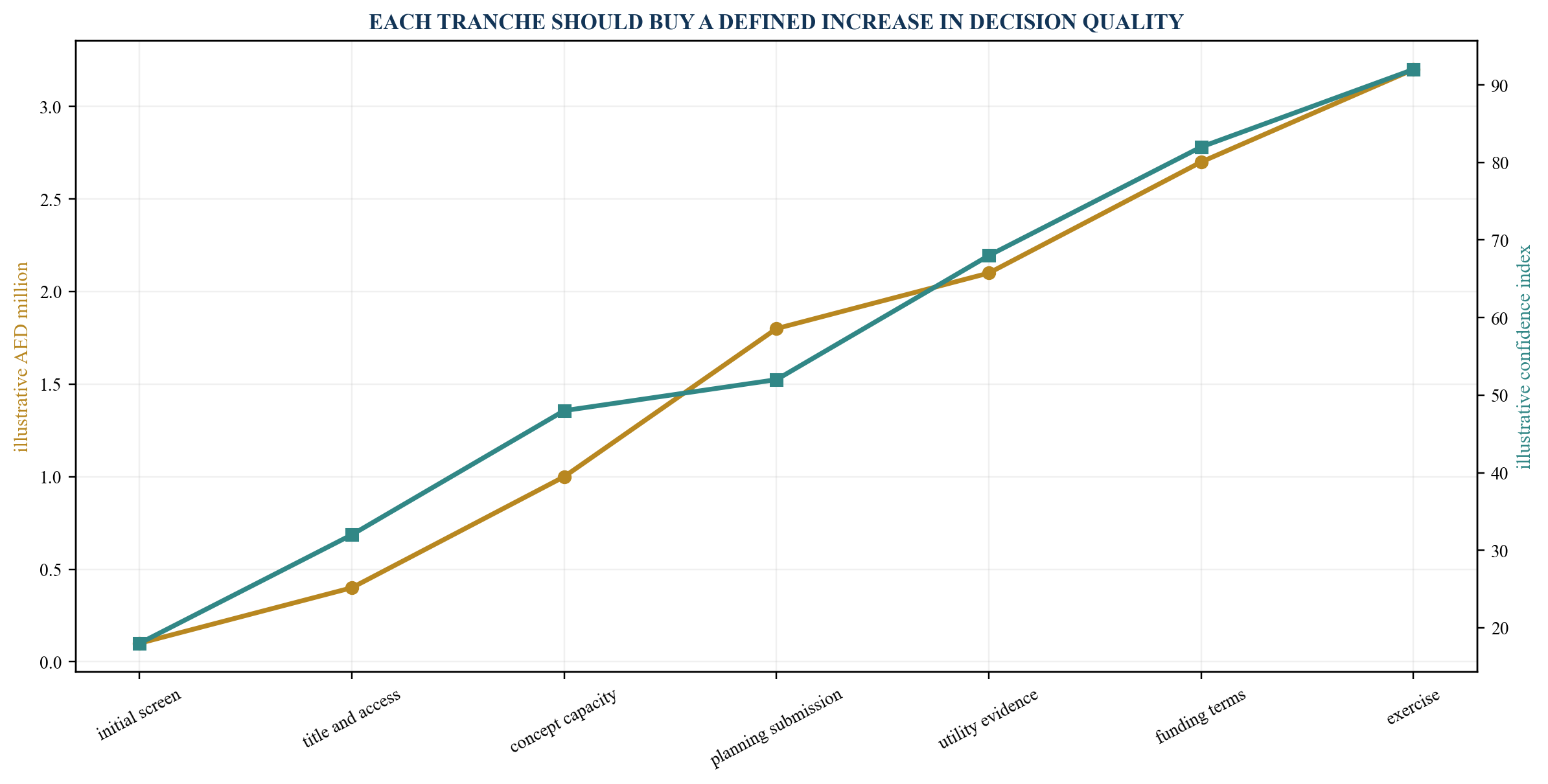
Values are management assumptions for demonstrating decision staging; they do not estimate a specific site's cost or success probability.
7. Rebuild residual land value as evidence changes
Land value is an output of product, area, price, pace, cost, time, finance, risk and required return. It should be recalculated when the evidence changes. A fixed headline price negotiated before density, utilities and programme are tested can transfer development uncertainty to the buyer.
The residual model begins with sellable or lettable product under a stated planning case. It applies market evidence, incentives, absorption, operating assumptions and exit. It deducts construction, infrastructure, professional, authority, finance, sales, contingency, tax and required return. The resulting land value is tested against the exercise price and full control cost.
RICS's development-property valuation material emphasises that the valuation purpose affects assumptions and outcome. It also identifies choices to develop, phase, sell or defer. The option model should retain these real choices. A site may support an initial phase while later land remains controlled. A change in utility timing may favour deferral. A planning uplift may support assignment rather than construction.
The board should see a range, not one residual. The range should identify which variables are market observations, professional estimates, contractual facts or management scenarios. The land-price mechanism can then use a fixed amount, formula, valuation process, floor, cap, participation or combination consistent with the risk allocation.
8. Make planning capacity a contract output
Planning success is not a binary label. The economically relevant outcome includes permitted use, gross and sellable area, height, massing, parking, access, public realm, affordable or community obligations, phasing, infrastructure, conditions and expiry. The option should define what outcome is acceptable and who decides.
The planning workstream should start with a policy and constraint review, then move through concept capacity, authority engagement, surveys, design development and application. Each iteration changes the residual model. The team should keep a dated assumption register so the board can distinguish authority evidence from design ambition.
Owner cooperation should cover application signatures, access, meetings, additional information, appeals, modifications and implementation. The parties should agree ownership and permitted use of drawings, studies and approvals if the developer does not exercise. A planning permission that stays with the land can increase owner value. The commercial terms should address that possibility directly.
The programme should include decision float. Authority requests, stakeholder consultation, adjacent owners and technical studies can extend the path. The long-stop and extension structure should recognise evidence of progress without creating open-ended control.
9. Treat utilities and access as development rights
A planning-compliant site may still lack an executable utility or access route. The diligence should identify electricity, water, sewerage, drainage, district cooling, telecoms, roads, fire access and construction logistics. For each, it records capacity, point of connection, route, land right, cost, payment timing, provider, design responsibility and programme.
Utility statements should be matched to the intended load and phase. A general indication is different from a committed capacity or executed connection agreement. A route across third-party land requires a right that survives completion and financing. A future substation or road may depend on a master developer or public programme outside the developer's control.
The option should permit surveys, boreholes and technical access under agreed insurance, reinstatement and safety provisions. It should also require the owner to disclose known services and constraints without turning incomplete information into assumed assurance.
The cost model separates site-specific connections, wider infrastructure, authority contributions and refundable deposits. The funding model shows which costs arise before land acquisition, financial close, off-plan receipts and construction drawdown.
Table 4. Site evidence and gap register
| Evidence domain | Minimum controlled record | Common decision gap | Gate affected |
|---|---|---|---|
| title and boundary | official extract, plot plan, survey and encumbrance review | parcel or access mismatch | signing, protection and security |
| planning | policy, capacity study, authority record and conditions | assumed area exceeds supported outcome | price, exercise and funding |
| utilities | load, route, capacity, cost, provider and delivery date | indication lacks commitment or route right | design, finance and opening |
| ground and environment | surveys, contamination, geotechnical and flood evidence | cost or remediation remains unbounded | residual value and completion |
| commercial | product, market, cost, programme and downside range | revenue evidence and cost plan use different design | board approval and lender case |
Evidence must be current, parcel-specific and reviewed by the responsible professional.
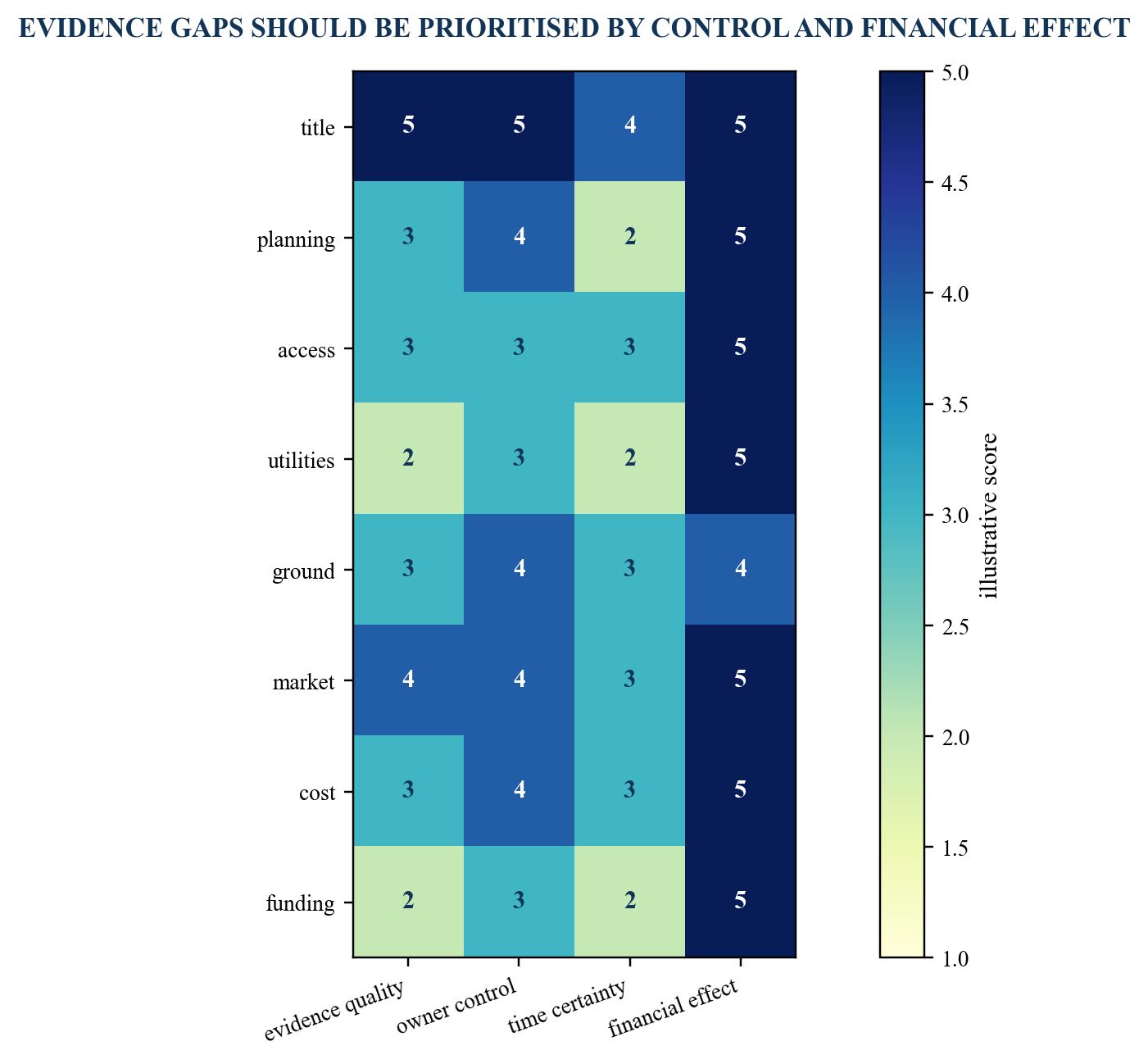
Scores are management assumptions for demonstrating prioritisation and require project-specific evidence.
10. Align owner protections with developer progress
The landowner needs certainty that the developer will investigate diligently, protect the land, meet milestones and either proceed or release the site. The developer needs time, exclusivity, cooperation and protection for money spent. A workable agreement balances both needs through measurable obligations.
Milestones can cover diligence commencement, concept submission, planning application, funding engagement and exercise. The owner may receive reports or consultation rights while the developer retains control of professional analysis and privileged material. Insurance, indemnity, access protocols and reinstatement protect the site during investigations.
The agreement should restrict new leases, charges, disposals, works and competing negotiations that could undermine the project. It can allow ordinary property management within defined limits. Owner representations should have a stated scope, knowledge standard, disclosure process, survival period and remedy.
If the developer misses a milestone, the remedy can include notice, cure, loss of exclusivity, fee adjustment or termination. Automatic termination can destroy value during a minor administrative delay. Unlimited discretion can strand the landowner. The decision framework should match remedy to economic harm and control.
11. Protect the right through the relevant register
The legal team should determine whether the right itself, or notice of it, can and should be registered or otherwise protected. The answer varies across jurisdictions and structures. A contractual option may require a notice or restriction. A Musataha or usufruct can operate as a registered real right under the applicable framework. A corporate joint venture may control the land-owning entity rather than register a separate acquisition right.
The UAE's 2025 Civil Transactions Law identifies ownership and derived rights including usufruct, use, habitation, Musataha and easement among principal real rights. Abu Dhabi's standard Musataha material describes registration and a development right on another's land. England and Wales introduced current information requirements for specified contractual control agreements in 2026, including options, conditional contracts, pre-emption rights and certain promotion arrangements. HM Land Registry also explains notices and restrictions used to protect third-party interests.
Registration analysis should occur before signing. It affects form, information disclosure, priority, owner cooperation, lender requirements, assignment and release. The transaction timetable should include applications, consents, fees, evidence and expected processing. The closing checklist should verify the final public record rather than rely only on submission receipts.
Confidentiality also needs review. Some regimes may publish information about a control agreement. The parties should understand required disclosures and align commercial communications accordingly.
12. Design the land right for funding and security
A lender or investment committee will test whether the developer controls the land for the construction and repayment period. It will examine term, permitted use, price, conditions, termination, assignment, mortgage, step-in, cure, priority, owner consents and completion mechanics. A project can be economically attractive and still fail this legal-control test.
The fundability review maps each financing requirement to the land instrument. If the lender expects security over a long lease or Musataha, that right must exist, be registrable and permit mortgage on acceptable terms. Abu Dhabi registration guidance expressly addresses mortgage documentation involving an owner or holder of usufruct or Musataha. If the lender funds acquisition on exercise, the closing mechanics must align option notice, price, equity, release of existing security, transfer and new security.
Off-plan finance introduces another layer. Dubai Land Department describes project escrow accounts receiving purchaser and project-financier amounts. Saudi Arabia's off-plan law requires a valid property deed and, where relevant, the agreement between the developer and landowner or usufructuary, alongside approved designs, feasibility, escrow and other licensing documents. These requirements show why land control, project approval and finance cannot be sequenced independently.
The developer should seek lender feedback before the land right hardens. A financeability term sheet can identify required consents and cure periods while the owner remains engaged.
Table 5. Land-right fundability review
| Lender question | Evidence required | Land-document response | Failure consequence |
|---|---|---|---|
| what right controls the site? | executed and protected agreement, title and official record | clear parcel, term, permitted development and exercise route | diligence stop or pricing penalty |
| can security attach and rank? | registrability, mortgage permission, consents and priority | express security, owner consent and closing steps | unavailable or structurally weak debt |
| can the lender cure or step in? | defaults, notice, cure, termination and transfer mechanics | lender notice, extended cure and permitted transferee route | termination risk during enforcement |
| is the term long enough? | construction, stabilisation, repayment and exit programme | adequate initial term and controlled extensions | reduced tenor, value or leverage |
| can the project close and launch? | approvals, escrow, landowner agreement and completion funds flow | coordinated conditions and deliverables | stranded equity or unlawful launch |
Financing and security requirements depend on the lender, instrument, law and registered interest.
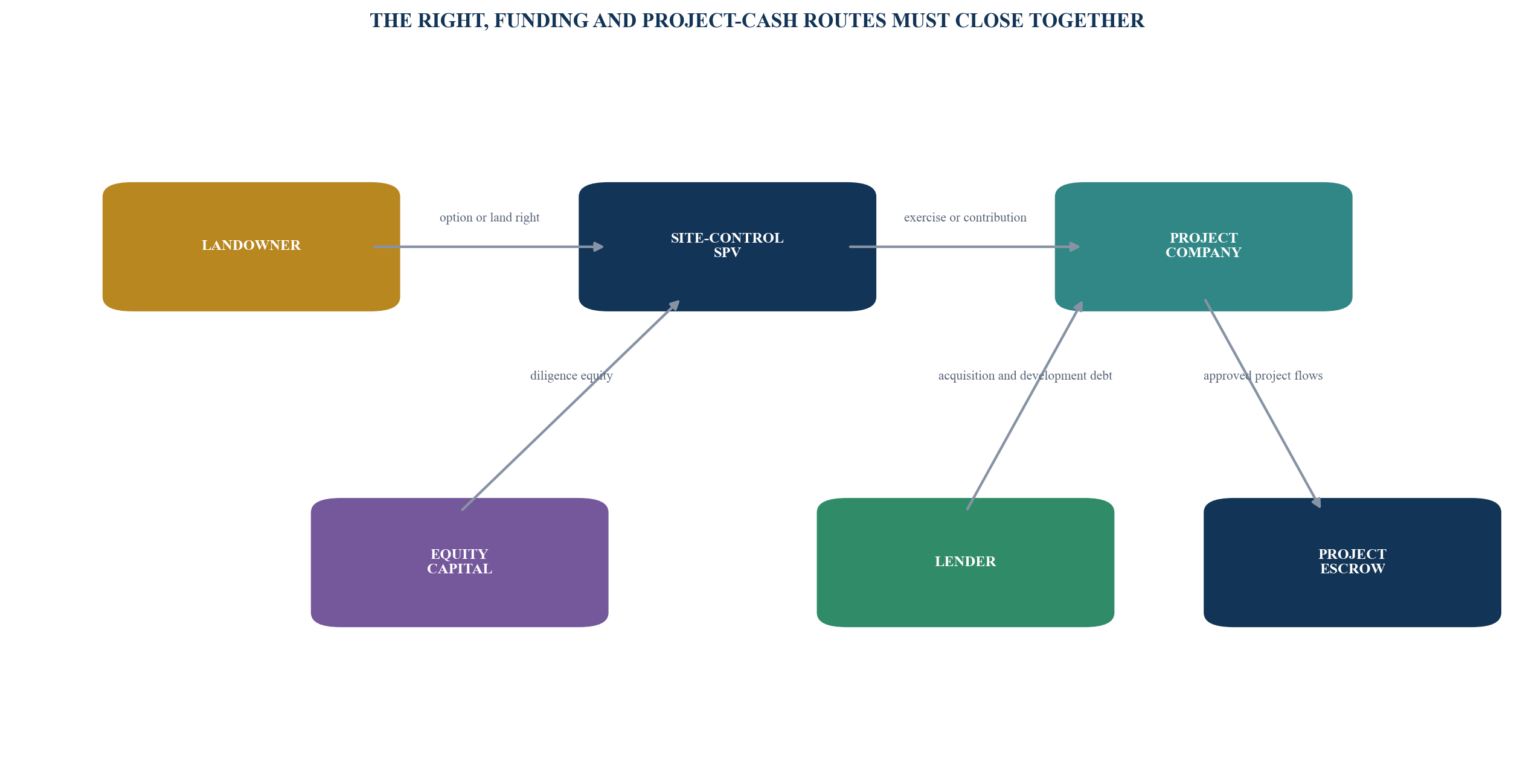
The legal and cash-flow architecture is illustrative; actual security and escrow routes require transaction-specific advice.
13. Use a site-control vehicle with explicit authority
A dedicated vehicle can ring-fence option payments, professional costs, work product and rights. It can also simplify admission of capital or nomination of a project company. The structure should remain proportionate to the site and should not create tax, licensing, substance or transfer problems.
The authority matrix should state who can sign the option, approve expenditure, submit applications, amend conditions, pay extensions, waive rights, exercise, assign, finance, settle disputes and terminate. The board should reserve irreversible decisions while delegating routine diligence within an approved budget.
If the landowner participates in the vehicle, governance becomes central. The parties should agree land valuation, equity credits, cash calls, dilution, reserved matters, related-party decisions, development management, distributions, cost overruns, deadlock and exit. Land contribution should occur at a defined gate rather than through an ambiguous promise.
The accounting record should reconcile commitments and payments to the agreement. The data room should preserve executed documents, notices, receipts, access records, studies, applications, authority correspondence, models and decisions under controlled versions.
14. Prevent exclusivity leakage and work-product capture
Exclusivity can fail even when the owner does not sign another sale. The owner may grant a lease, charge the property, allow competing diligence, change boundaries, alter access, commence works or use the developer's planning concept with another party. The restriction schedule should focus on actions that impair value or control.
The agreement should define permitted owner activity and disclosure of inbound approaches. It should require notice of title, authority or site changes. A remedy can include an injunction route where available, fee repayment, cost reimbursement, agreed compensation or termination, subject to applicable law and enforceability.
Work product needs its own regime. Surveys may be site-specific. Design may contain consultant intellectual property. Authority applications may sit in the owner's name. The agreement should state ownership, licences, reliance, transfer, confidentiality and use after termination. If the owner retains the benefit of a planning uplift created by the developer, the economics can include reimbursement or participation.
The developer should also protect its commercial strategy. Feasibility assumptions, capital sources and tenant or buyer discussions should not become general owner marketing material without consent.
15. Link extensions to progress and remaining value
Extensions should respond to a defined reason: an authority decision is pending, a utility solution is being documented, finance is at term-sheet stage or owner delay has consumed the original period. An automatic paid extension may be appropriate for predictable processes. A discretionary extension can protect the owner but creates renewal risk for the developer.
The extension memo should show cumulative cost, evidence completed, unresolved matters, revised critical path, new payment, price effect and walk-away alternative. It should state whether the site remains the best use of scarce management and capital.
Owner-caused delay can extend time without added fee. Force-majeure and authority delay may have separate treatment. The agreement should set a final long-stop so both parties understand when control ends.
Notice mechanics deserve operational discipline. Calendar, recipient, form, delivery evidence and business-day rules should be recorded at signing. A valuable right can be lost through a missed or defective notice.
16. Preserve assignment, nomination and clean exit
The initial option holder may not be the final project owner. The developer may need to nominate a project company, admit an investor, assign to an affiliate, transfer after planning, or sell the controlled opportunity. The agreement should address these routes and any owner consent, financial standing, guarantee or release.
Change-of-control provisions should be tested against the planned capital structure. A broad restriction can make ordinary fundraising a consent event. An unrestricted transfer can expose the owner to an unsuitable counterparty. Objective permitted-transferee criteria, continuing liability and consent standards can balance the interests.
The exit model includes exercise and build, exercise and sell, assign the right, contribute it to a joint venture, extend, renegotiate or walk away. Each route has different tax, fee, consent, work-product and funding effects. The board should see these before investing heavily in planning.
On termination, the parties should reconcile access, reinstatement, confidential information, studies, applications, registrations, notices, deposits, fees, claims and surviving obligations. Any registered protection should be released through a controlled process when the agreement requires it.
17. Keep off-plan launch behind a separate gate
Land control does not itself authorise project advertising, buyer contracting or collection. The project needs the applicable developer, land, design, licensing, registration and escrow framework. The launch team should not treat a signed option or heads of terms as completed project readiness.
Dubai Land Department explains that developers selling off-plan and receiving buyer or financier amounts fall within the project escrow framework. Its legislation material addresses developer registration, project approval and project-specific accounts. Saudi Arabia's current off-plan law prohibits unlicensed sale, lease, advertising and promotion and specifies a licensing package that includes title or the relevant landowner or usufructuary agreement, approved design, feasibility, consultant and accountant arrangements and escrow.
The launch gate should therefore verify the legal land right required for the relevant project licence, the status of every authority approval, approved sales material, purchaser document, escrow account, collection route and evidence date. Marketing milestones in the site-control agreement should remain conditional on those requirements.
Funding should separate option and diligence capital, acquisition capital, development equity, lender drawdown and permitted purchaser receipts. The board should know which source funds each stage and what happens if launch is delayed.
18. Run a ten-day site-control diagnostic
Days one and two establish the parcel, owner, current right, transaction structure, price, deadlines and authority. The team creates the title and document request, decision calendar and immediate-protection checklist.
Days three and four test planning capacity, access, utilities, surveys, environmental matters and critical dependencies. The output is an evidence heat map showing verified facts, current professional opinions, missing evidence and blocking issues.
Days five and six rebuild the residual model and option-cost frontier. The team reconciles product, area, revenue, cost, programme, finance and downside. It identifies the maximum additional capital justified before the next evidence gate.
Days seven and eight run the contract and fundability review. The work covers conditions, cooperation, exclusivity, protection, extension, assignment, mortgage, lender cure, completion, termination and off-plan sequence.
Days nine and ten produce a board decision pack: proceed, amend, extend, exercise or exit. It includes the rights matrix, condition register, cash at risk, residual range, critical path, funding gaps, red flags, owners and dated next actions.
Table 6. Board decision cases for a controlled site
| Decision case | Required evidence | Capital decision | Appropriate route |
|---|---|---|---|
| proceed with diligence | protected right, credible capacity and bounded next-stage cost | approve a limited evidence tranche | retain option and complete named conditions |
| amend before spending | material gaps in access, cooperation, protection or financeability | hold discretionary expenditure | revise rights, milestones, consents or price mechanics |
| exercise | acceptable title, approvals, model, funding and closing path | commit acquisition and project capital | deliver coordinated notice, funds and registrations |
| assign or partner | transferable right, documented work product and investable case | compare proceeds or shared economics | controlled assignment, nomination or joint venture |
| exit | failed threshold, unbounded risk or weak remaining value | stop further exposure | terminate, release protection and close the evidence file |
Outcomes depend on verified evidence, approved risk appetite and transaction-specific advice.
19. Operate a ninety-day site-control office
The first thirty days establish control. The office reconciles agreements, official records, payments, notices, access, consultants, applications and the integrated programme. It closes urgent protection gaps and creates one evidence repository.
Days thirty-one to sixty focus on the critical value questions. Planning and technical teams advance the supported design. Utility routes and site dependencies are documented. The cost plan, programme and commercial model are reconciled to the same design. Finance providers receive a controlled diligence pack and identify security requirements.
Days sixty-one to ninety convert evidence into a transaction decision. The team negotiates remaining amendments, prepares approvals, tests closing mechanics, confirms funding and produces the exercise or exit recommendation. If conditions remain pending, the extension paper states the evidence and value expected from added time.
The office maintains a weekly dashboard covering days remaining, cash at risk, condition states, title gaps, planning parameters, utility confidence, residual range, funding status, owner actions and next irreversible expenditure. Red status requires an owner, cure date and board consequence.
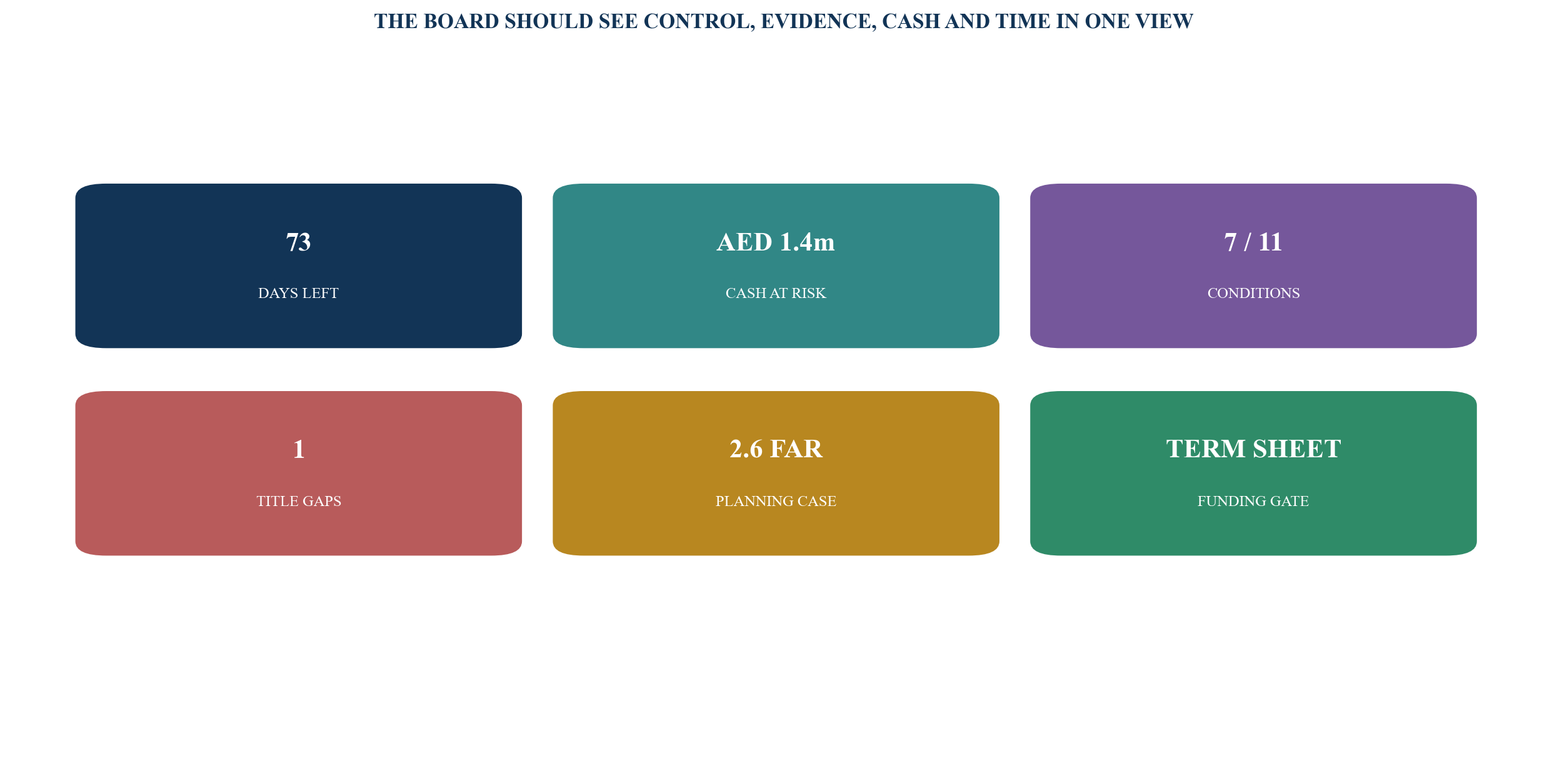
Values are management assumptions used only to demonstrate board reporting.
20. Package advisory work around funded land decisions
A site-control and economics diagnostic can support a developer before it signs, extends or exercises. The paid outcome is a comparable option between structures, revised transaction terms, a quantified evidence budget and a board decision. Legal, tax, valuation, planning and engineering specialists retain responsibility for their professional opinions.
A recurring site-control office can coordinate the agreement, diligence, model, approvals, utilities, funding and landowner workstreams. The mandate can be monthly with defined deliverables: updated condition register, critical-path report, cost-at-risk bridge, fundability actions and decision papers. This creates continuity between advisers without replacing their roles.
A capital and transaction mandate can support lender engagement, investor materials, landowner joint-venture economics and closing execution. Compensation and conflicts should be documented. Any success-related component should be tied to an objectively defined transaction outcome and applicable regulatory requirements.
Commercial qualification should test whether the client controls the decision, has a live parcel and owner, can fund diligence, will provide evidence and has an actionable timeline. The strongest mandate begins with a specific irreversible decision: sign, amend, extend, exercise, finance, partner or exit. Marketing interest without a controlled site, budget or decision owner remains an early lead rather than mandate evidence.
The durable proposition is disciplined optionality. The developer spends in stages, converts uncertainty into verified evidence, protects the right, preserves financing routes and commits full capital only when the project can support it.
References
- UAE Legislation. Federal Decree by Law No. 25 of 2025 Promulgating the Civil Transactions Law. https://uaelegislation.gov.ae/en/legislations/4011/download
- Abu Dhabi Real Estate Centre. Standard Musataha Contract. https://adrec.gov.ae/en/rules_and_regulations/standard-mustaha-contract
- Abu Dhabi Real Estate Centre. Registration. https://adrec.gov.ae/en/rules_and_regulations/Registration
- Dubai Land Department. Frequently Asked Questions. https://dubailand.gov.ae/en/frequently-asked-questions
- Dubai Land Department. Real Estate Legislation. https://dubailand.gov.ae/media/1omljeok/legislation_en.pdf
- Dubai Land Department. Request for Mortgage Payment in Escrow Account. https://dubailand.gov.ae/en/eservices/request-for-mortgage-payment-in-escrow-account/
- Saudi Real Estate General Authority. Law of Selling and Leasing Off-Plan Real Estate Projects. https://rega.gov.sa/en/laws-and-decisions/regulations-and-by-laws/rules/law-of-selling-and-leasing-off-plan-real-estate-projects/
- Saudi Real Estate General Authority. Procedural Manual for Sale and Lease of Off-Plan Real Estate Projects. https://rega.gov.sa/media/i0sd5oav/procedural-manual-for-sale-and-lease-of-off-plan-real-estate-projects.pdf
- UK Government. Contractual Control Agreements. https://www.gov.uk/government/publications/contractual-control-agreements/contractual-control-agreements
- HM Land Registry. Practice Guide 19: Notices, Restrictions and Protection of Third-Party Interests. https://www.gov.uk/government/publications/notices-restrictions-and-protection-of-third-party-interests-pg19/practice-guide-19-notices-restrictions-and-protection-of-third-party-interests-in-the-register
- Royal Institution of Chartered Surveyors. Valuation of Development Property. https://www.rics.org/content/dam/ricsglobal/documents/to-be-sorted/valuation-of-development-property---first-edition.pdf
About the Author
Chennakeshav Adya, Independent Researcher
