

Introduction
Orbital debris is a shared-infrastructure problem. A non-functional object can threaten commercial satellites, public services and future missions owned by parties that had no role in creating it. Collision avoidance, tracking and shielding reduce exposure, yet they do not remove the object. Active debris removal can reduce the stock of hazardous mass and demonstrate technologies needed for a more circular orbital economy.
The financing problem begins with a missing direct customer. Many beneficiaries cannot be individually charged, while the provider must finance engineering, licensing, launch, rendezvous and capture before the public outcome exists. Mission failure may leave little reusable value. Liability can cross national borders and treaty relationships. Verification must distinguish a completed removal from an attempt, a temporary nudge from a durable reduction in collision risk, and useful mission data from proprietary claims that cannot be audited.
A credible PPP structure converts the policy objective into a measurable service. It identifies the target and baseline risk, specifies the required end-state, prices each mission gate, allocates controllable risks, funds the risks that cannot be transferred efficiently and appoints an independent verifier. The public authority pays for defined evidence. The private partner earns returns through delivery, disciplined cost management and reusable capability. Lenders rely on contracted payments after objective conditions rather than speculative orbital value.
1. Define the public service
The decision concerns the exact orbital-risk reduction to be purchased, including target, acceptable final orbit or re-entry state, evidence date and public-service period. The authority should assemble current technical, legal, commercial and financial evidence at one controlled cut-off date. Every assumption should have an owner, source, confidence range and review trigger.
The required output is a procurement specification that links public purpose to observable performance. The analysis should show the base case, correlated downside, control owner, cash consequence and cure route. Public benefit, mission success and payment certainty should remain separate measures because each answers a different approval question.
The authority should avoid buying an undefined mission attempt. A service definition should state what must change in the orbital environment and how long the resulting risk reduction must remain valid. The contract should state who can observe the evidence, who decides acceptance, how disagreement is resolved and which payment or remedy follows. A financing model should apply the same definitions so that drawdown, debt service and distributions move with verified performance.
The board should also test interactions. A technically successful mission can deliver weak value if the selected target has low marginal risk. A high-value target can remain unsuitable if legal authority, capture feasibility or insurance is unresolved. A low bid can become unaffordable if change, liability and delay risks return to the authority through claims.
2. Select targets through transparent risk ranking
The decision concerns mass, orbit, conjunction history, fragmentation potential, ownership, legal authority, capture feasibility and network criticality. The authority should assemble current technical, legal, commercial and financial evidence at one controlled cut-off date. Every assumption should have an owner, source, confidence range and review trigger.
The required output is a target-ranking score with documented policy weights and sensitivity tests. The analysis should show the base case, correlated downside, control owner, cash consequence and cure route. Public benefit, mission success and payment certainty should remain separate measures because each answers a different approval question.
ESA and NASA both emphasise that target choice matters. The largest or most visible object is not automatically the highest-value removal when probability, feasibility and opportunity cost are considered. The contract should state who can observe the evidence, who decides acceptance, how disagreement is resolved and which payment or remedy follows. A financing model should apply the same definitions so that drawdown, debt service and distributions move with verified performance.
The board should also test interactions. A technically successful mission can deliver weak value if the selected target has low marginal risk. A high-value target can remain unsuitable if legal authority, capture feasibility or insurance is unresolved. A low bid can become unaffordable if change, liability and delay risks return to the authority through claims.
3. Establish the counterfactual
The decision concerns the expected risk, operator cost and service exposure if the authority does not procure the mission. The authority should assemble current technical, legal, commercial and financial evidence at one controlled cut-off date. Every assumption should have an owner, source, confidence range and review trigger.
The required output is a baseline against which avoided loss and incremental benefit can be measured. The analysis should show the base case, correlated downside, control owner, cash consequence and cure route. Public benefit, mission success and payment certainty should remain separate measures because each answers a different approval question.
Historical conjunctions and modelled collision probability inform the counterfactual. They do not create a guaranteed loss forecast. The appraisal should retain ranges and show which assumption drives the ranking. The contract should state who can observe the evidence, who decides acceptance, how disagreement is resolved and which payment or remedy follows. A financing model should apply the same definitions so that drawdown, debt service and distributions move with verified performance.
The board should also test interactions. A technically successful mission can deliver weak value if the selected target has low marginal risk. A high-value target can remain unsuitable if legal authority, capture feasibility or insurance is unresolved. A low bid can become unaffordable if change, liability and delay risks return to the authority through claims.
4. Price dispersed public benefit
The decision concerns avoided collision-loss equivalent, avoided manoeuvres, protected service continuity, demonstration value, environmental option value and strategic resilience. The authority should assemble current technical, legal, commercial and financial evidence at one controlled cut-off date. Every assumption should have an owner, source, confidence range and review trigger.
The required output is a public-benefit account that separates monetised, quantified non-monetised and qualitative effects. The analysis should show the base case, correlated downside, control owner, cash consequence and cure route. Public benefit, mission success and payment certainty should remain separate measures because each answers a different approval question.
Combining all effects into a single precise number can conceal weak evidence. The decision record should show the metric, beneficiary, time horizon and confidence attached to each category. The contract should state who can observe the evidence, who decides acceptance, how disagreement is resolved and which payment or remedy follows. A financing model should apply the same definitions so that drawdown, debt service and distributions move with verified performance.
The board should also test interactions. A technically successful mission can deliver weak value if the selected target has low marginal risk. A high-value target can remain unsuitable if legal authority, capture feasibility or insurance is unresolved. A low bid can become unaffordable if change, liability and delay risks return to the authority through claims.
5. Choose the procurement form
The decision concerns whether the authority needs a grant, cost-reimbursement contract, fixed-price service, milestone contract, availability payment or outcome-based PPP. The authority should assemble current technical, legal, commercial and financial evidence at one controlled cut-off date. Every assumption should have an owner, source, confidence range and review trigger.
The required output is a form matched to technical maturity, information asymmetry and public risk tolerance. The analysis should show the base case, correlated downside, control owner, cash consequence and cure route. Public benefit, mission success and payment certainty should remain separate measures because each answers a different approval question.
A novel capture concept may require development risk sharing. A mature repeat mission may support firmer pricing. Contract form should evolve with evidence rather than force early certainty. The contract should state who can observe the evidence, who decides acceptance, how disagreement is resolved and which payment or remedy follows. A financing model should apply the same definitions so that drawdown, debt service and distributions move with verified performance.
The board should also test interactions. A technically successful mission can deliver weak value if the selected target has low marginal risk. A high-value target can remain unsuitable if legal authority, capture feasibility or insurance is unresolved. A low bid can become unaffordable if change, liability and delay risks return to the authority through claims.
6. Build the mission work breakdown
The decision concerns target characterisation, design, licensing, manufacture, launch, commissioning, rendezvous, capture, disposal, data delivery and closeout. The authority should assemble current technical, legal, commercial and financial evidence at one controlled cut-off date. Every assumption should have an owner, source, confidence range and review trigger.
The required output is a costed and scheduled mission tree with accountable owners. The analysis should show the base case, correlated downside, control owner, cash consequence and cure route. Public benefit, mission success and payment certainty should remain separate measures because each answers a different approval question.
Programme finance depends on the interfaces between stages. A delay in target data, launch integration or regulatory consent can consume liquidity before any outcome payment becomes available. The contract should state who can observe the evidence, who decides acceptance, how disagreement is resolved and which payment or remedy follows. A financing model should apply the same definitions so that drawdown, debt service and distributions move with verified performance.
The board should also test interactions. A technically successful mission can deliver weak value if the selected target has low marginal risk. A high-value target can remain unsuitable if legal authority, capture feasibility or insurance is unresolved. A low bid can become unaffordable if change, liability and delay risks return to the authority through claims.
7. Design objective payment gates
The decision concerns the evidence required before each public payment becomes irrevocably earned. The authority should assemble current technical, legal, commercial and financial evidence at one controlled cut-off date. Every assumption should have an owner, source, confidence range and review trigger.
The required output is a milestone and outcome-payment schedule aligned with cost, value and risk retirement. The analysis should show the base case, correlated downside, control owner, cash consequence and cure route. Public benefit, mission success and payment certainty should remain separate measures because each answers a different approval question.
Early payments should fund necessary development and public dependencies. Later payments should remain conditional on independently verified capture, disposal and data delivery. Retention supports claims closeout and final evidence. The contract should state who can observe the evidence, who decides acceptance, how disagreement is resolved and which payment or remedy follows. A financing model should apply the same definitions so that drawdown, debt service and distributions move with verified performance.
The board should also test interactions. A technically successful mission can deliver weak value if the selected target has low marginal risk. A high-value target can remain unsuitable if legal authority, capture feasibility or insurance is unresolved. A low bid can become unaffordable if change, liability and delay risks return to the authority through claims.
8. Separate activity from outcome
The decision concerns engineering effort and launch expenditure versus durable reduction in orbital risk. The authority should assemble current technical, legal, commercial and financial evidence at one controlled cut-off date. Every assumption should have an owner, source, confidence range and review trigger.
The required output is two payment classes with different acceptance tests and termination rights. The analysis should show the base case, correlated downside, control owner, cash consequence and cure route. Public benefit, mission success and payment certainty should remain separate measures because each answers a different approval question.
Some activity payments are justified because the public authority requests novel research and owns resulting data. Outcome payments should remain reserved for completed risk reduction. The contract should state who can observe the evidence, who decides acceptance, how disagreement is resolved and which payment or remedy follows. A financing model should apply the same definitions so that drawdown, debt service and distributions move with verified performance.
The board should also test interactions. A technically successful mission can deliver weak value if the selected target has low marginal risk. A high-value target can remain unsuitable if legal authority, capture feasibility or insurance is unresolved. A low bid can become unaffordable if change, liability and delay risks return to the authority through claims.
9. Appoint an independent verifier
The decision concerns who observes tests, mission telemetry, tracking data, disposal evidence and contract compliance. The authority should assemble current technical, legal, commercial and financial evidence at one controlled cut-off date. Every assumption should have an owner, source, confidence range and review trigger.
The required output is a verification protocol with access rights, standards, dispute escalation and audit trail. The analysis should show the base case, correlated downside, control owner, cash consequence and cure route. Public benefit, mission success and payment certainty should remain separate measures because each answers a different approval question.
The verifier requires sufficient technical access without taking operational control. The contract should resolve conflicts between provider telemetry, public tracking and third-party catalogues. The contract should state who can observe the evidence, who decides acceptance, how disagreement is resolved and which payment or remedy follows. A financing model should apply the same definitions so that drawdown, debt service and distributions move with verified performance.
The board should also test interactions. A technically successful mission can deliver weak value if the selected target has low marginal risk. A high-value target can remain unsuitable if legal authority, capture feasibility or insurance is unresolved. A low bid can become unaffordable if change, liability and delay risks return to the authority through claims.
10. Allocate design and integration risk
The decision concerns whether the provider can control system design, suppliers, interfaces and qualification. The authority should assemble current technical, legal, commercial and financial evidence at one controlled cut-off date. Every assumption should have an owner, source, confidence range and review trigger.
The required output is provider responsibility supported by relief for authority-directed changes and deficient public data. The analysis should show the base case, correlated downside, control owner, cash consequence and cure route. Public benefit, mission success and payment certainty should remain separate measures because each answers a different approval question.
Risk transfer has value only when the provider can manage the risk and price it. Unbounded transfer can raise bids, weaken competition or produce claims after award. The contract should state who can observe the evidence, who decides acceptance, how disagreement is resolved and which payment or remedy follows. A financing model should apply the same definitions so that drawdown, debt service and distributions move with verified performance.
The board should also test interactions. A technically successful mission can deliver weak value if the selected target has low marginal risk. A high-value target can remain unsuitable if legal authority, capture feasibility or insurance is unresolved. A low bid can become unaffordable if change, liability and delay risks return to the authority through claims.
11. Allocate target-condition risk
The decision concerns uncertainty in tumbling, geometry, structural integrity, residual energy, materials and unrecorded modifications. The authority should assemble current technical, legal, commercial and financial evidence at one controlled cut-off date. Every assumption should have an owner, source, confidence range and review trigger.
The required output is a baseline target dossier, data-room warranty and change mechanism. The analysis should show the base case, correlated downside, control owner, cash consequence and cure route. Public benefit, mission success and payment certainty should remain separate measures because each answers a different approval question.
An unprepared, uncooperative object may differ from historical records. The authority should define the information standard, provider inspection duty and consequences of material deviation. The contract should state who can observe the evidence, who decides acceptance, how disagreement is resolved and which payment or remedy follows. A financing model should apply the same definitions so that drawdown, debt service and distributions move with verified performance.
The board should also test interactions. A technically successful mission can deliver weak value if the selected target has low marginal risk. A high-value target can remain unsuitable if legal authority, capture feasibility or insurance is unresolved. A low bid can become unaffordable if change, liability and delay risks return to the authority through claims.
12. Allocate launch and schedule risk
The decision concerns launcher availability, rideshare priority, integration, weather, regulatory slots and mission-window effects. The authority should assemble current technical, legal, commercial and financial evidence at one controlled cut-off date. Every assumption should have an owner, source, confidence range and review trigger.
The required output is a schedule regime with long-stop dates, substitute launch rights and delay liquidity. The analysis should show the base case, correlated downside, control owner, cash consequence and cure route. Public benefit, mission success and payment certainty should remain separate measures because each answers a different approval question.
Schedule risk can sit outside the removal provider's control. The finance plan should distinguish excusable delay from provider delay and keep debt service aligned with payment timing. The contract should state who can observe the evidence, who decides acceptance, how disagreement is resolved and which payment or remedy follows. A financing model should apply the same definitions so that drawdown, debt service and distributions move with verified performance.
The board should also test interactions. A technically successful mission can deliver weak value if the selected target has low marginal risk. A high-value target can remain unsuitable if legal authority, capture feasibility or insurance is unresolved. A low bid can become unaffordable if change, liability and delay risks return to the authority through claims.
13. Allocate capture and disposal risk
The decision concerns failed approach, collision, partial capture, loss of control, incomplete deorbit and post-capture fragmentation. The authority should assemble current technical, legal, commercial and financial evidence at one controlled cut-off date. Every assumption should have an owner, source, confidence range and review trigger.
The required output is mission-specific performance standards, abort rules, reserves and remedy hierarchy. The analysis should show the base case, correlated downside, control owner, cash consequence and cure route. Public benefit, mission success and payment certainty should remain separate measures because each answers a different approval question.
The contract should prioritise orbital safety over rigid schedule compliance. Safe abort, re-attempt and alternative disposal routes require predefined authority and funding. The contract should state who can observe the evidence, who decides acceptance, how disagreement is resolved and which payment or remedy follows. A financing model should apply the same definitions so that drawdown, debt service and distributions move with verified performance.
The board should also test interactions. A technically successful mission can deliver weak value if the selected target has low marginal risk. A high-value target can remain unsuitable if legal authority, capture feasibility or insurance is unresolved. A low bid can become unaffordable if change, liability and delay risks return to the authority through claims.
14. Map international liability
The decision concerns launching-state relationships, registration, control, fault, third-party damage, cross-waivers and recourse. The authority should assemble current technical, legal, commercial and financial evidence at one controlled cut-off date. Every assumption should have an owner, source, confidence range and review trigger.
The required output is a treaty-to-contract liability matrix supported by jurisdiction-specific legal opinions. The analysis should show the base case, correlated downside, control owner, cash consequence and cure route. Public benefit, mission success and payment certainty should remain separate measures because each answers a different approval question.
Government responsibility under international space law cannot be replaced by a private indemnity. Contractual allocation can define recourse between parties, subject to enforceability and counterparty capacity. The contract should state who can observe the evidence, who decides acceptance, how disagreement is resolved and which payment or remedy follows. A financing model should apply the same definitions so that drawdown, debt service and distributions move with verified performance.
The board should also test interactions. A technically successful mission can deliver weak value if the selected target has low marginal risk. A high-value target can remain unsuitable if legal authority, capture feasibility or insurance is unresolved. A low bid can become unaffordable if change, liability and delay risks return to the authority through claims.
15. Structure insurance and retained risk
The decision concerns launch, in-orbit operations, collision, third-party liability, professional risk, cyber events and unavailable coverage. The authority should assemble current technical, legal, commercial and financial evidence at one controlled cut-off date. Every assumption should have an owner, source, confidence range and review trigger.
The required output is a coverage map, deductibles, exclusions and funded retained-risk account. The analysis should show the base case, correlated downside, control owner, cash consequence and cure route. Public benefit, mission success and payment certainty should remain separate measures because each answers a different approval question.
Insurance markets may exclude novel capture phases or price them heavily. The affordability model should show uninsured exposure and avoid assuming that future cover will be available on historical terms. The contract should state who can observe the evidence, who decides acceptance, how disagreement is resolved and which payment or remedy follows. A financing model should apply the same definitions so that drawdown, debt service and distributions move with verified performance.
The board should also test interactions. A technically successful mission can deliver weak value if the selected target has low marginal risk. A high-value target can remain unsuitable if legal authority, capture feasibility or insurance is unresolved. A low bid can become unaffordable if change, liability and delay risks return to the authority through claims.
16. Define data rights and cyber controls
The decision concerns mission telemetry, imagery, tracking observations, software, trained models, security restrictions and publication rights. The authority should assemble current technical, legal, commercial and financial evidence at one controlled cut-off date. Every assumption should have an owner, source, confidence range and review trigger.
The required output is a data architecture supporting verification, future procurement and protected commercial know-how. The analysis should show the base case, correlated downside, control owner, cash consequence and cure route. Public benefit, mission success and payment certainty should remain separate measures because each answers a different approval question.
Public value can include reusable mission evidence. Data rights should support learning and accountability while protecting security-sensitive information and legitimate intellectual property. The contract should state who can observe the evidence, who decides acceptance, how disagreement is resolved and which payment or remedy follows. A financing model should apply the same definitions so that drawdown, debt service and distributions move with verified performance.
The board should also test interactions. A technically successful mission can deliver weak value if the selected target has low marginal risk. A high-value target can remain unsuitable if legal authority, capture feasibility or insurance is unresolved. A low bid can become unaffordable if change, liability and delay risks return to the authority through claims.
17. Finance development and construction
The decision concerns equity, grants, advance payments, senior debt, guarantees and contingent supplier terms before operating evidence exists. The authority should assemble current technical, legal, commercial and financial evidence at one controlled cut-off date. Every assumption should have an owner, source, confidence range and review trigger.
The required output is a fully funded sources-and-uses plan through downside commissioning. The analysis should show the base case, correlated downside, control owner, cash consequence and cure route. Public benefit, mission success and payment certainty should remain separate measures because each answers a different approval question.
Senior debt should enter after technical and contractual conditions reduce uncertainty. Sponsor equity and public development payments should absorb earlier design and integration risk. The contract should state who can observe the evidence, who decides acceptance, how disagreement is resolved and which payment or remedy follows. A financing model should apply the same definitions so that drawdown, debt service and distributions move with verified performance.
The board should also test interactions. A technically successful mission can deliver weak value if the selected target has low marginal risk. A high-value target can remain unsuitable if legal authority, capture feasibility or insurance is unresolved. A low bid can become unaffordable if change, liability and delay risks return to the authority through claims.
18. Size senior programme debt
The decision concerns the contracted payments that remain available after operating cost, reserves, taxes and downside delay. The authority should assemble current technical, legal, commercial and financial evidence at one controlled cut-off date. Every assumption should have an owner, source, confidence range and review trigger.
The required output is a debt schedule based on payment certainty, timing and termination compensation. The analysis should show the base case, correlated downside, control owner, cash consequence and cure route. Public benefit, mission success and payment certainty should remain separate measures because each answers a different approval question.
Debt capacity depends on enforceable public payment and accepted performance. Expected public benefit does not itself repay lenders. The contract should state who can observe the evidence, who decides acceptance, how disagreement is resolved and which payment or remedy follows. A financing model should apply the same definitions so that drawdown, debt service and distributions move with verified performance.
The board should also test interactions. A technically successful mission can deliver weak value if the selected target has low marginal risk. A high-value target can remain unsuitable if legal authority, capture feasibility or insurance is unresolved. A low bid can become unaffordable if change, liability and delay risks return to the authority through claims.
19. Construct the payment waterfall
The decision concerns the order of taxes, mission operations, safety reserves, debt service, cure funding, retention and sponsor distributions. The authority should assemble current technical, legal, commercial and financial evidence at one controlled cut-off date. Every assumption should have an owner, source, confidence range and review trigger.
The required output is controlled accounts and distribution tests linked to mission status. The analysis should show the base case, correlated downside, control owner, cash consequence and cure route. Public benefit, mission success and payment certainty should remain separate measures because each answers a different approval question.
Cash should remain trapped when technical, schedule, insurance or liability evidence deteriorates. Safety-critical recovery should rank before discretionary distribution. The contract should state who can observe the evidence, who decides acceptance, how disagreement is resolved and which payment or remedy follows. A financing model should apply the same definitions so that drawdown, debt service and distributions move with verified performance.
The board should also test interactions. A technically successful mission can deliver weak value if the selected target has low marginal risk. A high-value target can remain unsuitable if legal authority, capture feasibility or insurance is unresolved. A low bid can become unaffordable if change, liability and delay risks return to the authority through claims.
20. Test affordability and value for money
The decision concerns whole-life public cost, risk retained by the authority, competitive tension, financing cost, flexibility and expected benefit. The authority should assemble current technical, legal, commercial and financial evidence at one controlled cut-off date. Every assumption should have an owner, source, confidence range and review trigger.
The required output is a public-sector comparator and risk-adjusted bid evaluation. The analysis should show the base case, correlated downside, control owner, cash consequence and cure route. Public benefit, mission success and payment certainty should remain separate measures because each answers a different approval question.
Private finance may add discipline and capacity while increasing financing and transaction cost. Appraisal should compare realistic delivery models on the same scope and risk basis. The contract should state who can observe the evidence, who decides acceptance, how disagreement is resolved and which payment or remedy follows. A financing model should apply the same definitions so that drawdown, debt service and distributions move with verified performance.
The board should also test interactions. A technically successful mission can deliver weak value if the selected target has low marginal risk. A high-value target can remain unsuitable if legal authority, capture feasibility or insurance is unresolved. A low bid can become unaffordable if change, liability and delay risks return to the authority through claims.
21. Design termination and continuity
The decision concerns provider default, authority default, prolonged force majeure, mission impossibility, target change and security direction. The authority should assemble current technical, legal, commercial and financial evidence at one controlled cut-off date. Every assumption should have an owner, source, confidence range and review trigger.
The required output is termination payments, data handover, step-in, asset control and safe-state obligations. The analysis should show the base case, correlated downside, control owner, cash consequence and cure route. Public benefit, mission success and payment certainty should remain separate measures because each answers a different approval question.
Termination should preserve orbital safety and mission records. Lender protection should remain subordinate to lawful safety intervention. The contract should state who can observe the evidence, who decides acceptance, how disagreement is resolved and which payment or remedy follows. A financing model should apply the same definitions so that drawdown, debt service and distributions move with verified performance.
The board should also test interactions. A technically successful mission can deliver weak value if the selected target has low marginal risk. A high-value target can remain unsuitable if legal authority, capture feasibility or insurance is unresolved. A low bid can become unaffordable if change, liability and delay risks return to the authority through claims.
22. Govern change without destroying incentives
The decision concerns new conjunction data, target deterioration, regulation, launch substitution, technology improvement and authority scope change. The authority should assemble current technical, legal, commercial and financial evidence at one controlled cut-off date. Every assumption should have an owner, source, confidence range and review trigger.
The required output is a transparent change-control and price-adjustment mechanism. The analysis should show the base case, correlated downside, control owner, cash consequence and cure route. Public benefit, mission success and payment certainty should remain separate measures because each answers a different approval question.
A frozen specification can become unsafe or obsolete. An unlimited change mechanism can remove cost discipline. Decisions require evidence, valuation rules and independent review. The contract should state who can observe the evidence, who decides acceptance, how disagreement is resolved and which payment or remedy follows. A financing model should apply the same definitions so that drawdown, debt service and distributions move with verified performance.
The board should also test interactions. A technically successful mission can deliver weak value if the selected target has low marginal risk. A high-value target can remain unsuitable if legal authority, capture feasibility or insurance is unresolved. A low bid can become unaffordable if change, liability and delay risks return to the authority through claims.
23. Operate a public-benefit dashboard
The decision concerns target risk, mission status, spend, forecast payments, verified outcomes, residual liabilities and learning outputs. The authority should assemble current technical, legal, commercial and financial evidence at one controlled cut-off date. Every assumption should have an owner, source, confidence range and review trigger.
The required output is a board and public-authority control record with defined disclosure levels. The analysis should show the base case, correlated downside, control owner, cash consequence and cure route. Public benefit, mission success and payment certainty should remain separate measures because each answers a different approval question.
Operational transparency supports accountability. Security, export-control and commercial restrictions still require a controlled public-versus-confidential reporting boundary. The contract should state who can observe the evidence, who decides acceptance, how disagreement is resolved and which payment or remedy follows. A financing model should apply the same definitions so that drawdown, debt service and distributions move with verified performance.
The board should also test interactions. A technically successful mission can deliver weak value if the selected target has low marginal risk. A high-value target can remain unsuitable if legal authority, capture feasibility or insurance is unresolved. A low bid can become unaffordable if change, liability and delay risks return to the authority through claims.
24. Make the investment and award decision
The decision concerns whether benefits, affordability, deliverability, competition, liability and verification support procurement. The authority should assemble current technical, legal, commercial and financial evidence at one controlled cut-off date. Every assumption should have an owner, source, confidence range and review trigger.
The required output is approve, resize, redesign, stage or decline with an evidence register. The analysis should show the base case, correlated downside, control owner, cash consequence and cure route. Public benefit, mission success and payment certainty should remain separate measures because each answers a different approval question.
A strong decision identifies the target, counterfactual, mission outcome, payment gates, retained public risk, financing source, verification method and termination path. The contract should state who can observe the evidence, who decides acceptance, how disagreement is resolved and which payment or remedy follows. A financing model should apply the same definitions so that drawdown, debt service and distributions move with verified performance.
The board should also test interactions. A technically successful mission can deliver weak value if the selected target has low marginal risk. A high-value target can remain unsuitable if legal authority, capture feasibility or insurance is unresolved. A low bid can become unaffordable if change, liability and delay risks return to the authority through claims.
Conclusion
An orbital-debris removal PPP is financeable when public purpose is converted into a measurable service, mission risks are assigned to capable parties, payments follow verifiable evidence and residual liabilities remain funded. The authority should buy a defined change in orbital risk rather than a loosely specified mission attempt. The provider should control design and integration risks that it can manage. The public sector should retain or share risks that depend on sovereign authority, deficient public information or policy change.
Outcome payments create discipline when milestones are objective and independently observable. Development payments remain necessary where the authority commissions novel capability or requires data that has wider public value. The balance should evolve as flight heritage, standards, insurance and competition mature. Financing should follow the same sequence: early risk-bearing capital supports development; debt enters against contracted payments after conditions precedent; retention remains available until disposal evidence and claims closeout are complete.
The hypothetical programme shows the logic. USD 96 million of nominal service funding supports a two-target mission through sponsor equity, senior debt, milestone payments and retained contingent value. The public-benefit account totals USD 112 million and leaves USD 16 million of illustrative net value. These figures are decision mechanics rather than market evidence. A real procurement requires target-specific probability, mission design, competitive pricing, treaty and licensing analysis, insurer terms and independent verification.
Governance completes the structure. The public authority should maintain one integrated record of target risk, mission progress, payment eligibility, financing, retained liability and public benefit. Technical and financial definitions should remain aligned from procurement through closeout. A disciplined PPP can then produce capability, competition and verified risk reduction while preserving safety and public accountability.
Appendix A. Hypothetical programme assumptions
The programme covers two unprepared, uncooperative objects in low Earth orbit over five years. The service envelope is USD 96 million. Funding comprises USD 18 million of sponsor equity, USD 22 million of senior programme debt, USD 46 million of public milestone and outcome payments and USD 10 million of retained contingent payment. Illustrative public benefit totals USD 112 million: USD 34 million of avoided collision-loss equivalent, USD 18 million of avoided avoidance and operating cost, USD 31 million of protected service continuity, USD 17 million of demonstration and industrial spillover, and USD 12 million of environmental option value. All amounts are illustrative.
Appendix B. Evidence request
Request the target catalogue record, ownership and registration evidence, conjunction and fragmentation analysis, target attitude and structural data, mission concept, capture analysis, abort logic, launch plan, licensing path, international-liability opinions, insurance indications, supplier contracts, cost-to-complete model, funding commitments, payment schedule, verification protocol, data-rights matrix, cyber plan, security restrictions, environmental analysis, disposal evidence standard, termination model and public-sector comparator. Reconcile every item to the same target set, mission configuration and valuation date.
Appendix C. Red-flag tests
Red flags include a target selected without comparative risk ranking; public benefit presented as a guaranteed loss avoided; payments tied only to expenditure; a verifier lacking telemetry or tracking access; unlimited provider liability unsupported by capital or insurance; target-condition risk transferred without a reliable baseline; senior debt drawn before material licences and interfaces are secured; termination compensation that rewards provider default; disposal evidence defined only by provider telemetry; public data rights omitted; residual liabilities unfunded; and public value presented without a counterfactual.
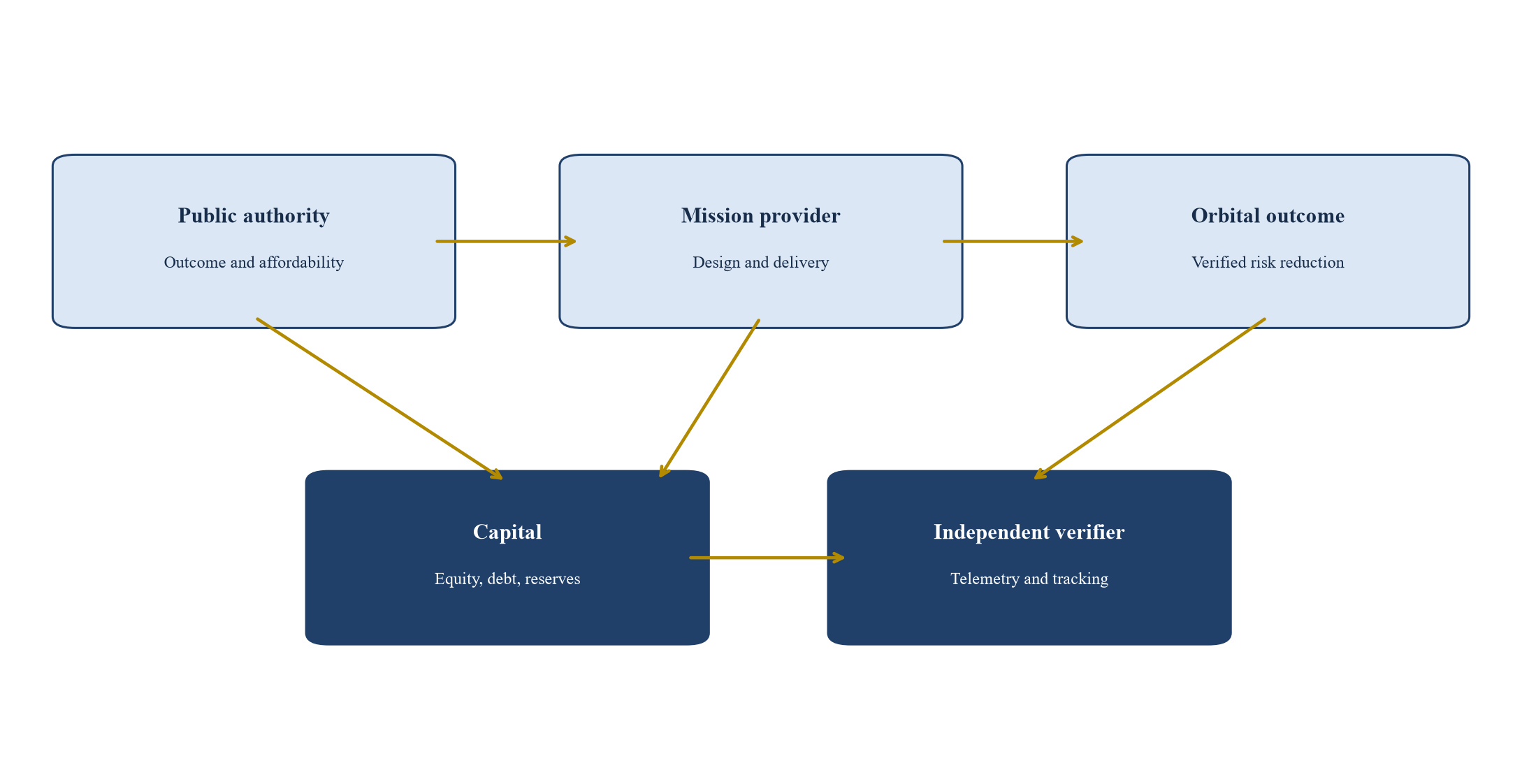
Proposed separation of public purpose, mission delivery, verification and payment.
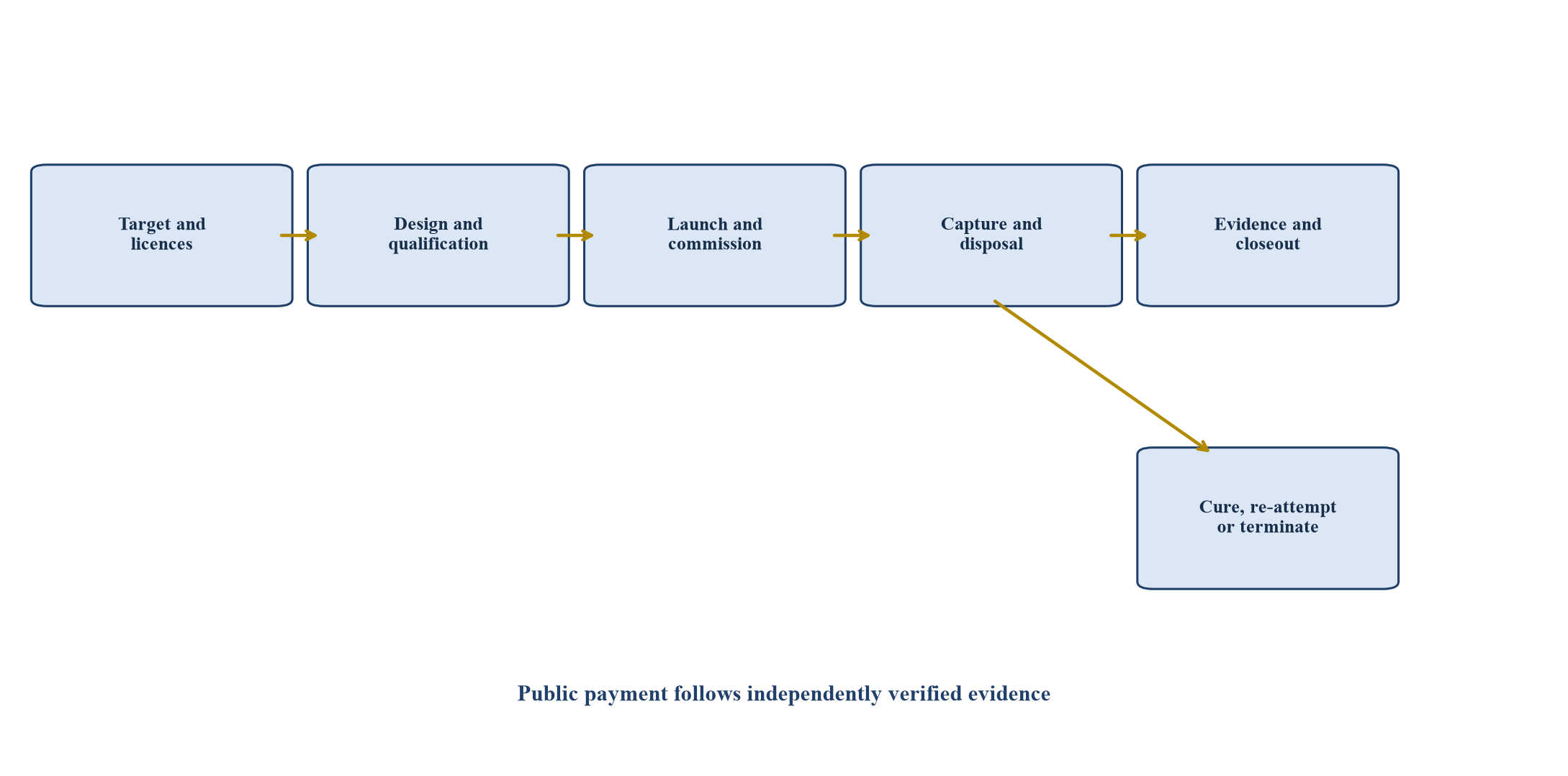
Illustrative sequence; payments require evidence at each gate.
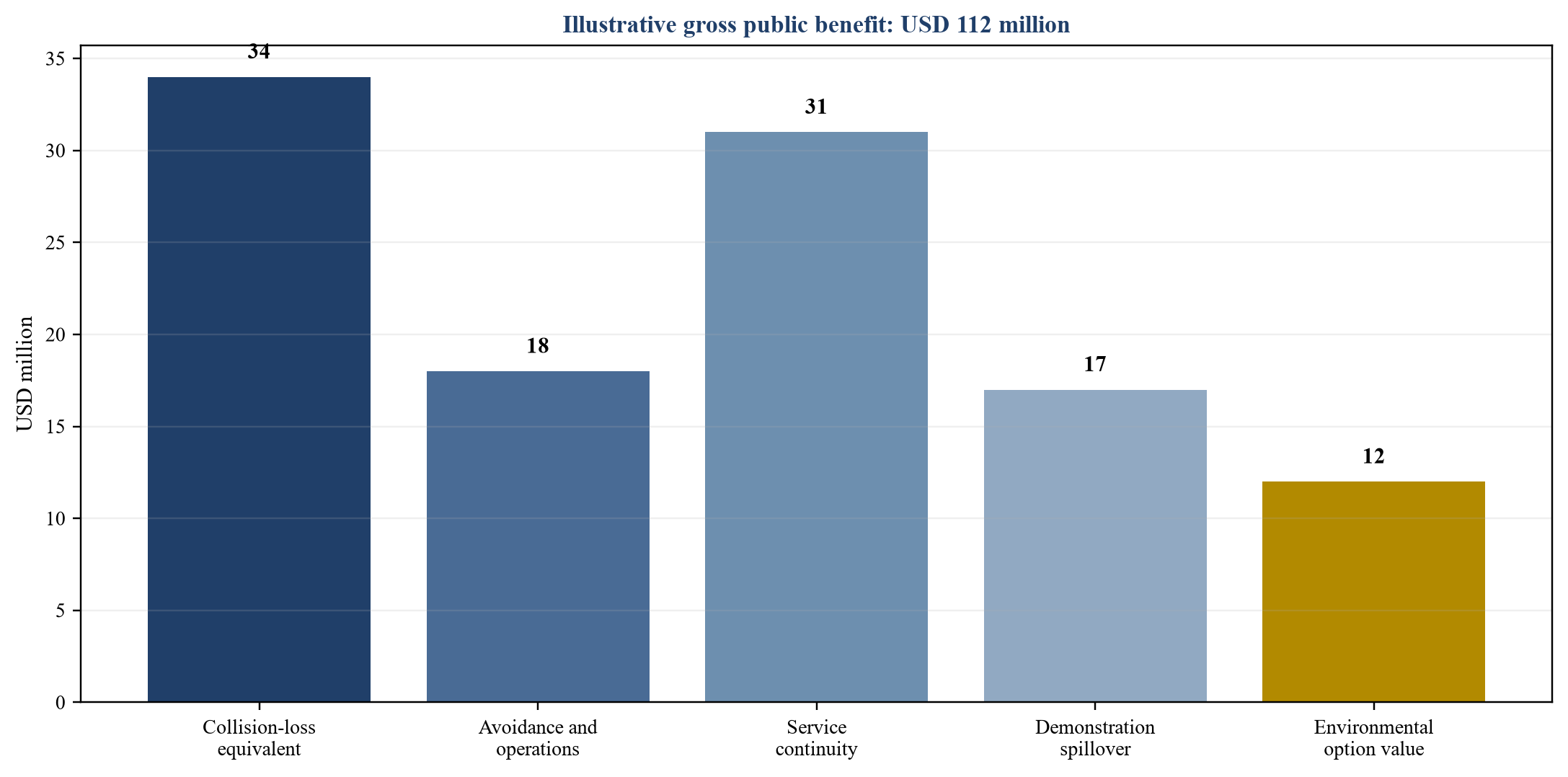
Illustrative USD millions; categories require mission-specific evidence.
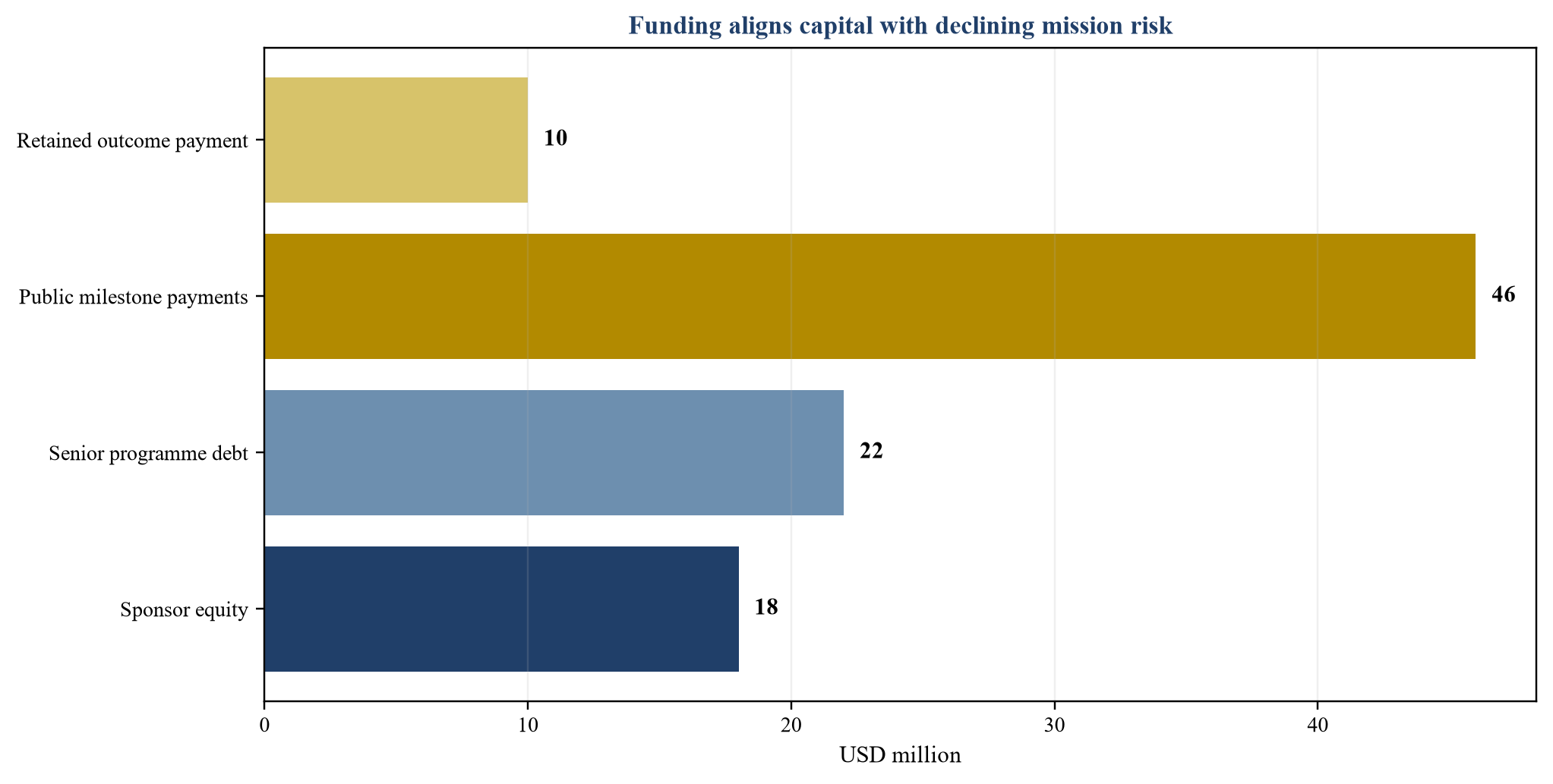
Illustrative USD millions; total nominal envelope USD 96 million.
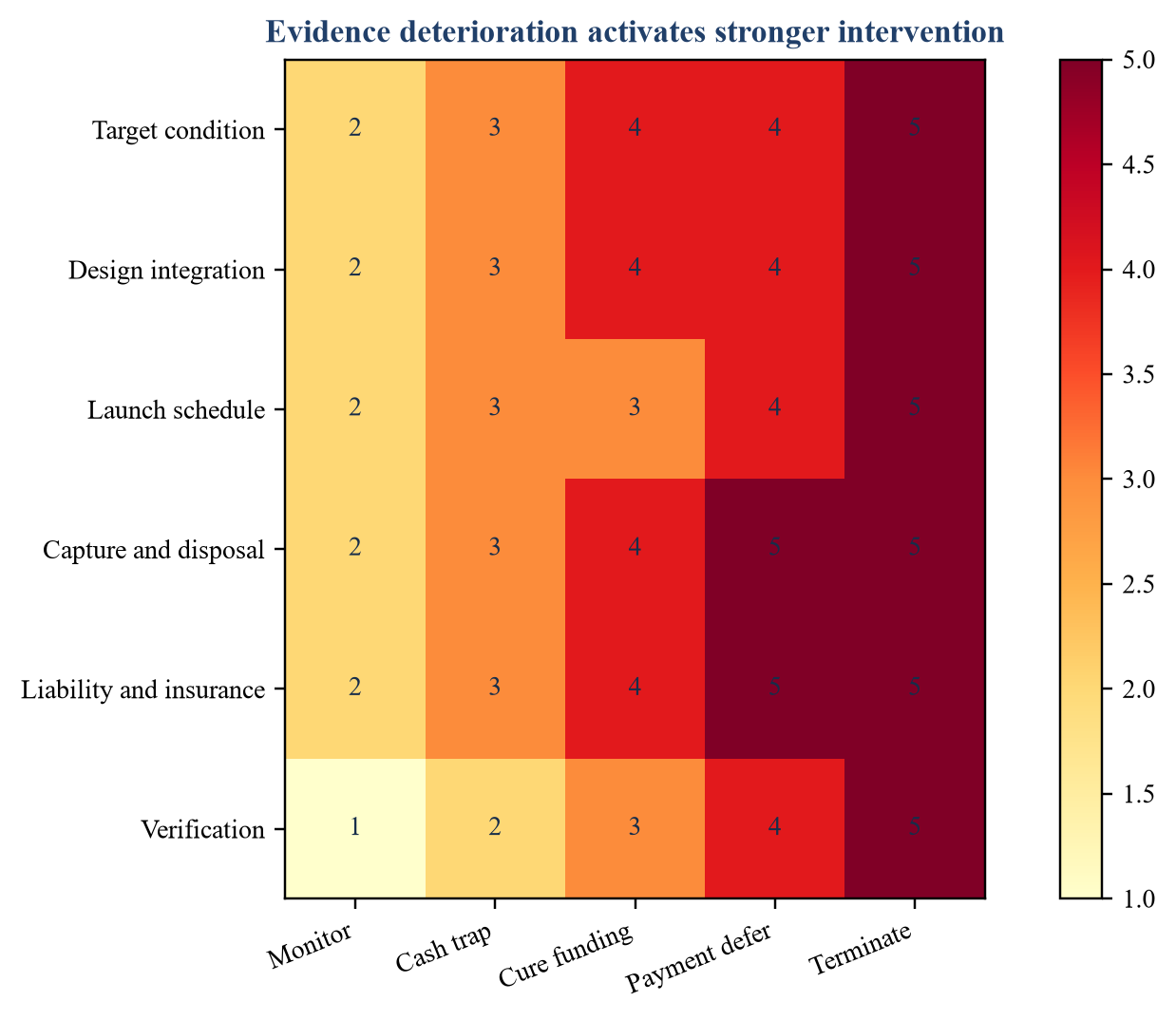
Illustrative severity score from one to five.
| Gate | Evidence | USD million | Payment character |
|---|---|---|---|
| Design and licensing | approved design, licences, insurance plan | 10 | development milestone |
| Manufacture and qualification | completed qualification and launch readiness | 18 | milestone |
| Launch and commissioning | functioning servicer in required orbit | 14 | milestone |
| Target 1 disposal | verified capture and compliant disposal | 20 | outcome |
| Target 2 disposal | verified capture and compliant disposal | 20 | outcome |
| Data and programme closeout | accepted data, audit and handover | 4 | closeout |
| Retained performance value | claims closeout and final evidence | 10 | contingent outcome |
Illustrative allocation of the USD 96 million service envelope.
| Benefit category | USD million | Primary evidence |
|---|---|---|
| Avoided collision-loss equivalent | 34 | probability model and exposed asset values |
| Avoided avoidance and operating cost | 18 | operator manoeuvre and tracking records |
| Protected service continuity | 31 | critical-service dependency and outage cases |
| Demonstration and industrial spillover | 17 | reuse plan, procurement pipeline and learning rights |
| Environmental option value | 12 | scenario analysis and policy weights |
| Gross public benefit | 112 | reconciled benefit register |
| Less nominal programme envelope | (96) | contracted sources and uses |
| Illustrative net public value | 16 | appraisal output |
Illustrative values; a live appraisal requires target-specific evidence.
| Risk | Primary bearer | Contract control |
|---|---|---|
| Target-selection policy | authority | transparent ranking and approval |
| Design and integration | provider | specification, qualification and warranty |
| Deficient public target data | authority/shared | baseline dossier and change mechanism |
| Supplier performance | provider | flow-down terms and replacement rights |
| Authority-directed change | authority | priced change control |
| Capture execution | provider | gates, abort logic, cure and retention |
| International state liability | state with contractual recourse | treaty and indemnity matrix |
| Uninsurable systemic risk | shared/authority | cap, reserve and termination regime |
Proposed starting point subject to procurement law and mission facts.
| Stage | Evidence | Independent check | Payment result |
|---|---|---|---|
| Qualification | test records and configuration | verifier witnesses critical tests | milestone eligibility |
| Commissioning | telemetry and orbit determination | tracking reconciliation | milestone eligibility |
| Rendezvous | proximity-operations record | safety review | continue or abort |
| Capture | telemetry, imagery and control state | multi-source confirmation | partial outcome eligibility |
| Disposal | orbit or re-entry evidence | public and third-party tracking | outcome payment |
| Closeout | data, claims and asset handover | final audit | retention release |
Proposed evidence classes for payment approval.
| Sources | USD million | Uses | USD million |
|---|---|---|---|
| Sponsor equity | 18 | design, licensing and target analysis | 16 |
| Senior programme debt | 22 | manufacture and qualification | 28 |
| Public milestone and outcome payments | 46 | launch, commissioning and operations | 24 |
| Retained contingent payment | 10 | capture, disposal and verification | 18 |
| reserves, insurance and closeout | 10 | ||
| Total | 96 | Total | 96 |
Illustrative USD millions.
| Exposure | Legal question | Financial control |
|---|---|---|
| Launch failure | launching-state and contract responsibility | launch cover and delay reserve |
| Target damage | authority to intervene and provider fault | indemnity, cap and mission cover |
| Third-party collision | treaty claim and private recourse | liability cover and retained-risk account |
| Cyber compromise | control and data responsibility | cyber cover, segmentation and incident plan |
| Failed disposal | continuing control and remediation duty | retention, cure funding and termination rights |
| Cross-border claim | forum, law and state representation | enforceability opinion and sovereign process |
Counsel and brokers must confirm jurisdiction-specific treatment.
| Gate | Question | Evidence threshold |
|---|---|---|
| Public need | is incremental intervention justified? | ranked target and counterfactual |
| Deliverability | can the proposed system complete the mission safely? | qualified design and mission tree |
| Authority | can each state and regulator authorise the operation? | licences and legal opinions |
| Value for money | does risk-adjusted benefit exceed delivery alternatives? | comparator and competitive pricing |
| Financeability | can contracted cash service debt through downside? | funded model and termination regime |
| Verification | can performance be independently observed? | accepted protocol and data access |
| Residual risk | are liability, recovery and closeout funded? | insurance, reserves and retention |
Proposed minimum approval record.
Sources
- European Space Agency, ESA Space Environment Report 2026, 14 September 2026. Read the primary source
- European Space Agency, Space Environment Statistics, updated 31 July 2026. Read the primary source
- European Space Agency, Active debris removal. Read the primary source
- NASA Office of Technology, Policy, and Strategy, Cost and Benefit Analysis of Orbital Debris Remediation, Phase 1, 2023. Read the primary source
- NASA, New NASA Report Reframes the Challenge of Addressing Orbital Debris, 2023. Read the primary source
- UK Space Agency, UK launches tender for mission to clean up space and safeguard vital services, 3 July 2025. Read the primary source
- UK Space Agency, Active Debris Removal mission procurement notice, 2025. Read the primary source
- European Space Agency, ClearSpace-1. Read the primary source
- European Space Agency, ESA advances ClearSpace-1 development. Read the primary source
- European Space Agency, ESA purchases world-first debris removal mission from start-up, 1 December 2020. Read the primary source
- European Space Agency, Zero Debris Charter. Read the primary source
- European Space Agency, Space Debris FAQ. Read the primary source
- NASA, NASA study provides new look at orbital debris potential solutions, 2024. Read the primary source
- U.S. Department of Commerce, National Orbital Debris Implementation Plan, 2022. Read the primary source
- U.S. Government, Orbital Debris Mitigation Standard Practices, November 2019. Read the primary source
- Federal Communications Commission, FCC adopts new five-year rule for deorbiting satellites, 29 September 2022. Read the primary source
- United Nations Office for Outer Space Affairs, Long-term Sustainability Guidelines repository. Read the primary source
- United Nations Office for Outer Space Affairs, Guidelines for the Long-term Sustainability of Outer Space Activities. Read the primary source
- Inter-Agency Space Debris Coordination Committee, IADC Space Debris Mitigation Guidelines, Revision 2. Read the primary source
- International Organization for Standardization, ISO 24113:2023 Space systems: Space debris mitigation requirements. Read the primary source
- International Organization for Standardization, Aerospace standards catalogue, including ISO 24330:2022. Read the primary source
- UK Space Agency, Annual Report and Accounts 2025 to 2026. Read the primary source
- UK Government, National Space Strategy. Read the primary source
- UK Government, Space sustainability case study. Read the primary source
- UK Government, UK and New Zealand agree blueprint for satellite removal and servicing missions. Read the primary source
- UK Government, Enabling multi-state active debris removal and in-orbit servicing missions. Read the primary source
- Japan Aerospace Exploration Agency, Commercial Removal of Debris Demonstration programme. Read the primary source
- Japan Aerospace Exploration Agency, CRD2 news and programme updates. Read the primary source
- European Commission, EU Space Act. Read the primary source
- European Commission, EU Space Act factsheet, 25 June 2025. Read the primary source
- U.S. Government Accountability Office, Orbital Debris: Agencies Should Improve Coordination and Establish Performance Measures, GAO-26-108079. Read the primary source
- ISO Technical Committee 20, Space debris mitigation standards overview. Read the primary source
