

Introduction
Microgravity can alter convection, sedimentation, phase separation, crystal growth and heat or mass transport. Vacuum, thermal cycling and access to the orbital environment can also support specialised processes. These conditions may produce material attributes that are difficult or uneconomic to obtain on Earth. NASA's materials research overview covers glasses and ceramics, metals, multiphase materials, nanomaterials, polymers, semiconductors and thermophysical properties. Its In Space Production Applications portfolio is designed to move selected concepts from research toward high production quality and commercial scale. [1][3][4]
An acquisition decision requires a narrower question. The buyer must determine whether a target owns a repeatable process that creates an accepted output under controlled conditions. A successful experiment, flight or recovered sample can establish an important milestone. Manufacturing value requires additional evidence about input variation, equipment configuration, operator or software control, mission environment, output measurement, customer qualification, production capacity and cash conversion.
This paper is written for strategic buyers, private equity investors, growth investors, corporate development teams, lenders and technical advisers. It provides a diligence architecture, a hypothetical valuation case, transaction protections and an integration plan. Public evidence establishes the development context. Target-specific conclusions require controlled data-room evidence, independent testing, customer confirmation and legal review.
1 Frame the transaction thesis and product boundary
The buyer should state the acquisition thesis in one operational sentence. Examples include acquiring a qualified optical-fibre process, obtaining a reusable orbital furnace and return system, adding proprietary crystal-growth know-how, securing access to customer development contracts or obtaining a platform that can host several material processes. Each thesis points to different evidence, liabilities and valuation methods.
The product boundary should identify what the target sells. The deliverable may be a returned material, a finished component, a process licence, a payload service, research data, intellectual property, mission integration or a combination. A customer may purchase an experiment while retaining ownership of the feedstock and output. Another contract may transfer material title only after testing. A platform provider may receive service revenue without owning the process recipe. The diligence model should keep these economics separate.
The boundary also determines the acquisition perimeter. A buyer may need operating assets, software, technical data, customer agreements, regulatory licences, university rights, grant obligations, key staff and supplier contracts. A share acquisition may preserve contracts and licences more readily while retaining historic liabilities. An asset acquisition can narrow liability but may trigger consent, transfer and requalification work. Counsel should map the actual rights rather than assume that a technology description identifies an owned asset.
2 Build the reproducibility evidence matrix
Reproducibility has several meanings. Scientific repeatability asks whether the same team can obtain a similar result under the same conditions. Engineering reproducibility asks whether a different mission, payload or operating team can achieve a comparable result. Manufacturing capability asks whether the process can remain within a defined specification at an economically useful yield and cadence. Customer reproducibility asks whether accepted material can be delivered repeatedly under the contract and qualification protocol.
The evidence matrix should list every claimed material advantage, its terrestrial comparator, the measured characteristic, the analytical method, the number of runs, the number of missions, the hardware configuration and the acceptance range. It should show negative and inconclusive results as well as favourable ones. Missing runs can create survivorship bias when management presents only the best sample.
NASA reported that eight optical-fibre draws each produced more than 700 metres and described this as evidence of repeatability at commercial length. NASA also stated that analysis after return was needed to determine whether the fibre achieved the fourth InSPA goal of ten times greater quality than terrestrial fibre. This distinction is central to diligence. Length repeatability and quality repeatability are different claims. [2]
3 Separate material advantage from process capability
A material can show a superior property while the process remains commercially incapable. The effect may depend on a narrow set of inputs, an expert operator, a specific payload, a favourable mission environment or extensive terrestrial selection. The buyer should define the customer specification and then evaluate the entire distribution of results around it.
NIST's process-characterisation framework begins with goals, process models, sampling plans, variance analysis, stability and capability. Process capability measures such as Cp and Cpk require a stable process and meaningful specification limits. A small orbital sample can provide scientific evidence without supporting a reliable capability estimate. The data room should therefore distinguish descriptive results, hypothesis tests, engineering limits and production capability claims. [6][7]
The buyer should also examine the economic cost of selectivity. A programme may produce a small amount of exceptional material by screening many runs or sacrificing most of the batch. The reported property advantage remains relevant, while accepted yield and contribution determine acquisition value. The diligence team should calculate first-pass yield, returned yield, within-specification yield and customer-accepted yield separately.
Capability evidence should be reviewed over time. Early experimental records may use broad tolerances because the team is learning which variables matter. Later records should show narrower control ranges, fewer unexplained interventions and a stable relationship between process signatures and material results. The buyer should test whether management's capability claim uses the current equipment and recipe. Combining legacy experiments with the latest configuration can overstate the sample size and conceal a process reset.
The process-control file should also identify the cost of maintaining capability. Calibration, replacement parts, sensor drift, payload refurbishment, quality staff, software validation and independent testing may be required for every mission. A process can meet specification while remaining uneconomic because control and verification consume too much capacity. The buyer should therefore connect capability statistics to mission contribution and calendar throughput.
4 Define the terrestrial benchmark and controls
Every orbital advantage requires a terrestrial benchmark. The comparator should use the same feedstock genealogy, nominal process recipe, analytical method, sample preparation and time period where possible. A weak terrestrial control can exaggerate the effect attributed to microgravity. A control produced on obsolete equipment or by a different laboratory may measure organisational variation rather than environmental advantage.
The protocol should be written before the relevant mission. It should identify primary and secondary endpoints, exclusion rules, calibration requirements, retained samples and statistical treatment. Post-hoc selection of a favourable wavelength, region, defect class or micrograph can produce an attractive narrative without a decision-grade result. Independent laboratories should receive blinded samples when practicable.
NASA's microgravity materials publication illustrates why controls matter. It links reduced gravity-induced forces to changes in defects and material behaviour across several classes. Those results support a mechanism and research agenda. Each acquisition target still needs product-specific controls, sample histories and analytical records. [3]
5 Trace feedstock batch genealogy and configuration
Orbital process data have limited value when the buyer cannot reconstruct the batch. The genealogy should connect supplier lot, material composition, storage, preparation, packaging, payload location, equipment serial number, software version, calibration status, mission timeline, process parameters, return conditions, terrestrial finishing and test result.
The diligence team should select sample batches and trace them in both directions. A forward trace begins with feedstock and follows every transformation to the customer result. A reverse trace begins with a reported result and identifies every input, instrument and operator that influenced it. Gaps should be logged by batch rather than described generally.
Configuration control is especially important when payloads evolve between missions. A better result may follow a heater redesign, sensor change, software update or revised feedstock. The company should show which change caused the improvement and whether the improved configuration is the one being acquired. Informal knowledge held by one engineer creates integration and continuity risk even when the patents and hardware transfer.
6 Test orbital process control and telemetry
The orbital process should have a defined control plan. The buyer should identify controlled variables, measured variables, alarms, autonomous responses, operator interventions, data-loss events and safe states. Telemetry frequency should be sufficient to explain the critical material transformation. A final sample can meet specification while the process record remains too weak for replication.
NIST describes manufacturing capability as dynamic and dependent on the production system, control decisions and required output. Its model-based work emphasises the relationship between process requirements, machine capability and measurement. This principle applies to orbital systems where power, thermal conditions, vibration, communications and crew or robotic access can vary. [7]
The diligence team should reconcile commanded parameters with actual measurements. It should inspect clock synchronisation, missing packets, sensor calibration, software logs, anomaly reports and manual overrides. A digital twin or process model should be tested against observed missions. Forecast accuracy should be reported across multiple runs, including failures. A model calibrated only to a successful mission provides limited evidence of control.
7 Separate flight success from batch acceptance
A spacecraft can complete its mission while the material batch fails. Launch, deployment, power, communications, process execution, re-entry and recovery are mission events. Material identity, property, contamination, geometry, integrity and customer performance are batch events. Diligence should maintain separate scorecards.
The buyer should review mission success criteria that existed before flight. A target may redefine success after an anomaly by emphasising the subsystems that worked. Engineering learning can retain value, but the valuation treatment should reflect the original commercial objective and remaining work.
ESA reported that ForgeStar-1 generated plasma in orbit in 2026 and described the event as a first for commercial in-space manufacturing. This is relevant evidence for an on-orbit subsystem. Return, recovered product, material qualification and repeat production remain separate evidence states. [19]
8 Model end to end yield
The yield model should begin with prepared input and follow every loss to customer acceptance. Losses can arise from payload commissioning, incomplete processing, off-spec material, packaging, launch or re-entry effects, recovery delay, sample allocation, destructive testing, terrestrial finishing and customer rejection.
Mass can be the correct unit for fibres, crystals, alloys or deposited material. Other products may require length, area, wafers, devices, usable specimens or accepted lots. The unit should correspond to the customer invoice and specification. Gross payload mass is rarely a valid revenue unit.
The hypothetical case begins with 144 kilograms of prepared input across six missions. Ninety-two kilograms return, 64 kilograms meet the technical specification and 48 kilograms enter customer qualification. The buyer should test each conversion with batch-level evidence. A forecast should not assume that the best demonstrated conversion applies to every future mission.
9 Evaluate return recovery and chain of custody
Return is part of the manufacturing system when the customer needs material on Earth. The buyer should examine vehicle availability, re-entry authorisation, environmental review, landing location, recovery time, transport, contamination control, temperature history, shock, vibration and custody records. A process can be repeatable in orbit and commercially unreliable at the point of delivery.
The FAA's Part 450 framework covers launch and re-entry licensing. In 2026 the FAA stated that Part 450 can support a portfolio of operations, vehicle configurations, mission profiles and sites under one licence, subject to the applicable approval. The United Kingdom has also funded reusable heat-shield development intended to support return of materials manufactured in space. These changes may improve the infrastructure environment while preserving operator-specific licensing and execution risk. [20][22][23][24]
The diligence model should price return dependency. A target relying on one vehicle, landing site or integration partner has concentration risk. Contracts should allocate delay, loss, insurance, replacement, title and acceptance. The buyer should confirm whether a licence or contract transfers after a change of control.
10 Verify measurement systems and metrology
Reproducibility claims depend on the measurement system. The diligence team should identify instruments, standards, calibration intervals, operators, sample preparation, environmental controls, software versions and uncertainty. A material difference smaller than the measurement uncertainty cannot support a reliable product claim.
ASTM guidance for relative-density measurement recommends repeatability and reproducibility analysis for methods influenced by specimen preparation or operator variation. NIST's advanced-manufacturing work combines high-precision characterisation tools to monitor material structure through process stages. These approaches illustrate the evidence expected when a valuation depends on defect density, purity, attenuation, crystalline structure or another measured attribute. [9][12]
The buyer should repeat selected tests through an independent laboratory. The protocol should include reference materials, blinded samples and acceptance ranges. A discrepancy should trigger root-cause analysis across the sample, method, instrument and data pipeline. The target's commercial claim should use the most conservative result supported by the controlled test record.
11 Test cross mission repeatability
Cross-mission evidence should separate common process settings from mission-specific conditions. The buyer should compare input lot, payload version, orbit, duration, thermal environment, radiation exposure, crew interaction, power availability, processing window, return mode and laboratory method.
The analysis should include variance components. Within-run variation shows local process uniformity. Between-run variation captures repeated cycles on one mission. Between-mission variation captures launch, orbital and return differences. Between-laboratory variation tests the measurement chain. A pooled average can conceal one mission that drove the apparent advantage.
Round-robin guidance from ASTM describes studies in which different participants attempt a nominally identical process to quantify process variability and robustness. An orbital programme can adapt this logic through duplicate payloads, replicated cartridges, independent analysis and controlled handover between operating teams. [11]
12 Test scale and hardware transfer
Scale changes heat transfer, fluid behaviour, residence time, power demand, control authority and failure modes. A small cartridge that produces an excellent specimen does not establish the performance of a larger batch or parallel production system. The target should provide a scaling law, test evidence and a plan for qualification at the intended volume.
Hardware transfer creates another test. The buyer should determine whether the process can operate on a new payload, host platform, free-flyer or commercial destination without losing the critical environment. Interfaces for power, data, thermal rejection, containment, safety and return may change. A claimed platform-independent process should have evidence across configurations or a documented transfer programme.
NASA's InSPA strategy uses phased development from proof of concept toward production quality and scalability. NASA's Technology Readiness Level framework defines a space-environment demonstration at TRL 7 and flight qualification at TRL 8. These measures are useful for engineering maturity. The buyer should add manufacturing readiness, customer qualification and economic readiness because a high TRL does not establish profitable production. [1][4][5]
13 Diligence product and customer qualification
Customer qualification should connect the material attribute to a real application. The file should identify the customer specification, test plan, decision owner, expected use, competing solution, approval process, sample status and commercial consequence. A customer can be interested in the science while remaining years from procurement.
The buyer should obtain direct customer confirmation with the seller's consent. Questions should cover the exact material tested, observed result, remaining qualification steps, switching cost, expected volumes, price basis, exclusivity, refund rights and reasons for continuing. The response should be reconciled with the contract and pipeline model.
Customer evidence should be dated and decision-specific. A technical champion may support another experiment while procurement has no approved budget. A funded development agreement may cover only testing, with no obligation to purchase output. A qualification letter may depend on a future device design or regulatory programme. The buyer should record these conditions instead of converting them into a single probability score.
The diligence team should also test whether the customer can use the output at the forecast volume. Downstream cutting, polishing, drawing, doping, packaging or device integration may become the bottleneck. The customer may need a second source or a terrestrial fallback before adopting the orbital route. These requirements affect price, exclusivity and the time between a technically accepted sample and recurring cash.
Qualification evidence also affects market size. A material advantage may apply only to one formulation, wavelength, temperature range or device architecture. The forecast should identify the addressable specification rather than the broader market for fibres, semiconductors or advanced materials. Customer concentration should be measured at the programme, application and end-market levels.
14 Evaluate intellectual property and freedom to operate
Orbital materials value can reside in patents, trade secrets, process data, software, payload design, materials formulations, analytical methods and customer-specific know-how. The buyer should map each claimed advantage to the right that protects it. A published scientific effect may be available to competitors even when the target owns a particular implementation.
The diligence team should review inventorship, assignments, employee and contractor agreements, university rights, government funding conditions, background intellectual property, improvements, field restrictions and change-of-control clauses. Joint development can divide rights among the material owner, payload developer, platform provider, customer and research institution.
Freedom-to-operate analysis should cover terrestrial preparation, orbital processing, return, finishing and intended customer use. A patent may protect the payload while a third party controls the feedstock composition or downstream component. Trade-secret value depends on access controls, documentation and the ability to retain key people. The buyer should discount undocumented know-how that cannot be transferred reliably.
15 Inspect contracts and revenue quality
Revenue should be classified by what the customer purchased. Research fees, engineering services, payload integration, mission reservations, milestone payments, material sales, licences and grants have different recurrence and margin. A development payment can validate willingness to engage without establishing production demand.
The buyer should build a contract waterfall from signed value to collected cash. It should deduct unfunded options, termination rights, acceptance risk, pass-through launch costs, refunds, customer credits and obligations that remain after payment. Revenue recognition in the accounts should be reconciled with invoices, bank receipts and delivery evidence.
Contracted backlog can contain programmes with technical conditions, government funding dependencies or schedule changes. Redwire's public filings describe backlog as a business measure and also disclose supply-chain, funding, competition and execution risks. A target-specific review should examine every material contract rather than apply a public-company metric mechanically. [25][26]
16 Assess licences grants and platform dependencies
The operating model can depend on launch and re-entry licences, payload safety approval, export controls, spectrum or remote-sensing permissions, environmental review, grant conditions and platform access. The buyer should identify the holder, scope, renewal date, mission coverage and effect of a change of control.
Public funding can accelerate development while creating reporting, domestic-performance, intellectual-property or repayment obligations. NASA states that InSPA is intended to prove concepts so that private investors can enter during commercialisation, and that NASA is not the customer for those technologies. The valuation should therefore separate awarded programme funding from independent customer demand. [4]
Platform access should be treated as a capacity contract. The diligence team should assess reserved volume, priority, power, crew time, data rights, integration lead time, schedule remedies and alternatives. A target may own a strong process but lack dependable access to execute it.
17 Diligence supply chain and operating capacity
The supply chain begins with specialised feedstock and extends through payload components, clean assembly, qualification testing, launch integration, orbital hosting, return, recovery and laboratory analysis. Each sole-source item should be linked to inventory, lead time, qualification status and substitute plan.
Capacity should be expressed through constrained resources. The limiting factor may be payload hardware, clean-room throughput, launch windows, orbital power, return slots, analytical testing or customer qualification. Announced mission capacity does not equal accepted production capacity.
The buyer should construct a twelve-to-twenty-four-month integrated schedule. It should reconcile signed missions, hardware builds, supplier commitments, staff availability, cash payments and customer milestones. Delay scenarios should show which work can continue on Earth and which costs remain fixed.
18 Normalise research development and completion capital
Historical spending should be separated into research, reusable platform development, customer-specific engineering, mission cost, capital equipment and operating support. A high research burn can create valuable knowledge while leaving substantial completion capital. The buyer should identify which expenditure must recur after acquisition.
IAS 38 distinguishes research from development and requires specific evidence before internally generated development expenditure qualifies for recognition. IFRS 3 requires an acquirer to recognise identifiable acquired assets and liabilities at fair value, including qualifying in-process research and development as a separate intangible asset. These accounting rules do not determine investment value, but they require the buyer to identify the acquired rights and remaining obligations with discipline. [27][28]
The completion budget should include engineering, payload qualification, launch, hosting, return, testing, customer qualification, insurance, working capital and contingency. Costs already incurred should not be treated as proof that the remaining programme is funded or technically feasible.
The buyer should reconcile the completion budget with the integrated schedule and contract milestones. A launch deposit may be paid months before the customer milestone. Hardware may need to be built before a grant reimbursement. A delayed return can postpone testing and cash while salaries and facilities continue. The model should therefore include monthly liquidity, cancellation rights and the next available mission window.
Management estimates should be compared with vendor quotations, signed capacity agreements and prior mission actuals. A contingency expressed as a percentage is insufficient when one launch, payload redesign or return event dominates the downside. The buyer should model those events directly and identify which party carries each cost.
19 Value in process research and development
The valuation should begin with the current evidence state. A probability-weighted cash-flow method can model products that have defined technical and commercial milestones. A replacement-cost method can inform the cost of recreating hardware, data and know-how, subject to obsolescence. Comparable transactions require close attention to maturity, rights, funding and customer evidence.
In-process research and development should be divided into identifiable programmes. Each programme should have a product definition, technical milestone, cost to completion, probability, launch schedule, customer pathway and ownership map. A portfolio discount may be appropriate where programmes compete for the same scarce platform, staff or capital.
Option value should be documented separately. A platform may support future materials outside the current pipeline. The buyer should identify the shared capability, incremental cost and evidence needed for each option. Broad references to the orbital economy should not enter the base valuation as cash flow.
20 Structure contingent consideration around evidence
Contingent consideration can align price with evidence that arrives after closing. Milestones may include a successful repeat mission, a predefined material property, customer qualification, accepted yield, a repeat order, a licence or a contribution threshold. Each milestone should use objective definitions, independent verification and a clear measurement period.
The buyer should avoid milestones that management can satisfy through spending or activity alone. A mission launched, patent filed or memorandum signed may have limited economic meaning. The milestone should correspond to a decision-changing result.
Transaction structure can combine cash at closing, escrow, holdback, earn-out, rollover equity and development funding. The structure should allocate control over the programme and protect the seller from deliberate underinvestment where an earn-out depends on buyer actions. Dispute procedures should identify the technical expert and accounting principles before closing.
Milestone drafting should specify the sample, method, laboratory, configuration, time window and treatment of failed or delayed missions. A threshold based on average output can be manipulated through run selection. A threshold based on one favourable sample can reward an outlier. The agreement should require a defined population of runs and a documented treatment of missing data.
The buyer should also distinguish purchase price from post-closing programme funding. Capital used to complete the technology benefits the combined business and should not automatically count as consideration to the seller. The board needs a clear bridge from headline price to cash at closing, escrow, contingent value, assumed liabilities and committed development capital.
21 Plan integration without losing tacit knowledge
Integration can destroy the capability being acquired when the buyer changes staff, suppliers, laboratories or configuration before understanding the process. The first integration phase should preserve the technical baseline. Changes should pass through configuration control and documented comparability assessment.
Key-person planning should identify process owners, payload engineers, materials scientists, quality staff, customer leads and regulatory contacts. Retention packages should be connected to knowledge transfer and programme milestones. The buyer should capture recipes, decision histories, anomaly investigations and unwritten operating practices.
The integration plan should also define governance. A joint technical and commercial committee can approve configuration changes, mission readiness, customer claims and capital release. The acquired team needs access to the buyer's quality, procurement and finance systems without losing the speed required for development.
22 Protect data software and configuration control
Orbital manufacturing depends on software, telemetry, analytical data and digital records. The buyer should inventory source code, repositories, third-party components, cloud services, encryption, access rights, backup, incident history and export-control classification. It should confirm that the seller can transfer the code and data required to operate the process.
Data provenance should connect raw telemetry and laboratory output to the reported result. Manual spreadsheets, overwritten files or missing metadata weaken reproducibility. The buyer should test whether another qualified person can reproduce the analysis from the preserved data and documented code.
Cybersecurity can affect both safety and intellectual property. Remote commands, payload updates and mission data should have controlled access, authentication and audit trails. A security incident can alter configuration, interrupt a mission or expose process knowledge. The integration plan should preserve operational access while moving accounts and systems under buyer control.
23 Make the investment decision
The investment committee should receive a claim-by-claim evidence matrix, a batch-level reproducibility analysis, an end-to-end yield model, customer confirmations, a rights map, a completion budget, a valuation bridge, transaction protections and an integration plan. Each unresolved issue should have a price, condition, covenant or walk-away implication.
The hypothetical valuation bridge begins with the seller's USD 168 million headline enterprise value. The buyer deducts USD 32 million of completion capital, USD 18 million for process-replication risk, USD 14 million for customer concentration and USD 12 million for return dependency. It adds USD 11 million for independently supported intellectual property and contracted development rights. The resulting USD 103 million indication is conditional and does not represent a valuation of any company.
The board should approve the acquisition only when the purchased rights, current evidence and funded integration plan support the price. Future value that depends on repeat production should remain contingent. A failed confirmatory test, missing right or non-transferable licence should trigger the pre-agreed response.
Conclusion
Orbital materials companies can create valuable scientific results, manufacturing know-how, hardware, data and customer relationships. Public programmes show expanding technical activity across optical fibres, semiconductors, metals, biomaterials and other advanced materials. The acquisition decision depends on evidence that the target can reproduce a defined output through the complete input-to-customer chain.
The most reliable diligence file links feedstock genealogy, configuration, telemetry, return conditions, metrology, accepted yield and customer qualification at batch level. It distinguishes an orbital material effect from a capable production system. It also converts uncertainty into transaction terms through completion-capital deductions, contingent consideration, covenants and integration controls.
The buyer's central discipline is simple: pay current value for controlled evidence and reserve future value for verified milestones. This approach protects the buyer while recognising genuine technical progress.
Appendix A Hypothetical acquisition case
The target operates an orbital advanced-materials process and presents six completed missions with 48 process runs. The programme used 144 kilograms of prepared feedstock. Ninety-two kilograms returned to Earth, 64 kilograms met the technical specification and 48 kilograms entered customer qualification. Twenty-four runs used the current payload configuration. Twelve of those runs used feedstock from the intended commercial supplier.
The seller presents USD 28 million of cumulative research and development revenue, USD 19 million of grant and milestone funding, USD 13 million of collected customer development cash and USD 8 million of material-related receipts. These amounts are historical and do not establish recurring production revenue. The target forecasts eight missions during the next twenty-four months and requires USD 32 million of completion capital before the forecast reaches customer-qualified repeat production.
The buyer's confirmatory programme selects six retained samples across three missions and two feedstock lots. An independent laboratory repeats the critical material-property test. The buyer also requires one replicated run using the current payload, agreed feedstock and predefined protocol. Customer interviews confirm one active qualification programme, two paid development relationships and several non-binding discussions.
The seller's headline enterprise value is USD 168 million. The buyer's bridge deducts completion capital, process-replication risk, customer concentration and return dependency. It adds value for independently supported intellectual property and contracted development rights. The resulting USD 103 million indication could be structured as USD 72 million at closing, USD 11 million in escrow and up to USD 20 million of contingent consideration tied to repeat production, customer acceptance and collected cash. Every amount in this appendix is hypothetical.
Appendix B Minimum diligence file
The minimum file should include the transaction perimeter, corporate structure, intellectual-property schedule, funding obligations, licences, grants, customer and supplier contracts, payload and process configurations, software inventory, feedstock genealogy, batch records, mission timelines, telemetry, anomaly reports, return and recovery records, chain-of-custody logs, analytical methods, calibration files, raw test data, independent reports, customer acceptance protocols, invoices, collected cash, backlog bridge, completion budget, insurance, employee and contractor agreements, cybersecurity evidence and integration dependencies.
The buyer should index every technical claim to the supporting item. A claim without a controlled source should remain unresolved. The data room should preserve file versions and access logs so the confirmatory work can be reproduced.
Appendix C Red flag tests
Red flags include presenting the best sample as the production average; changing the benchmark after flight; omitting failed runs; using payload mass as accepted output; combining different payload configurations in one yield statistic; relying on one laboratory without measurement-system analysis; treating mission success as batch acceptance; using a grant as evidence of customer demand; counting reservations as contracted production; omitting return and recovery losses; assuming a licence transfers on change of control; relying on undocumented trade secrets; failing to identify university or government rights; projecting scale without a heat or mass-transfer model; and integrating systems before the buyer can reproduce the acquired process.
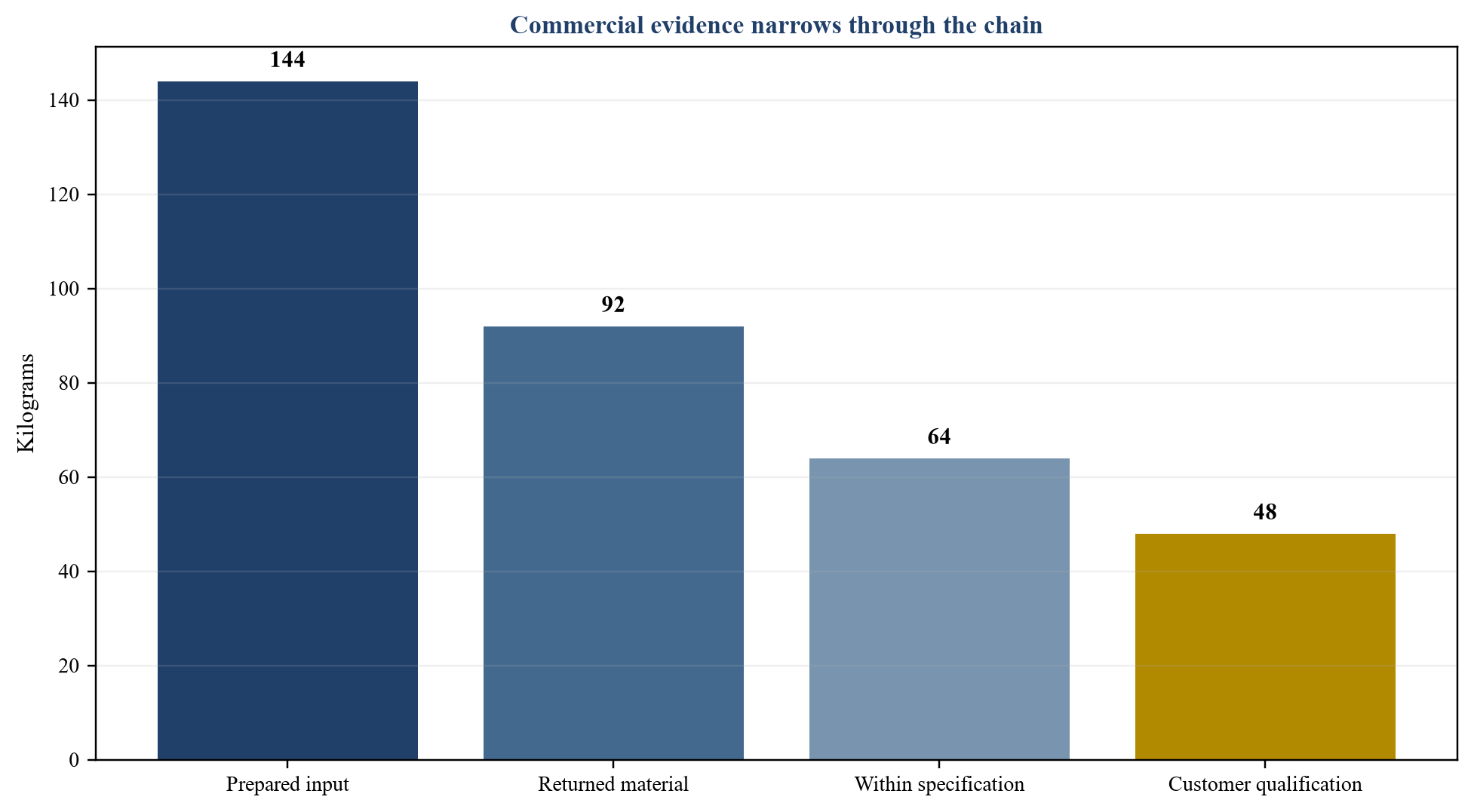
Illustrative kilograms across six missions and 48 process runs.
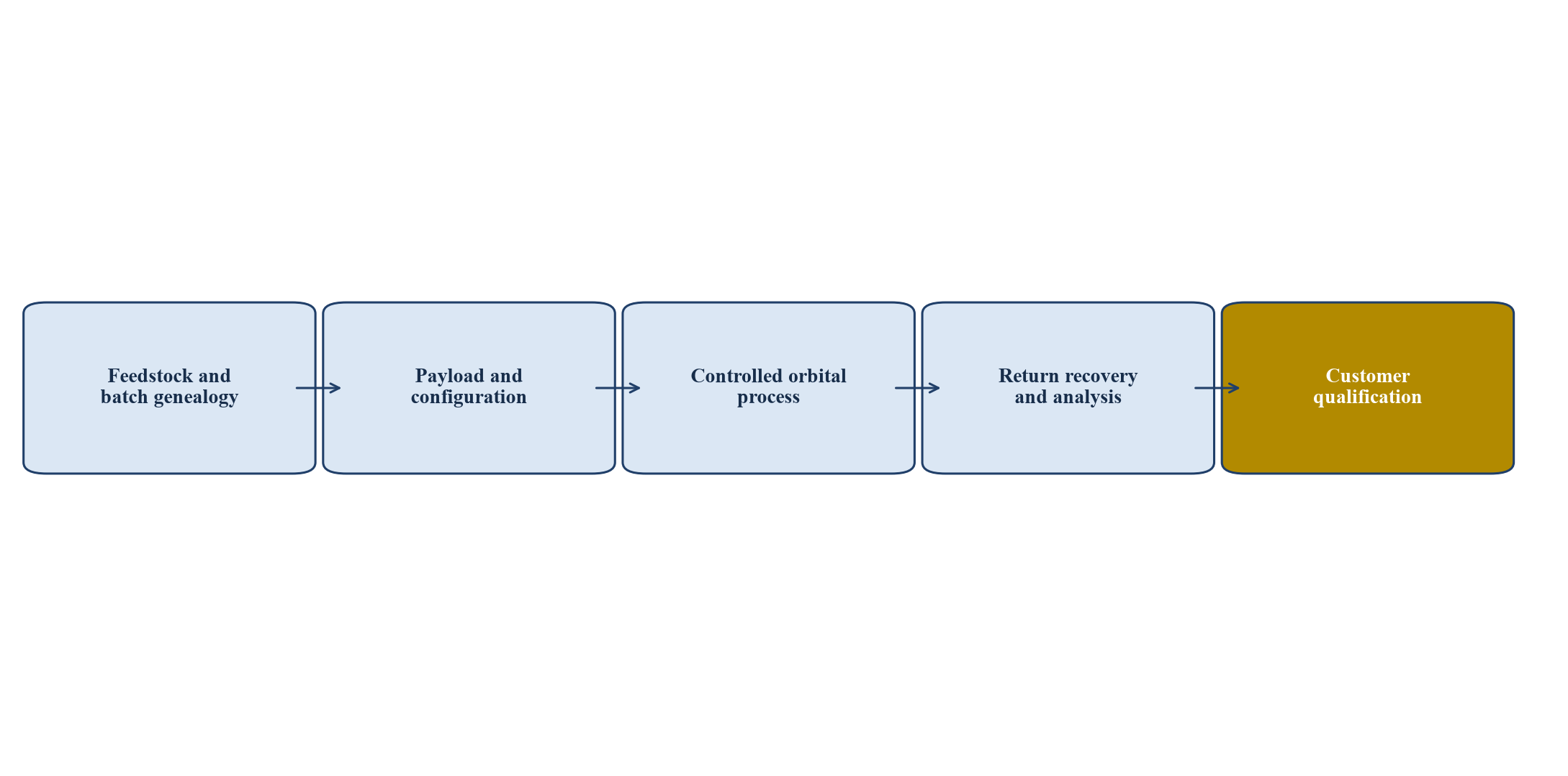
Proposed diligence architecture from controlled feedstock to customer-qualified output.
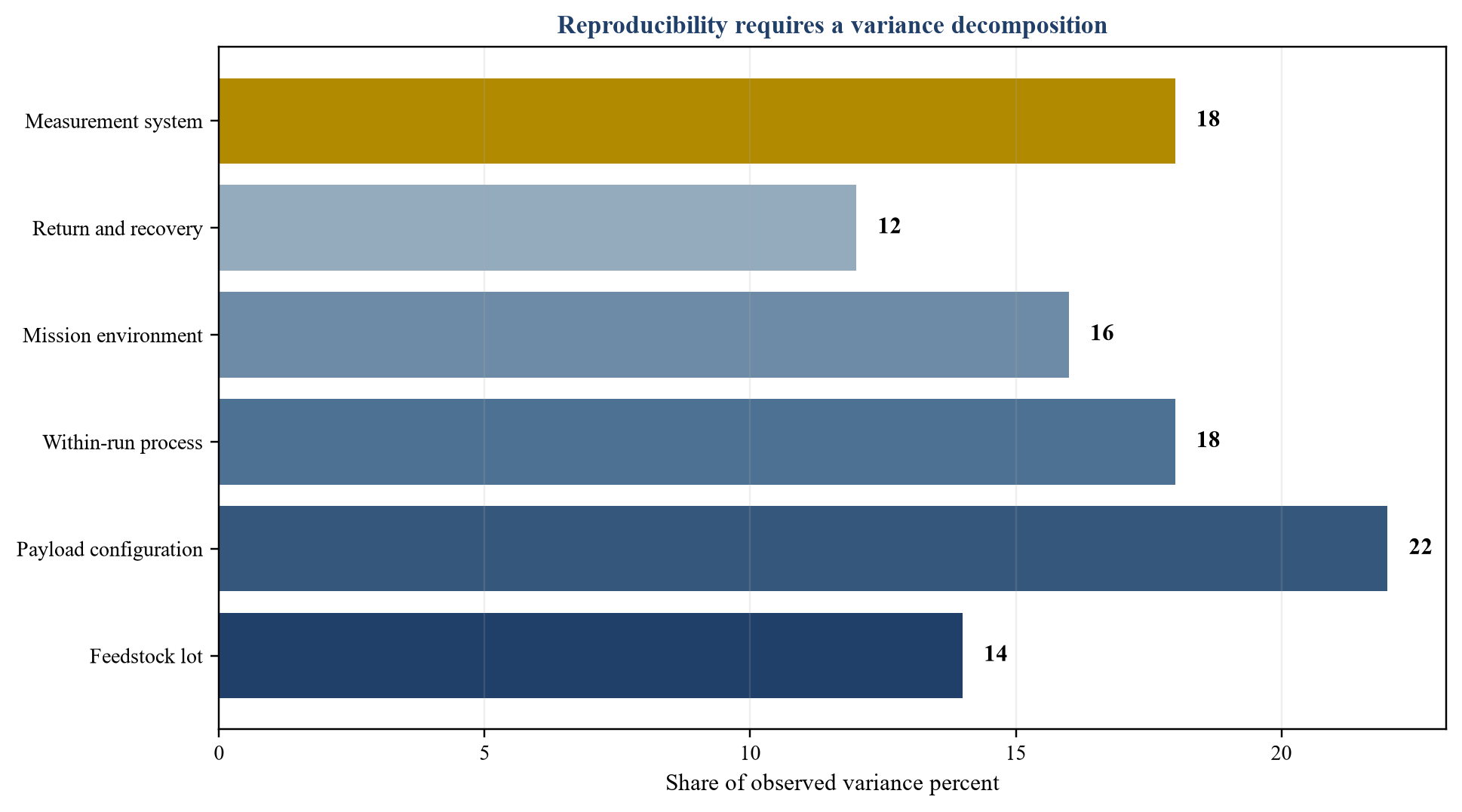
Illustrative share of observed variance; target-specific analysis is required.
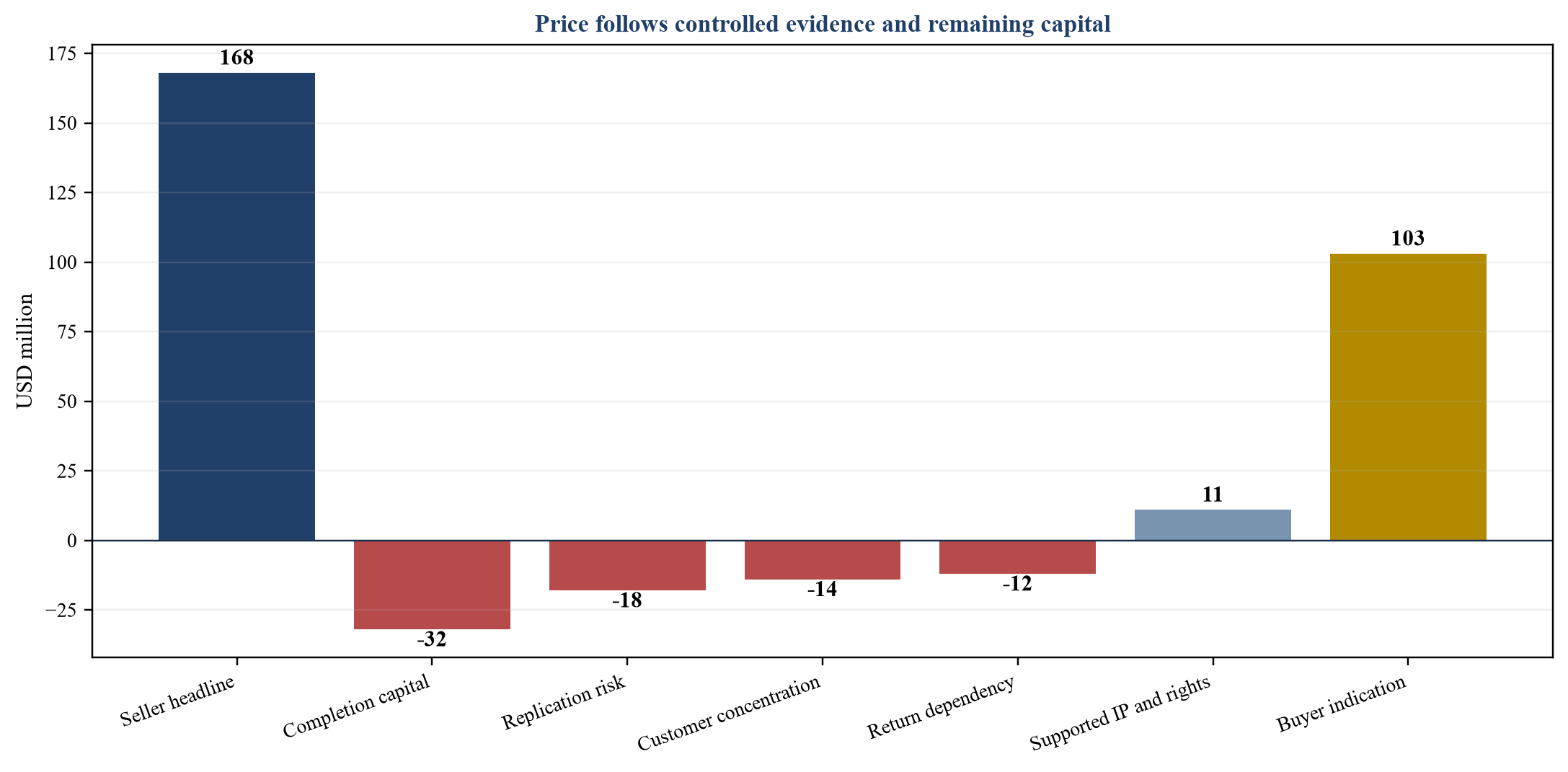
Illustrative USD millions; the result is conditional on confirmatory diligence.
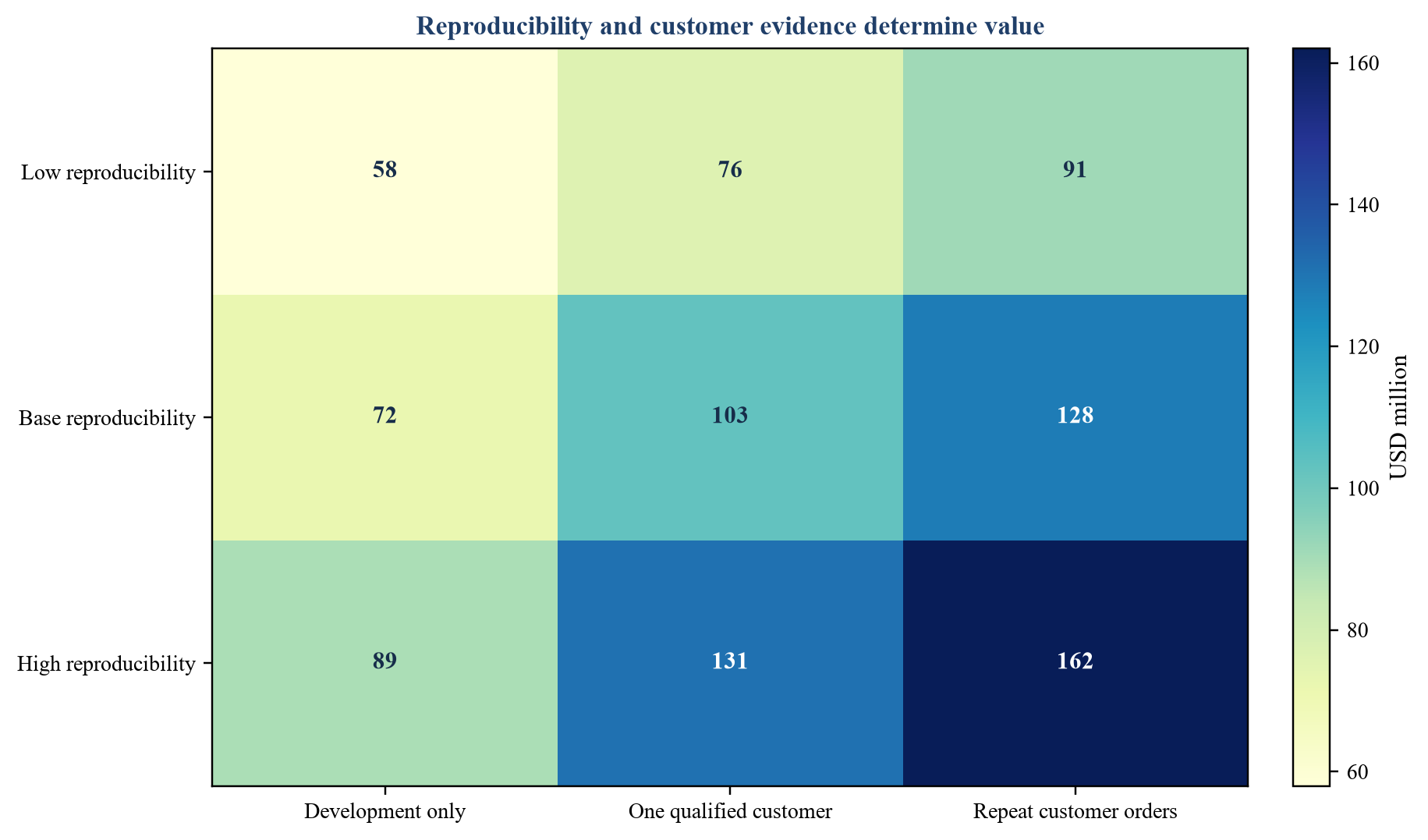
Illustrative USD millions across reproducibility and customer qualification outcomes.
| Evidence state | Minimum evidence | M&A treatment |
|---|---|---|
| Scientific effect | controlled orbital and terrestrial comparison | technical option value |
| Repeat run | comparable result under the same configuration | reduced process uncertainty |
| Repeat mission | result reproduced across mission conditions | engineering-reproducibility value |
| Qualified output | customer protocol and accepted sample | customer probability increase |
| Repeat production | accepted lots delivered at planned cadence | operating-business value |
Proposed transaction-diligence classification.
| Stage | Kilograms | Conversion from prior stage | Evidence |
|---|---|---|---|
| Prepared input | 144 | n.a. | feedstock genealogy and payload record |
| Returned material | 92 | 64 percent | recovery and custody record |
| Within specification | 64 | 70 percent | controlled laboratory result |
| Customer qualification | 48 | 75 percent | customer protocol and acceptance |
Illustrative kilograms across six missions.
| Variable | Evidence request | Confirmatory test |
|---|---|---|
| Feedstock | supplier lot composition storage preparation | repeat process across two controlled lots |
| Hardware | payload serial configuration maintenance calibration | replicate with current commercial configuration |
| Mission | orbit duration power vibration thermal record | compare results across missions |
| Return | vehicle environment recovery time custody | reconcile output with return history |
| Measurement | method instrument operator uncertainty | blinded independent laboratory test |
Proposed diligence tests.
| Asset or right | Primary evidence | Transaction concern |
|---|---|---|
| Process intellectual property | patents trade secrets assignments | ownership scope and transferability |
| Payload hardware | title serials configuration records | condition replacement and liens |
| Software and data | repositories licences provenance | transfer rights and reproducibility |
| Customer contracts | signed terms receipts acceptance | consent termination and concentration |
| Grants and platform access | award and capacity agreements | conditions change of control and expiry |
Proposed acquisition-perimeter review.
| Item | USDm | Basis |
|---|---|---|
| Seller headline enterprise value | 168 | seller presentation |
| Completion capital | -32 | funded programme to qualified repeat production |
| Process replication risk | -18 | confirmatory evidence pending |
| Customer concentration | -14 | one active qualification programme |
| Return dependency | -12 | limited vehicle and recovery alternatives |
| Supported intellectual property and rights | 11 | independent rights and contract evidence |
| Buyer conditional indication | 103 | before debt cash tax and transaction adjustments |
Illustrative USD millions; no company is valued.
| Scenario | Process evidence | Customer evidence | Transaction implication |
|---|---|---|---|
| Research asset | isolated successful samples | paid studies | asset value and staged funding |
| Reproducible development | repeat missions within range | qualification programme | milestone price and earn-out |
| Qualified production | capable process at accepted yield | repeat orders | operating valuation and integration |
Hypothetical outcomes; target-specific evidence is required.
| Gate | Decision question | Minimum evidence |
|---|---|---|
| Product | what exact output and right are acquired | perimeter and product definition |
| Advantage | is the orbital effect measured against a valid control | predefined protocol and independent result |
| Reproducibility | can the process repeat across runs and missions | variance analysis and batch genealogy |
| Yield | how much output reaches customer qualification | end-to-end yield waterfall |
| Customer | who accepts and pays under which conditions | contract confirmation and protocol |
| Capital | what funding is required after close | completion budget and delay case |
| Integration | can the capability survive ownership change | retention configuration and rights plan |
Proposed minimum approval record.
Sources
- NASA, In Space Production Applications. Read the primary source
- NASA, Optical Fiber Production, 25 March 2024. Read the primary source
- NASA, Microgravity Materials Science on the International Space Station, June 2025. Read the primary source
- NASA, In Space Production Applications Overview, October 2023. Read the primary source
- NASA, Technology Readiness Levels, 27 September 2023. Read the primary source
- National Institute of Standards and Technology, Production Process Characterization. Read the primary source
- National Institute of Standards and Technology, Model Based Manufacturing Capability Definition. Read the primary source
- National Institute of Standards and Technology, Metal Additive Manufacturing Powder Consortium. Read the primary source
- National Institute of Standards and Technology, Structural Metrology of Advanced Manufacturing Processes. Read the primary source
- ASTM International, ISO ASTM 52920 Qualification Principles for Industrial Additive Manufacturing Processes and Production Sites. Read the primary source
- ASTM International, ISO ASTM TR 52917 Additive Manufacturing Round Robin Testing General Guidelines. Read the primary source
- ASTM International, F3637 Standard Guide for Relative Density Measurement. Read the primary source
- ASTM International, E3353 Standard Guide for In Process Monitoring Using Optical and Thermal Methods. Read the primary source
- NASA, Ames Partnerships Office Annual Report 2025. Read the primary source
- NASA Technical Reports Server, Extraordinary Accomplishments of the In Space Production Applications Portfolio in 2024. Read the primary source
- NASA, NASA Selects Proposals to Enable Manufacturing in Space for Earth. Read the primary source
- NASA, Manufacturing and Materials. Read the primary source
- NASA TechPort, Molten Metal Solidification technology project 158519. Read the primary source
- European Space Agency, Space Forge Plasma in Space, May 2026. Read the primary source
- UK Space Agency and Department for Science Innovation and Technology, Made in Space UK Funding Boosts Breakthrough Space Technologies, 10 June 2026. Read the primary source
- European Space Agency Business in Space Growth Network, Space Forge. Read the primary source
- Federal Aviation Administration, FAA Streamlines Commercial Space License Approvals, 17 March 2026. Read the primary source
- Electronic Code of Federal Regulations, Title 14 Part 450 Launch and Reentry Licensing Requirements. Read the primary source
- UK Government, Guidance for Launch and Return Operator Licence Applicants and Licensees. Read the primary source
- Redwire Corporation, 2025 Annual Report. Read the primary source
- Redwire Corporation, 2024 Annual Report. Read the primary source
- IFRS Foundation, IFRS 3 Business Combinations. Read the primary source
- IFRS Foundation, IAS 38 Intangible Assets. Read the primary source
- NASA, Low Earth Orbit Microgravity Strategy, 16 December 2024. Read the primary source
- UK Space Agency, New Studies for Manufacturing Advanced Materials in Orbit, 9 February 2026. Read the primary source
