

1. Turn generosity into an accountable capital system
Philanthropy becomes strategic when the family can explain which public-benefit outcome it seeks, why its capital is suited to that problem, how decisions are made, what delivery capacity is required and which evidence will change the programme. A platform is therefore more than a legal vehicle or a schedule of grants. It is a capital-allocation and operating system with duties to beneficiaries, partners, regulators, the family and the public.
The Gulf can host family wealth, operating businesses, global networks and communities with significant needs. A platform may fund locally, regionally and internationally. Each geography adds its own definition of charitable purpose, licensing, solicitation, transfer, tax, reporting and governance. The platform should retain a common mission and control spine while adopting a current jurisdiction schedule for every legal owner and programme.
An outcomes-led system begins before instruments are chosen. The board defines a bounded problem, population, geography, time horizon and intended change. It records what the family knows, what remains uncertain and where affected communities hold essential knowledge. It then selects grants, recoverable grants, guarantees, concessionary finance, programme-related investments, market-rate investments, convening or operating activity according to purpose and evidence.
The platform's success cannot be reduced to money disbursed. Deployment is an input. Outputs describe delivered activity. Outcomes describe changes for people, institutions or ecosystems. Impact requires a credible view of what changed and how the intervention contributed, with limits and alternative explanations made visible.
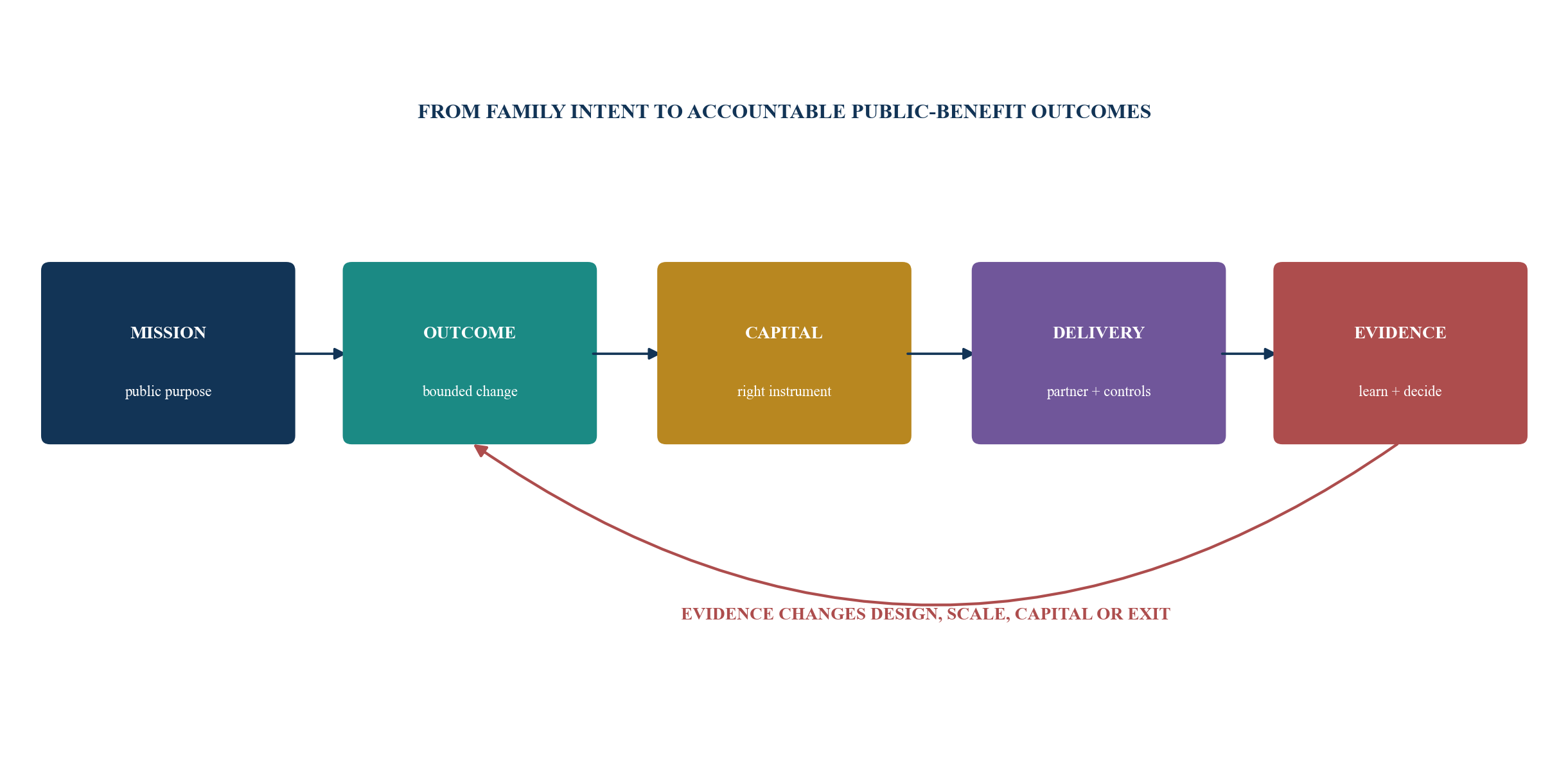
Each stage creates evidence for the next decision and can trigger redesign.
2. Separate family intent, legal purpose and outcome thesis
Family intent can include gratitude, faith, identity, legacy, place, lived experience or a desire to address a visible injustice. These motives matter, but the governing body must translate them into purposes permitted by the chosen legal and regulatory framework. The charter should state beneficiaries and public benefit with enough clarity to guide decisions across generations.
The outcome thesis explains the change the platform seeks and the mechanism through which its contribution may help. It should describe the problem, affected population, geography, system conditions, causal pathways, material assumptions, potential harms and the platform's comparative advantage. It should also state what lies outside scope.
A useful thesis is neither a slogan nor a rigid prediction. Complex outcomes depend on public policy, community behaviour, institutions, labour markets, health systems, climate, conflict and other funders. The platform should record its contribution and uncertainty. It should avoid claiming sole attribution where evidence supports only participation in a broader change.
Beneficiary voice enters at design, diligence, monitoring and evaluation. Paid advisory panels, community organisations, lived-experience research and accessible complaints channels can improve decisions. Participation needs safeguards against coercion, tokenism, privacy loss and the extraction of unpaid labour.
Table 1. Mission-to-outcome decision charter
| Charter field | Governing question | Minimum evidence |
|---|---|---|
| public-benefit purpose | which lawful purpose and beneficiary group does the platform serve? | governing instrument, jurisdiction advice and public-benefit rationale |
| bounded problem | what condition, population, place and horizon are in scope? | baseline, stakeholder research and system map |
| intended outcome | what observable change would justify continued capital? | outcome definition, indicator logic and decision threshold |
| contribution thesis | how can this platform's capital and capabilities influence the outcome? | causal pathway, comparative advantage and material assumptions |
| exclusions | which causes, geographies, beneficiaries or instruments are outside mandate? | board-approved boundary and referral approach |
| harm and equity | who could be excluded, burdened or exposed by the intervention? | safeguarding, accessibility, distribution and grievance analysis |
| learning question | which uncertainty most affects the next capital decision? | evaluation plan, owner, timeline and use of findings |
The board should approve the charter and record unresolved assumptions.
3. Choose a legal and operating architecture fit for purpose
The platform can operate through a foundation, trust, company, registered charity, donor-advised arrangement, intermediary, programme office or a combination. The choice affects control, perpetuity, tax, disclosure, permitted activity, fundraising, governance, staffing, cross-border transfers and the treatment of investments.
Gulf structuring requires precise boundary work. UAE Federal Law No. 3 of 2021 regulates donations, with executive rules and active administrative penalties. A family should determine when its activity constitutes donation collection, fundraising, grantmaking, sponsorship or private deployment, and which authority, licence and channel apply. Public solicitation should never be assumed to follow from the existence of a family vehicle.
ADGM foundations have separate legal personality and can hold assets for stated purposes. ADGM announced amendments effective in May 2026 restricting foundations and trusts from purposes falling within its anti-money-laundering definition of non-profit organisations. This illustrates why a vehicle marketed historically for public-interest purposes may require fresh legal analysis before use for philanthropic activity.
International comparisons clarify design choices without importing rules. US private foundations face annual filing, self-dealing, distributable-amount, excess-business-holdings, jeopardising-investment and taxable-expenditure regimes. UK charity trustees make investment decisions within their duties and purposes. Singapore's governance code addresses mission, effective boards, integrity, management, transparency and communication. Australian charities must meet governance standards and, when operating overseas, external conduct standards. The platform needs its own jurisdiction matrix.
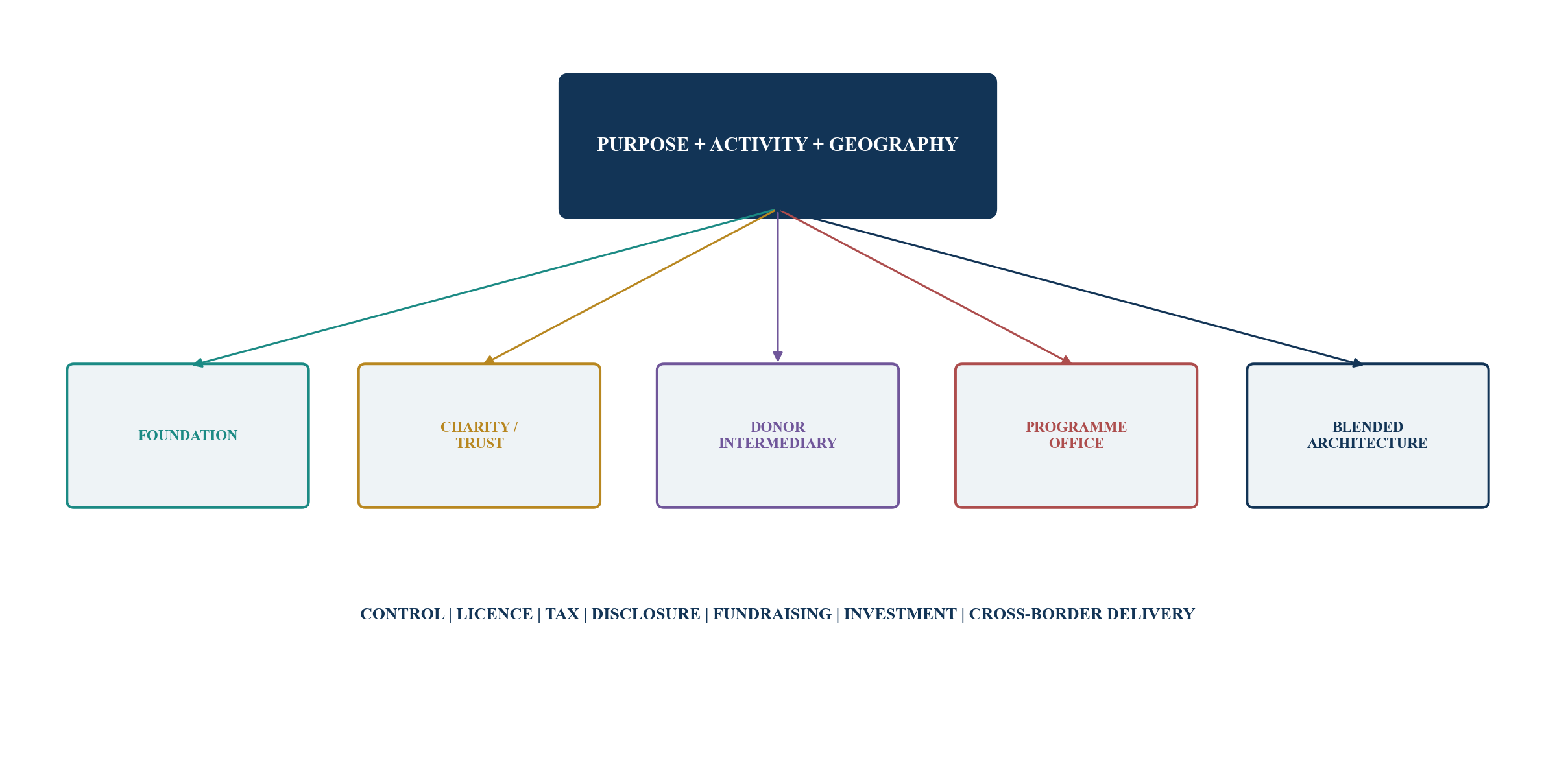
The structure is selected after mapping what the platform will fund, operate, solicit, invest and report.
4. Establish board authority and conflict controls
The governing body owns purpose, strategy, risk appetite, capital policy, senior appointments, conflicts, safeguarding, financial oversight and accountability. Family participation can preserve intent and long-term commitment. Independent members can add subject expertise, community perspective, financial control and challenge.
The charter should define reserved matters and delegated authority. It should distinguish grant approval, investment approval, programme operation, related-party transactions, emergency response and public communications. Committees can support diligence and expertise, while the board retains accountability.
Conflicts extend beyond direct financial benefit. A family member may sit on a grantee board, control a supplier, nominate a beneficiary, seek reputational benefit or direct funds toward a community connected to the family business. The register should capture actual, potential and perceived conflicts. Recusal, independent review, competitive sourcing and publication may be appropriate depending on the case.
The US private-foundation self-dealing regime shows how related-party rules can be specific and consequential. Other jurisdictions use different tests. The platform should apply current legal advice and a board policy that can be stricter than the minimum where public trust requires it.
5. Allocate capital by problem and evidence
Grantmaking is one instrument within a wider capital stack. Unrestricted grants can fund organisational resilience. Restricted project grants can support defined activity. Recoverable grants can recycle capital if an outcome or revenue event occurs. Guarantees can unlock lending. Concessionary investments can accept risk or return below market in pursuit of mission. Market-rate investments can align the endowment with purpose where duties permit. Convening, research and technical assistance can address coordination and capability gaps.
Instrument selection should follow the need. A grant suits a public good with no reliable revenue model. A guarantee may address lender risk perception. A concessionary investment may suit an enterprise with revenue and material impact additionality. A market-rate investment belongs where risk-adjusted economics and mission alignment both meet the platform's policy. A programme office may be justified where delivery capacity is unavailable and the platform has genuine operating advantage.
US rules recognise qualifying distributions, including certain programme-related investments. UK guidance distinguishes financial and social investment within trustee duties. These are jurisdiction-specific regimes. The general principle is to document purpose, expected financial behaviour, impact pathway, downside, conflicts, monitoring and exit for each instrument.
Table 2. Philanthropic capital instrument matrix
| Instrument | Suitable problem condition | Financial expectation | Core control |
|---|---|---|---|
| unrestricted grant | capable organisation needs flexible capacity | no repayment | mission fit, governance, budget resilience and outcome contribution |
| restricted grant | defined activity and accountable output | no repayment | milestone, permitted use, change control and proportionate reporting |
| recoverable grant | uncertain revenue event can recycle some capital | conditional recovery | recovery trigger, accounting, downside and mission priority |
| guarantee | financing is constrained by risk allocation | contingent loss | capped exposure, lender terms, additionality and claim process |
| concessionary investment | revenue exists but market capital cannot meet impact need | below-market or patient return | impact intent, risk, governance, valuation and responsible exit |
| market-rate aligned investment | investible economics and mission alignment coexist | risk-adjusted market return | fiduciary policy, impact evidence, conflicts and performance |
| direct operation | external delivery capacity is insufficient and platform has advantage | programme cost | licence, people, safeguarding, operations and independent evaluation |
Legal, tax, regulatory and investment treatment must be confirmed for the relevant entity and jurisdiction.
6. Build a portfolio rather than a list of causes
A portfolio gives the board a view across outcomes, geographies, beneficiaries, partners, instruments, duration, evidence maturity and risk. It prevents a series of individually attractive grants from creating hidden concentration or an unmanageable reporting burden.
The board can set allocation bands for core outcomes, exploratory work, systems change, rapid response and institutional capacity. It can distinguish evidence-building pilots from scaled programmes. It can also reserve capital for follow-on funding when early evidence is strong.
Concentration can be purposeful. A platform may choose one city, disease, education transition or climate system. The decision should be explicit, with an assessment of who remains outside scope. Diversification should not fragment the mission into dozens of unrelated themes.
The portfolio dashboard should show committed, approved, contracted, disbursed and expected cash separately. Multi-year commitments need a liquidity plan. Foreign-currency obligations, guarantees and recoverable instruments create additional treasury and accounting requirements.
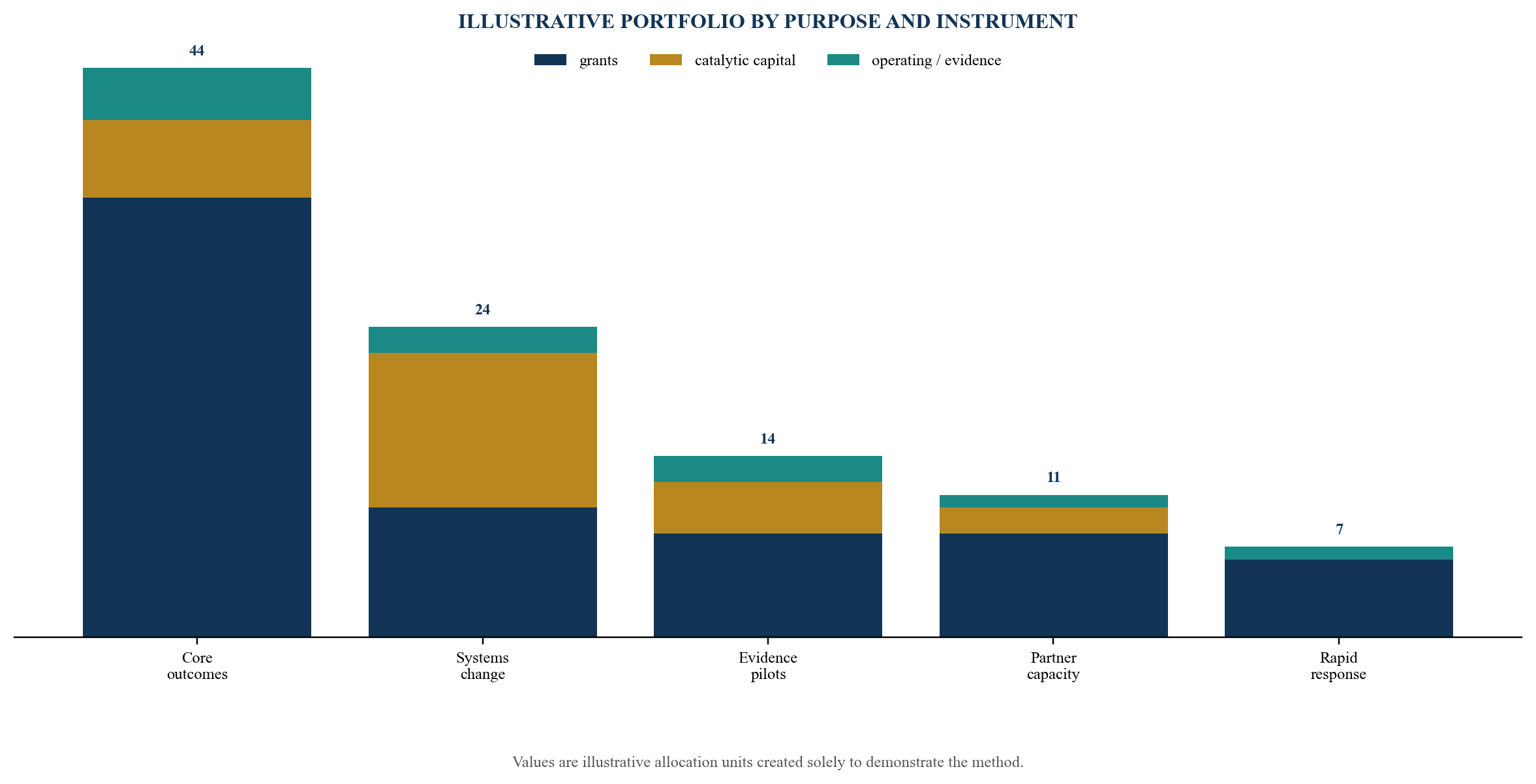
Illustrative allocation bands are management assumptions and do not represent client data.
7. Diligence partners through purpose and proportionality
Partner diligence should protect beneficiaries and capital without imposing a single institutional template on every organisation. Requirements should reflect grant size, geography, delivery model, vulnerable populations, cash handling, public exposure and risk.
The review should cover legal status, governance, beneficial ownership or control where relevant, leadership, finances, safeguarding, sanctions and financial crime, delivery record, data, complaints, conflicts, subcontractors and outcome capability. Cross-border delivery requires visibility through downstream partners and payment chains.
FATF's updated Recommendation 8 best practices emphasise focused, proportionate and risk-based measures for the subset of non-profit organisations exposed to terrorist-financing abuse. The guidance warns against one-size-fits-all controls and undue disruption of legitimate activity. A platform should therefore calibrate diligence, document the risk basis and avoid excluding small community partners solely because they lack sophisticated presentation.
Capacity support can follow diligence. A strong local partner may need funding for finance, safeguarding, measurement or technology. These costs are part of delivery infrastructure rather than overhead to be minimised automatically.
Table 3. Proportionate partner diligence and monitoring
| Domain | Baseline review | Enhanced review trigger |
|---|---|---|
| legal and governance | registration, governing body, authority and conflicts | complex control, related parties, new jurisdiction or material change |
| financial | accounts, budget, bank title and cash controls | weak reserves, cash delivery, rapid growth, fraud history or large advance |
| safeguarding | policy, reporting route and responsible lead | children, vulnerable adults, residential activity or high-risk environment |
| financial crime | identity, purpose, counterparties and sanctions screening | conflict area, complex transfers, intermediaries or adverse information |
| delivery | team, plan, partners, permissions and milestones | novel model, regulated service, construction or material subcontracting |
| evidence | baseline, indicators, data rights and learning question | high-stakes claim, scale decision or intrusive data collection |
| exit and continuity | close-out, asset treatment and beneficiary continuity | dependency on one funder, essential service or abrupt funding end |
Enhanced measures follow the assessed risk, programme and jurisdiction.
8. Protect beneficiaries through safeguarding and data governance
Outcome ambition does not excuse harm. The platform should define safeguarding duties, prohibited conduct, reporting, investigation, survivor-centred response, partner responsibilities and board oversight. Controls should cover staff, volunteers, contractors, researchers, media and technology.
Data can expose health, disability, migration, faith, poverty, location, identity and family circumstances. The platform should collect only what serves a defined purpose, use lawful and ethical authority, restrict access, set retention, secure transfers and establish deletion and incident procedures. Consent may be insufficient where power imbalance is material.
Storytelling requires separate care. A compelling beneficiary narrative can become permanent digital exposure. The platform should avoid coercive consent, humiliation, stereotyping and unnecessary identification. People should understand where content will appear and whether refusal affects support.
Complaints and grievance channels should be accessible in relevant languages and formats, available outside the delivery partner where appropriate, and protected against retaliation. The board should see themes, serious incidents and remediation while respecting privacy and due process.
9. Design evidence for decisions rather than decoration
Measurement should begin with the decision it needs to inform. A pilot may ask whether delivery is feasible and acceptable. A scale decision may require evidence of outcome magnitude, distribution, cost, contribution and operational readiness. A systems intervention may track policy, institutional behaviour, coordination and durable capacity.
The evidence plan should define baseline, indicators, method, frequency, responsibility, quality controls and decision thresholds. It should separate outputs from outcomes and record negative or unintended effects. Quantitative data can show reach and change; qualitative evidence can explain mechanism, experience and context.
UNDP's impact standards emphasise embedding impact into strategy, management, transparency and governance. IFC's Operating Principles provide a reference for impact-management systems and independent verification. These frameworks support a closed loop from intent through contribution, monitoring, response and disclosure.
Evaluation should be proportionate. A small grant does not need an expensive experimental design. A material claim affecting scale, public policy or vulnerable people may justify independent expertise. The evaluator should disclose limitations, missing data and conflicts.
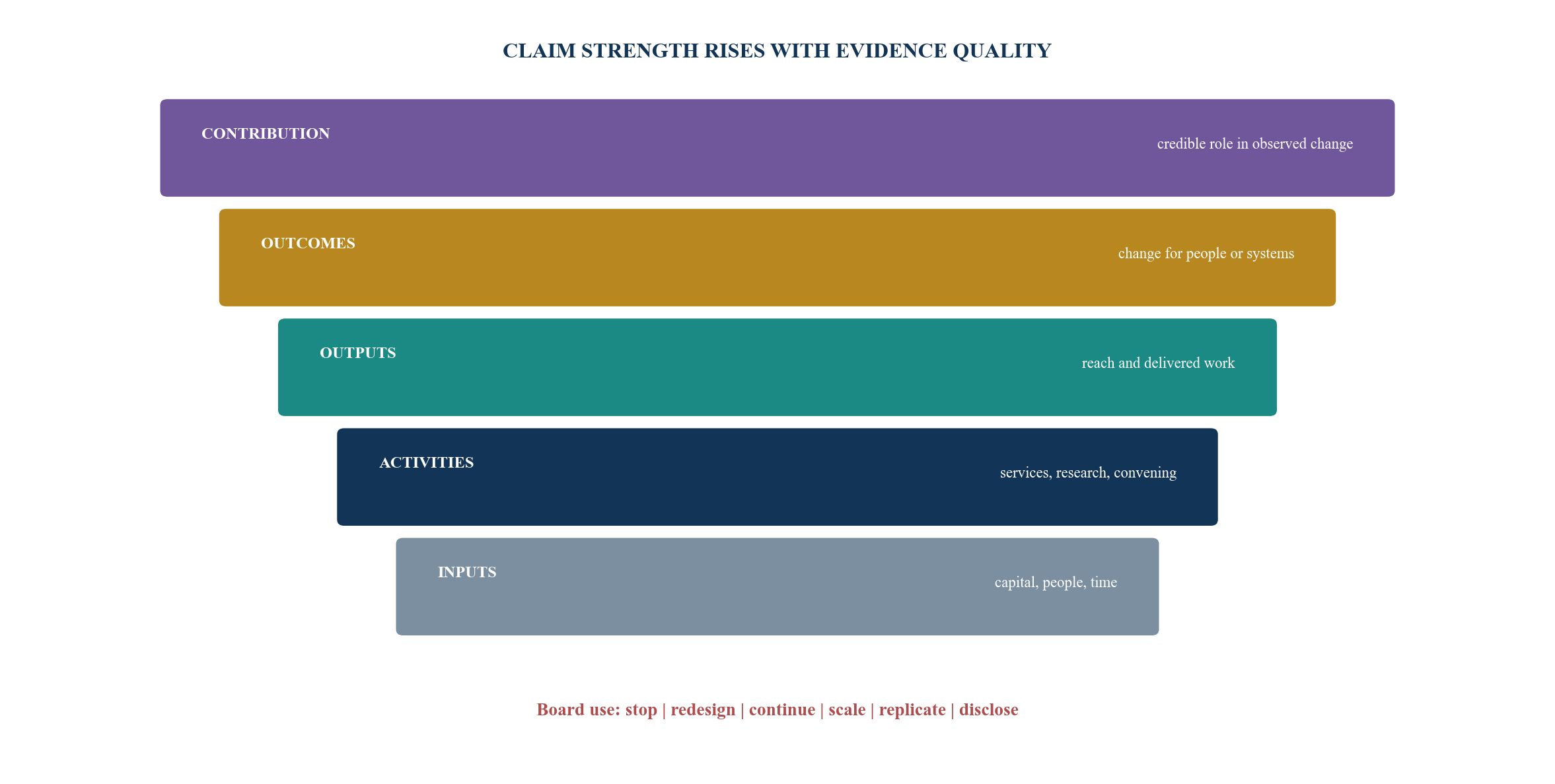
Stronger claims require stronger evidence and explicit treatment of alternative explanations.
10. Price the full cost of outcomes
Grant budgets often separate programme from overhead as though governance, people, finance, technology, safeguarding, evidence and reserves do not contribute to outcomes. This can weaken partners and create delivery risk.
The platform should understand full cost: direct activity, leadership, staff development, facilities, finance, compliance, safeguarding, monitoring, technology, insurance, working capital and organisational resilience. It can then judge whether the cost is reasonable for the result and context.
Cost-effectiveness compares resources with outcomes while respecting distribution and quality. The cheapest intervention may exclude harder-to-reach groups or transfer cost to unpaid caregivers and community organisations. The analysis should state perspective, time horizon, included costs and outcome definition.
Multi-year unrestricted support can be appropriate when an organisation has strong governance, mission alignment and an evidence-led plan. Milestone payments may suit projects with definable stages. The funding design should support delivery rather than force the partner to finance the platform's commitment.
11. Integrate endowment, payout and mission capital
The platform should connect spending policy, investment policy and mission. A perpetual endowment, spend-down vehicle and annual family allocation require different liquidity, risk and governance. The board should model commitments, operating cost, investment volatility and foreign-currency needs.
US private foundations generally calculate a minimum investment return at five percent of non-charitable-use assets after specified adjustments, with qualifying-distribution rules and other restrictions. This is a US tax regime rather than a global default payout policy. Other structures can have different duties or no equivalent percentage.
UK Charity Commission guidance asks trustees to make investment decisions that further the charity's purposes and comply with duties. The platform should document objectives, risk, liquidity, time horizon, delegation, responsible investment factors, performance and review. Programmatic and investment portfolios should be viewed together where law permits.
Mission-related and impact investments need the same discipline as grants. Financial return, impact intent, contribution, measurement, conflicts, valuation and exit should be explicit. Labelling an investment as impactful does not establish additionality or beneficiary benefit.
Table 4. Integrated capital-policy decisions
| Decision | Board question | Evidence |
|---|---|---|
| duration | is the platform perpetual, time-limited or subject to periodic reset? | founder intent, governing instrument and scenario plan |
| payout | what deployment range supports mission and committed obligations? | cash-flow ladder, regulatory requirement and outcome pipeline |
| liquidity | how much capacity is required for grants, operations and contingencies? | commitments, currency, market stress and reserve policy |
| investment risk | which losses could impair mission delivery or legal duties? | strategic allocation, stress test, concentration and delegated limits |
| mission alignment | how are material positive and negative effects considered? | policy, diligence, stewardship, exclusions and evidence |
| catalytic capital | when may the platform accept different risk or return for impact? | additionality, instrument rationale, downside, valuation and approval |
| spend-down | what sequence protects beneficiaries and institutional knowledge? | final outcome plan, partner transitions, archives and closure governance |
The policy should be tailored to the governing instrument, duties, tax regime and operating model.
12. Govern cross-border giving and emergency response
Cross-border giving requires a programme and legal route that can carry money, data, people and accountability. The platform should map origin entity, recipient, intermediary, banking path, currency, purpose, permits, sanctions, tax, reporting, safeguarding and downstream delivery.
Emergency giving increases speed and uncertainty. A pre-approved response policy can define trusted intermediaries, risk appetite, fast-track diligence, caps, documentation, restricted geographies, communications and retrospective review. Speed should come from preparation and delegation rather than missing controls.
The platform should avoid routing funds through opaque chains or informal mechanisms to overcome a compliance delay. When a bank, authority or partner raises a concern, the legal owner should pause, preserve evidence and obtain qualified advice. Humanitarian activity can have specific permissions and exceptions, but these require precise application.
Currency and transfer costs should be visible. Grant agreements should clarify who bears bank fees, foreign-exchange movements and local taxes. Programme budgets should include compliance and monitoring required by the geography.
13. Build a partner ecosystem without capturing it
Large family platforms can influence the agenda of smaller organisations through funding conditions, reporting formats and public profile. The board should assess whether its process redirects partner strategy, excludes local knowledge or creates dependency.
Partnership can include co-design, flexible funding, common reporting, shared infrastructure, referrals, research, data standards and collaborative funding. The platform can convene public agencies, charities, companies, universities and investors when it has a legitimate role and manages conflicts.
Power should be visible. Partners need clear criteria, response times, decision reasons, complaints and predictable close-out. Declined applicants should not be required to provide extensive unpaid work without a realistic prospect of support.
The platform should define responsible exit. Abrupt withdrawal can harm beneficiaries, staff and services. A transition plan may involve notice, tapering, replacement funders, asset transfer, data stewardship and public communication.
14. Create a board dashboard that supports learning
The dashboard should connect capital, delivery, outcome, risk and learning. It can show pipeline, commitments, disbursements, full cost, population reach, outcome indicators, evidence confidence, partner health, safeguarding, complaints, concentration and decisions due.
Evidence confidence should be displayed separately from outcome direction. A positive indicator based on weak data should not look equivalent to an independently verified result. The board should see baseline gaps, sample limitations, missing groups and reporting delay.
The dashboard should report distributions. An average improvement can conceal harm or exclusion for a subgroup. Geography, gender, age, disability and other relevant characteristics should be used only where lawful, ethical, safe and decision-useful.
Management should record the action triggered by evidence: continue, change, pause, scale, replicate, exit or commission further study. This closes the loop and prevents reports from becoming ceremonial.
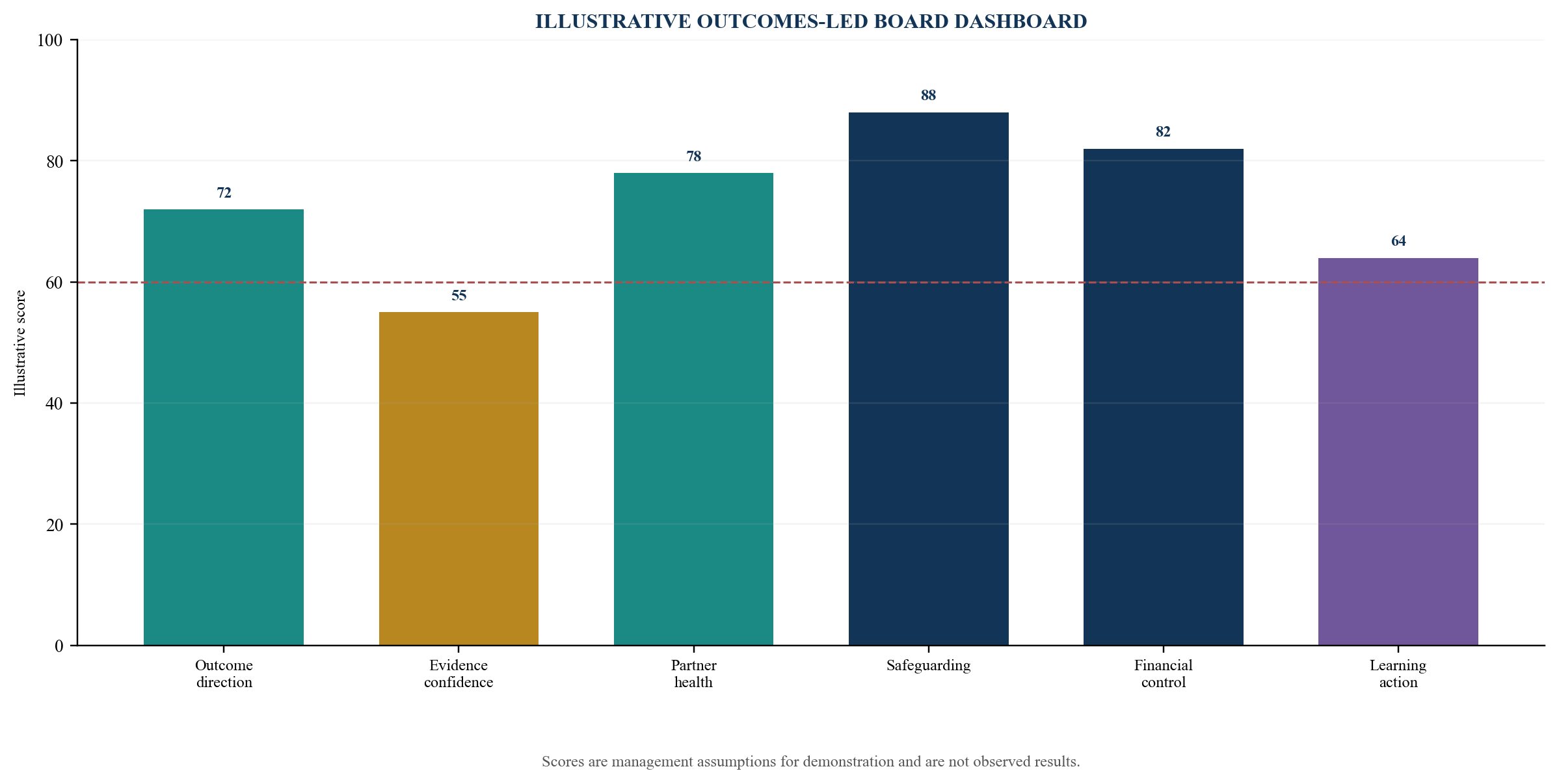
Illustrative scores are management assumptions and demonstrate dashboard logic.
15. Worked hypothetical case: a Gulf platform with global learning
Consider a hypothetical Gulf family committing management-estimated capital of USD 150 million over ten years to improve transitions from secondary education into skilled employment. The platform focuses on two Gulf markets and funds a small comparative learning portfolio in South and Southeast Asia.
Management allocates USD 75 million to multi-year partner grants, USD 20 million to evidence and data infrastructure, USD 18 million to partner capacity, USD 12 million to catalytic finance, USD 10 million to policy and employer coordination, USD 7 million to rapid response and USD 8 million to platform operations and reserves. These figures illustrate a method and do not represent actual client data or a recommendation.
The board defines its primary outcome as sustained employment or further accredited training 12 months after programme completion, with quality, wage, retention and beneficiary-experience measures. It avoids claiming impact from enrolment or course completion alone. A pilot requires feasibility and safeguarding evidence. Scale requires outcome evidence, employer demand, full-cost readiness, inclusion analysis and a credible funding path.
The platform uses a Gulf legal owner for approved local activity and authorised intermediaries for selected cross-border programmes. Counsel confirms fundraising and donations-law boundaries before launch. The platform uses current partner, banking, sanctions, data and safeguarding reviews for each geography.
Table 5. Hypothetical ten-year philanthropic portfolio
| Allocation | Amount | Decision purpose | Scale or renewal evidence |
|---|---|---|---|
| multi-year partner grants | 75 | deliver learner and employment pathways | 12-month outcomes, inclusion, quality, full cost and partner health |
| evidence and data | 20 | establish baseline, interoperability and evaluation | data quality, beneficiary protection and decision use |
| partner capacity | 18 | strengthen finance, safeguarding, leadership and technology | completed capability plan and reduced delivery risk |
| catalytic finance | 12 | test employer, training and outcome-linked models | additionality, repayment logic, outcome evidence and responsible exit |
| coordination | 10 | align employers, educators and public systems | institutional commitments and durable process change |
| rapid response | 7 | protect beneficiaries through shocks | defined trigger, speed, reach and retrospective review |
| operations and reserve | 8 | govern, staff, monitor and sustain the platform | service level, control, talent, reserve and cost discipline |
All values are management assumptions in USD millions and serve only as a worked example.
16. Implement the platform in 100 days
Days 1 to 20 establish purpose and perimeter. The family appoints an accountable sponsor, records founder intent, maps legal owners and planned activities, obtains jurisdiction advice, identifies stakeholders, reviews existing giving and defines the bounded problem.
Days 21 to 45 create the decision architecture. The board approves the outcome thesis, governance, conflicts, delegation, capital instruments, portfolio bands, risk appetite, safeguarding and partner-diligence tiers. Management builds the commitment and liquidity model.
Days 46 to 75 build the operating system. The team creates partner documents, evaluation templates, data controls, grant and investment workflows, treasury routes, complaints, reporting and the board dashboard. It selects a small pipeline through transparent criteria.
Days 76 to 100 test readiness. The platform runs a grant-decision simulation, emergency-response exercise, sanctions and payment check, safeguarding scenario, data review and dashboard rehearsal. Material gaps receive named owners and dates. Independent advisers review areas requiring legal, tax, regulatory, investment, safeguarding or evaluation expertise.
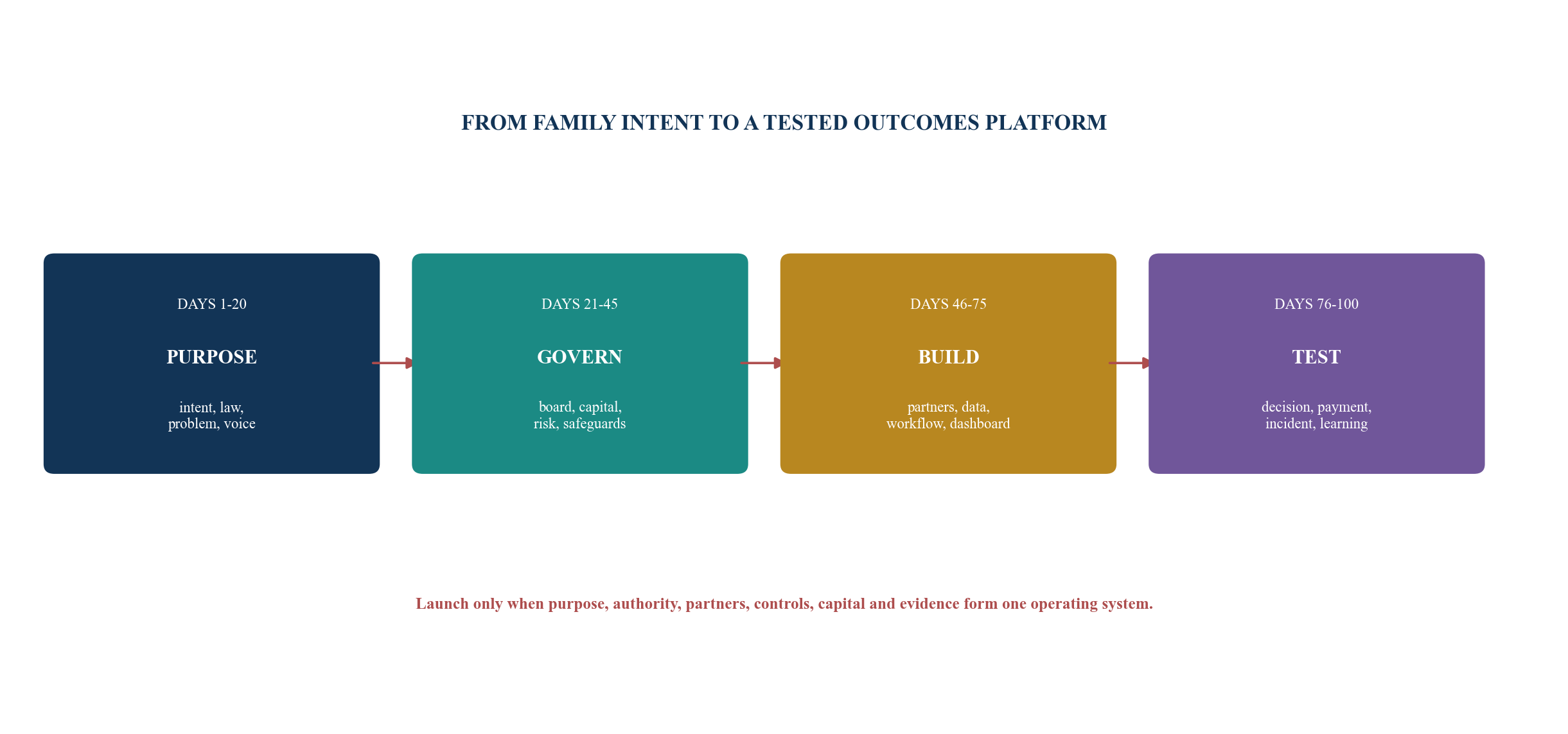
The launch gate requires legal readiness, accountable governance, funded operations and testable evidence.
17. Give the board a closed-loop implementation scorecard
The board should be able to trace every material deployment from lawful purpose through beneficiary need, instrument, approval, partner, payment, delivery, evidence and next decision. The scorecard should highlight stale evidence, unresolved risks and commitments that lack a funded route.
Table 6. Board-ready outcomes-led philanthropy scorecard
| Domain | Governing question | Acceptance evidence |
|---|---|---|
| purpose | is every activity within the lawful purpose and bounded outcome thesis? | governing instrument, jurisdiction schedule and board-approved charter |
| governance | are authority, independence, conflicts and accountability effective? | board matrix, registers, minutes, recusals and evaluation |
| capital | does each instrument fit the problem, evidence and financial behaviour? | instrument memo, additionality, terms, downside and approval |
| partners | are diligence and monitoring proportionate to delivery risk? | partner file, risk tier, agreement, capacity plan and current review |
| beneficiaries | are voice, safeguarding, data, accessibility and grievance protected? | participation record, controls, incidents, complaints and remediation |
| evidence | can the board distinguish inputs, outputs, outcomes and contribution? | baseline, method, quality, limitations and decision threshold |
| portfolio | are concentration, commitments, liquidity and full cost governed? | allocation bands, cash ladder, reserve and scenario analysis |
| cross-border | are licensing, transfer, sanctions, tax and downstream routes current? | legal schedule, payment evidence, screening and authorised partners |
| learning | does evidence change capital and operating decisions? | continue, redesign, scale, exit or research decision with rationale |
Acceptance requires current evidence and a named owner for every material exception.
An outcomes-led giving platform is disciplined generosity. Purpose defines the public benefit. Governance protects it. Capital instruments match the problem. Partners and beneficiaries shape delivery. Evidence informs decisions. Responsible exit protects continuity. The platform earns trust by documenting uncertainty, reporting material results and changing course when the evidence requires it.
References
- United Arab Emirates, Federal Law No. 3 of 2021 Regulating Donations, https://uaelegislation.gov.ae/en/legislations/1500
- United Arab Emirates, Cabinet Resolution No. 160 of 2025 on Administrative Violations and Penalties under the Donations Framework, https://uaelegislation.gov.ae/en/legislations/3863
- Abu Dhabi Global Market Registration Authority, Amendments to Commercial Legislation, 1 May 2026, https://www.adgm.com/media/announcements/adgm-registration-authority-publishes-amendments-to-the-commercial-legislation
- Financial Action Task Force, Best Practices on Combating the Abuse of Non-Profit Organisations, 16 November 2023, https://www.fatf-gafi.org/en/publications/Financialinclusionandnpoissues/Bpp-combating-abuse-npo.html
- United Kingdom Charity Commission, Investing Charity Money: Guidance for Trustees, CC14, updated 1 August 2023, https://www.gov.uk/government/publications/charities-and-investment-matters-a-guide-for-trustees-cc14
- United States Internal Revenue Service, Private Foundations, https://www.irs.gov/charities-non-profits/charitable-organizations/private-foundations
- United States Internal Revenue Service, Minimum Investment Return, reviewed 28 June 2026, https://www.irs.gov/charities-non-profits/private-foundations/minimum-investment-return
- United States Internal Revenue Service, Qualifying Distributions: In General, reviewed 27 June 2026, https://www.irs.gov/charities-non-profits/private-foundations/qualifying-distributions-in-general
- Singapore Charity Council, Code of Governance for Charities and Institutions of a Public Character, April 2023, https://www.charities.gov.sg/Pages/Charities-and-IPCs/Manage-Your-Charity/Code-of-Governance-for-Charities-IPCs.aspx
- Australian Charities and Not-for-profits Commission, Governance Standards, https://www.acnc.gov.au/for-charities/manage-your-charity/governance-hub/governance-standards
- United Nations Development Programme, SDG Impact Standards, https://sdgfinance.undp.org/resource-library/sdg-impact-standards-bond-issuers
- International Finance Corporation, Operating Principles for Impact Management, Disclosure Statement, October 2025, https://www.ifc.org/content/dam/ifc/doc/2025/202510-disclosure-statement-opim.pdf
- Organisation for Economic Co-operation and Development, Private Philanthropy for Sustainable Development 2018-20, 2023, https://www.oecd.org/content/dam/oecd/en/publications/reports/2023/07/private-philanthropy-for-sustainable-development-2018-20_c3a08d1d/0164439d-en.pdf
About the Author
Chennakeshav Adya is an independent researcher and Managing Partner of Matchpoint Partners. His work examines strategy, capital formation, valuation, transactions and operating execution across private and public markets.
