

1. Define the acquisition decision
The transaction question is whether the target owns a repeatable discovery capability, a portfolio of therapeutic assets, a set of contingent contracts, or a combination of the three. Each component has a different evidence base, risk pattern, capital requirement and integration path. The buyer should define them before selecting a valuation method or negotiating consideration.
A platform claim should describe an operating system, not a collection of attractive technologies. The system begins with a defined biological question and governed inputs. It generates hypotheses or molecules, selects experiments, receives wet-lab or clinical feedback, updates models under change control and produces a decision that advances, redesigns or stops a programme. Repeatability requires comparable evidence across programmes and over time.
Pipeline assets are specific therapeutic rights. Their value depends on target, modality, indication, differentiation, preclinical and clinical evidence, intellectual property, regulatory pathway, competitive landscape, remaining cost, development control and commercial rights. A promising candidate can be valuable without proving that the underlying discovery platform is repeatable.
Partnerships create a third value perimeter. Upfront fees, research funding, option payments, development milestones, sales milestones, royalties, co-development rights and cost obligations should be separated. A large disclosed headline may represent contingent payments across numerous programmes and decades. It should not be treated as contracted revenue or enterprise value.
The acquisition thesis should state which value is current, protected, funded, contingent and buyer-specific. It should also show where the platform and pipeline interact. Platform evidence can affect the probability, cost and timing assigned to pipeline assets. The pipeline must not then receive the same platform improvement a second time.
2. Build a platform–pipeline–partnership architecture
The buyer should create three linked ledgers. The platform ledger records data rights, model families, scientific workflows, laboratory systems, software, quality controls, personnel, productivity evidence and external adoption. The pipeline ledger records each programme, rights, indication, stage, evidence, cost, timing, probability and value. The partnership ledger records executed contractual economics and responsibilities.
This architecture prevents narrative transfer. A presentation may cite a clinical-stage candidate as proof of platform quality, include that candidate's risk-adjusted value in the pipeline, and capitalise the same proof into a platform multiple. The ledgers force the team to identify the precise evidence and its permitted valuation use.
The architecture should also distinguish internal, partnered and sold assets. A target may retain all economics in one programme, a royalty in another, an option right in a third and no rights after a discovery handoff in a fourth. Programme count is therefore a weak value measure.
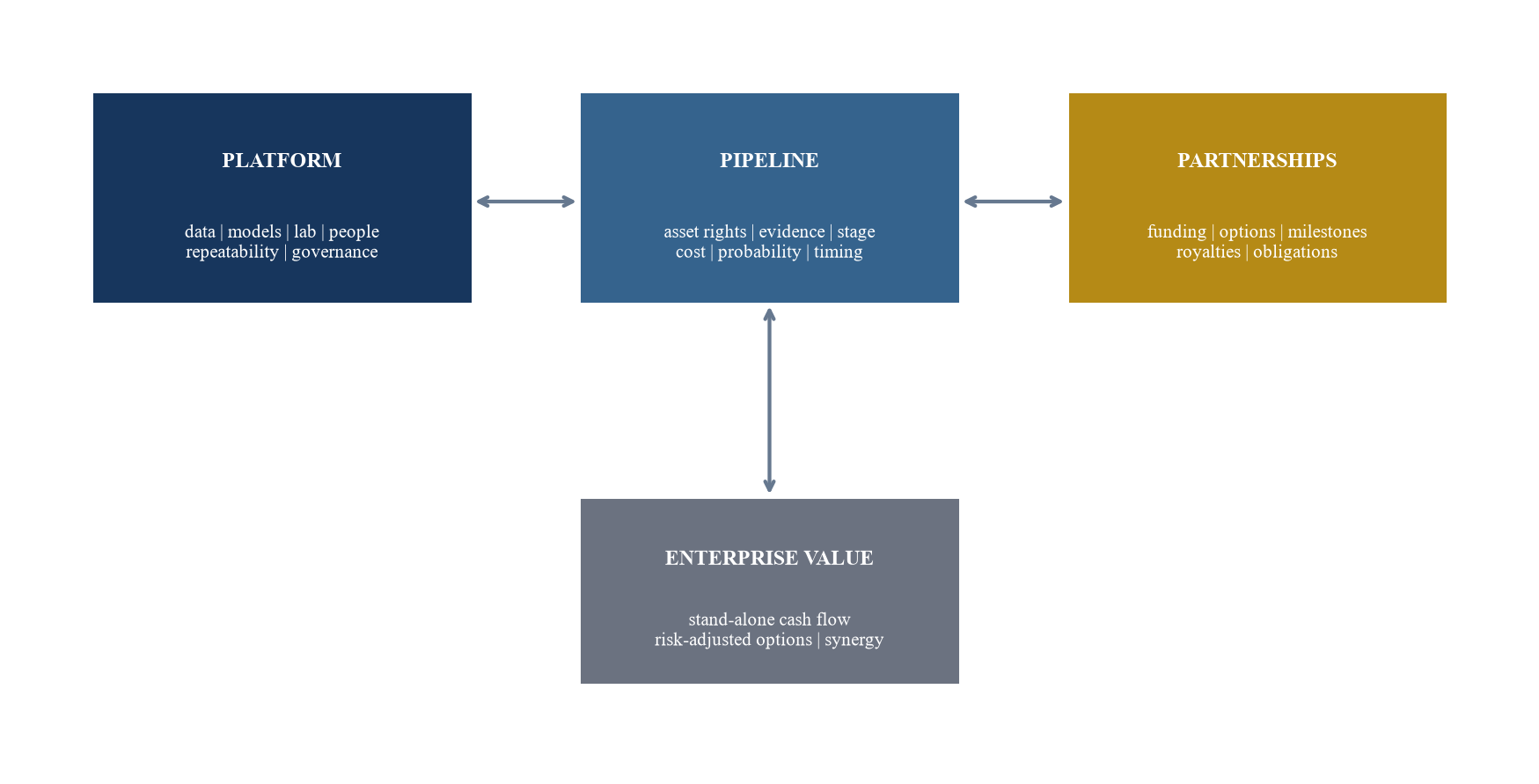
The three ledgers interact, but each economic benefit should have one primary valuation location.
| Component | Evidence unit | Primary method | Main double-counting risk |
|---|---|---|---|
| platform | independent programme and workflow | incremental cash flow, relief-from-royalty or replacement economics | pipeline success counted as platform proof and asset value |
| internal pipeline | asset, indication and jurisdiction | risk-adjusted net present value | platform benefit embedded twice in probability or cost |
| partnered pipeline | contractual programme | expected contractual cash flow | total headline milestones treated as earned value |
| software and services | customer cohort and contract | income approach and supported market evidence | research revenue treated as recurring software |
| data and models | governed right and productive use | incremental income or replacement evidence | historical cost treated as economic value |
| buyer synergy | named initiative and owner | buyer-specific discounted cash flow | included in seller stand-alone value and acquisition premium |
Proposed transaction architecture; rights and economics require contract-level verification.
3. Define a repeatable discovery platform
A repeatable platform produces evidence across independent programmes, not merely repeated use of the same software. The buyer should identify the context of use for each model: target identification, structure prediction, molecule generation, property prediction, toxicity, patient stratification, trial design or another decision. FDA's risk-based framework for AI supporting drug-development decisions connects credibility to the specific context of use.[1] EMA similarly emphasises intended use, data governance, model performance and lifecycle control.[2]
Repeatability requires a stable measurement system. For each programme, the target should record starting hypothesis, input data, model and version, candidate set, selection rule, experiments, failures, design cycles, elapsed time, cost and progression decision. Retrospective claims assembled after success provide weaker evidence than contemporaneous governed records.
The comparator matters. A platform should be compared with a credible alternative for the same problem. An easy target, inherited lead series or unusually rich dataset can make a workflow appear productive. Comparisons should control for modality, target difficulty, endpoint, stage and work transferred to partners.
The strongest evidence spans multiple teams, targets, modalities and time periods. It also includes terminated programmes. Failure data reveal whether the system recognises uncertainty and stops weak work. A platform that generates more candidates without improving selection can shift cost downstream.
4. Reconstruct the design–make–test–learn loop
The operating loop should be traced from decision to evidence. Design can involve target hypotheses, molecular structures, sequences, properties or experiments. Make includes synthesis, expression, assay preparation and data engineering. Test covers computational and physical experiments. Learn means that governed results change models, selection rules or scientific decisions.
The buyer should measure cycle time at each transition. A model may generate structures in minutes while synthesis, assay capacity, data curation or scientific review takes months. The relevant throughput is validated decisions per unit of elapsed time and capital. Compute speed alone does not establish enterprise productivity.
Wet-lab integration is a potential differentiator and a cost centre. Automated experiments can create proprietary data and shorten iteration. Their value depends on assay relevance, reproducibility, capacity utilisation, maintenance, sample quality and the ability to transfer operations. A laboratory optimised for one modality may not support the buyer's target portfolio.
Learning should be demonstrated. The team should test whether prediction error, hit rate, selectivity, developability, cycle time or decision quality improves as governed data accumulate. Model releases and experiment lineage should permit reconstruction. If every programme uses bespoke methods and scientists, the business may be a high-quality research organisation rather than a scalable platform.
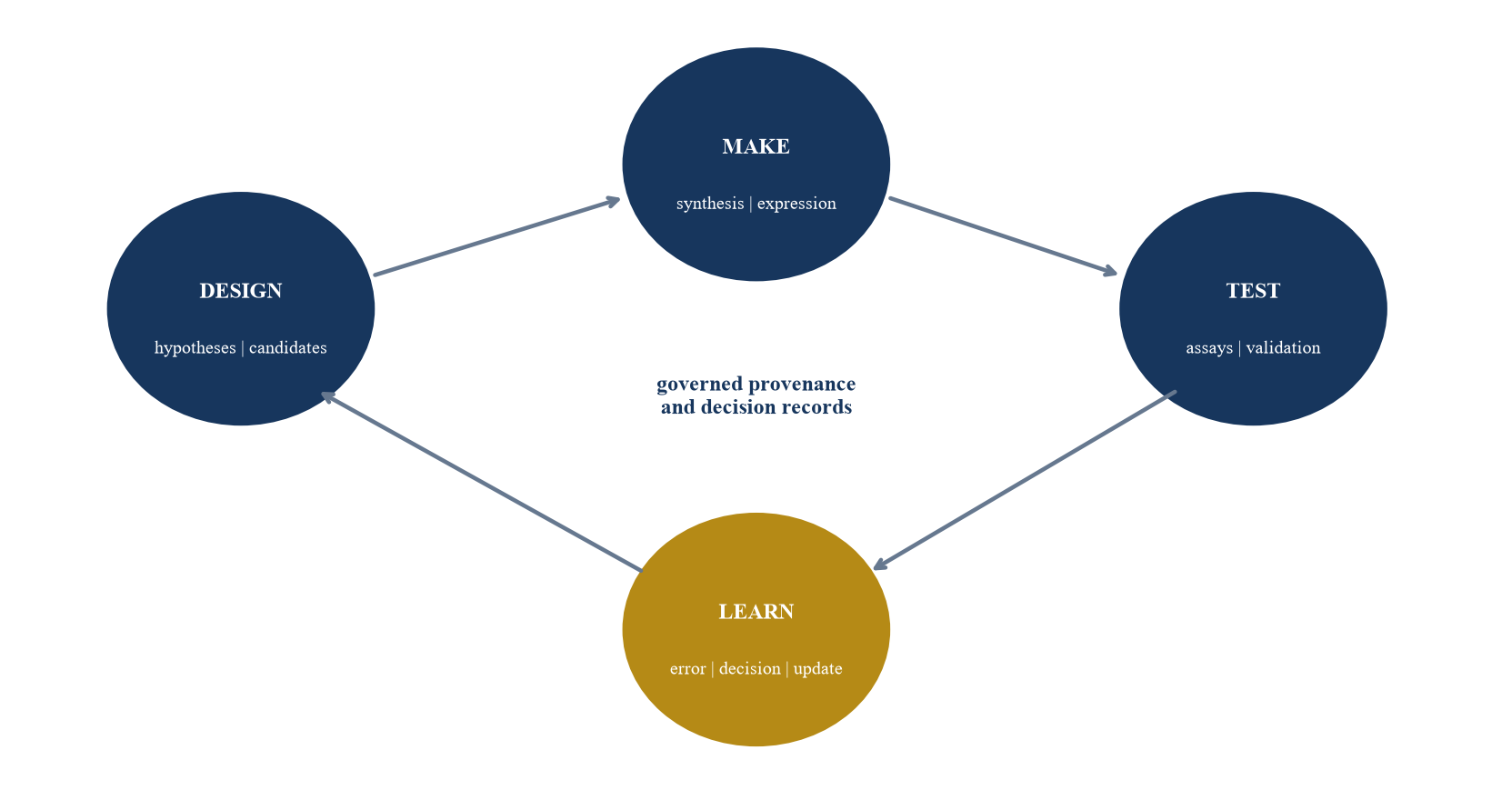
Productive learning requires traceable decisions, experiments and model change across complete cycles.
5. Test platform reproducibility
Reproducibility has technical, experimental and organisational layers. Technical reproducibility asks whether the same inputs, code, model artefacts and environment produce the same outputs within defined tolerance. Experimental reproducibility asks whether physical results can be repeated under controlled methods. Organisational reproducibility asks whether another qualified team can operate the system and reach a supported decision.
The diligence team should reproduce a sample of material analyses from raw governed input to output. It should select successful, failed and active programmes. Reproduction should use documented infrastructure and ordinary personnel rather than a founder-led demonstration. Differences should be classified and resolved.
Prospective holdouts provide stronger evidence of predictive value than reconstructed historical benchmarks. Public datasets can support comparison, but leakage and benchmark familiarity must be assessed. Proprietary data can improve relevance if lawful, sufficiently large, well annotated and representative. Proprietary status alone does not establish quality.
Scientific audit should challenge the decision threshold. A model can improve one metric while failing the multi-parameter profile required for a drug candidate. The team should examine potency, selectivity, pharmacokinetics, safety, manufacturability and indication-specific requirements together.
Benchmark construction requires particular care. Training and test compounds can share scaffolds, targets, assays or laboratory history in ways that inflate apparent generalisation. The diligence team should examine temporal splits, scaffold splits, prospective experiments and external replication. It should retain denominator data showing every generated, synthesised, tested and advanced candidate. A success rate calculated only from selected molecules cannot establish platform productivity.
Uncertainty should influence action. Calibrated confidence, applicability-domain controls and abstention can be more valuable than universal predictions. The buyer should identify how uncertainty changes experiment selection, programme escalation and human review. A platform that states limits and routes unsupported questions can preserve capital more effectively than one that produces confident output for every target.
| Layer | Test | Strong evidence | Failure signal |
|---|---|---|---|
| data | reconstruct lineage and rights | governed source, transformations and permissions | undocumented or non-transferable corpus |
| model | rerun versioned artefacts | reproducible output and calibrated uncertainty | unavailable code, weights or environment |
| experiment | repeat material assays | prespecified repeat within tolerance | selective or irreproducible wet-lab result |
| decision | reconstruct candidate selection | contemporaneous criteria and alternatives | success narrative assembled after outcome |
| programme | compare independent projects | improvement across varied targets | one flagship carries the evidence claim |
| organisation | transfer workflow to another team | documented operation without key-person rescue | tacit founder or scientist dependency |
Proposed scorecard; scientific specialists should set programme-specific tests and tolerances.
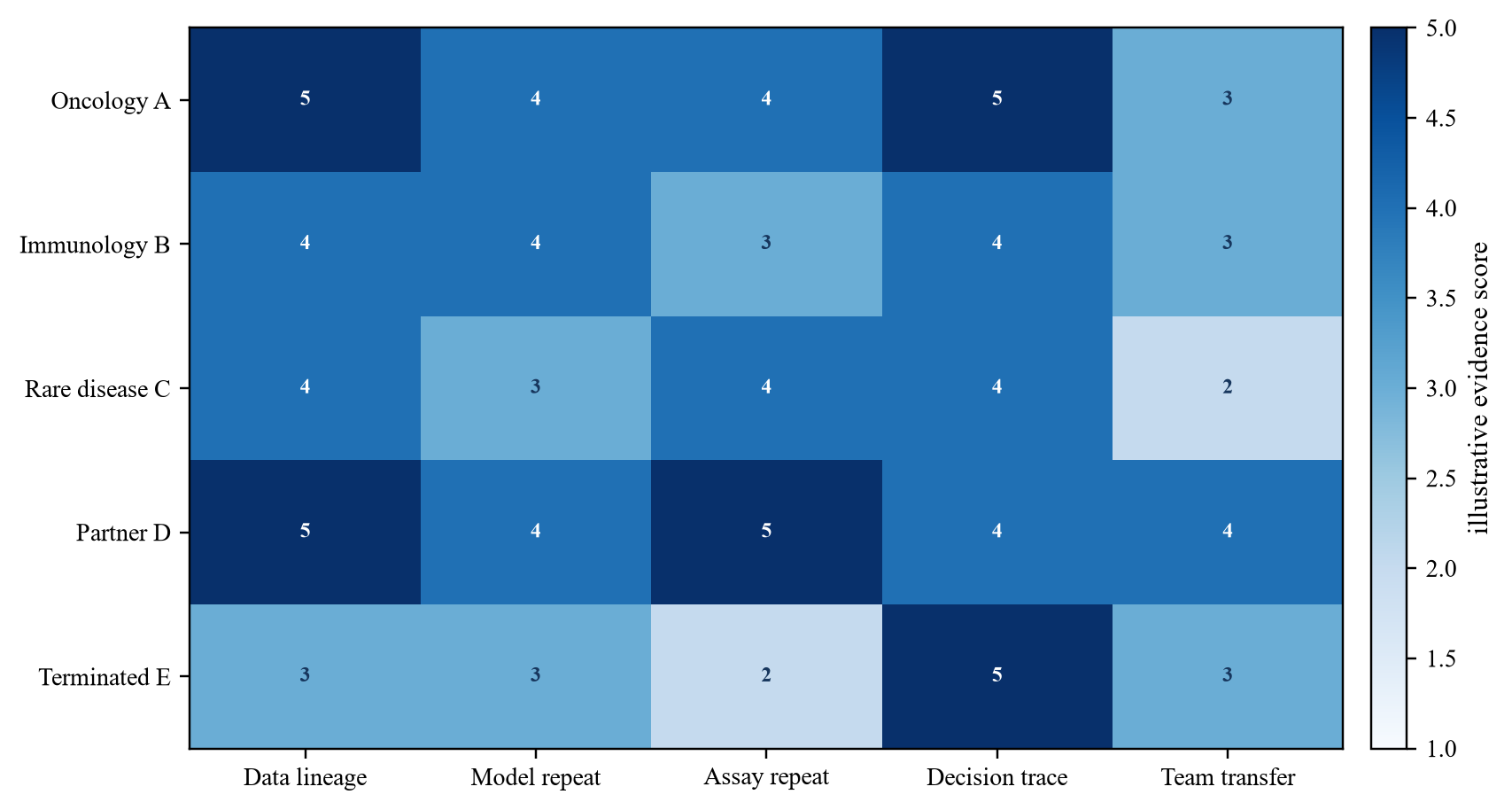
Illustrative management scores from one to five; scores are not scientific benchmarks or target assessments.
6. Diligence data as an economic asset
Data value depends on rights, relevance, quality, uniqueness, refresh and productive use. The buyer should identify whether data are owned, licensed, publicly sourced, generated for partners, derived from patient material or restricted by consent and contract. Rights to use data for one collaboration may not permit model training, commercial reuse or transfer on change of control.
Provenance should connect every material record to source, collection method, consent or licence, transformations, quality checks and deletion obligations. Biological and chemical data need units, assay conditions, controls, batch information and negative results. A large corpus with heterogeneous experimental conditions can create false confidence.
The data moat should be tested through ablation or comparative experiments where feasible. The question is how much performance or decision quality changes when the differentiated dataset is removed, aged or applied to another programme. Value should reflect productive contribution, not storage volume.
Data refresh can create recurring cost and strategic dependence. External databases, clinical partners, contract laboratories and cloud providers may be essential. The buyer should model renewals, price changes, service continuity, export rights and technical migration. Derived models may remain contractually contaminated even when raw data are deleted.
7. Diligence models, software and compute
The model inventory should include foundation models, task-specific models, physics-based methods, rules, ranking systems and human decision points. Each item needs purpose, owner, training data, version, performance, uncertainty, deployment use, dependencies and retirement criteria. Marketing labels should not replace technical boundaries.
Source code, weights, feature pipelines, simulation tools and third-party components should be mapped to ownership and licence. Open-source obligations, research licences and cloud marketplace terms can constrain commercial deployment. The buyer should test whether a critical model can run in the expected environment and whether required data can lawfully travel with it.
Compute economics belong in the platform model. Training, simulation, inference, storage and data movement can be material. Falling unit compute cost can expand use while weakening scarcity claims. The target should show productivity per dollar and per decision rather than raw processor count.
Cybersecurity and research integrity are value controls. Model theft, data poisoning, access leakage and unreproducible notebooks can damage pipeline and partnerships. Identity, environment segregation, logging, backup, incident response and validated release processes should cover research as well as production systems.
Vendor concentration should be modelled explicitly. A research workflow may rely on one cloud provider, accelerator architecture, foundation model, chemistry package or electronic laboratory notebook. The buyer should identify portability, egress cost, licence continuity, service-level commitments and export restrictions. A technically transferable model can remain economically captive when retraining data, specialised kernels or workflow orchestration cannot move on reasonable terms.
Technical debt should be separated from scientific uncertainty. Unsupported libraries, inconsistent environments and undocumented pipelines can be remediated through engineering. Weak labels, confounded experiments or absent negative results can require new science. Their cost, timing and effect on platform claims differ and should be shown separately in the integration plan.
8. Diligence intellectual property and freedom to operate
Patent diligence should separate platform methods, data-generation systems, compositions of matter, uses, formulations and manufacturing. Composition and use claims tied to a therapeutic candidate often have different enforceability and duration from computational-method claims. Trade secrets can protect data, parameters and laboratory know-how if controls preserve secrecy.
Inventorship and ownership require programme-level review. Employees, founders, universities, hospitals, consultants, contract research organisations and partners may have contributed. Assignment gaps or background intellectual property can restrict use. AI-assisted invention raises additional policy and evidentiary questions, while current patent systems generally require human inventors.[29][30]
Freedom to operate should cover the intended product and development plan. A platform patent does not establish freedom to develop a candidate. Conversely, a candidate's patent estate does not prove that the buyer can continue using the target's computational and laboratory systems.
The transaction should identify prosecution, maintenance, opposition, litigation, publication and confidentiality deadlines. Integration can change who accesses trade secrets and which licences apply. Clean-team and access controls may be needed before closing.
9. Value pipeline assets one by one
Each therapeutic programme should have an asset sheet covering target, modality, indication, product profile, stage, evidence, intellectual property, rights, competition, regulatory path, remaining development, manufacturing and commercial assumptions. Related indications can be modelled separately where evidence and economics differ.
Risk-adjusted net present value should use explicit probabilities for the relevant stage transitions. Published development probabilities can inform challenge but should not replace asset-specific assessment.[35][36] The buyer should test whether the target's platform changes a particular transition probability and whether evidence supports the magnitude.
Remaining cost includes discovery, preclinical, clinical, regulatory, chemistry, manufacturing, controls and post-approval commitments. Timeline should reflect enrolment, endpoints, regulators, manufacturing and financing. A faster discovery process may have limited effect when clinical development dominates time and capital.
Competitive value should focus on the target product profile. First-in-class and best-in-class claims require evidence against current and expected standards. Crowded targets, biomarker constraints, safety, delivery and combination strategies can alter value materially.
Portfolio correlation should remain visible. Several candidates can depend on the same target hypothesis, modality, assay, delivery technology or biomarker. Counting them as independent options can overstate diversification. The buyer should map common scientific and operational failure modes and run portfolio scenarios that remove an entire mechanism, platform component or partner.
Manufacturing readiness can become the controlling asset risk. A computationally attractive molecule or biologic still needs a robust process, analytical methods, specifications, stability and scalable supply. The development plan should identify when chemistry, manufacturing and controls work enters the critical path and whether the target owns the relevant know-how or relies on a constrained supplier.
| Dimension | Required evidence | Valuation use | Control against double counting |
|---|---|---|---|
| rights | ownership, territory, indication and encumbrance | addressable economics | exclude rights already granted to partner |
| development stage | governed package and regulator interaction | transition probability | use actual stage, not platform narrative |
| differentiation | product profile and comparative evidence | price, share and duration | separate candidate quality from model quality |
| remaining cost | study, manufacturing and regulatory plan | cash flow and financing | include platform operating cost once |
| timing | critical path and dependencies | discount period and option expiry | distinguish discovery speed from clinical time |
| competition | approved and developing alternatives | probability and terminal value | refresh at valuation date |
Proposed structure; all scientific, probability, cost and commercial inputs require asset-specific support.
10. Separate platform proof from pipeline value
A pipeline event can support both a candidate and the platform, but the uses should be explicit. A candidate reaching nomination can show that a workflow completed one discovery cycle. It does not prove clinical success or repeatability. A successful clinical readout primarily affects that asset unless the causal contribution of the platform to a generalisable development decision is demonstrated.
The buyer should maintain an evidence-allocation table. Each event receives one primary valuation effect and any secondary platform effect is bounded. For example, a validated structure prediction may strengthen a model capability while the molecule's commercial value remains in the asset. A partnership option exercise can support external validation and create contractual cash flow; the full future milestone pool remains contingent.
Platform value can be estimated from incremental programme economics after pipeline value is calculated without that increment. If supported evidence indicates fewer design cycles, lower synthesis cost or higher candidate-quality probability, the benefit should enter either the programme assumptions or a separate platform cash flow, not both.
Where evidence remains sparse, the platform can be treated as an option or enabling asset with staged consideration. This preserves upside without converting unverified repeatability into closing value.
11. Reconstruct partnerships and contingent economics
Partnership announcements should be reconciled to signed contracts. The team should identify programmes, targets, exclusivity, research term, funded work, option windows, development control, cost sharing, milestones, royalties, termination, rights reversion, data ownership and change-of-control provisions.
Headline potential milestones are not contracted revenue. They may require every programme to achieve every event, include sales thresholds far in the future and exclude the cost of work. Expected value should use programme-specific probabilities, timing, tax, cost and partner behaviour. Option rights can allow a partner to select only the strongest assets.
Research funding should be distinguished from margin. It may reimburse scientists, experiments and infrastructure with limited contribution. Upfront payments can compensate for licences, exclusivity, research and past work. Revenue recognition does not by itself identify economic value or cash durability.
Partner concentration matters. A platform with several announced collaborations may depend on one pharmaceutical group or a narrow set of decision makers. The buyer should review option exercises, extensions, terminations, programme transfers, cash collection and the proportion of internal capacity reserved for each partner.
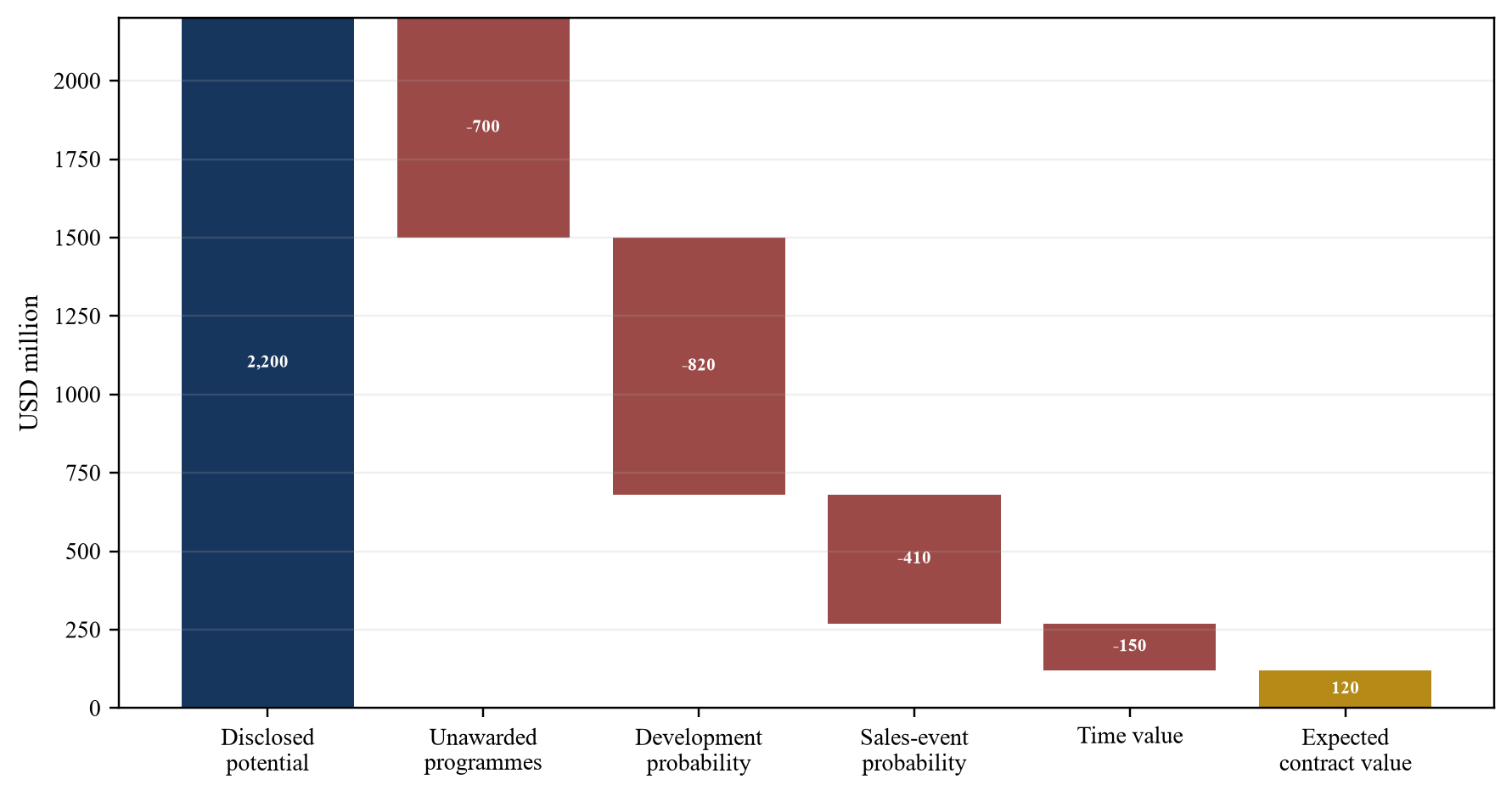
Wholly hypothetical USD millions; contingent pools are probability- and time-weighted and are not forecasts.
| Economic item | Evidence | Valuation treatment | Common error |
|---|---|---|---|
| upfront payment | contract, invoice and cash | recognise earned rights and obligations | treating all cash as recurring revenue |
| research funding | work plan, cost and margin | forecast funded contribution | ignoring capacity and delivery cost |
| option payment | option terms and decision gate | probability-weight by programme | assuming every option is exercised |
| development milestone | event definition and responsibility | probability- and time-weight | applying one portfolio probability |
| sales milestone | thresholds and product economics | model after approval and launch | including full disclosed pool at close |
| royalty | base, rate, deductions and term | risk-adjusted product cash flow | applying royalty to unowned geography |
| co-development right | cost share and governance | model both investment and economics | valuing profit share without funding duty |
Proposed contract map; accounting, legal and scientific review should be reconciled.
12. Rebuild software and research-service economics
Some discovery companies have a commercial software business; others provide research services or platform access. The buyer should separate licence, hosted software, professional services, funded research, milestones and drug-development revenue. Their gross margins, renewal patterns and capital needs differ.
Schrödinger's public reporting separates software and drug-discovery segments, illustrating why a consolidated revenue multiple can obscure economics.[12][13] The buyer should reconcile annual contract value, recognised revenue, invoicing and cash by product and cohort. Hosted transitions can shift recognition timing without changing contract economics.
Customer concentration, renewal, seat expansion, usage, cloud cost, support and scientific services should be measured. A software product used across customer programmes can support repeatability and market validation. Bespoke projects delivered by scientists may scale differently.
Internal pipeline use should not create external revenue. The model should allocate platform operating cost between commercial customers, partnered programmes and internal assets using a documented driver. This allows programme economics and software margin to be compared without hiding cost in central research.
13. Design the platform valuation test
Platform value should be supported through one or more observable economic channels. External software or service cash flow can be valued directly. Internal productivity can be valued through supported reductions in time, cost or attrition across a defined programme portfolio. Partnership origination can create contractual economics. Replacement cost can inform negotiation where it reflects lawful data, infrastructure, people, time and failure risk.
Relief-from-royalty requires a credible royalty base and rate. It may be appropriate for a licensable technology, but a platform used only internally has no automatic royalty market. Historical research expenditure is not value; it is evidence of investment. Recreating the same code without data, workflows, team and learning history may be impossible, while expensive work can still lack commercial utility.
Incremental income should be tied to measured performance. If a platform reduces a defined discovery cycle by six months, the model should identify affected programmes, required operating cost, probability of transfer and economic consequence. Benefits should end when technology becomes standard or the advantage erodes.
Platform terminal value requires durable rights, talent, data generation, customer or partner adoption and model maintenance. Rapid technical change can shorten useful life even where software remains operational. The buyer should avoid applying a perpetual software multiple to a research capability whose advantage depends on continuous scientific investment.
Valuation date discipline is essential. Clinical, patent, competitive, regulatory and partnership information can change quickly. The model should distinguish information known at signing from subsequent events and specify the update process before closing. A later programme failure should not be hidden inside a general platform discount; the affected asset and any genuine read-through to repeatability should be reassessed separately.
Accounting recognition and transaction pricing answer different questions. Purchase-price allocation may identify technology, contracts, in-process research and development, customer relationships or goodwill after the commercial bargain is struck. Those categories can inform useful-life and impairment analysis, yet they do not establish the amount a buyer should pay or remove the need to test overlap among value components.
14. Build the combined valuation
The combined model should begin with stand-alone software and service cash flow. It should add pipeline risk-adjusted value asset by asset, partnership cash flows by contract and platform incremental economics not already embedded. Non-operating assets, debt, preference rights and transaction obligations complete the bridge to equity proceeds.
The wholly hypothetical case contains USD 22 million of software and research revenue, of which USD 9 million is recurring licence revenue. It has six internal programmes, two of which are development candidates, and four collaborations. After attributable delivery, compute, laboratory and support cost, the commercial activity contributes USD 5 million before central research, tax and capital.
The central case assigns USD 42 million to supported commercial cash flow, USD 74 million to internal pipeline assets, USD 28 million to expected partnership economics and USD 24 million to platform productivity that is not embedded in those components. Net cash adds USD 31 million. Integration cost and duplicated infrastructure reduce value by USD 16 million. Illustrative equity value is USD 183 million.
Every amount is hypothetical. The example is designed to expose assumptions and double counting. It is not a market benchmark, forecast or valuation opinion.
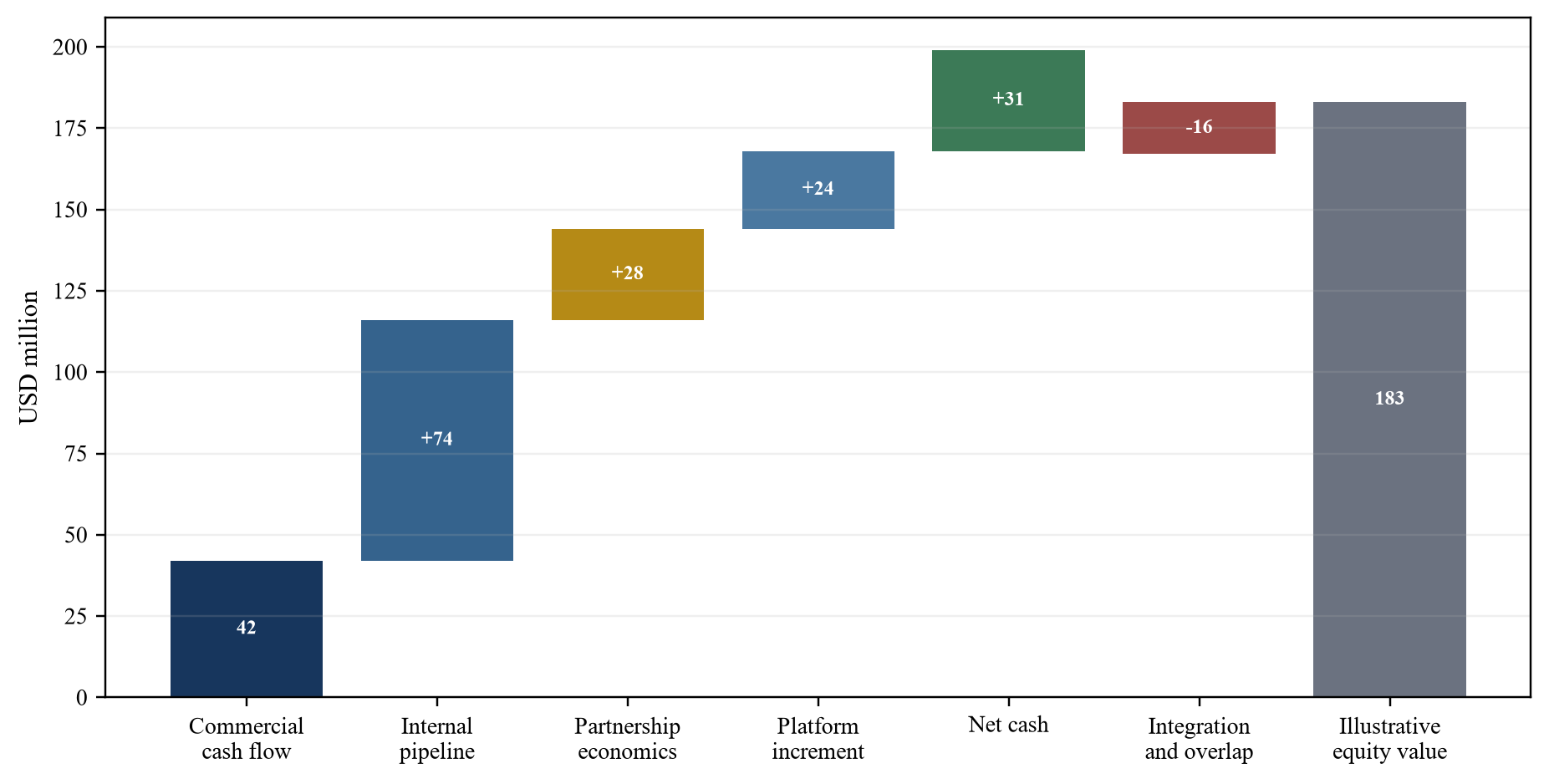
Wholly hypothetical USD millions; each benefit has one primary valuation location.
15. Test sensitivity without hiding correlation
Platform and pipeline risks are correlated. Weak data provenance can affect several programmes. Loss of a scientific team can slow internal assets and partner work. A model failure can damage future origination. Sensitivity should therefore include shared downside cases rather than varying every programme independently.
Key platform variables include reproducibility, transfer rate, programme throughput, operating cost and useful life. Pipeline variables include transition probability, timing, development cost, product differentiation and market duration. Partnership variables include option exercise, milestone timing, partner termination and cost to deliver.
The hypothetical sensitivity varies internal-pipeline value and supported platform increment. It holds commercial cash flow, partnership economics, net cash and integration cost constant. The cells are arithmetic scenarios and carry no market implication.
| Internal pipeline value; USDm | Platform USD 10m | USD 20m | USD 30m | USD 40m |
|---|---|---|---|---|
| 45 | 140 | 150 | 160 | 170 |
| 60 | 155 | 165 | 175 | 185 |
| 75 | 170 | 180 | 190 | 200 |
| 90 | 185 | 195 | 205 | 215 |
Wholly hypothetical USD millions; no cell is a forecast or market benchmark.
Downside cases should also show liquidity and financing. A delayed programme can require a new round before an asset event. Preference rights and anti-dilution can affect seller proceeds. The acquisition model should disclose which party funds each development plan.
16. Choose consideration that follows evidence
Closing consideration should reflect value supported at signing. Contingent consideration can address pipeline events, partner options, platform transfer or commercial retention. Each milestone needs a defined asset, evidence package, decision authority, observation period and dispute process.
A regulatory filing is an activity; acceptance, clearance or approval is a stronger event. Candidate nomination can be defined by a product profile and reproducible package. Platform milestones can require independent programme reproduction, validated cycle improvement or partner renewal. Revenue milestones should use collected cash and agreed cost allocation where margin matters.
Contingent value should not reward unsafe acceleration or underinvestment. Operating covenants should preserve appropriate scientific, clinical, quality and regulatory decisions. Seller protections can define minimum resources and consultation while retaining buyer authority to stop a programme for documented reasons.
Equity consideration can align long-term value but transfers market and integration risk. Escrow can address title, rights, data provenance or known contractual exposure. A licence, option or staged acquisition can be appropriate when platform repeatability remains unproven.
17. Translate diligence into transaction protections
Representations should cover corporate authority, intellectual property, inventorship, data rights, privacy, open source, scientific records, regulatory status, clinical work, partnerships, grants, cybersecurity, export controls and financial metrics. Schedules should identify programme and model versions rather than relying on broad knowledge qualifiers.
Conditions may include assignment of essential rights, partner or licensor consent, delivery of model artefacts, closure of a material provenance gap, reproducibility of a defined analysis and retention of critical personnel. Conditions should focus on matters required for lawful ownership or viable operation.
Interim covenants should control material model releases, publication, patent action, programme termination, new encumbrance, partner amendment, unusual data access and loss of key infrastructure. Ordinary scientific work should continue under an agreed change framework.
Indemnity and insurance should reflect recoverability and duration. Known pipeline risk belongs in price or contingent consideration. Title, deliberate misconduct and specified data or patent exposure may require separate treatment. The committee should map every material gap to one primary response so that the same issue is not deducted, escrowed and excluded from value without explanation.
| Evidence gap | Valuation response | Protection | Release evidence |
|---|---|---|---|
| platform proven on one programme | limit platform increment | staged consideration | independent programme reproduction |
| unclear training-data rights | exclude affected use | condition, escrow and indemnity | verified transferable rights |
| candidate evidence incomplete | probability-weight asset | programme milestone | governed development package |
| headline milestones highly contingent | expected-value contract cash flow | earn-out tied to collected event | partner payment received |
| key-person workflow | continuity discount | retention and transfer plan | qualified team operates independently |
| compute or lab dependency | include migration cost | service covenant and transition support | tested replacement environment |
| overlapping value claims | allocate benefit once | valuation schedule | reconciled ledgers approved |
Proposed matrix; legal drafting and remedies remain transaction-specific.
18. Design integration around scientific continuity
Integration can destroy the evidence base by changing data access, model environment, laboratory methods, scientific teams or programme priorities. Day-one design should preserve critical systems and decision records. Cost synergy should follow validated replacement.
The target architecture should classify capabilities as preserve, connect, migrate or retire. Preserve applies where the platform and quality controls remain productive. Connect uses governed interfaces and shared decision rights. Migrate transfers models, data or experiments after matched testing. Retire follows confirmation that obligations, provenance and scientific records remain accessible.
Data migration should retain identifiers, units, assay conditions, lineage, permissions, deletion state and negative results. Model migration should retain code, weights, dependencies, seeds, hardware assumptions and performance. Laboratory migration should compare protocols, equipment, controls and outputs.
Programme governance should remain asset-specific. A combined portfolio committee can prioritise capital, but it should record whether a stop decision reflects scientific weakness, strategic overlap, financing or capacity. That distinction matters for platform learning and contingent payments.
Partner-facing integration needs a separate workstream. Pharmaceutical partners may have audit, security, key-person, subcontracting, publication and change-of-control rights. The buyer should present a continuity plan, preserve agreed teams and obtain consents before moving data or work. An integration saving that causes programme termination can destroy more value than it releases.
Research records should remain inspection-ready. Electronic notebooks, experiment identifiers, samples, model artefacts, decisions, deviations and approvals should survive migration with an audit trail. The combined organisation should test retrieval for one active, one completed and one terminated programme before declaring the record transfer complete.
19. Retain the scientific operating system
Platform value can depend on scientists who connect biology, chemistry, computation, experiments and development. The buyer should map critical decisions, relationships and tacit knowledge. Job titles and publication counts are insufficient.
Retention should be paired with transfer. The plan should document model design, data decisions, assay history, failed hypotheses, partner commitments, programme rationale and regulatory interactions. Authority, access and signing rights should move under controlled procedures.
Founders may embody external credibility and internal arbitration. The buyer should test whether scientific governance works without their intervention. Independent review, reproducible records and clear decision rights reduce concentration.
Incentives should preserve rigorous stopping as well as progression. Teams rewarded only for candidate nominations can increase low-quality throughput. Balanced measures can include reproducibility, cycle improvement, programme quality, partner delivery, documentation and capital discipline.
20. Allocate synergy with evidence
Buyer-specific synergy can arise from targets, data, laboratories, clinical development, distribution, manufacturing and capital. Each synergy needs a named owner, enabling investment, evidence, timing and risk. Access to a large portfolio does not prove that the target platform can serve it.
Programme acceleration should identify the exact bottleneck removed. A buyer's assay, molecule library or disease expertise can improve a defined step. The model should avoid claiming both faster development and higher probability without separate evidence.
Data combination requires rights and compatibility. Larger data can improve learning, expose heterogeneity or create integration burden. The team should pilot a bounded use case and measure decision improvement before capitalising a broad data-network effect.
Cost synergy should distinguish duplicated corporate cost from productive platform capacity. Removing laboratory, engineering or scientific roles can reduce throughput and partner delivery. The synergy ledger should show the control or process that replaces every removed activity.
21. Govern regulatory and model lifecycle risk
AI used to support regulatory decisions should be governed according to its context of use and risk. FDA's draft guidance proposes a credibility framework, and FDA–EMA principles emphasise human-centric design, clear context, data governance, performance assessment and lifecycle management.[1][3] The buyer should map which models generate evidence used in submissions and how changes are controlled.
Models used only for exploratory research can still affect candidate selection and capital allocation. Governance should be proportionate and should preserve data lineage, versioning, performance, uncertainty, human review and decision records. A research label should not excuse irreproducibility.
Generative outputs require scientific validation. Molecules or hypotheses should be screened for feasibility, novelty, safety and manufacturability. The system should record rejected outputs and reasons. This protects learning and helps distinguish platform productivity from selective presentation.
Post-combination governance should establish owners for every material model, dataset, programme and partner deliverable. Change control should identify validation, regulatory, patent, contractual and valuation consequences. A platform remains valuable through controlled evolution rather than frozen technology.
22. Execute an evidence-gated 180-day programme
Days one to thirty should preserve data, models, laboratory operations, partner delivery, programme decisions, patent deadlines and cybersecurity. Governance, access, change restrictions and critical-person coverage should be established. Cash, contracts and programme rights should reconcile.
Days thirty to seventy should reproduce selected analyses and experiments, complete the platform and pipeline ledgers, validate rights, reconstruct partnership economics and confirm asset-level development plans. The team should identify where valuation relied on shared evidence.
Days seventy to one hundred and twenty should test bounded integration: one data connection, one model environment, one laboratory transfer and one joint programme decision. Defects should be resolved before broad migration. Commercial and research-service cohorts should be reviewed for delivery cost and renewal.
Days one hundred and twenty to one hundred and eighty should season transferred workflows, confirm partner performance, update programme probabilities, validate synergy and release contingent value only when agreed evidence passes. The board should receive a reconciled value bridge and capital plan.
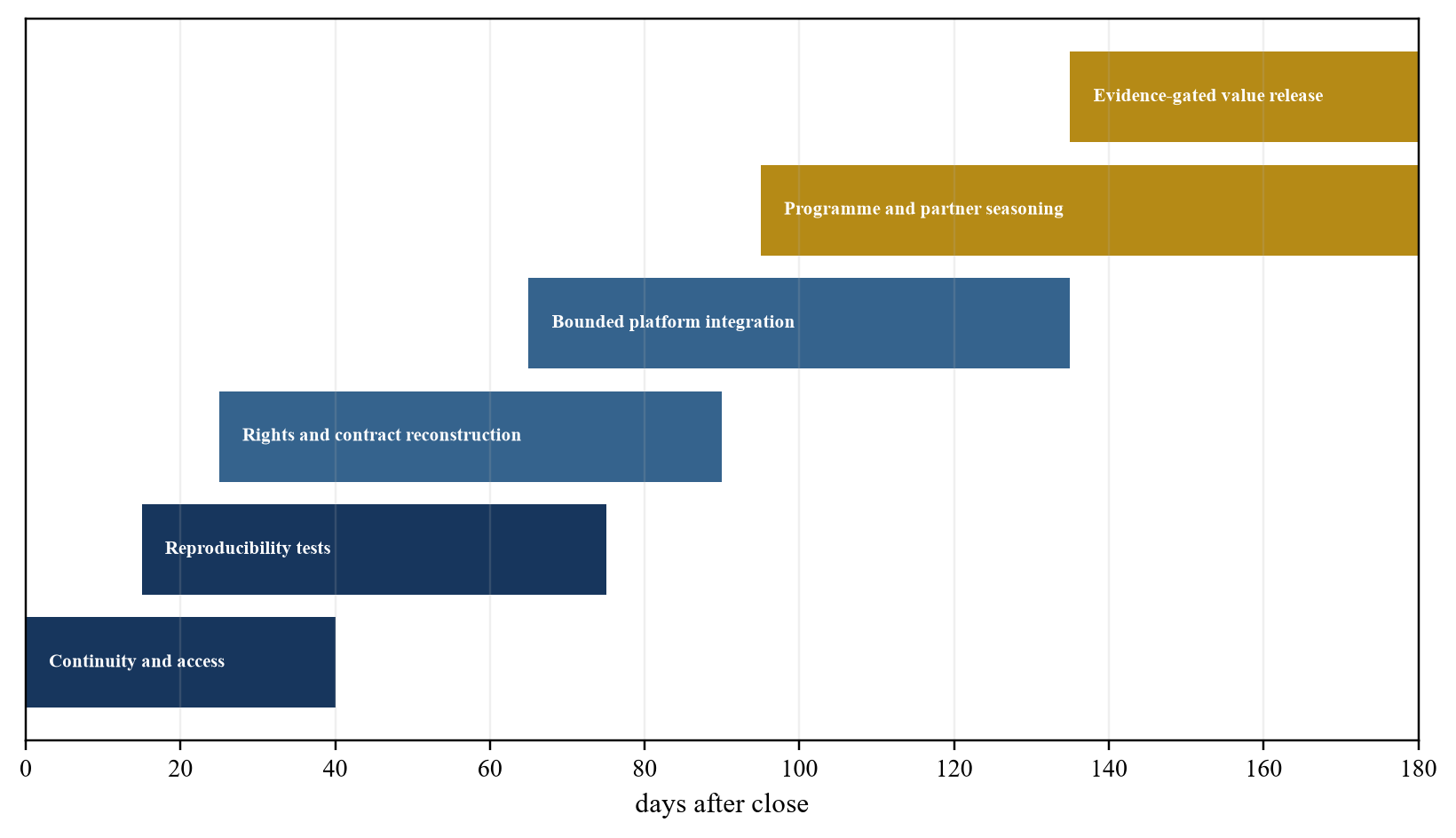
Timing should follow scientific, contractual, regulatory and operational dependencies.
| Gate | Evidence | Decision | Failure response |
|---|---|---|---|
| continuity | systems, rights, people and partner delivery stable | preserve operations | restrict changes and activate fallback |
| reproduction | selected models and experiments repeated | accept evidence base | reduce platform value and remediate |
| allocation | platform, pipeline and contract ledgers reconciled | approve valuation map | remove duplicated benefit |
| bounded integration | transferred workflow meets tolerance | expand migration | isolate and redesign |
| seasoning | programme, partner and commercial results persist | release synergy | extend observation or reprice |
| value release | contractual milestone evidence complete | pay contingent value | dispute or withhold under agreed terms |
Proposed governance sequence; transaction-specific accountability should be documented.
23. Decision and conclusion
AI drug-discovery acquisitions require disciplined separation of capability, assets and contracts. A platform is valuable when it repeatedly converts governed biological questions into better validated decisions across independent programmes. A candidate is valuable when its rights, evidence, differentiation, development plan and economics support risk-adjusted cash flow. A partnership is valuable to the extent that enforceable terms create funded work, option payments, milestones, royalties or strategic rights.
The buyer should reconstruct the design–make–test–learn loop, reproduce selected work, validate data and intellectual-property rights, and measure complete-cycle productivity. It should value every therapeutic programme separately and reconcile every partnership from contract to collected cash. Platform benefits should enter the model once.
Closing value can include supported commercial cash flow, pipeline risk-adjusted value, expected partnership economics and a bounded platform increment. Unproven repeatability, future indications and broad network effects can be preserved through milestones, options or staged ownership.
Integration should protect the scientific operating system before pursuing cost savings. Data, models, laboratory methods, people, decision history and partner obligations require controlled transfer. Programme stops should remain scientifically and contractually traceable.
The decisive question is not whether artificial intelligence contributed to a successful molecule. It is whether the acquired system can lawfully and reproducibly create better decisions across the buyer's future portfolio, after the cost of data, compute, experiments, people, governance and capital. That evidence determines whether the buyer is acquiring a platform, a pipeline, or an expensive narrative connecting the two.
Sources
- US Food and Drug Administration, Considerations for the Use of Artificial Intelligence to Support Regulatory Decision-Making for Drug and Biological Products Read the primary source
- European Medicines Agency, Reflection paper on the use of artificial intelligence in the medicinal product lifecycle Read the primary source
- US Food and Drug Administration, Guiding Principles of Good AI Practice in Drug Development Read the primary source
- European Medicines Agency, EMA and FDA set common principles for AI in medicine development Read the primary source
- US Food and Drug Administration, Using Artificial Intelligence and Machine Learning in the Development of Drug and Biological Products Read the primary source
- International Council for Harmonisation, E6 Good Clinical Practice Read the primary source
- International Council for Harmonisation, E8 General Considerations for Clinical Studies Read the primary source
- International Council for Harmonisation, E9 Statistical Principles for Clinical Trials Read the primary source
- US Securities and Exchange Commission, Recursion Pharmaceuticals 2024 Form 10-K Read the primary source
- US Securities and Exchange Commission, Recursion and Exscientia combination completion exhibit Read the primary source
- US Securities and Exchange Commission, Recursion and Exscientia transaction presentation Read the primary source
- US Securities and Exchange Commission, Schrödinger 2025 Form 10-K Read the primary source
- Schrödinger, 2025 full-year financial results Read the primary source
- US Securities and Exchange Commission, Absci annual report and integrated drug-creation platform disclosures Read the primary source
- US Securities and Exchange Commission, Absci public-offering prospectus Read the primary source
- Isomorphic Labs, strategic research collaboration with Novartis Read the primary source
- Isomorphic Labs, strategic research collaboration with Eli Lilly Read the primary source
- Google DeepMind, AlphaFold Read the primary source
- National Institutes of Health, PubChem Read the primary source
- European Bioinformatics Institute, ChEMBL Read the primary source
- RCSB Protein Data Bank Read the primary source
- US Food and Drug Administration, Drug Development and Review Definitions Read the primary source
- US Food and Drug Administration, Investigational New Drug Application Read the primary source
- European Medicines Agency, Scientific advice and protocol assistance Read the primary source
- ClinicalTrials.gov, study registry Read the primary source
- World Health Organization, International Clinical Trials Registry Platform Read the primary source
- World Intellectual Property Organization, Artificial Intelligence and Intellectual Property Read the primary source
- World Intellectual Property Organization, PATENTSCOPE Read the primary source
- United States Patent and Trademark Office, Inventorship Guidance for AI-Assisted Inventions Read the primary source
- European Patent Office, Artificial intelligence and machine learning Read the primary source
- US Federal Trade Commission and Department of Justice, 2023 Merger Guidelines Read the primary source
- European Commission, Guidelines on the assessment of horizontal mergers Read the primary source
- UK Competition and Markets Authority, Merger Assessment Guidelines Read the primary source
- US Federal Trade Commission, Premerger Notification Program Read the primary source
- Wong, Siah and Lo, Estimation of clinical trial success rates and related parameters, Biostatistics Read the primary source
- Biotechnology Innovation Organization, Clinical Development Success Rates and Contributing Factors Read the primary source
- US Food and Drug Administration, Project Optimus Read the primary source
- US Food and Drug Administration, Model-Informed Drug Development Paired Meeting Program Read the primary source
- National Institute of Standards and Technology, AI Risk Management Framework Read the primary source
- International Organization for Standardization, ISO IEC 42001 artificial-intelligence management systems Read the primary source
- International Organization for Standardization, ISO 27001 information-security management systems Read the primary source
- IFRS Foundation, IFRS 3 Business Combinations Read the primary source
- IFRS Foundation, IAS 38 Intangible Assets Read the primary source
- IFRS Foundation, IFRS 13 Fair Value Measurement Read the primary source
- Financial Accounting Standards Board, Business Combinations Topic 805 Read the primary source
- International Valuation Standards Council, International Valuation Standards Read the primary source
- OECD, Recommendation of the Council on Artificial Intelligence Read the primary source
- OECD, Recommendation on Health Data Governance Read the primary source
- European Union, Artificial Intelligence Act Read the primary source
- European Union, General Data Protection Regulation Read the primary source
