

1. Define the liquidity objective before selecting the instrument
Portfolio finance should begin with the cash need, its date, its duration and the value expected from meeting it. A fund can need liquidity to honour committed borrower drawings, protect a viable asset, finance an add-on, meet expenses, reduce concentration, return capital, bridge an asset sale or refinance maturing fund obligations. Those objectives have different risk and governance profiles.
The objective should identify the beneficiaries of the action. Capital that protects a strong loan, preserves contractual rights or finances an accretive commitment has a different investment case from debt raised solely to accelerate a distribution. The governing body should record the objective, alternatives, expected cash flows, conflicts, approval route and conditions before lender engagement or asset marketing.
A financing label does not establish economic merit. A facility can create liquidity while reducing future portfolio cash through interest, fees, amortisation and cash sweeps. An asset sale can create immediate cash while transferring future coupon, fees, recovery rights and optionality. Recycling can extend investment capacity while changing the timing of distributions and the duration of investor exposure.
The decision unit is the fund's dated net cash under each feasible route, subject to legal authority, investor terms and portfolio resilience. The analysis should preserve a no-action case because retaining liquidity pressure can sometimes be preferable to crystallising a discount or adding leverage.
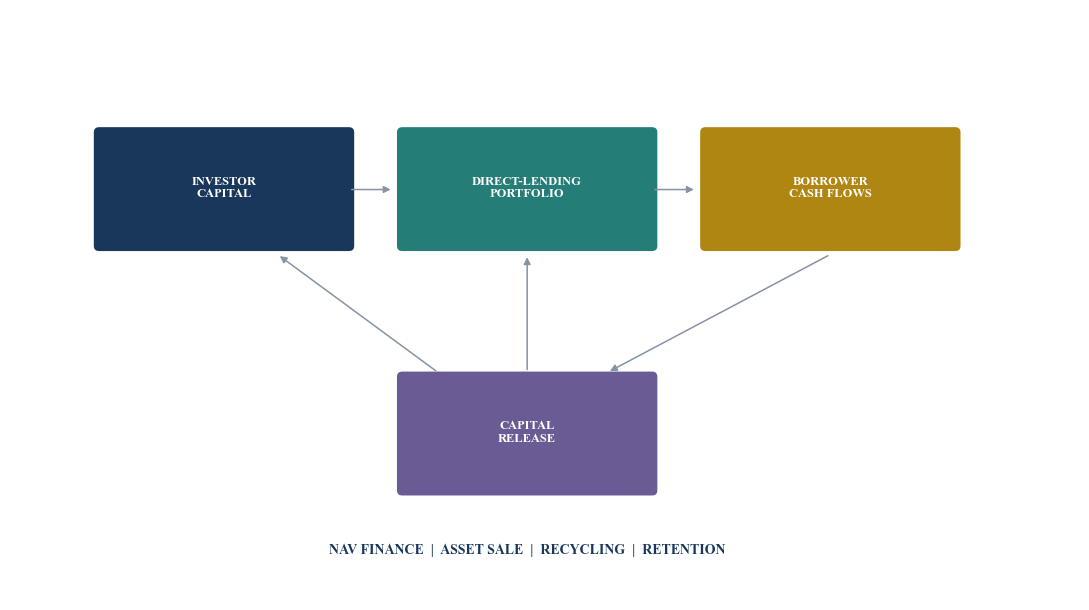
Author framework. Each capital source changes future portfolio cash, risk and investor outcomes.
2. Establish authority, perimeter and decision ownership
The fund documents should be read as a connected system. The limited partnership agreement, constitution, private placement memorandum, subscription agreements, side letters, investment-management agreement, committee mandates, valuation policy, borrowing policy and asset documents can each affect portfolio finance.
Authority should be tested at the fund, parallel fund, feeder, alternative vehicle, holding company and asset-owning entity. A special-purpose borrower below the fund can still create fund-level economic leverage and cross-portfolio exposure. ILPA states that NAV-based facilities constitute fund-level leverage and recommends clear treatment in borrowing limits and investor reporting.[1]
The analysis should identify who can borrow, guarantee, grant security, transfer assets, amend asset documents, redirect collections, approve conflicts and make distributions. It should also identify negative covenants, lender consents, concentration rules, recycling limits, investment-period restrictions and asset-transfer conditions.
Decision ownership should remain explicit. Investment, risk, valuation, finance, legal, compliance, operations and investor-relations teams each hold part of the evidence. The investment committee decides portfolio merit within delegated authority. A conflict committee or LP advisory committee may have a separate role. Fund counsel, regulatory counsel, tax advisers, auditors, administrators, valuers and financing counsel provide defined professional inputs.
Table 1. Portfolio-finance authority matrix
| Question | Evidence | Decision owner | Release gate |
|---|---|---|---|
| Fund may borrow | LPA, constitution, offering document | governing body and counsel | authority, purpose, amount and tenor confirmed |
| Entity may grant security | constitutional and transaction documents | entity board and counsel | valid benefit and approvals documented |
| Assets may be transferred | facility, security and intercreditor documents | investment and legal | consent, notice and transfer steps identified |
| Collections may be controlled | account, agency and servicing documents | finance, operations and counsel | account path and priority tested |
| Capital may be recycled | LPA, investment-period and realisation terms | governing body | permitted amount, period and use recorded |
| Distribution may be debt-funded | LPA, policy and investor guidance | governing body and conflict forum | rationale, alternatives and conflicts approved |
| Valuation may support borrowing | valuation policy and facility definition | valuation committee | current methodology and adjustments accepted |
| Portfolio limits remain satisfied | policy, regulation and facility covenants | risk function | base and stress compliance demonstrated |
| Investor engagement is complete | LPA, side letters and disclosure plan | investor relations and counsel | required consent, notice and disclosure completed |
| Transaction can close | conditions precedent and funds-flow memorandum | authorised signatories | evidence, funding and cash control complete |
Required approvals depend on the actual fund, entity, jurisdiction, documents and proposed route.
3. Map the portfolio cash obligation before sizing liquidity
The fund's available cash is not the bank balance. Cash can be reserved for undrawn commitments, delayed-draw term loans, revolvers, borrower protection, expenses, hedging, tax, fees, debt service, distributions and minimum liquidity. The capital plan should identify each obligation by amount, currency, expected date, legal priority and confidence.
Borrower facilities deserve particular attention. The IMF notes that correlated drawings on revolvers or other credit lines can create substantial funding needs for private-credit funds.[4] A portfolio financing that uses current cash without reserving for future borrower draws can transform an asset-quality problem into a fund-liquidity problem.
The plan should distinguish committed from discretionary uses. A legally binding borrower commitment differs from a potential follow-on investment. A known debt maturity differs from an optional distribution. The committee can then rank uses according to contractual obligation, preservation of value, risk-adjusted return, investor impact and reversibility.
Currency and timing matter. A dollar facility does not automatically fund a dirham, sterling or euro need without settlement, hedging and basis considerations. Asset cash can arrive later than the portfolio-finance payment date. Cash-flow analysis should use contractual dates, expected dates and downside dates.
4. Compare four routes through one decision tree
The first route is retention. The fund preserves cash, delays a discretionary use, reduces new origination or allows assets to amortise. Retention can avoid financing cost and sale discount, although it can forgo attractive deployment or a planned distribution.
The second route is NAV or asset-backed portfolio finance. It releases liquidity against portfolio value and controlled cash. The fund retains exposure to asset upside and income while accepting facility cost, covenants, cash sweeps, concentration tests, valuation controls, maturity and enforcement rights.
The third route is an asset sale. The fund transfers an entire position or participation for cash. The sale can provide price evidence, remove risk, reduce concentration and eliminate future funding. It can also crystallise a discount, transfer future income and require borrower, agent, security-trustee, regulatory or other consents.
The fourth route is recycling. Realised principal, sale proceeds or other permitted capital is redeployed rather than distributed. Recycling avoids an external creditor while changing the timing of investor cash and the portfolio's duration. It remains subject to the fund's investment period, recycling provisions, concentration limits and disclosure obligations.
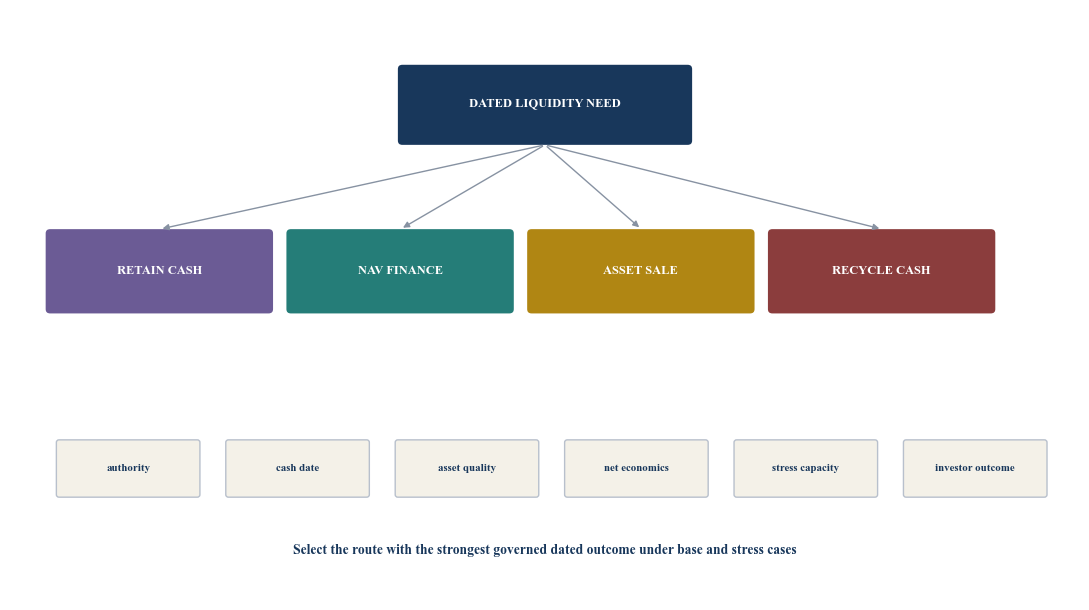
Author framework. The route follows authority, timing, asset quality, economics and resilience.
5. Build an asset-level eligibility file
A headline NAV does not determine reliable borrowing capacity. Each asset should enter an eligibility file with obligor, instrument, seniority, currency, maturity, commitment, outstanding amount, cash yield, payment status, covenant position, rating or internal grade, valuation, concentration, transfer rights, security, jurisdiction and data completeness.
Eligibility should be rule-based and reproducible. A lender can exclude assets with payment default, unresolved data gaps, excessive concentration, insufficient seasoning, prohibited jurisdiction, uncertain transferability, inadequate documentation or maturity beyond the permitted tail. Partial eligibility can be applied through advance rates and reserves where the facility permits.
ADGM's FSRA guidance requires private-credit fund managers within its scope to maintain a stated risk appetite, defined credit assessment and pricing methods, diversification, risk management and stress testing.[2] Those disciplines support a credible portfolio-finance data set even when a particular transaction sits outside that framework.
The file should distinguish funded exposure from total commitment. An undrawn amount can reduce liquidity and affect leverage even when it does not contribute current carrying value. It should also identify related obligors, sponsors, sectors, countries and collateral so concentration cannot be obscured by legal-entity fragmentation.
Table 2. Asset eligibility and funding file
| Field | Evidence | Funding relevance | Control question |
|---|---|---|---|
| Asset identity | executed facility and ledger | prevents duplication | does the record map to one enforceable asset? |
| Funded and undrawn | administrator and borrower records | current value and future liquidity | is total commitment reconciled? |
| Payment and covenant status | agent notices and monitoring | eligibility and haircut | are arrears, waivers and breaches current? |
| Credit grade | approved rating record | advance rate and trigger | was the grade refreshed for current evidence? |
| Value | valuation workpaper | borrowing-base input | what date, method and assumptions apply? |
| Concentration | obligor, group, sector, country and currency tags | excess deduction | are related exposures aggregated? |
| Transferability | asset and intercreditor documents | sale and security path | which consent, notice or restriction applies? |
| Security and priority | security file and legal review | recovery and lender rights | is perfection current and enforceability analysed? |
| Cash-flow profile | contractual schedule and forecast | debt service and maturity | when can controlled cash be received? |
| Data quality | exception log and ownership | eligibility and reserve | can the lender reproduce the record? |
Eligibility and adjustments are transaction-specific and require documentary and data evidence.
6. Govern valuation as a financing input
Portfolio finance can amplify valuation error because debt capacity, covenant headroom and cash sweeps can depend on reported value. Private-credit assets are illiquid and can lack frequent market transactions. The IMF identifies stale and potentially subjective valuations as a vulnerability and notes that leverage providers can mark assets down during stress.[4]
The valuation policy should define unit of account, methodology, calibration, market-participant assumptions, credit spread, probability of default, loss severity, prepayment, extension, restructuring, currency and observable-event treatment. IFRS 13 defines fair value for financial-reporting purposes as an exit-price measure under its scope.[8] IFRS 9 governs classification, measurement and expected credit losses within its scope.[9] Facility definitions can differ from accounting values.
Borrowing-base value should therefore be a contractual measure derived from the eligible asset set. It can start with an approved value and apply concentration deductions, credit haircuts, data reserves, FX adjustments, future-funding reserves and advance rates. The calculation should avoid treating an accounting carrying amount, face value and executable sale price as interchangeable.
Valuation independence and challenge matter. The committee should know who prepared the value, who reviewed it, which model and inputs changed, which assets relied on broker indications or management estimates, and what subsequent events occurred. A lender valuation right should be modelled as a real source of uncertainty.
7. Calculate an eligibility-based borrowing base
The borrowing-base bridge begins with gross approved value. It removes ineligible assets and excess concentration, adjusts for credit migration and data limitations, reserves for future funding and costs, and applies asset-level or portfolio advance rates. Existing secured obligations and minimum liquidity are then deducted to identify available drawings.
Advance rate should follow loss and liquidity behaviour. A senior secured, diversified, current-pay asset with complete documents and near-term cash can support a different rate from a concentrated, amended, payment-in-kind or junior exposure. A portfolio average can conceal a vulnerable tail.
Concentration limits should be applied after grouping related risk. A single sponsor can connect multiple legal borrowers. A sector shock can affect nominally separate assets. Country, currency, maturity and financing-source concentrations can also interact.
The facility should contain a cure sequence that the fund can execute. Potential cures include cash paydown, adding eligible assets, selling an asset, redirecting distributions, reducing commitments or obtaining new equity. A theoretical cure that depends on unavailable investor capital or an illiquid sale is weak protection.
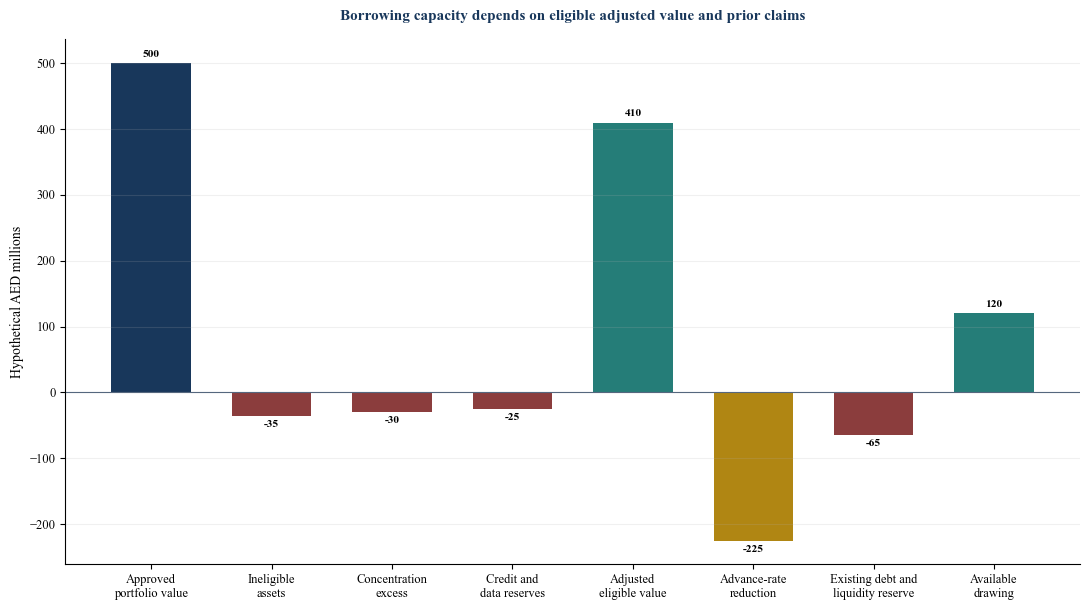
All values are hypothetical management assumptions in AED millions and demonstrate the calculation method only.
8. Design the cash waterfall around the stated purpose
Portfolio cash control can include collection accounts, distribution accounts, blocked accounts, payment waterfalls, reserve accounts, cash sweeps and lender consent rights. The structure should match the assets, entities and governing documents.
The waterfall should allocate operating and preservation amounts, taxes where applicable, fund expenses, borrower commitments, facility interest and fees, mandatory amortisation, covenant cure, permitted reinvestment and investor distributions. Each layer needs a definition, calculation agent, payment date, evidence source and dispute process.
The use of proceeds should remain traceable. The CBUAE credit-risk standards require licensed financial institutions within their scope to monitor the use of facility proceeds and repayment sources.[5] A direct-lending fund can apply the same control principle to its own portfolio financing by reconciling every draw to the approved use.
Cash leakage should be tested across parallel funds, feeders, co-investments, holding entities, servicers, agent accounts and currencies. A portfolio lender can have strong contractual rights at one entity and weak access to cash generated elsewhere.
9. Align asset cash, facility maturity and investor liquidity
A portfolio facility has a maturity profile even when its collateral is long-dated. Asset extensions, payment-in-kind elections, restructurings, delayed exits and borrower drawdowns can move cash beyond the facility's expected repayment date.
The liquidity model should map asset interest, principal, fees, prepayments, sale proceeds and recoveries against borrower commitments, expenses, hedge flows, debt service, amortisation, facility maturity and investor obligations. It should contain base, delay and downside cases.
Refinancing should not be the sole repayment plan. The IMF notes that private-credit fund leverage can carry rollover risk and loan-to-value triggers.[4] A robust maturity plan identifies controlled amortisation, scheduled asset sales, expected asset repayments and a contingency case with no refinancing.
Closed-end funds generally reduce redemption mismatch through long-term investor capital. Semiliquid structures introduce additional liquidity obligations. The EU's amended AIFMD framework sets leverage limits and liquidity requirements for loan-originating AIFs within its scope, distinguishing open-ended and closed-ended structures.[6] The applicable rules depend on the vehicle and jurisdiction.
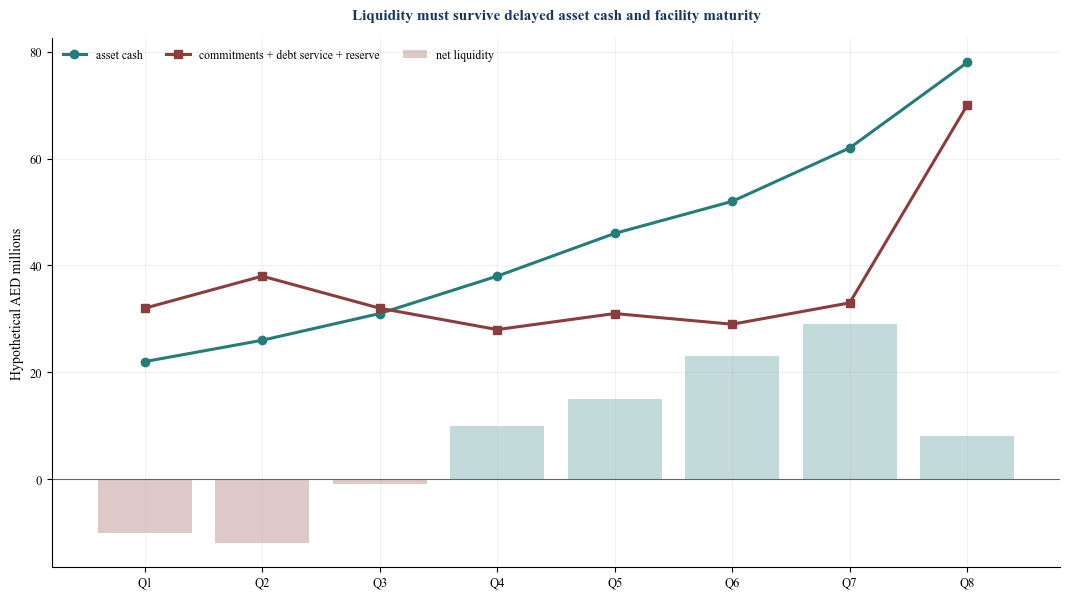
All timing and amounts are hypothetical management assumptions in AED millions.
10. Treat asset sales as portfolio construction
An asset sale is a portfolio decision rather than a residual source of cash. The fund should identify the asset's expected hold return, current bid, transaction cost, remaining funding, concentration contribution, downside risk, strategic relevance and effect on the residual portfolio.
Sale candidates can include low-conviction assets, concentrated positions, assets with high future funding, positions with strong market bids, short residual maturities or exposures that release a binding facility constraint. Selling the strongest liquid asset can raise cash quickly while weakening the quality of the remaining borrowing base.
Transfer mechanics should be mapped early. A sale can require borrower or agent consent, minimum hold, lender-of-record requirements, confidentiality arrangements, data-room permissions, sanctions screening, regulatory analysis, security-trustee mechanics, participation terms or tax review. Economic exposure and legal title can transfer at different times.
The sale price should be compared with the full retained case. The retained case includes coupon, fees, prepayment, extension, default, recovery, future funding and cost of capital. The sale case includes cash date, price, costs, released reserves, concentration relief and redeployment return. Both should use consistent dates and assumptions.
11. Govern capital recycling as a defined mandate
Recycling can preserve investment capacity after asset repayments or sales. It is economically different from borrowing because it does not introduce an external fixed claim. It still changes investor cash timing and can extend exposure.
The fund should define eligible recycling proceeds, the permitted period, aggregate cap, qualifying uses, portfolio limits and distribution treatment. Principal proceeds, income, fees and recallable distributions can have different treatment. Side letters can add investor-specific obligations.
Recycled capital should pass the same underwriting and portfolio tests as original capital. The availability of proceeds should not lower credit standards. The committee should compare the new asset's expected return and downside with distributing cash, repaying debt or reserving liquidity.
Investor reporting should show gross realisations, amounts recycled, amounts distributed, portfolio-finance debt, interest and fees, and the effect on remaining commitments and duration. This enables investors to distinguish operational capital efficiency from delayed liquidity.
12. Compare route economics on a common basis
Each route should be evaluated through dated cash flows to the fund and its investors. Relevant metrics can include net present value, expected multiple, return on retained equity, liquidity coverage, concentration, downside loss, covenant headroom and time to distributable cash.
IRR and DPI require careful interpretation when debt funds a distribution. ILPA observes that NAV-financed early distributions can materially affect reported IRR and DPI and recommends transparency, governance and synthetic measures that isolate the facility's effect.[1] A direct-lending fund should report the actual outcome and a consistent view excluding financing-generated timing effects where appropriate.
Financing cost includes margin, reference rate, upfront fee, commitment fee, legal and advisory cost, valuation cost, hedging, cash drag, mandatory amortisation and opportunity cost from restricted distributions. Sale cost includes bid discount, transaction cost, consent, lost future income and retained obligations.
The no-action case includes the cost of holding cash or foregoing deployment, plus the risk of a future liquidity shortfall. The decision should be based on the route that best serves the approved objective within the fund's risk and authority, rather than the route with the highest headline proceeds.
Table 3. Portfolio capital-release route comparison
| Route | Immediate liquidity | Future exposure | Primary benefit | Primary constraint |
|---|---|---|---|---|
| Retain cash | existing cash only | assets retained | no new debt or sale discount | reduced deployment or distribution |
| NAV facility | committed or drawn debt | assets retained plus facility claim | flexible liquidity and retained upside | cost, covenants, cash sweep and maturity |
| Whole-loan sale | sale proceeds | asset transferred subject to retained terms | realised cash and risk transfer | bid discount, consent and lost income |
| Participation sale | funded participation proceeds | legal title may remain | targeted liquidity with relationship continuity | counterparty, agency and structural risk |
| Capital recycling | realised permitted cash | new asset exposure | redeployment without external debt | investor terms, duration and opportunity cost |
| Hybrid plan | phased debt, sales and recycling | managed residual exposure | diversified liquidity sources | execution and governance complexity |
Outcomes depend on asset quality, documents, facility terms, market bids and fund objectives.
13. Stress the portfolio as a connected system
Stress analysis should combine credit, valuation, liquidity, funding and investor effects. A downgrade can reduce asset value, make an asset ineligible, increase concentration, trigger a cash sweep and reduce expected asset cash at the same time.
The IMF describes multiple leverage layers across borrowers, funds, special-purpose vehicles and investors.[4] Portfolio analysis should therefore include borrower leverage, fund leverage, derivatives, investor financing and refinancing dependence where the information is available.
Core stresses include spread widening, rating migration, payment-in-kind conversion, borrower draws, lower recovery, delayed repayments, asset-sale discount, FX movement, lender valuation adjustment, facility non-renewal and investor liquidity demand. Combined scenarios matter more than isolated shocks.
Management actions should be executable and time-bound. A planned sale requires a market, transferable asset and realistic settlement period. A capital call requires remaining commitments and valid authority. A distribution suspension requires governance and investor communication. Each action should have an owner and evidence.
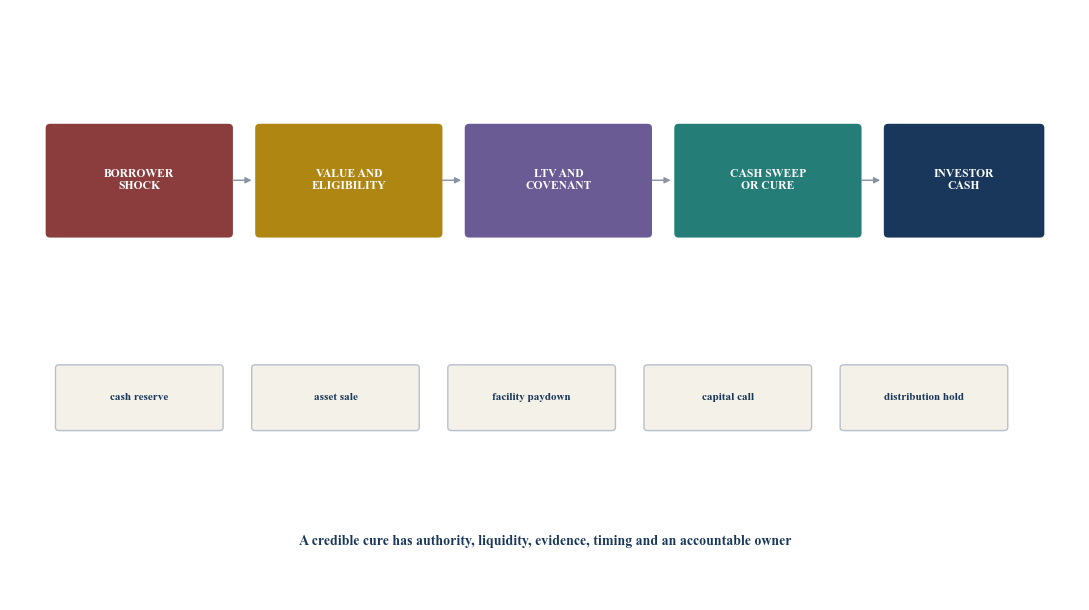
Author framework. One asset shock can affect value, eligibility, cash, covenants and investor outcomes.
Table 4. Portfolio-finance stress matrix
| Stress | Immediate effect | Secondary effect | Required management evidence |
|---|---|---|---|
| Credit migration | asset haircut or ineligibility | concentration and LTV pressure | current rating, covenant and valuation record |
| Correlated borrower draws | cash utilisation | lower liquidity and higher facility use | commitment schedule and draw assumptions |
| Repayment delay | lower asset cash | maturity and refinancing pressure | revised borrower cash forecast |
| Sale-price discount | reduced proceeds | larger retained exposure or debt | executable bids and transaction cost |
| Facility value adjustment | borrowing-base reduction | cash sweep or cure | calculation, dispute right and cure assets |
| Rate or currency movement | higher debt service or mismatch | weaker coverage and investor cash | hedge, basis and liquidity analysis |
| Facility non-renewal | maturity wall | forced sale or capital requirement | funded repayment and contingency plan |
| Semiliquid investor demand | redemption obligation | asset-liability mismatch | gates, notice, cash and fair-treatment controls |
Magnitudes and management actions require current portfolio and facility evidence.
14. Protect governance, transparency and alignment
Portfolio finance can create conflicts between current and future investors, different fund vehicles, the manager, portfolio assets and financing providers. Debt-funded distributions can improve near-term cash metrics while adding cost and risk to the residual portfolio. Cross-collateralisation can use stronger assets to support weaker assets.
ILPA recommends LP advisory committee consent where the LPA is silent and for NAV facilities used to fund distributions, along with disclosure of rationale, terms and conflicts.[1] Those recommendations relate to the stated scope of the ILPA guidance. The actual consent and disclosure obligation depends on the fund documents and law.
The committee paper should present the no-action case, all feasible alternatives, related-party interests, valuation method, fees, manager economics, allocation across vehicles, investor effects and downside. The decision record should explain why the selected route serves the fund's approved objective.
Disclosure should include facility amount, drawn amount, use of proceeds, collateral, maturity, cost, covenants, cash sweeps, LTV, asset sales, interest and fee impact, distributions generated by financing, recallability, conflicts and material breaches. Sensitive transaction detail can be handled through the applicable confidentiality framework.
15. Apply the relevant regulatory and professional perimeter
ADGM's private-credit-fund framework applies to qualifying funds and managers within its jurisdiction and imposes specific restrictions, diversification, systems, risk and stress-testing requirements.[2] Other Gulf and international vehicles can follow different regimes.
The EU's Directive 2024/927 amends AIFMD and includes rules for loan-originating AIFs within its scope. It defines leverage limits of 175 percent for open-ended and 300 percent for closed-ended loan-originating AIFs using the specified commitment-method ratio, with stated exclusions and conditions.[6] Those percentages should not be applied to a vehicle outside the Directive's scope.
The CBUAE credit-risk framework applies to licensed financial institutions within its scope. Its principles on portfolio aggregation, use-of-proceeds monitoring, collateral value and risk management provide authoritative UAE context for lenders.[5]
Accounting classification, derecognition, expected credit loss and fair value require instrument-specific analysis under the applicable reporting standards.[8][9] A participation can transfer economics without achieving accounting derecognition. A sale can include continuing involvement. Tax, withholding, VAT, transfer pricing and permanent-establishment effects require relevant advice.
16. Demonstrate a hypothetical capital plan
Consider a hypothetical closed-end direct-lending fund with AED 500 million of approved portfolio value, AED 35 million of ineligible assets, AED 30 million of concentration excess and AED 25 million of credit and data reserves. Adjusted eligible value is AED 410 million.
A hypothetical blended advance-rate framework reduces this by AED 225 million. Existing debt and minimum liquidity reserve consume AED 65 million. The resulting hypothetical available drawing is AED 120 million.
The fund has a hypothetical AED 90 million six-month liquidity need: AED 45 million of committed borrower drawings, AED 20 million of asset-protection capital, AED 10 million of expenses and hedging, and AED 15 million of minimum liquidity. It compares retention, a NAV draw, selected asset sales and permitted recycling.
The committee adopts a hypothetical hybrid plan: retain AED 15 million, draw AED 35 million, sell AED 25 million of two lower-conviction positions and recycle AED 15 million of scheduled principal. The NAV draw amortises from controlled asset cash and has a stated stop if adjusted eligible value falls below the assumed threshold. Every number and result is a hypothetical management assumption.
Table 5. Hypothetical six-month portfolio capital plan
| Component | Amount | Timing | Control |
|---|---|---|---|
| Committed borrower drawings | 45 | months 1 to 4 | executed commitments and draw conditions |
| Asset-protection capital | 20 | months 2 to 5 | milestone and revised underwriting |
| Expenses and hedging | 10 | monthly | approved budget and settlement schedule |
| Minimum liquidity | 15 | continuous | unencumbered controlled cash |
| Total liquidity need | 90 | six months | consolidated cash plan |
| Retained cash | 15 | day one | segregated liquidity reserve |
| NAV-facility draw | 35 | month 1 | eligible borrowing base and use of proceeds |
| Selected asset sales | 25 | months 1 to 3 | price, transfer and settlement gates |
| Permitted recycling | 15 | months 2 to 4 | realised principal and document authority |
| Total sources | 90 | six months | reconciled funds flow |
All values are hypothetical management assumptions in AED millions and demonstrate the method only.
17. Operate through a single portfolio-finance dashboard
The dashboard should connect liquidity, asset quality, value, eligibility, concentration, debt, covenant headroom, cash, asset-sale execution and investor outcomes. It should reconcile to the administrator, valuation records, bank accounts and facility agent.
Core measures include gross and adjusted portfolio value, eligible value, funded debt, undrawn facility, LTV, advance-rate headroom, ineligible assets, concentration excess, borrower commitments, twelve-month asset cash, facility debt service, maturity, asset-sale pipeline, realised sale price, amounts recycled and financing-generated distributions.
Each metric should have a definition, owner, source, date and exception threshold. Manual overlays should remain visible. Values, credit grades, eligibility and concentration should not change silently between committee meetings.
The dashboard should distinguish factual balances from management forecasts. Hypothetical or probability-weighted scenarios should remain labelled in committee materials. Actual cash, costs, sale proceeds and debt service should feed back into the planning model.
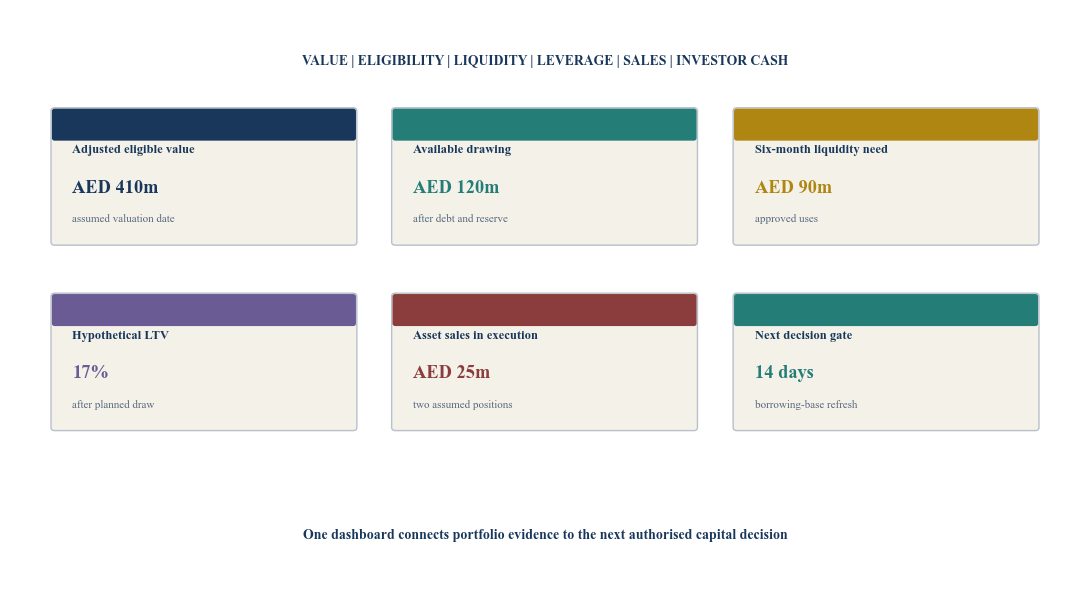
Every displayed value is a hypothetical management assumption created solely to demonstrate the dashboard design.
18. Implement the operating model in 120 days
Days one to twenty establish the objective, authority, entities, approvals, conflicts, asset perimeter and cash obligations. The team preserves documents and identifies every decision owner.
Days twenty-one to forty build the asset eligibility file, valuation bridge, concentration map, commitment schedule, cash controls and base liquidity forecast. Legal and finance teams validate transfer and account mechanics.
Days forty-one to sixty develop borrowing-base rules, facility scenarios, asset-sale candidates, recycling controls and route economics. Independent reviewers reproduce the calculations.
Days sixty-one to eighty run combined stresses, negotiate key terms, test lender valuation and cure mechanics, and prepare investor engagement. The committee chooses a route only after base and downside cases are complete.
Days eighty-one to one hundred prepare conditions precedent, account control, asset-sale execution, funds flow, reporting and contingency actions. Operations conducts a dry run of calculations and payments.
Days one hundred and one to one hundred and twenty close the approved transaction, reconcile cash, activate the dashboard, set review dates and complete investor reporting. The governing body records any deviations from the approved case.
Table 6. One-hundred-and-twenty-day portfolio-finance programme
| Days | Workstream | Controlled deliverable | Gate |
|---|---|---|---|
| 1 to 10 | objective and governance | dated liquidity need and decision owners | governing body confirms purpose |
| 11 to 20 | authority and perimeter | entity, approval, conflict and document map | counsel confirms review perimeter |
| 21 to 30 | asset file | reconciled commitments, values and risk data | investment and finance validate population |
| 31 to 40 | liquidity and controls | cash obligations, accounts and timing | treasurer confirms base forecast |
| 41 to 50 | borrowing base | eligibility, concentration, reserves and advance rates | calculation independently reproduced |
| 51 to 60 | alternatives | retention, facility, sale and recycling cases | common dated economics accepted |
| 61 to 70 | stress | combined credit, value, draw and maturity cases | executable cures identified |
| 71 to 80 | terms and approvals | key terms, conflicts and investor engagement | required approvals complete |
| 81 to 90 | execution design | conditions, transfers, accounts and funds flow | operational dry run passes |
| 91 to 100 | reporting | dashboard, definitions and exception process | administrator and lender data reconcile |
| 101 to 110 | closing | executed documents and controlled cash | conditions precedent satisfied |
| 111 to 120 | adoption | first report, review calendar and lessons | governing body accepts controlled use |
Timing depends on documents, portfolio data, lender process, asset transfers, investor approvals and regulation.
19. Limitations and conclusion
The ILPA guidance cited in this paper states that its detailed NAV-facility scope addresses private-equity buyout funds and does not cover every private-credit structure.[1] Its transparency, governance and alignment principles require contextual application.
The ADGM, CBUAE and EU materials apply within their stated regulatory scopes.[2][5][6] A fund should not apply a rule from one jurisdiction or vehicle type to another without appropriate analysis. IFRS and valuation guidance have their own scope, definitions and professional requirements.[7][8][9]
Every value, facility term, borrowing-base input, sale price, cash flow, probability, haircut, rate, cost, date and result in the worked example is a hypothetical management assumption. No client portfolio, lender proposal, investor consent, market bid or realised outcome is claimed.
Portfolio finance creates value when it solves a defined liquidity constraint within authority, preserves portfolio resilience and improves the fund's dated net outcome after cost and risk. The discipline is to treat NAV finance, asset sales, recycling and retention as comparable capital-allocation routes.
The resulting decision connects fund authority, asset evidence, valuation, concentration, cash obligations, financing terms, transfer mechanics, investor governance and downside capacity. Capital can then move through a controlled system rather than a headline NAV number.
References
- [1] Institutional Limited Partners Association, NAV-Based Facilities: Guidance for Limited Partners and General Partners, July 2024. https://ilpa.org/wp-content/uploads/2024/07/ILPA-Guidance-on-NAV-Facilities-2024.pdf
- [2] Abu Dhabi Global Market Financial Services Regulatory Authority, Supplementary Guidance: Private Credit Funds, 4 May 2023. https://assets.adgm.com/download/assets/Guidance%2BPrivate%2BCredit%2BFunds%2B20230504.pdf/35ee16046c4111efb03df2d590e1d568
- [3] Abu Dhabi Global Market Financial Services Regulatory Authority, Fund Rules and official legal framework materials, current access 13 August 2026. https://www.adgm.com/legal-framework/rules-and-regulations
- [4] International Monetary Fund, Global Financial Stability Report, April 2024, Chapter 2, The Rise and Risks of Private Credit. https://www.imf.org/-/media/files/publications/gfsr/2024/april/english/ch2.pdf
- [5] Central Bank of the UAE, Credit Risk Management Regulation and Standards, C 3/2024, effective 30 November 2024. https://rulebook.centralbank.ae/en/rulebook/credit-risk-management-regulation
- [6] European Union, Directive (EU) 2024/927 amending Directives 2011/61/EU and 2009/65/EC, Official Journal, 26 March 2024. https://eur-lex.europa.eu/eli/dir/2024/927/oj/eng
- [7] International Private Equity and Venture Capital Valuation Guidelines Board, International Private Equity and Venture Capital Valuation Guidelines, current official edition accessed 13 August 2026. https://www.privateequityvaluation.com/valuation-guidelines/4588034291
- [8] IFRS Foundation, IFRS 13 Fair Value Measurement, official standard overview. https://www.ifrs.org/issued-standards/list-of-standards/ifrs-13-fair-value-measurement/
- [9] IFRS Foundation, IFRS 9 Financial Instruments, official standard overview. https://www.ifrs.org/issued-standards/list-of-standards/ifrs-9-financial-instruments/
- [10] International Monetary Fund, Global Financial Stability Report, April 2025, liquidity management and bank exposure to private-credit funds. https://www.elibrary.imf.org/display/book/9798229003261/CH001.xml
- [11] International Monetary Fund, Global Financial Stability Report, April 2026, Chapter 1, private-credit and semiliquid-fund analysis. https://www.elibrary.imf.org/abstract/book/9798229035910/CH001.xml
- [12] International Organization of Securities Commissions, Thematic Analysis: Emerging Risks in Private Finance, official report, September 2023. https://www.iosco.org/library/pubdocs/pdf/IOSCOPD745.pdf
- [13] Institutional Limited Partners Association, Principles and Best Practices, NAV facilities, subscription lines and continuation-fund resources, current access 13 August 2026. https://ilpa.org/industry-guidance/principles-best-practices/
- [14] Central Bank of the UAE, Article 11: Portfolio Management and Internal Reporting, Credit Risk Management Standards. https://rulebook.centralbank.ae/en/rulebook/article-11-portfolio-management-and-internal-reporting-0
- [15] European Union, consolidated Directive 2011/61/EU as amended and applicable 16 April 2026. https://eur-lex.europa.eu/legal-content/EN/TXT/?uri=CELEX:02011L0061-20260416
About the Author
Chennakeshav Adya is an independent researcher and Managing Partner of Matchpoint Partners. His research focuses on investment strategy, capital formation, transaction execution, governance and operating-model design across the Gulf and international markets.
