

1. Pacing converts uncertain exits into a controlled commitment rate
Pre-IPO shares are negotiated assets rather than continuously traded securities. A transaction can require issuer consent, a right-of-first-refusal process, investor eligibility, legal opinions, transfer documents, payment coordination and register update. A portfolio can value a holding each quarter while remaining unable to sell it on demand.
Pacing determines how much capital the investor can approve and fund over time without depending on a particular exit. The rule connects new purchases to the size, concentration, maturity, liquidity and evidence quality of existing positions. It is a portfolio decision made before an attractive single-name opportunity becomes urgent.
The decision should distinguish commitment from funding. A signed acquisition can settle later or in stages. An SPV can call capital after investors subscribe. Follow-on rights, taxes, fees, hedging and legal work can create further cash needs. Expected sale proceeds can move or disappear.
A robust rule uses hard limits, warning limits and evidence-based exceptions. Hard limits define exposures the mandate cannot exceed without formal amendment. Warning limits trigger new diligence, valuation or liquidity action. Exceptions require an owner, evidence, expiry date and remediation path.
The portfolio remains subject to investment loss. Pacing cannot make a private security liquid or preserve its value. It creates decision discipline, cash preparedness and visibility into correlated exposures.
The capacity formula should begin with the mandate rather than the available bank balance. It should reconcile target and maximum private-share allocation, current adjusted exposure, approved but unsettled purchases, reserved follow-ons, concentration headroom and minimum liquid resources. Cash above the reserve does not create capacity when an issuer, vintage or exit-window cap already binds.
Opportunity cost should remain visible. A commitment uses legal, operational, valuation and governance capacity as well as capital. A small position in a difficult vehicle can consume disproportionate diligence and monitoring resources. The committee can rank opportunities by expected return, downside loss, evidence quality, liquidity use and execution burden without compressing them into a single unsupported score.
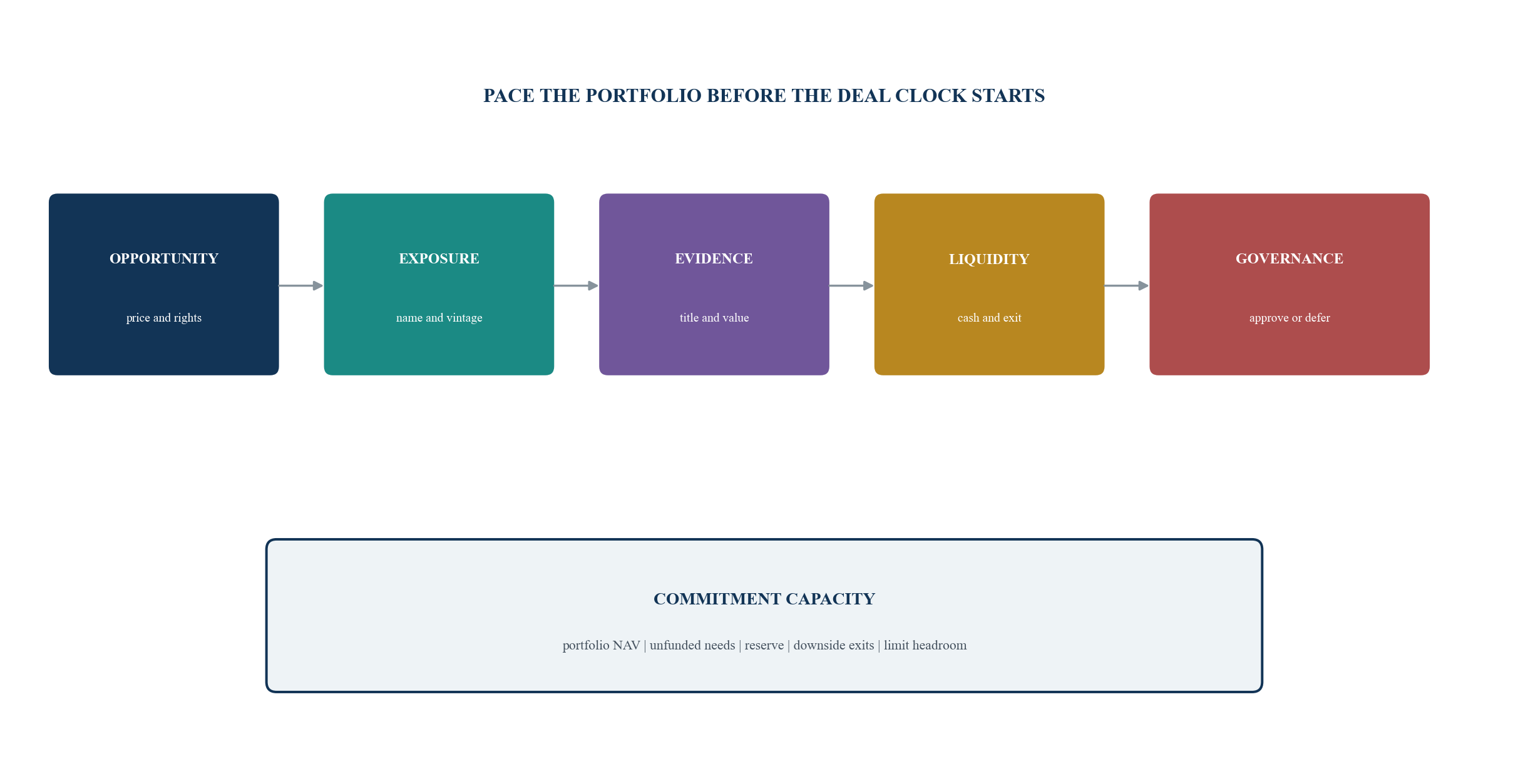
New commitments pass through exposure, evidence, liquidity and governance gates before funding.
2. Define the legal, vehicle and ownership perimeter
The portfolio map identifies the beneficial investor, fund, feeder, SPV, nominee, custodian, manager, issuer, seller and transfer agent. It records the jurisdiction and regulatory status of each role. Direct shares and interests in an SPV that owns shares create different rights and look-through exposures.
The security record includes issuer, class, quantity, registered holder, beneficial owner, acquisition route, original issue date, holding period, affiliate status, transfer restrictions, rights of first refusal, co-sale, drag, lock-up, information rights and liens. Share-class rights can make two positions in one company economically different.
SEC materials explain that securities issued in exempt private offerings can be restricted and are not freely tradable. The SEC's private-secondary materials describe several US resale pathways, including Rule 144 and Section 4(a)(7), with specific conditions. State-law requirements can also apply. Other jurisdictions use their own securities and transfer rules.
Rule 144 is one US safe harbour. Conditions can depend on issuer reporting status, holding period, current information, affiliate status, volume, manner of sale and notice. Meeting a holding period alone does not establish that a transfer can settle. The issuer, shareholder documents, securities law and operational registration all require review.
The pacing model should therefore use legal eligibility and practical transferability as separate fields. A position can be eligible for one route while issuer consent, information, buyer eligibility or documentation still constrains timing.
Table 1. Pre-IPO portfolio perimeter and ownership record
| Dimension | Required field | Primary evidence | Pacing implication |
|---|---|---|---|
| investor | identity, eligibility and authority | constitutional, mandate and KYC records | determines permitted exposure and route |
| vehicle | entity, term, governance and commitments | offering and operating documents | creates cash and approval obligations |
| issuer | legal entity, domicile and reporting status | registry and issuer materials | affects information and resale analysis |
| security | class, rights, quantity and issue history | register, certificate and purchase documents | establishes economic and legal exposure |
| ownership | registered and beneficial chain | issuer, nominee and custodian records | proves position and instruction authority |
| restrictions | contract, legend, law and lock-up | shareholder agreement, legend and legal memo | controls feasible exit timing |
| encumbrance | pledge, lien or financing | security and lender records | reduces transferable or available value |
| exit route | tender, private sale, IPO, merger or distribution | route-specific legal and operating checklist | supports liquidity bucket and timing range |
Current counsel should determine the applicable offering, resale and transfer requirements for each jurisdiction and security.
3. Establish one exposure ledger across direct and indirect holdings
The exposure ledger should look through every vehicle to issuer, security class and economic interest. It should prevent the same company from appearing as several unrelated positions through direct shares, SPVs, funds, co-investments, employee tenders or structured notes.
Exposure is measured on more than current reported value. The ledger can retain acquisition cost, independently governed current value, funded amount, unfunded commitment, debt, guarantees, expected fees, currency and maximum loss. It should identify priority and dilution rights.
Ownership percentage and position size have operational effects. A larger holder can face information, affiliate or sale-volume considerations under applicable law. A small economic position can remain difficult to transfer when it sits inside a poorly governed SPV.
Related issuers and common dependencies need tags. Several AI companies can depend on the same hyperscaler, accelerator supply, customer, financing environment or listing window. Geographic labels alone do not capture this correlation.
The controlled ledger is reconciled to issuer records, custodians, administrators, bank and general ledger. Disagreements remain exceptions with an owner and deadline. Portfolio limits should use the more conservative supported exposure while a material break is unresolved.
The ledger should also preserve transaction price and total acquisition cost. Brokerage, placement, SPV formation, administration, legal review, tax, foreign exchange and financing can make the effective entry price higher than the headline share price. Any rebate, fee share or related-party payment should be assigned to the relevant position and disclosed to the approving body.
Security economics should be modelled on a fully diluted basis and across exit values. Preference, participation, conversion, seniority, dividends, warrants and option-pool changes can make the same enterprise outcome produce materially different proceeds. Limit use based solely on headline common-equivalent shares can understate priority and dilution risk.
4. Separate five clocks for every position
The commitment clock starts when the investor becomes contractually obliged. The funding clock records cash payments and future calls. The holding-period clock follows the relevant security-law and acquisition facts. The valuation clock records the evidence date. The liquidity clock estimates when a feasible exit can produce usable cash.
These clocks rarely align. A position acquired through a deferred settlement can consume commitment capacity before funding. A recent round can update valuation without improving transferability. An announced IPO can change expectations while a lock-up delays monetisation.
The exit range should use earliest feasible, base and downside dates. The range should include approvals, buyer diligence, legal documentation, settlement, listing process, lock-up and cash release. A single management date is insufficient for reserve planning.
Holding periods under Rule 144 apply within the rule's US scope and depend on facts described by the SEC. They should not be presented as a global liquidity schedule or assurance of sale. The model should link the legal memo to the relevant position and valuation date.
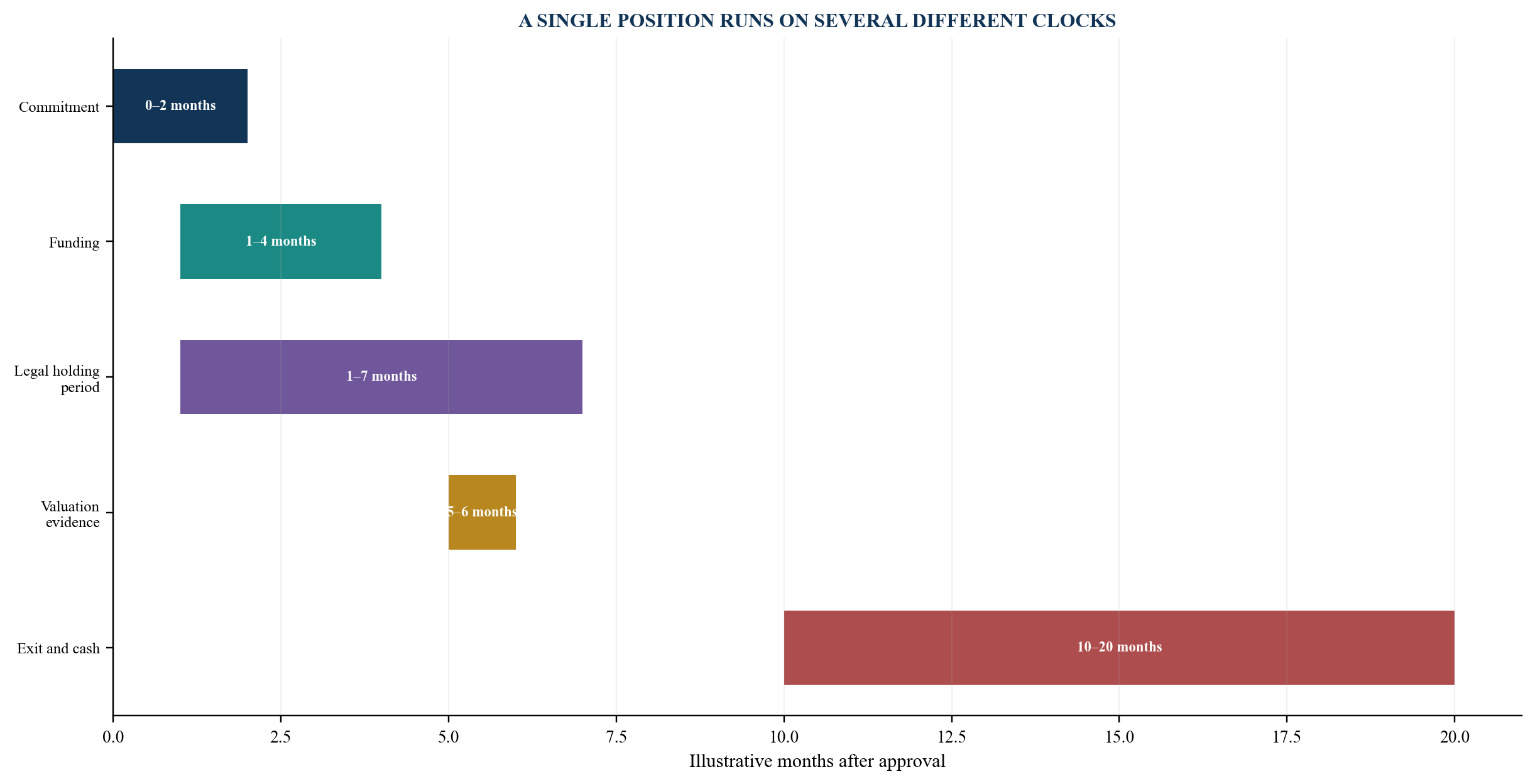
Dates are management assumptions for method demonstration; the actual clocks follow executed documents and applicable law.
5. Define vintage by exposure, not by label
Vintage can refer to purchase year, company funding round, security issue, fund commitment or expected exit. The pacing policy should state which definition answers each decision. For a direct secondary portfolio, acquisition vintage and valuation-regime vintage are both useful.
Acquisition vintage groups positions bought under similar market prices, financing conditions and information. Valuation-regime vintage groups holdings whose entry values were calibrated during the same market environment. Expected-exit vintage groups positions competing for the same liquidity window.
A rolling limit can cap commitments approved in one quarter, year or market regime. It reduces the chance that a surge of attractive supply consumes several years of capacity. The limit can be expressed as a percentage of target private-asset NAV, total portfolio NAV or a fixed currency amount.
Vintage limits should include signed but unsettled purchases and related fees. Follow-on allocations should retain the original company exposure and receive a new commitment date. A transfer from one internal vehicle to another should not create fresh diversification.
Pacing should respond to evidence. A material fall in public comparables, delayed listings, weaker funding conditions or widespread issuer underperformance can tighten commitment capacity while valuations are refreshed. A policy change requires documented approval rather than an informal pause.
Table 2. Illustrative vintage-limit architecture
| Limit | Illustrative warning | Illustrative hard cap | Measurement base | Purpose |
|---|---|---|---|---|
| quarterly approvals | 6% | 8% | target private-share NAV | slow deal clustering |
| annual acquisition vintage | 18% | 22% | target private-share NAV | diversify entry conditions |
| one valuation regime | 28% | 35% | adjusted portfolio value | control common mark risk |
| one expected-exit year | 25% | 30% | adjusted portfolio value | reduce liquidity bunching |
| unsettled commitments | 8% | 12% | liquid resources | protect cash capacity |
| follow-on reserve | below 50% funded | policy floor | approved reserve amount | preserve selective support capacity |
| exception exposure | 3% | 5% | adjusted portfolio value | contain approved limit breaches |
Thresholds are management assumptions and do not represent a recommendation for any investor.
6. Set issuer, security and dependency limits
The issuer limit should use look-through exposure across all vehicles and related instruments. It can be based on adjusted current value, invested cost, maximum loss and downside value. The most binding result controls new commitment capacity.
Security-class concentration matters when preferred, common, options, forwards or SPV interests have different priorities and dilution. The model should translate each instrument into expected proceeds across exit values rather than simply add headline marks.
Sector and geography limits need economic substance. An issuer's incorporation, employees, customers, data centres, regulation and exit market can span several countries. The ledger should record revenue, operating and liquidity dependencies separately.
Common-dependency limits capture correlations that category labels miss. Examples include reliance on one customer, sovereign programme, commodity, lender, distribution platform, cloud provider, regulatory approval or public-market comparable set.
An issuer at the warning limit can remain eligible for a small protective follow-on if the policy permits. The decision should compare dilution avoidance, expected value, liquidity cost and opportunity cost. An automatic follow-on can compound a weak exposure.
Table 3. Illustrative name and dependency limits
| Exposure dimension | Illustrative warning | Illustrative hard cap | Required look-through | Escalation |
|---|---|---|---|---|
| single issuer | 7% | 10% | direct, SPV, fund and structured exposure | independent value and liquidity review |
| single security class | 5% | 8% | equivalent economic rights | class waterfall and dilution test |
| top five issuers | 30% | 40% | full portfolio | concentration stress and commitment pause |
| one sector | 25% | 35% | revenue and operating exposure | correlation and comparable-set review |
| one primary exit market | 35% | 45% | expected listing or sale venue | exit-window stress |
| one platform dependency | 20% | 30% | common cloud, customer or distributor | dependency failure scenario |
| one manager or sponsor | 15% | 20% | all controlled vehicles | governance and counterparty review |
Limits are management assumptions and should be approved for the investor's mandate, risk capacity and legal structure.
7. Adjust marks before they enter the limit denominator
Private valuations use judgement and can remain unchanged between formal cycles. Using an optimistic or stale portfolio value as the denominator can create apparent headroom for additional purchases. The pacing model should use a governed adjusted value.
The FCA's 2025 private-market review identified good practices around independence, documented methodology, conflicts, ad hoc triggers, transparency and backtesting. It also described risks when valuations influence fees, marketing, borrowing or transfers. These observations support a separate portfolio-construction adjustment rather than replacing the accounting value.
The adjustment can consider evidence age, financing terms, company performance, public comparables, secondary bids, security rights, transfer restrictions, information quality and exit timing. It should show each bridge and approval. An unexplained universal discount is weak governance.
Actual transaction evidence can carry significant weight while remaining specific to size, class, rights, seller need and buyer access. A small employee tender, a primary round and a structured secondary can imply different economics.
Backtesting compares realised proceeds or later evidence with prior marks. The result should inform future method, assumptions and uncertainty. It should not be used to rewrite historical decisions without a documented reason.
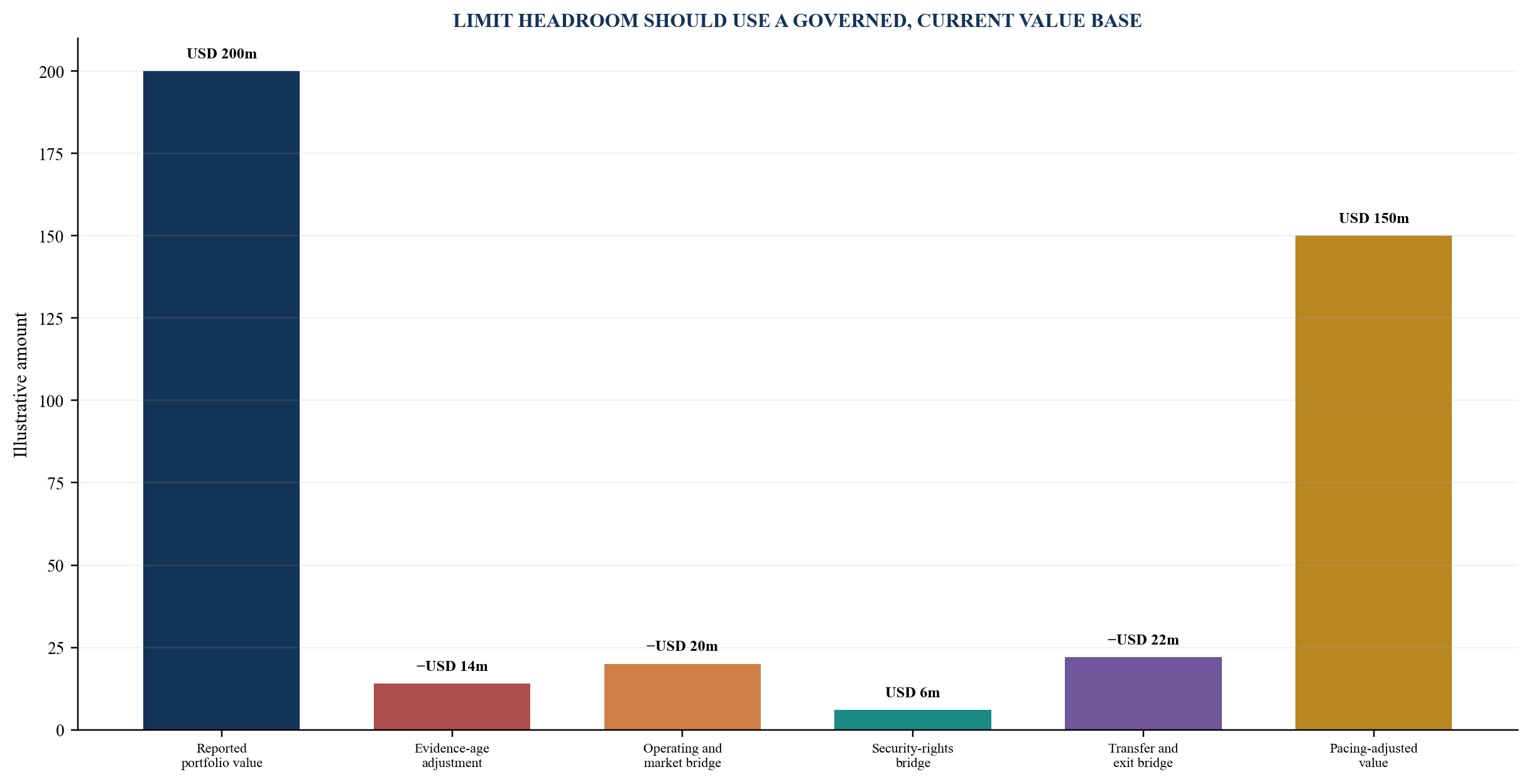
Values and adjustments are management assumptions and do not represent an observed portfolio.
8. Score transaction readiness separately from investment conviction
A strong company can be a weak transaction when the seller lacks title, the security is unclear, consent is uncertain, information is incomplete or settlement cannot be controlled. The pacing gate should preserve this distinction.
The readiness score can cover seller identity and authority, chain of title, security rights, issuer recognition, transfer pathway, consents, information, valuation evidence, funds control, closing mechanics and post-close custody. Each score should link to a document or explicit missing item.
The score affects commitment capacity, required reserve and settlement conditions. A low-readiness opportunity can be deferred rather than rejected permanently. A high-conviction investment should not receive an automatic exception to legal or possession requirements.
Readiness also affects exit liquidity after acquisition. A clean issuer register, transferable structure, current information and portable custody can reduce future friction. Stacked SPVs, undocumented nominees and missing historical transfers increase both acquisition and exit risk.
The investment committee should receive two recommendations: investment merit and transaction readiness. Conditions should specify which issues must be closed before signing, funding or registration.
9. Build a cash-flow forecast without treating exits as commitments
The forecast begins with unrestricted cash and committed facilities that are legally available for the intended purpose. It deducts signed settlements, unfunded calls, fees, taxes, debt service, hedging, operating expenses and a contingency reserve.
Expected exits are modelled by range and probability rather than treated as contracted cash. A company-sponsored tender can change size, eligibility, price or timing. An IPO can be delayed and followed by a lock-up. A private sale can fail at consent or settlement.
ILPA cash-flow and performance materials emphasise consistent contribution, distribution and performance records. Their fund context differs from a direct-share portfolio, while the discipline of transaction-level cash-flow data is relevant to pacing.
The portfolio should maintain minimum survival resources without completing a new secondary sale. The period can be defined in months or through a specific downside window. Available cash should reflect currency, location, encumbrance and transfer time.
The cash model should include closing-path risk. Funds may enter escrow before issuer recognition, remain blocked during a right-of-first-refusal process or be returned after a failed transfer. A simultaneous pipeline can therefore use liquidity even when only some acquisitions complete. Settlement probabilities belong in scenarios; signed obligations and protected reserves belong in the hard-cap calculation.
Foreign-currency holdings create two separate questions. The share value can move with the issuer and exchange rate, while the cash needed for settlement or calls can sit in another currency. The policy should define hedge authority, eligible instruments, collateral needs and treatment of unrealised hedge gains. A hedge should not be assumed available after market stress without counterparty and liquidity evidence.
Table 4. Illustrative twelve-month liquidity capacity
| Liquidity component | Illustrative amount | Availability treatment | Pacing use |
|---|---|---|---|
| unrestricted cash | USD 42m | immediate and verified | primary resource |
| committed revolving facility | USD 20m | 60% counted after covenant and draw review | secondary resource |
| signed settlements | negative USD 18m | full deduction | contractual use |
| unfunded vehicle calls | negative USD 9m | full or stressed deduction | portfolio obligation |
| fees, tax and operations | negative USD 5m | forecast deduction | operating survival |
| contingency reserve | negative USD 12m | protected floor | downside liquidity |
| base expected exits | USD 30m | excluded from hard commitment capacity | scenario information only |
| immediate new capacity | USD 30m | supported liquid resources after deductions | maximum before other limits |
Values, haircuts and timing are management assumptions for method demonstration.
10. Size the liquidity reserve against a distribution drought
The reserve should cover scheduled obligations and a stress in which expected exits are delayed. It can include settlement, follow-on, tax, vehicle, custody, legal, debt and operating cash. The policy should state which resources qualify and how quickly they can be used.
IOSCO's 2025 collective-investment-scheme recommendations address fund liquidity within their scope. They emphasise consistency between asset liquidity, fund design, investor terms, stress testing, governance and contingency planning. A closed or direct pre-IPO portfolio has a different liability structure, while the underlying alignment principle remains useful.
The reserve can use three layers: immediate cash; committed and tested liquidity; and planned actions. Expected private-share sales belong in the third layer until a binding settlement is sufficiently advanced. Public securities may require market, lock-up, concentration and currency haircuts.
The stress should bunch adverse events. It can combine no exits for twenty-four months, a follow-on request, delayed receivables, a tax payment, a currency move and a valuation decline. The reserve threshold should activate a commitment pause before cash becomes critical.
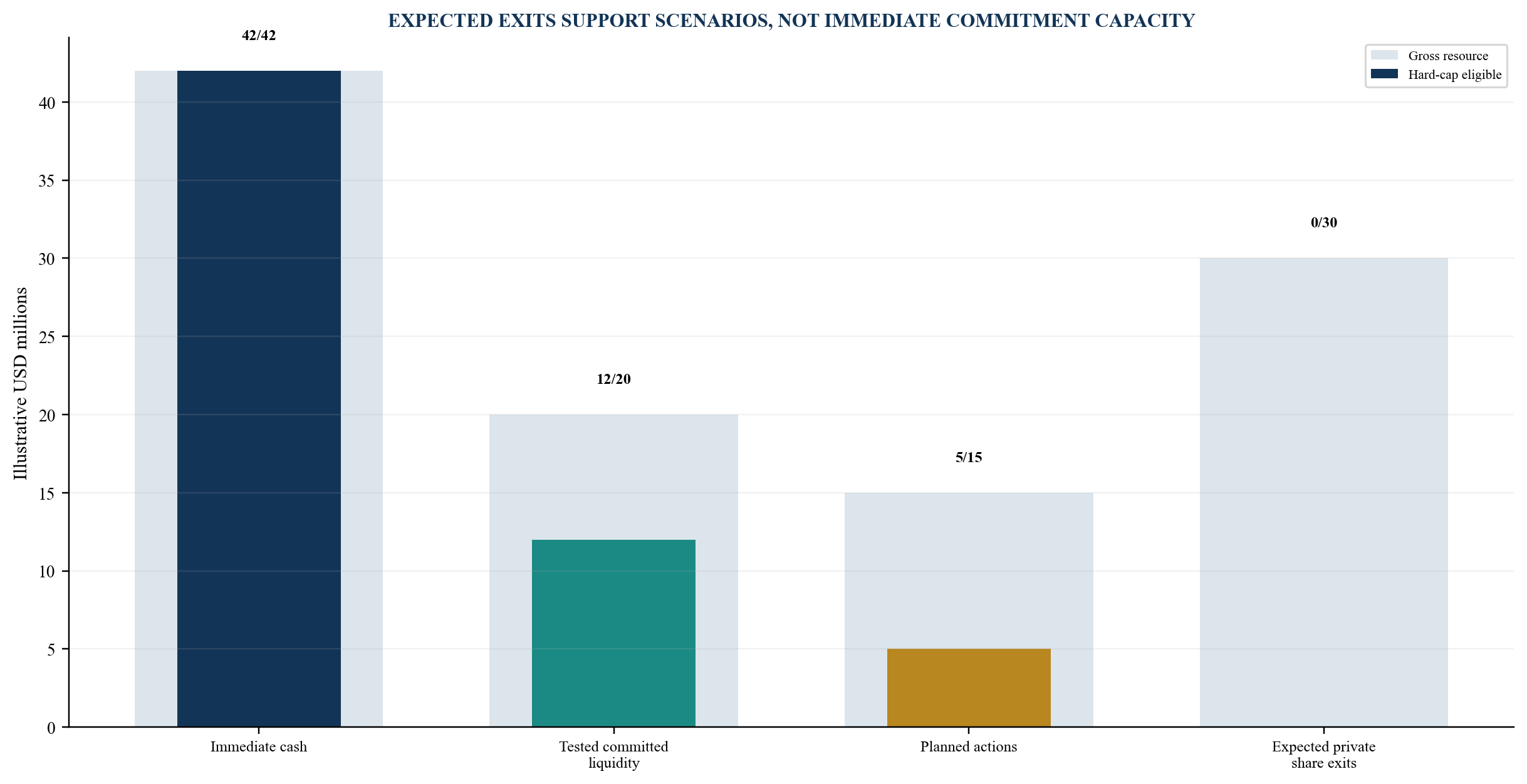
Values and eligibility haircuts are management assumptions and require replacement with portfolio evidence.
11. Model exit-window concentration and lock-up risk
Several positions can appear diversified while depending on the same public-market window. Companies in similar sectors and stages can pursue listings when comparable valuations and investor demand are favourable. A market closure can delay them together.
The exit calendar should show readiness, probable route, earliest date, base range, downside range, required approvals, lock-up, position size and expected cash. It should distinguish issuer plans from independently supported milestones.
An IPO creates a new sequence rather than immediate liquidity. Filing, review, launch, pricing, allocation, conversion, registration, lock-up, orderly-sale restrictions, insider status and market capacity can affect when proceeds are available. Current legal advice is required.
Tender offers can provide partial liquidity. Eligibility, allocation, priority, tax, price, fees and settlement can differ by holder and vehicle. The portfolio should model zero, partial and full participation.
A private secondary sale requires a buyer, authorised seller, complete diligence package, permissible communication, agreed price, transfer approvals and controlled settlement. Bid evidence should be dated and sized; an indicative quote for a small block may not support the value or liquidity of a larger position. The plan should identify potential buyers without treating outreach as committed demand.
Distribution in kind can transfer the liquidity problem to underlying investors. Before treating it as an exit, the vehicle should confirm legal authority, investor eligibility, custody capability, fractional interests, tax, information rights and downstream transfer restrictions. A distribution can end the vehicle's ownership while leaving investors unable to monetise the asset.
Exit-window limits can cap the adjusted value expected to rely on one year or one route. The downside forecast should push the cluster later and add costs, dilution or financing needs.
12. Treat follow-ons as a separate allocation decision
Pre-emptive or follow-on rights can protect ownership and economics. They also create optional or contractual cash demands when portfolio values are under pressure. The pacing policy should identify which rights exist and whether funding is mandatory.
A follow-on reserve can be assigned by issuer, probability and strategic value. It should be reviewed with performance, runway, financing terms, dilution and exit evidence. The reserve is not an obligation unless documents create one.
Pay-to-play, down-round, warrant, conversion and preference terms can alter the cost of declining. The class waterfall should calculate proceeds under participate and decline cases. A nominal ownership percentage can conceal a material economic change.
The investment committee should compare the follow-on with a new opportunity and with preserving cash. Sunk cost is not a decision criterion. The recommendation should state the incremental capital, rights received, expected value, downside loss, liquidity impact and limit use.
A protective follow-on that breaches the issuer limit requires a dated exception or a separate mandate rule. The record should state the intended path back within limits, including exit, dilution or reclassification.
13. Integrate financing and encumbrance into pacing
Debt against an SPV or portfolio can increase acquisition capacity while adding interest, covenants, margin calls and maturity. The pacing model should show gross and net exposure and identify assets that are pledged or distribution-restricted.
Borrowing capacity should use a lender-eligible value and a separate internal pacing value. A high reported NAV should not expand commitment capacity when the lender applies different haircuts or the portfolio cannot produce cash.
Cash held for debt service or collateral calls is not freely available for new acquisitions. Unfunded investor commitments can support liquidity only when enforceable, creditworthy and callable within the relevant period. Currency and jurisdiction can delay access.
The portfolio should stress simultaneous valuation decline, lender haircut, exit delay and new funding need. A levered vehicle can face a call precisely when secondary sale discounts widen.
Financing terms should enter the issuer, vintage and liquidity limits. A concentrated acquisition financed with short-dated debt uses more risk capacity than the same purchase funded with permanent equity.
14. Run an integrated pacing stress
The scenario engine should alter valuation, exit date, sale discount, follow-on calls, financing, currency and new-deal availability together. It calculates adjusted NAV, limit breaches, cash runway and required action by date.
The base case uses independently supported holdings and transaction evidence. The downside should include correlated delay rather than a series of isolated single-name cases. Reverse stress identifies the combination that exhausts the reserve or breaches a hard limit.
Table 5. Illustrative integrated pre-IPO pacing stress
| Scenario | Adjusted value effect | Liquidity effect | Limit effect | Required pacing response |
|---|---|---|---|---|
| base portfolio | governed current values | scheduled obligations covered | within warning limits | continue selective commitments |
| IPO window delayed two years | value timing and discount updated | expected distributions removed | exit-year cluster moves later | reduce annual approval capacity |
| top issuer falls 50% | issuer and NAV decline | no immediate cash | denominator shrink raises other concentrations | refresh all limits and pause exceptions |
| broad mark reset of 30% | portfolio value declines | no exits assumed | several names reach warnings | preserve reserve and re-underwrite pipeline |
| follow-on cluster | value conditional on participation | USD 15m calls in six months | issuer limits can rise | rank rights and fund selectively |
| lender haircut plus delay | pledged value and headroom decline | collateral call uses cash | leverage and name limits bind | halt acquisitions and cure financing |
| settlement failure | target purchase does not register | funds can be delayed or disputed | commitment remains until resolved | activate closing remedies and exception owner |
Values and outcomes are management assumptions and do not represent an observed portfolio.
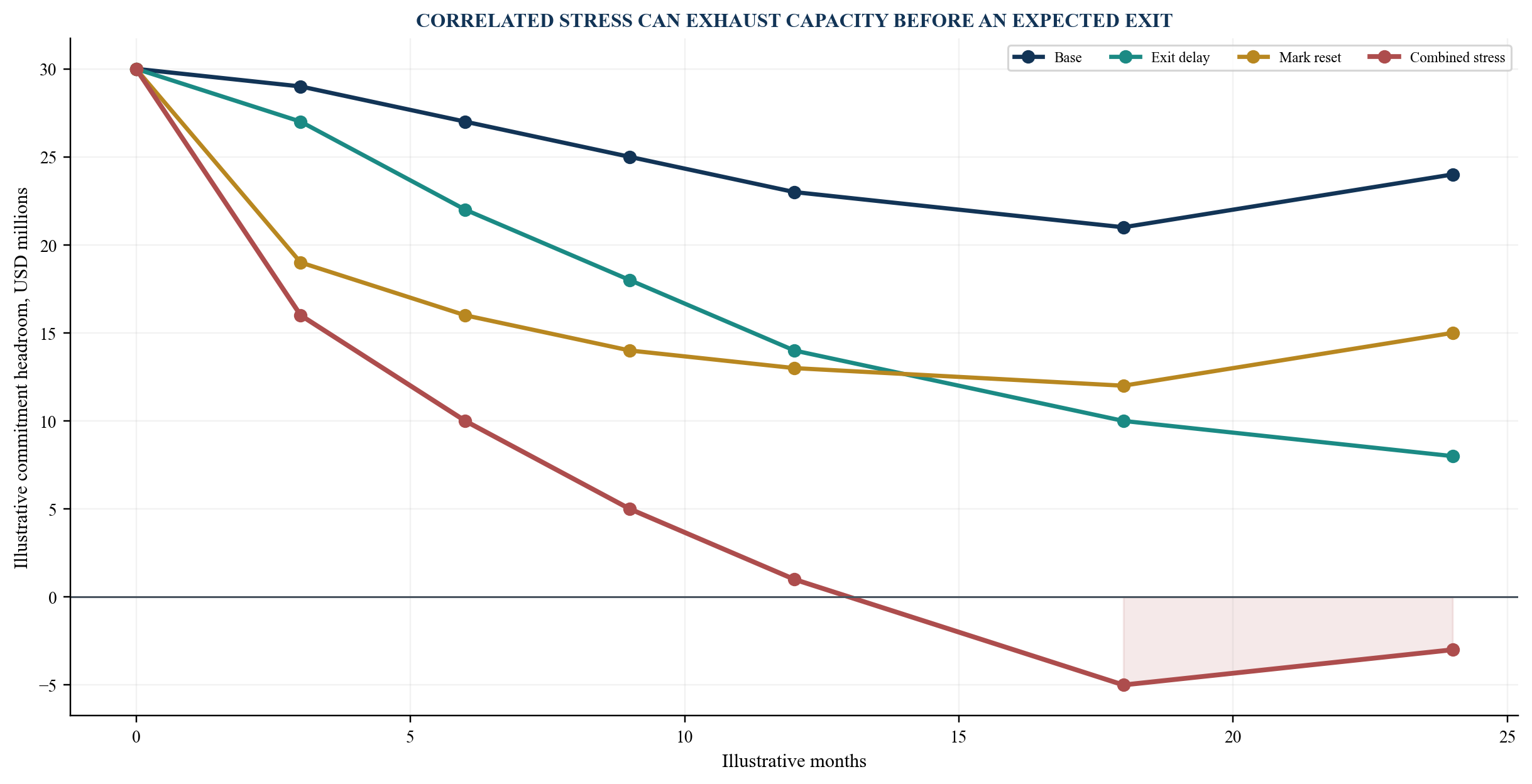
Values are management assumptions for method demonstration and do not represent an observed portfolio.
15. Govern limits, exceptions and independent challenge
The policy should assign ownership for data, valuation, legal status, liquidity, risk and approval. The investment team proposes an acquisition. Operations confirms possession and settlement. Finance confirms cash and commitments. Legal confirms the transaction route. Risk or an independent committee tests limits and exceptions.
The investment-committee pack should show pre- and post-transaction exposures, adjusted values, cash forecast, exit calendar, stress, readiness and every warning or breach. It should identify which fields are observed, advised, estimated or missing.
Price discipline should be linked to portfolio use. The investment case should bridge the seller's headline price to fully diluted value, security rights, company performance, current market evidence, transaction costs, transfer restrictions and expected exit. A discount to a dated primary round can still represent a high effective price when rights differ or the exit has moved later.
The committee can define an expiry for approval. If price, quantity, documents, valuation evidence, capacity or portfolio limits change before signing, the opportunity returns for review. This prevents a mandate granted for one transaction from being reused after the economic or legal facts change.
An exception should state the limit, amount, rationale, evidence, mitigants, expiry and accountable owner. Repeated renewals require higher approval. A temporary waiver should not become an unrecorded mandate change.
Conflicts can arise when a manager earns transaction, management or performance fees; owns the seller; controls the SPV; provides the mark; or needs an exit for another vehicle. The conflict register should connect the conflict to decision rights and independent review.
The portfolio dashboard should be updated after every commitment, funding, transfer, valuation, financing, corporate action and exit. A monthly governance cycle may be insufficient during a tender, listing or stress event.
16. Run a ten-day portfolio-pacing diagnostic
Days one and two define the investor, mandate, vehicles, holdings, commitments, cash and jurisdictions. The team freezes a common date and gathers ownership, valuation, bank, administrator, lender and legal records.
Days three and four build the look-through issuer and security ledger. It maps acquisition, funding, holding-period, valuation and liquidity clocks and identifies unresolved title or restriction issues.
Days five and six calculate adjusted values, vintage, name, security, sector, dependency and exit-window exposure. The team reconciles reported and pacing values.
Days seven and eight build the cash forecast, reserve layers, follow-on schedule, financing exposure and integrated stress. It tests the current pipeline against limit headroom.
Day nine ranks legal, valuation, liquidity, concentration, financing, operational and governance gaps. Day ten is the gate: continue; slow; pause; resize; obtain evidence; hedge; sell; refinance; or amend the mandate.
The ten-day period is a management target. Complex vehicles, missing ownership records, cross-border law or valuation work can require longer. Unresolved matters should remain visible.
Table 6. Ten-day pre-IPO portfolio-pacing diagnostic
| Period | Workstream | Decision | Completion evidence |
|---|---|---|---|
| days 1-2 | perimeter and data freeze | what portfolio and obligations are controlled? | mandate, entity, cash and evidence map |
| days 3-4 | ownership and five clocks | what is owned, restricted and potentially liquid? | look-through ledger and legal status |
| days 5-6 | values and limits | where is vintage, name and dependency exposure? | adjusted-value and limit report |
| days 7-8 | liquidity and stress | what cash survives clustered delays and calls? | reserve, forecast and reverse stress |
| day 9 | remediation | which gaps block new commitments? | severity-ranked action register |
| day 10 | governance gate | continue, slow, pause, resize or restructure? | signed decision and conditions |
Owners and timing should be adapted to the investor, portfolio and jurisdiction.
17. Implement a thirty-day portfolio-control office
The first week establishes governance, mandate definitions, limit formulas, evidence standards and a controlled look-through ledger. Roles, approvals, exceptions and version control are documented.
The second week reconciles issuer, nominee, custodian, administrator, bank and financing records. It completes security rights, restrictions, legal status, valuation dates and the five clocks for each position.
The third week implements adjusted-value, vintage, name, dependency, exit-calendar, cash, reserve, follow-on and financing dashboards. The pipeline connects directly to post-transaction limits and liquidity.
The fourth week runs simulations: delayed IPOs, broad mark reset, issuer loss, follow-on cluster, lender call, tender allocation and settlement failure. Failed controls enter accountable remediation before further commitments.
Ongoing retained work can include monthly exposure and liquidity monitoring, quarterly valuation challenge, transaction-readiness reviews, committee packs, tender and secondary execution, financing management and portfolio exits. The service boundary and decision authority should be explicit.
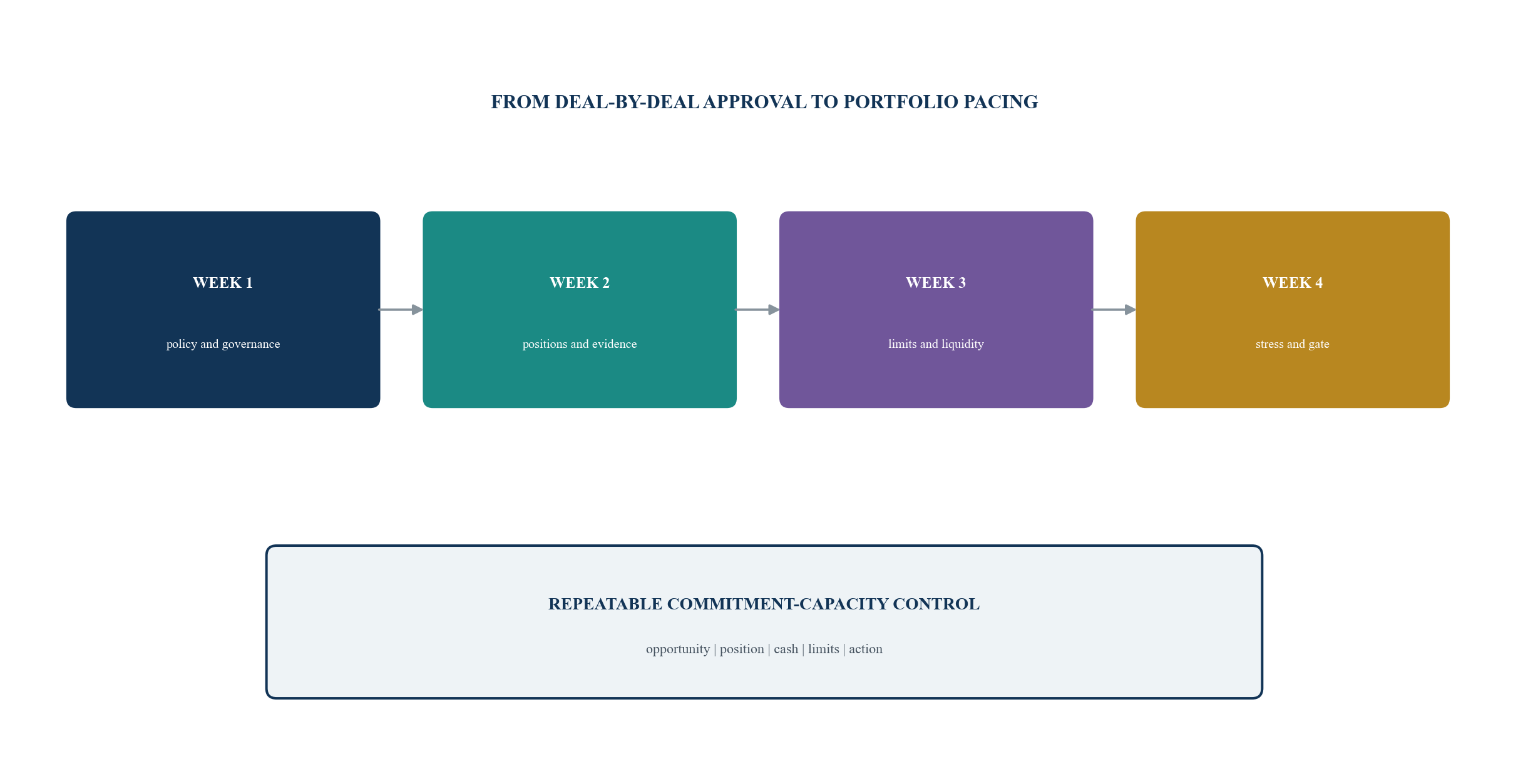
The control office connects opportunity review to portfolio capacity and executable liquidity.
18. Conclusion
Pre-IPO secondary portfolios combine negotiated entry with uncertain exit. Diversification by holding count can conceal common acquisition vintages, valuation regimes, issuer dependencies and expected liquidity windows. Commitment capacity should therefore be governed through look-through exposure and cash evidence.
The framework separates five clocks, adjusts marks before using them in limits, and applies vintage, issuer, security, dependency, manager and exit-window controls. It distinguishes investment conviction from transaction readiness and treats expected exits as scenario resources until settlement evidence supports stronger treatment. Follow-ons and financing enter the same capacity model.
SEC materials define specific US resale considerations. FCA findings reinforce independent, documented and trigger-based valuation. IOSCO and ILPA materials support disciplined liquidity, cash-flow and performance controls within their respective scopes. Each investor requires current professional advice for its actual mandate and transactions.
For investment committees, the result is a visible answer to how much can be committed now and why. For finance teams, it is a downside cash and reserve plan. For transaction teams, it links possession, transferability and settlement to portfolio construction. For advisers, it creates a route from ten-day diagnostic to retained monitoring, acquisition, financing and exit execution. Commercial demand and fees remain unverified until evidenced by signed engagements and collected payments.
References
- US Securities and Exchange Commission. Private Secondary Markets. Updated 24 April 2026. https://www.sec.gov/resources-small-businesses/capital-raising-building-blocks/private-secondary-markets
- US Securities and Exchange Commission. Rule 144: Selling Restricted and Control Securities. https://www.sec.gov/reports/rule-144-selling-restricted-control-securities
- US Securities and Exchange Commission. Frequently Asked Questions About Exempt Offerings. https://www.sec.gov/resources-small-businesses/exempt-offerings/frequently-asked-questions-about-exempt-offerings
- US Securities and Exchange Commission. Securities Act Rules: Compliance and Disclosure Interpretations. https://www.sec.gov/rules-regulations/staff-guidance/corporation-finance-interpretations/securities-act-rules
- Financial Conduct Authority. Private Market Valuation Practices. 5 March 2025. https://www.fca.org.uk/publications/multi-firm-reviews/private-market-valuation-practices
- International Organization of Securities Commissions. Revised Recommendations for Liquidity Risk Management for Collective Investment Schemes. May 2025. https://www.iosco.org/library/pubdocs/pdf/IOSCOPD798.pdf
- International Organization of Securities Commissions. Guidance for Open-ended Funds for Effective Implementation of the Recommendations for Liquidity Risk Management. May 2025. https://www.iosco.org/publications/?subsection=public_reports
- Institutional Limited Partners Association. Performance Template: Granular Methodology, version 1.1. 28 April 2025. https://ilpa.org/resources-tools/resource-library/ilpa-performance-template-granular-methodology-v-1-1/
- Institutional Limited Partners Association. Commitment and Cash Flow Modeling. 2019. https://ilpa.org/wp-content/uploads/2019/06/2019-ILPA-MCON-Commitment-Cashflow-Modeling-FINAL.pdf
- Institutional Limited Partners Association. Portfolio Management: Investing in Private Equity. https://ilpa.org/wp-content/uploads/2017/05/2017-ILPA-MCON-Boston-Portfolio-Management_FINAL.pdf
- Institutional Limited Partners Association. Quantitative 101. https://ilpa.org/wp-content/uploads/2016/02/ILPA-MOC-Chicago_Quant101_FINAL.pdf
About the Author
Chennakeshav Adya, Independent Researcher
