

1. Liquidity and control must be defined before an instrument is selected
A family group can be wealthy on a consolidated balance sheet and illiquid at the level where family obligations, succession payments, acquisitions or diversification commitments arise. Mature subsidiaries may generate stable earnings, yet their cash belongs to separate legal entities. Existing lenders, minority shareholders, regulatory requirements, working-capital needs and distributable-reserve tests can constrain movement to the holding company. The practical question is therefore narrower than how much the group is worth. It is how much cash can be raised, by which entity, against which assets and cash flows, with which rights granted to the capital provider.
Control is also multidimensional. A family can retain more than 50 percent of votes and still lose meaningful control through board composition, vetoes, information rights, business-plan approvals, leverage limits, dividend restrictions, forced-sale provisions or default remedies. An investor can hold no ordinary votes and still obtain decisive influence over acquisitions, disposals, budgets or management appointments. Transaction design should measure legal ownership, operating authority, economic participation and exit power separately.
The family should begin with a written liquidity charter. It states the required net proceeds, use of funds, acceptable cost, preferred funding entity, protected assets, minimum voting ownership, board composition, reserved matters, dividend capacity, maximum leverage, permitted security, investment horizon and acceptable exit routes. It should also distinguish family liquidity from corporate growth capital. Mixing the two can create conflicts over whether operating subsidiaries should service a transaction whose proceeds leave the business.
The charter needs a clear beneficiary and purpose. Liquidity for estate equalisation has different duration and certainty requirements from liquidity for a new acquisition. A one-off tax or succession payment may justify a bridge followed by asset disposal. A long-term family diversification programme may suit perpetual or redeemable preferred capital. A growth investment into a subsidiary may be best funded directly at that subsidiary so that the capital and return obligations remain aligned.
Governance should precede negotiation. The IFC Family Business Governance Handbook describes the overlapping roles of owner, family member, director and manager, and recommends clearer family and corporate governance as complexity increases [1]. The UAE Family Business Law provides a statutory framework concerning family businesses and recognises the role of family constitutions and governance arrangements [2]. DIFC's Family Arrangements Regulations support structures for family entities, offices and businesses [3]. These frameworks do not prescribe a single financing instrument. They reinforce the need to decide who has authority to raise capital, encumber assets and grant investor rights.
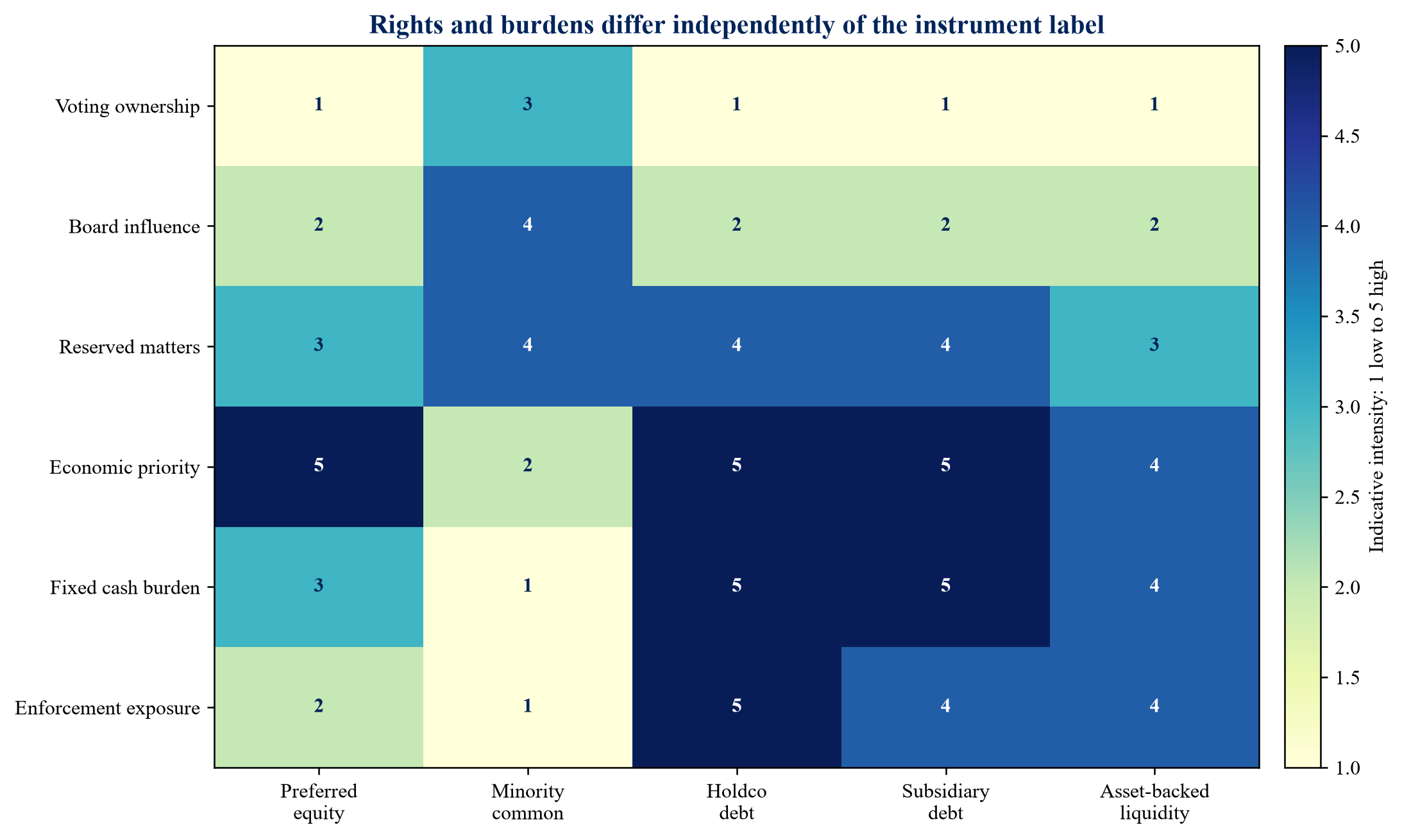
The matrix is author-designed. Rights shown are indicative and depend on negotiated documents and applicable law.
A transaction succeeds when the family receives sufficient net liquidity and the operating businesses retain enough capacity to invest, withstand stress and meet obligations. A nominally non-dilutive structure can fail this test if fixed distributions or redemption absorb future cash. A minority equity structure can satisfy it if governance is carefully bounded and the investor's return comes mainly from genuine value creation. The decision should therefore be based on total economic and control burden, rather than the security label.
2. The funding perimeter determines value, recourse and governance
The same capital can be raised at the family holding company, an intermediate holding company, a mature subsidiary or a special-purpose vehicle. Each location changes the collateral, cash-flow route, tax profile, minority protections, accounting outcome and enforcement risk. A group chart should show legal ownership, jurisdiction, management, debt, security, guarantees, cash, distributable reserves, regulatory status and related-party arrangements for every material entity.
A holding-company instrument provides liquidity close to the family and can avoid direct dilution in an operating subsidiary. Its repayment or distribution capacity depends on dividends, fees, interest or asset-sale proceeds received from below. This structural subordination means operating creditors and subsidiary lenders are paid first. If the holding company grants share security, enforcement may transfer ownership of valuable subsidiaries even when operating companies remain solvent.
A subsidiary-level investment gives the capital provider direct access to the relevant cash flow and assets. It can achieve a lower required return because structural leakage is reduced. The family then introduces a minority investor into the operating entity and must govern business plans, distributions, acquisitions, related-party dealings and exit. The arrangement can also complicate intra-group transfers, shared services and future restructurings.
An intermediate vehicle can ring-fence a selected portfolio of subsidiaries. It allows the family to raise against mature assets while excluding strategic or regulated businesses. The structure requires genuine ownership transfers, tax analysis, lender consent, valuation and corporate-benefit work. Moving assets shortly before financing can trigger transfer taxes, gains, pre-emption rights, change-of-control clauses or creditor challenges.
An asset-backed special-purpose vehicle can purchase receivables, property interests, contracted cash flows or other eligible assets. This may create liquidity without issuing group-level equity. The transaction requires true-sale or enforceable-security analysis, asset eligibility, concentration limits, servicing controls, collection accounts and insolvency remoteness. Asset monetisation should be connected to real cash generation rather than a temporary accounting presentation.
The perimeter should be tested under enforcement. The family should understand which shares, accounts, receivables, property or contractual rights can be transferred; which consents are required; whether guarantees are valid; and how local insolvency law ranks claims. A capital provider's remedy should be proportionate to the funded risk. Cross-defaults and broad security can turn a limited liquidity transaction into a claim across the group.
Table 1. Funding-route comparison across control, cash flow and downside
| Route | Cash certainty | Family voting ownership | Cash-flow burden | Main governance burden | Principal downside risk |
|---|---|---|---|---|---|
| Preferred equity | High at closing when fully funded | Usually preserved | Contractual or discretionary preferred distributions; redemption may be required | Protective rights, board observer, exit and information rights | Debt-like economics can accumulate and force a sale or refinancing |
| Structured minority common | High at closing | Reduced but commonly above control threshold | Dividends only when declared; investor return relies on equity value | Board seat, reserved matters, anti-dilution, tag and exit rights | Strategic disagreement and exit pressure |
| Holding-company debt | High at closing subject to conditions | Preserved until enforcement | Fixed interest, amortisation and maturity | Covenants, security, cash controls and reporting | Structural subordination and refinancing cliff |
| Subsidiary debt | High for operating or permitted upstream use | Preserved until enforcement | Fixed service at cash-generating entity | Operating covenants and local security | Reduced investment capacity and covenant lock-up |
| Asset-backed monetisation | Linked to eligible asset pool | Preserved | Collections and reserves service investors | Eligibility, concentration, servicing and account control | Asset performance or legal-transfer failure |
The assessment is author-designed. Actual outcomes depend on terms, jurisdiction, tax, accounting and existing financing.
The perimeter decision should be made through a sources-and-uses model. Gross proceeds are reduced by fees, taxes, reserve funding, existing debt repayment and minimum cash requirements. The model should state where net cash lands and whether it may be distributed to the intended beneficiary. It should also identify cash retained in operating companies and the capacity available for planned investment.
3. Preferred equity is a bundle of cash-flow, priority and control rights
Preferred equity can provide funded liquidity while preserving ordinary voting ownership. Its economic effect depends on dividend, liquidation, conversion, redemption and governance provisions. The family should model the instrument as a contract rather than assume that the word equity means permanent, junior or non-controlling capital.
The preferred return may be cash-pay, payment-in-kind, cumulative, non-cumulative, participating or performance-linked. A cash-pay dividend creates a recurring burden similar to interest, subject to company-law distribution capacity. A PIK return preserves near-term cash while compounding the liquidation or redemption amount. A cumulative dividend can become a growing claim ahead of ordinary shareholders. Participation gives the investor both priority and a share of residual upside.
Liquidation preference defines the distribution priority on a sale, liquidation or other specified event. A 1.0 times non-participating preference commonly allows the investor to choose between its preference amount and conversion into ordinary equity. A participating preference can return invested capital and then share in the residual. Seniority across multiple classes matters. A modest headline return can produce a large economic transfer when participation, compounding and broad deemed-liquidation events are combined.
Redemption is a central design choice. Investor redemption rights can create a contractual obligation to deliver cash at a fixed date or on demand. The group may need to refinance or sell assets if distributable reserves and liquidity are insufficient. Issuer call rights improve family flexibility while usually requiring a minimum return or make-whole. A negotiated redemption window, cash-flow sweep and extension mechanism can align liquidity with the family's planning horizon.
IAS 32 classifies a financial instrument according to the substance of contractual arrangements. The distinction between liability and equity turns materially on whether the issuer has an obligation to deliver cash or another financial asset [4]. A preference share can therefore be presented as a financial liability when its terms create a cash obligation. Compound instruments can require separate liability and equity components. Accounting advisers should assess the final documents, since classification affects leverage, earnings, covenants and stakeholder perception.
Conversion rights can protect downside or share upside. A fixed-price conversion may dilute the family after underperformance. A valuation-based or event-based conversion can transfer control when milestones are missed. Anti-dilution adjustments and pay-to-play provisions affect future fundraising. The family should calculate fully diluted ownership at each conversion trigger and future capital round.
Governance rights should protect the investor without giving routine operating control. Appropriate reserved matters may cover new senior securities, material asset sales, related-party transactions, changes to constitutional documents, dividends outside policy, leverage above an agreed threshold and transactions that prejudice the preferred class. A veto over annual budgets, ordinary hiring or routine contracts can obstruct management. Time limits, materiality thresholds, deemed consent and dispute escalation reduce this risk.
Table 2. Preferred-capital rights matrix for negotiation and governance
| Right | Investor purpose | Family risk | Control-preserving design response |
|---|---|---|---|
| Cumulative preferred return | Protect time value and downside | Compounding claim can consume future equity value | Cap accrual, permit cash/PIK election, link step-up to controllable events |
| Liquidation preference | Priority on downside or exit | Broad triggers can capture reorganisations or ordinary asset sales | Use precise events, non-participating structure and clear conversion election |
| Redemption | Defined liquidity horizon | Maturity can force refinancing or sale | Use window, affordability test, extension and staged redemption |
| Board or observer right | Information and oversight | Informal influence can expand into operating control | Define role, confidentiality, conflicts and recusal |
| Reserved matters | Prevent value leakage or senior claims | Low thresholds can paralyse ordinary business | Apply materiality, scope, response deadlines and escalation |
| Put, call and exit rights | Provide route to liquidity | Investor can force a sale at an adverse time | Sequence issuer call, market process and fair-value mechanism |
| Anti-dilution | Protect against down rounds | Future capital becomes expensive and dilutive | Prefer broad-based weighted average and defined exclusions |
| Information rights | Monitor performance and compliance | Burden and confidentiality risk | Standard pack, secure portal, purpose limits and data controls |
The provisions are illustrative design choices. Counsel must tailor the documents to the relevant entities and law.
The term sheet should include worked examples. It should calculate returns and family proceeds at low, base and high exit values; under cash-pay and PIK elections; before and after conversion; and at each redemption date. Written examples expose interactions that summary drafting can hide.
4. Structured minority common equity exchanges ownership for flexible cash flow
Minority common equity usually creates no fixed return or contractual redemption obligation. The investor participates directly in value appreciation and receives dividends when lawfully declared. This can preserve operating cash during stress and align the parties around growth. The family gives up a permanent share of the subsidiary or holding company and accepts minority governance rights.
Valuation becomes more visible than in preferred capital. The parties must agree enterprise value, debt, cash, normalised working capital, non-operating assets and any control or marketability considerations. Primary capital and secondary liquidity should be separated. A USD 55 million cheque can partly fund the business and partly purchase family shares, with different effects on ownership and balance-sheet resilience.
The investor's percentage alone does not determine influence. Board representation, quorum, reserved matters, information rights, pre-emption, anti-dilution, dividend policy, related-party rules and exit provisions can confer meaningful control. IFRS 10 describes control through power, exposure to variable returns and the ability to use power to affect returns [5]. An investor with less than half the votes can influence accounting conclusions if contractual rights are substantive. IAS 28 can apply when an investor has significant influence [6]. Both parties should evaluate governance and accounting together.
Related-party transactions require particular discipline in family groups. Shared services, property leases, shareholder loans, procurement, management remuneration and brand licences can move value between entities. The G20/OECD Principles call for material related-party transactions to be identified, disclosed and managed with conflicts controlled [7]. A minority investment should establish an approved policy, arm's-length evidence, independent review for material items and recusal by interested decision-makers.
Exit design must be executable and balanced. A tag right protects the investor if the family sells control. A drag right can facilitate a whole-company sale, although thresholds and minimum value matter. An investor put transfers liquidity risk back to the family. An initial public offering right may be aspirational unless the company is capable of public-market governance and reporting. A structured market process after an agreed period can provide price discovery while giving the family a first opportunity to buy.
The family can protect control through ownership floors, limited reserved matters, chair appointment, casting-vote rules, management authority and restrictions on transfers to competitors. The investor can protect capital through board representation, information, business-plan consultation, pre-emption and consent over fundamental changes. These provisions should create accountable governance rather than duplicate management.
Minority common capital suits a family that accepts shared value creation, expects material growth and can support a credible eventual liquidity event. It is less suitable when family members require a guaranteed buyback, strategic decisions are unlikely to be shared or related-party boundaries cannot be made transparent.
5. Debt and asset-backed liquidity preserve ownership while concentrating cash-flow risk
Holding-company debt leaves the equity register unchanged. It can provide a clear cost and maturity, and may be refinanced or prepaid. The burden is fixed. Interest and principal must be serviced through dividends or other upstream cash after operating companies meet their own obligations. Structural subordination and cash leakage therefore define capacity.
Debt sizing should use cash received by the borrower rather than consolidated EBITDA alone. The model should identify subsidiary operating cash, maintenance investment, taxes, local debt service, minority distributions, regulatory capital, distributable reserves and transfer timing. A cash-positive group can still default at the holding company if upstream payments are delayed or blocked.
Financial covenants can protect the lender while restricting family flexibility. Leverage, debt-service coverage, minimum liquidity, distribution tests, investment limits and permitted debt should be calibrated to entity-level forecasts. Security over subsidiary shares can expose the family to control loss on enforcement. A pledge cap, cure period, permitted refinancing and staged remedies may produce a more proportionate structure.
Subsidiary debt aligns servicing with operating cash flow and may offer stronger collateral. It can constrain the operating company's investment, acquisitions and distributions. Existing creditors may hold negative pledges or priority security. The family must decide whether extracting liquidity from a mature subsidiary leaves sufficient resilience for the business itself.
Asset-backed routes can target specific assets. Receivables facilities depend on obligor quality, dilution, disputes, concentration and collection control. Property-backed facilities depend on title, valuation, lease cash flow and enforcement. Sale-and-leaseback releases capital while creating rent obligations and potential loss of strategic property flexibility. Portfolio or net-asset-value facilities can borrow against several subsidiaries, though valuation triggers and lender remedies can transmit weakness from one asset across the portfolio.
Debt remains valuable when cash flows are predictable, leverage is modest, upstream routes are dependable and the family has a credible repayment plan. It becomes fragile when liquidity depends on uncertain dividends, refinancing is the only exit, or a business downturn would require operating companies to fund family-level obligations.
6. Legal capacity, distributions and class rights shape executable liquidity
Company law determines whether the issuer can create the instrument, grant rights, make distributions, redeem shares, provide financial assistance, guarantee obligations and encumber assets. Constitutional documents, shareholder agreements, licences and existing financing can add restrictions. A term sheet should be reviewed against the actual entity and jurisdiction before its economics are treated as available.
The UAE Family Business Law addresses governance and ownership arrangements for qualifying family businesses [2]. The UAE Commercial Companies framework governs company forms, share capital, management and corporate actions [8]. Free-zone regimes can apply separate company laws and regulations. DIFC Family Arrangements Regulations provide a framework for family entities and arrangements within DIFC [3]. Counsel must identify which regime governs each relevant entity and asset.
Distributions and redemptions commonly depend on profits, reserves, solvency, capital-maintenance procedures or board determinations. A contractual preferred return does not guarantee that a corporate dividend may lawfully be paid. If missed amounts accumulate, the economic claim can grow even while cash remains unavailable. The financing model should distinguish contractual accrual, lawful distribution capacity and actual liquidity.
The UK Companies Act 2006 restricts distributions to amounts available for that purpose and contains rules for share capital and class rights [9]. Articles of association and shareholder agreements define further rights. Private companies considering preferred capital should align class terms, allotment authority, pre-emption, redemption funding and distributable reserves. The Wates Principles provide a governance framework for large private companies, including purpose, board composition, responsibilities and stakeholder relationships [10].
India's Companies Act 2013 contains specific provisions for issue and redemption of preference shares, private placement, further issue of capital and shareholder approval [11]. Cross-border investment can also engage foreign-exchange rules, pricing, sector conditions and reporting administered through the Reserve Bank of India [12]. A family group spanning India and another jurisdiction needs entity-specific advice on both issuance and movement of proceeds.
Saudi Arabia's Companies Law recognises different classes of shares and corporate forms, subject to its implementing framework and constitutional documents [13]. Capital-market or regulated entities face additional requirements. Across jurisdictions, the principles remain consistent: confirm power, approval, class rights, creditor protection, lawful distribution, enforceability, security perfection and remedies.
Minority protection should be designed rather than treated as a closing issue. New preferred rights can disadvantage existing ordinary or minority shareholders. Asset transfers to a financing vehicle can shift value. A fairness analysis, independent valuation, conflict disclosure and proper approval record can support both legality and family legitimacy.
7. Valuation must connect enterprise value to the security's actual payoff
Enterprise value provides a starting point. The investor receives a security with a particular priority, return, conversion, dilution, governance and exit profile. Its value depends on the distribution of future outcomes and the timing of cash. A headline percentage or coupon does not capture that payoff.
The valuation process should normalise earnings, identify maintenance capital expenditure, assess working capital, separate non-operating assets, reconcile debt-like items and test customer, supplier, management and geographic concentration. Mature subsidiaries can contain hidden cyclicality or underinvestment. Family-related expenses and transactions require evidence-based adjustments. Forecasts should reconcile operational drivers to cash generation.
The International Valuation Standards set principles for scope, bases of value, approaches, data and reporting [14]. A preferred security analysis should combine enterprise valuation with a waterfall or scenario allocation. The market approach can inform enterprise multiples. The income approach can value cash flows. The security allocation then applies priority, participation, conversion and exit terms across scenarios.
Fairness within the family matters alongside external valuation. A transaction that distributes proceeds to one branch while operating companies bear the burden can create future conflict. The family council and boards should record the purpose, beneficiaries, allocation of costs and effect on other owners. Independent directors or advisers can evaluate related-party aspects.
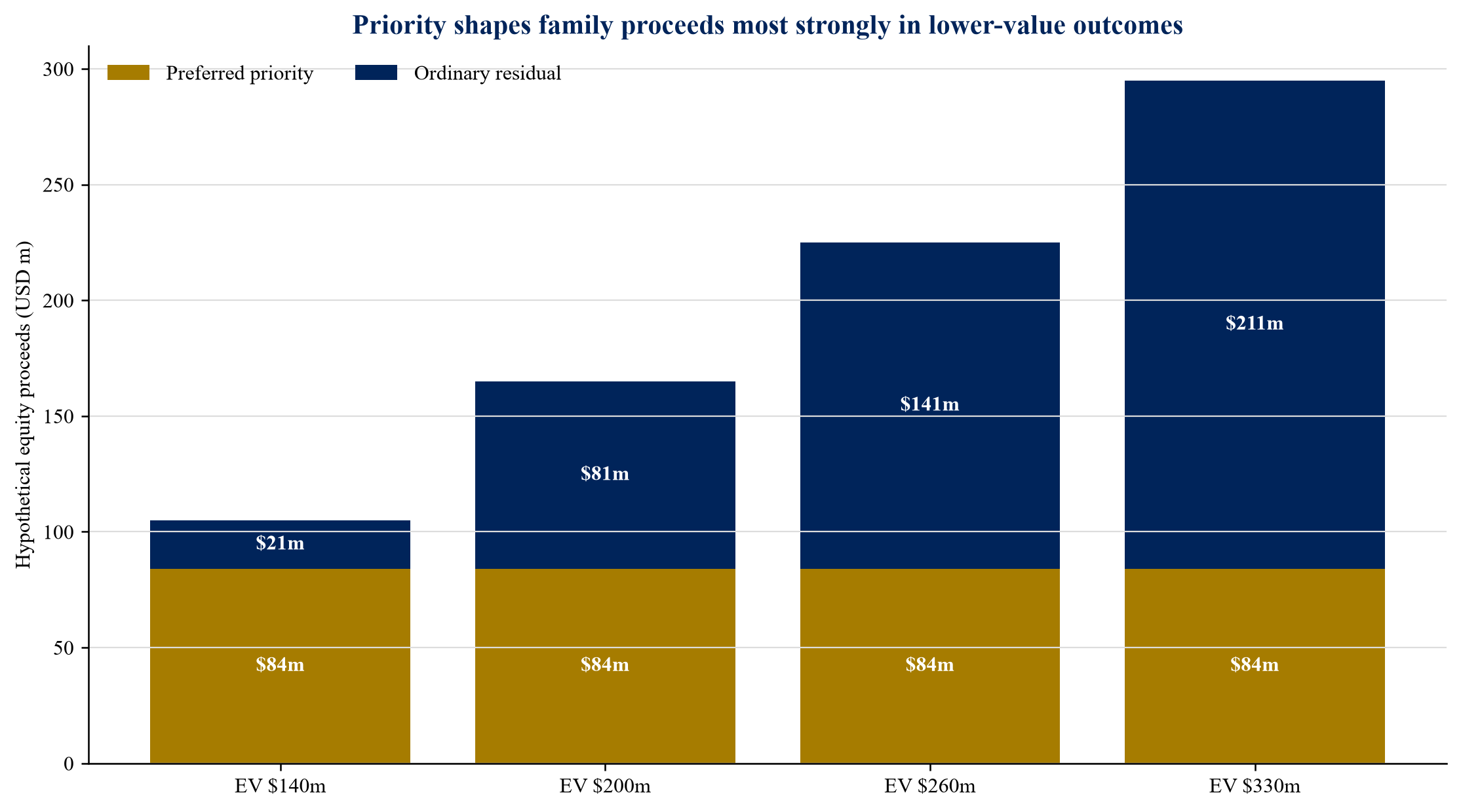
All values and terms are author assumptions. The figure illustrates priority and residual value at a hypothetical exit.
The waterfall should cover low outcomes where the preference absorbs most equity value, intermediate outcomes where conversion becomes attractive and high outcomes where participation or common ownership drives returns. It should calculate gross and net proceeds to each stakeholder after debt, transaction costs and taxes. The family should also test interim dividends and accumulated preferred return.
Valuation sensitivity should show the family's retained value, investor return and control outcome across EBITDA and exit multiple. The purpose is to identify terms that become unstable in plausible downside. A structure that works only at the base forecast transfers too much risk to future refinancing or sale.
8. A hypothetical USD 55 million liquidity case exposes the trade-offs
Consider an illustrative family group that owns three mature subsidiaries. Consolidated revenue is assumed at USD 310 million, EBITDA at USD 32 million and maintenance capital expenditure at USD 7 million. Existing net debt is assumed at USD 48 million. An 8.0 times EBITDA reference multiple implies enterprise value of USD 256 million and equity value of USD 208 million. The family seeks USD 55 million of net liquidity for succession equalisation and diversification while retaining operating control.
The first route is USD 55 million of preferred equity at the intermediate holding company. The assumed terms are an 8 percent cash dividend plus 3 percent PIK when cash is not paid, a 1.0 times non-participating liquidation preference, no ordinary votes, one board observer, defined protective rights and an issuer call from year four. If unredeemed, the investor can initiate a structured liquidity process after year six, with the family retaining a matching right and a fair-value mechanism.
The second route is USD 55 million for 25 percent of the common equity at an assumed USD 220 million post-money valuation. The investor receives one of five board seats, pre-emption, information, tag rights and consent over fundamental transactions. There is no contractual dividend or redemption. After year six, either party can initiate a market-tested liquidity process, subject to family purchase rights.
The third route is a USD 55 million secured holding-company facility with an assumed 9.5 percent cash interest rate, 1 percent annual amortisation and a five-year bullet. Security includes shares in two subsidiaries and controlled distribution accounts. The assumed annual cash service in the first year is about USD 5.8 million before fees. The family must refinance or repay the remaining principal at maturity.
Table 3. Hypothetical sources, uses and economics for three liquidity routes
| Item | Preferred equity | Minority common | Holding-company debt |
|---|---|---|---|
| Gross capital | USD 58.0m | USD 58.0m | USD 58.5m |
| Fees, taxes and reserves | USD 3.0m | USD 3.0m | USD 3.5m |
| Net family liquidity | USD 55.0m | USD 55.0m | USD 55.0m |
| Opening ordinary ownership retained | 100% | 75% | 100% |
| Assumed year-one cash burden | USD 4.64m | Discretionary | USD 5.8m |
| Accumulation or maturity | 3% PIK on unpaid amount; call from year 4 | No contractual accumulation | Five-year maturity with bullet balance |
| Main control exposure | Protective rights and exit process | Permanent minority rights and board seat | Share enforcement and covenant control |
Every value, rate, term and outcome is an author assumption without market calibration.
The base case assumes EBITDA grows 4 percent annually, cash conversion after maintenance investment and tax is 65 percent of EBITDA, and the group maintains USD 12 million of operating liquidity. Each route is affordable in the first two years. Preferred cash distributions consume less cash than debt service, while PIK flexibility absorbs a temporary shortfall. Minority common leaves distributions fully discretionary. Debt has the lowest opening dilution and the clearest refinancing requirement.
The downside case assumes EBITDA falls 15 percent in year one, recovers slowly and the exit multiple falls to 7.0 times. The preferred issuer elects to pay half the preferred return in cash and half in PIK. The claim grows, but the group avoids a cash default. The common investor absorbs the enterprise-value decline alongside the family. The debt route continues to require full cash interest and approaches its covenant threshold.
The severe case assumes EBITDA falls 25 percent, cash conversion declines to 50 percent and the reference multiple falls to 6.0 times. The preferred instrument accrues its return and suspends ordinary distributions. Reserved-matter and information rights intensify, but a sale is not automatic under the assumed terms. Common equity carries no fixed cash burden, although investor and family may disagree on reinvestment and exit. Debt breaches the assumed coverage covenant and requires a waiver, equity cure, asset sale or restructuring.
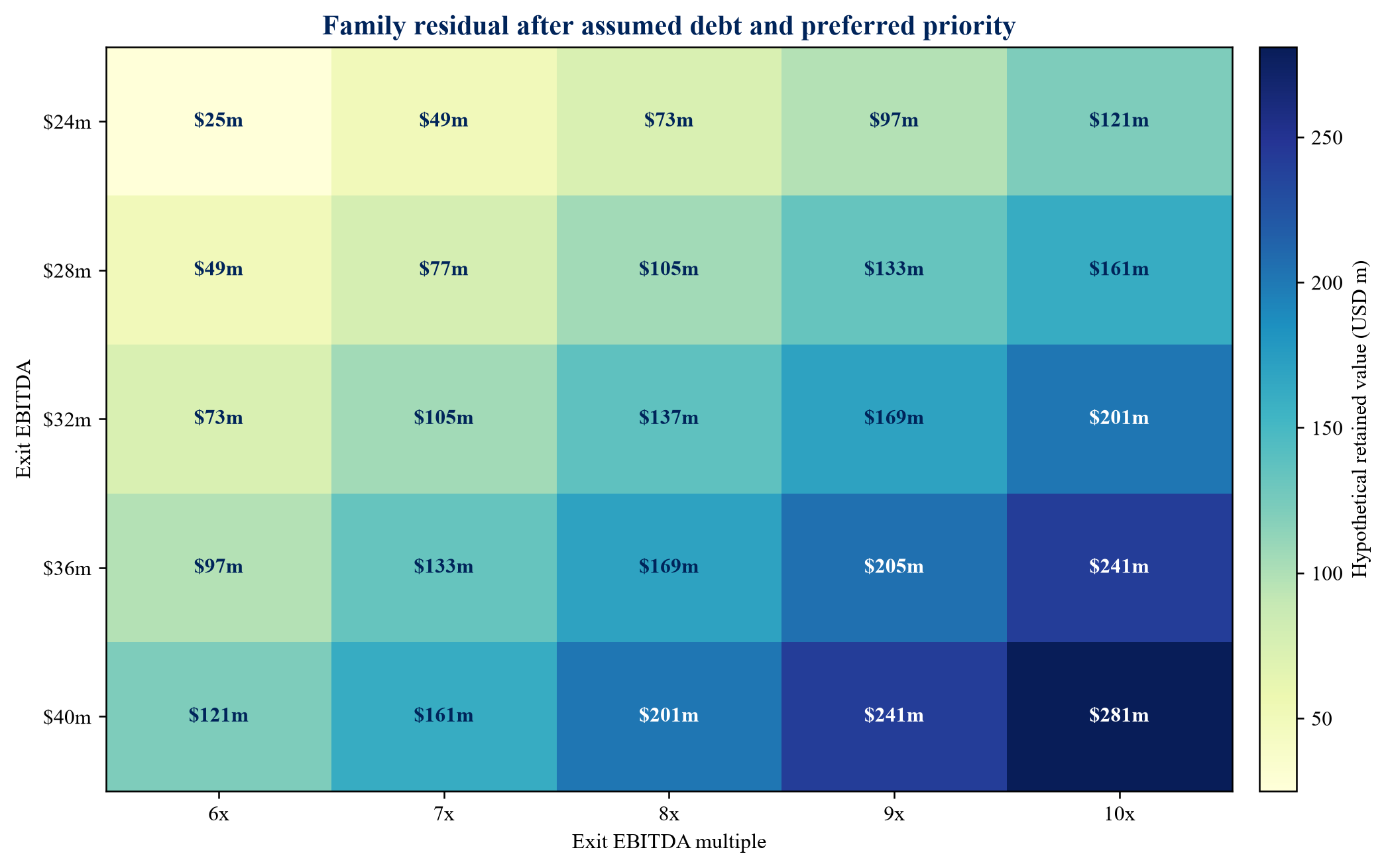
All EBITDA, multiple, debt and instrument values are author assumptions. The chart is illustrative rather than a market valuation.
At a hypothetical year-five enterprise value of USD 330 million and net debt of USD 35 million, equity value is USD 295 million. If the preferred claim has grown to USD 84 million and remains non-participating, the investor compares redemption with conversion terms, if any. The family retains the residual after priority. Under minority common, the investor's 25 percent interest is worth USD 73.75 million before costs and taxes, and the family retains USD 221.25 million. Under debt, the family owns all equity after repaying the remaining facility, but has carried higher fixed service and refinancing risk.
The numerical comparison does not identify a universal winner. Preferred equity provides near-term control preservation and cash flexibility at the price of priority and future liquidity pressure. Minority common shares downside and upside while permanently diluting ownership. Debt preserves upside when performance is strong while concentrating downside and maturity risk. The family should select the route whose failure mode it can govern.
9. Exit engineering should begin at signing
Capital becomes difficult when the exit path is left to future negotiation. The transaction should identify the probable source of investor liquidity, the earliest date, required conditions, valuation method, process and fallback. The exit path must also fit expected family succession, strategic plans and capital expenditure.
An issuer redemption can be funded from retained cash, subsidiary dividends, refinancing, a new investor, asset sale or partial public offering. Each source has constraints. Retained cash may be needed for operations. Dividends depend on distributable reserves and local obligations. Refinancing depends on future markets. Asset sales take time. A credible plan uses several sources and begins preparation well before the redemption window.
A family call right can preserve control by allowing repurchase before an external sale. Pricing can be fixed by formula, independent valuation or market test. A formula is predictable but may detach from economic reality. An independent valuation needs scope, assumptions and dispute rules. A market process can establish price while creating confidentiality and execution risk. The documents should state which mechanism prevails and how disagreements are resolved.
An investor put creates certainty for the investor and funding risk for the family. It should be subject to legal distribution capacity, solvency, cure time and an agreed process when cash is unavailable. Transforming an unpaid put into immediate control or a broad forced sale may be disproportionate. Staged redemption, extension return and sale of a defined asset pool can provide a more orderly remedy.
Drag rights should protect against holdout risk while respecting valuation and control. The threshold, minimum return, permitted buyer, representations, liability allocation and treatment of rollover equity matter. Tag rights should allow minorities to participate on equivalent terms. A sale process should address family employment, brand, property and related-party arrangements before bids are sought.
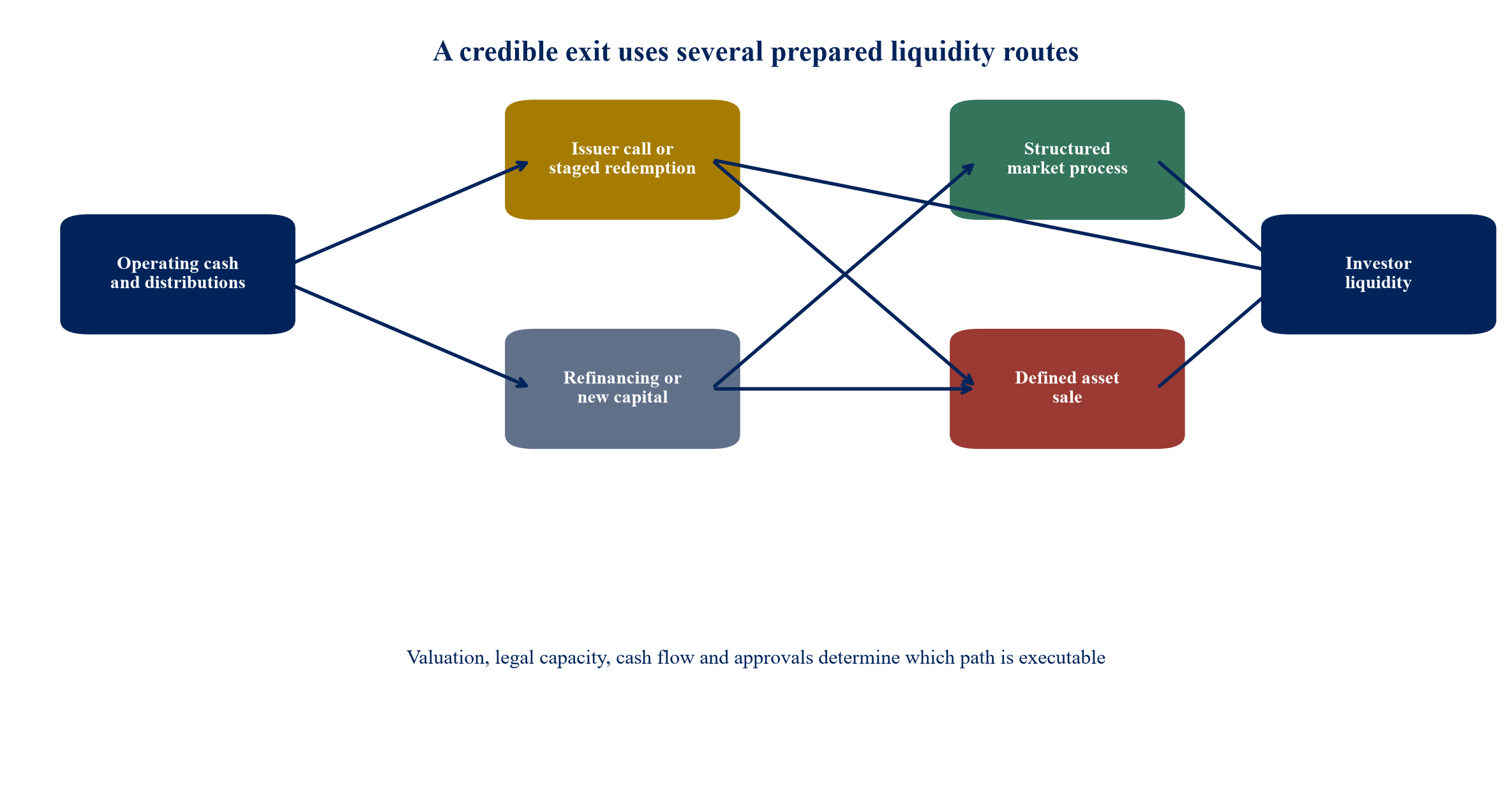
The map is author-designed. Timing and availability depend on performance, law, documents and market conditions.
Exit readiness should be monitored through a rolling 24-month plan. It includes forecast distributable cash, leverage capacity, valuation range, diligence readiness, potential capital providers, asset-sale candidates and required approvals. A traffic-light system can trigger early refinancing work when coverage, growth, valuation or timing moves outside the agreed corridor.
10. Tax and accounting can change the apparent cost of capital
The legal form and accounting presentation of preferred capital can diverge. IAS 32 focuses on contractual substance and cash obligations [4]. IFRS 9 can govern recognition and measurement when an instrument is a financial liability [15]. IFRS 7 requires relevant risk disclosures [16]. IFRS 10 and IAS 28 address control and significant influence [5][6]. The final terms can therefore affect leverage ratios, earnings, finance costs, consolidation and covenant compliance.
Tax treatment depends on issuer, holder, jurisdiction and instrument. Distributions may be treated differently from interest. Deductibility, withholding, participation exemptions, transfer pricing, hybrid-mismatch rules and anti-abuse provisions require transaction-specific analysis. A return described as a dividend can receive debt-like accounting and a different tax outcome. Models should show gross cash paid, tax withheld, recipient cash and issuer after-tax cost separately.
The UAE corporate-tax regime includes participation-exemption provisions and interest-deduction rules, subject to detailed conditions and guidance [17][18]. Cross-border flows remain affected by source-country withholding and treaty access. The family should validate beneficial ownership, residence, substance, transfer pricing and documentation for the actual structure.
Asset transfers into a financing vehicle can create gains, duties, value-added tax, registration cost or loss of tax attributes. Related-party pricing must be supportable. Debt secured over shares can affect interest limitation and acquisition-finance rules. Minority investment can change group relief, consolidation or exemption conditions. Tax work should therefore be integrated before the perimeter is fixed.
The board should receive an accounting and tax bridge. It reconciles legal form, balance-sheet classification, income-statement effect, cash payments, tax cost, covenant treatment and distributable reserves. It should show outcomes under base and stress cases. This prevents a nominally cheaper instrument from creating an unexpected leverage or cash burden.
11. A control-preserving transaction requires a disciplined process
The first phase defines the objective and perimeter. The family council or authorised owner body approves the liquidity charter. Management builds the group map, cash-flow forecast and strategic plan. Advisers identify candidate entities and assets. The board assesses corporate benefit and conflicts. Existing financing and shareholder documents are reviewed before investors are approached.
The second phase creates a fact base. Financial diligence normalises earnings and cash conversion. Legal diligence covers ownership, authority, class rights, distributions, material contracts, litigation, licences, security and change of control. Tax diligence covers the instrument, flows and restructuring. Commercial diligence tests market position and downside. The data room should distinguish verified facts from management forecasts and assumptions.
The third phase compares structures through a single model. Each route uses the same operating cases, enterprise valuation and transaction date. The model calculates net proceeds, annual cash burden, leverage, dilution, investor return, family retained value and control rights. It also tests exit failure, delayed refinancing, covenant stress and adverse valuation.
The fourth phase runs a controlled capital process. Potential providers receive consistent information and a clear request. Indicative proposals are compared through a term matrix rather than headline price alone. The family assesses certainty, conditions, rights, funding source, reputation, decision process and ability to support the business. Final bidders receive confirmatory diligence within a defined timetable.
The fifth phase documents governance and exit. Constitutional amendments, investment agreements, financing documents, security, intercreditor arrangements, distribution policy and family governance should align. Worked waterfall examples should be attached or agreed. The closing funds flow should identify gross proceeds, fees, taxes, reserves, repayment and final beneficiary accounts.
Table 4. Monitoring triggers and governance responses after closing
| Trigger | Risk indicated | Management response | Board or investor response |
|---|---|---|---|
| EBITDA or cash conversion falls below plan | Distribution, service or redemption capacity is weakening | Reforecast entity cash and protect maintenance investment | Review dividend election, covenant headroom and remediation |
| Preferred claim exceeds agreed share of equity value | Compounding is consuming residual value | Prepare cash-pay, partial redemption or refinancing plan | Activate formal liquidity-path review |
| Holding-company coverage falls below buffer | Upstream cash may not support debt service | Restrict discretionary distributions and preserve liquidity | Consider cure, waiver, refinancing or asset monetisation |
| Related-party transaction exceeds threshold | Minority fairness and value leakage concern | Produce arm's-length evidence and conflict declaration | Independent approval or shareholder process |
| Exit readiness misses timetable | Redemption or investor liquidity may be delayed | Complete diligence, valuation and capital-provider work | Apply extension process and revised milestones |
| Reserved-matter response is delayed | Governance is obstructing ordinary execution | Apply materiality, escalation and deemed-consent process | Chair or dispute-resolution intervention |
Thresholds are illustrative and should be calibrated to the final instrument and operating plan.
The process should preserve optionality. A family may combine a smaller preferred instrument with a modest debt facility, or pair minority growth capital with secondary liquidity. Layering can reduce dependence on one exit source. It also introduces intercreditor, priority and governance complexity, which must be modelled explicitly.
12. Technology and data can make rights, value and liquidity observable
Family groups often manage information across subsidiaries, jurisdictions and systems. A transaction-grade data layer can consolidate financial performance, cash, debt, distributions, covenants, cap tables, shareholder rights and approvals. Each metric should retain its entity, source, date and owner. This supports both investor diligence and post-closing governance.
A digital rights register can translate constitutional and financing documents into structured fields. It records voting thresholds, board rights, reserved matters, dividend conditions, redemption windows, conversion terms, security and transfer restrictions. Alerts can identify an approaching approval, covenant test or liquidity date. Counsel remains responsible for interpretation, while the register makes obligations visible to management.
Scenario modelling can connect operating drivers to the investor waterfall. Revenue, margin, capital expenditure, working capital, debt and valuation assumptions flow into distributions, preferred accrual, conversion value, covenant headroom and family retained value. The model should be version-controlled and approved. Every manually overridden input should have a reason and owner.
Artificial intelligence can assist with document comparison, clause extraction, data-room classification, financial variance analysis and scenario generation. Outputs require accountable human review. Legal rights, tax treatment, accounting classification and valuation conclusions must be established from signed documents, reliable data and professional judgement. Confidential family and transaction data also requires access controls, approved storage and retention rules.
A board dashboard should focus on decisions. It shows operating cash generation, distributable capacity, fixed and discretionary payments, preferred claim, debt service, covenant headroom, implied equity value, ownership, reserved matters and exit milestones. The dashboard should reconcile to audited or management accounts and identify assumptions. This allows the family and capital provider to address emerging issues before they become control events.
13. A 120-day roadmap can convert illiquid ownership into governed liquidity
Days 1 to 20 establish authority and objectives. The family approves the liquidity charter and decision process. Management confirms uses, beneficiaries and timing. Advisers map entities, ownership, debt, security and cash-flow routes. The board identifies conflicts, protected assets and the initial funding perimeter.
Days 21 to 45 build the evidence base. Financial and commercial diligence establish maintainable earnings, cash conversion and downside. Legal and tax advisers assess issuance capacity, class rights, distributions, security, transfer, withholding and approvals. An independent valuation establishes a range and explains key sensitivities. The family reviews effects on succession and internal fairness.
Days 46 to 65 design structures. Preferred, minority common, debt and asset-backed routes are modelled on the same assumptions. Rights matrices and waterfalls expose economic and control effects. The family selects a primary route and a credible alternative. The board approves parameters for valuation, proceeds, governance, leverage and exit.
Days 66 to 95 run the capital process. A controlled group of investors or lenders receives consistent materials. Management meetings focus on the business and proposed partnership. Indicative terms are compared across certainty, economics, rights and execution. Diligence is tracked to closure, with sensitive information released in stages.
Days 96 to 115 negotiate and document. The parties agree economics, governance, representations, covenants, information, conflicts, transfers, exit, valuation and remedies. Accounting and tax analyses are updated to the final terms. Existing lenders and shareholders provide required consents. Closing documents and funds flow are rehearsed.
Days 116 to 120 complete and transition. Funds settle into verified accounts. Fees, reserves and distributions reconcile to the approved funds flow. Governance bodies receive calendars and reporting templates. The rights register, scenario model and exit plan move to named owners. The board schedules the first post-closing review.
The roadmap should stop or redirect when evidence fails. Weak cash conversion may reduce proceeds. A valuable subsidiary may be excluded because existing covenants prohibit security. A preferred structure may be rejected because redemption would be classified as a liability and breach leverage limits. Early evidence preserves negotiating leverage by preventing late structural surprises.
14. Conclusion
Family groups can raise material liquidity against mature subsidiaries while retaining operating and voting control. The outcome depends on precise definition of the funding perimeter, rights, cash burden and exit. Security labels provide limited guidance. Preferred equity can contain a compounding priority and eventual sale pressure. Minority common can create durable partnership and governance. Debt can preserve upside while imposing fixed service and enforcement risk. Asset-backed routes can isolate value while requiring strong legal transfer and cash control.
The recommended decision system begins with a family liquidity charter and an entity-level fact base. It compares all routes through the same operating forecast, valuation and downside cases. It measures legal ownership, board influence, reserved matters, economic priority, fixed cash burden, security and exit power separately. It connects accounting, tax and company-law analysis to the actual contract.
The hypothetical case illustrates the trade-off. A USD 55 million preferred investment preserves opening ordinary ownership and offers cash-payment flexibility, while accumulating priority. A 25 percent minority common investment shares business risk and upside without fixed service. Holding-company debt retains full ownership until enforcement while creating the largest near-term cash burden and a five-year refinancing requirement. Every figure is assumed, yet the decision logic applies widely.
Control is preserved through governance quality as much as ownership percentage. A bounded rights matrix, independent valuation, conflict procedures, entity-level cash tests and credible exit plan protect both family and investor. A well-designed liquidity transaction converts concentrated enterprise value into usable capital while leaving the operating companies able to invest, adapt and remain under purposeful family stewardship.
References
- International Finance Corporation. Family Business Governance Handbook. 2011. https://www.ifc.org/en/insights-reports/2011/ifc-family-business-governance-handbook
- UAE Legislation. Federal Decree-Law No. 37 of 2022 Concerning Family Businesses. https://uaelegislation.gov.ae/en/legislations/1608
- Dubai International Financial Centre. Family Arrangements Regulations 2023. https://assets.difc.com/v1/media/edge/images/dubaiintern0078-difcexperie96c5-production-3253/media/project/difcexperiences/difc/difcwebsite/documents/familydocs/family_arrangements_regulations_updated_april23.pdf
- IFRS Foundation. IAS 32 Financial Instruments: Presentation. https://www.ifrs.org/issued-standards/list-of-standards/ias-32-financial-instruments-presentation/
- IFRS Foundation. IFRS 10 Consolidated Financial Statements. https://www.ifrs.org/issued-standards/list-of-standards/ifrs-10-consolidated-financial-statements/
- IFRS Foundation. IAS 28 Investments in Associates and Joint Ventures. https://www.ifrs.org/issued-standards/list-of-standards/ias-28-investments-in-associates-and-joint-ventures/
- OECD. G20/OECD Principles of Corporate Governance 2023. https://doi.org/10.1787/ed750b30-en
- UAE Legislation. Federal Decree-Law No. 32 of 2021 on Commercial Companies. https://uaelegislation.gov.ae/en/legislations/1542
- UK Legislation. Companies Act 2006. https://www.legislation.gov.uk/ukpga/2006/46/contents
- Financial Reporting Council. The Wates Corporate Governance Principles for Large Private Companies. https://www.frc.org.uk/library/standards-codes-policy/corporate-governance/the-wates-corporate-governance-principles-for-large-private-companies/
- India Code. Companies Act 2013. https://www.indiacode.nic.in/handle/123456789/2114
- Reserve Bank of India. Foreign Exchange Management Act and Master Directions. https://www.rbi.org.in/scripts/Fema.aspx
- Saudi Ministry of Commerce. Companies Law. https://mc.gov.sa/en/RulesAndRegulations/Pages/CompaniesLaw.aspx
- International Valuation Standards Council. International Valuation Standards. https://www.ivsc.org/standards/
- IFRS Foundation. IFRS 9 Financial Instruments. https://www.ifrs.org/issued-standards/list-of-standards/ifrs-9-financial-instruments/
- IFRS Foundation. IFRS 7 Financial Instruments: Disclosures. https://www.ifrs.org/issued-standards/list-of-standards/ifrs-7-financial-instruments-disclosures/
- UAE Federal Tax Authority. Corporate Tax Guide: Exempt Income, Dividends and Participation Exemption. https://tax.gov.ae/Datafolder/Files/Guides/CT/CT%20-%20Exempt%20Income%20-%20Dividends%20and%20Participation%20Exemption%20-%2016%2010%202023.pdf
- UAE Federal Tax Authority. Corporate Tax Guides and References. https://tax.gov.ae/en/taxes/corporate.tax/corporate.tax.guides.references.aspx
- International Finance Corporation. Corporate Governance FAQs for the Middle East and North Africa. 2016. https://www.ifc.org/en/insights-reports/2016/corporate-governance-faqs
- OECD. Corporate Governance Factbook 2023. https://doi.org/10.1787/6d912314-en
- Basel Committee on Banking Supervision. Principles for the Management of Credit Risk. 2025. https://www.bis.org/bcbs/publ/d591.htm
- Financial Action Task Force. International Standards on Combating Money Laundering and the Financing of Terrorism and Proliferation. https://www.fatf-gafi.org/en/publications/Fatfrecommendations/Fatf-recommendations.html
