

1. Translate the sales funnel into a credit evidence chain
A sales dashboard answers questions about commercial activity. A lender underwriting a development facility asks whether the reported demand can support debt repayment and reduce completion risk. These perspectives use some of the same records, yet the definitions and decision thresholds differ.
The evidence chain begins with an identified buyer and unit. It records the reservation, sales agreement, required registration, deposit, scheduled instalments, funds received into the approved account, financing plan, changes, default, cancellation, replacement and completion. Each state has a date, source record, responsible owner and financial consequence.
Headline gross sales value can overstate credit support when reservations remain revocable, deposits are small or refundable, payments are overdue, contracts lack required execution or registration, buyers are concentrated, mortgages remain uncertain, or the expected completion value is exposed to a market fall. The lender needs a governed subset whose policy attributes are evidenced.
The developer should therefore retain two views. The commercial funnel measures enquiry, reservation, conversion, price and absorption. The credit-evidence register measures legal commitment, cash at risk, payment performance, concentration, funding readiness and stressed settlement. Reconciliation between the views preserves one transaction history while allowing different decisions.
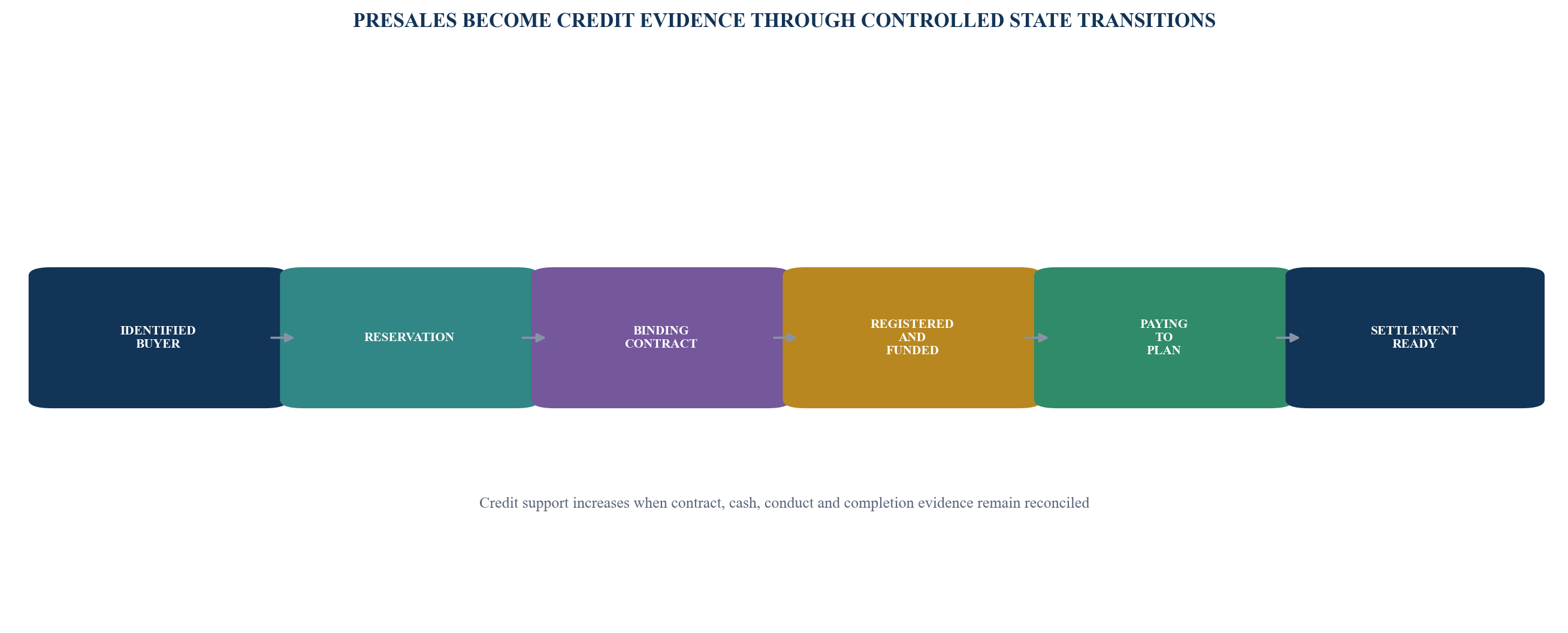
States and evidence requirements vary by project, contract, jurisdiction and lender policy.
2. Define the qualifying-presale policy before counting coverage
A qualifying-presale policy states which transactions can enter lender coverage and why. It should be agreed before facility sizing or draw conditions are tested. A percentage calculated without a controlled population can appear precise while combining transactions with very different credit value.
Basel's current framework describes residential acquisition, development and construction treatment using prudent underwriting and either a significant portion of qualifying presale or prelease contracts or substantial borrower equity at risk. Its presale description refers to legally binding written contracts and substantial buyer cash deposits subject to forfeiture if the contract is terminated. APRA's current practice guide describes good-practice policy features including legally binding contracts, arm's-length terms, a required non-refundable minimum deposit, appropriate sunset dates and limits on concentration to a buyer or foreign purchases.
These sources provide international prudential comparators. They do not create one universal commercial-lending threshold for every project. APRA's 2025 clarification confirms that its earlier reference to presales equivalent to committed debt was an observation of industry practice and not a minimum APRA expectation. Each lender must apply its current policy, jurisdictional rules, facility terms and credit judgement.
The developer's register should retain the lender's exact eligibility logic. Attributes can cover contract form, signatures, registration, arm's-length status, minimum cleared deposit, refundability, payment status, buyer identity, related parties, concentration, financing contingency, sunset date, completion date, legal opinion and approved exceptions. Transactions outside the definition remain visible as commercial demand without inflating qualifying coverage.
Table 1. Qualifying-presale policy register
| Policy attribute | Controlled evidence | Exclusion or adjustment | Decision owner |
|---|---|---|---|
| binding contract | final executed agreement and required authority record | reservation, incomplete execution or unresolved condition | lender legal and credit |
| buyer cash at risk | cleared deposit in approved account and contractual treatment | refundable, unpaid, financed or disputed amount | credit and project finance |
| arm's-length sale | identity, relationship and pricing evidence | related party, side agreement or unsupported incentive | compliance and credit |
| current payment | instalment schedule, receipts, ageing and approved cure | material arrears, returned funds or unapproved deferral | monitoring and credit |
| concentration | buyer, group, nationality, broker, unit and funding aggregates | excess above approved limits | credit committee |
| settlement route | equity, mortgage or other verified funding plan | unsupported funding assumption | lender and developer finance |
The policy is illustrative; actual lender criteria and legal conclusions require transaction-specific approval.
3. Establish one buyer and unit identity
Presales data can fragment across the customer relationship platform, booking engine, sales agreement repository, registration system, escrow bank, accounts receivable, mortgage desk and broker files. The same buyer may appear under different names, entities, passports, phone numbers or intermediaries. The same unit may be reserved, cancelled and resold several times.
The evidence model creates durable buyer, connected-party, contract and unit identifiers. It records the legal purchaser, beneficial owner where required, joint buyers, related entity, broker, payment source and intended use. It also preserves the transaction sequence so a replacement sale cannot erase the cancellation history.
Identity controls support concentration analysis, AML processes and settlement planning. A project with many contracts may have hidden economic concentration when several buyers are controlled by one family, employer, investment vehicle or sales channel. Payment sources can also reveal third-party funding that requires review.
The data steward should reconcile identity exceptions rather than silently merge them. Name similarity alone is insufficient. The resolution record states the evidence used, decision, date and owner. Personal data should be restricted to authorised purposes, retained under the applicable policy and shared with lenders through controlled fields and permissions.
4. Separate reservation, contract and registration states
A reservation expresses interest under defined terms. A sales agreement creates contractual rights and obligations when validly executed. Public registration can create another authoritative record under the applicable regime. These states should not be combined.
Dubai Land Department describes initial registration for off-plan transactions and provides a project registration service through Oqood that includes opening the project escrow account. Its published legislation states that specified off-plan dispositions before project approval and registration can be void and requires relevant sale proceeds to enter the project escrow account. The project's actual legal and registration requirements need current local advice.
The lender file should show contract date, signatures, conditions, unit, price, payment plan, deposit, cancellation, completion, assignment, purchaser remedies and required registration status. A legal review should identify whether any bespoke amendment, incentive, side letter or broker promise changes the standard form.
The state machine should prevent premature promotion. A transaction becomes contracted only when the required agreement evidence passes. It becomes registered only when the relevant authority record is verified. It becomes funded only when cleared cash is matched to the correct buyer, contract and unit.
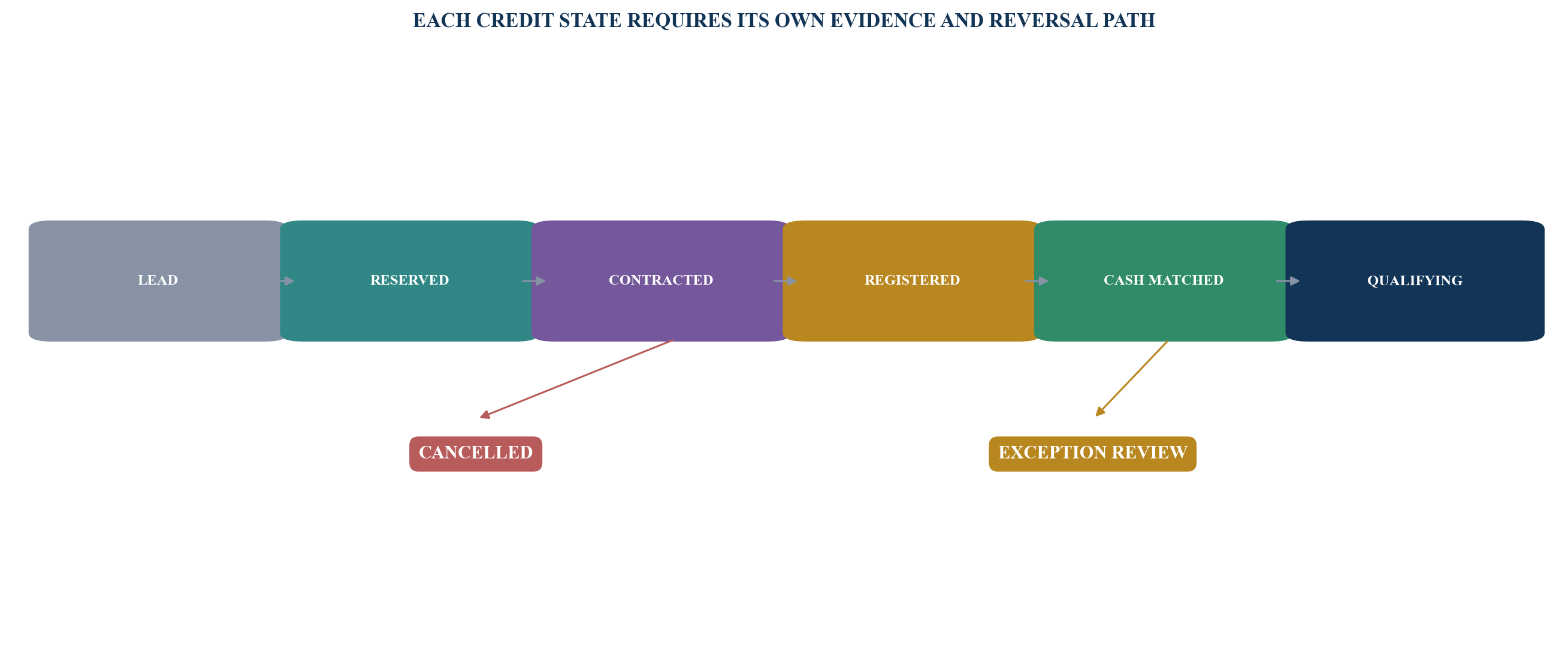
State definitions are illustrative and must align with the applicable contract, authority process and lender policy.
5. Reconcile the contract value to cash received
A signed contract creates scheduled obligations. Credit support improves when purchaser cash clears into the authorised project account and remains at risk under the contract. The reconciliation should therefore connect contract price, incentives, taxes or fees, payment plan, invoices or calls, receipts, refunds, chargebacks, returned payments and outstanding amounts.
Dubai Land Department describes project escrow accounts as repositories for amounts received from off-plan purchasers and project financiers. It also states that purchaser payments for off-plan units fall within the escrow framework. Saudi Arabia's off-plan law establishes a separate escrow account for each project and governs activation and disbursement after project licensing and property notation. The applicable treatment must be verified for the project.
The daily cash match uses bank value date, amount, currency, remitter, reference, buyer and unit. Unmatched receipts sit in suspense until resolved. A receipt should not be allocated to a qualifying transaction solely because its amount resembles an instalment. Third-party remitters, split payments, refunds and transfers between units require an auditable decision.
Coverage metrics should distinguish contract value, amount due to date, cleared cash received, cash still at risk and cash eligible under the lender definition. Gross future instalments carry different uncertainty from deposits already received.
Table 2. Contract-to-cash reconciliation
| Evidence layer | Illustrative amount | Credit interpretation | Control test |
|---|---|---|---|
| gross contracted sales | AED 620m | total contractual value before eligibility | executed terms and buyer population verified |
| scheduled due to date | AED 155m | contractual cash expected by reporting date | current schedule includes approved changes |
| cleared receipts | AED 143m | cash received and matched | bank and escrow records reconcile to buyer and unit |
| retained buyer cash at risk | AED 132m | cash remaining after refunds and disputed items | contractual treatment and availability evidenced |
| lender-eligible contract value | AED 475m | subset passing policy and concentration rules | all required attributes and exceptions approved |
Values are management assumptions used only to demonstrate the method; they do not represent a project or lender policy.
6. Measure payment behaviour as a migration curve
Payment behaviour provides a richer signal than a current-versus-overdue label. The lender needs to see whether buyers pay early, on time, within cure, after repeated collection effort, through restructuring or not at all. Cohort behaviour can reveal weakening settlement capacity before cancellations rise.
The ledger should retain original due dates and amounts. Approved payment-plan changes create a new version without deleting the prior schedule. Ageing buckets can include not due, current, one to thirty days, thirty-one to sixty, sixty-one to ninety and more than ninety days, with a separate legal or cancellation state.
A migration matrix shows how balances move between buckets month to month. Deterioration can be concentrated in a launch cohort, broker, nationality, investor segment, payment plan or unit type. Improvement after reminders is different from improvement after widespread rescheduling.
The credit committee should receive cure and roll rates, amount and buyer counts, largest arrears, connected exposure, approved concessions and expected cancellation. Reported collection rates should use a stable denominator and disclose whether future instalments, cancelled units or resold units have been removed.
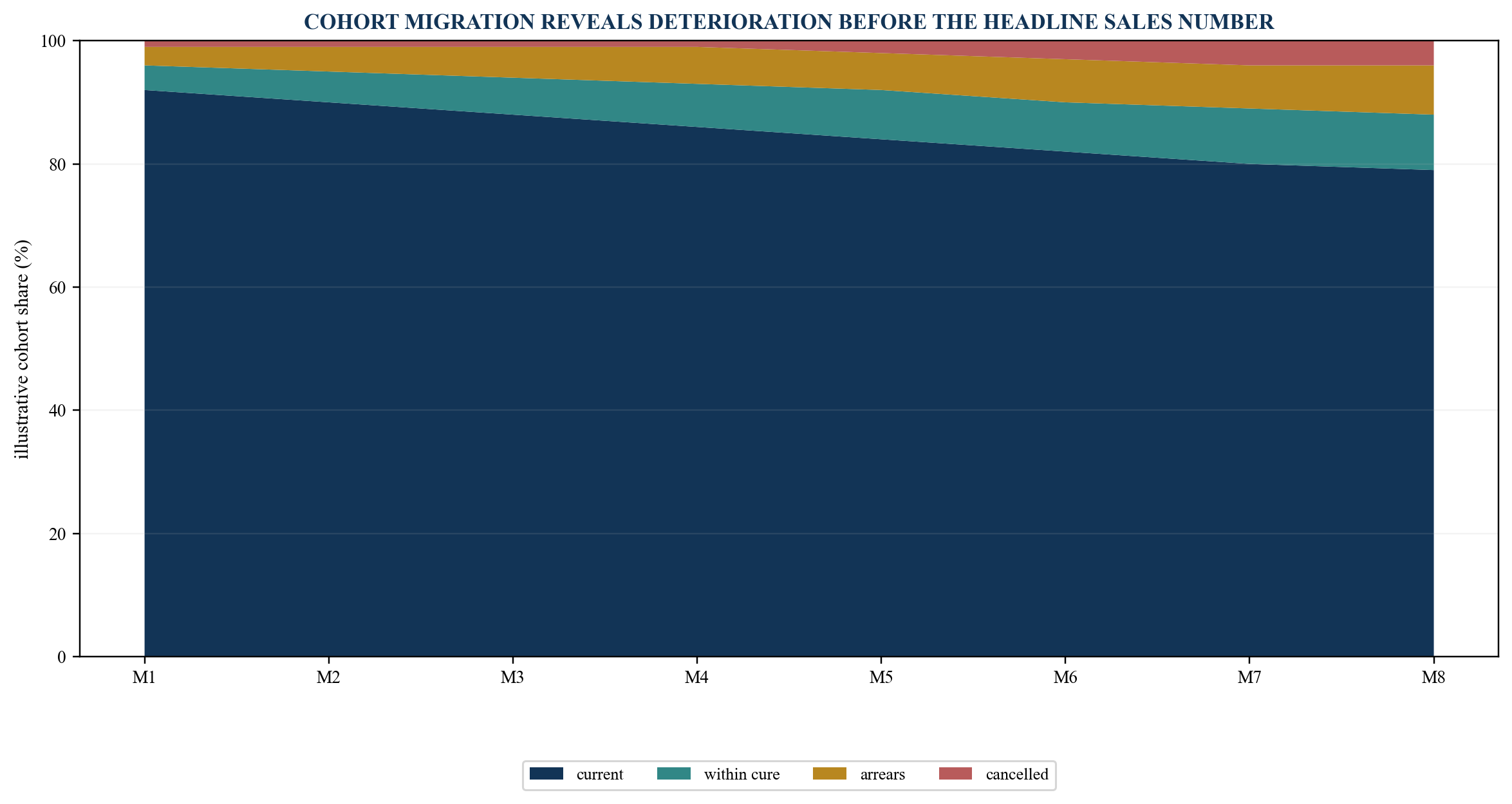
Percentages are management assumptions for demonstrating cohort monitoring; they are not project performance data.
7. Analyse deposits by economic risk rather than label
A deposit can be nominal, refundable, funded by another party, subject to a cooling period, held outside the approved route or recoverable through a side agreement. The label alone does not establish buyer commitment.
The contract review should determine amount, timing, refundability, forfeiture, cure, termination, assignment and set-off. Local consumer and real-estate law may restrict or shape the contractual outcome. The project team should avoid describing an amount as non-refundable without approved legal support.
The source of funds also matters. A buyer may use own cash, a broker advance, developer finance, a related-party loan or a promotional credit. These structures can change behavioural meaning and create connected exposure. Incentives should be reflected in net price and cash at risk.
The lender evidence file should show cleared deposit as a percentage of contract price and expected buyer equity through completion. A large initial deposit can still leave settlement risk if the final balloon relies on an unapproved mortgage or asset sale.
8. Preserve the cancellation and replacement history
A cancelled unit can be resold, allowing current inventory and gross sales to recover. Credit history remains relevant. The original buyer's default, refund, forfeiture, collection cost, broker commission and time off market affect cash, margin and settlement confidence.
The unit ledger should preserve every transaction version. It records cancellation reason, days from reservation or contract, payment status, refund, legal action, broker, price change, incentive, replacement buyer and time to replace. The buyer ledger preserves repeated reservations and cancellations across units or projects.
Cancellation metrics should use both unit and value bases. Early administrative cancellations differ from late payment defaults. A project can show a low net cancellation count while relying on rapid resales through a narrow broker channel. Replacement quality should be tested under the same qualifying policy.
The cash model should reflect timing. A refunded deposit may leave before the replacement deposit arrives. Commissions may already have been paid. The replacement contract may use a higher headline price with a more aggressive payment plan. Net coverage should use current eligible evidence and retain the loss history in stress assumptions.
Table 3. Cancellation and replacement register
| Event | Evidence retained | Financial effect | Credit response |
|---|---|---|---|
| buyer cancellation | notice, reason, payment history and contract outcome | refund or retention, commission and cash timing | remove or adjust coverage under policy |
| developer termination | default evidence, notices, cure and approval | recovery cost, dispute and resale delay | flag legal and operational risk |
| unit replacement | new buyer, price, terms, deposit, broker and registration | revised cash curve and margin | qualify independently after evidence passes |
| assignment | transfer agreement, approvals, payment and identity | fee, buyer change and continuing obligations | assess assignee and preserve original lineage |
| bulk switch | connected buyers, unit group and common funding | concentration and simultaneous settlement risk | apply group limits and scenario stress |
The register should preserve the full transaction lineage and approved accounting treatment.
9. Map concentration beyond the buyer name
Presales can be concentrated by connected buyer, employer, nationality, residence, broker, introducer, funding bank, unit type, price band, payment plan or intended use. The lender should identify channels that can fail together.
APRA's good-practice guidance refers to maximum proportions for presales to a single entity or individual and to foreign purchases. A global project should design its concentration map around its actual risk drivers and the lender's policy. Nationality alone can be an incomplete or inappropriate proxy; residency, income currency, funding route and legal entity can provide more decision-relevant evidence.
The developer should aggregate known connected parties and common payment sources. Broker concentration can matter when one intermediary controls buyer communication or provided aggressive representations. Mortgage-bank concentration can create a settlement bottleneck if a bank changes policy.
The dashboard shows gross share, qualifying share and stressed loss from each concentration. Limits can trigger added buyer evidence, lower recognition, alternative funding or a sales-channel adjustment.
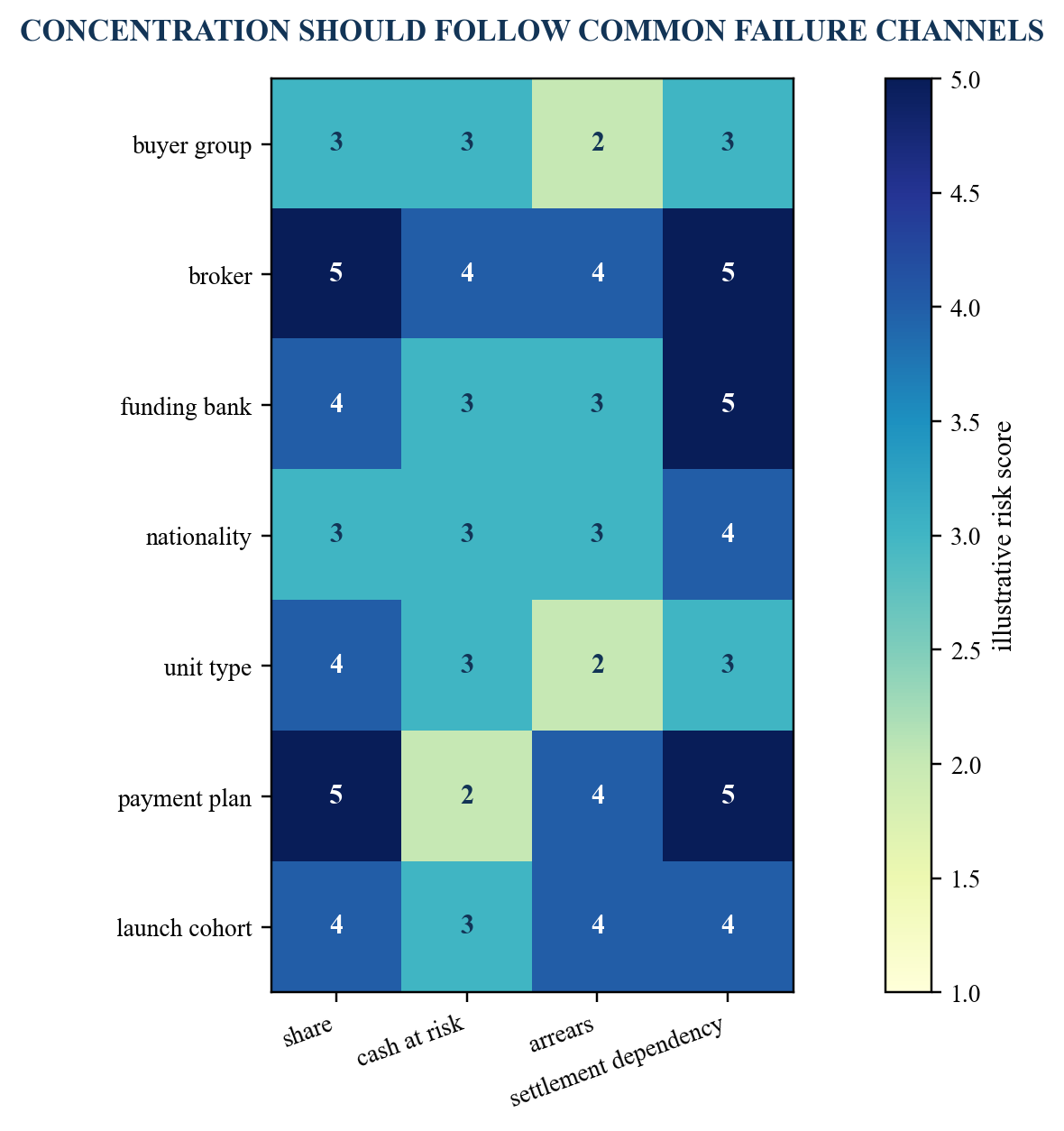
Scores are management assumptions used solely to demonstrate risk prioritisation.
10. Build a mortgage-readiness view before completion
Many buyers intend to fund the final payment with a mortgage. A reservation or contract may precede formal underwriting by years. Income, employment, rates, valuation, loan-to-value policy, age, residency and bank appetite can change before completion.
Mortgage readiness should therefore be a current evidence view rather than an assumed approval. The register can show intended cash or mortgage route, target bank, application stage, preliminary eligibility, required equity, valuation sensitivity, documentation gaps and expiry dates. Privacy and consent requirements should govern information sharing.
An indicative approval is different from a binding commitment and may remain subject to valuation, updated credit checks, completion and policy. The project should avoid representing buyer mortgage eligibility as certain. A mortgage desk can coordinate lender panels, education and document readiness while leaving the credit decision with the authorised institution.
The settlement forecast should stress lower valuations, lower approved loan amounts and delayed processing. Buyers with large completion balloons and limited verified equity warrant earlier engagement. The developer can adjust collection, incentives and handover scheduling through approved commercial and legal processes.
11. Reconcile broker provenance and sales promises
Broker-originated transactions can expand demand and create data gaps. The developer needs the broker licence and agreement, buyer introduction, approved materials, commission terms, conflict disclosures and communication record. The buyer should receive the authorised project and contract information through the correct process.
Dubai Land Department's real-estate brokerage guidance refers to licensing, project registration and escrow controls for off-plan marketing. Its published legislation requires the project marketed through a broker to be registered and addresses broker agreements and deposit of relevant proceeds into project escrow. Current requirements should be checked for the transaction.
The evidence register should flag side promises about returns, resale, mortgages, rental income, completion or refunds. A promise outside the authorised contract can affect cancellation, dispute and reputation. It can also indicate that headline demand relied on a proposition the project cannot support.
Broker performance should combine conversion, payment behaviour, cancellation, complaint, settlement and concentration. Volume alone can reward low-quality contracts. Commission release can be linked to controlled milestones under the approved agreement.
12. Make the sales ledger auditable by the lender
The lender should be able to trace a reported coverage number to individual eligible contracts and source evidence without receiving an uncontrolled export of sensitive buyer data. The reporting model needs defined fields, access, encryption, retention and review.
Every record should carry source system, extraction time, version, data owner and transformation rule. Adjustments and exclusions require reason codes. The lender tape should reconcile to the contract repository, registration status, project ledger and bank receipts at the reporting date.
The data dictionary defines price, net price, deposit, amount due, receipt, arrears, cancellation, replacement, qualifying value and concentration. It also states currency conversion, date cut-off and treatment of taxes, fees, upgrades, incentives and assignments.
Independent checks can sample signatures, registration, cash, related parties and side amendments. The frequency and scope should follow facility terms and risk. Exceptions remain open until closed with evidence or accepted by authorised credit.
Table 4. Minimum lender presales tape
| Data family | Core fields | Source control | Credit use |
|---|---|---|---|
| buyer and connection | controlled ID, legal purchaser, connection and residency or funding attributes | KYC and approved customer record | concentration and eligibility |
| unit and contract | unit, type, area, price, net incentives, dates and contract version | executed agreement and unit register | value, terms and cohort analysis |
| authority state | project, contract or unit registration reference and status | verified authority record | legal and regulatory gate |
| cash and ageing | schedule, due, cleared receipts, account, refunds and arrears | project ledger and bank or escrow reconciliation | cash at risk and performance |
| funding and settlement | intended route, mortgage stage, equity gap and evidence expiry | buyer-authorised mortgage desk or finance record | completion stress and intervention |
| exception and lineage | amendments, cancellations, assignments, replacements and approvals | controlled case file | coverage adjustment and audit trail |
Personal and confidential fields should be minimised, protected and shared only under an approved lawful process.
13. Convert presales into a borrowing-base bridge
The developer may begin with gross contracted sales and progressively apply eligibility, cash and concentration adjustments. The result is a lender-recognised coverage measure under the facility definition. The bridge should remain transparent and reproducible.
Common deductions can include reservations, incomplete or unregistered contracts, related-party sales, insufficient deposits, arrears, payment-plan changes, refundable amounts, excessive concentration, expired sunset dates and unsupported mortgage-dependent balances. Some contracts may receive partial recognition rather than full exclusion under an approved policy.
Coverage can be measured against committed debt, drawn debt, remaining project cost or another facility denominator. Each answer serves a different purpose. APRA's 2025 clarification is useful here: an observed industry practice regarding presales equal to committed debt should not be presented as a universal supervisory minimum. The governing facility and lender decision provide the applicable test.
The bridge should show both current and stressed coverage. A stress removes contracts exposed to a common shock, applies payment default and settlement shortfall, and recalculates debt service and funding need. The lender can then size contingency, equity and draw conditions around the residual case.
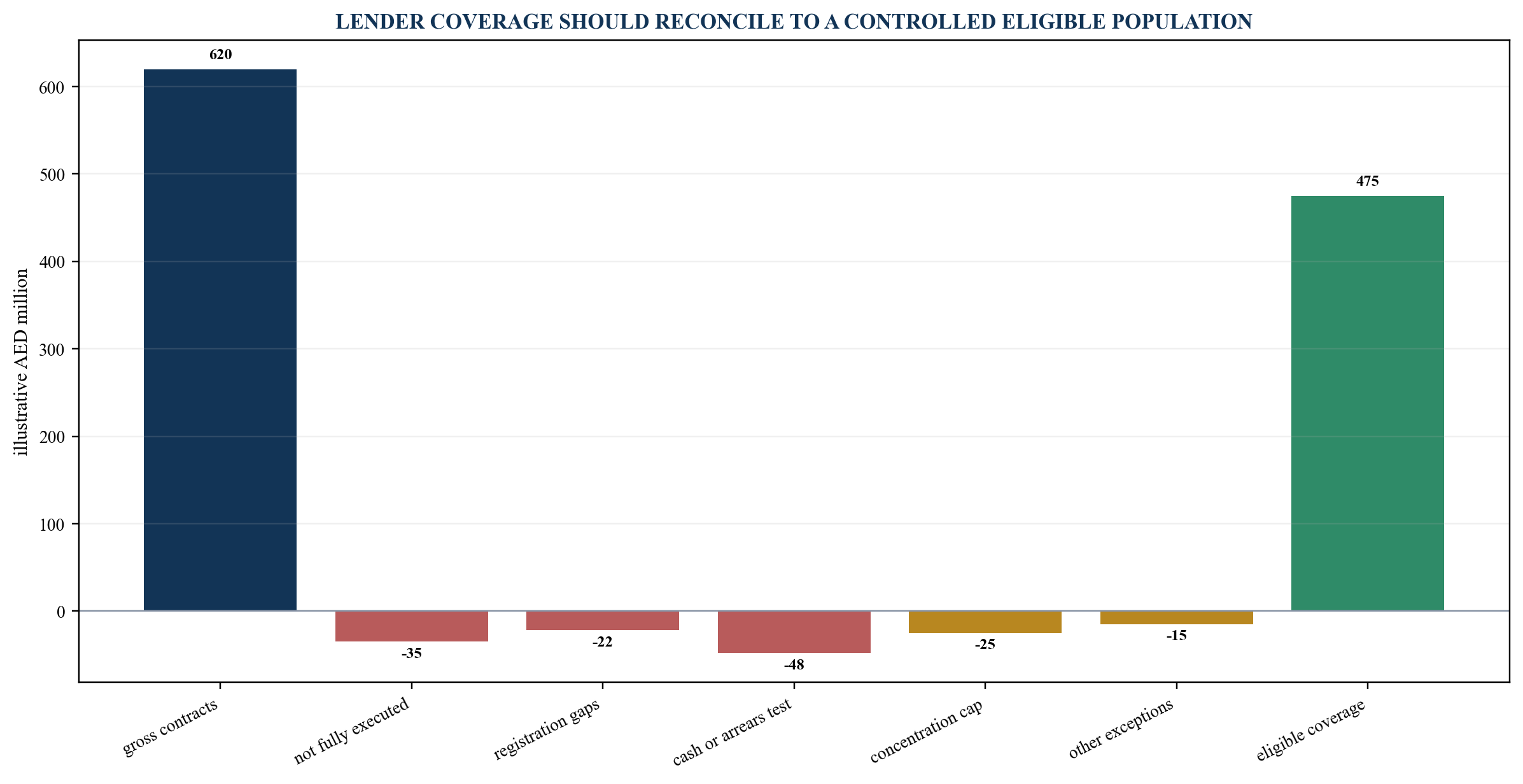
Values are management assumptions for demonstrating a reconciliation; they are not facility terms or project data.
14. Stress settlement rather than extrapolating sales velocity
Development repayment may depend on purchasers completing years after the launch. The UK PRA describes acquisition, development and construction exposures as higher risk where repayment depends on future uncertain property sales or substantially uncertain cash flows. Current sales velocity alone cannot resolve that uncertainty.
The settlement stress combines market value, mortgage availability, interest rates, buyer income, payment arrears, completion timing, defects, handover sequencing, currency and concentration. It estimates units and value that may delay, default, renegotiate or require replacement.
A price decline can create a funding gap for mortgage-dependent buyers when the bank valuation falls below the contract price. Hong Kong Monetary Authority material on certain buyers of uncompleted properties illustrates this channel: property-price declines reduced the mortgage amount available at application compared with earlier expectations. The scheme described there is jurisdiction-specific; the risk mechanism is broadly relevant.
The model should also stress project delay. A later completion can push beyond mortgage approvals, buyer plans or contract dates. An earlier completion can bring a large balloon payment forward. The cash forecast should show receipts, refunds, replacement timing, unsold inventory and added equity or debt under each case.
15. Integrate presales with full development underwriting
Presales form one part of the credit case. The lender also assesses sponsor equity, land, approvals, market, cost, contractor, programme, contingency, security, draw controls, completion support and exit. The EBA's loan-origination guidelines require robust and prudent standards through the credit lifecycle.
The CBUAE requires bank analysis of real-estate exposure and concentration risk under its supervisory framework. Its capital guidance identifies loans for buying or constructing commercial property, including residential and mixed-use towers, within commercial real-estate concepts. The project's lender will apply its approved policy and current regulatory interpretation.
The presales file should reconcile to the development model. Unit mix and price should match the approved inventory. Payment plans should flow into project cash. Commissions and incentives should enter cost and margin. Completion dates should align with construction and handover. Refund and replacement assumptions should be visible.
The credit memo should state how presales affect draw availability, covenant headroom, interest reserve, equity requirement and repayment. It should also state which risks presales do not address, including cost overruns, construction failure, permitting and title.
16. Design covenants around evidence quality and change
A covenant can measure qualifying presale coverage, cash collection, arrears, cancellation, concentration, sales pace or settlement readiness. Definitions should be precise enough to calculate consistently and flexible enough to handle permitted contract changes.
The facility should specify reporting frequency, cut-off, source evidence, independent verification, grace, cure and consequence. It should state whether coverage uses contracted value, net value, received cash, remaining instalments or another measure. Double counting between sales value and escrow cash should be prevented.
Early-warning triggers can sit above hard defaults. A rise in arrears or mortgage shortfalls can prompt a revised forecast, added equity, sales-channel action or distribution restriction. The response should match the risk and preserve project completion.
Waivers and exceptions require an evidence file. The record identifies the affected contracts, financial effect, mitigants, authority, expiry and monitoring. Repeated waivers can reveal that the original definition no longer matches operating reality.
Table 5. Presales monitoring and covenant architecture
| Metric | Controlled calculation | Early-warning signal | Possible credit response |
|---|---|---|---|
| qualifying coverage | eligible net contract value divided by approved denominator | decline toward trigger or concentration adjustment | revised forecast, restricted draw or added support |
| cash collection | cleared eligible receipts divided by scheduled eligible receipts | rising shortfall or unmatched cash | collection plan and cash reconciliation |
| arrears migration | balance and buyers moving into later ageing | cohort or channel deterioration | buyer outreach, reserve or lower recognition |
| cancellation and replacement | gross cancellations, refunds, time to replace and new eligibility | late cancellations or weaker replacements | stress update and sales-quality action |
| settlement readiness | verified cash and mortgage route against completion amounts | valuation or finance gaps near handover | earlier buyer plan and contingency funding |
Facility terms require lender, borrower and legal approval for the actual transaction.
17. Build the board and lender dashboard from the same ledger
The board needs commercial and funding decisions. The lender needs credit and covenant evidence. Both should draw from the same controlled buyer, contract, authority and cash records.
The dashboard can show gross contracted value, qualifying value, cleared buyer cash, amount due, arrears, cancellations, replacements, concentration, mortgage-readiness gaps, stressed settlement and coverage. Each metric links to its definition, reporting date and drill-down population.
Trend matters. A monthly snapshot can conceal worsening cohorts or rapid replacement. The dashboard should show original and revised payment schedules, vintage, broker, buyer segment and unit type. It should also identify data-quality exceptions and stale evidence.
Decision rights should be explicit. Sales owns buyer engagement and approved commercial terms. Finance owns cash and forecast reconciliation. Legal owns contract interpretations. Compliance owns applicable customer and monitoring requirements. Development owns programme and handover. Credit approves facility eligibility and exceptions.
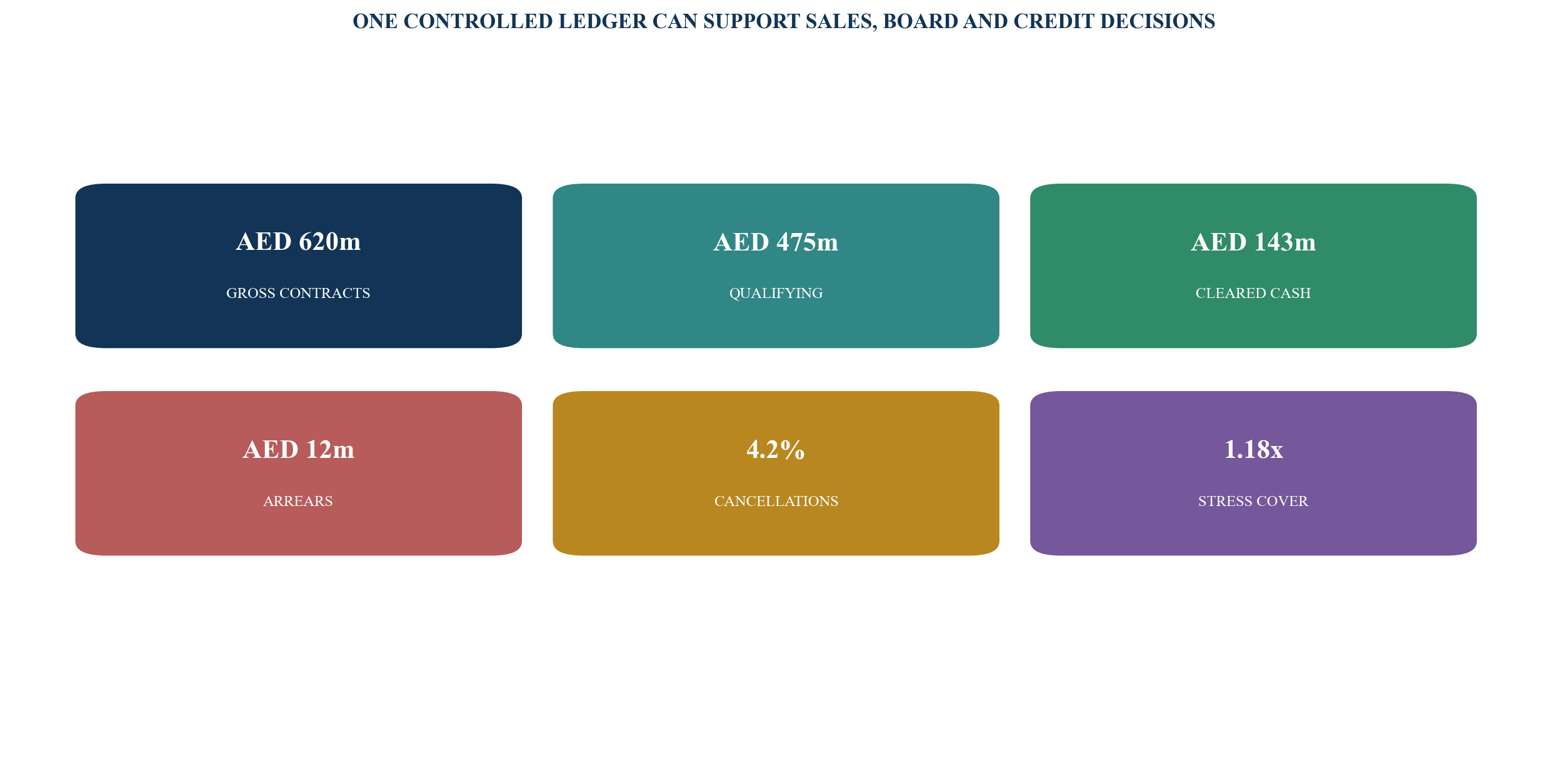
Values are management assumptions used only to demonstrate decision reporting.
18. Run a ten-day presales evidence diagnostic
Days one and two establish the facility question, project, inventory, contract forms, lender definition, source systems, reporting date and data owners. The team freezes a controlled extract and maps the sales-to-credit evidence chain.
Days three and four reconcile buyers, connected parties, units, contracts, registrations and amendments. Reservations and incomplete records are separated from the contracted population. Legal and authority gaps are recorded.
Days five and six reconcile scheduled payments, bank or escrow receipts, refunds, arrears, cancellations, replacements and commissions. The output is a contract-to-cash exception file and a repeatable matching rule set.
Days seven and eight apply eligibility and concentration rules, create cohort migration, test mortgage readiness and run settlement stresses. The team calculates gross, qualifying and stressed coverage under the documented facility denominator.
Days nine and ten produce the board and lender pack: reconciled tape, policy matrix, borrowing-base bridge, cash forecast, covenant headroom, red flags, owners and dated cure plan. Data-quality limitations remain visible in the decision paper.
19. Operate a ninety-day presales evidence office
The first thirty days establish controlled definitions, identity resolution, contract states, cash matching, authority verification and daily exception ownership. The office creates one evidence repository and reporting calendar.
Days thirty-one to sixty focus on buyer quality and settlement. The team analyses ageing migration, cancellations, replacements, broker cohorts, concentration and mortgage pathways. Sales, finance, legal and development actions are aligned to the same unit-level record.
Days sixty-one to ninety embed the lender report and covenant process. The team tests the borrowing-base calculation, independent sampling, stress cases, draw deliverables and waiver workflow. It documents handover and settlement interventions for exposed cohorts.
The recurring office can provide weekly exceptions and monthly credit packs. Scope can include contract and cash reconciliation, eligibility, concentration, forecast, covenant headroom, buyer-finance readiness and data-room upkeep. Advisory judgement and lender authority remain separate.
Table 6. Ninety-day presales evidence office
| Phase | Core output | Decision supported | Measurable completion test |
|---|---|---|---|
| days 1 to 30 | controlled buyer, contract, registration and cash ledger | baseline eligibility and exposure | source populations reconcile and exceptions have owners |
| days 31 to 60 | cohort, concentration, cancellation and mortgage analysis | commercial and settlement action | priority cohorts have approved interventions and dates |
| days 61 to 90 | lender tape, coverage bridge, stress and covenant pack | draw, waiver, refinancing and board decisions | report reproduces from controlled data and passes review |
| recurring mandate | weekly exceptions and monthly credit evidence | continued funding and completion readiness | ageing, coverage, settlement and data-quality actions close to cadence |
The sequence should be adapted to the facility, reporting cycle and project stage.
20. Package advisory work around funded developer decisions
A presales evidence diagnostic can support a developer preparing for a development facility, draw, refinancing, covenant test or handover. The paid outcome is a lender-ready view of what has been sold, what cash has been received, which contracts qualify, where concentration sits and how settlement performs under stress.
A recurring evidence office can coordinate sales operations, finance, legal, compliance, mortgage desk, development and lender reporting. The mandate can deliver a controlled tape, exception queue, borrowing-base bridge, cash forecast, covenant dashboard and monthly committee paper. The office supports accountability without taking the lender's credit decision or the advisers' regulated roles.
A transaction mandate can support financing materials, lender diligence, data-room management, term-sheet comparison, covenant negotiation and closing. Compensation, conflicts, permitted activity and success events should be documented under the applicable framework.
Commercial qualification should establish a live project, decision owner, lender or financing objective, controlled access to contract and cash evidence, budget and timeline. A large headline pipeline without signed and paid advisory authority is marketing activity rather than mandate evidence.
The durable proposition is evidence that survives challenge. A reconciled buyer history connects the sales narrative to cash, concentration, settlement and debt. It helps a board decide which demand is valuable, helps a lender understand repayment support and gives the project team a measurable path to improve fundability.
References
- Dubai Land Department. Register Project. https://dubailand.gov.ae/en/eservices/register-project/
- Dubai Land Department. Real Estate Legislation. https://dubailand.gov.ae/media/1omljeok/legislation_en.pdf
- Dubai Land Department. Real Estate Brokerage Practice Guide. https://dubailand.gov.ae/media/i31iv1n0/real-estate-brokerage-practice-guide_en.pdf
- Saudi Real Estate General Authority. Law of Selling and Leasing Off-Plan Real Estate Projects. https://rega.gov.sa/en/laws-and-decisions/regulations-and-by-laws/rules/law-of-selling-and-leasing-off-plan-real-estate-projects/
- Basel Committee on Banking Supervision. Basel Framework, CRE20, Land Acquisition, Development and Construction Exposures. https://www.bis.org/basel_framework/chapter/CRE/20.htm
- Australian Prudential Regulation Authority. APG 112 Capital Adequacy: Standardised Approach to Credit Risk. https://www.apra.gov.au/practice-guides/apg-112
- Australian Prudential Regulation Authority. APRA Clarifies Its March 2017 Letter Regarding Commercial Property Lending. https://www.apra.gov.au/news-and-publications/apra-clarifies-its-march-2017-letter-regarding-commercial-property-lending
- European Banking Authority. Guidelines on Loan Origination and Monitoring. https://www.eba.europa.eu/activities/single-rulebook/regulatory-activities/credit-risk/guidelines-loan-origination-and-monitoring
- Bank of England Prudential Regulation Authority. Implementation of the Basel 3.1 Standards, Land Acquisition, Development and Construction Exposures. https://www.bankofengland.co.uk/prudential-regulation/publication/2024/september/implementation-of-the-basel-3-1-standards-near-final-policy-statement-part-2
- Hong Kong Monetary Authority. Prudential Measures for Property Mortgage Loans, 4 December 2024. https://brdr.hkma.gov.hk/eng/doc-ldg/docId/getPdf/20250106-1-EN/20250106-1-EN.pdf
- Central Bank of the UAE. Guidance for Capital Adequacy of Banks in the UAE. https://rulebook.centralbank.ae/en/rulebook/guidance-capital-adequacy-banks-uae
About the Author
Chennakeshav Adya, Independent Researcher
