

1. Start with realised transaction economics
A pricing programme should begin with the economics of completed transactions. List price, invoice price, recognised revenue, gross margin and cash contribution answer different questions. Management needs a controlled bridge from the commercial promise to the economic result.
The unit of analysis may be an invoice line, order, contract, project, subscription, shipment or customer-month. It should be granular enough to preserve the price, quantity, product or service, customer, channel, date, currency, tax treatment, concession and fulfilment evidence that shaped the outcome. Aggregation before diagnosis can hide a profitable product sold through an uneconomic channel or a valuable customer served through loss-making exceptions.
Pocket revenue is the consideration expected to be retained after on-invoice and off-invoice concessions attributable to the transaction. Pocket margin then deducts a controlled view of variable product, fulfilment, channel and service costs. This internal measure requires a written definition. IFRS 15 treats discounts, rebates, refunds, credits, price concessions, incentives, bonuses and penalties as possible forms of variable consideration and requires an entity to determine the transaction price under the standard's recognition and measurement requirements.[1] An internal pocket-margin measure should reconcile to accounting records rather than replace them.
The first diagnostic should preserve negative findings. Missing rebate accruals, incomplete freight allocation, generic cost standards, inconsistent units of measure and unmatched credit notes are evidence about the operating system. Management should not fill those gaps with optimistic assumptions and present the result as observed margin.
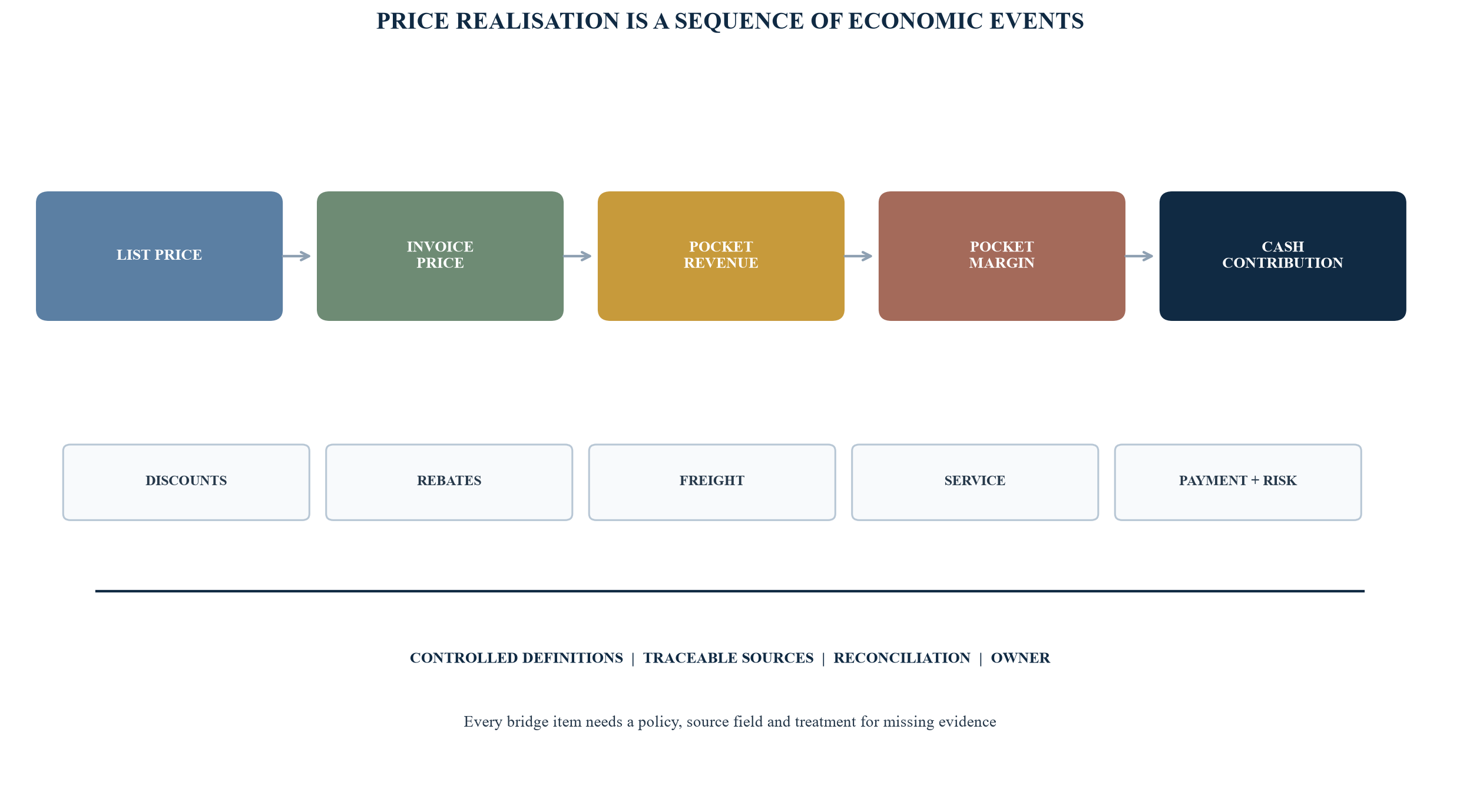
The bridge is a management model. Definitions, allocation methods and accounting treatment require documented policy and professional review.
Table 1. Minimum transaction-economics data diagnostic
| Data domain | Minimum evidence | Control test | Common failure |
|---|---|---|---|
| commercial | quote, order, contract, price condition and approval | Can the agreed price and exception be reconstructed? | final invoice retained without decision trail |
| customer | legal entity, segment, channel, geography and relationship | Is the customer identity consistent across systems? | duplicates or group relationships obscured |
| product or service | item, bundle, unit, specification and obligation | Does quantity and scope match the promise? | bundles or service additions left unallocated |
| concessions | discounts, rebates, credits, returns and free goods | Are on- and off-invoice concessions linked? | rebates recorded only at aggregate level |
| fulfilment | freight, handling, expedite, installation and support | Can cost to serve be attributed consistently? | service cost absorbed in overhead |
| finance | currency, tax, cost basis, payment terms and collection | Does the bridge reconcile to ledgers and cash? | timing and foreign-exchange effects mixed with price |
| governance | owner, authority, evidence, expiry and override | Was the exception within approved authority? | email approval without threshold or expiry |
The fields should be tailored to the business model, accounting policies, contractual architecture and data quality.
2. Define a controlled pocket-margin measure
Management should write a pocket-margin policy before publishing dashboards. The policy should state the unit of analysis, revenue basis, variable consideration, tax exclusion, currency conversion, cost elements, allocation method, cut-off, treatment of missing values and reconciliation to financial records. Alternative definitions may be useful for different decisions, but their names should remain distinct.
IFRS 15 requires the transaction price to reflect the consideration an entity expects to be entitled to, excluding amounts collected on behalf of third parties, and addresses variable consideration, financing components, non-cash consideration and consideration payable to a customer.[1] The standard also allocates transaction price to performance obligations using relative stand-alone selling prices.[2] Contract and accounting conclusions remain the responsibility of qualified management and advisers.
IFRS 18 introduces presentation and disclosure requirements, including requirements for management-defined performance measures within its scope. It requires clear descriptions, calculation methods and reconciliation to the most directly comparable IFRS subtotal or total for qualifying measures.[3] Pocket margin used only for internal transaction management may fall outside that definition. Public use requires an accounting assessment.
Taxes require separate treatment. VAT may change the billed and collected amount while remaining outside revenue for accounting purposes. Discounts, rebates, free goods, vouchers and non-monetary consideration can produce different tax consequences. Saudi ZATCA's business-promotions guideline explains, among other cases, that VAT on a discounted supply is generally calculated on the reduced consideration and that a rebate relating to an earlier supply may require a credit note and output-tax adjustment.[4] UAE treatment should be checked against the current VAT legislation and FTA guidance.[5]
A management view can include cash contribution after expected collection delay or credit loss, but it should not relabel a forecast as realised margin. The dashboard should show observed, accrued, estimated and allocated components separately.
3. Build an auditable pricing data spine
The pricing data spine links commercial, operational, financial and governance evidence through stable keys. The minimum chain is quote to order, order to invoice, invoice to credit note, transaction to fulfilment, customer to contract, product to cost, and exception to approval. Where a stable key is absent, the matching method and confidence level should be visible.
Data lineage matters because a price recommendation can appear precise while relying on incomplete concession or cost data. Each material field should have a source system, definition, owner, refresh frequency, permissible values and quality test. Manual adjustments should retain author, reason, date, evidence and approval.
Customer data used in segmentation or recommendation models may be personal data. The UAE Personal Data Protection Law establishes a framework for processing and protecting personal data and defines obligations for parties handling it.[6] Saudi Arabia's Personal Data Protection Law and implementing materials address collection, processing, disclosure, transfer and data-subject rights.[7] A pricing team should minimise personal data, document the purpose and legal basis, control access, define retention and assess cross-border transfer requirements.
The diagnostic should quantify coverage rather than conceal gaps. For example, management can report the share of invoiced value with matched contract, concession, fulfilment and cost evidence. The percentages are useful only when numerator, denominator and exclusions are controlled.
4. Construct the price waterfall before changing price points
The price waterfall explains how a reference price becomes pocket revenue. Its exact steps depend on the commercial model. A distributor may include channel discount, promotion, freight and returns. A project business may include scope variation, delay, liquidated damages, mobilisation and financing. A subscription business may include free periods, credits, usage adjustments and retention concessions.
The waterfall should separate price from volume, mix and currency. It should also distinguish a contractual entitlement from a discretionary concession and an accrued concession from a paid one. Without this separation, management may attribute a weak outcome to discounting when the primary mechanism is product mix, cost inflation, fulfilment or adverse foreign exchange.
Every step needs a mathematical sign, source field, recognition point, owner and reconciliation rule. A concession should appear once. Freight recovered from the customer and freight paid to a carrier are separate economic events. A rebate should remain visible even when paid after the reporting period.
The first waterfall should be built as a transaction cohort rather than a single-period average. Cohorts by quote month, contract vintage, customer segment, product family and channel help management distinguish an execution problem from an ageing contractual position. They also show whether a price action reached new business, renewals and legacy accounts at different speeds. A stable cohort definition should be retained long enough to observe the lag from approval to quote, order, invoice, credit note and collection.
Leakage codes should identify an economic cause. A generic "discount" field is insufficient when the concession arose from competitive matching, damaged stock, volume commitment, advance payment, service failure, channel support, tender compliance or an undocumented negotiation. A concise root-cause taxonomy allows management to direct action to the relevant owner. Finance can address accrual quality, operations can address fulfilment failures, sales can address negotiation, and product leaders can address an offer whose value is unclear.
The review cadence should combine a weekly exception view with a monthly reconciled view. The weekly view supports intervention while a quotation or concession is still actionable. The monthly view closes the loop through invoicing, credits, fulfilment and cash. Management should preserve both versions and explain later changes caused by accruals, allocations or corrected data. This history makes the waterfall a control record rather than a disposable dashboard.
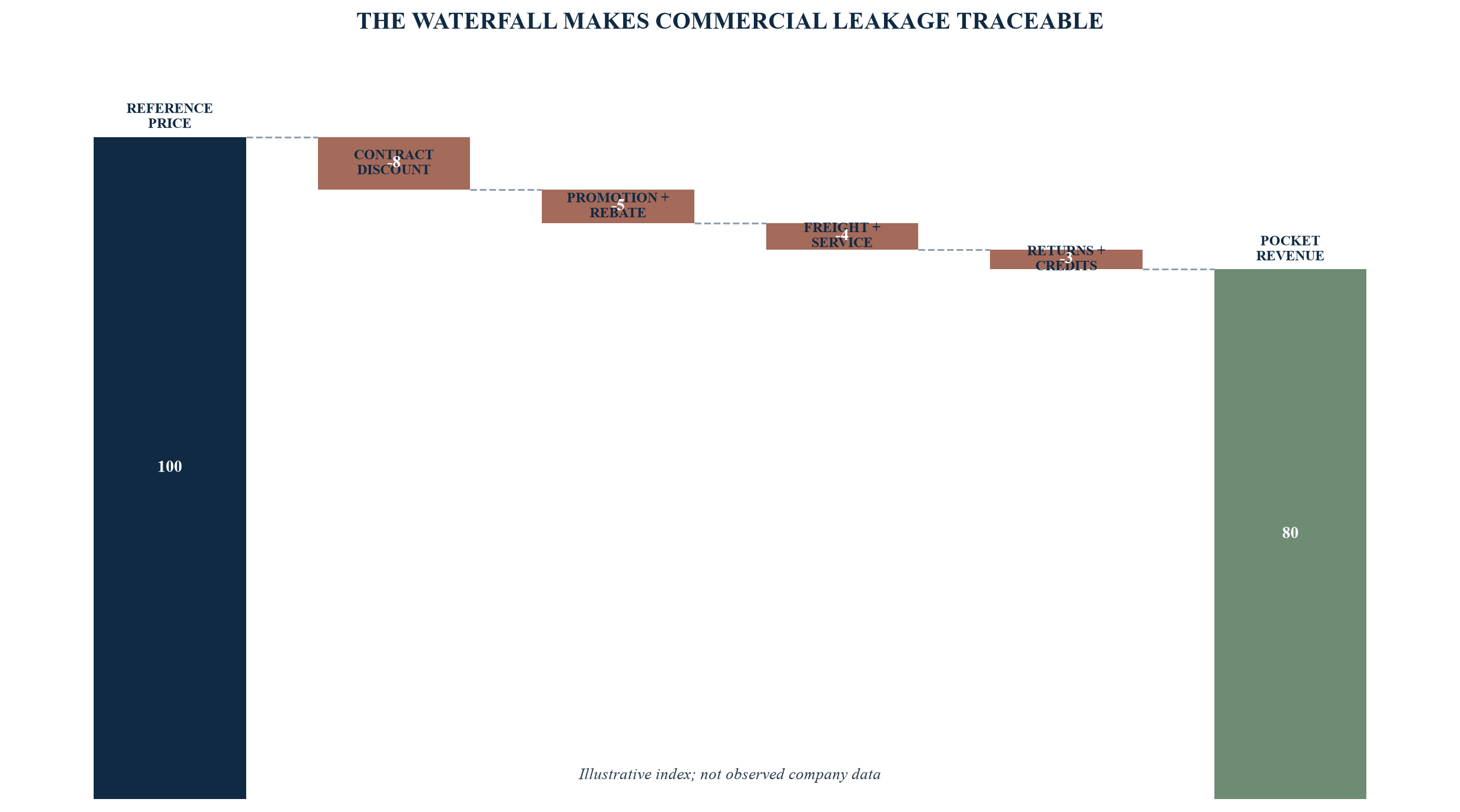
The sequence is illustrative. Businesses should define contractual, accounting, tax and timing treatment for every component.
Table 2. Price-waterfall definition register
| Component | Definition decision | Required evidence | Review question |
|---|---|---|---|
| reference price | list, tariff, catalogue or approved baseline | effective-dated price master | Was the baseline valid for the transaction? |
| contractual discount | recurring concession written into terms | executed contract and price condition | Does the concession reflect the approved segment? |
| discretionary discount | exception granted for a specific decision | quote, rationale, authority and expiry | What value or risk justified the exception? |
| rebate or incentive | contingent or retrospective consideration | scheme terms, accrual basis and settlement | Is expected exposure recorded and reconciled? |
| freight and service | charge or concession for fulfilment activity | order term, delivery evidence and supplier cost | Is customer recovery visible beside cost to serve? |
| returns and credits | reversal, allowance or customer compensation | return reason, credit note and approval | Does the root cause belong to price, quality or execution? |
| pocket revenue | retained transaction consideration under policy | reconciled waterfall | Are estimates and allocations separately identified? |
Each component should have one controlled treatment and a documented reconciliation path.
5. Segment on economic mechanism
Segmentation should support a pricing decision. Labels such as strategic, key, SME or enterprise are too broad unless they change an offer, service level, price metric, authority or commercial approach. A useful segment describes why customers value the offer, what alternatives they have, how they buy, how costly they are to serve and how the relationship contributes to strategy.
Customer value can include operating continuity, speed, risk transfer, technical performance, yield, convenience, compliance, revenue generation or reduced capital intensity. Evidence may come from product usage, win-loss records, service data, interviews, tender outcomes and controlled experiments. Sales opinion is evidence of experience, but it should remain distinguishable from observed behaviour.
Cost to serve includes transaction frequency, customisation, order volatility, delivery complexity, credit risk, support burden, returns and channel economics. A high-revenue account can destroy value when concessions and service obligations exceed the economic return. A low-volume account may remain valuable because it pays for scarce capability, provides reference credibility or opens a strategically important route. Those claims need explicit assumptions and governance.
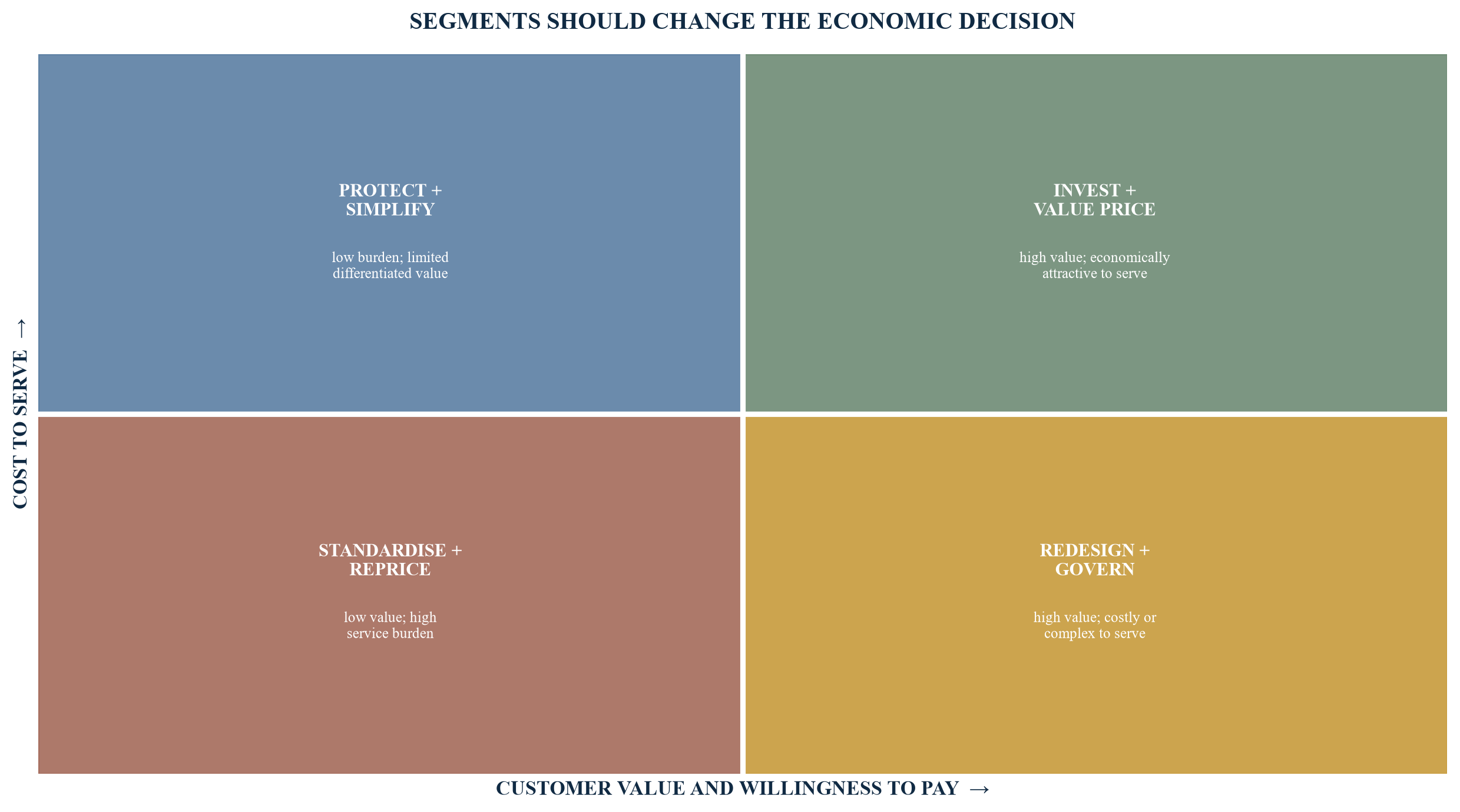
Placement is illustrative. Each customer or transaction requires current evidence and controlled criteria.
Table 3. Segment-to-action design
| Segment lens | Evidence | Price or offer action | Guardrail |
|---|---|---|---|
| high value, low burden | outcome value, retention, alternatives and service use | value metric, differentiated offer, disciplined renewal | avoid relying on untested willingness-to-pay claims |
| high value, high burden | outcome value plus customisation and service cost | paid service tiers, scope control, minimum economics | preserve essential service and contractual obligations |
| low value, low burden | standard demand and efficient fulfilment | simplified offer, transparent bands, digital execution | monitor competitive alternatives and volume response |
| low value, high burden | weak contribution, exceptions, returns or volatility | reprice, redesign terms, reduce avoidable complexity | consider relationship, reputation and exit consequences |
| strategic option | future route, capability or reference value | time-bound investment with milestones | separate option value from observed current margin |
Actions are hypotheses until tested against customer, competitive, legal, operational and financial evidence.
6. Design a coherent price architecture
Price architecture defines what is priced, the metric, the level, the fences between offers and the rules for change. It should make the economically different choices visible to customers and employees. Hidden complexity creates negotiation and billing errors.
The price metric should follow the customer's value mechanism where practicable. Possible metrics include unit, usage, capacity, project, milestone, availability, outcome, user, site or risk transferred. The metric must also be measurable, contractible, billable and understandable. A theoretically elegant metric that the business cannot observe or enforce is a weak operating design.
Offer fences should reflect meaningful differences in scope, speed, capacity, service, warranty, exclusivity, risk, payment or access. Artificial fences that obscure a substantially similar offer can create customer distrust and legal exposure. Management should review consumer, competition and sector requirements before implementation.
Price levels need a controlled evidence pack: economic objective, segment, comparable transactions, cost and capacity, alternatives, demand evidence, channel effects, tax, currency, contract terms and downside scenarios. A competitor's advertised price may exclude service, credit, freight, configuration or risk and should not be treated as directly comparable without verification.
Bundles require particular discipline. A package can simplify buying and support value communication, yet it can also conceal free service, unused capacity or cross-subsidies. The architecture should state which elements are mandatory, optional or conditional; how each is measured; how consideration is allocated for management and accounting purposes; and what happens when scope changes. The commercial system should prevent an employee from recreating a premium bundle through unpriced line-item concessions.
Currency and country architecture should be explicit in a multi-market GCC business. A single regional list can create unintended price differences when exchange rates, duties, freight, payment terms, local service obligations and tax treatment vary. Management can define a reference currency, local price books, review triggers and permitted hedging or adjustment clauses. Each choice should be traceable to a commercial objective and approved treatment rather than an informal conversion at the point of quotation.
7. Replace blanket discounting with decision rights
Discount governance should accelerate routine decisions and deepen review where value or risk is material. The design needs standard authority bands, aggregation rules, mandatory evidence, time limits, expiry, override treatment and post-decision review.
Authority should follow pocket economics and risk rather than headline percentage alone. A small discount on a low-margin, high-service transaction may be more material than a larger discount on an efficient product with favourable terms. The workflow should therefore show pocket-margin effect, total contract exposure, non-price concessions and precedent risk.
The approver should receive a clear recommendation and alternatives: preserve price, change scope, change quantity, adjust service, improve payment, stage delivery, use a conditional rebate or decline. Approval should state the option chosen, rationale, conditions, owner and expiry. Silence or attendance at a meeting is not approval.
The quoting workflow should disclose the evidence needed at each authority level and the service time expected from approvers. Routine quotations can move immediately when all guardrails are satisfied. Exceptions should route to the smallest competent group, with a visible clock and escalation path. This design reduces the incentive to bypass controls because a salesperson fears losing a time-sensitive transaction while waiting for a committee.
Post-decision review should test whether the approved exchange occurred. If a discount depended on volume, advance payment, reduced service or a reference commitment, the system should verify delivery of that condition. Failure should trigger a defined response such as removal of the concession, repricing at renewal, collection action or an explicit waiver. The accumulated results then inform whether an authority band, standard condition or segment policy remains economically sound.
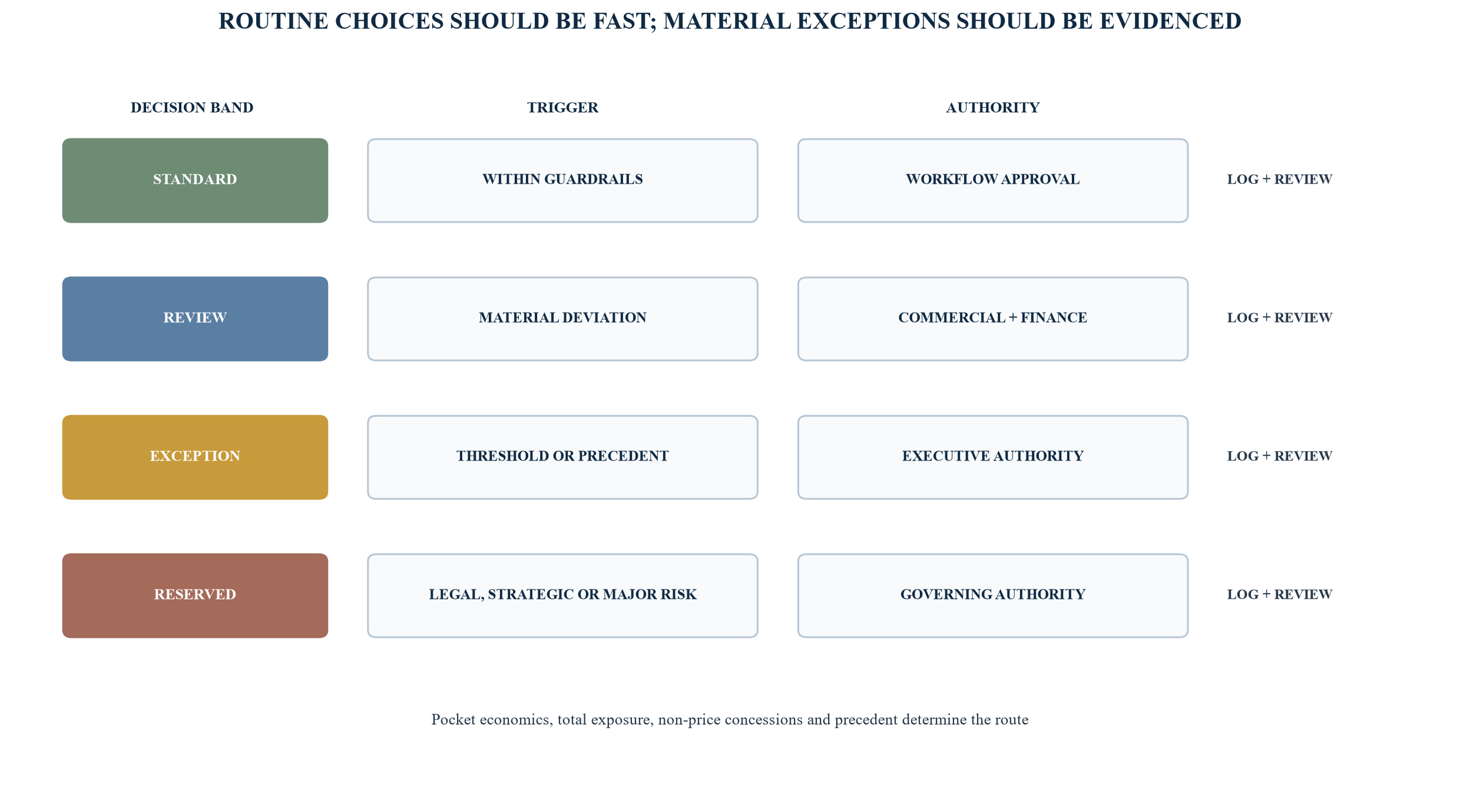
Thresholds are illustrative and require company-specific legal, financial and operational approval.
Table 4. Minimum pricing-exception approval record
| Field | Required content | Decision test | Retained evidence |
|---|---|---|---|
| commercial purpose | customer need, opportunity and intended outcome | Why is an exception required? | quote and recommendation |
| economics | waterfall, volume, mix, cost to serve and scenarios | What is the expected pocket contribution? | controlled calculation |
| alternatives | scope, quantity, service, payment and timing options | Was value traded before price was conceded? | option comparison |
| authority | limit, aggregate exposure and reserved matter check | Can this role approve the full arrangement? | authority reference |
| conditions | milestones, expiry, clawback, minimum volume or review | What protects the economic premise? | contract wording and owner |
| controls | tax, legal, competition, data and accounting review | What mandatory constraints apply? | specialist concurrence |
| outcome | final terms, actual economics and learning | Did the decision perform as expected? | invoice and post-decision review |
The record should integrate with legal authority, contract controls and system access.
8. Integrate channel, contract and service economics
Pricing is distributed across the commercial system. A distributor margin, marketplace fee, sales commission, credit term, freight promise, installation commitment or service-level penalty can alter realised economics without changing invoice price. Management should therefore govern the whole value exchange.
Channel design should identify the role performed, value created, cost incurred, risk accepted and data provided by each participant. Incentives should pay for verifiable behaviours or outcomes. Overlapping discounts, retrospective rebates and special funds can create leakage and disputes when eligibility and settlement evidence are weak.
Long-term contracts require effective-dated price rules, indexation, currency treatment, scope variation, change control, volume bands, service assumptions and exit provisions. Price increases should not be announced before contract rights, customer value, competitive alternatives and execution capacity are understood.
Cost inflation can justify a review but does not determine customer willingness to pay. A cost-plus policy may also weaken the connection between price and value. Management needs separate views of cost recovery, market position, value delivered and capacity allocation.
Tender and framework-agreement business requires its own transaction logic. The quoted price may interact with bid bonds, performance obligations, liquidated damages, escalation clauses, mobilisation, minimum volumes, call-off uncertainty and payment certification. A tender review should therefore model expected pocket economics across plausible order, timing and service scenarios. The approval record should state which assumptions are contractual, which depend on buyer behaviour and which remain management scenarios.
Payment terms belong in the value exchange. An extended credit period, retention amount, advance-payment waiver or disputed certification can consume cash and risk capacity even when the accounting margin appears attractive. Commercial teams should be able to trade a price concession for improved cash protection or trade a payment concession for price, security or committed volume. The decision should preserve the separate effects of price, financing and credit risk.
9. Respect transfer-pricing and jurisdictional constraints
Related-party prices require a separate tax analysis. The OECD Transfer Pricing Guidelines provide guidance on applying the arm's-length principle to cross-border transactions between associated enterprises.[8] The UAE FTA Transfer Pricing Guide explains the UAE regime, related-party analysis, arm's-length methods and documentation requirements within its scope.[9] Saudi ZATCA's Transfer Pricing Guidelines explain the Kingdom's approach and reference the applicable bylaws and arm's-length principle.[10]
A commercial pricing programme should therefore identify related parties and controlled transactions before changing intercompany charges, rebates, services, royalties, financing or allocation methods. Customer-facing price architecture and intercompany transfer pricing can influence each other while remaining distinct decisions with different evidence and approvals.
Competition requirements also shape pricing. UAE Federal Decree-Law No. 36 of 2023 addresses restrictive agreements, abuse of dominance and predatory pricing within its scope.[11] Saudi competition law and implementing materials require current Saudi legal analysis; the General Authority for Competition's official guidance describes the Kingdom's competition framework.[12]
Consumer-facing promotions may require permits, genuine reference prices, visible disclosures and other controls. Saudi Ministry of Commerce guidance states requirements for licensed sales and disclosure of prices before and after discount in applicable retail promotions.[13] Application varies by business model and jurisdiction.
10. Test pricing hypotheses with controlled experiments
Experimentation can reduce reliance on anecdote. A pricing experiment should state the hypothesis, eligible population, treatment, control or comparison, duration, allocation method, primary outcome, guardrails, stopping rule and decision owner. It should also record legal, customer, operational and data constraints.
Randomised tests are not always feasible. Quasi-experimental designs, matched cohorts, phased rollouts, tender comparisons and structured win-loss reviews can still improve evidence. Management should pre-specify the question and avoid selecting a favourable period after results are known.
Outcomes should include volume, mix, conversion, retention, pocket revenue, pocket margin, service load, returns, complaints, cash and strategic consequences. A margin improvement accompanied by service failure or customer loss may be unacceptable. A conversion decline may be economically rational when contribution improves and capacity is scarce.
Table 5. Pricing experiment protocol
| Element | Required decision | Evidence retained | Failure controlled |
|---|---|---|---|
| hypothesis | precise causal mechanism and expected direction | approved experiment brief | vague test interpreted after results |
| population | eligible customers, products, channels and exclusions | reproducible selection rule | selective treatment or hidden bias |
| treatment | price, metric, offer, communication and execution | effective-dated configuration | multiple changes cannot be separated |
| comparison | control, matched cohort, prior period or phased route | allocation and comparability checks | invalid baseline |
| outcomes | commercial, financial, service and customer measures | controlled definitions and sources | revenue measure ignores margin or harm |
| guardrails | legal, complaint, churn, capacity and risk thresholds | monitoring log and stop authority | experiment continues after unacceptable effect |
| decision | scale, revise, stop or gather more evidence | signed outcome review | successful activity without a decision |
The protocol is a management template; statistical, legal and ethical review should match the risk and decision.
11. Govern analytics and algorithmic recommendations
Pricing analytics can identify dispersion, leakage, customer patterns and scenario effects. A recommendation engine may estimate response, flag an exception, propose a band or rank opportunities. Management remains responsible for the objective, data, constraints, use and outcome.
The OECD's 2025 work on algorithmic pricing describes how pricing systems may use prices, volumes, inventory and customer responsiveness while highlighting competition, consumer-protection and data-policy concerns.[14] The NIST AI Risk Management Framework provides voluntary governance, mapping, measurement and management functions for AI risk.[15] These sources support a controlled lifecycle rather than automatic trust in a model.
The model register should state purpose, owner, users, data, methodology, prohibited uses, validation, limitations, monitoring and retirement conditions. Recommendations should remain interpretable enough for the decision and risk. Sensitive attributes, proxies and customer-level personal data need legal and fairness review.
Human override requires structure. The user should record the reason and evidence. Override rates and outcomes can reveal a poor model, a weak policy, missing data or resistant adoption. High compliance alone does not prove that the recommendation is correct.
Validation should match the decision risk. It can test data completeness, leakage, temporal stability, out-of-sample performance, sensitivity to alternative assumptions, segment calibration and the economic cost of error. A model that ranks opportunities may need different validation from one that automatically changes a customer price. Independent review should be available where the model influences material transactions or creates legal, competition, consumer or reputational exposure.
Monitoring should connect model behaviour to realised outcomes. Drift in product mix, cost, channel, competitor conduct, regulation or customer response can make an earlier relationship unreliable. The team should define alert thresholds, review frequency, fallback rules and the person authorised to suspend use. A stable prediction metric is insufficient when complaints, override reasons or pocket economics deteriorate.
12. Align sales incentives with realised economics
Sales incentives shape price behaviour. A plan based only on booked revenue can reward low-quality volume, long payment terms, heavy service obligations or discounts that later create credits and rebates. A plan based only on margin can discourage strategic acquisition, new-product adoption or necessary customer investment.
The incentive design should state the objective, eligible measure, controllable components, timing, threshold, cap, adjustment, dispute process and governance. Employees need visibility before making the decision. A complex measure that appears only after finance closes the period has weak behavioural value.
Possible measures include pocket revenue, contribution, price realisation, quality of pipeline, retention, cash collection, product mix and adherence to approved terms. Any formula needs controls against gaming, delayed concessions, channel shifting and unrecorded service promises.
Management should assess employment, tax and regulatory requirements before changing compensation. The transition may need shadow reporting, training and a staged effective date.
13. Measure benefits through a reconciled value bridge
A pricing programme should preserve a pre-change baseline and a counterfactual method. Reported benefits need separation from volume, mix, cost, currency, acquisition, inflation, seasonality and unrelated commercial initiatives.
The bridge should distinguish realised, accrued, forecast and pipeline value. Realised value requires invoices and the applicable concession and cost evidence. Accrued value depends on controlled accounting estimates. Forecast value is a scenario. Pipeline value is an opportunity and should not be added to realised benefit.
Attribution can use transaction cohorts, matched comparisons, approved decomposition or other documented methods. The method should stay stable or changes should be explained. Management should retain both positive and negative effects.
Every benefit should have an operational owner and a finance reviewer. The operational owner explains the action and verifies that the relevant commercial condition changed. Finance verifies the baseline, accounting population, bridge mechanics and evidence gate. A programme office can consolidate the register, but it should not convert a forecast into realised value because a milestone was completed.
The executive cadence should address value and control together. A weekly meeting can focus on blocked decisions, material exceptions, customer response and execution risk. A monthly meeting can reconcile invoiced and realised effects, review cohorts, retire failed hypotheses and decide the next intervention. A quarterly review can reassess price architecture, authority, incentives, model governance and the capacity needed to sustain the operating system.
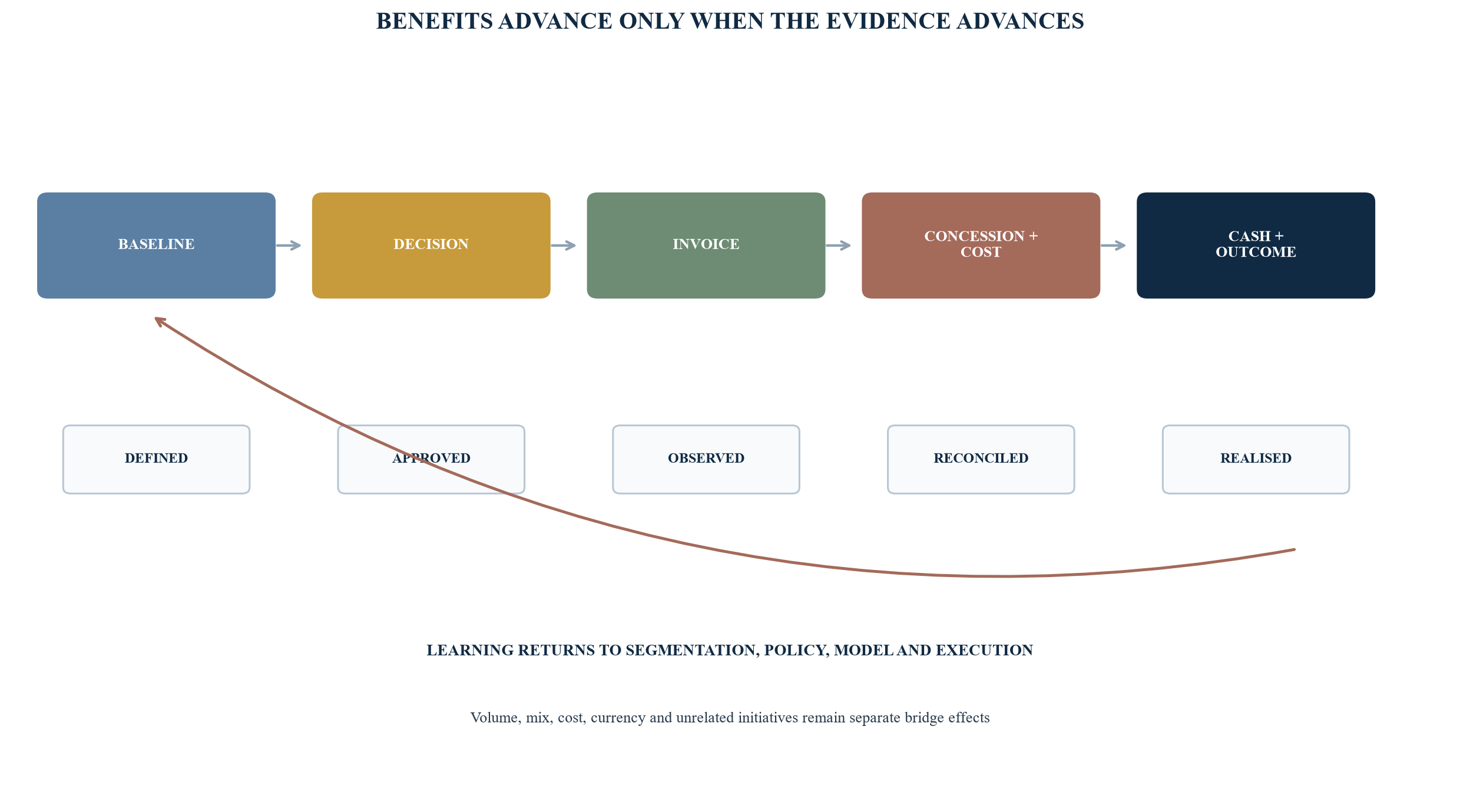
Benefits are recognised only at the evidence gate defined by management policy; the illustration does not represent observed results.
Table 6. Pricing benefit register
| Benefit class | Recognition gate | Reconciliation | Principal caution |
|---|---|---|---|
| approved opportunity | decision authorised with baseline and owner | approval log | remains a management case |
| contracted value | executed terms compared with controlled baseline | contract and quote | customer volume may remain uncertain |
| invoiced effect | eligible invoice lines under new terms | invoice waterfall | credits and rebates may follow |
| pocket-revenue effect | concessions accrued or settled under policy | revenue and concession records | allocation and cut-off require control |
| pocket-margin effect | revenue and variable cost evidence reconciled | finance bridge | cost changes may be unrelated to price |
| cash contribution | collection and related cash effects observed | bank and receivable records | timing and credit effects remain distinct |
| strategic effect | retention, capacity, mix or capability outcome | defined operational evidence | attribution may remain uncertain |
Numerical thresholds and recognition gates should be approved before programme reporting begins.
14. Execute a twelve-week pricing reset
During weeks one and two, management should confirm the sponsor, scope, legal entities, products, channels and decisions. The team should freeze definitions, select a representative transaction sample and assess data coverage. It should identify contracts, promotions, related parties and regulated or sensitive areas requiring specialist advice.
During weeks three and four, the team should build the transaction-economics data spine and reconcile the first waterfall. Missing data, unmatched credits and disputed cost allocations should enter a controlled issue register.
During weeks five and six, management should design economic segments, offer and price architecture, approval rights and the minimum evidence pack. Front-line employees should test the design against real quotations and customer scenarios.
During weeks seven and eight, workflow, dashboards, contract controls, system configuration and incentive shadow reporting should be prepared. Legal, tax, accounting, competition, data and operational reviews should resolve mandatory constraints.
During weeks nine and ten, the company should pilot selected products, segments or channels with explicit guardrails. Decisions, overrides, customer responses, margin effects and service consequences should be captured.
During weeks eleven and twelve, management should reconcile outcomes, correct the design and approve staged expansion. Full rollout should depend on evidence of data, workflow, capability and control readiness.
15. Board and executive diagnostic
Boards and executives can test the pricing system through twelve questions:
1. Can management reconcile list price, invoice price, pocket revenue, pocket margin and cash contribution? 2. Which concessions are visible only after invoicing or period close? 3. What share of invoiced value has matched contract, cost-to-serve and approval evidence? 4. Which segments change the offer, metric, service or authority in practice? 5. Which products, customers and channels show persistent margin dispersion after legitimate differences are controlled? 6. Do price exceptions show the alternatives considered before concession? 7. Are related-party transactions identified before commercial price changes are implemented? 8. Which consumer, competition, tax, data or sector rules constrain pricing decisions? 9. Can the company explain, validate, monitor and override each material analytic recommendation? 10. Do sales incentives reward realised economics and approved strategic choices? 11. Are benefits reconciled to invoices, concessions, cost and cash using a preserved baseline? 12. Which evidence would cause management to stop, revise or reverse the pricing programme?
A missing answer identifies a data, policy, capability or governance gap. Management should prioritise gaps by value, legal exposure, customer consequence and decision urgency.
16. Conclusion
Pricing for margin is an operating-system change. It connects transaction data, customer value, offer design, commercial judgement, accounting, tax, legal constraints, workflow, incentives and benefit evidence. A list-price increase without this system can leave the principal leakage untouched.
The practical sequence begins with realised transaction economics and a controlled waterfall. It then segments customers and offers by economic mechanism, designs coherent metrics and fences, delegates routine choices, governs exceptions and tests hypotheses. Analytics and incentives support the system when their purpose, evidence and limits are explicit.
The result sought is decision quality: the right commercial choice, made at the right level, using traceable evidence, with the value exchange and constraints visible before commitment. Benefit is recognised only as the evidence advances from decision to contract, invoice, pocket economics and cash.
References
- IFRS Foundation. IFRS 15 Revenue from Contracts with Customers. Current issued standard accessed August 2026. https://www.ifrs.org/issued-standards/list-of-standards/ifrs-15-revenue-from-contracts-with-customers/
- IFRS Foundation. IFRS 15 Revenue from Contracts with Customers, issued standards text. 2021. https://www.ifrs.org/content/dam/ifrs/publications/pdf-standards/english/2021/issued/part-a/ifrs-15-revenue-from-contracts-with-customers.pdf
- IFRS Foundation. IFRS 18 Presentation and Disclosure in Financial Statements. Current issued standard accessed August 2026. https://www.ifrs.org/issued-standards/list-of-standards/ifrs-18-presentation-and-disclosure-in-financial-statements/
- Zakat, Tax and Customs Authority, Saudi Arabia. VAT Guideline: Business Promotions. 2021. https://www.zatca.gov.sa/en/HelpCenter/guidelines/Documents/Business%20promotions.pdf
- Federal Tax Authority, United Arab Emirates. VAT legislation, guides, references and public clarifications. Current official resources accessed August 2026. https://tax.gov.ae/en/taxes/Vat/guides.references.aspx
- Government of the United Arab Emirates. Data Protection Laws; Federal Decree-Law No. 45 of 2021. Current official resource accessed August 2026. https://u.ae/en/about-the-uae/digital-uae/data/data-protection-laws
- Saudi Data and Artificial Intelligence Authority. Guide to the Saudi Personal Data Protection Law. Current official resource accessed August 2026. https://dgp.sdaia.gov.sa/wps/portal/pdp/knowledgecenter/
- OECD. OECD Transfer Pricing Guidelines for Multinational Enterprises and Tax Administrations 2022. 2022. https://doi.org/10.1787/0e655865-en
- Federal Tax Authority, United Arab Emirates. Transfer Pricing Guide | CTGTP1. 2023. https://tax.gov.ae/Datafolder/Files/Pdf/2023/Transfer%20Pricing%20Guide%20-%20EN%20-%2023%2010%202023.pdf
- Zakat, Tax and Customs Authority, Saudi Arabia. Transfer Pricing Guidelines. Current official version accessed August 2026. https://www.zatca.gov.sa/en/HelpCenter/guidelines/Documents/Transfer%20Pricing%20Guidelines_Final_Manual.pdf
- Ministry of Economy, United Arab Emirates. Federal Decree-Law No. 36 of 2023 Regulating Competition. 2023. https://www.moec.gov.ae/documents/20121/0/Federal%2BDecree-Law%2BNo.%2B%2836%29%2Bof%2B2023%2BRegulating%2BCompetition.pdf
- General Authority for Competition, Saudi Arabia. Economic Concentration Review Guidelines and official competition-law framework. Current official version accessed August 2026. https://gacbep.gac.gov.sa/cms/b9376edc-79a1-4573-a36d-4f3effaba838.pdf
- Ministry of Commerce, Saudi Arabia. Sales Licensing and consumer discount controls. Current official service accessed August 2026. https://mc.gov.sa/en/eservices/Pages/ServiceDetails.aspx?sid=46
- OECD. Algorithmic Pricing and Competition in G7 Jurisdictions: Emerging Trends and Responses. 2025. https://doi.org/10.1787/f36dacf8-en
- National Institute of Standards and Technology. Artificial Intelligence Risk Management Framework 1.0. 2023. https://doi.org/10.6028/NIST.AI.100-1
- National Institute of Standards and Technology. AI RMF Playbook. Updated 2026. https://www.nist.gov/itl/ai-risk-management-framework/nist-ai-rmf-playbook
- Saudi Data and Artificial Intelligence Authority. Regulation on Personal Data Transfer Outside the Kingdom. Current official resource accessed August 2026. https://sdaia.gov.sa/Documents/RegulationonPersonalDataEN.pdf
About the Author
Chennakeshav Adya is an independent researcher whose work focuses on corporate finance, value creation, private capital and transaction execution. His research translates financial, commercial and operating evidence into decision frameworks for boards, investors and management teams.
