

1. Convert a portfolio label into a dated cash proposition
A private-asset allocation can contain many different instruments. A limited-partner interest, a direct minority shareholding, a co-investment vehicle and a private credit instrument can all appear in one portfolio category. Their liquidity mechanics differ. The legal owner, governing documents, information rights, consent path, buyer population and settlement conditions determine whether a proposed route is available.
The liquidity calendar translates each position into a dated cash proposition. It asks what can be transferred, who can authorise it, which information can be shared, when a credible buyer can complete, how value will be established and how much cash will remain after obligations, withholding, tax, expenses and currency conversion. A calendar entry is therefore more demanding than an estimated exit date.
The calendar should begin with the obligations that liquidity must meet. Capital calls, debt service, acquisitions, tax, distributions and succession payments have different authority and priority. Their date, currency, legal obligor, amount range and consequence of delay should be recorded. This makes the liquidity objective measurable.
Reported net asset value remains important evidence. It can support portfolio monitoring, allocation decisions and transaction preparation. The Financial Conduct Authority explains that private-market valuation uses judgement because frequent trading and regular price discovery are absent. Its 2025 review found that robust processes could evidence independence, expertise, transparency and consistency. A liquidity calendar retains the reference valuation and separately models transaction price, costs, liabilities and timing.
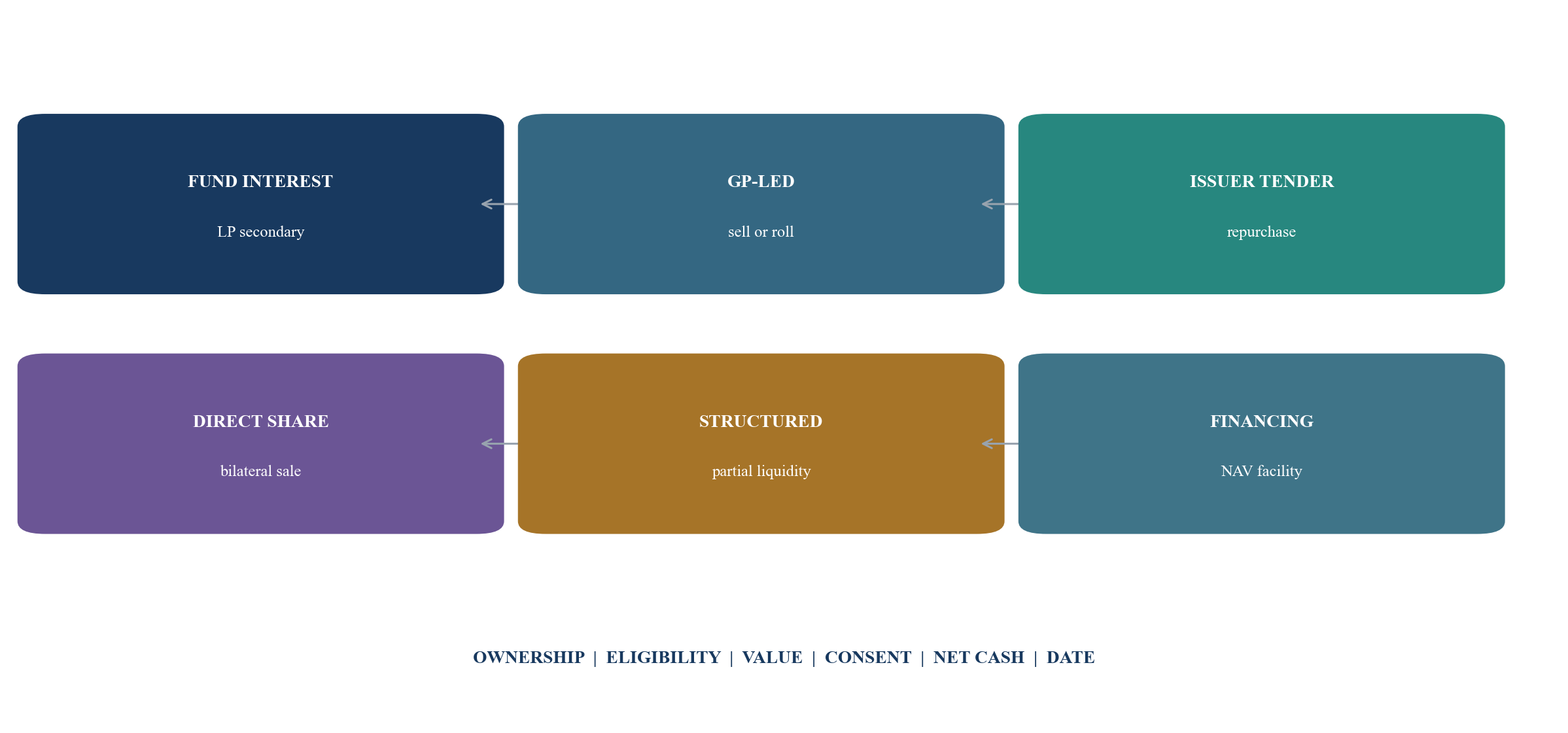
Each route has a separate legal, valuation, conflict, buyer and settlement path.
2. Classify the route before estimating the proceeds
The first route is an LP secondary. A fund investor sells all or part of its interest to an eligible buyer under the limited partnership agreement and related documents. The buyer generally acquires the economic position and assumes future obligations specified in the transfer. Unfunded commitments, distributions after the reference date, consent, know-your-customer review and closing adjustments can materially change the cash calculation.
The second route is a GP-led transaction, including a continuation vehicle. Assets move from an existing vehicle to a new vehicle managed or sponsored by a related manager. Existing investors can be offered an election to sell, roll or combine the two, subject to the actual process and documents. Institutional Limited Partners Association guidance focuses on alignment, transparency, process and informed LP engagement because the manager can participate on several sides of the transaction.
The third route is an issuer or sponsor tender. A company, fund, sponsor or other bidder offers to acquire eligible interests under stated terms. Eligibility, offer period, withdrawal, proration, financing, disclosure and governing law require transaction-specific analysis. United States tender offers can engage federal rules, including Regulation 14E and, for certain issuer tenders, Rule 13e-4. The exact facts and securities determine the applicable requirements.
The fourth route is a direct-company share sale. It can involve another shareholder, a strategic buyer, a financial investor, the company or a family vehicle. Constitutional documents, shareholder agreements, rights of first refusal, pre-emption, tag, drag, board consent, securities law, beneficial ownership, capital rules and filings can affect the route. A direct-company sale also requires diligence on the underlying business rather than solely on an investment vehicle.
The fifth route is a structured partial exit. Examples can include preferred equity, a staged sale, a sale with deferred consideration, a distribution-in-kind followed by a sale, or financing supported by a portfolio. The structure reallocates timing, control, downside and counterparty exposure. Legal and tax advisers should analyse the actual instrument and jurisdictions before it is treated as available liquidity.
Table 1. Private-asset liquidity route taxonomy
| Route | Primary transaction | Central evidence | Principal timing variable |
|---|---|---|---|
| LP secondary | transfer of a fund interest and specified obligations | partnership documents, capital account, notices, consent and transfer agreement | buyer diligence, GP consent and reference-date true-up |
| GP-led or continuation | sale, roll or combined election into a related successor vehicle | process materials, asset information, price support, conflicts and election documents | LP engagement, buyer process, approvals and election period |
| issuer or sponsor tender | acquisition of eligible interests under common offer terms | offer documents, eligibility, financing, disclosure, proration and withdrawal mechanics | applicable offer period, conditions and settlement |
| direct-company share sale | bilateral or marketed transfer of private-company shares | constitution, shareholder agreement, cap table, rights, diligence and approvals | pre-emption, consent, buyer diligence and regulatory clearance |
| company repurchase | issuer acquisition of its own shares | statutory capacity, distributable resources or capital process, approvals and solvency evidence | corporate approvals, financing and filing sequence |
| structured partial exit | preferred, deferred, tranched or collateral-supported liquidity | instrument terms, priority, security, covenants, valuation and exit path | documentation, financing conditions and future realisation |
| NAV-based facility | borrowing supported by portfolio value and cash flows | borrower authority, collateral, valuation, covenants, lender diligence and repayment plan | lender process, security perfection and draw conditions |
Availability depends on the asset, documents, parties, governing law and current facts.
3. Build the obligations calendar before selecting assets
Liquidity planning begins with uses of cash. Each obligation should state its owner, legal status, base currency, due date, amount, confidence range, approval status, flexibility and consequence of delay. A contractual capital call is different from a proposed acquisition. A tax payment is different from a discretionary family distribution. A board should see those differences before it chooses a private asset to monetise.
The obligations calendar should cover at least 24 months when the portfolio contains closed-end funds and direct assets. Private transactions can require long preparation and can be delayed by consent, diligence or market conditions. A rolling period also exposes clusters of capital calls, debt maturities, investment commitments and family events that a one-year budget may miss.
Currency belongs in the same record. A sale settling in US dollars does not directly discharge a sterling, euro, Singapore-dollar or dirham obligation. The calendar should identify when foreign exchange will be converted, hedged or retained; who has authority; which account can receive proceeds; and what evidence supports the assumed rate and cost. Bank-account readiness, sanctions screening, beneficial ownership and payment controls can delay usable cash after commercial agreement.
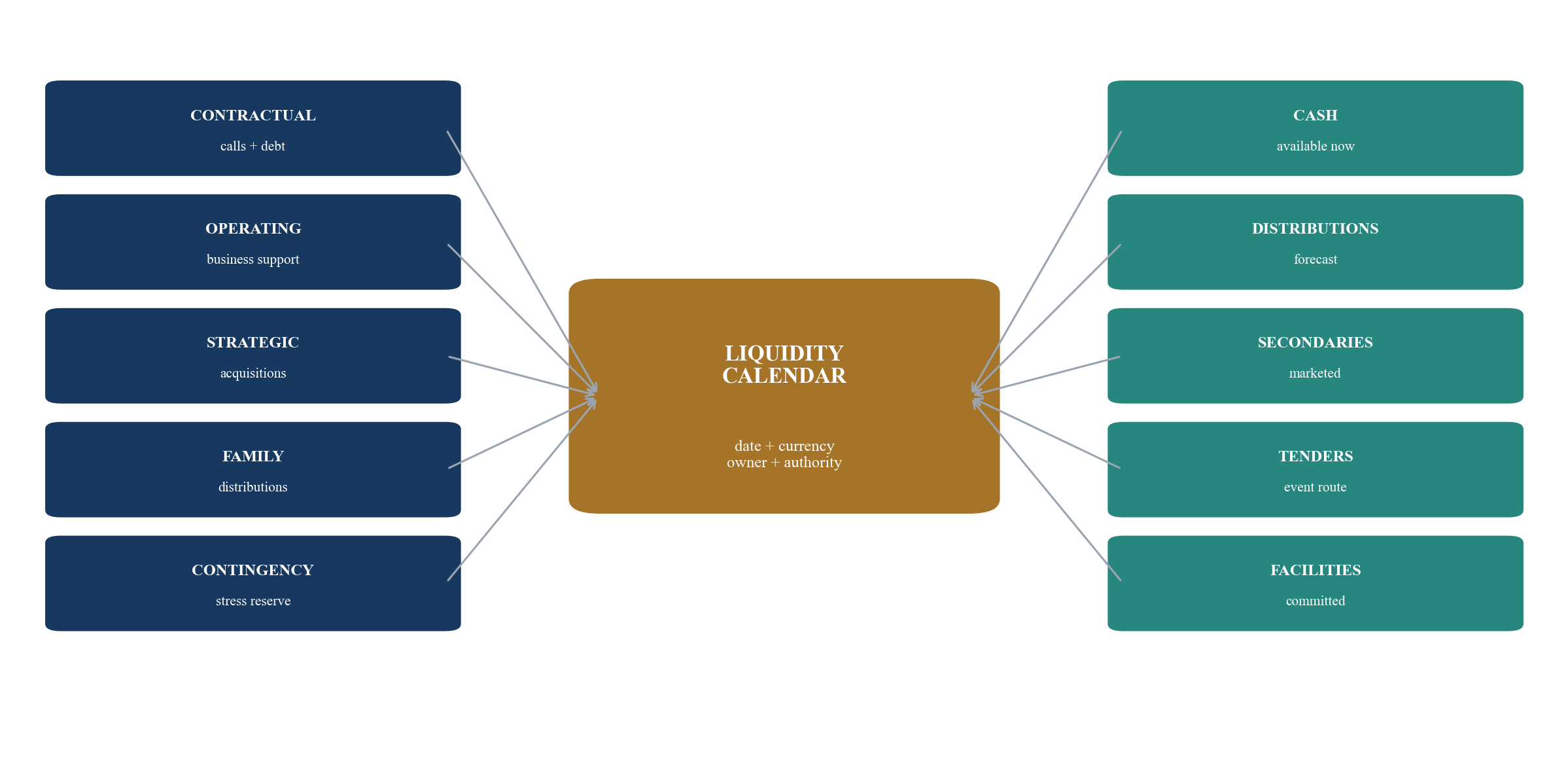
Obligations are matched to verified sources by date, currency, owner and authority.
4. Create one verified register for every candidate asset
A liquidity decision can fail because the office cannot prove what it owns or share sufficient information with a buyer. The minimum register should reconcile the legal owner, beneficial owner, asset, vehicle, commitment, funded amount, unfunded amount, distributions, reference valuation, valuation date, governing law and controlling documents. It should identify security interests, side letters, transfer restrictions, confidentiality, tax status and relevant contacts.
The register should link facts to evidence. An administrator statement, executed agreement, company register, share certificate, capital account, audited financial statement, bank record and tax form serve different purposes. The office should record the source date and responsible reviewer. Estimated values and expected dates should be identified as management assumptions until verified.
Table 2. Minimum private-asset liquidity register
| Field | Governing question | Minimum evidence |
|---|---|---|
| ownership | which entity holds legal and beneficial title? | register, certificate, executed agreement, trust or nominee record |
| instrument | what interest, class, percentage and rights are held? | governing documents, cap table, capital account and side letter |
| economics | what has been funded, distributed and committed? | administrator or issuer statements and reconciled cash records |
| valuation | what is the reference value, date, method and approval? | valuation report, accounts, manager statement and committee record |
| transfer | what consent, pre-emption, eligibility, minimum size and notice applies? | constitutional and transaction documents plus adviser review |
| information | what data can the seller access and disclose to a buyer? | contractual rights, confidentiality terms, consent and data-room log |
| encumbrance | is the asset pledged, restricted, subject to a lien or included in a borrowing base? | security documents, lender confirmation and covenant report |
| tax and reporting | what forms, withholding, filing and tax analysis may apply? | current tax records and qualified transaction-specific advice |
| authority | who can approve preparation, launch, price, documents and settlement? | delegation, board or investment-committee terms and resolutions |
| settlement | which account, currency, identity checks and closing deliverables apply? | payment instructions, KYC record, closing checklist and bank control |
Every material field should link to current evidence, an owner and a review date.
5. Test eligibility, transfer rights and approvals early
The fastest apparent asset can be unavailable. A partnership agreement may require GP consent, impose a minimum retained interest or restrict eligible transferees. A shareholder agreement may provide pre-emption or a right of first refusal. A company constitution can require board approval. A lender may have security over the asset or impose a negative covenant. A trust or foundation may require trustee or council action.
The office should prepare a transfer-rights memorandum for each shortlisted asset. It should identify the governing instruments, parties, notice sequence, consent standard, permitted-transfer provisions, related-party rules, pre-emption, tag, drag, change-of-control implications, regulatory approvals and expected evidence. Counsel should confirm the analysis in each relevant jurisdiction.
Official company-law sources show why jurisdiction matters. Section 160 of the Delaware General Corporation Law addresses a corporation's power and limits in dealing in its own shares. Part 18 of the UK Companies Act 2006 governs acquisition by a limited company of its own shares, including funding and approval rules. Singapore's Accounting and Corporate Regulatory Authority states that private-company share transfers must involve fully paid shares, comply with the constitution and use a proper instrument; the transfer takes effect after the electronic register of members is updated. These are examples for issue spotting, not interchangeable rules.
Approval rights should be separated by stage. Preparation may allow confidential adviser engagement and document collection. Launch may authorise a defined route and buyer population. Price approval may depend on current bids and an independent valuation bridge. Signing and settlement may require final documents, conditions and payment controls. This staged authority preserves decision quality as facts develop.
6. Establish a route scorecard before approaching buyers
A board should compare routes against the objective. Relevant criteria include expected net cash, confidence of completion, earliest and latest cash date, control retained, future upside retained, information burden, counterparty exposure, confidentiality, tax complexity, regulatory complexity, governance conflicts, covenant effect and internal capacity.
The weights should reflect the current obligation. A near-term contractual payment can place greater weight on date confidence. A discretionary portfolio rebalance can place greater weight on price and retained upside. A succession transaction can include equitable treatment, control and family-governance criteria. The record should show why the weights were chosen.
Table 3. Route decision scorecard
| Criterion | Decision question | Evidence measure |
|---|---|---|
| net cash | what cash is expected after obligations, true-ups, costs, withholding and currency? | low, base and high net-proceeds bridge |
| date confidence | when can usable cash reach the correct legal owner? | milestone plan, conditions, consent and settlement evidence |
| execution probability | how credible are buyer, financing, approvals and information readiness? | gated probability by transaction stage |
| value retained | what future participation, governance and optionality remain? | post-transaction ownership and rights model |
| risk transferred | which asset, funding, liability and downside exposures move or remain? | legal and economic risk-allocation schedule |
| confidentiality | what information must be shared and with whom? | permission map, NDA, data-room controls and buyer list |
| conflict | who participates on more than one side or benefits from price and timing? | conflict register, recusals and independent challenge |
| portfolio effect | how do allocation, concentration, unfunded commitments and leverage change? | pre- and post-transaction portfolio model |
| operating burden | can the office run diligence, tax, legal, reporting and closing work? | named team, adviser plan, budget and critical path |
Weights and scores are management decisions supported by current evidence and specialist advice.
7. Build a defensible valuation bridge to net cash
The reference value and the transaction price answer different questions. The reference value can be a manager-reported NAV or a board-approved company valuation. A bidder considers information quality, concentration, risk, duration, unfunded commitments, governance, transferability, financing and expected return. Negotiated price can therefore differ from reference value.
The valuation bridge should preserve the starting value and show each adjustment. For an LP interest, the bridge can include valuation-date movements, distributions, capital calls, unfunded commitments, carried-interest effects, expected closing adjustments and buyer pricing. For a direct company, it can include enterprise-to-equity adjustments, net debt, working capital, minority position, rights, dilution, contingent liabilities and transaction structure.
The Financial Conduct Authority identifies valuation conflicts around asset transfers, redemptions, subscriptions, investor marketing and secured borrowing. Its review describes controls including third-party valuation, separate teams or committees, market testing and detailed records. It also reports continuation-fund processes in which incoming investors bid and existing investors could sell or roll, with fairness depending on incoming investors having sufficient information to form their view.
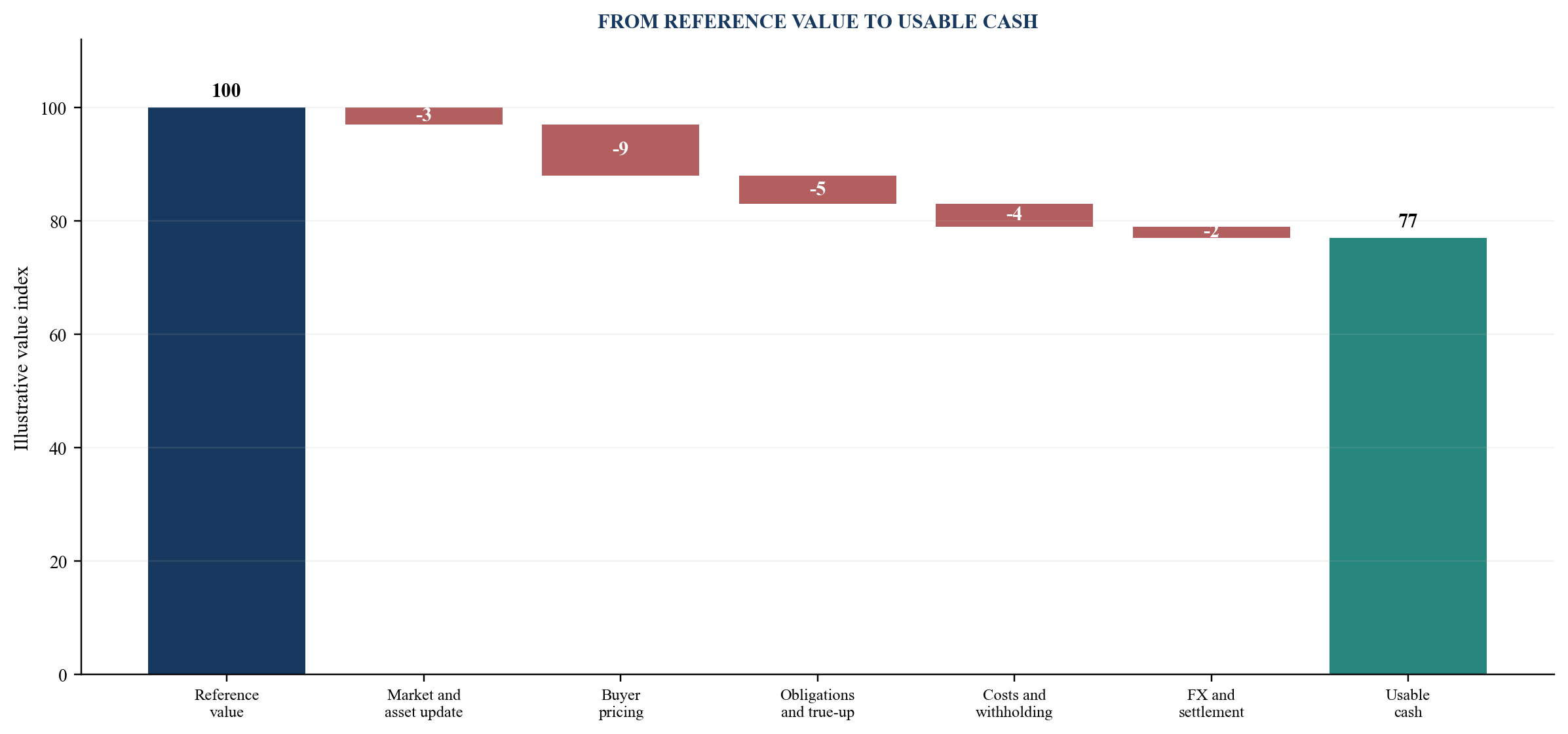
Transaction value becomes liquidity only after liabilities, true-ups, costs, tax, currency and settlement.
Table 4. Illustrative valuation and net-cash bridge
| Bridge item | Illustrative index | Evidence required before approval |
|---|---|---|
| reference value | 100 | current approved valuation, date, method and scope |
| asset and market update | -3 | post-valuation operating, financing and market evidence |
| buyer pricing adjustment | -9 | bids, assumptions, rights, concentration and return requirement |
| obligations and true-up | -5 | unfunded commitment, distributions, calls and closing formula |
| adviser and transaction costs | -2 | engagement letters, tax treatment and closing estimate |
| withholding and provisional tax reserve | -2 | qualified jurisdiction-specific tax analysis and forms |
| currency and settlement | -2 | conversion plan, bank charges, account and payment controls |
| illustrative usable cash | 77 | reconciled funds received by the correct legal owner |
Values use a 100 reference-value index and are management assumptions solely for explaining the method.
8. Govern GP-led and continuation transactions as conflicted decisions
A continuation transaction can offer liquidity while preserving exposure to selected assets. It can also place the sponsor in roles that require careful conflict governance. The manager can influence asset selection, timing, information, valuation, transaction terms, future economics and the choice of buyer group. Existing investors may face a sell-or-roll decision under a defined timetable.
Institutional Limited Partners Association guidance asks market participants to focus on alignment, transparency, process and LP engagement. The board of a family office should record the information received, price evidence, transaction expenses, carried-interest treatment, management fees, roll mechanics, tax consequences, conflicts, election deadline and approval authority. It should also confirm whether the selling, rolling and incoming investor groups receive sufficient information for their decisions.
The roll decision should be analysed as a new investment decision. The office should assess mandate fit, concentration, duration, governance, fees, carried interest, leverage, follow-on needs, exit plan, manager capacity and the rights of the new vehicle. Historical ownership of the asset does not replace current underwriting.
The sell decision should be evaluated against the same net-cash bridge as any secondary. A price stated as a percentage of NAV is incomplete without the NAV date, post-date movements, unfunded obligations, distributions, taxes, costs and settlement terms. The election record should preserve these elements and the advice relied upon.
9. Treat tender offers as governed processes
A tender offer requires a complete offer record. It should identify the bidder, eligible holders, interests sought, price or pricing formula, maximum amount, proration, financing, conditions, withdrawal rights, timetable, disclosure, conflicts, tax treatment and settlement mechanics. The office should determine whether partial acceptance creates a residual position that remains economical and governable.
United States securities rules can apply to particular tender structures. The Securities and Exchange Commission publishes interpretations relating to tender-offer rules and schedules and separate filer information for issuer tender offers. Counsel should analyse the issuer, security, bidder, holder population, communications, jurisdiction and offer mechanics. An internal label such as liquidity window does not determine the legal analysis.
Proration creates funding uncertainty. If holders tender more than the bidder will acquire, accepted amounts can be reduced under the offer terms. The calendar should therefore use a range for proceeds until acceptance is confirmed. The office should also model the post-tender ownership, rights, concentration, information access and future liquidity of the retained interest.
10. Run LP secondaries through a controlled transaction funnel
An LP-secondary process begins with a mandate, eligible asset set and confidentiality plan. The office and adviser prepare a teaser or portfolio summary, identify buyers whose strategies and status fit the transfer rules, and obtain required permissions. Buyer outreach should record recipient, permission, information shared and conflicts.
Indicative bids are compared on price, conditions, scope, funding, buyer eligibility, diligence burden, reference date, treatment of distributions and calls, and expected closing. A high price with broad conditions can deliver less date certainty than a funded bid with limited conditions. The scorecard should preserve this distinction.
Final diligence commonly requires legal documents, capital accounts, financial statements, notices, cash-flow history, unfunded commitments, side letters, tax forms and seller identity evidence. The seller should maintain a question log and ensure that responses are authorised, consistent and supported. Sensitive underlying information should remain within contractual permissions.
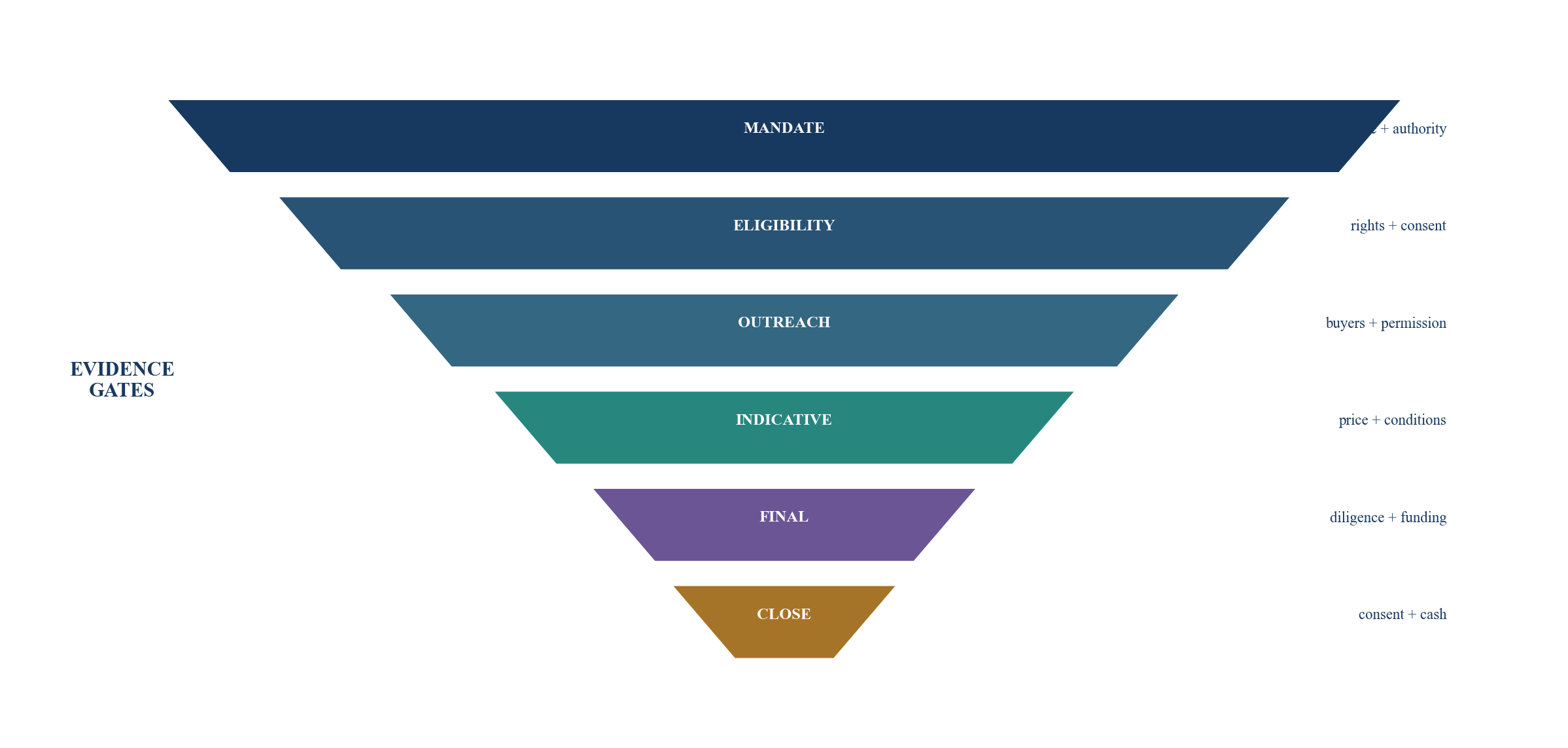
Each stage has an evidence gate and a named authority.
11. Prepare direct-company shares for diligence and transfer
A direct private-company interest places the underlying business at the centre of diligence. Buyers can require current financial statements, quality of earnings, forecasts, customers, suppliers, employees, intellectual property, tax, litigation, regulation, debt, cap table, options, related parties and material contracts. A minority seller may not control access to this information.
The office should map information rights and obtain company cooperation before treating the route as executable. It should also understand whether a broad process could affect employees, customers, lenders or strategic plans. A controlled buyer list, staged data room, clean-team arrangement and management-access protocol can support confidentiality where appropriate and legally permissible.
Transfer rights should be modelled as a timeline. Notice can trigger pre-emption, a right of first refusal, co-sale, board consideration, lender consent or regulatory filing. Price changes can require a repeated process under the documents. The office should avoid announcing a cash date before these mechanics are confirmed.
12. Use structured exits to solve a defined constraint
A structured exit can address a price gap, buyer-funding limit, control objective or timing need. A seller may receive cash now and retain a residual interest; accept deferred consideration; exchange common equity for a preference instrument; sell in tranches; or use a portfolio-supported facility. Each structure changes risk rather than simply creating cash.
Deferred consideration introduces counterparty and collection risk. The office should assess obligor credit, security, covenants, subordination, payment priority, currency, set-off, tax timing and enforcement. A headline purchase price that includes contingent or unsecured future payments should be separated into cash received, secured fixed amounts, unsecured fixed amounts and contingent value.
A portfolio facility creates liquidity without an asset sale. Institutional Limited Partners Association's NAV-based facilities guidance covers transparency, LP engagement, legal documentation and disclosure. The office should analyse borrower authority, collateral, valuation, loan-to-value, concentration, cash sweep, covenants, recourse, maturity, interest, fees, permitted use and repayment. Financing proceeds are debt-funded liquidity and should remain linked to a credible repayment source.
13. Calculate tax, withholding and filing before approving price
Gross proceeds do not establish spendable cash. The selling entity, asset, buyer, source of gain, vehicle classification, holding period, treaty position, forms and transaction structure can affect tax and withholding. Qualified advisers should prepare a transaction-specific analysis before the board approves the net-cash expectation.
Official tax guidance illustrates the issue. The United States Internal Revenue Service states that section 1446(f) can require a transferee to withhold 10 percent of the amount realised on a transfer of a partnership interest when the statutory conditions apply, subject to exceptions and detailed rules. The seller's ultimate tax liability and cash withheld are separate questions.
United Kingdom guidance states that buyers generally pay stamp taxes on certain share purchases, with the current paper stock-transfer process and rates set out by HM Revenue & Customs. The UK government also announced in July 2026 a future Securities Transfer Tax intended to replace Stamp Duty and Stamp Duty Reserve Tax. A current transaction should be assessed against the law and commencement position applying at that time.
The tax workstream should identify filings, certificates, buyer withholding, seller reserves, reclaim or credit mechanics, payment dates, foreign exchange and financial-statement treatment. The liquidity calendar should show cash received at settlement, cash restricted or reserved, and cash expected later. Only reconciled funds under the correct owner's control should be treated as usable cash.
14. Make conflicts visible throughout the transaction
Private-asset liquidity can create conflicts among sellers, remaining investors, rolling investors, incoming buyers, managers, sponsors, advisers, lenders and related family vehicles. Compensation can depend on transaction completion, valuation, fees, carried interest or future management economics. A principal may also have a personal relationship with a counterparty.
The conflict register should name the interested person, interest, affected decision, materiality, disclosure, mitigation, recusal, independent reviewer and approval body. Generic statements provide limited decision support. The record should explain how the conflict appears in this transaction and which control responds to it.
Independent challenge can include a separate committee, external valuation, fairness opinion, competitive process, independent counsel, market test or approval by disinterested persons. The chosen control should fit the conflict. Its scope, information and limitations should be recorded.
Related-party transfers require particular care. The board should establish that authority, price evidence, terms, tax, minority interests, duties, disclosure and approvals have been addressed. A transaction inside a family structure can still move value among entities, branches, generations or beneficiaries.
15. Operate a transaction risk dashboard
The risk dashboard should focus attention on conditions that can change cash, timing or validity. Core categories include ownership, authority, information, valuation, buyer, financing, consent, tax, regulation, confidentiality, currency and settlement. Each risk needs a fact-based status, owner, deadline, response and escalation rule.
A colour alone is insufficient. A red valuation status might mean the reference NAV is stale, a material post-date event is unresolved or independent review is incomplete. An amber consent status might mean the required notice has been filed and the decision is pending. The dashboard should state the evidence and next action.
Probability estimates should be stage gated. Before buyer outreach, completion probability is a management estimate with a wide range. A funded final bid, completed diligence, executed documents and received consents progressively improve evidence. The calendar should update its range rather than preserve the original launch assumption.
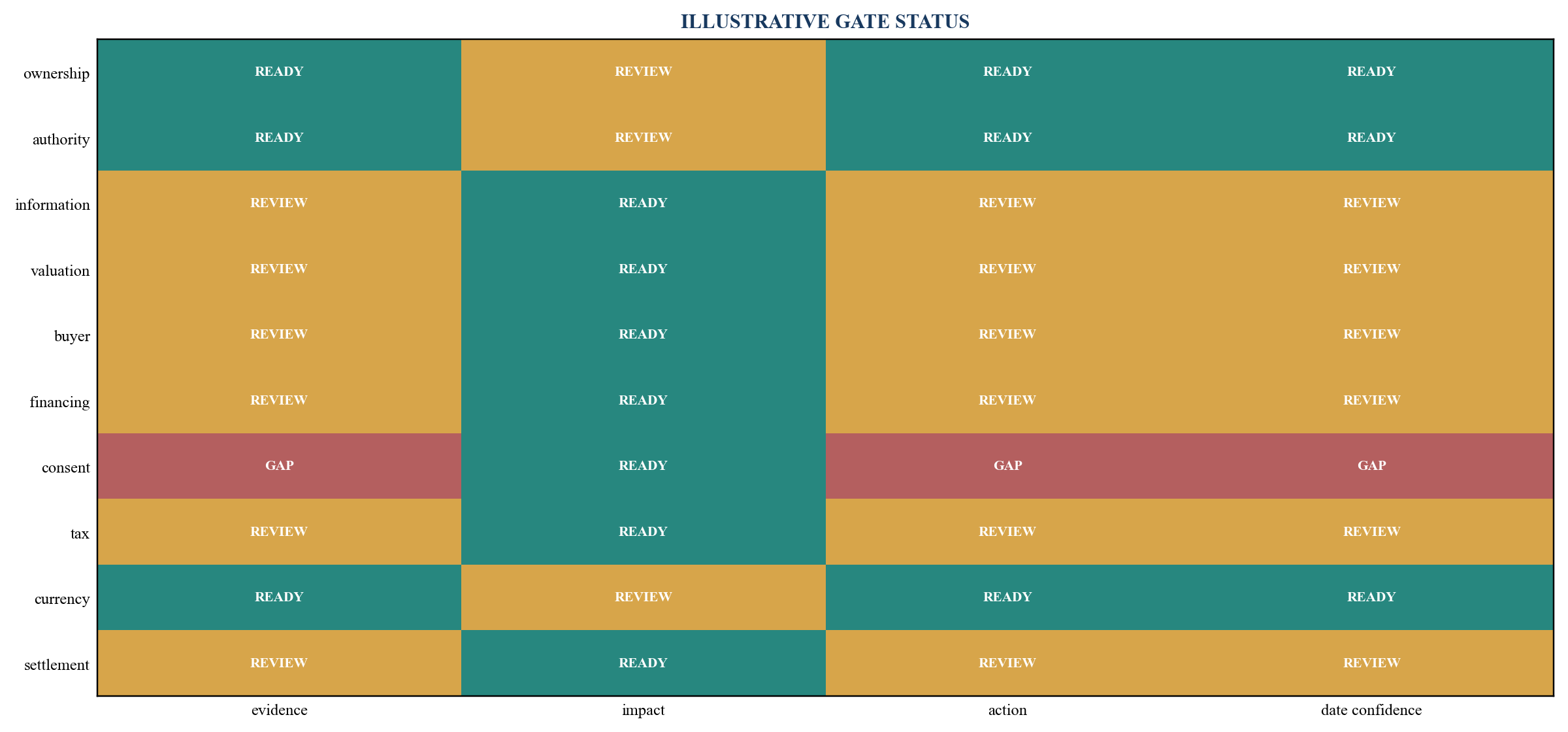
Status must identify the evidence gap, owner, action and escalation date.
16. Demonstrate the calendar with a hypothetical global family office
Consider a hypothetical family office with USD 1.20 billion of investible assets. Private assets have a reported reference value of USD 480 million. The office expects USD 75 million of contractual capital calls and debt service during the next 24 months, plus a proposed USD 40 million strategic acquisition subject to approval. It holds cash and short-duration instruments that cover USD 55 million after maintaining an approved minimum reserve. Every value, date and outcome in this example is a management assumption for illustration.
The office first protects the contractual calendar. It allocates USD 55 million of verified liquid resources and identifies a further USD 20 million requirement. It creates a secondary shortlist containing diversified fund interests with complete records and a direct-company stake subject to pre-emption. It also receives notice of a sponsor tender and a continuation-fund election.
The board authorises preparation across several routes. It does not commit the acquisition until the funding source reaches its approval gate. A fund-interest secondary becomes the primary route for the contractual gap because ownership, information and transfer records are complete. The direct-company stake remains a strategic option because company cooperation and pre-emption timing remain unresolved.
The secondary's reference value is USD 38 million. The board receives a funded final bid, a net-cash bridge and consent timetable. It authorises signing subject to a minimum net-cash threshold and final tax confirmation. The transaction settles with USD 28 million of usable cash under the illustrative assumptions. The excess above the contractual gap returns to the reserve pending the acquisition decision.
Table 5. Hypothetical 24-month private-asset liquidity calendar
| Period | Obligation or event | Candidate source | Gate and decision | Illustrative usable cash status |
|---|---|---|---|---|
| months 0-3 | capital calls and debt service | existing cash and short-duration instruments | ownership, account and authority reconciled | 35 |
| months 3-6 | remaining contractual funding gap | diversified LP-interest secondary | funded bid, valuation bridge, tax and GP consent | 28 |
| months 6-9 | sponsor tender election | eligible fund interests | price, proration, residual position and terms reviewed | 0 until acceptance |
| months 6-12 | proposed strategic acquisition | reserve plus approved liquidity route | investment approval and funding certainty required | uncommitted |
| months 9-15 | direct-company liquidity option | minority shareholding | company data, pre-emption, buyer and consent pending | uncommitted |
| months 12-18 | continuation-fund election | selected portfolio exposure | sell-or-roll underwriting, conflict and tax review | decision dependent |
| months 18-24 | next commitment cycle | distributions, reserve and refreshed secondary list | quarterly forecast and downside test | range refreshed |
All amounts, dates, probabilities and outcomes are illustrative management assumptions.
The example shows why several routes can be prepared while only one funds a defined need. It also shows why pending tenders and proposed sales do not count as cash. The board retains the evidence, assumptions, rejected routes and realised outcome for later learning.
17. Sequence the operating plan across 100 days
During days 1 to 20, the office confirms obligations, minimum reserve, legal owners, asset register, documents, valuations, confidentiality, transfer rights, encumbrances and authority. It appoints legal, tax, valuation and transaction advisers under approved scope. The board receives the initial route scorecard and risk dashboard.
During days 21 to 40, the office prepares the data room, obtains information permissions, develops buyer and counterparty criteria, drafts transaction materials, updates valuations and completes preliminary tax analysis. It seeks early consent guidance where the documents and relationship permit. Management assumptions remain identified in the decision record.
During days 41 to 65, the office conducts controlled outreach or responds to the event process. It logs buyers, permissions, questions, indicative terms and conflicts. The decision body compares bids and routes using net cash, date confidence, conditions and retained exposure. Shortlisted counterparties receive authorised diligence access.
During days 66 to 85, the office completes final diligence, negotiates documents, confirms funding, obtains valuation challenge, finalises tax analysis and pursues consents. The board or delegated body receives the approval pack with redlines, net-cash bridge, risk dashboard and closing conditions.
During days 86 to 100, the office signs, satisfies conditions, verifies payment instructions, settles and reconciles funds. It updates ownership, accounting, tax, portfolio, commitment and risk records. It compares realised price, cost and time with the approved case and records lessons for the next calendar cycle. The actual timetable can be longer or shorter; this sequence is an operating template.
18. Install a recurring governance calendar
Liquidity readiness requires maintenance between transactions. Monthly operations can reconcile notices, calls, distributions, bank accounts and ownership events. Quarterly governance can update valuations, obligations, commitment pacing, route readiness, currencies and borrowing capacity. Semi-annual work can refresh buyer intelligence, adviser readiness and direct-company information rights. Annual governance can approve the liquidity policy, authority, reserve and scenario tests.
Event-driven review should occur when a manager launches a tender or continuation transaction, a company proposes a financing or sale, an asset is pledged, a material valuation event occurs, a family owner dies or becomes incapacitated, a tax rule changes, a sanction issue arises or a large obligation is proposed. The event record should state which calendar assumptions are affected.
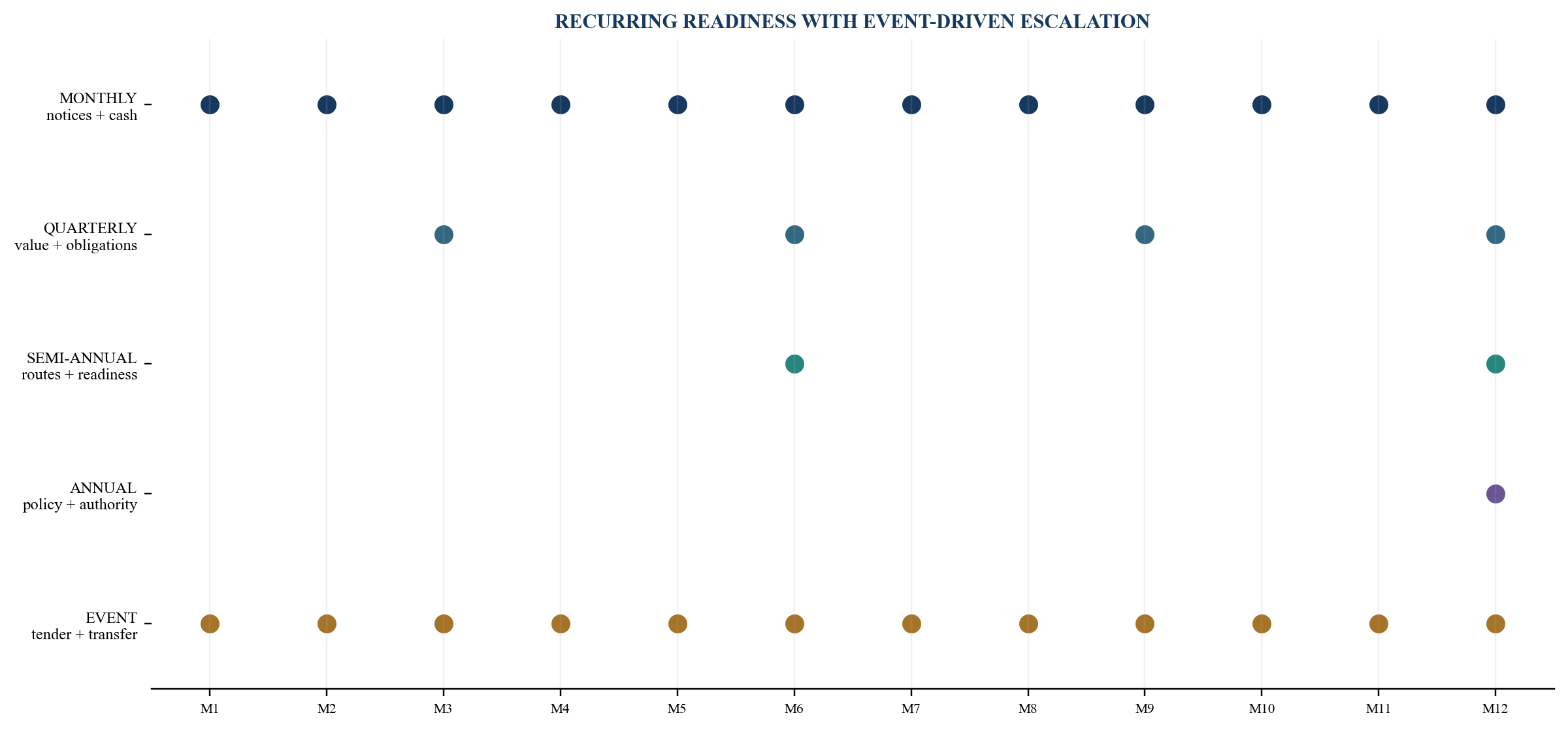
Recurring review is supplemented by immediate event-driven escalation.
19. Give the board a closed-loop liquidity scorecard
The board scorecard should establish whether the calendar is governable and whether completed transactions delivered the approved outcome. It covers obligations, ownership, route availability, information, valuation, conflicts, tax, execution, settlement and learning. Every material exception should have an owner and deadline.
Table 6. Board-ready private-asset liquidity scorecard
| Domain | Governing question | Acceptance evidence |
|---|---|---|
| obligations | are amount, date, currency, owner, authority and consequence verified? | approved obligations register and downside cases |
| ownership | can the office prove the interest, rights, encumbrances and legal owner? | reconciled documents, registers, statements and confirmations |
| route | is the proposed transfer or financing route legally and contractually available? | counsel review, consent map, eligibility and approval sequence |
| information | can authorised decision-makers and counterparties receive sufficient evidence? | information-rights map, permissions, data room and access log |
| valuation | can the board trace reference value to price and usable cash? | current valuation, independent challenge, bids and net-cash bridge |
| conflicts | are interests, affected decisions and controls transaction specific? | conflict register, disclosure, recusal and independent review |
| tax and regulation | are withholding, filing, advice and applicable transaction rules addressed? | qualified advice, forms, timetable and reserved cash |
| execution | are buyer, funding, documents, consent and conditions credible? | transaction plan, signed terms, financing evidence and condition log |
| settlement | did funds reach the correct owner and were records updated? | bank receipt, closing statement, ownership and accounting reconciliation |
| learning | did price, cost, timing and risk match the approved case? | post-close review, backtest and calendar improvements |
Acceptance requires current evidence and a named authority for each stage.
The calendar becomes useful when it changes decisions. It can cause the office to prepare an asset earlier, retain more reserve, seek information rights, decline a conditional bid, obtain independent valuation support, separate a roll decision from a sale decision, or delay a commitment until funding is credible. These are observable governance outcomes.
Private-asset liquidity remains contingent until authority, eligibility, information, price, buyer, consent, tax and settlement align. A disciplined calendar connects these elements to dated obligations and reconciled cash. It gives the family office a repeatable method for acting on tenders, secondaries and structured exits across jurisdictions while preserving evidence, accountability and learning.
References
- Financial Conduct Authority, Private Market Valuation Practices, 5 March 2025, https://www.fca.org.uk/publications/multi-firm-reviews/private-market-valuation-practices
- Institutional Limited Partners Association, Continuation Funds: Considerations for Limited Partners and General Partners, May 2023, https://ilpa.org/resources-tools/resource-library/continuation-funds-considerations-for-limited-partners-and-general-partners/
- Institutional Limited Partners Association, NAV-Based Facilities Guidance, 25 July 2024, https://ilpa.org/resources-tools/resource-library/nav-based-facilities-guidance/
- United States Securities and Exchange Commission, Tender Offer Rules and Schedules, updated 3 October 2025, https://www.sec.gov/rules-regulations/staff-guidance/corporation-finance-interpretations/tender-offer-rules-schedules
- United States Securities and Exchange Commission, Information for Certain Types of Transactions and Filers, https://www.sec.gov/about/divisions-offices/division-corporation-finance/information-certain-types-transactions-filers
- Internal Revenue Service, Partnership Withholding, including Section 1446(f), https://www.irs.gov/individuals/international-taxpayers/partnership-withholding
- HM Revenue & Customs, Tax When You Buy Shares, https://www.gov.uk/tax-buy-shares
- HM Revenue & Customs, Completing a Stock Transfer Form, updated 10 August 2023, https://www.gov.uk/guidance/stamp-duty-on-shares
- United Kingdom, Companies Act 2006, Part 18, Acquisition by Limited Company of Its Own Shares, https://www.legislation.gov.uk/ukpga/2006/46/part/18
- Government of the United Kingdom, Modernisation of the Stamp Taxes on Shares Framework; Securities Transfer Tax, 13 July 2026, https://www.gov.uk/government/publications/securities-transfer-tax-modernisation-of-the-stamp-taxes-on-shares-framework/modernisation-of-the-stamp-taxes-on-shares-framework-securities-transfer-tax
- Delaware General Assembly, Delaware General Corporation Law, Title 8, sections 159 and 160, https://delcode.delaware.gov/title8/c001/sc05/index.html
- Accounting and Corporate Regulatory Authority Singapore, Filing a Transfer of Shares, updated 19 March 2026, https://www.acra.gov.sg/manage/companies/shares/transfer-of-shares/
About the Author
Chennakeshav Adya is an independent researcher and Managing Partner of Matchpoint Partners. His work examines strategy, capital formation, valuation, transactions and operating execution across private and public markets.
