

1. Finance the contractual cash cycle rather than the headline order book
An engineering contractor may report strong revenue, positive project margin and a large order book while being unable to meet payroll or supplier commitments. The apparent contradiction comes from timing. Cash leaves when people, materials, plant and subcontractors are mobilised. Revenue is recognised as work progresses under the applicable accounting policy. A payment application is submitted after a measurement date. An engineer, consultant or employer reviews the application, issues a certificate and applies contractual deductions. Cash arrives after the contractual payment period, administrative processing and any delay. Debt service sits inside this sequence.
A lender therefore needs a project-level cash model rather than a revenue multiple. The model should identify the legal employer, contracting entity, scope, price basis, programme, remaining cost, margin, billing procedure, certificate authority, payment period, retention, advance recovery, liquidated damages, set-off, variation procedure and dispute route. It should reconcile the contract ledger to the general ledger and bank receipts. Work that has not been measured, supported or accepted should remain outside the core repayment case.
The Gulf market is not a single legal or procurement environment. Saudi public procurement, UAE movable-security and receivables-transfer rules, Qatar tender requirements, project-specific conditions and private contracts can produce different rights and procedures.[1][2][3][4][10][11] UAE federal procurement legislation provides useful institutional context, although its stated exclusions include construction projects; it should not be treated as the source of construction-payment rights.[5][6] The transaction team must read the current documents and obtain jurisdiction-specific legal advice. A framework improves questions and controls; it does not replace documentary diligence.
The first board decision is the purpose of the requested capital. Mobilisation finance funds the initial negative cash curve. Certificate finance bridges eligible approved work to receipt. A revolving working-capital line absorbs timing variation across a portfolio. Equipment finance funds identifiable assets. A guarantee line supports tender, performance, advance-payment and retention obligations. A term loan should fund a durable use with a repayment path longer than the operating cycle. Combining these purposes in one undifferentiated facility can hide risk and consume scarce security or liquidity headroom.
All company figures, project cash flows, certificate amounts, advance rates, interest rates, haircuts, covenant levels and stress cases in this paper are illustrative management assumptions. They do not describe a financing offer or any identified contractor. Current legal, tax, accounting, regulatory, credit and investment advice is required for an actual transaction.
2. Use six connected controls
The proposed system has six controls. Contract authority establishes that the relevant entity has an enforceable award and identifies every condition affecting billing and collection. Mobilisation control allocates initial funding to a costed work package and maps the advance-payment guarantee. Certification control proves what has been completed, submitted, reviewed and approved. Payment control follows every certificate through deductions, due date, dispute and bank receipt. Security control identifies receivables, accounts, equipment, inventory, guarantees and competing claims. Liquidity control connects all five to weekly cash and debt service.
Each control answers a different credit question. An executed contract does not prove that remaining cost is funded. A mobilisation advance does not prove that the contractor can replace liquidity as the advance is recovered. A certificate does not prove that the full gross amount is collectible. A receivable does not prove that it is assignable or free of set-off. Equipment does not prove an efficient enforcement outcome. A central cash forecast does not prove that project managers have updated the events that drive receipts.
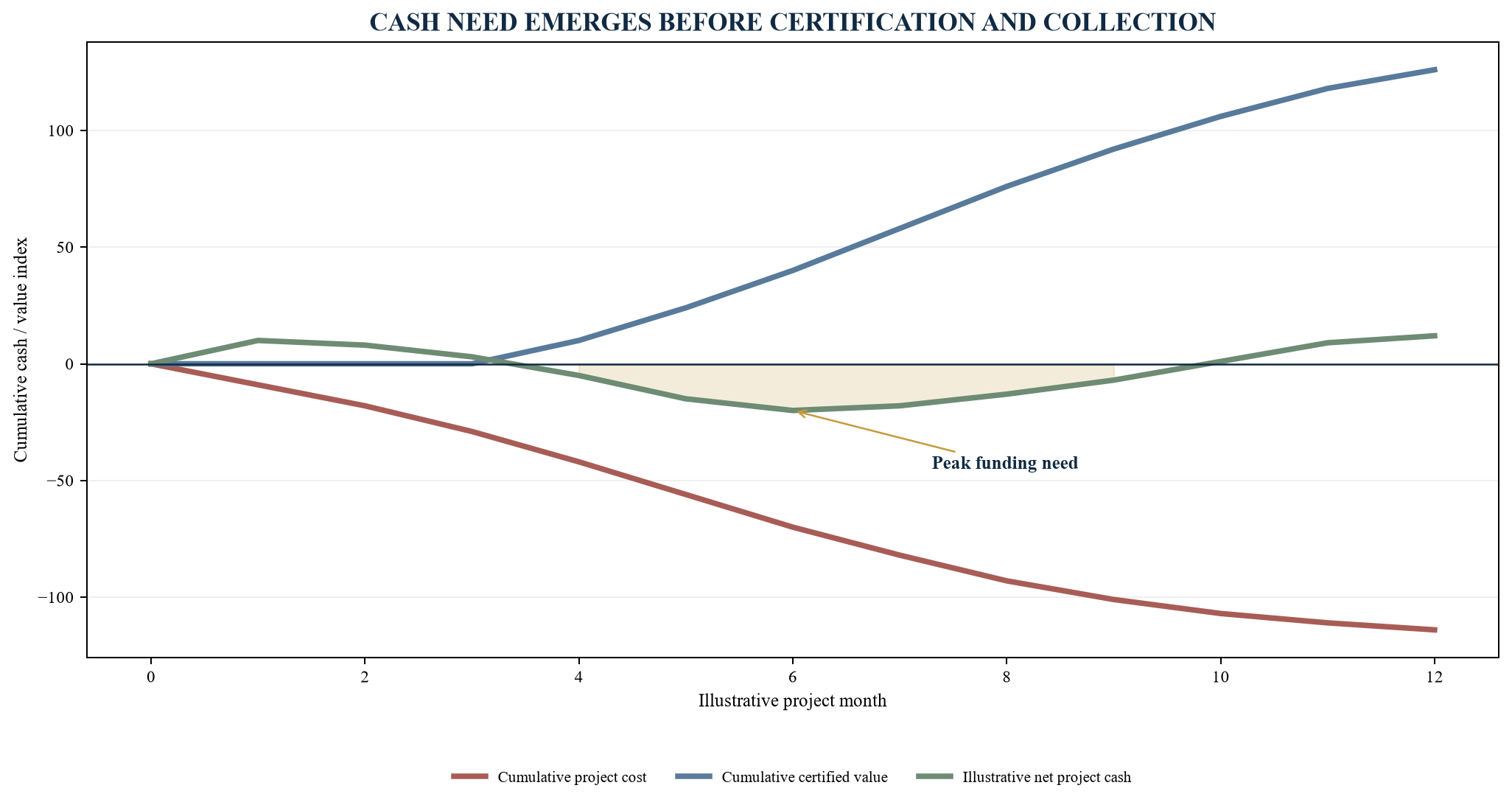
Illustrative timing only; each project requires its own cost, billing, certification and receipt evidence.
The six controls should operate through one exception register. An unsigned variation, overdue certificate, depleted guarantee line, unperfected security document or projected liquidity breach receives an owner, amount, decision, evidence requirement and deadline. Weekly operations supply the underlying facts. Monthly governance tests trends, covenant headroom and lender communication. The board receives the exceptions with sufficient detail to act.
Data quality is a credit condition. Executed agreements, certificates, bank receipts, guarantee instruments and security filings sit above management forecasts. Forecasts should state their preparation date, owner and next evidence event. Commercial expectations, relationship confidence and proposed variations should remain separately identified. This hierarchy reduces the risk that an expected approval is financed as though it were cash.
3. Establish contract authority and financeability
The review begins with the exact legal chain. The lender should identify the employer, contractor, joint-venture parties, subcontracting entities, signatories and paying account. It should confirm the award, conditions precedent, notices to proceed, amendments and governing conditions. Framework agreements, letters of intent and verbal instructions require separate treatment because their payment rights may differ from a fully executed work order.
Authority diligence continues into the payment mechanism. The contract should identify who measures work, who certifies, who approves variations, what documents support an application, the review period, due date and dispute process. The model should record whether the employer may set off claims from the same contract or another relationship. It should capture pay-when-paid exposure in subcontracting chains, currency, tax deductions, retention and any prohibition or consent requirement affecting assignment.
Remaining-cost analysis is essential. Gross contract value does not fund debt. The credit case uses remaining revenue, certified and collected value, remaining direct cost, overhead allocation, contingency, warranty provision, delay exposure, unresolved variations and the expected cash profile. Fixed-price exposure, imported materials, specialist labour and design responsibility can cause remaining margin to differ materially from bid margin.
Table 1. Contract-authority and financeability register
| Dimension | Minimum evidence | Financeable condition | Credit response when weak |
|---|---|---|---|
| legal authority | executed contract, award, amendments and signatories | scope and parties are verified | exclude or require documentary completion |
| commencement | notice to proceed and conditions precedent | work is authorised and conditions satisfied | hold funding until activation |
| economics | budget, procurement, cost-to-complete and contingency | remaining margin supported by current evidence | haircut, reserve or sponsor support |
| measurement | bill of quantities, milestone or agreed method | objective measurement and records | limit eligibility to certified work |
| certification | named certifier, procedure and timetable | certificate path is documented and observed | longer availability period and liquidity reserve |
| payment | due date, deductions and bank history | receipts reconcile to certificates | ageing haircut and concentration cap |
| assignment | contract, notice and legal review | receivable can support agreed security | alternative collateral or consent condition |
| claims | variations, delay, defects, set-off and disputes | exposure quantified and reserved | exclusion, reserve or event trigger |
The register should be completed for every material project and reconciled to the accounting and cash records.
Portfolio analysis should identify common employers, related government entities, sectors, consultants and payment processes. Apparent project diversification can disappear when one payer or programme controls a large share of receipts. Concentration should be measured using outstanding eligible certificates, forecast collections, remaining project cash contribution and guarantee exposure. The strongest cap is based on the point at which one delayed payer would threaten minimum liquidity.
4. Convert mobilisation into a controlled work package
Mobilisation is a defined period with measurable outputs. The contractor may need to establish a site, obtain permits, recruit labour, secure accommodation, place long-lead orders, move equipment, arrange insurance, issue guarantees and build temporary works. Each item should have an owner, budget, due date, contractual dependency and documentary evidence. A mobilisation facility should fund this approved work package rather than a general deficit.
The opening sources-and-uses schedule should reconcile the employer advance, contractor equity, lender draw, supplier credit and any restricted cash. Uses should distinguish refundable deposits, equipment with residual value, consumables, labour, subcontractor advances, guarantee cash margins and overhead. The lender can then decide which uses are draw-eligible, which require equity first and which need direct payment or documentary control.
Draw conditions should follow physical and contractual progress. The first draw may require the effective contract, notice to proceed, advance-payment guarantee, performance guarantee, insurance and approved baseline programme. Later draws can require evidence that the previous tranche was applied to the work package, critical procurement was placed and the project remains within cost and schedule thresholds. Unused funding should remain committed only while these conditions persist.
The mobilisation budget must include the time between starting work and receiving the first net certificate. A project can complete mobilisation on schedule and still face a cash gap because the first application date, certification period and payment term were omitted. The facility should also model VAT or other tax timing where applicable, payroll dates, supplier deposits and guarantee fees. These items often create the highest weekly requirement before reported revenue becomes substantial.
Contractor equity should absorb clearly identified first-loss risks. Equity can fund bid cost, unsupported claims, margin deterioration and cost overruns beyond an agreed contingency. Debt can fund eligible documented uses where the repayment source has been established. The allocation should be written into the funds flow, draw conditions and project reporting so that the parties do not renegotiate it during a liquidity event.
5. Treat the mobilisation advance and its guarantee as one obligation
An employer advance can improve initial liquidity, yet it creates a recovery obligation and normally requires an advance-payment guarantee. Under Saudi public-procurement executive regulations, an advance may reach 10% of contract value, subject to an equal bank guarantee, and is recovered from payments under the contract.[1] Project terms elsewhere differ. The financing analysis should use the executed instrument, the underlying contract and current local advice.
The lender should model four linked movements: employer cash received, advance proceeds used, guarantee exposure outstanding and advance recovered through certificates. A gross certificate may look sufficient until advance recovery, retention and other deductions are applied. Guarantee exposure may decline only after specific contractual events or documentary confirmation. The bank may hold cash margin or consume guarantee-line capacity until release. These timing differences affect both liquidity and available credit.
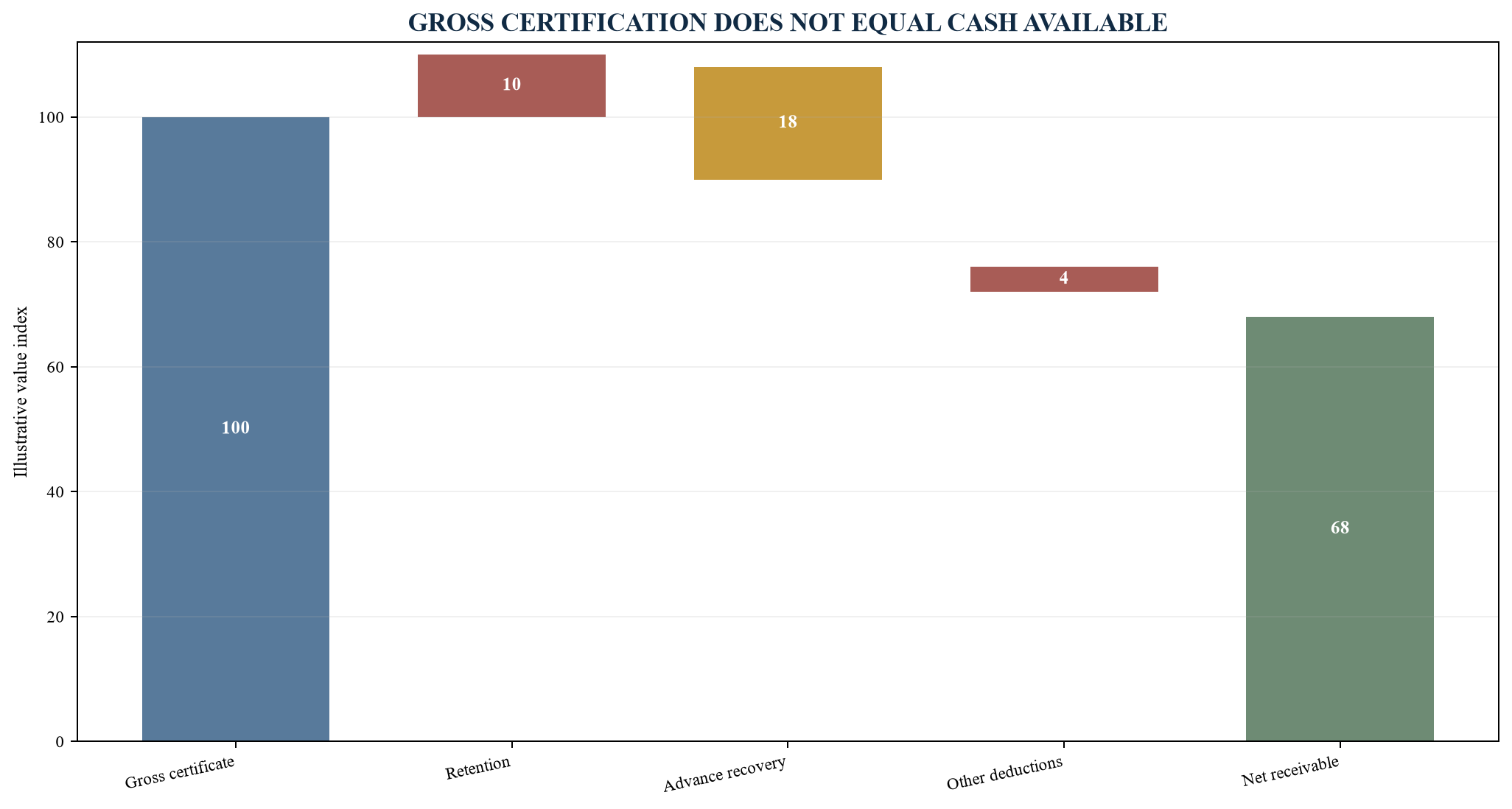
Illustrative index values; deductions and guarantee release depend on the executed project documents.
Table 2. Advance and guarantee control schedule
| Control item | Core question | Evidence | Financing treatment |
|---|---|---|---|
| advance receipt | was cash received into the agreed account? | employer advice and bank statement | source in opening funds flow |
| permitted use | was the advance applied to mobilisation? | invoices, payroll, procurement and site records | draw and use-of-proceeds test |
| guarantee exposure | what amount can the issuing bank be called for? | executed guarantee and bank confirmation | non-funded exposure and headroom use |
| recovery start | when do certificate deductions begin? | contract formula and certificate history | monthly net-receipt forecast |
| recovery rate | how quickly is the advance repaid? | deduction schedule and remaining work | replacement-liquidity curve |
| release | what evidence reduces or cancels the guarantee? | contractual milestone and beneficiary release | bank-line availability event |
| cash margin | is cash blocked against the instrument? | facility letter and account record | restricted-cash adjustment |
| default interaction | what happens after termination or dispute? | contract, guarantee and legal review | downside loss and liquidity reserve |
Every movement should reconcile to the employer ledger, certificate deductions, bank instrument and cash account.
The advance should be amortised economically as work converts into net collectible certificates. Management should track the advance balance per contract, recovery through each certificate, guarantee amount, guarantee expiry and expected release evidence. Differences between employer records, accounting records and bank exposure should become immediate exceptions.
Replacement liquidity needs advance planning. As the employer recovers the advance, the project may still need labour, materials and subcontractor funding. A revolving tranche can bridge eligible certificates, while contractor equity covers ineligible work and overruns. The facility should avoid a circular assumption in which future certificates repay debt while also being required to fund the remaining project cost.
6. Make progress evidence part of the financing system
The financing record should begin before a payment application is submitted. Site diaries, approved drawings, inspection requests, material approvals, delivery notes, timesheets, test records, measurement sheets, photographs and subcontractor statements support the claim that work has been performed. Their value depends on completeness, consistency and contractual relevance. A large file repository cannot compensate for missing approval or a measurement that does not follow the contract.
The contractor should maintain a work-done bridge for every project. Opening uncertified work is increased by measured progress and approved variations, then reduced by submitted applications and certification adjustments. The balance should identify aged items, reasons for delay and the next required action. Finance should reconcile the bridge to recognised revenue and contract assets. Project management should own the operational evidence and expected certification date.
Variations require a separate register. The register should identify instruction authority, date, scope, estimated cost, submitted value, approval status, programme effect and expected billing route. A commercially necessary instruction can still be weak collateral. The borrowing base should generally exclude an unapproved variation unless the legal and credit analysis supports a specifically reserved treatment. Forecast cash should show the central, delayed and rejected outcomes.
Quality and completion records affect both certification and later set-off. The project file should show non-conformance reports, snagging, testing, commissioning, handover, warranty obligations and rectification cost. A certificate can be issued while defects or incomplete close-out documents remain. The lender should determine whether the employer can withhold later payments or call security and whether a reserve is necessary.
Digital project controls can improve timeliness when they preserve an auditable chain from field evidence to application, certificate, invoice and receipt. Access rights, change logs and source-system reconciliation matter. A dashboard derived from manually re-keyed information can create precision without reliability. The credit agreement should specify required reports and permit reasonable validation of source records.
7. Turn certification into a dated conversion process
Certification is a process with distinct states. Work may be measured, documented, included in an application, queried, adjusted, approved, invoiced, due and collected. Each state has a different probability and timing of cash. Combining them as work in progress conceals the point at which an operational delay becomes a credit problem.
The certificate register should capture the application reference, measurement period, gross value, submitted date, certifier, queried amount, approved amount, certificate date, invoice date, retention, advance recovery, tax, set-off, net due, contractual due date, actual receipt date and unresolved balance. Age should be measured from multiple points: work date to submission, submission to certificate, certificate to due date and due date to receipt. The cause of delay determines the remedy.
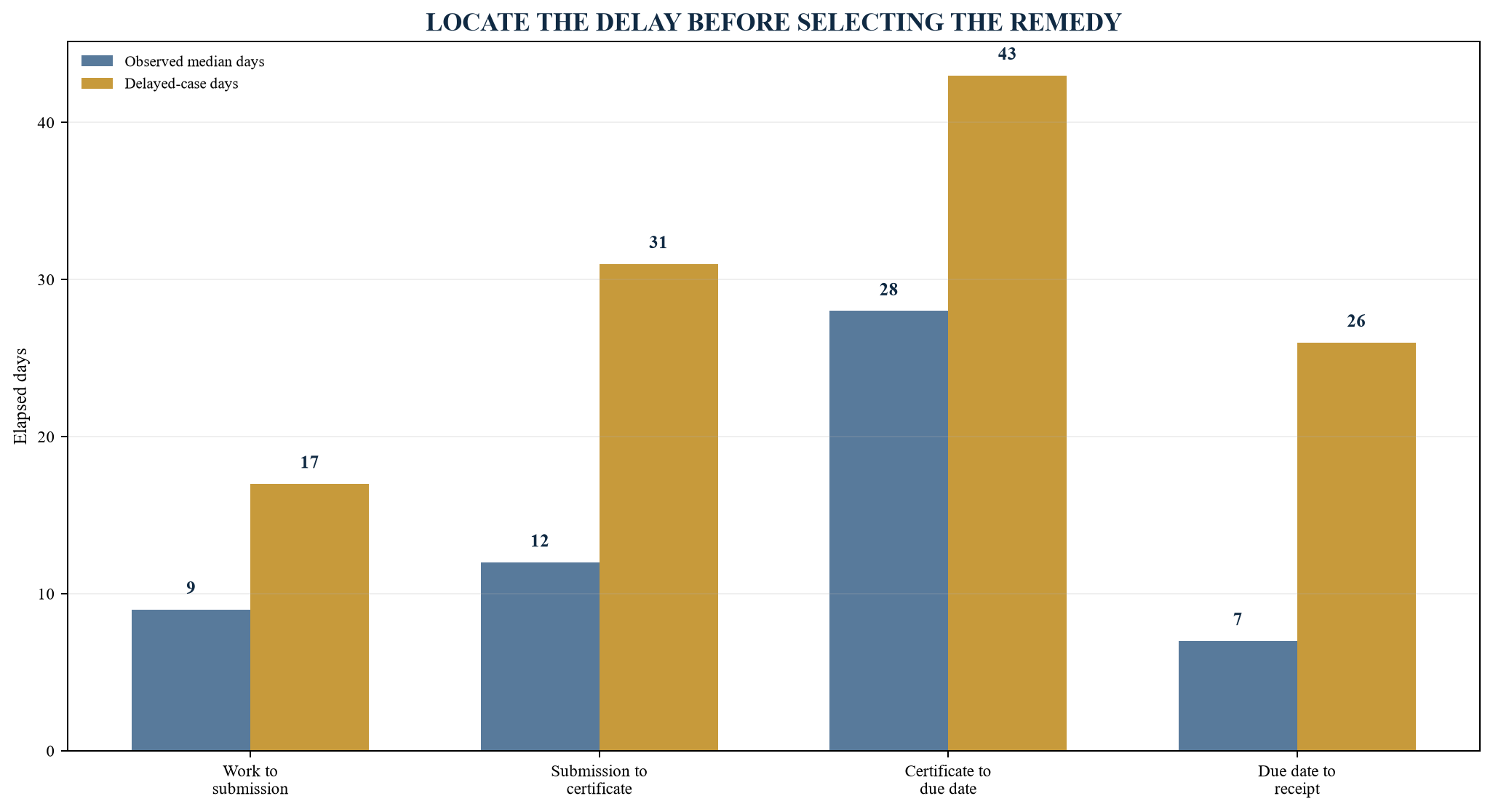
Illustrative portfolio; management should compare each stage with the executed contractual timetable and observed payer behaviour.
Table 3. Certificate-ageing decision matrix
| Stage | Typical evidence | Primary risk | Management action | Lender treatment |
|---|---|---|---|---|
| measured, not submitted | quantity records and site evidence | document or cut-off delay | complete application pack | ineligible or deeply discounted |
| submitted, under review | application and acknowledgement | query, variation or measurement | resolve named query | limited availability with reserve |
| certified, not invoiced | signed certificate | administrative failure | issue compliant invoice | short cure period |
| invoiced, not due | invoice and due-date calculation | normal timing | monitor deductions and account | potentially eligible |
| overdue, undisputed | correspondence and payment history | payer processing or liquidity | escalation and collection plan | ageing haircut and concentration cap |
| disputed or set off | notice, claim and legal analysis | recoverability and delay | quantified resolution strategy | exclude until resolved |
| collected | bank receipt and remittance | allocation error | reconcile certificate and debt | borrowing-base reduction |
Ageing thresholds are illustrative and should be calibrated to the contract, payer and historical distribution.
Certificate quality should be tested from the instrument and surrounding records. The team should confirm that the certifier acted within authority, the certificate relates to the borrower, deductions are complete and no later notice has challenged payment. Interim certification may remain subject to later adjustment under the contract. Eligibility therefore needs continuing representations and a mechanism to remove or reserve an affected receivable.
The portfolio view should show both amount and velocity. A small number of large delayed certificates may dominate liquidity. A rising submission-to-certificate period can signal document weakness or employer scrutiny before amounts become contractually overdue. A stable median can hide a severe tail. Management should report weighted average days, ageing buckets, disputed amounts, the five largest exposures and movements since the prior review.
8. Build the borrowing base from net collectible value
A borrowing base translates project assets into controlled availability. The starting pool may include certified, invoiced and undisputed receivables owed to eligible contractor entities by approved employers. Eligibility rules then remove amounts that are too old, disputed, subject to material set-off, owed by excluded counterparties, denominated in unsupported currencies, restricted from assignment, duplicated, already pledged or otherwise outside the security package.
The eligible amount should use the net receivable after retention, advance recovery, tax and known deductions. An advance rate is then applied, subject to single-employer, project, sector and jurisdiction concentration caps. Reserves can cover dilution, warranty, defects, claims, guarantee exposure, negative project margin and expected completion cost. The facility amount is the lower of the borrowing base, committed limit and any other debt-capacity constraint.
Borrowing-base integrity requires frequent reconciliation. The contractor submits the certificate register, invoice ledger, ageing, cash receipts, credit notes and project exceptions. The lender or facility agent reconciles opening eligible receivables, additions, exclusions, collections, write-offs and closing eligibility. Cash received against financed assets should reduce utilisation or flow through the agreed waterfall. Reconciliation differences should suspend incremental availability until resolved.
Uncertified work can be considered only through a more conservative and evidence-intensive tranche. Such a structure may require objective measurement, approved scope, a short certification period, a strong payer, independent review, cost-to-complete headroom and a low advance rate. It should have a hard conversion deadline. Failure to certify by that date should trigger repayment, reclassification or reserve rather than repeated extension.
Dilution should be measured from actual outcomes. The relevant ratio includes credit notes, downward certifications, disputed deductions, offsets and other reductions between submitted or gross certified value and cash collected. Advance rates should reflect the distribution and tail, rather than an optimistic average. A deterioration in dilution is an early indicator of project, documentation or payer risk.
9. Underwrite payment delay as a portfolio event
Payment delay must be separated into causes. An incomplete application requires an internal process response. A certifier query requires technical evidence. An unapproved variation requires commercial and contractual action. An overdue undisputed invoice requires collection escalation. A payer funding issue requires exposure reduction and liquidity protection. A formal dispute requires legal assessment and usually borrowing-base exclusion.
The lender should analyse historical receipts by employer, project and stage. Averages can mislead when a payer settles several certificates together or when one large receipt dominates the period. The preferred evidence includes certificate-level scheduled and actual dates, partial receipts, deductions and correspondence. The analysis should show median, upper-quartile and severe-tail delay as well as the share of balances beyond each threshold.
Portfolio correlation matters. Government-related employers can be separate legal entities while sharing approval, budget or administrative cycles. Projects may rely on the same consultant, ministry, developer or programme. A concentration test should reflect the economic source of payment and the operational bottleneck. The lender can use a concentration reserve or lower advance rate where several apparent exposures can delay together.
The stress case should shift cash dates without automatically shifting costs. Payroll, accommodation, insurance, rent and critical suppliers may remain due. Subcontractors may slow work or seek direct payment. Guarantee costs continue. A certificate delay can therefore increase cost and extend the period before repayment. The model should capture the second-order effect on project completion and future certification.
Collection governance should be contractual, documented and proportionate. The borrower retains the commercial relationship while using a dated escalation ladder: project-team query resolution, finance confirmation, senior commercial review, formal notice and agreed legal action. Lender step-in or direct contact should follow the agreed security and account-control arrangements. An uncontrolled collection response can damage the project that generates repayment.
10. Coordinate funded debt and guarantee capacity
Engineering contractors require funded and non-funded facilities. Funded facilities provide cash through overdrafts, revolving loans, certificate finance, term debt or equipment finance. Non-funded facilities support tender bonds, performance guarantees, advance-payment guarantees, retention bonds and letters of credit. Both consume bank or lender risk appetite and may compete for collateral, cash margin and covenant headroom.
A complete facilities map should show provider, borrower, instrument, commitment, utilisation, expiry, security, cash margin, fees, financial covenants, cross-default and cancellation rights. Project-level guarantees should map to contract milestones and expected release evidence. The map should also identify contingent calls and the funding route if a guarantee is drawn. A guarantee call can convert a non-funded exposure into immediate funded debt.
Table 4. Funded and non-funded instrument map
| Instrument | Primary use | Repayment or release event | Key control |
|---|---|---|---|
| mobilisation tranche | initial project cash deficit | first eligible project receipts or amortisation | approved work package and draw evidence |
| certificate revolver | bridge certified net receivables | controlled collection | borrowing base and receipt sweep |
| general working-capital line | portfolio timing variation | operating cash conversion | minimum liquidity and portfolio limits |
| equipment finance | identifiable plant and machinery | amortising operating cash | title, valuation, insurance and maintenance |
| performance guarantee | contractual performance security | employer release or contract milestone | expiry, call terms and project status |
| advance-payment guarantee | employer advance security | advance recovery and beneficiary release | guarantee-to-advance reconciliation |
| retention bond | substitute for withheld retention | expiry or defects milestone | close-out evidence and claims reserve |
| letter of credit | procurement and trade payment | funded reimbursement at maturity | goods, documents, currency and cash plan |
Suitability depends on borrower evidence, lender appetite, jurisdiction and transaction documents.
The structure should reserve sufficient guarantee capacity for the awarded backlog and realistic pipeline. A contractor can win profitable work and be unable to start because its guarantee line is full. Headroom should be forecast by project, instrument and month, including expected releases and potential delays. A release should enter the base case only when the contractual milestone and documentary procedure are understood.
Cross-default and security interaction require careful review. A dispute under one project, a guarantee call or a covenant breach can affect several facilities. Pari passu, priority, intercreditor and account-control terms should support the intended waterfall. A new private-credit facility should not assume access to receivables or equipment already secured to a bank without a documented ranking or release arrangement.
11. Map security to the cash and asset chain
Security should follow the assets and cash that support repayment. The relevant package may include receivables, contract rights where permitted, controlled collection accounts, equipment, vehicles, inventory, shares, intercompany balances, insurance proceeds and assignments of material project documents. The usefulness of each element depends on ownership, existing liens, contractual restrictions, perfection steps, priority, enforcement procedure and continuing asset value.
The UAE movable-security framework expressly contemplates security over categories such as receivables, bank accounts, equipment and inventory, subject to the applicable statute, registration and transaction facts.[3] UAE receivables legislation provides a framework for transfers of receivables and factoring.[4] Other GCC jurisdictions and project documents require separate analysis. The legal diligence should produce a jurisdiction-by-jurisdiction perfection and priority schedule, rather than a generic statement that all assets are secured.
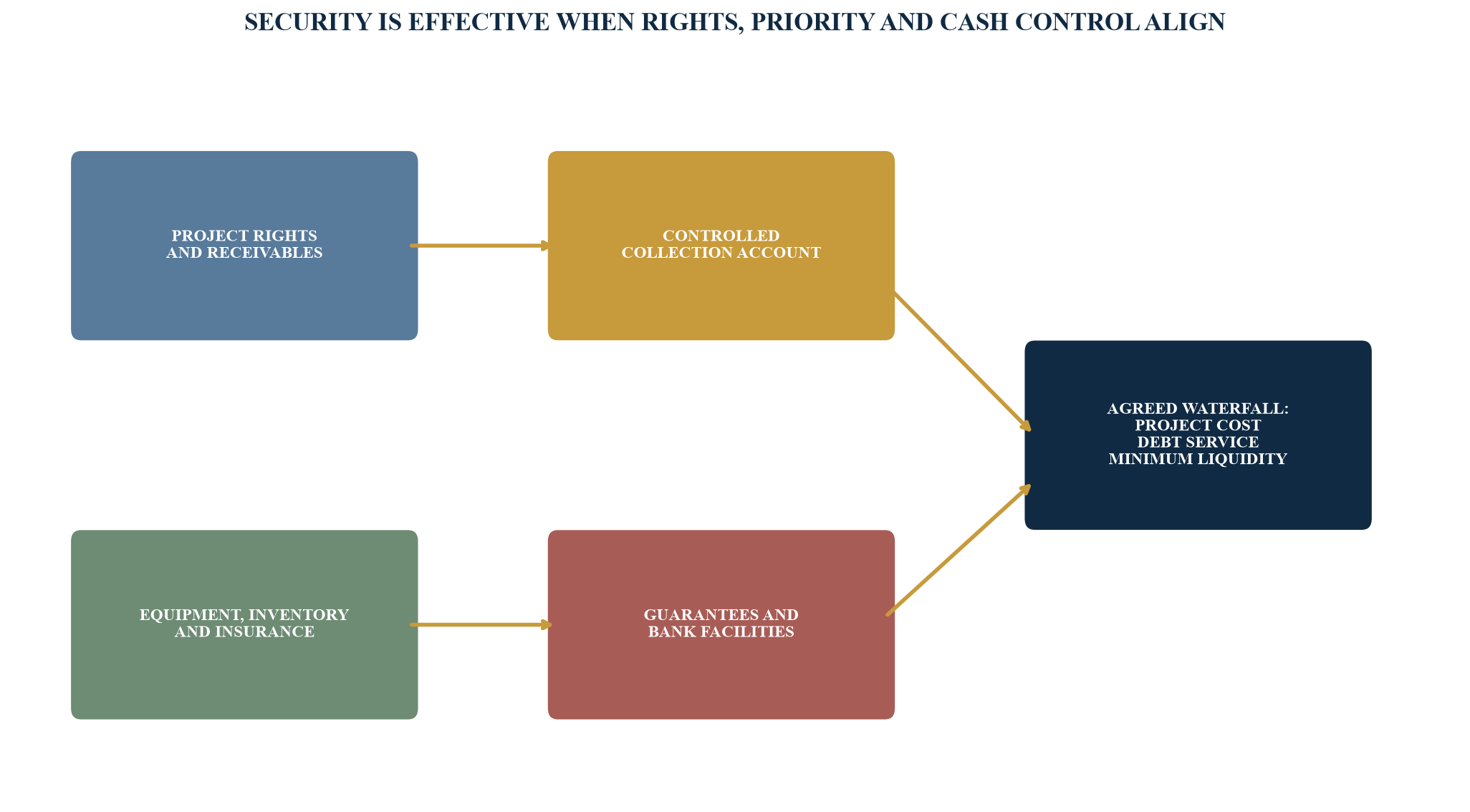
Availability and priority require transaction-specific legal diligence, contractual consent and completion of applicable perfection steps.
Table 5. Security diligence and control matrix
| Asset or right | Diligence question | Control or perfection evidence | Continuing monitor |
|---|---|---|---|
| receivables | who owns the claim and can it be transferred or secured? | contract review, assignment and registration where applicable | ageing, disputes, dilution and collections |
| collection account | can receipts be identified and controlled? | account agreement, notice and waterfall | daily receipt reconciliation |
| equipment | is title clear and value recoverable? | invoice, serial register, valuation, registration and insurance | location, condition, prior lien and maintenance |
| inventory | is it identifiable, usable and free of prior claims? | inventory records and applicable security steps | ageing, location and project allocation |
| contract rights | are consent or notice required? | executed consent, notice or acknowledgement | amendments, termination and claims |
| insurance | are material risks covered and proceeds assigned? | policy, endorsement and premium evidence | expiry, claims and adequacy |
| shares and intercompany | does the structure permit effective control and repayment? | corporate approvals and security documents | distributions, leakage and structural priority |
| guarantees | what claims, expiry and reimbursement rights apply? | instrument and facility confirmation | calls, extensions, cash margin and release |
The final package should reflect current legal advice, existing creditor rights and the commercial structure.
Equipment value must be separated from operational importance. Specialist plant can be essential to completing a project while having limited secondary-market value or high removal cost. Valuation should consider ownership, specification, condition, location, import status, maintenance, insurance, prior liens and saleability. The advance rate should reflect a realistic enforcement scenario rather than replacement cost.
Cash control should preserve project completion as well as debt repayment. The waterfall can prioritise taxes, payroll, critical project costs, agreed reserves, scheduled interest and principal, with surplus release subject to compliance. The order depends on the transaction and law. A waterfall that removes cash needed to complete eligible work can impair the receivables that support the facility.
12. Size debt through the lowest supported constraint
Debt capacity is the lowest amount supported across borrowing-base value, cash-flow debt service, minimum liquidity, guarantee headroom, completion funding, collateral and concentration. Each constraint should be calculated independently and reconciled. The central case should avoid counting the same certificate both as collateral for a revolver and as unrestricted cash for a separate term loan without recognising the facility waterfall.
The borrowing-base constraint uses eligible net receivables after exclusions, concentration caps and reserves. The cash-flow constraint uses cash available after project completion cost, overhead, tax, maintenance capex and working-capital needs. The liquidity constraint preserves a minimum amount under the delayed-payment case. The guarantee constraint preserves non-funded capacity necessary to perform the contracted backlog. The completion constraint includes remaining committed cost and contingency.
Interest and principal should be modelled using the actual utilisation path. A revolving certificate facility may peak when several projects enter intensive delivery and decline after large receipts. A fixed opening balance can understate interest during peak utilisation or overstate debt later. Fees on undrawn commitments and guarantees, cash margins, hedging and withholding or tax treatment should be captured where applicable.
The repayment profile should match the asset cycle. Certificate financing can repay from controlled collections. Mobilisation debt may amortise from early net certificates or convert into the revolver after eligibility conditions are satisfied. Equipment debt can amortise over the conservative useful life, subject to project and cash-flow constraints. A bullet requires an evidenced refinance or asset-realisation route and early milestones.
The final facility may be smaller than the contractor's apparent need. The remaining gap must have an identified response: additional equity, project advance, supplier terms, subcontractor structure, asset sale, scope reduction, slower mobilisation, a different guarantee provider or a postponed award. Funding an unexplained gap usually defers the problem into the delivery period.
13. Use a 13-week cash forecast as the operating control
The 13-week forecast converts project events into weekly treasury decisions. It should begin with bank-verified opening cash, restricted cash and available facilities. Receipts should identify the exact certificate or other source, contractual due date, management forecast date, confidence and next evidence event. Payments should distinguish payroll, critical suppliers, subcontractors, taxes, insurance, guarantees, debt service, overhead and discretionary expenditure.
Project managers should update measured work, application dates, certificate queries, programme changes and critical procurement. Finance reconciles applications, certificates, invoices and receipts. Treasury updates bank availability, guarantee headroom and debt service. The weekly meeting approves the base case, downside, disbursement priorities and external communications. Every material variance should trace back to a project event.
Forecast accuracy should be measured. Receipts can be compared with the prior forecast by amount and week. Persistent optimism for a payer, project manager or certificate stage should change the forecast rule. Supplier and payroll variance should also be analysed. A forecast becomes a governance tool when observed bias changes assumptions and decisions.
Minimum liquidity should cover the period between an adverse event and a realistic management response. The buffer may reflect payroll, essential suppliers, insurance, site continuity and debt service. It should sit above restricted cash and unavailable guarantee margins. A covenant can require both current minimum liquidity and forecast headroom for a defined period.
The 13-week view should connect to the longer project model. Near-term cash cannot be improved by deferring a payment that increases completion cost or prevents future certification. The monthly model should show remaining cost, certificate timing, guarantees, retention release and final completion. Differences between weekly and monthly assumptions should be reconciled.
14. Stress certification, payment and completion together
A credible downside changes several linked variables. Certification delay postpones receipts. Payment delay extends receivable ageing. Slow variation approval removes expected cash. Cost inflation or rework increases completion funding. A guarantee extension consumes fees or cash margin. Lower mobilisation on new work reduces future margin while releasing some near-term cash requirement. The model should preserve these interactions.
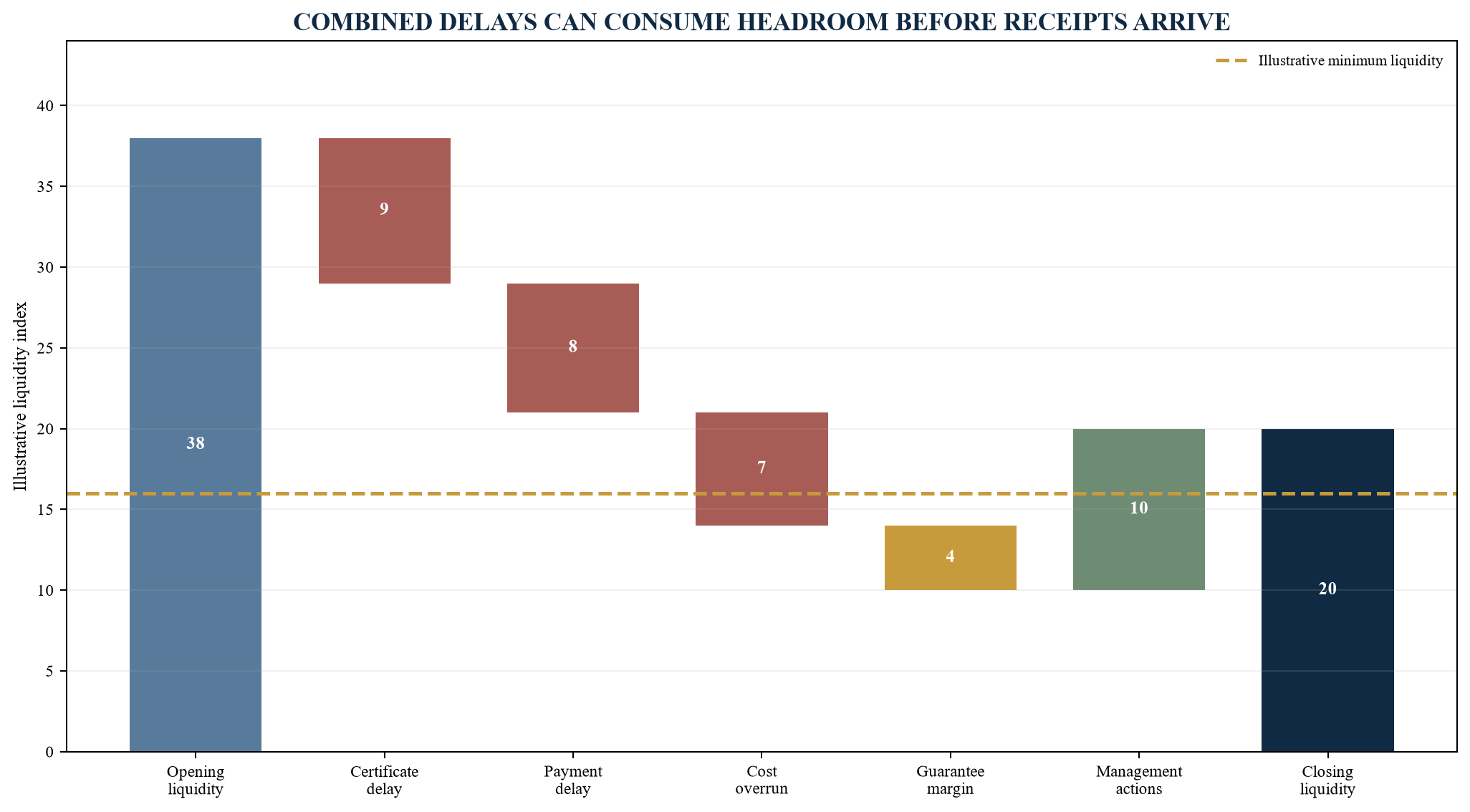
Values are management-assumption indices; an actual transaction requires borrower and project data.
The downside should identify the first week in which minimum liquidity is breached, the largest funding gap, affected projects and required actions. Actions must be dated and executable: accelerate document completion, obtain an employer confirmation, defer non-critical capex, reduce discretionary overhead, secure supplier terms, draw a committed line, inject equity or pause a new mobilisation. A proposed refinancing or asset sale should enter the remedy only after its timing and conditions are evidenced.
Reverse stress testing asks what combination causes failure. The board can solve for the number of delayed certificates, cost overrun, guarantee call or payer concentration that exhausts liquidity. The result informs concentration limits, reserves, covenants and contingency capital. It also reveals whether the contractor depends on one receipt whose timing it does not control.
Stress assumptions should be portfolio-specific. Historical severe-tail delays provide a starting point, while current project conditions and public-finance developments may justify additional sensitivity. The World Bank's June 2025 Gulf update described continuing non-oil growth supported by infrastructure and construction, while emphasising the quality and sustainability of spending.[7] The World Bank PPI database provides structured project and investment records that can inform market context.[8] Neither source substitutes for borrower-level cash and contract data.
15. Use covenants as an intervention system
Covenants should identify deterioration early enough for action. Minimum liquidity, borrowing-base availability, concentration, certificate ageing, negative project margin, guarantee headroom, leverage, debt-service cover and information delivery can work together. Definitions should reconcile to source records and avoid measures that management cannot produce reliably.
Project indicators can trigger graduated responses. A late application may require a remediation plan. A certificate beyond its expected review period may receive an availability reserve. A disputed certificate may become ineligible. A project forecast loss may require equity support and a distribution block. A guarantee call or threatened termination may trigger a formal review, draw stop or event under the negotiated documents.
The covenant package should recognise seasonality and portfolio growth. A static receivables concentration test can tighten as the best payer settles. A leverage ratio can look stronger because working capital has risen rather than because cash has been collected. Minimum-liquidity and borrowing-base measures provide a cash discipline alongside accounting ratios.
Information undertakings are operational controls. The borrower should deliver the project register, certificate ageing, borrowing-base certificate, 13-week forecast, facilities map, guarantee schedule, covenant calculations and material notices on an agreed calendar. Accuracy, completeness and timeliness matter. A repeated data failure can signal that the lender cannot monitor the repayment assets.
Distributions, acquisitions, new debt, material project awards and security releases should be governed by capacity and compliance tests. A contractor may need consent before accepting a project that consumes guarantee headroom or creates a large mobilisation gap. The decision should consider expected margin and the portfolio's ability to finance delivery, not only the contract value.
16. Control collections through an agreed waterfall
The collection structure should identify where employers pay, how receipts are matched to certificates and how cash is released. A controlled account is most effective when payment instructions, account ownership, bank acknowledgement, permitted withdrawals and lender rights are consistent with the contracts and applicable law. The transaction should address employers that cannot change payment instructions or require formal assignment notices.
Daily reconciliation can connect the bank receipt to the employer, project, certificate, invoice and expected deduction. Unidentified receipts remain outside availability until allocated. Partial payments should reduce the correct receivable and preserve the unresolved balance with its ageing and collection action. Credit notes, refunds and reversals should flow through the dilution calculation.
The waterfall needs to support continued performance. Taxes and legally protected amounts require correct treatment. Payroll, essential site cost and critical suppliers may need an approved operating reserve. Scheduled fees, interest and principal follow the negotiated order. Surplus cash can be released when the borrowing base, minimum liquidity, project-completion funding and covenants remain satisfied. The exact order should be documented from the transaction facts.
Cash leakage should be monitored across related entities, joint ventures and projects. An employer may pay an affiliate, a subcontractor may receive direct settlement, or intercompany transfers may move cash away from the borrowing entity. The legal structure and project arrangements should define which flows are permitted. The lender should receive enough reporting to distinguish a valid project payment from an unauthorised transfer.
Collections also require a communications protocol. The contractor should continue normal commercial engagement and resolve documentation promptly. Formal notices must comply with the contract. The lender should know when it will be informed of an overdue amount, dispute, termination threat or guarantee call. Direct lender action should occur only through the negotiated rights and an agreed escalation, because project value depends on an operating relationship.
17. Execute a 100-day financing and control programme
The financing process should combine diligence, operating improvement and lender execution. During the first two weeks, management establishes the exact funding objective, legal structure, facilities map, project register and opening 13-week cash forecast. It also identifies the largest certificate, payer, guarantee and completion exposures. This creates an evidence-based perimeter before lenders price a structure.
The next phase rebuilds project economics and cash conversion. Management validates remaining cost, mobilisation uses, application status, certificates, deductions, receipts and disputes. Legal advisers review authority, assignment, security, priority and material restrictions. The finance team builds the borrowing base, downside liquidity bridge and debt-capacity model. Management resolves data gaps or labels them as conditions.
Lender engagement should use a controlled information memorandum and a consistent data room. The presentation explains the requested instruments, eligible assets, project controls, downside, security and governance. Lender questions are logged and answered from verified records. Competing proposals should be compared using total cost, commitment certainty, advance rates, exclusions, concentration caps, reserves, guarantee capacity, covenants, reporting, security and exit flexibility.
Table 6. One-hundred-day financing and implementation plan
| Period | Contractor work | Financing work | Decision gate |
|---|---|---|---|
| days 1-10 | opening cash, facilities, projects and exceptions | confirm purpose, perimeter and information protocol | approve funding objective and red lines |
| days 11-25 | cost-to-complete, mobilisation and certificate reconstruction | preliminary borrowing base and legal issue list | approve eligible asset perimeter |
| days 26-40 | payment history, guarantee map and security inventory | downside sizing and lender universe | approve capacity range and approach |
| days 41-55 | management session and data-room responses | indicative proposals and structure comparison | select lead and reserve route |
| days 56-75 | close diligence gaps and implement weekly controls | credit approval, valuation and legal drafting | approve negotiated commercial terms |
| days 76-90 | account, reporting and covenant readiness | conditions precedent, security and funds flow | confirm closing readiness |
| days 91-100 | first borrowing-base certificate and liquidity review | funding, post-close calendar and lender handover | release only after evidence is complete |
Timing is illustrative and should be adapted to transaction complexity, approvals and legal requirements.
Documentation and implementation should proceed together. Account structures, payment instructions, guarantee arrangements, security filings, reporting templates and covenant definitions should be tested before closing. The first borrowing-base certificate can be prepared using live records. The first 13-week forecast can be reviewed under the agreed definitions. A dry run often identifies entity, ageing and deduction issues that legal drafting alone cannot reveal.
Post-close governance begins immediately. The board should receive a monthly financing pack and a weekly liquidity exception report. Management should preserve the source data and decision record. The lender should receive scheduled information and material notices. Project awards, new guarantees, material variations and distributions should pass the agreed approval tests. The facility remains effective when the control system evolves with the portfolio.
18. Conclusion
Private credit for GCC engineering contractors depends on the conversion of physical progress into controlled cash. Contract awards provide an opportunity set. Financeability comes from legal authority, costed mobilisation, reliable progress evidence, disciplined certification, collectible net receivables, coordinated guarantees, effective security and sufficient downside liquidity.
The six-control framework makes this conversion visible. A contract-authority register establishes the legal and economic perimeter. A mobilisation work package identifies the first cash need. An advance-payment waterfall shows how employer funding, guarantee exposure and recovery interact. A certificate-ageing schedule locates delay. A borrowing base converts only eligible net value into availability. A security map and collection waterfall connect assets to repayment. A 13-week forecast and reverse stress test establish the intervention point.
The framework also changes the contractor's commercial decisions. A profitable project can be declined or restructured when mobilisation and guarantee capacity are unavailable. A lower-margin project can remain attractive when payments are reliable and cash conversion is short. A variation can be commercially valuable while remaining outside debt capacity until approved. A lender can support growth while protecting the liquidity required to perform the work.
The strongest transaction produces more than capital. It creates a shared operating language across project management, commercial, finance, treasury, the board and lenders. Each material exposure has a source record, owner, amount, next evidence event and decision. This discipline improves the probability that the contractor can start, perform, certify, collect and repay through ordinary project execution.
References
- Saudi Arabia Ministry of Finance. Executive Regulations of the Government Tenders and Procurement Law, including Articles 108, 109 and 111 on advances, payment for completed work and invoice deductions. Official English publication accessed 29 August 2026. https://mof.gov.sa/en/Knowledgecenter/newGovTendandProcLow/Documents/Executive%20Regulations.pdf
- Saudi Arabia Ministry of Finance. Government Tenders and Procurement Law, issued by Royal Decree No. M/128 dated 16 July 2019. Official English publication accessed 29 August 2026. https://www.mof.gov.sa/en/Knowledgecenter/newGovTendandProcLow/Documents/The%20Government%20Tenders%20and%20Procurement%20Law2.pdf
- United Arab Emirates Government Legislation. Federal Law No. 4 of 2020 on Securing Rights in Movables. Official English publication accessed 29 August 2026. https://www.uaelegislation.gov.ae/en/legislations/1446/download
- United Arab Emirates Government Legislation. Federal Decree-Law No. 16 of 2021 on Factoring and Transfer of Receivables. Official English publication accessed 29 August 2026. https://www.uaelegislation.gov.ae/en/legislations/1515/download
- United Arab Emirates Government Legislation. Federal Law No. 11 of 2023 concerning Procurements in the Federal Government, including the construction-project exclusion in Article 4. Official English publication accessed 29 August 2026. https://uaelegislation.gov.ae/en/legislations/2165
- United Arab Emirates Government Legislation. Cabinet Resolution No. 122 of 2024 concerning the Executive Regulation of Federal Law No. 11 of 2023. Effective 14 May 2025; official English publication accessed 29 August 2026. https://uaelegislation.gov.ae/en/legislations/2709
- World Bank. GCC Growth on the Rise, but Smart Spending Will Shape a Thriving Future, 19 June 2025. https://www.worldbank.org/en/news/press-release/2025/06/19/gcc-growth-on-the-rise-but-smart-spending-will-shape-a-thriving-future
- World Bank. Private Participation in Infrastructure Database. Official project and investment database accessed 29 August 2026. https://ppi.worldbank.org/en/ppi
- FIDIC. Conditions of Contract for Construction, Second Edition 2017, reprinted 2022 with amendments. Official bookshop record accessed 29 August 2026. https://fidic.org/bookshop/red-book
- State of Qatar, Al Meezan Legal Portal. Law No. 24 of 2015 Regulating Tenders and Auctions. Official legal text accessed 29 August 2026. https://www.almeezan.qa/LawPage.aspx?id=6812&language=ar
- State of Qatar, Al Meezan Legal Portal. Current English laws list and official downloadable materials for procurement legislation. Accessed 29 August 2026. https://www.almeezan.qa/EnglishLawsList.aspx?language=en
- Saudi Arabia Bureau of Experts at the Council of Ministers. Movable Property Security Law. Official legal text accessed 29 August 2026. https://laws.boe.gov.sa/BoeLaws/Laws/LawDetails/e2c00ba7-2af3-41fa-a1ab-ab9f00af1dec/1
- Financial Action Task Force. The FATF Recommendations, as amended June 2026. https://www.fatf-gafi.org/en/publications/Fatfrecommendations/Fatf-recommendations.html
- IFRS Foundation. IFRS 15 Revenue from Contracts with Customers. Official standard overview accessed 29 August 2026. https://www.ifrs.org/issued-standards/list-of-standards/ifrs-15-revenue-from-contracts-with-customers/
- World Bank. Infrastructure Foundations: From Current Assets to Future Growth. Official report page accessed 29 August 2026. https://www.worldbank.org/en/topic/infrastructure/publication/infrastructure-foundations-from-current-assets-to-future-growth
- International Chamber of Commerce. Uniform Rules for Demand Guarantees, URDG 758. Official rules accessed 29 August 2026. https://library.iccwbo.org/content/tfb/RULES/tfb-urdg758-rules.htm
- United Nations Commission on International Trade Law. Model Law on Secured Transactions. https://uncitral.un.org/en/texts/securityinterests/modellaw/secured_transactions
- General Authority for Statistics, Saudi Arabia. Methodology and Quality Report for Construction and Real Estate Activities Statistics. Official publication accessed 29 August 2026. https://stats.gov.sa/en/w/methodology-and-quality-report-for-construction-and-real-estate-activities-statistics
About the Author
Authored by Chennakeshav Adya Independent Researcher
Appendix A: Minimum transaction evidence pack
The evidence pack should contain the legal-entity chart; constitutional and authority documents; debt, guarantee and security schedule; bank statements; audited and current management accounts; contract register; executed material contracts and amendments; notices to proceed; project budgets; cost-to-complete reports; procurement commitments; programme updates; variation and claims register; mobilisation uses; payment applications; certificates; invoices; ageing; receipt history; retention; advance recovery; guarantee instruments; equipment and inventory registers; insurance; tax records; 13-week cash forecast; integrated project and debt model; proposed security; legal diligence; covenant calculations; and the latest board decisions.
Each file should have an owner, source date, legal entity, project reference and reconciliation status. Missing or inconsistent evidence should remain an explicit condition, exclusion, reserve or action. The data room should preserve version history and restrict access appropriately. Personal data, commercially sensitive records and legally privileged material require controlled handling.
Appendix B: Monthly board and lender dashboard
The dashboard should show opening and closing liquidity; restricted cash; funded availability; guarantee capacity; project cash curves; mobilisation spend against budget; gross and net certification; certificate ageing; overdue and disputed amounts; collections against forecast; borrowing-base eligibility and reserves; payer and project concentrations; cost-to-complete movement; negative-margin projects; retention; advance and guarantee reconciliation; equipment and security exceptions; covenant headroom; downside liquidity; material notices; decisions; owners; and due dates.
The board pack should distinguish contractual facts, bank-verified cash, certified amounts, management forecasts and scenarios. Trends and exceptions should be more prominent than a large volume of stable data. Every material variance should connect to an action or an acknowledged decision to accept the exposure.
