
1. Finance evidence of demand, not a queue headline
A grid project is frequently justified by a pipeline of connection requests. The pipeline can include housing districts, industrial estates, renewable projects, battery systems, logistics facilities, electric-vehicle charging, airports, water plants and data centres. Those requests have different probabilities, dates and legal weight. A lender should not treat every requested megawatt as contracted load.
The credit file should classify each connection through six states. Requested capacity is an application. Studied capacity has a completed technical assessment. Reserved capacity has a defined place in the network plan and a reservation obligation. Contracted capacity has executed payment, construction, security and cancellation terms. Energised capacity has passed network acceptance. Billing capacity is connected, metered and producing collectible revenue. Debt capacity should be anchored to the last three states and give limited or no value to the first two unless sponsor support covers the transition.
This distinction matters because a connection queue can grow while the financeable base weakens. Developers may submit multiple applications, change sites, reduce capacity or depend on permits and financing that remain incomplete. A large load can require generation, transmission and distribution upgrades beyond its immediate connection assets. The earliest credible date may depend on transformers, cables, switchgear, land, rights of way, protection studies and network outages that are outside the customer's control.
The IEA's 2026 grid analysis identifies a global timing mismatch: grid infrastructure can take five to fifteen years to plan and build, while data centres and other demand projects can be delivered much faster.[1] The lender therefore needs a dated evidence ledger rather than one commercial-operation date. Every state should identify the responsible party, conditions, expiry, payment, refundability, security and consequence of delay.
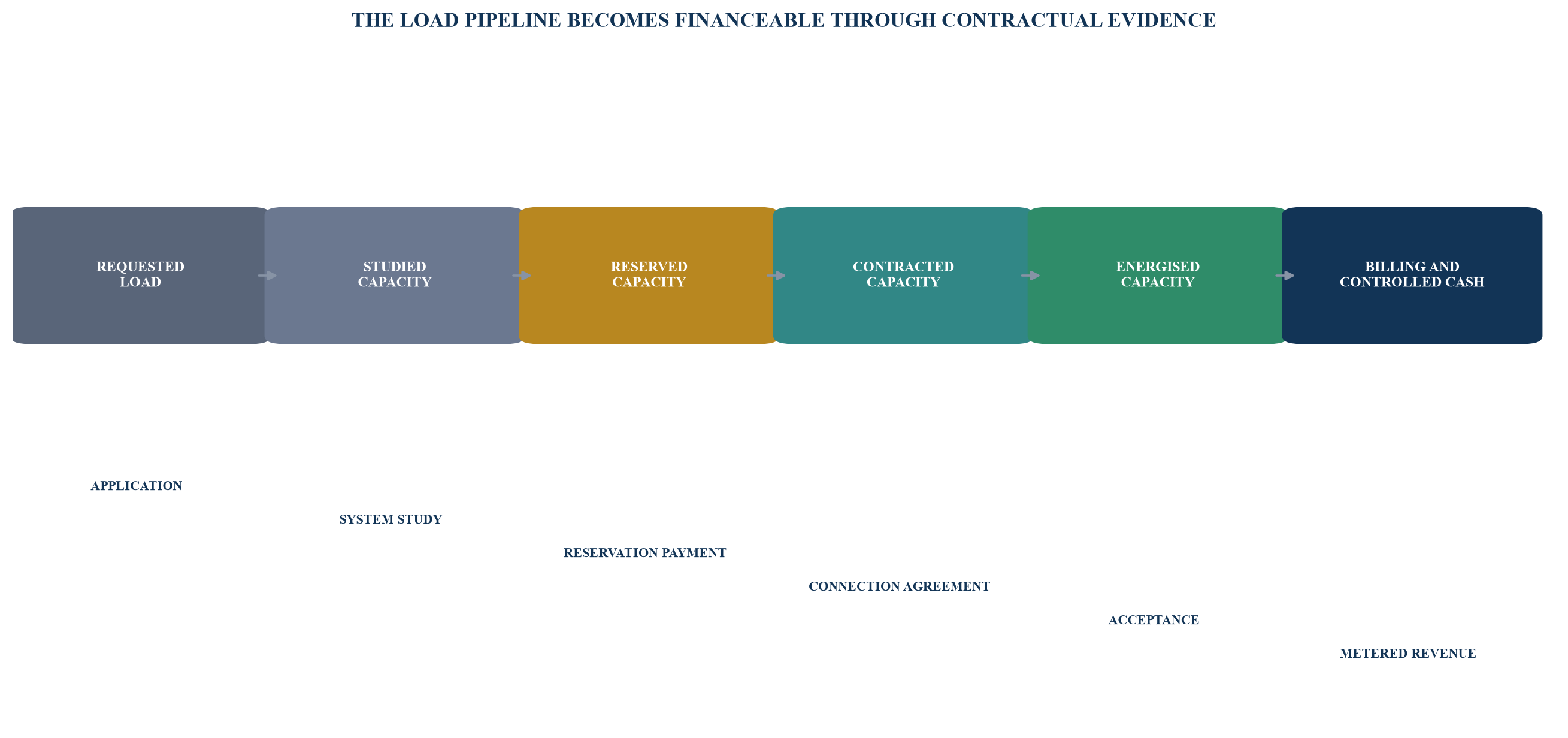
Debt capacity increases only as a connection moves from an expression of interest to enforceable payment and accepted service.
2. Define the financed grid boundary
Grid expansion is rarely one asset. A programme can contain land, access roads, primary substations, transformers, reactors, switchgear, protection and control, supervisory systems, underground cables, overhead lines, distribution substations, metering, fibre and customer-side works. The network owner may build some elements, a developer may fund others and a contractor may deliver an integrated package.
The financing boundary should state which entity owns each component during construction and after energisation. It should identify which costs enter a regulated asset base, which are recovered through a connection charge, which remain customer-funded and which provide wider system benefit. A cost that benefits several future users can be stranded if the first customer is asked to fund it without a reimbursement or sharing mechanism.
The boundary also determines security and recovery. A lender may be able to take security over project-company shares, bank accounts, receivables, equipment before vesting and contractual rights. It may have little practical ability to enforce against an energised line that has transferred to a public utility or forms part of an essential network. The repayment route must therefore survive asset transfer and commissioning.
World Bank transmission guidance describes several private-participation models, including long-term concessions, build-own-operate-transfer structures, financial ownership and dedicated lines for identified users.[7] Each model allocates ownership, revenue, operational responsibility and transfer differently. The financing should follow the selected model rather than assume a generic project-finance structure.
3. Separate system revenue from connection revenue
Grid cash flow can arise from regulated tariffs, availability payments, user connection charges, capacity reservation fees, capital contributions, wheeling charges, service payments, public-budget transfers or combinations of these. A lender should identify the legal source, calculation, timing and priority of each stream.
Regulated revenue can offer broad customer diversification, but it introduces regulatory reset, cost-recovery and asset-eligibility risk. A connection charge can be contractually clear, but it may be refundable or dependent on customer milestones. An availability payment can protect volume risk while exposing the project to construction, performance and deduction risk. A merchant congestion payment may be volatile and unsuitable for base debt without strong downside support.
The World Bank's regional electricity guidebook notes that financial analysis must reflect the institutional model and that bankable interconnection projects require tariff schedules informed by project economics.[8] The lender model should begin with the payment instrument, then determine how much of each payment is protected from demand delay, cancellation, tariff reset, dispute, set-off and transfer.
Table 1. Grid-expansion revenue and risk allocation
| Revenue source | Primary payer | Payment trigger | Principal risk | Typical credit response |
|---|---|---|---|---|
| regulated network tariff | broad customer base through utility | asset enters eligible service and tariff base | regulatory reset, disallowance or lag | eligibility opinion, regulatory covenant and liquidity reserve |
| availability payment | utility or public authority | commissioned capacity meets service standard | deductions, counterparty and termination | acceptance protocol, deduction cap and payment security |
| connection contribution | named customer or developer | milestones under connection agreement | cancellation, dispute and refund | upfront funding, escrow and non-refundable milestones |
| capacity reservation fee | prospective large-load customer | reserved MW and continued queue position | customer delay or option-like behaviour | credit support, expiry and capacity release rights |
| wheeling or transmission charge | generators, distributors or users | metered network use | volume, congestion and tariff basis | minimum payment or conservative volume case |
| public capital contribution | government or development entity | approved programme milestone | appropriation and timing | committed budget, direct agreement and no-draw condition |
Revenue labels matter less than the obligation, payer, trigger and remedy supporting each cash flow.
4. Convert the load forecast into a ramp model
A grid financing model should separate capacity from energy. A 200 MW connection does not imply immediate or continuous consumption of 200 MW. The customer may energise in phases, operate below peak, retain redundancy or delay equipment deployment. Revenue may follow reserved capacity, maximum demand, metered energy, availability or a blended formula.
The base case should map each customer from connection date to monthly capacity and energy. It should include construction probability, phased energisation, ramp rate, seasonal demand, power factor, coincident peak and contractual minimums. Portfolio effects matter. Ten customers with different schedules can create a more stable ramp than one dominant data centre or industrial plant.
The downside cases should be causal. A six-month customer delay changes reservation income, connection milestones, interest carry and the timing of tariff eligibility. A 25 percent capacity reduction changes asset utilisation and may leave oversized equipment. Cancellation can release capacity to another user, but replacement requires time and may need new studies or works. A lender should not apply one arbitrary revenue haircut to every case.
The model should distinguish system need from named-customer need. A substation that also improves reliability or releases other constrained connections may retain value if one customer delays. A dedicated spur serving one project has higher concentration and recovery risk. The beneficiary map should allocate cost and downside to the parties that create the need.
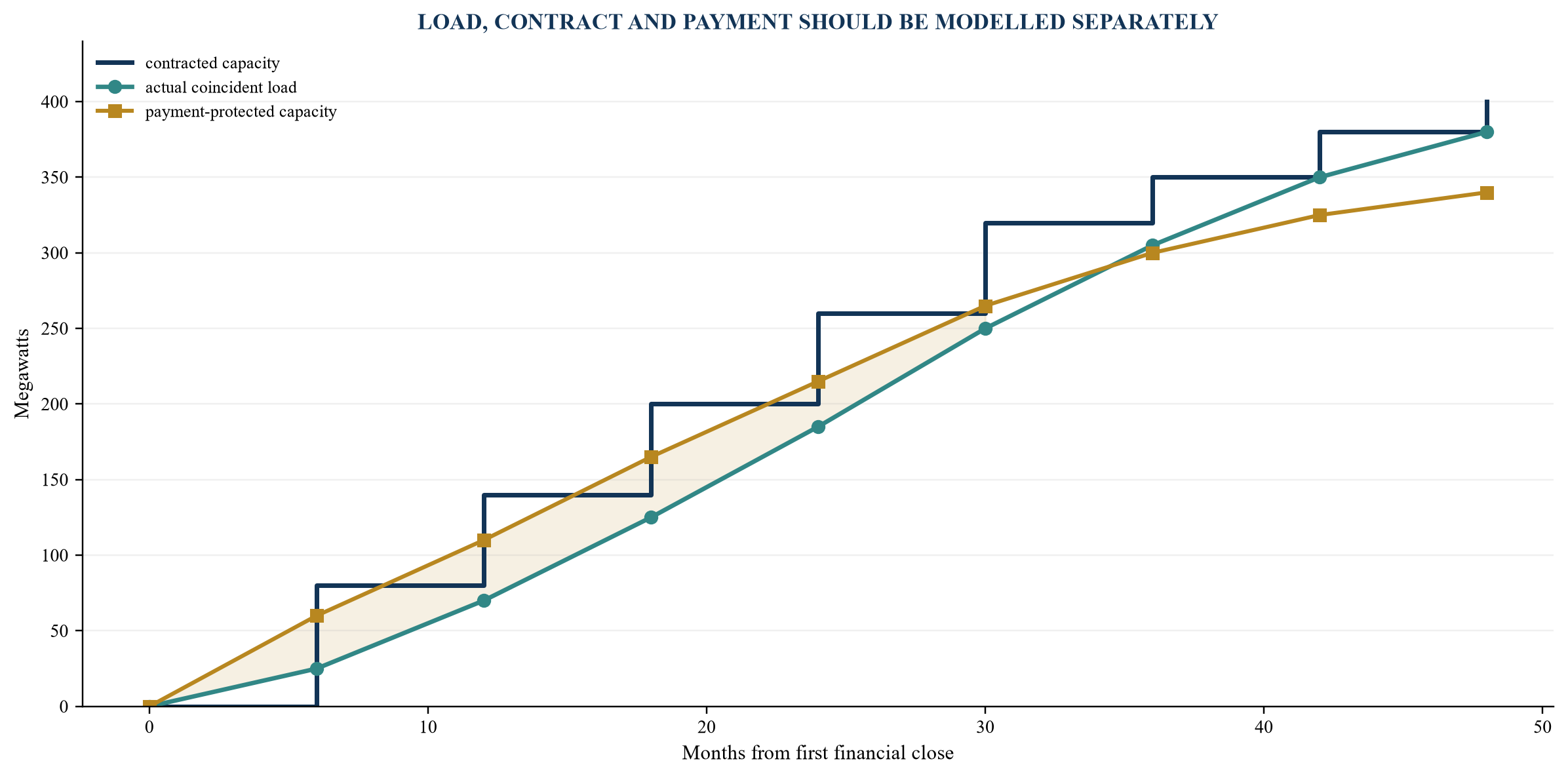
Contracted capacity can support financing before full utilisation when reservation and minimum-payment obligations remain enforceable.
5. Make staged drawdowns follow evidence
Debt should fund a sequence of de-risking events. Early draws may cover land, surveys, design and long-lead deposits. Later draws should depend on permits, executed contracts, equipment vesting, civil progress, energisation readiness and customer obligations. A single notice to proceed is too broad to govern a multi-interface grid programme.
Every draw should satisfy four tests. The asset test confirms that funded work belongs to the financing perimeter and can be used in the completed network. The progress test confirms physical completion and critical-path status. The sources test confirms that remaining debt, equity, customer contributions, contingency and recoveries exceed forecast remaining cost. The revenue test confirms that the payment and takeout route remains valid after updated customer and utility dates.
The independent engineer should reconcile invoices with verified work, procurement status and earned value. Payments for transformers, cables and switchgear should be supported by purchase orders, manufacturing records, inspection, vesting, insurance and delivery schedules. Advance payments require security and a clear refund route.
Table 2. Staged drawdown gates for grid construction
| Gate | Evidence | Permitted use | Holdback or reserve | Stop-draw trigger |
|---|---|---|---|---|
| development ready | land, route, studies, connection scope and approvals plan | surveys, design and bid costs | development contingency | unresolved route or authority objection |
| contract ready | executed EPC and major equipment orders | deposits and mobilisation | advance-payment security | unallocated interface or open price |
| construction ready | permits, access, programme and funded sources | civil and installation works | cost-to-complete buffer | sources below remaining cost |
| equipment vested | title, inspection, insurance and delivery evidence | certified equipment payments | retention and replacement reserve | delay beyond critical path |
| energisation ready | protection, control, outage and customer readiness | testing and commissioning | performance holdback | network or customer interface unavailable |
| revenue ready | acceptance, metering and payment certification | final draw and reserve funding | DSRA and ramp reserve | payment obligation not effective |
Draws advance only when construction evidence and the route to revenue remain current.
6. Rebuild cost to complete at every draw
Grid projects are exposed to commodity prices, equipment lead times, route changes, outage windows, authority requirements, contractor claims and customer-scope changes. A budget approved at financial close becomes stale quickly. The lender needs a current remaining-cost view prepared on a common cut-off date.
Remaining sources should include only committed and available cash. Undrawn debt is available only if its conditions can be met. Sponsor equity requires enforceable funding obligations and evidence of capacity. Customer contributions require executed payment terms and eligible invoices. Performance security should not be treated as cash until a valid claim and collection route exist.
Remaining uses should include unpaid contract value, approved and forecast changes, owner costs, land, financing costs, taxes, hedging, commissioning, spares, cyber and control systems, contingency, reserves and the cost of delay. Interface risk should be priced even when each individual contract is fixed-price. A substation can be mechanically complete yet unable to energise because the upstream line, customer plant or system outage is unavailable.
The cost-to-complete test should also include schedule sufficiency. Cash sources that cover nominal cost may be inadequate if a twelve-month delay adds interest, commitment fees, storage, remobilisation and expiring security. The lender should test cost and time together.
7. Treat transformers and cables as a financing workstream
Long-lead grid equipment can determine the entire financing timetable. Transformers, gas-insulated switchgear, high-voltage cables, reactors, protection systems and specialised control equipment require manufacturing slots, technical approvals, factory tests, transport planning and installation resources. The IEA reports that prices for key grid components have nearly doubled over five years and that supply chains are a material constraint on expansion.[1]
The credit file should establish specification freeze, approved manufacturers, order date, manufacturing programme, currency, price adjustment, warranty, liquidated damages, inspection, title transfer, storage, insurance and replacement options. A customised transformer has limited alternative use if the project is cancelled or the specification changes.
Equipment finance should match asset state. Before vesting, the lender is exposed mainly to supplier and refund risk. After vesting but before delivery, it is exposed to transport, storage and project-continuation risk. After installation but before energisation, recovery depends on the network and transfer arrangements. Advance rates should change across these states.
Supplier concentration deserves explicit limits. A programme that relies on one factory or one approved design can suffer correlated delays across several substations. Framework procurement can improve price and delivery certainty, but the lender should confirm allocation among projects and rights if one project is deferred.
8. Use capacity reservations to pay for waiting
Building ahead of demand creates an option for the future user. The grid owner commits scarce capacity and capital while the user retains flexibility over timing and utilisation. A capacity-reservation agreement should price that option and prevent speculative queue positions from shifting cost to other customers.
The agreement should identify reserved MW, location, voltage, target date, conditions, reservation payment, indexation, credit support, milestones, transfer, reduction, cancellation and capacity release. Payments can step up as the grid owner commits equipment and construction. Refundability should narrow as costs become irreversible.
The user should provide evidence of site control, permits, financing, construction progress and equipment orders. Failure to meet milestones should allow the network to reduce or reallocate capacity after notice and cure. The grid owner should have reciprocal obligations for studies, design, works and energisation, with relief for defined system events.
World Bank energy-contract guidance recognises the connection agreement as a core project document setting relationships with the network operator.[9] For financing, the agreement should also support assignment, lender notice, cure and continued payment during a project-company default where service remains available.
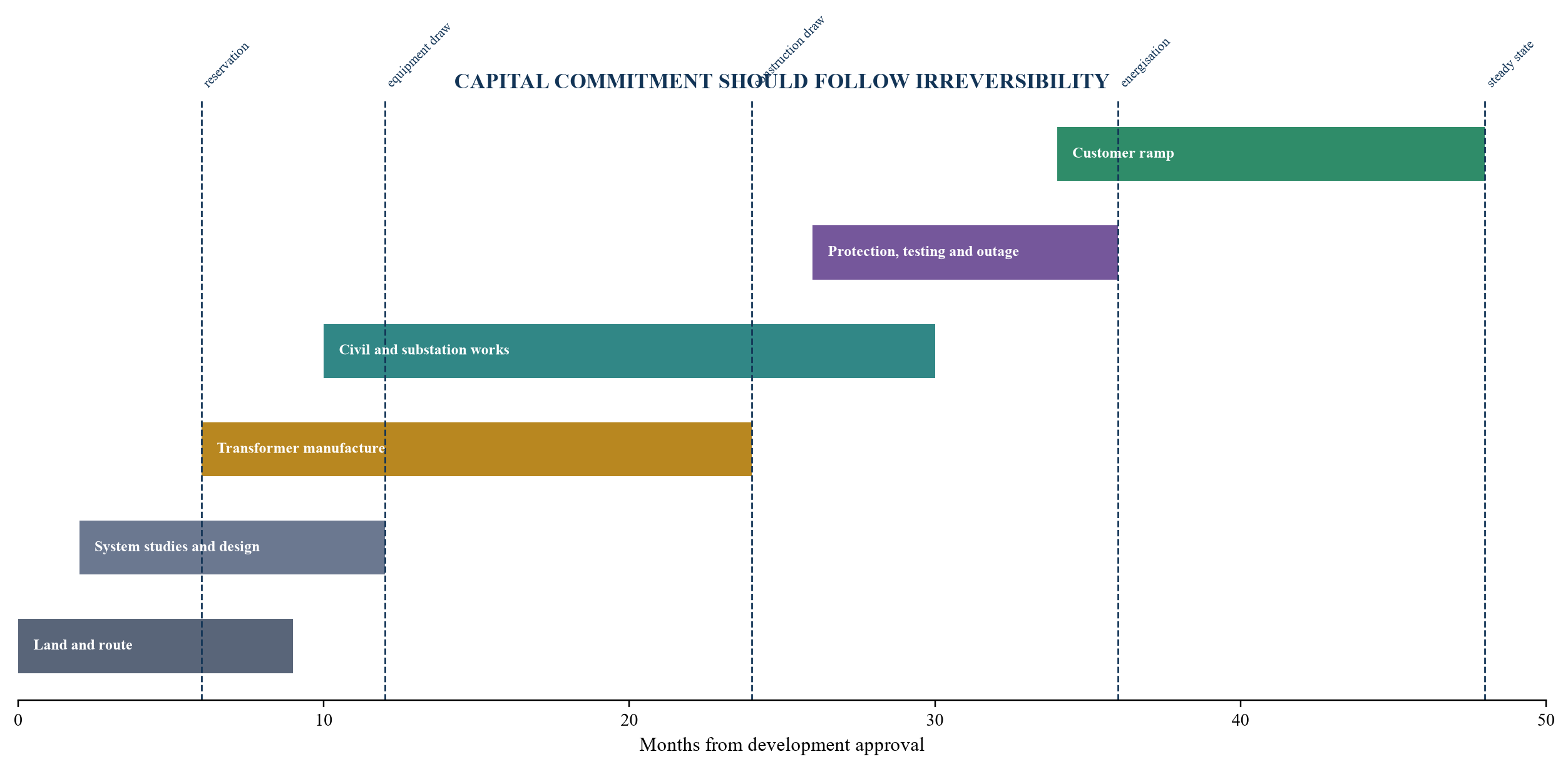
Financial commitments should step up only as land, equipment, construction, customer and network milestones become irreversible.
9. Underwrite the route into regulated or contracted revenue
The strongest grid financing case has a clear conversion from construction work in progress to an operating asset with an approved revenue entitlement. That conversion may occur through inclusion in a regulated asset base, commencement of an availability payment, transfer to a utility for a fixed consideration or certification of connection charges.
The lender should obtain evidence of eligibility before funding. The framework should identify the regulator or approving authority, capital plan, procurement route, efficiency test, allowed cost, depreciation, return, tariff period, commissioning standard and treatment of overruns. Expenditure can be technically useful yet excluded from recovery if it was not approved, efficiently incurred or properly documented.
Saudi Energy's first-half 2026 disclosure illustrates the relationship between capital delivery and regulated value: completed projects were commissioned and transferred into the regulated asset base, while transmission and distribution RAB reached SAR 271.8 billion.[6] A lender to a smaller project or supplier should verify the same conversion mechanics at transaction level rather than rely on system-wide precedent.
Timing matters. Regulatory recognition may occur after commissioning, while debt service begins earlier. A bridge facility needs capitalised interest, a liquidity reserve or interim customer payments. If the asset transfers to a utility, the purchase price, acceptance certificate and payment date should be direct conditions to repayment.
10. Score customers, utilities and public support separately
Grid projects can depend on several credit layers: a large-load customer, a developer, a network utility, a regulator and a government. Their obligations are not interchangeable. A policy objective to attract industry does not create an enforceable payment. A utility connection commitment may be subject to customer works. A customer reservation payment may not cover system-wide assets.
The lender should score each obligor for legal form, financial capacity, payment history, approval authority, budget, guarantee powers, termination obligations and dispute route. Credit enhancement can include cash deposits, letters of credit, parent guarantees, escrow, advance contributions, government support, minimum payments and termination compensation.
Concentration should be measured across legal and economic exposure. Several special-purpose customers may share one parent or financing source. A portfolio of data centres may depend on the same tenant or cloud platform. Industrial customers may depend on one commodity cycle. The downside model should reflect correlated delay and cancellation.
Table 3. Connection and capacity contract scorecard
| Dimension | Strong evidence | Moderate evidence | Weak evidence | Credit response |
|---|---|---|---|---|
| reservation obligation | non-refundable staged payments | refundable subject to defined costs | free or nominal queue position | exclude or require funded deposit |
| customer readiness | financed site with active construction | permits and financing progressing | conceptual project or multiple sites | milestone conditions and capacity release |
| utility obligation | dated works and acceptance commitments | best-efforts programme | non-binding estimate | no-draw condition or delay support |
| regulated recovery | approved eligible cost and tariff route | expected inclusion after review | no identified cost recovery | lower leverage or public contribution |
| payment security | cash, LC or strong guarantee | parent support with capacity | thin project company | stronger collateral and reserve |
| cancellation remedy | cost recovery plus committed return | reimbursement of defined costs | broad refund to customer | upfront funding and termination payment |
| assignment and cure | lender notice, cure and transfer rights | consent subject to criteria | prohibition or automatic termination | direct agreement before draw |
Contract value depends on the enforceability, credit and timing of the underlying obligation.
11. Test DSCR across ramp and delay together
Debt-service coverage is sensitive to both utilisation and time. A slow ramp reduces cash while construction debt continues to accrue interest. A delayed energisation can postpone regulated revenue and customer payments while extending commitment fees and overhead. Testing one variable at a time understates their interaction.
The model should calculate coverage across a matrix of load achievement and delay. Load can be expressed as a percentage of payment-protected capacity, with separate cases for actual energy if revenue is volume-based. Delay should shift revenue, add carrying cost and test expiry of commitments, hedges, customer security and equipment warranties.
The covenant should be calibrated to the revenue model. Historic DSCR may be unavailable during ramp. A forward-looking contracted-coverage test can compare protected payments with scheduled debt service. A minimum liquidity test can supplement coverage before billing history exists. Distribution should require both current performance and a credible remaining ramp.
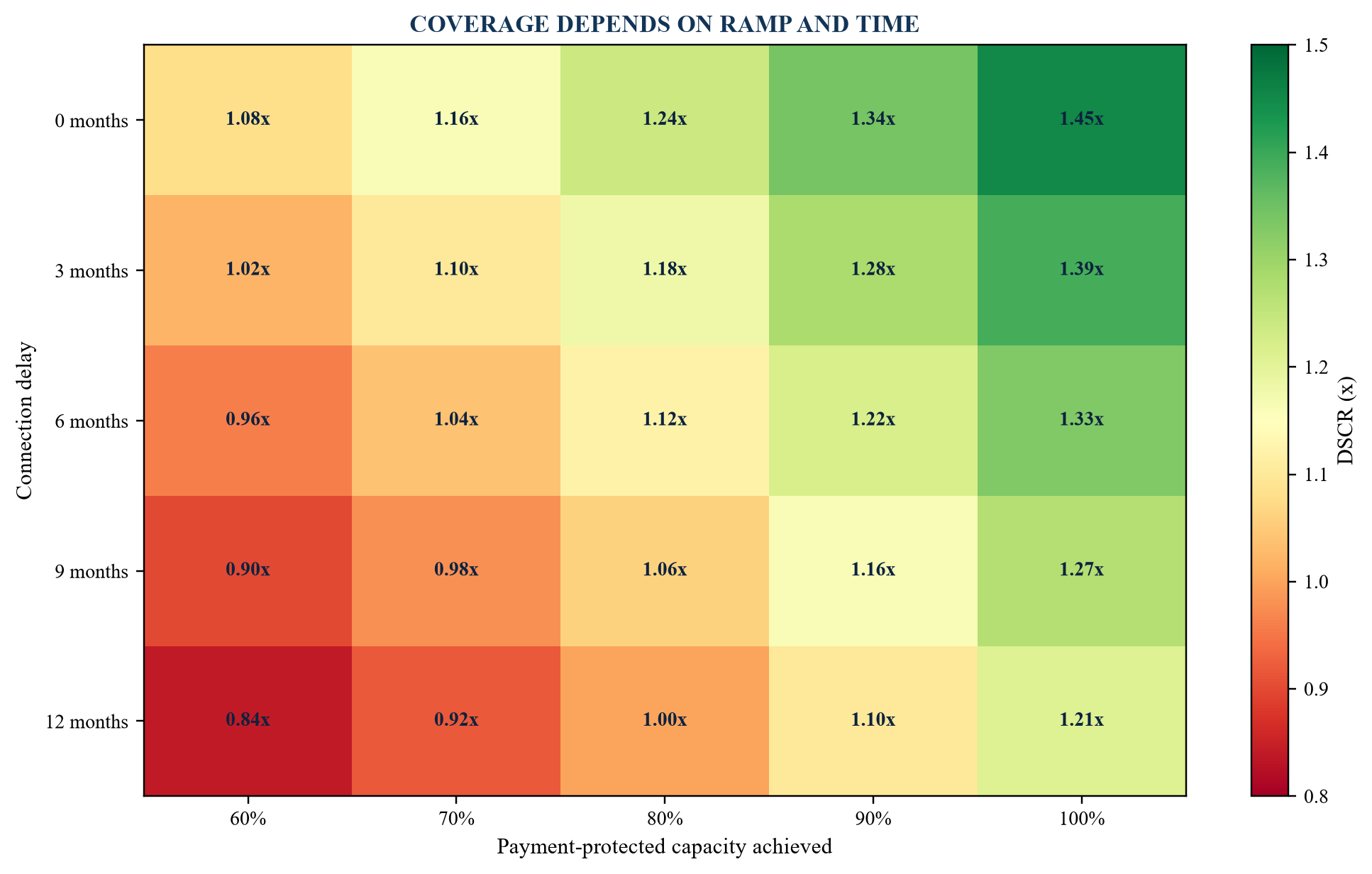
The values are illustrative management assumptions; combined delay and weak ramp can erode coverage faster than either variable alone.
12. Design reserves around the timing gap
A grid facility may need separate reserves for construction contingency, interest during construction, equipment price and storage, commissioning, customer delay, debt service, operations and lifecycle replacement. Combining every risk in one generic reserve can obscure whether the amount remains available for the event it is meant to cover.
The ramp reserve should reflect the contractual gap between energisation and steady-state protected payments. It can be funded by sponsor equity, customer deposits, facility proceeds or excess cash after commissioning. Release should follow achieved billing capacity, customer credit and forward coverage rather than a calendar date alone.
The debt-service reserve can be cash, a letter of credit or a committed facility. Replacement, expiry and draw conditions matter. A facility that terminates when the underlying customer defaults provides little protection. A letter of credit from the same banking group providing other critical support creates concentration.
Lifecycle reserves should reflect transformer, breaker, cable, protection, software and cyber-maintenance needs. The network may be highly available yet require large periodic expenditure. Deferring maintenance can preserve short-term cash while increasing outage and regulatory risk.
13. Link amortisation to commissioning and utilisation
Level amortisation can force principal repayment before the asset produces its mature cash flow. An appropriate private-credit structure can use capitalised interest during construction, a short post-energisation grace period, sculpted amortisation against protected payments and cash sweeps as utilisation exceeds the base case.
Performance-linked amortisation should rely on objective evidence. Triggers can include accepted MVA, energised feeders, contracted MW, payment-protected capacity, billed customers, regulated-asset inclusion and achieved coverage. Failure to meet a ramp milestone can retain cash, increase amortisation, require sponsor support or reduce undrawn availability.
The structure should avoid permanent back-ending. A bullet depends on refinancing or asset transfer that may be delayed by market conditions, regulation or incomplete ramp. The base amortisation should reduce exposure through the contract tenor, while a documented takeout can accelerate repayment.
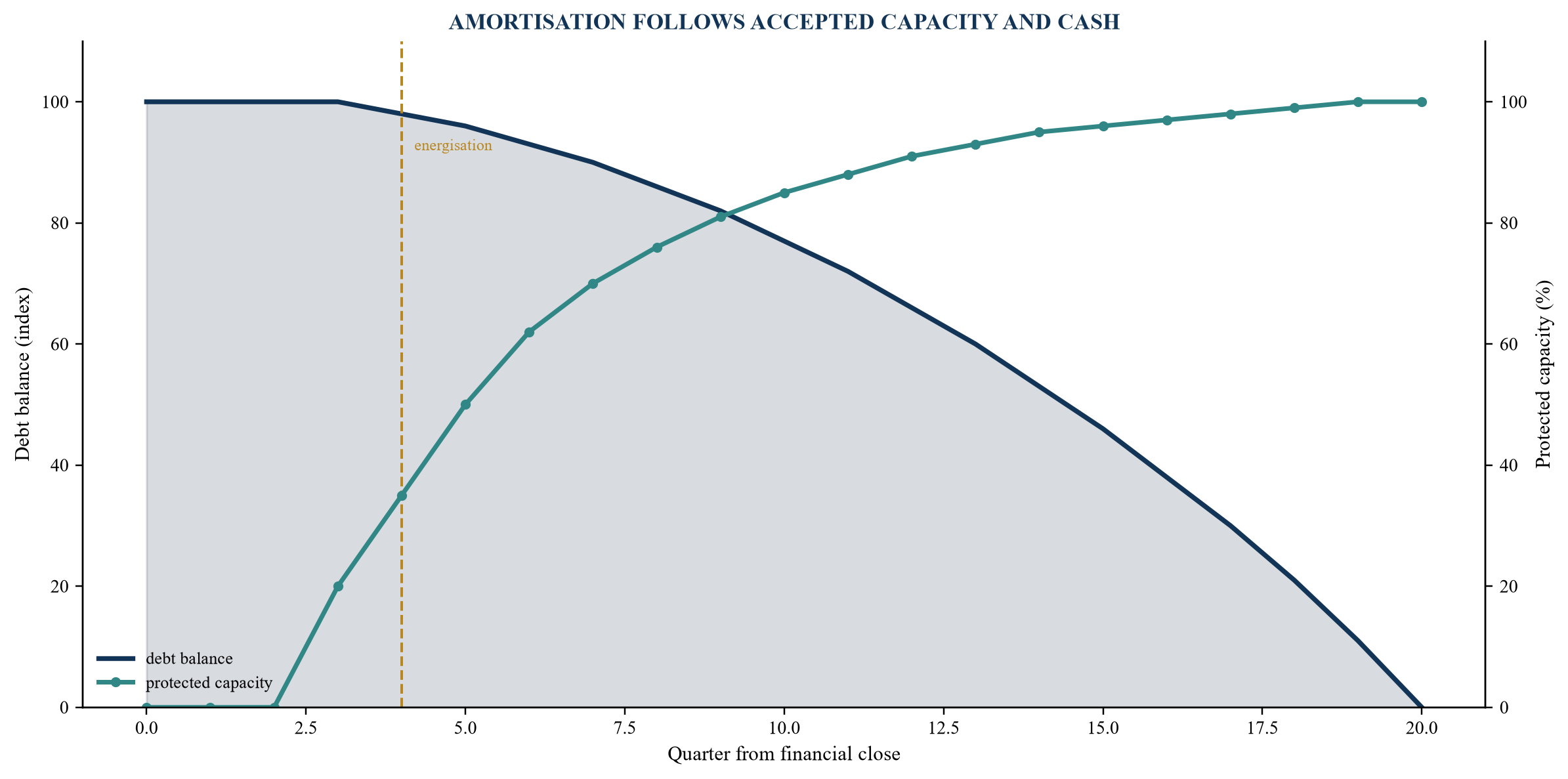
Scheduled amortisation begins after energisation and accelerates as protected capacity and cash flow mature.
14. Build security around contracts and accounts
Physical grid assets can be difficult to enforce or remove once integrated into an essential network. Security should therefore prioritise the rights and cash that make the asset valuable. The package may include share pledges, assignments of connection and EPC contracts, security over accounts and receivables, equipment security before transfer, insurance proceeds and rights under guarantees.
Account control should capture customer contributions, reservation fees, public payments, insurance, liquidated damages and transfer proceeds. The waterfall should fund taxes and essential operating costs, senior debt service, required reserves and lifecycle expenditure before distributions. Set-off and account-bank exposure should be addressed.
Direct agreements should provide notice, standstill, cure and substitution before termination of the connection, concession, EPC, O&M or material equipment contract. The lender needs access to designs, test records, warranties, software, spares and operational data. A right to step into the project company is incomplete if the network operator can terminate the connection automatically.
Local counsel should confirm creation, perfection, priority, assignment restrictions, sovereign or public-entity issues and enforcement. The downside route may be continuation, transfer or refinancing rather than asset sale. Security value should be measured against that route.
Table 4. Grid project risk and control matrix
| Risk | Evidence | Financial consequence | Control | Escalation trigger |
|---|---|---|---|---|
| route and land | title, easements and access plan | redesign, delay and compensation | condition precedent and route reserve | unresolved parcel on critical path |
| equipment supply | purchase orders, factory schedule and tests | delay, storage and replacement cost | vesting, security and alternate supplier | missed factory milestone |
| network interface | outage, protection and upstream works plan | completed asset cannot energise | coordinated programme and direct agreement | interface later than commissioning |
| customer delay | site, financing and construction evidence | reservation and load-ramp shortfall | milestone payments and capacity release | missed readiness milestone |
| regulatory recovery | approval, eligibility and tariff route | cost disallowance or recovery lag | regulatory covenant and liquidity | ineligible cost or delayed approval |
| operating performance | availability, losses and quality data | deductions and lower revenue | performance testing and O&M support | repeated outage or loss threshold |
| cyber and control | architecture, access and response plan | outage, safety and remediation | segregated controls and testing | material incident or failed audit |
| refinancing | takeout criteria and market evidence | maturity wall or extension cost | cash sweep and early process | missed market-sounding milestone |
Each material risk requires an evidence owner, quantified consequence and funded or contractual response.
15. Treat cross-border interconnection as a multi-obligor credit
Cross-border lines add system value through reserve sharing, trade, reliability and access to lower-cost generation. Their financing also depends on several systems, regulators, currencies, dispatch rules and settlement arrangements. The asset can be physically complete while commercial flows remain limited.
GCCIA's current programme includes expanding UAE interconnection capacity to 3,500 MW, establishing a direct Oman connection and linking the GCC grid to Iraq.[4] The credit analysis should identify who funds construction, who owns each segment, how capacity is allocated, how services are paid, which party bears losses and congestion, and what happens when one national system is unavailable.
The World Bank guidebook for regional electricity projects emphasises economic and financial appraisal linked to the institutional model and tariff design.[8] Economic benefits such as avoided generation, reserve sharing and lower emissions do not automatically create project cash. The financing needs a settlement mechanism that converts those benefits into dated obligations.
Currency, convertibility, political relations and public-law approvals require specific treatment. Reserve accounts, multilateral support, guarantees and termination payments can strengthen the structure. Dispute resolution and continuing operation are central because interruption can affect system security beyond the project company.
16. Model operational, climate and cyber resilience
Grid credit quality depends on availability, losses, voltage, frequency, protection, restoration and maintenance. Reliability targets should be translated into measurable service levels, deduction bands and cure rights. Force majeure should distinguish events that excuse performance from events that also provide payment relief.
Extreme heat can reduce equipment ratings and increase cooling demand at the same time. Flooding, sand, salt, wind, lightning and coastal conditions can affect substations and lines. The engineering case should define design standards, redundancy, spares, emergency access, black-start or restoration interfaces and insurance.
Digital substations and supervisory systems improve visibility and capacity utilisation, but they create cyber and vendor risks. Access control, remote maintenance, software support, patching, backups, incident response and manual fallback should be part of technical diligence. A cyber event can interrupt revenue even when the physical asset is undamaged.
The IEA notes that grid-enhancing technologies, demand flexibility, reconductoring and voltage uprating can unlock substantial hosting capacity faster than major new lines.[1] The lender should compare new-build cost with credible optimisation alternatives. Financing an oversized asset is difficult if lower-cost capacity can satisfy the same need.
17. Use private credit for a defined financing gap
Private credit can complement utility balance sheets, bank facilities, sukuk, bonds, export credit and public funding. Its value lies in bespoke timing, concentrated underwriting, delayed draws, equipment advances, reserve commitments, junior priority or a bridge to a long-term takeout. The use and repayment route should be precise.
Possible facilities include a development loan for studies and land; an equipment facility for transformer deposits; a customer-contribution bridge; a construction contingency tranche; a reserve facility; subordinated debt beneath regulated senior finance; or a bridge to asset transfer, RAB inclusion or infrastructure refinancing.
Private credit should not become unstructured permanent leverage. Draw conditions should match the risk funded. Intercreditor terms should address payment priority, additional debt, enforcement, cure, voting, turnover and release. Pricing, fees and return should reflect actual commitment and draw risk.
BIS research estimated global private-credit assets under management above USD 2.5 trillion and identified infrastructure among hard-asset lending categories.[17] That scale does not make every grid project suitable. The lender needs technical capability, public-contract expertise, construction monitoring and a continuity-focused workout plan.
Table 5. Private-credit instrument menu for grid expansion
| Instrument | Defined use | Primary repayment | Essential controls | Principal risk |
|---|---|---|---|---|
| development loan | studies, land and connection design | sponsor equity or construction close | milestone budget and conversion terms | failure to reach approval |
| equipment facility | transformer and switchgear deposits | construction debt or customer contribution | vesting, inspection and refund security | supplier delay or cancellation |
| contribution bridge | timing of committed customer payments | executed milestone contributions | escrow, eligibility and direct agreement | dispute or customer default |
| contingency tranche | defined overrun or interface cost | project cash or takeout | cost-to-complete test and draw hierarchy | adverse selection after deterioration |
| ramp reserve facility | post-energisation cash shortfall | protected operating cash | controlled account and limited use | reserve unavailable during stress |
| subordinated term debt | gap beneath regulated or senior finance | residual contracted cash | intercreditor rights and cash sweep | low recovery after senior action |
| takeout bridge | period to RAB, transfer or long-term refinance | documented utility or capital-market takeout | milestones and mandatory prepayment | market or approval delay |
The instrument should fund one identified timing gap and preserve a documented repayment route.
18. Set covenants that lead to action
Construction reporting should cover permits, route, design, procurement, factory progress, civil works, protection, outages, customer readiness, cost to complete, claims, contingency, equity and safety. Operating reporting should cover accepted capacity, metered load, availability, losses, outages, receivables, customer milestones, reserves and coverage.
Covenants should use definitions from the connection and revenue documents. Contracted MW, reserved MW, energised MVA and billed capacity should not be mixed. Cash available for debt service should exclude refundable deposits, disputed revenue and non-cash regulatory accrual unless collection is demonstrable.
The remedy ladder should begin before default. A watch trigger increases reporting and adviser involvement. A control trigger can stop draws, trap cash, require a top-up, reduce capacity commitments or block distributions. A default trigger can accelerate, enforce support or commence substitution. Essential-service continuity may require a managed enforcement process.
Table 6. Covenant and remedy ladder
| Indicator | Watch response | Control response | Escalation response |
|---|---|---|---|
| route or permit delay | refreshed critical path | additional contingency and stop affected draw | restructure scope or enforce support |
| equipment milestone | factory recovery plan | retain security and source alternative | cancel order or replace supplier |
| cost-to-complete coverage | independent forecast refresh | sponsor top-up before next advance | stop draw or default |
| customer readiness | evidence and cure timetable | increase reservation payment or release capacity | terminate and remarket capacity |
| energisation date | interface rehearsal | extend reserve and trap cash | claim delay support or restructure debt |
| protected load ramp | customer action plan | accelerated amortisation and distribution block | enforce security or seek replacement user |
| DSCR | enhanced monthly monitoring | cash sweep and reserve top-up | default or recapitalisation |
| takeout milestone | market sounding | adviser appointment and mandatory sweep | extension, asset transfer or sale process |
Thresholds are illustrative and must be calibrated to executed contracts, regulation and the financial model.
19. Run a twelve-day bankability diagnostic
Days one and two establish the asset boundary, ownership, network need, customers, requested capacity, connection states and financing use. Days three and four rebuild the route, permits, programme, equipment schedule, interfaces and cost to complete. Days five and six reconstruct the revenue formula, capacity reservations, customer contributions, regulated recovery and payment security.
Days seven and eight test load ramp, delay, cancellation, coverage, reserves and amortisation. Days nine and ten review security, accounts, direct agreements, step-in, insurance, cyber, climate and operating continuity. Days eleven and twelve present the funding structure, draw gates, covenant ladder, takeout route and decision.
The minimum evidence pack includes network studies; land and route documents; approvals; connection agreements; customer-readiness evidence; EPC and equipment contracts; technical-adviser reports; utility and regulatory approvals; revenue model; financial model; existing debt and security; insurance; cyber and operational plans; claims; disputes; and all material support.
The outcome is proceed, proceed after specified evidence, restructure or decline. A conditional proceed should state what must be true before term sheet, credit approval, financial close, each draw, energisation, revenue commencement and distribution.
20. Apply a 100-day financing execution plan
Days one to twenty establish governance, data room, document register, model version, project budget, schedule, evidence owners and decision rights. The team reconciles the network plan, connection contracts, customer pipeline, regulatory route and financing perimeter.
Days twenty-one to forty-five complete technical, legal, regulatory, insurance, tax, model, customer and counterparty diligence. The independent engineer updates procurement, critical path and cost to complete. Counsel confirms route rights, connection obligations, payment, security, direct agreements, asset transfer and enforcement.
Days forty-six to seventy align commercial terms and documents. Facility amount, draws, equity, contributions, pricing, amortisation, reserves, accounts, security, intercreditor, hedging, covenants, defaults, cures, protective advances, transfer and termination should agree with the credit case.
Days seventy-one to ninety rehearse operations. The parties test a draw request, factory certificate, customer delay, capacity reduction, connection invoice, regulatory submission, cash waterfall, reserve top-up, energisation delay, outage and step-in notice. The rehearsal exposes process gaps before utilisation.
Days ninety-one to one hundred transfer governance into monitoring. Weekly construction and liquidity review continues until energisation. Monthly reporting updates customer readiness, capacity states, progress, cost, performance, payment, reserves and covenants. Quarterly review refreshes counterparty, regulation, lifecycle and takeout evidence.
21. Conclusion
Grid expansion ahead of demand can be financed when future load is converted from a forecast into enforceable and staged obligations. The lender should distinguish applications from reservations, reservations from contracts, contracts from energisation and energisation from collectible cash. Each transition needs evidence, payment, an owner, a date and a remedy.
The framework joins six disciplines. Network planning defines the asset and beneficiaries. Contract analysis creates reservation, connection and payment obligations. Construction analysis makes cost to complete the draw governor. Financial analysis models capacity, load, delay and cancellation separately. Credit design establishes reserves, amortisation and covenants. Direct agreements preserve continuity and takeout value.
Private credit can fund development, equipment, customer-contribution timing, contingency, ramp reserves, subordinated capital or a bridge to regulated or long-term finance. Each facility should serve one documented gap and have a repayment route that remains valid if demand arrives later than planned.
The central question is practical: after construction delay, equipment risk, customer slippage, regulatory lag and the remaining conditions to energisation, how much payment-protected capacity will produce controlled cash for debt service? A project that answers that question with current evidence can translate strategic grid capacity into bankable private capital.
References
- International Energy Agency. Electricity 2026: Grids. 2026. https://www.iea.org/reports/electricity-2026/grids
- Dubai Electricity and Water Authority. DEWA's Electricity Transmission Investments Surpass AED 7.6 Billion. 4 August 2025. https://www.dewa.gov.ae/en/about-us/media-publications/latest-news/2025/07/dewa-electricity-transmission-projects
- Dubai Electricity and Water Authority. DEWA Commissions Record Number of 11 kV Distribution Substations in First Half of 2025. 10 August 2025. https://www.dewa.gov.ae/en/about-us/media-publications/latest-news/2025/08/dewa-commissions-record-number-of-11-kv-distribution-substations-in-first-half-of-2025
- GCC Interconnection Authority. Projects Under Construction. https://gccia.com.sa/gccia-grid/projects-under-construction-2/
- Nama Power and Water Procurement Company. Power 7 Year Statement 2025-2031, Issue 19. https://www.omanpwp.om/storage/files/1/7-year-statement/696087c603ae3.pdf
- Saudi Energy Company. H1 2026 Results and Grid Investment Update. 2026. https://www.se.com.sa/en/News/CorporateNews/CorporateNews49
- World Bank. Scaling Up to Phase Down: Financing Energy Transitions in the Power Sector. 2023. https://documents1.worldbank.org/curated/en/099645409062314892/pdf/IDU0e6f91c9204b9e0428c09f050e8c815126f56.pdf
- World Bank Public-Private Partnership Resource Center. Guidebook for Economic and Financial Analysis of Regional Electricity Projects. 2020. https://ppp.worldbank.org/library/guidebook-economic-and-financial-analysis-regional-electricity-projects
- World Bank Public-Private Partnership Resource Center. Energy and Power Agreements. https://ppp.worldbank.org/sector/energy/energy-power-agreements
- International Energy Agency. World Energy Investment 2025. https://www.iea.org/reports/world-energy-investment-2025
- International Energy Agency. Energy and AI: Executive Summary. 2025. https://www.iea.org/reports/energy-and-ai/executive-summary
- Dubai Electricity and Water Authority. Consolidated Financial Statements 2025. https://dewa.gov.ae/-/media/Files/Investor-Relations-Files/DEWA_Consolidated-FS-2025_English.ashx
- Emirates Water and Electricity Company. Statistical Report 2024. https://ewec.ae/uploads/mediakit/0.91096900%201756961868/Statistical%20Report%202024.pdf
- International Energy Agency. Grid Investments. 11 June 2025. https://www.iea.org/reports/grid-investments
- World Bank. Linking Up: Public-Private Partnerships in Power Transmission. https://www.worldbank.org/en/topic/energy/publication/linking-up-public-private-partnerships-in-power-transmission-in-africa
- Fitch Ratings. Fitch Affirms GCC Interconnection Authority A+; Outlook Stable. 2025. https://gccia.com.sa/wp-content/uploads/2025/10/Fitch-Affirms-Gulf-Cooperation-Council-Interconnection-Authority-A-Outlook-Stable.pdf
- Bank for International Settlements. The Global Drivers of Private Credit. BIS Quarterly Review, March 2025. https://www.bis.org/publ/qtrpdf/r_qt2503b.htm
- World Bank Group. Private Participation in Infrastructure 2024 Annual Report. https://ppi.worldbank.org/content/dam/PPI/documents/PPI-2024-Annual-Report.pdf
