

1. Underwrite the route from collateral to lender cash
Real-estate development produces several assets at different stages. The developer may control land, hold planning or master-developer approvals, complete infrastructure, build saleable units, enter purchaser contracts, receive escrow deposits and retain unsold inventory. Each item has economic value. Each also has conditions between its reported value and cash that can repay a lender.
The underwriting task is to map those conditions. Land value depends on title, ownership restrictions, permitted use, access, infrastructure, encumbrances, development obligations and the cost and time required to reach a sale. Work in progress depends on verified quantity, quality, remaining cost, permits, contractor claims and the feasibility of completion. Presales depend on enforceable contracts, required registration, purchaser cash at risk, payment conduct, cancellation rights, concentration and settlement funding. Escrow cash depends on the project account agreement, authority rules, approved uses and withdrawal evidence. Completed units depend on title, handover, defects, sales velocity, price, transaction cost and the ability to transfer proceeds through the agreed waterfall.
A headline valuation can therefore overstate debt capacity when it assumes completion, gross sales and normal timing while the facility must survive incomplete work, restricted cash and a slower market. A lender should retain a current value view and a collateral-to-cash view. The current value view supports asset comparison. The conversion view states the deductions, decisions and elapsed time between each asset state and cash recovery.
The paper uses six connected gates. Gate one verifies legal and project authority. Gate two establishes a fully funded cost-to-complete. Gate three maps escrow and account control. Gate four tests presales and receivables. Gate five measures marketability and valuation under time. Gate six proves the downside route. Failure at an earlier gate limits recognition at later gates. A large gross development value cannot cure uncertain title or an unfunded completion deficit.
The credit memorandum should state the precise repayment route. Primary repayment can come from controlled purchaser collections, refinanced stabilised assets or completed-unit sales. Secondary repayment can come from sale of the land or project, sponsor support, additional equity or enforcement. Each route needs evidence, timing, cost and decision ownership. The structure should avoid counting the same cash twice, such as treating future purchaser instalments as both completion funding and debt repayment.
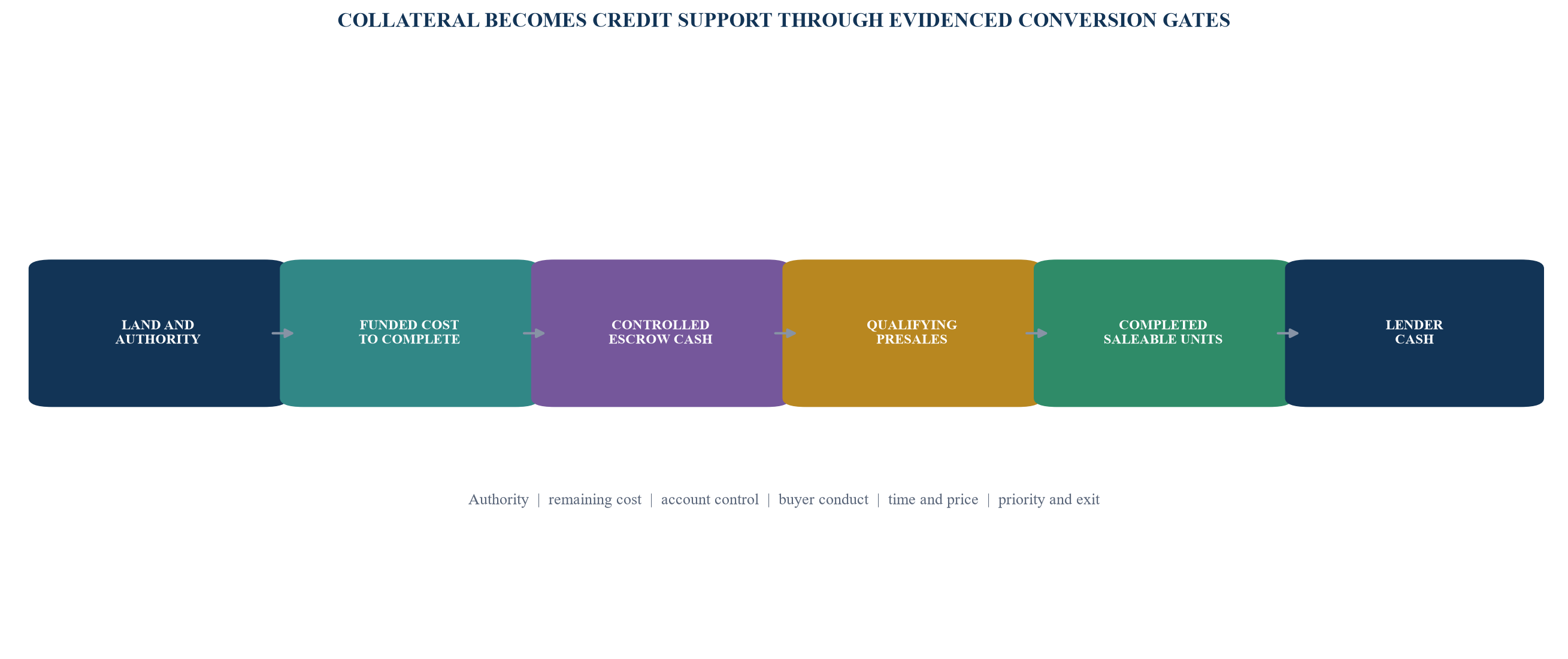
Each gate requires current documentary evidence; later-stage value cannot compensate automatically for an unresolved earlier gate.
2. Establish legal control before assigning value
The first gate begins with the exact parcel and project. The file should reconcile the official property record, plot plan, area, boundaries, ownership, leasehold or development right, permitted use, restrictions, mortgages, attachments, easements, access, master-community obligations and development agreement. The borrower must hold the right that the credit analysis assumes. A group company owning land while another company develops and borrows requires documented rights, security and cash flows across the entities.
Authority extends beyond title. The developer, project, design, marketing and off-plan activity can require registrations, licences and approvals. Dubai Land Department's published process links project registration to the opening of the project escrow account, and its escrow law requires a written agreement for a special project account into which off-plan purchaser and project-financier payments are deposited. Abu Dhabi's framework requires a separate project escrow account and published development controls. Saudi Arabia's off-plan law and implementing regulations require project licensing and a dedicated escrow account.
The land register should show purchase price, current basis, payment obligations, deferred consideration, seller security, development milestones, reversion rights, infrastructure commitments and related-party terms. It should identify what survives a borrower default and what requires owner, master-developer, lessor, authority or mortgagee consent. A long lease, Musataha, usufruct, development agreement or joint-venture interest can be financeable when its term, registration, transfer, mortgage, cure and termination mechanics support the proposed facility.
Planning and infrastructure should enter the same register. Approved gross floor area, unit mix, parking, height, public-realm obligations, utility capacity, connection cost and delivery dates affect residual value and completion. A concept approval or management expectation should not be modelled as final authority. The file should show the source document, issue date, conditions, expiry and responsible owner for every critical permission.
Security diligence then asks what the lender can validly take and how it ranks. The answer may include a mortgage over land or a registered real right, share security, assignment of project contracts, security over movable assets, account control, receivables rights, insurance proceeds, sponsor undertakings and step-in agreements. Jurisdiction-specific counsel should confirm creation, perfection, priority, enforcement and any restriction arising from escrow or purchaser protection.
Table 1. Land and project authority register
| Dimension | Minimum evidence | Conversion question | Credit response when unresolved |
|---|---|---|---|
| property right | official extract, plot plan and underlying agreement | can the borrower develop, transfer and grant the intended security? | exclude value or require enforceable control before funding |
| owner and authority | constitutional records, approvals and signatories | are all relevant parties validly bound? | condition precedent and legal opinion |
| permitted development | approved use, density, plans and conditions | does the financed scheme fit the operative approval? | lower case, redesign reserve or no draw |
| infrastructure | access, utilities, connection agreements and programme | can the project be completed and occupied on time? | funded obligation, contingency and milestone |
| project status | developer, project, marketing and sales permissions | can the project lawfully sell and collect? | prohibit recognition of unsupported sales |
| encumbrances | mortgages, claims, seller rights and competing security | what ranks ahead of lender recovery? | release, intercreditor agreement or haircut |
| transfer and enforcement | consents, cure, step-in and sale route | can control move to a capable successor? | executable consent package before closing |
The register should use current official records and transaction-specific legal advice.
3. Build a sources-and-uses statement that closes
The second gate establishes the total amount required to finish the project and reach the repayment event. The opening sources-and-uses statement should reconcile land consideration, design, authority fees, enabling works, main construction, infrastructure, professional fees, marketing, finance cost, taxes, contingency, claims, fit-out, testing, handover, defects, sales cost and lender fees. It should state what has been paid, what is committed, what remains and which source funds each item.
Cost-to-complete should begin with a current quantity surveyor or project-monitor assessment. The analysis then adds costs that may sit outside the construction contract: developer obligations, utility contributions, authority charges, pending variations, claims, extension cost, financing during delay, sales commissions, purchaser remedies and a contingency calibrated to design maturity and contract risk. Reported accounting cost and physical cost to complete answer different questions and should be bridged.
Funding sources should be equally specific. Sponsor equity, land equity, subordinated funding, purchaser escrow, senior facility, private-credit facility, supplier credit and asset sale proceeds have different availability conditions. Land already paid for may count as sponsor capital, yet it does not provide cash for payroll or contractors. Future purchaser receipts should enter only through the contractual payment schedule, observed performance, expected sales and applicable escrow rules.
The facility should close on both a cash and commitment basis. The committed-sources test asks whether legally available sources cover all remaining cost, contingency, interest and fees. The timing test asks whether cash arrives before each weekly obligation. A project can pass the first and fail the second. The model therefore needs a monthly development cash flow and a rolling thirteen-week liquidity view.
Equity timing should be written into the draw mechanics. An equity-first structure offers strong early protection but can leave the lender funding the final and riskiest phase. Pari passu funding shares risk over time but requires reliable verification. A minimum-equity-maintained structure can respond to cost changes. The correct approach depends on sponsor capacity, stage, security and completion risk; it should be explicit before the first draw.
Table 2. Illustrative cost-to-complete and committed-funding test
| Item | Total budget | Paid or funded | Remaining requirement | Primary evidence |
|---|---|---|---|---|
| land and development rights | AED 180m | AED 180m | AED 0m | title, acquisition statement and payment record |
| construction and infrastructure | AED 420m | AED 145m | AED 275m | contracts, quantity surveyor report and variations |
| professional, authority and utility cost | AED 62m | AED 18m | AED 44m | appointments, invoices and authority schedules |
| finance, selling and close-out cost | AED 88m | AED 12m | AED 76m | facility model, agency terms and handover plan |
| contingency and delay reserve | AED 45m | AED 0m | AED 45m | risk register and independent review |
| total | AED 795m | AED 355m | AED 440m | reconciled development budget |
| committed undrawn sources | AED 468m | equity, eligible escrow and executed facilities | ||
| illustrative headroom | AED 28m | sources less remaining requirement |
Amounts are management assumptions used to demonstrate the method; they do not represent an identified project.
4. Make progress certification a credit control
Construction progress converts committed capital into a more complete asset. The lender needs evidence of quantity, quality, cost and programme. A project monitor or independent engineer should verify work completed, materials on site where eligible, critical-path progress, approvals, defects, claims, forecast final cost, contingency use and the amount appropriate for the next draw. The report should reconcile to contractor certificates and the developer ledger.
Percentage completion can be measured in several ways. Cost incurred, value of certified work, physical quantities and elapsed programme can diverge. A project may spend heavily on imported equipment before installation, certify slowly despite physical progress, or record accounting accruals without lender-eligible evidence. The facility should define its accepted measure for each purpose and preserve the reconciliation.
The payment process should protect completion. Direct payment to approved contractors, a controlled construction account, dual authorisation, invoice and certificate checks, lien or claim monitoring, and evidence of prior draw use can reduce diversion. These controls should remain workable; a process that cannot meet payroll or contractor cycles can itself cause delay.
Variations, claims and delays require a dated exception register. Each item should state instruction authority, scope, amount, status, programme effect, funding source, dispute route and next evidence event. The cost-to-complete should include probable exposure with an appropriate reserve. Expected recoveries from contractors, insurers or authorities should remain separate until supported and collectible.
Completion has several layers: substantial or practical completion, authority certification, utility activation, title or unit registration, handover, purchaser settlement, defects close-out and release of retained amounts. The repayment model should use the milestone that actually releases cash. Construction completion alone may not permit transfer, occupation or final purchaser payment.
5. Treat loan-to-cost and loan-to-value as simultaneous constraints
Loan-to-cost measures debt against an agreed project-cost base. Loan-to-value measures debt against an accepted current or completed value. Each can limit availability. Each can also mislead when used alone. A low loan-to-cost ratio can coexist with weak recovery if land was acquired at an inflated related-party price. A low projected loan-to-value ratio can coexist with a completion deficit if the value assumes future construction without funding its cost.
The cost denominator should define eligible cost, land basis, capitalised interest, related-party charges, contingencies and excluded expenditures. The value denominator should define current condition, special assumptions, gross development value, net realisable value, valuation date and disposal period. Both should be updated when cost, time, sales or market evidence changes.
International Valuation Standards identify development property as requiring specific analysis. The residual method derives an indication after deducting anticipated completion costs and other elements from the expected completed value. Small changes in price, time, cost and required return can create large changes in residual land value. A lender should request sensitivity and understand the valuer's information, assumptions, special assumptions and scope.
The facility amount is the lowest of several limits: committed facility, loan-to-cost cap, loan-to-current-value cap, loan-to-completed-value cap, cost-to-complete requirement, dynamic lending base, debt-service or interest-reserve capacity, and any concentration or policy limit. The credit memorandum should show which constraint binds at closing and under each stress.
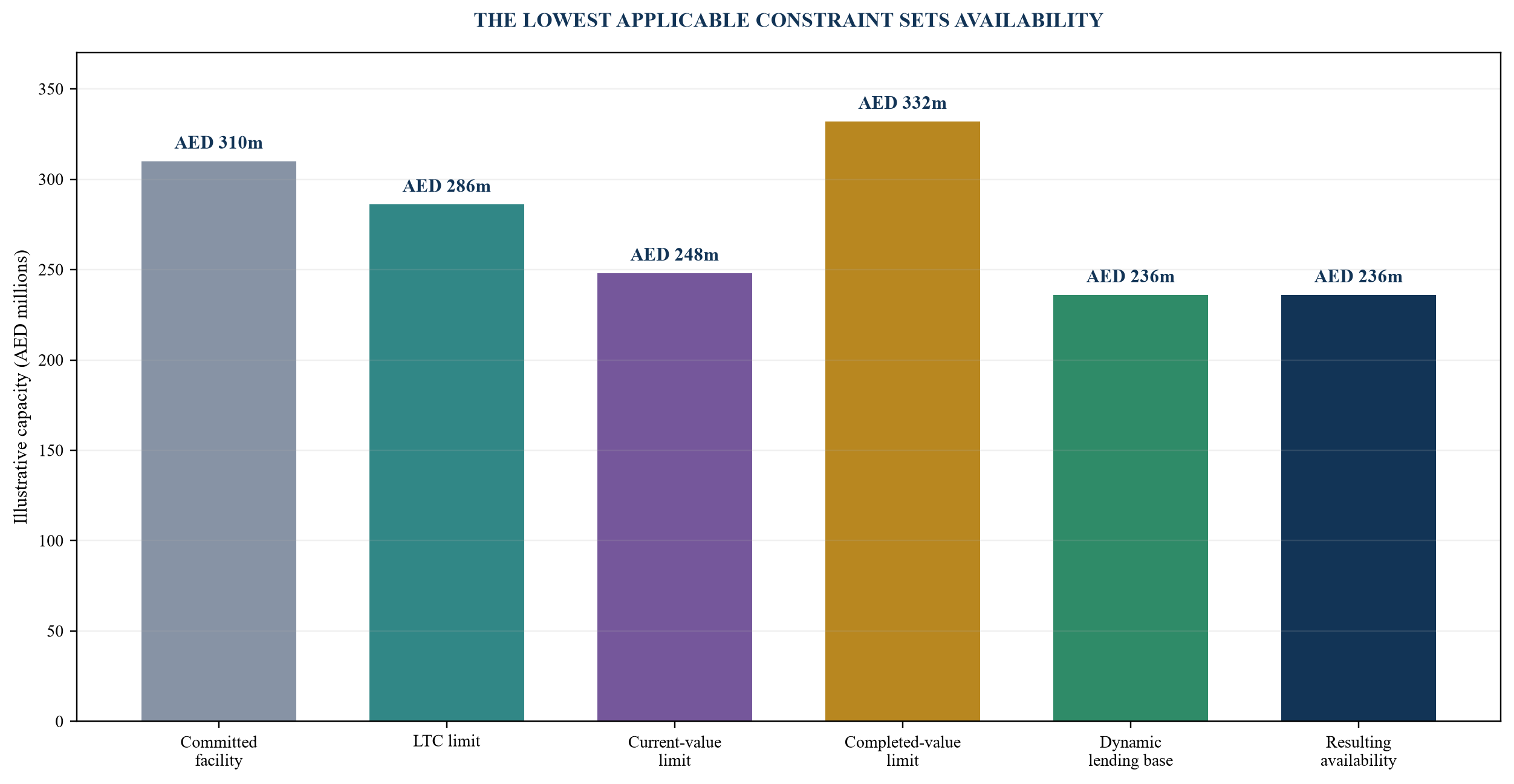
Values and advance rates are management assumptions used solely to demonstrate simultaneous facility constraints.
6. Map escrow as a controlled cash system
Escrow is a legal and operational control, not a generic cash balance. The project account agreement, applicable law, authority procedures and bank operations determine what enters the account, what can leave, whose approval is required, and how funds are handled during completion, cancellation or enforcement.
Dubai Land Department describes project escrow as the account for amounts collected from off-plan purchasers and project financiers. It identifies approved account trustees and confirms that a bank may act as trustee and development financier. Its published law requires project-specific use, and current procedures link withdrawals and account administration to authority controls and technical progress. Abu Dhabi's published framework requires buyer payments into the project escrow account and states that disbursement is tied to verified construction progress. Saudi Arabia's off-plan regime likewise requires a separate project account with documented withdrawal controls and retention.
The lender should obtain the executed account agreement, account-opening evidence, authority records, signatory matrix, approved budget, withdrawal process, historic statements, reconciliations and technical reports. It should distinguish cash legally available for construction from cash available for debt service. An account balance can be economically valuable while unavailable for interest or principal at the required date.
The daily reconciliation should connect purchaser, unit, contract, scheduled instalment, receipt, bank value date, project account and permitted use. Suspense, refunds, chargebacks, payment-plan amendments and unit transfers require controlled resolution. The construction draw should reconcile opening cash, purchaser receipts, lender funding, authorised expenditure, reserves, debt service where permitted and closing cash.
Account control should cover every relevant flow. Collection accounts, project escrow, construction payment accounts, operating accounts, debt-service reserves and sale-proceeds accounts may sit at different banks. The security and waterfall must state how cash moves, who can instruct, what triggers a block and how required payments continue during a dispute or lender intervention.
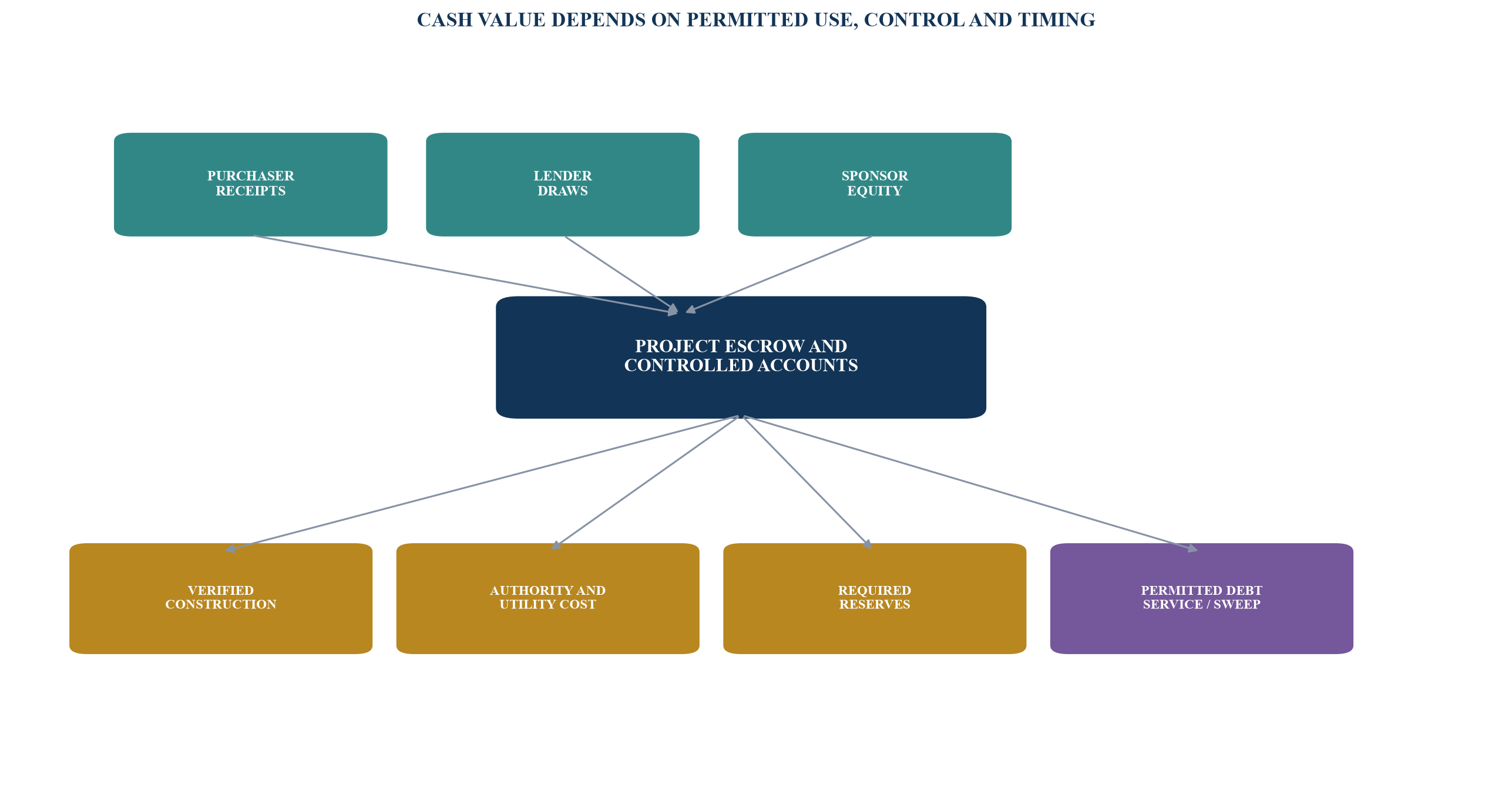
Actual permitted deposits, withdrawals, reserves and debt-service treatment depend on applicable law, authority procedures and account agreements.
Table 3. Escrow and account-control evidence matrix
| Control | Evidence | Credit question | Monitoring output |
|---|---|---|---|
| account authority | executed agreement, authority approval and bank confirmation | is the account valid for the project and governed as assumed? | account map and signatory register |
| purchaser receipt | buyer, unit, schedule, bank reference and cleared amount | does reported collection reconcile to controlled cash? | daily contract-to-cash exceptions |
| withdrawal | technical report, approved invoice, certificate and instruction | is the use permitted, verified and within budget? | draw certificate and variance report |
| reserve | legal, authority, contract and facility requirement | what cash must remain restricted? | restricted-cash schedule |
| debt service | express permitted route and waterfall | can interest or principal be paid from this cash? | available-cash calculation |
| cancellation or default | law, account agreement and authority procedure | who controls cash and how are claims ranked? | downside waterfall and counsel opinion |
The applicable authority and account trustee should confirm current requirements for the specific project.
7. Convert presales into qualifying credit evidence
Reported sales can mean reservations, signed contracts, registered off-plan transactions, gross contract value, scheduled instalments or cash collected. A lender should define one buyer-and-unit state machine and retain each state separately. A sale becomes stronger evidence as the buyer is identified, the contract is validly executed, required registration is complete, cleared cash is received into the approved account, scheduled payments remain current and a credible completion funding route exists.
The qualifying policy should state contract form, signatures, registration, arm's-length status, minimum cash at risk, refundability, payment status, buyer identity, related parties, concentration, financing contingency, completion date and approved exceptions. Commercial sales outside the policy remain visible without entering lender coverage.
Buyer payment conduct should be measured through original schedules, receipts, arrears, cures, amendments, cancellations, refunds and replacement sales. A resold unit does not erase the original cancellation. Cohort analysis by launch, broker, buyer group, nationality, payment plan, unit type and funding route can reveal common failure channels. Personal data should be governed through appropriate purpose, access and retention controls.
The final instalment deserves separate analysis. Purchasers may intend to use cash, a retail mortgage or an asset sale. Central Bank of the UAE mortgage regulations set retail borrower and loan-to-value limits, including a 50% maximum loan-to-value ratio for off-plan residential mortgages. A developer should not treat future mortgage approval as certain. The settlement register should show intended route, indicative status, equity requirement, valuation sensitivity, expiry and evidence gaps.
Presales can reduce completion risk when cash already received and reliably scheduled collections fund remaining cost. They can also create purchaser obligations and reputational exposure if completion is delayed. The credit model should therefore stress both inflows and consequences: slower new sales, payment arrears, cancellations, refunds where applicable, final-payment shortfalls and purchaser remedies.
8. Build a dynamic collateral-to-cash lending base
A dynamic lending base gives distinct recognition to assets with different conversion qualities. The pool can include eligible land value, independently verified work in place, unrestricted or specifically available controlled cash, qualifying receivables and completed unsold units. The rules should prevent duplication. Work funded by purchaser cash should not be counted simultaneously as cash and full incremental project value without a reconciled bridge.
Land recognition should use an accepted current value after prior claims, unpaid consideration, disposal cost and a liquidity haircut. Work-in-place recognition should be capped by verified cost and accepted current value, then reduced for completion deficit, contractor claims, defects and contingency. Controlled cash should be reduced by legal, authority, construction and purchaser reserves. Receivables should use the net amount after expected deductions, arrears, concentration and settlement risk. Completed inventory should reflect title, handover status, price evidence, selling cost and time.
Advance rates express conversion uncertainty and should vary by state. Current project cash subject to an authorised sweep may receive high recognition. A completed, titled and vacant unit with current comparable evidence may receive moderate recognition. Land requiring further approval or a receivable dependent on future purchaser mortgage approval warrants lower recognition or exclusion. The rates should respond to evidence rather than serve as fixed marketing assumptions.
The base is recalculated at an agreed frequency and after material events. Additions require source evidence. Collections reduce the relevant asset and flow through the waterfall. Cost increases, value declines, arrears, cancellations, delayed permits, contractor default, account restrictions and security defects create reserves or exclusions. The resulting availability is the lesser of the calculated base and every facility constraint.
Table 4. Illustrative dynamic collateral-to-cash lending base
| Asset state | Gross evidenced amount | Key deductions | Illustrative recognised base |
|---|---|---|---|
| land and project rights | AED 230m | prior claims, disposal cost, approval and liquidity haircut | AED 126m |
| verified work in place | AED 165m | unpaid contractor amounts, defects, completion reserve and overlap | AED 74m |
| controlled cash | AED 58m | restricted construction, purchaser and authority reserves | AED 21m |
| qualifying purchaser receivables | AED 190m | future performance, arrears, cancellation and concentration | AED 63m |
| completed unsold units | AED 44m | title, selling cost, price and time haircut | AED 27m |
| gross recognised collateral base | sum after deductions | AED 311m | |
| senior and prior-ranking exposure | mortgage, account and contractual priority | (AED 75m) | |
| illustrative net lending base | before other facility constraints | AED 236m |
Values and advance rates are management assumptions for demonstrating mechanics; actual eligibility and rates require approved credit and legal terms.
9. Reconcile valuation with disposal time and completion obligation
Valuation should describe the asset state that exists on the valuation date. A development property can be valued in its current incomplete condition and under a special assumption of completion, subject to the valuer's mandate and applicable standards. The lender should understand which basis supports each covenant, draw or recovery calculation.
Gross development value is the aggregate value expected after completing and selling or leasing the scheme under stated assumptions. Net realisable value deducts selling costs and other amounts. Residual value deducts remaining development cost, finance, timing and required return from completed value. Current market value reflects the interest in its actual condition. These measures serve different decisions and should not be substituted silently.
Time affects value in three ways. Revenue is delayed and discounted. Remaining cost can rise with prolongation, inflation, remobilisation and financing. The range of buyers can narrow because an acquirer must have development capacity, approvals and capital. A forced or constrained process can produce a different outcome from an orderly marketing period. The recovery analysis should use a dated sale strategy and disclose the assumed exposure period.
Comparable transactions require adjustment for location, right, planning, scale, infrastructure, stage, buyer obligations, payment terms and market date. Transaction evidence can be sparse for incomplete projects. The lender should reconcile market comparables, residual analysis and cost evidence and understand the sensitivity to the largest inputs.
The valuer, project monitor and lender model should share a controlled information set while preserving independent responsibilities. Approved plans, unit schedule, construction budget, programme, sales register, incentives, arrears, leases, title and project obligations should reconcile. Differences become explicit exceptions rather than hidden model drift.
10. Stress sales velocity, price, cost and time together
Sales velocity is the number or value of units contracted and converted into cash over time. A base case based on recent launch activity can overstate sustained performance. Early sales may reflect pent-up demand, incentives, preferred inventory or concentrated channels. The model should use cohorts and distinguish reservation, binding contract, registered sale, cash collection and settlement.
A useful stress combines four variables. New sales slow. Achieved net price declines after incentives and commissions. Existing purchasers pay later or cancel. Completion cost and time increase. The interaction matters. Slower sales reduces cash for construction; construction delay weakens buyer conduct; weaker conduct increases funding need; funding pressure can further delay completion.
The model should show monthly available cash, minimum construction expenditure, interest, reserve requirements, covenant headroom and the earliest funding deficit. A stress that reduces revenue while leaving sales commission, finance cost, contractor claims and completion timing unchanged is incomplete. A severe case should state management actions and the evidence required to execute them.
Management levers can include additional sponsor equity, lower discretionary expenditure, repriced inventory, bulk sale, construction resequencing, contractor settlement, approved refinancing and asset sale. Each lever has lead time, authority, documentation, value effect and execution risk. The credit decision should recognise only actions that are available within the relevant window.
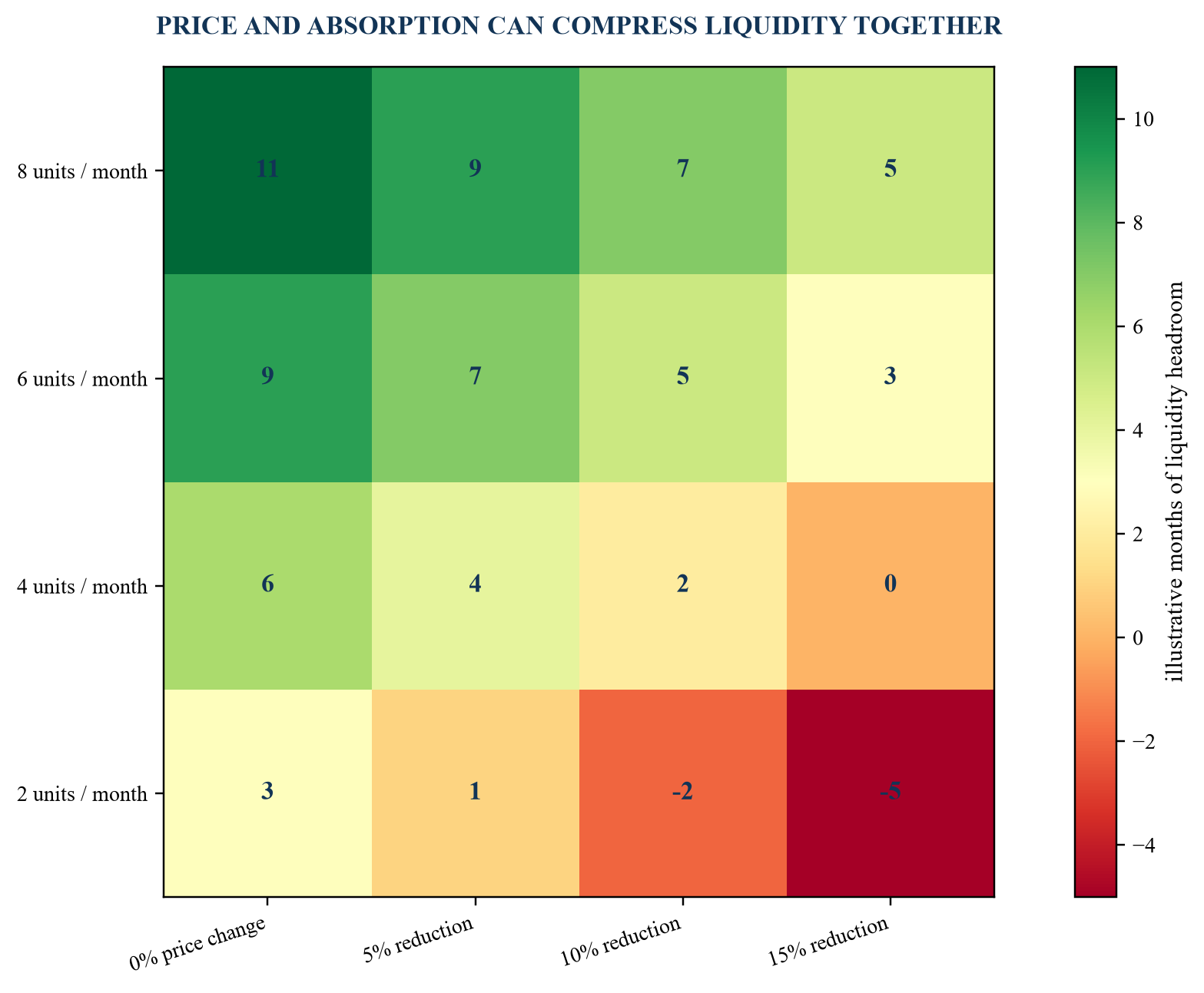
Values are management assumptions showing months of liquidity headroom after combined sales and price stress; they are not forecasts.
11. Design the security package around conversion dependencies
A real-estate development security package should match the repayment routes and the jurisdiction. A land mortgage may be central, but it does not by itself control contracts, accounts, insurance, shares, development rights or the operational decisions needed to finish and sell. The structure should identify every asset and right required to preserve value.
The security map can include mortgage or registered security over the property right, share security over the project company, assignment of development, construction, consultancy, insurance, sale and material supply contracts, security over movable assets, control of relevant accounts, assignment of receivables and insurance proceeds, sponsor subordination, completion support, powers of attorney where valid, and direct agreements containing notice, cure and step-in rights.
Perfection and priority are separate workstreams. The file should state the signing requirement, registration or notice, authority consent, account-bank acknowledgement, existing creditor release, intercreditor terms, recurring renewal and evidence of completion. A closing checklist should not mark a security item complete merely because a draft exists.
Purchaser and escrow rights require particular care. The lender should not assume that project cash can be swept or that purchaser claims rank behind the facility. The applicable law, account agreement and counsel advice determine the permitted treatment. The downside model should show restricted cash and claims separately from lender-controlled recoveries.
Insurance should be linked to the project and security. Construction all-risk, third-party liability, professional indemnity, property, delay and other cover depend on scope and transaction. The lender should verify insured parties, loss payee or assignment arrangements where applicable, limits, deductibles, exclusions, expiry, premium payment and claim procedures.
Table 5. Security and conversion dependency map
| Recovery asset | Supporting control | Conversion dependency | Required closing evidence |
|---|---|---|---|
| land or registered development right | mortgage or registered charge | valid right, priority, consent and saleability | official registration and priority confirmation |
| project company | share security and governance controls | transfer restrictions, licences and continuing authority | perfected share security and agreed reserved matters |
| project contracts | assignment and direct agreement | counterparty notice, cure, step-in and replacement | acknowledgements and enforceability advice |
| project cash | account control and waterfall | escrow law, bank process and permitted uses | executed account documents and tested instructions |
| purchaser receivables | assignment or recognised security | contract, registration, set-off, cancellation and privacy | eligible register and legal analysis |
| insurance proceeds | assignment, endorsement or loss-payee arrangement | insured event, reinstatement decision and claims process | policy review and insurer acknowledgement |
Security availability, creation, priority and enforcement are jurisdiction- and transaction-specific.
12. Build downside execution before the first draw
Downside planning is an operating plan rather than a paragraph stating that the lender can enforce. The plan begins with trigger recognition and stabilisation. It identifies who can access the site, keep insurance active, pay security, retain the project team, protect purchasers, preserve permits, control accounts and appoint replacement contractors or developers.
The first decision is often whether to complete, sell as-is, restructure, refinance or combine those paths. Completion can protect value when remaining cost is modest, demand persists and control is obtainable. It can destroy value when cost, authority or market assumptions are weak. An as-is sale avoids further construction exposure but can attract a narrow buyer pool and a large discount. The lender should predefine the evidence and decision authority for each route.
The enforcement timetable should include contractual notices, cure periods, security enforcement, registry or authority steps, project and developer approvals, account control, contractor replacement, purchaser communications, valuation, sales process and distribution. These actions may run in parallel or depend on one another. Counsel, project monitor, broker and restructuring adviser should agree the critical path.
A funded stabilisation reserve is essential. Insurance, site security, utilities, consultants, payroll, critical contractors, authority fees and legal cost continue during transition. An enforcement right without liquidity can allow the asset to deteriorate. The reserve should be sized under a dated plan and accessible through documented controls.
Recovery should be calculated as cash after prior claims, remaining cost, stabilisation, tax, selling expense, professional fees and elapsed interest. The model should show a range rather than a single point and identify the assumptions most capable of changing the result.
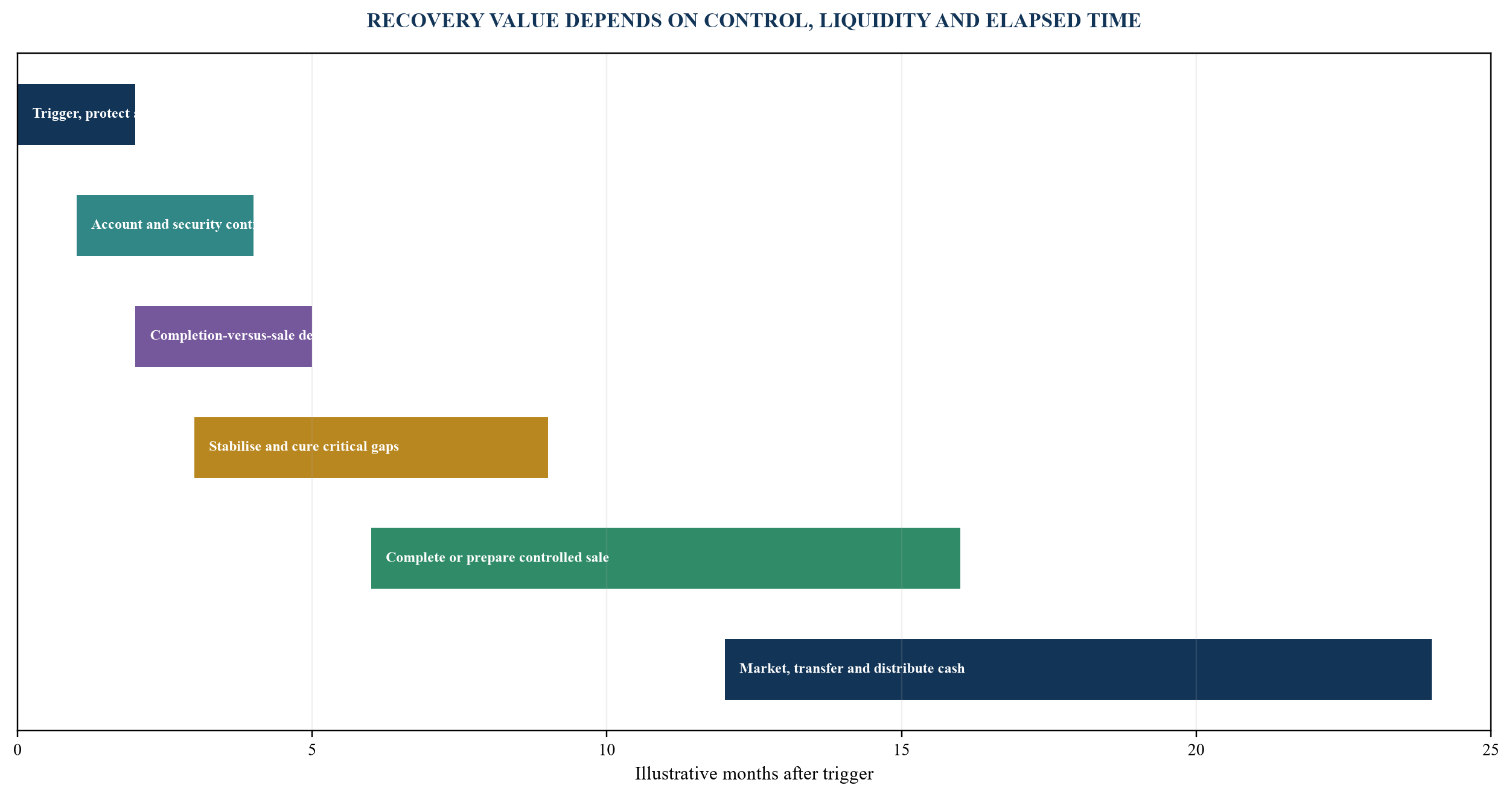
Timing is conceptual; actual enforcement, authority, project and sale procedures require current transaction-specific advice.
13. Use covenants as an early-warning system
Covenants should detect deterioration while management and lenders retain options. Financial covenants can include maximum loan-to-cost, loan-to-value and net leverage; minimum liquidity, interest reserve, cost-to-complete headroom and equity; and limits on distributions, additional debt, related-party payments and asset disposals. Project covenants can cover approvals, progress, sales, collections, contractor status, insurance and security.
The most useful tests are connected. The cost-to-complete covenant compares unrestricted committed sources with remaining cost and contingency. The lending-base covenant adjusts recognition as asset states change. The sales covenant measures qualifying contracts, net receipts, arrears, cancellations and concentration. The progress covenant measures certified physical work and critical-path variance. The liquidity covenant measures the lowest weekly cash point.
Thresholds should create a ladder. An early-warning level increases reporting and requires a cure plan. A cash-control level blocks distributions or reduces availability. A draw-stop level protects remaining commitments. A default level enables agreed remedies. Sudden binary testing can give the lender information too late and create avoidable negotiation.
Cure rights need funding substance. A sponsor equity cure should be paid as cash or another approved form and should not mask repeated operating weakness. A value-based cure should be treated cautiously because valuation can change without adding liquidity. Every cure should update cost-to-complete, cash, covenant and recovery models.
Reporting should specify definitions, source systems, sign-off, due dates and supporting evidence. The lender should receive a monthly package and immediate notice of material events. A dashboard without source reconciliation is insufficient. The package should preserve opening balance, movements and closing balance for every major schedule.
14. Establish a single project evidence room
The evidence room should follow the conversion chain. It begins with corporate authority, property rights, approvals and security. It continues through budget, contracts, progress, sales, escrow, finance, insurance, disputes, tax and exit. Each document should have a stable name, date, version, owner and status.
The core registers are interconnected: land and rights, conditions and permits, development budget, contracts and commitments, draw and progress, variations and claims, units and prices, purchasers and payment schedules, escrow receipts and withdrawals, facilities and security, insurance, covenants and exceptions. Stable identifiers link plot, phase, unit, buyer, contract, receipt, invoice and draw.
Evidence hierarchy should be explicit. Official registry records, executed agreements, bank statements, authority approvals and independent certificates rank above internal forecasts. Forecasts remain necessary and should state owner, preparation date, assumptions and next validation event. Verbal expectations should appear only as actions, not as verified asset value.
Access should be role-based. Purchaser and personal data require controlled use. Lenders and advisers should receive the information required for diligence under appropriate confidentiality and data arrangements. A complete audit trail preserves changes and supports later covenant and enforcement decisions.
The evidence room should be tested through reconciliation rather than file count. The unit schedule should equal approved inventory. Contracted sales should reconcile to buyer contracts and required registration. Receipts should reconcile to bank and escrow. Costs should reconcile to contracts, certificates and ledger. Security should reconcile to official registrations and acknowledgements.
15. Price the facility for capital, work and optionality
Facility economics include more than the coupon. The borrower may pay arrangement, commitment, monitoring, valuation, legal, account, agency, exit and prepayment amounts. The lender may reserve capital for funded and undrawn commitments and bear the operational cost of progress, escrow, sales and collateral monitoring. Pricing should correspond to risk, work and duration.
Draw mechanics affect effective cost. A committed delayed-draw facility can protect completion while charging commitment fees. A borrowing-base facility can match exposure to eligible assets but requires frequent reporting. A term facility offers certainty and can increase negative carry. An interest reserve protects timing but adds debt unless separately funded.
Prepayment design should reflect the expected repayment path. Unit-release prices and mandatory sweeps can amortise the facility as sales settle. A minimum return or make-whole can compensate the lender for early repayment, while excessive friction can impede refinancing or asset sales that improve credit. The agreement should state permitted disposals, release conditions, application of proceeds and clean-down tests.
The borrower should model all-in cost under base, faster and slower cases. Delay increases interest, commitment cost, monitoring and professional fees. A lower headline rate with weak draw certainty can be more expensive if it causes construction interruption. Execution certainty should be assessed through approved commitment, conditions precedent, funding mechanics and lender capacity.
The lender should price uncommitted future support separately from the base facility. Completion overruns, guarantee needs and purchaser refunds cannot be assumed to receive new capital. The closing structure should either fund realistic downside needs, allocate them to an evidenced sponsor source or state the consequence if they occur.
16. Run a ten-day collateral-to-cash diagnostic
A ten-day diagnostic can establish whether the proposed financing case is ready for full underwriting. Days one and two confirm the borrower, project entities, property rights, authority status, existing debt and requested use. Days three and four reconcile the development budget, paid cost, commitments, progress and remaining cost. Days five and six reconcile units, contracts, registrations, buyer receipts and escrow.
Days seven and eight build the lending base, loan-to-cost and loan-to-value bridge, liquidity forecast and combined stress. Day nine maps security, prior claims, account control, enforcement dependencies and required opinions. Day ten presents the decision, information gaps, proposed structure, conditions, monitoring plan and 100-day execution path.
The diagnostic requires a controlled minimum dataset. Property and corporate records, project and design approvals, development agreement, budget, construction contracts, project-monitor reports, unit schedule, sales register, purchaser ageing, escrow statements, facility documents, security records, valuation, insurance and disputes should be provided in current form. Missing items remain visible as gaps.
The output is a decision matrix rather than a promotional memorandum. Green items have verified evidence and an acceptable position. Amber items have a defined resolution, owner, date and conservative interim treatment. Red items block funding or asset recognition. The committee should see the effect of every amber and red item on availability and recovery.
The diagnostic can support three outcomes. Proceed to term sheet and diligence where conversion gates are credible. Proceed only after specified evidence or equity where the gap is curable. Decline or redesign where authority, completion funding or downside control is not credible. This disciplined early decision can save professional cost and management time.
17. Implement the financing through a 100-day control plan
The first twenty days establish ownership and data. The sponsor appoints finance, project, legal, sales and treasury owners. The team freezes definitions, reconciles opening registers and resolves entity, land, budget, unit and account differences. Advisers receive a controlled evidence pack and an agreed question log.
Days twenty-one to forty-five complete independent work. Legal advisers confirm rights, approvals, security and enforcement. The project monitor tests progress and cost-to-complete. The valuer examines current and completed bases and sensitivity. Tax and accounting advisers address relevant treatment. The lender tests the borrowing base, stress, liquidity and sponsor capacity.
Days forty-six to seventy negotiate the documents and close conditions. Facility amount, purpose, draw, equity, interest reserve, accounts, security, representations, covenants, information, cash sweeps, unit releases, defaults and cures are aligned with the models. Direct agreements, consents, acknowledgements and authority processes move on a tracked critical path.
Days seventy-one to ninety complete perfection, account testing and operational rehearsal. The team tests a sample draw from request through independent certification, approval, account instruction and contractor receipt. It tests purchaser cash reconciliation, a unit release and the monthly reporting pack. Exceptions are cured before significant funding.
Days ninety-one to one hundred transfer the process into business-as-usual governance. Weekly liquidity and exceptions continue. Monthly reporting includes cost, progress, sales, cash, collateral, security and covenant movements. Quarterly review refreshes valuation inputs, stress cases and downside decisions. Material events trigger immediate reporting.
Table 6. One-hundred-day financing and control plan
| Period | Principal work | Evidence gate | Board or credit decision |
|---|---|---|---|
| days 1 to 20 | definitions, owners, data room and opening reconciliations | one controlled project dataset | approve diligence scope and critical blockers |
| days 21 to 45 | legal, technical, valuation, tax and credit diligence | verified conversion assumptions and gaps | confirm structure, reserves and conditions |
| days 46 to 70 | facility, security, accounts, consents and intercreditor terms | executable document suite | approve final economics and risk allocation |
| days 71 to 90 | perfection, account testing, sample draw and reporting rehearsal | operational controls work end to end | authorise initial utilisation |
| days 91 to 100 | governance handover and monitoring calendar | signed responsibilities and reporting baseline | move to controlled operating phase |
Timing should be adapted to project stage, transaction complexity, authority procedures and lender requirements.
18. Conclusion
Private credit for GCC real estate should be sized from evidenced conversion rather than aggregate collateral. Land, construction progress, presales, escrow cash and completed units contribute to repayment in different ways and on different timelines. Their value to a lender depends on authority, remaining cost, control, buyer behaviour, marketability, priority and execution.
The six-gate test creates a practical discipline. Legal and project authority establishes the asset that exists. A funded cost-to-complete protects completion. Escrow and account mapping identifies cash that can be used. Presale analysis separates reported demand from qualifying evidence. Valuation and sales-velocity stress make time and price visible. Downside planning converts security rights into an operating recovery route.
The resulting facility is dynamic. Availability changes as permits are obtained, equity is invested, work is verified, purchaser cash is received, units settle, costs move and risk is retired. Covenants and reporting detect deterioration early. The lender and sponsor share a reconciled view of the project while retaining distinct responsibilities.
The central committee question is concise: after every prior claim, remaining cost, restriction, haircut, selling expense and month of delay, how much cash can reach the lender and what evidence supports that conclusion? A financing case that answers this question asset by asset is positioned for disciplined execution. A case that depends primarily on headline gross development value remains exposed to the very conversion risks the facility is intended to bridge.
References
- Dubai Land Department. Law No. 8 of 2007 Concerning Escrow Accounts for Real Estate Development in the Emirate of Dubai. https://dubailand.gov.ae/media/x0bf21ii/book.pdf
- Dubai Land Department. Frequently Asked Questions: real-estate escrow accounts and project liquidation. https://dubailand.gov.ae/en/frequently-asked-questions/
- Dubai Land Department. Register Project service. https://dubailand.gov.ae/en/eservices/register-project/
- Dubai Land Department. Request to Activate an Escrow Account. https://dubailand.gov.ae/en/eservices/request-to-activate-an-escrow-account/
- Dubai Land Department. Project Cancellation Upon Request. https://dubailand.gov.ae/en/eservices/request-for-real-estate-project-cancellation/
- Dubai Land Department. Bank Guarantees Cancellation. https://dubailand.gov.ae/en/eservices/request-for-bank-guarantee-cancellation/
- Abu Dhabi Real Estate Centre. Project Development. https://adrec.gov.ae/en/sectors/regulatory-services/project-development
- Abu Dhabi Real Estate Centre. Developer Journey. https://adrec.gov.ae/en/sectors/regulatory-services/project-development/developer-journey
- Abu Dhabi Real Estate Centre. Real Estate Legislations: Project Escrow Account Management. https://adrec.gov.ae/-/media/E1BA75E6AF36479393BE8CD3EC653D3A.ashx
- Abu Dhabi Real Estate Centre. Real Estate Legislations: Creating the Project Escrow Account. https://adrec.gov.ae/-/media/4844AFD706FC4D978777FF1A76FB6278.ashx
- Real Estate General Authority, Saudi Arabia. Law of Selling and Leasing Off-Plan Real Estate Projects. https://rega.gov.sa/en/laws-and-decisions/regulations-and-by-laws/rules/law-of-selling-and-leasing-off-plan-real-estate-projects/
- Real Estate General Authority, Saudi Arabia. Implementing Regulations of the Off-Plan Sale and Lease of Real Estate Projects Law. https://rega.gov.sa/en/laws-and-decisions/regulations-and-by-laws/regulations/implementing-regulations-of-the-off-plan-sale-and-lease-of-real-estate-projects-law/
- Real Estate General Authority, Saudi Arabia. Wafi Off-Plan Sales and Lease. https://rega.gov.sa/en/rega-services/platforms/wafi-off-plan-sales-and-lease/
- Real Estate General Authority, Saudi Arabia. Procedural Manual for Sale and Lease of Off-Plan Real Estate Projects. https://rega.gov.sa/en/laws-and-decisions/regulations-and-by-laws/guidelines/procedural-manual-for-sale-and-lease-of-off-plan-real-estate-projects/
- Central Bank of the UAE. Regulations Regarding Mortgage Loans. https://rulebook.centralbank.ae/en/rulebook/regulations-regarding-mortgage-loans
- Central Bank of the UAE. Financial Stability Report 2025, published 17 August 2026. https://www.centralbank.ae/media/i5gma2bm/financial-stability-report-en-2025.pdf
- Central Bank of the UAE. Guidance Re Capital Adequacy Standards: Real Estate. https://www.centralbank.ae/media/2kel2drc/cbuaebsd-2022-guidance-re-capital-adequacy.pdf
- International Valuation Standards Council. International Valuation Standards, including IVS 410 Development Property. https://ivsc.org/standards/
